
Optimal Structure-Preserving Signatures in


Description: Optimal Structure-Preserving Signatures in Asymmetric Bilinear Groups Masayuki Abe, NTT Jens Groth, University College London Kristiyan Haralambiev, NYU Miyako Ohkubo, NICT Mathematical structures in cryptography Cyclic prime order group G
Related Topics
Download Presentation
"Optimal Structure-Preserving Signatures in" is the property of its rightful owner. Permission is granted to download and print the materials on this website for personal, non-commercial use only, and to display it on your personal computer provided you do not modify the materials and that you retain all copyright notices contained in the materials. By downloading content from our website, you accept the terms of this agreement.
Presentation Transcript
slide1. Optimal Structure-Preserving Signatures in Asymmetric Bilinear Groups Masayuki Abe, NTT
Jens Groth, University College London
Kristiyan Haralambiev, NYU
Miyako Ohkubo, NICT<br>
slide2. Mathematical structures in cryptography Cyclic prime order group G
Useful mathematical structure
ElGamal encryption
Pedersen commitments
Schnorr proofs
…<br>
slide3. Pairing-based cryptography Groups G, H, T with bilinear map e: GHT
Additional mathematical structure
Identity-based encryption
Short digital signatures
Non-interactive zero-knowledge proofs
…<br>
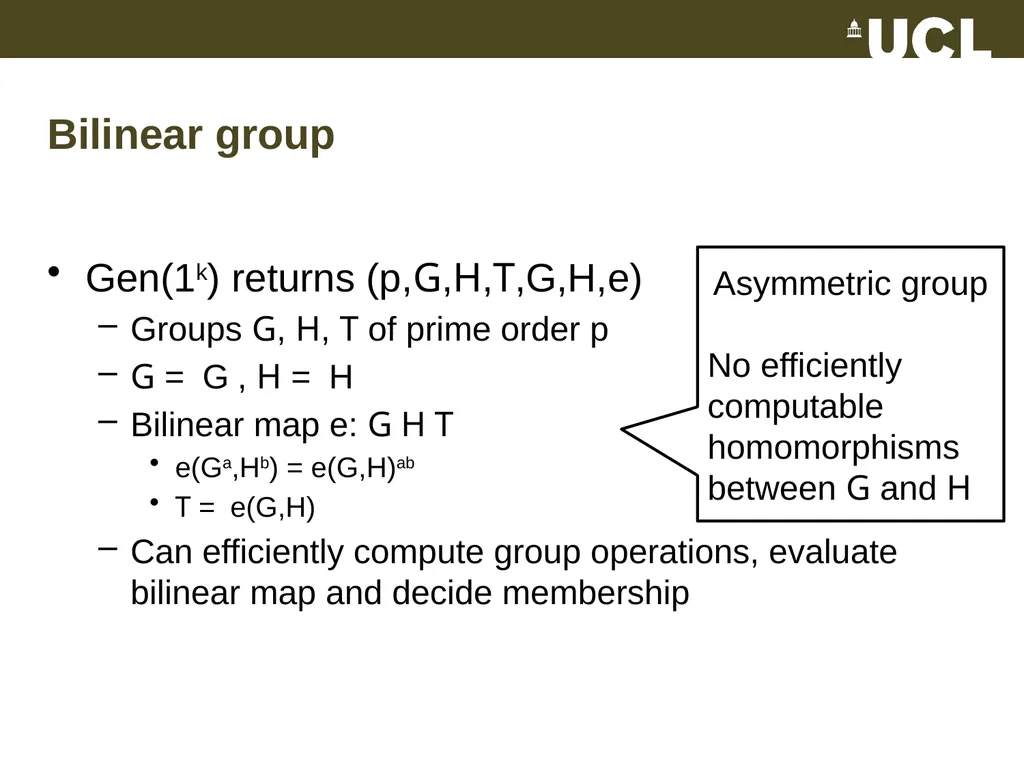
slide4. Bilinear group Gen(1k) returns (p,G,H,T,G,H,e)
Groups G, H, T of prime order p
G = G, H = H
Bilinear map e: GHT
e(Ga,Hb) = e(G,H)ab
T = e(G,H)
Can efficiently compute group operations, evaluate bilinear map and decide membership Asymmetric group
No efficiently computable homomorphisms between G and H<br>
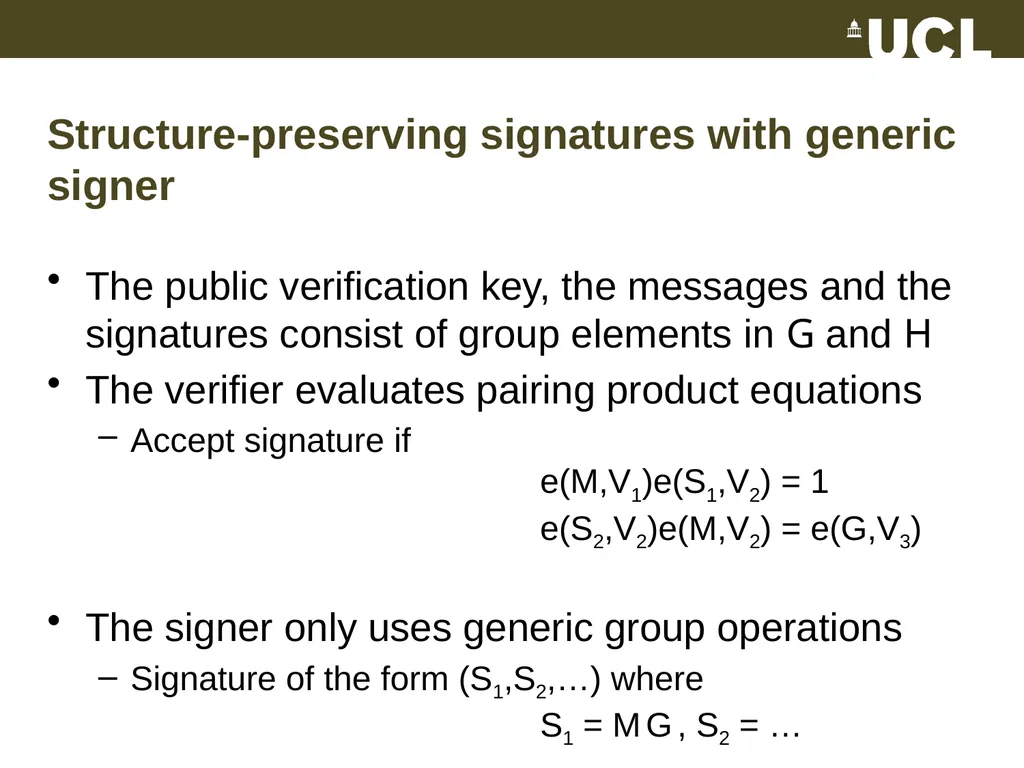
slide5. Structure-preserving signatures with generic signer The public verification key, the messages and the signatures consist of group elements in G and H
The verifier evaluates pairing product equations
Accept signature if e(M,V1)e(S1,V2) = 1 e(S2,V2)e(M,V2) = e(G,V3)
The signer only uses generic group operations
Signature of the form (S1,S2,…) where S1 = MG, S2 = …<br>
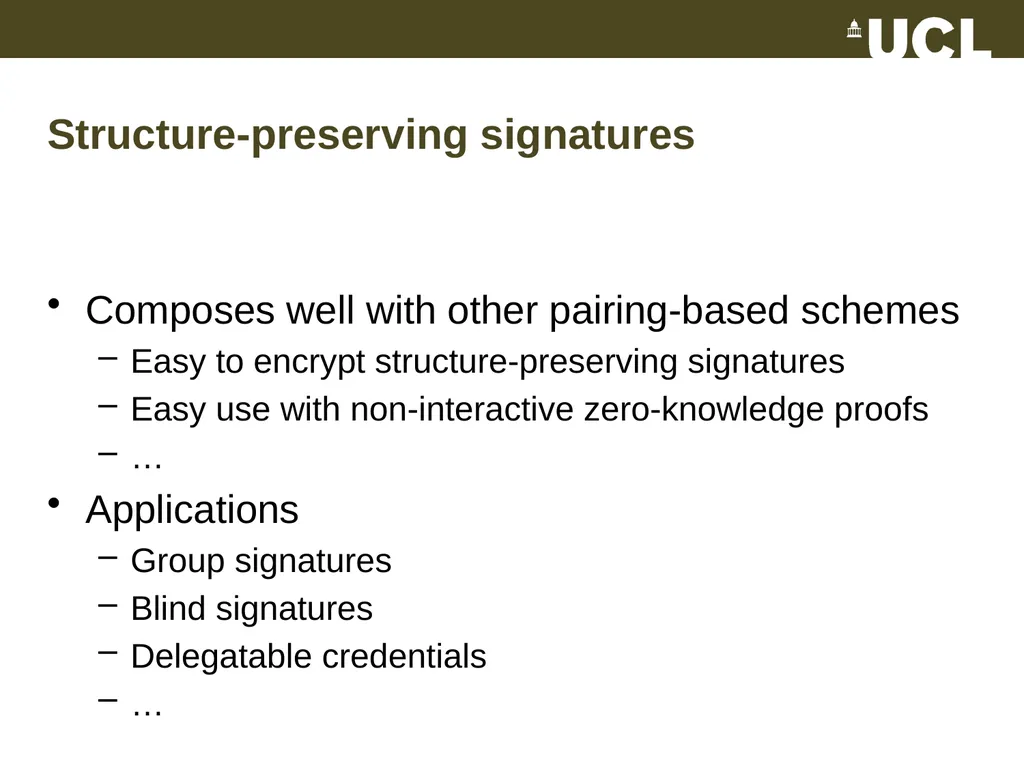
slide6. Structure-preserving signatures Composes well with other pairing-based schemes
Easy to encrypt structure-preserving signatures
Easy use with non-interactive zero-knowledge proofs
…
Applications
Group signatures
Blind signatures
Delegatable credentials
…<br>
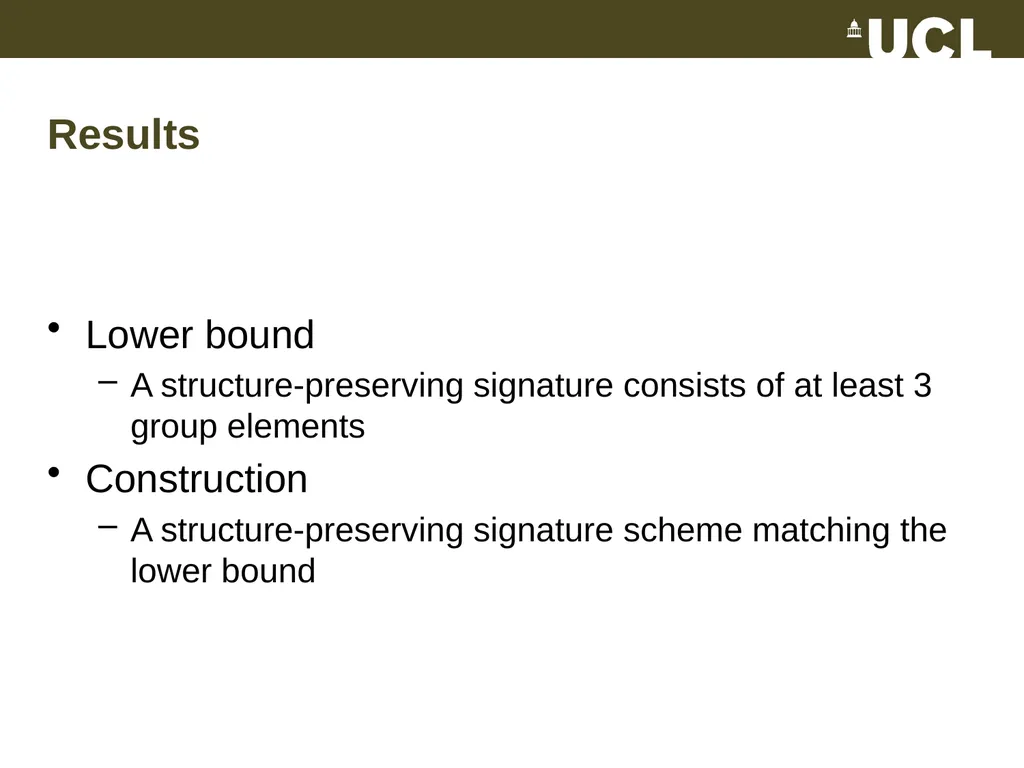
slide7. Results Lower bound
A structure-preserving signature consists of at least 3 group elements
Construction
A structure-preserving signature scheme matching the lower bound<br>
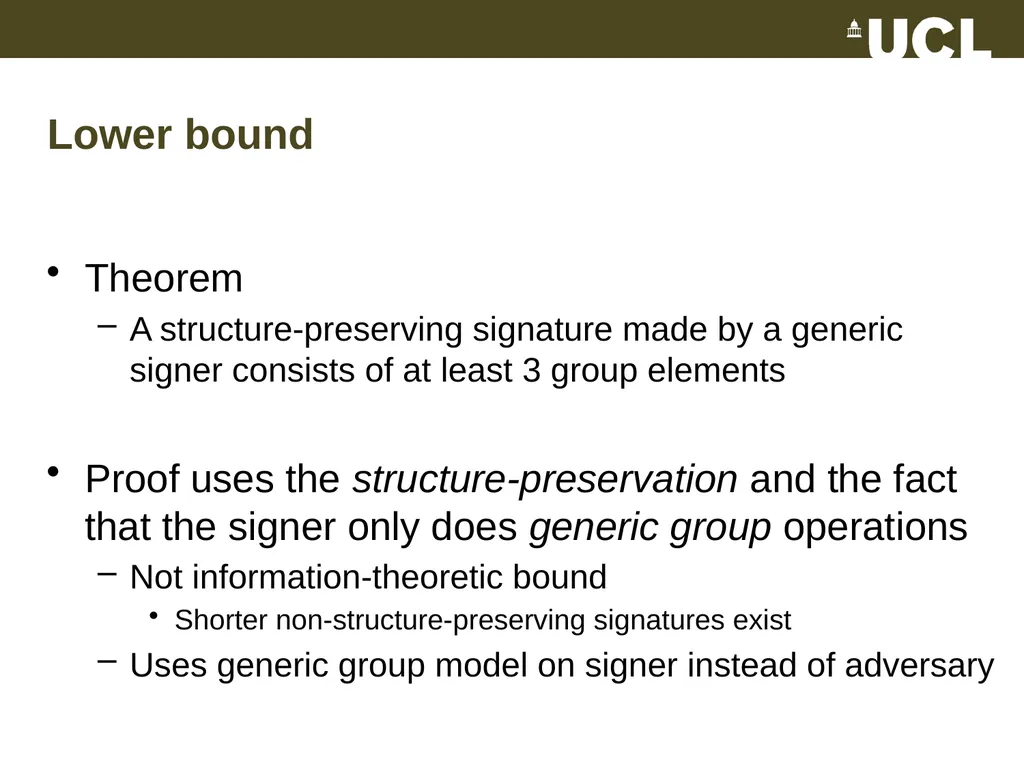
slide8. Lower bound Theorem
A structure-preserving signature made by a generic signer consists of at least 3 group elements
Proof uses the structure-preservation and the fact that the signer only does generic group operations
Not information-theoretic bound
Shorter non-structure-preserving signatures exist
Uses generic group model on signer instead of adversary<br>
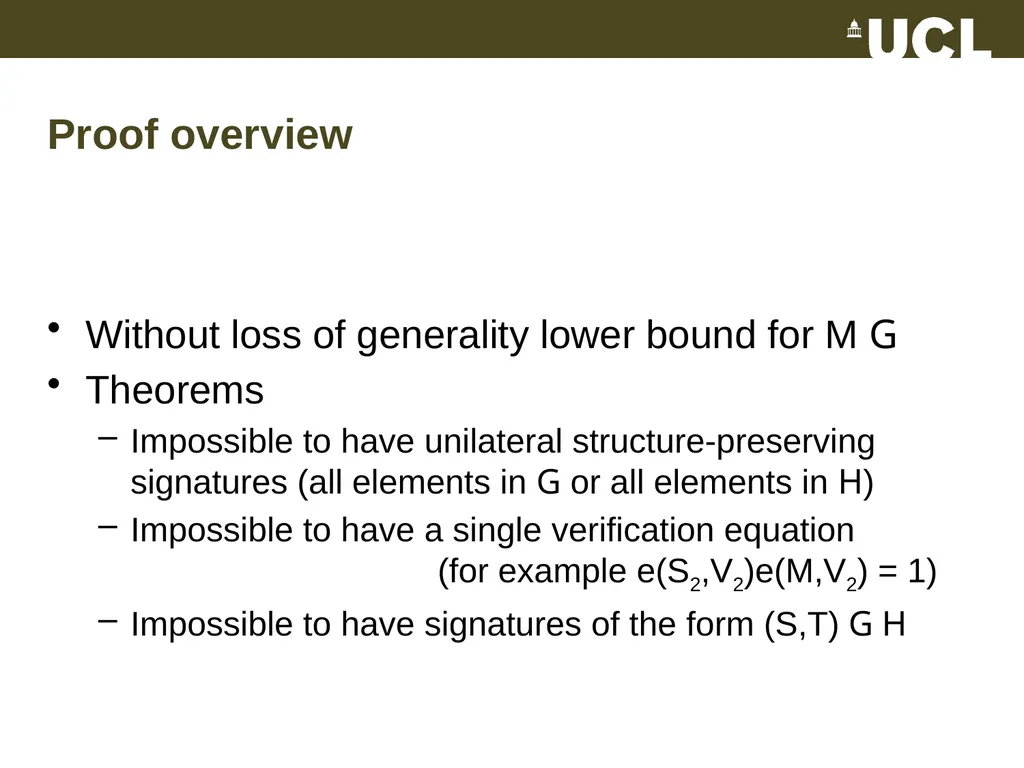
slide9. Proof overview Without loss of generality lower bound for MG
Theorems
Impossible to have unilateral structure-preserving signatures (all elements in G or all elements in H)
Impossible to have a single verification equation (for example e(S2,V2)e(M,V2) = 1)
Impossible to have signatures of the form (S,T)GH<br>
slide10. Unilateral signatures are impossible A similar argument shows there are no unilateral signatures (S1,S2,…,Sk) Gk<br>
slide11. Unilateral signatures are impossible Case II
There is no single element signature TH for MG
Proof
A generic signer wlog computes T = Ht where t is chosen independently of M
Since T is independent of M either the signature scheme is not correct or the signature is valid for any choice of M and therefore easily forgeable A similar argument shows there are no unilateral signatures (T1,T2,…,Tk) Hk<br>
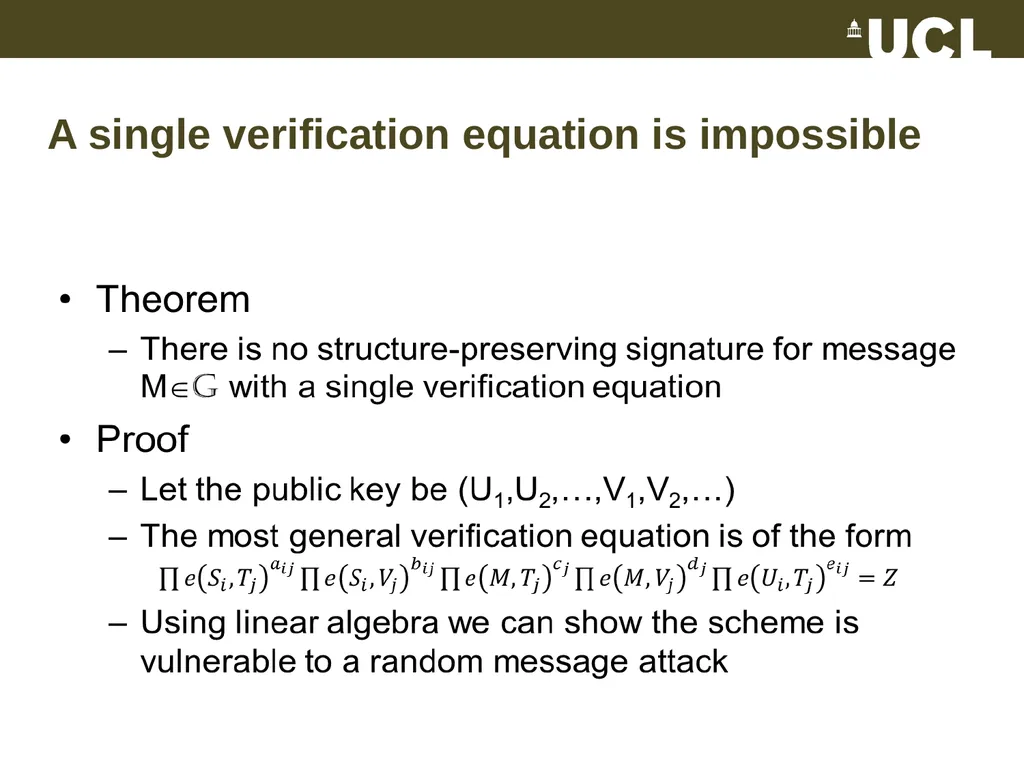
slide12. A single verification equation is impossible<br>
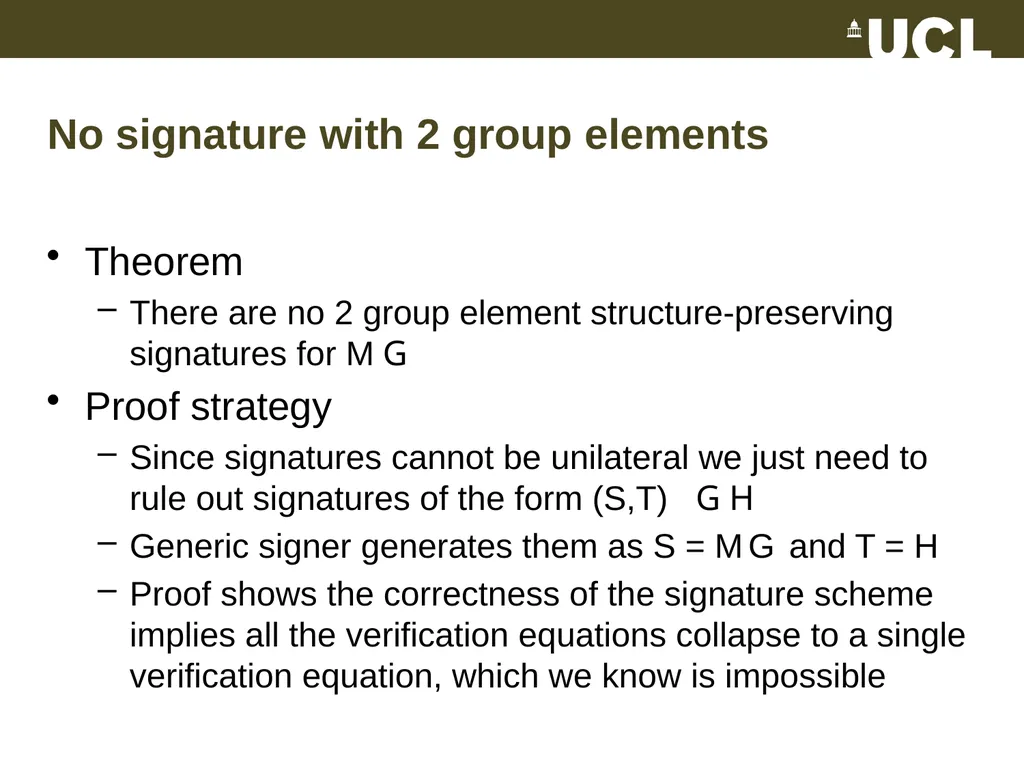
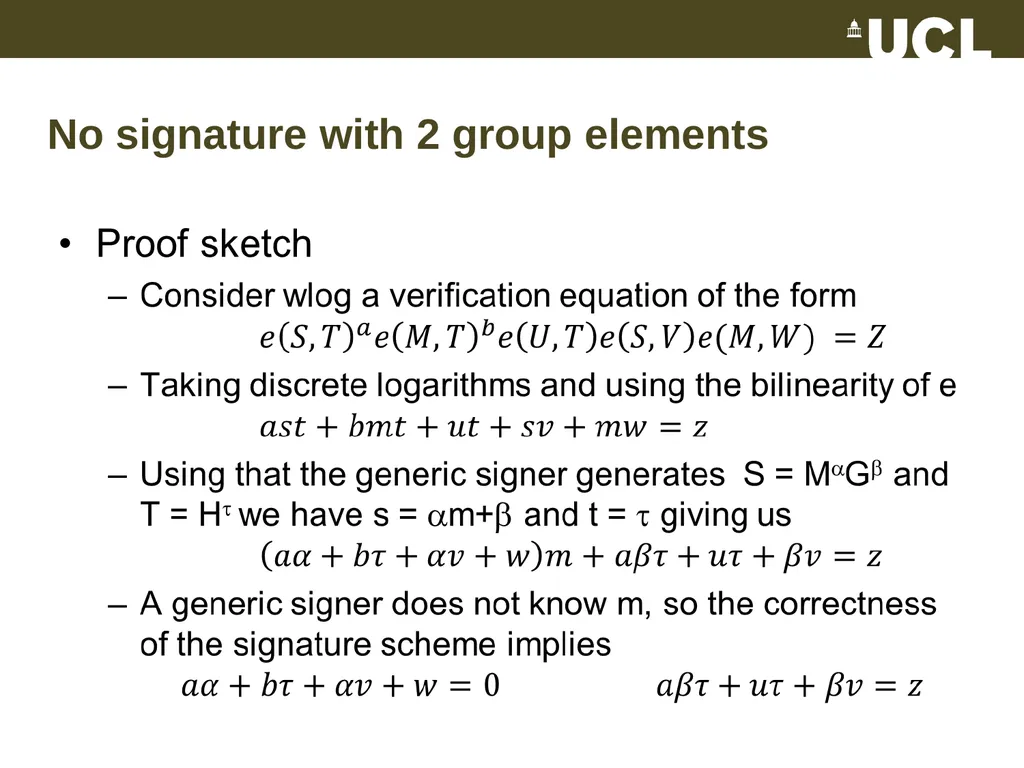
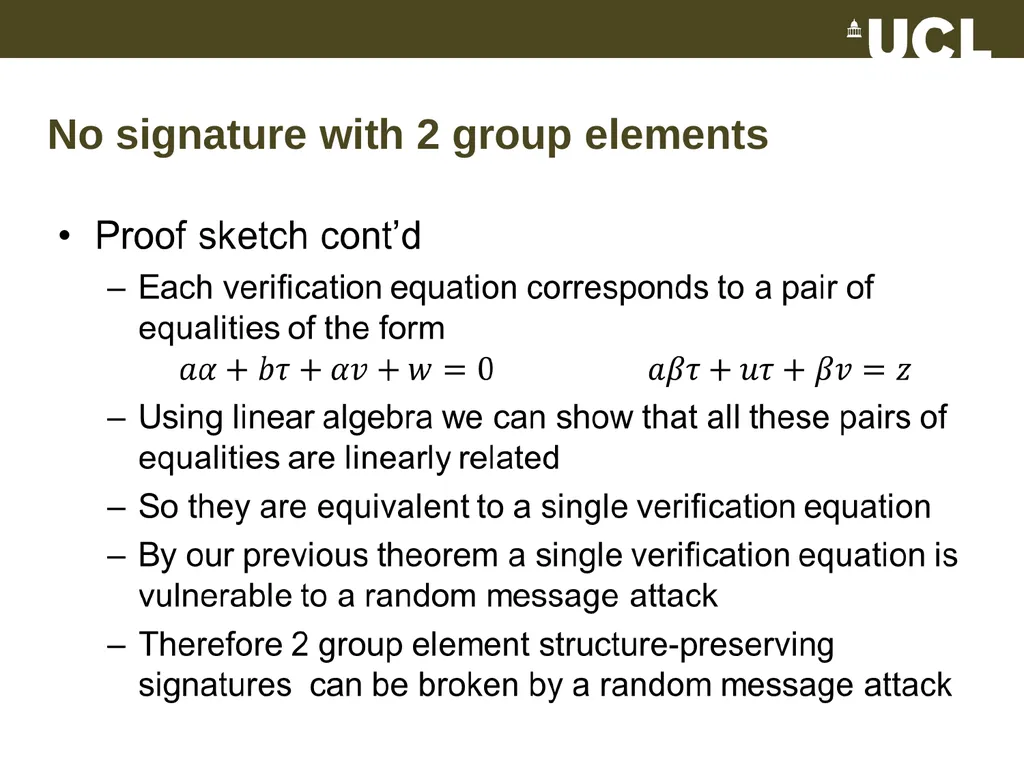
slide13. No signature with 2 group elements Theorem
There are no 2 group element structure-preserving signatures for MG
Proof strategy
Since signatures cannot be unilateral we just need to rule out signatures of the form (S,T) GH
Generic signer generates them as S = MG and T = H
Proof shows the correctness of the signature scheme implies all the verification equations collapse to a single verification equation, which we know is impossible<br>
slide14. No signature with 2 group elements<br>
slide15. No signature with 2 group elements<br>
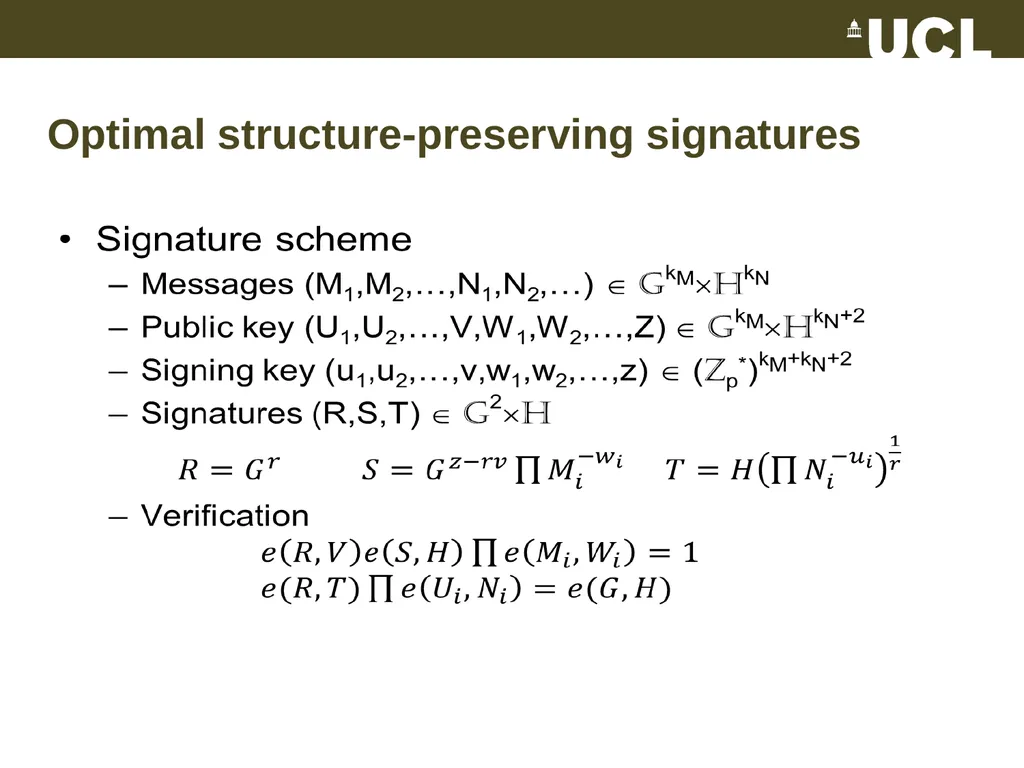
slide16. Optimal structure-preserving signatures<br>
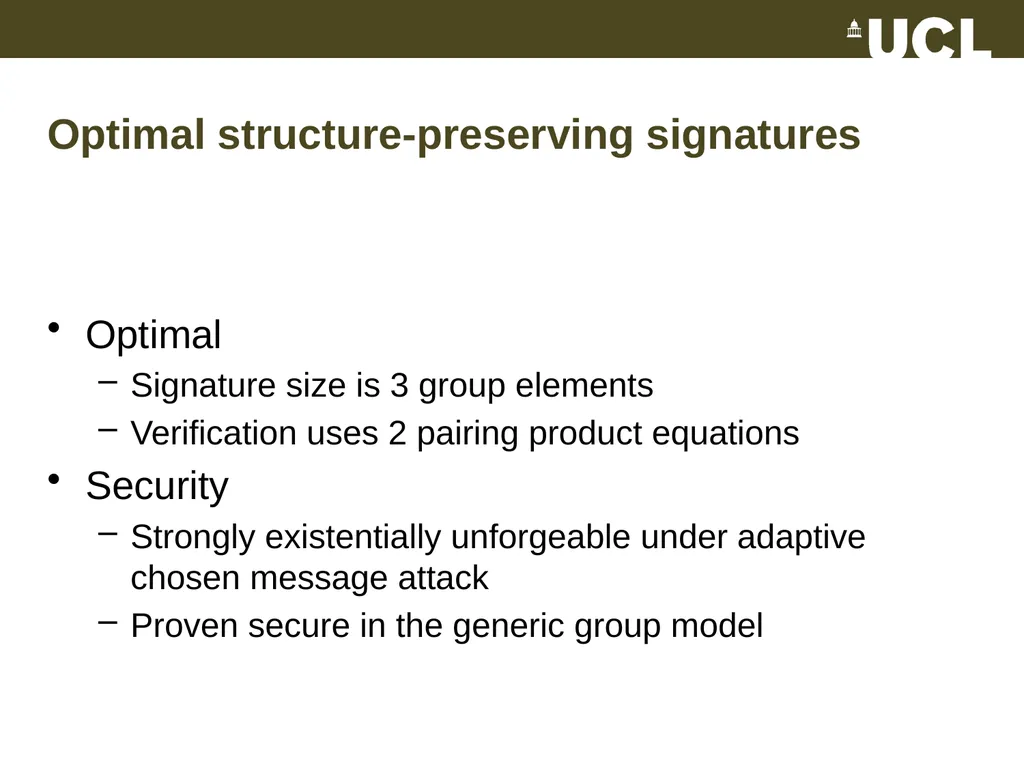
slide17. Optimal structure-preserving signatures Optimal
Signature size is 3 group elements
Verification uses 2 pairing product equations
Security
Strongly existentially unforgeable under adaptive chosen message attack
Proven secure in the generic group model<br>
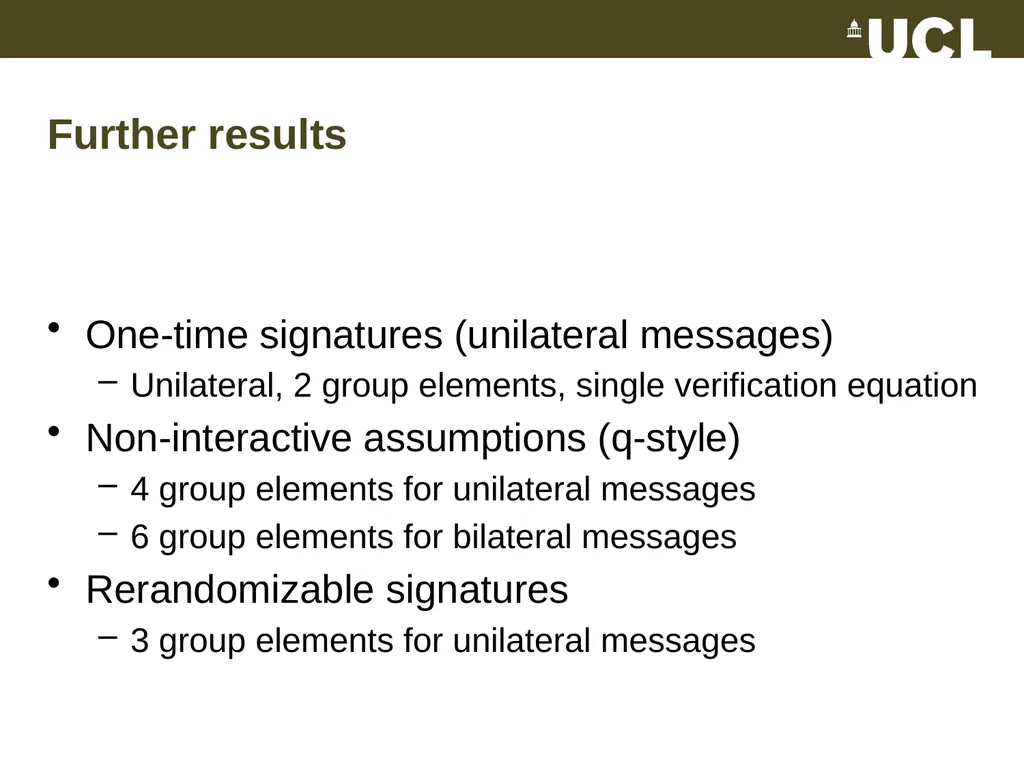
slide18. Further results One-time signatures (unilateral messages)
Unilateral, 2 group elements, single verification equation
Non-interactive assumptions (q-style)
4 group elements for unilateral messages
6 group elements for bilateral messages
Rerandomizable signatures
3 group elements for unilateral messages<br>
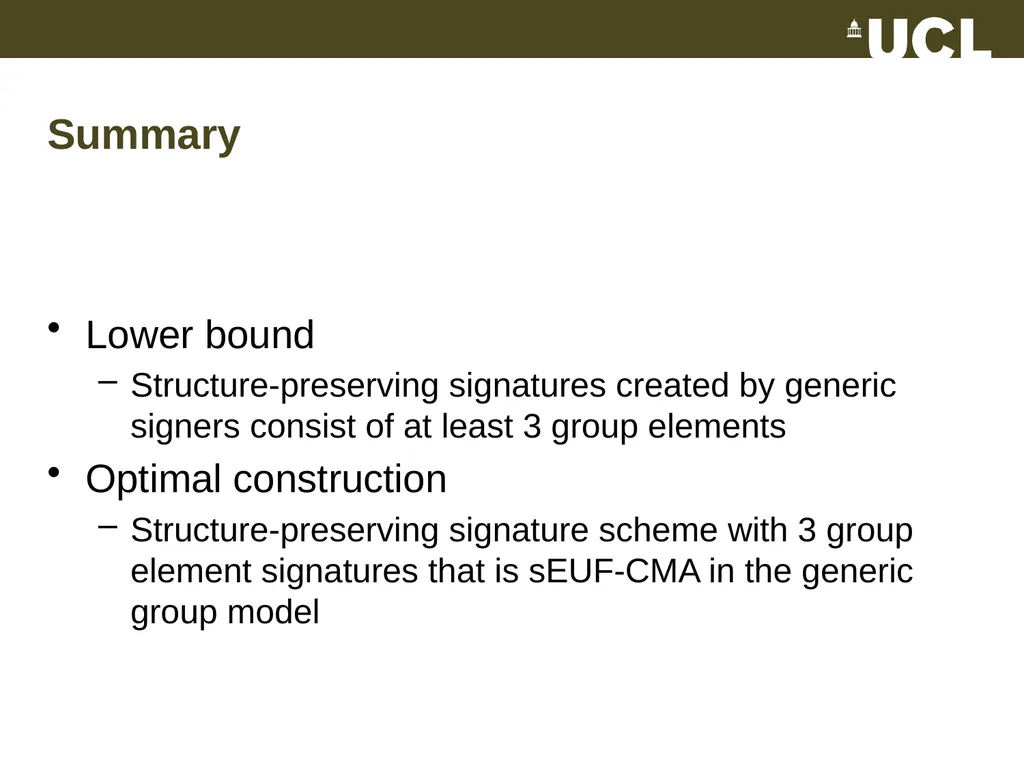
slide19. Summary Lower bound
Structure-preserving signatures created by generic signers consist of at least 3 group elements
Optimal construction
Structure-preserving signature scheme with 3 group element signatures that is sEUF-CMA in the generic group model<br>
Jens Groth, University College London
Kristiyan Haralambiev, NYU
Miyako Ohkubo, NICT<br>
slide2. Mathematical structures in cryptography Cyclic prime order group G
Useful mathematical structure
ElGamal encryption
Pedersen commitments
Schnorr proofs
…<br>
slide3. Pairing-based cryptography Groups G, H, T with bilinear map e: GHT
Additional mathematical structure
Identity-based encryption
Short digital signatures
Non-interactive zero-knowledge proofs
…<br>
slide4. Bilinear group Gen(1k) returns (p,G,H,T,G,H,e)
Groups G, H, T of prime order p
G = G, H = H
Bilinear map e: GHT
e(Ga,Hb) = e(G,H)ab
T = e(G,H)
Can efficiently compute group operations, evaluate bilinear map and decide membership Asymmetric group
No efficiently computable homomorphisms between G and H<br>
slide5. Structure-preserving signatures with generic signer The public verification key, the messages and the signatures consist of group elements in G and H
The verifier evaluates pairing product equations
Accept signature if e(M,V1)e(S1,V2) = 1 e(S2,V2)e(M,V2) = e(G,V3)
The signer only uses generic group operations
Signature of the form (S1,S2,…) where S1 = MG, S2 = …<br>
slide6. Structure-preserving signatures Composes well with other pairing-based schemes
Easy to encrypt structure-preserving signatures
Easy use with non-interactive zero-knowledge proofs
…
Applications
Group signatures
Blind signatures
Delegatable credentials
…<br>
slide7. Results Lower bound
A structure-preserving signature consists of at least 3 group elements
Construction
A structure-preserving signature scheme matching the lower bound<br>
slide8. Lower bound Theorem
A structure-preserving signature made by a generic signer consists of at least 3 group elements
Proof uses the structure-preservation and the fact that the signer only does generic group operations
Not information-theoretic bound
Shorter non-structure-preserving signatures exist
Uses generic group model on signer instead of adversary<br>
slide9. Proof overview Without loss of generality lower bound for MG
Theorems
Impossible to have unilateral structure-preserving signatures (all elements in G or all elements in H)
Impossible to have a single verification equation (for example e(S2,V2)e(M,V2) = 1)
Impossible to have signatures of the form (S,T)GH<br>
slide10. Unilateral signatures are impossible A similar argument shows there are no unilateral signatures (S1,S2,…,Sk) Gk<br>
slide11. Unilateral signatures are impossible Case II
There is no single element signature TH for MG
Proof
A generic signer wlog computes T = Ht where t is chosen independently of M
Since T is independent of M either the signature scheme is not correct or the signature is valid for any choice of M and therefore easily forgeable A similar argument shows there are no unilateral signatures (T1,T2,…,Tk) Hk<br>
slide12. A single verification equation is impossible<br>
slide13. No signature with 2 group elements Theorem
There are no 2 group element structure-preserving signatures for MG
Proof strategy
Since signatures cannot be unilateral we just need to rule out signatures of the form (S,T) GH
Generic signer generates them as S = MG and T = H
Proof shows the correctness of the signature scheme implies all the verification equations collapse to a single verification equation, which we know is impossible<br>
slide14. No signature with 2 group elements<br>
slide15. No signature with 2 group elements<br>
slide16. Optimal structure-preserving signatures<br>
slide17. Optimal structure-preserving signatures Optimal
Signature size is 3 group elements
Verification uses 2 pairing product equations
Security
Strongly existentially unforgeable under adaptive chosen message attack
Proven secure in the generic group model<br>
slide18. Further results One-time signatures (unilateral messages)
Unilateral, 2 group elements, single verification equation
Non-interactive assumptions (q-style)
4 group elements for unilateral messages
6 group elements for bilateral messages
Rerandomizable signatures
3 group elements for unilateral messages<br>
slide19. Summary Lower bound
Structure-preserving signatures created by generic signers consist of at least 3 group elements
Optimal construction
Structure-preserving signature scheme with 3 group element signatures that is sEUF-CMA in the generic group model<br>