
Optimize technology to meet the educational and

Description: Optimize technology to meet the educational and administrative needs of SWOSU Strategic Goal 6 Nicholas Lindley Tami Moser Hardeep Saluja Keith Talley Trisha Wald Jerome Wichert Jonathan Woltz Goal 6 Committee Members Co-Chairs: Marci
Related Topics
Download Presentation
"Optimize technology to meet the educational and" is the property of its rightful owner. Permission is granted to download and print the materials on this website for personal, non-commercial use only, and to display it on your personal computer provided you do not modify the materials and that you retain all copyright notices contained in the materials. By downloading content from our website, you accept the terms of this agreement.
Presentation Transcript
slide1. Optimize technology to meet the educational and administrative needs of SWOSU Strategic Goal #6<br>
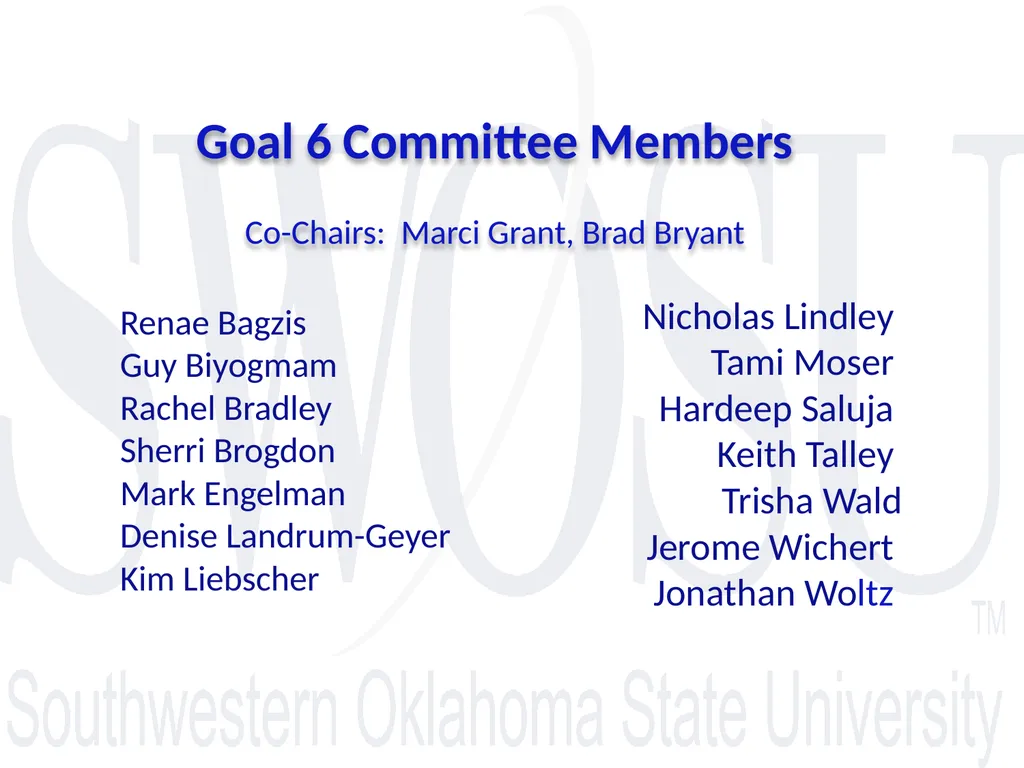
slide2. Nicholas Lindley Tami Moser Hardeep Saluja Keith Talley Trisha Wald Jerome Wichert Jonathan Woltz Goal 6 Committee Members
Co-Chairs: Marci Grant, Brad Bryant Renae Bagzis
Guy Biyogmam
Rachel Bradley
Sherri Brogdon
Mark Engelman
Denise Landrum-Geyer
Kim Liebscher<br>
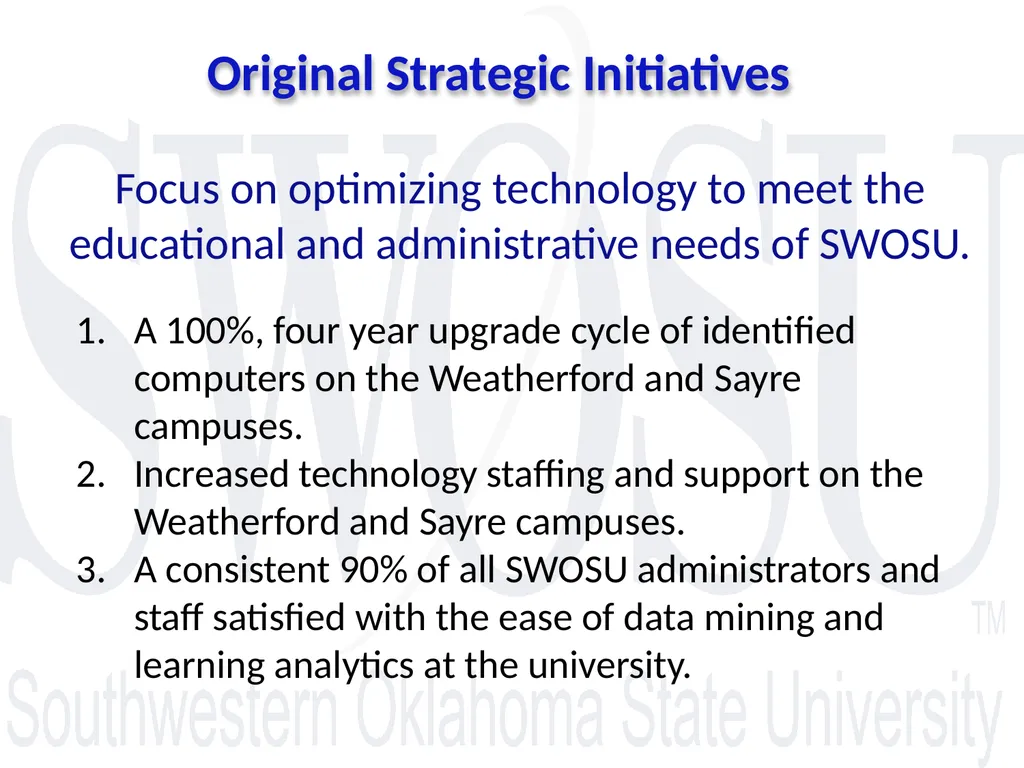
slide3. Original Strategic Initiatives A 100%, four year upgrade cycle of identified computers on the Weatherford and Sayre campuses.
Increased technology staffing and support on the Weatherford and Sayre campuses.
A consistent 90% of all SWOSU administrators and staff satisfied with the ease of data mining and learning analytics at the university. Focus on optimizing technology to meet the educational and administrative needs of SWOSU.<br>
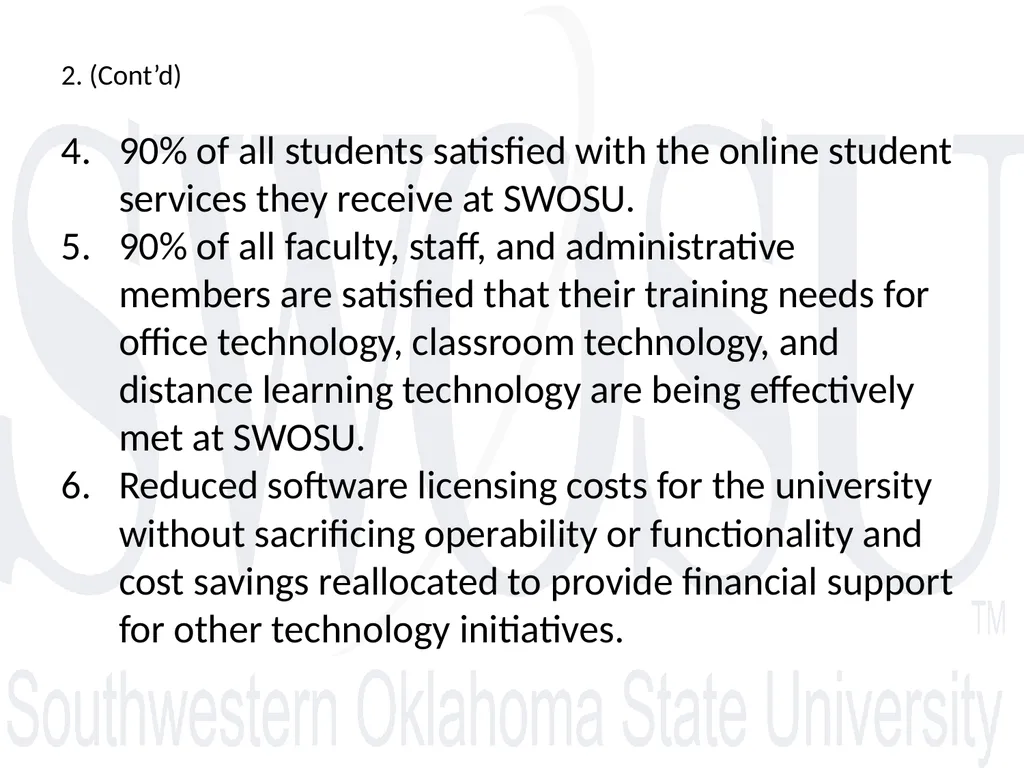
slide4. 2. (Cont’d)
90% of all students satisfied with the online student services they receive at SWOSU.
90% of all faculty, staff, and administrative members are satisfied that their training needs for office technology, classroom technology, and distance learning technology are being effectively met at SWOSU.
Reduced software licensing costs for the university without sacrificing operability or functionality and cost savings reallocated to provide financial support for other technology initiatives.<br>
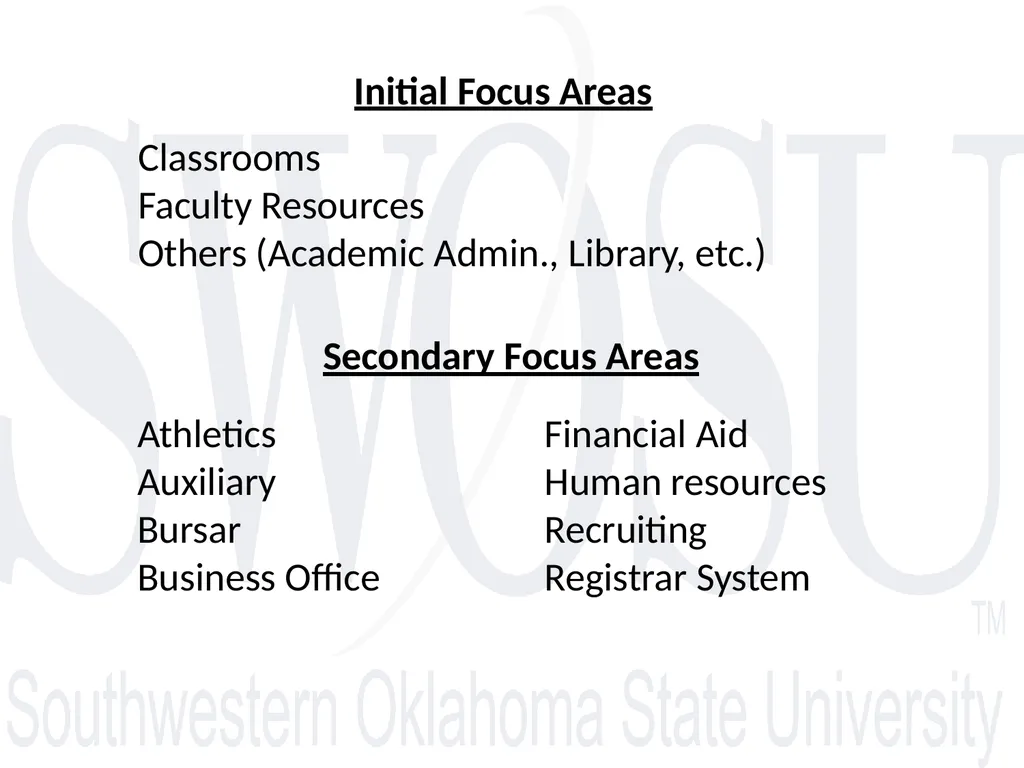
slide5. Secondary Focus Areas Initial Focus Areas
Classrooms
Faculty Resources
Others (Academic Admin., Library, etc.) Athletics
Auxiliary
Bursar
Business Office Financial Aid
Human resources
Recruiting
Registrar System<br>
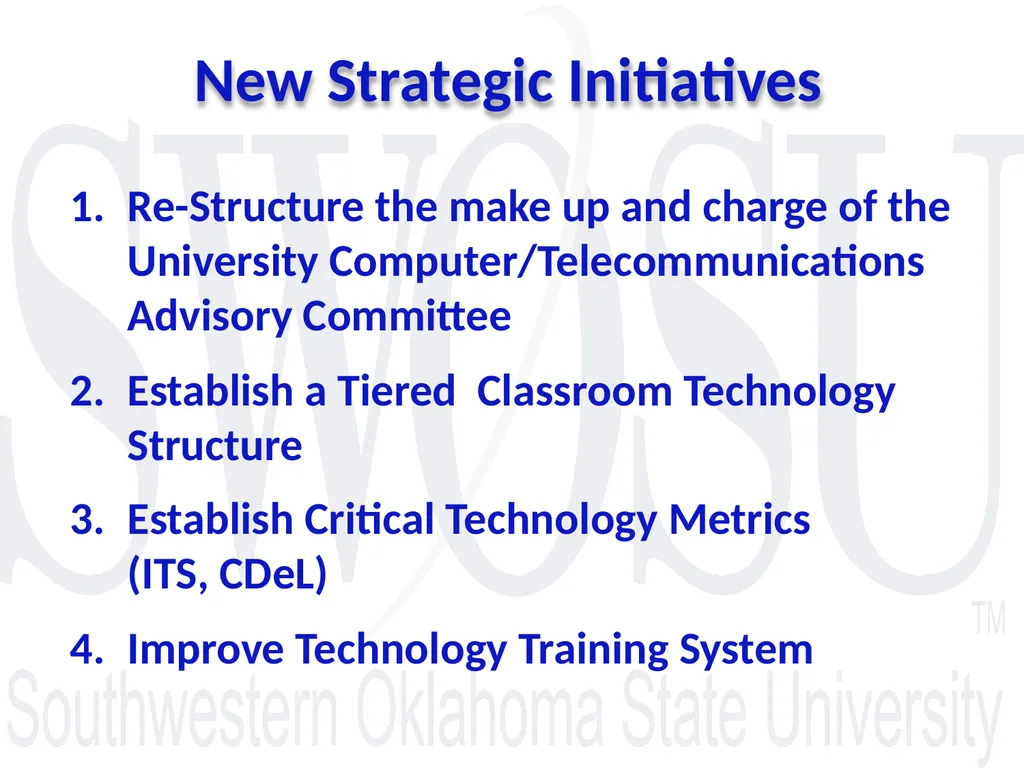
slide6. New Strategic Initiatives Re-Structure the make up and charge of the University Computer/Telecommunications Advisory Committee
Establish a Tiered Classroom Technology Structure
Establish Critical Technology Metrics (ITS, CDeL)
Improve Technology Training System<br>
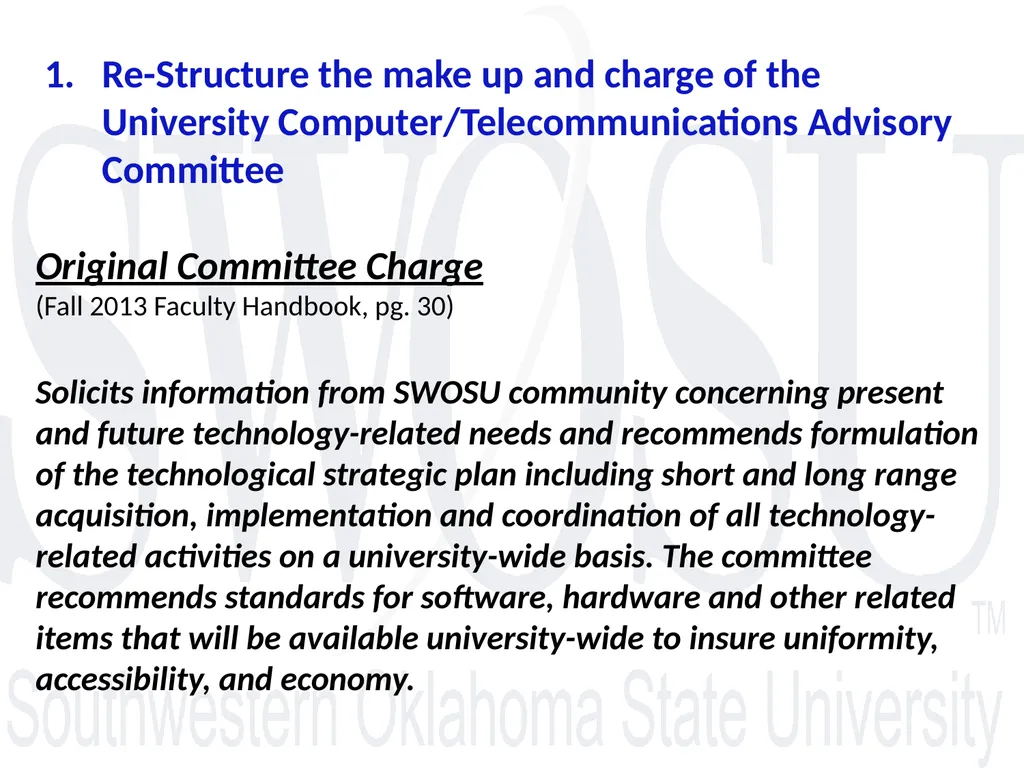
slide7. Original Committee Charge
(Fall 2013 Faculty Handbook, pg. 30)
Solicits information from SWOSU community concerning present and future technology-related needs and recommends formulation of the technological strategic plan including short and long range acquisition, implementation and coordination of all technology-related activities on a university-wide basis. The committee recommends standards for software, hardware and other related items that will be available university-wide to insure uniformity, accessibility, and economy. Re-Structure the make up and charge of the University Computer/Telecommunications Advisory Committee<br>
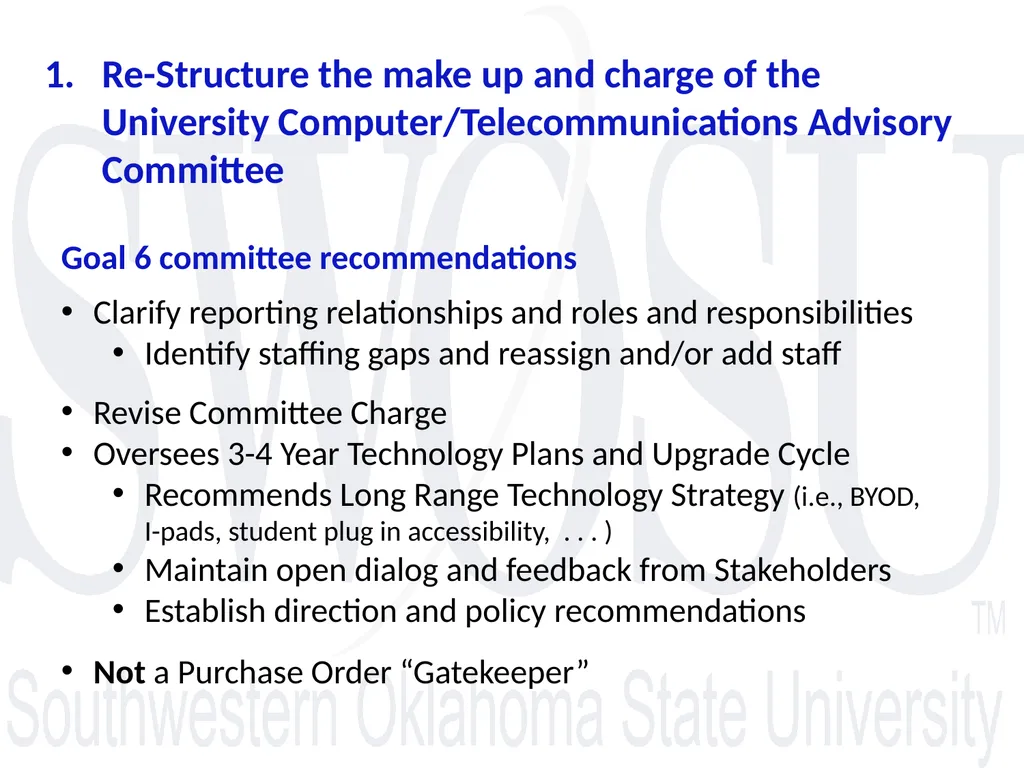
slide8. Goal 6 committee recommendations
Clarify reporting relationships and roles and responsibilities
Identify staffing gaps and reassign and/or add staff
Revise Committee Charge
Oversees 3-4 Year Technology Plans and Upgrade Cycle
Recommends Long Range Technology Strategy (i.e., BYOD, I-pads, student plug in accessibility, . . . )
Maintain open dialog and feedback from Stakeholders
Establish direction and policy recommendations
Not a Purchase Order “Gatekeeper” Re-Structure the make up and charge of the University Computer/Telecommunications Advisory Committee<br>
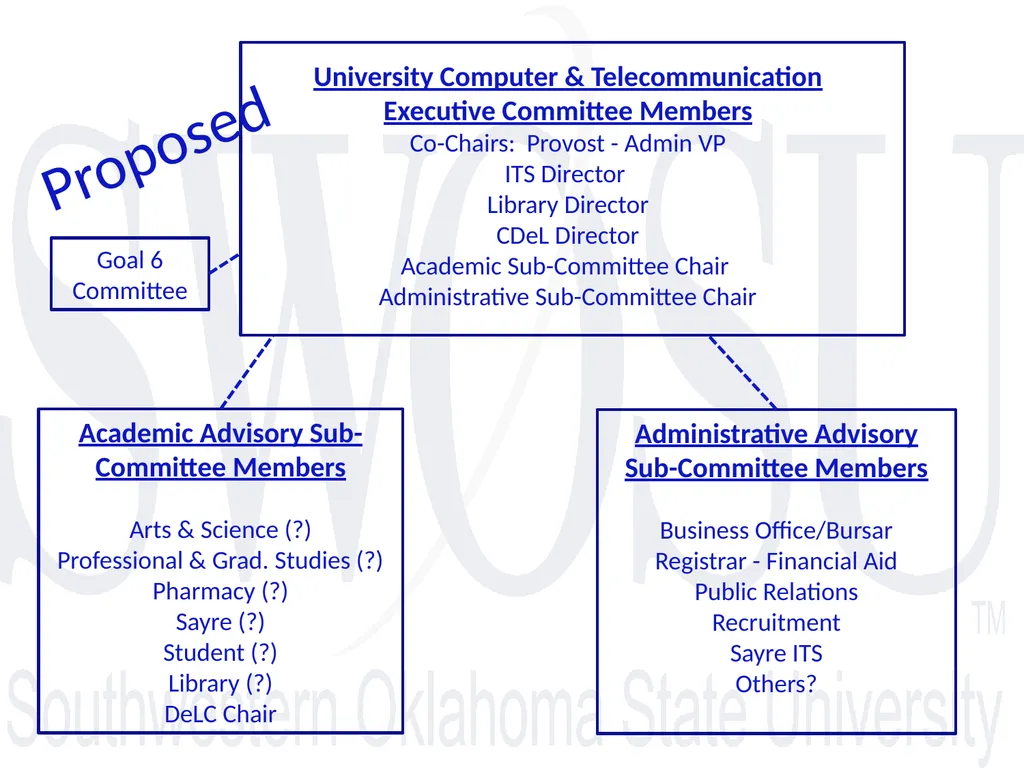
slide9. Goal 6 Committee<br>
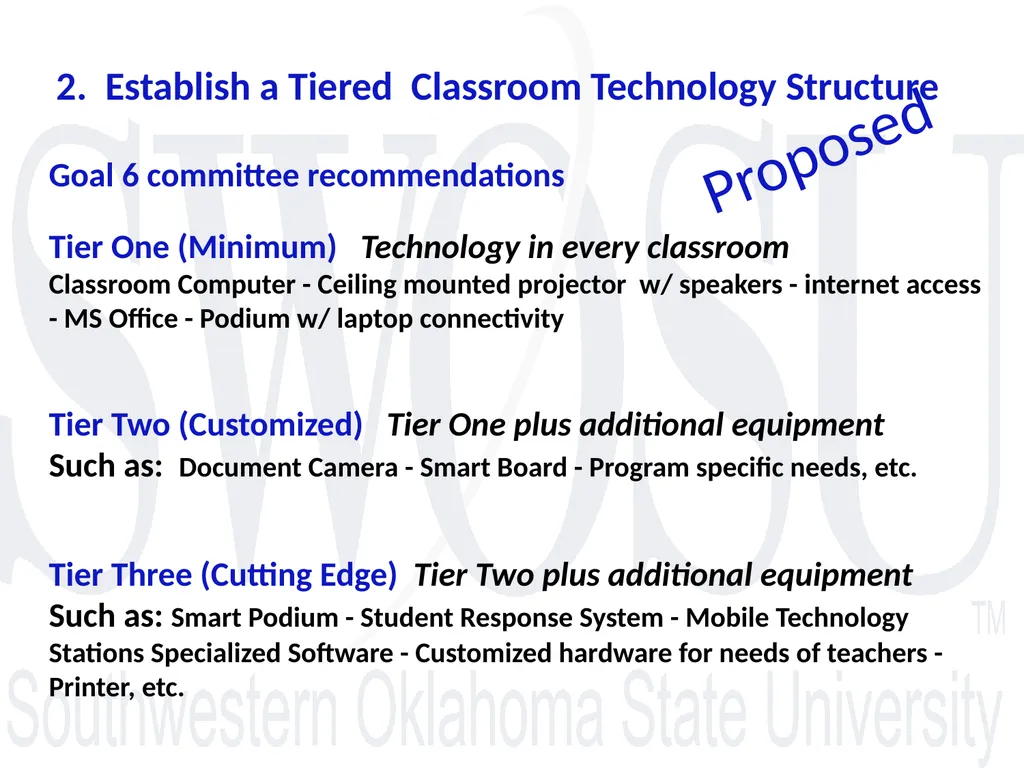
slide10. 2. Establish a Tiered Classroom Technology Structure Goal 6 committee recommendations
Tier One (Minimum) Technology in every classroom
Classroom Computer - Ceiling mounted projector w/ speakers - internet access - MS Office - Podium w/ laptop connectivity
Tier Two (Customized) Tier One plus additional equipment
Such as: Document Camera - Smart Board - Program specific needs, etc.
Tier Three (Cutting Edge) Tier Two plus additional equipment
Such as: Smart Podium - Student Response System - Mobile Technology Stations Specialized Software - Customized hardware for needs of teachers - Printer, etc. Proposed<br>
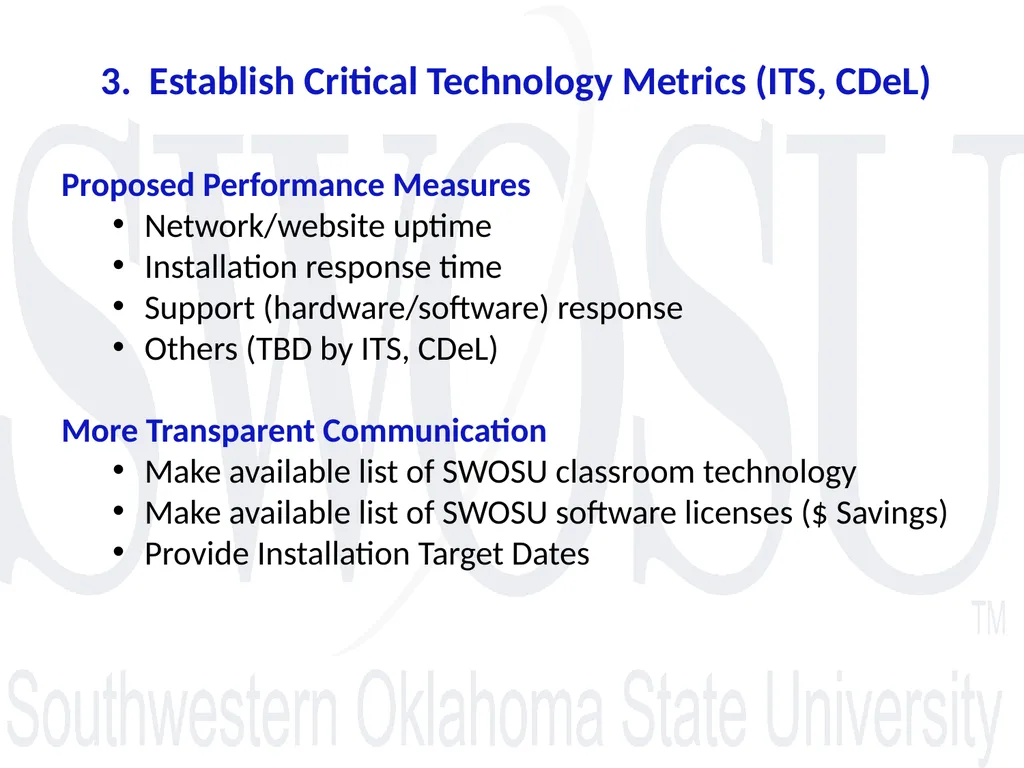
slide11. 3. Establish Critical Technology Metrics (ITS, CDeL) Proposed Performance Measures
Network/website uptime
Installation response time
Support (hardware/software) response
Others (TBD by ITS, CDeL)
More Transparent Communication
Make available list of SWOSU classroom technology
Make available list of SWOSU software licenses ($ Savings)
Provide Installation Target Dates<br>
slide12. Clarify Training Responsibility for Technology Training (University Computer/ Telecommunications Advisory Committee)
Training Coordinator . . . Locates Expertise
Foundational vs. Advanced
Foundational (LMS, MS Office, Phone, Campus Connect, PX, Classroom Technology, etc.)
Advanced (Smart Board, Specialized Software, Web 2.0, Voice Thread, Panopto, Collaborate, etc.)
Training Delivery Method
(Brown Bag Sessions, Formal Workshops, Others as Needed) 4. Improve Technology Training System<br>
slide13. Additional Goal 6 Concerns
Succession Management-critical campus technology roles (Executive)
Digital Content Strategy - (i.e., Paperless work flow) (Executive)
BullDawg Job Board Improvements (Administrative)
SWOSU Room Scheduling (Administrative)
Mobile Technology Devices Policy. i.e., BYOD (Academic)
Social Media Policy and Support (Administrative)
Coordinate working tools: Office 365, Dropbox, Google Docs (Executive)
WIFI connectivity in all buildings (Administrative)<br>
slide14. Next Steps Schedule meeting with the University Computer/ Telecommunications Executive Committee
Determine members and schedule of sub-committees
Review proposed initiatives – discuss action plans
Survey Classrooms For Existing Technology
Creates a Technology Baseline
Needed for Cost Estimates<br>
slide15. Questions<br>
slide2. Nicholas Lindley Tami Moser Hardeep Saluja Keith Talley Trisha Wald Jerome Wichert Jonathan Woltz Goal 6 Committee Members
Co-Chairs: Marci Grant, Brad Bryant Renae Bagzis
Guy Biyogmam
Rachel Bradley
Sherri Brogdon
Mark Engelman
Denise Landrum-Geyer
Kim Liebscher<br>
slide3. Original Strategic Initiatives A 100%, four year upgrade cycle of identified computers on the Weatherford and Sayre campuses.
Increased technology staffing and support on the Weatherford and Sayre campuses.
A consistent 90% of all SWOSU administrators and staff satisfied with the ease of data mining and learning analytics at the university. Focus on optimizing technology to meet the educational and administrative needs of SWOSU.<br>
slide4. 2. (Cont’d)
90% of all students satisfied with the online student services they receive at SWOSU.
90% of all faculty, staff, and administrative members are satisfied that their training needs for office technology, classroom technology, and distance learning technology are being effectively met at SWOSU.
Reduced software licensing costs for the university without sacrificing operability or functionality and cost savings reallocated to provide financial support for other technology initiatives.<br>
slide5. Secondary Focus Areas Initial Focus Areas
Classrooms
Faculty Resources
Others (Academic Admin., Library, etc.) Athletics
Auxiliary
Bursar
Business Office Financial Aid
Human resources
Recruiting
Registrar System<br>
slide6. New Strategic Initiatives Re-Structure the make up and charge of the University Computer/Telecommunications Advisory Committee
Establish a Tiered Classroom Technology Structure
Establish Critical Technology Metrics (ITS, CDeL)
Improve Technology Training System<br>
slide7. Original Committee Charge
(Fall 2013 Faculty Handbook, pg. 30)
Solicits information from SWOSU community concerning present and future technology-related needs and recommends formulation of the technological strategic plan including short and long range acquisition, implementation and coordination of all technology-related activities on a university-wide basis. The committee recommends standards for software, hardware and other related items that will be available university-wide to insure uniformity, accessibility, and economy. Re-Structure the make up and charge of the University Computer/Telecommunications Advisory Committee<br>
slide8. Goal 6 committee recommendations
Clarify reporting relationships and roles and responsibilities
Identify staffing gaps and reassign and/or add staff
Revise Committee Charge
Oversees 3-4 Year Technology Plans and Upgrade Cycle
Recommends Long Range Technology Strategy (i.e., BYOD, I-pads, student plug in accessibility, . . . )
Maintain open dialog and feedback from Stakeholders
Establish direction and policy recommendations
Not a Purchase Order “Gatekeeper” Re-Structure the make up and charge of the University Computer/Telecommunications Advisory Committee<br>
slide9. Goal 6 Committee<br>
slide10. 2. Establish a Tiered Classroom Technology Structure Goal 6 committee recommendations
Tier One (Minimum) Technology in every classroom
Classroom Computer - Ceiling mounted projector w/ speakers - internet access - MS Office - Podium w/ laptop connectivity
Tier Two (Customized) Tier One plus additional equipment
Such as: Document Camera - Smart Board - Program specific needs, etc.
Tier Three (Cutting Edge) Tier Two plus additional equipment
Such as: Smart Podium - Student Response System - Mobile Technology Stations Specialized Software - Customized hardware for needs of teachers - Printer, etc. Proposed<br>
slide11. 3. Establish Critical Technology Metrics (ITS, CDeL) Proposed Performance Measures
Network/website uptime
Installation response time
Support (hardware/software) response
Others (TBD by ITS, CDeL)
More Transparent Communication
Make available list of SWOSU classroom technology
Make available list of SWOSU software licenses ($ Savings)
Provide Installation Target Dates<br>
slide12. Clarify Training Responsibility for Technology Training (University Computer/ Telecommunications Advisory Committee)
Training Coordinator . . . Locates Expertise
Foundational vs. Advanced
Foundational (LMS, MS Office, Phone, Campus Connect, PX, Classroom Technology, etc.)
Advanced (Smart Board, Specialized Software, Web 2.0, Voice Thread, Panopto, Collaborate, etc.)
Training Delivery Method
(Brown Bag Sessions, Formal Workshops, Others as Needed) 4. Improve Technology Training System<br>
slide13. Additional Goal 6 Concerns
Succession Management-critical campus technology roles (Executive)
Digital Content Strategy - (i.e., Paperless work flow) (Executive)
BullDawg Job Board Improvements (Administrative)
SWOSU Room Scheduling (Administrative)
Mobile Technology Devices Policy. i.e., BYOD (Academic)
Social Media Policy and Support (Administrative)
Coordinate working tools: Office 365, Dropbox, Google Docs (Executive)
WIFI connectivity in all buildings (Administrative)<br>
slide14. Next Steps Schedule meeting with the University Computer/ Telecommunications Executive Committee
Determine members and schedule of sub-committees
Review proposed initiatives – discuss action plans
Survey Classrooms For Existing Technology
Creates a Technology Baseline
Needed for Cost Estimates<br>
slide15. Questions<br>