
OPTIONAL SUBHEAD HERE Andrew McGehee Minh Nguyen
A
Published · 44 slides · 0 views

1 / 1

Description
OPTIONAL SUBHEAD HERE Andrew McGehee Minh Nguyen November 4th, 2020 Understanding FA Rates Why an FA Cost Rate? It is federal policy to provide for the reimbursement of FA costs except when specific limitations and prohibitions exist
Related Topics
Share
Embed code
Download this presentation From Below
"OPTIONAL SUBHEAD HERE Andrew McGehee Minh Nguyen" is the property of its rightful owner. Permission is granted to download and print the materials on this website for personal, non-commercial use only, and to display it on your personal computer provided you do not modify the materials and that you retain all copyright notices contained in the materials. By downloading content from our website, you accept the terms of this agreement.
Presentation Transcript
01
OPTIONAL SUBHEAD HERE Andrew McGehee
Minh Nguyen
November 4th, 2020 Understanding F&A Rates<br>
Minh Nguyen
November 4th, 2020 Understanding F&A Rates<br>
02
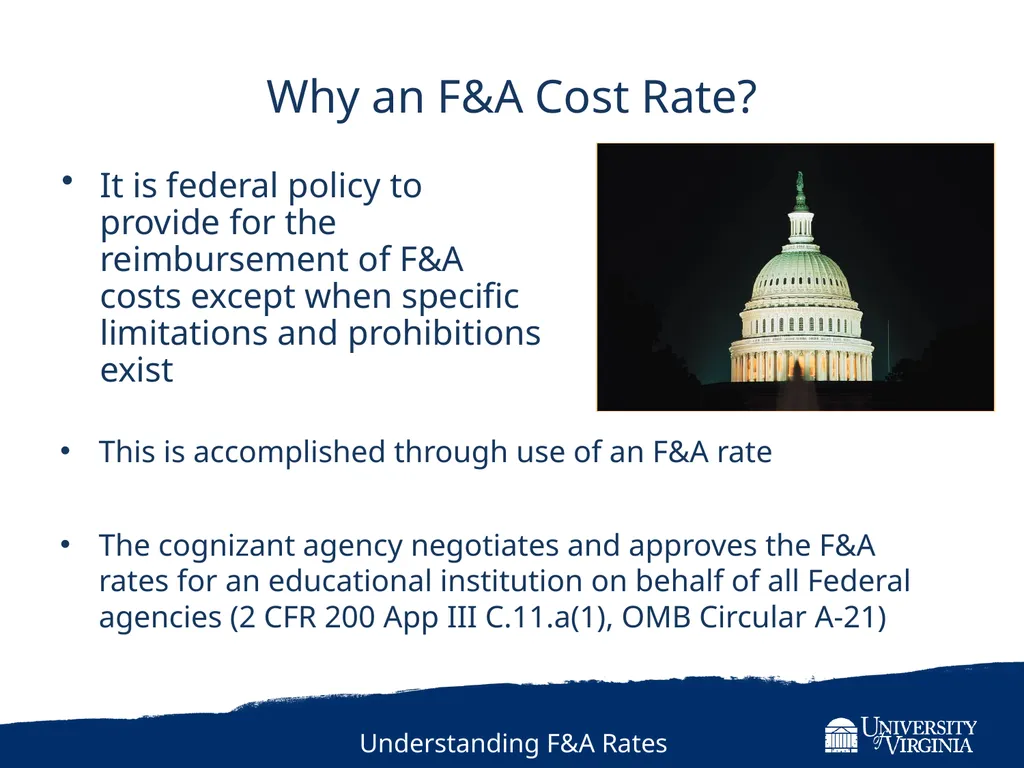
Why an F&A Cost Rate? It is federal policy to provide for the reimbursement of F&A costs except when specific limitations and prohibitions exist This is accomplished through use of an F&A rate
The cognizant agency negotiates and approves the F&A rates for an educational institution on behalf of all Federal agencies (2 CFR 200 App III C.11.a(1), OMB Circular A-21) Understanding F&A Rates<br>
The cognizant agency negotiates and approves the F&A rates for an educational institution on behalf of all Federal agencies (2 CFR 200 App III C.11.a(1), OMB Circular A-21) Understanding F&A Rates<br>
03
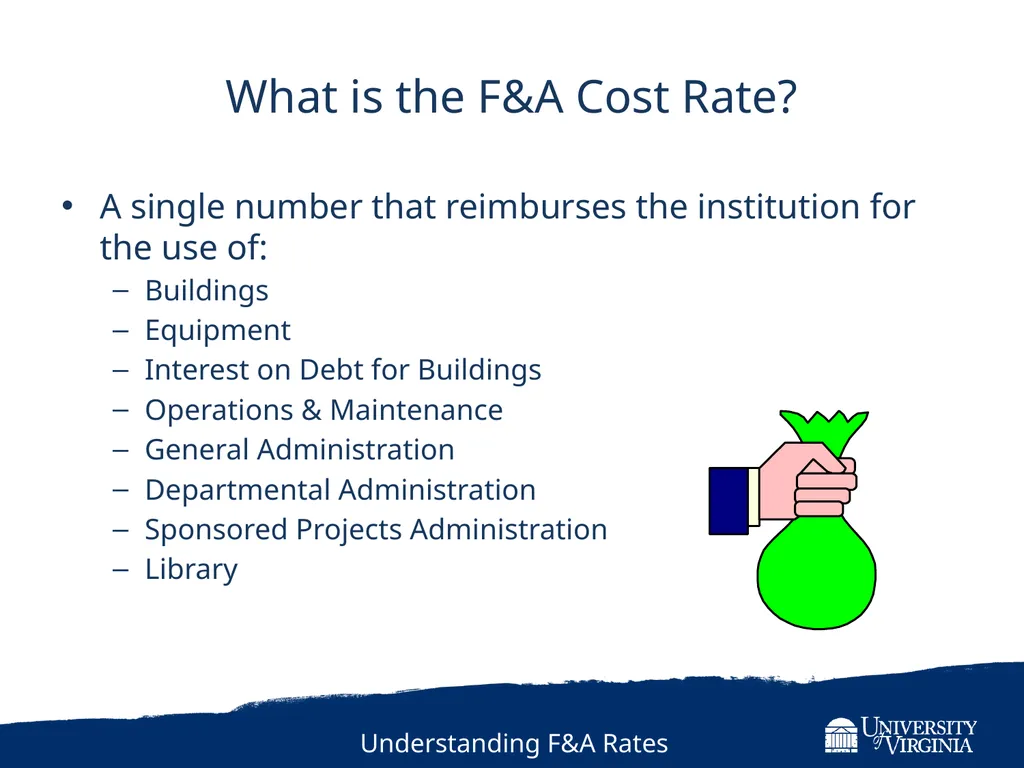
What is the F&A Cost Rate? A single number that reimburses the institution for the use of:
Buildings
Equipment
Interest on Debt for Buildings
Operations & Maintenance
General Administration
Departmental Administration
Sponsored Projects Administration
Library Understanding F&A Rates<br>
Buildings
Equipment
Interest on Debt for Buildings
Operations & Maintenance
General Administration
Departmental Administration
Sponsored Projects Administration
Library Understanding F&A Rates<br>
04
. . . or stated another way . . . The ratio, expressed as a percentage, of an OR facilities and administrative cost pool and an OR direct cost base.
The OR cost pool is made up of allocations from the administrative and facilities cost pools
OR allocated pool costs/OR base direct costs = OR F&A rate. Understanding F&A Rates<br>
The OR cost pool is made up of allocations from the administrative and facilities cost pools
OR allocated pool costs/OR base direct costs = OR F&A rate. Understanding F&A Rates<br>
05
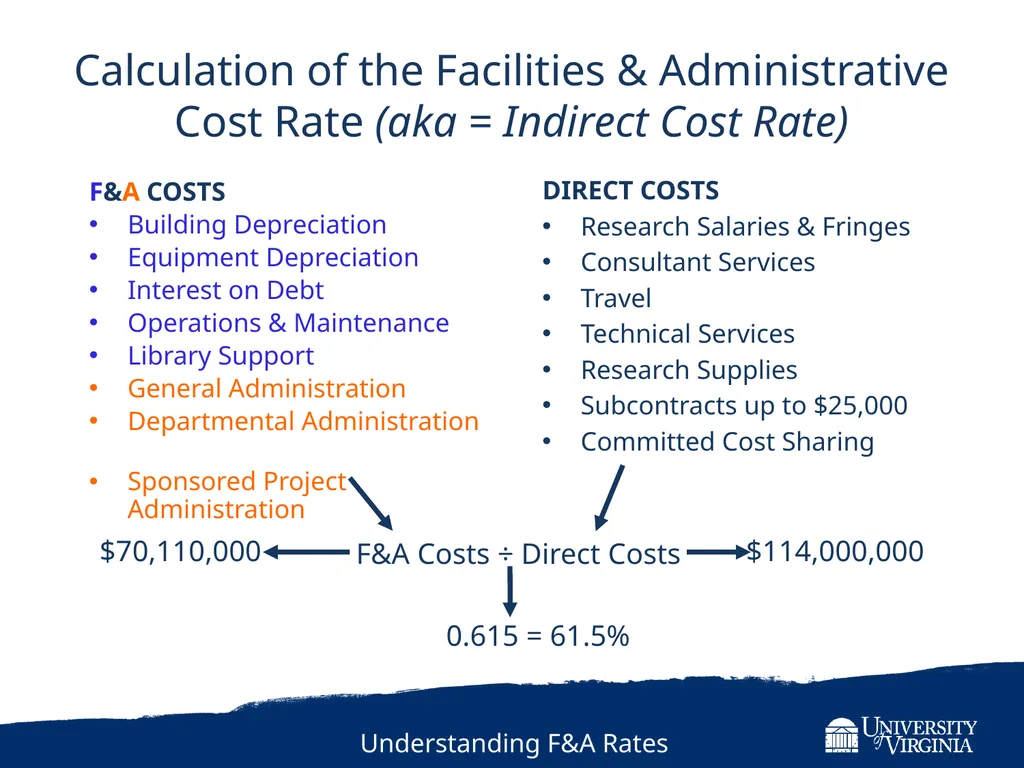
Calculation of the Facilities & Administrative Cost Rate (aka = Indirect Cost Rate) Understanding F&A Rates F&A COSTS
Building Depreciation
Equipment Depreciation
Interest on Debt
Operations & Maintenance
Library Support
General Administration
Departmental Administration
Sponsored Project Administration DIRECT COSTS
Research Salaries & Fringes
Consultant Services
Travel
Technical Services
Research Supplies
Subcontracts up to $25,000
Committed Cost Sharing F&A Costs ÷ Direct Costs<br>
Building Depreciation
Equipment Depreciation
Interest on Debt
Operations & Maintenance
Library Support
General Administration
Departmental Administration
Sponsored Project Administration DIRECT COSTS
Research Salaries & Fringes
Consultant Services
Travel
Technical Services
Research Supplies
Subcontracts up to $25,000
Committed Cost Sharing F&A Costs ÷ Direct Costs<br>
06
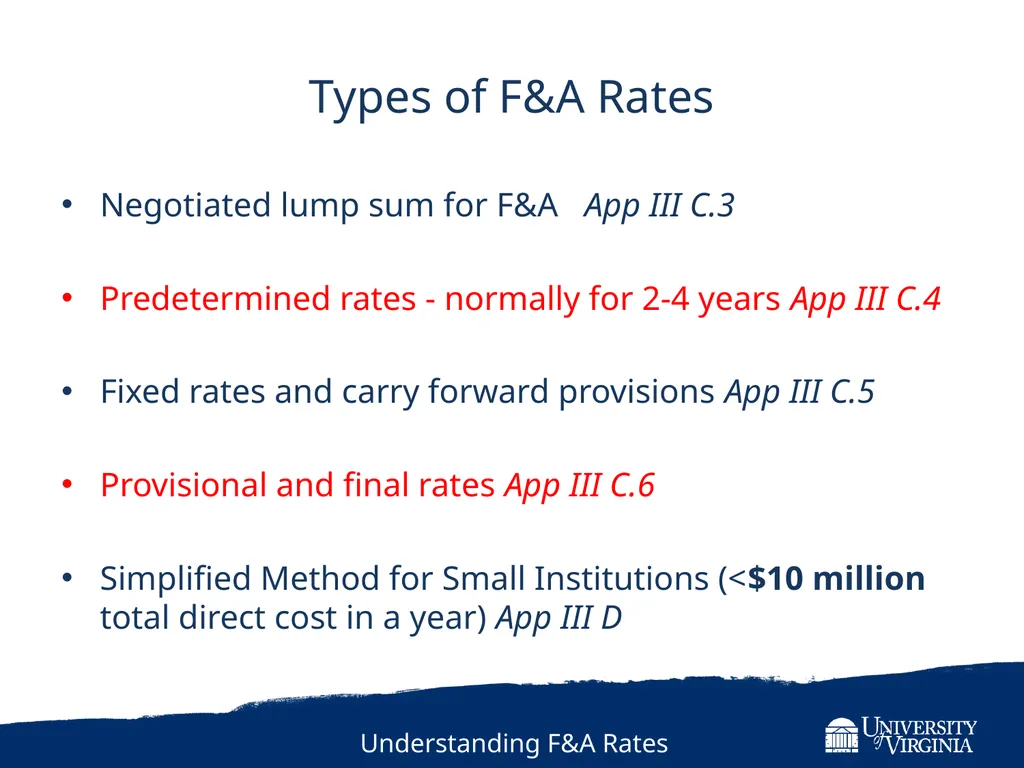
Types of F&A Rates Negotiated lump sum for F&A App III C.3
Predetermined rates - normally for 2-4 years App III C.4
Fixed rates and carry forward provisions App III C.5
Provisional and final rates App III C.6
Simplified Method for Small Institutions (<$10 million total direct cost in a year) App III D Understanding F&A Rates<br>
Predetermined rates - normally for 2-4 years App III C.4
Fixed rates and carry forward provisions App III C.5
Provisional and final rates App III C.6
Simplified Method for Small Institutions (<$10 million total direct cost in a year) App III D Understanding F&A Rates<br>
07
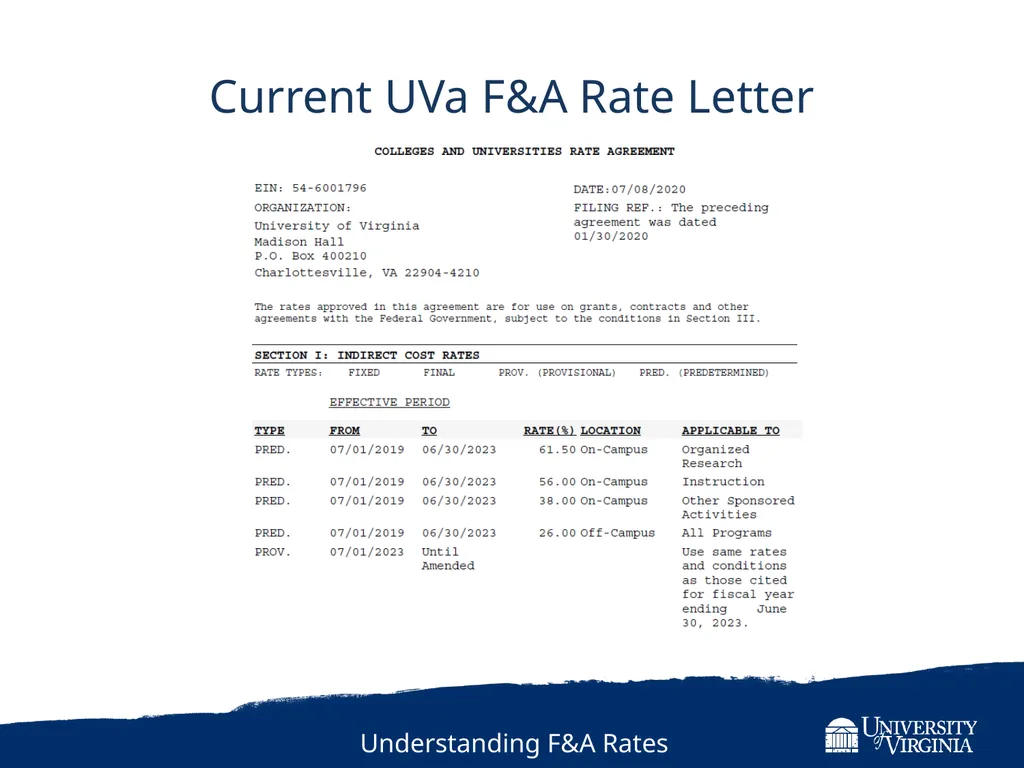
Current UVa F&A Rate Letter Understanding F&A Rates<br>
08
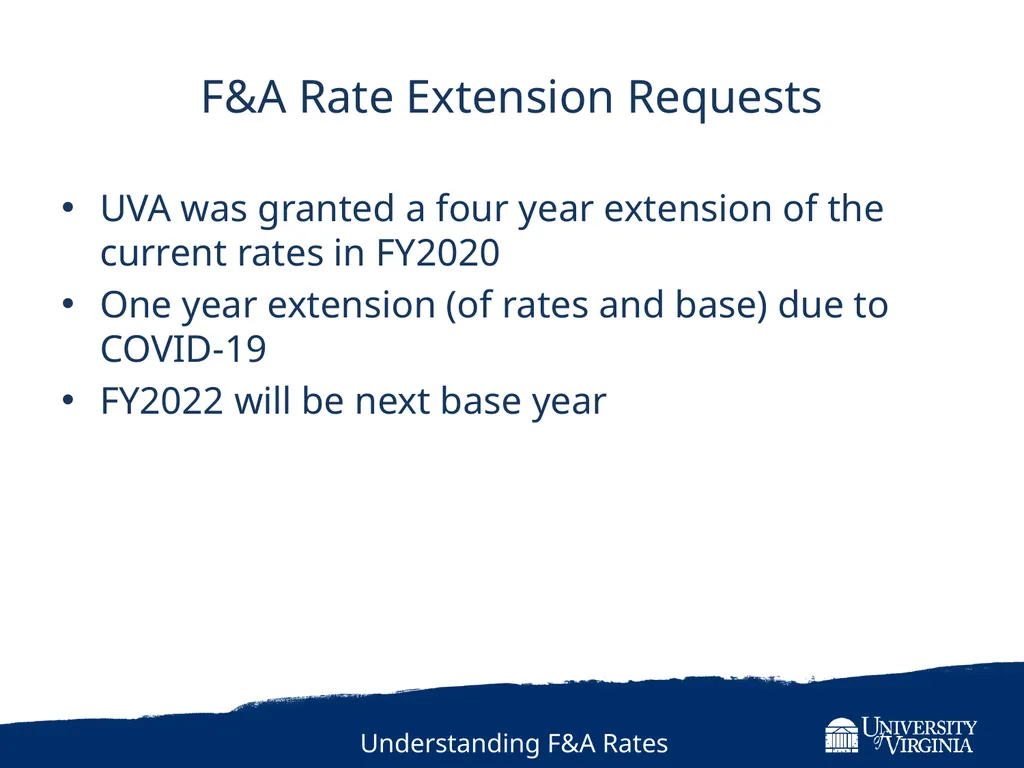
F&A Rate Extension Requests UVA was granted a four year extension of the current rates in FY2020
One year extension (of rates and base) due to COVID-19
FY2022 will be next base year Understanding F&A Rates<br>
One year extension (of rates and base) due to COVID-19
FY2022 will be next base year Understanding F&A Rates<br>
09
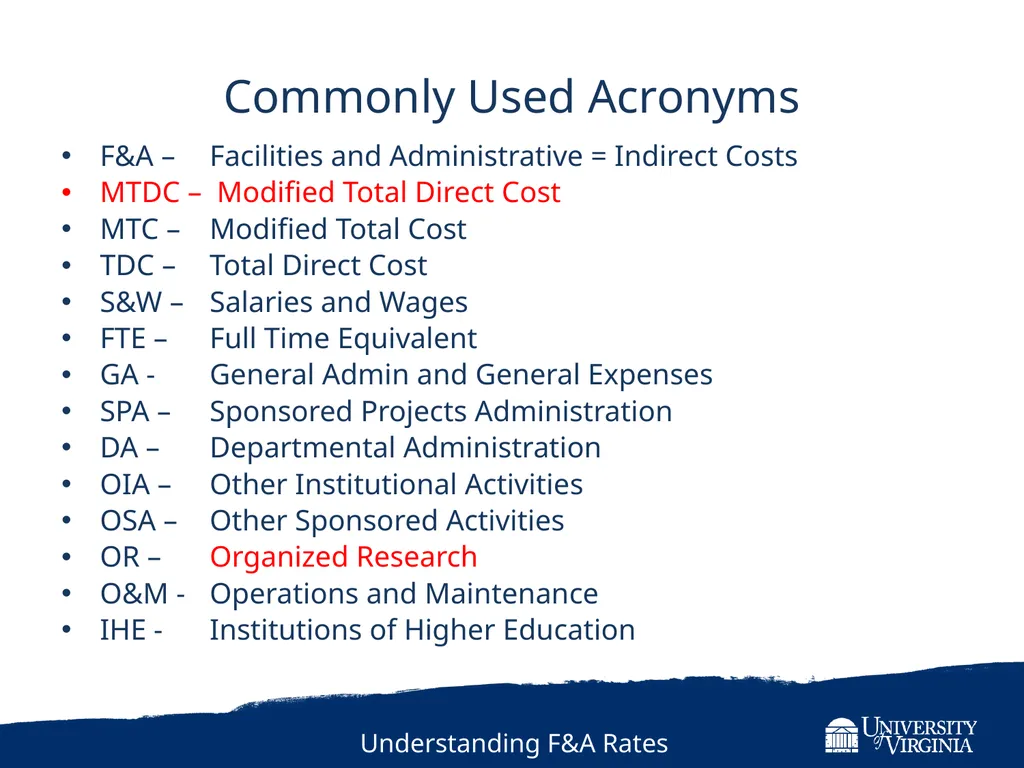
Commonly Used Acronyms F&A – Facilities and Administrative = Indirect Costs
MTDC – Modified Total Direct Cost
MTC – Modified Total Cost
TDC – Total Direct Cost
S&W – Salaries and Wages
FTE – Full Time Equivalent
GA - General Admin and General Expenses
SPA – Sponsored Projects Administration
DA – Departmental Administration
OIA – Other Institutional Activities
OSA – Other Sponsored Activities
OR – Organized Research
O&M - Operations and Maintenance
IHE - Institutions of Higher Education Understanding F&A Rates<br>
MTDC – Modified Total Direct Cost
MTC – Modified Total Cost
TDC – Total Direct Cost
S&W – Salaries and Wages
FTE – Full Time Equivalent
GA - General Admin and General Expenses
SPA – Sponsored Projects Administration
DA – Departmental Administration
OIA – Other Institutional Activities
OSA – Other Sponsored Activities
OR – Organized Research
O&M - Operations and Maintenance
IHE - Institutions of Higher Education Understanding F&A Rates<br>
10
The Direct Cost Bases Understanding F&A Rates<br>
11
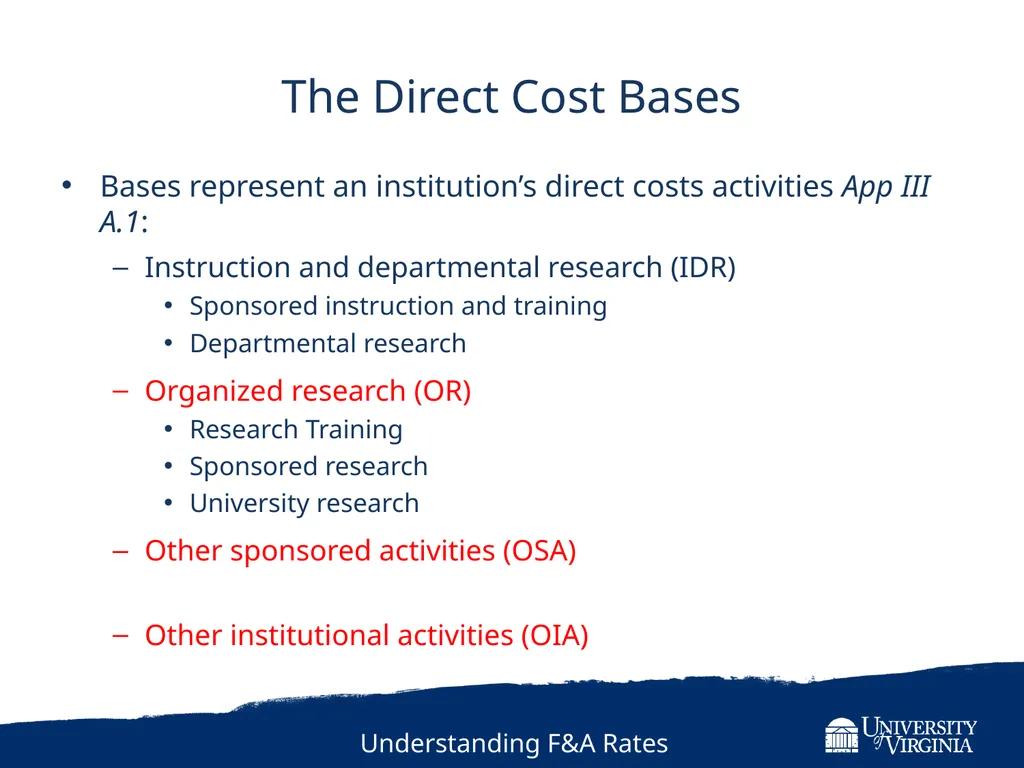
The Direct Cost Bases Bases represent an institution’s direct costs activities App III A.1:
Instruction and departmental research (IDR)
Sponsored instruction and training
Departmental research
Organized research (OR)
Research Training
Sponsored research
University research
Other sponsored activities (OSA)
Other institutional activities (OIA) Understanding F&A Rates<br>
Instruction and departmental research (IDR)
Sponsored instruction and training
Departmental research
Organized research (OR)
Research Training
Sponsored research
University research
Other sponsored activities (OSA)
Other institutional activities (OIA) Understanding F&A Rates<br>
12
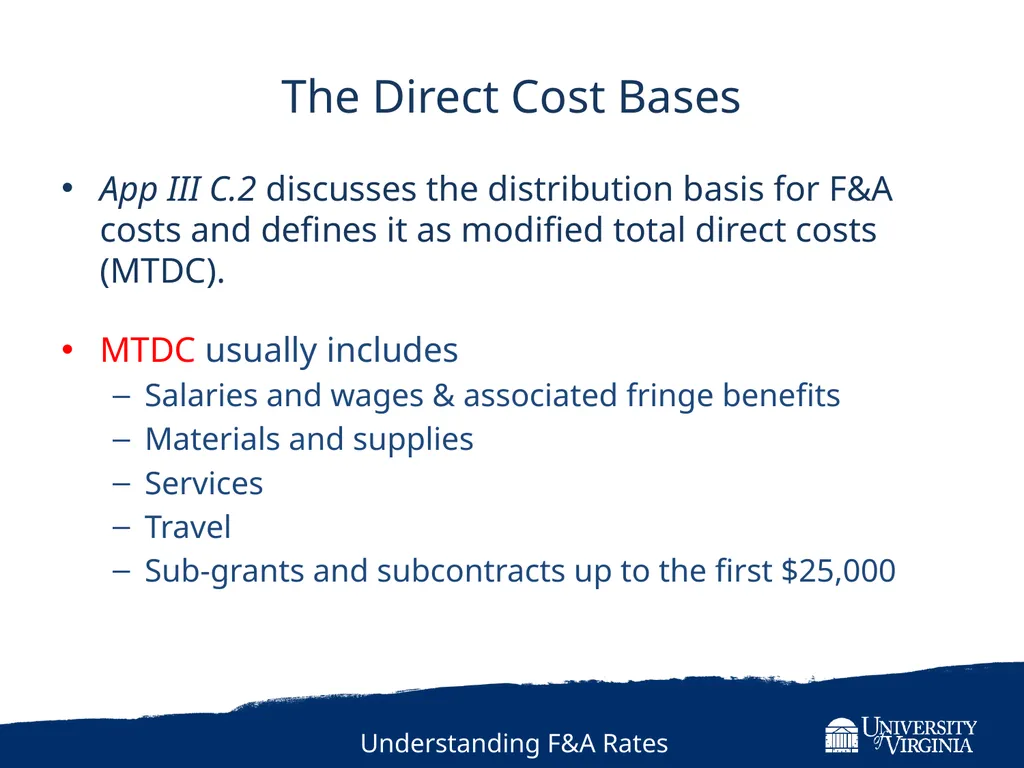
The Direct Cost Bases App III C.2 discusses the distribution basis for F&A costs and defines it as modified total direct costs (MTDC).
MTDC usually includes
Salaries and wages & associated fringe benefits
Materials and supplies
Services
Travel
Sub-grants and subcontracts up to the first $25,000 Understanding F&A Rates<br>
MTDC usually includes
Salaries and wages & associated fringe benefits
Materials and supplies
Services
Travel
Sub-grants and subcontracts up to the first $25,000 Understanding F&A Rates<br>
13
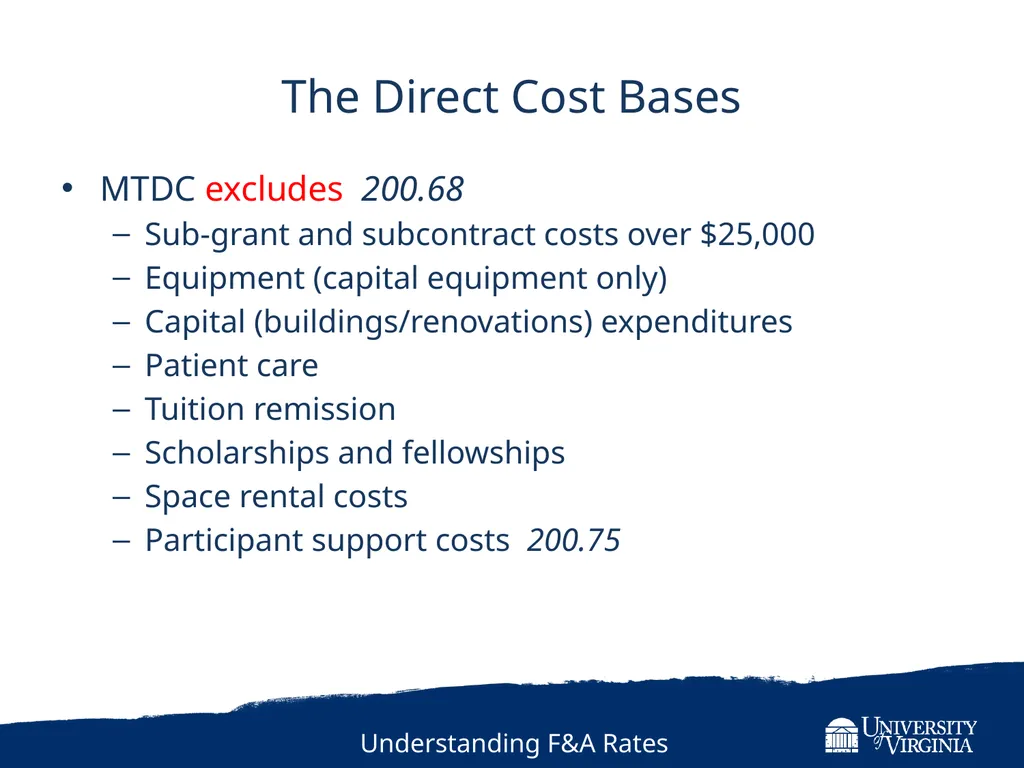
The Direct Cost Bases MTDC excludes 200.68
Sub-grant and subcontract costs over $25,000
Equipment (capital equipment only)
Capital (buildings/renovations) expenditures
Patient care
Tuition remission
Scholarships and fellowships
Space rental costs
Participant support costs 200.75 Understanding F&A Rates<br>
Sub-grant and subcontract costs over $25,000
Equipment (capital equipment only)
Capital (buildings/renovations) expenditures
Patient care
Tuition remission
Scholarships and fellowships
Space rental costs
Participant support costs 200.75 Understanding F&A Rates<br>
14
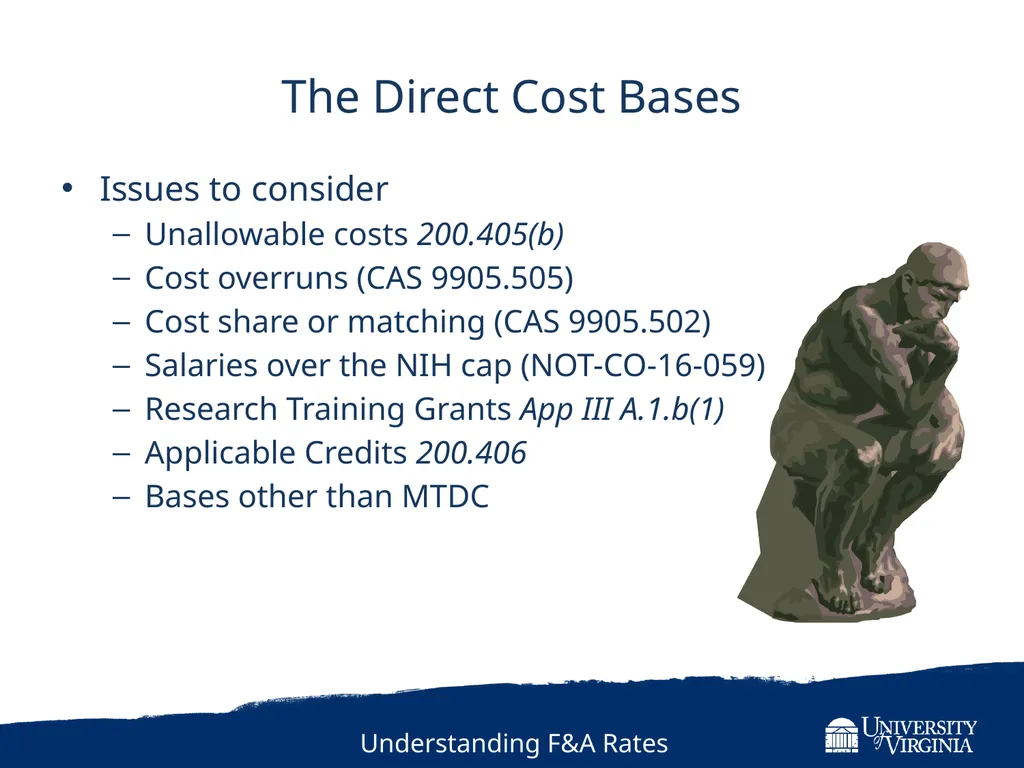
The Direct Cost Bases Issues to consider
Unallowable costs 200.405(b)
Cost overruns (CAS 9905.505)
Cost share or matching (CAS 9905.502)
Salaries over the NIH cap (NOT-CO-16-059)
Research Training Grants App III A.1.b(1)
Applicable Credits 200.406
Bases other than MTDC Understanding F&A Rates<br>
Unallowable costs 200.405(b)
Cost overruns (CAS 9905.505)
Cost share or matching (CAS 9905.502)
Salaries over the NIH cap (NOT-CO-16-059)
Research Training Grants App III A.1.b(1)
Applicable Credits 200.406
Bases other than MTDC Understanding F&A Rates<br>
15
Indirect Costs Understanding F&A Rates<br>
16
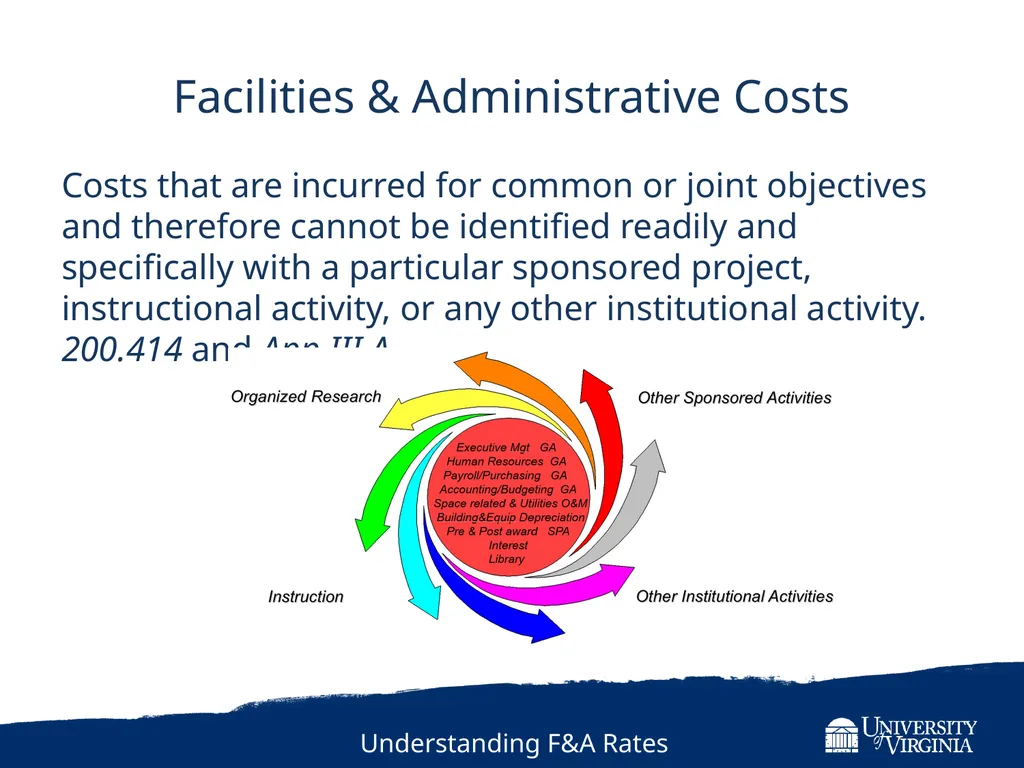
Facilities & Administrative Costs Costs that are incurred for common or joint objectives and therefore cannot be identified readily and specifically with a particular sponsored project, instructional activity, or any other institutional activity. 200.414 and App III A Understanding F&A Rates<br>
17
The Facilities Components Building depreciation
Equipment depreciation
Interest expense
Operations and maintenance
Library Understanding F&A Rates<br>
Equipment depreciation
Interest expense
Operations and maintenance
Library Understanding F&A Rates<br>
18
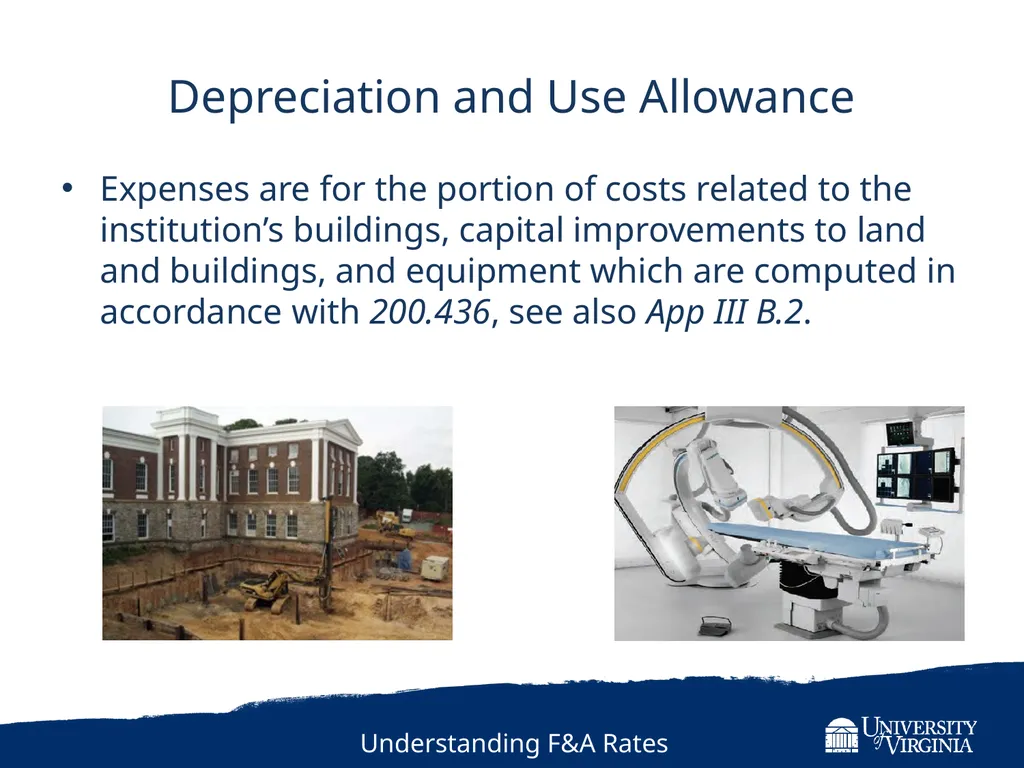
Depreciation and Use Allowance Expenses are for the portion of costs related to the institution’s buildings, capital improvements to land and buildings, and equipment which are computed in accordance with 200.436, see also App III B.2. Understanding F&A Rates<br>
19
Interest on Debt Interest associated with certain buildings, equipment, and capital improvements are allowable if they support sponsored agreements 200.449 and App III B.3
Buildings acquired or completed after July 1, 1982
Major reconstruction and remodeling of existing buildings completed on or after July 1, 1982
Acquisition or fabrication of capital equipment on or after July 1, 1982, costing $10,000 or more, if the government agrees Understanding F&A Rates<br>
Buildings acquired or completed after July 1, 1982
Major reconstruction and remodeling of existing buildings completed on or after July 1, 1982
Acquisition or fabrication of capital equipment on or after July 1, 1982, costing $10,000 or more, if the government agrees Understanding F&A Rates<br>
20
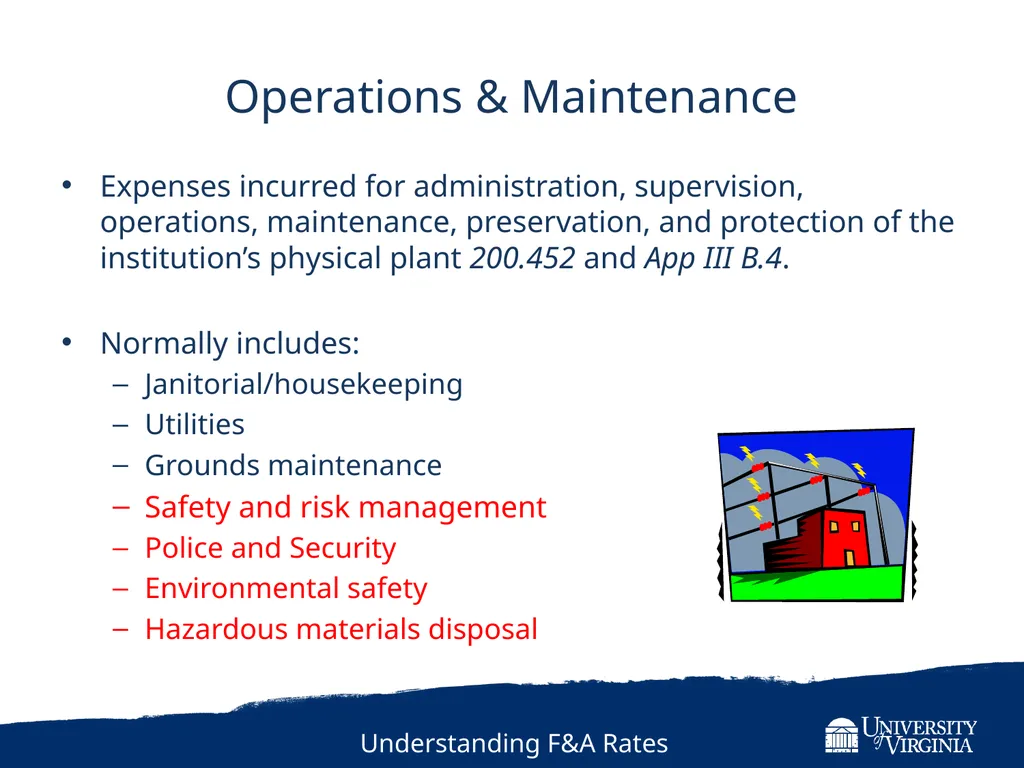
Operations & Maintenance Expenses incurred for administration, supervision, operations, maintenance, preservation, and protection of the institution’s physical plant 200.452 and App III B.4.
Normally includes:
Janitorial/housekeeping
Utilities
Grounds maintenance
Safety and risk management
Police and Security
Environmental safety
Hazardous materials disposal Understanding F&A Rates<br>
Normally includes:
Janitorial/housekeeping
Utilities
Grounds maintenance
Safety and risk management
Police and Security
Environmental safety
Hazardous materials disposal Understanding F&A Rates<br>
21
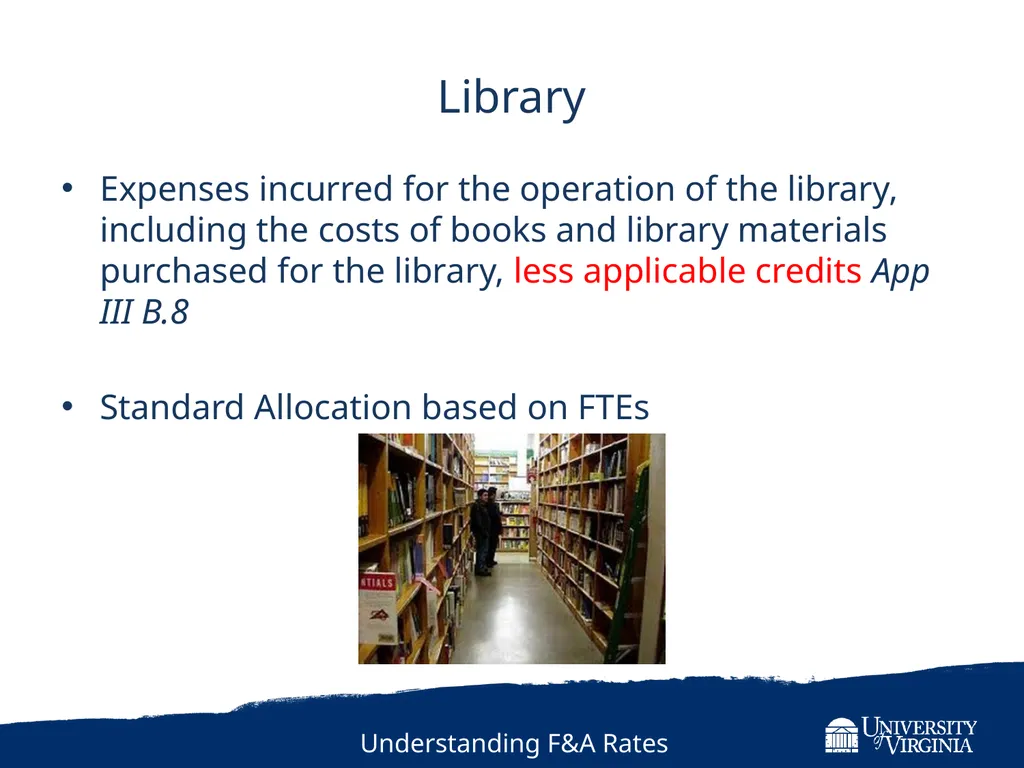
Library Expenses incurred for the operation of the library, including the costs of books and library materials purchased for the library, less applicable credits App III B.8
Standard Allocation based on FTEs Understanding F&A Rates<br>
Standard Allocation based on FTEs Understanding F&A Rates<br>
22
The Administrative Components Administrative components (cost pools)
General administration and general expenses
Departmental administration
Sponsored projects administration
Student administration and services
The combined total of Administrative components is capped at 26% of modified total direct costs App III C.8 Understanding F&A Rates<br>
General administration and general expenses
Departmental administration
Sponsored projects administration
Student administration and services
The combined total of Administrative components is capped at 26% of modified total direct costs App III C.8 Understanding F&A Rates<br>
23
General Administration and General Expenses Expenses incurred for the general executive and administrative office and other expenses of a general nature which do not relate solely to any major function of the institution App III B.5
Normally includes
Allocations from administrative offices that serve an entire university system, (e.g. California, North Carolina, Texas)
Institutional administrative executive offices
Financial planning, budgeting, payroll, accounting
General Counsel
Management information systems
Cross allocations from depreciation, interest, and O&M cost pools
Admin costs from the SICAP 200.418 Understanding F&A Rates<br>
Normally includes
Allocations from administrative offices that serve an entire university system, (e.g. California, North Carolina, Texas)
Institutional administrative executive offices
Financial planning, budgeting, payroll, accounting
General Counsel
Management information systems
Cross allocations from depreciation, interest, and O&M cost pools
Admin costs from the SICAP 200.418 Understanding F&A Rates<br>
24
Departmental Administration (DA) Expenses incurred for administrative and supporting services that benefit common or joint departmental activities or objectives App III B.6
DA costs are not normally identified on university current financial statements
Cross allocations from depreciation, interest, O&M, and GA cost pools Understanding F&A Rates<br>
DA costs are not normally identified on university current financial statements
Cross allocations from depreciation, interest, O&M, and GA cost pools Understanding F&A Rates<br>
25
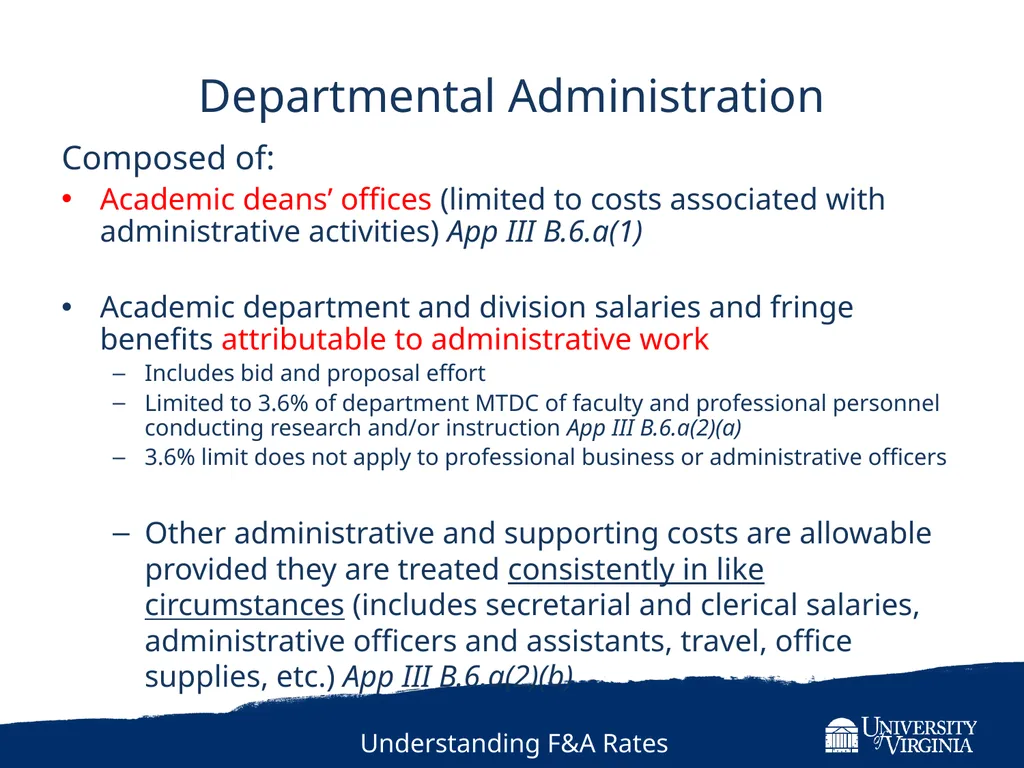
Departmental Administration Composed of:
Academic deans’ offices (limited to costs associated with administrative activities) App III B.6.a(1)
Academic department and division salaries and fringe benefits attributable to administrative work
Includes bid and proposal effort
Limited to 3.6% of department MTDC of faculty and professional personnel conducting research and/or instruction App III B.6.a(2)(a)
3.6% limit does not apply to professional business or administrative officers
Other administrative and supporting costs are allowable provided they are treated consistently in like circumstances (includes secretarial and clerical salaries, administrative officers and assistants, travel, office supplies, etc.) App III B.6.a(2)(b) Understanding F&A Rates<br>
Academic deans’ offices (limited to costs associated with administrative activities) App III B.6.a(1)
Academic department and division salaries and fringe benefits attributable to administrative work
Includes bid and proposal effort
Limited to 3.6% of department MTDC of faculty and professional personnel conducting research and/or instruction App III B.6.a(2)(a)
3.6% limit does not apply to professional business or administrative officers
Other administrative and supporting costs are allowable provided they are treated consistently in like circumstances (includes secretarial and clerical salaries, administrative officers and assistants, travel, office supplies, etc.) App III B.6.a(2)(b) Understanding F&A Rates<br>
26
Expenses are limited to those incurred by a separate organization established primarily to administer sponsor projects. Includes grant and contract administration, special security, purchasing, personnel, etc. App III B.7
Cross allocation from depreciation, interest, O&M, and GA cost pools
SPA is allocated to the functions performing sponsored projects based on MTC of the sponsored projects
Usually includes
Organized research
Sponsored instruction
Other sponsored activity Sponsored Projects Administration Understanding F&A Rates<br>
Cross allocation from depreciation, interest, O&M, and GA cost pools
SPA is allocated to the functions performing sponsored projects based on MTC of the sponsored projects
Usually includes
Organized research
Sponsored instruction
Other sponsored activity Sponsored Projects Administration Understanding F&A Rates<br>
27
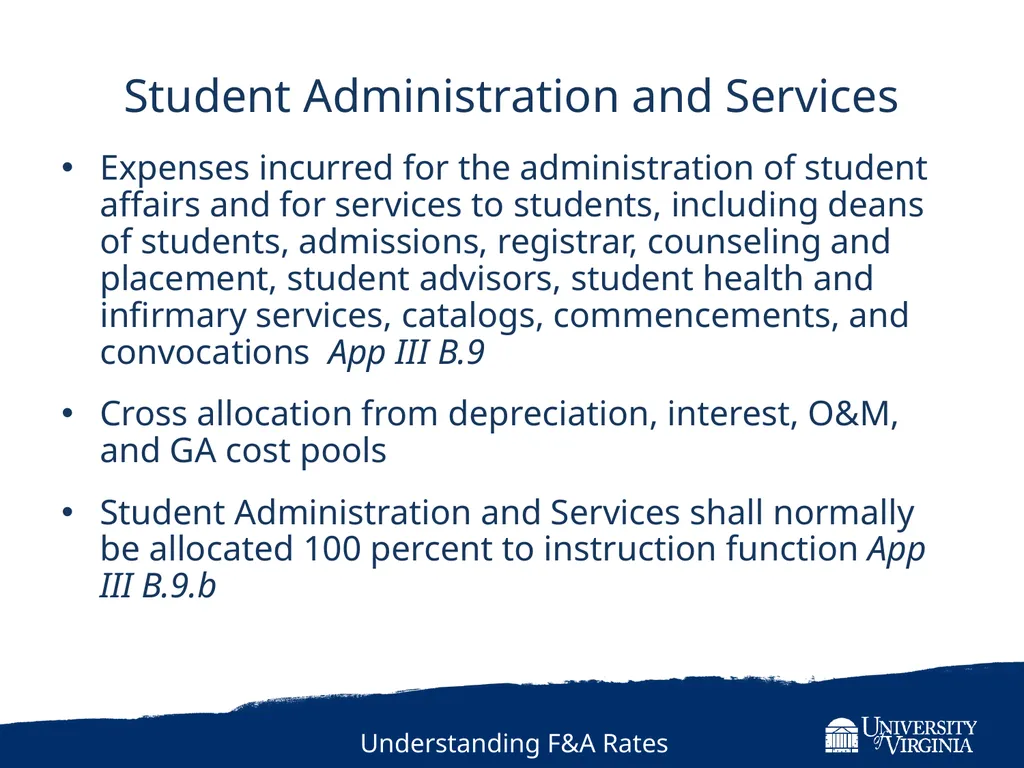
Expenses incurred for the administration of student affairs and for services to students, including deans of students, admissions, registrar, counseling and placement, student advisors, student health and infirmary services, catalogs, commencements, and convocations App III B.9
Cross allocation from depreciation, interest, O&M, and GA cost pools
Student Administration and Services shall normally be allocated 100 percent to instruction function App III B.9.b Student Administration and Services Understanding F&A Rates<br>
Cross allocation from depreciation, interest, O&M, and GA cost pools
Student Administration and Services shall normally be allocated 100 percent to instruction function App III B.9.b Student Administration and Services Understanding F&A Rates<br>
28
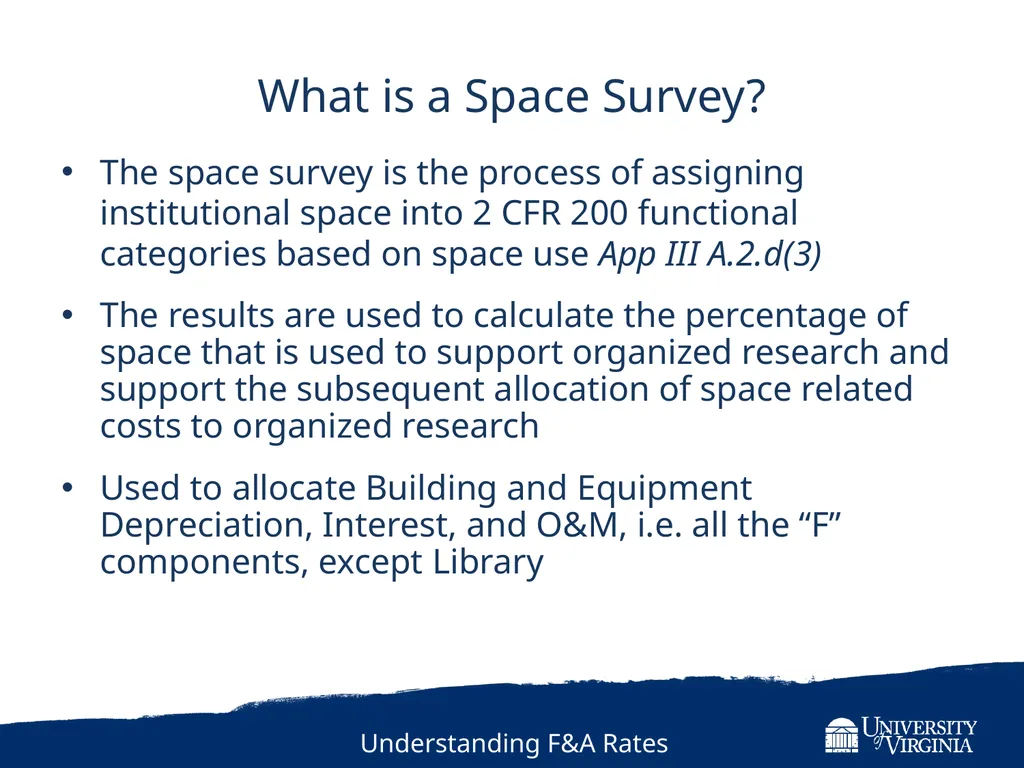
The space survey is the process of assigning institutional space into 2 CFR 200 functional categories based on space use App III A.2.d(3)
The results are used to calculate the percentage of space that is used to support organized research and support the subsequent allocation of space related costs to organized research
Used to allocate Building and Equipment Depreciation, Interest, and O&M, i.e. all the “F” components, except Library What is a Space Survey? Understanding F&A Rates<br>
The results are used to calculate the percentage of space that is used to support organized research and support the subsequent allocation of space related costs to organized research
Used to allocate Building and Equipment Depreciation, Interest, and O&M, i.e. all the “F” components, except Library What is a Space Survey? Understanding F&A Rates<br>
29
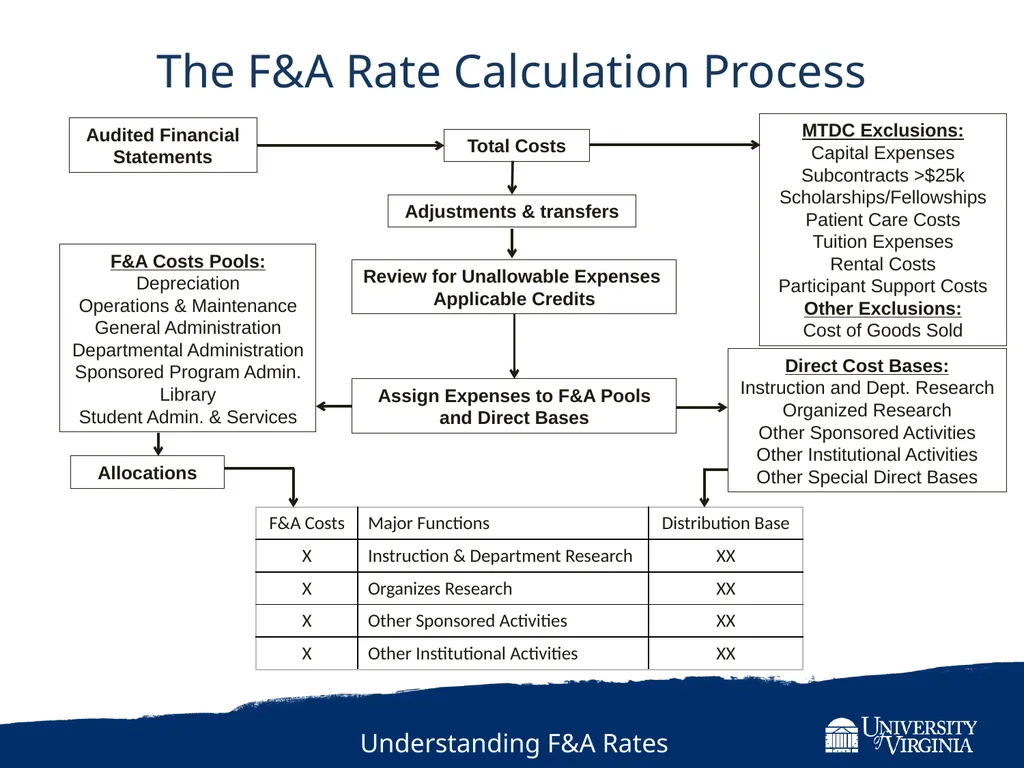
The F&A Rate Calculation Process Audited Financial Statements Total Costs Understanding F&A Rates<br>
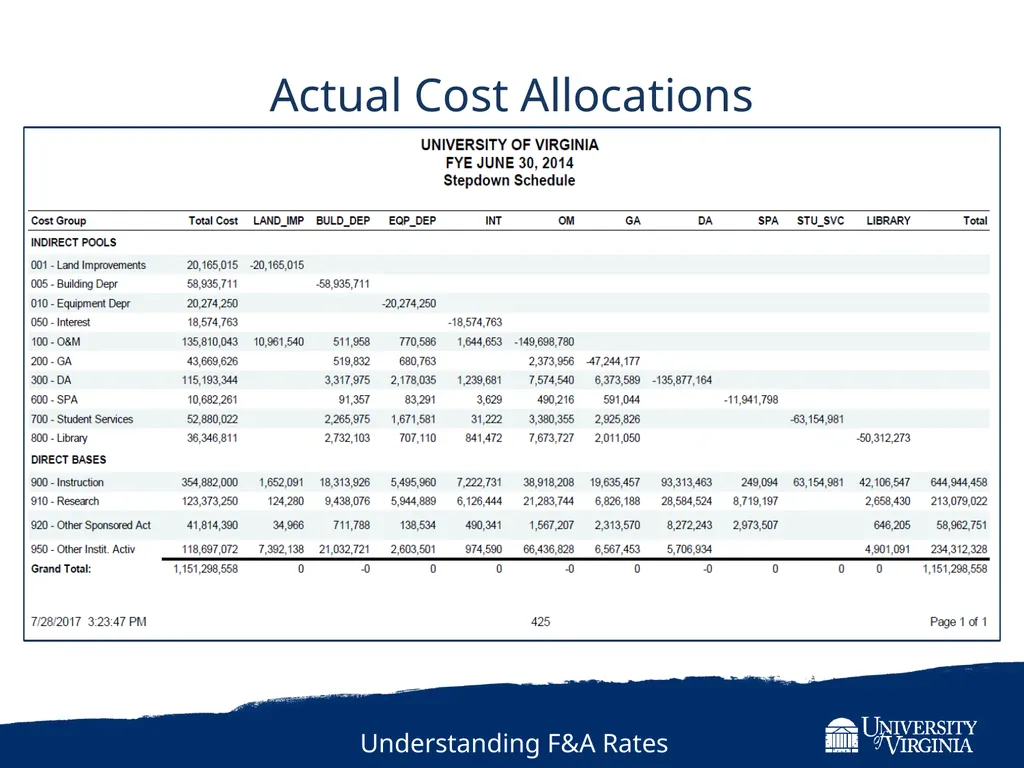
30
Actual Cost Allocations Understanding F&A Rates<br>
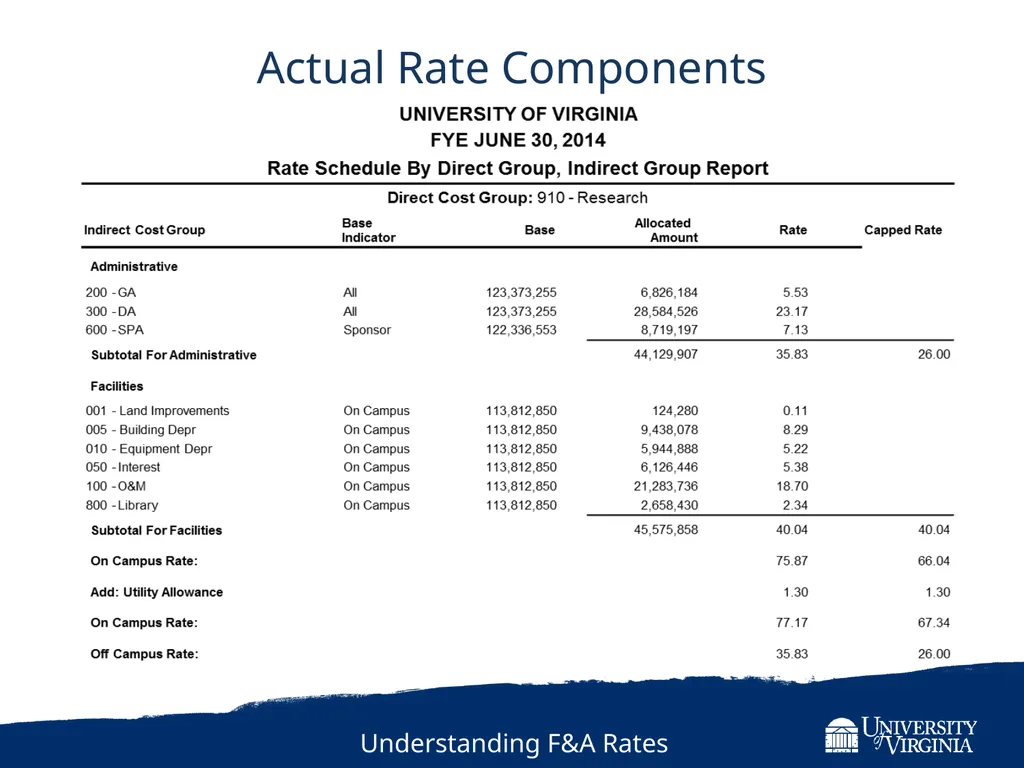
31
Actual Rate Components Understanding F&A Rates<br>
32
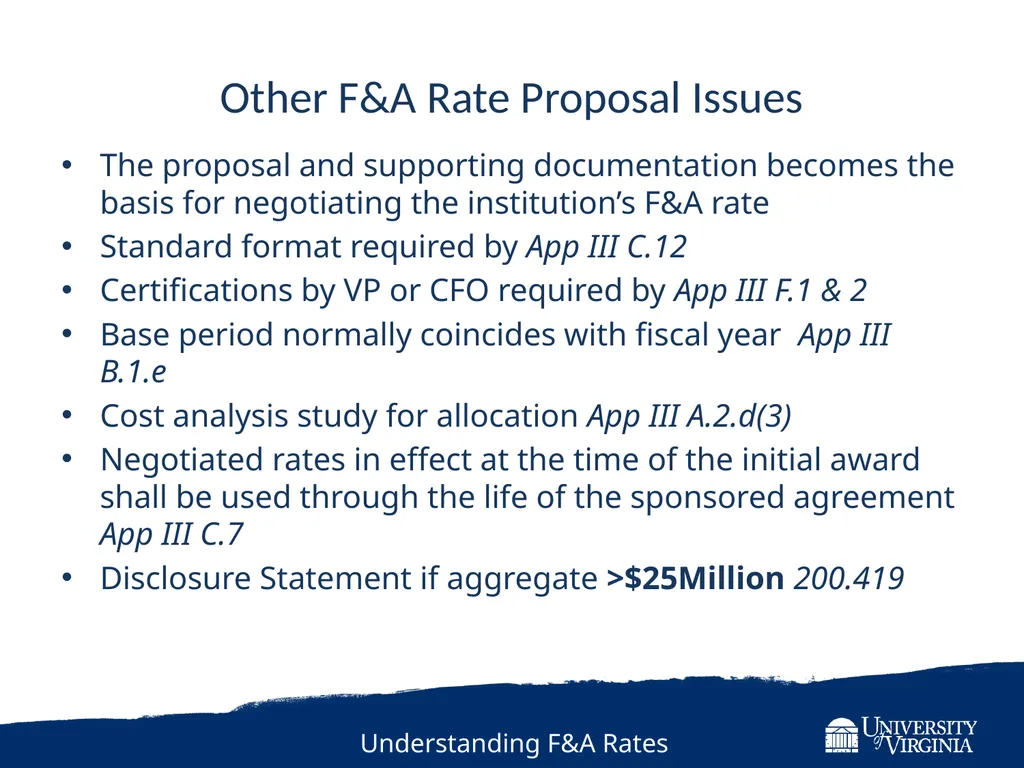
Other F&A Rate Proposal Issues The proposal and supporting documentation becomes the basis for negotiating the institution’s F&A rate
Standard format required by App III C.12
Certifications by VP or CFO required by App III F.1 & 2
Base period normally coincides with fiscal year App III B.1.e
Cost analysis study for allocation App III A.2.d(3)
Negotiated rates in effect at the time of the initial award shall be used through the life of the sponsored agreement App III C.7
Disclosure Statement if aggregate >$25Million 200.419 Understanding F&A Rates<br>
Standard format required by App III C.12
Certifications by VP or CFO required by App III F.1 & 2
Base period normally coincides with fiscal year App III B.1.e
Cost analysis study for allocation App III A.2.d(3)
Negotiated rates in effect at the time of the initial award shall be used through the life of the sponsored agreement App III C.7
Disclosure Statement if aggregate >$25Million 200.419 Understanding F&A Rates<br>
33
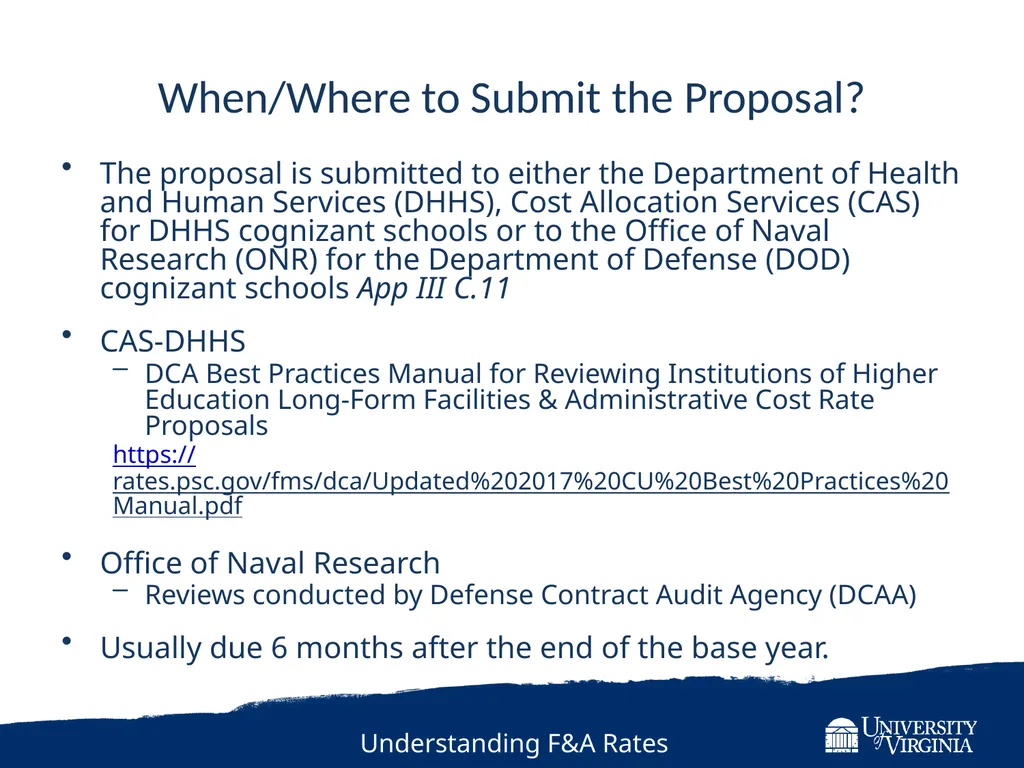
When/Where to Submit the Proposal? The proposal is submitted to either the Department of Health and Human Services (DHHS), Cost Allocation Services (CAS) for DHHS cognizant schools or to the Office of Naval Research (ONR) for the Department of Defense (DOD) cognizant schools App III C.11
CAS-DHHS
DCA Best Practices Manual for Reviewing Institutions of Higher Education Long-Form Facilities & Administrative Cost Rate Proposals
https://rates.psc.gov/fms/dca/Updated%202017%20CU%20Best%20Practices%20Manual.pdf
Office of Naval Research
Reviews conducted by Defense Contract Audit Agency (DCAA)
Usually due 6 months after the end of the base year. Understanding F&A Rates<br>
CAS-DHHS
DCA Best Practices Manual for Reviewing Institutions of Higher Education Long-Form Facilities & Administrative Cost Rate Proposals
https://rates.psc.gov/fms/dca/Updated%202017%20CU%20Best%20Practices%20Manual.pdf
Office of Naval Research
Reviews conducted by Defense Contract Audit Agency (DCAA)
Usually due 6 months after the end of the base year. Understanding F&A Rates<br>
34
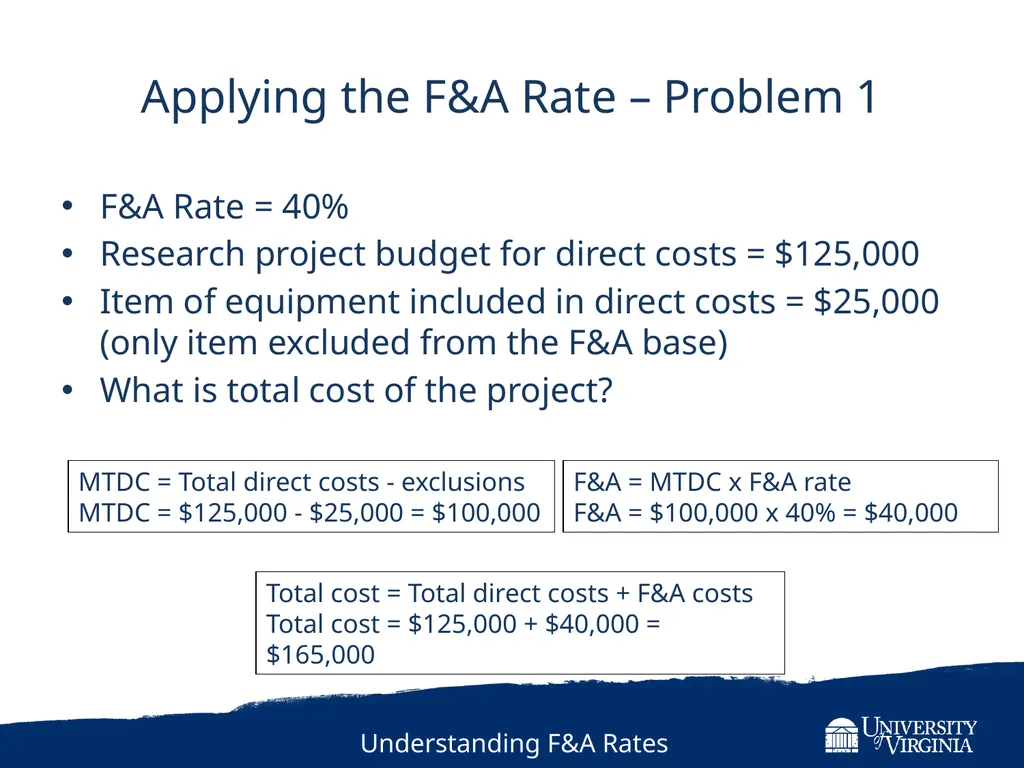
Applying the F&A Rate – Problem 1 F&A Rate = 40%
Research project budget for direct costs = $125,000
Item of equipment included in direct costs = $25,000 (only item excluded from the F&A base)
What is total cost of the project? MTDC = Total direct costs - exclusions
MTDC = $125,000 - $25,000 = $100,000 Total cost = Total direct costs + F&A costs
Total cost = $125,000 + $40,000 = $165,000 F&A = MTDC x F&A rate
F&A = $100,000 x 40% = $40,000 Understanding F&A Rates<br>
Research project budget for direct costs = $125,000
Item of equipment included in direct costs = $25,000 (only item excluded from the F&A base)
What is total cost of the project? MTDC = Total direct costs - exclusions
MTDC = $125,000 - $25,000 = $100,000 Total cost = Total direct costs + F&A costs
Total cost = $125,000 + $40,000 = $165,000 F&A = MTDC x F&A rate
F&A = $100,000 x 40% = $40,000 Understanding F&A Rates<br>
35
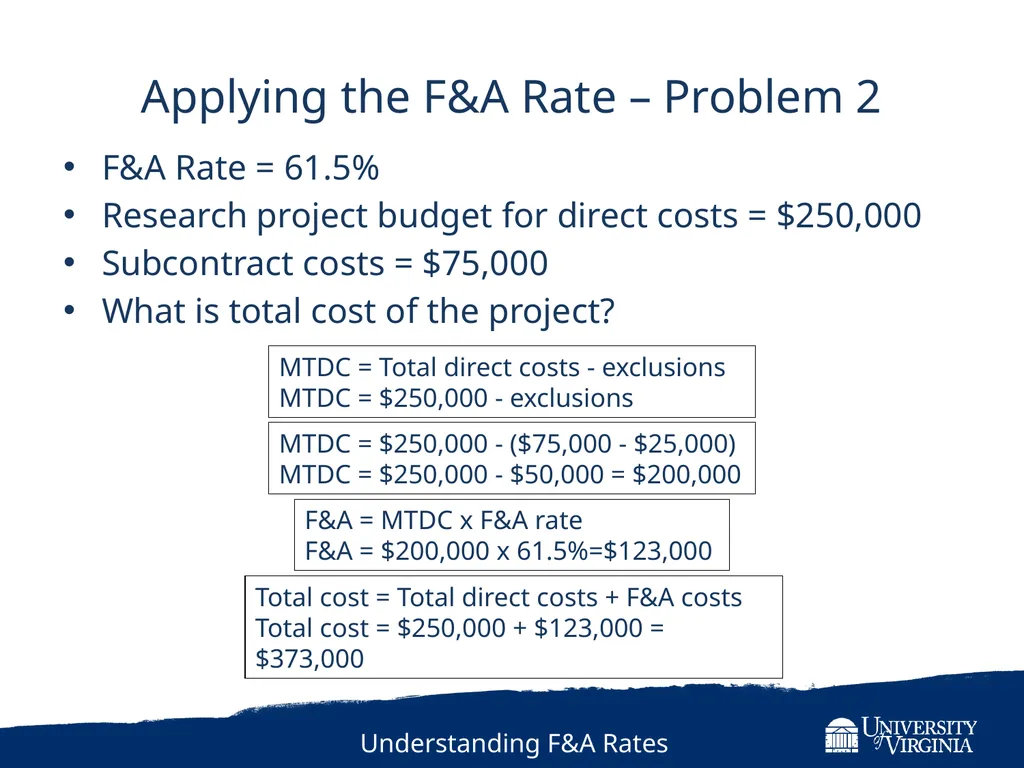
Applying the F&A Rate – Problem 2 F&A Rate = 61.5%
Research project budget for direct costs = $250,000
Subcontract costs = $75,000
What is total cost of the project? MTDC = Total direct costs - exclusions
MTDC = $250,000 - exclusions Total cost = Total direct costs + F&A costs
Total cost = $250,000 + $123,000 = $373,000 F&A = MTDC x F&A rate
F&A = $200,000 x 61.5%=$123,000 MTDC = $250,000 - ($75,000 - $25,000)
MTDC = $250,000 - $50,000 = $200,000 Understanding F&A Rates<br>
Research project budget for direct costs = $250,000
Subcontract costs = $75,000
What is total cost of the project? MTDC = Total direct costs - exclusions
MTDC = $250,000 - exclusions Total cost = Total direct costs + F&A costs
Total cost = $250,000 + $123,000 = $373,000 F&A = MTDC x F&A rate
F&A = $200,000 x 61.5%=$123,000 MTDC = $250,000 - ($75,000 - $25,000)
MTDC = $250,000 - $50,000 = $200,000 Understanding F&A Rates<br>
36
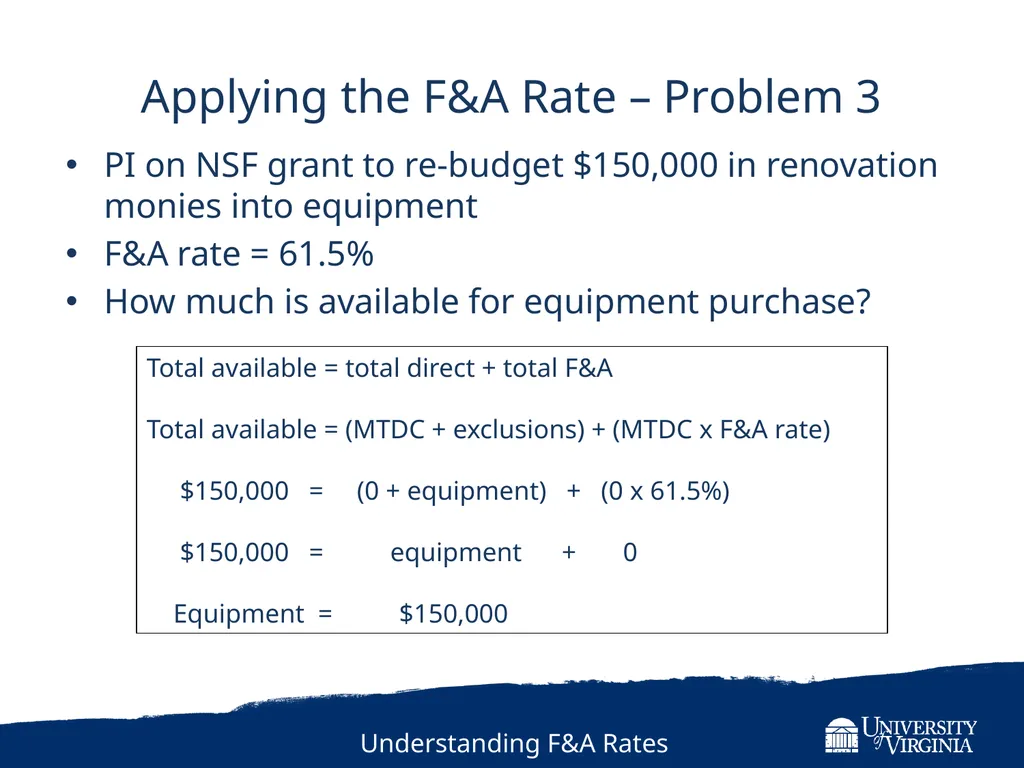
Applying the F&A Rate – Problem 3 PI on NSF grant to re-budget $150,000 in renovation monies into equipment
F&A rate = 61.5%
How much is available for equipment purchase? Total available = total direct + total F&A
Total available = (MTDC + exclusions) + (MTDC x F&A rate)
$150,000 = (0 + equipment) + (0 x 61.5%)
$150,000 = equipment + 0
Equipment = $150,000 Understanding F&A Rates<br>
F&A rate = 61.5%
How much is available for equipment purchase? Total available = total direct + total F&A
Total available = (MTDC + exclusions) + (MTDC x F&A rate)
$150,000 = (0 + equipment) + (0 x 61.5%)
$150,000 = equipment + 0
Equipment = $150,000 Understanding F&A Rates<br>
37
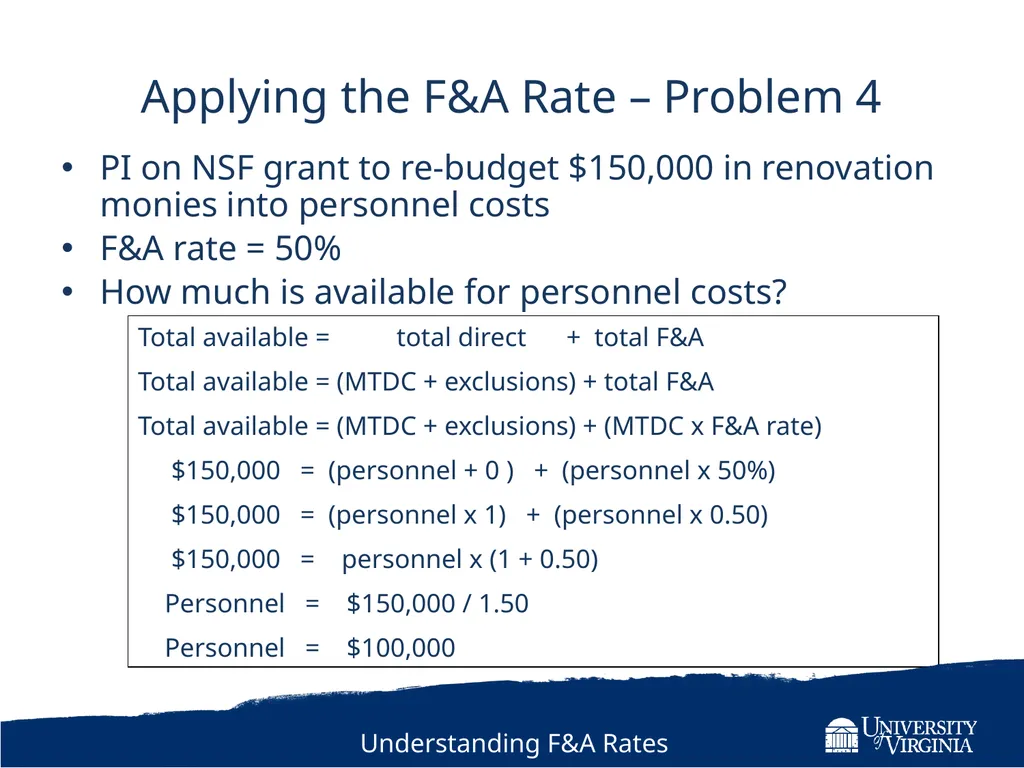
Applying the F&A Rate – Problem 4 PI on NSF grant to re-budget $150,000 in renovation monies into personnel costs
F&A rate = 50%
How much is available for personnel costs? Total available = total direct + total F&A
Total available = (MTDC + exclusions) + total F&A
Total available = (MTDC + exclusions) + (MTDC x F&A rate)
$150,000 = (personnel + 0 ) + (personnel x 50%)
$150,000 = (personnel x 1) + (personnel x 0.50)
$150,000 = personnel x (1 + 0.50)
Personnel = $150,000 / 1.50
Personnel = $100,000 Understanding F&A Rates<br>
F&A rate = 50%
How much is available for personnel costs? Total available = total direct + total F&A
Total available = (MTDC + exclusions) + total F&A
Total available = (MTDC + exclusions) + (MTDC x F&A rate)
$150,000 = (personnel + 0 ) + (personnel x 50%)
$150,000 = (personnel x 1) + (personnel x 0.50)
$150,000 = personnel x (1 + 0.50)
Personnel = $150,000 / 1.50
Personnel = $100,000 Understanding F&A Rates<br>
38
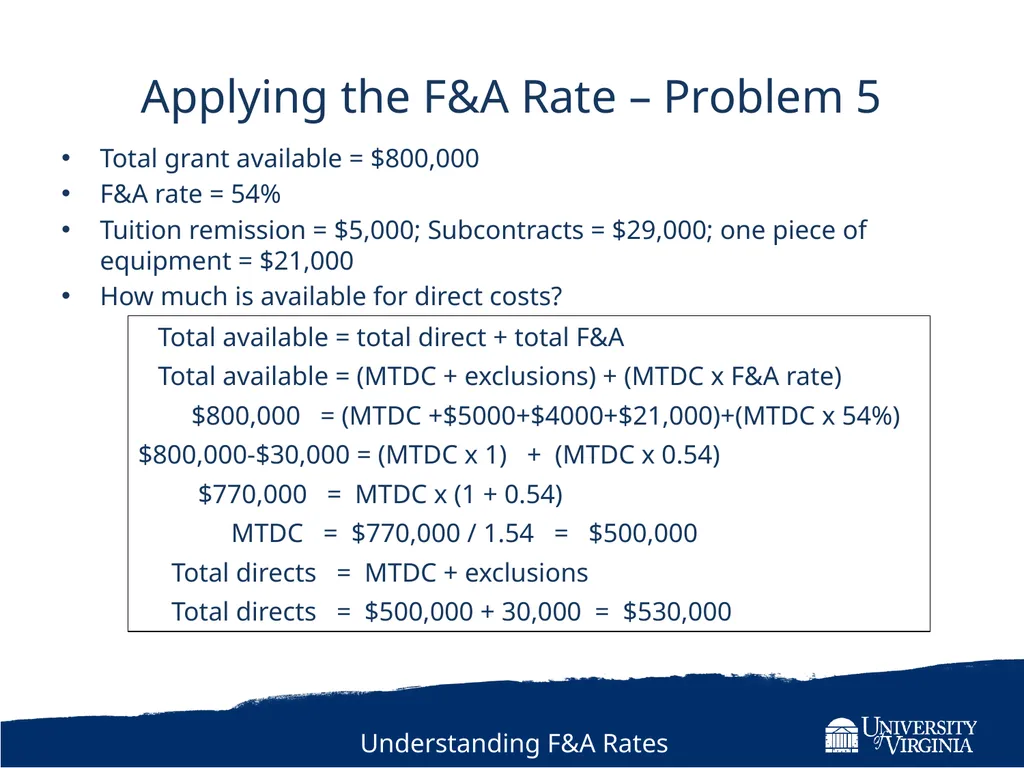
Applying the F&A Rate – Problem 5 Total grant available = $800,000
F&A rate = 54%
Tuition remission = $5,000; Subcontracts = $29,000; one piece of equipment = $21,000
How much is available for direct costs? Total available = total direct + total F&A
Total available = (MTDC + exclusions) + (MTDC x F&A rate)
$800,000 = (MTDC +$5000+$4000+$21,000)+(MTDC x 54%)
$800,000-$30,000 = (MTDC x 1) + (MTDC x 0.54)
$770,000 = MTDC x (1 + 0.54)
MTDC = $770,000 / 1.54 = $500,000
Total directs = MTDC + exclusions
Total directs = $500,000 + 30,000 = $530,000 Understanding F&A Rates<br>
F&A rate = 54%
Tuition remission = $5,000; Subcontracts = $29,000; one piece of equipment = $21,000
How much is available for direct costs? Total available = total direct + total F&A
Total available = (MTDC + exclusions) + (MTDC x F&A rate)
$800,000 = (MTDC +$5000+$4000+$21,000)+(MTDC x 54%)
$800,000-$30,000 = (MTDC x 1) + (MTDC x 0.54)
$770,000 = MTDC x (1 + 0.54)
MTDC = $770,000 / 1.54 = $500,000
Total directs = MTDC + exclusions
Total directs = $500,000 + 30,000 = $530,000 Understanding F&A Rates<br>
39
Significant Issues Regarding Recharge Operations Understanding F&A Rates<br>
40
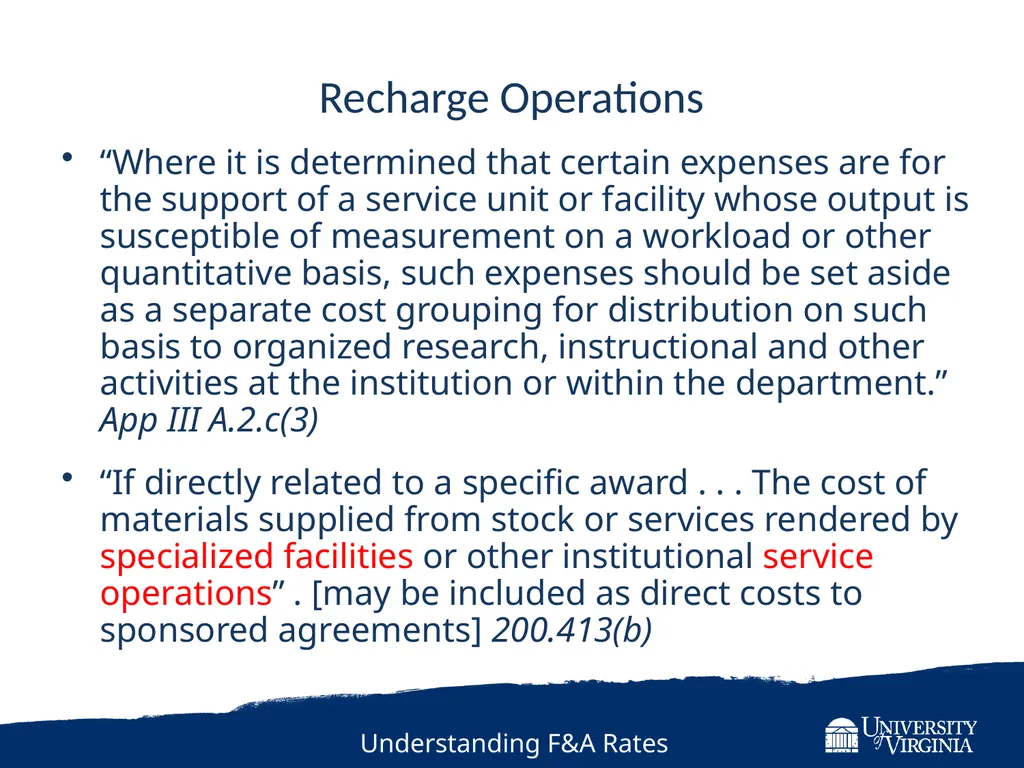
Recharge Operations “Where it is determined that certain expenses are for the support of a service unit or facility whose output is susceptible of measurement on a workload or other quantitative basis, such expenses should be set aside as a separate cost grouping for distribution on such basis to organized research, instructional and other activities at the institution or within the department.” App III A.2.c(3)
“If directly related to a specific award . . . The cost of materials supplied from stock or services rendered by specialized facilities or other institutional service operations” . [may be included as direct costs to sponsored agreements] 200.413(b) Understanding F&A Rates<br>
“If directly related to a specific award . . . The cost of materials supplied from stock or services rendered by specialized facilities or other institutional service operations” . [may be included as direct costs to sponsored agreements] 200.413(b) Understanding F&A Rates<br>
41
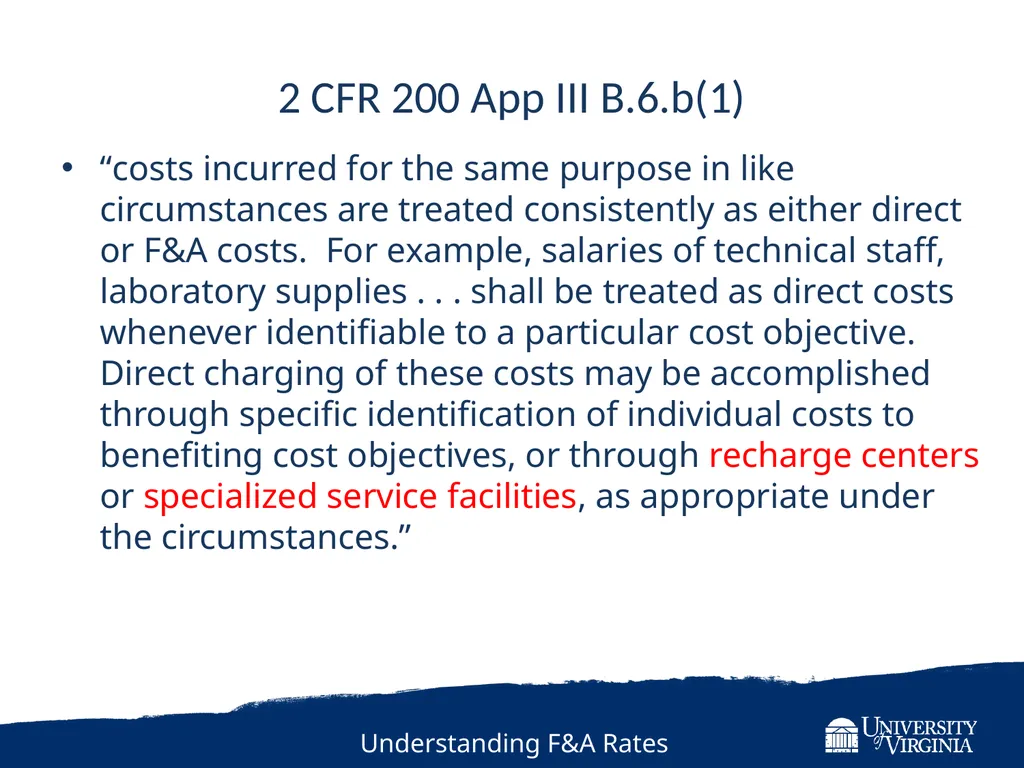
2 CFR 200 App III B.6.b(1) “costs incurred for the same purpose in like circumstances are treated consistently as either direct or F&A costs. For example, salaries of technical staff, laboratory supplies . . . shall be treated as direct costs whenever identifiable to a particular cost objective. Direct charging of these costs may be accomplished through specific identification of individual costs to benefiting cost objectives, or through recharge centers or specialized service facilities, as appropriate under the circumstances.” Understanding F&A Rates<br>
42
2 CFR 200.468 “Does not discriminate against federal-supported activities of the institution, including usage by the institution for internal purposes.”
“Is designed to recover only the aggregate costs of the services.”
“The costs of the service shall consist normally of both its direct costs and its allocable share of all F&A costs.”
Rates shall be adjusted at least biennially, and shall take into consideration over/under applied costs of the pervious period(s). Understanding F&A Rates<br>
“Is designed to recover only the aggregate costs of the services.”
“The costs of the service shall consist normally of both its direct costs and its allocable share of all F&A costs.”
Rates shall be adjusted at least biennially, and shall take into consideration over/under applied costs of the pervious period(s). Understanding F&A Rates<br>
43
Other Recharge Center Key Points No profit – break-even operations - recover only cost
No unallowable costs
If over-charge, then must refund to every grant or lower next year’s rate
Depreciation is allowable
Consistency, consistency, consistency
Use a recognized method of computing actual costs
Confirm to generally accepted cost accounting practices
Service center, recharge center, specialized service facility Understanding F&A Rates<br>
No unallowable costs
If over-charge, then must refund to every grant or lower next year’s rate
Depreciation is allowable
Consistency, consistency, consistency
Use a recognized method of computing actual costs
Confirm to generally accepted cost accounting practices
Service center, recharge center, specialized service facility Understanding F&A Rates<br>
44
Questions? Office of Financial Planning & Analysis contact information
Andrew McGehee ajm9ws@virginia.edu
Minh Nguyen mtn9ba@virginia.edu
Our F&A website is at
https://financialplanning.vpfinance.virginia.edu/facilities-administrative-costs Understanding F&A Rates<br>
Andrew McGehee ajm9ws@virginia.edu
Minh Nguyen mtn9ba@virginia.edu
Our F&A website is at
https://financialplanning.vpfinance.virginia.edu/facilities-administrative-costs Understanding F&A Rates<br>