
Oracle Statistics by Example Mauro Pagano Mauro
A
Published · 36 slides · 0 views

1 / 1

Description
Oracle Statistics by Example Mauro Pagano Mauro Pagano Consultant Developer Oracle Enkitec Accenture DBPerf and SQL Tuning Training Tools (SQLT, SQLd360, TUNAs360, Pathfinder) 2 Background Optimizer generates execution plans Many
Related Topics
Share
Embed code
Download this presentation From Below
"Oracle Statistics by Example Mauro Pagano Mauro" is the property of its rightful owner. Permission is granted to download and print the materials on this website for personal, non-commercial use only, and to display it on your personal computer provided you do not modify the materials and that you retain all copyright notices contained in the materials. By downloading content from our website, you accept the terms of this agreement.
Presentation Transcript
01
Oracle Statistics by Example Mauro Pagano<br>
02
Mauro Pagano Consultant & Developer
Oracle Enkitec Accenture
DBPerf and SQL Tuning
Training
Tools (SQLT, SQLd360, TUNAs360, Pathfinder) 2<br>
Oracle Enkitec Accenture
DBPerf and SQL Tuning
Training
Tools (SQLT, SQLd360, TUNAs360, Pathfinder) 2<br>
03
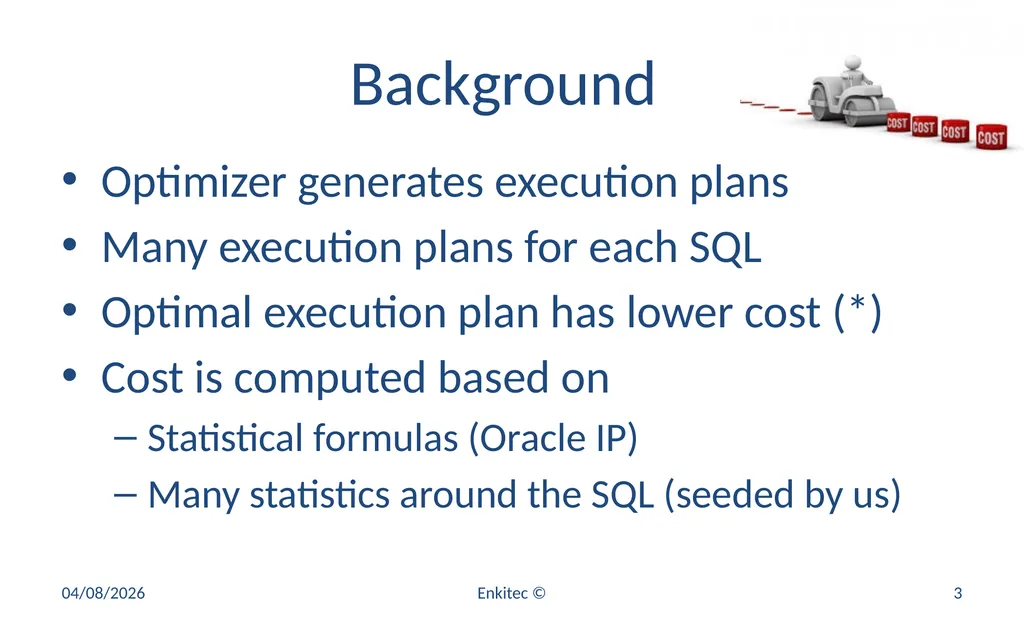
Background Optimizer generates execution plans
Many execution plans for each SQL
Optimal execution plan has lower cost (*)
Cost is computed based on
Statistical formulas (Oracle IP)
Many statistics around the SQL (seeded by us) 10/28/16 Enkitec © 3<br>
Many execution plans for each SQL
Optimal execution plan has lower cost (*)
Cost is computed based on
Statistical formulas (Oracle IP)
Many statistics around the SQL (seeded by us) 10/28/16 Enkitec © 3<br>
04
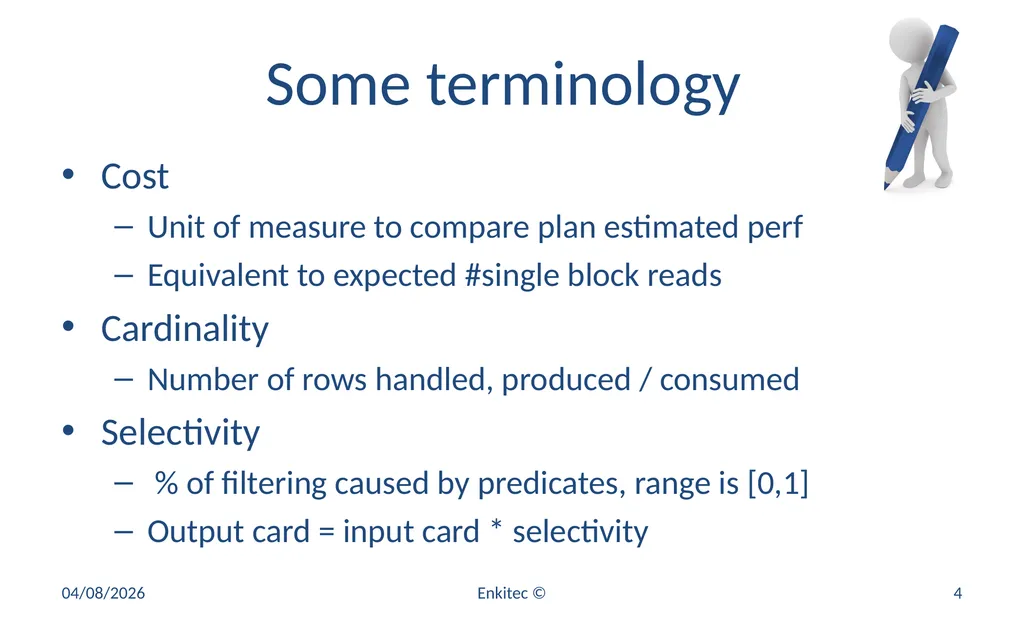
Some terminology Cost
Unit of measure to compare plan estimated perf
Equivalent to expected #single block reads
Cardinality
Number of rows handled, produced / consumed
Selectivity
% of filtering caused by predicates, range is [0,1]
Output card = input card * selectivity 10/28/16 Enkitec © 4<br>
Unit of measure to compare plan estimated perf
Equivalent to expected #single block reads
Cardinality
Number of rows handled, produced / consumed
Selectivity
% of filtering caused by predicates, range is [0,1]
Output card = input card * selectivity 10/28/16 Enkitec © 4<br>
05
Why so much emphasis? Statistics are “picture” about entities
Quality of the picture affects quality plan
Poor stats generally lead to poor plans (*)
Better stats generally lead to better plans (*)
Our best bet is to provide good quality stats
Not always as trivial as it sounds 10/28/16 Enkitec © 5<br>
Quality of the picture affects quality plan
Poor stats generally lead to poor plans (*)
Better stats generally lead to better plans (*)
Our best bet is to provide good quality stats
Not always as trivial as it sounds 10/28/16 Enkitec © 5<br>
06
Many type of statistics Oracle Optimizer uses statistics about
Objects: tables, indexes, columns, etc
System: CPU Speed and many IO metrics
Dictionary: Oracle internal physical objects
Fixed Objects: memory structure (X$)
First two affect application SQLs
Focus of this presentation is object statistics 10/28/16 Enkitec © 6<br>
Objects: tables, indexes, columns, etc
System: CPU Speed and many IO metrics
Dictionary: Oracle internal physical objects
Fixed Objects: memory structure (X$)
First two affect application SQLs
Focus of this presentation is object statistics 10/28/16 Enkitec © 6<br>
07
What should I do about statistics? Collect them
Object stats when there are “enough” changes
System stats once, if any (*)
Oracle-seeded package DBMS_STATS
Used to collect all type of statistics
Plus drop, exp/imp, set prefs, etc etc
Many params to affect how/what to collect
Can have large impact on quality 10/28/16 Enkitec © 7<br>
Object stats when there are “enough” changes
System stats once, if any (*)
Oracle-seeded package DBMS_STATS
Used to collect all type of statistics
Plus drop, exp/imp, set prefs, etc etc
Many params to affect how/what to collect
Can have large impact on quality 10/28/16 Enkitec © 7<br>
08
When should I gather stats? No specific threshold in terms of time
Balance between frequency and quality
Gather high quality is expensive thus slow exec
Gather frequently require fast exec
Optimal plans tend not to change over time
Favor quality over frequency 10/28/16 Enkitec © 8<br>
Balance between frequency and quality
Gather high quality is expensive thus slow exec
Gather frequently require fast exec
Optimal plans tend not to change over time
Favor quality over frequency 10/28/16 Enkitec © 8<br>
09
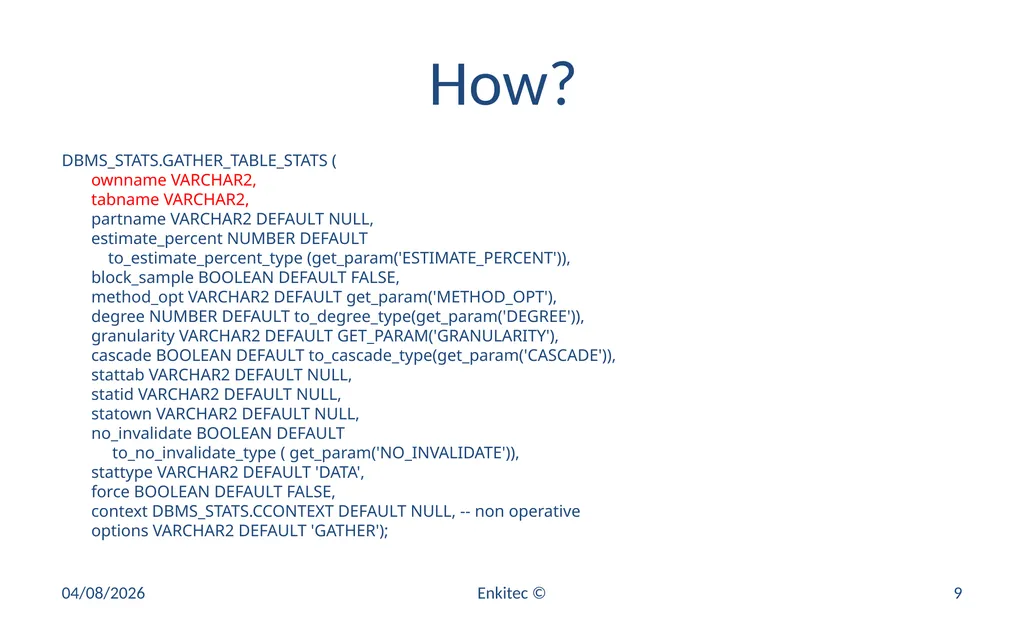
How? DBMS_STATS.GATHER_TABLE_STATS (
ownname VARCHAR2,
tabname VARCHAR2,
partname VARCHAR2 DEFAULT NULL,
estimate_percent NUMBER DEFAULT
to_estimate_percent_type (get_param('ESTIMATE_PERCENT')),
block_sample BOOLEAN DEFAULT FALSE,
method_opt VARCHAR2 DEFAULT get_param('METHOD_OPT'),
degree NUMBER DEFAULT to_degree_type(get_param('DEGREE')),
granularity VARCHAR2 DEFAULT GET_PARAM('GRANULARITY'),
cascade BOOLEAN DEFAULT to_cascade_type(get_param('CASCADE')),
stattab VARCHAR2 DEFAULT NULL,
statid VARCHAR2 DEFAULT NULL,
statown VARCHAR2 DEFAULT NULL,
no_invalidate BOOLEAN DEFAULT
to_no_invalidate_type ( get_param('NO_INVALIDATE')),
stattype VARCHAR2 DEFAULT 'DATA',
force BOOLEAN DEFAULT FALSE,
context DBMS_STATS.CCONTEXT DEFAULT NULL, -- non operative
options VARCHAR2 DEFAULT 'GATHER'); 10/28/16 Enkitec © 9<br>
ownname VARCHAR2,
tabname VARCHAR2,
partname VARCHAR2 DEFAULT NULL,
estimate_percent NUMBER DEFAULT
to_estimate_percent_type (get_param('ESTIMATE_PERCENT')),
block_sample BOOLEAN DEFAULT FALSE,
method_opt VARCHAR2 DEFAULT get_param('METHOD_OPT'),
degree NUMBER DEFAULT to_degree_type(get_param('DEGREE')),
granularity VARCHAR2 DEFAULT GET_PARAM('GRANULARITY'),
cascade BOOLEAN DEFAULT to_cascade_type(get_param('CASCADE')),
stattab VARCHAR2 DEFAULT NULL,
statid VARCHAR2 DEFAULT NULL,
statown VARCHAR2 DEFAULT NULL,
no_invalidate BOOLEAN DEFAULT
to_no_invalidate_type ( get_param('NO_INVALIDATE')),
stattype VARCHAR2 DEFAULT 'DATA',
force BOOLEAN DEFAULT FALSE,
context DBMS_STATS.CCONTEXT DEFAULT NULL, -- non operative
options VARCHAR2 DEFAULT 'GATHER'); 10/28/16 Enkitec © 9<br>
10
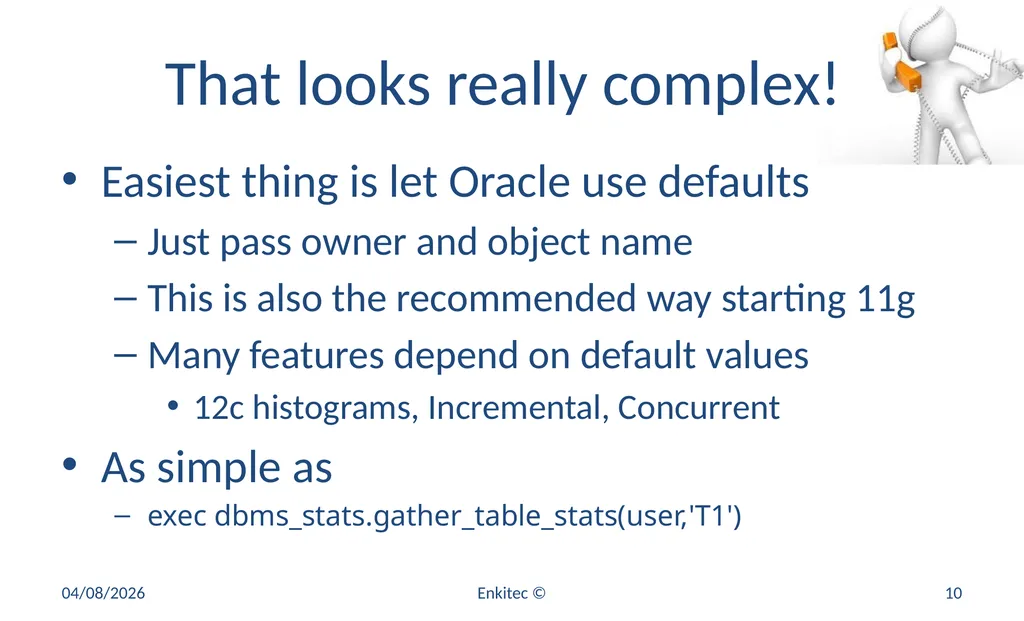
That looks really complex! Easiest thing is let Oracle use defaults
Just pass owner and object name
This is also the recommended way starting 11g
Many features depend on default values
12c histograms, Incremental, Concurrent
As simple as
exec dbms_stats.gather_table_stats(user,'T1') 10/28/16 Enkitec © 10<br>
Just pass owner and object name
This is also the recommended way starting 11g
Many features depend on default values
12c histograms, Incremental, Concurrent
As simple as
exec dbms_stats.gather_table_stats(user,'T1') 10/28/16 Enkitec © 10<br>
11
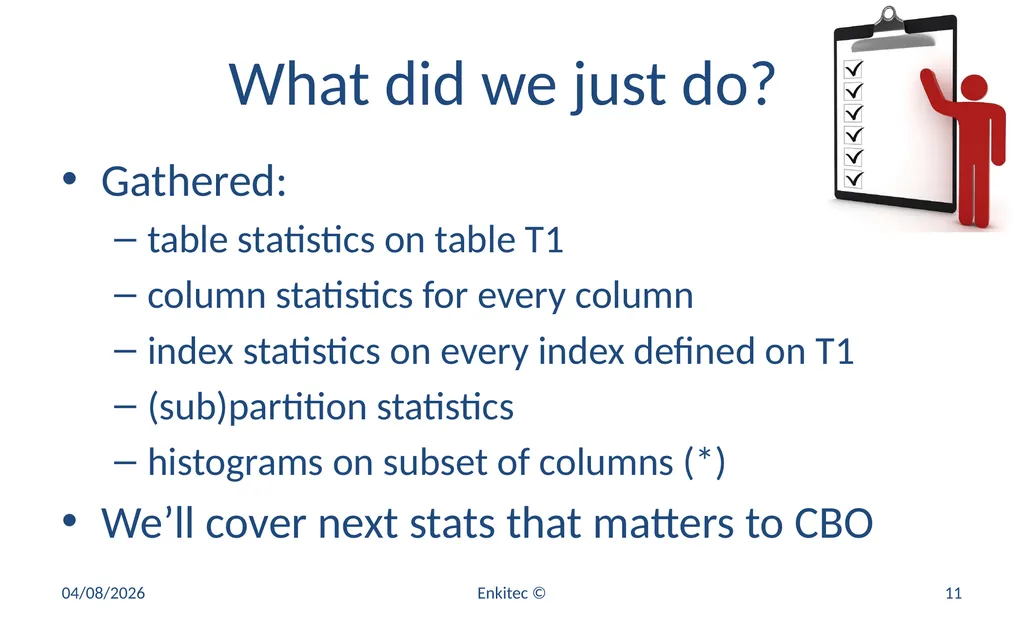
What did we just do? Gathered:
table statistics on table T1
column statistics for every column
index statistics on every index defined on T1
(sub)partition statistics
histograms on subset of columns (*)
We’ll cover next stats that matters to CBO 10/28/16 Enkitec © 11<br>
table statistics on table T1
column statistics for every column
index statistics on every index defined on T1
(sub)partition statistics
histograms on subset of columns (*)
We’ll cover next stats that matters to CBO 10/28/16 Enkitec © 11<br>
12
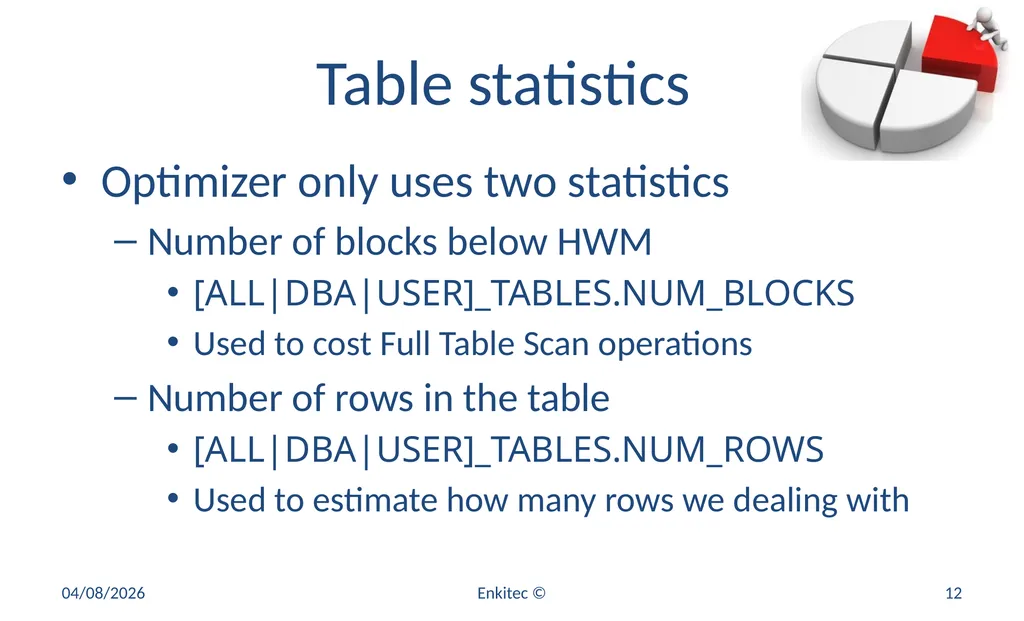
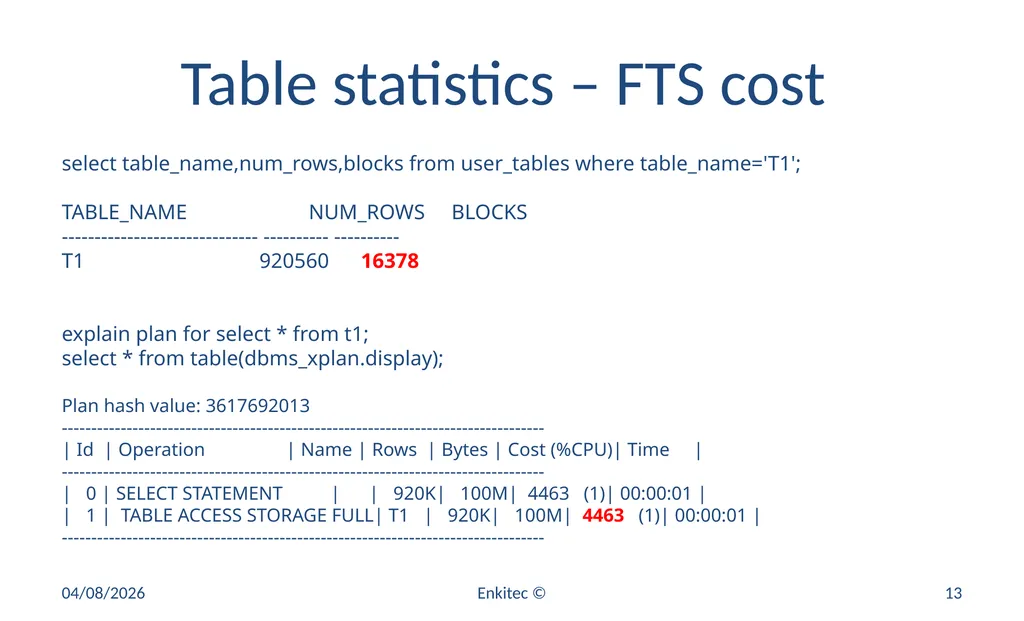
Table statistics Optimizer only uses two statistics
Number of blocks below HWM
[ALL|DBA|USER]_TABLES.NUM_BLOCKS
Used to cost Full Table Scan operations
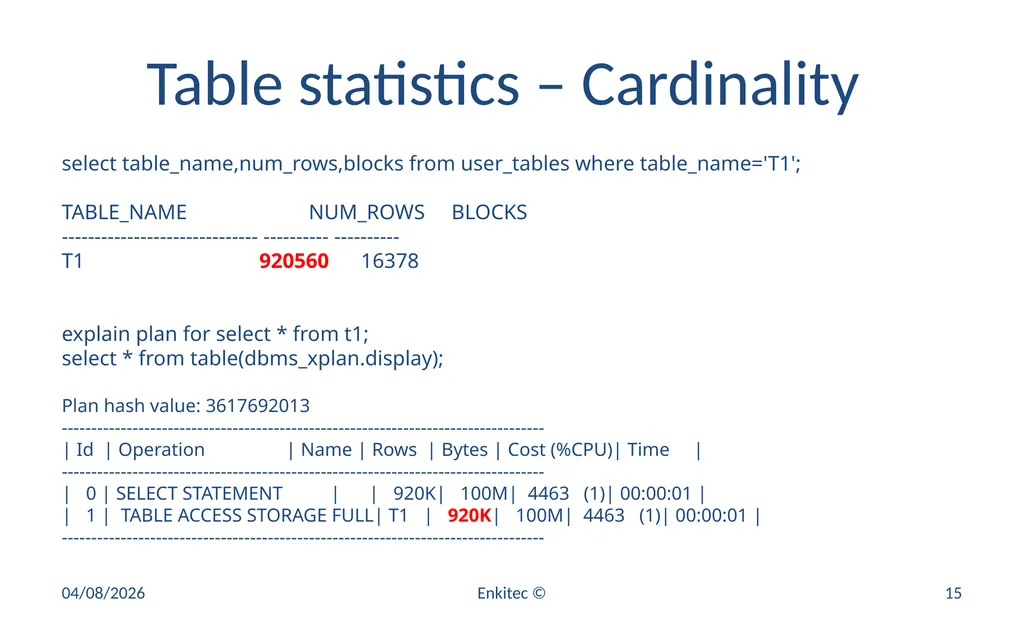
Number of rows in the table
[ALL|DBA|USER]_TABLES.NUM_ROWS
Used to estimate how many rows we dealing with 10/28/16 Enkitec © 12<br>
Number of blocks below HWM
[ALL|DBA|USER]_TABLES.NUM_BLOCKS
Used to cost Full Table Scan operations
Number of rows in the table
[ALL|DBA|USER]_TABLES.NUM_ROWS
Used to estimate how many rows we dealing with 10/28/16 Enkitec © 12<br>
13
Table statistics – FTS cost select table_name,num_rows,blocks from user_tables where table_name='T1';
TABLE_NAME NUM_ROWS BLOCKS
------------------------------ ---------- ----------
T1 920560 16378
explain plan for select * from t1;
select * from table(dbms_xplan.display);
Plan hash value: 3617692013
----------------------------------------------------------------------------------
| Id | Operation | Name | Rows | Bytes | Cost (%CPU)| Time |
----------------------------------------------------------------------------------
| 0 | SELECT STATEMENT | | 920K| 100M| 4463 (1)| 00:00:01 |
| 1 | TABLE ACCESS STORAGE FULL| T1 | 920K| 100M| 4463 (1)| 00:00:01 |
---------------------------------------------------------------------------------- 10/28/16 Enkitec © 13<br>
TABLE_NAME NUM_ROWS BLOCKS
------------------------------ ---------- ----------
T1 920560 16378
explain plan for select * from t1;
select * from table(dbms_xplan.display);
Plan hash value: 3617692013
----------------------------------------------------------------------------------
| Id | Operation | Name | Rows | Bytes | Cost (%CPU)| Time |
----------------------------------------------------------------------------------
| 0 | SELECT STATEMENT | | 920K| 100M| 4463 (1)| 00:00:01 |
| 1 | TABLE ACCESS STORAGE FULL| T1 | 920K| 100M| 4463 (1)| 00:00:01 |
---------------------------------------------------------------------------------- 10/28/16 Enkitec © 13<br>
14
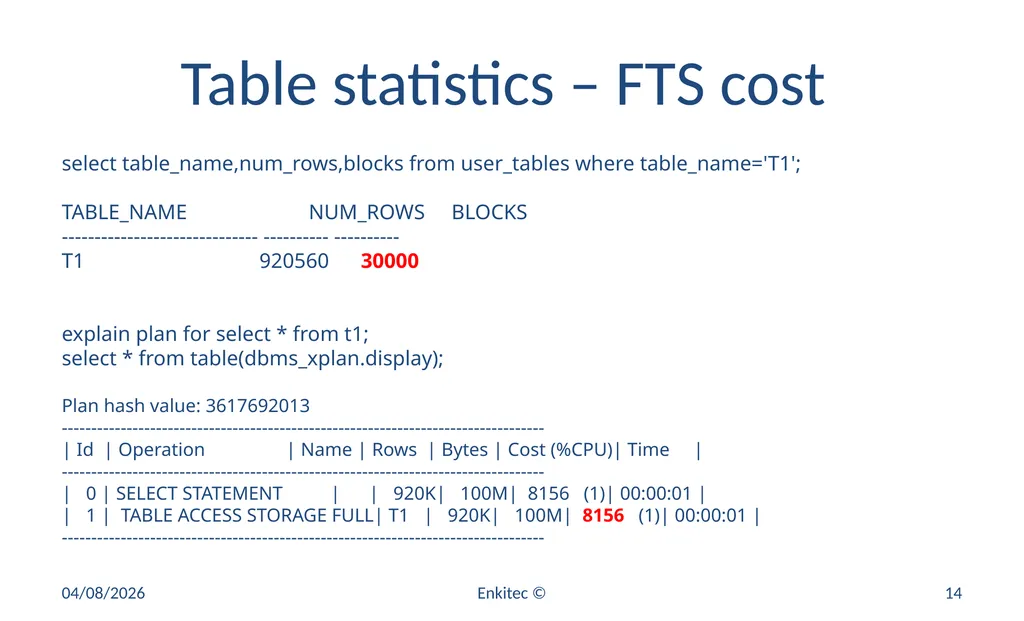
Table statistics – FTS cost select table_name,num_rows,blocks from user_tables where table_name='T1';
TABLE_NAME NUM_ROWS BLOCKS
------------------------------ ---------- ----------
T1 920560 30000
explain plan for select * from t1;
select * from table(dbms_xplan.display);
Plan hash value: 3617692013
----------------------------------------------------------------------------------
| Id | Operation | Name | Rows | Bytes | Cost (%CPU)| Time |
----------------------------------------------------------------------------------
| 0 | SELECT STATEMENT | | 920K| 100M| 8156 (1)| 00:00:01 |
| 1 | TABLE ACCESS STORAGE FULL| T1 | 920K| 100M| 8156 (1)| 00:00:01 |
---------------------------------------------------------------------------------- 10/28/16 Enkitec © 14<br>
TABLE_NAME NUM_ROWS BLOCKS
------------------------------ ---------- ----------
T1 920560 30000
explain plan for select * from t1;
select * from table(dbms_xplan.display);
Plan hash value: 3617692013
----------------------------------------------------------------------------------
| Id | Operation | Name | Rows | Bytes | Cost (%CPU)| Time |
----------------------------------------------------------------------------------
| 0 | SELECT STATEMENT | | 920K| 100M| 8156 (1)| 00:00:01 |
| 1 | TABLE ACCESS STORAGE FULL| T1 | 920K| 100M| 8156 (1)| 00:00:01 |
---------------------------------------------------------------------------------- 10/28/16 Enkitec © 14<br>
15
Table statistics – Cardinality select table_name,num_rows,blocks from user_tables where table_name='T1';
TABLE_NAME NUM_ROWS BLOCKS
------------------------------ ---------- ----------
T1 920560 16378
explain plan for select * from t1;
select * from table(dbms_xplan.display);
Plan hash value: 3617692013
----------------------------------------------------------------------------------
| Id | Operation | Name | Rows | Bytes | Cost (%CPU)| Time |
----------------------------------------------------------------------------------
| 0 | SELECT STATEMENT | | 920K| 100M| 4463 (1)| 00:00:01 |
| 1 | TABLE ACCESS STORAGE FULL| T1 | 920K| 100M| 4463 (1)| 00:00:01 |
---------------------------------------------------------------------------------- 10/28/16 Enkitec © 15<br>
TABLE_NAME NUM_ROWS BLOCKS
------------------------------ ---------- ----------
T1 920560 16378
explain plan for select * from t1;
select * from table(dbms_xplan.display);
Plan hash value: 3617692013
----------------------------------------------------------------------------------
| Id | Operation | Name | Rows | Bytes | Cost (%CPU)| Time |
----------------------------------------------------------------------------------
| 0 | SELECT STATEMENT | | 920K| 100M| 4463 (1)| 00:00:01 |
| 1 | TABLE ACCESS STORAGE FULL| T1 | 920K| 100M| 4463 (1)| 00:00:01 |
---------------------------------------------------------------------------------- 10/28/16 Enkitec © 15<br>
16
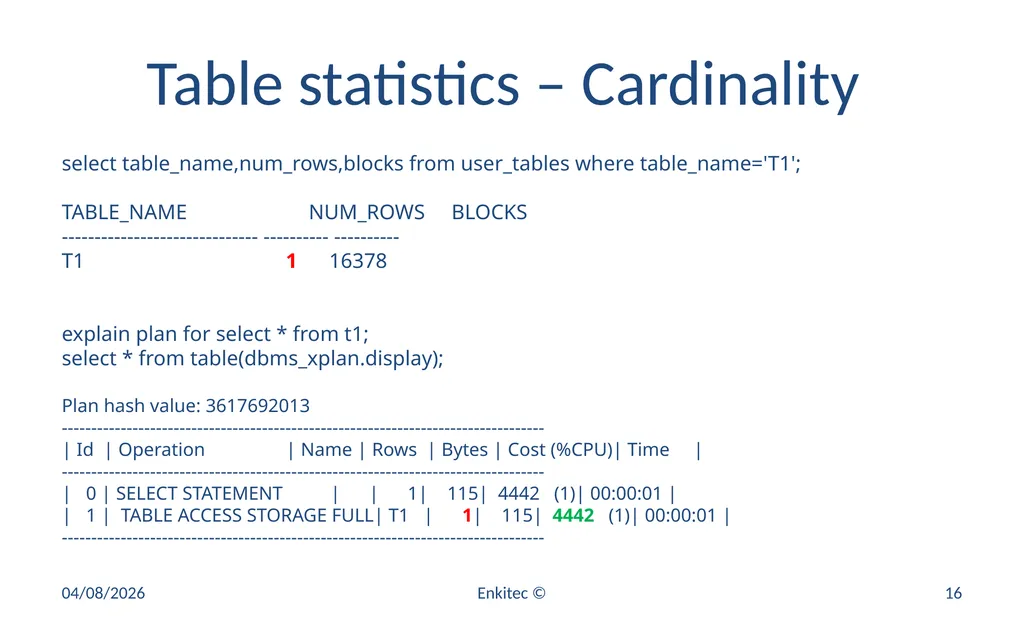
Table statistics – Cardinality select table_name,num_rows,blocks from user_tables where table_name='T1';
TABLE_NAME NUM_ROWS BLOCKS
------------------------------ ---------- ----------
T1 1 16378
explain plan for select * from t1;
select * from table(dbms_xplan.display);
Plan hash value: 3617692013
----------------------------------------------------------------------------------
| Id | Operation | Name | Rows | Bytes | Cost (%CPU)| Time |
----------------------------------------------------------------------------------
| 0 | SELECT STATEMENT | | 1| 115| 4442 (1)| 00:00:01 |
| 1 | TABLE ACCESS STORAGE FULL| T1 | 1| 115| 4442 (1)| 00:00:01 |
---------------------------------------------------------------------------------- 10/28/16 Enkitec © 16<br>
TABLE_NAME NUM_ROWS BLOCKS
------------------------------ ---------- ----------
T1 1 16378
explain plan for select * from t1;
select * from table(dbms_xplan.display);
Plan hash value: 3617692013
----------------------------------------------------------------------------------
| Id | Operation | Name | Rows | Bytes | Cost (%CPU)| Time |
----------------------------------------------------------------------------------
| 0 | SELECT STATEMENT | | 1| 115| 4442 (1)| 00:00:01 |
| 1 | TABLE ACCESS STORAGE FULL| T1 | 1| 115| 4442 (1)| 00:00:01 |
---------------------------------------------------------------------------------- 10/28/16 Enkitec © 16<br>
17
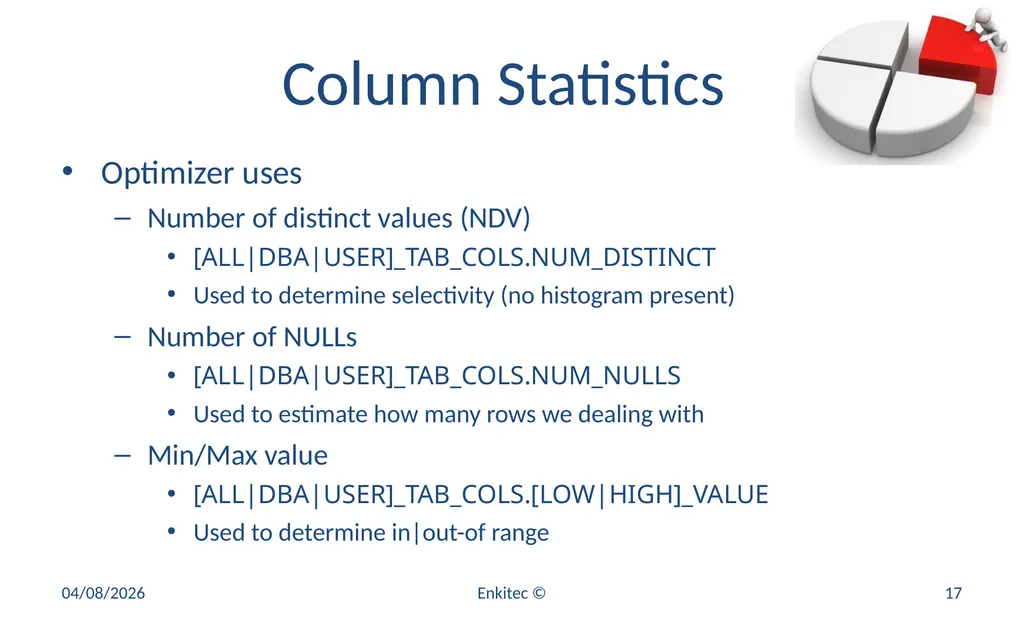
Column Statistics Optimizer uses
Number of distinct values (NDV)
[ALL|DBA|USER]_TAB_COLS.NUM_DISTINCT
Used to determine selectivity (no histogram present)
Number of NULLs
[ALL|DBA|USER]_TAB_COLS.NUM_NULLS
Used to estimate how many rows we dealing with
Min/Max value
[ALL|DBA|USER]_TAB_COLS.[LOW|HIGH]_VALUE
Used to determine in|out-of range 10/28/16 Enkitec © 17<br>
Number of distinct values (NDV)
[ALL|DBA|USER]_TAB_COLS.NUM_DISTINCT
Used to determine selectivity (no histogram present)
Number of NULLs
[ALL|DBA|USER]_TAB_COLS.NUM_NULLS
Used to estimate how many rows we dealing with
Min/Max value
[ALL|DBA|USER]_TAB_COLS.[LOW|HIGH]_VALUE
Used to determine in|out-of range 10/28/16 Enkitec © 17<br>
18
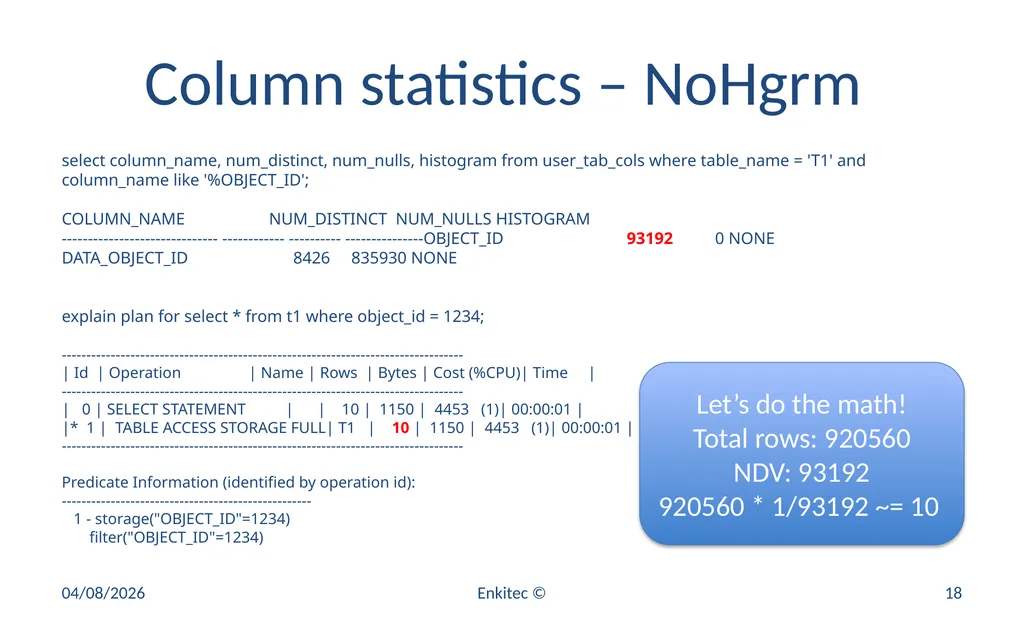
Column statistics – NoHgrm 10/28/16 Enkitec © 18 select column_name, num_distinct, num_nulls, histogram from user_tab_cols where table_name = 'T1' and column_name like '%OBJECT_ID';
COLUMN_NAME NUM_DISTINCT NUM_NULLS HISTOGRAM
------------------------------ ------------ ---------- ---------------OBJECT_ID 93192 0 NONE
DATA_OBJECT_ID 8426 835930 NONE
explain plan for select * from t1 where object_id = 1234;
----------------------------------------------------------------------------------
| Id | Operation | Name | Rows | Bytes | Cost (%CPU)| Time |
----------------------------------------------------------------------------------
| 0 | SELECT STATEMENT | | 10 | 1150 | 4453 (1)| 00:00:01 |
|* 1 | TABLE ACCESS STORAGE FULL| T1 | 10 | 1150 | 4453 (1)| 00:00:01 |
----------------------------------------------------------------------------------
Predicate Information (identified by operation id):
---------------------------------------------------
1 - storage("OBJECT_ID"=1234)
filter("OBJECT_ID"=1234) Let’s do the math!
Total rows: 920560
NDV: 93192
920560 * 1/93192 ~= 10<br>
COLUMN_NAME NUM_DISTINCT NUM_NULLS HISTOGRAM
------------------------------ ------------ ---------- ---------------OBJECT_ID 93192 0 NONE
DATA_OBJECT_ID 8426 835930 NONE
explain plan for select * from t1 where object_id = 1234;
----------------------------------------------------------------------------------
| Id | Operation | Name | Rows | Bytes | Cost (%CPU)| Time |
----------------------------------------------------------------------------------
| 0 | SELECT STATEMENT | | 10 | 1150 | 4453 (1)| 00:00:01 |
|* 1 | TABLE ACCESS STORAGE FULL| T1 | 10 | 1150 | 4453 (1)| 00:00:01 |
----------------------------------------------------------------------------------
Predicate Information (identified by operation id):
---------------------------------------------------
1 - storage("OBJECT_ID"=1234)
filter("OBJECT_ID"=1234) Let’s do the math!
Total rows: 920560
NDV: 93192
920560 * 1/93192 ~= 10<br>
19
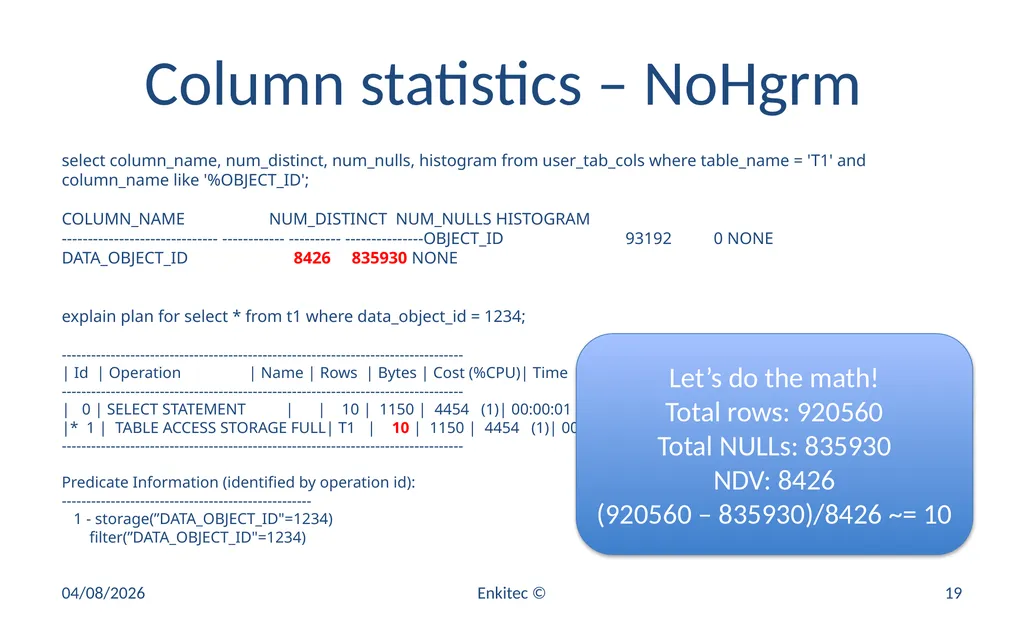
Column statistics – NoHgrm 10/28/16 Enkitec © 19 select column_name, num_distinct, num_nulls, histogram from user_tab_cols where table_name = 'T1' and column_name like '%OBJECT_ID';
COLUMN_NAME NUM_DISTINCT NUM_NULLS HISTOGRAM
------------------------------ ------------ ---------- ---------------OBJECT_ID 93192 0 NONE
DATA_OBJECT_ID 8426 835930 NONE
explain plan for select * from t1 where data_object_id = 1234;
----------------------------------------------------------------------------------
| Id | Operation | Name | Rows | Bytes | Cost (%CPU)| Time |
----------------------------------------------------------------------------------
| 0 | SELECT STATEMENT | | 10 | 1150 | 4454 (1)| 00:00:01 |
|* 1 | TABLE ACCESS STORAGE FULL| T1 | 10 | 1150 | 4454 (1)| 00:00:01 |
----------------------------------------------------------------------------------
Predicate Information (identified by operation id):
---------------------------------------------------
1 - storage(”DATA_OBJECT_ID"=1234)
filter(”DATA_OBJECT_ID"=1234) Let’s do the math!
Total rows: 920560
Total NULLs: 835930
NDV: 8426
(920560 – 835930)/8426 ~= 10<br>
COLUMN_NAME NUM_DISTINCT NUM_NULLS HISTOGRAM
------------------------------ ------------ ---------- ---------------OBJECT_ID 93192 0 NONE
DATA_OBJECT_ID 8426 835930 NONE
explain plan for select * from t1 where data_object_id = 1234;
----------------------------------------------------------------------------------
| Id | Operation | Name | Rows | Bytes | Cost (%CPU)| Time |
----------------------------------------------------------------------------------
| 0 | SELECT STATEMENT | | 10 | 1150 | 4454 (1)| 00:00:01 |
|* 1 | TABLE ACCESS STORAGE FULL| T1 | 10 | 1150 | 4454 (1)| 00:00:01 |
----------------------------------------------------------------------------------
Predicate Information (identified by operation id):
---------------------------------------------------
1 - storage(”DATA_OBJECT_ID"=1234)
filter(”DATA_OBJECT_ID"=1234) Let’s do the math!
Total rows: 920560
Total NULLs: 835930
NDV: 8426
(920560 – 835930)/8426 ~= 10<br>
20
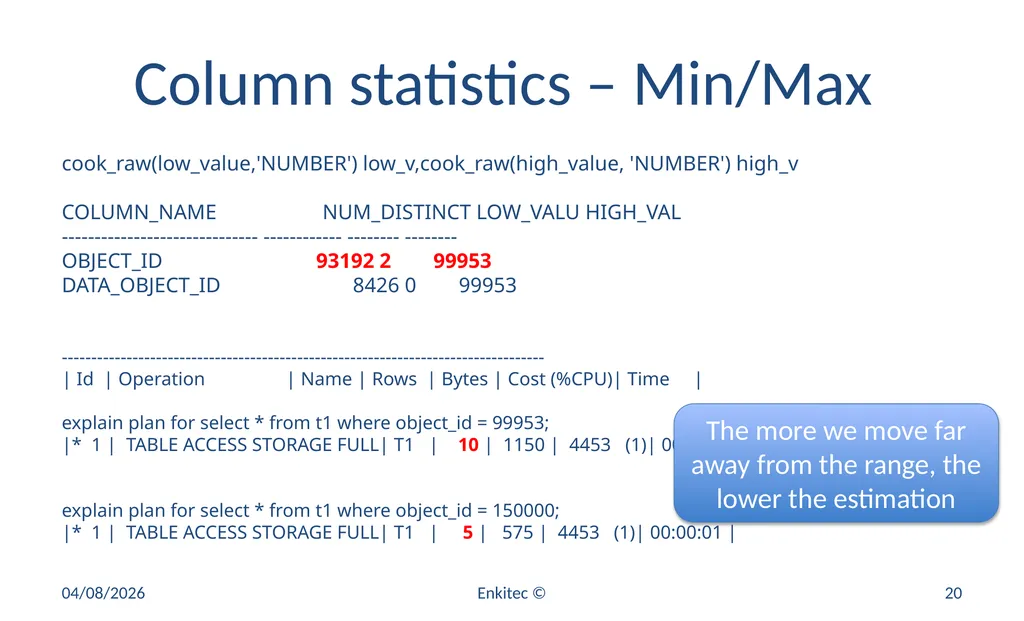
Column statistics – Min/Max 10/28/16 Enkitec © 20 cook_raw(low_value,'NUMBER') low_v,cook_raw(high_value, 'NUMBER') high_v
COLUMN_NAME NUM_DISTINCT LOW_VALU HIGH_VAL
------------------------------ ------------ -------- --------
OBJECT_ID 93192 2 99953
DATA_OBJECT_ID 8426 0 99953
----------------------------------------------------------------------------------
| Id | Operation | Name | Rows | Bytes | Cost (%CPU)| Time |
explain plan for select * from t1 where object_id = 99953;
|* 1 | TABLE ACCESS STORAGE FULL| T1 | 10 | 1150 | 4453 (1)| 00:00:01 |
explain plan for select * from t1 where object_id = 150000;
|* 1 | TABLE ACCESS STORAGE FULL| T1 | 5 | 575 | 4453 (1)| 00:00:01 | The more we move far away from the range, the lower the estimation<br>
COLUMN_NAME NUM_DISTINCT LOW_VALU HIGH_VAL
------------------------------ ------------ -------- --------
OBJECT_ID 93192 2 99953
DATA_OBJECT_ID 8426 0 99953
----------------------------------------------------------------------------------
| Id | Operation | Name | Rows | Bytes | Cost (%CPU)| Time |
explain plan for select * from t1 where object_id = 99953;
|* 1 | TABLE ACCESS STORAGE FULL| T1 | 10 | 1150 | 4453 (1)| 00:00:01 |
explain plan for select * from t1 where object_id = 150000;
|* 1 | TABLE ACCESS STORAGE FULL| T1 | 5 | 575 | 4453 (1)| 00:00:01 | The more we move far away from the range, the lower the estimation<br>
21
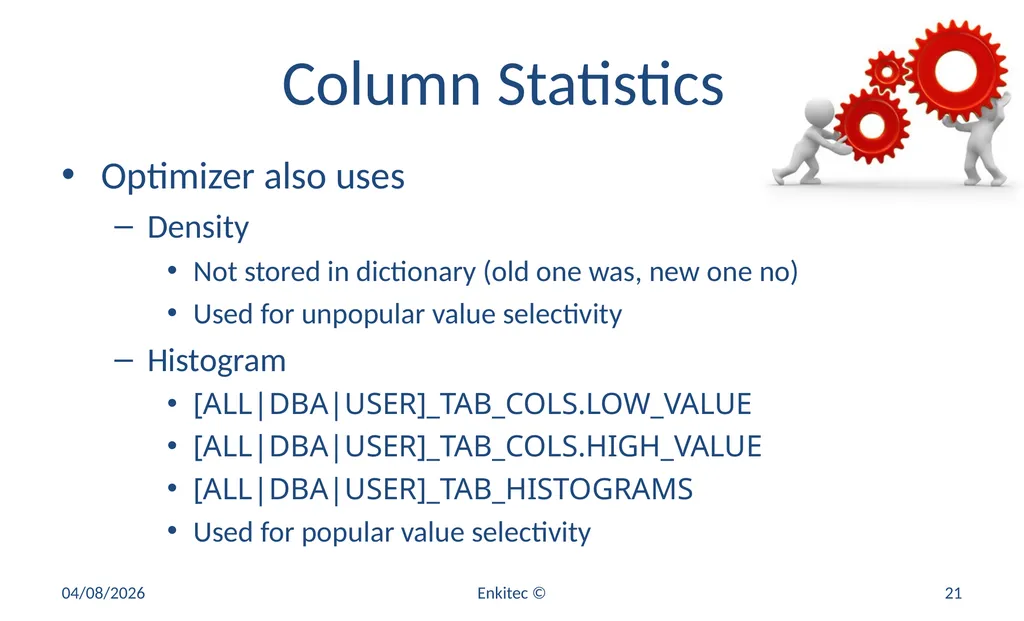
Column Statistics Optimizer also uses
Density
Not stored in dictionary (old one was, new one no)
Used for unpopular value selectivity
Histogram
[ALL|DBA|USER]_TAB_COLS.LOW_VALUE
[ALL|DBA|USER]_TAB_COLS.HIGH_VALUE
[ALL|DBA|USER]_TAB_HISTOGRAMS
Used for popular value selectivity 10/28/16 Enkitec © 21<br>
Density
Not stored in dictionary (old one was, new one no)
Used for unpopular value selectivity
Histogram
[ALL|DBA|USER]_TAB_COLS.LOW_VALUE
[ALL|DBA|USER]_TAB_COLS.HIGH_VALUE
[ALL|DBA|USER]_TAB_HISTOGRAMS
Used for popular value selectivity 10/28/16 Enkitec © 21<br>
22
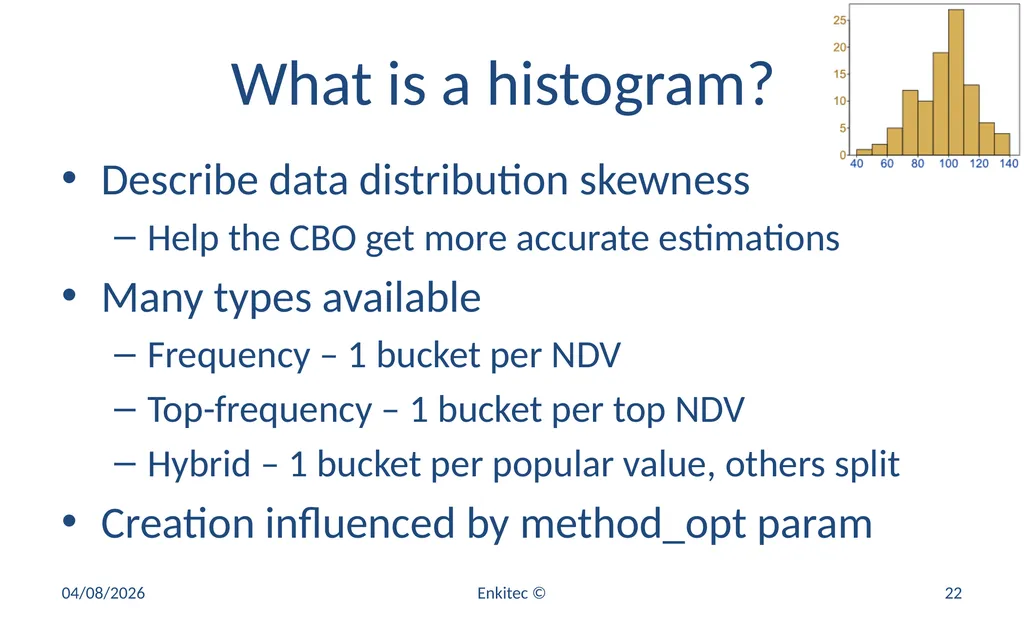
What is a histogram? Describe data distribution skewness
Help the CBO get more accurate estimations
Many types available
Frequency – 1 bucket per NDV
Top-frequency – 1 bucket per top NDV
Hybrid – 1 bucket per popular value, others split
Creation influenced by method_opt param 10/28/16 Enkitec © 22<br>
Help the CBO get more accurate estimations
Many types available
Frequency – 1 bucket per NDV
Top-frequency – 1 bucket per top NDV
Hybrid – 1 bucket per popular value, others split
Creation influenced by method_opt param 10/28/16 Enkitec © 22<br>
23
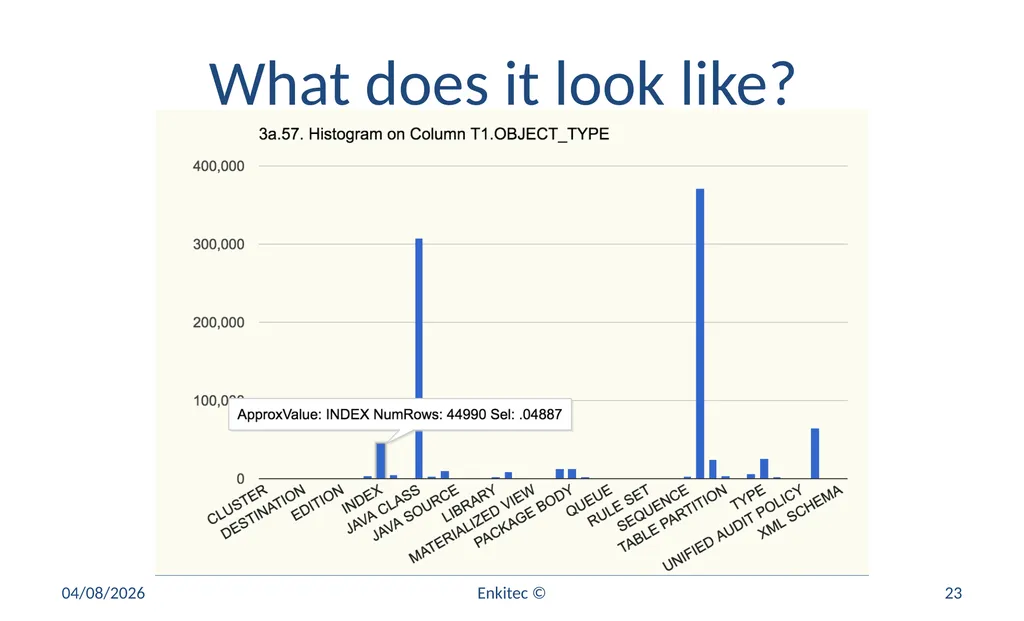
What does it look like? 10/28/16 Enkitec © 23<br>
24
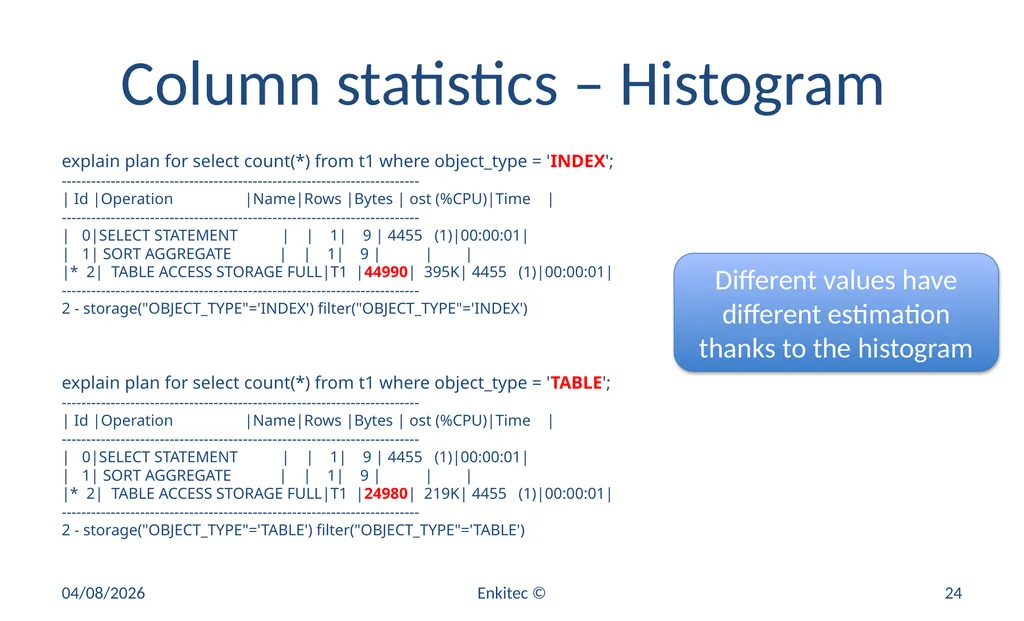
Column statistics – Histogram 10/28/16 Enkitec © 24 explain plan for select count(*) from t1 where object_type = 'INDEX';
-------------------------------------------------------------------------
| Id |Operation |Name|Rows |Bytes | ost (%CPU)|Time |
-------------------------------------------------------------------------
| 0|SELECT STATEMENT | | 1| 9 | 4455 (1)|00:00:01|
| 1| SORT AGGREGATE | | 1| 9 | | |
|* 2| TABLE ACCESS STORAGE FULL|T1 |44990| 395K| 4455 (1)|00:00:01|
-------------------------------------------------------------------------
2 - storage("OBJECT_TYPE"='INDEX') filter("OBJECT_TYPE"='INDEX')
explain plan for select count(*) from t1 where object_type = 'TABLE';
-------------------------------------------------------------------------
| Id |Operation |Name|Rows |Bytes | ost (%CPU)|Time |
-------------------------------------------------------------------------
| 0|SELECT STATEMENT | | 1| 9 | 4455 (1)|00:00:01|
| 1| SORT AGGREGATE | | 1| 9 | | |
|* 2| TABLE ACCESS STORAGE FULL|T1 |24980| 219K| 4455 (1)|00:00:01|
-------------------------------------------------------------------------
2 - storage("OBJECT_TYPE"='TABLE') filter("OBJECT_TYPE"='TABLE') Different values have different estimation thanks to the histogram<br>
-------------------------------------------------------------------------
| Id |Operation |Name|Rows |Bytes | ost (%CPU)|Time |
-------------------------------------------------------------------------
| 0|SELECT STATEMENT | | 1| 9 | 4455 (1)|00:00:01|
| 1| SORT AGGREGATE | | 1| 9 | | |
|* 2| TABLE ACCESS STORAGE FULL|T1 |44990| 395K| 4455 (1)|00:00:01|
-------------------------------------------------------------------------
2 - storage("OBJECT_TYPE"='INDEX') filter("OBJECT_TYPE"='INDEX')
explain plan for select count(*) from t1 where object_type = 'TABLE';
-------------------------------------------------------------------------
| Id |Operation |Name|Rows |Bytes | ost (%CPU)|Time |
-------------------------------------------------------------------------
| 0|SELECT STATEMENT | | 1| 9 | 4455 (1)|00:00:01|
| 1| SORT AGGREGATE | | 1| 9 | | |
|* 2| TABLE ACCESS STORAGE FULL|T1 |24980| 219K| 4455 (1)|00:00:01|
-------------------------------------------------------------------------
2 - storage("OBJECT_TYPE"='TABLE') filter("OBJECT_TYPE"='TABLE') Different values have different estimation thanks to the histogram<br>
25
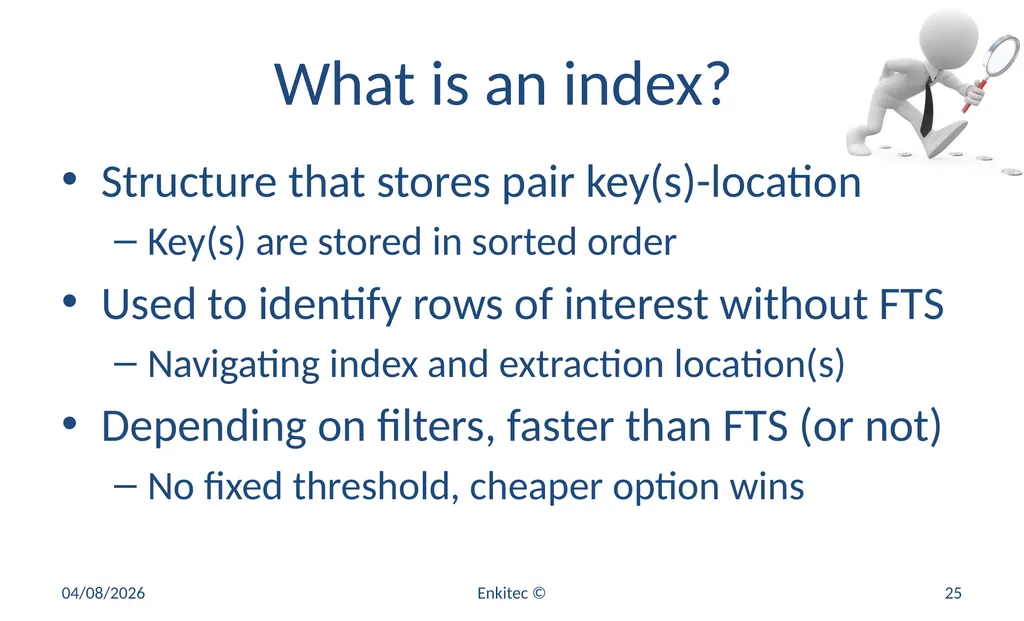
What is an index? Structure that stores pair key(s)-location
Key(s) are stored in sorted order
Used to identify rows of interest without FTS
Navigating index and extraction location(s)
Depending on filters, faster than FTS (or not)
No fixed threshold, cheaper option wins 10/28/16 Enkitec © 25<br>
Key(s) are stored in sorted order
Used to identify rows of interest without FTS
Navigating index and extraction location(s)
Depending on filters, faster than FTS (or not)
No fixed threshold, cheaper option wins 10/28/16 Enkitec © 25<br>
26
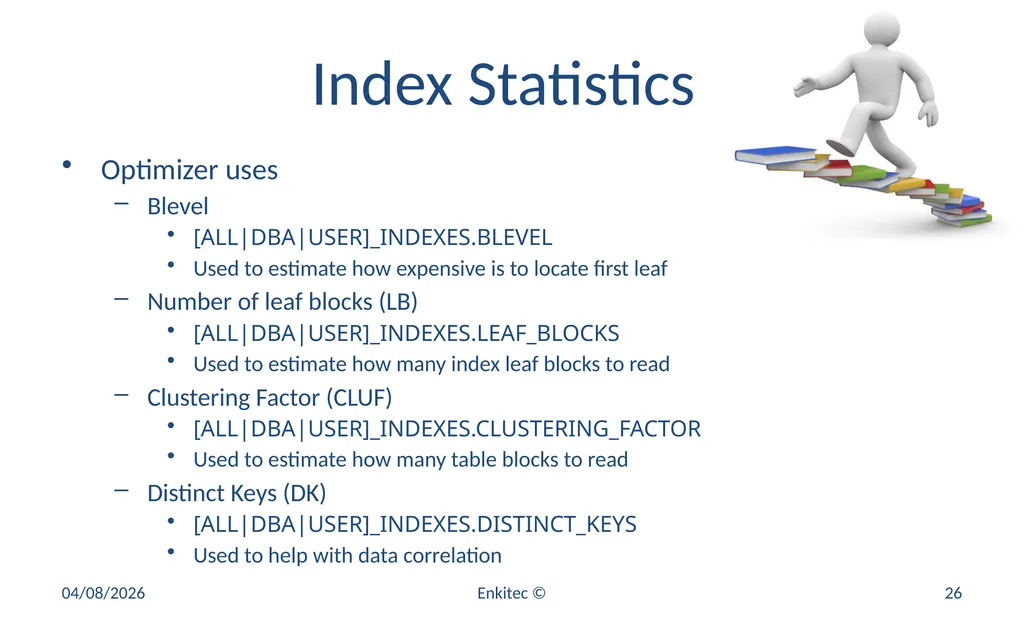
Index Statistics Optimizer uses
Blevel
[ALL|DBA|USER]_INDEXES.BLEVEL
Used to estimate how expensive is to locate first leaf
Number of leaf blocks (LB)
[ALL|DBA|USER]_INDEXES.LEAF_BLOCKS
Used to estimate how many index leaf blocks to read
Clustering Factor (CLUF)
[ALL|DBA|USER]_INDEXES.CLUSTERING_FACTOR
Used to estimate how many table blocks to read
Distinct Keys (DK)
[ALL|DBA|USER]_INDEXES.DISTINCT_KEYS
Used to help with data correlation 10/28/16 Enkitec © 26<br>
Blevel
[ALL|DBA|USER]_INDEXES.BLEVEL
Used to estimate how expensive is to locate first leaf
Number of leaf blocks (LB)
[ALL|DBA|USER]_INDEXES.LEAF_BLOCKS
Used to estimate how many index leaf blocks to read
Clustering Factor (CLUF)
[ALL|DBA|USER]_INDEXES.CLUSTERING_FACTOR
Used to estimate how many table blocks to read
Distinct Keys (DK)
[ALL|DBA|USER]_INDEXES.DISTINCT_KEYS
Used to help with data correlation 10/28/16 Enkitec © 26<br>
27
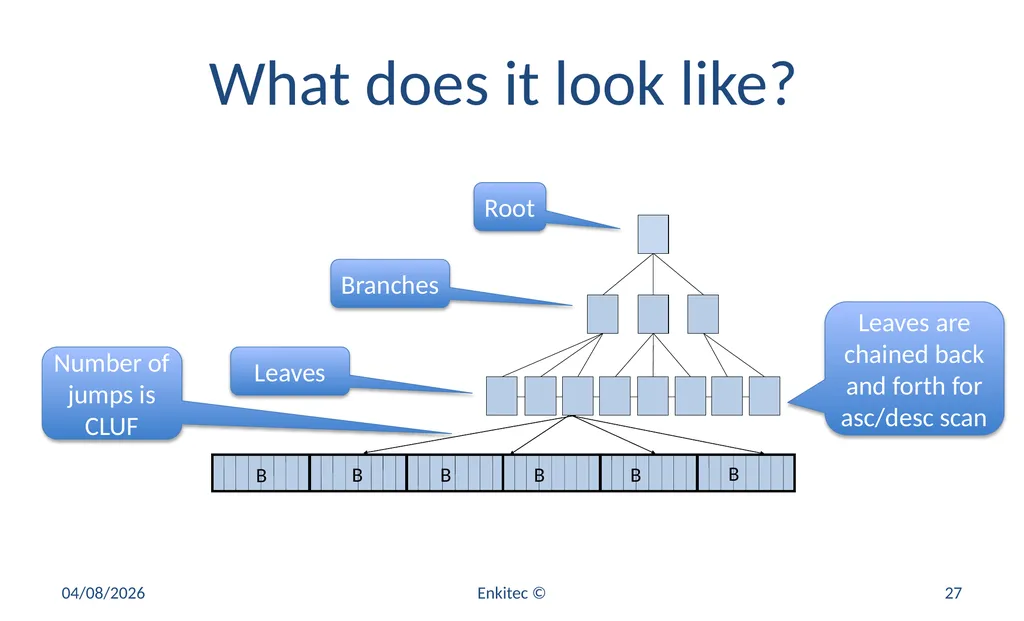
What does it look like? 10/28/16 Enkitec © 27 B B B B B B Root Branches Leaves Leaves are chained back and forth for asc/desc scan Number of jumps is CLUF<br>
28
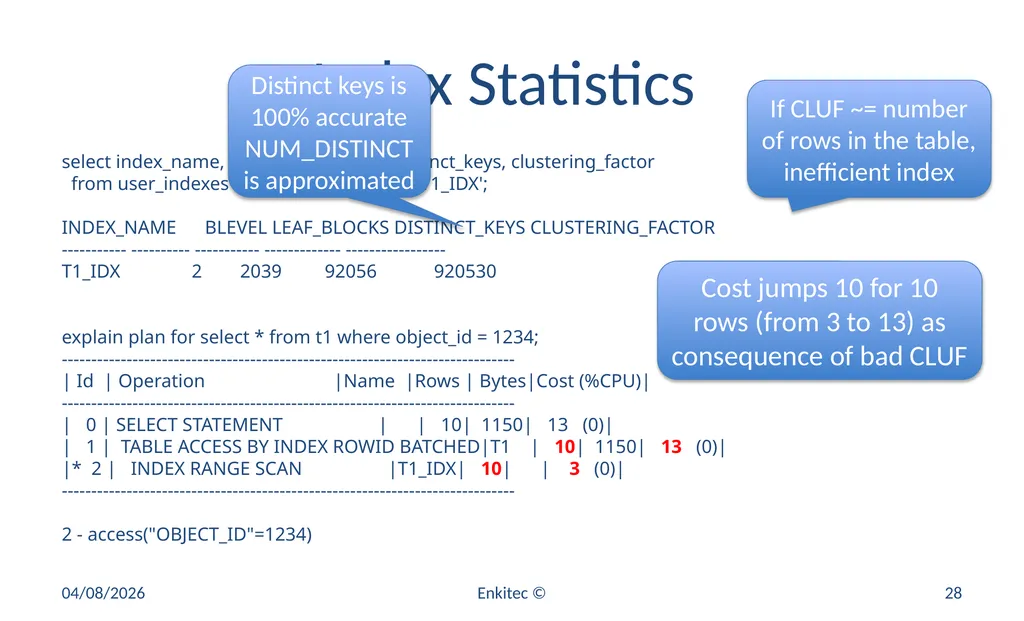
Index Statistics 10/28/16 Enkitec © 28 select index_name, blevel, leaf_blocks, distinct_keys, clustering_factor
from user_indexes where index_name = 'T1_IDX';
INDEX_NAME BLEVEL LEAF_BLOCKS DISTINCT_KEYS CLUSTERING_FACTOR
----------- ---------- ----------- ------------- -----------------
T1_IDX 2 2039 92056 920530
explain plan for select * from t1 where object_id = 1234;
-----------------------------------------------------------------------------
| Id | Operation |Name |Rows | Bytes|Cost (%CPU)|
-----------------------------------------------------------------------------
| 0 | SELECT STATEMENT | | 10| 1150| 13 (0)|
| 1 | TABLE ACCESS BY INDEX ROWID BATCHED|T1 | 10| 1150| 13 (0)|
|* 2 | INDEX RANGE SCAN |T1_IDX| 10| | 3 (0)|
-----------------------------------------------------------------------------
2 - access("OBJECT_ID"=1234) Distinct keys is 100% accurate NUM_DISTINCT is approximated If CLUF ~= number of rows in the table, inefficient index Cost jumps 10 for 10 rows (from 3 to 13) as consequence of bad CLUF<br>
from user_indexes where index_name = 'T1_IDX';
INDEX_NAME BLEVEL LEAF_BLOCKS DISTINCT_KEYS CLUSTERING_FACTOR
----------- ---------- ----------- ------------- -----------------
T1_IDX 2 2039 92056 920530
explain plan for select * from t1 where object_id = 1234;
-----------------------------------------------------------------------------
| Id | Operation |Name |Rows | Bytes|Cost (%CPU)|
-----------------------------------------------------------------------------
| 0 | SELECT STATEMENT | | 10| 1150| 13 (0)|
| 1 | TABLE ACCESS BY INDEX ROWID BATCHED|T1 | 10| 1150| 13 (0)|
|* 2 | INDEX RANGE SCAN |T1_IDX| 10| | 3 (0)|
-----------------------------------------------------------------------------
2 - access("OBJECT_ID"=1234) Distinct keys is 100% accurate NUM_DISTINCT is approximated If CLUF ~= number of rows in the table, inefficient index Cost jumps 10 for 10 rows (from 3 to 13) as consequence of bad CLUF<br>
29
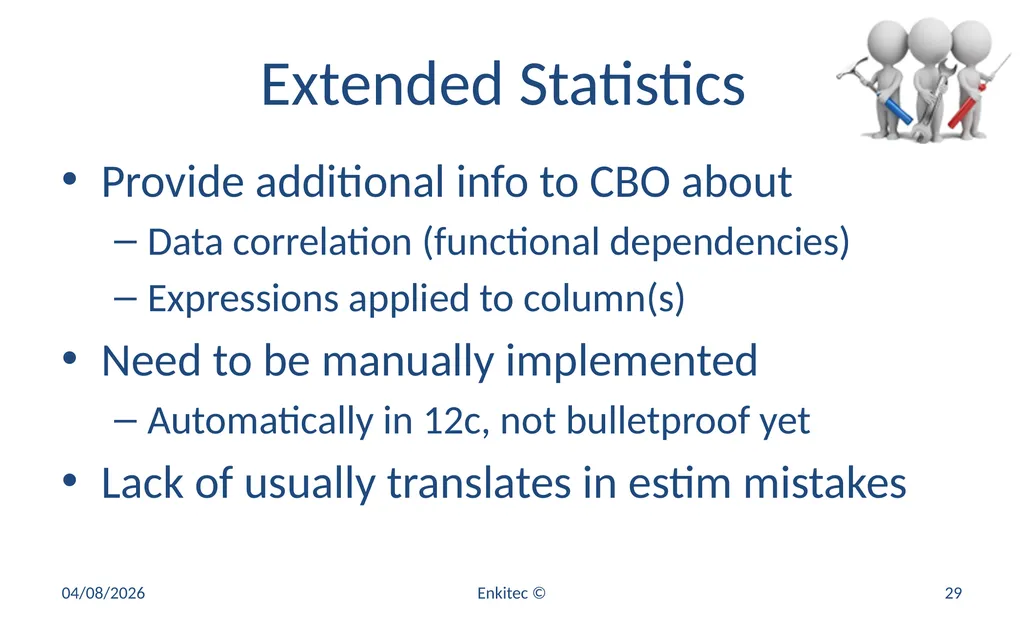
Extended Statistics Provide additional info to CBO about
Data correlation (functional dependencies)
Expressions applied to column(s)
Need to be manually implemented
Automatically in 12c, not bulletproof yet
Lack of usually translates in estim mistakes 10/28/16 Enkitec © 29<br>
Data correlation (functional dependencies)
Expressions applied to column(s)
Need to be manually implemented
Automatically in 12c, not bulletproof yet
Lack of usually translates in estim mistakes 10/28/16 Enkitec © 29<br>
30
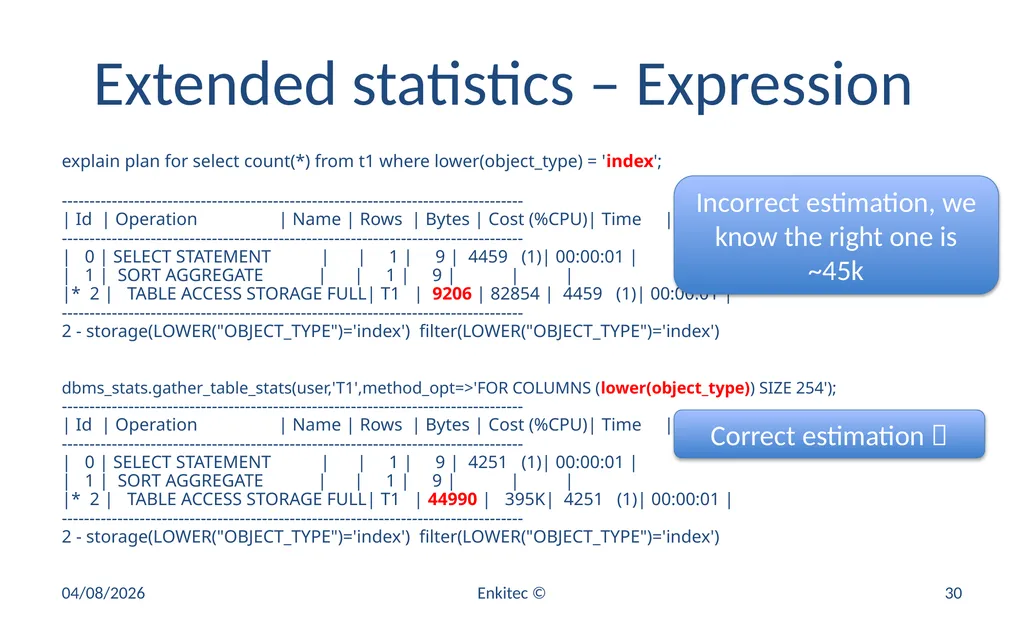
Extended statistics – Expression 10/28/16 Enkitec © 30 explain plan for select count(*) from t1 where lower(object_type) = 'index';
-----------------------------------------------------------------------------------
| Id | Operation | Name | Rows | Bytes | Cost (%CPU)| Time |
-----------------------------------------------------------------------------------
| 0 | SELECT STATEMENT | | 1 | 9 | 4459 (1)| 00:00:01 |
| 1 | SORT AGGREGATE | | 1 | 9 | | |
|* 2 | TABLE ACCESS STORAGE FULL| T1 | 9206 | 82854 | 4459 (1)| 00:00:01 |
-----------------------------------------------------------------------------------
2 - storage(LOWER("OBJECT_TYPE")='index') filter(LOWER("OBJECT_TYPE")='index')
dbms_stats.gather_table_stats(user,'T1',method_opt=>'FOR COLUMNS (lower(object_type)) SIZE 254');
-----------------------------------------------------------------------------------
| Id | Operation | Name | Rows | Bytes | Cost (%CPU)| Time |
-----------------------------------------------------------------------------------
| 0 | SELECT STATEMENT | | 1 | 9 | 4251 (1)| 00:00:01 |
| 1 | SORT AGGREGATE | | 1 | 9 | | |
|* 2 | TABLE ACCESS STORAGE FULL| T1 | 44990 | 395K| 4251 (1)| 00:00:01 |
-----------------------------------------------------------------------------------
2 - storage(LOWER("OBJECT_TYPE")='index') filter(LOWER("OBJECT_TYPE")='index') Incorrect estimation, we know the right one is ~45k Correct estimation <br>
-----------------------------------------------------------------------------------
| Id | Operation | Name | Rows | Bytes | Cost (%CPU)| Time |
-----------------------------------------------------------------------------------
| 0 | SELECT STATEMENT | | 1 | 9 | 4459 (1)| 00:00:01 |
| 1 | SORT AGGREGATE | | 1 | 9 | | |
|* 2 | TABLE ACCESS STORAGE FULL| T1 | 9206 | 82854 | 4459 (1)| 00:00:01 |
-----------------------------------------------------------------------------------
2 - storage(LOWER("OBJECT_TYPE")='index') filter(LOWER("OBJECT_TYPE")='index')
dbms_stats.gather_table_stats(user,'T1',method_opt=>'FOR COLUMNS (lower(object_type)) SIZE 254');
-----------------------------------------------------------------------------------
| Id | Operation | Name | Rows | Bytes | Cost (%CPU)| Time |
-----------------------------------------------------------------------------------
| 0 | SELECT STATEMENT | | 1 | 9 | 4251 (1)| 00:00:01 |
| 1 | SORT AGGREGATE | | 1 | 9 | | |
|* 2 | TABLE ACCESS STORAGE FULL| T1 | 44990 | 395K| 4251 (1)| 00:00:01 |
-----------------------------------------------------------------------------------
2 - storage(LOWER("OBJECT_TYPE")='index') filter(LOWER("OBJECT_TYPE")='index') Incorrect estimation, we know the right one is ~45k Correct estimation <br>
31
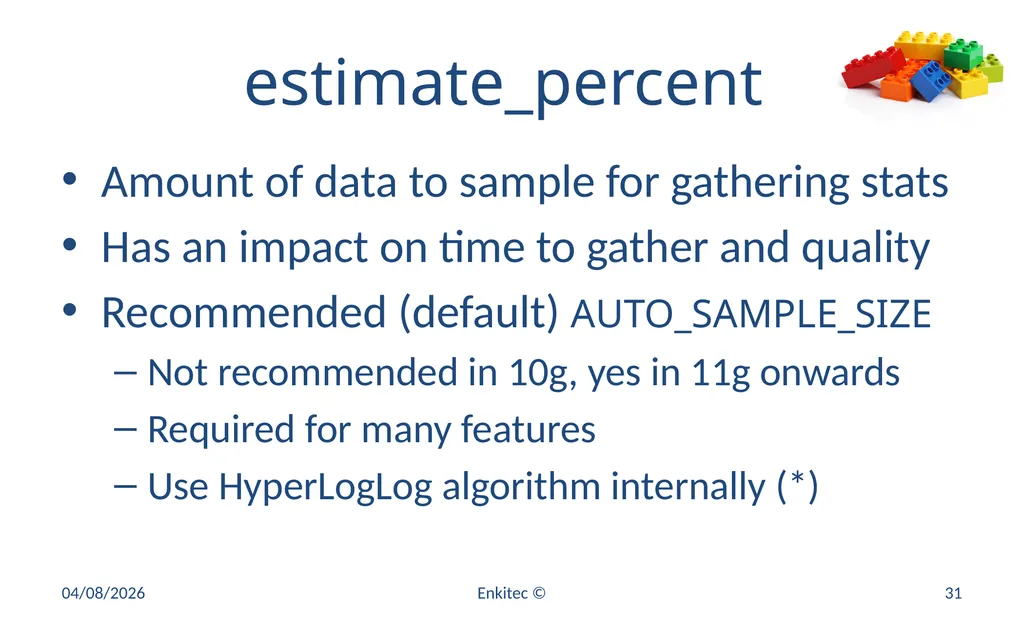
estimate_percent Amount of data to sample for gathering stats
Has an impact on time to gather and quality
Recommended (default) AUTO_SAMPLE_SIZE
Not recommended in 10g, yes in 11g onwards
Required for many features
Use HyperLogLog algorithm internally (*) 10/28/16 Enkitec © 31<br>
Has an impact on time to gather and quality
Recommended (default) AUTO_SAMPLE_SIZE
Not recommended in 10g, yes in 11g onwards
Required for many features
Use HyperLogLog algorithm internally (*) 10/28/16 Enkitec © 31<br>
32
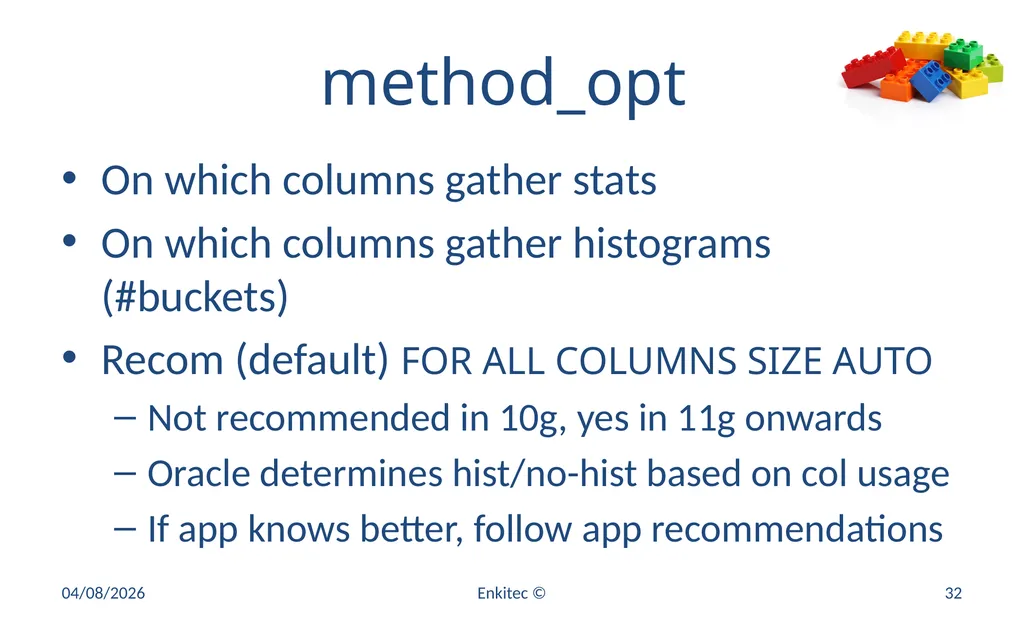
method_opt On which columns gather stats
On which columns gather histograms (#buckets)
Recom (default) FOR ALL COLUMNS SIZE AUTO
Not recommended in 10g, yes in 11g onwards
Oracle determines hist/no-hist based on col usage
If app knows better, follow app recommendations 10/28/16 Enkitec © 32<br>
On which columns gather histograms (#buckets)
Recom (default) FOR ALL COLUMNS SIZE AUTO
Not recommended in 10g, yes in 11g onwards
Oracle determines hist/no-hist based on col usage
If app knows better, follow app recommendations 10/28/16 Enkitec © 32<br>
33
Can’t Oracle do it for me? Oracle provides nightly job to gather stats
Does a decent job starting 11g (so so in 10g)
Prioritize tables order depending on #changes
Only allowed to run for fixed number of hours
Might not touch all needed objects
Collects object and dictionary stats only
Apps might have specific req, follow them 10/28/16 Enkitec © 33<br>
Does a decent job starting 11g (so so in 10g)
Prioritize tables order depending on #changes
Only allowed to run for fixed number of hours
Might not touch all needed objects
Collects object and dictionary stats only
Apps might have specific req, follow them 10/28/16 Enkitec © 33<br>
34
34<br>
35
References Oracle Database PL/SQL Packages and Types Reference 12.1
Oracle Database SQL Tuning Guide 12.1
http://blogs.oracle.com/optimizer
Master Note: Optimizer Statistics (Doc ID 1369591.1) 35<br>
Oracle Database SQL Tuning Guide 12.1
http://blogs.oracle.com/optimizer
Master Note: Optimizer Statistics (Doc ID 1369591.1) 35<br>
36
Contact Information http://mauro-pagano.com
Tools
SQLd360, TUNAs360, Pathfinder
Email
mauro.pagano@gmail.com 36<br>
Tools
SQLd360, TUNAs360, Pathfinder
mauro.pagano@gmail.com 36<br>