
بسم الله الرحمن الرحيم صدق الله العلي العظيم Oral
CM
Published · 50 slides · 0 views

1 / 1








Description
بسم الله الرحمن الرحيم صدق الله العلي العظيم Oral hygiene measures Dr. Rihab Abdul Hussein Ali B.D.S , M.Sc. , PhD. Mechanical plaque control Plaque control is the removal of microbial plaque and the prevention of its accumulation on the
Related Topics
Share
Embed code
Download this presentation From Below
"بسم الله الرحمن الرحيم صدق الله العلي العظيم Oral" is the property of its rightful owner. Permission is granted to download and print the materials on this website for personal, non-commercial use only, and to display it on your personal computer provided you do not modify the materials and that you retain all copyright notices contained in the materials. By downloading content from our website, you accept the terms of this agreement.
Presentation Transcript
01
بسم الله الرحمن الرحيم صدق الله العلي العظيم<br>
02
Oral hygiene measures
Dr. Rihab Abdul Hussein Ali
B.D.S , M.Sc. , PhD.<br>
Dr. Rihab Abdul Hussein Ali
B.D.S , M.Sc. , PhD.<br>
03
Mechanical plaque control
Plaque control is the removal of microbial plaque and the prevention of its accumulation on the teeth and adjacent gingival tissues, it also deals with the prevention of calculus formation and leads to resolution of gingival inflammation. Thus, Plaque control is an effective way of treating gingivitis and therefore is a critical part of all the procedures involved in the treatment and prevention of periodontal disease.<br>
Plaque control is the removal of microbial plaque and the prevention of its accumulation on the teeth and adjacent gingival tissues, it also deals with the prevention of calculus formation and leads to resolution of gingival inflammation. Thus, Plaque control is an effective way of treating gingivitis and therefore is a critical part of all the procedures involved in the treatment and prevention of periodontal disease.<br>
04
Plaque control includes mechanical procedures (includes tooth brushing and interdental cleaning aids and professional prophylaxis) and chemical agents which retards plaque formation.
Plaque control should be the basis of prevention and control of gingivitis, periodontitis, and dental caries.
Each environment in the oral cavity (micro- and macro-environment) offers specific conditions for plaque formation, composition of microflora and accessibility for plaque removal.<br>
Plaque control should be the basis of prevention and control of gingivitis, periodontitis, and dental caries.
Each environment in the oral cavity (micro- and macro-environment) offers specific conditions for plaque formation, composition of microflora and accessibility for plaque removal.<br>
05
In periodontal therapy, plaque control serves two purposes:
To minimize gingival inflammation.
To prevent recurrence or progression of periodontal disease in treated mouth.
The process of plaque control requires motivation on the part of the patient, education and instruction, followed by encouragement and reinforcement.<br>
To minimize gingival inflammation.
To prevent recurrence or progression of periodontal disease in treated mouth.
The process of plaque control requires motivation on the part of the patient, education and instruction, followed by encouragement and reinforcement.<br>
06
Mechanical plaque control aids include:
1- Toothbrushes:
They were first introduced in China as early as 1600 B.C. Through the years toothbrushes have undergone changes in many ways as possible. By early nineteenth century the handles were constructed from gold, Ivory or ebony in which replaceable brush heads could be fitted.
Nylon bristles came into use in 1938 to replace the natural bristles. Nylon bristles flex as many as 10 times more often than natural bristles before breaking; they do not split or abrade and are easier to clean. The shape and stiffness of nylon bristles can be standardized. Natural bristle diameters vary greatly in each filament.<br>
1- Toothbrushes:
They were first introduced in China as early as 1600 B.C. Through the years toothbrushes have undergone changes in many ways as possible. By early nineteenth century the handles were constructed from gold, Ivory or ebony in which replaceable brush heads could be fitted.
Nylon bristles came into use in 1938 to replace the natural bristles. Nylon bristles flex as many as 10 times more often than natural bristles before breaking; they do not split or abrade and are easier to clean. The shape and stiffness of nylon bristles can be standardized. Natural bristle diameters vary greatly in each filament.<br>
07
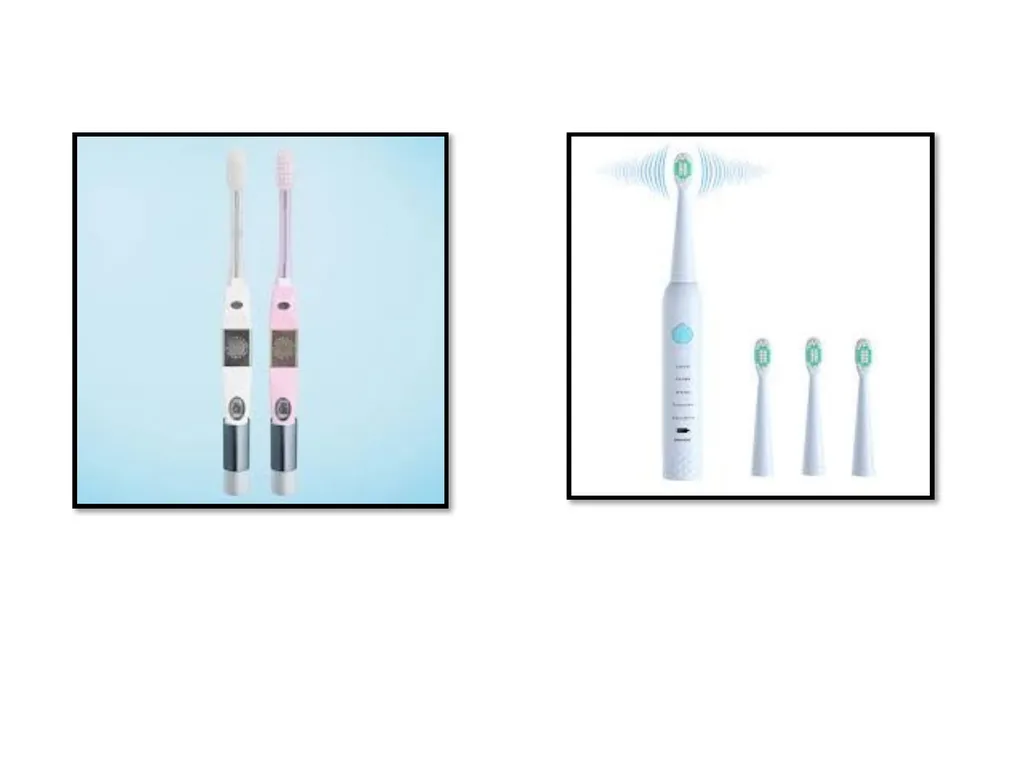
Types of toothbrushes:
Manual toothbrush.
Powered toothbrush.
Sonic and ultrasonic toothbrush.
Ionic toothbrush.
1- Manual toothbrush: It should be easily and effectively manipulated, inexpensive.
Parts of toothbrush:
1. Handle: The part grasped in the hand during tooth brushing.
2. Head: The working end of a toothbrush that holds the bristles.
3. Tufts: Clusters of bristles secured into head.
4. Shank: The section that connects head and handle.<br>
Manual toothbrush.
Powered toothbrush.
Sonic and ultrasonic toothbrush.
Ionic toothbrush.
1- Manual toothbrush: It should be easily and effectively manipulated, inexpensive.
Parts of toothbrush:
1. Handle: The part grasped in the hand during tooth brushing.
2. Head: The working end of a toothbrush that holds the bristles.
3. Tufts: Clusters of bristles secured into head.
4. Shank: The section that connects head and handle.<br>
08
Toothbrush bristles
They are either natural from hair of hogs or synthetic from nylon (not larger than 0.23 mm in diameter) which are uniform in size and elasticity, resistant to fracture.
Rounded bristles ends cause fewer scratches on the gingiva. The type of brush is a matter of individual preference. A toothbrush should be able to reach and clean most areas of teeth.
For maintenance of toothbrush; most brushes wear out in three months and should be replaced, it should be stored in dry areas and cleaned in antiseptic mouthwashes.<br>
They are either natural from hair of hogs or synthetic from nylon (not larger than 0.23 mm in diameter) which are uniform in size and elasticity, resistant to fracture.
Rounded bristles ends cause fewer scratches on the gingiva. The type of brush is a matter of individual preference. A toothbrush should be able to reach and clean most areas of teeth.
For maintenance of toothbrush; most brushes wear out in three months and should be replaced, it should be stored in dry areas and cleaned in antiseptic mouthwashes.<br>
09
Tooth brushing methods:
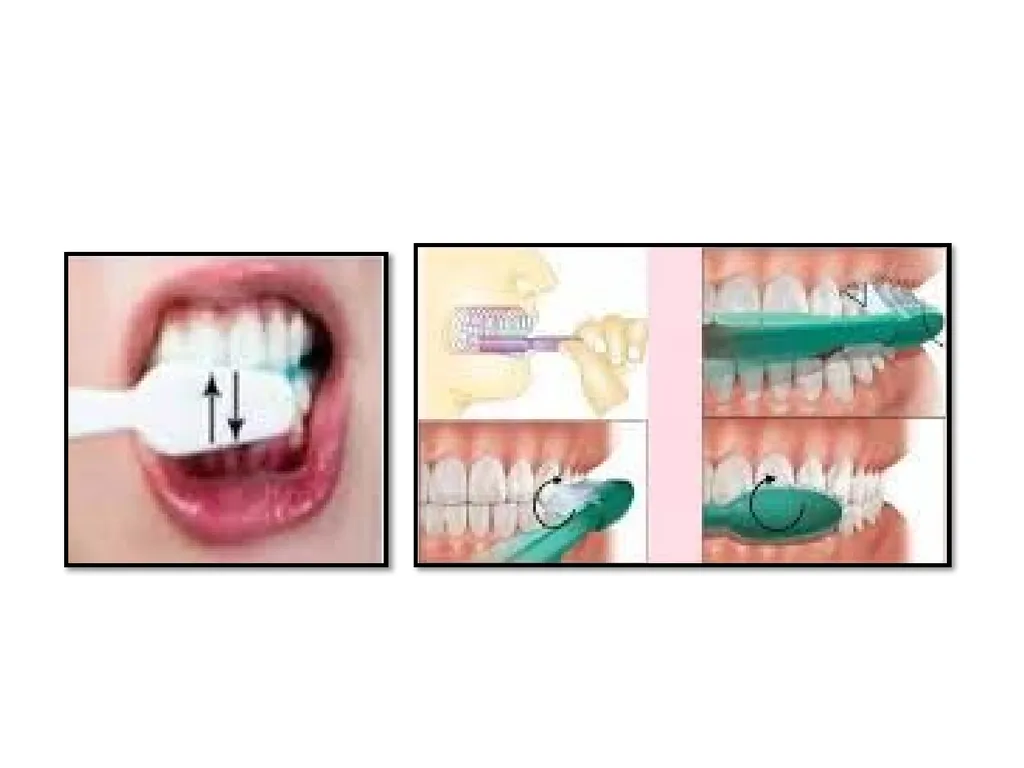
Bass method: It is the most widely accepted and most effective method for dental plaque removal, adjacent and directly beneath the gingival margin. The technique is place the bristles at 45° angle to the gingiva and move in back and forth motions. Strokes are repeated around 20 times.
Advantages: Effective method for removing plaque from the cervical area beneath the height of contour of enamel, easy to learn, provides good gingival stimulation and recommended for patient with or without periodontitis.
Modified Bass technique: This technique combines the circular motions of Bass technique with the sweeping motion of the Roll technique. It has sweeping motion from cervical to incisal or occlusal surface. The bristles are gently vibrated by moving the brush handle in a back and forth motion.
Advantages: Good interproximal, gingival and sulcus cleaning as well as good gingival stimulation.<br>
Bass method: It is the most widely accepted and most effective method for dental plaque removal, adjacent and directly beneath the gingival margin. The technique is place the bristles at 45° angle to the gingiva and move in back and forth motions. Strokes are repeated around 20 times.
Advantages: Effective method for removing plaque from the cervical area beneath the height of contour of enamel, easy to learn, provides good gingival stimulation and recommended for patient with or without periodontitis.
Modified Bass technique: This technique combines the circular motions of Bass technique with the sweeping motion of the Roll technique. It has sweeping motion from cervical to incisal or occlusal surface. The bristles are gently vibrated by moving the brush handle in a back and forth motion.
Advantages: Good interproximal, gingival and sulcus cleaning as well as good gingival stimulation.<br>
10
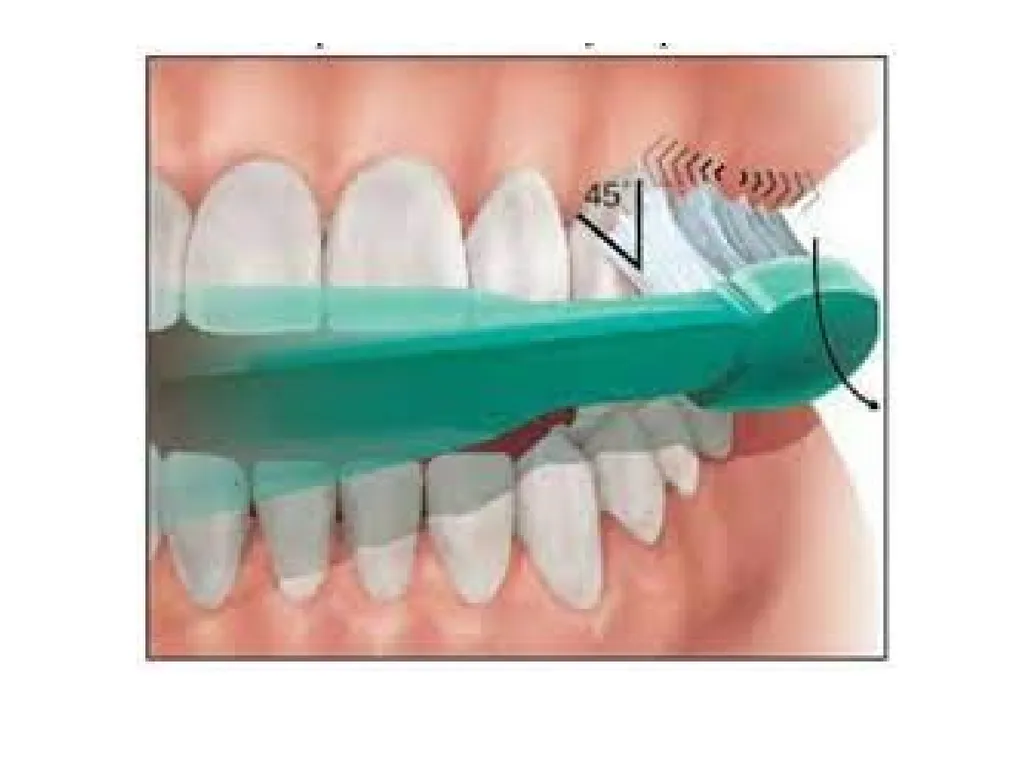
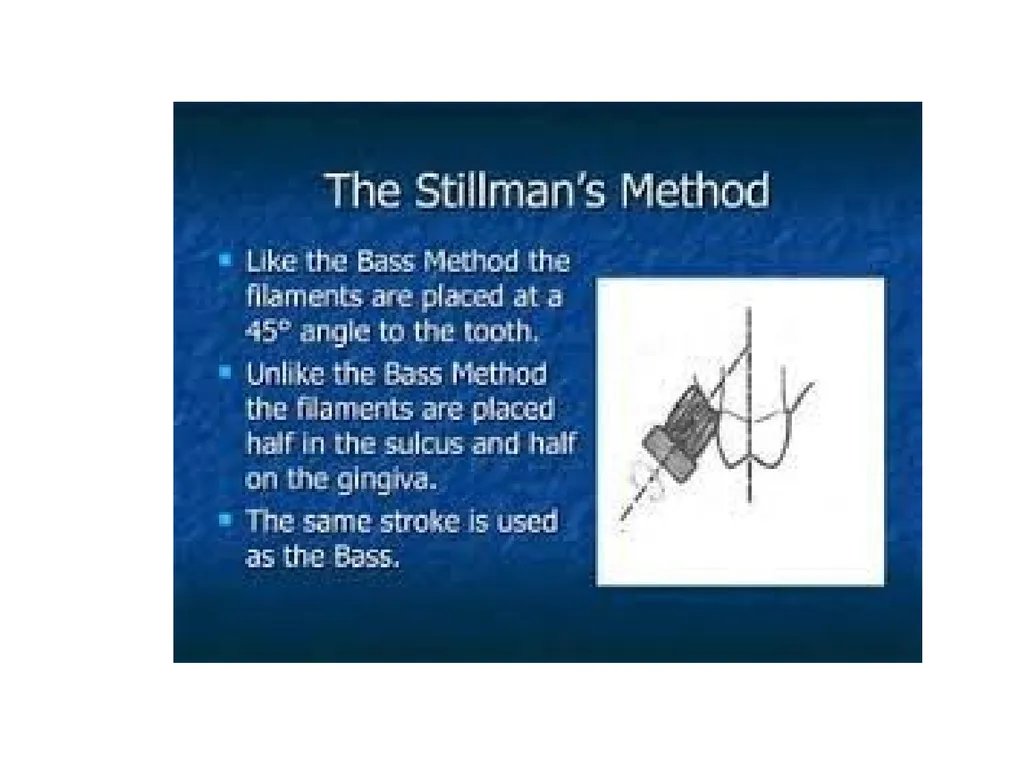
Stillman’s method: The bristles are positioned apically along the long axis of the tooth. The edge of the brush head should be touching the facial or lingual aspect of the tooth. The brush is slightly rotated at a 45‐degree angle and vibrated over the crown.
Advantages: It is used for massage and stimulation of gingiva and for cleaning the cervical area of the teeth.
Modified Stillman’s method: The bristles are positioned partly on the cervical portion of teeth and partly on the adjacent gingiva in an apical direction with an oblique angle to the long axis of the tooth. Roll the brush down to the crown of the tooth.
Advantages: It is recommended for cleaning in areas with progressing gingival recession and root exposure to prevent abrasive tissue destruction.<br>
Advantages: It is used for massage and stimulation of gingiva and for cleaning the cervical area of the teeth.
Modified Stillman’s method: The bristles are positioned partly on the cervical portion of teeth and partly on the adjacent gingiva in an apical direction with an oblique angle to the long axis of the tooth. Roll the brush down to the crown of the tooth.
Advantages: It is recommended for cleaning in areas with progressing gingival recession and root exposure to prevent abrasive tissue destruction.<br>
11
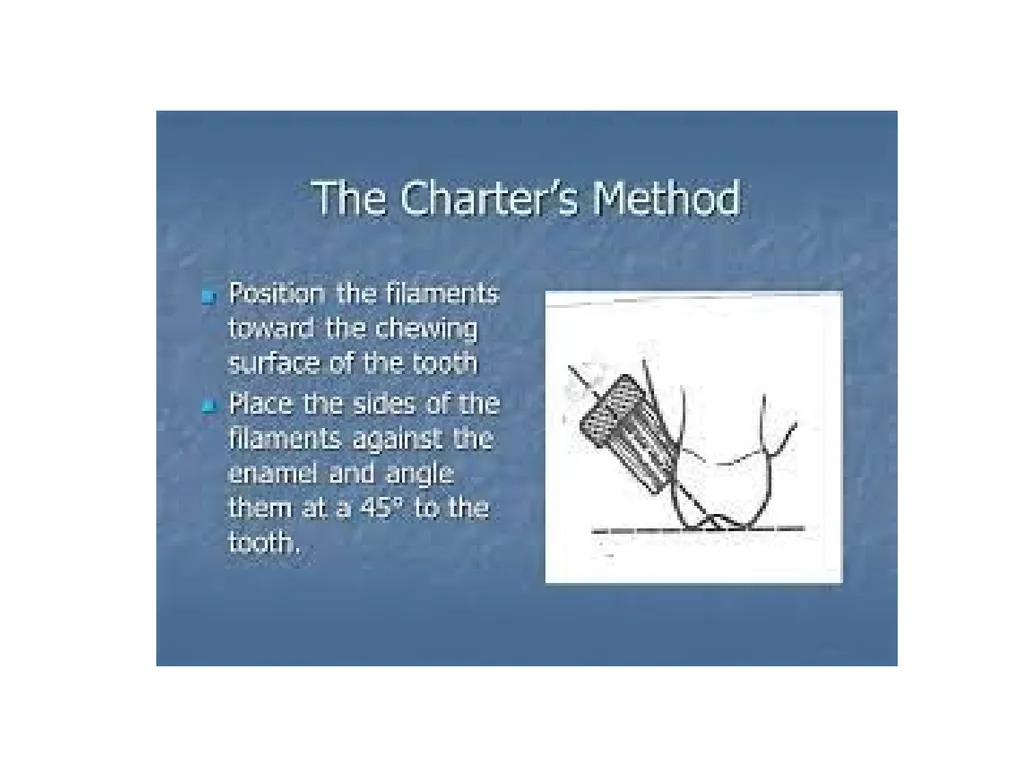
Charters method: The bristles are placed at a 45‐degree angle toward the occlusal or incisal surface of the tooth. The bristles should touch at the junction of the free gingival margin and tooth. A circular vibratory motion is then activated.
Advantages: It is recommended for temporary cleaning in areas of healing wounds after periodontal surgery and effective for cleaning around devices used to correct improper contact of opposing teeth and plaque under abutment teeth.
Scrub brush method: The teeth are placed edge to edge while the brush maintains a 90‐degree angle to the long axis of the tooth. The brush is then moved in a horizontal stroke. This technique is known to cause excessive toothbrush abrasion.<br>
Advantages: It is recommended for temporary cleaning in areas of healing wounds after periodontal surgery and effective for cleaning around devices used to correct improper contact of opposing teeth and plaque under abutment teeth.
Scrub brush method: The teeth are placed edge to edge while the brush maintains a 90‐degree angle to the long axis of the tooth. The brush is then moved in a horizontal stroke. This technique is known to cause excessive toothbrush abrasion.<br>
12
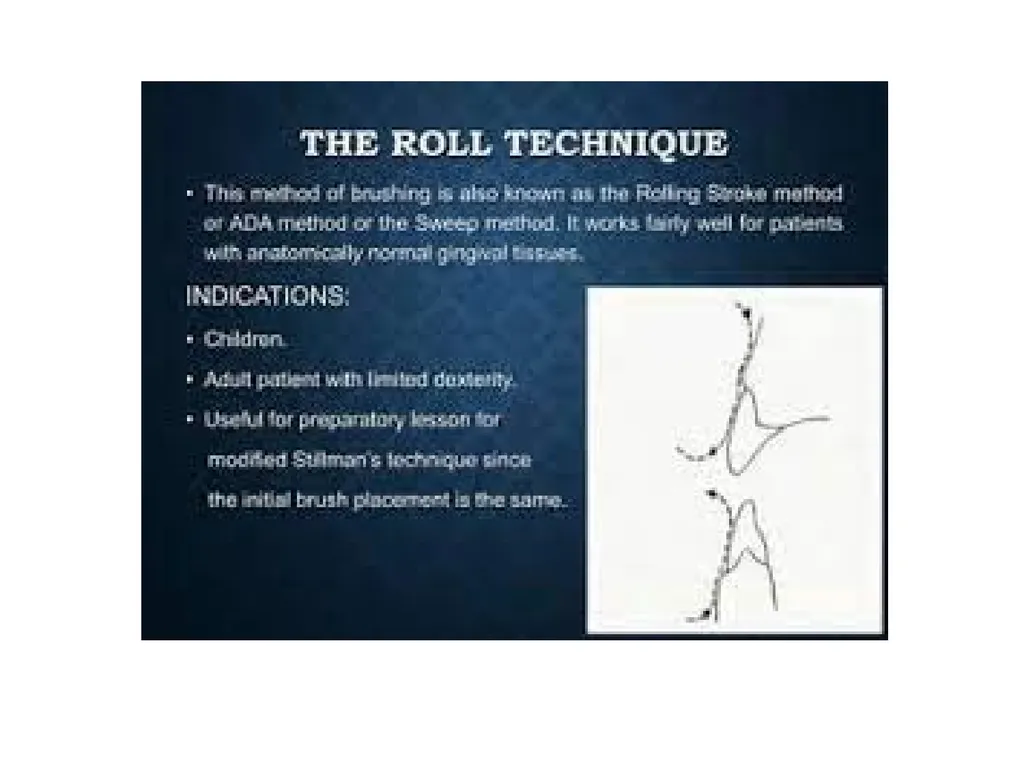
Roll technique or sweep method: The bristles are placed at 45° angle and lightly rolled across the tooth surface toward the occlusal surface. The edge of the brush head should be touching the facial or lingual aspect of the tooth. Then with light pressure, the bristles are rolled against the tooth from the apical position toward the occlusal plane. It is indicated for children and for individuals with limited dexterity.
Advantages: It works fairly well for patients with anatomically normal gingival tissues.<br>
Advantages: It works fairly well for patients with anatomically normal gingival tissues.<br>
13
Fones method or circular scrub method: The teeth are clenched, and the brush is placed inside the cheeks. The brush is moved in a circular motion over both maxillary and manibular teeth. In the anterior region, the teeth are placed in an edge‐to‐edge position and the circular motion is continued. On the lingual aspect, an in‐and‐out stroke is used against all surfaces. This technique can be damaging if done too vigorously.
Advantages: It is recommended for children and physically or emotionally handicapped individuals.
Vertical method or Leonard’s method: The bristles of toothbrush are placed at 90° angle to the facial surface of the teeth. The teeth are held in an edge‐to‐edge position. Next the toothbrush is moved in a vertical, vigorous motion up and down the teeth. The maxillary and mandibular teeth are brushed separately.
Advantages: Most convenient and effective for small children.<br>
Advantages: It is recommended for children and physically or emotionally handicapped individuals.
Vertical method or Leonard’s method: The bristles of toothbrush are placed at 90° angle to the facial surface of the teeth. The teeth are held in an edge‐to‐edge position. Next the toothbrush is moved in a vertical, vigorous motion up and down the teeth. The maxillary and mandibular teeth are brushed separately.
Advantages: Most convenient and effective for small children.<br>
14
2- Powered toothbrush:
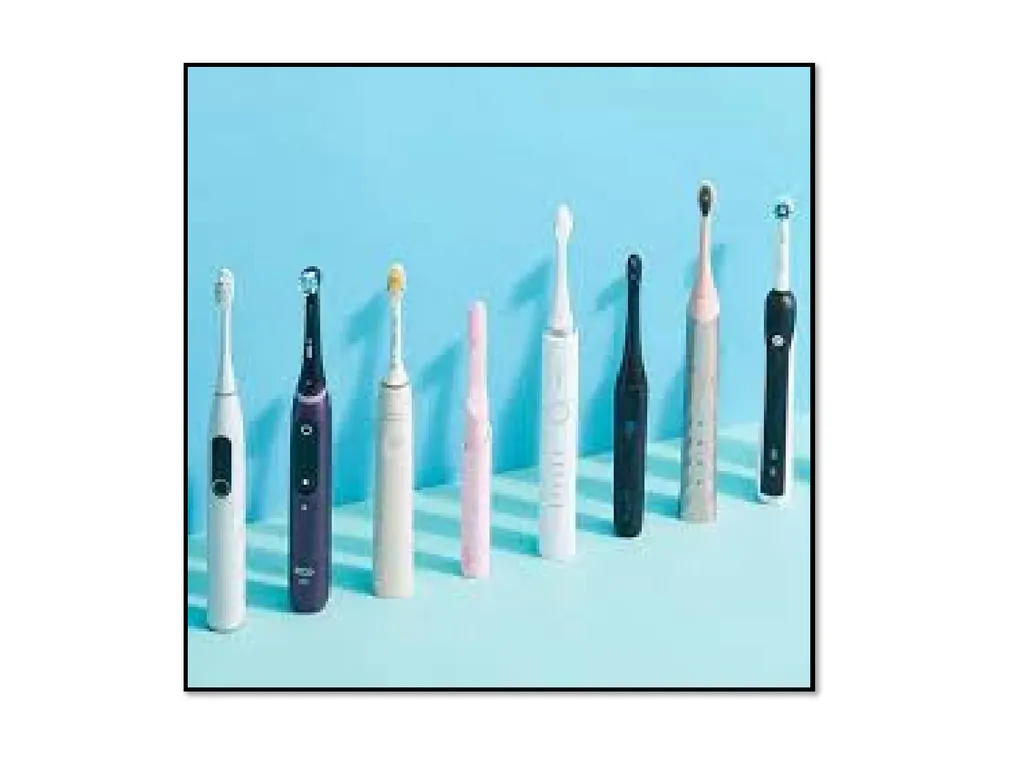
These were introduced in 1960’s. Powered toothbrushes are not superior to manual. Most powered toothbrush manufacturers do not recommend a specific brushing method. However, some guidelines for using a powered brush are available.
It is recommended that the brush be positioned slightly differently for each surface of the tooth. Each tooth and corresponding gingival areas should be brushed separately, always with light, steady pressure.
Pressure should never be exerted on the bristles of a powered toothbrush because this could damage the tissues.<br>
These were introduced in 1960’s. Powered toothbrushes are not superior to manual. Most powered toothbrush manufacturers do not recommend a specific brushing method. However, some guidelines for using a powered brush are available.
It is recommended that the brush be positioned slightly differently for each surface of the tooth. Each tooth and corresponding gingival areas should be brushed separately, always with light, steady pressure.
Pressure should never be exerted on the bristles of a powered toothbrush because this could damage the tissues.<br>
15
The indications for uses are:
1- Young children.
2- Disabled patients.
3- Individuals lacking manual dexterity.
4- Patients with prosthodontics, or orthodontic treatment as well as implants.
5- Patients on supportive periodontal treatment.
6- Institutionalized elderly peoples.<br>
1- Young children.
2- Disabled patients.
3- Individuals lacking manual dexterity.
4- Patients with prosthodontics, or orthodontic treatment as well as implants.
5- Patients on supportive periodontal treatment.
6- Institutionalized elderly peoples.<br>
16
3- Sonic and ultrasonic toothbrush: These types produce high frequency vibrations (200-400 HZ for sonic and 1.6 MHZ for ultrasonic), which lead to the phenomenon of disruption of bacterial cell wall (bactericidal) and aids in stain removal.
4- Ionic toothbrush: This type changes the surface charge of a tooth by influx of positively charged ions. The plaque with similar charge is repelled from the tooth surface and is attracted by the negatively charged bristles of the toothbrush. It indicates a brush that aims to impart an electrical charge to the tooth surface with the intent of disrupting the attachment of dental plaque.<br>
4- Ionic toothbrush: This type changes the surface charge of a tooth by influx of positively charged ions. The plaque with similar charge is repelled from the tooth surface and is attracted by the negatively charged bristles of the toothbrush. It indicates a brush that aims to impart an electrical charge to the tooth surface with the intent of disrupting the attachment of dental plaque.<br>
17
Objectives of tooth brushing:
1. To clean teeth and interdental spaces.
2. To prevent plaque formation.
3. To disturb and remove plaque.
4. To stimulate and massage gingival tissues.
5. To clean the tongue.
Effects of improper tooth brushing:
1. Gingival alterations include:
Acute lacerations.
Chronic alterations.
Recession.
Change in gingival contour.
Corrective measures: Use of soft toothbrush and change of brushing method.<br>
1. To clean teeth and interdental spaces.
2. To prevent plaque formation.
3. To disturb and remove plaque.
4. To stimulate and massage gingival tissues.
5. To clean the tongue.
Effects of improper tooth brushing:
1. Gingival alterations include:
Acute lacerations.
Chronic alterations.
Recession.
Change in gingival contour.
Corrective measures: Use of soft toothbrush and change of brushing method.<br>
18
2. Abrasion of the teeth: It means the loss of tooth substance produced by mechanical wear other than by mastication. The contributing factors are: hard toothbrush, horizontal brushing, abrasive agents in dentifrice, excessive pressure during brushing and prominence of the tooth surface labially or buccally. The abraded areas are on the cervical areas of exposed root but may occur on enamel.
Corrective measures: Recommend a less abrasive dentifrice, change the tooth brush method and advise the patient to use soft texture bristles.<br>
Corrective measures: Recommend a less abrasive dentifrice, change the tooth brush method and advise the patient to use soft texture bristles.<br>
19
2- Interdental Cleaning aids:
The toothbrush does not completely remove interdental plaque either in healthy or periodontal involved patients. Interdental cleaning is crucial to augment the effect of tooth brushing.
Factors affecting the selection of interdental cleaning aids:
Type of gingival embrasures.
Alignment of teeth.
Fixed prosthesis or orthodontic appliances.
Open furcation areas.
Contact areas.<br>
The toothbrush does not completely remove interdental plaque either in healthy or periodontal involved patients. Interdental cleaning is crucial to augment the effect of tooth brushing.
Factors affecting the selection of interdental cleaning aids:
Type of gingival embrasures.
Alignment of teeth.
Fixed prosthesis or orthodontic appliances.
Open furcation areas.
Contact areas.<br>
20
1- Dental floss:
It is used to remove plaque from interproximal surfaces in which the embrasure is completely occupied by healthy interdental papilla. There are many types either waxed, unwaxed, flavored or tape.
Function of dental floss:
1. Remove of adherent plaque and food debris to teeth and others.
2. Reducing gingival bleeding.
3. Improving oral hygiene.
4. Massaging the interdental papillae.
5. Helping in locating calculus, overhanging restorations and proximal carious lesion.
6. Polishing of tooth surfaces during plaque removal.<br>
It is used to remove plaque from interproximal surfaces in which the embrasure is completely occupied by healthy interdental papilla. There are many types either waxed, unwaxed, flavored or tape.
Function of dental floss:
1. Remove of adherent plaque and food debris to teeth and others.
2. Reducing gingival bleeding.
3. Improving oral hygiene.
4. Massaging the interdental papillae.
5. Helping in locating calculus, overhanging restorations and proximal carious lesion.
6. Polishing of tooth surfaces during plaque removal.<br>
21
2- Wooden tips: They are placed in the interdental space in such a way that the base of triangle toward the gingiva and the sides are in contact with the proximal surfaces.
3- Interdental brushes: These brushes are suitable for cleaning large, irregular tooth surfaces adjacent to wide interdental spaces and may also be used to clean furcation areas.
4- Miswak (Siwak): It is a traditional chewing stick prepared from the roots, twigs and stem of salvadora persica and has been used as a natural method for tooth cleaning provides both mechanical (bristles) and chemical (antimicrobial agents) measures for plaque control. It contains fluoride and was found to release significant amounts of calcium and phosphorus into water. Although miswak is an essential aid in oral hygiene measures, some disadvantages are associated with its use and these may be overcome by precise instructions on methods and duration of miswak use.<br>
3- Interdental brushes: These brushes are suitable for cleaning large, irregular tooth surfaces adjacent to wide interdental spaces and may also be used to clean furcation areas.
4- Miswak (Siwak): It is a traditional chewing stick prepared from the roots, twigs and stem of salvadora persica and has been used as a natural method for tooth cleaning provides both mechanical (bristles) and chemical (antimicrobial agents) measures for plaque control. It contains fluoride and was found to release significant amounts of calcium and phosphorus into water. Although miswak is an essential aid in oral hygiene measures, some disadvantages are associated with its use and these may be overcome by precise instructions on methods and duration of miswak use.<br>
22
5- Oral irrigation devices: These devices are beneficial in the removal of unattached plaque and debris. They may also be used to deliver antimicrobial agents such as chlorhexidine.
6- Gingival massage: Massaging the gingiva with toothbrush produce epithelial thickening and increased keratinization.
7- Tongue brushing: The tongue is anatomically perfect for harboring bacteria. The tongue can transmit organisms during tooth brushing and infection or reinfection of a periodontal pocket. For these reasons, the tongue, especially those with fissuring or prominent papilla, should be regularly cleaned. Commercial tongue cleaners, made of plastic or a flexible metal, are also available. They are curved so they can be placed over the tongue without touching the teeth. These instruments are swept over the dorsum of the tongue to remove bacterial plaque and debris.<br>
6- Gingival massage: Massaging the gingiva with toothbrush produce epithelial thickening and increased keratinization.
7- Tongue brushing: The tongue is anatomically perfect for harboring bacteria. The tongue can transmit organisms during tooth brushing and infection or reinfection of a periodontal pocket. For these reasons, the tongue, especially those with fissuring or prominent papilla, should be regularly cleaned. Commercial tongue cleaners, made of plastic or a flexible metal, are also available. They are curved so they can be placed over the tongue without touching the teeth. These instruments are swept over the dorsum of the tongue to remove bacterial plaque and debris.<br>
23
Chemical plaque control agents:
They have proven to be an ideal adjunct to mechanical plaque control. They are designed to be used as supplements to mechanical plaque control procedures and not to replace them. They have ability to interfere with metabolic activity or adhesion of dental plaque.<br>
They have proven to be an ideal adjunct to mechanical plaque control. They are designed to be used as supplements to mechanical plaque control procedures and not to replace them. They have ability to interfere with metabolic activity or adhesion of dental plaque.<br>
24
Ideal properties of chemical plaque control agents:
1- Should reduce plaque and gingivitis.
2- Should prevent growth of pathogenic bacteria.
3- Should prevent resistant bacteria.
4- Should compatible with the oral tissues.
5- Should not stain teeth or alter taste.
6- Should exhibit good retentive properties.
7- Should be inexpensive and easy to use.<br>
1- Should reduce plaque and gingivitis.
2- Should prevent growth of pathogenic bacteria.
3- Should prevent resistant bacteria.
4- Should compatible with the oral tissues.
5- Should not stain teeth or alter taste.
6- Should exhibit good retentive properties.
7- Should be inexpensive and easy to use.<br>
25
Modes of action
1. Inhibition of bacterial colonization by interference with bacterial adsorption.
2. Inhibition of bacterial growth and metabolism (bactericidal and bacteriostatic effects).
3. Disruption of mature plaque by eliminating of existing plaque.
4. Modification of plaque biochemistry and ecology.<br>
1. Inhibition of bacterial colonization by interference with bacterial adsorption.
2. Inhibition of bacterial growth and metabolism (bactericidal and bacteriostatic effects).
3. Disruption of mature plaque by eliminating of existing plaque.
4. Modification of plaque biochemistry and ecology.<br>
26
Factors affecting delivery and clearance of agents from the oral cavity
- Solubility
- Accessibility
- Stability
Chemoprophylactic agents are delivered as:
1- Mouth rinses
2- Dentifrices
3- Gels (contains humectant, but without abrasives and foam agents).
4- Sustained release devices and varnishes
5- Chewing gums and lozenges (they increase the time of clearance of agents from the mouth).<br>
- Solubility
- Accessibility
- Stability
Chemoprophylactic agents are delivered as:
1- Mouth rinses
2- Dentifrices
3- Gels (contains humectant, but without abrasives and foam agents).
4- Sustained release devices and varnishes
5- Chewing gums and lozenges (they increase the time of clearance of agents from the mouth).<br>
27
The most widely used agents are:
Chlorhexidine (CHX):
This antiseptic agent has both bactericidal and bacteriostatic activity depending on its concentration. Chlorhexidine is a cationic compound that binds to the hydroxyapatite of tooth enamel, the pellicle, plaque bacteria, the extracellular polysaccharide of the plaque, and especially to the mucous membrane. The chlorhexidine adsorbed to the hydroxyapatite is believed to inhibit bacterial colonization and prevent pellicle formation.<br>
Chlorhexidine (CHX):
This antiseptic agent has both bactericidal and bacteriostatic activity depending on its concentration. Chlorhexidine is a cationic compound that binds to the hydroxyapatite of tooth enamel, the pellicle, plaque bacteria, the extracellular polysaccharide of the plaque, and especially to the mucous membrane. The chlorhexidine adsorbed to the hydroxyapatite is believed to inhibit bacterial colonization and prevent pellicle formation.<br>
28
Chlorhexidine may also inhibit the enzyme glucosyltransferase, which is essential for microbial accumulation on tooth surfaces, and the metabolic enzyme phosphoenolpyruvate phosphotransferase, which is involved in the transport and phosphorylation of glucose across the membrane. After binding, the agent is slowly released in an active form over 8 to 12 hours.
Also, CHX is effective against gram +ve and yeast organisms. Tooth paste should be used before rinsing with chlorhexidine. Two daily rinses with 10 ml of 0.2% solution of chlorhexidine gluconate will completely inhibited the development of dental plaque, calculus and gingival inflammation. It can be used in concentration of 0.12% in 15 ml twice daily. Unpleasant taste and brown discoloration of teeth and filling are the side effects related to CHX.<br>
Also, CHX is effective against gram +ve and yeast organisms. Tooth paste should be used before rinsing with chlorhexidine. Two daily rinses with 10 ml of 0.2% solution of chlorhexidine gluconate will completely inhibited the development of dental plaque, calculus and gingival inflammation. It can be used in concentration of 0.12% in 15 ml twice daily. Unpleasant taste and brown discoloration of teeth and filling are the side effects related to CHX.<br>
29
Triclosan: It is phenol derivative included in mouthwashes and toothpaste. It has a broad spectrum of activity against gram positive, negative bacteria and yeasts. Dentifrice products containing a zinc citrate and triclosan combination have shown to be effective in reducing acid production and plaque formation and in preventing gingivitis.
Essential oil mouthwashes or Listerine:
They are effective in controlling plaque and gingivitis because the oil alters the bacterial cell wall. The active ingredients (essential oils) used in these mouth rinses include a combination of thymol, menthol, eucalyptol, and methyl salicylate.<br>
Essential oil mouthwashes or Listerine:
They are effective in controlling plaque and gingivitis because the oil alters the bacterial cell wall. The active ingredients (essential oils) used in these mouth rinses include a combination of thymol, menthol, eucalyptol, and methyl salicylate.<br>
30
Although the safety of essential oils is well established, some patients can have difficulty tolerating the burning sensation associated with the alcohol content. In addition, slight extrinsic staining has been reported with the use of essential oils rinses, which is a possible transient (short‐term) side effect of any antimicrobial agent. Essential oil mouthrinses are indicated for patients who need and are compliant with antiplaque/antigingivitis mouthrinses.<br>
31
Listerine Antiseptic was antiplaque and antigingivitis mouthrinse to be approved by the ADA in 1988. Patients are advised to rinse twice daily with one‐half ounce of Listerine for 30 seconds in addition to their usual oral‐hygiene regimen. Microorganisms do not develop a resistance to the antibacterial effects of essential oils, such as clove oil (eugenol) and thyme oil (thymol). As with chlorhexidine, just rinsing with an essential oil mouthrinse is unlikely to be effective in treating periodontitis because the solution does not reach the depths of the periodontal pockets.<br>
32
For the dental professional, these mouthrinses are recommended in patients prior to aerosol‐ generating procedures. Unless the dental professional uses an effective dry‐field technique in a 30‐second period, the bacterial aerosol generated by an ultrasonic scaler that removes calculus, an air‐powered tooth polisher, or a slow‐speed or high‐speed hand piece can be roughly equivalent to the aerosols received from a patient directly sneezing into the dental provider’s face.<br>
33
Enzymes: Certain enzymes are bactericidal to microorganisms. They would be able to breakdown already formed matrix of plaque and calculus. Enzymes like Mutanase and Amyloglucosidase. Addition of these enzymes to oral products provides sufficient hydrogen peroxide to control proliferation of bacteria through enhanced peroxidase activity.
Sanguinarine extracts (SE): It is a herbal preparation obtained from the blood root of Sanguinaria canadensis plant. They are effective against Gram-positive and Gram-negative microorganisms, including oral microorganisms. SE may increase saliva-mediated aggregation. SE seems to exert a bactericidal effect by interfering with essential steps in the synthesis of the microbial cell wall.<br>
Sanguinarine extracts (SE): It is a herbal preparation obtained from the blood root of Sanguinaria canadensis plant. They are effective against Gram-positive and Gram-negative microorganisms, including oral microorganisms. SE may increase saliva-mediated aggregation. SE seems to exert a bactericidal effect by interfering with essential steps in the synthesis of the microbial cell wall.<br>
34
Metal ions: Salts of zinc and copper are the most commonly used. These are effective plaque inhibitors at high concentration. Metallic salts reduce the glycolytic activity in microorganisms and delay bacterial growth. They bind strongly to plaque components; through electrostatic forces. They have unpleasant taste with dry mouth and staining. The staining is probably caused by metal sulfides formed as a result of reactions between the metal ions and sulfhydryl groups of pellicle proteins.
Antibiotics: Vancomycin, erythromycin and kanamycin have been used as agents for plaque control.<br>
Antibiotics: Vancomycin, erythromycin and kanamycin have been used as agents for plaque control.<br>
35
Dentifrices: They are substance used with toothbrush for purpose of cleaning the accessible surfaces of teeth. They may contain the followings:
- The therapeutic agent like fluoride to inhibit dental caries.
- Antimicrobial agent such as chlorhexidine to reduce microorganisms.
- An anti-calculus agent as zinc chloride or citrate to dissolve calculus.
The function of toothpaste in conjunction with toothbrush is:
Minimizing plaque buildup.
Anti-caries action.
Removal of stains.
Mouth fresher.<br>
- The therapeutic agent like fluoride to inhibit dental caries.
- Antimicrobial agent such as chlorhexidine to reduce microorganisms.
- An anti-calculus agent as zinc chloride or citrate to dissolve calculus.
The function of toothpaste in conjunction with toothbrush is:
Minimizing plaque buildup.
Anti-caries action.
Removal of stains.
Mouth fresher.<br>
36
Composition of dentifrices:
A dentifrice contains a number of ingredients that serve a definite purpose in providing adequate plaque control thus preventing caries and periodontal disease. The following are the common ingredients:
- Abrasive agents (Calcium carbonate, silicas): These agents have a mild abrasive action which aids in eliminating plaque and remove stained pellicle from tooth surface. The degree of dentifrice abrasiveness depends on the inherent hardness of the abrasive, size of the abrasive particle, and the shape of the particle.<br>
A dentifrice contains a number of ingredients that serve a definite purpose in providing adequate plaque control thus preventing caries and periodontal disease. The following are the common ingredients:
- Abrasive agents (Calcium carbonate, silicas): These agents have a mild abrasive action which aids in eliminating plaque and remove stained pellicle from tooth surface. The degree of dentifrice abrasiveness depends on the inherent hardness of the abrasive, size of the abrasive particle, and the shape of the particle.<br>
37
The most common types of abrasives used are carbonates, phosphates, and silicas. Carbonates include calcium carbonate (chalk) and sodium carbonate (baking soda). Calcium carbonate is highly effective abrasive, although the calcium ion limits the amount of soluble fluoride in toothpaste up to 7 ppm.
Phosphate abrasives include calcium pyrophosphate and dicalcium phosphate dihydrate. Silicas, such as silicon oxides, mechanically cleans the tooth, are chemically inert, and do not react with other dentifrice ingredients. When toothbrush abrasion damage does occur, it usually appears as a V‐shaped notch in the cementum apical to the cementoenamel junction. This area is vulnerable because enamel is about 20 times harder than dentin or cementum.<br>
Phosphate abrasives include calcium pyrophosphate and dicalcium phosphate dihydrate. Silicas, such as silicon oxides, mechanically cleans the tooth, are chemically inert, and do not react with other dentifrice ingredients. When toothbrush abrasion damage does occur, it usually appears as a V‐shaped notch in the cementum apical to the cementoenamel junction. This area is vulnerable because enamel is about 20 times harder than dentin or cementum.<br>
38
- Binding agents (Water soluble agents): These agents control stability and consistency of toothpaste and effects ease of dispersion of the paste in the mouth.
- Detergents: They are producing the foam which aid in the removal of food debris and also dispersion of the paste in the mouth. Sodium lauryl sulfate is the most widely used detergent. It is stable, possesses some antibacterial properties, and has a low surface tension, which facilitates the flow of the dentifrice over the teeth. Sodium lauryl sulfate is active at a neutral pH, has a flavor that is easy to mask.<br>
- Detergents: They are producing the foam which aid in the removal of food debris and also dispersion of the paste in the mouth. Sodium lauryl sulfate is the most widely used detergent. It is stable, possesses some antibacterial properties, and has a low surface tension, which facilitates the flow of the dentifrice over the teeth. Sodium lauryl sulfate is active at a neutral pH, has a flavor that is easy to mask.<br>
39
- Humectants (Glycerin, mannitol, glycerol): These agents aid in reducing the loss of moisture from the toothpaste and prevent hardening. These humectants are non-toxic, but bacterial growth can occur in their presence. For this reason, preservatives such as sodium benzoate, dichlorinated phenols, and alcohols are added to prevent their growth. At high concentration (>40%), humectants act as preservatives.<br>
40
- Flavoring agents: They render the product pleasant to use and leave a fresh taste in the mouth after use. Spearmint, peppermint, wintergreen, cinnamon, and the most recently introduced flavor, vanilla give toothpaste a pleasant taste, aroma, and refreshing aftertaste. It is difficult to formulate a flavor that is universally acceptable because people have different color and taste preferences. Some manufacturers use essential oils such as thymol which can provide a “medicinal” taste to the product.<br>
41
- Anti-calculus agents (soluble pyrophosphates or zinc citrate): These agents are designed to inhibit the mineralization of plaque. Dentifrices containing these agents are labeled as tartar control toothpastes.
- Sweeteners and coloring agents (Sorbitol, mannitol): They serve a dual role as sweetening agents and humectants. Glycerin also serves as a humectant, adds to the sweet taste. A new sweetener in some dentifrices is xylitol.
- Anti-caries agents (NaF, MFP, SnF2): These agents aid in the control of caries.
- Essential-oil dentifrices, Listerine as anti-halitosis.<br>
- Sweeteners and coloring agents (Sorbitol, mannitol): They serve a dual role as sweetening agents and humectants. Glycerin also serves as a humectant, adds to the sweet taste. A new sweetener in some dentifrices is xylitol.
- Anti-caries agents (NaF, MFP, SnF2): These agents aid in the control of caries.
- Essential-oil dentifrices, Listerine as anti-halitosis.<br>
42
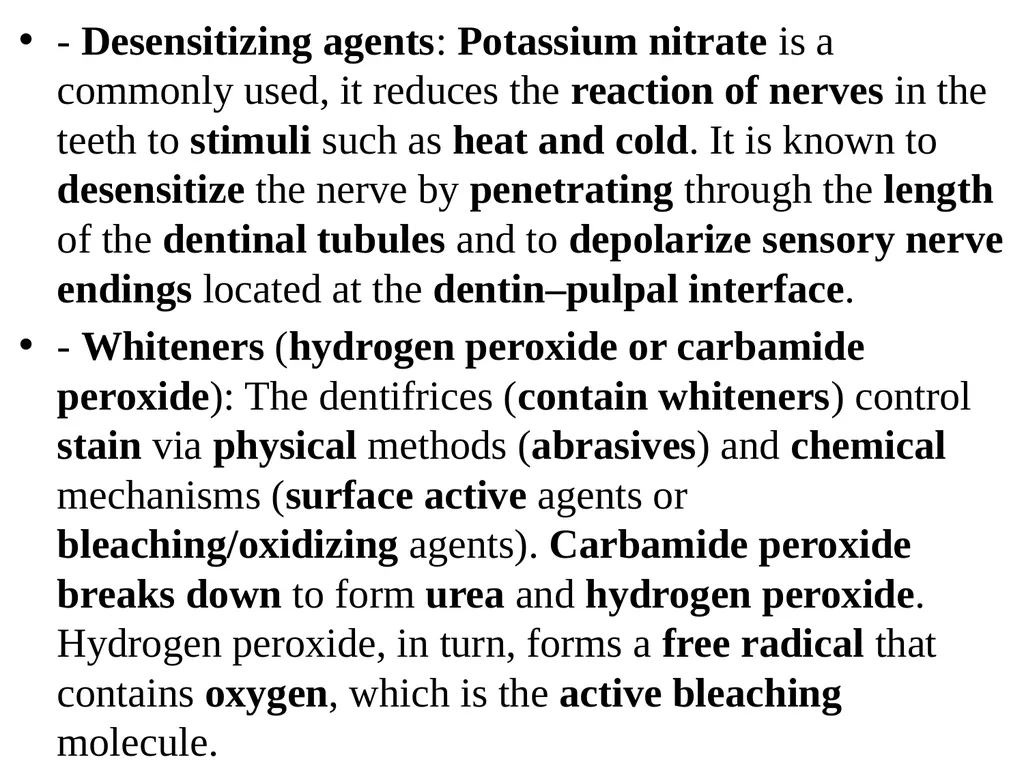
- Desensitizing agents: Potassium nitrate is a commonly used, it reduces the reaction of nerves in the teeth to stimuli such as heat and cold. It is known to desensitize the nerve by penetrating through the length of the dentinal tubules and to depolarize sensory nerve endings located at the dentin–pulpal interface.
- Whiteners (hydrogen peroxide or carbamide peroxide): The dentifrices (contain whiteners) control stain via physical methods (abrasives) and chemical mechanisms (surface active agents or bleaching/oxidizing agents). Carbamide peroxide breaks down to form urea and hydrogen peroxide. Hydrogen peroxide, in turn, forms a free radical that contains oxygen, which is the active bleaching molecule.<br>
- Whiteners (hydrogen peroxide or carbamide peroxide): The dentifrices (contain whiteners) control stain via physical methods (abrasives) and chemical mechanisms (surface active agents or bleaching/oxidizing agents). Carbamide peroxide breaks down to form urea and hydrogen peroxide. Hydrogen peroxide, in turn, forms a free radical that contains oxygen, which is the active bleaching molecule.<br>
43
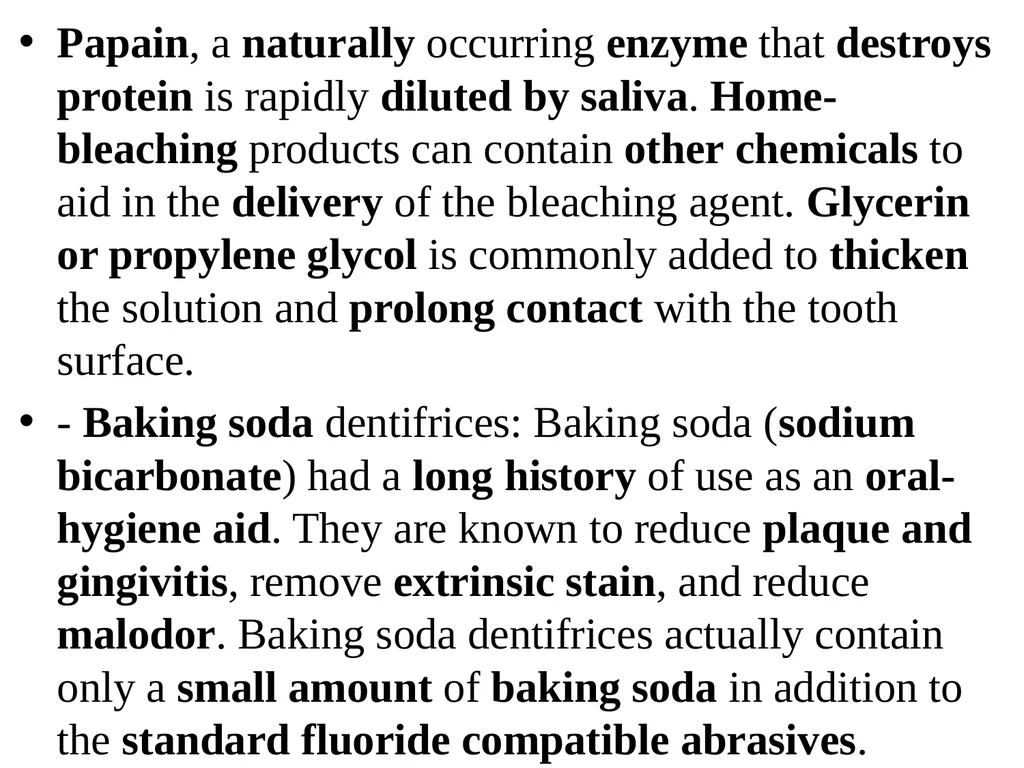
Papain, a naturally occurring enzyme that destroys protein is rapidly diluted by saliva. Home‐bleaching products can contain other chemicals to aid in the delivery of the bleaching agent. Glycerin or propylene glycol is commonly added to thicken the solution and prolong contact with the tooth surface.
- Baking soda dentifrices: Baking soda (sodium bicarbonate) had a long history of use as an oral‐hygiene aid. They are known to reduce plaque and gingivitis, remove extrinsic stain, and reduce malodor. Baking soda dentifrices actually contain only a small amount of baking soda in addition to the standard fluoride compatible abrasives.<br>
- Baking soda dentifrices: Baking soda (sodium bicarbonate) had a long history of use as an oral‐hygiene aid. They are known to reduce plaque and gingivitis, remove extrinsic stain, and reduce malodor. Baking soda dentifrices actually contain only a small amount of baking soda in addition to the standard fluoride compatible abrasives.<br>