Origins of Computing Post 1900 Raj Reddy Carnegie Mellon University Jan 16, 2013 rrcmu.edu 15-346 Schedule of Presentations Spring 2013 Jan 14 Raj Reddy Origins of Computers I Pre 1900 Jan 16 Raj Reddy Origins of Computers II Post
"Origins of Computing – Post 1900 Raj Reddy" is the property of its rightful owner. Permission is granted to
download and print the materials on this website for personal, non-commercial use only, and to display it
on your personal computer provided you do not modify the materials and that you retain all copyright
notices contained in the materials. By downloading content from our website, you accept the terms of this
agreement.
Presentation Transcript
01
Origins of Computing – Post 1900 Raj Reddy
Carnegie Mellon University
Jan 16, 2013
rr@cmu.edu<br>
02
15-346 Schedule of Presentations Spring 2013 Jan 14 Raj Reddy Origins of Computers I – Pre 1900
Jan 16 Raj Reddy Origins of Computers II– Post 1900
Jan 21 Chuck Thacker Computer Architecture in the 20th century
Jan 23 Chuck Thacker Computer Architecture in the 21st century
Jan 28 & 30 Majd Sakr Fetch & Execute, Pipelining & IL Parallelism
Feb 4 M Hammoud The Memory Hierarchy
Feb 6 M Hammoud Multicore Challenges
Feb 11 & 13 Gordon Bell Architectures from Digestible to the Largest
Feb 18 (VC) Dan Siewiorek Mobile Hardware Technologies
Feb 20 (VC) Dan Siewiorek End-to-End Application Considerations
Feb 25 & 27 Student Presentations<br>
03
Necessary Conditions for The Evolution of Computers Representation of Data and Logic
Text, Numbers, Procedures
Physical Technology
Mechanical, EM Relays, Electronic Devices
Control Unit and Arithmetic Logic Unit
I/O Devices
Manual, Paper Tape, Punch Cards, Teletype
Programmability
Flexible Automation: Most mechanical machines do just one task; A programmable computer can do many tasks
A Language for Expression of Desired Computation
Automatic Sequencing of successive operations including
Conditional Branching: If…then statements
Iteration: Loops - going back to a previous instruction<br>
04
Origins of Computers – Post 1900 Steps towards Automation of Computation Alan Turing (1936 and 1945)
Pioneers in Computing Hardware (1939-45)
George Stibitz
Konrad Zuse
John Atanasoff
Howard Aiken
Presper Eckert and John Mauchly
John von Neumann (1945)<br>
05
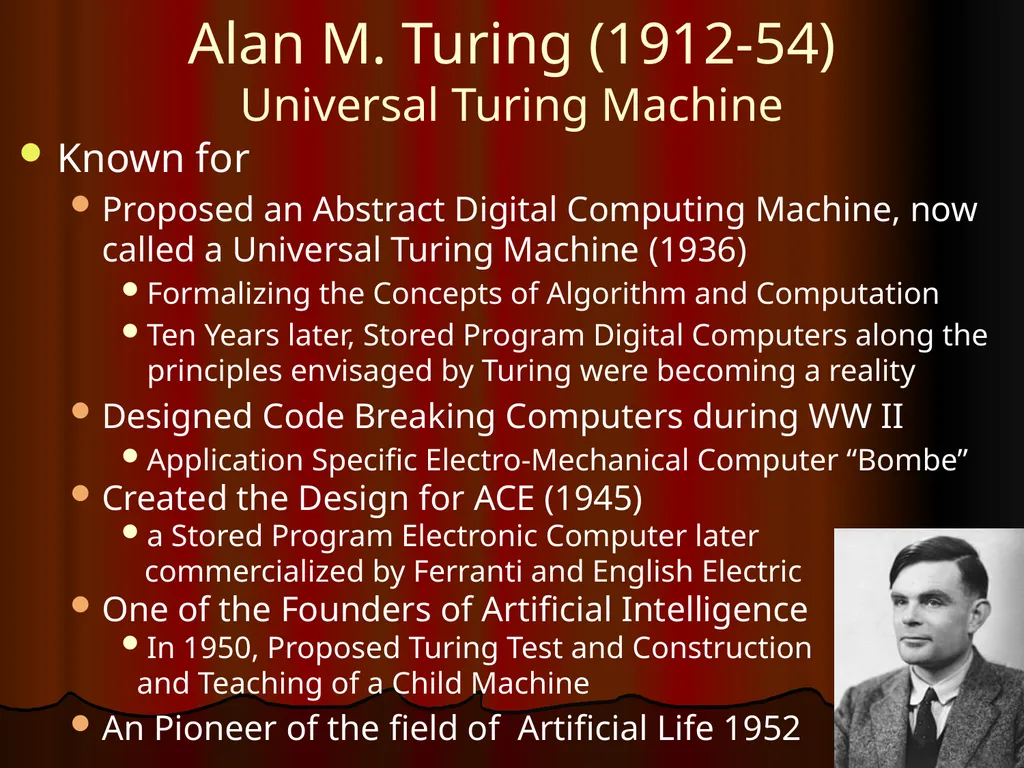
Alan M. Turing (1912-54) Universal Turing Machine Known for
Proposed an Abstract Digital Computing Machine, now called a Universal Turing Machine (1936)
Formalizing the Concepts of Algorithm and Computation
Ten Years later, Stored Program Digital Computers along the principles envisaged by Turing were becoming a reality
Designed Code Breaking Computers during WW II
Application Specific Electro-Mechanical Computer “Bombe”
Created the Design for ACE (1945)
a Stored Program Electronic Computer later
commercialized by Ferranti and English Electric
One of the Founders of Artificial Intelligence
In 1950, Proposed Turing Test and Construction
and Teaching of a Child Machine
An Pioneer of the field of Artificial Life 1952<br>
06
Turing Machine Overview<br>
07
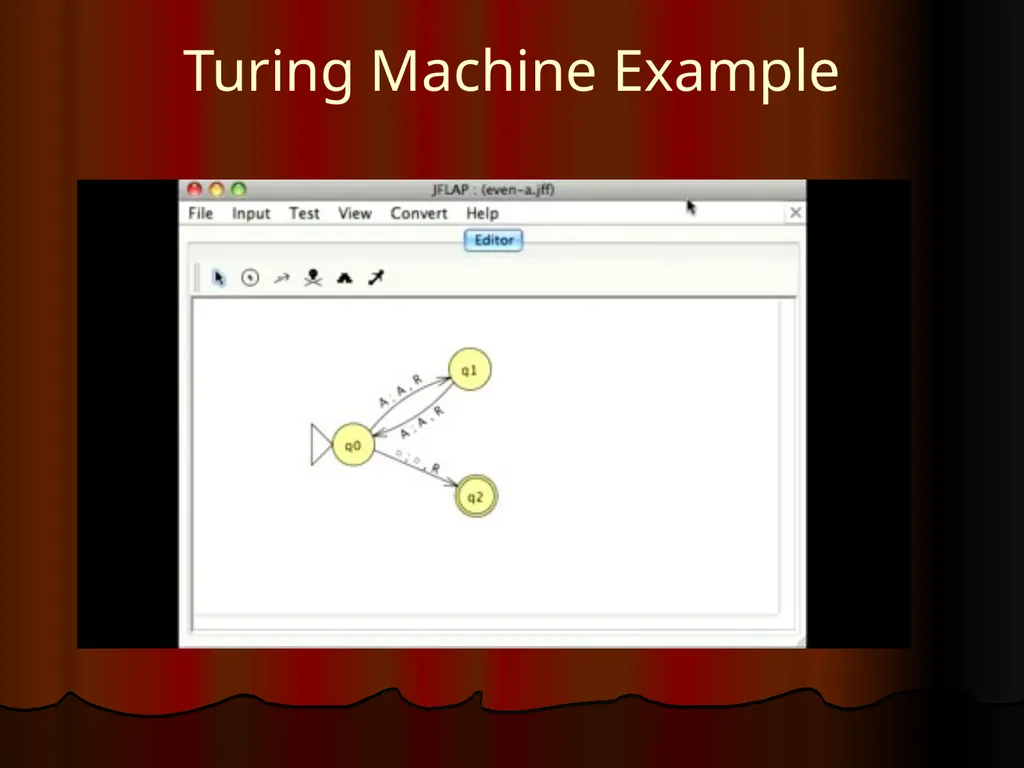
Turing Machine Example<br>
08
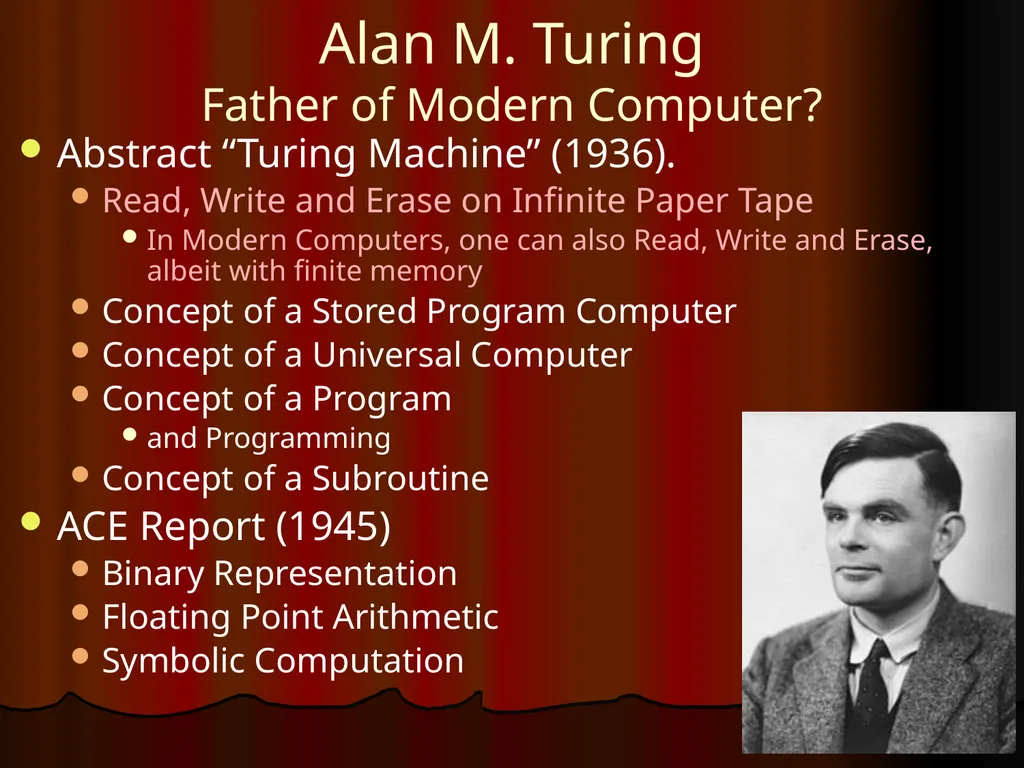
Alan M. Turing Father of Modern Computer? Abstract “Turing Machine” (1936).
Read, Write and Erase on Infinite Paper Tape
In Modern Computers, one can also Read, Write and Erase, albeit with finite memory
Concept of a Stored Program Computer
Concept of a Universal Computer
Concept of a Program
and Programming
Concept of a Subroutine
ACE Report (1945)
Binary Representation
Floating Point Arithmetic
Symbolic Computation<br>
09
George Stibitz (1904-95) BTL1 1939 Stibitz is a pioneer in the design of electro mechanical digital computers
BTL1 is known for
Complex Multiplication and Division
(x + yi)(u + vi) = (xu – yv) + (xv + yu)i
Only 3 multiplications and 3 additions
Needs a sequence of calculations and
storing intermediate results
Fixed Function – Not programmable
First Computing Device ever used
Remotely over Phone Lines
Boolean Logic for Circuit Design<br>
10
Bell Telephone Labs BTL1<br>
11
Konrad Zuse (1910-1995) Z3 1941 Konrad Zuse is a pioneer in the design of electro mechanical digital computers
Z3 is known for
First working program-controlled general-purpose computer
Sequence of Instructions on Tape
Conditional Branching missing
First to use Binary Representation
First use of Floating Point
Single Address Instructions
Operation, Operand
First Programmable Computer<br>
12
Z3<br>
13
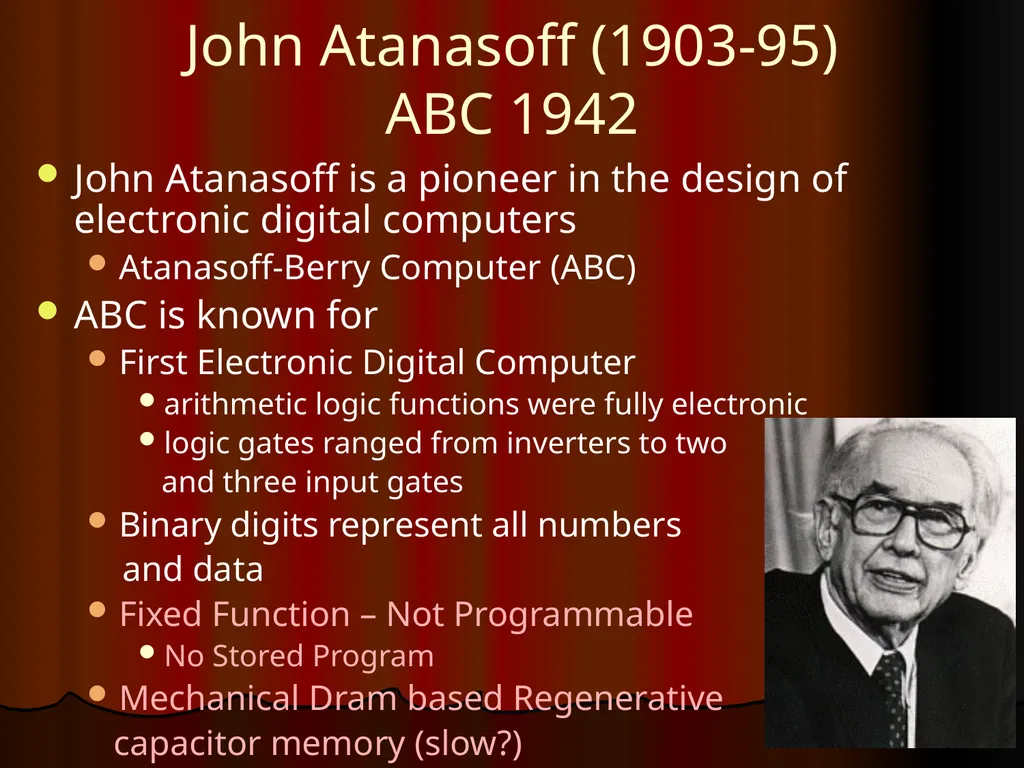
John Atanasoff (1903-95) ABC 1942 John Atanasoff is a pioneer in the design of electronic digital computers
Atanasoff-Berry Computer (ABC)
ABC is known for
First Electronic Digital Computer
arithmetic logic functions were fully electronic
logic gates ranged from inverters to two
and three input gates
Binary digits represent all numbers
and data
Fixed Function – Not Programmable
No Stored Program
Mechanical Dram based Regenerative
capacitor memory (slow?)<br>
14
ABC<br>
15
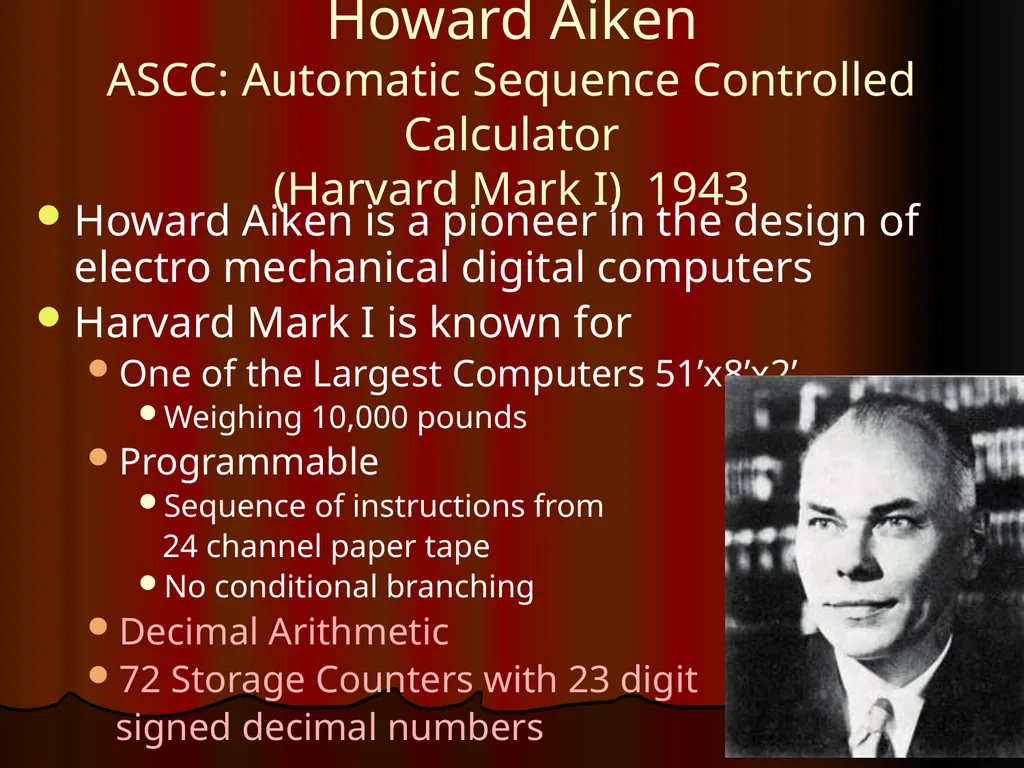
Howard Aiken ASCC: Automatic Sequence Controlled Calculator (Harvard Mark I) 1943 Howard Aiken is a pioneer in the design of electro mechanical digital computers
Harvard Mark I is known for
One of the Largest Computers 51’x8’x2’
Weighing 10,000 pounds
Programmable
Sequence of instructions from
24 channel paper tape
No conditional branching
Decimal Arithmetic
72 Storage Counters with 23 digit
signed decimal numbers<br>
16
ASSC – Harvard Mark I<br>
17
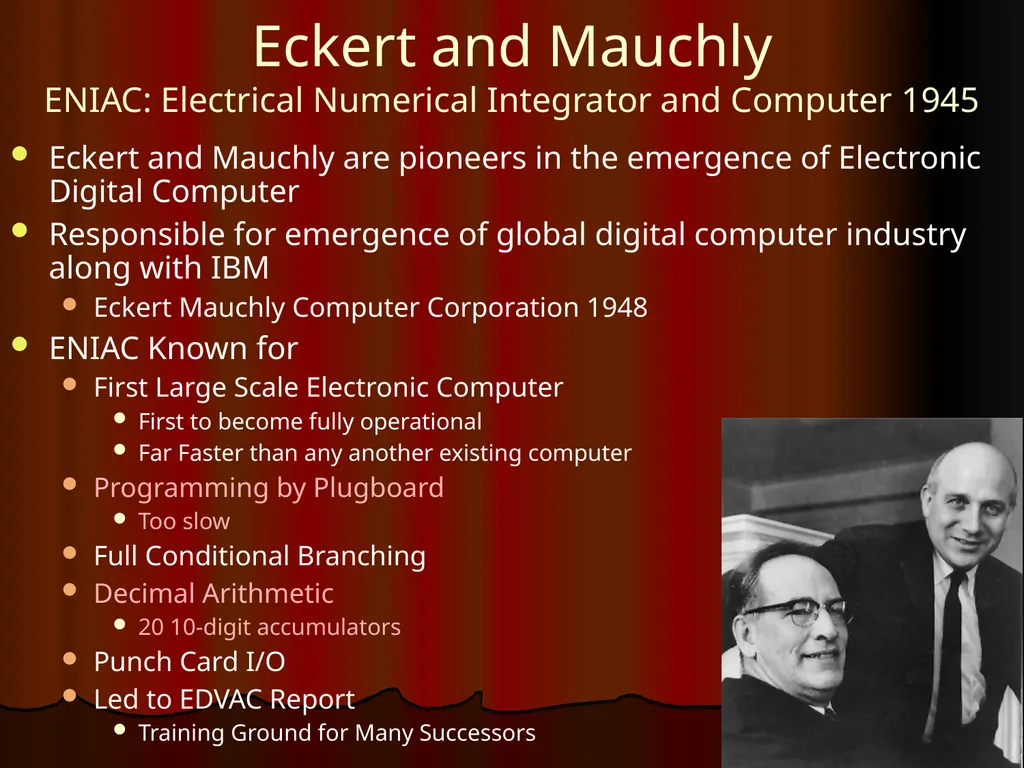
Eckert and Mauchly ENIAC: Electrical Numerical Integrator and Computer 1945 Eckert and Mauchly are pioneers in the emergence of Electronic Digital Computer
Responsible for emergence of global digital computer industry along with IBM
Eckert Mauchly Computer Corporation 1948
ENIAC Known for
First Large Scale Electronic Computer
First to become fully operational
Far Faster than any another existing computer
Programming by Plugboard
Too slow
Full Conditional Branching
Decimal Arithmetic
20 10-digit accumulators
Punch Card I/O
Led to EDVAC Report
Training Ground for Many Successors<br>
18
ENIAC<br>
19
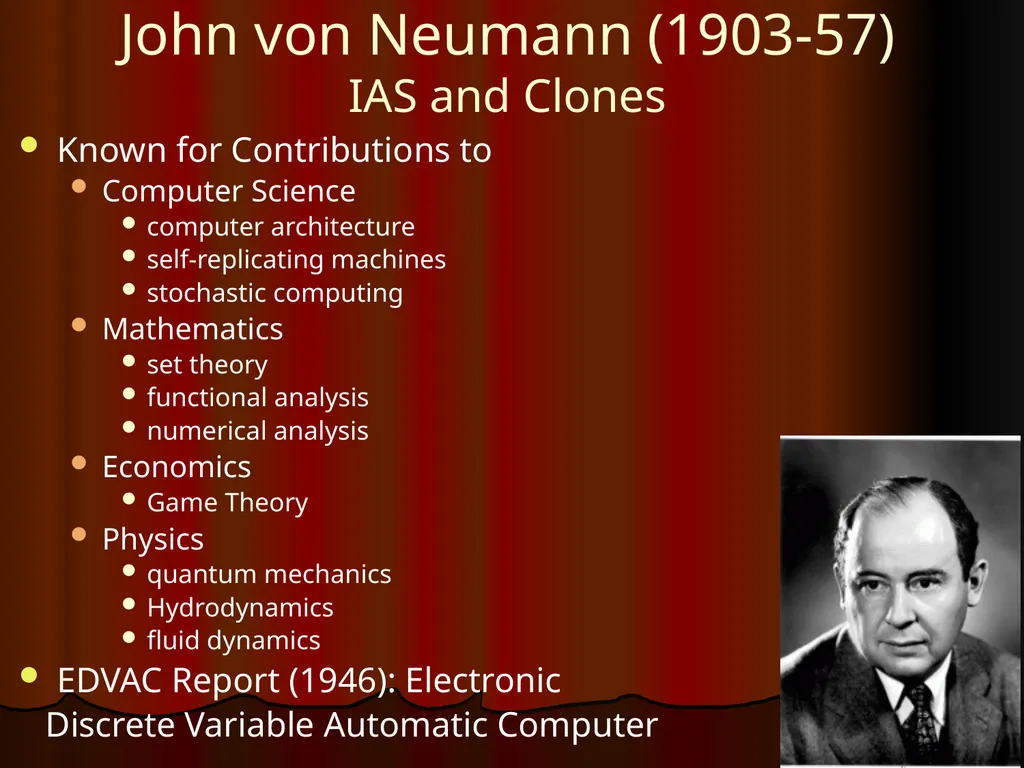
John von Neumann (1903-57) IAS and Clones Known for Contributions to
Computer Science
computer architecture
self-replicating machines
stochastic computing
Mathematics
set theory
functional analysis
numerical analysis
Economics
Game Theory
Physics
quantum mechanics
Hydrodynamics
fluid dynamics
EDVAC Report (1946): Electronic
Discrete Variable Automatic Computer<br>
20
IAS Computer of Institute for Advanced Studies, Princeton<br>
21
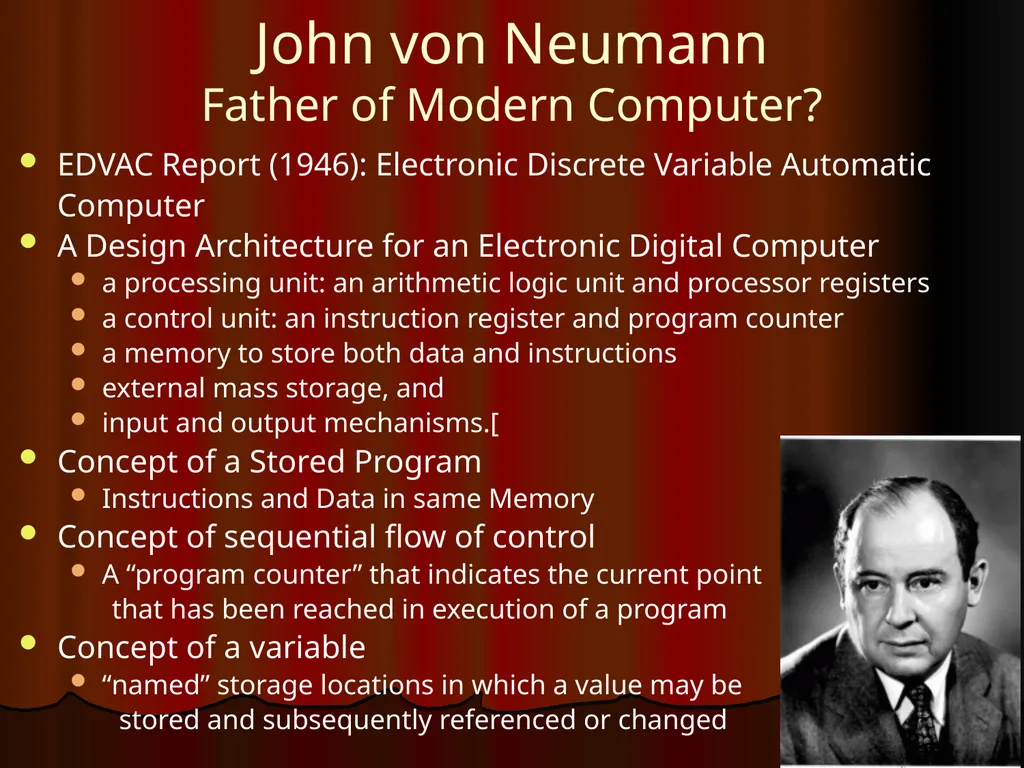
John von Neumann Father of Modern Computer? EDVAC Report (1946): Electronic Discrete Variable Automatic Computer
A Design Architecture for an Electronic Digital Computer
a processing unit: an arithmetic logic unit and processor registers
a control unit: an instruction register and program counter
a memory to store both data and instructions
external mass storage, and
input and output mechanisms.[
Concept of a Stored Program
Instructions and Data in same Memory
Concept of sequential flow of control
A “program counter” that indicates the current point
that has been reached in execution of a program
Concept of a variable
“named” storage locations in which a value may be
stored and subsequently referenced or changed<br>
22
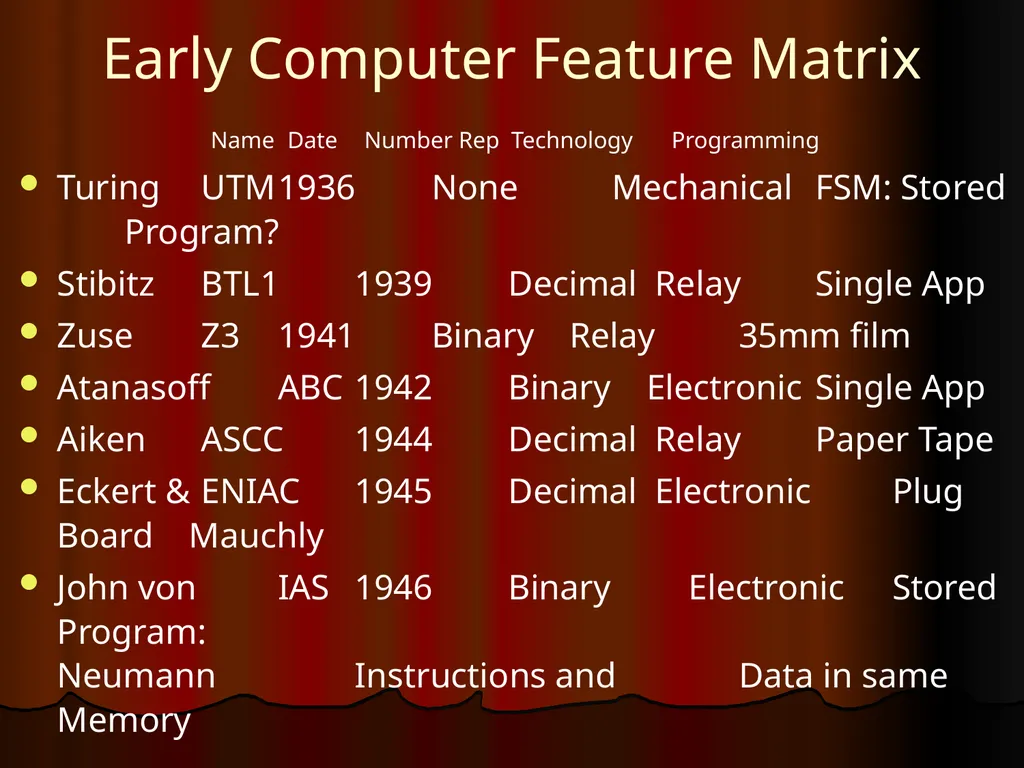
Early Computer Feature Matrix Name Date Number Rep Technology Programming
Turing UTM 1936 None Mechanical FSM: Stored Program?
Stibitz BTL1 1939 Decimal Relay Single App
Zuse Z3 1941 Binary Relay 35mm film
Atanasoff ABC 1942 Binary Electronic Single App
Aiken ASCC 1944 Decimal Relay Paper Tape
Eckert & ENIAC 1945 Decimal Electronic Plug Board Mauchly
John von IAS 1946 Binary Electronic Stored Program: Neumann Instructions and Data in same Memory<br>
23
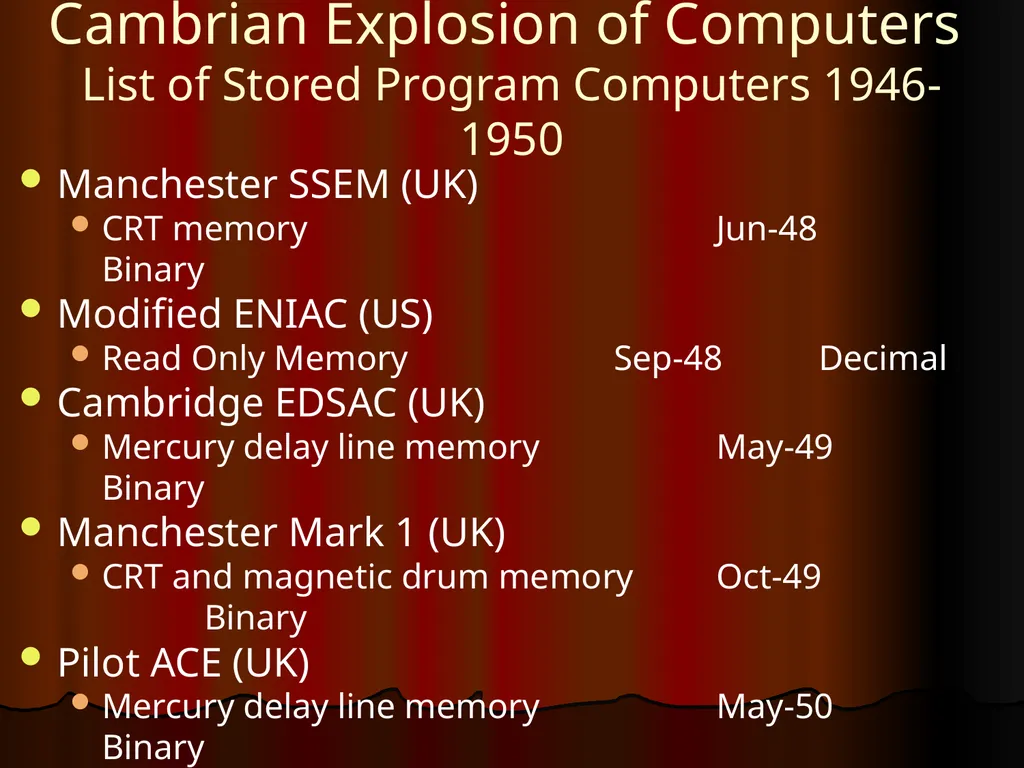
Cambrian Explosion of Computers List of Stored Program Computers 1946-1950 Manchester SSEM (UK)
CRT memory Jun-48 Binary
Modified ENIAC (US)
Read Only Memory Sep-48 Decimal
Cambridge EDSAC (UK)
Mercury delay line memory May-49 Binary
Manchester Mark 1 (UK)
CRT and magnetic drum memory Oct-49 Binary
Pilot ACE (UK)
Mercury delay line memory May-50 Binary
Also CSIRAC, BINAC, UNIVAC, SEAC, Harvard MarkIII<br>
24
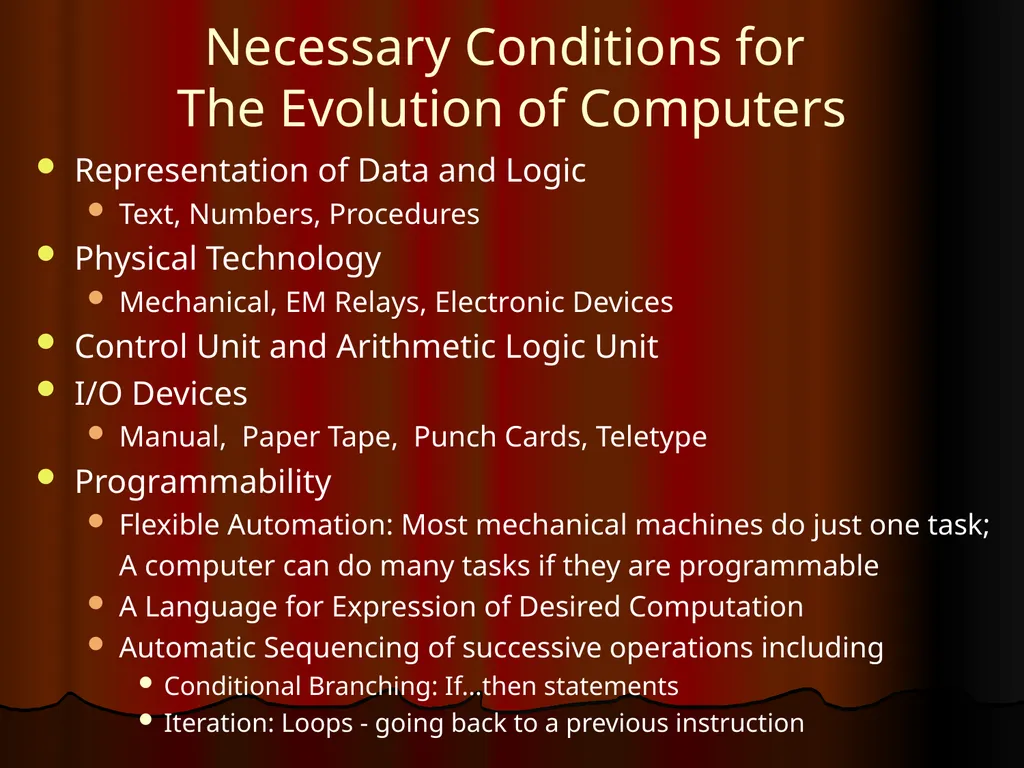
Necessary Conditions for The Evolution of Computers Representation of Data and Logic
Text, Numbers, Procedures
Physical Technology
Mechanical, EM Relays, Electronic Devices
Control Unit and Arithmetic Logic Unit
I/O Devices
Manual, Paper Tape, Punch Cards, Teletype
Programmability
Flexible Automation: Most mechanical machines do just one task; A computer can do many tasks if they are programmable
A Language for Expression of Desired Computation
Automatic Sequencing of successive operations including
Conditional Branching: If…then statements
Iteration: Loops - going back to a previous instruction<br>
25
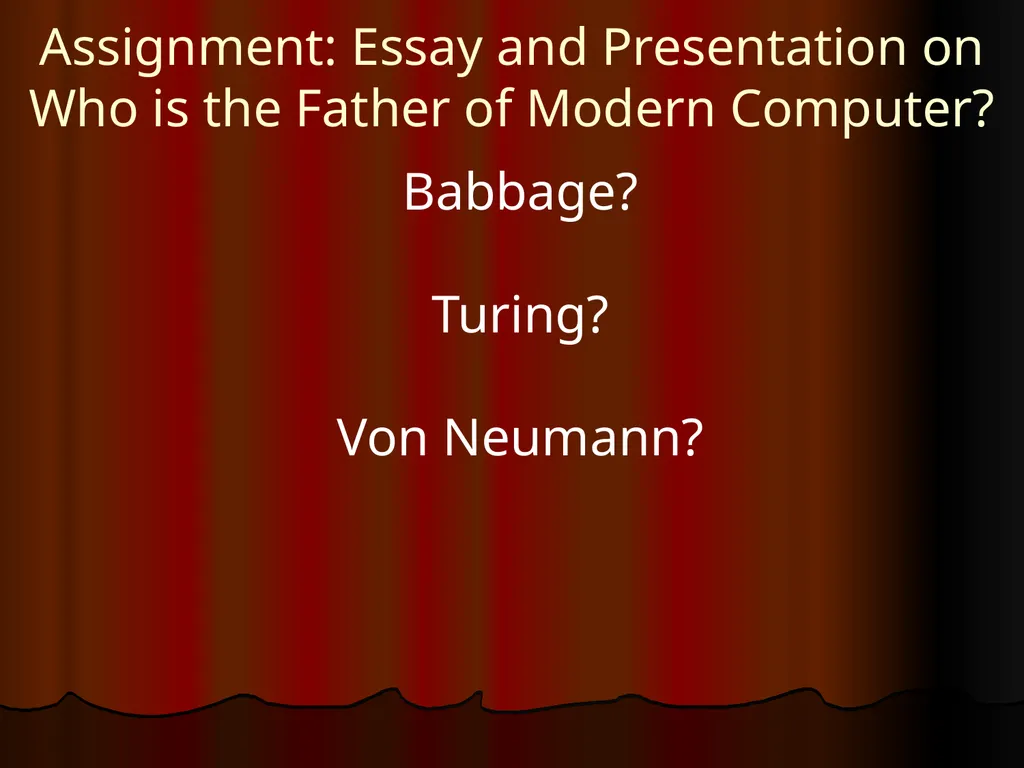
Assignment: Essay and Presentation on Who is the Father of Modern Computer? Babbage?