OTC OFFICE OF TECHNOLOGY COMMERCIALIZATION UNIVERSITY OF OKLAHOMA Patents 101: First, Do No Harm How to Write and Speak About Your Invention Without Losing US or Foreign Patent Rights Dr. Chris Corbett Director of Intellectual Property
"OTC OFFICE OF TECHNOLOGY COMMERCIALIZATION" is the property of its rightful owner. Permission is granted to
download and print the materials on this website for personal, non-commercial use only, and to display it
on your personal computer provided you do not modify the materials and that you retain all copyright
notices contained in the materials. By downloading content from our website, you accept the terms of this
agreement.
Presentation Transcript
01
OTC OFFICE OF TECHNOLOGY COMMERCIALIZATION UNIVERSITY OF OKLAHOMA Patents 101: First, Do No Harm How to Write and Speak About Your Invention Without Losing US or Foreign Patent Rights Dr. Chris Corbett
Director of Intellectual Property
2022<br>
02
The Struggle Is Real There is an inherent conflict between the confidentiality needed to preserve patent rights, and the goal of the University, which is unfettered dissemination of knowledge.
OTC endeavors to manage and mitigate this conflict.<br>
03
Topics for Discussion What is a patent and what does a patent protect?
Common myths about patenting in a university.
Requirements for patentability.
Prior art and public disclosures.
Types of public disclosures.
How to publish without hurting your patent rights.
Key milestones of the patent process and types of patents.<br>
04
What is a patent? what does a patent protect? A patent is a document which gives the patent owner (the University) a monopoly over the “claimed” invention for up to 20 years.
A patent gives the owner the right to exclude others from making, using, selling, or importing the claimed invention.
The invention claimed in an issued patent is established only after an extended “prosecution” process with the Patent Office.
A patent is only good in the country it is issued.<br>
05
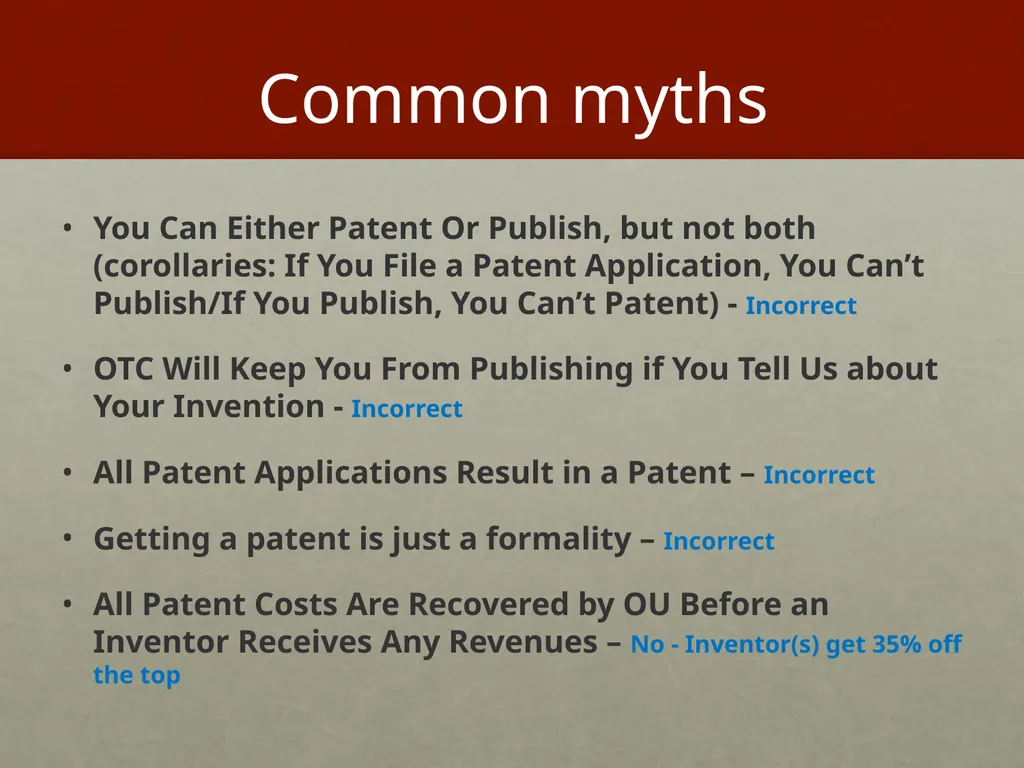
Common myths You Can Either Patent Or Publish, but not both (corollaries: If You File a Patent Application, You Can’t Publish/If You Publish, You Can’t Patent) - Incorrect
OTC Will Keep You From Publishing if You Tell Us about Your Invention - Incorrect
All Patent Applications Result in a Patent – Incorrect
Getting a patent is just a formality – Incorrect
All Patent Costs Are Recovered by OU Before an Inventor Receives Any Revenues – No - Inventor(s) get 35% off the top<br>
06
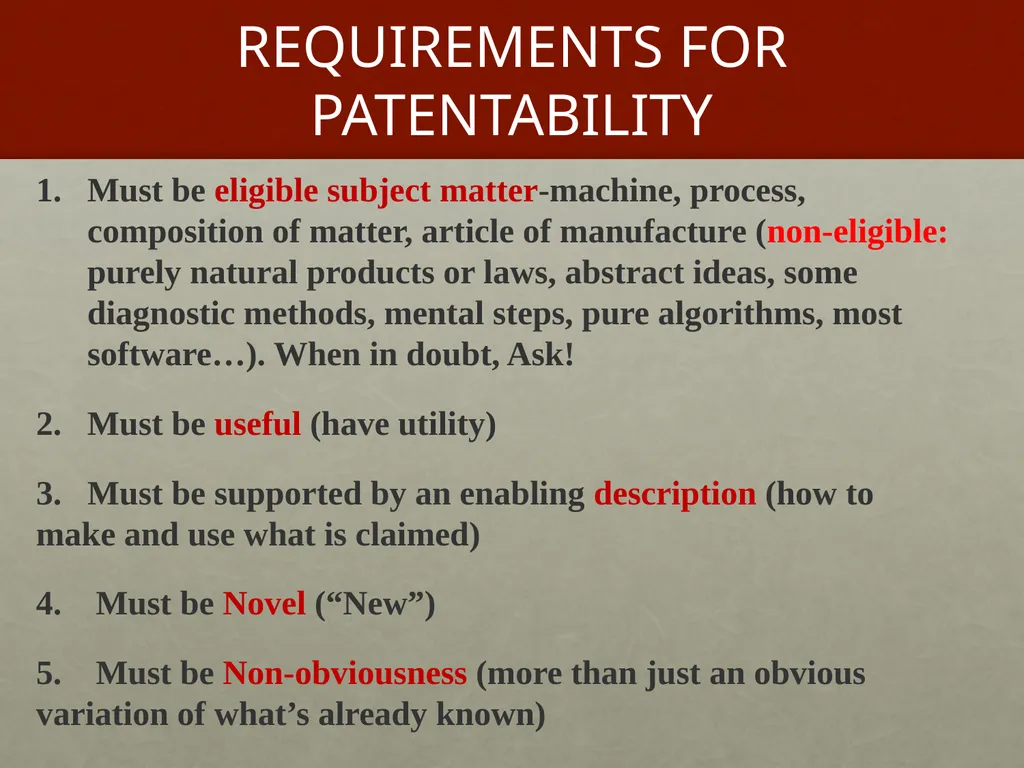
REQUIREMENTS FOR PATENTABILITY Must be eligible subject matter-machine, process, composition of matter, article of manufacture (non-eligible: purely natural products or laws, abstract ideas, some diagnostic methods, mental steps, pure algorithms, most software…). When in doubt, Ask!
Must be useful (have utility)
3. Must be supported by an enabling description (how to make and use what is claimed)
4. Must be Novel (“New”)
5. Must be Non-obviousness (more than just an obvious variation of what’s already known)<br>
07
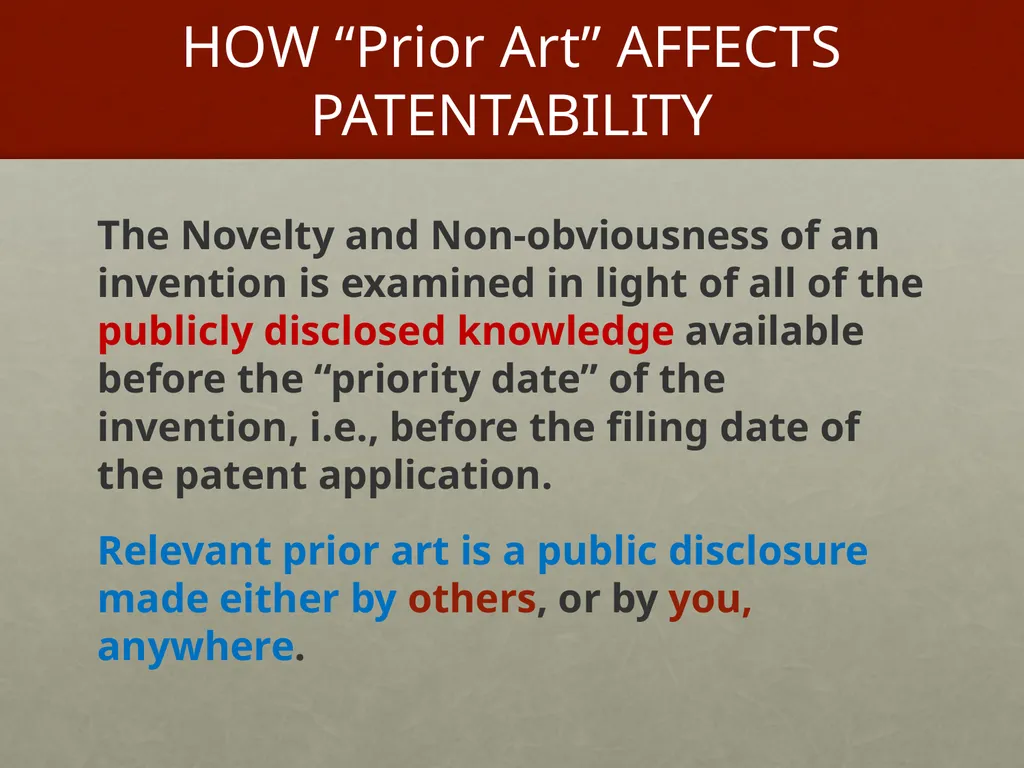
HOW “Prior Art” AFFECTS PATENTABILITY The Novelty and Non-obviousness of an invention is examined in light of all of the publicly disclosed knowledge available before the “priority date” of the invention, i.e., before the filing date of the patent application.
Relevant prior art is a public disclosure made either by others, or by you, anywhere.<br>
08
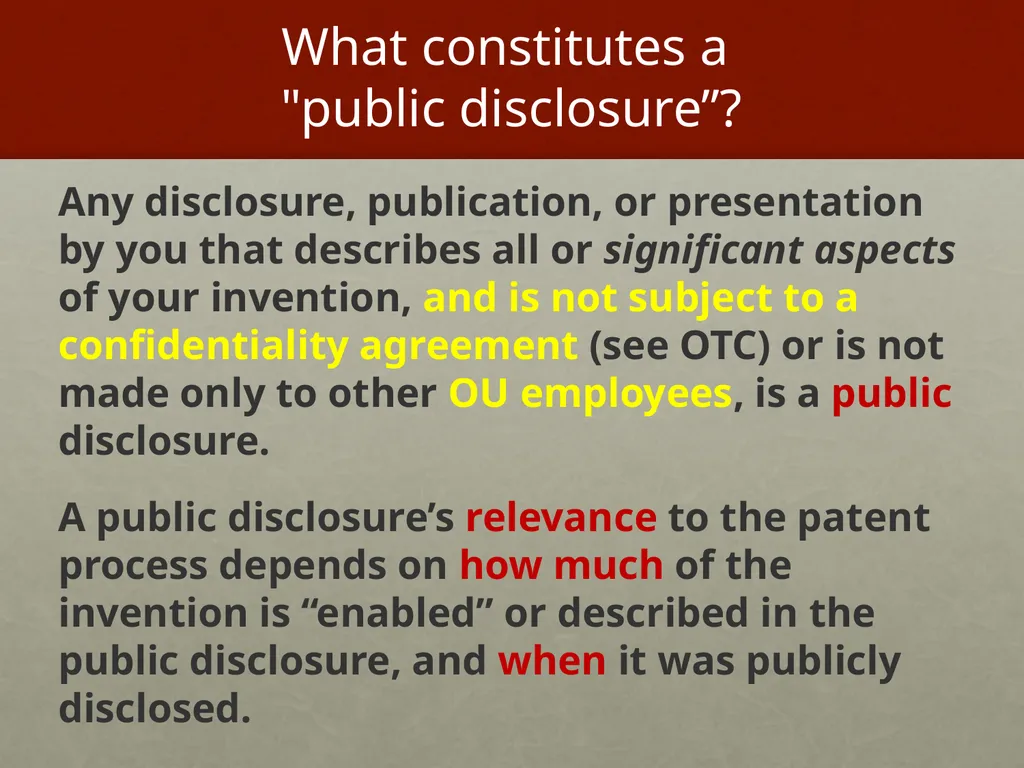
What constitutes a "public disclosure”? Any disclosure, publication, or presentation by you that describes all or significant aspects of your invention, and is not subject to a confidentiality agreement (see OTC) or is not made only to other OU employees, is a public disclosure.
A public disclosure’s relevance to the patent process depends on how much of the invention is “enabled” or described in the public disclosure, and when it was publicly disclosed.
Types: Written, Oral, Public Use or Sale<br>
09
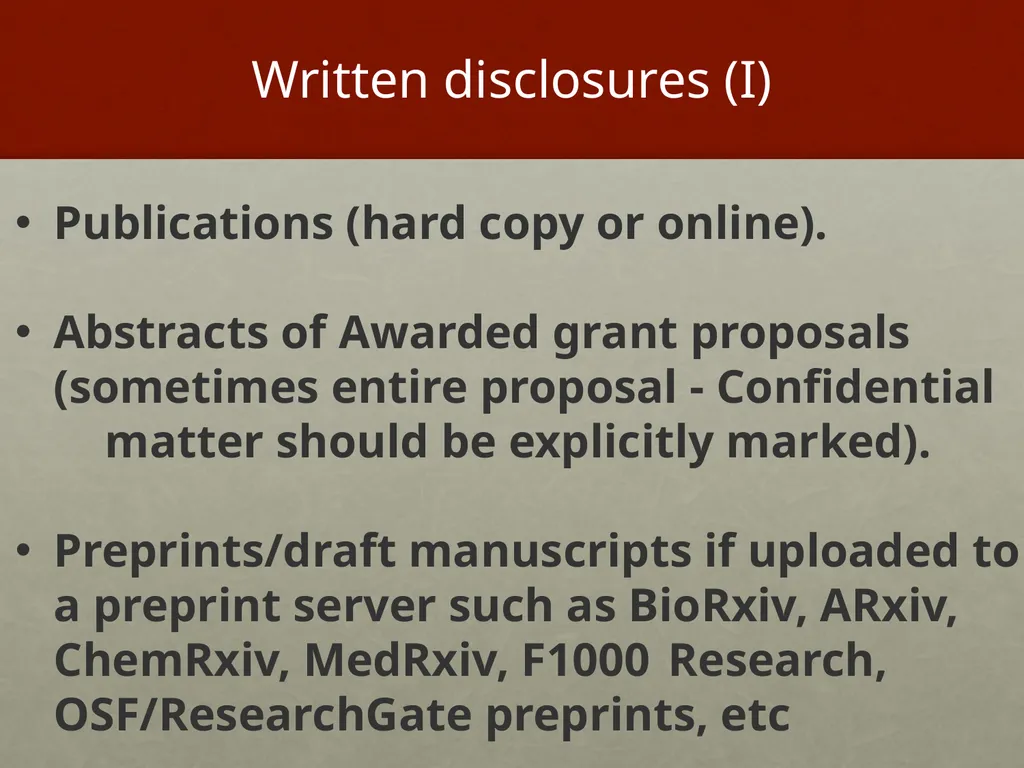
Written disclosures (I) Publications (hard copy or online).
Abstracts of Awarded grant proposals (sometimes entire proposal - Confidential matter should be explicitly marked).
Preprints/draft manuscripts if uploaded to a preprint server such as BioRxiv, ARxiv, ChemRxiv, MedRxiv, F1000 Research, OSF/ResearchGate preprints, etc<br>
10
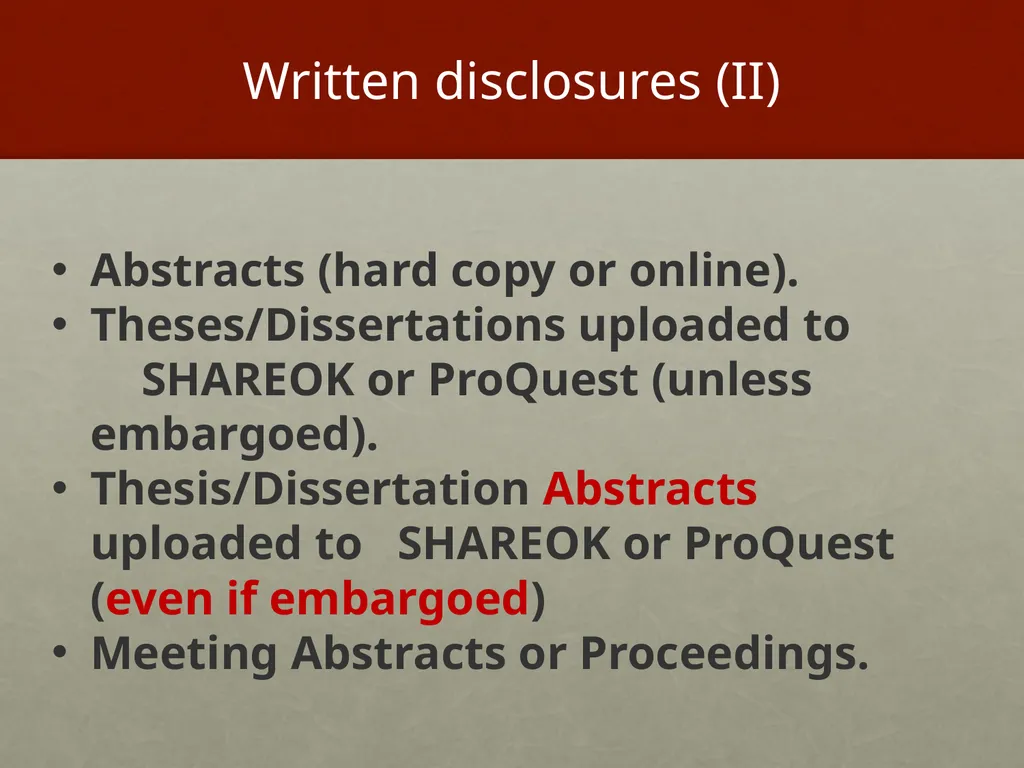
Written disclosures (II) Abstracts (hard copy or online).
Theses/Dissertations uploaded to SHAREOK or ProQuest (unless embargoed).
Thesis/Dissertation Abstracts uploaded to SHAREOK or ProQuest (even if embargoed)
Meeting Abstracts or Proceedings.<br>
11
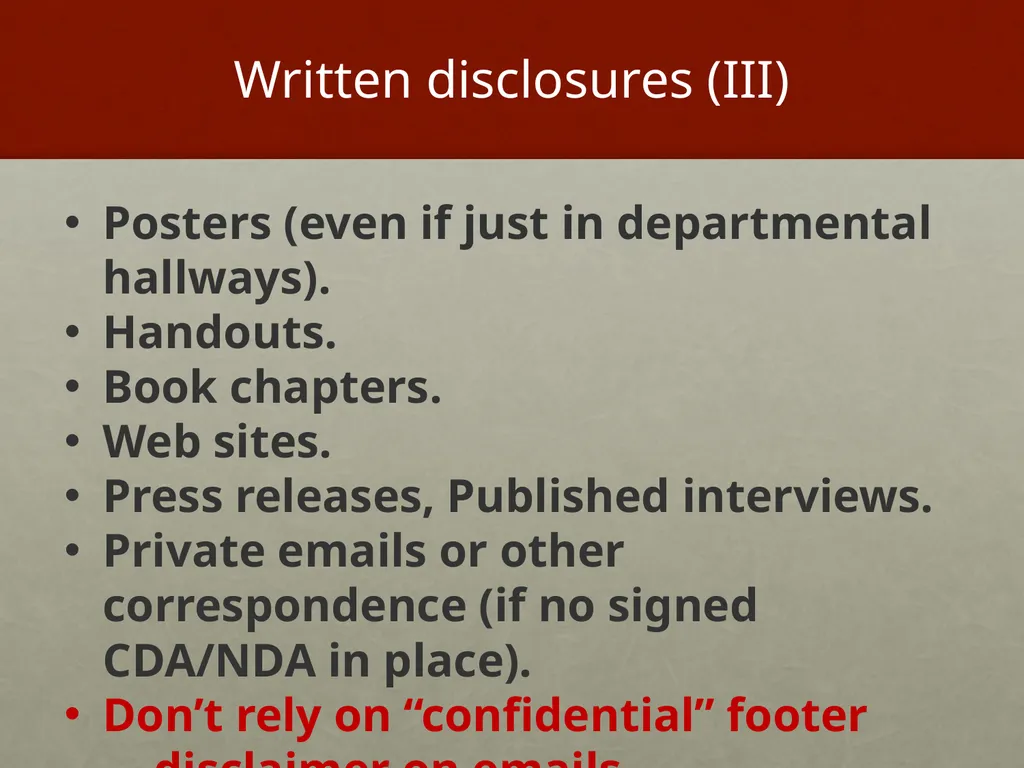
Written disclosures (III) Posters (even if just in departmental hallways).
Handouts.
Book chapters.
Web sites.
Press releases, Published interviews.
Private emails or other correspondence (if no signed CDA/NDA in place).
Don’t rely on “confidential” footer disclaimer on emails.<br>
12
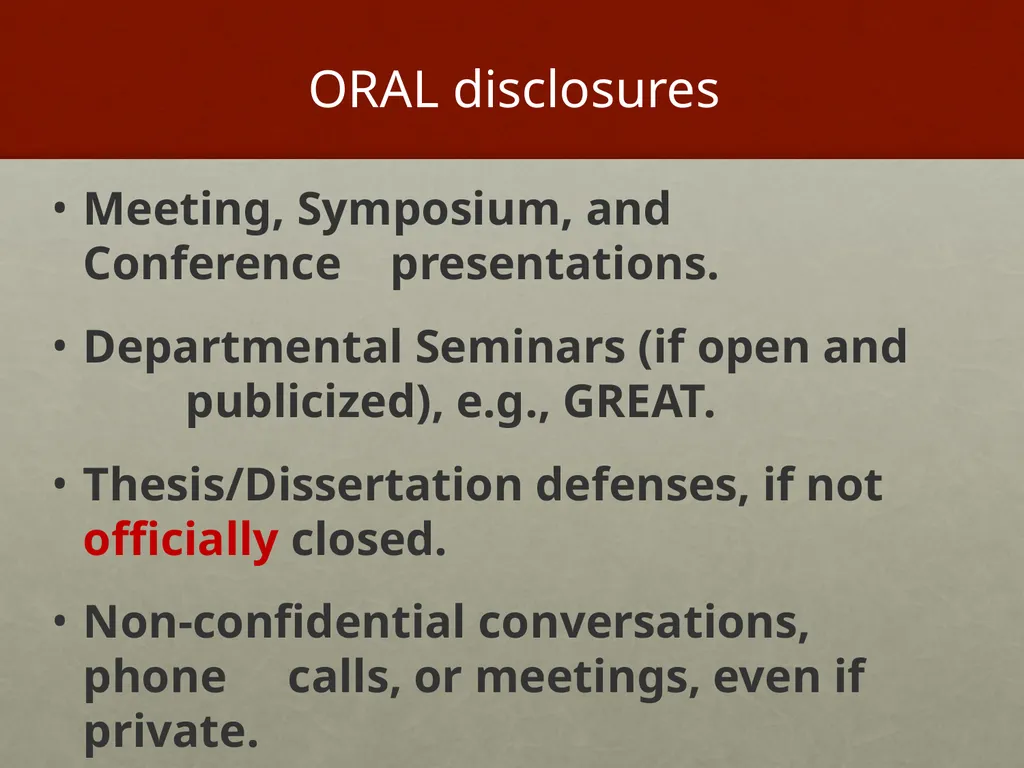
ORAL disclosures Meeting, Symposium, and Conference presentations.
Departmental Seminars (if open and publicized), e.g., GREAT.
Thesis/Dissertation defenses, if not officially closed.
Non-confidential conversations, phone calls, or meetings, even if private.<br>
13
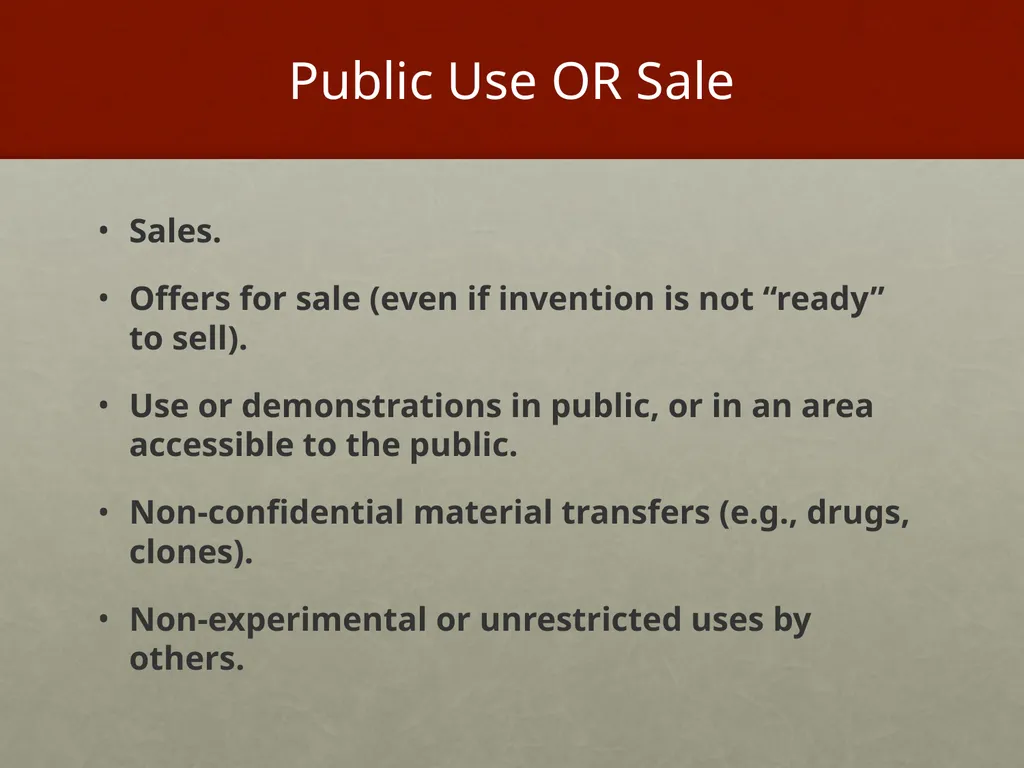
Public Use OR Sale Sales.
Offers for sale (even if invention is not “ready” to sell).
Use or demonstrations in public, or in an area accessible to the public.
Non-confidential material transfers (e.g., drugs, clones).
Non-experimental or unrestricted uses by others.<br>
14
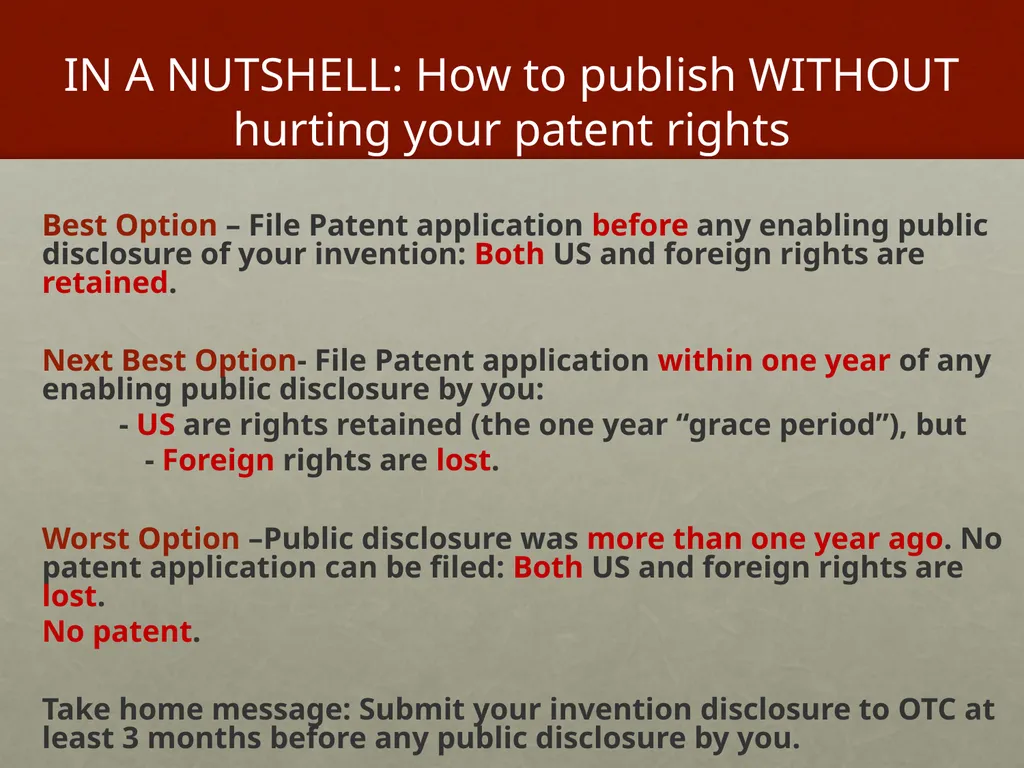
IN A NUTSHELL: How to publish WITHOUT hurting your patent rights Best Option – File Patent application before any enabling public disclosure of your invention: Both US and foreign rights are retained.
Next Best Option- File Patent application within one year of any enabling public disclosure by you:
- US are rights retained (the one year “grace period”), but
- Foreign rights are lost.
Worst Option –Public disclosure was more than one year ago. No patent application can be filed: Both US and foreign rights are lost.
No patent.
Take home message: Submit your invention disclosure to OTC at least 3 months before any public disclosure by you.<br>
15
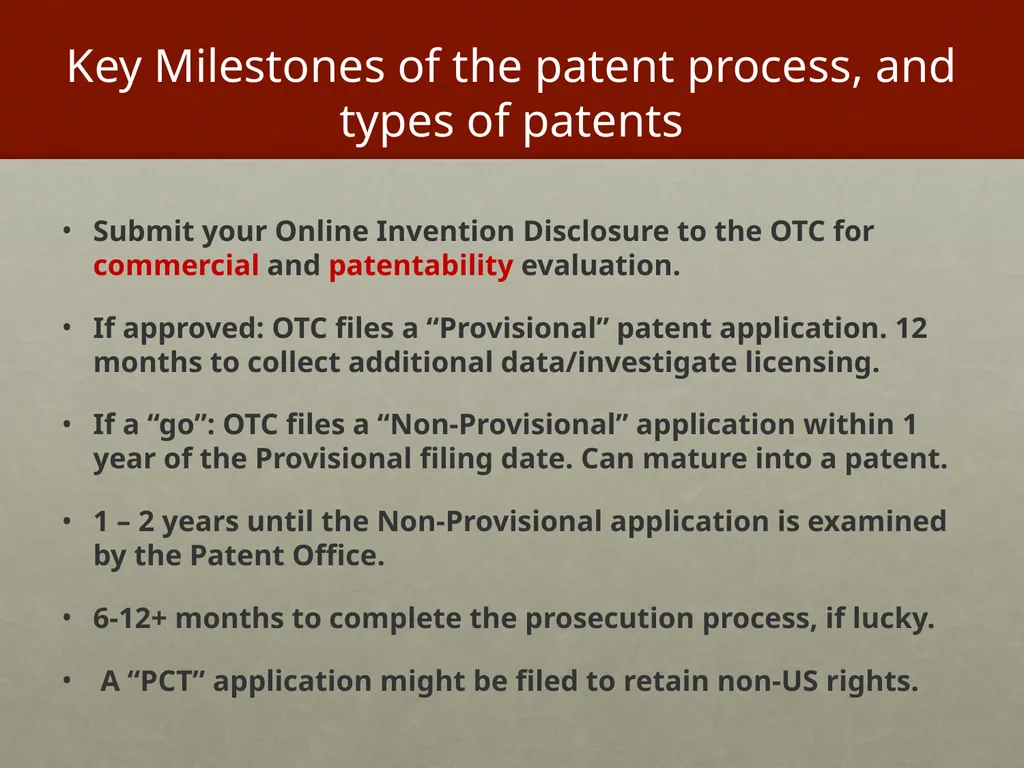
Key Milestones of the patent process, and types of patents Submit your Online Invention Disclosure to the OTC for commercial and patentability evaluation.
If approved: OTC files a “Provisional” patent application. 12 months to collect additional data/investigate licensing.
If a “go”: OTC files a “Non-Provisional” application within 1 year of the Provisional filing date. Can mature into a patent.
1 – 2 years until the Non-Provisional application is examined by the Patent Office.
6-12+ months to complete the prosecution process, if lucky.
A “PCT” application might be filed to retain non-US rights.<br>
16
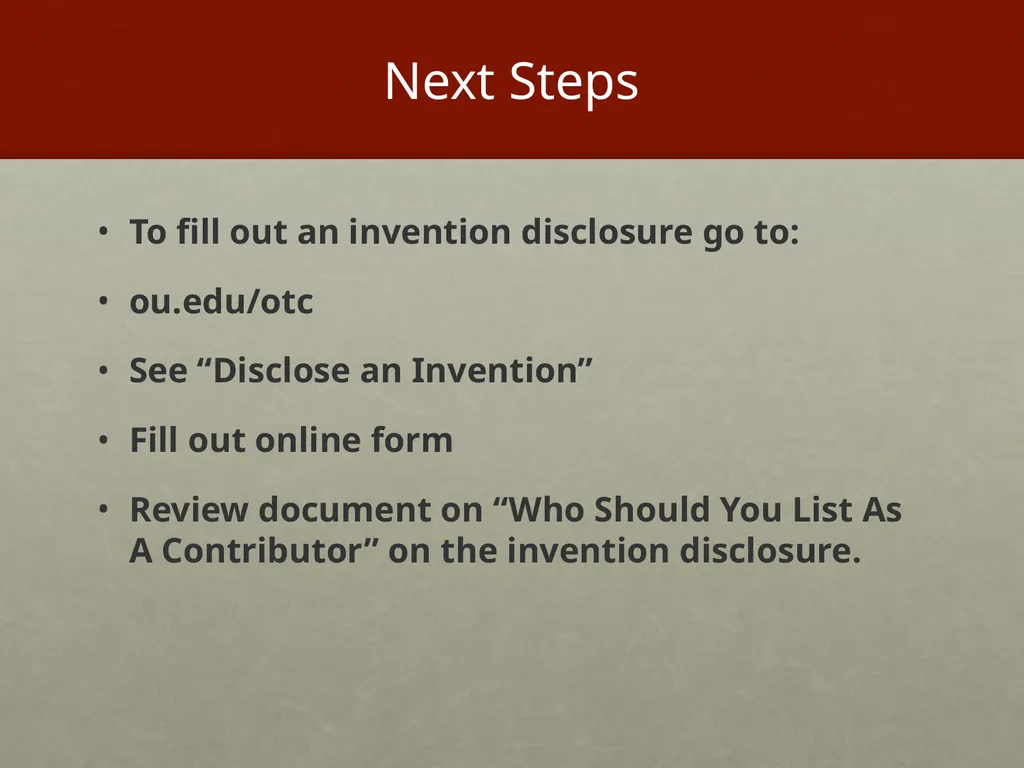
Next Steps To fill out an invention disclosure go to:
ou.edu/otc
See “Disclose an Invention”
Fill out online form
Review document on “Who Should You List As A Contributor” on the invention disclosure.<br>