
Othello: Act 1 Scene 1 Key Events Roderigo and
MT
Published · 6 slides · 0 views

1 / 1
Description
Othello: Act 1 Scene 1 Key Events Roderigo and Iago discuss Cassios promotion by Othello which they believe is unfair. They discuss their dislike of Othello and Iago reveals that his loyalty is a façade he plans to take his revenge
Related Topics
Share
Embed code
Download this presentation From Below
"Othello: Act 1 Scene 1 Key Events Roderigo and" is the property of its rightful owner. Permission is granted to download and print the materials on this website for personal, non-commercial use only, and to display it on your personal computer provided you do not modify the materials and that you retain all copyright notices contained in the materials. By downloading content from our website, you accept the terms of this agreement.
Presentation Transcript
01
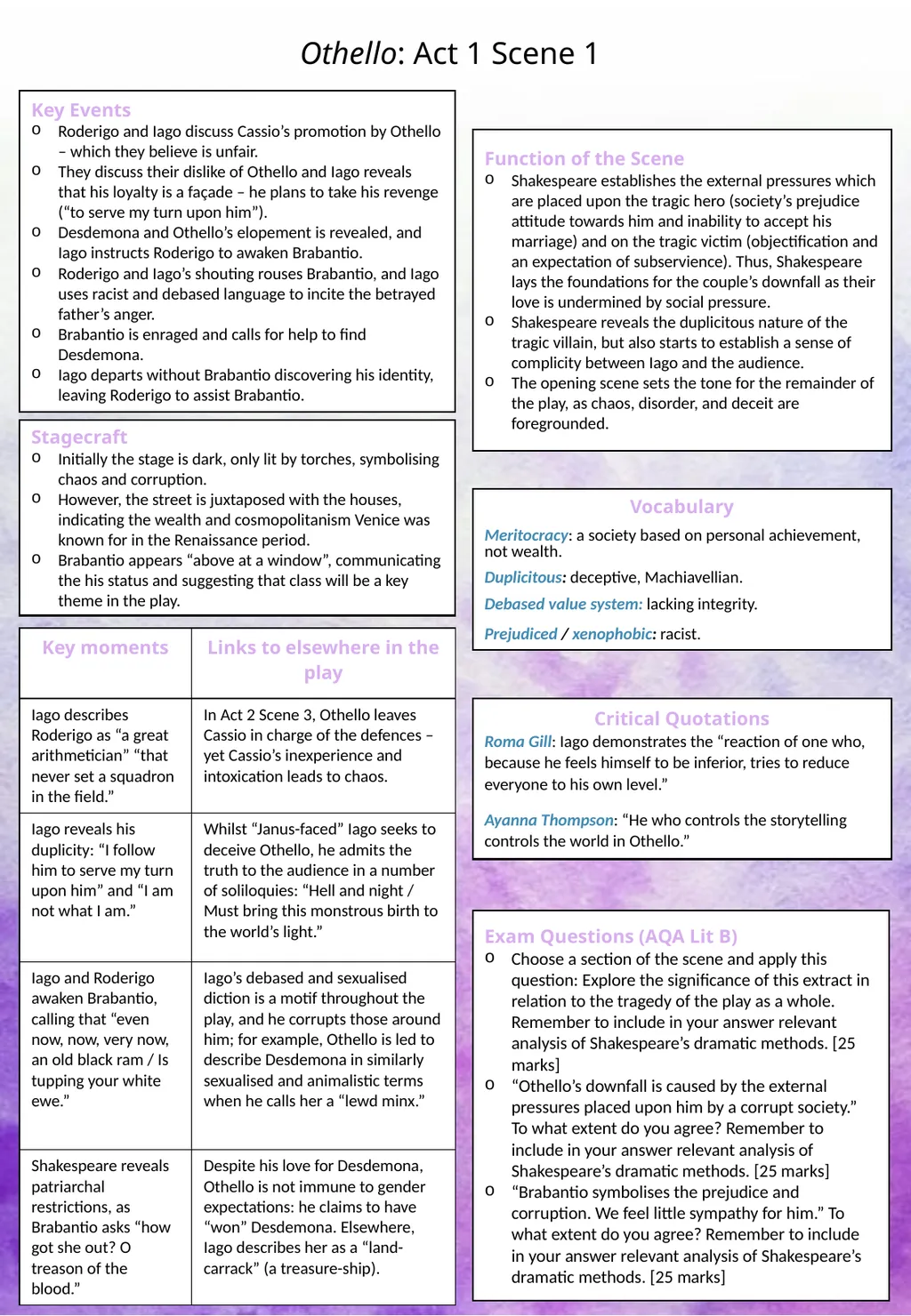
Othello: Act 1 Scene 1 Key Events
Roderigo and Iago discuss Cassio’s promotion by Othello – which they believe is unfair.
They discuss their dislike of Othello and Iago reveals that his loyalty is a façade – he plans to take his revenge (“to serve my turn upon him”).
Desdemona and Othello’s elopement is revealed, and Iago instructs Roderigo to awaken Brabantio.
Roderigo and Iago’s shouting rouses Brabantio, and Iago uses racist and debased language to incite the betrayed father’s anger.
Brabantio is enraged and calls for help to find Desdemona.
Iago departs without Brabantio discovering his identity, leaving Roderigo to assist Brabantio. Function of the Scene
Shakespeare establishes the external pressures which are placed upon the tragic hero (society’s prejudice attitude towards him and inability to accept his marriage) and on the tragic victim (objectification and an expectation of subservience). Thus, Shakespeare lays the foundations for the couple’s downfall as their love is undermined by social pressure.
Shakespeare reveals the duplicitous nature of the tragic villain, but also starts to establish a sense of complicity between Iago and the audience.
The opening scene sets the tone for the remainder of the play, as chaos, disorder, and deceit are foregrounded. Vocabulary
Meritocracy: a society based on personal achievement, not wealth.
Duplicitous: deceptive, Machiavellian.
Debased value system: lacking integrity.
Prejudiced / xenophobic: racist. Stagecraft
Initially the stage is dark, only lit by torches, symbolising chaos and corruption.
However, the street is juxtaposed with the houses, indicating the wealth and cosmopolitanism Venice was known for in the Renaissance period.
Brabantio appears “above at a window”, communicating the his status and suggesting that class will be a key theme in the play. Exam Questions (AQA Lit B)
Choose a section of the scene and apply this question: Explore the significance of this extract in relation to the tragedy of the play as a whole. Remember to include in your answer relevant analysis of Shakespeare’s dramatic methods. [25 marks]
“Othello’s downfall is caused by the external pressures placed upon him by a corrupt society.” To what extent do you agree? Remember to include in your answer relevant analysis of Shakespeare’s dramatic methods. [25 marks]
“Brabantio symbolises the prejudice and corruption. We feel little sympathy for him.” To what extent do you agree? Remember to include in your answer relevant analysis of Shakespeare’s dramatic methods. [25 marks] Critical Quotations
Roma Gill: Iago demonstrates the “reaction of one who, because he feels himself to be inferior, tries to reduce everyone to his own level.”
Ayanna Thompson: “He who controls the storytelling controls the world in Othello.”<br>
02
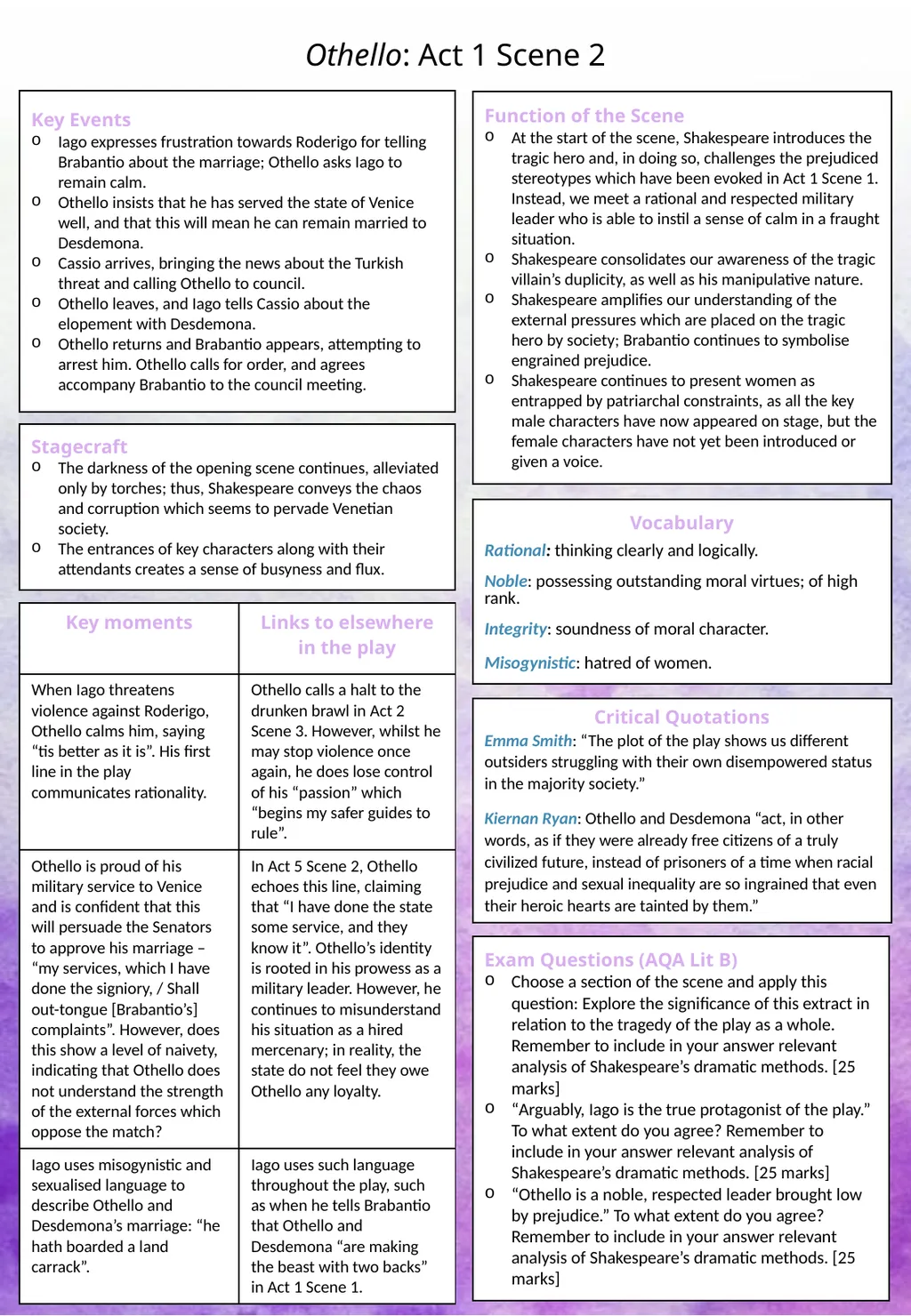
Othello: Act 1 Scene 2 Key Events
Iago expresses frustration towards Roderigo for telling Brabantio about the marriage; Othello asks Iago to remain calm.
Othello insists that he has served the state of Venice well, and that this will mean he can remain married to Desdemona.
Cassio arrives, bringing the news about the Turkish threat and calling Othello to council.
Othello leaves, and Iago tells Cassio about the elopement with Desdemona.
Othello returns and Brabantio appears, attempting to arrest him. Othello calls for order, and agrees accompany Brabantio to the council meeting. Function of the Scene
At the start of the scene, Shakespeare introduces the tragic hero and, in doing so, challenges the prejudiced stereotypes which have been evoked in Act 1 Scene 1. Instead, we meet a rational and respected military leader who is able to instil a sense of calm in a fraught situation.
Shakespeare consolidates our awareness of the tragic villain’s duplicity, as well as his manipulative nature.
Shakespeare amplifies our understanding of the external pressures which are placed on the tragic hero by society; Brabantio continues to symbolise engrained prejudice.
Shakespeare continues to present women as entrapped by patriarchal constraints, as all the key male characters have now appeared on stage, but the female characters have not yet been introduced or given a voice. Vocabulary
Rational: thinking clearly and logically.
Noble: possessing outstanding moral virtues; of high rank.
Integrity: soundness of moral character.
Misogynistic: hatred of women. Stagecraft
The darkness of the opening scene continues, alleviated only by torches; thus, Shakespeare conveys the chaos and corruption which seems to pervade Venetian society.
The entrances of key characters along with their attendants creates a sense of busyness and flux. Exam Questions (AQA Lit B)
Choose a section of the scene and apply this question: Explore the significance of this extract in relation to the tragedy of the play as a whole. Remember to include in your answer relevant analysis of Shakespeare’s dramatic methods. [25 marks]
“Arguably, Iago is the true protagonist of the play.” To what extent do you agree? Remember to include in your answer relevant analysis of Shakespeare’s dramatic methods. [25 marks]
“Othello is a noble, respected leader brought low by prejudice.” To what extent do you agree? Remember to include in your answer relevant analysis of Shakespeare’s dramatic methods. [25 marks] Critical Quotations
Emma Smith: “The plot of the play shows us different outsiders struggling with their own disempowered status in the majority society.”
Kiernan Ryan: Othello and Desdemona “act, in other words, as if they were already free citizens of a truly civilized future, instead of prisoners of a time when racial prejudice and sexual inequality are so ingrained that even their heroic hearts are tainted by them.”<br>
03
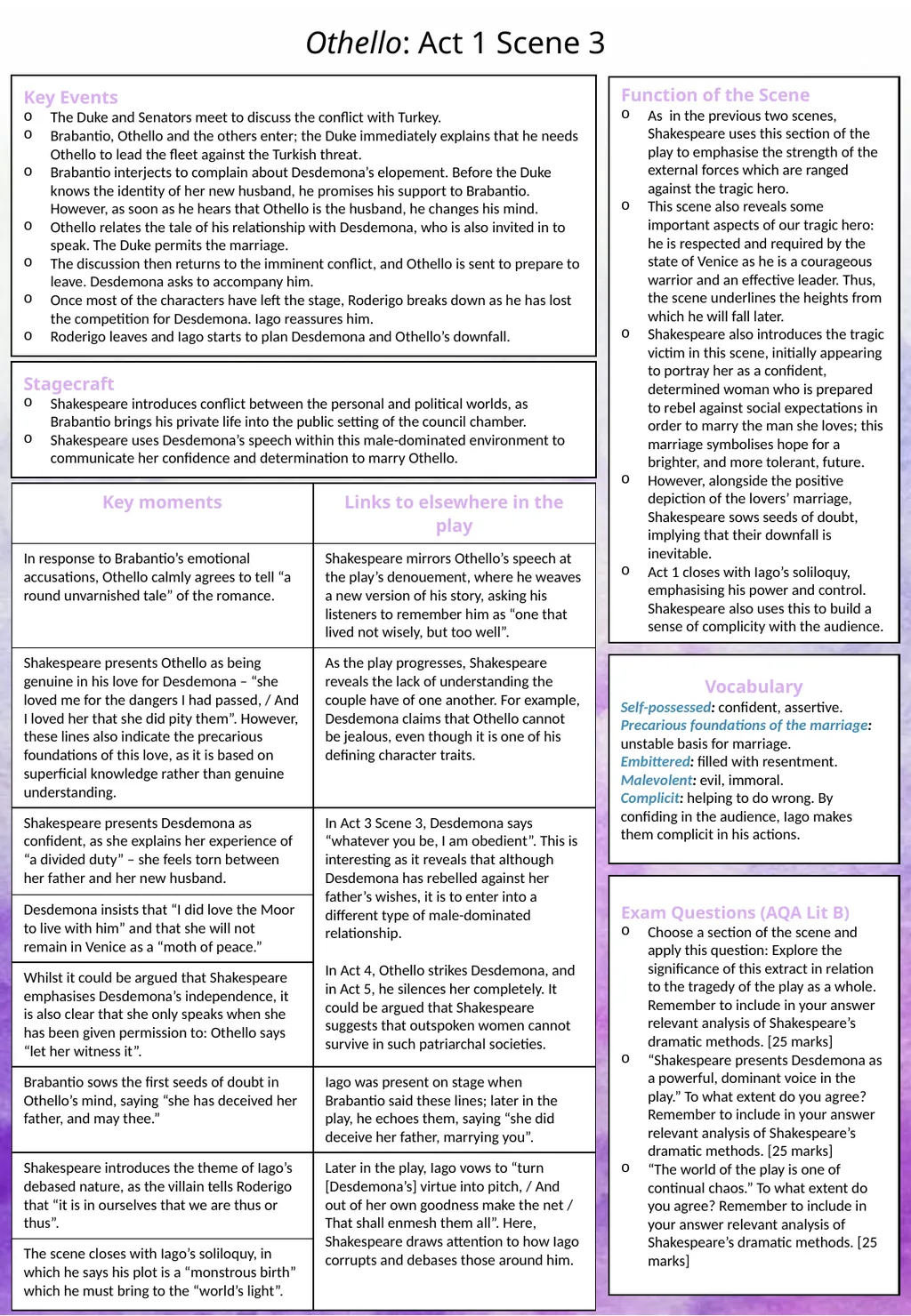
Othello: Act 1 Scene 3 Function of the Scene
As in the previous two scenes, Shakespeare uses this section of the play to emphasise the strength of the external forces which are ranged against the tragic hero.
This scene also reveals some important aspects of our tragic hero: he is respected and required by the state of Venice as he is a courageous warrior and an effective leader. Thus, the scene underlines the heights from which he will fall later.
Shakespeare also introduces the tragic victim in this scene, initially appearing to portray her as a confident, determined woman who is prepared to rebel against social expectations in order to marry the man she loves; this marriage symbolises hope for a brighter, and more tolerant, future.
However, alongside the positive depiction of the lovers’ marriage, Shakespeare sows seeds of doubt, implying that their downfall is inevitable.
Act 1 closes with Iago’s soliloquy, emphasising his power and control. Shakespeare also uses this to build a sense of complicity with the audience. Vocabulary
Self-possessed: confident, assertive.
Precarious foundations of the marriage: unstable basis for marriage.
Embittered: filled with resentment.
Malevolent: evil, immoral.
Complicit: helping to do wrong. By confiding in the audience, Iago makes them complicit in his actions. Key Events
The Duke and Senators meet to discuss the conflict with Turkey.
Brabantio, Othello and the others enter; the Duke immediately explains that he needs Othello to lead the fleet against the Turkish threat.
Brabantio interjects to complain about Desdemona’s elopement. Before the Duke knows the identity of her new husband, he promises his support to Brabantio. However, as soon as he hears that Othello is the husband, he changes his mind.
Othello relates the tale of his relationship with Desdemona, who is also invited in to speak. The Duke permits the marriage.
The discussion then returns to the imminent conflict, and Othello is sent to prepare to leave. Desdemona asks to accompany him.
Once most of the characters have left the stage, Roderigo breaks down as he has lost the competition for Desdemona. Iago reassures him.
Roderigo leaves and Iago starts to plan Desdemona and Othello’s downfall. Stagecraft
Shakespeare introduces conflict between the personal and political worlds, as Brabantio brings his private life into the public setting of the council chamber.
Shakespeare uses Desdemona’s speech within this male-dominated environment to communicate her confidence and determination to marry Othello. Exam Questions (AQA Lit B)
Choose a section of the scene and apply this question: Explore the significance of this extract in relation to the tragedy of the play as a whole. Remember to include in your answer relevant analysis of Shakespeare’s dramatic methods. [25 marks]
“Shakespeare presents Desdemona as a powerful, dominant voice in the play.” To what extent do you agree? Remember to include in your answer relevant analysis of Shakespeare’s dramatic methods. [25 marks]
“The world of the play is one of continual chaos.” To what extent do you agree? Remember to include in your answer relevant analysis of Shakespeare’s dramatic methods. [25 marks]<br>
04
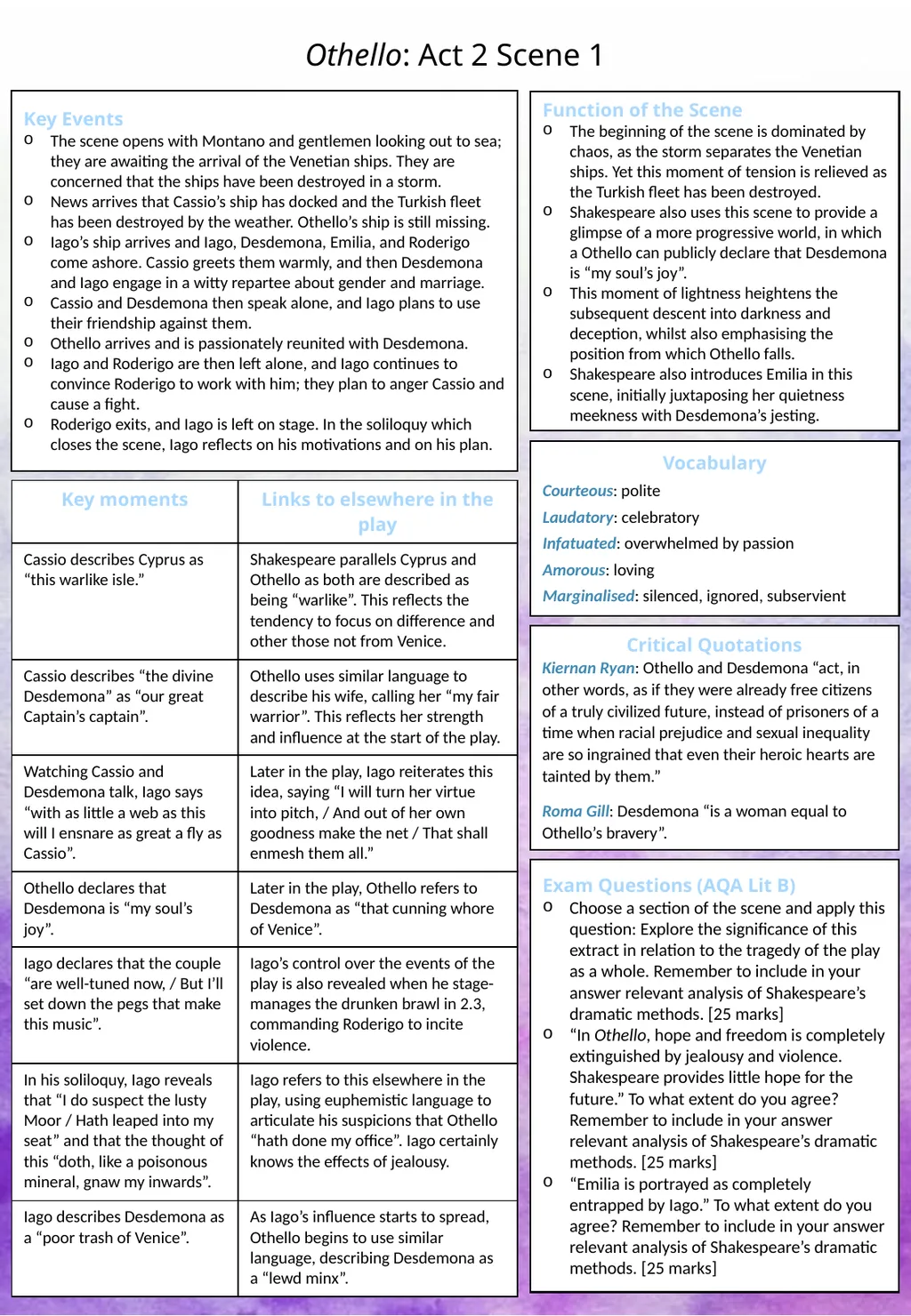
Othello: Act 2 Scene 1 Key Events
The scene opens with Montano and gentlemen looking out to sea; they are awaiting the arrival of the Venetian ships. They are concerned that the ships have been destroyed in a storm.
News arrives that Cassio’s ship has docked and the Turkish fleet has been destroyed by the weather. Othello’s ship is still missing.
Iago’s ship arrives and Iago, Desdemona, Emilia, and Roderigo come ashore. Cassio greets them warmly, and then Desdemona and Iago engage in a witty repartee about gender and marriage.
Cassio and Desdemona then speak alone, and Iago plans to use their friendship against them.
Othello arrives and is passionately reunited with Desdemona.
Iago and Roderigo are then left alone, and Iago continues to convince Roderigo to work with him; they plan to anger Cassio and cause a fight.
Roderigo exits, and Iago is left on stage. In the soliloquy which closes the scene, Iago reflects on his motivations and on his plan. Function of the Scene
The beginning of the scene is dominated by chaos, as the storm separates the Venetian ships. Yet this moment of tension is relieved as the Turkish fleet has been destroyed.
Shakespeare also uses this scene to provide a glimpse of a more progressive world, in which a Othello can publicly declare that Desdemona is “my soul’s joy”.
This moment of lightness heightens the subsequent descent into darkness and deception, whilst also emphasising the position from which Othello falls.
Shakespeare also introduces Emilia in this scene, initially juxtaposing her quietness meekness with Desdemona’s jesting. Vocabulary
Courteous: polite
Laudatory: celebratory
Infatuated: overwhelmed by passion
Amorous: loving
Marginalised: silenced, ignored, subservient Exam Questions (AQA Lit B)
Choose a section of the scene and apply this question: Explore the significance of this extract in relation to the tragedy of the play as a whole. Remember to include in your answer relevant analysis of Shakespeare’s dramatic methods. [25 marks]
“In Othello, hope and freedom is completely extinguished by jealousy and violence. Shakespeare provides little hope for the future.” To what extent do you agree? Remember to include in your answer relevant analysis of Shakespeare’s dramatic methods. [25 marks]
“Emilia is portrayed as completely entrapped by Iago.” To what extent do you agree? Remember to include in your answer relevant analysis of Shakespeare’s dramatic methods. [25 marks] Critical Quotations
Kiernan Ryan: Othello and Desdemona “act, in other words, as if they were already free citizens of a truly civilized future, instead of prisoners of a time when racial prejudice and sexual inequality are so ingrained that even their heroic hearts are tainted by them.”
Roma Gill: Desdemona “is a woman equal to Othello’s bravery”.<br>
05
Othello: Act 2 Scene 2 Key Events
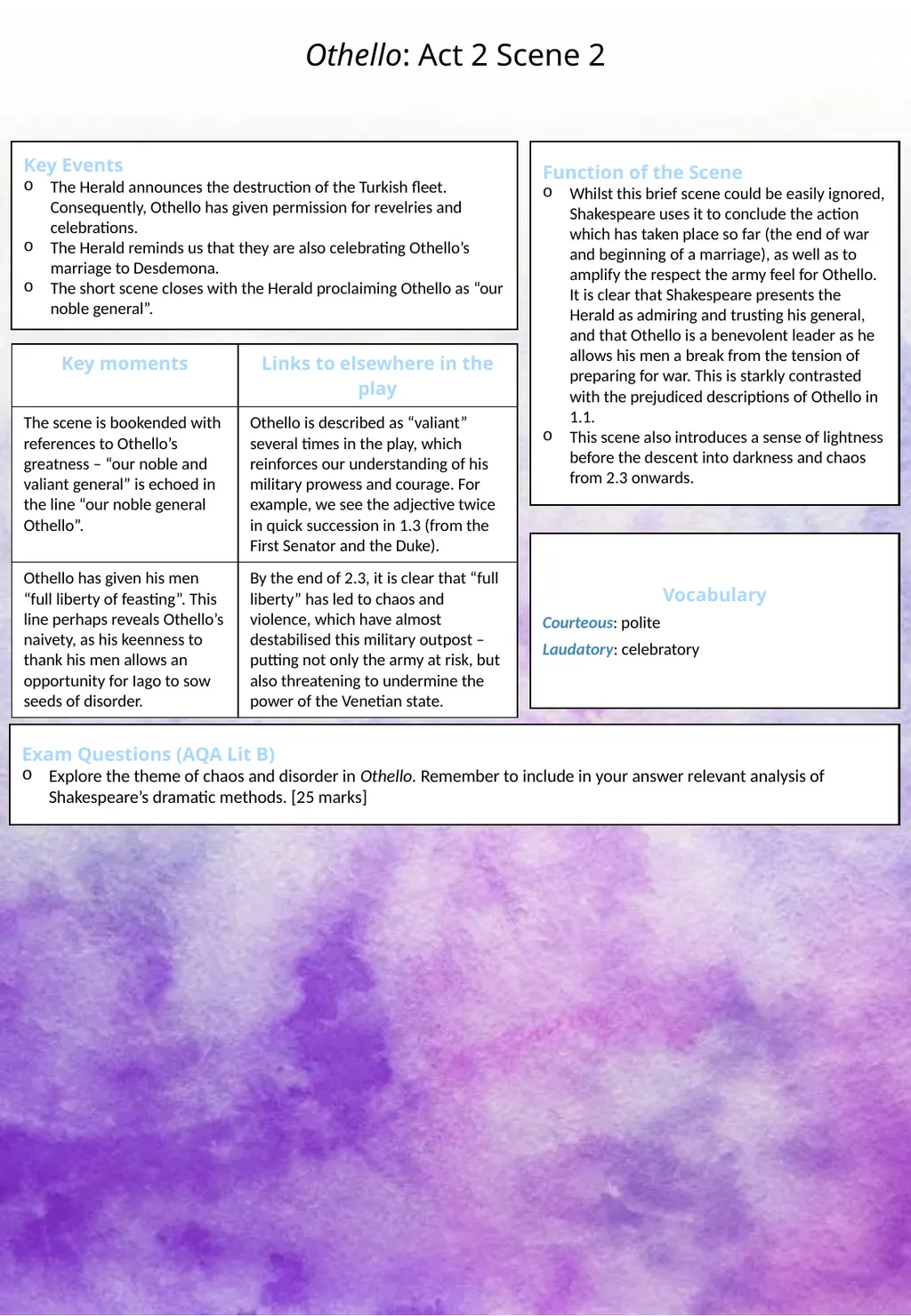
The Herald announces the destruction of the Turkish fleet. Consequently, Othello has given permission for revelries and celebrations.
The Herald reminds us that they are also celebrating Othello’s marriage to Desdemona.
The short scene closes with the Herald proclaiming Othello as “our noble general”. Function of the Scene
Whilst this brief scene could be easily ignored, Shakespeare uses it to conclude the action which has taken place so far (the end of war and beginning of a marriage), as well as to amplify the respect the army feel for Othello. It is clear that Shakespeare presents the Herald as admiring and trusting his general, and that Othello is a benevolent leader as he allows his men a break from the tension of preparing for war. This is starkly contrasted with the prejudiced descriptions of Othello in 1.1.
This scene also introduces a sense of lightness before the descent into darkness and chaos from 2.3 onwards. Vocabulary
Courteous: polite
Laudatory: celebratory Exam Questions (AQA Lit B)
Explore the theme of chaos and disorder in Othello. Remember to include in your answer relevant analysis of Shakespeare’s dramatic methods. [25 marks]<br>
06
Othello: Act 2 Scene 3 Key Events
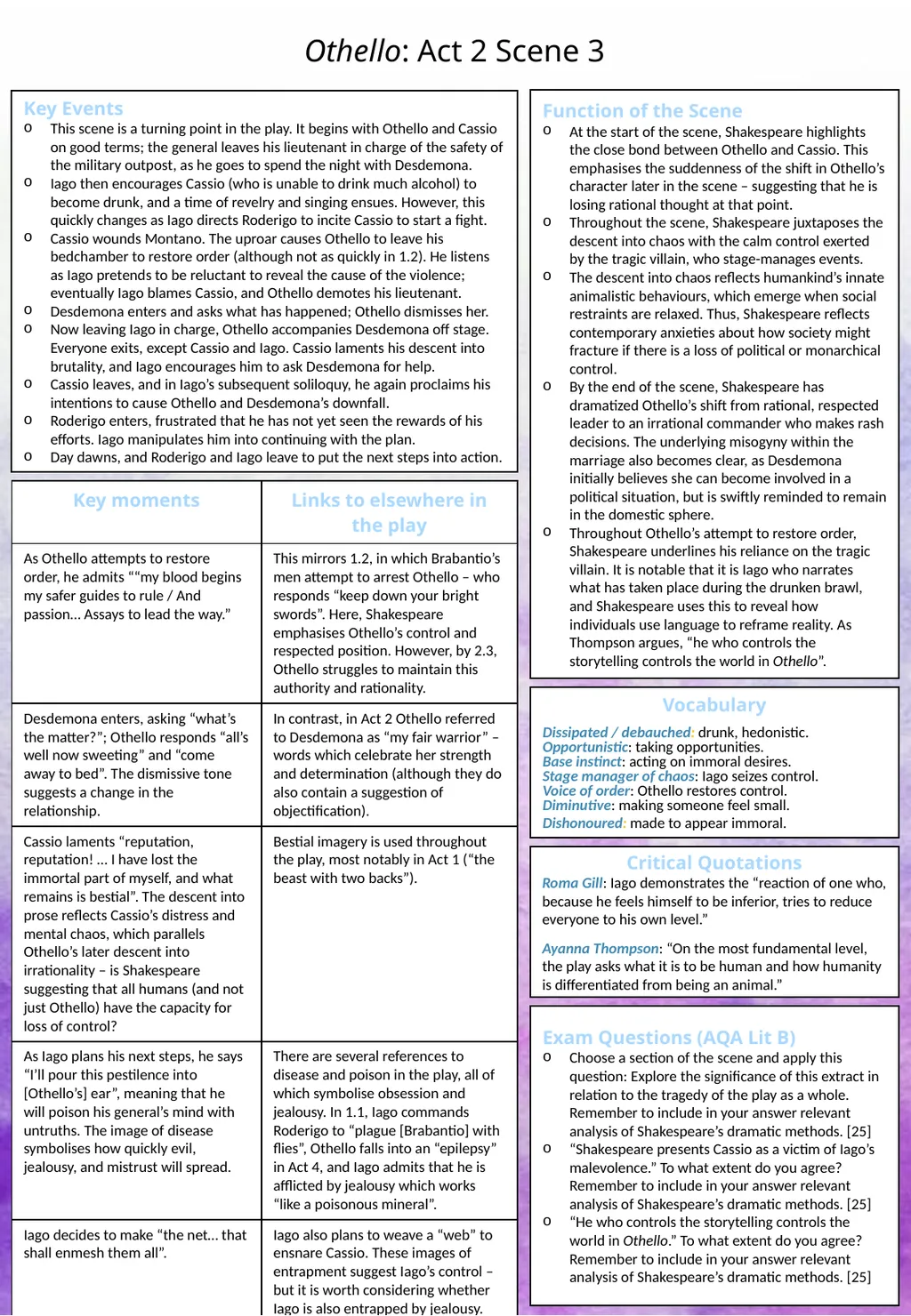
This scene is a turning point in the play. It begins with Othello and Cassio on good terms; the general leaves his lieutenant in charge of the safety of the military outpost, as he goes to spend the night with Desdemona.
Iago then encourages Cassio (who is unable to drink much alcohol) to become drunk, and a time of revelry and singing ensues. However, this quickly changes as Iago directs Roderigo to incite Cassio to start a fight.
Cassio wounds Montano. The uproar causes Othello to leave his bedchamber to restore order (although not as quickly in 1.2). He listens as Iago pretends to be reluctant to reveal the cause of the violence; eventually Iago blames Cassio, and Othello demotes his lieutenant.
Desdemona enters and asks what has happened; Othello dismisses her.
Now leaving Iago in charge, Othello accompanies Desdemona off stage. Everyone exits, except Cassio and Iago. Cassio laments his descent into brutality, and Iago encourages him to ask Desdemona for help.
Cassio leaves, and in Iago’s subsequent soliloquy, he again proclaims his intentions to cause Othello and Desdemona’s downfall.
Roderigo enters, frustrated that he has not yet seen the rewards of his efforts. Iago manipulates him into continuing with the plan.
Day dawns, and Roderigo and Iago leave to put the next steps into action. Function of the Scene
At the start of the scene, Shakespeare highlights the close bond between Othello and Cassio. This emphasises the suddenness of the shift in Othello’s character later in the scene – suggesting that he is losing rational thought at that point.
Throughout the scene, Shakespeare juxtaposes the descent into chaos with the calm control exerted by the tragic villain, who stage-manages events.
The descent into chaos reflects humankind’s innate animalistic behaviours, which emerge when social restraints are relaxed. Thus, Shakespeare reflects contemporary anxieties about how society might fracture if there is a loss of political or monarchical control.
By the end of the scene, Shakespeare has dramatized Othello’s shift from rational, respected leader to an irrational commander who makes rash decisions. The underlying misogyny within the marriage also becomes clear, as Desdemona initially believes she can become involved in a political situation, but is swiftly reminded to remain in the domestic sphere.
Throughout Othello’s attempt to restore order, Shakespeare underlines his reliance on the tragic villain. It is notable that it is Iago who narrates what has taken place during the drunken brawl, and Shakespeare uses this to reveal how individuals use language to reframe reality. As Thompson argues, “he who controls the storytelling controls the world in Othello”. Vocabulary
Dissipated / debauched: drunk, hedonistic.
Opportunistic: taking opportunities.
Base instinct: acting on immoral desires.
Stage manager of chaos: Iago seizes control.
Voice of order: Othello restores control.
Diminutive: making someone feel small.
Dishonoured: made to appear immoral. Exam Questions (AQA Lit B)
Choose a section of the scene and apply this question: Explore the significance of this extract in relation to the tragedy of the play as a whole. Remember to include in your answer relevant analysis of Shakespeare’s dramatic methods. [25]
“Shakespeare presents Cassio as a victim of Iago’s malevolence.” To what extent do you agree? Remember to include in your answer relevant analysis of Shakespeare’s dramatic methods. [25]
“He who controls the storytelling controls the world in Othello.” To what extent do you agree? Remember to include in your answer relevant analysis of Shakespeare’s dramatic methods. [25] Critical Quotations
Roma Gill: Iago demonstrates the “reaction of one who, because he feels himself to be inferior, tries to reduce everyone to his own level.”
Ayanna Thompson: “On the most fundamental level, the play asks what it is to be human and how humanity is differentiated from being an animal.”<br>