
Other General Exceptions that Libraries Can Avail


Description: Other General Exceptions that Libraries Can Avail Prof. Prabuddha Ganguli S. Matilal Secondary Copyright Infringement No legal system limits the ambit of liability of a wrong only to the party who personally commits it, but in most
Related Topics
Download Presentation
"Other General Exceptions that Libraries Can Avail" is the property of its rightful owner. Permission is granted to download and print the materials on this website for personal, non-commercial use only, and to display it on your personal computer provided you do not modify the materials and that you retain all copyright notices contained in the materials. By downloading content from our website, you accept the terms of this agreement.
Presentation Transcript
slide1. Other General Exceptions that Libraries Can Avail Prof. Prabuddha Ganguli
&
S. Matilal<br>
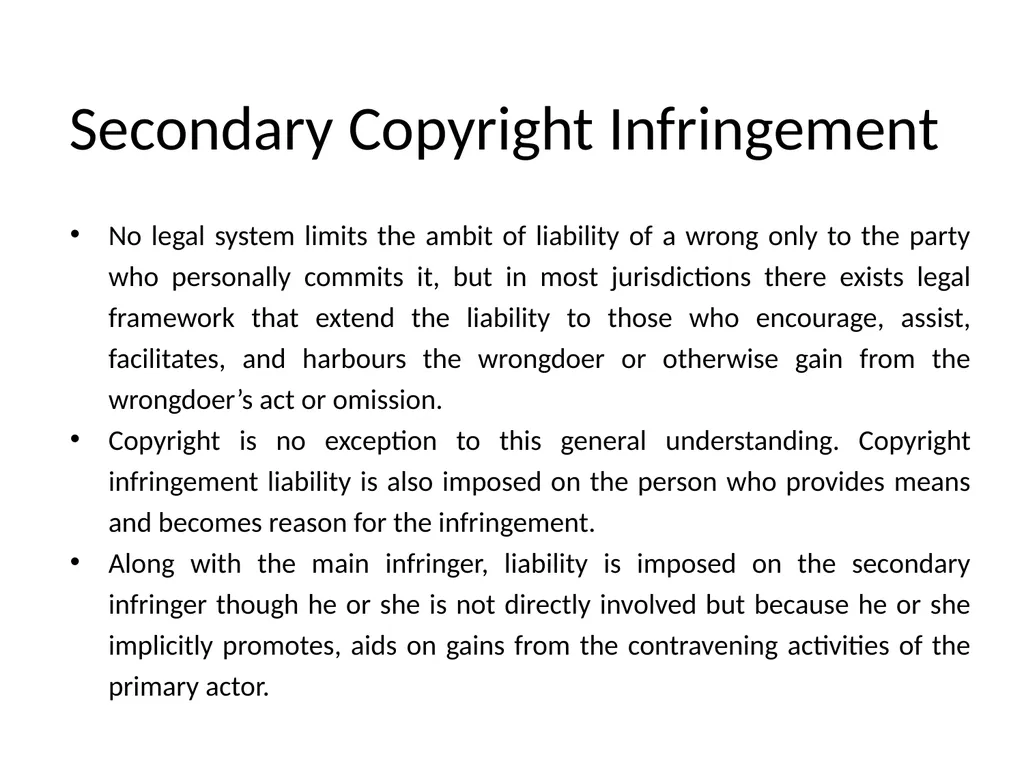
slide2. Secondary Copyright Infringement No legal system limits the ambit of liability of a wrong only to the party who personally commits it, but in most jurisdictions there exists legal framework that extend the liability to those who encourage, assist, facilitates, and harbours the wrongdoer or otherwise gain from the wrongdoer’s act or omission.
Copyright is no exception to this general understanding. Copyright infringement liability is also imposed on the person who provides means and becomes reason for the infringement.
Along with the main infringer, liability is imposed on the secondary infringer though he or she is not directly involved but because he or she implicitly promotes, aids on gains from the contravening activities of the primary actor.<br>
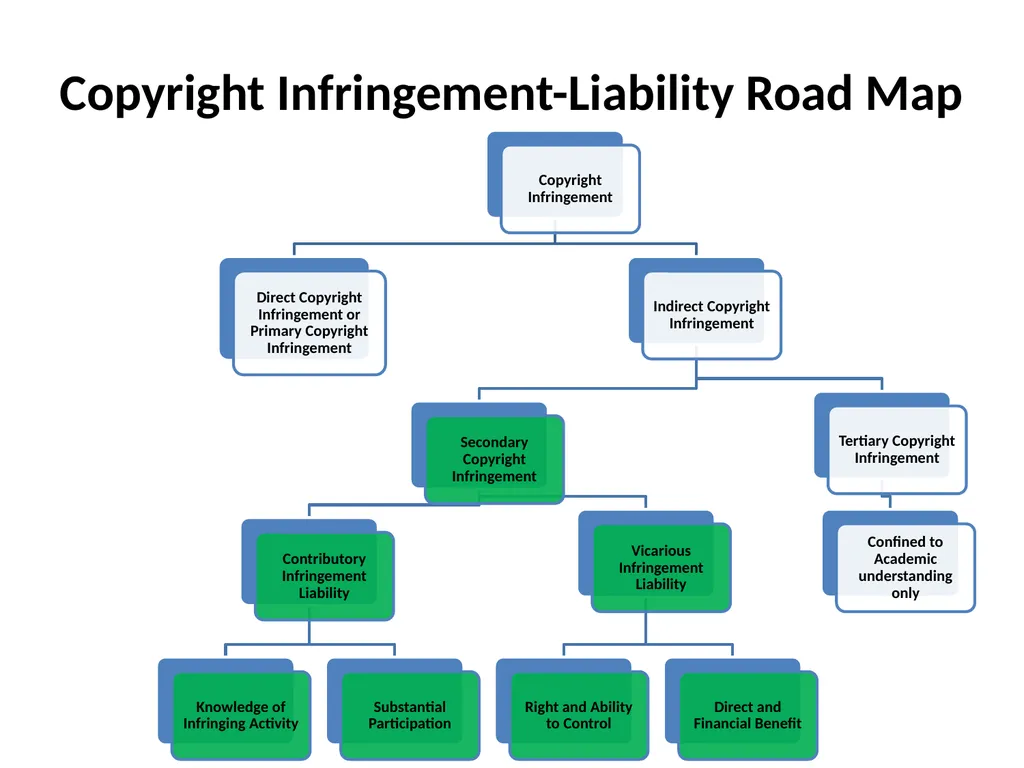
slide3. Copyright Infringement-Liability Road Map<br>
slide4. Section 51: When copyright infringed Copyright in a work shall be deemed to be infringed— (a) when any person, without a licence granted by the owner of the copyright or the Registrar of Copyrights under this Act or in contravention of the conditions of a licence so granted or of any condition imposed by a competent authority under this Act— (i) does anything, the exclusive right to do which is by this Act conferred upon the owner of the copyright, or (ii) permits for profit any place to be used for the communication of the work to the public where such communication constitutes an infringement of the copyright in the work, unless he was not aware and had no reasonable ground for believing that such communication to the public would be an infringement of copyright; or<br>
slide5. Section 52(1)(b)
the transient or incidental storage of a work or performance purely in the technical process of electronic transmission or communication to the public.<br>
slide6. Safe harbour immunity<br>
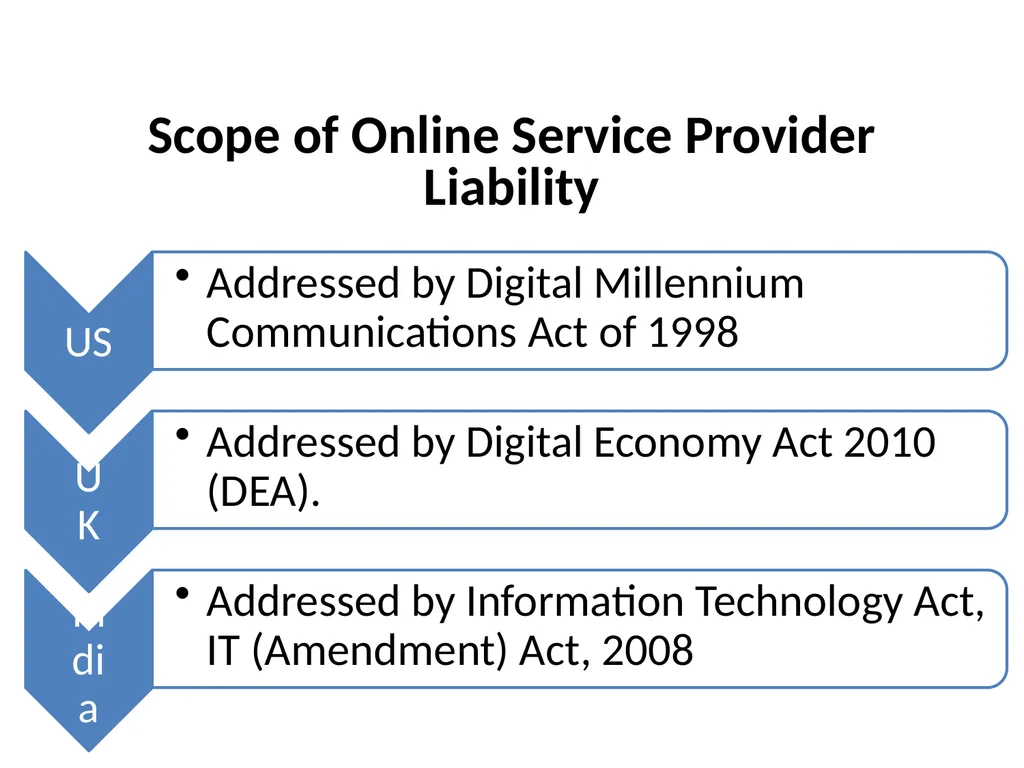
slide7. Scope of Online Service Provider Liability<br>
slide8. Intermediary Liability In India, intermediaries are governed by the Information Technology Act, 2000.
The Act defines an intermediary as “intermediary", with respect to any particular electronic records, means any person who on behalf of another person receives, stores or transmits that record or provides any service with respect to that record and includes telecom service providers, network service providers, internet service providers, web-hosting service providers, search engines, online payment sites, online-auction sites, online-market places and cyber cafes [Section 2(1)(w)]<br>
slide9. Indian Safe Harbour India grants intermediaries a conditional safe harbour under the Section 79 of the I.T. Act and the Information Technology (Intermediaries Guidelines) Rules 2011.
Section 79 of the IT Act provides that an intermediary is not liable for any third-party content hosted/made available through such intermediary when: (1) the function of the intermediary is limited to providing access to the system; or (2) the intermediary does not initiate, select the receiver of or select/modify the information contained in a transmission; and (3) the intermediary observes due diligence and abides by other guidelines prescribed by the Government.<br>
slide10. Do the digital libraries QUALIFY AS INTERMEDIARY?<br>
slide11. Section 52 of the Copyright Act. Certain acts not to be infringement of copyright. (1) The following acts shall not constitute an infringement of copyright, namely:
(c) transient or incidental storage of a work or performance for the purpose of providing electronic links, access or integration, where such links, access or integration has not been expressly prohibited by the right holder, unless the person responsible is aware or has reasonable grounds for believing that such storage is of an infringing copy:
Provided that if the person responsible for the storage of the copy has received a written complaint from the owner of copyright in the work, complaining that such transient or incidental storage is an infringement, such person responsible for the storage shall refrain from facilitating such access for a period of twenty-one days or till he receives an order from the competent court refraining from facilitating access and in case no such order is received before the expiry of such period of twenty-one days, he may continue to provide the facility of such access;<br>
slide12. Due Diligence The 2011 Intermediaries Guidelines provides a due diligence framework to be followed by intermediaries in order to avail of the exemption under Section 79.
Various procedures have been prescribed which needs to be observed by an intermediary, such as (i) the need to inform the users of the computer resource not to transmit any information that amongst other things is harmful, obscene or defamatory; (ii) the requirement to “act within 36 hours” of receiving knowledge of the transmission of any prohibited information; and (iii) the requirement to disable information that is contradictory to the Intermediaries Guidelines.<br>
slide13. Section 81 The provisions of this Act shall have effect notwithstanding anything inconsistent therewith contained in any other law for the time being in force.
Provided that nothing contained in this Act shall restrict any person from exercising any right conferred under the Copyright Act 1957 or the Patents Act 1970<br>
slide14. Super Cassettes Industries Limited v. MySpace Inc. & Another, 2011(48) PTC 49 (Del) MySpace argued that it was an intermediary within the meaning of Section 2(1)(w) of the Information Technology Act, 2000 and as such it was entitled to safe harbour immunity.
The Court rejected this contention. Justice Manmohan Singh reasoned that MySpce was not merely providing access to a communication system, but it took a limited license from its users to modify the content as such MySpce’s conducts had gone beyond the normal role of an intermediary.
Furthermore, by referring to the proviso to Section 81 of the Information Technology Act, 2000, Justice Manmohan Singh held that safe harbour immunity under Section 79 was not available to an intermediary who was alleged to have been involved in copyright infringement.<br>
slide15. Myspace v. Super Cassette Industries Ltd. 2017(69)PTC1(Del) The Division Bench (Justice S. Ravindra Bhat and Justice Deepa Sharma) allowed the appeal. The Division Bench reasoned.
(1) The rule of harmonious of interpretation should be applied while conjointly reading Sections 79 and 81 of the Information Technology Act, 2000 and Section 51(a)(ii) of the Copyright Act, 1957.
Such a reading allowed an intermediary to advance the affirmative defence of safe harbour in a copyright infringement action in spite of Section 81 proviso.<br>
slide16. Section 52 (1)(c) of the Copyright Act (1) The following acts shall not constitute an infringement of copyright, namely:
(c) transient or incidental storage of a work or performance for the purpose of providing electronic links, access or integration, where such links, access or integration has not been expressly prohibited by the right holder, unless the person responsible is aware or has reasonable grounds for believing that such storage is of an infringing copy:
Provided that if the person responsible for the storage of the copy has received a written complaint from the owner of copyright in the work, complaining that such transient or incidental storage is an infringement, such person responsible for the storage shall refrain from facilitating such access for a period of twenty-one days or till he receives an order from the competent court refraining from facilitating access and in case no such order is received before the expiry of such period of twenty-one days, he may continue to provide the facility of such access;<br>
slide17. U.S. Digital Millennium Copyright Act (DMCA) DMCA, Title II, the Online Copyright Infringement Liability Limitation Act ("OCILLA"), creates a safe harbour for online service providers (OSPs, including ISPs) against copyright infringement liability, provided they meet specific requirements.
OSPs must adhere to and qualify for certain prescribed safe harbour guidelines and promptly block access to alleged infringing material (or remove such material from their systems) when they receive notification of an infringement claim from a copyright holder or the copyright holder's agent.
The Act also includes a counter-notification provision that offers OSPs a safe harbour from liability to their users when users claim that the material in question is not, in fact, infringing.<br>
slide18. LIBRARY EXCEPTIONS<br>
slide19. Section 52(1)(n) the storing of a work in any medium by electronic means by a noncommercial public library, for preservation if the library already possesses a non-digital copy of the work.
Example: Your Library has a hard copy of Amish Tripathi’s Latest Book “RAAVAN- Enemy of Aryavarta”. You can scan and store the book for archival purpose. Library Exception 1<br>
slide20. S52(1)(o) the making of not more than three copies of a book (including a pamphlet, sheet of music, map, chart or plan) by or under the direction of the person in charge of a non-commercial public library public library for the use of the library if such book is not available for sale in India. Library Exception 2<br>
slide21. S 52 (1) (p) the reproduction, for the purpose of research or private study or with a view to publication, of an unpublished literary, dramatic or musical work kept in a library, museum or other institution to which the public has access.
This is available to any library whether commercial or non-commercial.
Example: Your library possesses an unpublished copy of music composed by Mozart. You may publish the same. Library Exception 3<br>
slide22. The Problem of Non-Commercial Public Library Section 2(fa) of our Copyright Act defines “non-profit library” in the context rental of computer programme, sound recording, visual recording and cinematograph. It contemplates that rental by a “non-profit library” should not be treated as “commercial rental” which is otherwise is one of the exclusive rights of the copyright-holder under Sections 14(b)(ii), 14(d)(ii) and 14(e)(ii).
This has nothing to do with the fair dealing (library exception) provisions of Sections 52(1)(n) and 52(1)(o). Moreover, these two sections use the expression “noncommercial public library” whereas Section 2(fa) deals with the expression “non-profit library.” They are not one and the same.<br>
slide23. DRM- TPM and RMI<br>
slide24. 65A. Protection of technological measures. (1) Any person who circumvents an effective technological measure applied for the purpose of protecting any of the rights conferred by this Act, with the intention of infringing such rights, shall be punishable with imprisonment which may extend to two years and shall also be liable to fine.
(2) Nothing in sub-section (1) shall prevent any person from,—
(a) doing anything referred to therein for a purpose not expressly prohibited by this Act:
Provided that any person facilitating circumvention by another person of a technological measure for such a purpose shall maintain a complete record of such other person including his name, address and all relevant particulars necessary to identify him and the purpose for which he has been facilitated; or
(b) doing anything necessary to conduct encryption research using a lawfully obtained encrypted copy; or
(c) conducting any lawful investigation; or
(d) doing anything necessary for the purpose of testing the security of a computer system or a computer network with the authorisation of its owner; or
(e) operator; or
(f) doing anything necessary to circumvent technological measures intended for identification or surveillance of a user; or
(g) taking measures necessary in the interest of national security.<br>
slide25. SONY COMPUTER ENTERTAINMENT EUROPE LIMITED V. HARMEET SINGH & ORS. [CS(OS) NO. 1725 OF 2012]
Sony manufactures Play Station devices (various versions including PS3). Sony along with its various associates are also makes various gaming software programs such Drake Deception etc.
Jailbreak is the process or the act of circumvention of technology protection measures (enabled within the consoles) which enables the hard disk of the PS3 console to read/play any unauthorized games on the Sony PS3 devices. The act of Jail breaking was done at various markets in Delhi, Mumbai, Hyderabad, Bangalore etc. Few of the jail break softwares are Multiman, Gaia Manager etc.
In the present suit, after conducting careful investigations the defendants were found to be installing Jailbreak software onto the PS3 consoles
The Delhi High Court granted injunctions.<br>
slide26. Tata Sky vs. Youtube [JUSTICE S. MURALIDHAR on 10.08.2016] “how to watch HD channels free in TATA SKY Trick” or “Hack tata sky for free exclusive”<br>
slide27. Removal of Digital water marking<br>
slide28. Section 65B 65B. Protection of Rights Management Information.— Any person, who knowingly, —
(i) removes or alters any rights management information without authority, or
(ii) distributes, imports for distribution, broadcasts or communicates to the public, without authority, copies of any work, or performance knowing that electronic rights management information has been removed or altered without authority, shall be punishable with imprisonment which may extend to two years and shall also be liable to fine:
Provided that if the rights management information has been tampered with in any work, the owner of copyright in such work may also avail of civil remedies provided under Chapter XII against the persons indulging in such acts.<br>
&
S. Matilal<br>
slide2. Secondary Copyright Infringement No legal system limits the ambit of liability of a wrong only to the party who personally commits it, but in most jurisdictions there exists legal framework that extend the liability to those who encourage, assist, facilitates, and harbours the wrongdoer or otherwise gain from the wrongdoer’s act or omission.
Copyright is no exception to this general understanding. Copyright infringement liability is also imposed on the person who provides means and becomes reason for the infringement.
Along with the main infringer, liability is imposed on the secondary infringer though he or she is not directly involved but because he or she implicitly promotes, aids on gains from the contravening activities of the primary actor.<br>
slide3. Copyright Infringement-Liability Road Map<br>
slide4. Section 51: When copyright infringed Copyright in a work shall be deemed to be infringed— (a) when any person, without a licence granted by the owner of the copyright or the Registrar of Copyrights under this Act or in contravention of the conditions of a licence so granted or of any condition imposed by a competent authority under this Act— (i) does anything, the exclusive right to do which is by this Act conferred upon the owner of the copyright, or (ii) permits for profit any place to be used for the communication of the work to the public where such communication constitutes an infringement of the copyright in the work, unless he was not aware and had no reasonable ground for believing that such communication to the public would be an infringement of copyright; or<br>
slide5. Section 52(1)(b)
the transient or incidental storage of a work or performance purely in the technical process of electronic transmission or communication to the public.<br>
slide6. Safe harbour immunity<br>
slide7. Scope of Online Service Provider Liability<br>
slide8. Intermediary Liability In India, intermediaries are governed by the Information Technology Act, 2000.
The Act defines an intermediary as “intermediary", with respect to any particular electronic records, means any person who on behalf of another person receives, stores or transmits that record or provides any service with respect to that record and includes telecom service providers, network service providers, internet service providers, web-hosting service providers, search engines, online payment sites, online-auction sites, online-market places and cyber cafes [Section 2(1)(w)]<br>
slide9. Indian Safe Harbour India grants intermediaries a conditional safe harbour under the Section 79 of the I.T. Act and the Information Technology (Intermediaries Guidelines) Rules 2011.
Section 79 of the IT Act provides that an intermediary is not liable for any third-party content hosted/made available through such intermediary when: (1) the function of the intermediary is limited to providing access to the system; or (2) the intermediary does not initiate, select the receiver of or select/modify the information contained in a transmission; and (3) the intermediary observes due diligence and abides by other guidelines prescribed by the Government.<br>
slide10. Do the digital libraries QUALIFY AS INTERMEDIARY?<br>
slide11. Section 52 of the Copyright Act. Certain acts not to be infringement of copyright. (1) The following acts shall not constitute an infringement of copyright, namely:
(c) transient or incidental storage of a work or performance for the purpose of providing electronic links, access or integration, where such links, access or integration has not been expressly prohibited by the right holder, unless the person responsible is aware or has reasonable grounds for believing that such storage is of an infringing copy:
Provided that if the person responsible for the storage of the copy has received a written complaint from the owner of copyright in the work, complaining that such transient or incidental storage is an infringement, such person responsible for the storage shall refrain from facilitating such access for a period of twenty-one days or till he receives an order from the competent court refraining from facilitating access and in case no such order is received before the expiry of such period of twenty-one days, he may continue to provide the facility of such access;<br>
slide12. Due Diligence The 2011 Intermediaries Guidelines provides a due diligence framework to be followed by intermediaries in order to avail of the exemption under Section 79.
Various procedures have been prescribed which needs to be observed by an intermediary, such as (i) the need to inform the users of the computer resource not to transmit any information that amongst other things is harmful, obscene or defamatory; (ii) the requirement to “act within 36 hours” of receiving knowledge of the transmission of any prohibited information; and (iii) the requirement to disable information that is contradictory to the Intermediaries Guidelines.<br>
slide13. Section 81 The provisions of this Act shall have effect notwithstanding anything inconsistent therewith contained in any other law for the time being in force.
Provided that nothing contained in this Act shall restrict any person from exercising any right conferred under the Copyright Act 1957 or the Patents Act 1970<br>
slide14. Super Cassettes Industries Limited v. MySpace Inc. & Another, 2011(48) PTC 49 (Del) MySpace argued that it was an intermediary within the meaning of Section 2(1)(w) of the Information Technology Act, 2000 and as such it was entitled to safe harbour immunity.
The Court rejected this contention. Justice Manmohan Singh reasoned that MySpce was not merely providing access to a communication system, but it took a limited license from its users to modify the content as such MySpce’s conducts had gone beyond the normal role of an intermediary.
Furthermore, by referring to the proviso to Section 81 of the Information Technology Act, 2000, Justice Manmohan Singh held that safe harbour immunity under Section 79 was not available to an intermediary who was alleged to have been involved in copyright infringement.<br>
slide15. Myspace v. Super Cassette Industries Ltd. 2017(69)PTC1(Del) The Division Bench (Justice S. Ravindra Bhat and Justice Deepa Sharma) allowed the appeal. The Division Bench reasoned.
(1) The rule of harmonious of interpretation should be applied while conjointly reading Sections 79 and 81 of the Information Technology Act, 2000 and Section 51(a)(ii) of the Copyright Act, 1957.
Such a reading allowed an intermediary to advance the affirmative defence of safe harbour in a copyright infringement action in spite of Section 81 proviso.<br>
slide16. Section 52 (1)(c) of the Copyright Act (1) The following acts shall not constitute an infringement of copyright, namely:
(c) transient or incidental storage of a work or performance for the purpose of providing electronic links, access or integration, where such links, access or integration has not been expressly prohibited by the right holder, unless the person responsible is aware or has reasonable grounds for believing that such storage is of an infringing copy:
Provided that if the person responsible for the storage of the copy has received a written complaint from the owner of copyright in the work, complaining that such transient or incidental storage is an infringement, such person responsible for the storage shall refrain from facilitating such access for a period of twenty-one days or till he receives an order from the competent court refraining from facilitating access and in case no such order is received before the expiry of such period of twenty-one days, he may continue to provide the facility of such access;<br>
slide17. U.S. Digital Millennium Copyright Act (DMCA) DMCA, Title II, the Online Copyright Infringement Liability Limitation Act ("OCILLA"), creates a safe harbour for online service providers (OSPs, including ISPs) against copyright infringement liability, provided they meet specific requirements.
OSPs must adhere to and qualify for certain prescribed safe harbour guidelines and promptly block access to alleged infringing material (or remove such material from their systems) when they receive notification of an infringement claim from a copyright holder or the copyright holder's agent.
The Act also includes a counter-notification provision that offers OSPs a safe harbour from liability to their users when users claim that the material in question is not, in fact, infringing.<br>
slide18. LIBRARY EXCEPTIONS<br>
slide19. Section 52(1)(n) the storing of a work in any medium by electronic means by a noncommercial public library, for preservation if the library already possesses a non-digital copy of the work.
Example: Your Library has a hard copy of Amish Tripathi’s Latest Book “RAAVAN- Enemy of Aryavarta”. You can scan and store the book for archival purpose. Library Exception 1<br>
slide20. S52(1)(o) the making of not more than three copies of a book (including a pamphlet, sheet of music, map, chart or plan) by or under the direction of the person in charge of a non-commercial public library public library for the use of the library if such book is not available for sale in India. Library Exception 2<br>
slide21. S 52 (1) (p) the reproduction, for the purpose of research or private study or with a view to publication, of an unpublished literary, dramatic or musical work kept in a library, museum or other institution to which the public has access.
This is available to any library whether commercial or non-commercial.
Example: Your library possesses an unpublished copy of music composed by Mozart. You may publish the same. Library Exception 3<br>
slide22. The Problem of Non-Commercial Public Library Section 2(fa) of our Copyright Act defines “non-profit library” in the context rental of computer programme, sound recording, visual recording and cinematograph. It contemplates that rental by a “non-profit library” should not be treated as “commercial rental” which is otherwise is one of the exclusive rights of the copyright-holder under Sections 14(b)(ii), 14(d)(ii) and 14(e)(ii).
This has nothing to do with the fair dealing (library exception) provisions of Sections 52(1)(n) and 52(1)(o). Moreover, these two sections use the expression “noncommercial public library” whereas Section 2(fa) deals with the expression “non-profit library.” They are not one and the same.<br>
slide23. DRM- TPM and RMI<br>
slide24. 65A. Protection of technological measures. (1) Any person who circumvents an effective technological measure applied for the purpose of protecting any of the rights conferred by this Act, with the intention of infringing such rights, shall be punishable with imprisonment which may extend to two years and shall also be liable to fine.
(2) Nothing in sub-section (1) shall prevent any person from,—
(a) doing anything referred to therein for a purpose not expressly prohibited by this Act:
Provided that any person facilitating circumvention by another person of a technological measure for such a purpose shall maintain a complete record of such other person including his name, address and all relevant particulars necessary to identify him and the purpose for which he has been facilitated; or
(b) doing anything necessary to conduct encryption research using a lawfully obtained encrypted copy; or
(c) conducting any lawful investigation; or
(d) doing anything necessary for the purpose of testing the security of a computer system or a computer network with the authorisation of its owner; or
(e) operator; or
(f) doing anything necessary to circumvent technological measures intended for identification or surveillance of a user; or
(g) taking measures necessary in the interest of national security.<br>
slide25. SONY COMPUTER ENTERTAINMENT EUROPE LIMITED V. HARMEET SINGH & ORS. [CS(OS) NO. 1725 OF 2012]
Sony manufactures Play Station devices (various versions including PS3). Sony along with its various associates are also makes various gaming software programs such Drake Deception etc.
Jailbreak is the process or the act of circumvention of technology protection measures (enabled within the consoles) which enables the hard disk of the PS3 console to read/play any unauthorized games on the Sony PS3 devices. The act of Jail breaking was done at various markets in Delhi, Mumbai, Hyderabad, Bangalore etc. Few of the jail break softwares are Multiman, Gaia Manager etc.
In the present suit, after conducting careful investigations the defendants were found to be installing Jailbreak software onto the PS3 consoles
The Delhi High Court granted injunctions.<br>
slide26. Tata Sky vs. Youtube [JUSTICE S. MURALIDHAR on 10.08.2016] “how to watch HD channels free in TATA SKY Trick” or “Hack tata sky for free exclusive”<br>
slide27. Removal of Digital water marking<br>
slide28. Section 65B 65B. Protection of Rights Management Information.— Any person, who knowingly, —
(i) removes or alters any rights management information without authority, or
(ii) distributes, imports for distribution, broadcasts or communicates to the public, without authority, copies of any work, or performance knowing that electronic rights management information has been removed or altered without authority, shall be punishable with imprisonment which may extend to two years and shall also be liable to fine:
Provided that if the rights management information has been tampered with in any work, the owner of copyright in such work may also avail of civil remedies provided under Chapter XII against the persons indulging in such acts.<br>