
Outbreak study report Objectives Propose minimum




Description: Outbreak study report Objectives Propose minimum components for a scientific outbreak report Emphasize the importance of disseminating results from outbreak investigations Provide general guidelines to prepare reports Content Aim and target
Related Topics
Download Presentation
"Outbreak study report Objectives Propose minimum" is the property of its rightful owner. Permission is granted to download and print the materials on this website for personal, non-commercial use only, and to display it on your personal computer provided you do not modify the materials and that you retain all copyright notices contained in the materials. By downloading content from our website, you accept the terms of this agreement.
Presentation Transcript
slide1. Outbreak study report<br>
slide2. Objectives Propose minimum components for a scientific outbreak report Emphasize the importance of disseminating results from outbreak investigations Provide general guidelines to prepare reports<br>
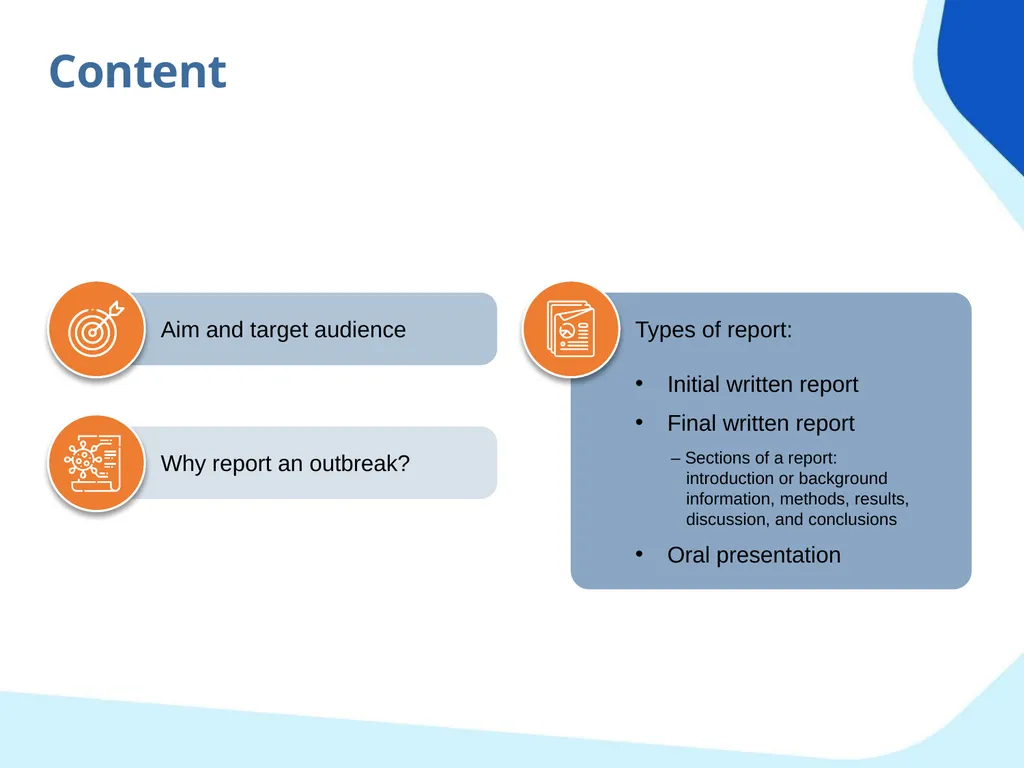
slide3. Content Aim and target audience Why report an outbreak? Types of report:
Initial written report
Final written report
– Sections of a report: introduction or background information, methods, results, discussion, and conclusions
Oral presentation<br>
slide4. Introduction Field investigators and health personnel are usually responsible for presenting written reports
This report may have several aims:
Administrative
Dissemination in the press
Scientific
Academic<br>
slide5. Introduction The report’s objective influences the content and level of technicality
It is necessary to know who the target audience is:
– Healthcare managers
– Academia
– A group of epidemiologists
– The media or general public<br>
slide6. Aim and target audience of a report<br>
slide7. Why report an outbreak? Publication is the investigation’s main aim: studies are carried out to disseminate information!<br>
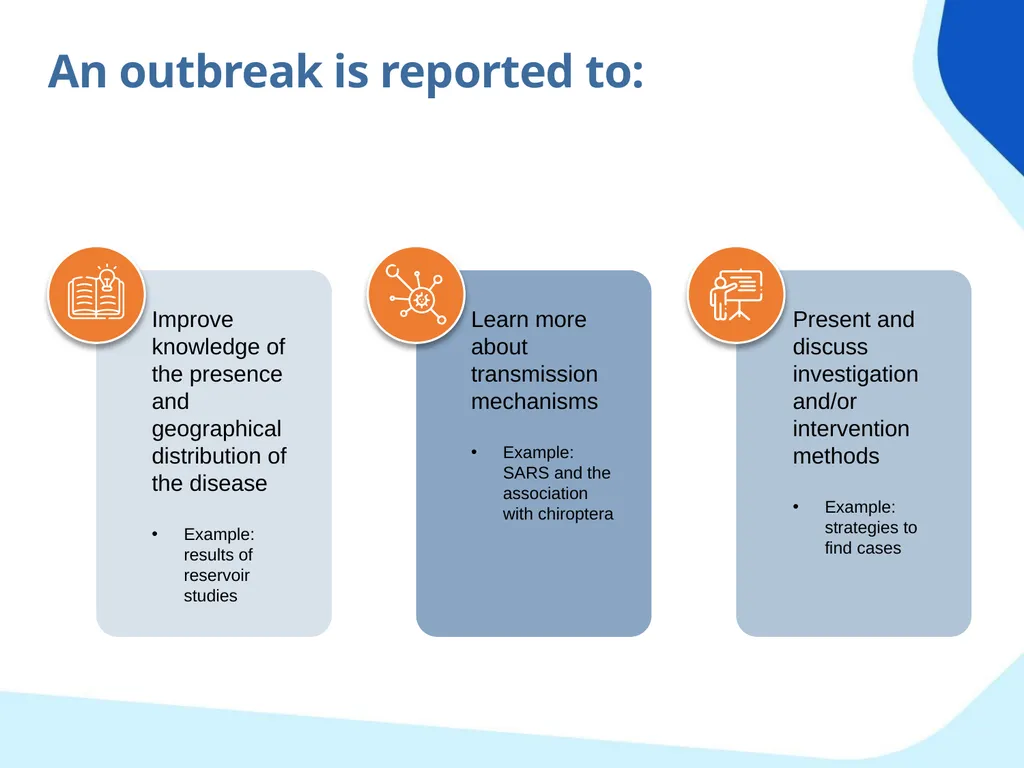
slide8. An outbreak is reported to: Improve knowledge of the presence and geographical distribution of the disease
Example: results of reservoir studies Learn more about transmission mechanisms
Example: SARS and the association with chiroptera Present and discuss investigation and/or intervention methods
Example: strategies to find cases<br>
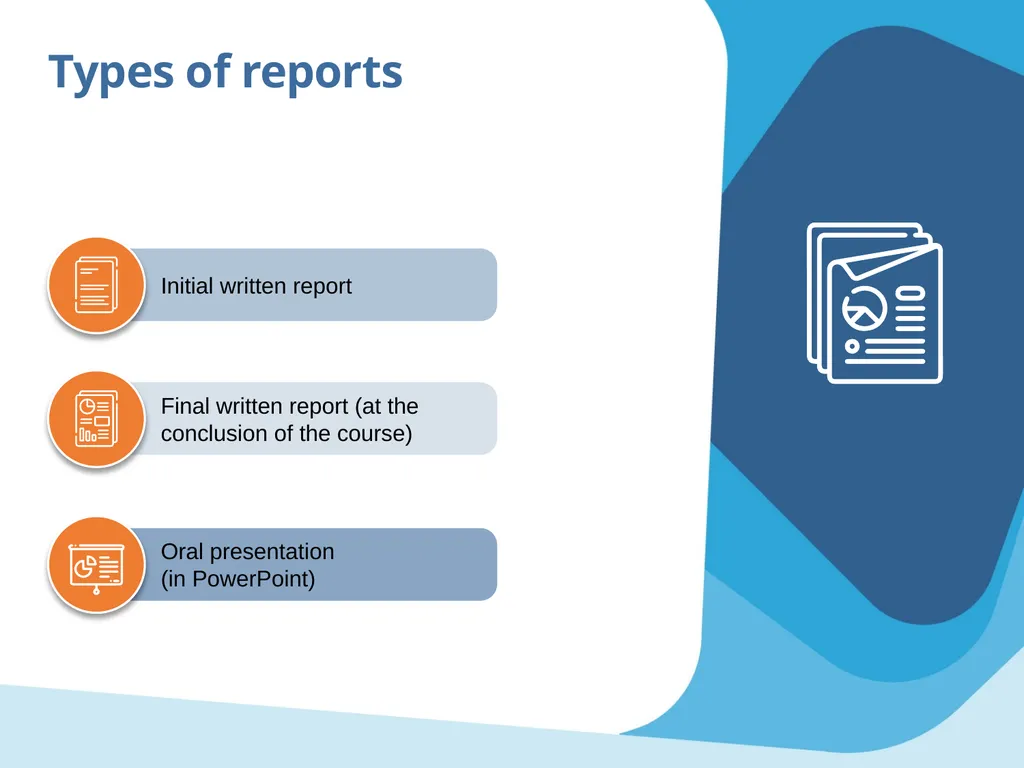
slide9. Types of reports Initial written report Final written report (at the conclusion of the course) Oral presentation
(in PowerPoint)<br>
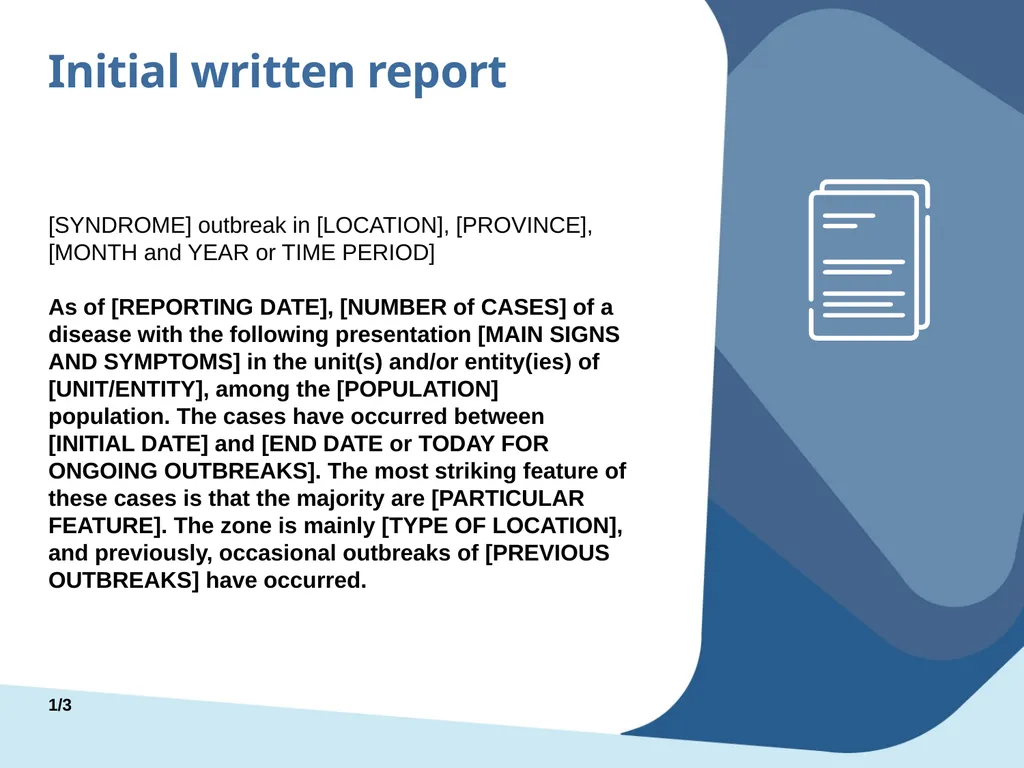
slide10. Initial written report [SYNDROME] outbreak in [LOCATION], [PROVINCE], [MONTH and YEAR or TIME PERIOD]
As of [REPORTING DATE], [NUMBER of CASES] of a disease with the following presentation [MAIN SIGNS AND SYMPTOMS] in the unit(s) and/or entity(ies) of [UNIT/ENTITY], among the [POPULATION] population. The cases have occurred between [INITIAL DATE] and [END DATE or TODAY FOR ONGOING OUTBREAKS]. The most striking feature of these cases is that the majority are [PARTICULAR FEATURE]. The zone is mainly [TYPE OF LOCATION], and previously, occasional outbreaks of [PREVIOUS OUTBREAKS] have occurred. 1/3<br>
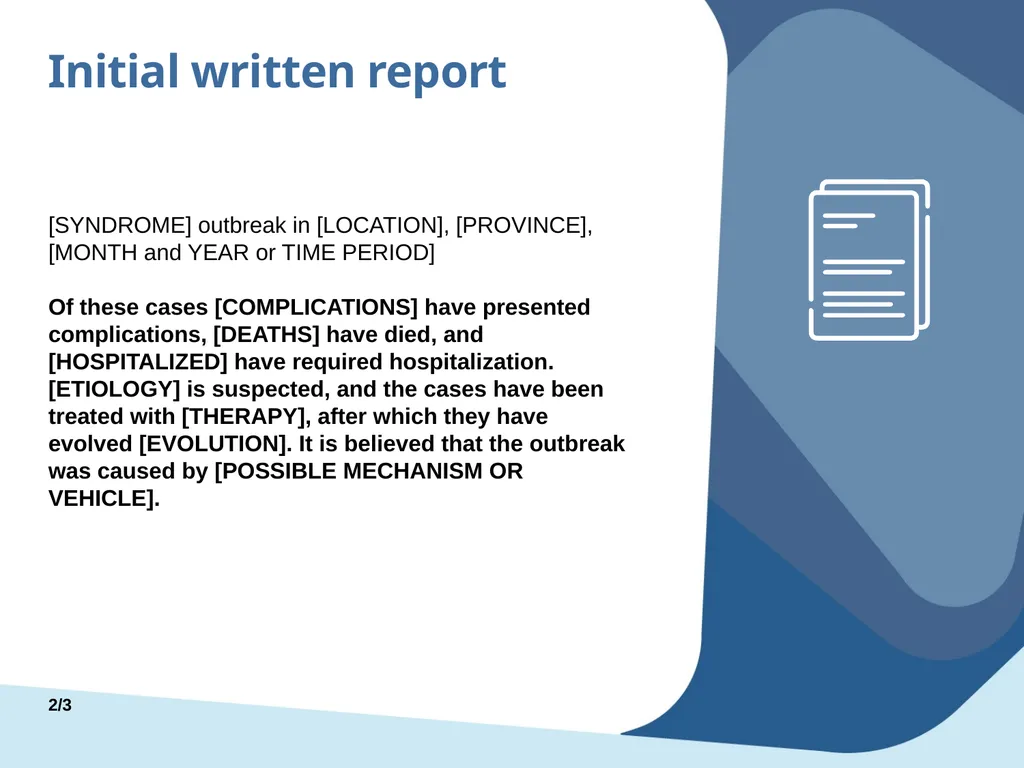
slide11. Initial written report [SYNDROME] outbreak in [LOCATION], [PROVINCE], [MONTH and YEAR or TIME PERIOD]
Of these cases [COMPLICATIONS] have presented complications, [DEATHS] have died, and [HOSPITALIZED] have required hospitalization. [ETIOLOGY] is suspected, and the cases have been treated with [THERAPY], after which they have evolved [EVOLUTION]. It is believed that the outbreak was caused by [POSSIBLE MECHANISM OR VEHICLE]. 2/3<br>
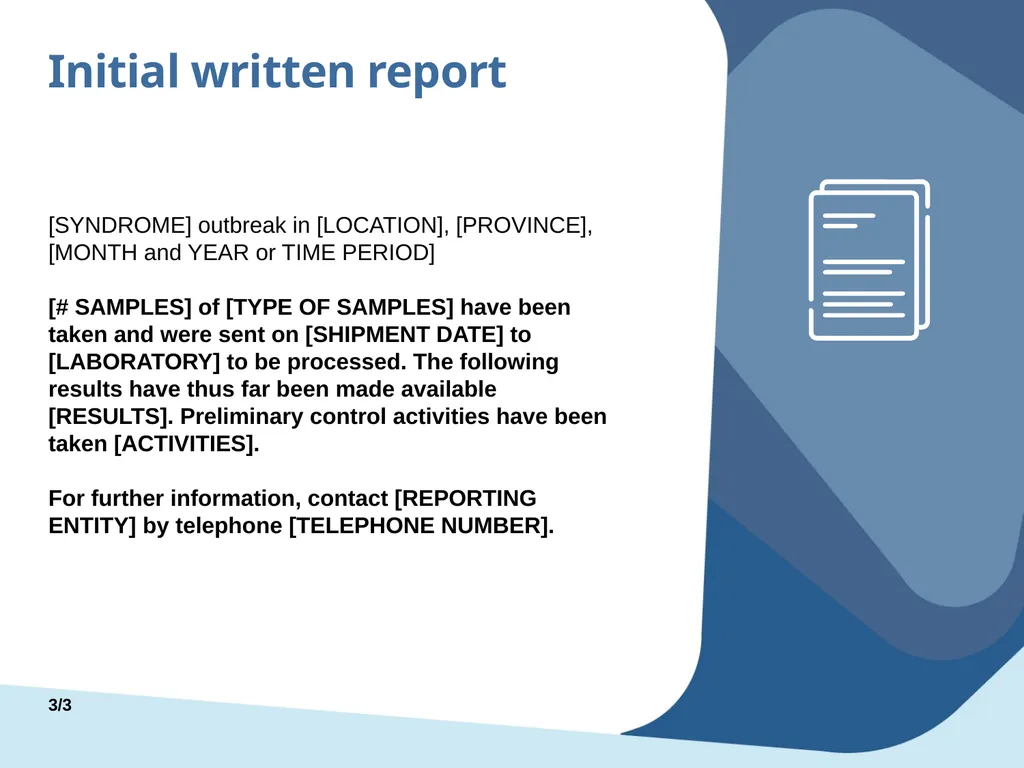
slide12. Initial written report [SYNDROME] outbreak in [LOCATION], [PROVINCE], [MONTH and YEAR or TIME PERIOD]
[# SAMPLES] of [TYPE OF SAMPLES] have been taken and were sent on [SHIPMENT DATE] to [LABORATORY] to be processed. The following results have thus far been made available [RESULTS]. Preliminary control activities have been taken [ACTIVITIES].
For further information, contact [REPORTING ENTITY] by telephone [TELEPHONE NUMBER]. 3/3<br>
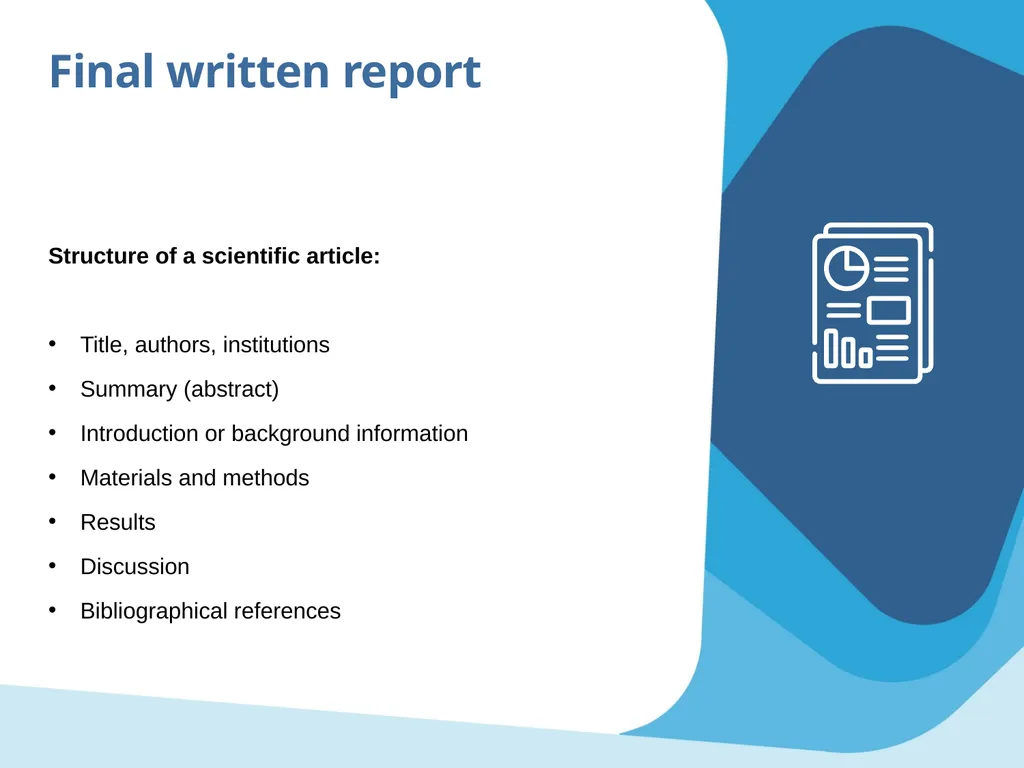
slide13. Final written report Structure of a scientific article:
Title, authors, institutions
Summary (abstract)
Introduction or background information
Materials and methods
Results
Discussion
Bibliographical references<br>
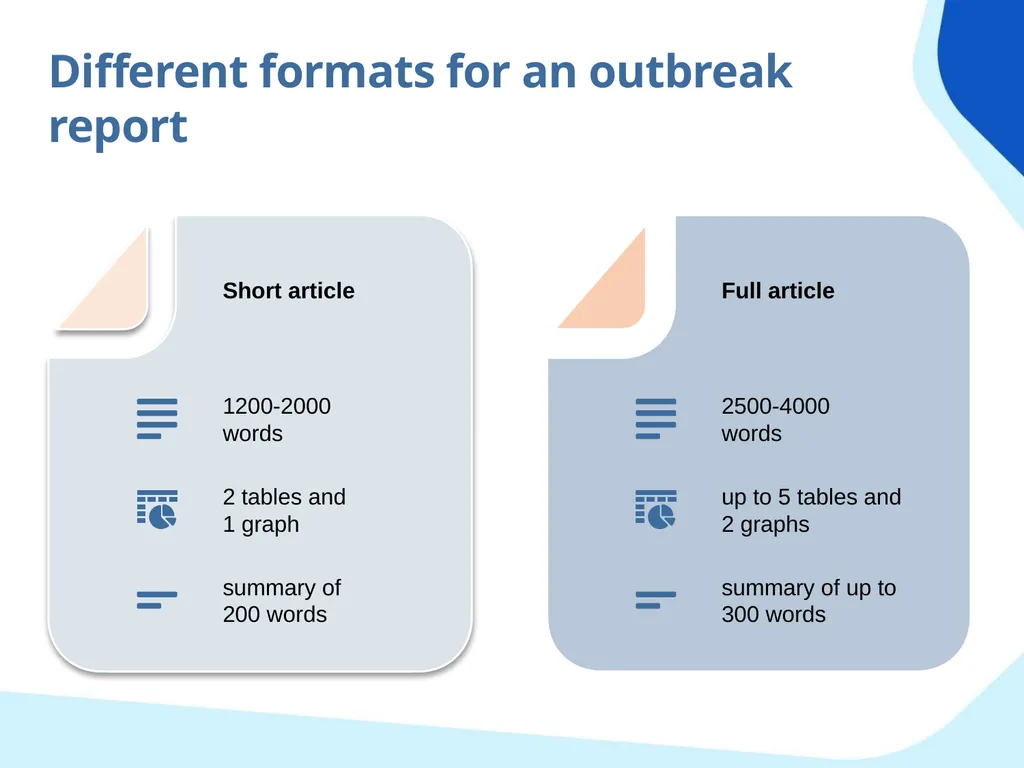
slide14. Different formats for an outbreak report Short article 1200-2000
words 2 tables and 1 graph summary of
200 words Full article 2500-4000
words up to 5 tables and 2 graphs summary of up to 300 words<br>
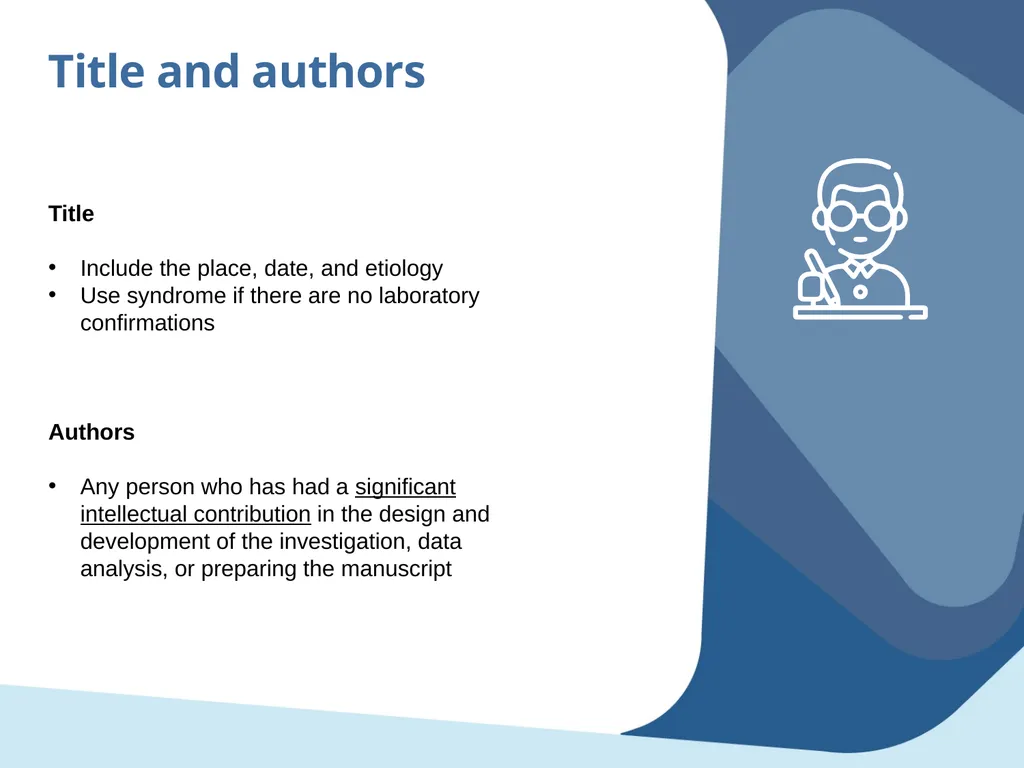
slide15. Title and authors Title
Include the place, date, and etiology
Use syndrome if there are no laboratory confirmations
Authors
Any person who has had a significant intellectual contribution in the design and development of the investigation, data analysis, or preparing the manuscript<br>
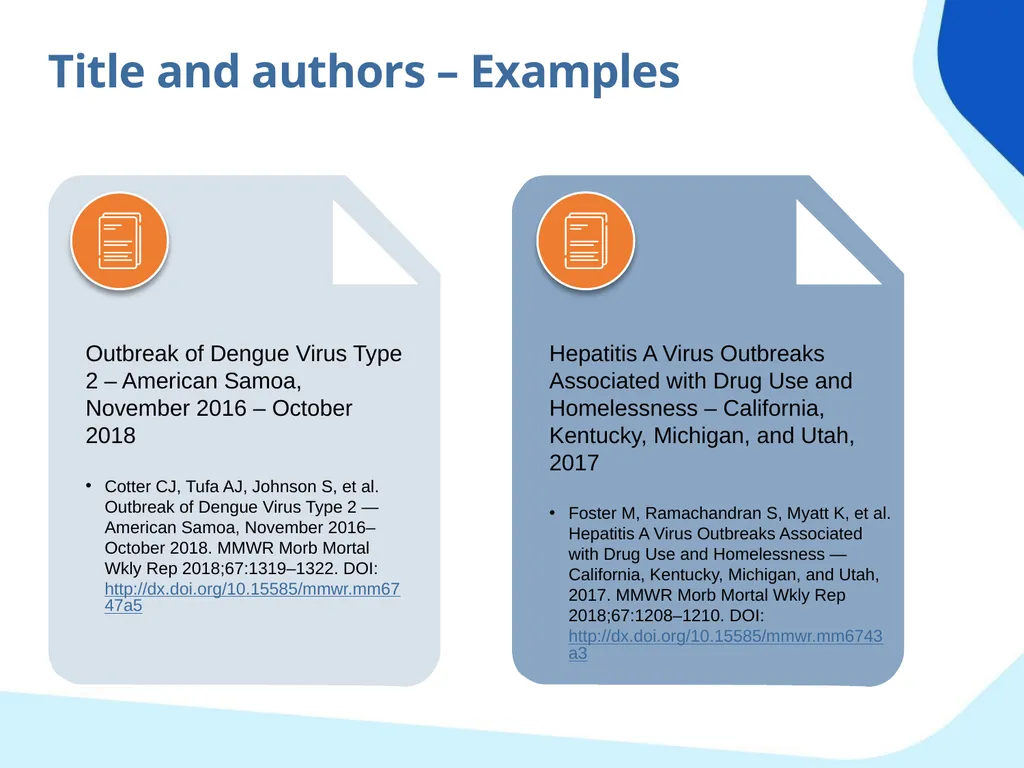
slide16. Title and authors – Examples Outbreak of Dengue Virus Type 2 – American Samoa, November 2016 – October 2018
Cotter CJ, Tufa AJ, Johnson S, et al. Outbreak of Dengue Virus Type 2 — American Samoa, November 2016–October 2018. MMWR Morb Mortal Wkly Rep 2018;67:1319–1322. DOI: http://dx.doi.org/10.15585/mmwr.mm6747a5 Hepatitis A Virus Outbreaks Associated with Drug Use and Homelessness – California, Kentucky, Michigan, and Utah, 2017
Foster M, Ramachandran S, Myatt K, et al. Hepatitis A Virus Outbreaks Associated with Drug Use and Homelessness — California, Kentucky, Michigan, and Utah, 2017. MMWR Morb Mortal Wkly Rep 2018;67:1208–1210. DOI: http://dx.doi.org/10.15585/mmwr.mm6743a3<br>
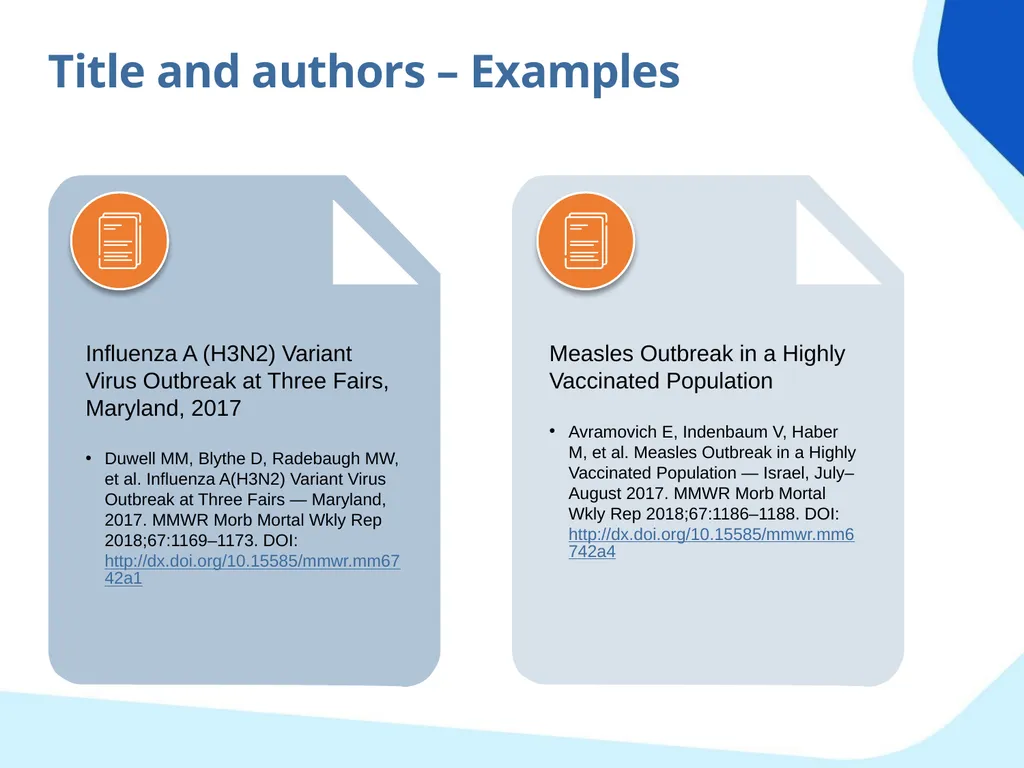
slide17. Title and authors – Examples Influenza A (H3N2) Variant Virus Outbreak at Three Fairs, Maryland, 2017
Duwell MM, Blythe D, Radebaugh MW, et al. Influenza A(H3N2) Variant Virus Outbreak at Three Fairs — Maryland, 2017. MMWR Morb Mortal Wkly Rep 2018;67:1169–1173. DOI: http://dx.doi.org/10.15585/mmwr.mm6742a1 Measles Outbreak in a Highly Vaccinated Population
Avramovich E, Indenbaum V, Haber M, et al. Measles Outbreak in a Highly Vaccinated Population — Israel, July–August 2017. MMWR Morb Mortal Wkly Rep 2018;67:1186–1188. DOI: http://dx.doi.org/10.15585/mmwr.mm6742a4<br>
slide18. Summary or abstract Used to quickly review the aim of the article
At the beginning of the manuscript, about 150-250 words in length
Background or introduction, objectives, methods, results, and conclusions<br>
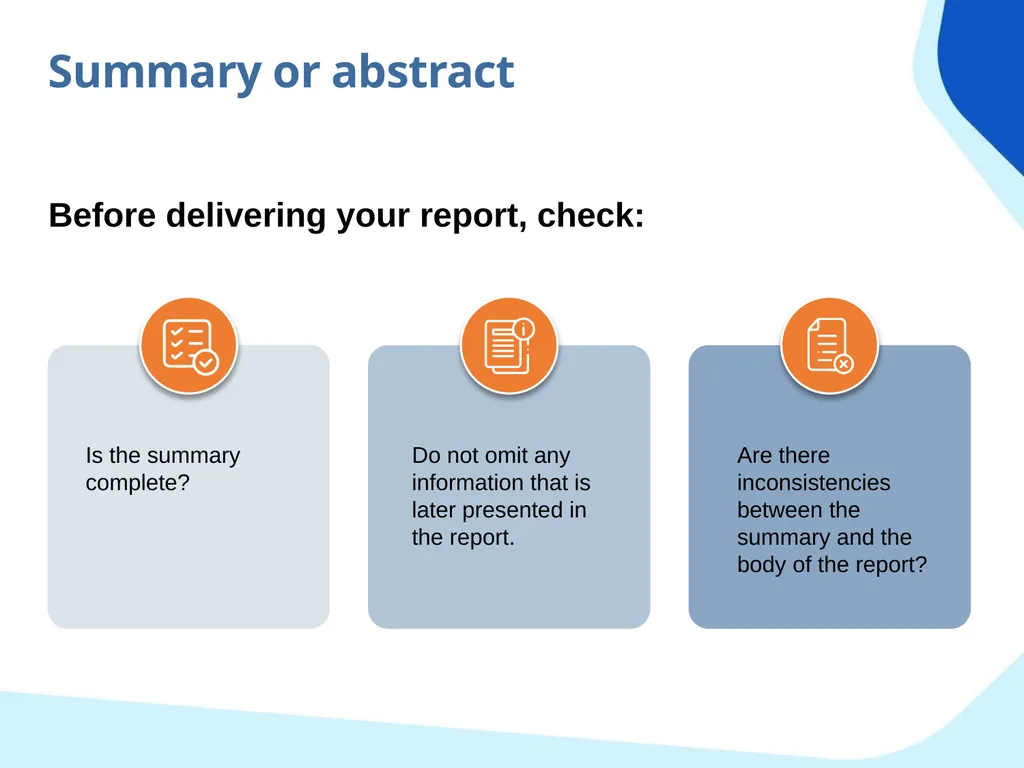
slide19. Summary or abstract Is the summary complete? Do not omit any information that is later presented in the report. Are there inconsistencies between the summary and the body of the report? Before delivering your report, check:<br>
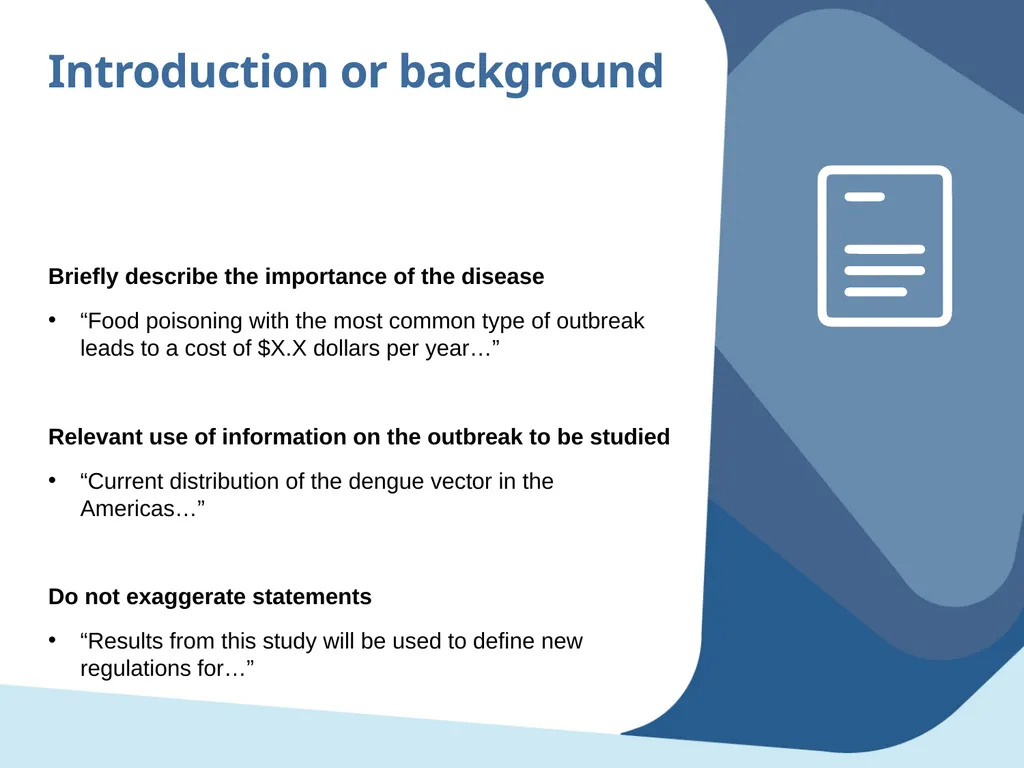
slide20. Introduction or background Briefly describe the importance of the disease
“Food poisoning with the most common type of outbreak leads to a cost of $X.X dollars per year…”
Relevant use of information on the outbreak to be studied
“Current distribution of the dengue vector in the Americas…”
Do not exaggerate statements
“Results from this study will be used to define new regulations for…”<br>
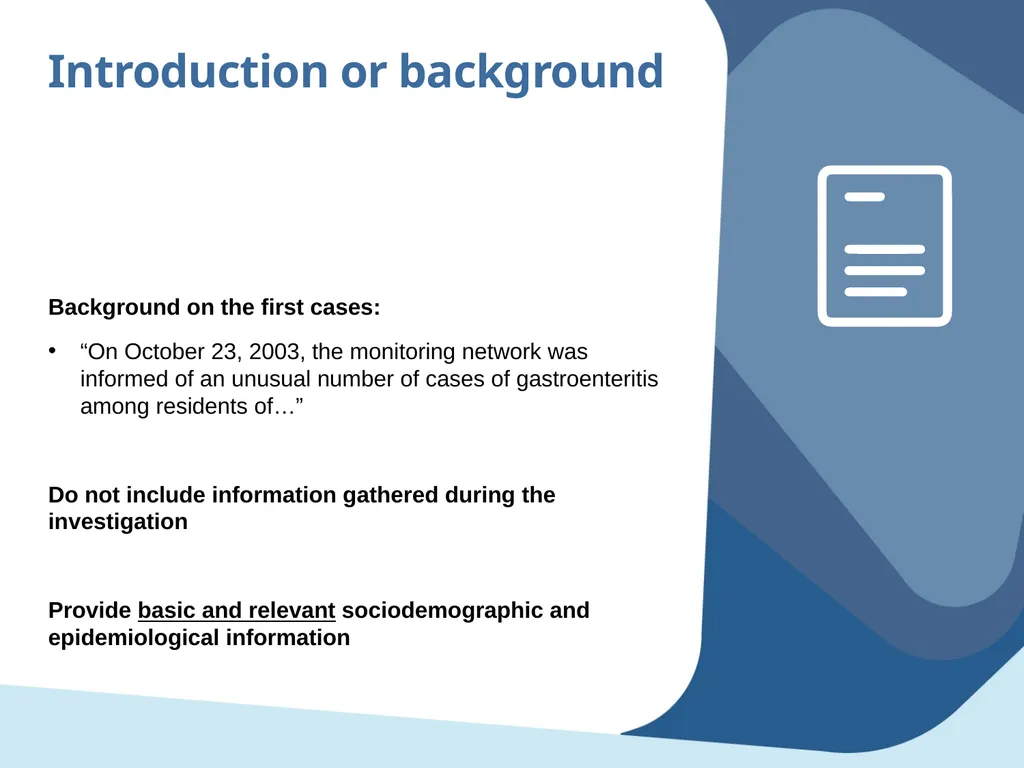
slide21. Introduction or background Background on the first cases:
“On October 23, 2003, the monitoring network was informed of an unusual number of cases of gastroenteritis among residents of…”
Do not include information gathered during the investigation
Provide basic and relevant sociodemographic and epidemiological information<br>
slide22. Introduction or background Objectives (last paragraph of the introduction) Specify why the outbreak is being investigated Do not include administrative details When writing the results and discussion, be sure you have met these objectives<br>
slide23. Introduction or background Included the initial report Not included information that is part of the results Only included relevant information Included the objectives When submitting your report, make sure you have:<br>
slide24. Introduction or background Example “Previously, personnel responsible for the health center had converted the facilities into an operations center, allowing constant communication with the areas close to the outbreak. The provincial Civil Defense Committee has been working intersectorally with the education sector, subprefecture, and archbishopry, representatives of the Ministries of Agriculture and Transport and Communications, the Army and police, the municipality, and local organizations including social security”<br>
slide25. Materials and methods All activities undertaken since the beginning of the study generally pertain to the background
– Example: a comparison of morbidity rates to confirm the outbreak
Should describe all outbreak investigation activities: case identification, sampling, data and laboratory analysis, among others<br>
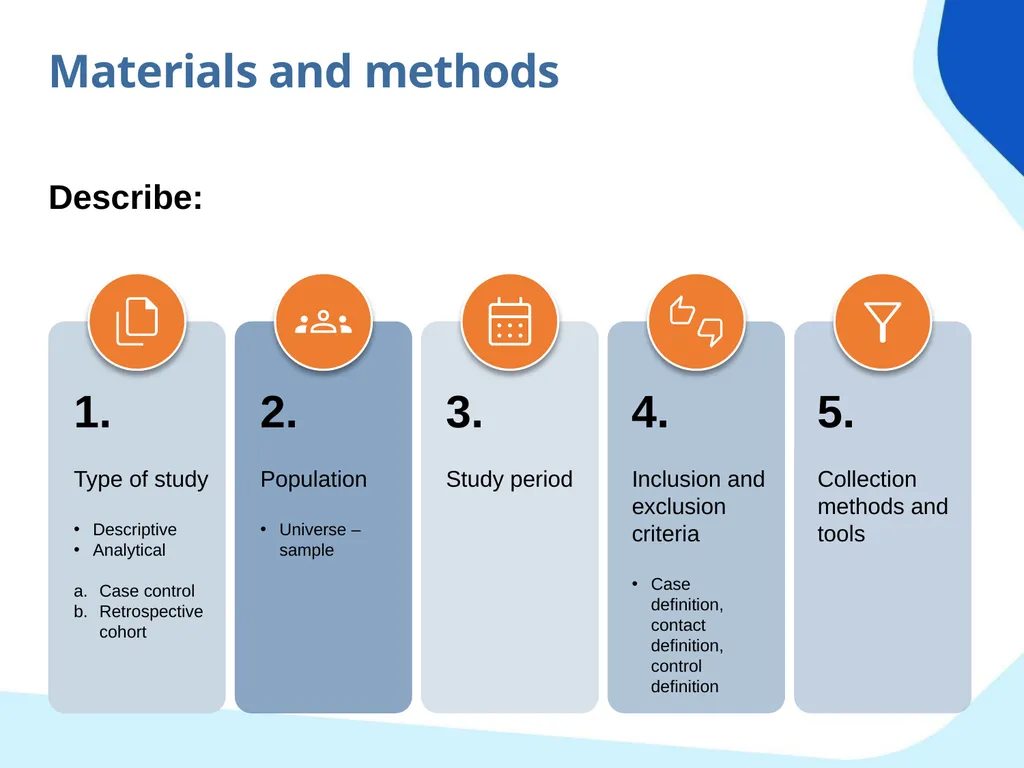
slide26. Materials and methods Describe: 1.
Type of study
Descriptive
Analytical
Case control
Retrospective cohort 2.
Population
Universe – sample 3.
Study period 4.
Inclusion and exclusion criteria
Case definition, contact definition, control definition 5.
Collection methods and tools<br>
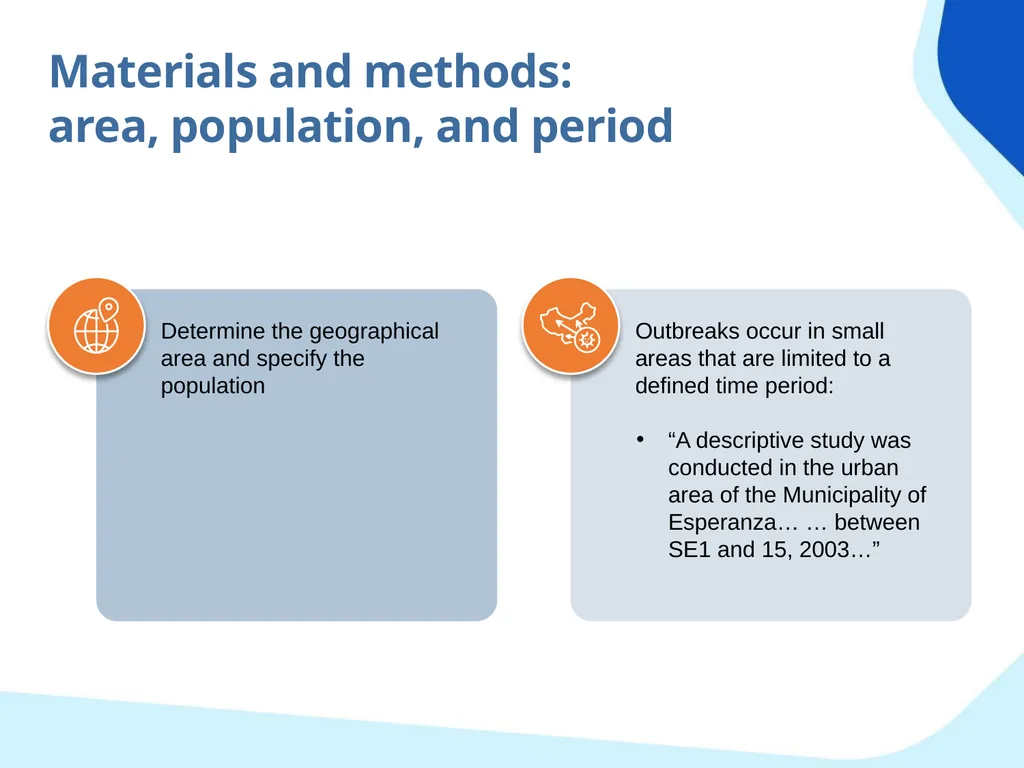
slide27. Materials and methods:
area, population, and period Determine the geographical area and specify the population Outbreaks occur in small areas that are limited to a defined time period:
“A descriptive study was conducted in the urban area of the Municipality of Esperanza… … between SE1 and 15, 2003…”<br>
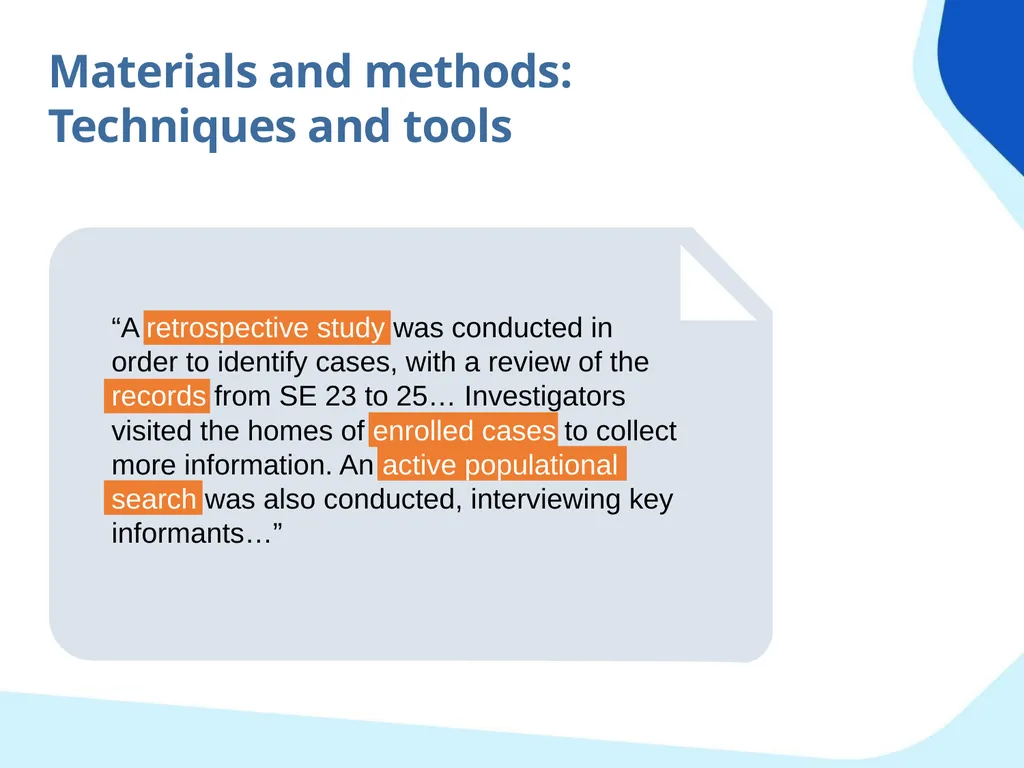
slide28. Materials and methods:
Techniques and tools “A retrospective study was conducted in order to identify cases, with a review of the records from SE 23 to 25… Investigators visited the homes of enrolled cases to collect more information. An active populational search was also conducted, interviewing key informants…”<br>
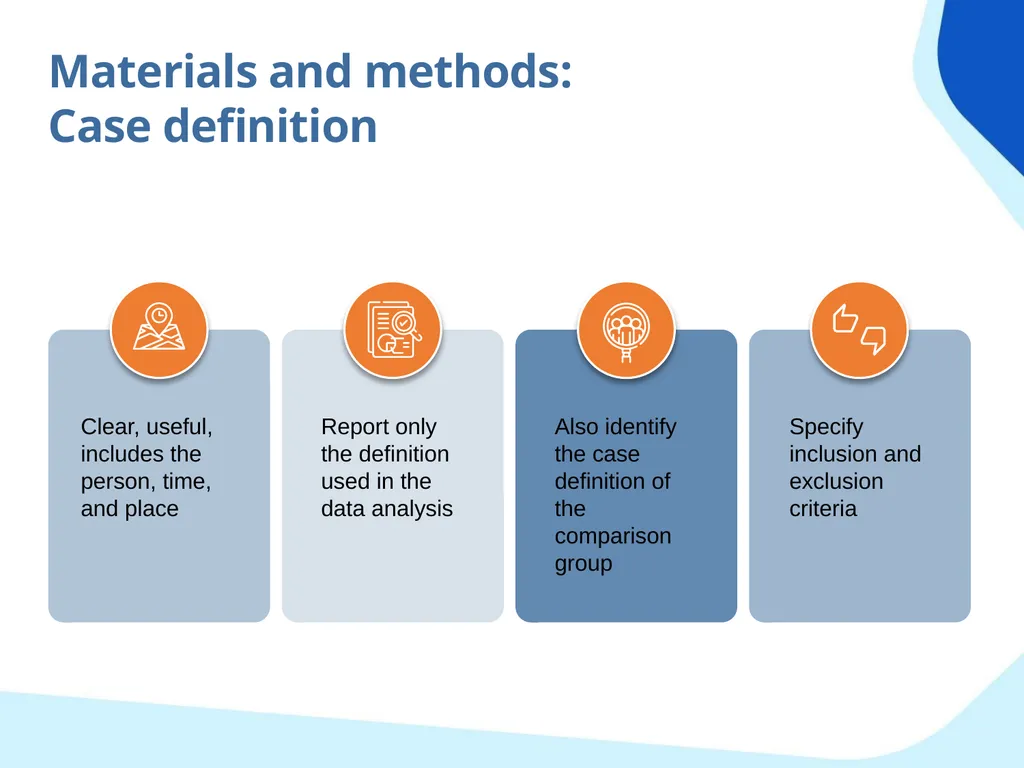
slide29. Materials and methods:
Case definition Clear, useful, includes the person, time, and place Report only the definition used in the data analysis Also identify the case definition of the comparison group Specify inclusion and exclusion criteria<br>
slide30. Materials and methods:
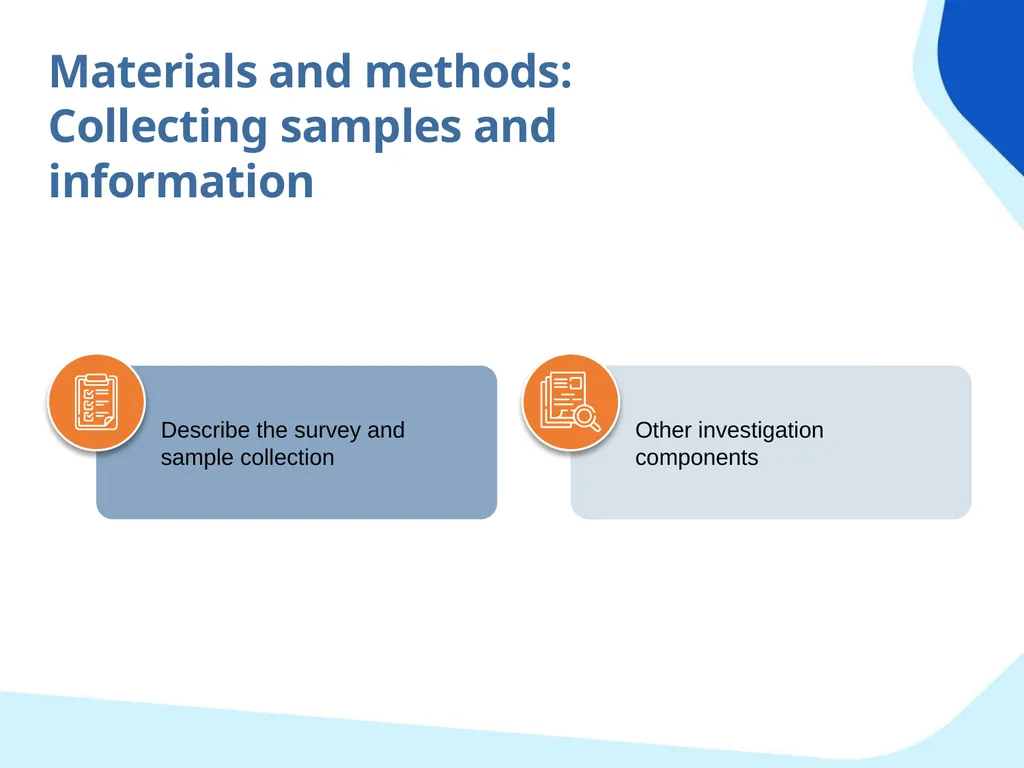
Collecting samples and information Describe the survey and sample collection Other investigation components<br>
slide31. Materials and methods:
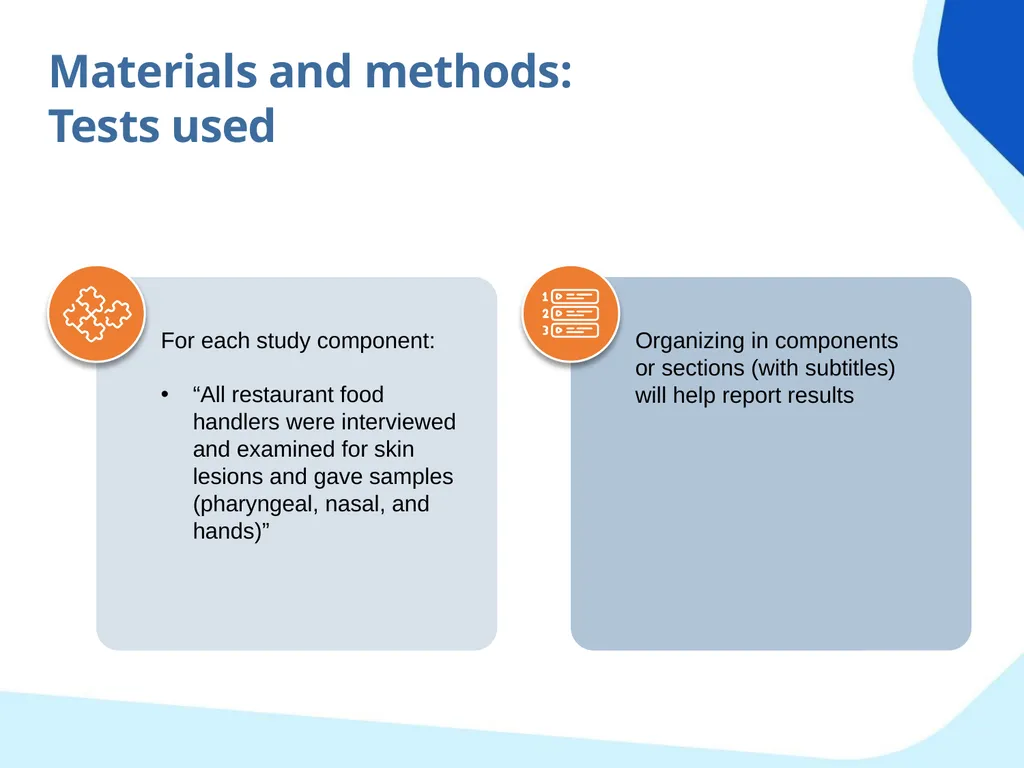
Tests used For each study component:
“All restaurant food handlers were interviewed and examined for skin lesions and gave samples (pharyngeal, nasal, and hands)” Organizing in components or sections (with subtitles) will help report results<br>
slide32. Results Present results in sections with subtitles
Ensure that the study objectives have been fulfilled
Describe the outbreak response
Indicate the results that support the selected intervention strategy<br>
slide33. Results: suggested subtitles Case search Managing signs and symptoms Risk factors (descriptive / analytical epidemiological) Laboratory findings and confirmation Control measures and outbreak response<br>
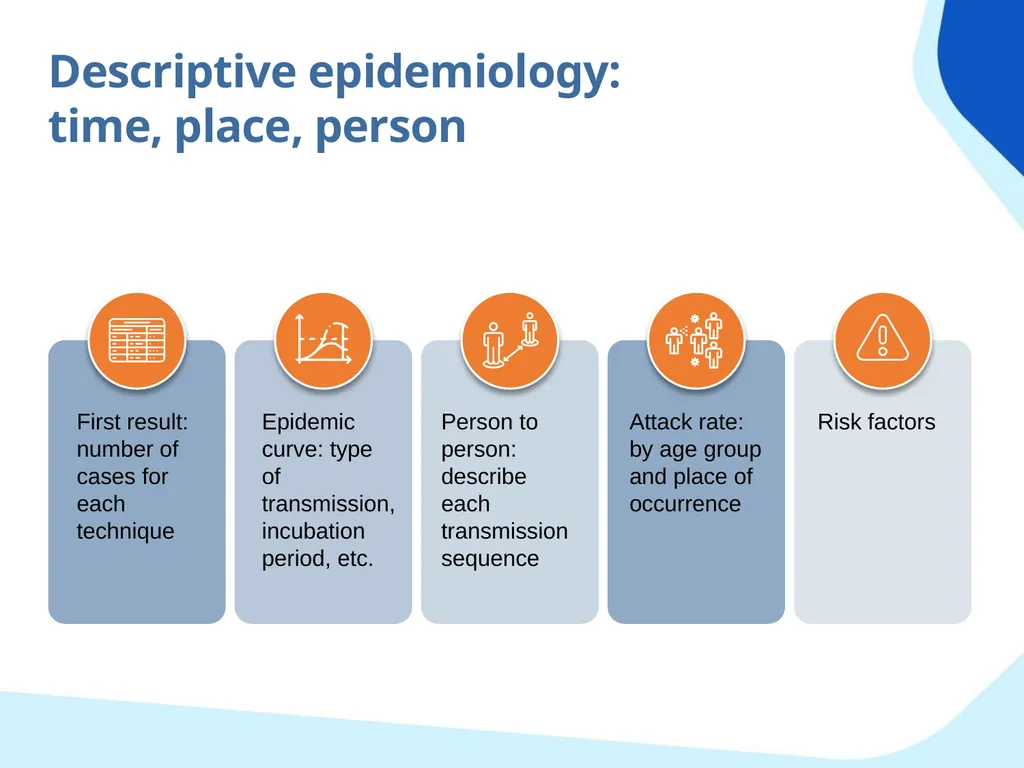
slide34. Descriptive epidemiology:
time, place, person First result: number of cases for each technique Epidemic curve: type of transmission, incubation period, etc. Person to person: describe each transmission sequence Attack rate: by age group and place of occurrence Risk factors<br>
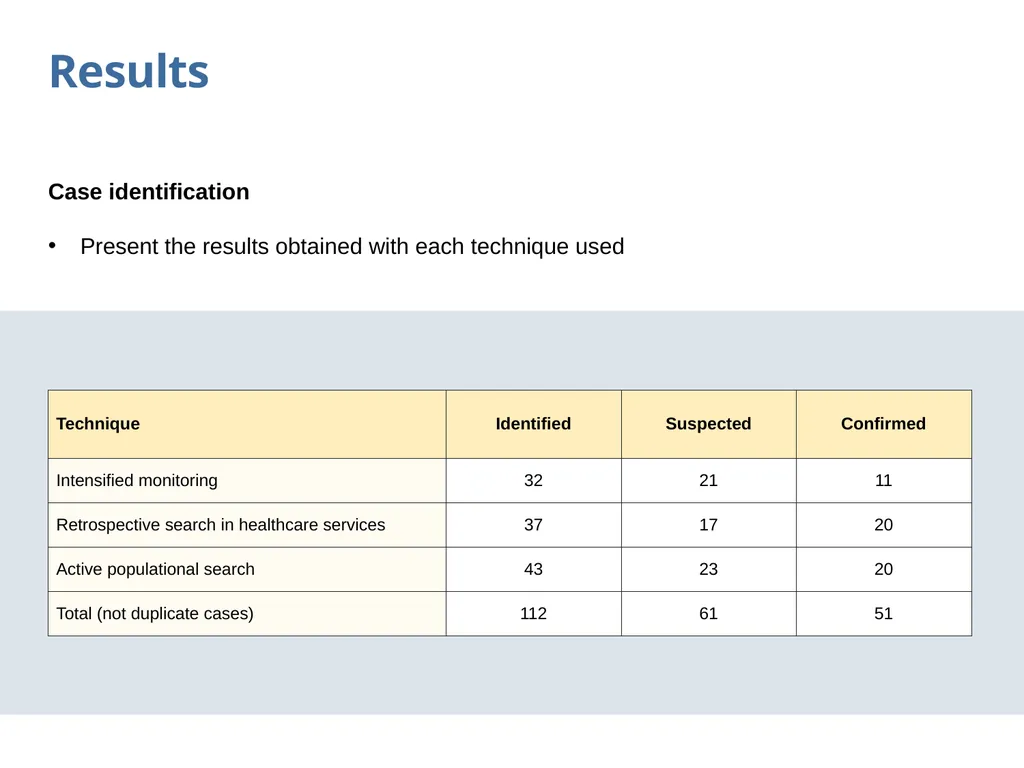
slide35. Results Case identification
Present the results obtained with each technique used<br>
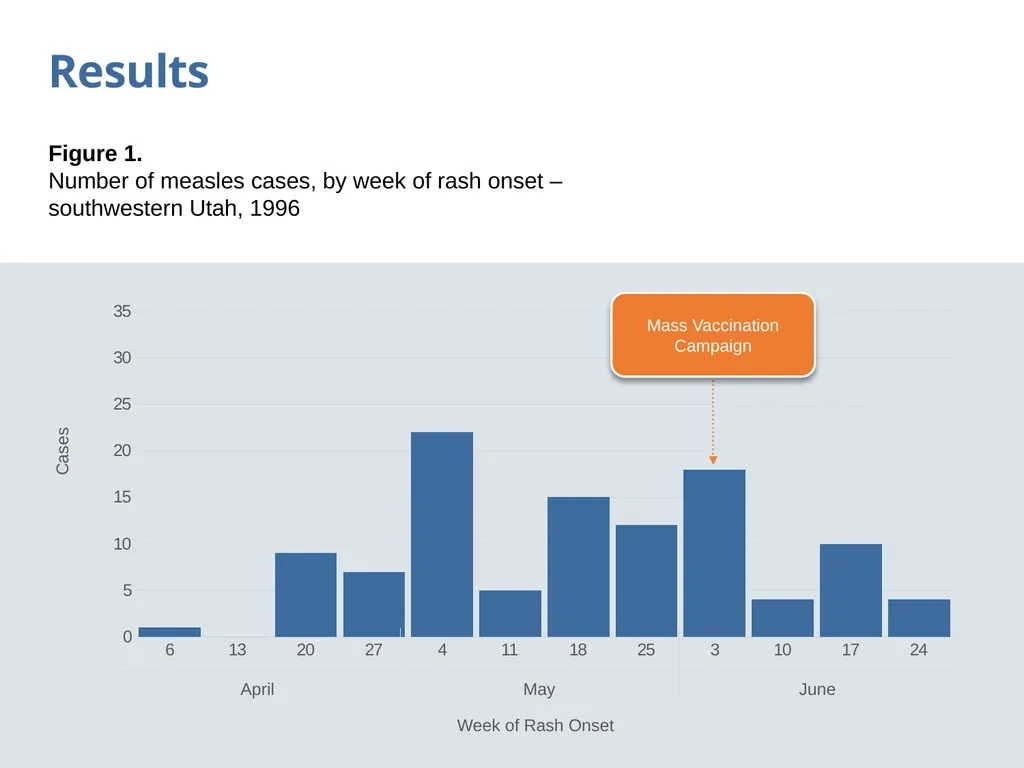
slide36. Results Figure 1.
Number of measles cases, by week of rash onset – southwestern Utah, 1996 April June Week of Rash Onset May Mass Vaccination Campaign<br>
slide37. Analytical epidemiology Present the case and control or exposed and not exposed results, indicating the ORs and RRs and p values
Complement with the results from other study components
Do not present conclusions or discussion here<br>
slide38. Discussion Identify and communicate the main messages
Comment on how to investigate and respond to similar situations in the future
Discuss the investigation’s limits and assess how they impacted (or did not impact) your conclusions
Conclude by repeating and expanding the main message<br>
slide39. Discussion: suggestion Discuss one topic per paragraph
Sentences within each paragraph are connected via a logical sequence
The first paragraph summarizes the main results
The last paragraph generally suggests what to do<br>
slide40. Interpreting evidence Do not get attached to the first attractive hypothesis you produce
Always think “outside the box” (but within the budget) and consider alternative explanations
Never discard contradictory results
Your common sense may be more significant than a p < 0.0001<br>
slide41. Other considerations Do not forget your partners
Determine who the authors are and each one’s contribution
Ethical issues and consent forms
Decide where best to publish and establish a time frame<br>
slide42. Oral presentation Keep the structure of a scientific article
Keep within the assigned time limits
Slides should not have much text
When your present or discuss
– Do not read. Use your notes as a guide
– Use appropriate technical language<br>
slide43. © Pan American Health Organization, 2023
Property of the Pan American Health Organization. Reproduced with permission pursuant to the Creative Commons Attribution-NonCommercial-NoDerivs 3.0 IGO license (CC BY-NC-ND 3.0 IGO).
In any use of this work, there should be no suggestion that the Pan American Health Organization (PAHO) endorses any specific organization, product, or service. Use of the PAHO logo, in a way that is not already incorporated in the work or consistent with the Creative Commons license CC BY-NC-ND 3.0 IGO, is strictly prohibited. Any use of this work that is inconsistent with or not permitted under the Creative Commons license BY-NC-ND 3.0 IGO requires the express written consent of PAHO.
Further, all reasonable precautions have been taken by PAHO and the GS/OAS to verify the information contained in this publication. However, the published material is being distributed without warranty of any kind, either expressed or implied. The responsibility for the interpretation and use of the material lies with the reader. In no event shall PAHO and/or the OAS or GS/OAS be liable for damages arising from its use<br>
slide2. Objectives Propose minimum components for a scientific outbreak report Emphasize the importance of disseminating results from outbreak investigations Provide general guidelines to prepare reports<br>
slide3. Content Aim and target audience Why report an outbreak? Types of report:
Initial written report
Final written report
– Sections of a report: introduction or background information, methods, results, discussion, and conclusions
Oral presentation<br>
slide4. Introduction Field investigators and health personnel are usually responsible for presenting written reports
This report may have several aims:
Administrative
Dissemination in the press
Scientific
Academic<br>
slide5. Introduction The report’s objective influences the content and level of technicality
It is necessary to know who the target audience is:
– Healthcare managers
– Academia
– A group of epidemiologists
– The media or general public<br>
slide6. Aim and target audience of a report<br>
slide7. Why report an outbreak? Publication is the investigation’s main aim: studies are carried out to disseminate information!<br>
slide8. An outbreak is reported to: Improve knowledge of the presence and geographical distribution of the disease
Example: results of reservoir studies Learn more about transmission mechanisms
Example: SARS and the association with chiroptera Present and discuss investigation and/or intervention methods
Example: strategies to find cases<br>
slide9. Types of reports Initial written report Final written report (at the conclusion of the course) Oral presentation
(in PowerPoint)<br>
slide10. Initial written report [SYNDROME] outbreak in [LOCATION], [PROVINCE], [MONTH and YEAR or TIME PERIOD]
As of [REPORTING DATE], [NUMBER of CASES] of a disease with the following presentation [MAIN SIGNS AND SYMPTOMS] in the unit(s) and/or entity(ies) of [UNIT/ENTITY], among the [POPULATION] population. The cases have occurred between [INITIAL DATE] and [END DATE or TODAY FOR ONGOING OUTBREAKS]. The most striking feature of these cases is that the majority are [PARTICULAR FEATURE]. The zone is mainly [TYPE OF LOCATION], and previously, occasional outbreaks of [PREVIOUS OUTBREAKS] have occurred. 1/3<br>
slide11. Initial written report [SYNDROME] outbreak in [LOCATION], [PROVINCE], [MONTH and YEAR or TIME PERIOD]
Of these cases [COMPLICATIONS] have presented complications, [DEATHS] have died, and [HOSPITALIZED] have required hospitalization. [ETIOLOGY] is suspected, and the cases have been treated with [THERAPY], after which they have evolved [EVOLUTION]. It is believed that the outbreak was caused by [POSSIBLE MECHANISM OR VEHICLE]. 2/3<br>
slide12. Initial written report [SYNDROME] outbreak in [LOCATION], [PROVINCE], [MONTH and YEAR or TIME PERIOD]
[# SAMPLES] of [TYPE OF SAMPLES] have been taken and were sent on [SHIPMENT DATE] to [LABORATORY] to be processed. The following results have thus far been made available [RESULTS]. Preliminary control activities have been taken [ACTIVITIES].
For further information, contact [REPORTING ENTITY] by telephone [TELEPHONE NUMBER]. 3/3<br>
slide13. Final written report Structure of a scientific article:
Title, authors, institutions
Summary (abstract)
Introduction or background information
Materials and methods
Results
Discussion
Bibliographical references<br>
slide14. Different formats for an outbreak report Short article 1200-2000
words 2 tables and 1 graph summary of
200 words Full article 2500-4000
words up to 5 tables and 2 graphs summary of up to 300 words<br>
slide15. Title and authors Title
Include the place, date, and etiology
Use syndrome if there are no laboratory confirmations
Authors
Any person who has had a significant intellectual contribution in the design and development of the investigation, data analysis, or preparing the manuscript<br>
slide16. Title and authors – Examples Outbreak of Dengue Virus Type 2 – American Samoa, November 2016 – October 2018
Cotter CJ, Tufa AJ, Johnson S, et al. Outbreak of Dengue Virus Type 2 — American Samoa, November 2016–October 2018. MMWR Morb Mortal Wkly Rep 2018;67:1319–1322. DOI: http://dx.doi.org/10.15585/mmwr.mm6747a5 Hepatitis A Virus Outbreaks Associated with Drug Use and Homelessness – California, Kentucky, Michigan, and Utah, 2017
Foster M, Ramachandran S, Myatt K, et al. Hepatitis A Virus Outbreaks Associated with Drug Use and Homelessness — California, Kentucky, Michigan, and Utah, 2017. MMWR Morb Mortal Wkly Rep 2018;67:1208–1210. DOI: http://dx.doi.org/10.15585/mmwr.mm6743a3<br>
slide17. Title and authors – Examples Influenza A (H3N2) Variant Virus Outbreak at Three Fairs, Maryland, 2017
Duwell MM, Blythe D, Radebaugh MW, et al. Influenza A(H3N2) Variant Virus Outbreak at Three Fairs — Maryland, 2017. MMWR Morb Mortal Wkly Rep 2018;67:1169–1173. DOI: http://dx.doi.org/10.15585/mmwr.mm6742a1 Measles Outbreak in a Highly Vaccinated Population
Avramovich E, Indenbaum V, Haber M, et al. Measles Outbreak in a Highly Vaccinated Population — Israel, July–August 2017. MMWR Morb Mortal Wkly Rep 2018;67:1186–1188. DOI: http://dx.doi.org/10.15585/mmwr.mm6742a4<br>
slide18. Summary or abstract Used to quickly review the aim of the article
At the beginning of the manuscript, about 150-250 words in length
Background or introduction, objectives, methods, results, and conclusions<br>
slide19. Summary or abstract Is the summary complete? Do not omit any information that is later presented in the report. Are there inconsistencies between the summary and the body of the report? Before delivering your report, check:<br>
slide20. Introduction or background Briefly describe the importance of the disease
“Food poisoning with the most common type of outbreak leads to a cost of $X.X dollars per year…”
Relevant use of information on the outbreak to be studied
“Current distribution of the dengue vector in the Americas…”
Do not exaggerate statements
“Results from this study will be used to define new regulations for…”<br>
slide21. Introduction or background Background on the first cases:
“On October 23, 2003, the monitoring network was informed of an unusual number of cases of gastroenteritis among residents of…”
Do not include information gathered during the investigation
Provide basic and relevant sociodemographic and epidemiological information<br>
slide22. Introduction or background Objectives (last paragraph of the introduction) Specify why the outbreak is being investigated Do not include administrative details When writing the results and discussion, be sure you have met these objectives<br>
slide23. Introduction or background Included the initial report Not included information that is part of the results Only included relevant information Included the objectives When submitting your report, make sure you have:<br>
slide24. Introduction or background Example “Previously, personnel responsible for the health center had converted the facilities into an operations center, allowing constant communication with the areas close to the outbreak. The provincial Civil Defense Committee has been working intersectorally with the education sector, subprefecture, and archbishopry, representatives of the Ministries of Agriculture and Transport and Communications, the Army and police, the municipality, and local organizations including social security”<br>
slide25. Materials and methods All activities undertaken since the beginning of the study generally pertain to the background
– Example: a comparison of morbidity rates to confirm the outbreak
Should describe all outbreak investigation activities: case identification, sampling, data and laboratory analysis, among others<br>
slide26. Materials and methods Describe: 1.
Type of study
Descriptive
Analytical
Case control
Retrospective cohort 2.
Population
Universe – sample 3.
Study period 4.
Inclusion and exclusion criteria
Case definition, contact definition, control definition 5.
Collection methods and tools<br>
slide27. Materials and methods:
area, population, and period Determine the geographical area and specify the population Outbreaks occur in small areas that are limited to a defined time period:
“A descriptive study was conducted in the urban area of the Municipality of Esperanza… … between SE1 and 15, 2003…”<br>
slide28. Materials and methods:
Techniques and tools “A retrospective study was conducted in order to identify cases, with a review of the records from SE 23 to 25… Investigators visited the homes of enrolled cases to collect more information. An active populational search was also conducted, interviewing key informants…”<br>
slide29. Materials and methods:
Case definition Clear, useful, includes the person, time, and place Report only the definition used in the data analysis Also identify the case definition of the comparison group Specify inclusion and exclusion criteria<br>
slide30. Materials and methods:
Collecting samples and information Describe the survey and sample collection Other investigation components<br>
slide31. Materials and methods:
Tests used For each study component:
“All restaurant food handlers were interviewed and examined for skin lesions and gave samples (pharyngeal, nasal, and hands)” Organizing in components or sections (with subtitles) will help report results<br>
slide32. Results Present results in sections with subtitles
Ensure that the study objectives have been fulfilled
Describe the outbreak response
Indicate the results that support the selected intervention strategy<br>
slide33. Results: suggested subtitles Case search Managing signs and symptoms Risk factors (descriptive / analytical epidemiological) Laboratory findings and confirmation Control measures and outbreak response<br>
slide34. Descriptive epidemiology:
time, place, person First result: number of cases for each technique Epidemic curve: type of transmission, incubation period, etc. Person to person: describe each transmission sequence Attack rate: by age group and place of occurrence Risk factors<br>
slide35. Results Case identification
Present the results obtained with each technique used<br>
slide36. Results Figure 1.
Number of measles cases, by week of rash onset – southwestern Utah, 1996 April June Week of Rash Onset May Mass Vaccination Campaign<br>
slide37. Analytical epidemiology Present the case and control or exposed and not exposed results, indicating the ORs and RRs and p values
Complement with the results from other study components
Do not present conclusions or discussion here<br>
slide38. Discussion Identify and communicate the main messages
Comment on how to investigate and respond to similar situations in the future
Discuss the investigation’s limits and assess how they impacted (or did not impact) your conclusions
Conclude by repeating and expanding the main message<br>
slide39. Discussion: suggestion Discuss one topic per paragraph
Sentences within each paragraph are connected via a logical sequence
The first paragraph summarizes the main results
The last paragraph generally suggests what to do<br>
slide40. Interpreting evidence Do not get attached to the first attractive hypothesis you produce
Always think “outside the box” (but within the budget) and consider alternative explanations
Never discard contradictory results
Your common sense may be more significant than a p < 0.0001<br>
slide41. Other considerations Do not forget your partners
Determine who the authors are and each one’s contribution
Ethical issues and consent forms
Decide where best to publish and establish a time frame<br>
slide42. Oral presentation Keep the structure of a scientific article
Keep within the assigned time limits
Slides should not have much text
When your present or discuss
– Do not read. Use your notes as a guide
– Use appropriate technical language<br>
slide43. © Pan American Health Organization, 2023
Property of the Pan American Health Organization. Reproduced with permission pursuant to the Creative Commons Attribution-NonCommercial-NoDerivs 3.0 IGO license (CC BY-NC-ND 3.0 IGO).
In any use of this work, there should be no suggestion that the Pan American Health Organization (PAHO) endorses any specific organization, product, or service. Use of the PAHO logo, in a way that is not already incorporated in the work or consistent with the Creative Commons license CC BY-NC-ND 3.0 IGO, is strictly prohibited. Any use of this work that is inconsistent with or not permitted under the Creative Commons license BY-NC-ND 3.0 IGO requires the express written consent of PAHO.
Further, all reasonable precautions have been taken by PAHO and the GS/OAS to verify the information contained in this publication. However, the published material is being distributed without warranty of any kind, either expressed or implied. The responsibility for the interpretation and use of the material lies with the reader. In no event shall PAHO and/or the OAS or GS/OAS be liable for damages arising from its use<br>