04
Labor Standards and Work Measurement Started early in the 20th century
Important to both manufacturing and service organizations
Necessary for determining staffing requirements
Important to labor incentive systems<br>
05
Meaningful Standards Help Determine Labor content of items produced
Staffing needs
Cost and time estimates
Crew size and work balance
Expected production
Basis of wage incentive plans
Efficiency of employees<br>
06
Labor Standards May be set in four ways: Historical experience
Time studies
Predetermined time standards
Work sampling<br>
07
Historical Experience How the task was performed last time
Easy and inexpensive
Data available from production records or time cards
Data is not objective and may be inaccurate
Not recommended<br>
08
Time Studies Involves timing a sample of a worker’s performance and using it to set a standard
Requires trained and experienced observers
Cannot be set before the work is performed<br>
09
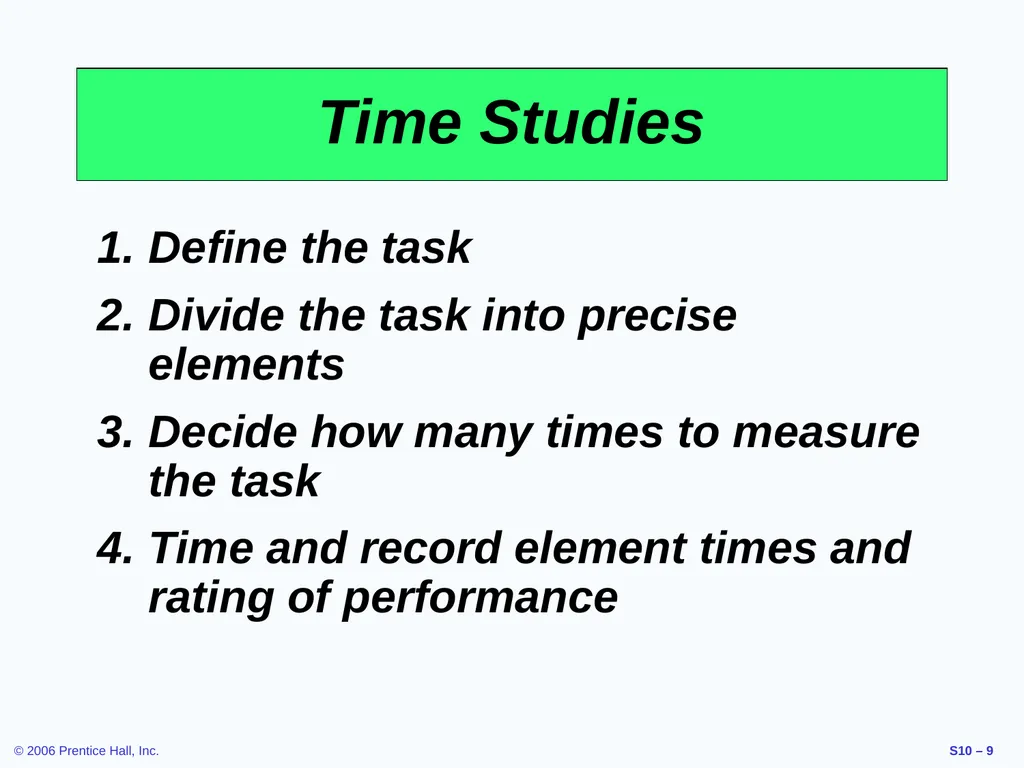
Time Studies Define the task
Divide the task into precise elements
Decide how many times to measure the task
Time and record element times and rating of performance<br>
10
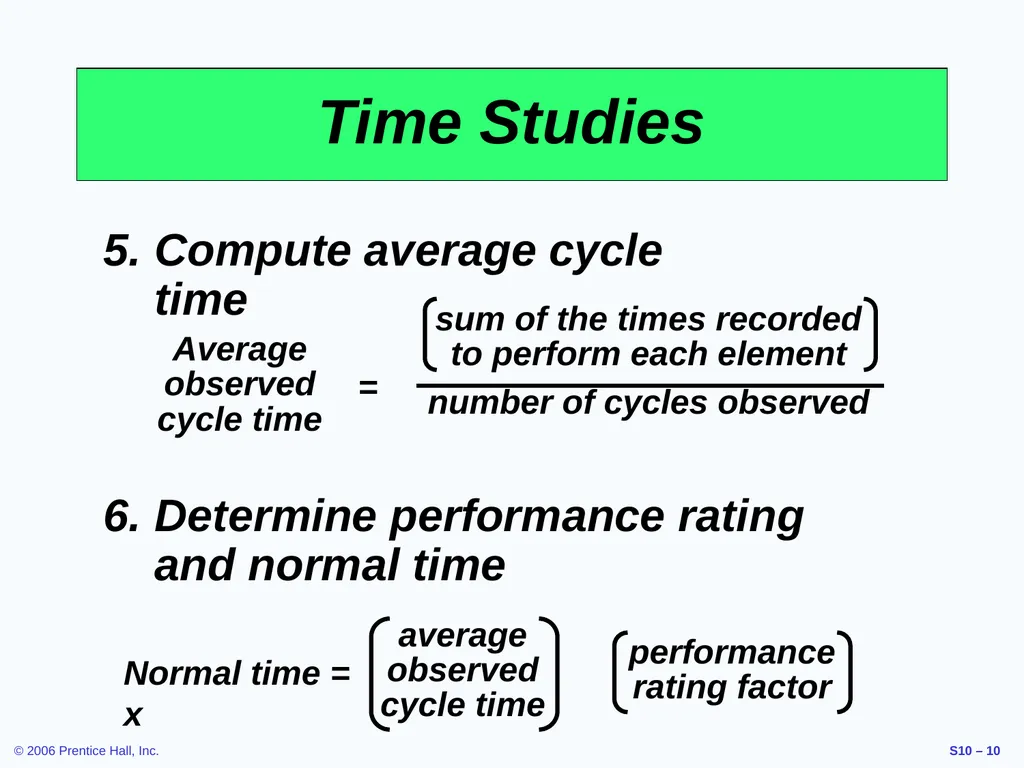
Time Studies Compute average cycle time Determine performance rating and normal time<br>
11
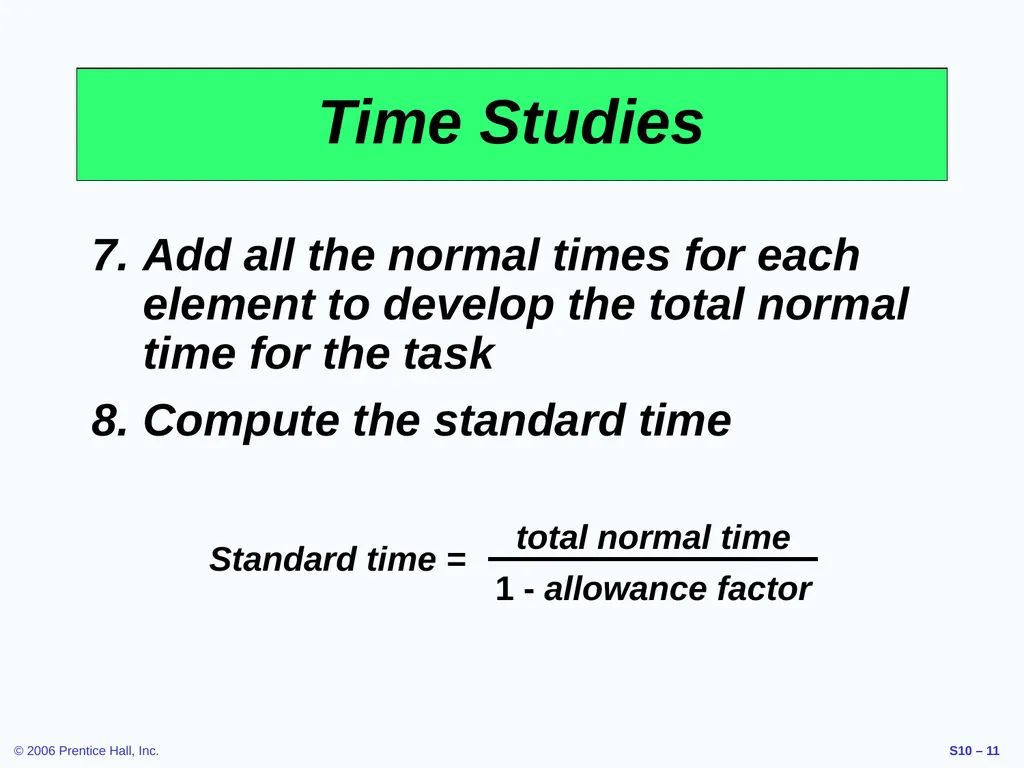
Time Studies Add all the normal times for each element to develop the total normal time for the task
Compute the standard time<br>
12
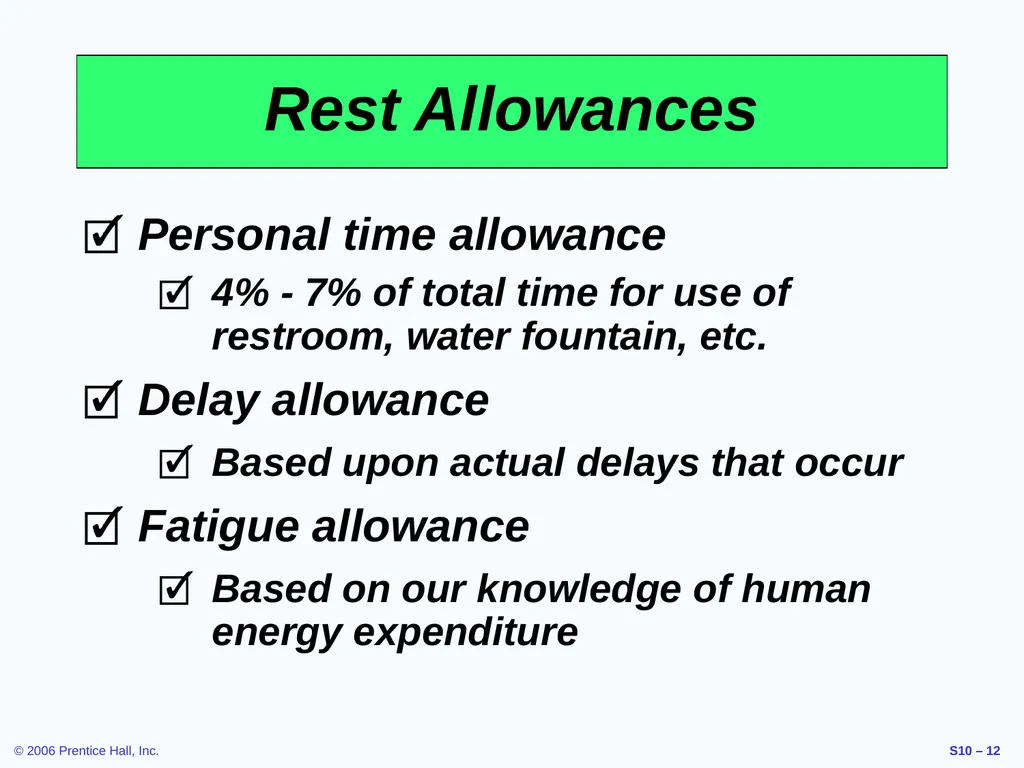
Rest Allowances Personal time allowance
4% - 7% of total time for use of restroom, water fountain, etc.
Delay allowance
Based upon actual delays that occur
Fatigue allowance
Based on our knowledge of human energy expenditure<br>
13
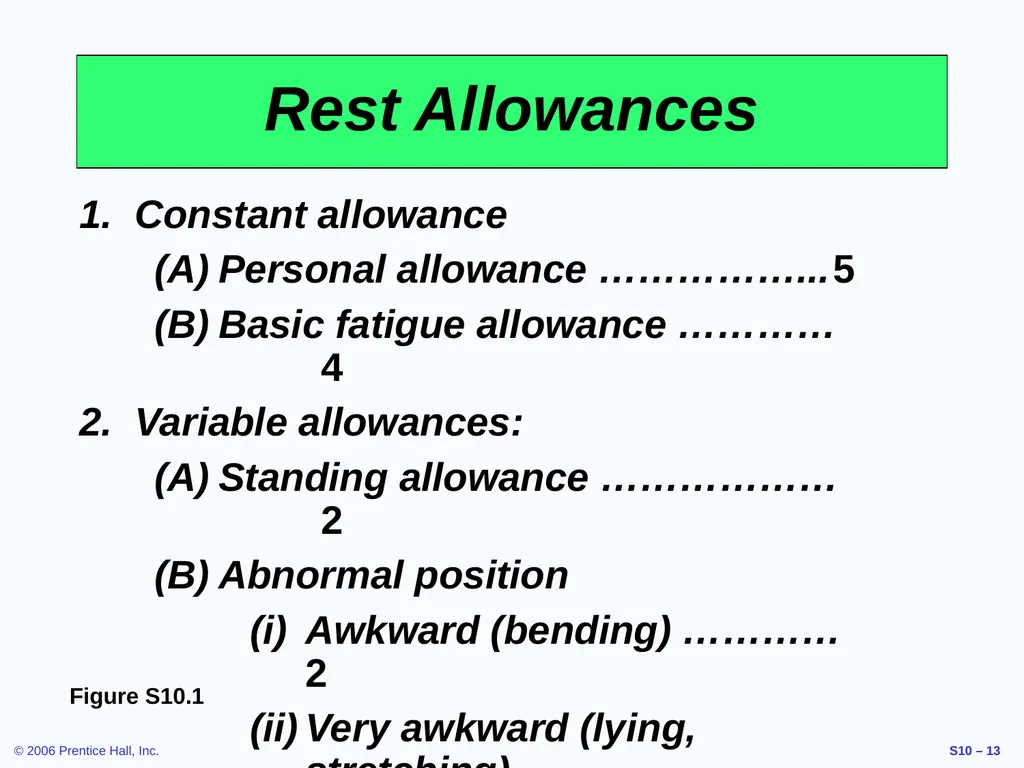
Rest Allowances 1. Constant allowance
(A) Personal allowance ……………... 5
(B) Basic fatigue allowance ………… 4
2. Variable allowances:
(A) Standing allowance ……………… 2
(B) Abnormal position
(i) Awkward (bending) ………… 2
Very awkward (lying, �stretching) …………………… 7 Figure S10.1<br>
14
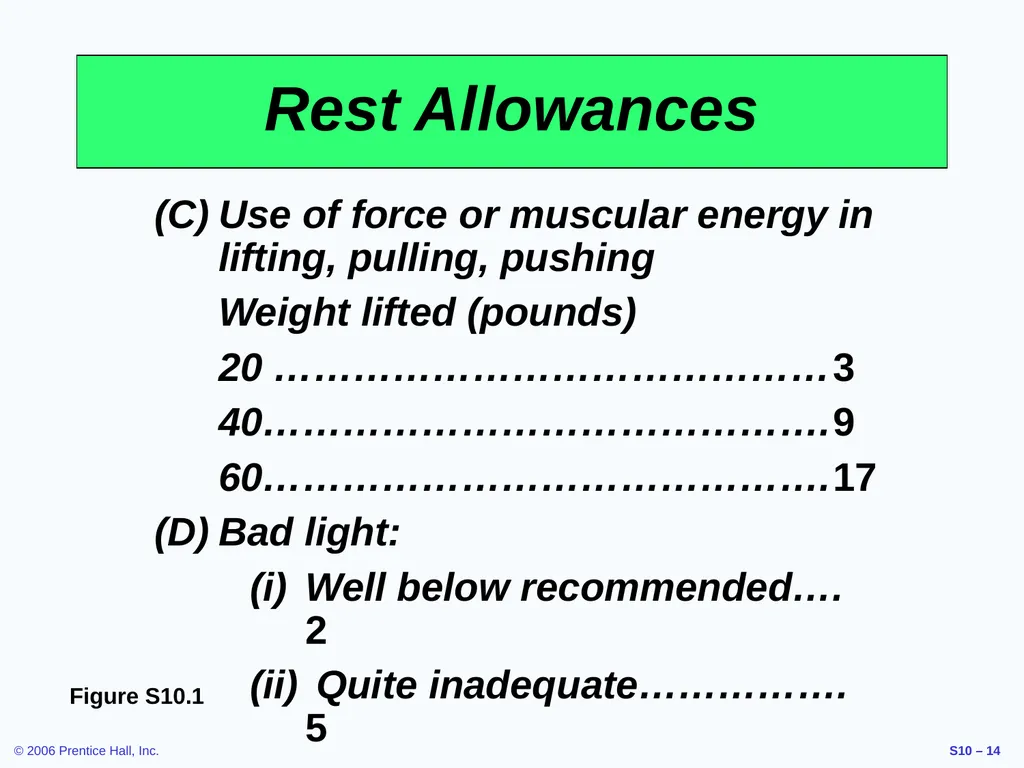
Rest Allowances Use of force or muscular energy in lifting, pulling, pushing
Weight lifted (pounds)
20 …………………………………… 3
40……………………………………. 9
60……………………………………. 17
Bad light:
Well below recommended…. 2
Quite inadequate……………. 5 Figure S10.1<br>
15
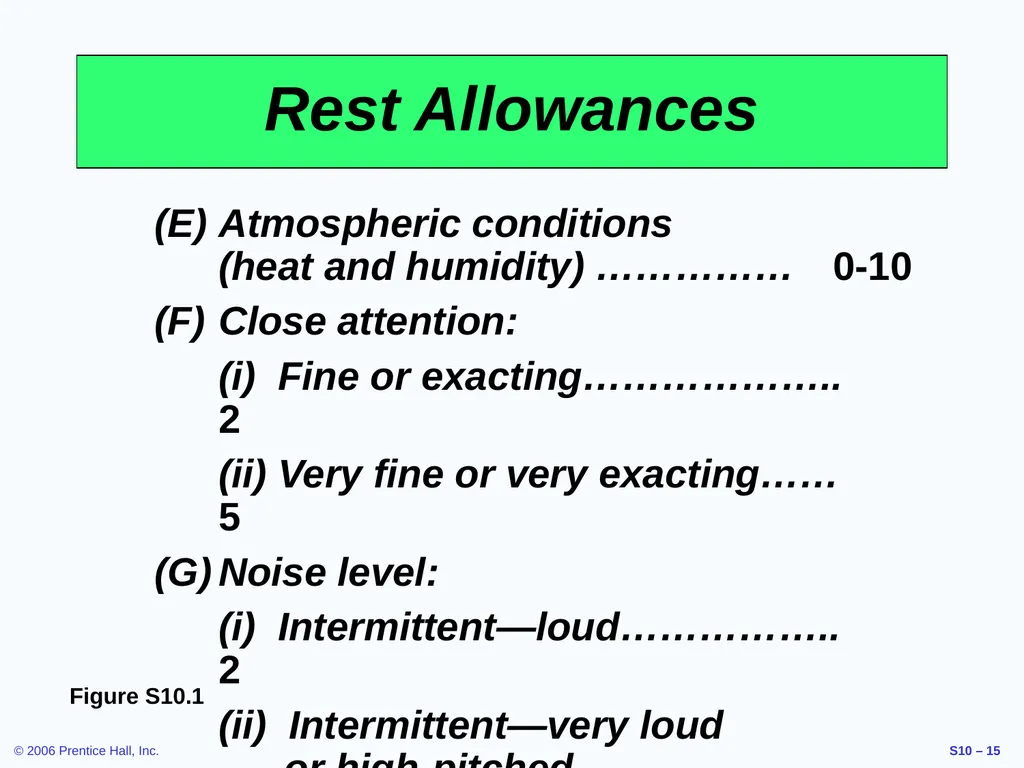
Rest Allowances (E) Atmospheric conditions �(heat and humidity) …………… 0-10
Close attention:
(i) Fine or exacting……………….. 2
(ii) Very fine or very exacting…… 5
Noise level:
(i) Intermittent—loud…………….. 2
(ii) Intermittent—very loud� or high-pitched………………... 5 Figure S10.1<br>
16
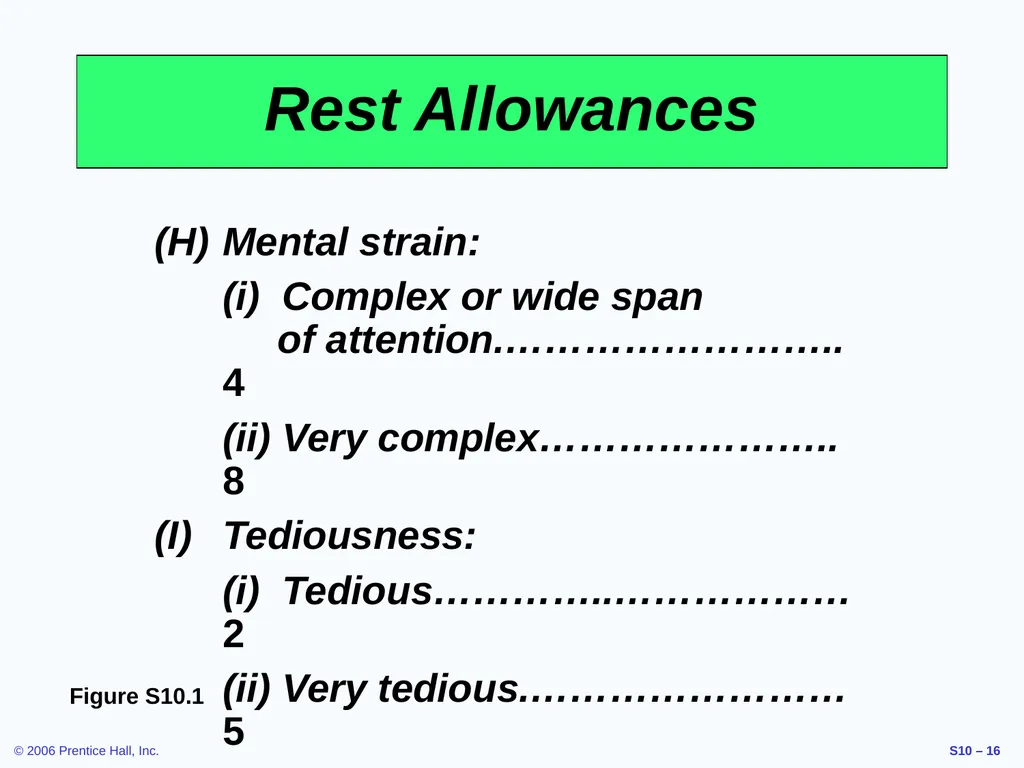
Rest Allowances Mental strain:
(i) Complex or wide span � of attention.…………………….. 4
(ii) Very complex………………….. 8
Tediousness:
(i) Tedious…………..……………… 2
(ii) Very tedious.…………………… 5 Figure S10.1<br>
17
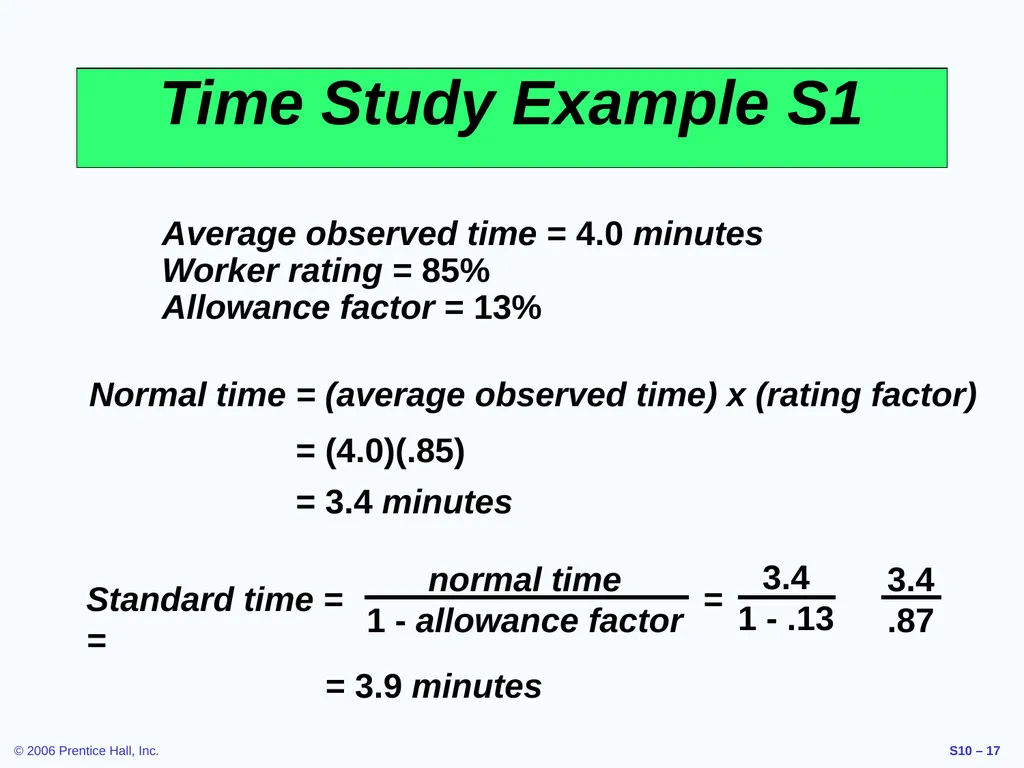
Time Study Example S1 Average observed time = 4.0 minutes
Worker rating = 85%
Allowance factor = 13%<br>
18
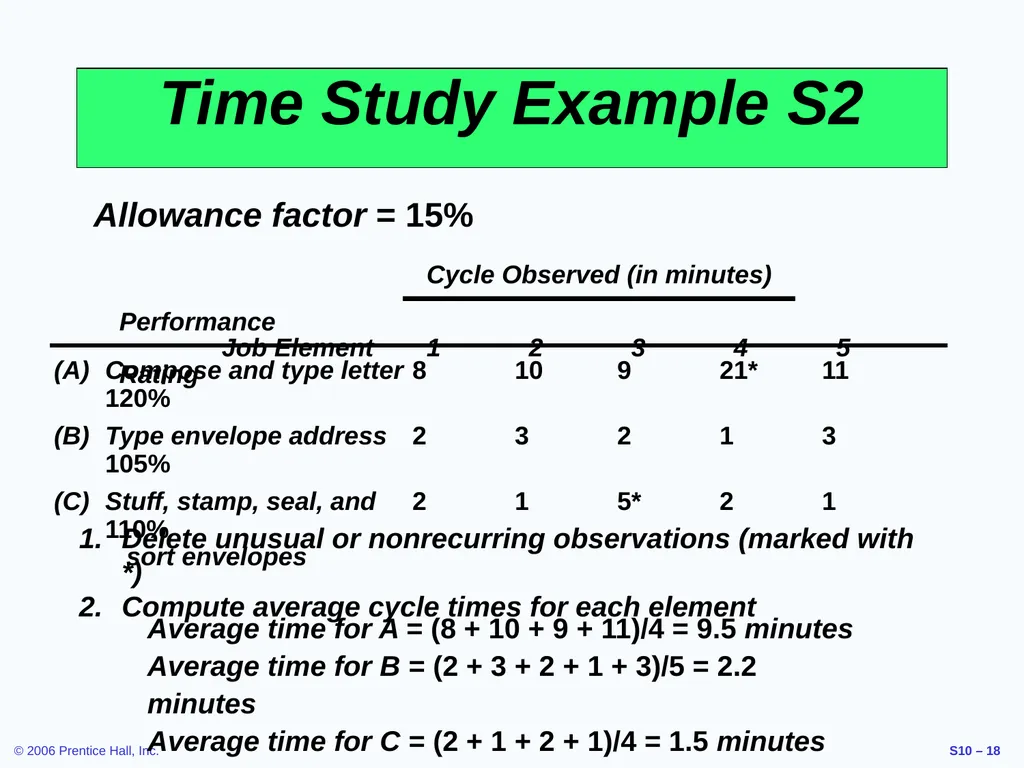
Time Study Example S2 Allowance factor = 15% Delete unusual or nonrecurring observations (marked with *)
Compute average cycle times for each element Average time for A = (8 + 10 + 9 + 11)/4 = 9.5 minutes
Average time for B = (2 + 3 + 2 + 1 + 3)/5 = 2.2 minutes
Average time for C = (2 + 1 + 2 + 1)/4 = 1.5 minutes<br>
19
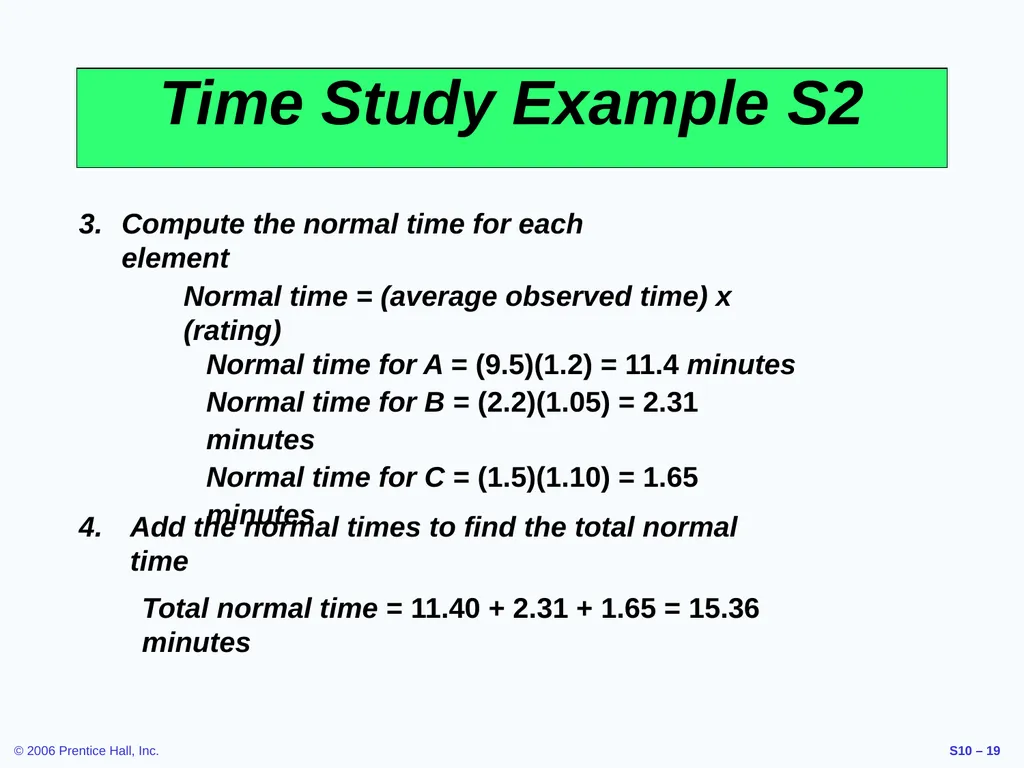
Time Study Example S2 Compute the normal time for each element Normal time for A = (9.5)(1.2) = 11.4 minutes
Normal time for B = (2.2)(1.05) = 2.31 minutes
Normal time for C = (1.5)(1.10) = 1.65 minutes Normal time = (average observed time) x (rating) Add the normal times to find the total normal time Total normal time = 11.40 + 2.31 + 1.65 = 15.36 minutes<br>
20
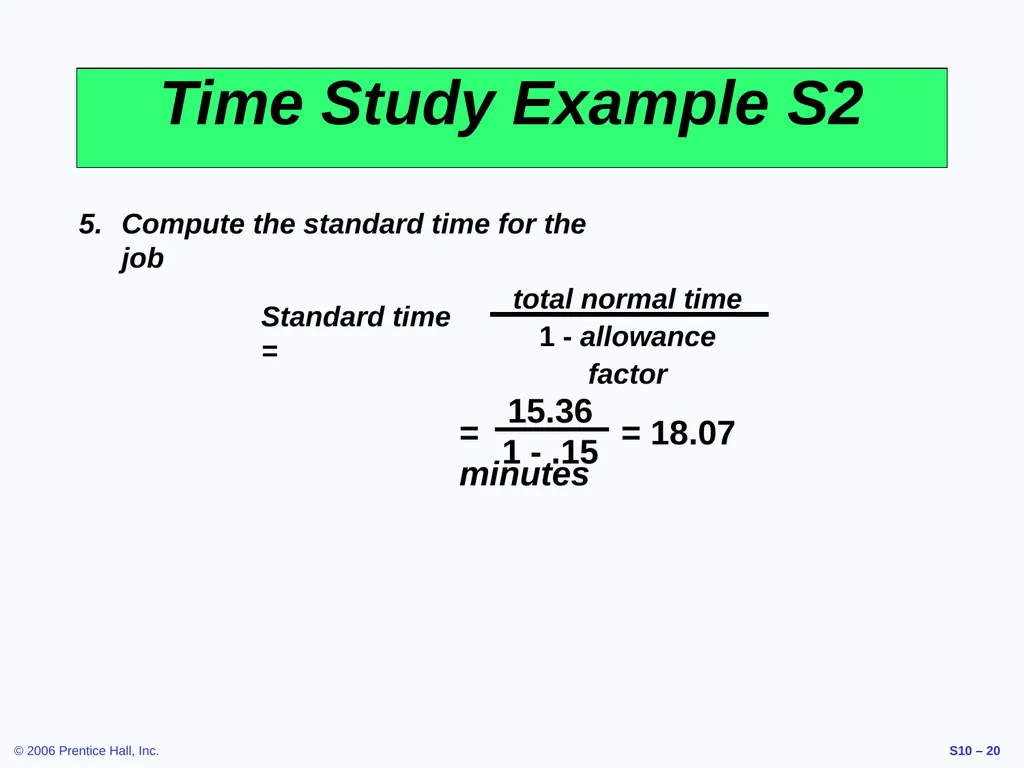
Time Study Example S2 Compute the standard time for the job<br>
21
Determine Sample Size How accurate we want to be
The desired level of confidence
How much variation exists within the job elements<br>
22
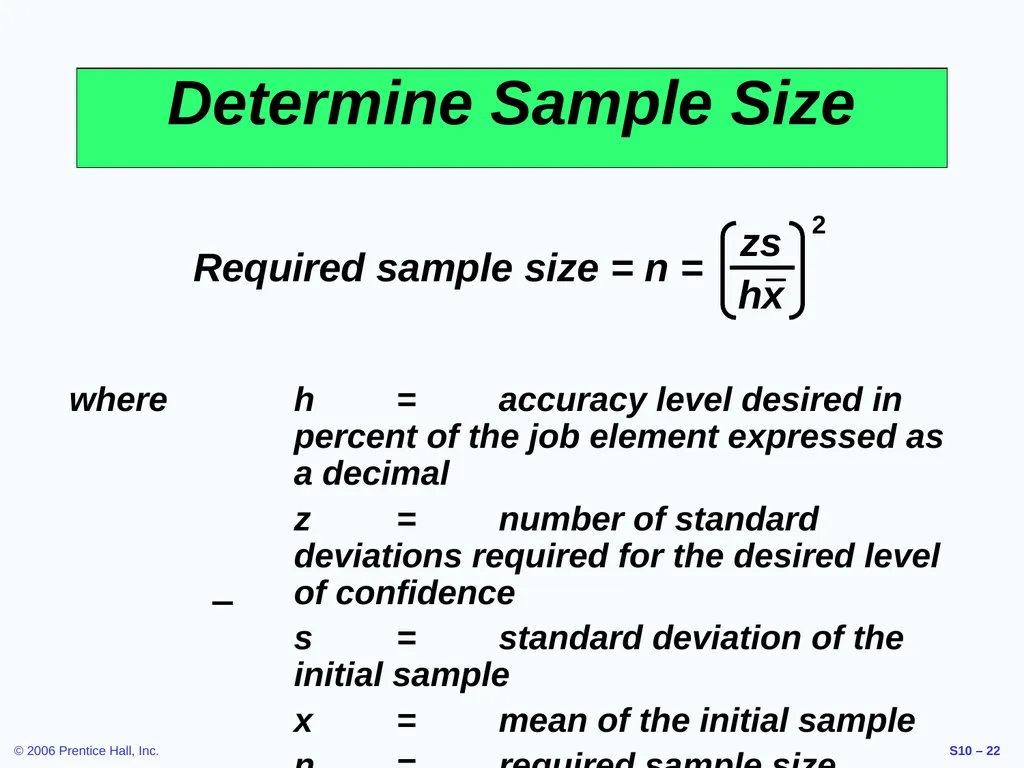
Determine Sample Size<br>
23
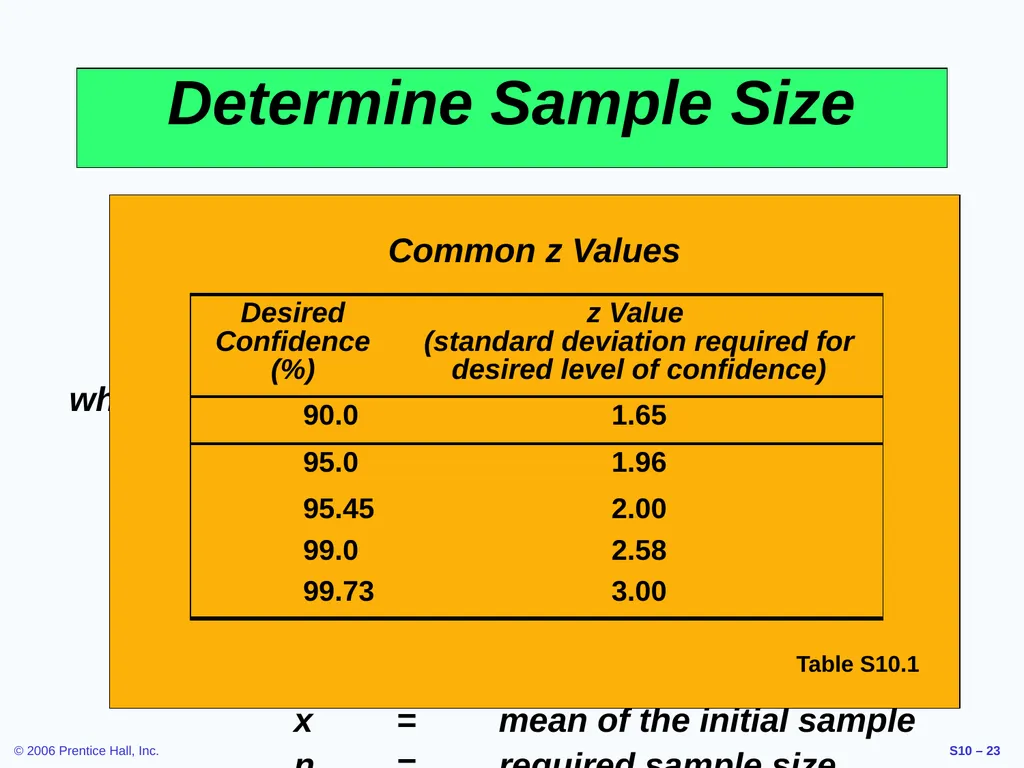
Determine Sample Size Common z Values Table S10.1<br>
24
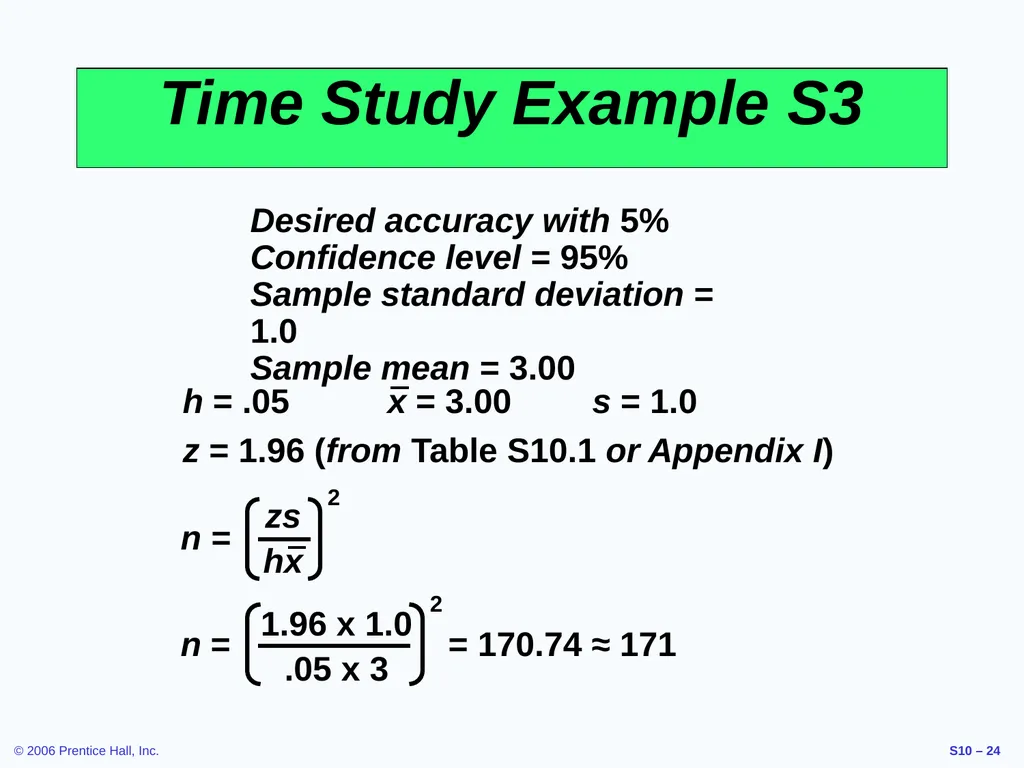
Time Study Example S3 Desired accuracy with 5%
Confidence level = 95%
Sample standard deviation = 1.0
Sample mean = 3.00<br>
25
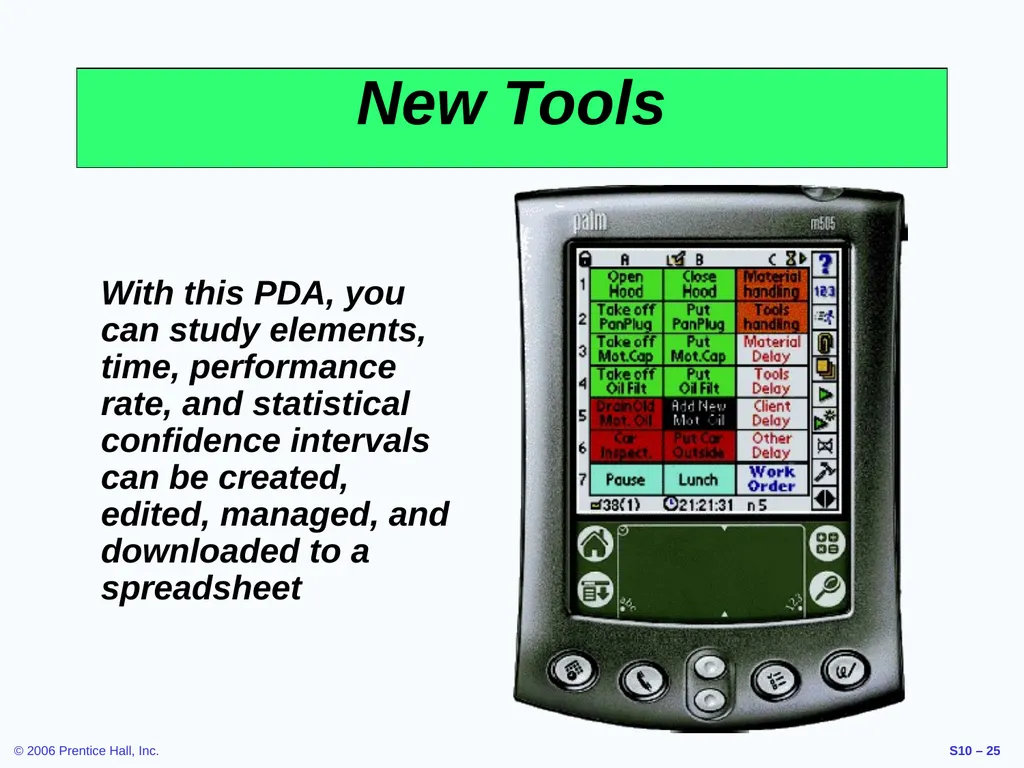
New Tools With this PDA, you can study elements, time, performance rate, and statistical confidence intervals can be created, edited, managed, and downloaded to a spreadsheet<br>
26
Predetermined Time Standards Divide manual work into small basic elements that have established times
Can be done in a laboratory away from the actual production operation
Can be set before the work is actually performed
No performance ratings are necessary<br>
27
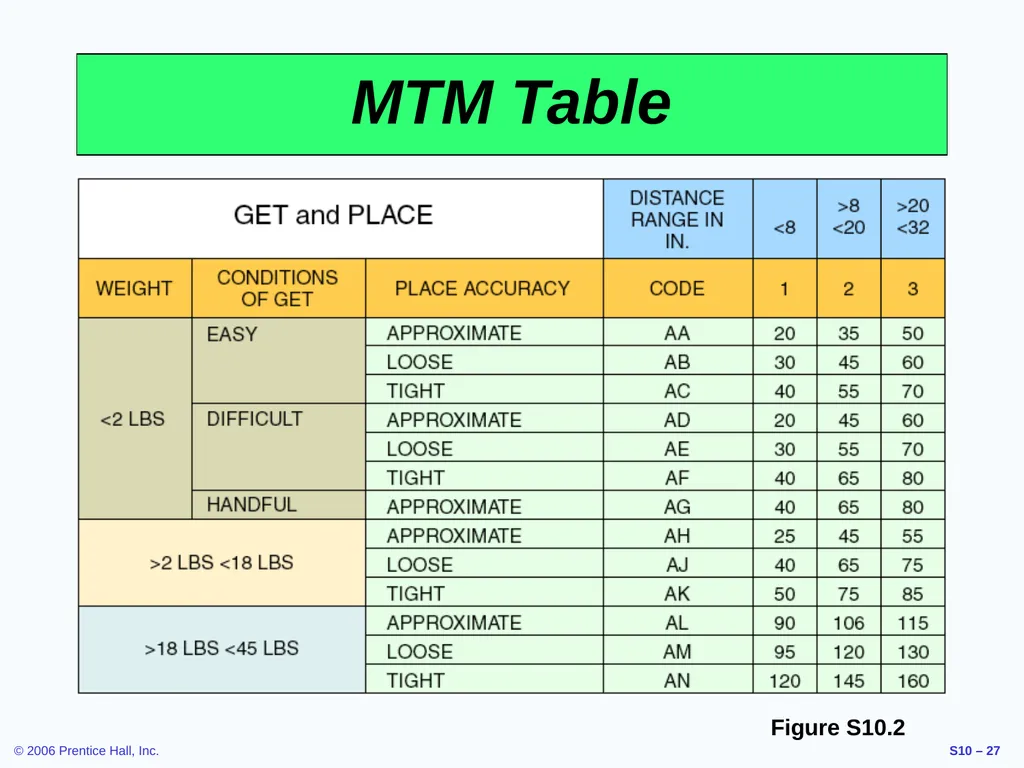
MTM Table Figure S10.2<br>
28
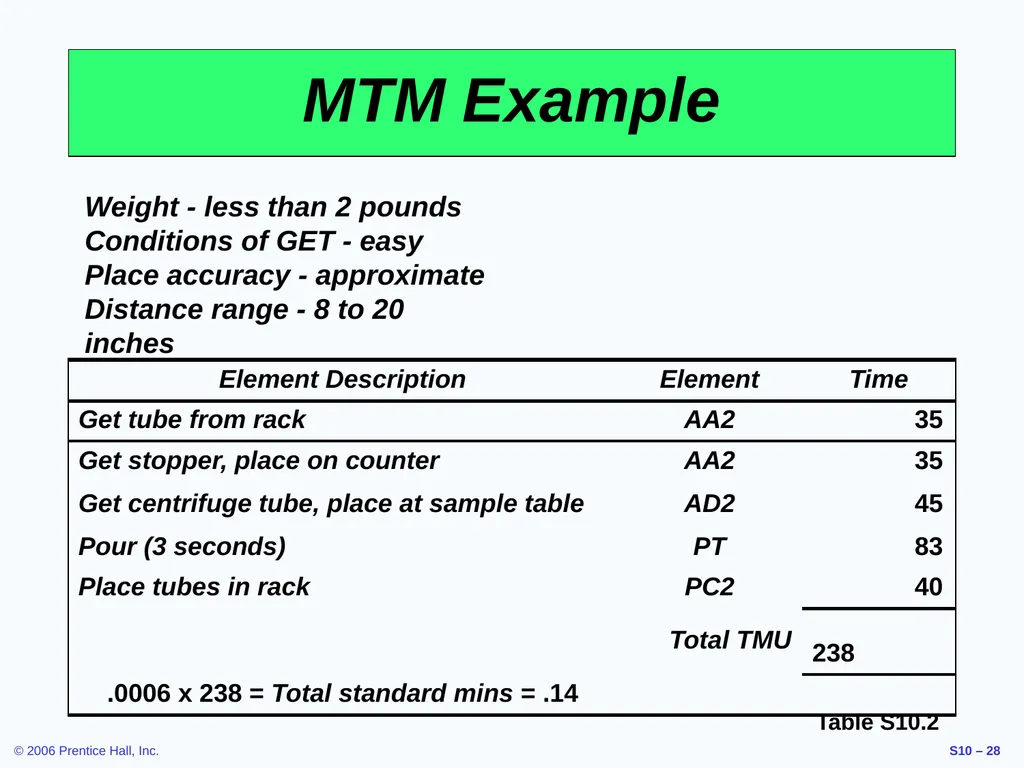
MTM Example Weight - less than 2 pounds
Conditions of GET - easy
Place accuracy - approximate
Distance range - 8 to 20 inches Table S10.2<br>
29
Work Sampling Estimates percent of time a worker spends on various tasks
Less expensive than time study
Observers need little training
Studies can be delayed or interrupted with little impact on results
Worker has little chance to affect results
Less intrusive<br>
30
Work Sampling Estimates percent of time a worker spends on various tasks
Does not divide work elements as completely as time study
Can yield biased results if observer does not follow random pattern
Less accurate than time study, especially when job element times are short<br>
31
Work Sampling Take a preliminary sample to obtain estimates of parameter values
Compute the sample size required
Prepare a schedule for random observations at appropriate times
Observe and record worker activities
Determine how workers spend their time<br>
32
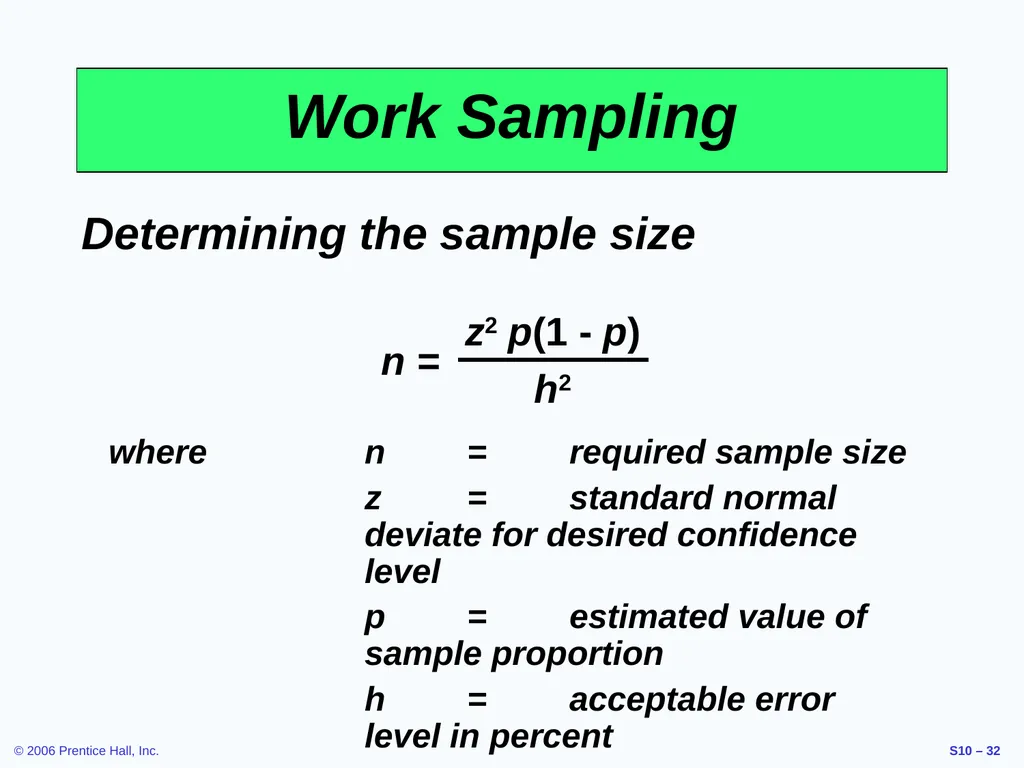
Work Sampling Determining the sample size where n = required sample size
z = standard normal deviate for desired confidence level
p = estimated value of sample proportion
h = acceptable error level in percent<br>
33
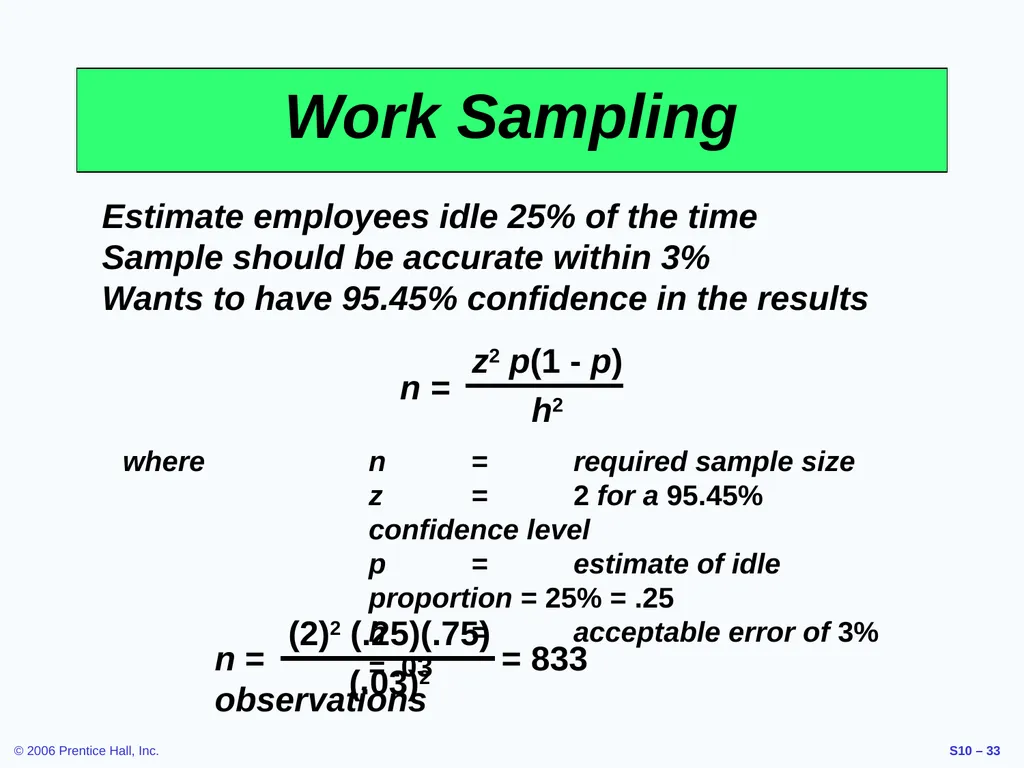
Work Sampling Estimate employees idle 25% of the time
Sample should be accurate within 3%
Wants to have 95.45% confidence in the results where n = required sample size
z = 2 for a 95.45% confidence level
p = estimate of idle proportion = 25% = .25
h = acceptable error of 3% = .03<br>
34
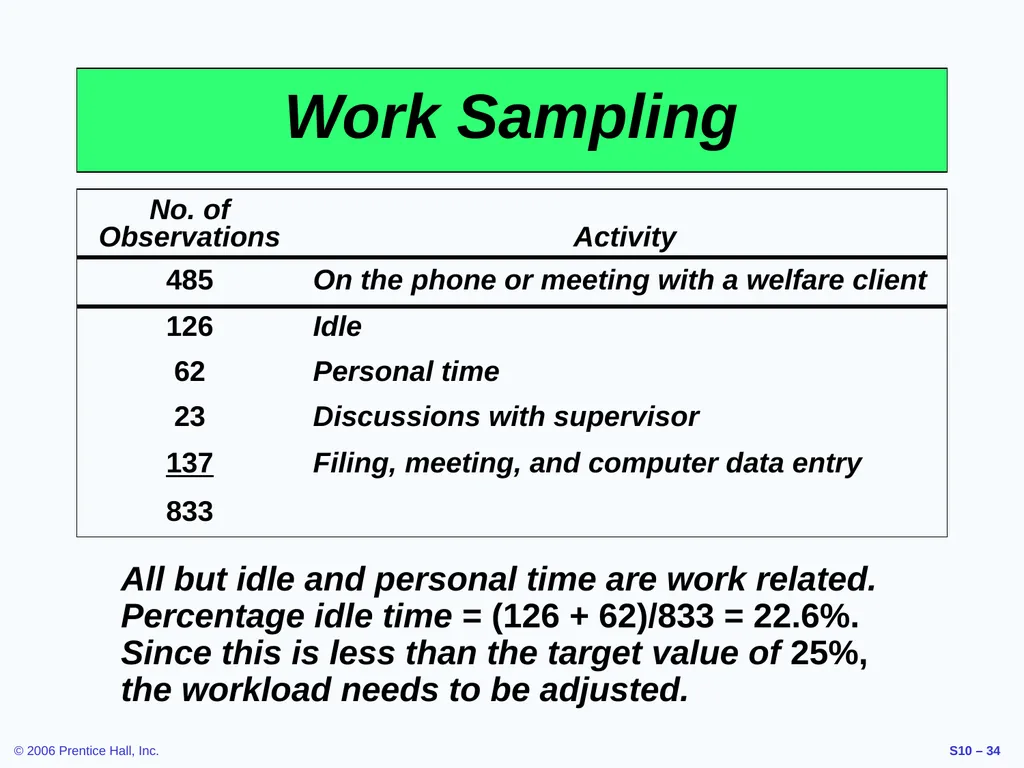
Work Sampling All but idle and personal time are work related. Percentage idle time = (126 + 62)/833 = 22.6%. Since this is less than the target value of 25%, the workload needs to be adjusted.<br>
35
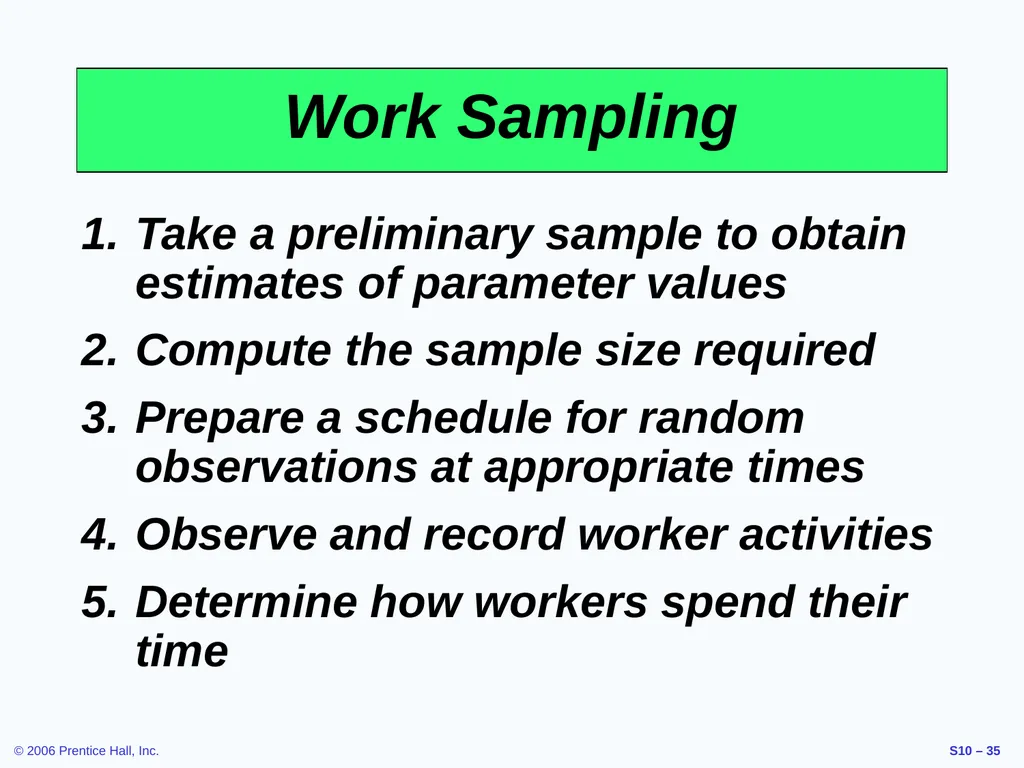
Work Sampling Take a preliminary sample to obtain estimates of parameter values
Compute the sample size required
Prepare a schedule for random observations at appropriate times
Observe and record worker activities
Determine how workers spend their time<br>
36
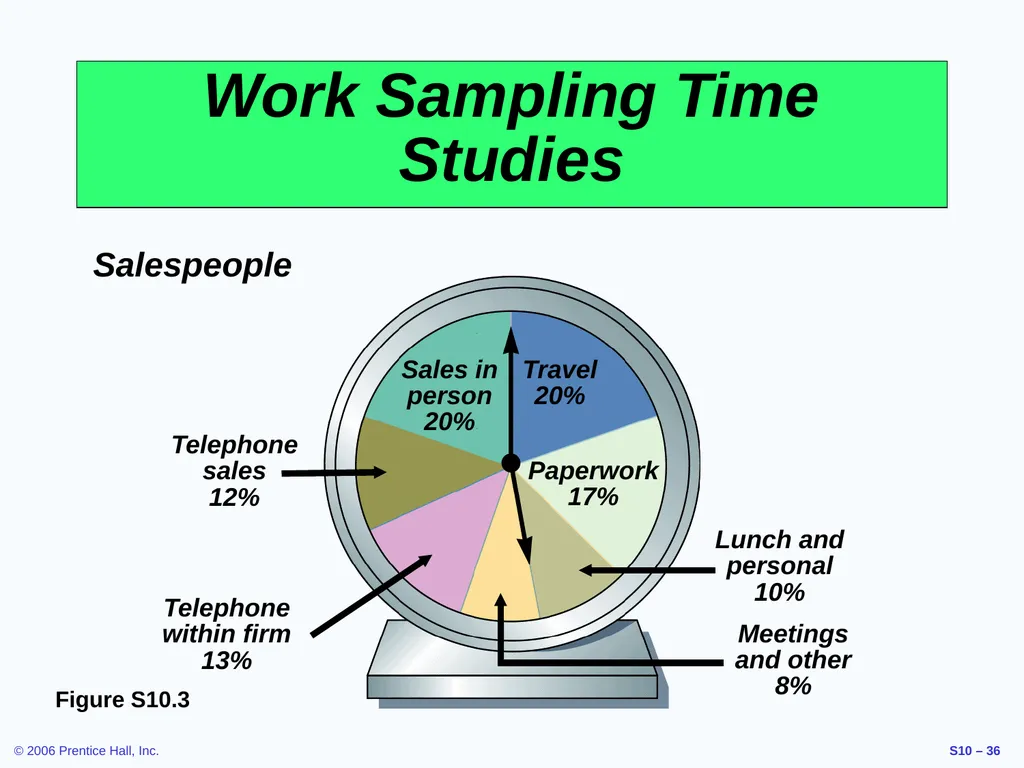
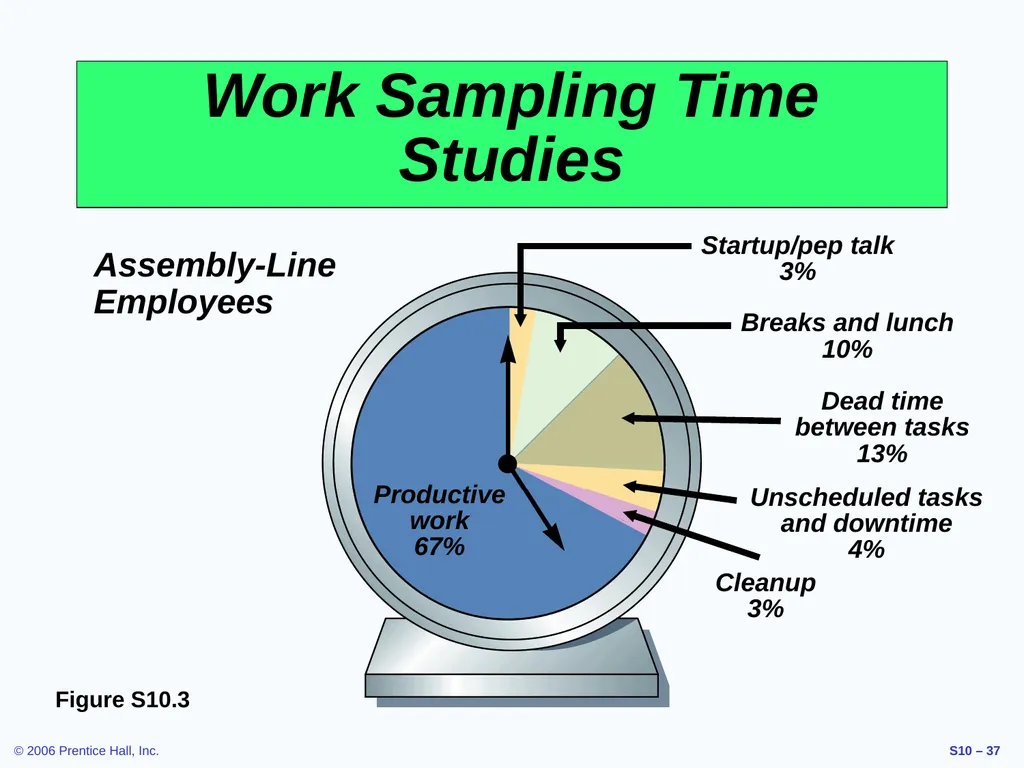
Work Sampling Time Studies Salespeople Figure S10.3 Paperwork
17% Travel
20% Sales in person
20%<br>
37
Work Sampling Time Studies Figure S10.3 Productive work
67% Assembly-Line Employees<br>