
Péter Szőke, Quantitative Analyst – Assistant Vice

Description: Péter Szőke, Quantitative Analyst Assistant Vice President Applied Mathematics at Citi MQA 27092019 Public Markets and Securities Services Agenda Who is a Quant? Markets Quantitative Analysis at Citi How do we work? InternshipCareer
Related Topics
Download Presentation
"Péter Szőke, Quantitative Analyst – Assistant Vice" is the property of its rightful owner. Permission is granted to download and print the materials on this website for personal, non-commercial use only, and to display it on your personal computer provided you do not modify the materials and that you retain all copyright notices contained in the materials. By downloading content from our website, you accept the terms of this agreement.
Presentation Transcript
slide1. Péter Szőke,
Quantitative Analyst – Assistant Vice President Applied Mathematics at Citi MQA 27/09/2019 Public Markets and Securities Services<br>
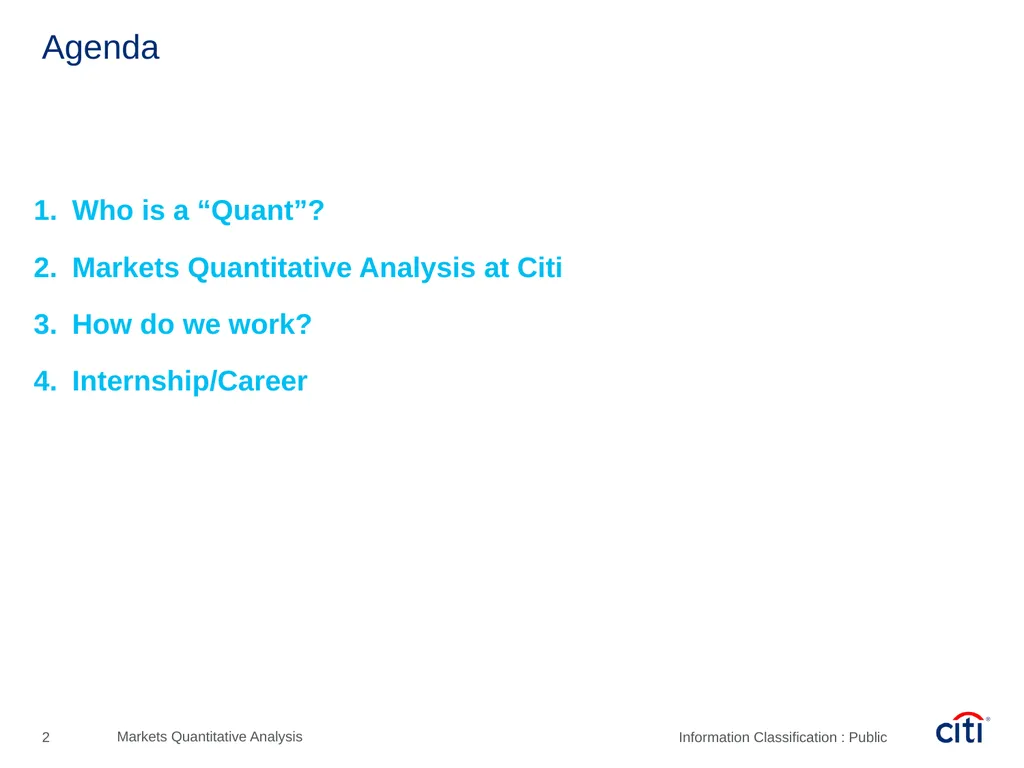
slide2. Agenda Who is a “Quant”?
Markets Quantitative Analysis at Citi
How do we work?
Internship/Career<br>
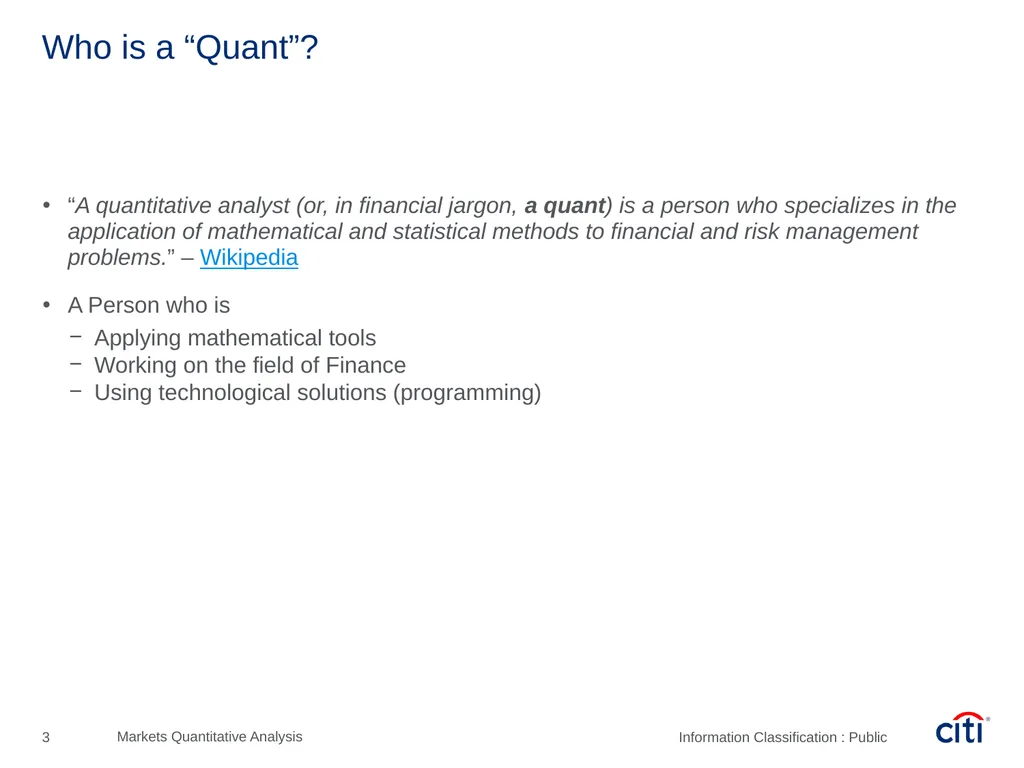
slide3. Who is a “Quant”? “A quantitative analyst (or, in financial jargon, a quant) is a person who specializes in the application of mathematical and statistical methods to financial and risk management problems.” – Wikipedia
A Person who is
Applying mathematical tools
Working on the field of Finance
Using technological solutions (programming)<br>
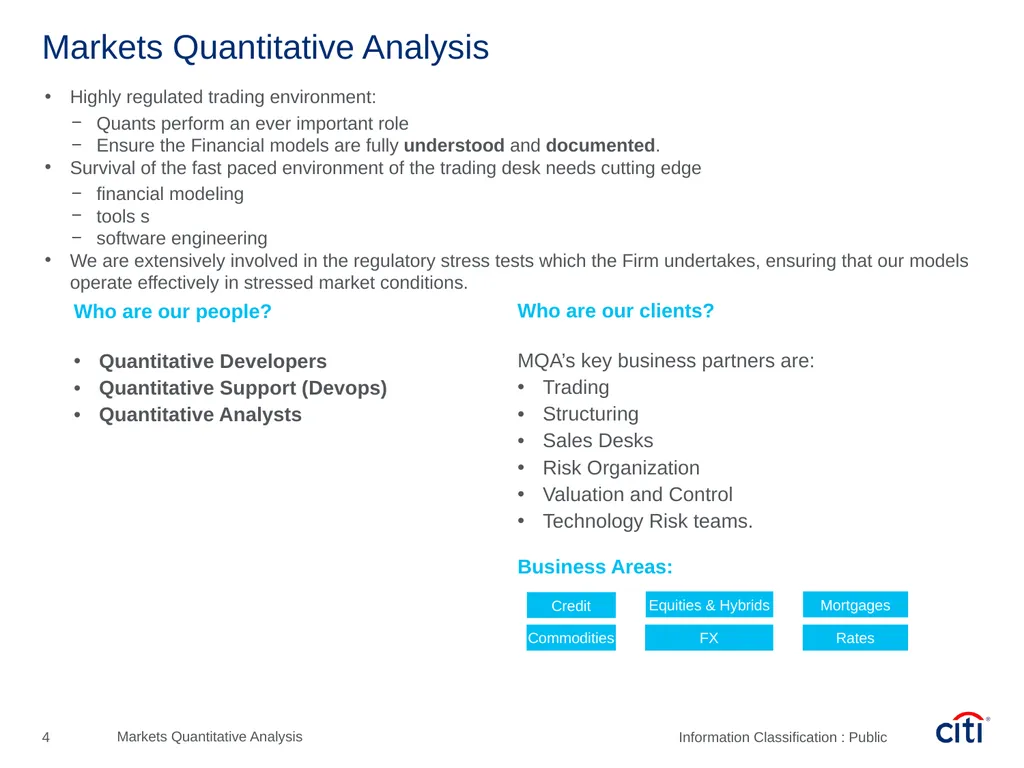
slide4. Markets Quantitative Analysis Highly regulated trading environment:
Quants perform an ever important role
Ensure the Financial models are fully understood and documented.
Survival of the fast paced environment of the trading desk needs cutting edge
financial modeling
tools s
software engineering
We are extensively involved in the regulatory stress tests which the Firm undertakes, ensuring that our models operate effectively in stressed market conditions. Who are our people?
Quantitative Developers
Quantitative Support (Devops)
Quantitative Analysts Who are our clients?
MQA’s key business partners are:
Trading
Structuring
Sales Desks
Risk Organization
Valuation and Control
Technology Risk teams.
Business Areas: Credit FX Mortgages Rates Commodities Equities & Hybrids<br>
slide5. Markets Quantitative Analysis Where are we located ?
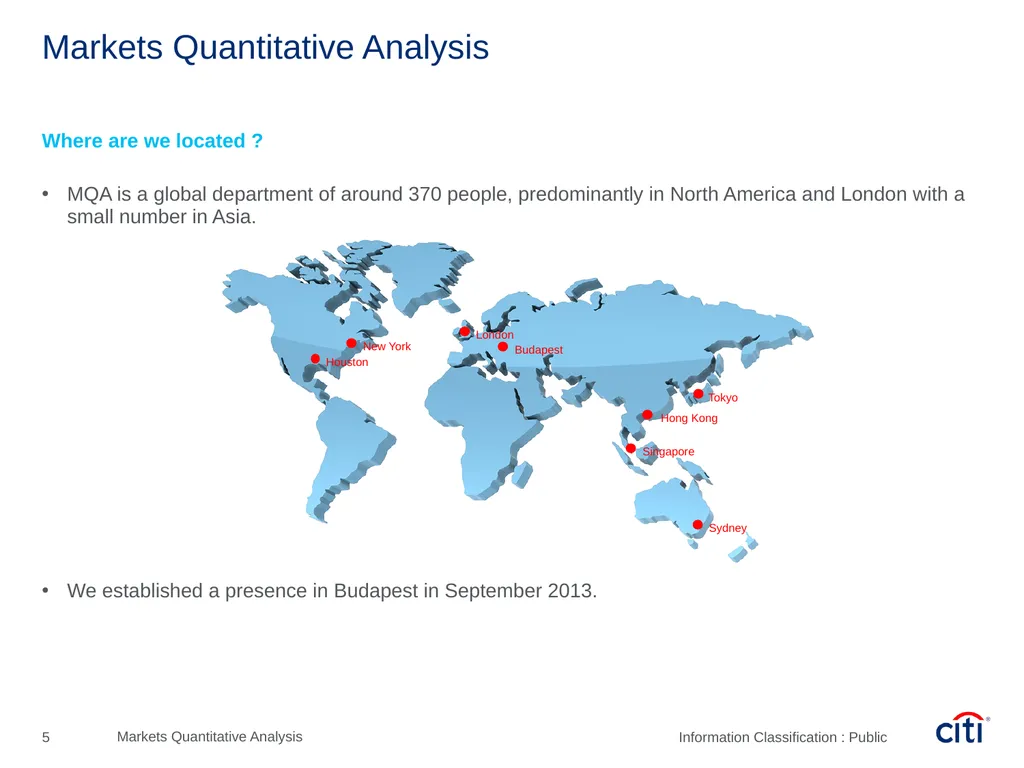
MQA is a global department of around 370 people, predominantly in North America and London with a small number in Asia.
We established a presence in Budapest in September 2013.<br>
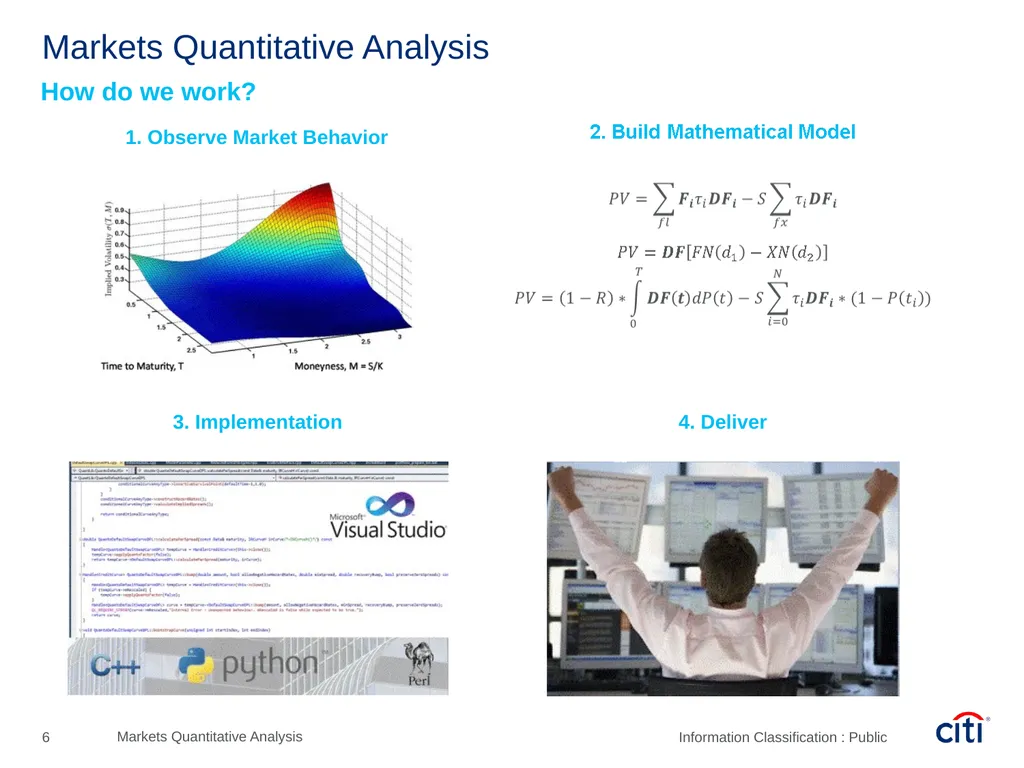
slide6. Markets Quantitative Analysis 4. Deliver 3. Implementation 1. Observe Market Behavior How do we work?<br>
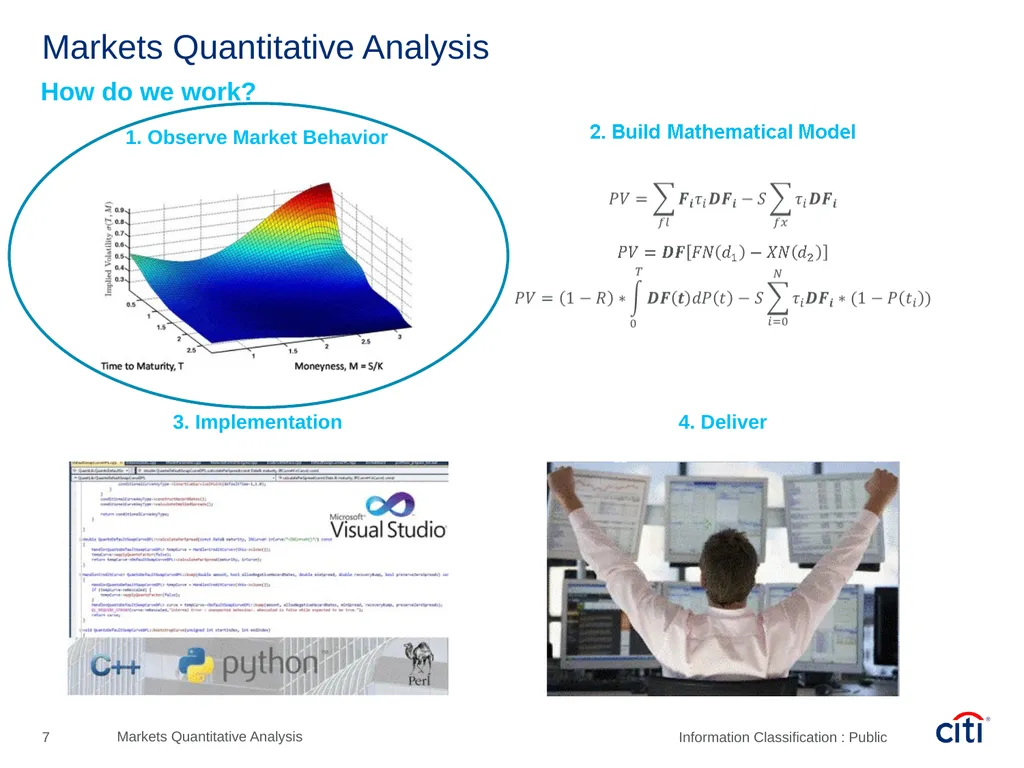
slide7. Markets Quantitative Analysis 4. Deliver 3. Implementation 1. Observe Market Behavior How do we work?<br>
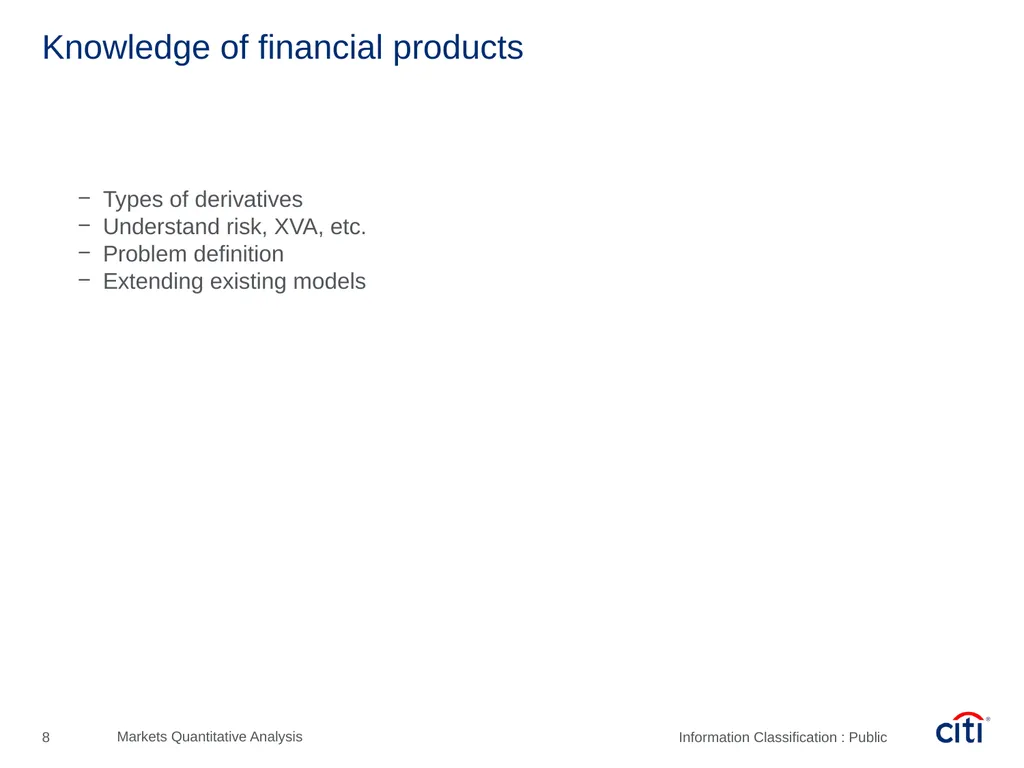
slide8. Knowledge of financial products Types of derivatives
Understand risk, XVA, etc.
Problem definition
Extending existing models<br>
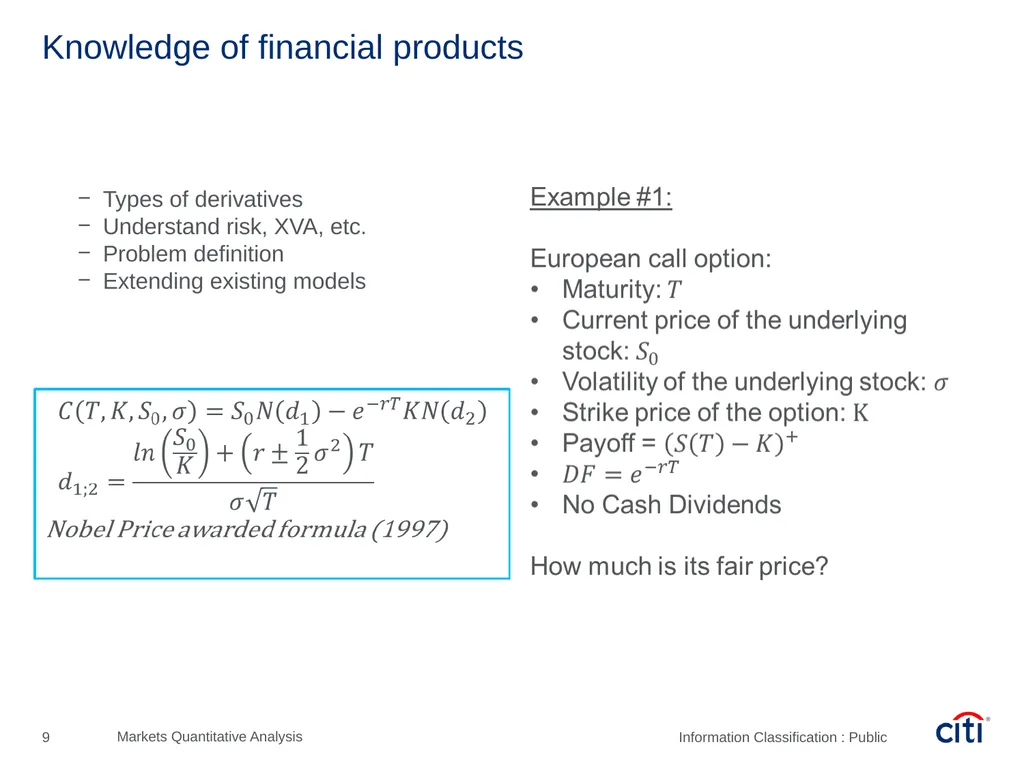
slide9. Knowledge of financial products Types of derivatives
Understand risk, XVA, etc.
Problem definition
Extending existing models<br>
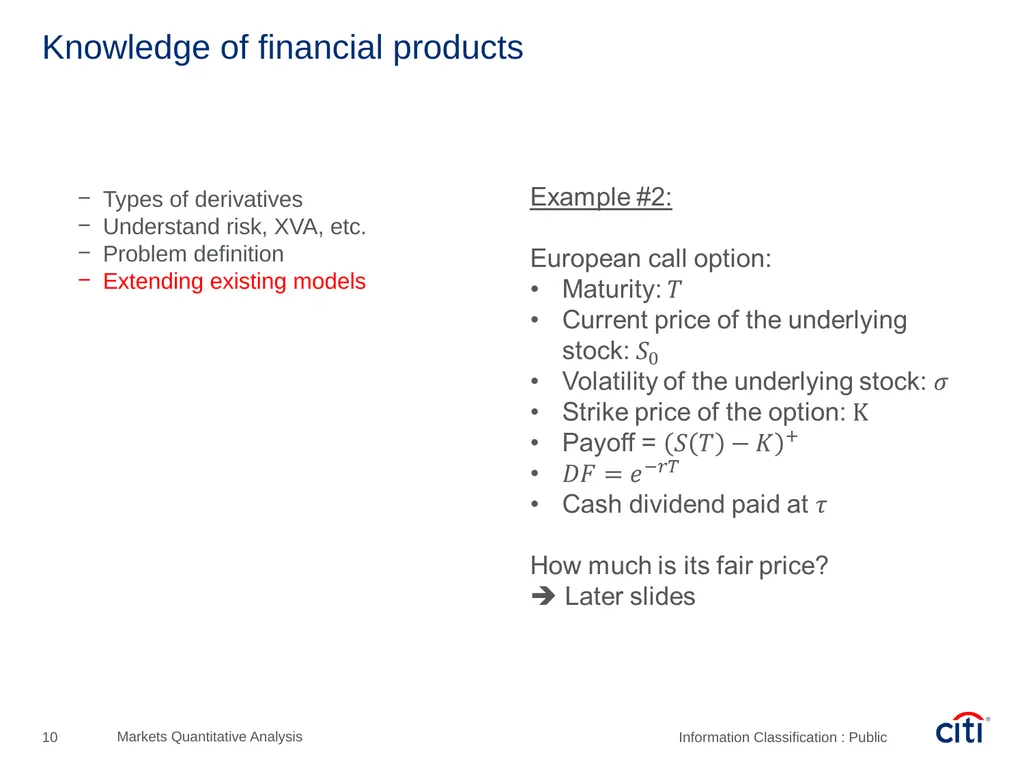
slide10. Knowledge of financial products Types of derivatives
Understand risk, XVA, etc.
Problem definition
Extending existing models<br>
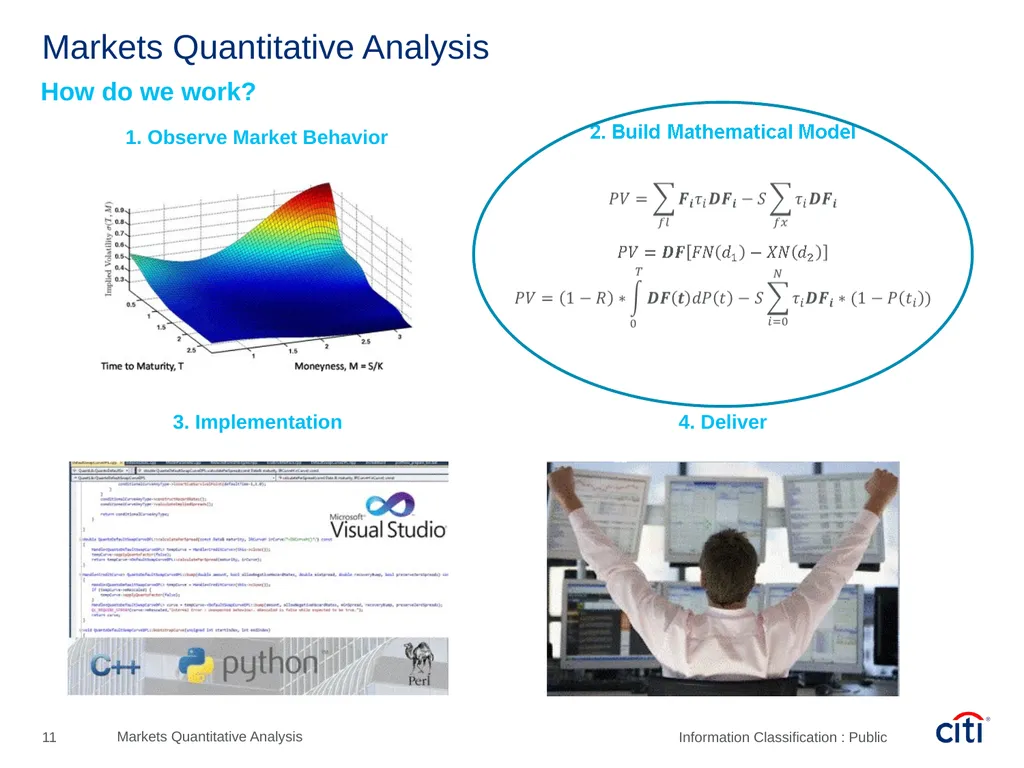
slide11. Markets Quantitative Analysis 4. Deliver 3. Implementation 1. Observe Market Behavior How do we work?<br>
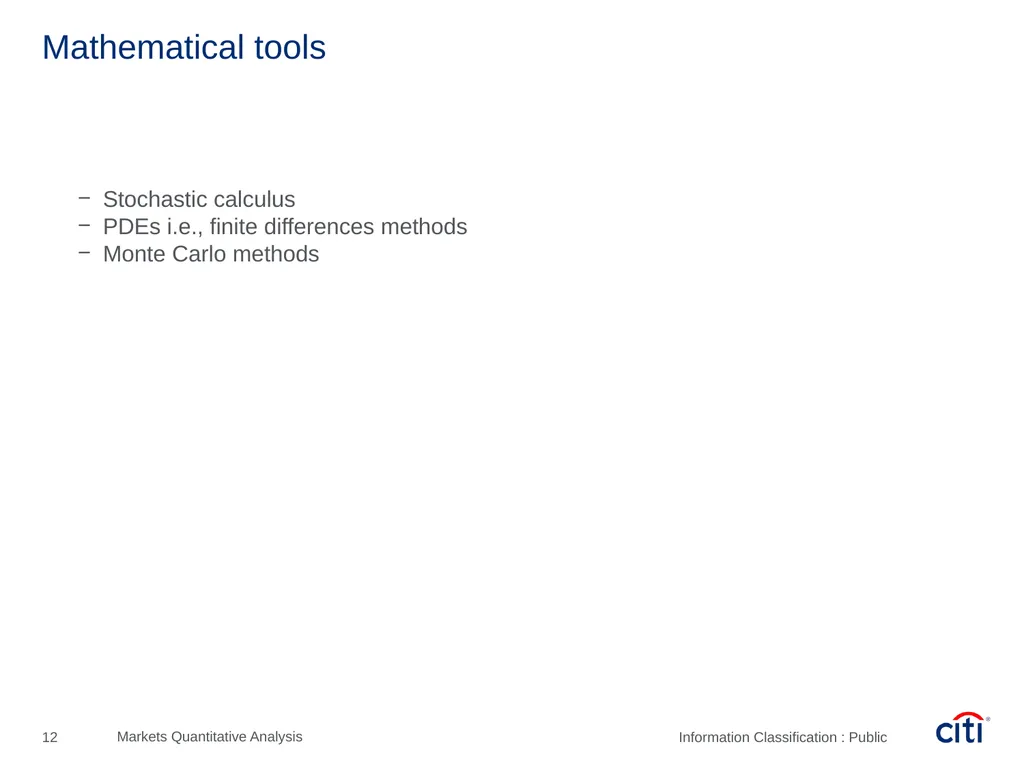
slide12. Mathematical tools Stochastic calculus
PDEs i.e., finite differences methods
Monte Carlo methods<br>
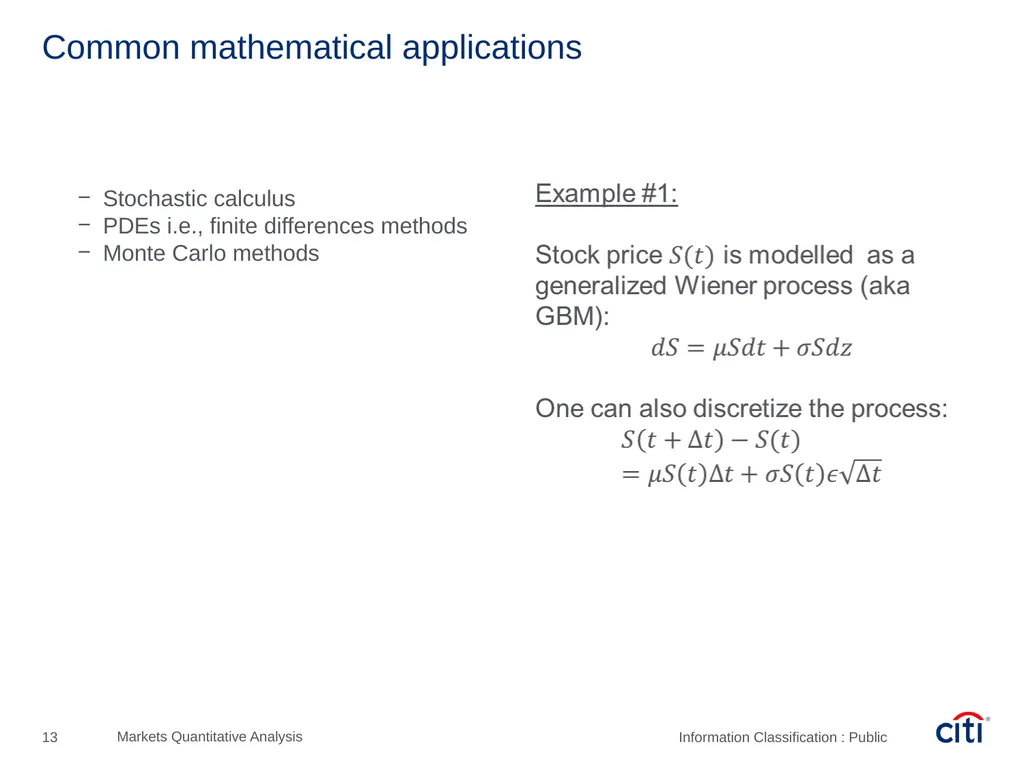
slide13. Common mathematical applications Stochastic calculus
PDEs i.e., finite differences methods
Monte Carlo methods<br>
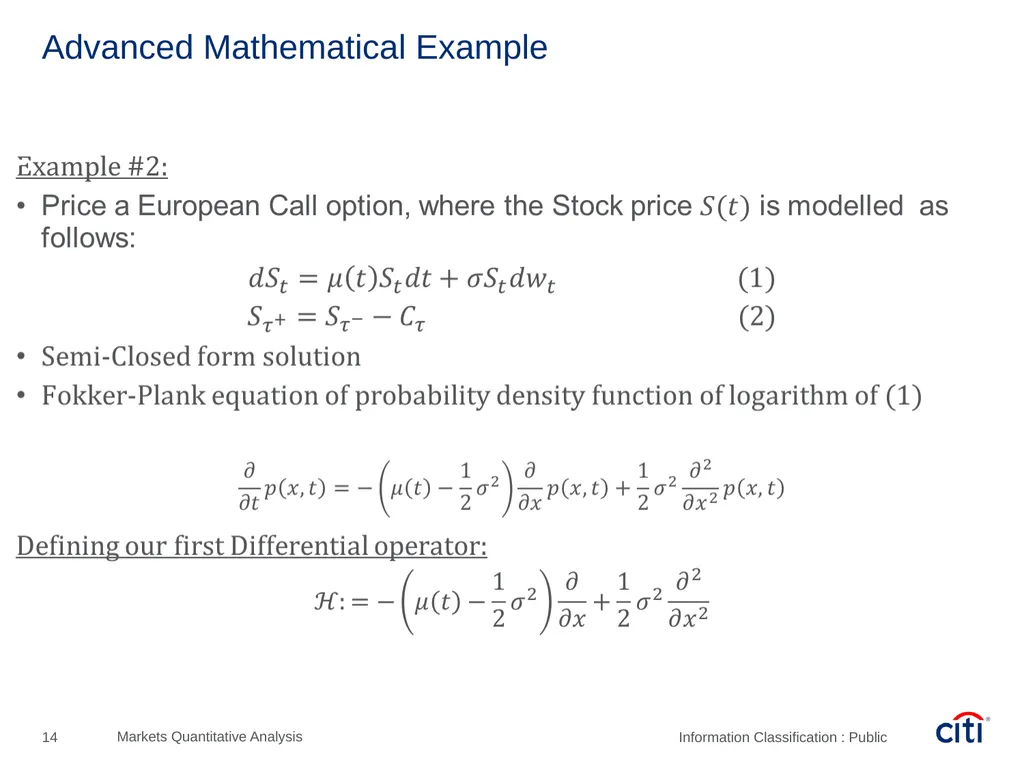
slide14. Advanced Mathematical Example<br>
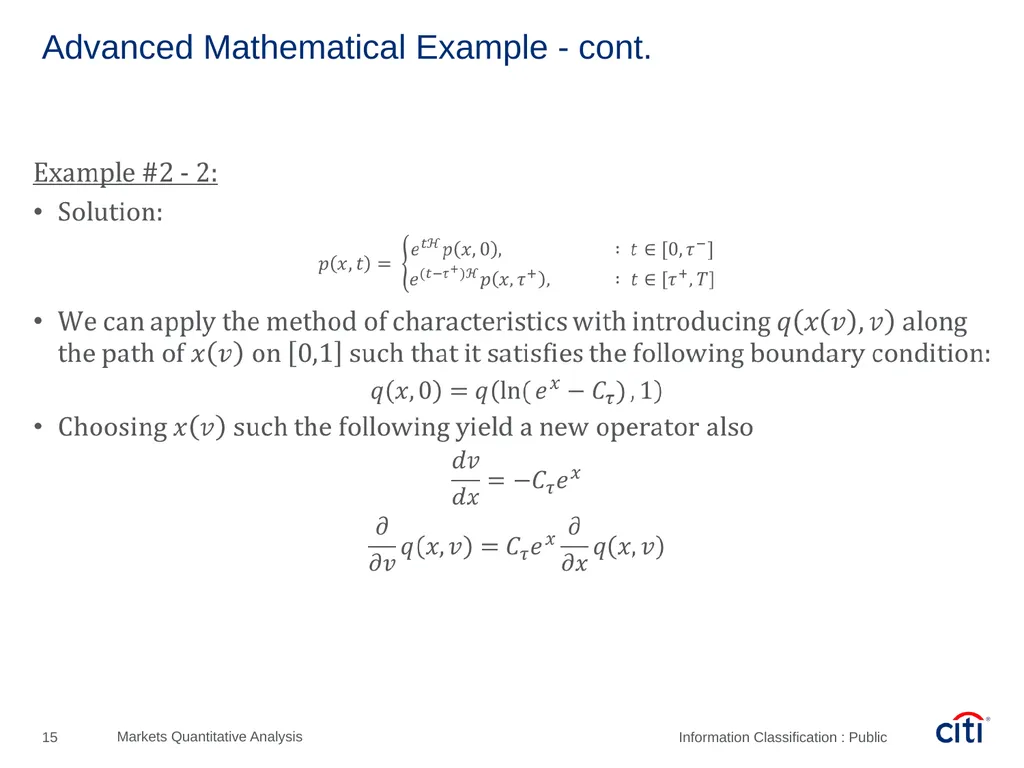
slide15. Advanced Mathematical Example - cont.<br>
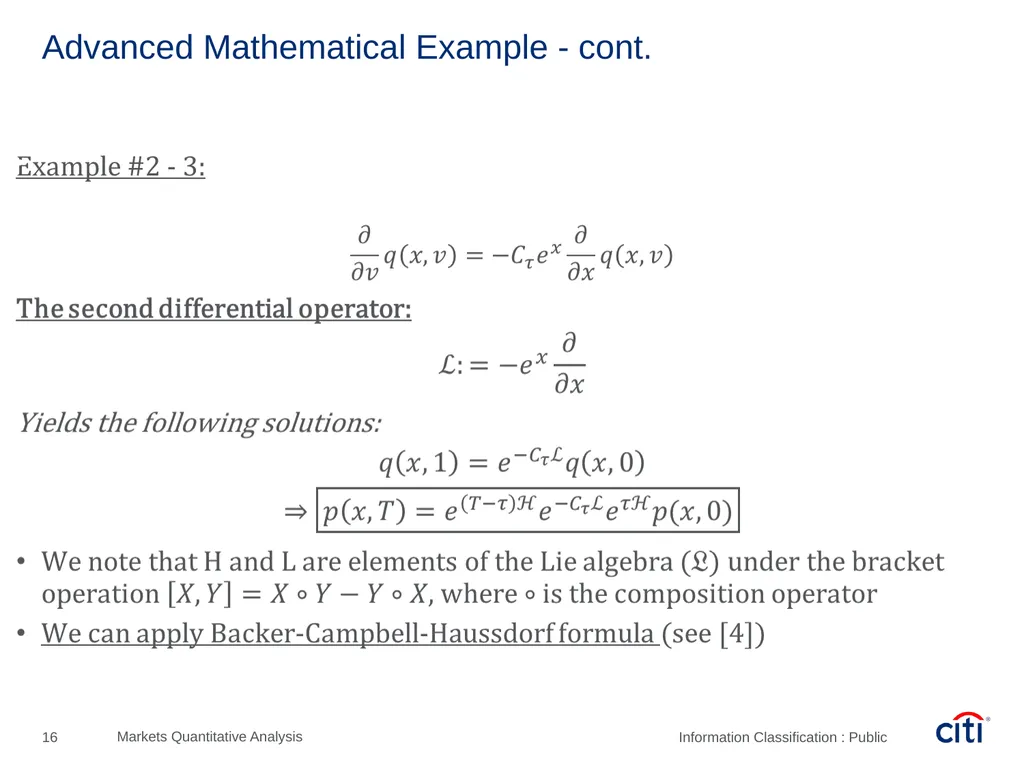
slide16. Advanced Mathematical Example - cont.<br>
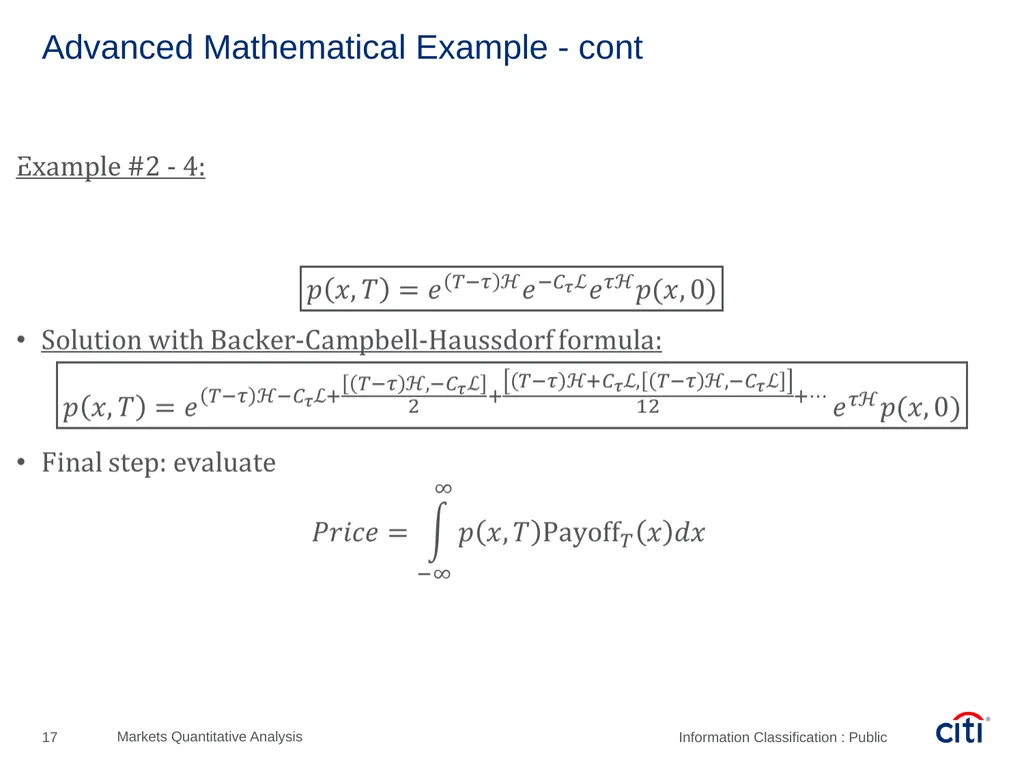
slide17. Advanced Mathematical Example - cont<br>
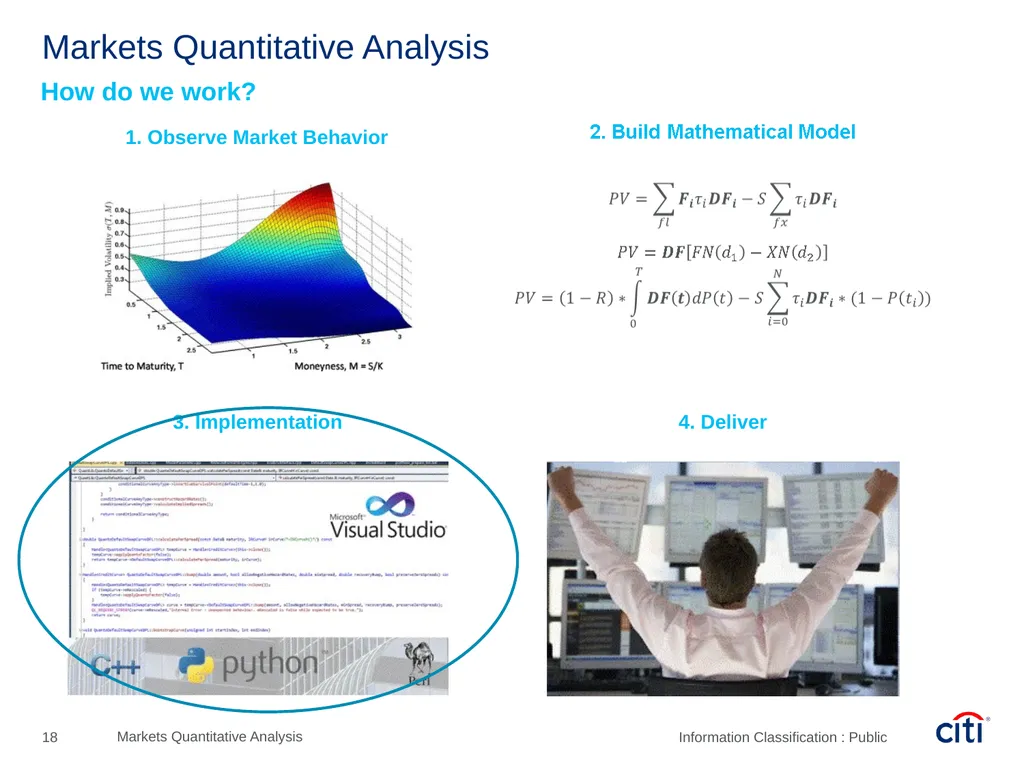
slide18. Markets Quantitative Analysis 4. Deliver 3. Implementation 1. Observe Market Behavior How do we work?<br>
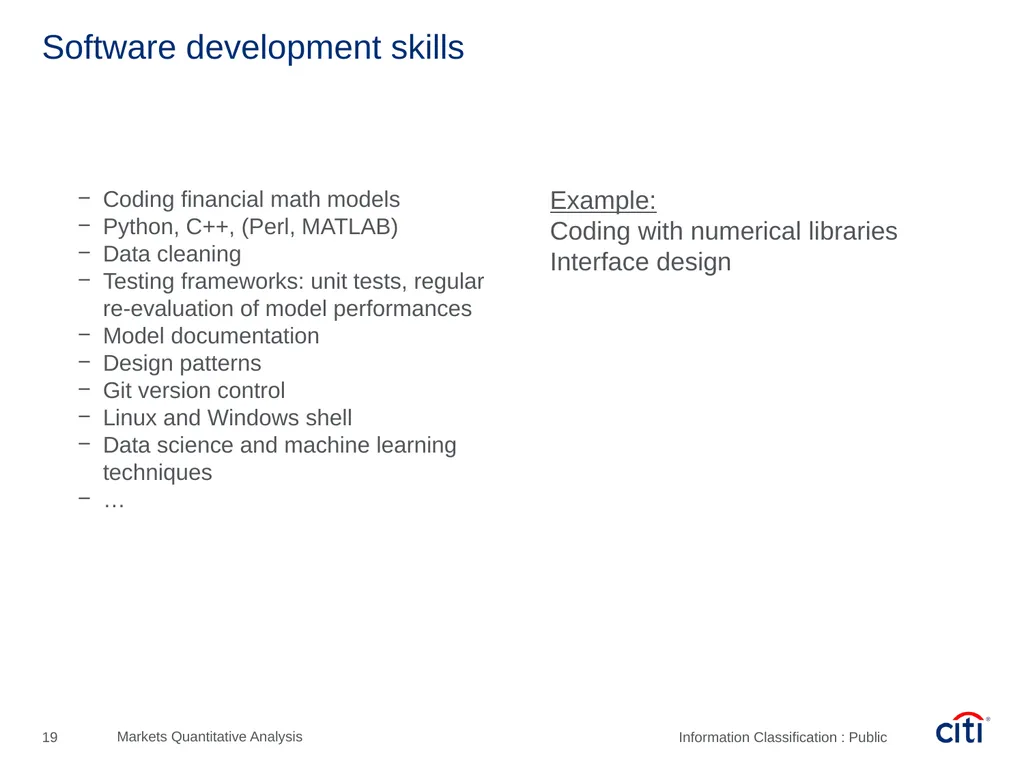
slide19. Software development skills Coding financial math models
Python, C++, (Perl, MATLAB)
Data cleaning
Testing frameworks: unit tests, regular re-evaluation of model performances
Model documentation
Design patterns
Git version control
Linux and Windows shell
Data science and machine learning techniques
… Example:
Coding with numerical libraries
Interface design<br>
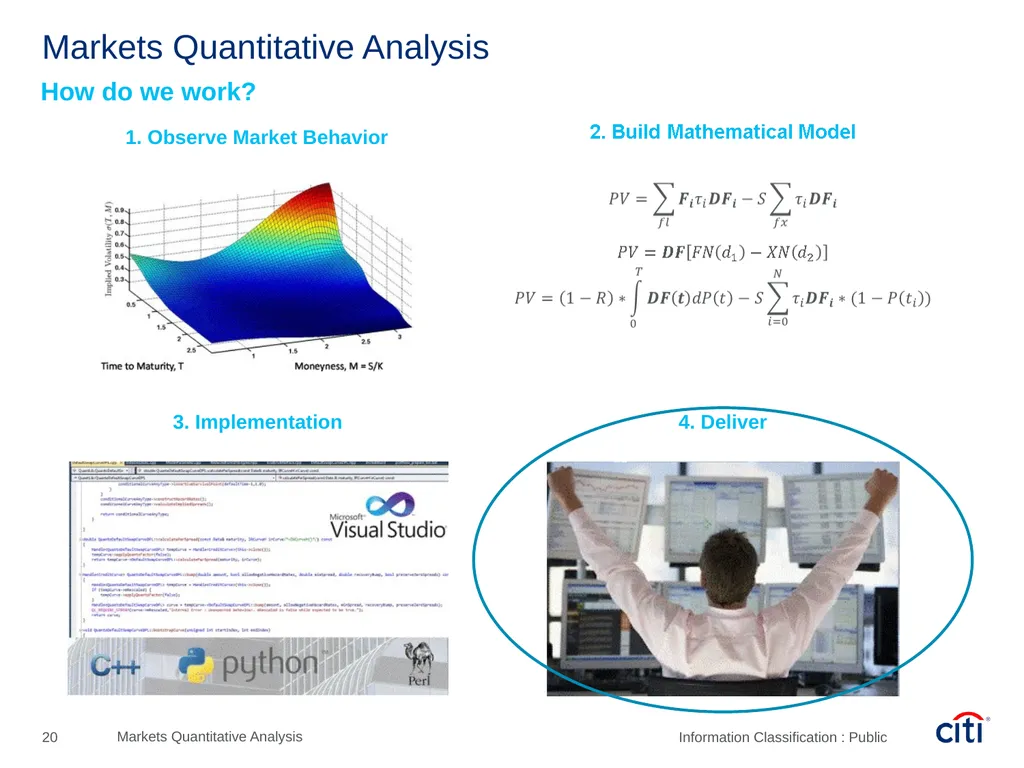
slide20. Markets Quantitative Analysis 4. Deliver 3. Implementation 1. Observe Market Behavior How do we work?<br>
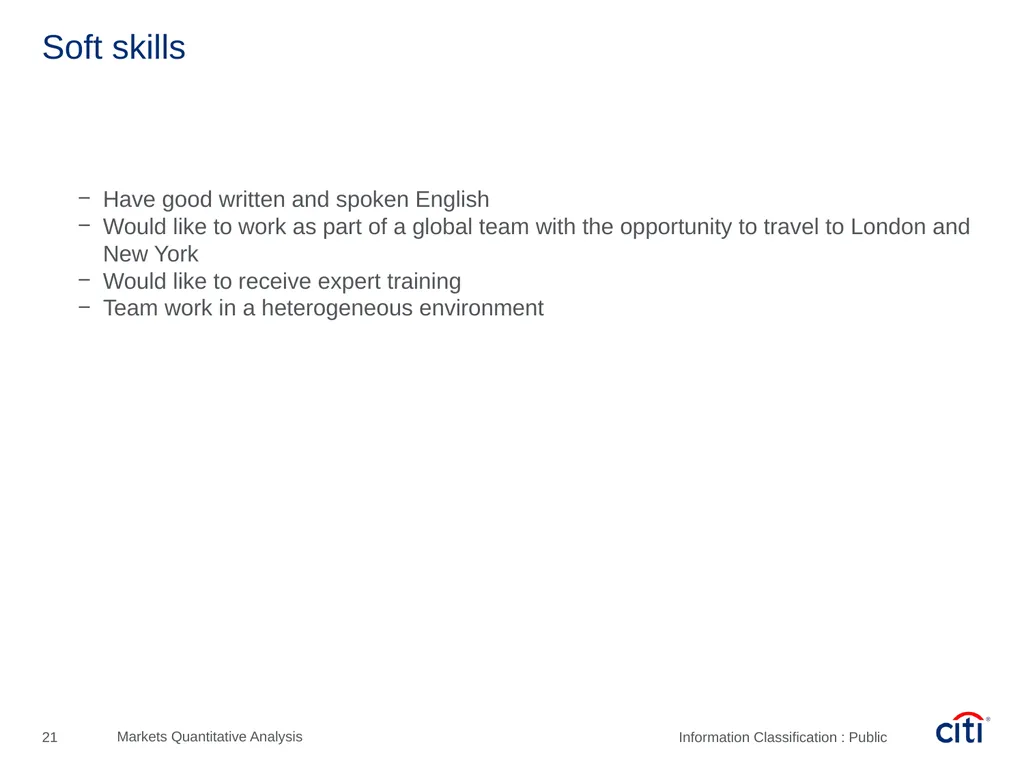
slide21. Soft skills Have good written and spoken English
Would like to work as part of a global team with the opportunity to travel to London and New York
Would like to receive expert training
Team work in a heterogeneous environment<br>
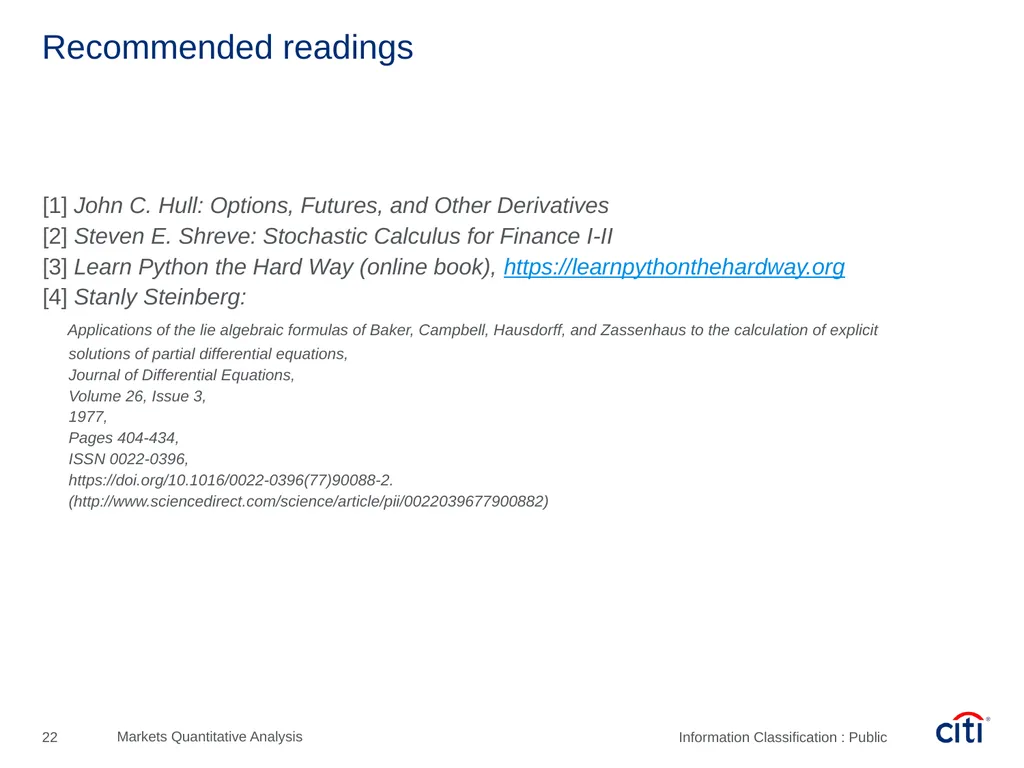
slide22. Recommended readings [1] John C. Hull: Options, Futures, and Other Derivatives
[2] Steven E. Shreve: Stochastic Calculus for Finance I-II
[3] Learn Python the Hard Way (online book), https://learnpythonthehardway.org
[4] Stanly Steinberg:
Applications of the lie algebraic formulas of Baker, Campbell, Hausdorff, and Zassenhaus to the calculation of explicit
solutions of partial differential equations,
Journal of Differential Equations,
Volume 26, Issue 3,
1977,
Pages 404-434,
ISSN 0022-0396,
https://doi.org/10.1016/0022-0396(77)90088-2.
(http://www.sciencedirect.com/science/article/pii/0022039677900882)<br>
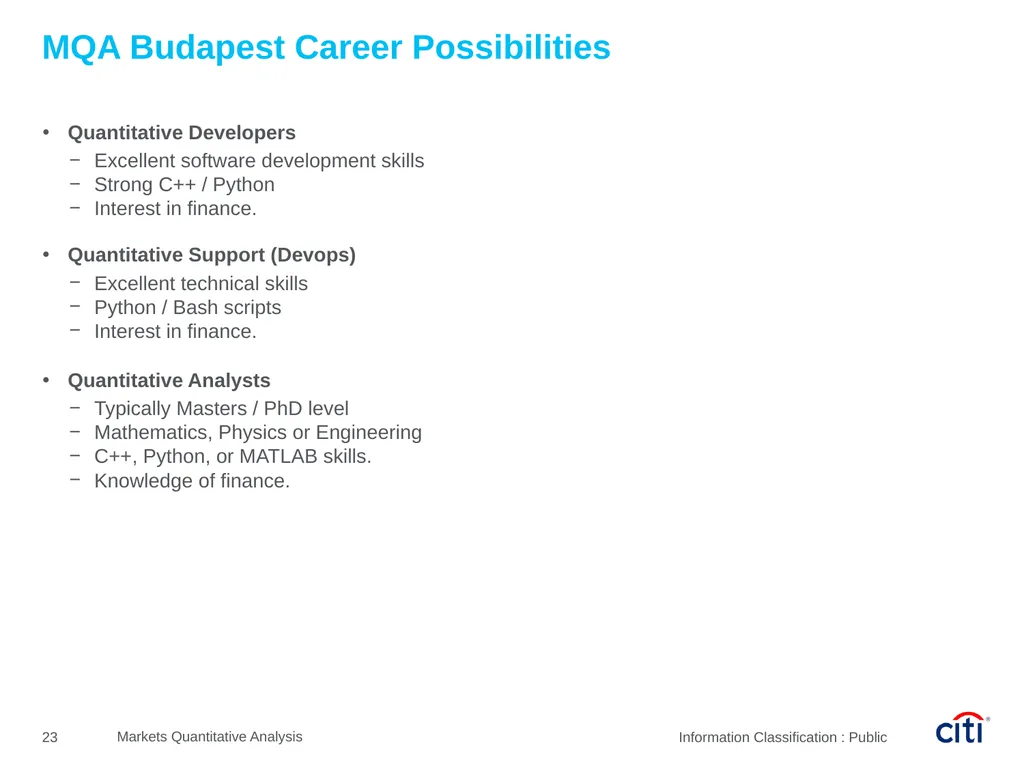
slide23. MQA Budapest Career Possibilities Quantitative Developers
Excellent software development skills
Strong C++ / Python
Interest in finance.
Quantitative Support (Devops)
Excellent technical skills
Python / Bash scripts
Interest in finance.
Quantitative Analysts
Typically Masters / PhD level
Mathematics, Physics or Engineering
C++, Python, or MATLAB skills.
Knowledge of finance.<br>
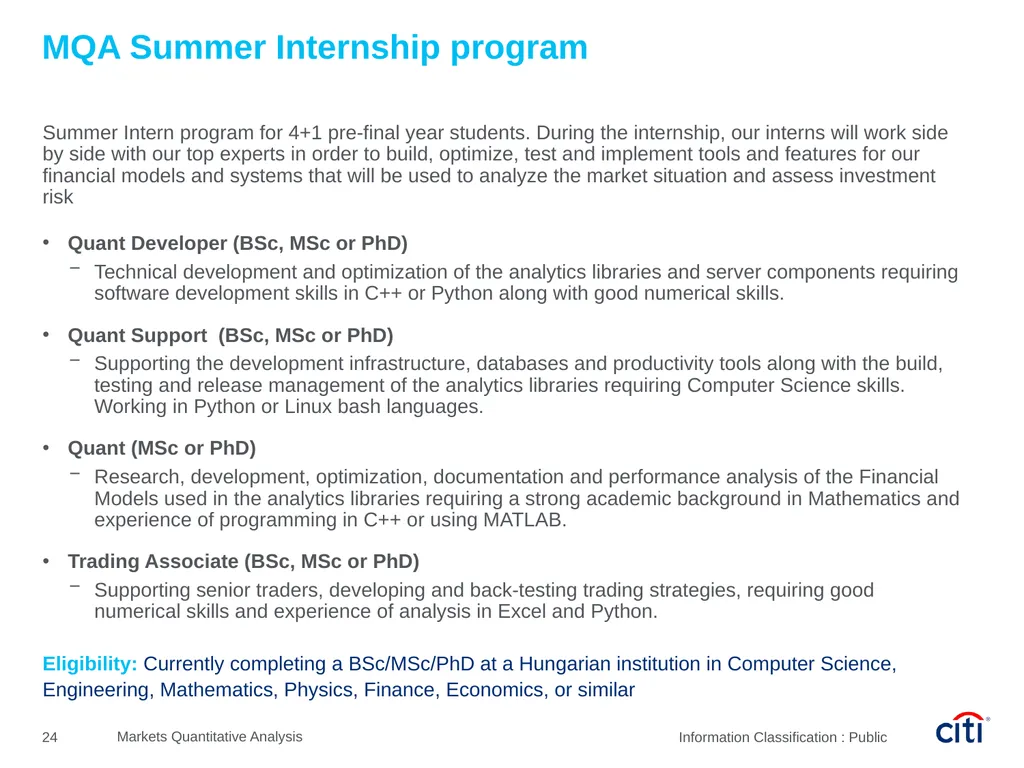
slide24. MQA Summer Internship program Summer Intern program for 4+1 pre-final year students. During the internship, our interns will work side by side with our top experts in order to build, optimize, test and implement tools and features for our financial models and systems that will be used to analyze the market situation and assess investment risk
Quant Developer (BSc, MSc or PhD)
Technical development and optimization of the analytics libraries and server components requiring software development skills in C++ or Python along with good numerical skills.
Quant Support (BSc, MSc or PhD)
Supporting the development infrastructure, databases and productivity tools along with the build, testing and release management of the analytics libraries requiring Computer Science skills. Working in Python or Linux bash languages.
Quant (MSc or PhD)
Research, development, optimization, documentation and performance analysis of the Financial Models used in the analytics libraries requiring a strong academic background in Mathematics and experience of programming in C++ or using MATLAB.
Trading Associate (BSc, MSc or PhD)
Supporting senior traders, developing and back-testing trading strategies, requiring good numerical skills and experience of analysis in Excel and Python.
Eligibility: Currently completing a BSc/MSc/PhD at a Hungarian institution in Computer Science, Engineering, Mathematics, Physics, Finance, Economics, or similar<br>
slide25. Thanks for your attention!
Q & A Visit jobs.citi.com + keywords: Internship + Budapest<br>
Quantitative Analyst – Assistant Vice President Applied Mathematics at Citi MQA 27/09/2019 Public Markets and Securities Services<br>
slide2. Agenda Who is a “Quant”?
Markets Quantitative Analysis at Citi
How do we work?
Internship/Career<br>
slide3. Who is a “Quant”? “A quantitative analyst (or, in financial jargon, a quant) is a person who specializes in the application of mathematical and statistical methods to financial and risk management problems.” – Wikipedia
A Person who is
Applying mathematical tools
Working on the field of Finance
Using technological solutions (programming)<br>
slide4. Markets Quantitative Analysis Highly regulated trading environment:
Quants perform an ever important role
Ensure the Financial models are fully understood and documented.
Survival of the fast paced environment of the trading desk needs cutting edge
financial modeling
tools s
software engineering
We are extensively involved in the regulatory stress tests which the Firm undertakes, ensuring that our models operate effectively in stressed market conditions. Who are our people?
Quantitative Developers
Quantitative Support (Devops)
Quantitative Analysts Who are our clients?
MQA’s key business partners are:
Trading
Structuring
Sales Desks
Risk Organization
Valuation and Control
Technology Risk teams.
Business Areas: Credit FX Mortgages Rates Commodities Equities & Hybrids<br>
slide5. Markets Quantitative Analysis Where are we located ?
MQA is a global department of around 370 people, predominantly in North America and London with a small number in Asia.
We established a presence in Budapest in September 2013.<br>
slide6. Markets Quantitative Analysis 4. Deliver 3. Implementation 1. Observe Market Behavior How do we work?<br>
slide7. Markets Quantitative Analysis 4. Deliver 3. Implementation 1. Observe Market Behavior How do we work?<br>
slide8. Knowledge of financial products Types of derivatives
Understand risk, XVA, etc.
Problem definition
Extending existing models<br>
slide9. Knowledge of financial products Types of derivatives
Understand risk, XVA, etc.
Problem definition
Extending existing models<br>
slide10. Knowledge of financial products Types of derivatives
Understand risk, XVA, etc.
Problem definition
Extending existing models<br>
slide11. Markets Quantitative Analysis 4. Deliver 3. Implementation 1. Observe Market Behavior How do we work?<br>
slide12. Mathematical tools Stochastic calculus
PDEs i.e., finite differences methods
Monte Carlo methods<br>
slide13. Common mathematical applications Stochastic calculus
PDEs i.e., finite differences methods
Monte Carlo methods<br>
slide14. Advanced Mathematical Example<br>
slide15. Advanced Mathematical Example - cont.<br>
slide16. Advanced Mathematical Example - cont.<br>
slide17. Advanced Mathematical Example - cont<br>
slide18. Markets Quantitative Analysis 4. Deliver 3. Implementation 1. Observe Market Behavior How do we work?<br>
slide19. Software development skills Coding financial math models
Python, C++, (Perl, MATLAB)
Data cleaning
Testing frameworks: unit tests, regular re-evaluation of model performances
Model documentation
Design patterns
Git version control
Linux and Windows shell
Data science and machine learning techniques
… Example:
Coding with numerical libraries
Interface design<br>
slide20. Markets Quantitative Analysis 4. Deliver 3. Implementation 1. Observe Market Behavior How do we work?<br>
slide21. Soft skills Have good written and spoken English
Would like to work as part of a global team with the opportunity to travel to London and New York
Would like to receive expert training
Team work in a heterogeneous environment<br>
slide22. Recommended readings [1] John C. Hull: Options, Futures, and Other Derivatives
[2] Steven E. Shreve: Stochastic Calculus for Finance I-II
[3] Learn Python the Hard Way (online book), https://learnpythonthehardway.org
[4] Stanly Steinberg:
Applications of the lie algebraic formulas of Baker, Campbell, Hausdorff, and Zassenhaus to the calculation of explicit
solutions of partial differential equations,
Journal of Differential Equations,
Volume 26, Issue 3,
1977,
Pages 404-434,
ISSN 0022-0396,
https://doi.org/10.1016/0022-0396(77)90088-2.
(http://www.sciencedirect.com/science/article/pii/0022039677900882)<br>
slide23. MQA Budapest Career Possibilities Quantitative Developers
Excellent software development skills
Strong C++ / Python
Interest in finance.
Quantitative Support (Devops)
Excellent technical skills
Python / Bash scripts
Interest in finance.
Quantitative Analysts
Typically Masters / PhD level
Mathematics, Physics or Engineering
C++, Python, or MATLAB skills.
Knowledge of finance.<br>
slide24. MQA Summer Internship program Summer Intern program for 4+1 pre-final year students. During the internship, our interns will work side by side with our top experts in order to build, optimize, test and implement tools and features for our financial models and systems that will be used to analyze the market situation and assess investment risk
Quant Developer (BSc, MSc or PhD)
Technical development and optimization of the analytics libraries and server components requiring software development skills in C++ or Python along with good numerical skills.
Quant Support (BSc, MSc or PhD)
Supporting the development infrastructure, databases and productivity tools along with the build, testing and release management of the analytics libraries requiring Computer Science skills. Working in Python or Linux bash languages.
Quant (MSc or PhD)
Research, development, optimization, documentation and performance analysis of the Financial Models used in the analytics libraries requiring a strong academic background in Mathematics and experience of programming in C++ or using MATLAB.
Trading Associate (BSc, MSc or PhD)
Supporting senior traders, developing and back-testing trading strategies, requiring good numerical skills and experience of analysis in Excel and Python.
Eligibility: Currently completing a BSc/MSc/PhD at a Hungarian institution in Computer Science, Engineering, Mathematics, Physics, Finance, Economics, or similar<br>
slide25. Thanks for your attention!
Q & A Visit jobs.citi.com + keywords: Internship + Budapest<br>