Pacific HIES methods: gap assessment Presenter name: Michael Sharp Presenter title: Manager, Statistics Collections Presenter affiliation: Pacific Community (SPC) PACSTAT project (P169122): Statistical Innovation and Capacity Building in
"Pacific HIES methods: gap assessment Presenter" is the property of its rightful owner. Permission is granted to
download and print the materials on this website for personal, non-commercial use only, and to display it
on your personal computer provided you do not modify the materials and that you retain all copyright
notices contained in the materials. By downloading content from our website, you accept the terms of this
agreement.
Presentation Transcript
01
Pacific HIES methods: gap assessment Presenter name: Michael Sharp
Presenter title: Manager, Statistics Collections
Presenter affiliation: Pacific Community (SPC) PACSTAT project (P169122): Statistical Innovation and Capacity Building in the Pacific Island Countries Pacific Regional Conference on HIES Methods
28 to 31 March 2023
Nadi, Fiji<br>
02
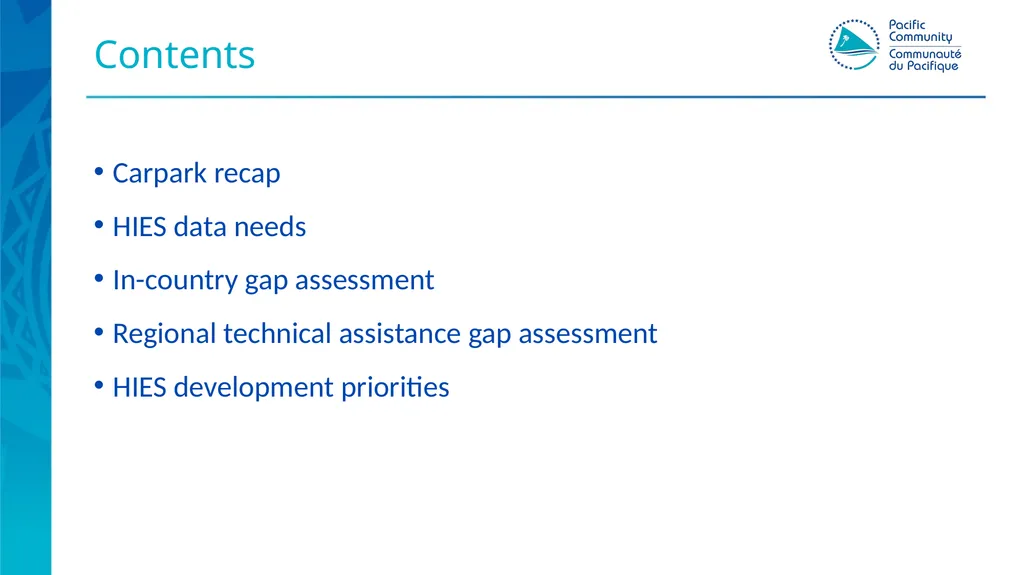
Contents Carpark recap
HIES data needs
In-country gap assessment
Regional technical assistance gap assessment
HIES development priorities<br>
03
Questionnaire too long
Requirement for automatic field checks
More involvement of NSO in post enumeration activities
Expansion of HIES needs (initially, prices, NA, poverty; now new needs)
Data editing / cleaning: in field outlier detection;
Statistical literacy in HIES data use
CPI benefits more from location of purchase than detail on item
Imported v local inflation (e.g., Ukraine war impact on prices)
Need to look at location and branding of items (local v import) and then we can determine the driver of inflation
MICS: modulated questionnaire, standard tools and instruments, structured development plan, reports and infographics
Microdata anonymization guidelines
FIES – individual or household?
Financial inclusion – individual or household
Supplementary labour modules (migrant worker (returned migrant and absentee), own use production (incl. time use)
For reporting, identify priority populations to disaggregate by (e.g., LNOB)
Perhaps need to develop sampling techniques
Build analysis/tabulation plan into survey planning
HIES summary should be tailored to national needs; connect to policy
Data integration (link variables between different surveys and across surveys (e.g., HIES, census, LFS)
Part of survey planning / MICS does this
Survey vetting: lots of surveys happening; lots of requests for unique data; need survey plan with advocacy and user consultation; new modules being proposed and it’s important they’re reviewed and only included when relevant
Donor and development partners running own stand alone surveys (e.g., financial inclusion, migrant workers)
Statistical coordination is important
NSO strategic planning to include users
Raise awareness of existing data and types of information collected in HIES
National priorities need to be met, then international – user consultation
South-South / Peer-to-Peer; coordination by SPC; resource distribution; support to small NSOs
Structural design / governance: something specific for HIES for the Pacific; proposal to develop
Need to be aware that data needs will change and therefore we need ongoing development Carpark<br>
04
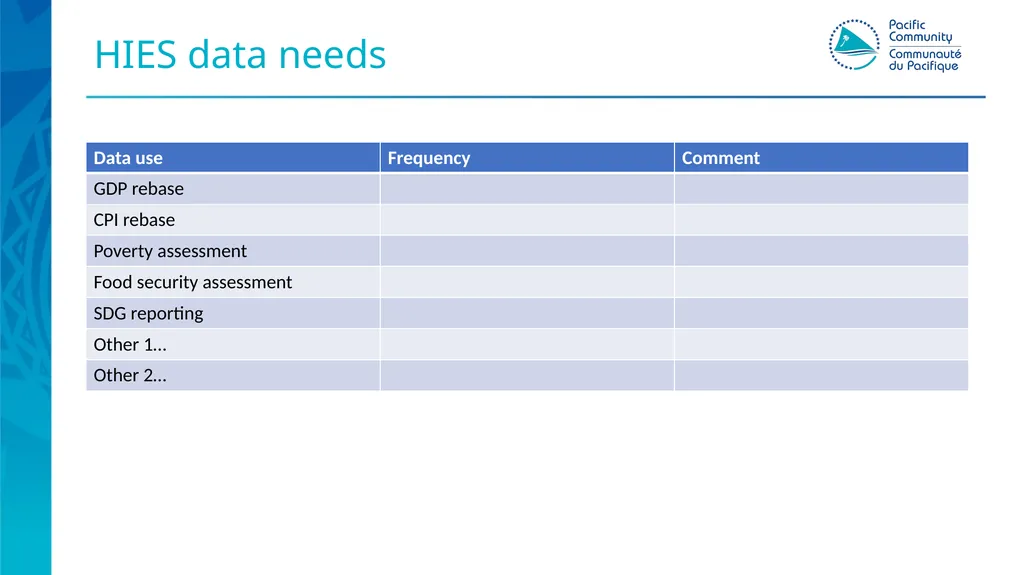
HIES data needs<br>
05
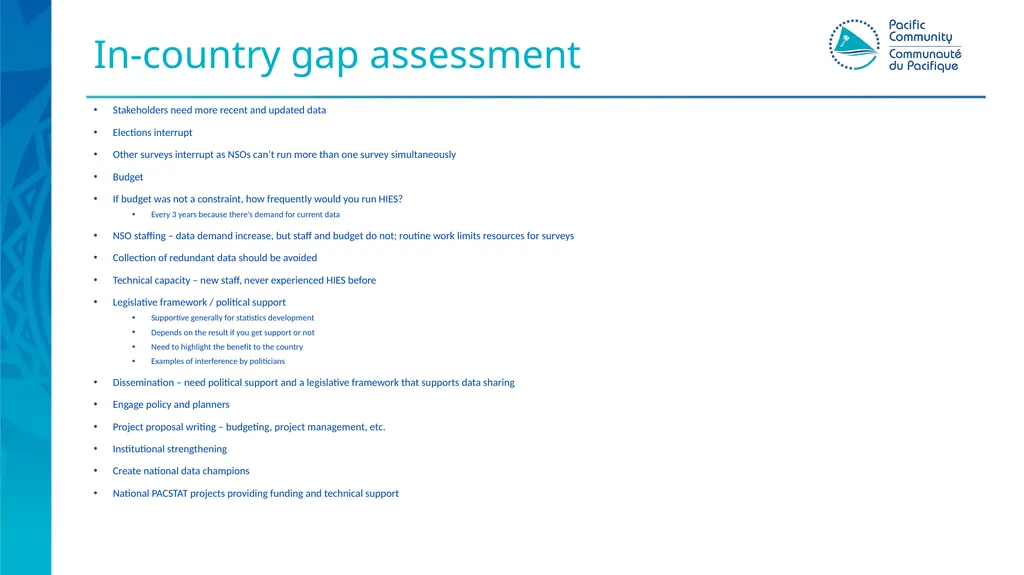
Stakeholders need more recent and updated data
Elections interrupt
Other surveys interrupt as NSOs can’t run more than one survey simultaneously
Budget
If budget was not a constraint, how frequently would you run HIES?
Every 3 years because there’s demand for current data
NSO staffing – data demand increase, but staff and budget do not; routine work limits resources for surveys
Collection of redundant data should be avoided
Technical capacity – new staff, never experienced HIES before
Legislative framework / political support
Supportive generally for statistics development
Depends on the result if you get support or not
Need to highlight the benefit to the country
Examples of interference by politicians
Dissemination – need political support and a legislative framework that supports data sharing
Engage policy and planners
Project proposal writing – budgeting, project management, etc.
Institutional strengthening
Create national data champions
National PACSTAT projects providing funding and technical support In-country gap assessment<br>
06
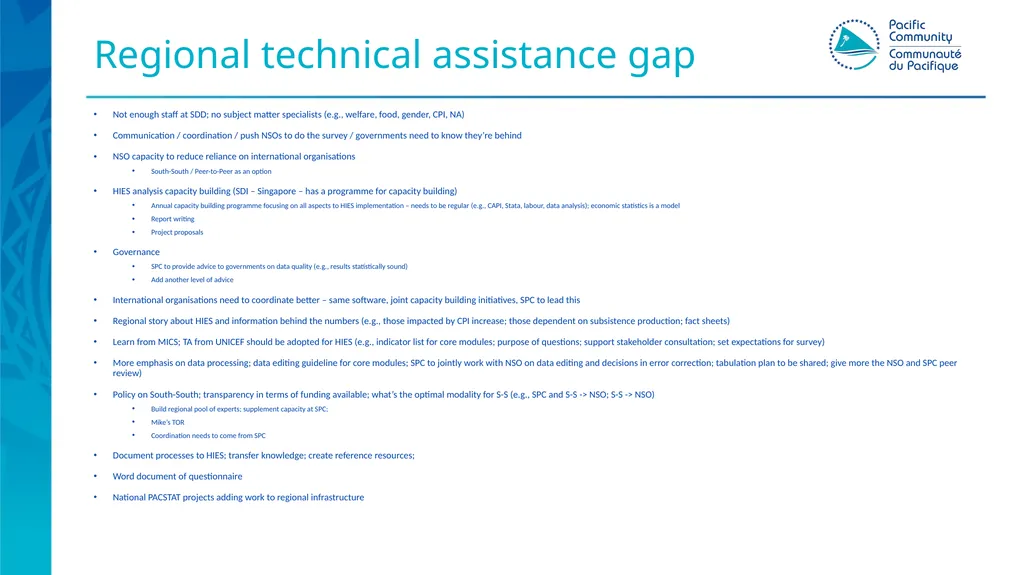
Not enough staff at SDD; no subject matter specialists (e.g., welfare, food, gender, CPI, NA)
Communication / coordination / push NSOs to do the survey / governments need to know they’re behind
NSO capacity to reduce reliance on international organisations
South-South / Peer-to-Peer as an option
HIES analysis capacity building (SDI – Singapore – has a programme for capacity building)
Annual capacity building programme focusing on all aspects to HIES implementation – needs to be regular (e.g., CAPI, Stata, labour, data analysis); economic statistics is a model
Report writing
Project proposals
Governance
SPC to provide advice to governments on data quality (e.g., results statistically sound)
Add another level of advice
International organisations need to coordinate better – same software, joint capacity building initiatives, SPC to lead this
Regional story about HIES and information behind the numbers (e.g., those impacted by CPI increase; those dependent on subsistence production; fact sheets)
Learn from MICS; TA from UNICEF should be adopted for HIES (e.g., indicator list for core modules; purpose of questions; support stakeholder consultation; set expectations for survey)
More emphasis on data processing; data editing guideline for core modules; SPC to jointly work with NSO on data editing and decisions in error correction; tabulation plan to be shared; give more the NSO and SPC peer review)
Policy on South-South; transparency in terms of funding available; what’s the optimal modality for S-S (e.g., SPC and S-S -> NSO; S-S -> NSO)
Build regional pool of experts; supplement capacity at SPC;
Mike’s TOR
Coordination needs to come from SPC
Document processes to HIES; transfer knowledge; create reference resources;
Word document of questionnaire
National PACSTAT projects adding work to regional infrastructure Regional technical assistance gap<br>
07
HIES development priorities<br>
08
Thank you Address/post: Pacific Community (SPC), 95 Promenade Roger Laroque, BP D5 98848 Noumea, New Caledonia
Phone: +687 262000 | Fax: +687 263818 | Email: complaints@spc.int | Web: https://spc.int/accountability<br>