Paleolithic Culture 1. Tool making Culture Introduction The term Palaeolithic consists of two Greek words: palaios old and lithos stone. It is used to indicate Old Stone Age. Paleolithic was coined by archaeologist John Lubbock
"Paleolithic Culture 1. Tool – making Culture" is the property of its rightful owner. Permission is granted to
download and print the materials on this website for personal, non-commercial use only, and to display it
on your personal computer provided you do not modify the materials and that you retain all copyright
notices contained in the materials. By downloading content from our website, you accept the terms of this
agreement.
Presentation Transcript
01
Paleolithic Culture 1. Tool – making Culture<br>
02
Introduction The term ‘Palaeolithic’ consists of two Greek words: palaios= old and lithos = stone. It is used to indicate ‘Old Stone Age’.
‘Paleolithic’ was coined by archaeologist John Lubbock in 1865.
It is used for the period of prehistory from around 2.5 million years ago when humans began to make stone tools.
Evolution of humans from ‘Homo Habilis/tool-making man’ to ‘Homo sapien sapien’ (wise and modern man) is a long-drawn process in relation to biological changes.
The changes that led to evolution were not just biological but cultural as well.
This culture not only refers to manufactured stone tools and how they evolved over a period of time, but also changes in the environment and accessibility of resources. The biological changes include hunting strategies, methods of communication, ability to control fire, making and modifying tools, subsistence patterns, burials, paintings and so on.<br>
03
Debate on Division of Labour Richard B. Lee and I. Devore (1968) began their argument with the concept of Man the Hunter. They supported the view that man was the ‘leader’ and ‘in-charge’ of women and children.
Nancy Tanner, A. Zihlmann (1978) etc, refute the notion of a ‘gendered division of labour’ in prehistoric societies. These scholars understand hunting as opportunistic in nature.
They argued that crude tools and their functions suggest that hunting was not the main economic activity of the early humans rather they were scavengers.
Joan Gero (in Kathryn W. Arthur, 2010), a pioneer in feminist archaeology, argues that women in prehistory must have been toolmakers for they would have required flakes to carry out a number of tasks.<br>
04
Debate Continued… Ethnographic studies show that women contributed a large share in food production processes in most foraging societies. Further, in many societies, women went for hunting, alone and along with men. In a way, foraging challenges the notion of gendered division of labour in prehistoric societies
According to the ‘Gathering’ hypothesis, women played a central role as opposed to men in prehistoric period by using tools to gather and process plant food. They argue that gathering was an equally important activity and should not be qualified as less productive ‘women’s work’ or equated as being less productive.
A. Zihlman (1978), supposes that the human way of life was not based on sexual division of labour but on a system where male as well as female collect and engage in predatory behavioural flexibility which was a major contributing factor to early hominid survival. In fact, both contributed equally in the early society which was pertinent for their survival.<br>
05
Lower/Early Palaeolithic/Stone Culture Palaeolithic culture - divided into three periods based on the type of tools, social and economic changes, nature of habitation and a few other criteria
Tools made by Homo Habilis - simple and crude stone tools believed to have existed around 2.5 million years ago
Technology associated with them is called the Oldowan tool technology, named after Olduvai Gorge in Tanzania - where these tools were first discovered (Louis and Mary Leaky)
Earliest tools - Chopper-chopping tools, generally made by percussion method (striking one object to another), usually hitting a lava cobble with another. The flakes (small, thin piece of scraped stone) were long and sharp, used to make scrapers and cutting tools to cut or scrape wood, plants, skin and also meat.<br>
06
Lower Paleolithic Culture Cond…. D. Strout (2011) has shown that even the simple artefact such as the Oldowan tools, involved a complex method which consisted of careful selection of the raw material, followed by flake production and then flake detachment. Following this, working on the percussion method, tools could be produced
The Oldowan technology - the only form of tool technology in use for more than a million years. ‘Knapping’- removal of flakes from the core, ‘Debitage’ - waste material. The earliest core was simple unipolar (single) core from which one or two flakes were removed
Oldowan tools – used for chopping or scraping plants and animals. They were mostly used to process carcasses for skinning, opening joints and meat and breaking to open bones. A large number of animal bones with tools concentrated over a small area have been found both at Olduvai Gorge (Tanzania) and Koobi Fora (near Lake Turkana in Northern Kenya)
Later, early humans moved to more complex Levallois technique - flakes of predetermined size and shape could be removed. The earliest cores were generally called the pebble-tools.<br>
07
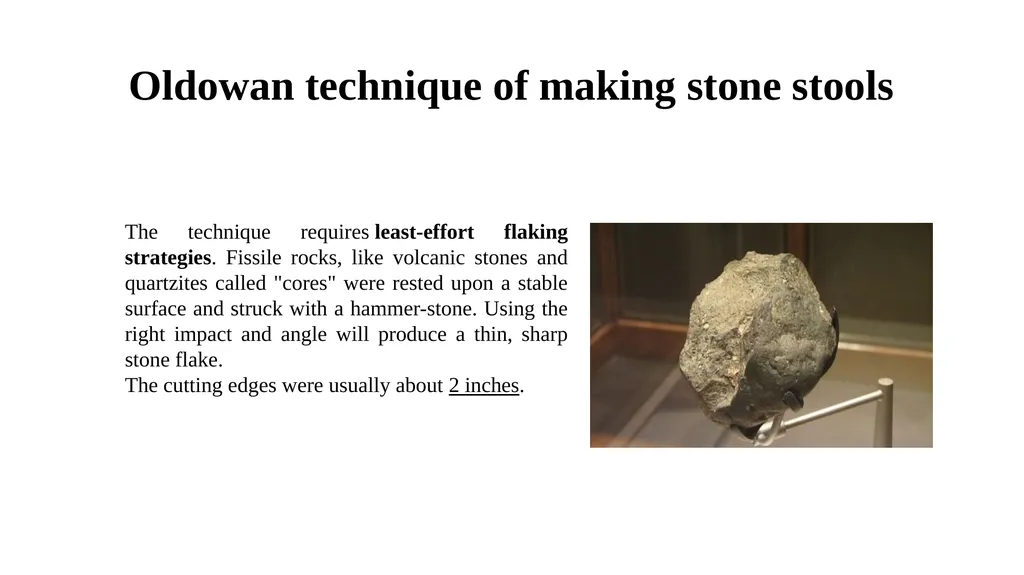
Oldowan technique of making stone stools The technique requires least-effort flaking strategies. Fissile rocks, like volcanic stones and quartzites called "cores" were rested upon a stable surface and struck with a hammer-stone. Using the right impact and angle will produce a thin, sharp stone flake.
The cutting edges were usually about 2 inches.<br>
08
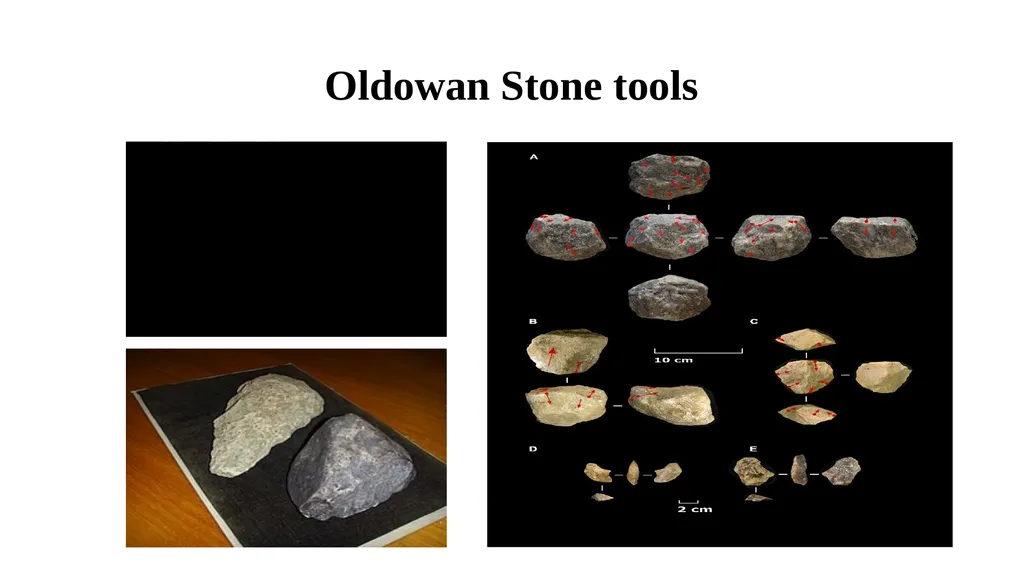
Oldowan Stone tools Oldowan stone tools<br>
09
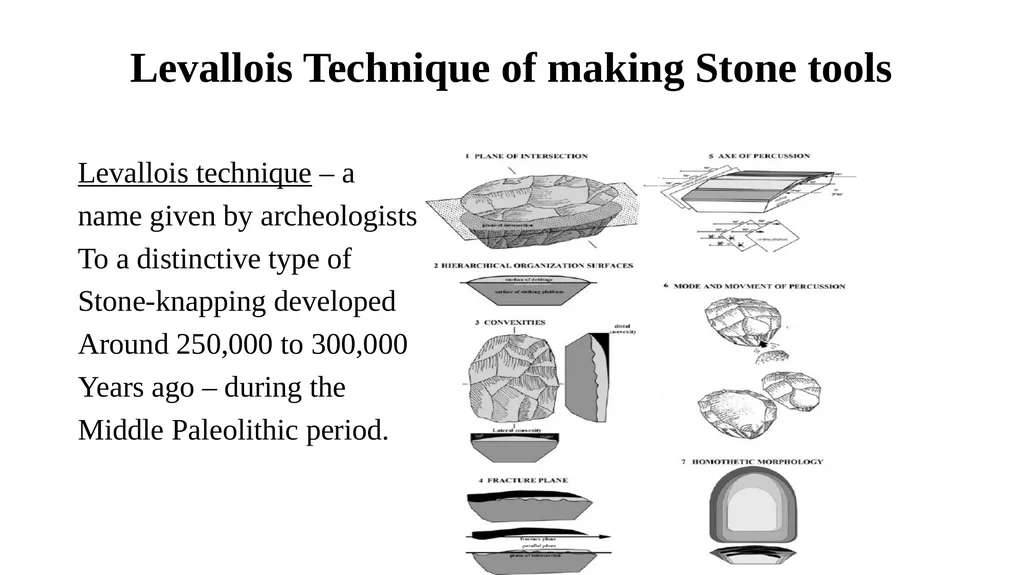
Levallois Technique of making Stone tools Levallois technique – a
name given by archeologists
To a distinctive type of
Stone-knapping developed
Around 250,000 to 300,000
Years ago – during the
Middle Paleolithic period.<br>
10
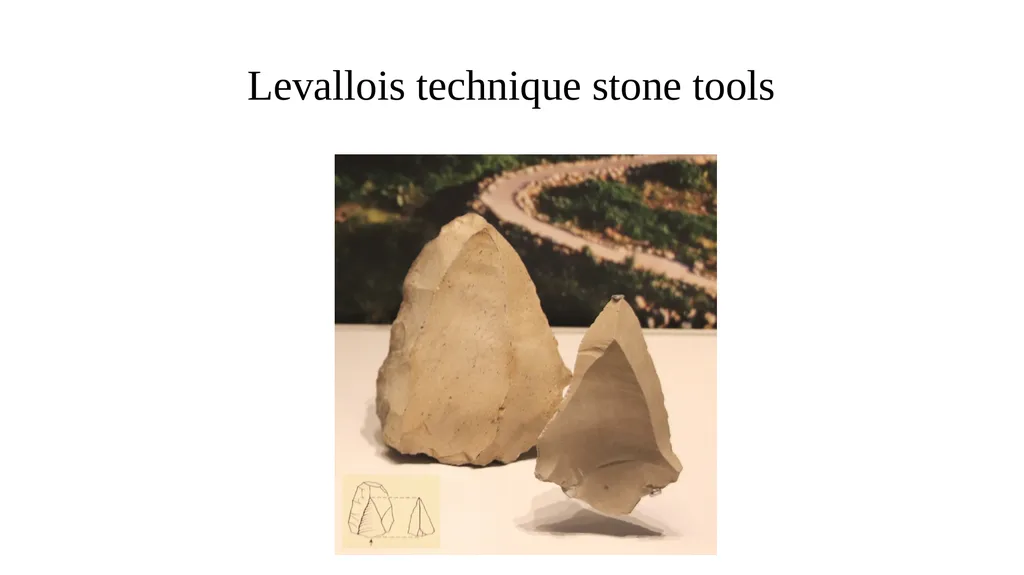
Levallois technique stone tools<br>
11
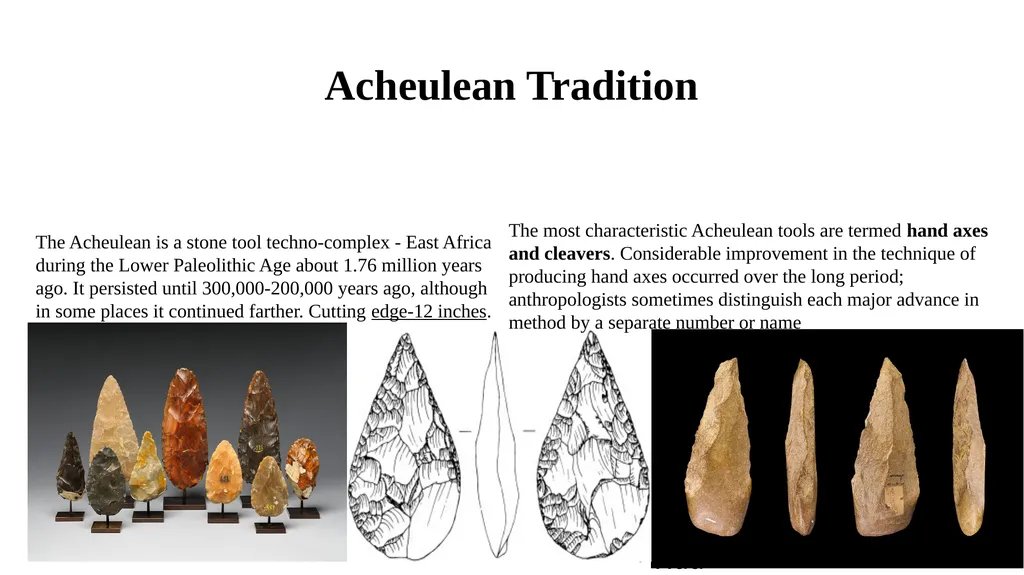
Acheulean Tradition Hdd The most characteristic Acheulean tools are termed hand axes and cleavers. Considerable improvement in the technique of producing hand axes occurred over the long period; anthropologists sometimes distinguish each major advance in method by a separate number or name The Acheulean is a stone tool techno-complex - East Africa during the Lower Paleolithic Age about 1.76 million years ago. It persisted until 300,000-200,000 years ago, although in some places it continued farther. Cutting edge-12 inches.<br>