
Panel - IS History: The Historical Development of
CB
Published · 37 slides · 0 views

1 / 1

Description
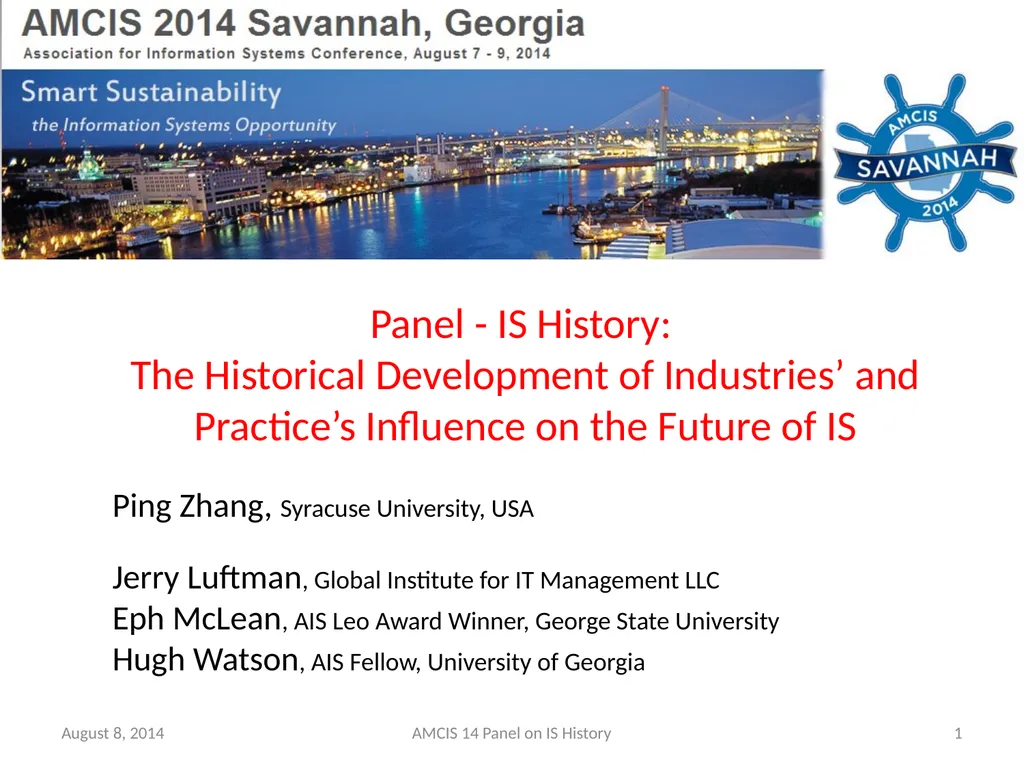
Panel - IS History: The Historical Development of Industries and Practices Influence on the Future of IS Ping Zhang, Syracuse University, USA Jerry Luftman, Global Institute for IT Management LLC Eph McLean, AIS Leo Award Winner, George
Related Topics
Share
Embed code
Download this presentation From Below
"Panel - IS History: The Historical Development of" is the property of its rightful owner. Permission is granted to download and print the materials on this website for personal, non-commercial use only, and to display it on your personal computer provided you do not modify the materials and that you retain all copyright notices contained in the materials. By downloading content from our website, you accept the terms of this agreement.
Presentation Transcript
01
Panel - IS History:
The Historical Development of Industries’ and Practice’s Influence on the Future of IS Ping Zhang, Syracuse University, USA
Jerry Luftman, Global Institute for IT Management LLC
Eph McLean, AIS Leo Award Winner, George State University
Hugh Watson, AIS Fellow, University of Georgia AMCIS 14 Panel on IS History 1 August 8, 2014<br>
Jerry Luftman, Global Institute for IT Management LLC
Eph McLean, AIS Leo Award Winner, George State University
Hugh Watson, AIS Fellow, University of Georgia AMCIS 14 Panel on IS History 1 August 8, 2014<br>
02
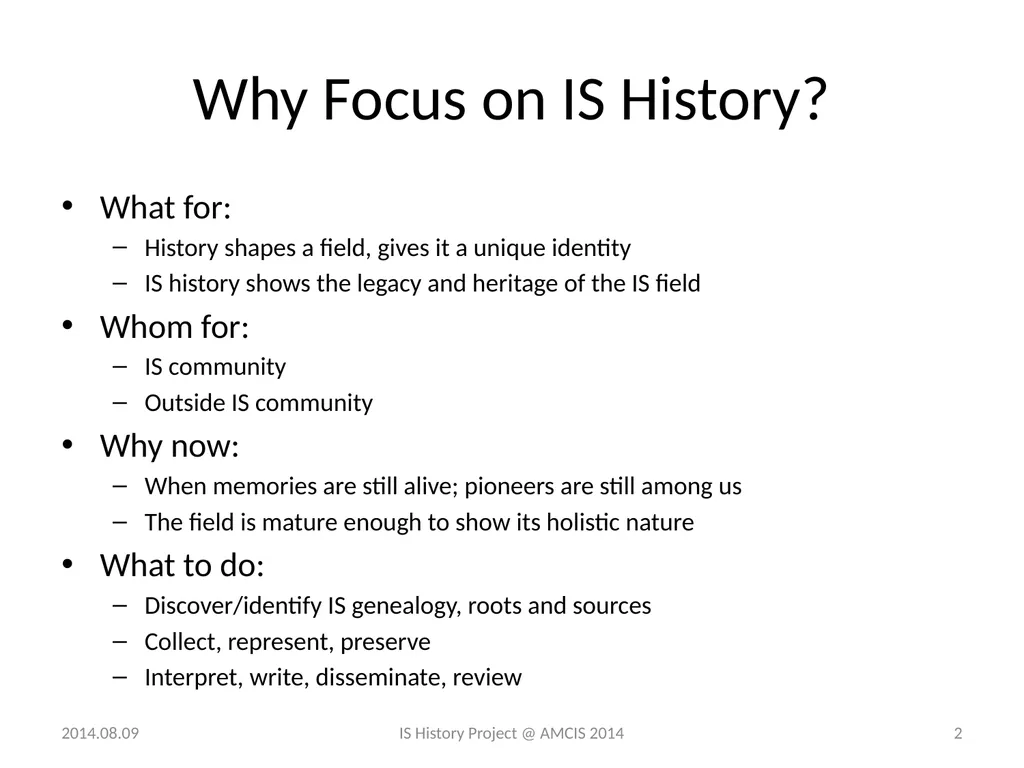
What for:
History shapes a field, gives it a unique identity
IS history shows the legacy and heritage of the IS field
Whom for:
IS community
Outside IS community
Why now:
When memories are still alive; pioneers are still among us
The field is mature enough to show its holistic nature
What to do:
Discover/identify IS genealogy, roots and sources
Collect, represent, preserve
Interpret, write, disseminate, review IS History Project @ AMCIS 2014 2 Why Focus on IS History? 2014.08.09<br>
History shapes a field, gives it a unique identity
IS history shows the legacy and heritage of the IS field
Whom for:
IS community
Outside IS community
Why now:
When memories are still alive; pioneers are still among us
The field is mature enough to show its holistic nature
What to do:
Discover/identify IS genealogy, roots and sources
Collect, represent, preserve
Interpret, write, disseminate, review IS History Project @ AMCIS 2014 2 Why Focus on IS History? 2014.08.09<br>
03
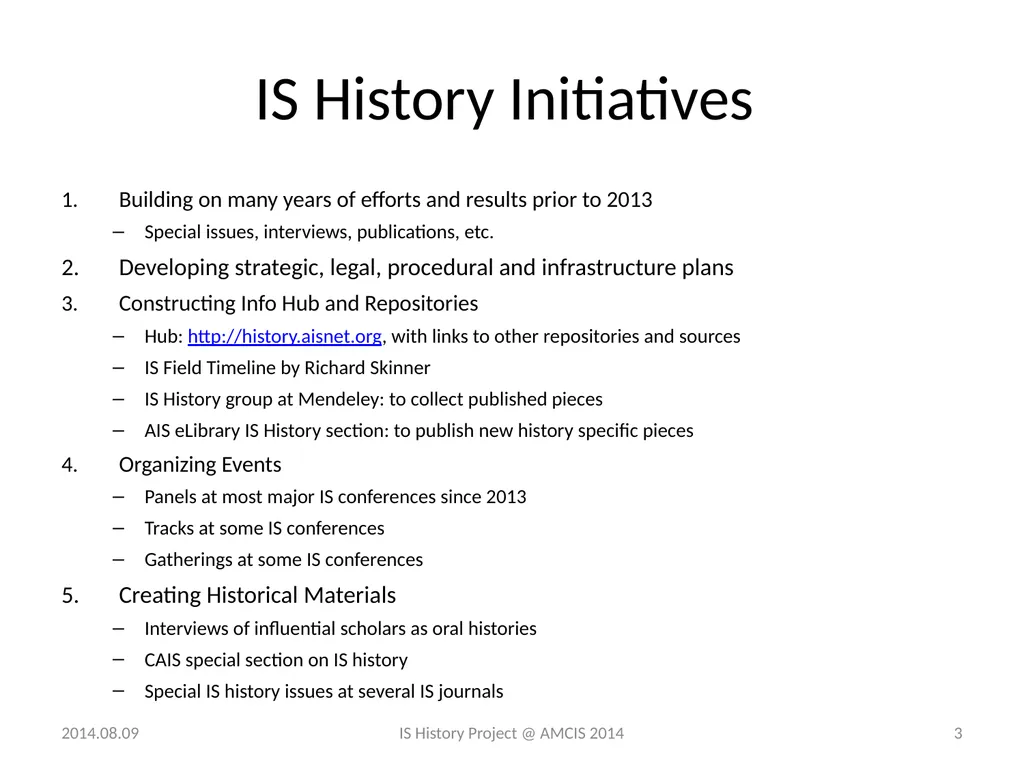
IS History Initiatives Building on many years of efforts and results prior to 2013
Special issues, interviews, publications, etc.
Developing strategic, legal, procedural and infrastructure plans
Constructing Info Hub and Repositories
Hub: http://history.aisnet.org, with links to other repositories and sources
IS Field Timeline by Richard Skinner
IS History group at Mendeley: to collect published pieces
AIS eLibrary IS History section: to publish new history specific pieces
Organizing Events
Panels at most major IS conferences since 2013
Tracks at some IS conferences
Gatherings at some IS conferences
Creating Historical Materials
Interviews of influential scholars as oral histories
CAIS special section on IS history
Special IS history issues at several IS journals 2014.08.09 IS History Project @ AMCIS 2014 3<br>
Special issues, interviews, publications, etc.
Developing strategic, legal, procedural and infrastructure plans
Constructing Info Hub and Repositories
Hub: http://history.aisnet.org, with links to other repositories and sources
IS Field Timeline by Richard Skinner
IS History group at Mendeley: to collect published pieces
AIS eLibrary IS History section: to publish new history specific pieces
Organizing Events
Panels at most major IS conferences since 2013
Tracks at some IS conferences
Gatherings at some IS conferences
Creating Historical Materials
Interviews of influential scholars as oral histories
CAIS special section on IS history
Special IS history issues at several IS journals 2014.08.09 IS History Project @ AMCIS 2014 3<br>
04
IS History Initiatives Events
Panels at all major IS conferences since 2013
Tracks at some IS conferences
Gatherings at some IS conferences
Interviews of influential scholars as oral histories
CAIS special section on IS history
Hub and Repositories
http://history.aisnet.org
IS History group at Mendeley
Other Special Issues on IS History
Many published studies on or about IS History August 8, 2014 AMCIS 14 Panel on IS History 4<br>
Panels at all major IS conferences since 2013
Tracks at some IS conferences
Gatherings at some IS conferences
Interviews of influential scholars as oral histories
CAIS special section on IS history
Hub and Repositories
http://history.aisnet.org
IS History group at Mendeley
Other Special Issues on IS History
Many published studies on or about IS History August 8, 2014 AMCIS 14 Panel on IS History 4<br>
05
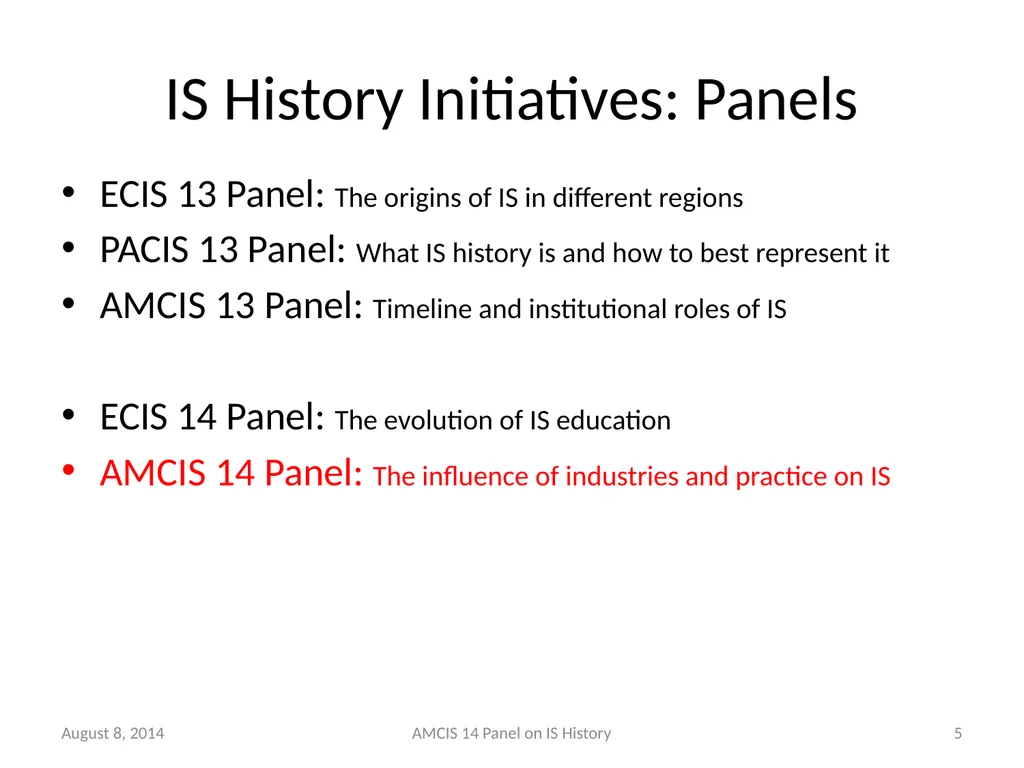
IS History Initiatives: Panels ECIS 13 Panel: The origins of IS in different regions
PACIS 13 Panel: What IS history is and how to best represent it
AMCIS 13 Panel: Timeline and institutional roles of IS
ECIS 14 Panel: The evolution of IS education
AMCIS 14 Panel: The influence of industries and practice on IS AMCIS 14 Panel on IS History 5 August 8, 2014<br>
PACIS 13 Panel: What IS history is and how to best represent it
AMCIS 13 Panel: Timeline and institutional roles of IS
ECIS 14 Panel: The evolution of IS education
AMCIS 14 Panel: The influence of industries and practice on IS AMCIS 14 Panel on IS History 5 August 8, 2014<br>
06
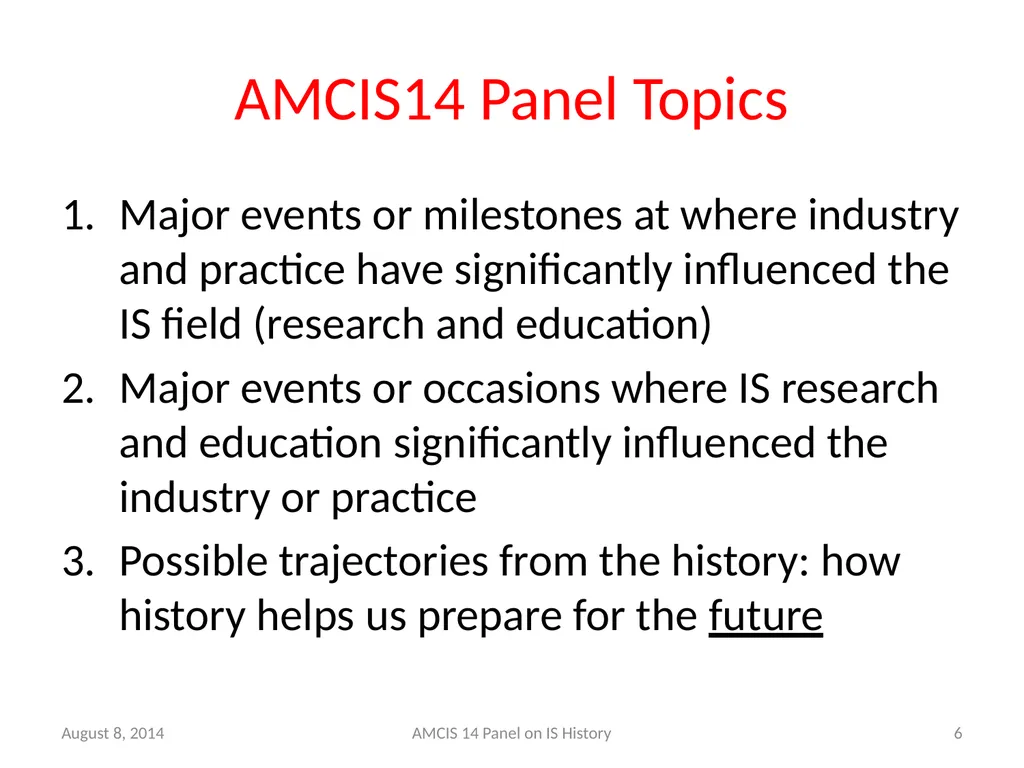
AMCIS14 Panel Topics Major events or milestones at where industry and practice have significantly influenced the IS field (research and education)
Major events or occasions where IS research and education significantly influenced the industry or practice
Possible trajectories from the history: how history helps us prepare for the future AMCIS 14 Panel on IS History 6 August 8, 2014<br>
Major events or occasions where IS research and education significantly influenced the industry or practice
Possible trajectories from the history: how history helps us prepare for the future AMCIS 14 Panel on IS History 6 August 8, 2014<br>
07
Hugh Watson AMCIS 14 Panel on IS History 7 August 8, 2014<br>
08
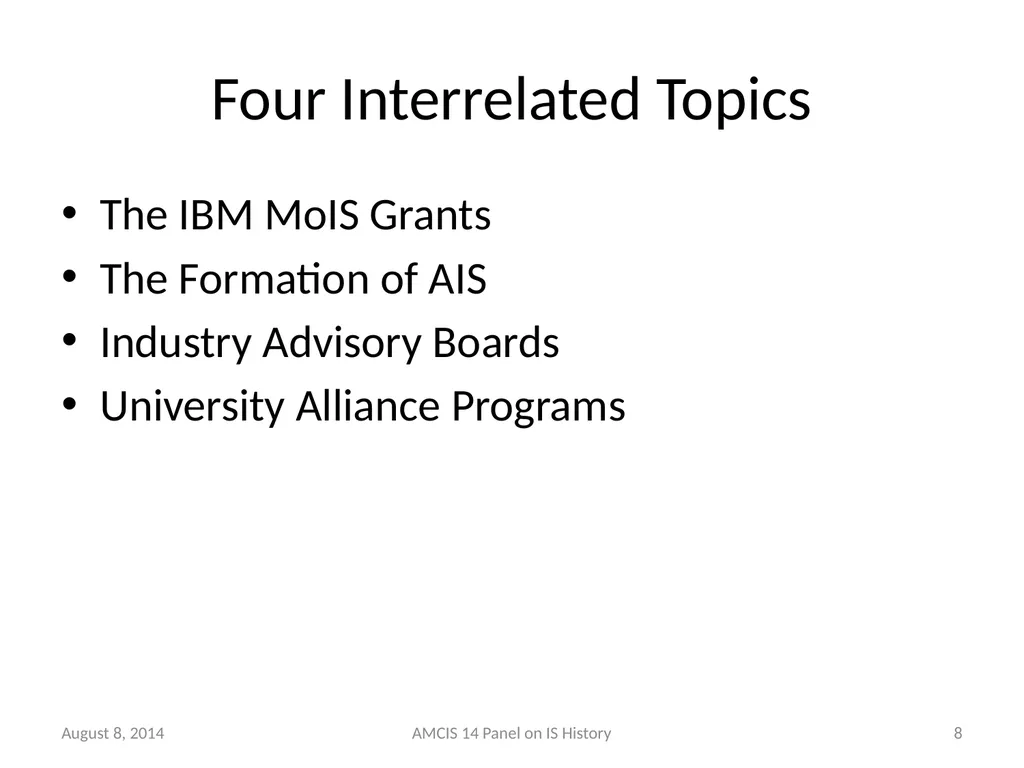
Four Interrelated Topics The IBM MoIS Grants
The Formation of AIS
Industry Advisory Boards
University Alliance Programs August 8, 2014 AMCIS 14 Panel on IS History 8<br>
The Formation of AIS
Industry Advisory Boards
University Alliance Programs August 8, 2014 AMCIS 14 Panel on IS History 8<br>
09
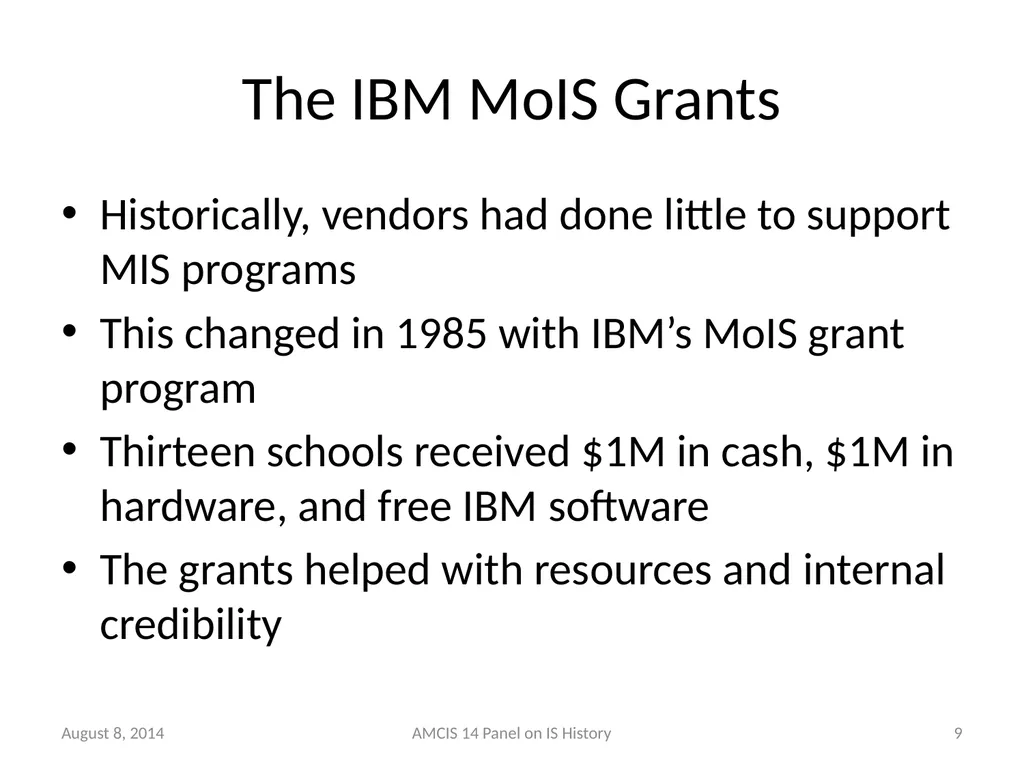
The IBM MoIS Grants Historically, vendors had done little to support MIS programs
This changed in 1985 with IBM’s MoIS grant program
Thirteen schools received $1M in cash, $1M in hardware, and free IBM software
The grants helped with resources and internal credibility August 8, 2014 AMCIS 14 Panel on IS History 9<br>
This changed in 1985 with IBM’s MoIS grant program
Thirteen schools received $1M in cash, $1M in hardware, and free IBM software
The grants helped with resources and internal credibility August 8, 2014 AMCIS 14 Panel on IS History 9<br>
10
The IBM MoIS Grants The grants also helped bring the leaders at those schools together
At the conclusion of the grant program, Paul Gray, Bill King, Eph McLean and I decided to write a book on the Management of Information Systems August 8, 2014 AMCIS 14 Panel on IS History 10<br>
At the conclusion of the grant program, Paul Gray, Bill King, Eph McLean and I decided to write a book on the Management of Information Systems August 8, 2014 AMCIS 14 Panel on IS History 10<br>
11
The Formation of AIS We were working on the book at HICSS in 1992 and discussed the sad state of the MIS academic field
This led to the initial steps to form AIS
Bill King incorporated the organization
Paul Gray organized a panel at ICIS in 1992
A Organizing Committee was formed
I served as the Program Chair for the first AMCIS August 8, 2014 AMCIS 14 Panel on IS History 11<br>
This led to the initial steps to form AIS
Bill King incorporated the organization
Paul Gray organized a panel at ICIS in 1992
A Organizing Committee was formed
I served as the Program Chair for the first AMCIS August 8, 2014 AMCIS 14 Panel on IS History 11<br>
12
Industry Advisory Boards The IBM MoIS grant program was a driver for UGA to create an MIS Advisory Board in 1985
Companies on the Board August 8, 2014 AMCIS 14 Panel on IS History 12<br>
Companies on the Board August 8, 2014 AMCIS 14 Panel on IS History 12<br>
13
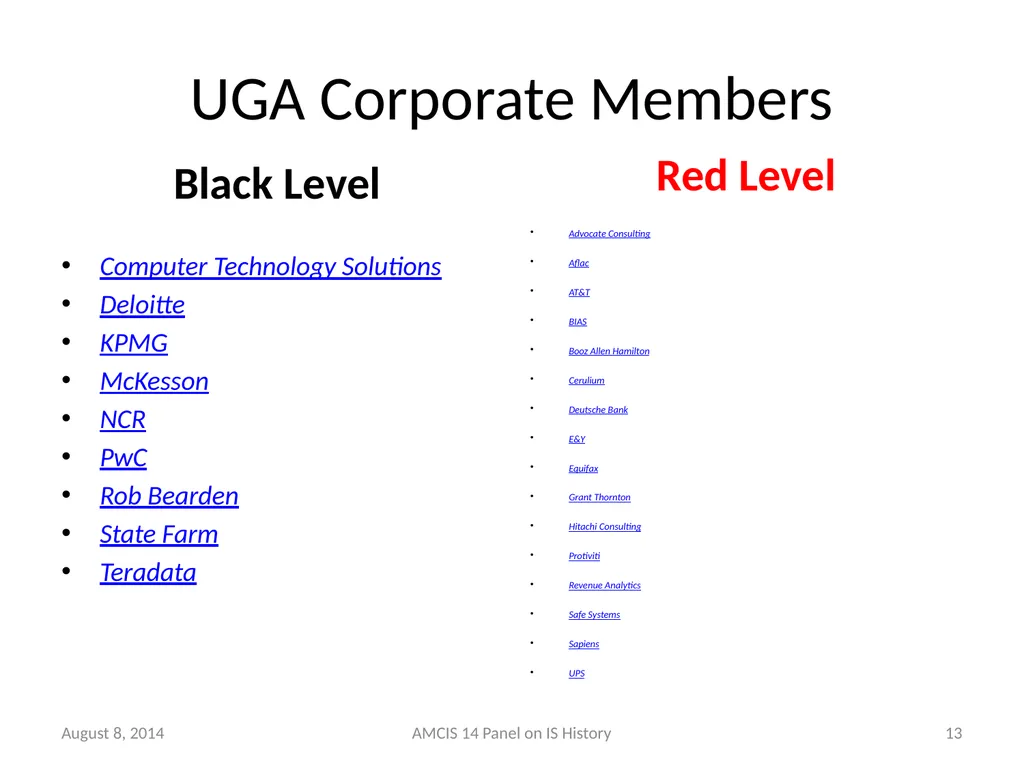
UGA Corporate Members Black Level Computer Technology Solutions
Deloitte
KPMG
McKesson
NCR
PwC
Rob Bearden
State Farm
Teradata Red Level Advocate Consulting
Aflac
AT&T
BIAS
Booz Allen Hamilton
Cerulium
Deutsche Bank
E&Y
Equifax
Grant Thornton
Hitachi Consulting
Protiviti
Revenue Analytics
Safe Systems
Sapiens
UPS August 8, 2014 AMCIS 14 Panel on IS History 13<br>
Deloitte
KPMG
McKesson
NCR
PwC
Rob Bearden
State Farm
Teradata Red Level Advocate Consulting
Aflac
AT&T
BIAS
Booz Allen Hamilton
Cerulium
Deutsche Bank
E&Y
Equifax
Grant Thornton
Hitachi Consulting
Protiviti
Revenue Analytics
Safe Systems
Sapiens
UPS August 8, 2014 AMCIS 14 Panel on IS History 13<br>
14
Industry Advisory Boards The issues faced and current operation of the Board might be of interest.
Membership fees
Board composition
Students on the Board
Board meetings and events
Keeping meetings interesting
Remember why Board members are there August 8, 2014 AMCIS 14 Panel on IS History 14<br>
Membership fees
Board composition
Students on the Board
Board meetings and events
Keeping meetings interesting
Remember why Board members are there August 8, 2014 AMCIS 14 Panel on IS History 14<br>
15
University Alliance Programs Vendors provide resources – software, instructional materials
Vendors offering programs include
IBM
Microsoft
Oracle
SAP
SAS
Teradata August 8, 2014 AMCIS 14 Panel on IS History 15<br>
Vendors offering programs include
IBM
Microsoft
Oracle
SAP
SAS
Teradata August 8, 2014 AMCIS 14 Panel on IS History 15<br>
16
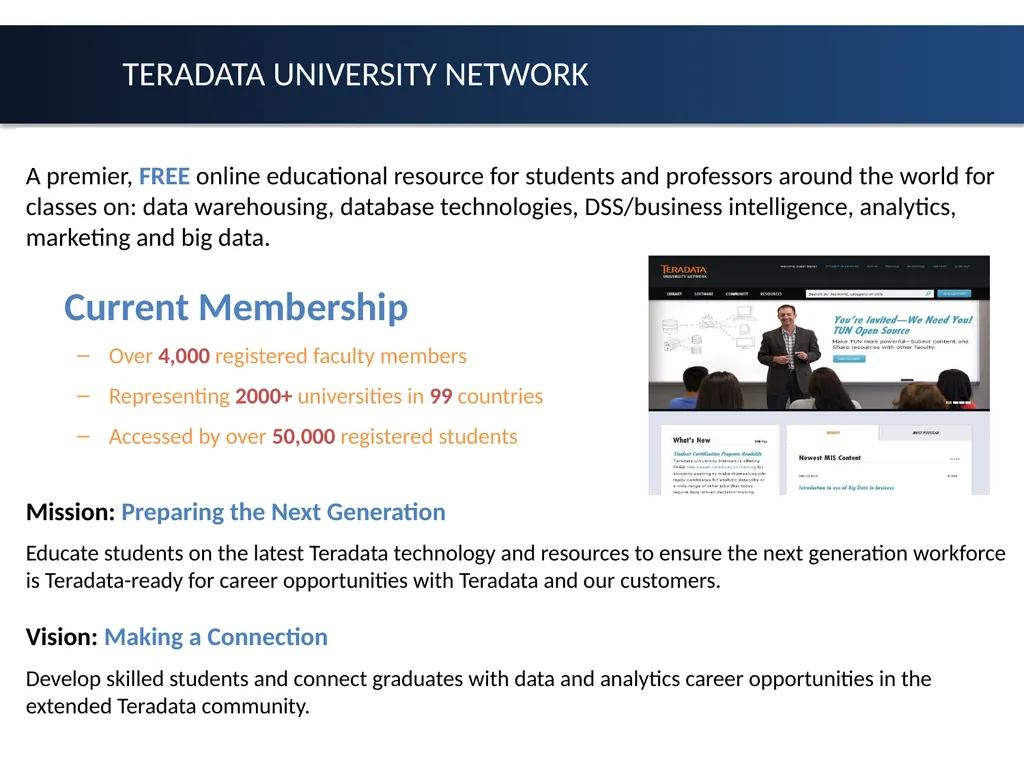
Teradata university network A premier, FREE online educational resource for students and professors around the world for classes on: data warehousing, database technologies, DSS/business intelligence, analytics, marketing and big data.
Current Membership
Over 4,000 registered faculty members
Representing 2000+ universities in 99 countries
Accessed by over 50,000 registered students
Mission: Preparing the Next Generation
Educate students on the latest Teradata technology and resources to ensure the next generation workforce is Teradata-ready for career opportunities with Teradata and our customers.
Vision: Making a Connection
Develop skilled students and connect graduates with data and analytics career opportunities in the extended Teradata community.<br>
Current Membership
Over 4,000 registered faculty members
Representing 2000+ universities in 99 countries
Accessed by over 50,000 registered students
Mission: Preparing the Next Generation
Educate students on the latest Teradata technology and resources to ensure the next generation workforce is Teradata-ready for career opportunities with Teradata and our customers.
Vision: Making a Connection
Develop skilled students and connect graduates with data and analytics career opportunities in the extended Teradata community.<br>
17
Jerry Luftman AMCIS 14 Panel on IS History 17 August 8, 2014<br>
18
JERRY LUFTMAN Ph.D.
luftman@hotmail.com www.globaliim.com IT Trends<br>
luftman@hotmail.com www.globaliim.com IT Trends<br>
19
“ THE ONE THING WE KNOW ABOUT THE FUTURE IS THAT IT IS COMING. ” FUTURE<br>
20
The most significant change to IT in the future will be:
Contribution/Value to business
HR/Skills/Sourcing
Governance/Relationship to business
Organizational reporting
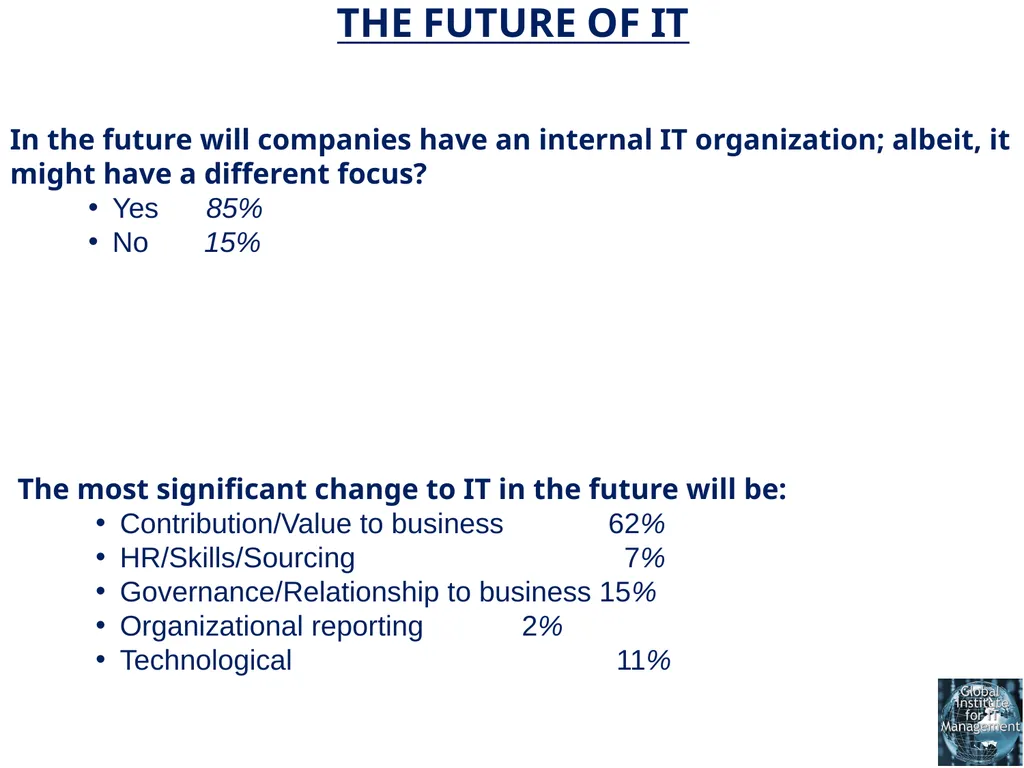
Technological THE FUTURE OF IT In the future will companies have an internal IT organization; albeit, it might have a different focus?
Yes
No In the future will companies have an internal IT organization; albeit, it might have a different focus?
Yes 85%
No 15% The most significant change to IT in the future will be:
Contribution/Value to business 62%
HR/Skills/Sourcing 7%
Governance/Relationship to business 15%
Organizational reporting 2%
Technological 11%<br>
Contribution/Value to business
HR/Skills/Sourcing
Governance/Relationship to business
Organizational reporting
Technological THE FUTURE OF IT In the future will companies have an internal IT organization; albeit, it might have a different focus?
Yes
No In the future will companies have an internal IT organization; albeit, it might have a different focus?
Yes 85%
No 15% The most significant change to IT in the future will be:
Contribution/Value to business 62%
HR/Skills/Sourcing 7%
Governance/Relationship to business 15%
Organizational reporting 2%
Technological 11%<br>
21
The biggest mistake a CIO can make relates to:
Business communications/Partners
Demonstrating value
HR/People/Sourcing
IT processes
Technology/Vendors The most effective way for CIOs to communicate with their internal business (non-IT) executives is via:
Board meeting presentations
Governance meetings
Informal discussions/meetings
IT briefings
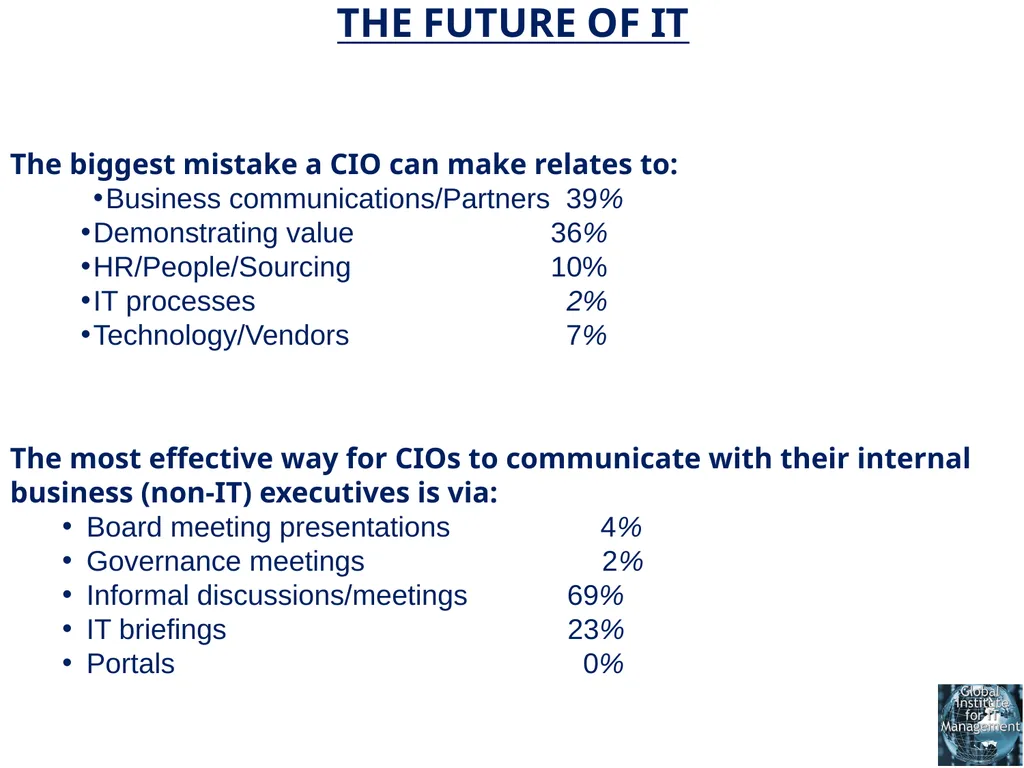
Portals The biggest mistake a CIO can make relates to:
Business communications/Partners 39%
Demonstrating value 36%
HR/People/Sourcing 10%
IT processes 2%
Technology/Vendors 7% The most effective way for CIOs to communicate with their internal business (non-IT) executives is via:
Board meeting presentations 4%
Governance meetings 2%
Informal discussions/meetings 69%
IT briefings 23%
Portals 0% THE FUTURE OF IT<br>
Business communications/Partners
Demonstrating value
HR/People/Sourcing
IT processes
Technology/Vendors The most effective way for CIOs to communicate with their internal business (non-IT) executives is via:
Board meeting presentations
Governance meetings
Informal discussions/meetings
IT briefings
Portals The biggest mistake a CIO can make relates to:
Business communications/Partners 39%
Demonstrating value 36%
HR/People/Sourcing 10%
IT processes 2%
Technology/Vendors 7% The most effective way for CIOs to communicate with their internal business (non-IT) executives is via:
Board meeting presentations 4%
Governance meetings 2%
Informal discussions/meetings 69%
IT briefings 23%
Portals 0% THE FUTURE OF IT<br>
22
The most important skill for the head of IT application services (whatever it might be called) of the future will be:
General Business Knowledge
Interpersonal/Communications
Knowledge of applying IT to business
Leadership
Technology Awareness The most important skill for the CTO (head of IT infrastructure architecture whatever it might be called) of the future will be:
General Business Knowledge
Interpersonal/Communications
Knowledge of applying IT to business
Leadership
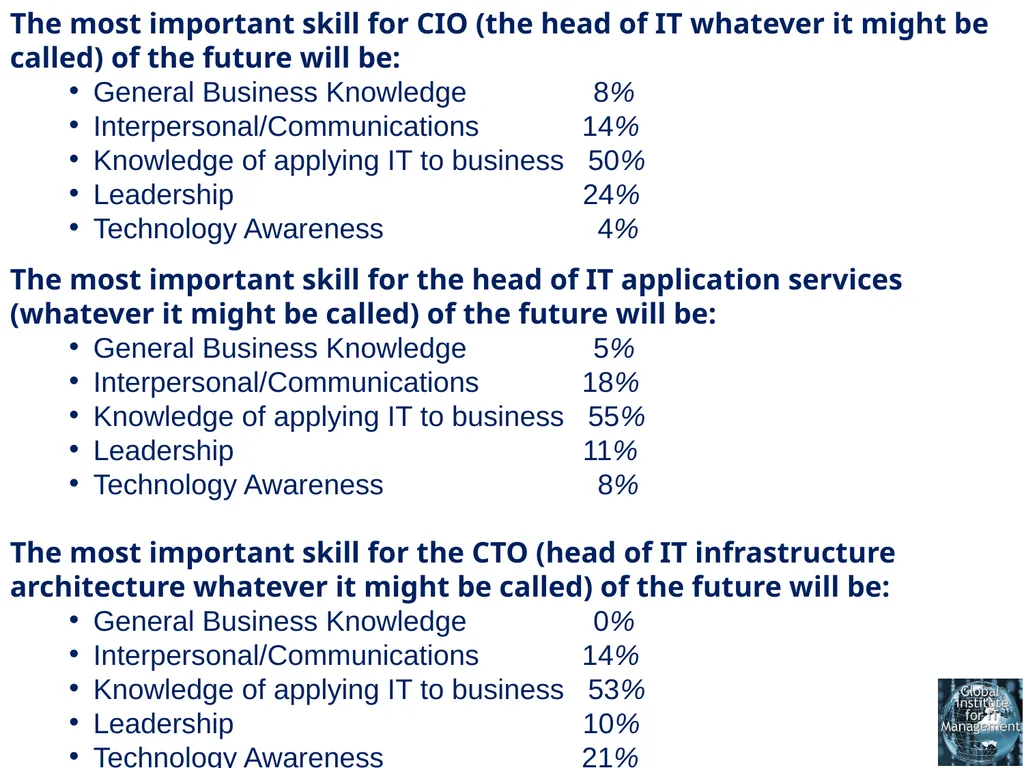
Technology Awareness The most important skill for CIO (the head of IT whatever it might be called) of the future will be:
General Business Knowledge
Interpersonal/Communications
Knowledge of applying IT to business
Leadership
Technology Awareness The most important skill for CIO (the head of IT whatever it might be called) of the future will be:
General Business Knowledge 8%
Interpersonal/Communications 14%
Knowledge of applying IT to business 50%
Leadership 24%
Technology Awareness 4% The most important skill for the head of IT application services (whatever it might be called) of the future will be:
General Business Knowledge 5%
Interpersonal/Communications 18%
Knowledge of applying IT to business 55%
Leadership 11%
Technology Awareness 8% The most important skill for the CTO (head of IT infrastructure architecture whatever it might be called) of the future will be:
General Business Knowledge 0%
Interpersonal/Communications 14%
Knowledge of applying IT to business 53%
Leadership 10%
Technology Awareness 21%<br>
General Business Knowledge
Interpersonal/Communications
Knowledge of applying IT to business
Leadership
Technology Awareness The most important skill for the CTO (head of IT infrastructure architecture whatever it might be called) of the future will be:
General Business Knowledge
Interpersonal/Communications
Knowledge of applying IT to business
Leadership
Technology Awareness The most important skill for CIO (the head of IT whatever it might be called) of the future will be:
General Business Knowledge
Interpersonal/Communications
Knowledge of applying IT to business
Leadership
Technology Awareness The most important skill for CIO (the head of IT whatever it might be called) of the future will be:
General Business Knowledge 8%
Interpersonal/Communications 14%
Knowledge of applying IT to business 50%
Leadership 24%
Technology Awareness 4% The most important skill for the head of IT application services (whatever it might be called) of the future will be:
General Business Knowledge 5%
Interpersonal/Communications 18%
Knowledge of applying IT to business 55%
Leadership 11%
Technology Awareness 8% The most important skill for the CTO (head of IT infrastructure architecture whatever it might be called) of the future will be:
General Business Knowledge 0%
Interpersonal/Communications 14%
Knowledge of applying IT to business 53%
Leadership 10%
Technology Awareness 21%<br>
23
The future skills of the CIO (head of IT, whatever it might be called) will be:
More technical
More business
More business & technical
Unchanged
There will not be a CIO (head of IT) The future skills of the CTO (head of infrastructure/architecture, whatever it might be called) will be:
More technical
More business
More business & technical
Unchanged
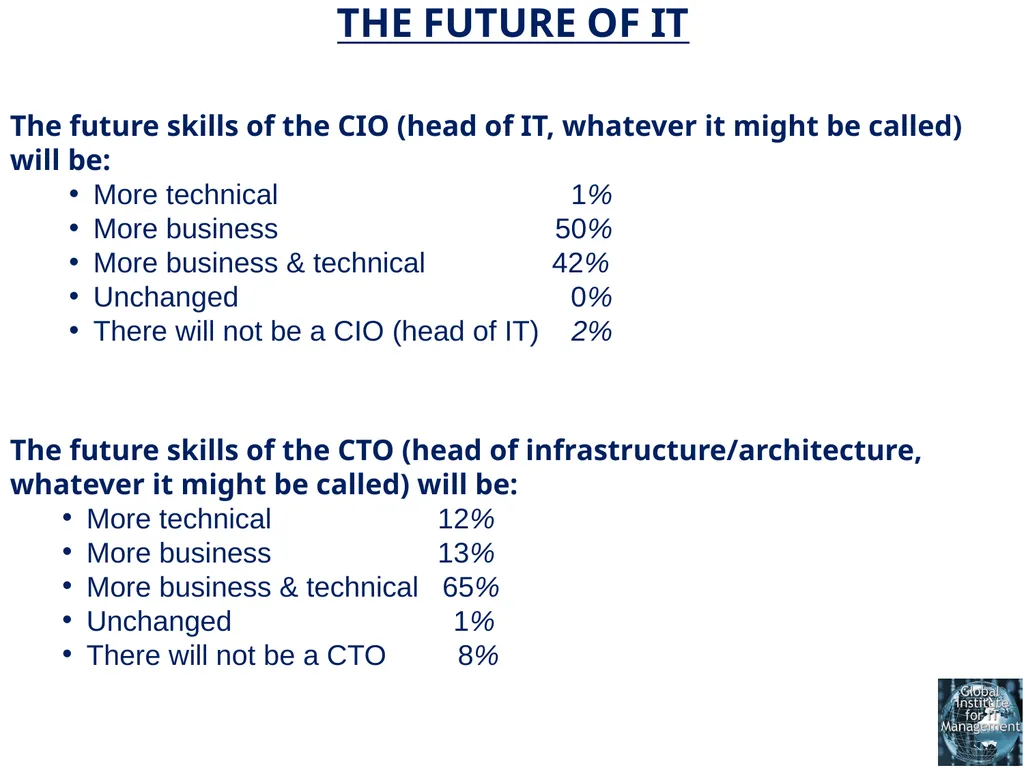
There will not be a CTO The future skills of the CIO (head of IT, whatever it might be called) will be:
More technical 1%
More business 50%
More business & technical 42%
Unchanged 0%
There will not be a CIO (head of IT) 2% The future skills of the CTO (head of infrastructure/architecture, whatever it might be called) will be:
More technical 12%
More business 13%
More business & technical 65%
Unchanged 1%
There will not be a CTO 8% THE FUTURE OF IT<br>
More technical
More business
More business & technical
Unchanged
There will not be a CIO (head of IT) The future skills of the CTO (head of infrastructure/architecture, whatever it might be called) will be:
More technical
More business
More business & technical
Unchanged
There will not be a CTO The future skills of the CIO (head of IT, whatever it might be called) will be:
More technical 1%
More business 50%
More business & technical 42%
Unchanged 0%
There will not be a CIO (head of IT) 2% The future skills of the CTO (head of infrastructure/architecture, whatever it might be called) will be:
More technical 12%
More business 13%
More business & technical 65%
Unchanged 1%
There will not be a CTO 8% THE FUTURE OF IT<br>
24
Will the future of supporting IT infrastructure be primarily done by outsourcing to a Cloud service provider?
Yes
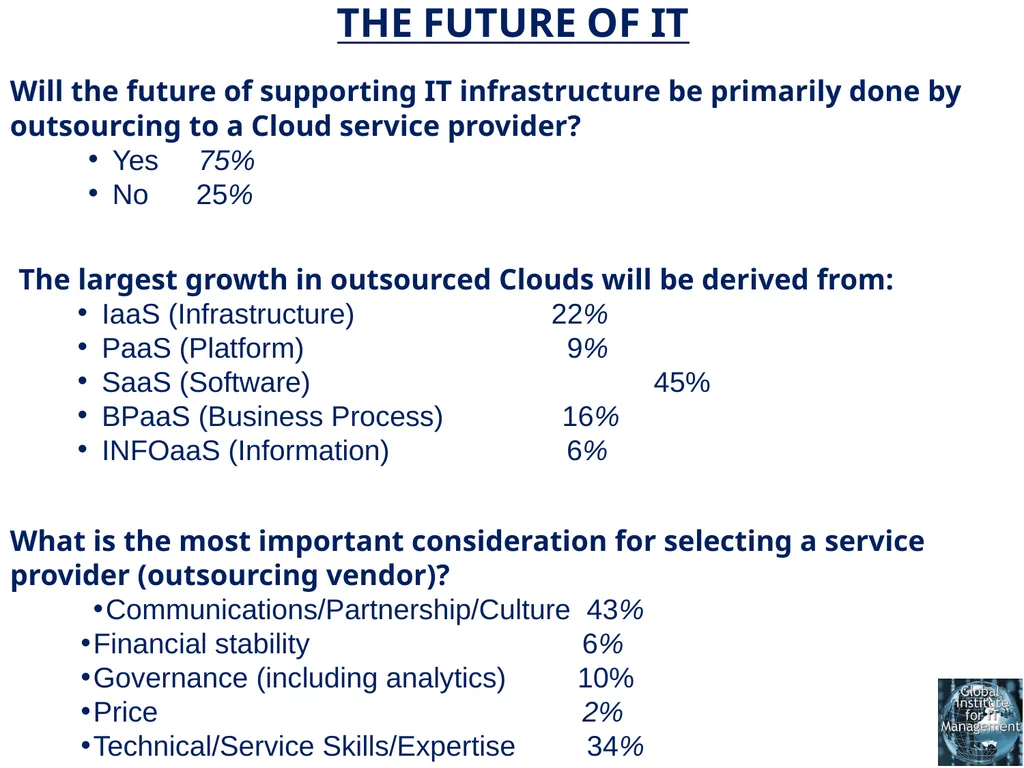
No Will the future of supporting IT infrastructure be primarily done by outsourcing to a Cloud service provider?
Yes 75%
No 25% The largest growth in outsourced Clouds will be derived from:
IaaS (Infrastructure)
PaaS (Platform)
SaaS (Software)
BPaaS (Business Process)
INFOaaS (Information) The largest growth in outsourced Clouds will be derived from:
IaaS (Infrastructure) 22%
PaaS (Platform) 9%
SaaS (Software) 45%
BPaaS (Business Process) 16%
INFOaaS (Information) 6% What is the most important consideration for selecting a service provider (outsourcing vendor)?
Communications/Partnership/Culture
Financial stability
Governance (including analytics)
Price
Technical/Service skills/Expertise What is the most important consideration for selecting a service provider (outsourcing vendor)?
Communications/Partnership/Culture 43%
Financial stability 6%
Governance (including analytics) 10%
Price 2%
Technical/Service Skills/Expertise 34% THE FUTURE OF IT<br>
Yes
No Will the future of supporting IT infrastructure be primarily done by outsourcing to a Cloud service provider?
Yes 75%
No 25% The largest growth in outsourced Clouds will be derived from:
IaaS (Infrastructure)
PaaS (Platform)
SaaS (Software)
BPaaS (Business Process)
INFOaaS (Information) The largest growth in outsourced Clouds will be derived from:
IaaS (Infrastructure) 22%
PaaS (Platform) 9%
SaaS (Software) 45%
BPaaS (Business Process) 16%
INFOaaS (Information) 6% What is the most important consideration for selecting a service provider (outsourcing vendor)?
Communications/Partnership/Culture
Financial stability
Governance (including analytics)
Price
Technical/Service skills/Expertise What is the most important consideration for selecting a service provider (outsourcing vendor)?
Communications/Partnership/Culture 43%
Financial stability 6%
Governance (including analytics) 10%
Price 2%
Technical/Service Skills/Expertise 34% THE FUTURE OF IT<br>
25
Will future IT application development staff be primarily organized:
Centralized
Decentralized
Federated
Networked
Not part of an IT function The future of developing and maintaining application services will see the largest increase coming from:
COTS (Commercial Off The Shelf)
ERPs
In-House Staff
Outsourced Off-Shore
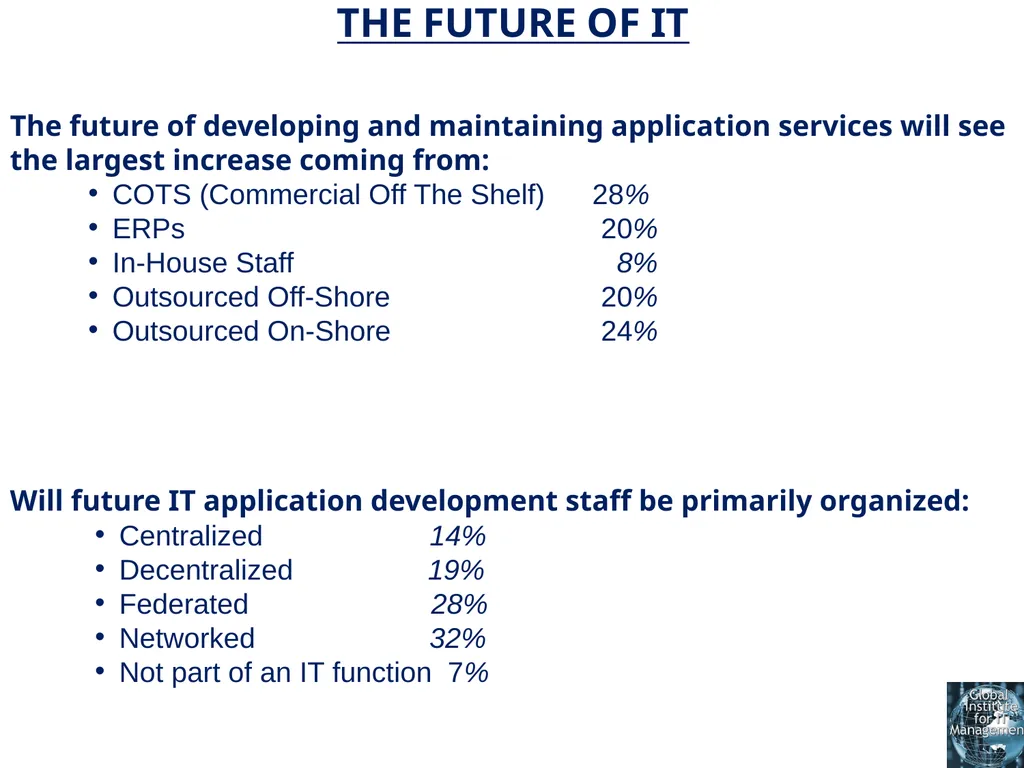
Outsourced On-Shore Will future IT application development staff be primarily organized:
Centralized 14%
Decentralized 19%
Federated 28%
Networked 32%
Not part of an IT function 7% The future of developing and maintaining application services will see the largest increase coming from:
COTS (Commercial Off The Shelf) 28%
ERPs 20%
In-House Staff 8%
Outsourced Off-Shore 20%
Outsourced On-Shore 24% THE FUTURE OF IT<br>
Centralized
Decentralized
Federated
Networked
Not part of an IT function The future of developing and maintaining application services will see the largest increase coming from:
COTS (Commercial Off The Shelf)
ERPs
In-House Staff
Outsourced Off-Shore
Outsourced On-Shore Will future IT application development staff be primarily organized:
Centralized 14%
Decentralized 19%
Federated 28%
Networked 32%
Not part of an IT function 7% The future of developing and maintaining application services will see the largest increase coming from:
COTS (Commercial Off The Shelf) 28%
ERPs 20%
In-House Staff 8%
Outsourced Off-Shore 20%
Outsourced On-Shore 24% THE FUTURE OF IT<br>
26
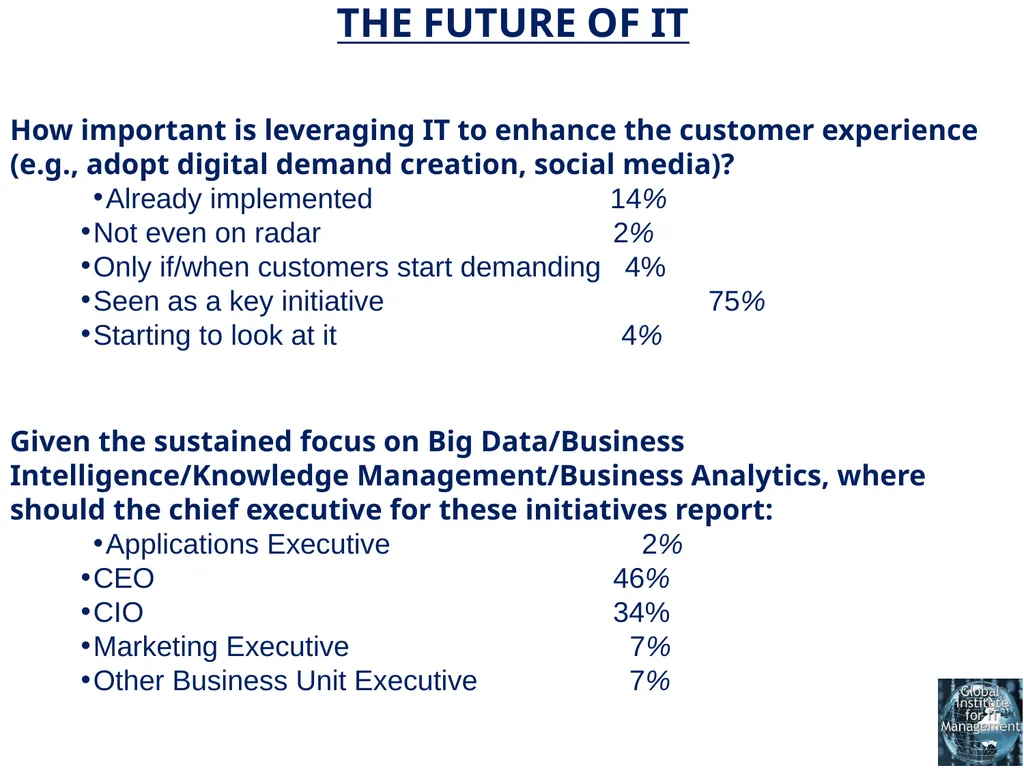
How important is leveraging IT to enhance the customer experience (e.g., adopt digital demand creation, social media)?
Already implemented
Not even on radar
Only if/when customers start demanding
Seen as a key initiative
Starting to look at it Given the sustained focus on Big Data/Business Intelligence/Knowledge Management/Business Analytics, where should the chief executive for these initiatives report:
Applications Executive
CEO
CIO
Marketing Executive
Other Business Unit Executive How important is leveraging IT to enhance the customer experience (e.g., adopt digital demand creation, social media)?
Already implemented 14%
Not even on radar 2%
Only if/when customers start demanding 4%
Seen as a key initiative 75%
Starting to look at it 4% Given the sustained focus on Big Data/Business Intelligence/Knowledge Management/Business Analytics, where should the chief executive for these initiatives report:
Applications Executive 2%
CEO 46%
CIO 34%
Marketing Executive 7%
Other Business Unit Executive 7% THE FUTURE OF IT<br>
Already implemented
Not even on radar
Only if/when customers start demanding
Seen as a key initiative
Starting to look at it Given the sustained focus on Big Data/Business Intelligence/Knowledge Management/Business Analytics, where should the chief executive for these initiatives report:
Applications Executive
CEO
CIO
Marketing Executive
Other Business Unit Executive How important is leveraging IT to enhance the customer experience (e.g., adopt digital demand creation, social media)?
Already implemented 14%
Not even on radar 2%
Only if/when customers start demanding 4%
Seen as a key initiative 75%
Starting to look at it 4% Given the sustained focus on Big Data/Business Intelligence/Knowledge Management/Business Analytics, where should the chief executive for these initiatives report:
Applications Executive 2%
CEO 46%
CIO 34%
Marketing Executive 7%
Other Business Unit Executive 7% THE FUTURE OF IT<br>
27
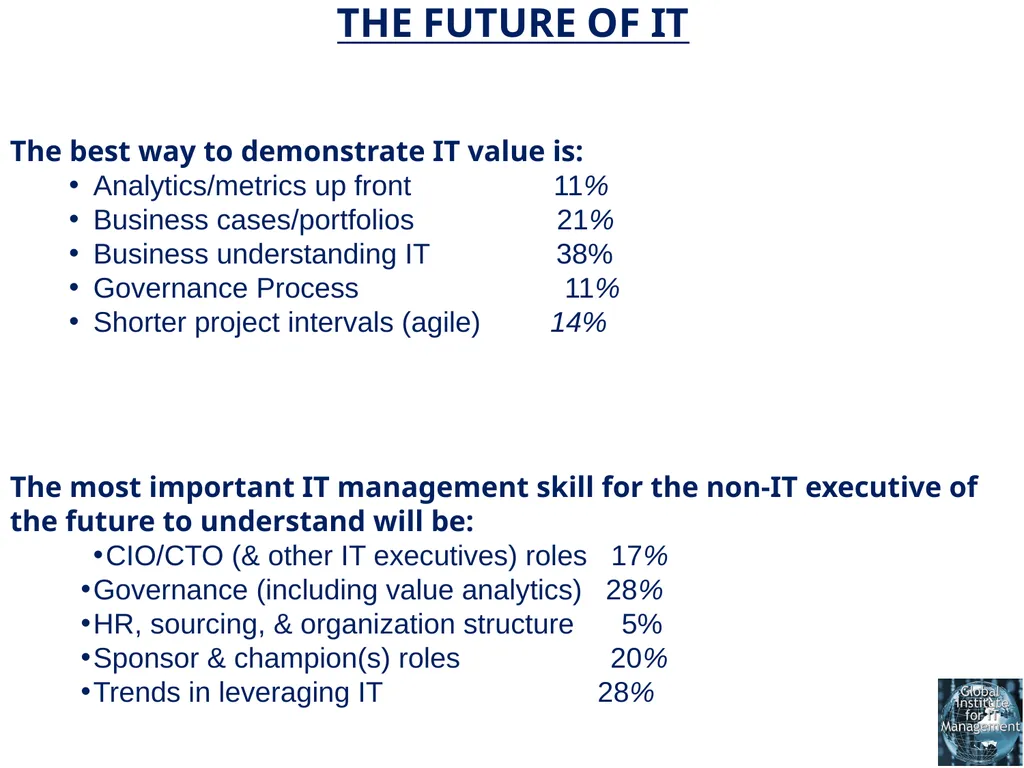
The most important IT management skill for the non-IT executive of the future to understand will be:
CIO/CTO (& other IT executives) roles)
Governance (including value analytics)
HR, sourcing, & organization structure
Sponsor & champion(s) roles
Trends in leveraging IT The most important IT management skill for the non-IT executive of the future to understand will be:
CIO/CTO (& other IT executives) roles 17%
Governance (including value analytics) 28%
HR, sourcing, & organization structure 5%
Sponsor & champion(s) roles 20%
Trends in leveraging IT 28% The best way to demonstrate IT value is:
Analytics/metrics up front
Business cases/portfolios
Business understanding IT
Governance Process
Shorter project intervals (agile) The best way to demonstrate IT value is:
Analytics/metrics up front 11%
Business cases/portfolios 21%
Business understanding IT 38%
Governance Process 11%
Shorter project intervals (agile) 14% THE FUTURE OF IT<br>
CIO/CTO (& other IT executives) roles)
Governance (including value analytics)
HR, sourcing, & organization structure
Sponsor & champion(s) roles
Trends in leveraging IT The most important IT management skill for the non-IT executive of the future to understand will be:
CIO/CTO (& other IT executives) roles 17%
Governance (including value analytics) 28%
HR, sourcing, & organization structure 5%
Sponsor & champion(s) roles 20%
Trends in leveraging IT 28% The best way to demonstrate IT value is:
Analytics/metrics up front
Business cases/portfolios
Business understanding IT
Governance Process
Shorter project intervals (agile) The best way to demonstrate IT value is:
Analytics/metrics up front 11%
Business cases/portfolios 21%
Business understanding IT 38%
Governance Process 11%
Shorter project intervals (agile) 14% THE FUTURE OF IT<br>
28
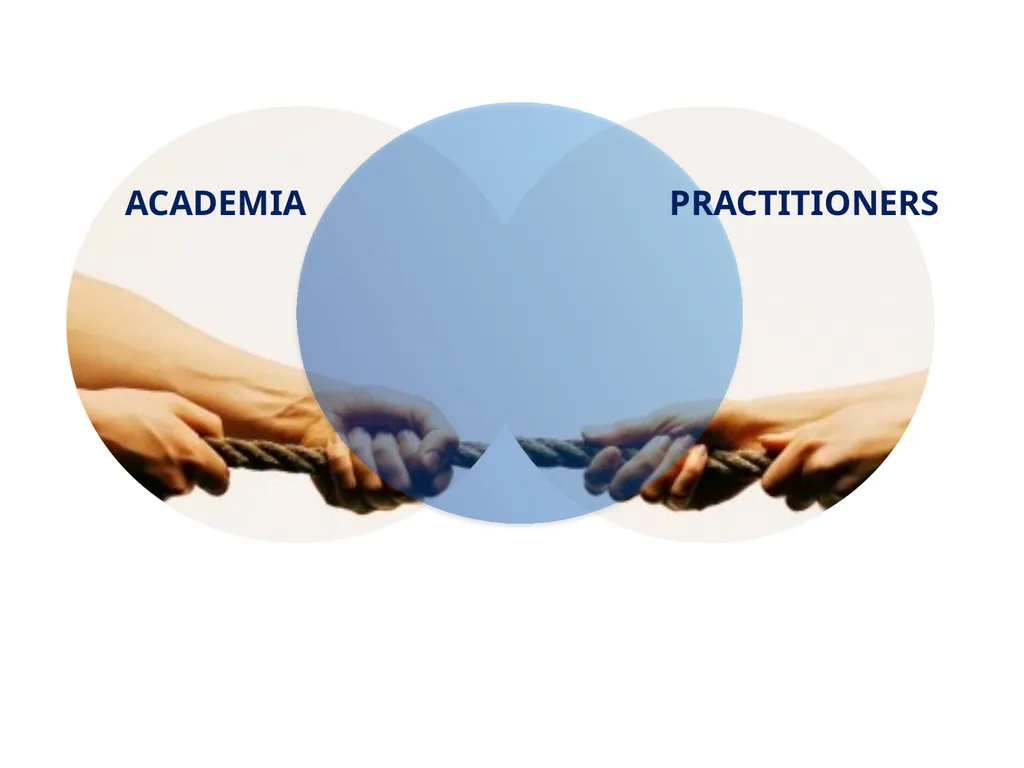
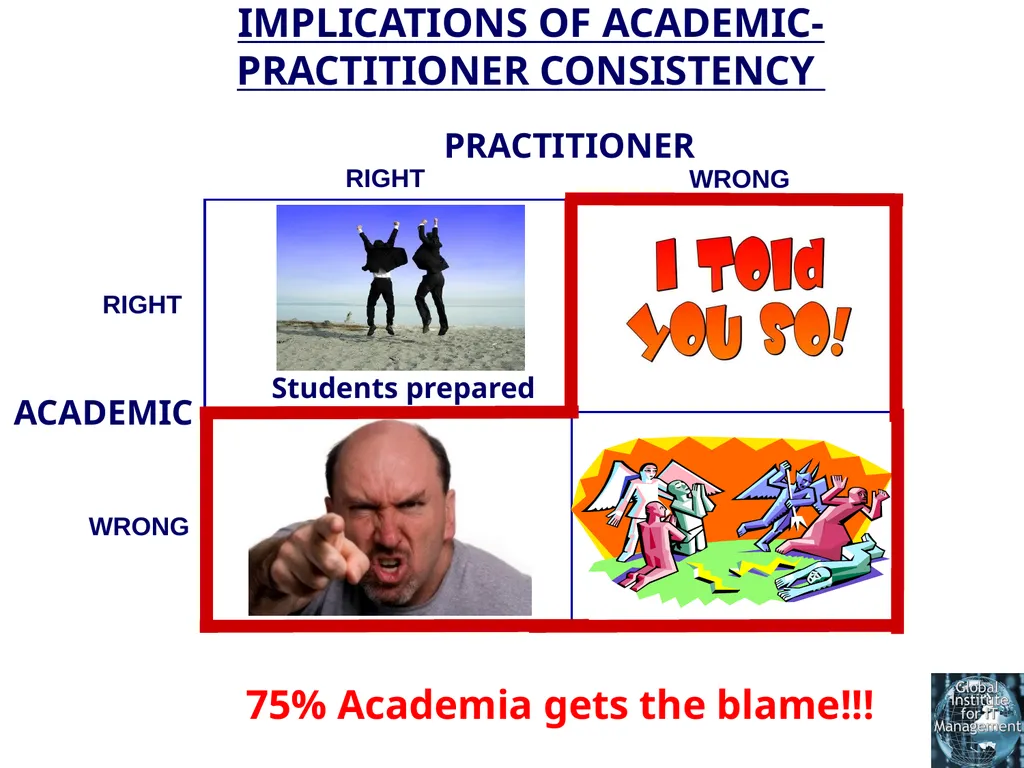
Implications of Academic-Practitioner Consistency<br>
29
Eph McLean AMCIS 14 Panel on IS History 30 August 8, 2014<br>
30
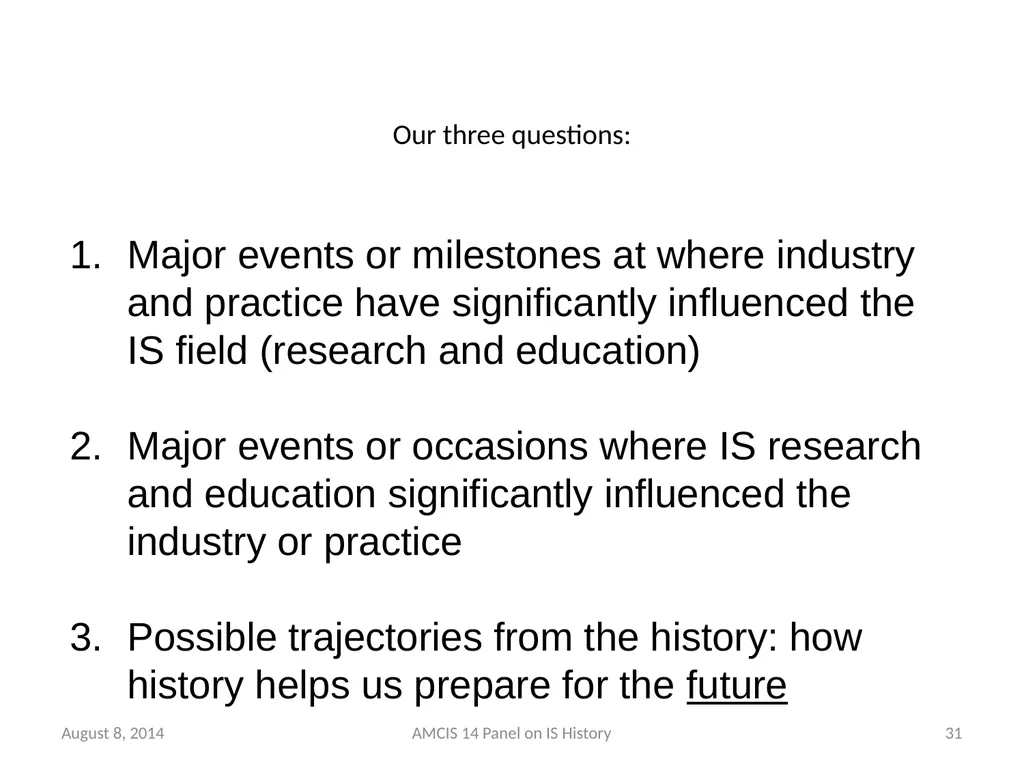
Our three questions: August 8, 2014 AMCIS 14 Panel on IS History 31 Major events or milestones at where industry and practice have significantly influenced the IS field (research and education)
Major events or occasions where IS research and education significantly influenced the industry or practice
Possible trajectories from the history: how history helps us prepare for the future<br>
Major events or occasions where IS research and education significantly influenced the industry or practice
Possible trajectories from the history: how history helps us prepare for the future<br>
31
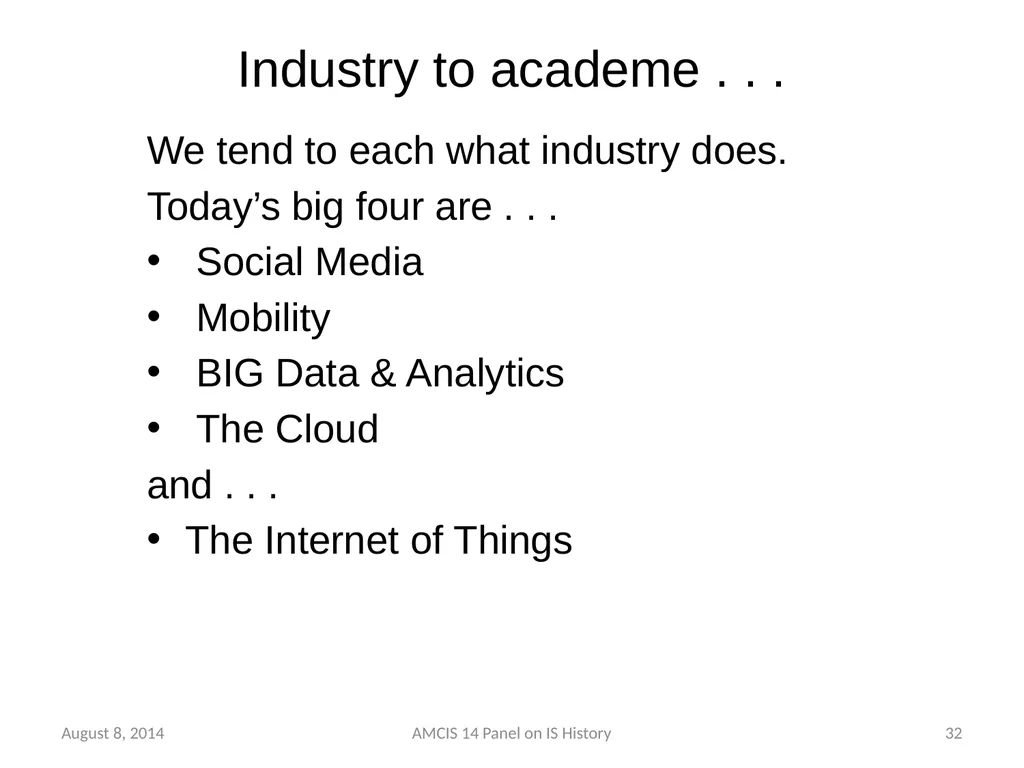
Industry to academe . . . We tend to each what industry does.
Today’s big four are . . .
Social Media
Mobility
BIG Data & Analytics
The Cloud
and . . .
The Internet of Things August 8, 2014 AMCIS 14 Panel on IS History 32<br>
Today’s big four are . . .
Social Media
Mobility
BIG Data & Analytics
The Cloud
and . . .
The Internet of Things August 8, 2014 AMCIS 14 Panel on IS History 32<br>
32
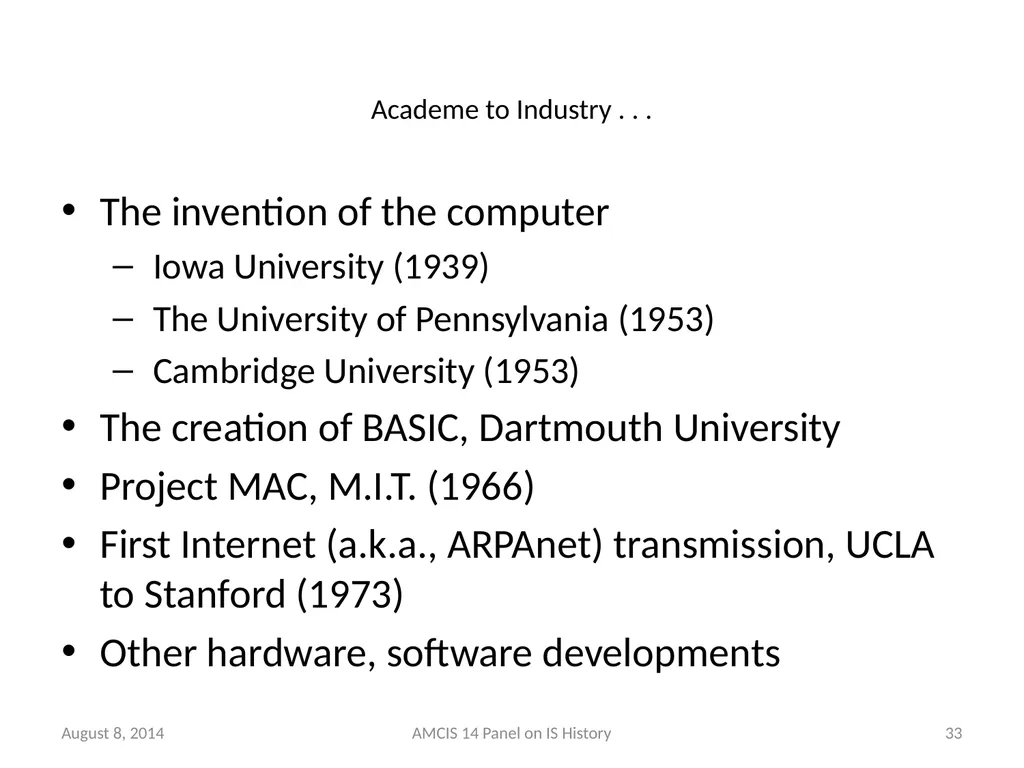
Academe to Industry . . . The invention of the computer
Iowa University (1939)
The University of Pennsylvania (1953)
Cambridge University (1953)
The creation of BASIC, Dartmouth University
Project MAC, M.I.T. (1966)
First Internet (a.k.a., ARPAnet) transmission, UCLA to Stanford (1973)
Other hardware, software developments August 8, 2014 AMCIS 14 Panel on IS History 33<br>
Iowa University (1939)
The University of Pennsylvania (1953)
Cambridge University (1953)
The creation of BASIC, Dartmouth University
Project MAC, M.I.T. (1966)
First Internet (a.k.a., ARPAnet) transmission, UCLA to Stanford (1973)
Other hardware, software developments August 8, 2014 AMCIS 14 Panel on IS History 33<br>
33
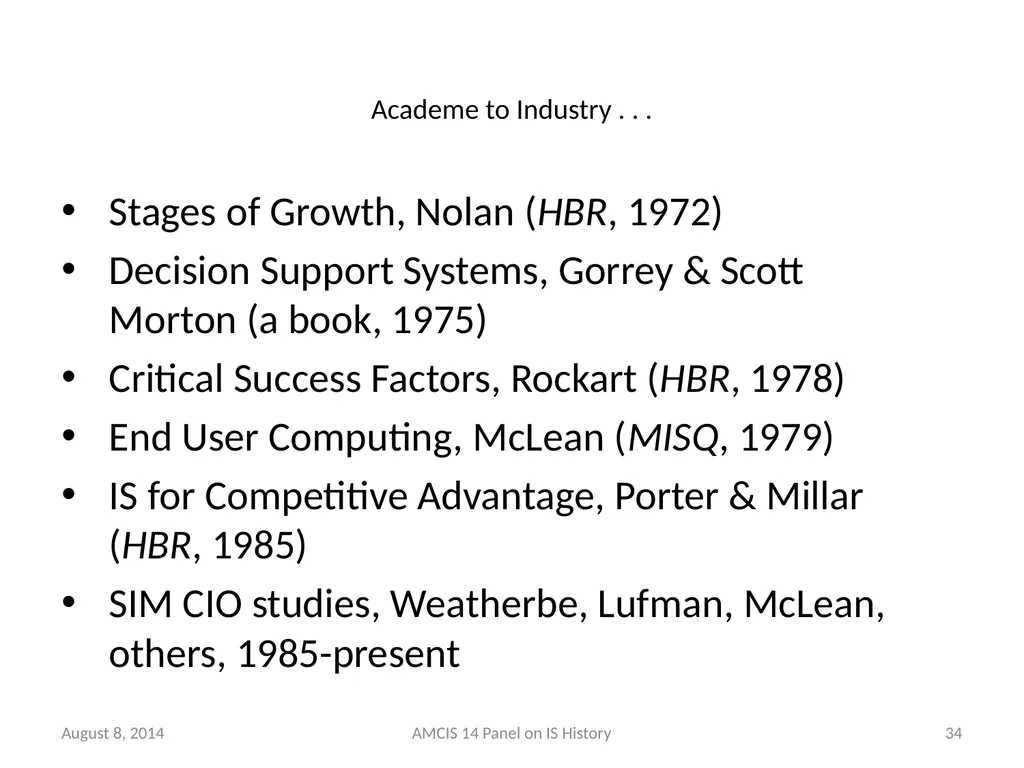
Academe to Industry . . . Stages of Growth, Nolan (HBR, 1972)
Decision Support Systems, Gorrey & Scott Morton (a book, 1975)
Critical Success Factors, Rockart (HBR, 1978)
End User Computing, McLean (MISQ, 1979)
IS for Competitive Advantage, Porter & Millar (HBR, 1985)
SIM CIO studies, Weatherbe, Lufman, McLean, others, 1985-present August 8, 2014 AMCIS 14 Panel on IS History 34<br>
Decision Support Systems, Gorrey & Scott Morton (a book, 1975)
Critical Success Factors, Rockart (HBR, 1978)
End User Computing, McLean (MISQ, 1979)
IS for Competitive Advantage, Porter & Millar (HBR, 1985)
SIM CIO studies, Weatherbe, Lufman, McLean, others, 1985-present August 8, 2014 AMCIS 14 Panel on IS History 34<br>
34
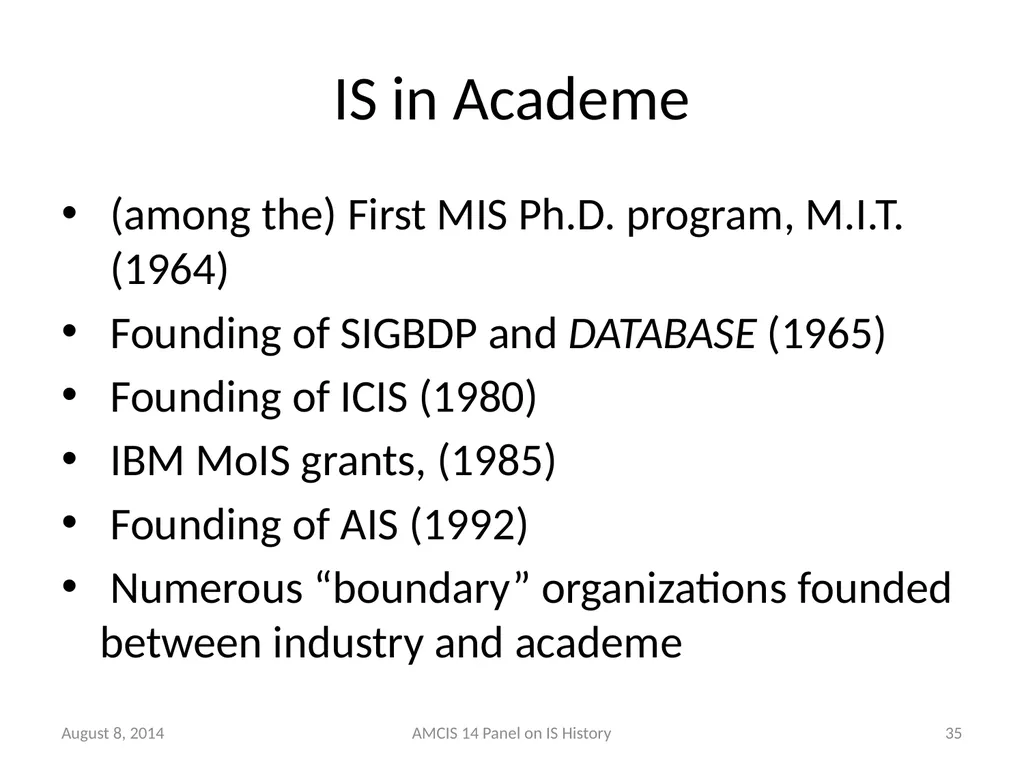
IS in Academe (among the) First MIS Ph.D. program, M.I.T.
(1964)
Founding of SIGBDP and DATABASE (1965)
Founding of ICIS (1980)
IBM MoIS grants, (1985)
Founding of AIS (1992)
Numerous “boundary” organizations founded between industry and academe August 8, 2014 AMCIS 14 Panel on IS History 35<br>
Founding of SIGBDP and DATABASE (1965)
Founding of ICIS (1980)
IBM MoIS grants, (1985)
Founding of AIS (1992)
Numerous “boundary” organizations founded between industry and academe August 8, 2014 AMCIS 14 Panel on IS History 35<br>
35
Our Future? I wrote a paper in 1985 on the future of IS programs in universities.
It compared what was happening in IS to what had happened to university programs in Management Science/Operations Research.
My prediction: we would thrive as IS departments in universities long as IS organizations in industry thrive.
So . . . are we thriving? August 8, 2014 AMCIS 14 Panel on IS History 36<br>
It compared what was happening in IS to what had happened to university programs in Management Science/Operations Research.
My prediction: we would thrive as IS departments in universities long as IS organizations in industry thrive.
So . . . are we thriving? August 8, 2014 AMCIS 14 Panel on IS History 36<br>
36
Audience’s Responses
&
Learning from the history to help in the future AMCIS 14 Panel on IS History 37 August 8, 2014<br>
37
Thank You! Ping Zhang, Syracuse University, USA
Jerry Luftman, Global Institute for IT Management LLC
Eph McLean, AIS Leo Award Recipient, George State University
Hugh Watson, University of Georgia AMCIS 14 Panel on IS History 38 August 8, 2014<br>
Jerry Luftman, Global Institute for IT Management LLC
Eph McLean, AIS Leo Award Recipient, George State University
Hugh Watson, University of Georgia AMCIS 14 Panel on IS History 38 August 8, 2014<br>