Paper Title Authors Venue, Year Your Name (email) Date of presentation 2 Problem Motivation (1-2 slides) Clearly define the problems addressed in this work Why are they important? What are the challenges in solving them? The inputoutput
"Paper Title Authors Venue, Year Your Name (email)" is the property of its rightful owner. Permission is granted to
download and print the materials on this website for personal, non-commercial use only, and to display it
on your personal computer provided you do not modify the materials and that you retain all copyright
notices contained in the materials. By downloading content from our website, you accept the terms of this
agreement.
Presentation Transcript
01
Paper Title Authors Venue, Year Your Name (email)
Date of presentation<br>
02
2 Problem & Motivation (1-2 slides) Clearly define the problems addressed in this work
Why are they important?
What are the challenges in solving them?
The input/output space should be very clearly defined (if relevant)
Examples of the problem<br>
03
3 Contents: List of contents of the presentation<br>
04
4 Previous approaches (SoTA) (1-2 slide) Briefly explain the best/widely used approach for the problem (if methods exist)
Make connections to relevant work previously presented in this course<br>
05
5 Contributions of this work (1 slide) Sneak peak into the contributions of this work
Eg. New NLP problems, Representations, Models, Algorithmic approaches, Datasets, etc.
Potentially discuss additional contributions that the work makes, but were not explicitly stated in the paper<br>
06
6 Details of the contributions (3-4 slides) Explain the high-level idea of the paper
preferably using an overview image, if relevant
Identify and clearly explain the assumptions made
Present the details of the proposed approaches, including important mathematical details.
If there are parts of the model that already existed, point it out clearly to isolate the contributions of this work<br>
07
7 Results and Analysis (2-3 slides) How does the paper argue for the claimed contributions
Typically these will be the experiments conducted to test the hypothesis; in some cases these can be mathematical proofs; or in rare cases it will be only arguments and examples.
Focus on the key experiments/arguments (not necessarily all)
Clearly define the experimental setup, datasets used, evaluation methodology
Analyze the results presented in the paper, and present only data-points that convey some information.
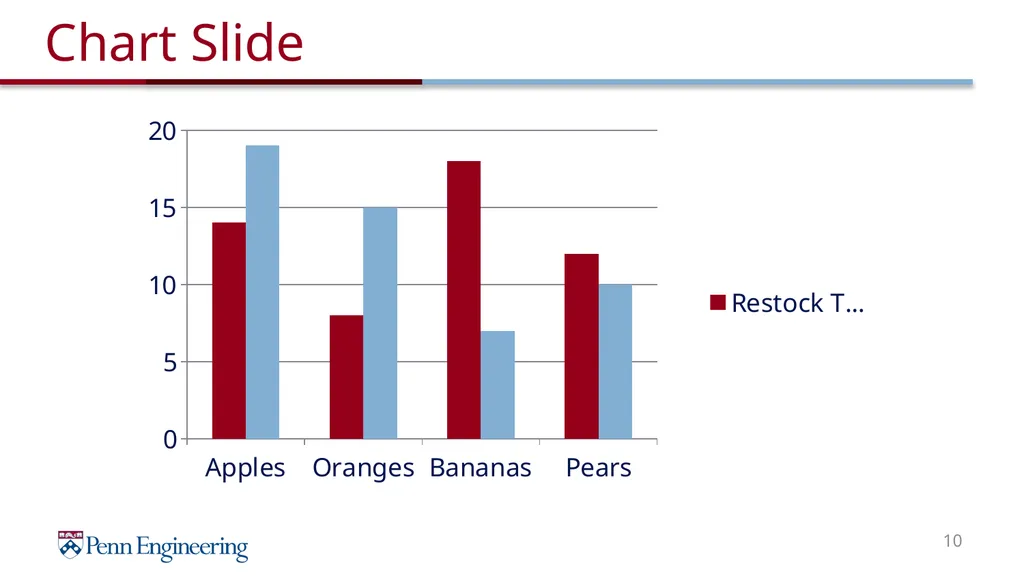
Do not blindly copy/screenshot tables from the papers. Make your own tables/plots (A template is at the end of this slide deck)
Analysis of the outputs – If there is analysis provided for outputs, example predictions (if present), etc.<br>
08
8 Conclusions, Shortcomings and Future Work (2-3 slides) What have you learned from this paper?
What are the important lessons that this work leaves for the community
Are there any resources, eg. Code, Datasets, Evaluation Metrics, etc. that are used / can be used for future research
What are the major shortcomings of the paper
It is usually easy to criticize papers, but coming up with solutions for criticism is difficult – Try to come up with possible solutions and discuss
How can this work be improved/extended?<br>