Paper Title: Ethiopias Digital Land Information System (NRLAIS): A Model for Climate-Responsive and Justice-Oriented Land Governance Author Name: Yohannes Redda Gebre, NRLAIS Manager affiliation: Responsible and Innovative Land
"Paper Title: Ethiopia’s Digital Land Information" is the property of its rightful owner. Permission is granted to
download and print the materials on this website for personal, non-commercial use only, and to display it
on your personal computer provided you do not modify the materials and that you retain all copyright
notices contained in the materials. By downloading content from our website, you accept the terms of this
agreement.
Presentation Transcript
01
Paper Title: Ethiopia’s Digital Land Information System (NRLAIS): A Model for Climate-Responsive and Justice-Oriented Land Governance Author Name: Yohannes Redda Gebre, NRLAIS Manager affiliation: Responsible and Innovative Land Administration (REILA) Project – NIRAS, Ministry of Agriculture, Ethiopia<br>
02
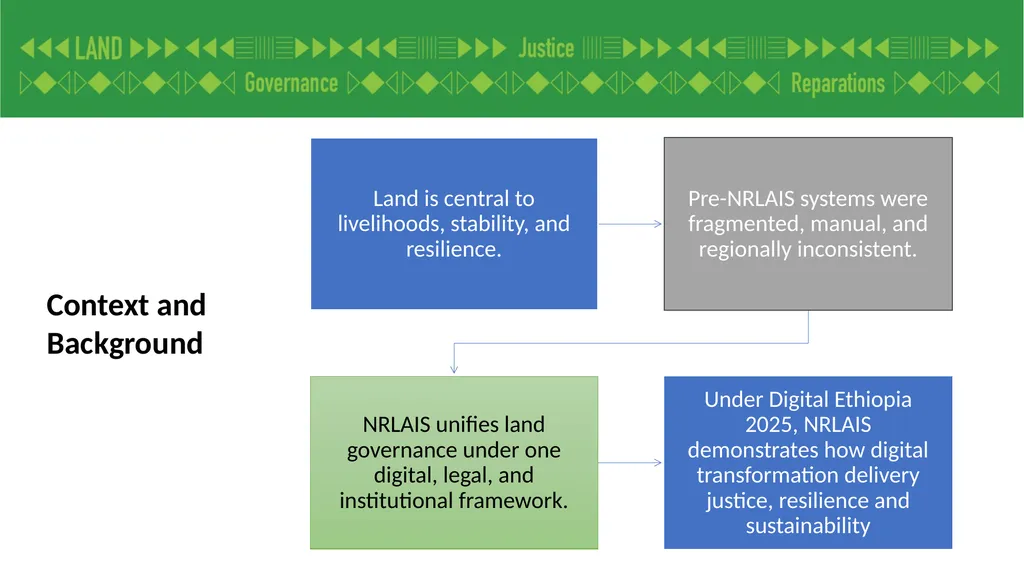
Context and Background<br>
03
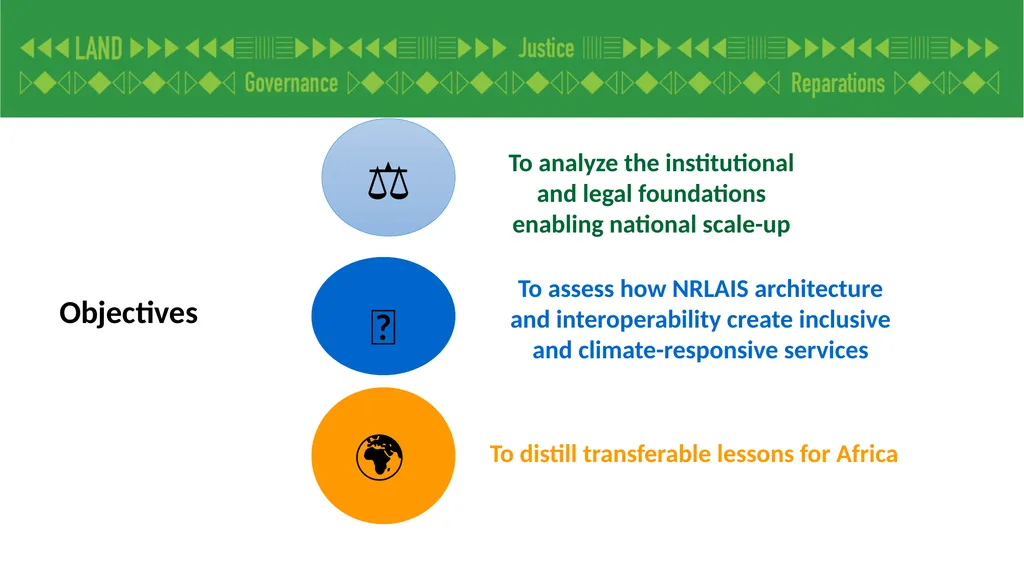
Objectives ⚖️ To analyze the institutional and legal foundations enabling national scale-up 🔗 To assess how NRLAIS architecture and interoperability create inclusive and climate-responsive services 🌍 To distill transferable lessons for Africa<br>
04
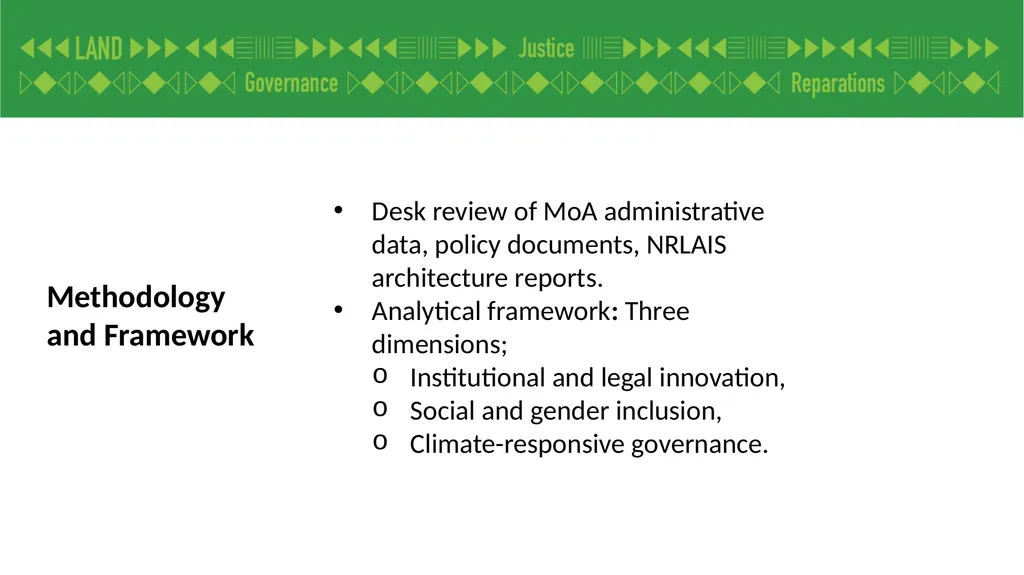
Methodology and Framework Desk review of MoA administrative data, policy documents, NRLAIS architecture reports.
Analytical framework: Three dimensions;
Institutional and legal innovation,
Social and gender inclusion,
Climate-responsive governance.<br>
05
Evolution and Scale Pilot →Capacity Building →Scaleup
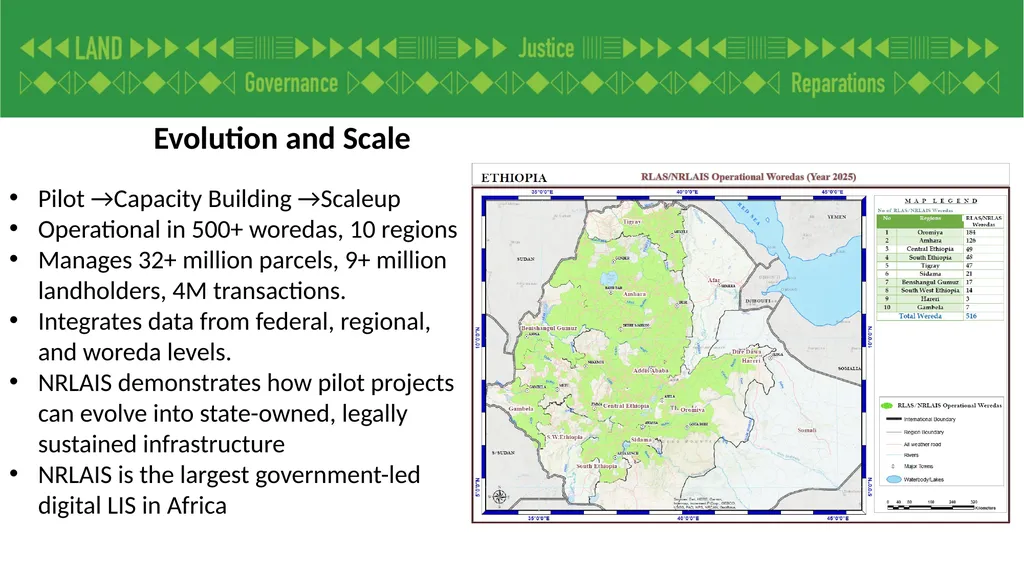
Operational in 500+ woredas, 10 regions
Manages 32+ million parcels, 9+ million landholders, 4M transactions.
Integrates data from federal, regional, and woreda levels.
NRLAIS demonstrates how pilot projects can evolve into state-owned, legally sustained infrastructure
NRLAIS is the largest government-led digital LIS in Africa<br>
06
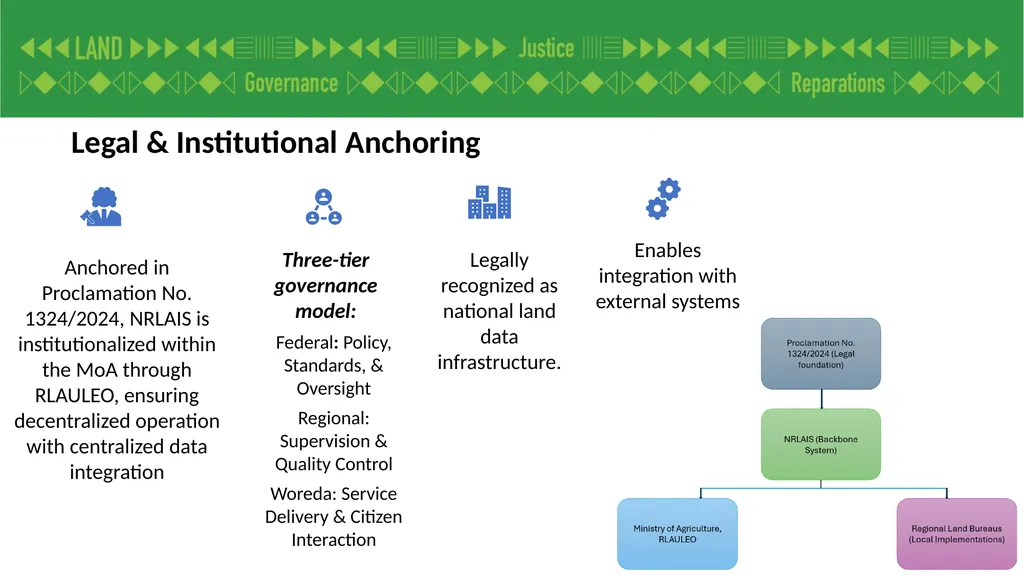
Legal & Institutional Anchoring<br>
07
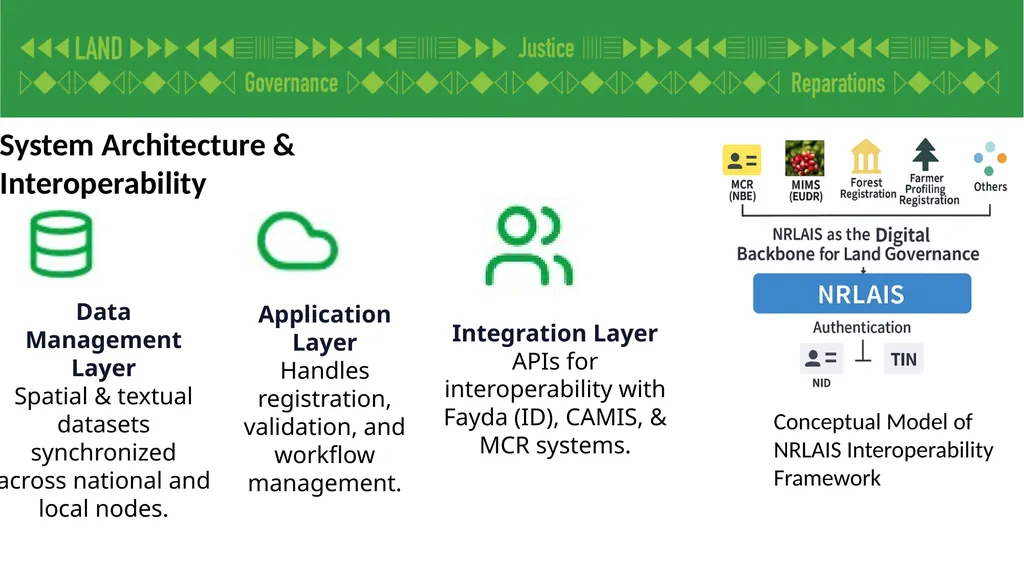
System Architecture & Interoperability Data Management Layer
Spatial & textual datasets synchronized across national and local nodes. Application Layer
Handles registration, validation, and workflow management. Integration Layer
APIs for interoperability with Fayda (ID), CAMIS, & MCR systems. Conceptual Model of NRLAIS Interoperability Framework<br>
08
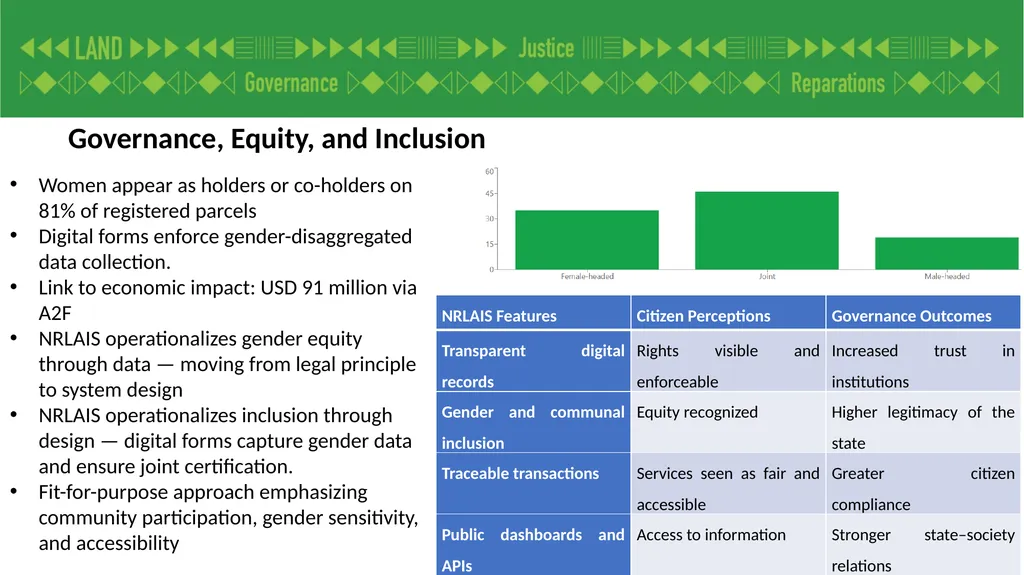
Governance, Equity, and Inclusion Women appear as holders or co-holders on 81% of registered parcels
Digital forms enforce gender-disaggregated data collection.
Link to economic impact: USD 91 million via A2F
NRLAIS operationalizes gender equity through data — moving from legal principle to system design
NRLAIS operationalizes inclusion through design — digital forms capture gender data and ensure joint certification.
Fit-for-purpose approach emphasizing community participation, gender sensitivity, and accessibility<br>
09
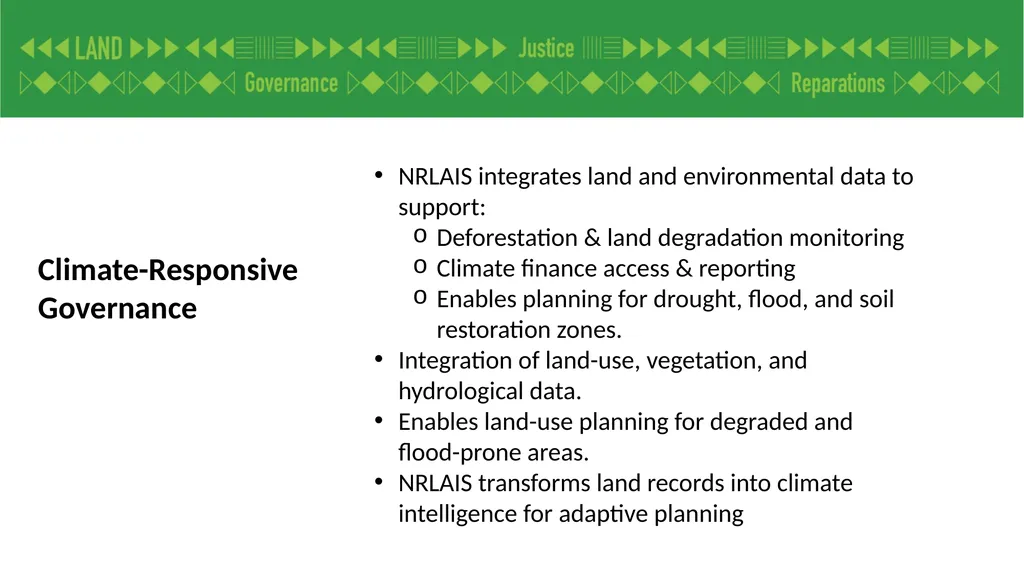
Climate-Responsive Governance NRLAIS integrates land and environmental data to support:
Deforestation & land degradation monitoring
Climate finance access & reporting
Enables planning for drought, flood, and soil restoration zones.
Integration of land-use, vegetation, and hydrological data.
Enables land-use planning for degraded and flood-prone areas.
NRLAIS transforms land records into climate intelligence for adaptive planning<br>
10
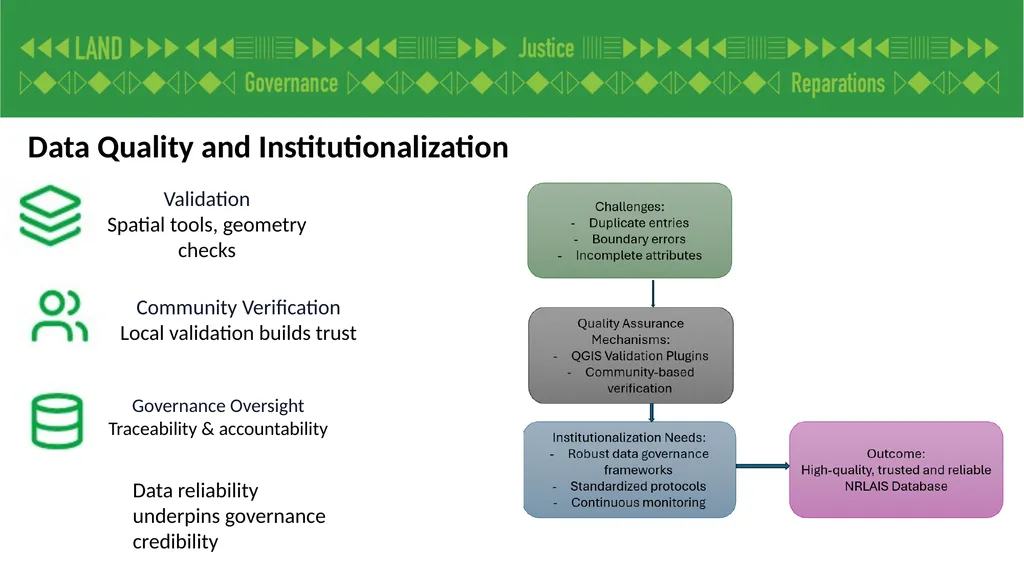
Data Quality and Institutionalization Validation
Spatial tools, geometry checks Community Verification
Local validation builds trust Governance Oversight
Traceability & accountability Data reliability underpins governance credibility<br>
11
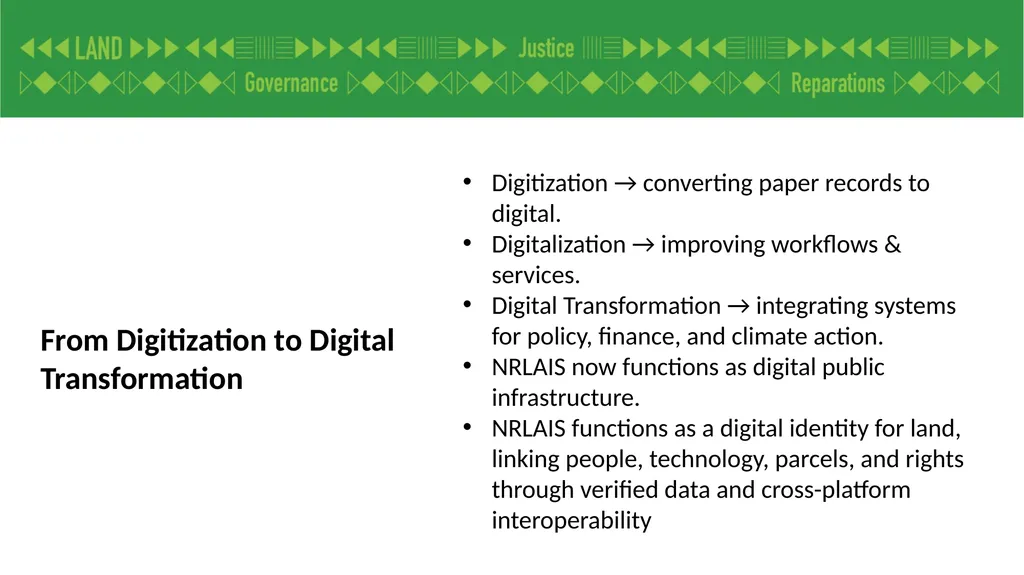
From Digitization to Digital Transformation Digitization → converting paper records to digital.
Digitalization → improving workflows & services.
Digital Transformation → integrating systems for policy, finance, and climate action.
NRLAIS now functions as digital public infrastructure.
NRLAIS functions as a digital identity for land, linking people, technology, parcels, and rights through verified data and cross-platform interoperability<br>
12
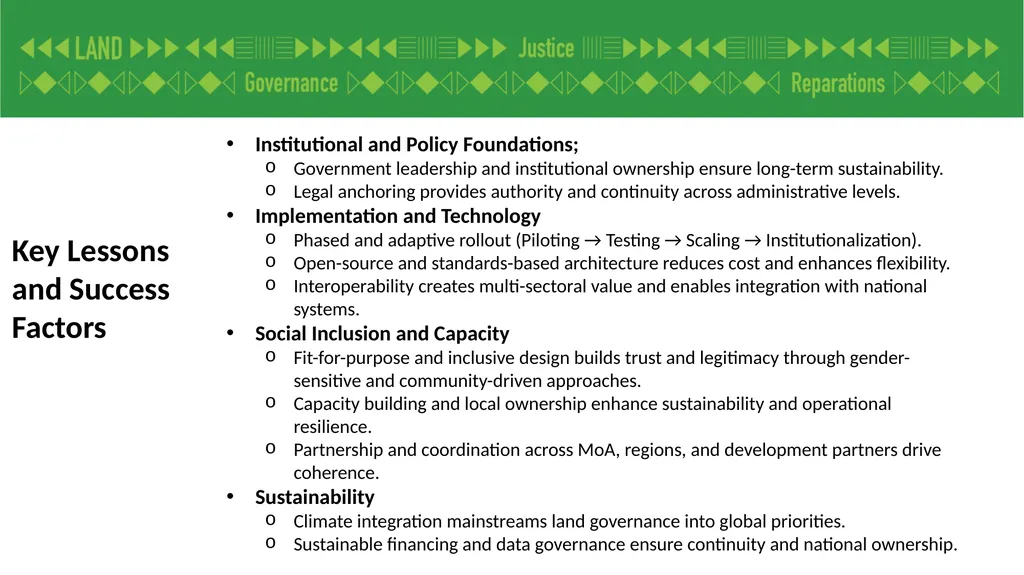
Key Lessons and Success Factors Institutional and Policy Foundations;
Government leadership and institutional ownership ensure long-term sustainability.
Legal anchoring provides authority and continuity across administrative levels.
Implementation and Technology
Phased and adaptive rollout (Piloting → Testing → Scaling → Institutionalization).
Open-source and standards-based architecture reduces cost and enhances flexibility.
Interoperability creates multi-sectoral value and enables integration with national systems.
Social Inclusion and Capacity
Fit-for-purpose and inclusive design builds trust and legitimacy through gender-sensitive and community-driven approaches.
Capacity building and local ownership enhance sustainability and operational resilience.
Partnership and coordination across MoA, regions, and development partners drive coherence.
Sustainability
Climate integration mainstreams land governance into global priorities.
Sustainable financing and data governance ensure continuity and national ownership.<br>
13
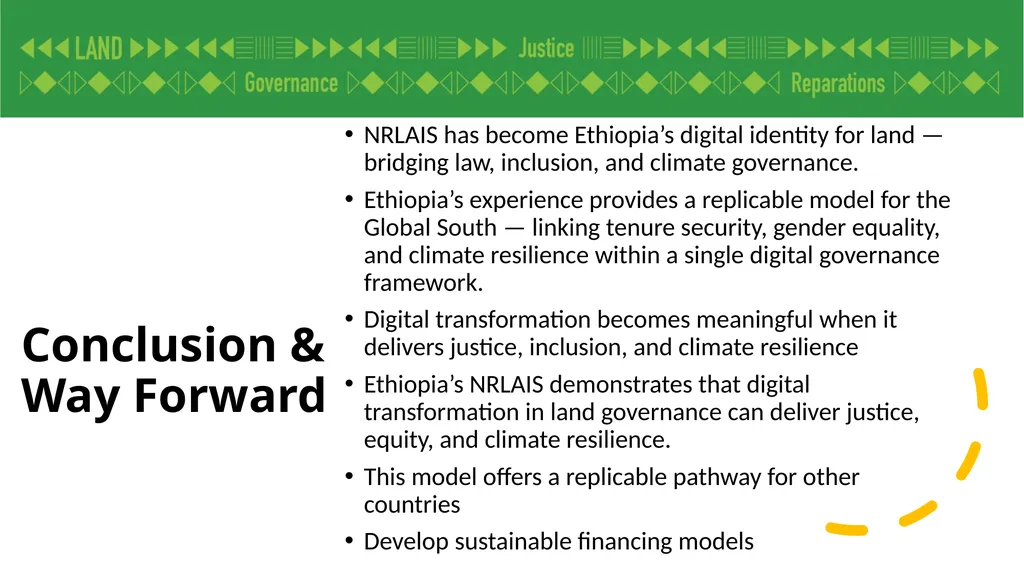
Conclusion & Way Forward NRLAIS has become Ethiopia’s digital identity for land — bridging law, inclusion, and climate governance.
Ethiopia’s experience provides a replicable model for the Global South — linking tenure security, gender equality, and climate resilience within a single digital governance framework.
Digital transformation becomes meaningful when it delivers justice, inclusion, and climate resilience
Ethiopia’s NRLAIS demonstrates that digital transformation in land governance can deliver justice, equity, and climate resilience.
This model offers a replicable pathway for other countries
Develop sustainable financing models<br>