
PART 1: STRATEGIC MANAGEMENT INPUTS CHAPTER 2 The



Description: PART 1: STRATEGIC MANAGEMENT INPUTS CHAPTER 2 The External Environment: Opportunities, Threats, Industry Competition, Competitor Analysis THE STRATEGIC MANAGEMENT PROCESS KNOWLEDGE OBJECTIVES KNOWLEDGE OBJECTIVES IMPORTANT DEFINITIONS A
Related Topics
Download Presentation
"PART 1: STRATEGIC MANAGEMENT INPUTS CHAPTER 2 The" is the property of its rightful owner. Permission is granted to download and print the materials on this website for personal, non-commercial use only, and to display it on your personal computer provided you do not modify the materials and that you retain all copyright notices contained in the materials. By downloading content from our website, you accept the terms of this agreement.
Presentation Transcript
slide1. PART 1: STRATEGIC MANAGEMENT INPUTS CHAPTER 2
The External Environment: Opportunities, Threats, Industry Competition, & Competitor Analysis<br>
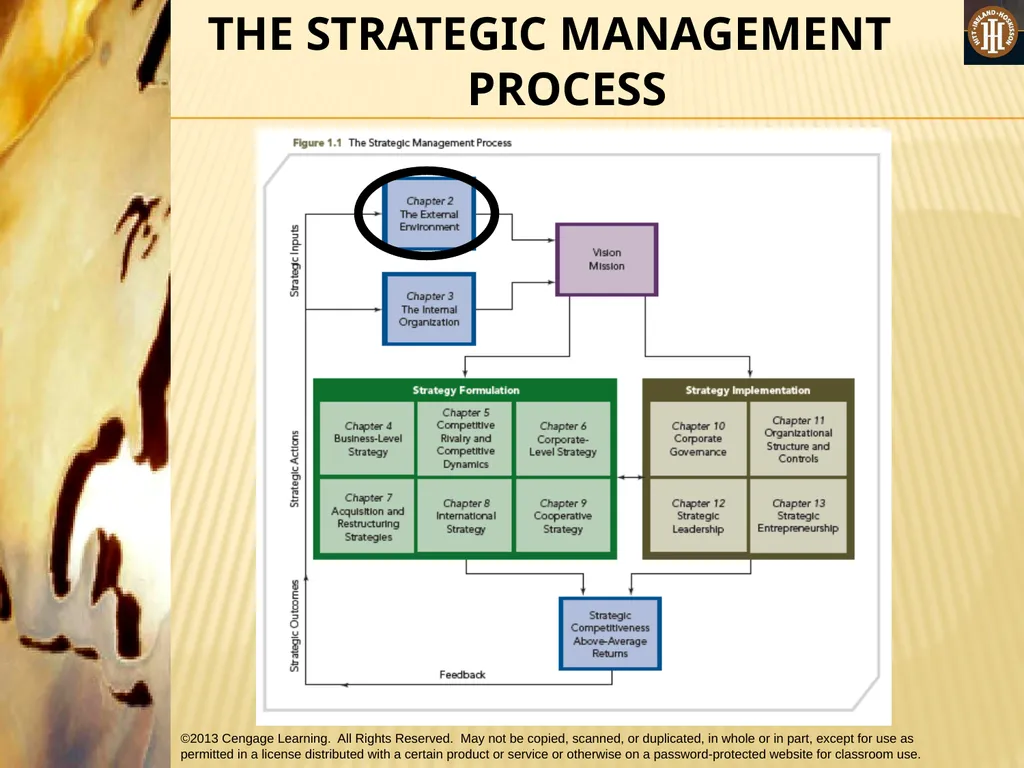
slide2. THE STRATEGIC MANAGEMENT PROCESS<br>
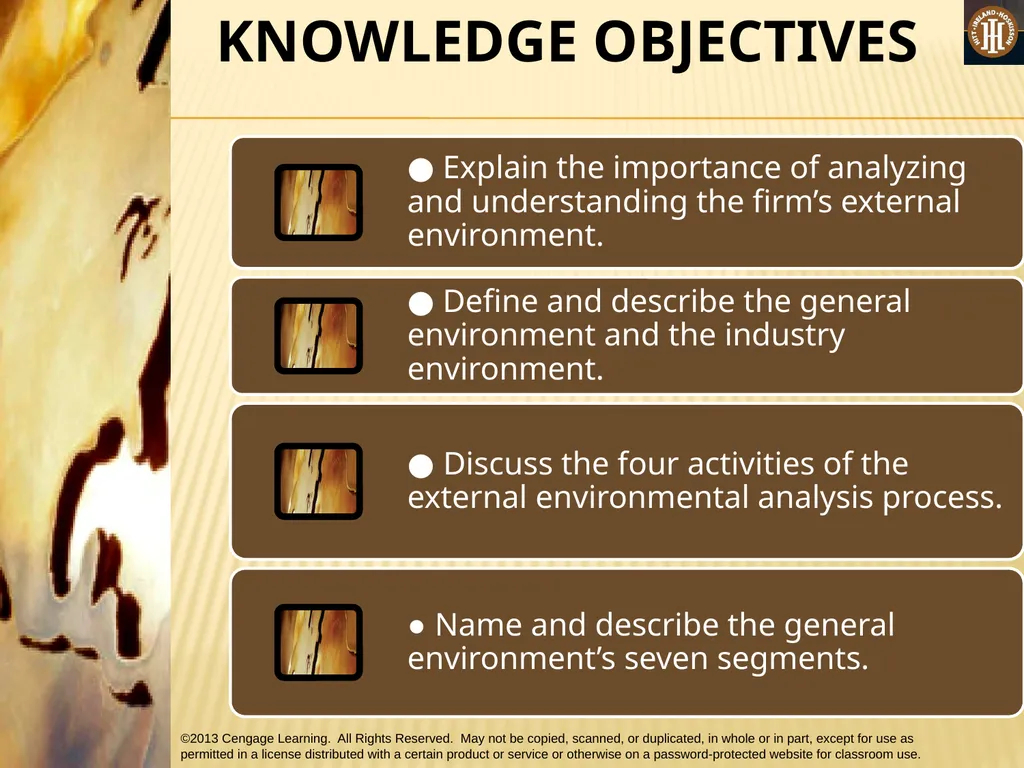
slide3. KNOWLEDGE OBJECTIVES<br>
slide4. KNOWLEDGE OBJECTIVES<br>
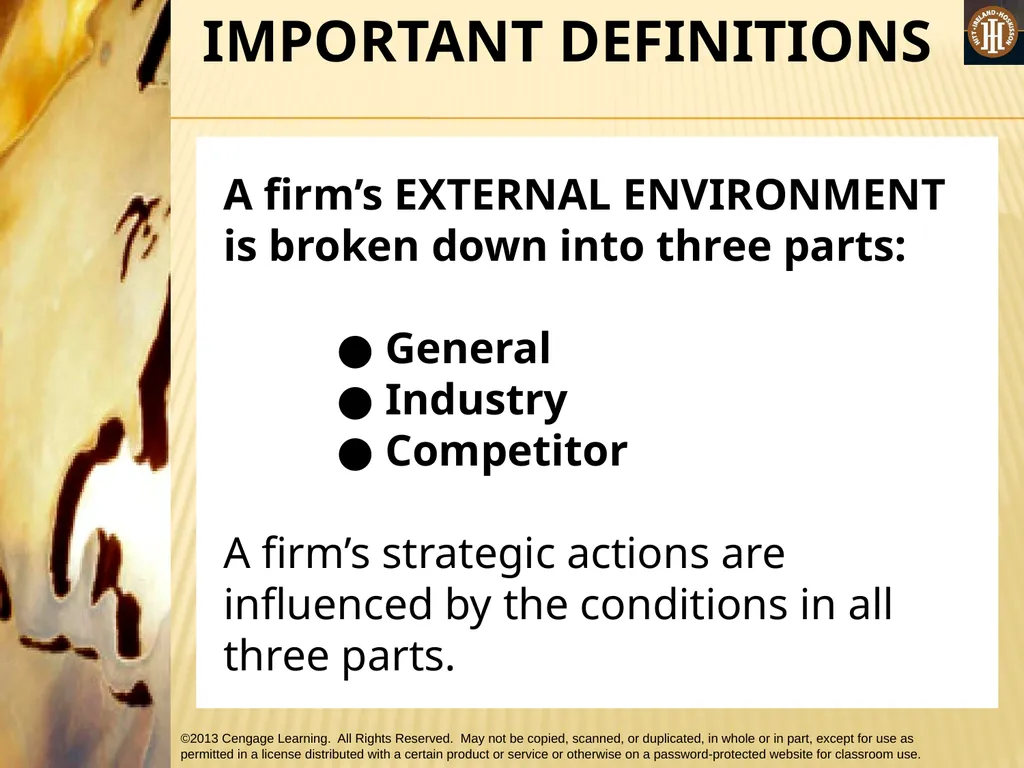
slide5. IMPORTANT DEFINITIONS A firm’s EXTERNAL ENVIRONMENT is broken down into three parts:
● General
● Industry
● Competitor
A firm’s strategic actions are influenced by the conditions in all three parts.<br>
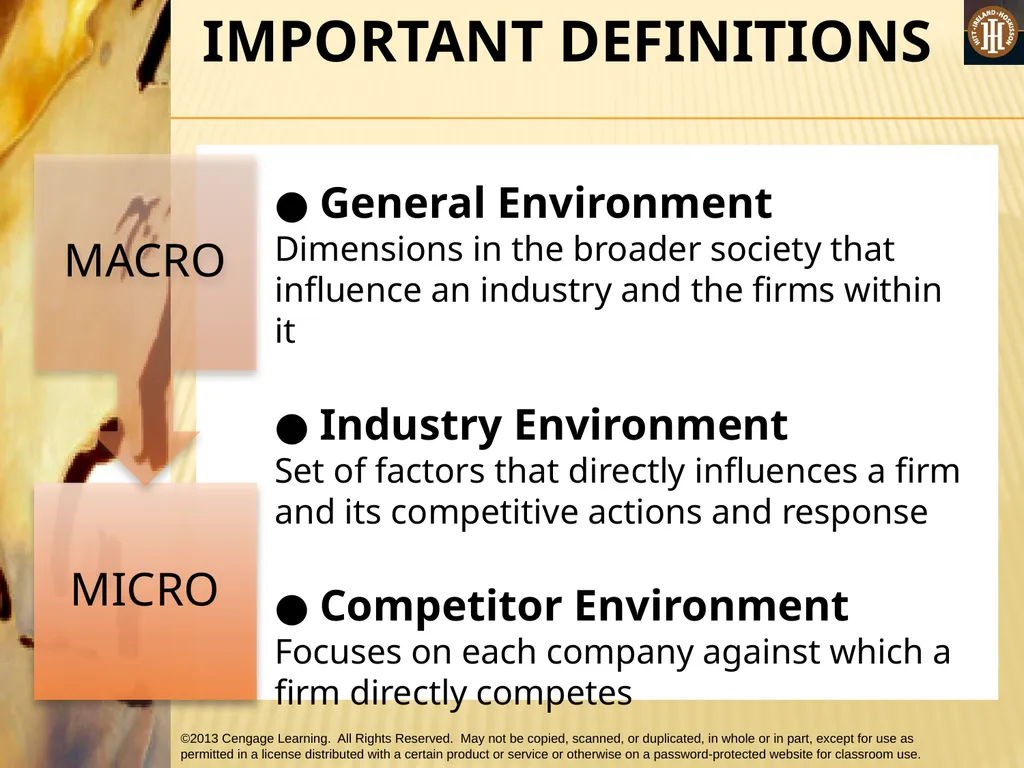
slide6. IMPORTANT DEFINITIONS ● General Environment
Dimensions in the broader society that influence an industry and the firms within it
● Industry Environment
Set of factors that directly influences a firm and its competitive actions and response
● Competitor Environment
Focuses on each company against which a firm directly competes<br>
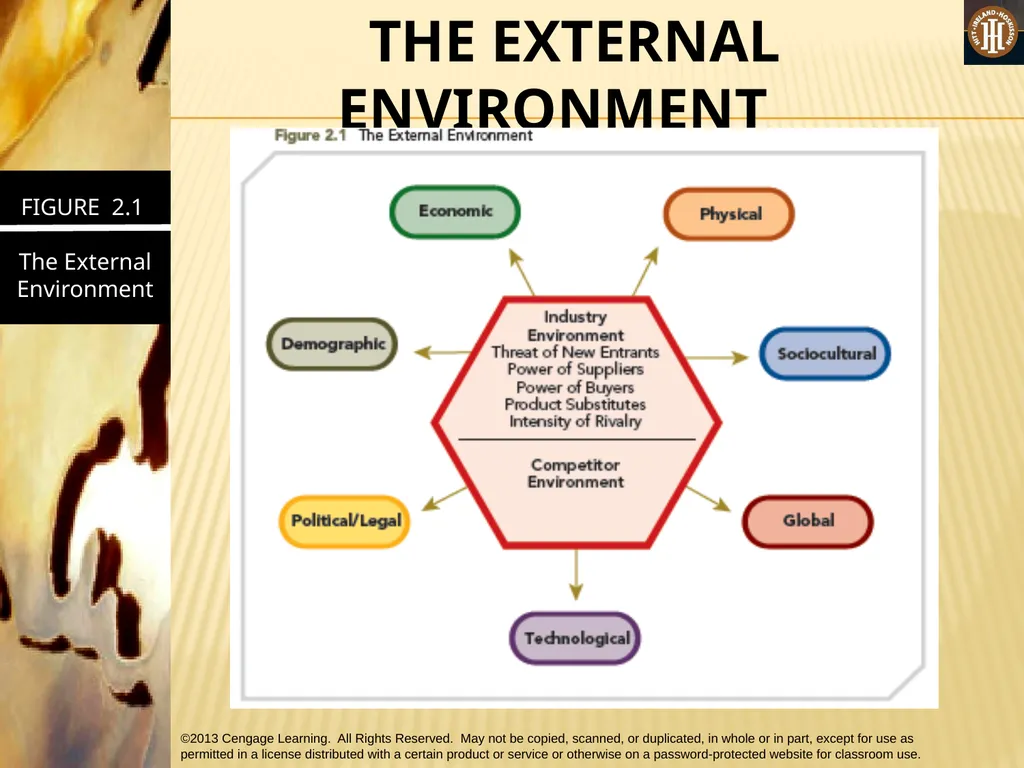
slide7. THE EXTERNAL ENVIRONMENT FIGURE 2.1 The External Environment<br>
slide8. External environment affects a firm’s strategic actions
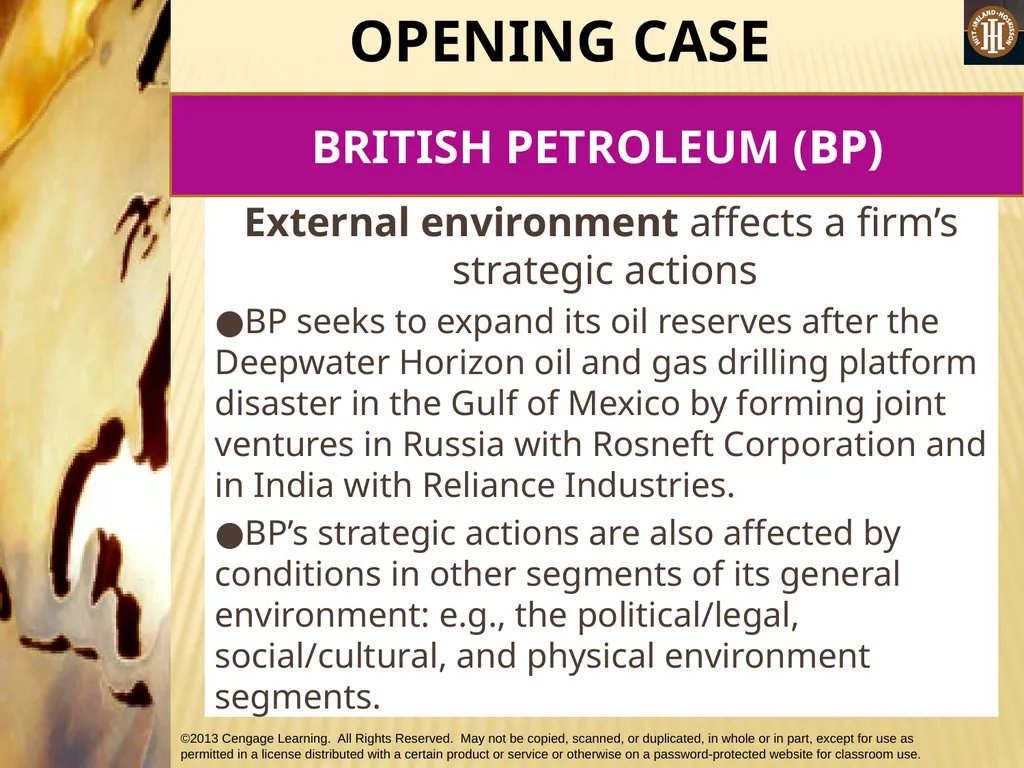
●BP seeks to expand its oil reserves after the Deepwater Horizon oil and gas drilling platform disaster in the Gulf of Mexico by forming joint ventures in Russia with Rosneft Corporation and in India with Reliance Industries.
●BP’s strategic actions are also affected by conditions in other segments of its general environment: e.g., the political/legal, social/cultural, and physical environment segments. BRITISH PETROLEUM (BP) OPENING CASE<br>
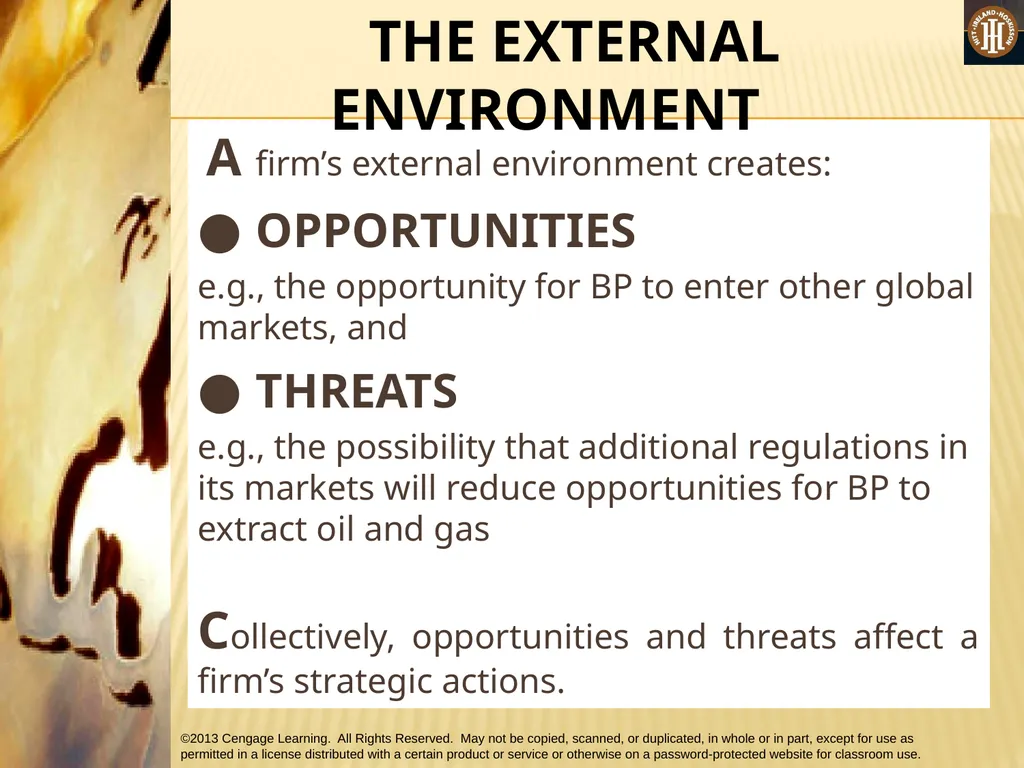
slide9. A firm’s external environment creates:
● OPPORTUNITIES
e.g., the opportunity for BP to enter other global markets, and
● THREATS
e.g., the possibility that additional regulations in its markets will reduce opportunities for BP to extract oil and gas
Collectively, opportunities and threats affect a firm’s strategic actions. THE EXTERNAL ENVIRONMENT<br>
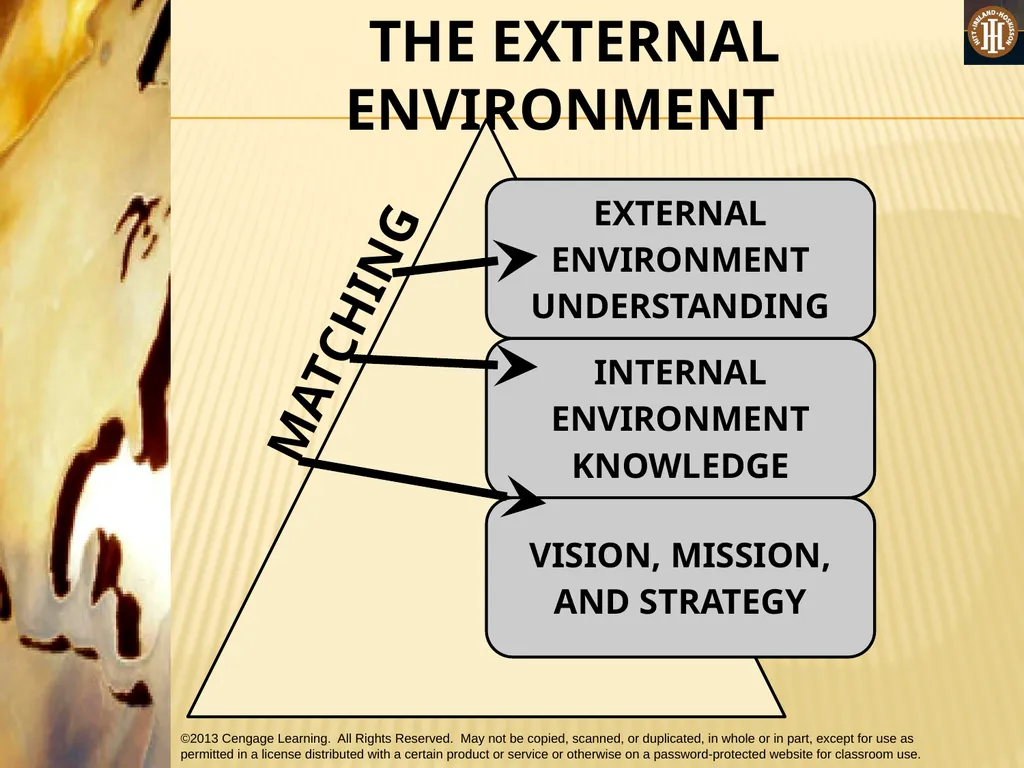
slide10. THE EXTERNAL ENVIRONMENT MATCHING<br>
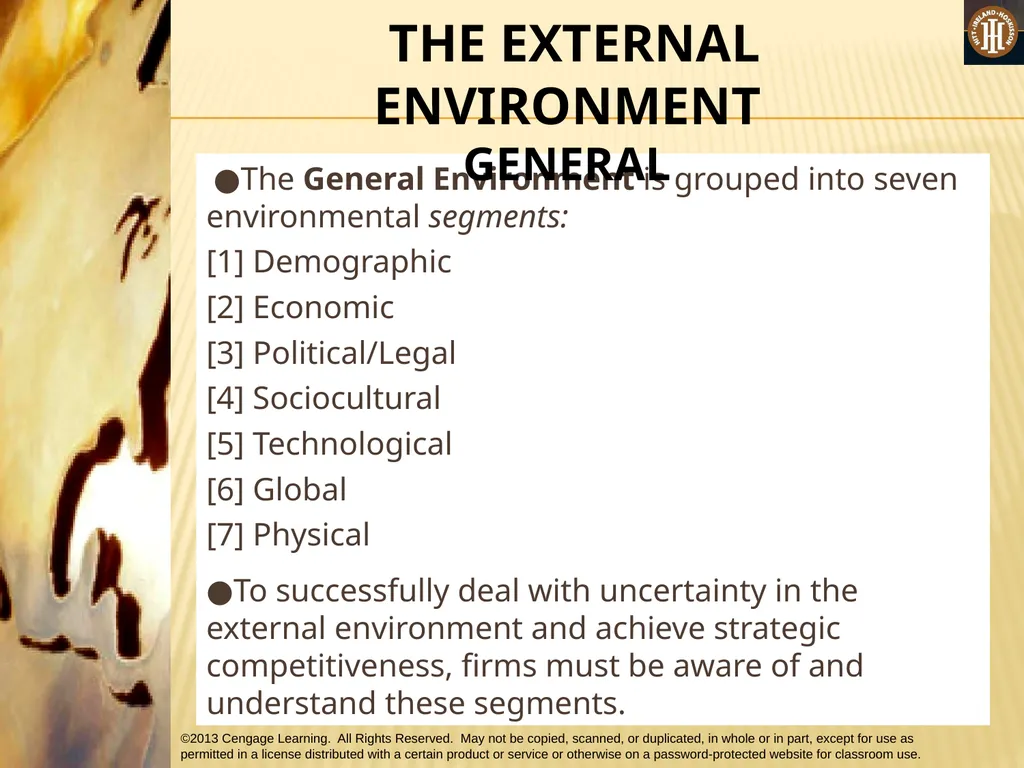
slide11. ●The General Environment is grouped into seven environmental segments:
[1] Demographic
[2] Economic
[3] Political/Legal
[4] Sociocultural
[5] Technological
[6] Global
[7] Physical
●To successfully deal with uncertainty in the external environment and achieve strategic competitiveness, firms must be aware of and understand these segments. THE EXTERNAL ENVIRONMENT
GENERAL<br>
slide12. ● Firms cannot directly CONTROL the general environment’s segments.
● However, these segments influence the actions that firms take.
● Successful firms learn how to gather the information needed to understand all segments and their implications for selecting and implementing the firm’s strategies. THE EXTERNAL ENVIRONMENT
GENERAL<br>
slide13. THE DEMOGRAPHIC SEGMENT
Demographic segments are commonly analyzed on a global basis because of their potential effects across countries’ borders and because many firms compete in global markets.
Demographic Segment
Population size
Age structure
Geographic distribution
Ethnic mix
Income distribution THE EXTERNAL ENVIRONMENT
GENERAL SEGMENTS AND ELEMENTS<br>
slide14. Economic Segment
Inflation rates
Interest rates
Trade deficits or surpluses
Budget deficits or surpluses
Personal savings rate
Business savings rates
Gross domestic product THE EXTERNAL ENVIRONMENT
GENERAL SEGMENTS AND ELEMENTS THE ECONOMIC SEGMENT
This segment refers to the nature and direction of the economy in which a firm competes or may compete. Firms generally seek to compete in relatively stable economies with strong growth potential. With globalization and the interconnectedness of nations, firms must scan, monitor, forecast, and assess the health of their host nation and the health of the economies outside their host nation.<br>
slide15. THE POLITICAL/LEGAL SEGMENT
This segment represents how organizations and governments mutually try to influence each other, and how firms try to understand these influences (current and projected) on their strategic actions.
Political/Legal Segment
Antitrust laws
Taxation laws
Deregulation philosophies
Labor training laws
Educational philosophies and policies THE EXTERNAL ENVIRONMENT
GENERAL SEGMENTS AND ELEMENTS<br>
slide16. THE SOCIOCULTURAL SEGMENT
The sociocultural segment is concerned with a society’s attitudes and cultural values. Because attitudes and values form the cornerstone of a society, they often drive demographic, economic, political/legal, and technological conditions and changes.
Sociocultural Segment
Women in the workforce
Workforce
Diversity attitudes about the quality of work life
Shifts in work and career preferences
Shifts in product and service preference characteristics THE EXTERNAL ENVIRONMENT
GENERAL SEGMENTS AND ELEMENTS<br>
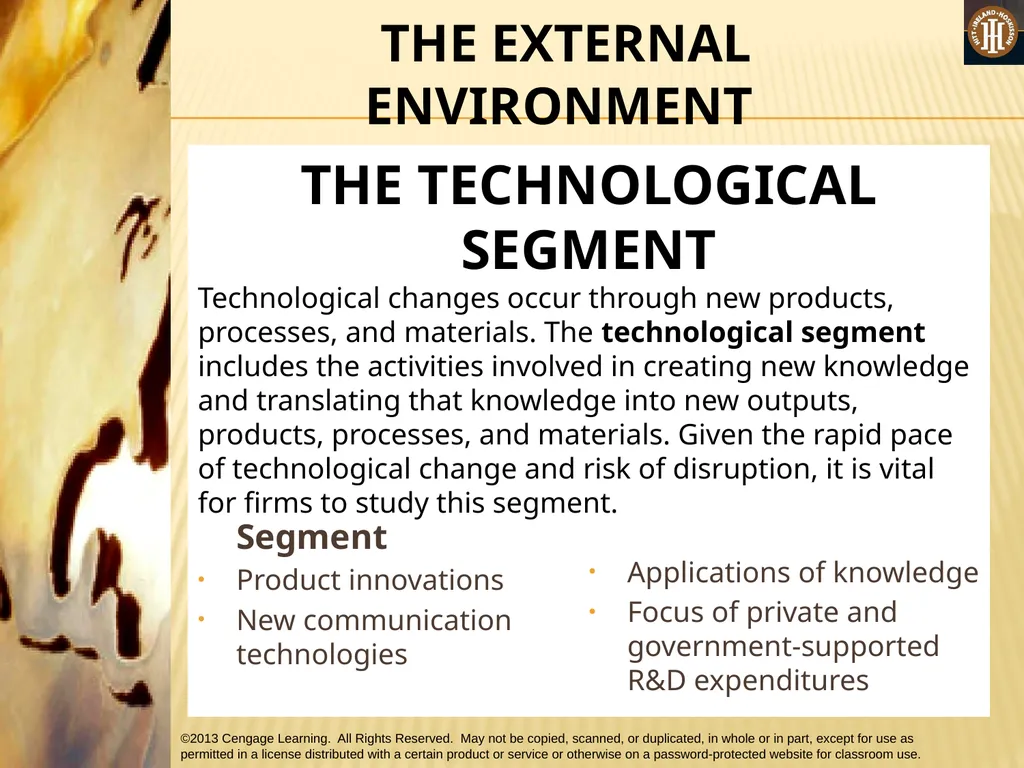
slide17. Technological Segment
Product innovations
New communication technologies
Applications of knowledge
Focus of private and government-supported R&D expenditures THE EXTERNAL ENVIRONMENT
GENERAL SEGMENTS AND ELEMENTS THE TECHNOLOGICAL SEGMENT
Technological changes occur through new products, processes, and materials. The technological segment includes the activities involved in creating new knowledge and translating that knowledge into new outputs, products, processes, and materials. Given the rapid pace of technological change and risk of disruption, it is vital for firms to study this segment.<br>
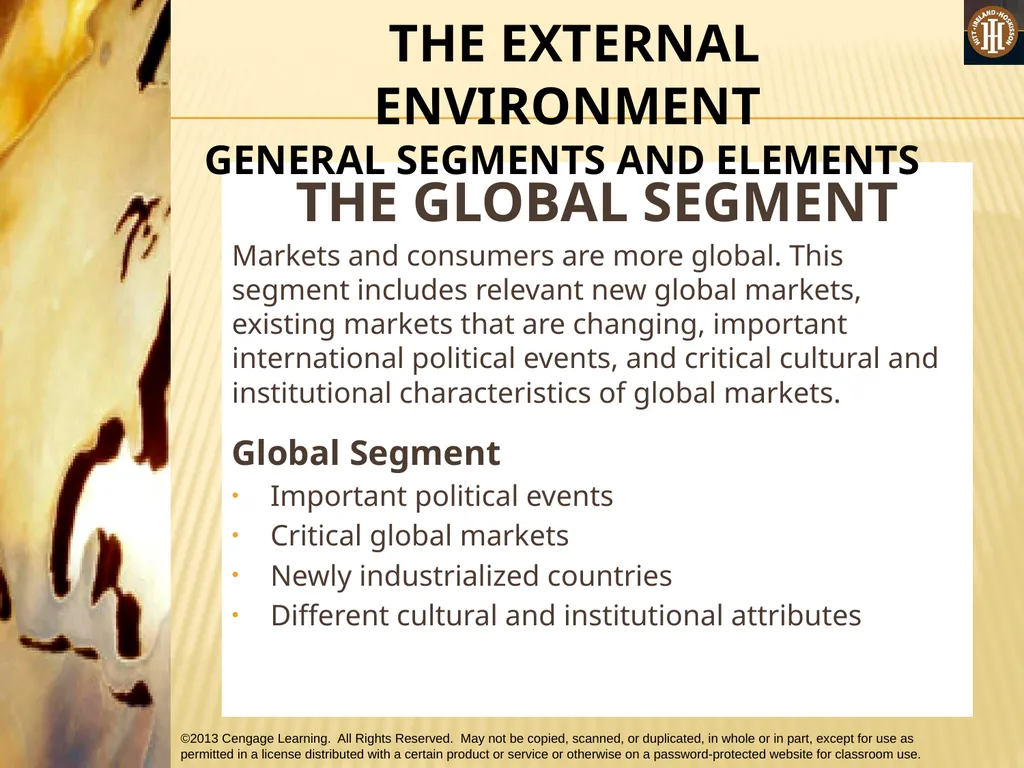
slide18. THE GLOBAL SEGMENT
Markets and consumers are more global. This segment includes relevant new global markets, existing markets that are changing, important international political events, and critical cultural and institutional characteristics of global markets.
Global Segment
Important political events
Critical global markets
Newly industrialized countries
Different cultural and institutional attributes THE EXTERNAL ENVIRONMENT
GENERAL SEGMENTS AND ELEMENTS<br>
slide19. THE PHYSICAL ENVIRONMENT SEGMENT
Concerned with trends oriented to sustaining the world’s physical environment, firms recognize that ecological, social, and economic systems interactively influence what happens in this particular segment. This segment refers to potential and actual changes in the physical environment and business practices that are intended to positively respond to and deal with those changes.
Physical Environment Segment
Energy consumption
Practices used to develop energy sources
Renewable energy efforts
Minimizing a firm’s environmental footprint
Availability of water as a resource
Producing environmentally friendly products
Reacting to natural or man-made disasters THE EXTERNAL ENVIRONMENT
GENERAL SEGMENTS AND ELEMENTS<br>
slide20. THE PHYSICAL ENVIRONMENT SEGMENT
Strategic Focus: Firms’ Efforts to Take Care of the Physical Environment in Which They Compete
● The examples noted in this Strategic Focus: Siemens AG, McDonald’s, Procter & Gamble, and GE signify a growing commitment by firms around the globe in response to emerging trends in the physical environment segment.
● In addition to positively responding to the observed trends in this segment of the general environment, there is some evidence that firms engaging in these types of behaviors outperform those failing to do so.
● This emerging evidence suggests that these behaviors benefit companies, their stakeholders, and the physical environment in which they operate. THE EXTERNAL ENVIRONMENT
GENERAL SEGMENTS AND ELEMENTS EXAMPLE<br>
slide21. External environments are:
Turbulent
Complex
Global
Uncertain
Ambiguous
Incomplete
Firms engage in external environmental analysis to better understand and cope with their environments.
This analysis has four parts:
scanning, monitoring, forecasting, and assessing. EXTERNAL ENVIRONMENTAL ANALYSIS<br>
slide22. EXTERNAL ENVIRONMENTAL ANALYSIS Analyzing the external environment is a difficult, yet significant, activity.<br>
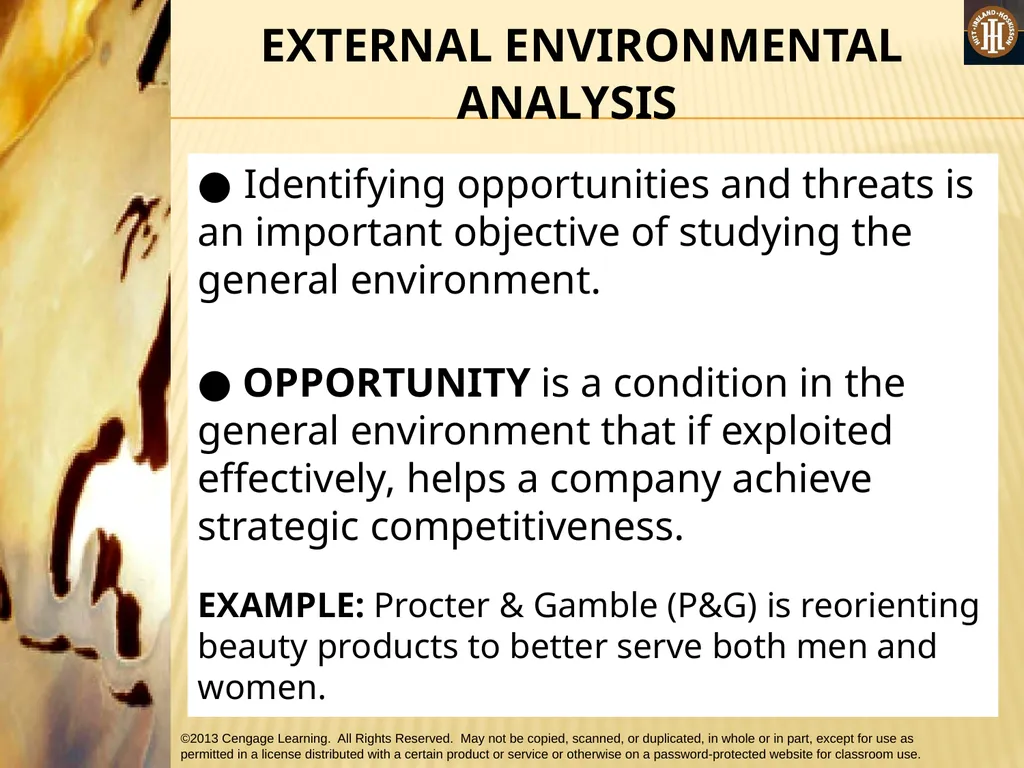
slide23. EXTERNAL ENVIRONMENTAL ANALYSIS ● Identifying opportunities and threats is an important objective of studying the general environment.
● OPPORTUNITY is a condition in the general environment that if exploited effectively, helps a company achieve strategic competitiveness.
EXAMPLE: Procter & Gamble (P&G) is reorienting beauty products to better serve both men and women.<br>
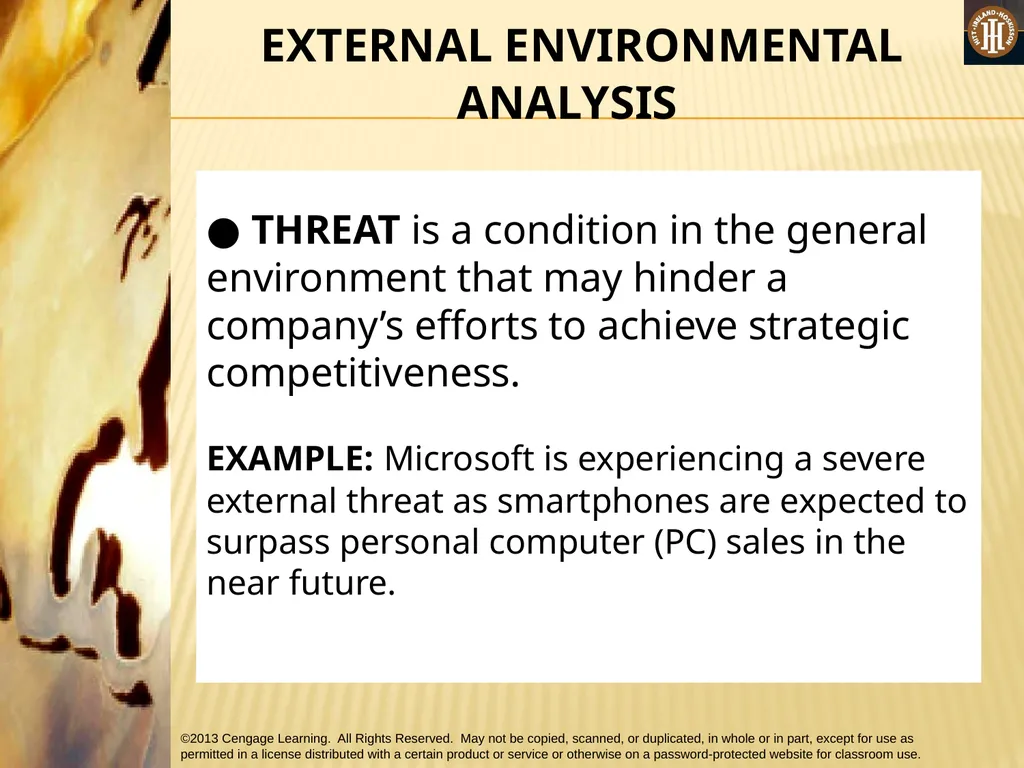
slide24. EXTERNAL ENVIRONMENTAL ANALYSIS ● THREAT is a condition in the general environment that may hinder a company’s efforts to achieve strategic competitiveness.
EXAMPLE: Microsoft is experiencing a severe external threat as smartphones are expected to surpass personal computer (PC) sales in the near future.<br>
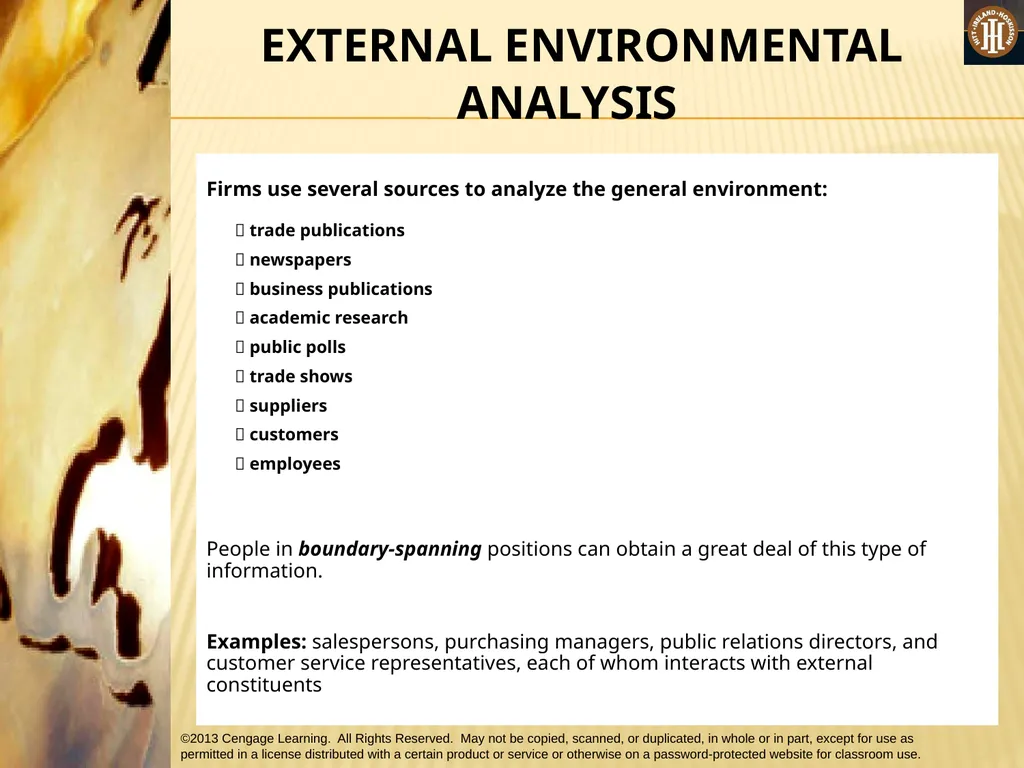
slide25. EXTERNAL ENVIRONMENTAL ANALYSIS Firms use several sources to analyze the general environment:
trade publications
newspapers
business publications
academic research
public polls
trade shows
suppliers
customers
employees
People in boundary-spanning positions can obtain a great deal of this type of information.
Examples: salespersons, purchasing managers, public relations directors, and customer service representatives, each of whom interacts with external constituents<br>
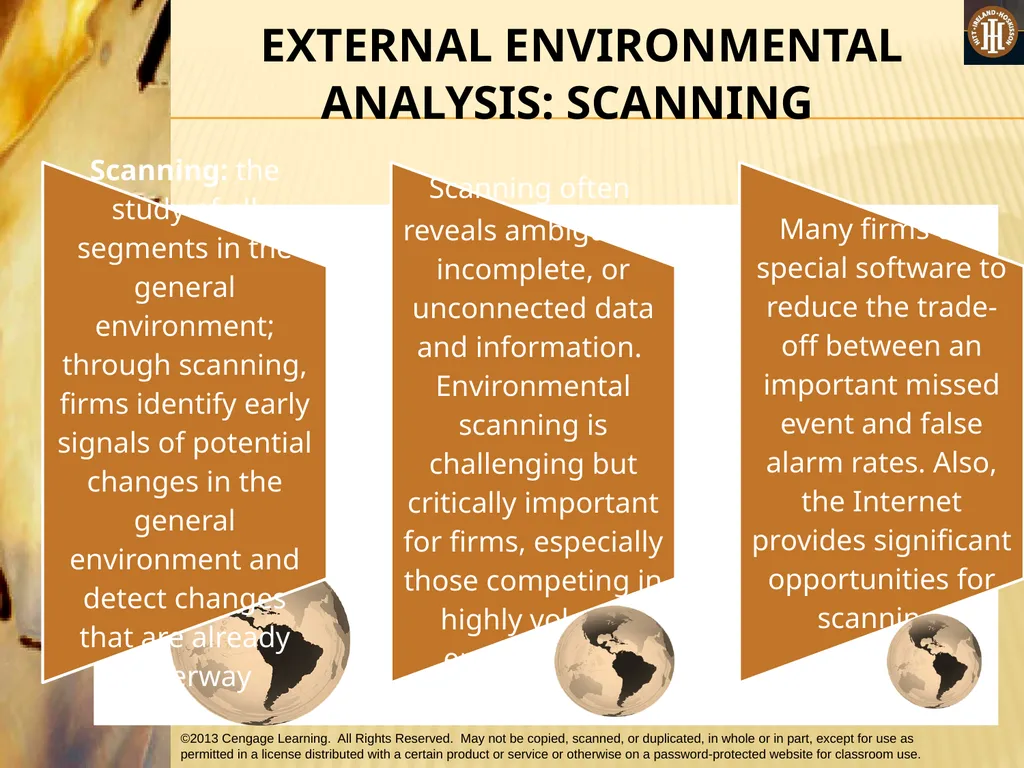
slide26. EXTERNAL ENVIRONMENTAL ANALYSIS: SCANNING<br>
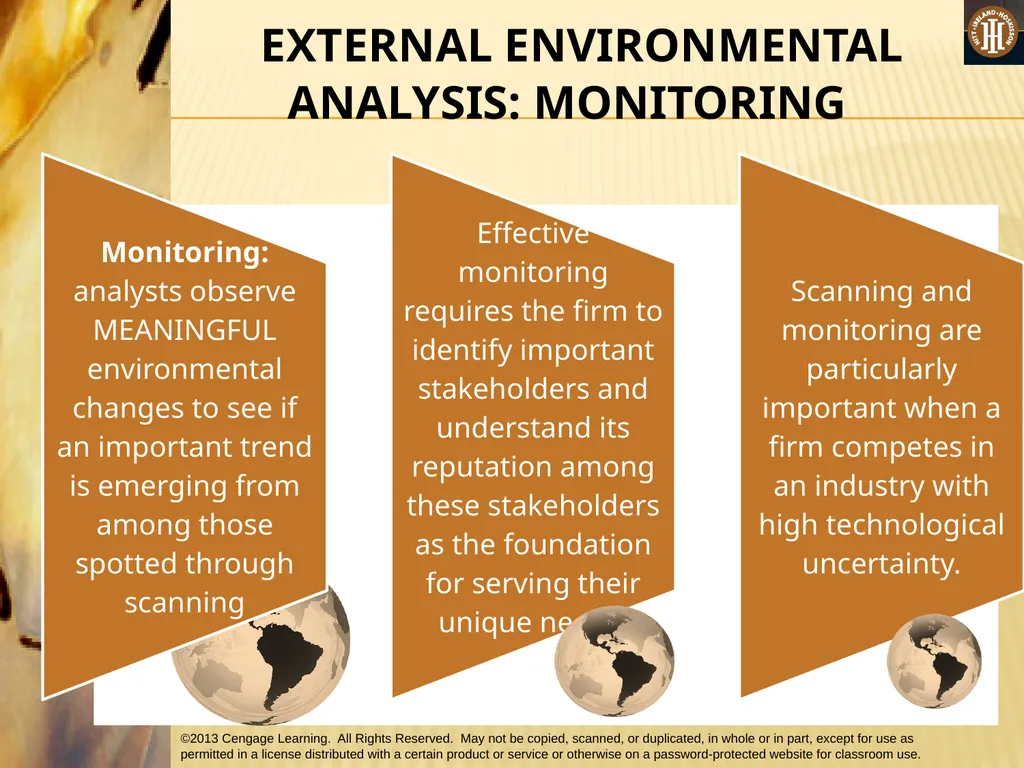
slide27. EXTERNAL ENVIRONMENTAL ANALYSIS: MONITORING<br>
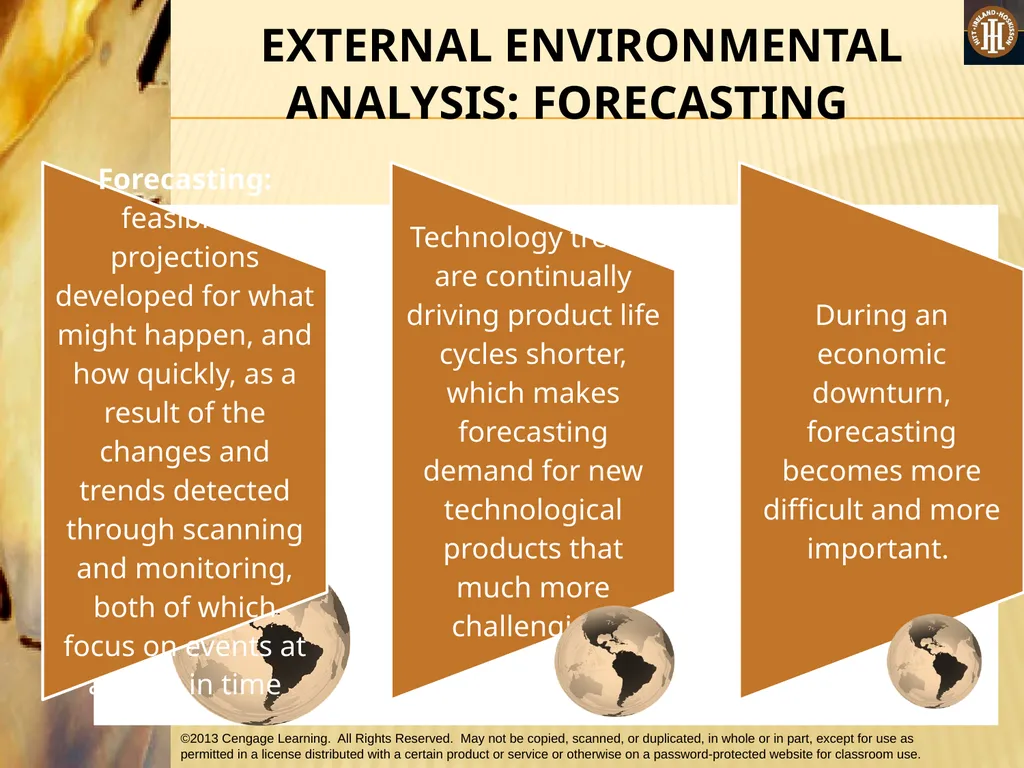
slide28. EXTERNAL ENVIRONMENTAL ANALYSIS: FORECASTING<br>
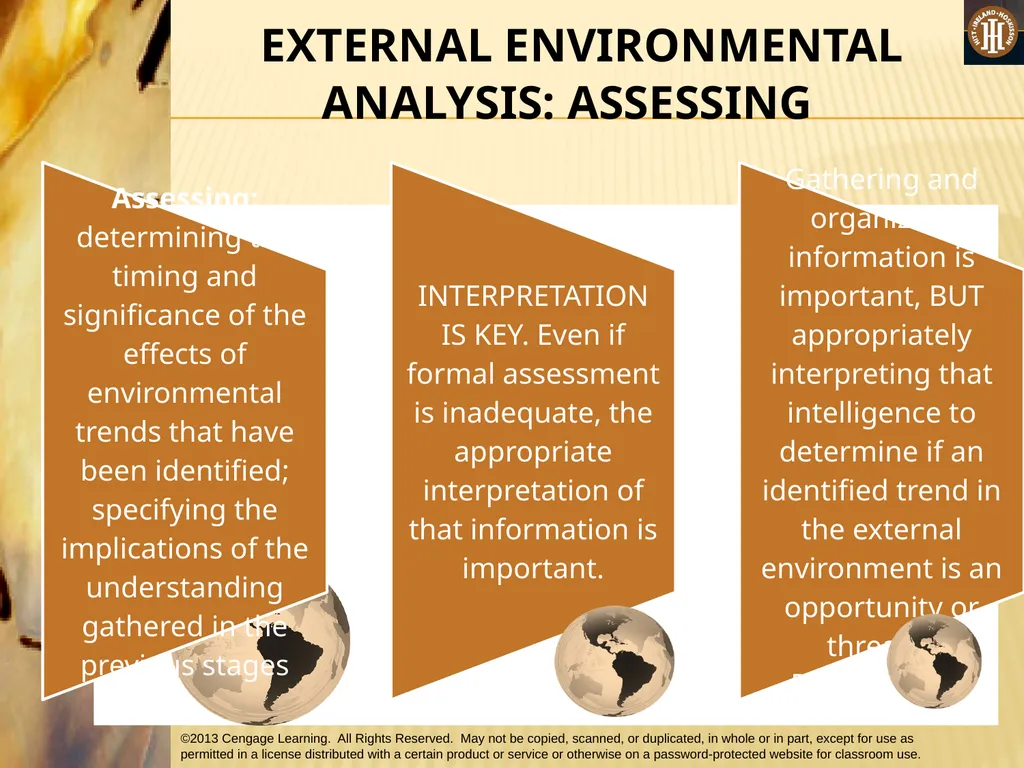
slide29. EXTERNAL ENVIRONMENTAL ANALYSIS: ASSESSING<br>
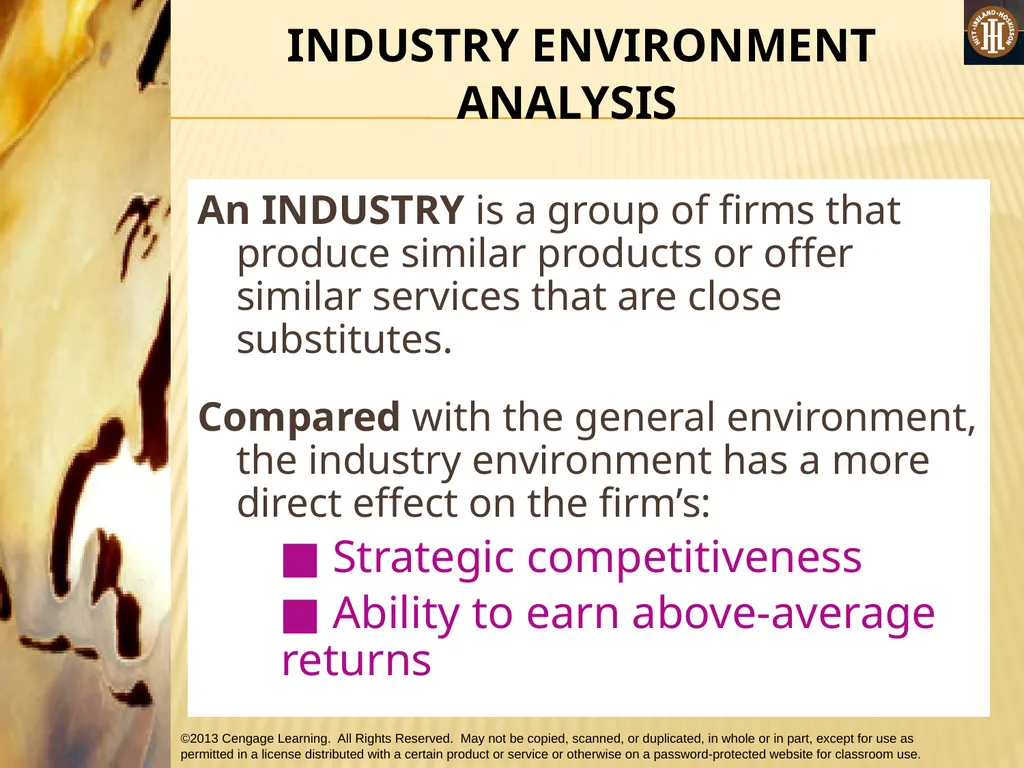
slide30. An INDUSTRY is a group of firms that produce similar products or offer similar services that are close substitutes.
Compared with the general environment, the industry environment has a more direct effect on the firm’s:
■ Strategic competitiveness
■ Ability to earn above-average returns INDUSTRY ENVIRONMENT ANALYSIS<br>
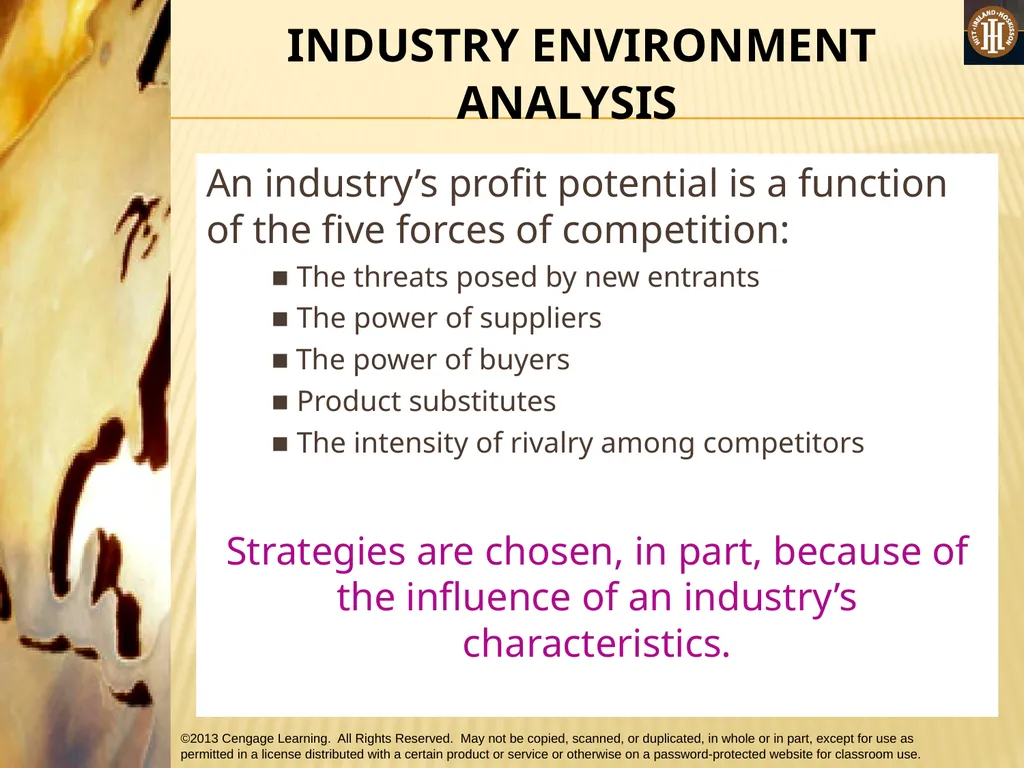
slide31. An industry’s profit potential is a function of the five forces of competition:
■ The threats posed by new entrants
■ The power of suppliers
■ The power of buyers
■ Product substitutes
■ The intensity of rivalry among competitors
Strategies are chosen, in part, because of the influence of an industry’s characteristics. INDUSTRY ENVIRONMENT ANALYSIS<br>
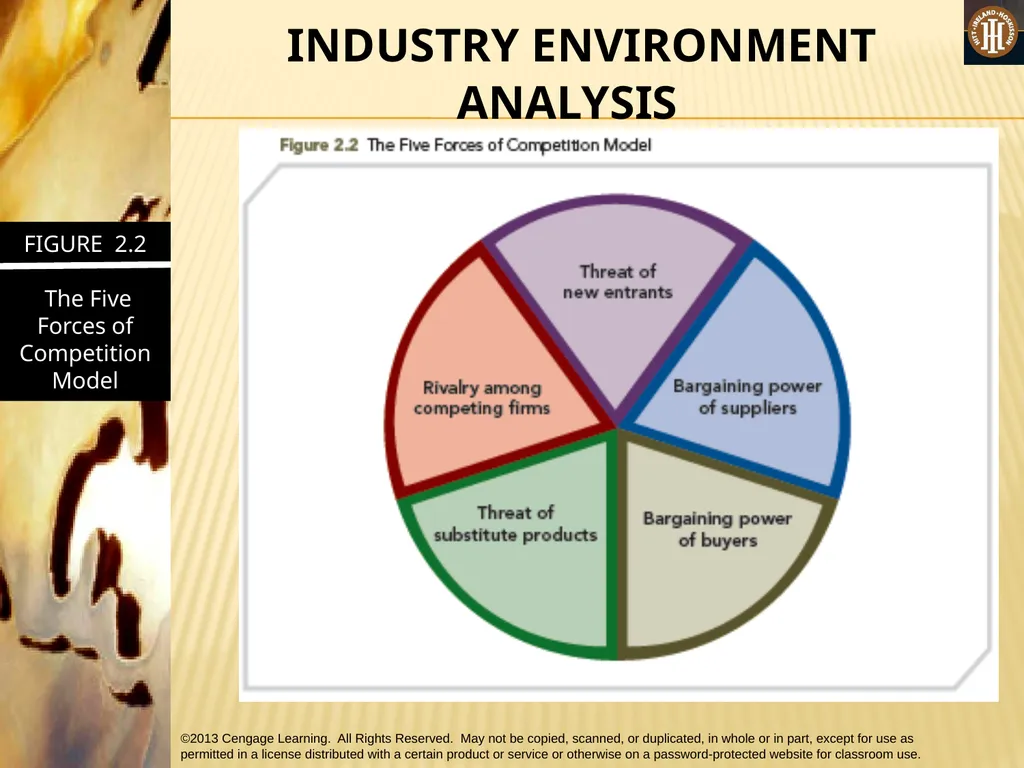
slide32. INDUSTRY ENVIRONMENT ANALYSIS FIGURE 2.2
The Five Forces of Competition Model<br>
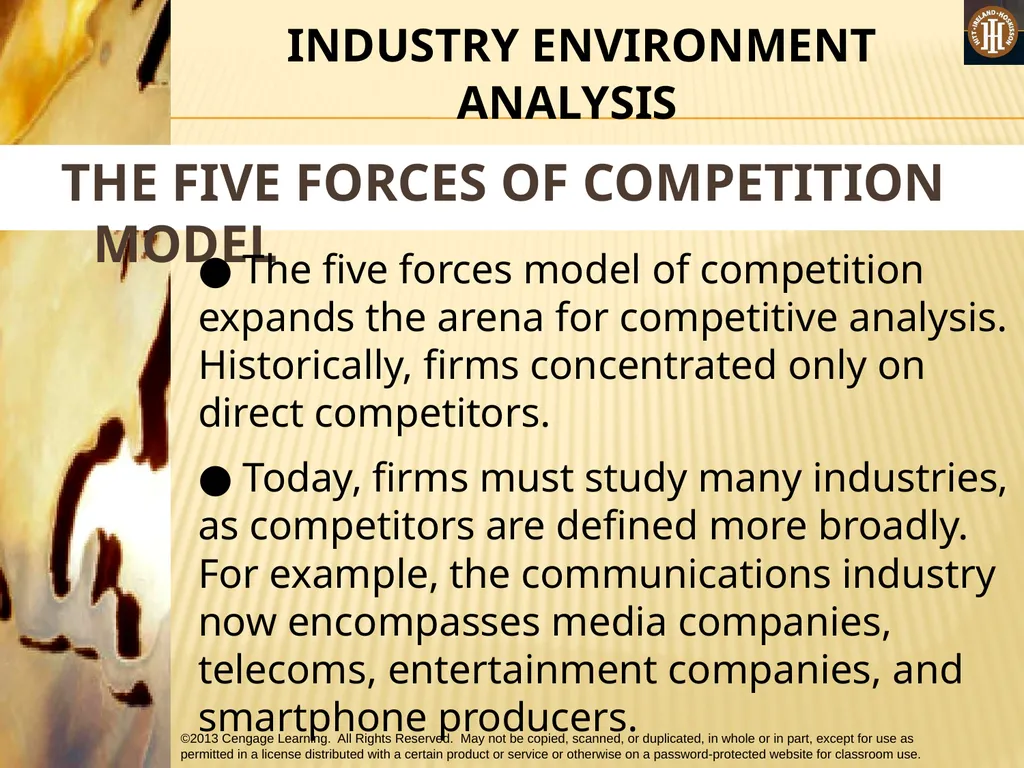
slide33. THE FIVE FORCES OF COMPETITION MODEL INDUSTRY ENVIRONMENT ANALYSIS ● The five forces model of competition expands the arena for competitive analysis. Historically, firms concentrated only on direct competitors.
● Today, firms must study many industries, as competitors are defined more broadly. For example, the communications industry now encompasses media companies, telecoms, entertainment companies, and smartphone producers.<br>
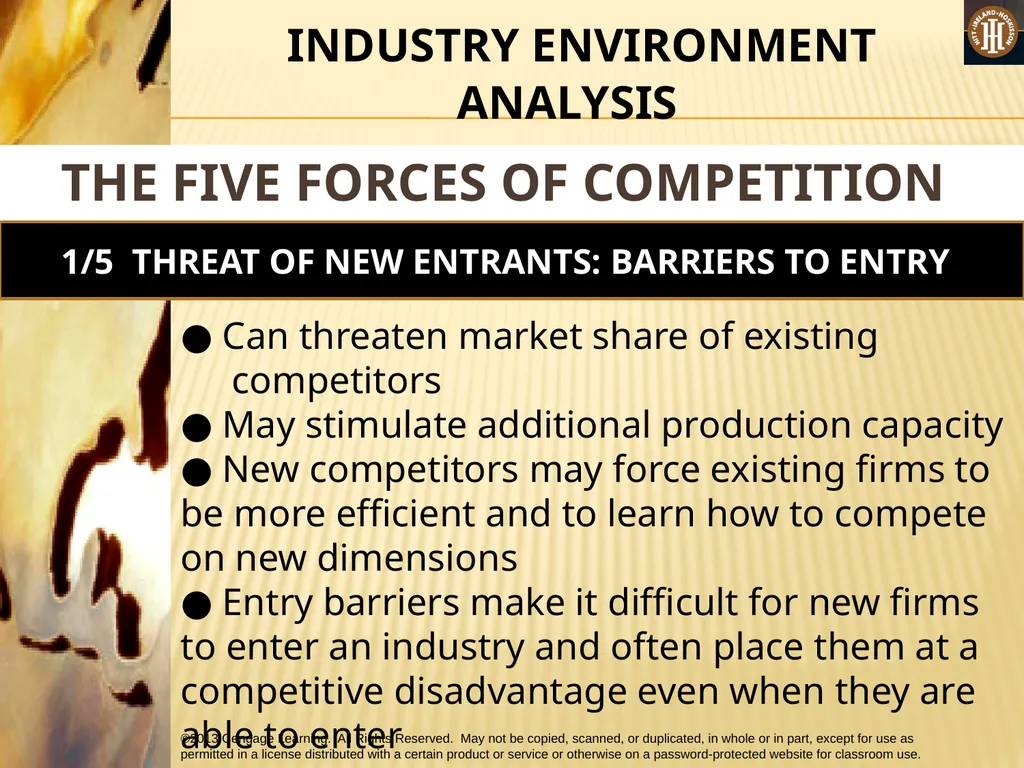
slide34. THE FIVE FORCES OF COMPETITION MODEL INDUSTRY ENVIRONMENT ANALYSIS ● Can threaten market share of existing competitors
● May stimulate additional production capacity
● New competitors may force existing firms to be more efficient and to learn how to compete on new dimensions
● Entry barriers make it difficult for new firms to enter an industry and often place them at a competitive disadvantage even when they are able to enter 1/5 THREAT OF NEW ENTRANTS: BARRIERS TO ENTRY<br>
slide35. THE FIVE FORCES OF COMPETITION MODEL INDUSTRY ENVIRONMENT ANALYSIS ● High entry barriers tend to increase the returns for existing firms in the industry and may allow some firms to dominate the industry
● Industry incumbents want to maintain high entry barriers in order to discourage potential competitors from entering the industry 1/5 THREAT OF NEW ENTRANTS: BARRIERS TO ENTRY<br>
slide36. THE FIVE FORCES OF COMPETITION MODEL INDUSTRY ENVIRONMENT ANALYSIS 1/5 THREAT OF NEW ENTRANTS: BARRIERS TO ENTRY FUNCTION OF TWO FACTORS
1 BARRIERS TO ENTRY
● Economies of scale
● Product differentiation
● Capital requirements
● Switching costs
● Access to distribution channels
● Cost disadvantages independent of scale
● Government policy
2 EXPECTED RETALIATION<br>
slide37. THE FIVE FORCES OF COMPETITION MODEL INDUSTRY ENVIRONMENT ANALYSIS 1/5 THREAT OF NEW ENTRANTS: BARRIERS TO ENTRY ECONOMIES OF SCALE
● Marginal improvements in efficiency that a firm experiences as it incrementally increases its size
● Economies of scale can be developed in most business functions, such as marketing, manufacturing, research and development, and purchasing<br>
slide38. THE FIVE FORCES OF COMPETITION MODEL INDUSTRY ENVIRONMENT ANALYSIS 1/5 THREAT OF NEW ENTRANTS: BARRIERS TO ENTRY ECONOMIES OF SCALE (cont’d)
FACTORS (advantages/disadvantages) related to large- and small-scale entry
● Flexibility in pricing and market share
● Costs related to scale economies
● Competitor retaliation
● Flexible manufacturing systems diminishes the effectiveness of economies scale to act as a barrier<br>
slide39. THE FIVE FORCES OF COMPETITION MODEL INDUSTRY ENVIRONMENT ANALYSIS 1/5 THREAT OF NEW ENTRANTS: BARRIERS TO ENTRY PRODUCT DIFFERENTIATION
● Unique products
● Customer loyalty
● New entrants frequently offer products at lower prices<br>
slide40. THE FIVE FORCES OF COMPETITION MODEL INDUSTRY ENVIRONMENT ANALYSIS 1/5 THREAT OF NEW ENTRANTS: BARRIERS TO ENTRY CAPITAL REQUIREMENTS
● Differ according to industry
● Availability of capital
● Physical facilities/Inventories/Marketing activities
● Knowledge requirements<br>
slide41. THE FIVE FORCES OF COMPETITION MODEL INDUSTRY ENVIRONMENT ANALYSIS 1/5 THREAT OF NEW ENTRANTS: BARRIERS TO ENTRY SWITCHING COSTS
One-time costs customers incur when they buy from a different supplier
■ New equipment
■ Retraining employees
■ Psychological costs of ending a supplier relationship<br>
slide42. THE FIVE FORCES OF COMPETITION MODEL INDUSTRY ENVIRONMENT ANALYSIS 1/5 THREAT OF NEW ENTRANTS: BARRIERS TO ENTRY ACCESS TO DISTRIBUTION CHANNELS
● Stocking or shelf space
● Price breaks/Cooperative advertising allowances
● Less of a barrier for products that can be sold on the Internet<br>
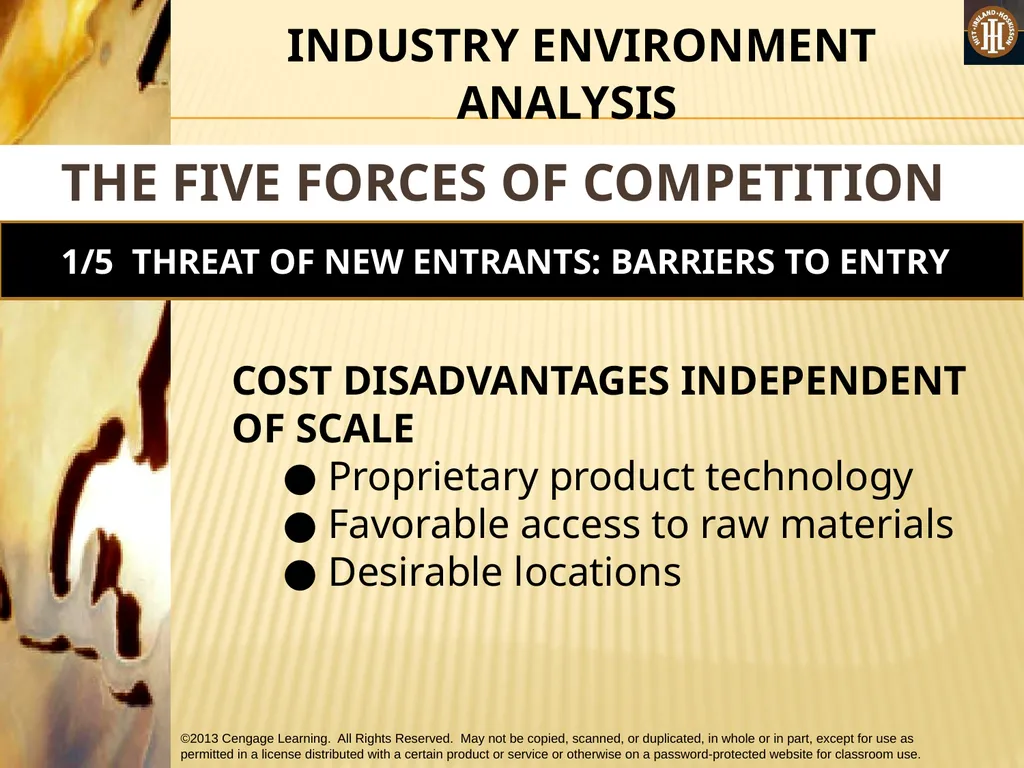
slide43. THE FIVE FORCES OF COMPETITION MODEL INDUSTRY ENVIRONMENT ANALYSIS 1/5 THREAT OF NEW ENTRANTS: BARRIERS TO ENTRY COST DISADVANTAGES INDEPENDENT OF SCALE
● Proprietary product technology
● Favorable access to raw materials
● Desirable locations<br>
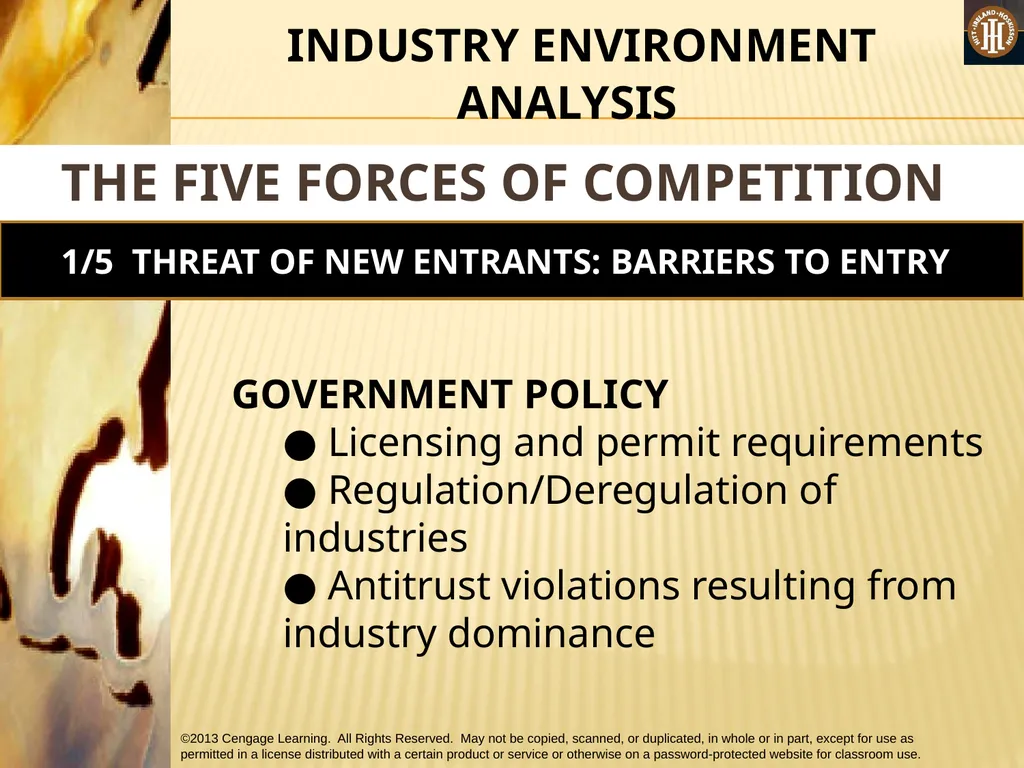
slide44. THE FIVE FORCES OF COMPETITION MODEL INDUSTRY ENVIRONMENT ANALYSIS 1/5 THREAT OF NEW ENTRANTS: BARRIERS TO ENTRY GOVERNMENT POLICY
● Licensing and permit requirements
● Regulation/Deregulation of industries
● Antitrust violations resulting from industry dominance<br>
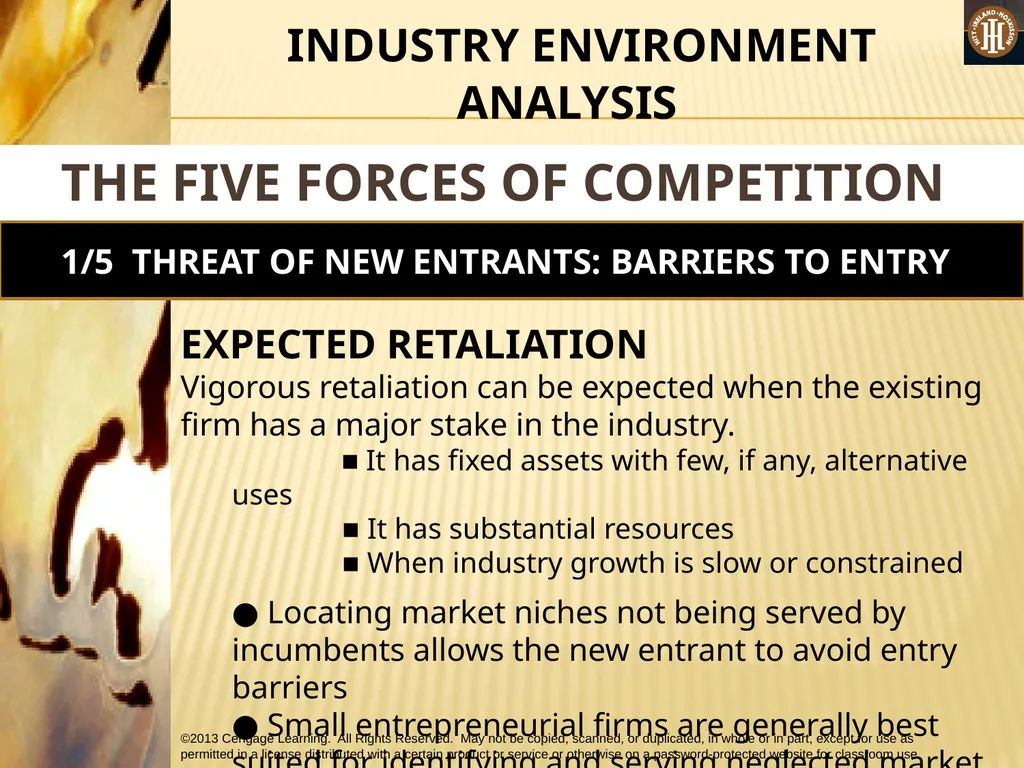
slide45. THE FIVE FORCES OF COMPETITION MODEL INDUSTRY ENVIRONMENT ANALYSIS 1/5 THREAT OF NEW ENTRANTS: BARRIERS TO ENTRY EXPECTED RETALIATION
Vigorous retaliation can be expected when the existing firm has a major stake in the industry.
■ It has fixed assets with few, if any, alternative uses
■ It has substantial resources
■ When industry growth is slow or constrained
● Locating market niches not being served by incumbents allows the new entrant to avoid entry barriers
● Small entrepreneurial firms are generally best suited for identifying and serving neglected market segments<br>
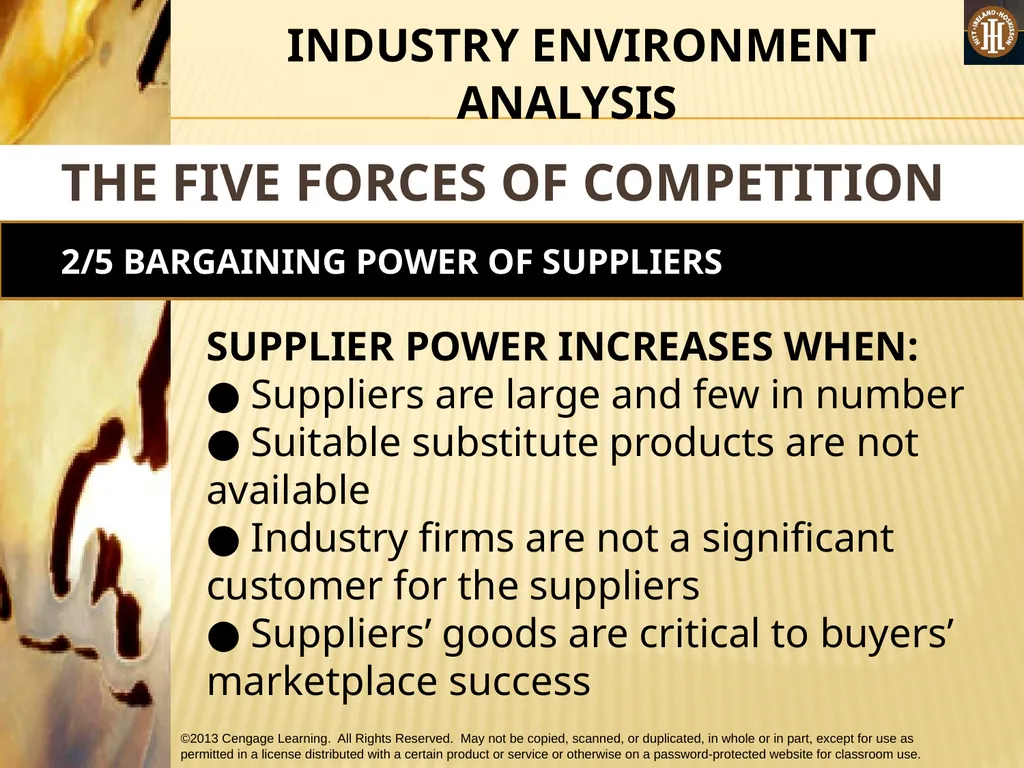
slide46. THE FIVE FORCES OF COMPETITION MODEL INDUSTRY ENVIRONMENT ANALYSIS 2/5 BARGAINING POWER OF SUPPLIERS SUPPLIER POWER INCREASES WHEN:
● Suppliers are large and few in number
● Suitable substitute products are not available
● Industry firms are not a significant customer for the suppliers
● Suppliers’ goods are critical to buyers’ marketplace success<br>
slide47. THE FIVE FORCES OF COMPETITION MODEL INDUSTRY ENVIRONMENT ANALYSIS 2/5 BARGAINING POWER OF SUPPLIERS SUPPLIER POWER INCREASES WHEN (cont’d):
● Suppliers’ products create high switching costs
● Suppliers have substantial resources and provide a highly differentiated product
● Suppliers pose a credible threat to integrate forward into the buyers’ industry<br>
slide48. THE FIVE FORCES OF COMPETITION MODEL INDUSTRY ENVIRONMENT ANALYSIS 3/5 BARGAINING POWER OF BUYERS BUYER POWER INCREASES WHEN:
● Buyers purchase a large portion of an industry’s total output
● Buyers’ purchases are a significant portion of a seller’s annual revenues
● Switching costs are low (to other industry product)<br>
slide49. THE FIVE FORCES OF COMPETITION MODEL INDUSTRY ENVIRONMENT ANALYSIS 3/5 BARGAINING POWER OF BUYERS BUYER POWER INCREASES WHEN (cont’d):
● The industry’s products are undifferentiated or standardized
● Buyers pose a credible threat to integrate backward into the sellers’ industry<br>
slide50. THE FIVE FORCES OF COMPETITION MODEL INDUSTRY ENVIRONMENT ANALYSIS 4/5 THREAT OF SUBSTITUTE PRODUCTS THREAT OF SUBSTITUTE PRODUCTS INCREASES WHEN:
● Buyers face few switching costs
● The substitute product’s price is lower
● Substitute product’s quality and performance are equal to or greater than the existing product
● Differentiated industry products that are valued by customers reduce this threat<br>
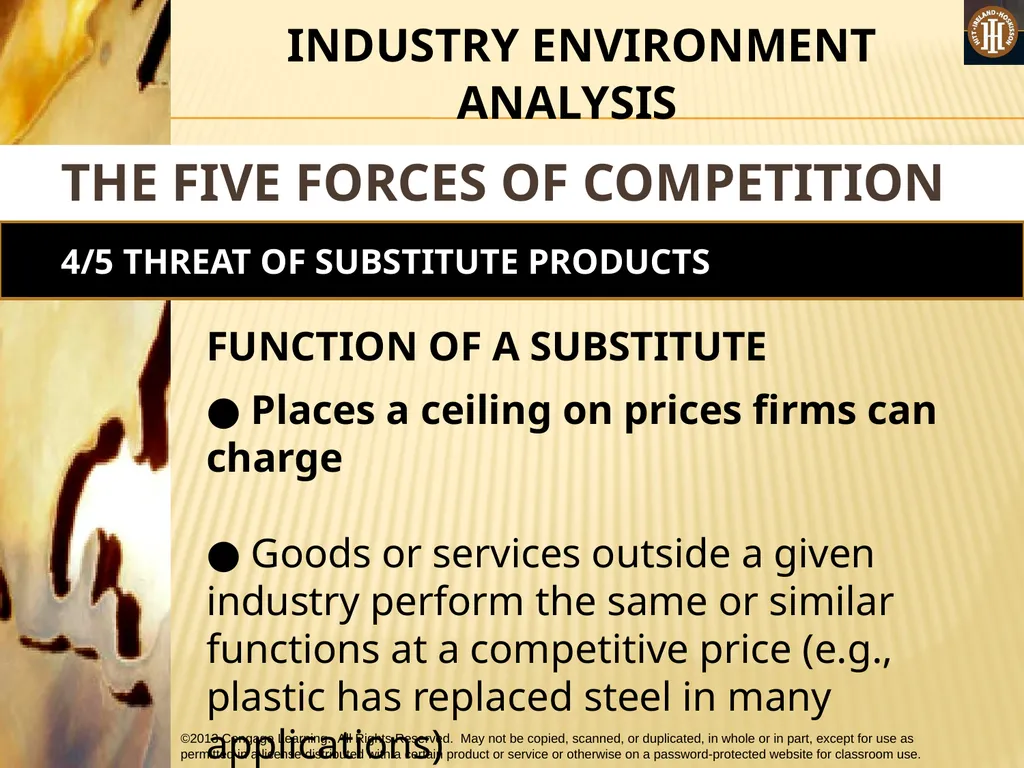
slide51. THE FIVE FORCES OF COMPETITION MODEL INDUSTRY ENVIRONMENT ANALYSIS 4/5 THREAT OF SUBSTITUTE PRODUCTS FUNCTION OF A SUBSTITUTE
● Places a ceiling on prices firms can charge
● Goods or services outside a given industry perform the same or similar functions at a competitive price (e.g., plastic has replaced steel in many applications)<br>
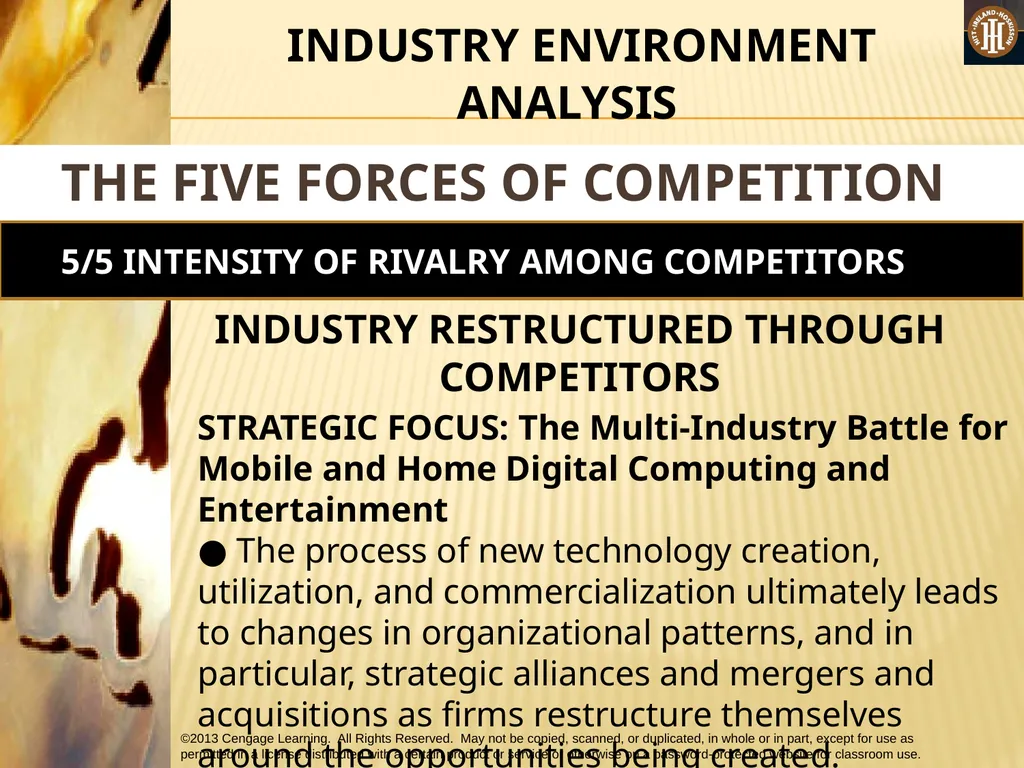
slide52. THE FIVE FORCES OF COMPETITION MODEL INDUSTRY ENVIRONMENT ANALYSIS 5/5 INTENSITY OF RIVALRY AMONG COMPETITORS INDUSTRY RESTRUCTURED THROUGH COMPETITORS
STRATEGIC FOCUS: The Multi-Industry Battle for Mobile and Home Digital Computing and Entertainment
● The process of new technology creation, utilization, and commercialization ultimately leads to changes in organizational patterns, and in particular, strategic alliances and mergers and acquisitions as firms restructure themselves around the opportunities being created.<br>
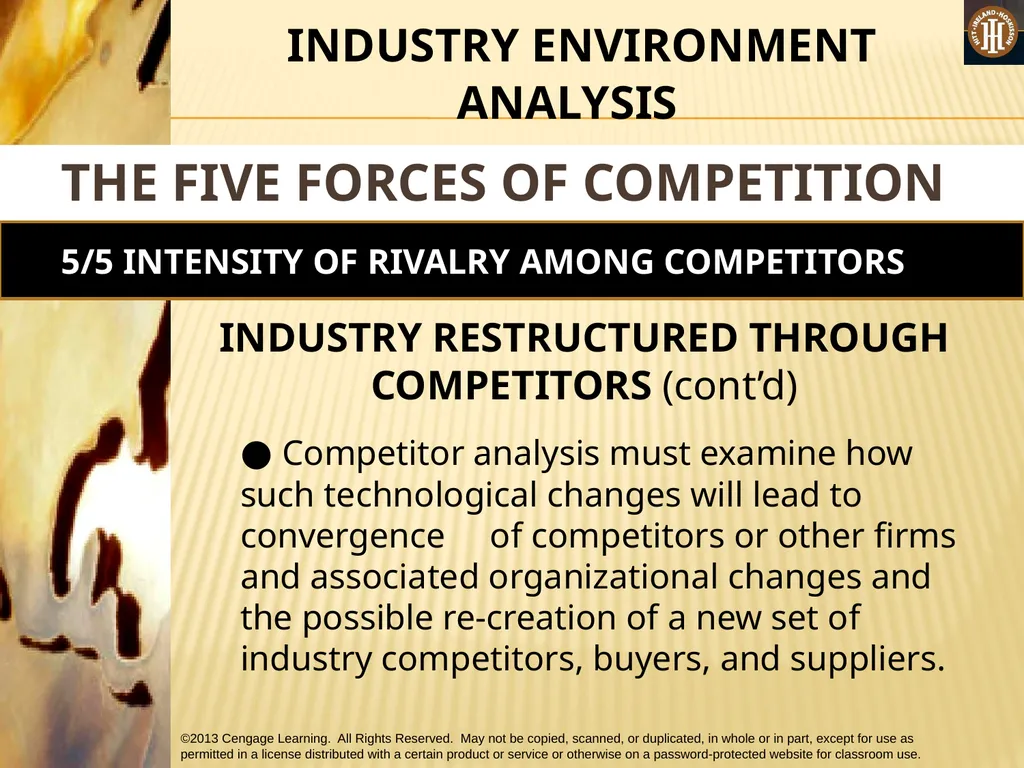
slide53. THE FIVE FORCES OF COMPETITION MODEL INDUSTRY ENVIRONMENT ANALYSIS 5/5 INTENSITY OF RIVALRY AMONG COMPETITORS INDUSTRY RESTRUCTURED THROUGH COMPETITORS (cont’d)
● Competitor analysis must examine how such technological changes will lead to convergence of competitors or other firms and associated organizational changes and the possible re-creation of a new set of industry competitors, buyers, and suppliers.<br>
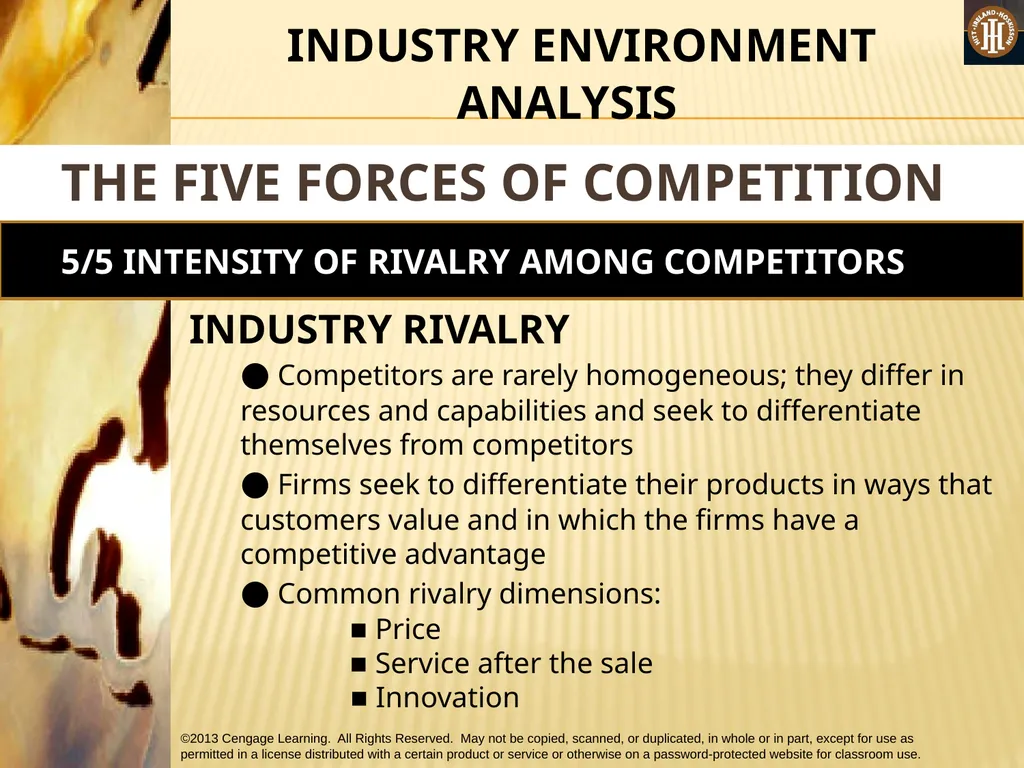
slide54. THE FIVE FORCES OF COMPETITION MODEL INDUSTRY ENVIRONMENT ANALYSIS 5/5 INTENSITY OF RIVALRY AMONG COMPETITORS INDUSTRY RIVALRY
● Competitors are rarely homogeneous; they differ in resources and capabilities and seek to differentiate themselves from competitors
● Firms seek to differentiate their products in ways that customers value and in which the firms have a competitive advantage
● Common rivalry dimensions:
■ Price
■ Service after the sale
■ Innovation<br>
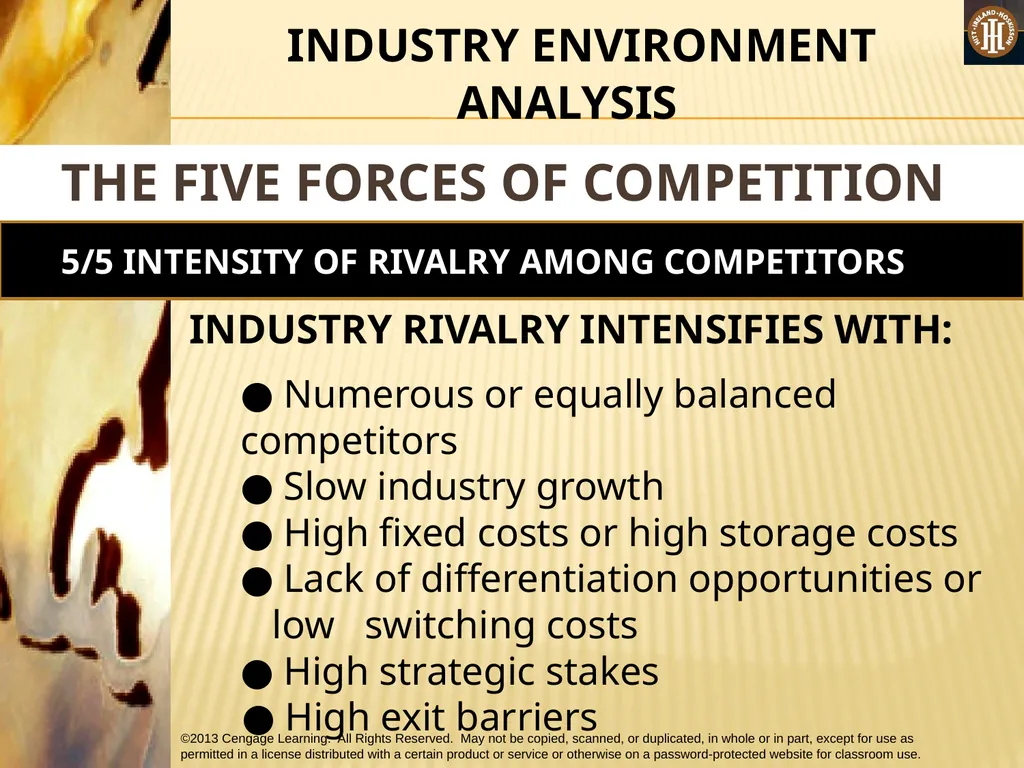
slide55. THE FIVE FORCES OF COMPETITION MODEL INDUSTRY ENVIRONMENT ANALYSIS 5/5 INTENSITY OF RIVALRY AMONG COMPETITORS INDUSTRY RIVALRY INTENSIFIES WITH:
● Numerous or equally balanced competitors
● Slow industry growth
● High fixed costs or high storage costs
● Lack of differentiation opportunities or low switching costs
● High strategic stakes
● High exit barriers<br>
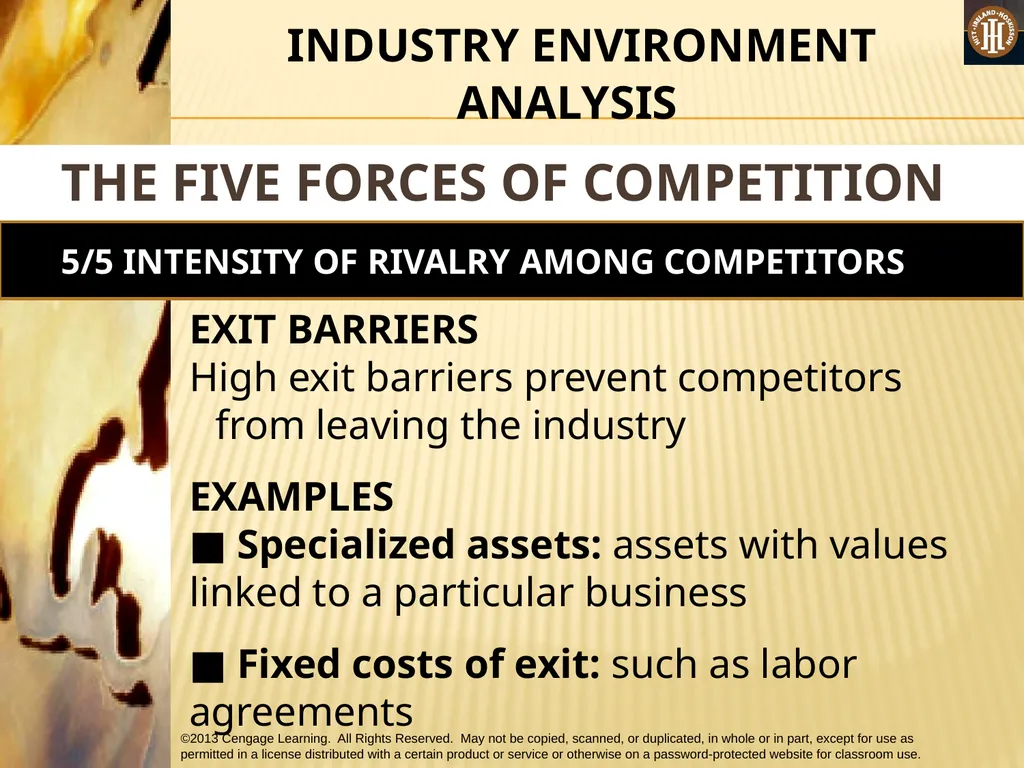
slide56. THE FIVE FORCES OF COMPETITION MODEL INDUSTRY ENVIRONMENT ANALYSIS 5/5 INTENSITY OF RIVALRY AMONG COMPETITORS EXIT BARRIERS
High exit barriers prevent competitors from leaving the industry
EXAMPLES
■ Specialized assets: assets with values linked to a particular business
■ Fixed costs of exit: such as labor agreements<br>
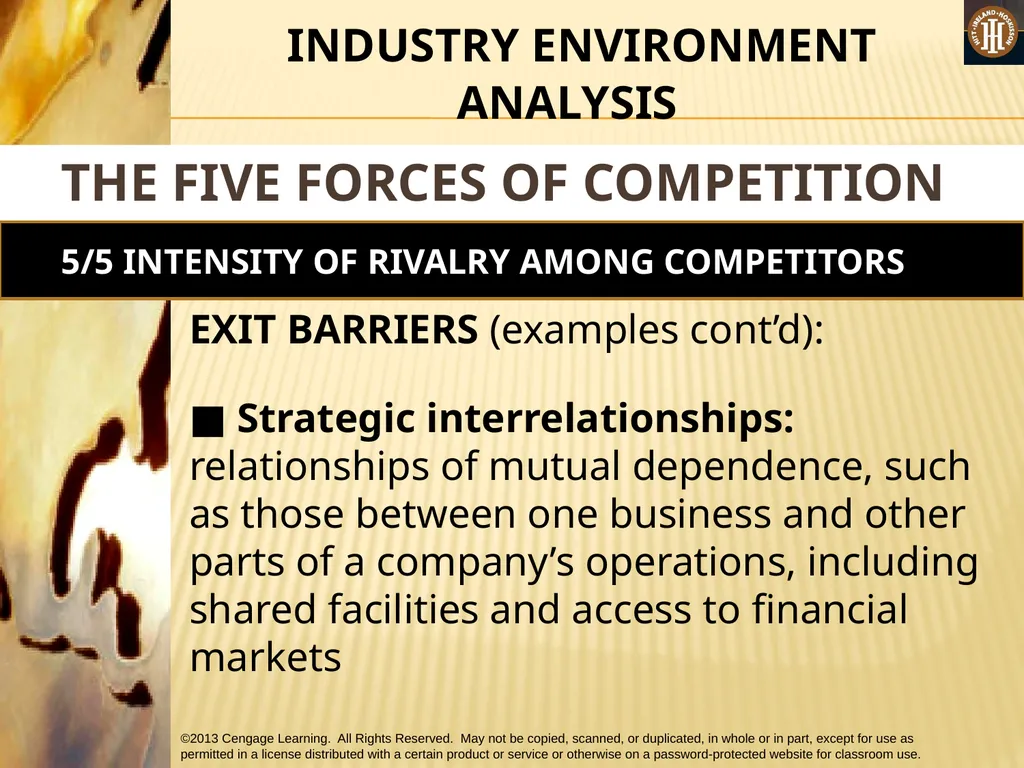
slide57. THE FIVE FORCES OF COMPETITION MODEL INDUSTRY ENVIRONMENT ANALYSIS 5/5 INTENSITY OF RIVALRY AMONG COMPETITORS EXIT BARRIERS (examples cont’d):
■ Strategic interrelationships: relationships of mutual dependence, such as those between one business and other parts of a company’s operations, including shared facilities and access to financial markets<br>
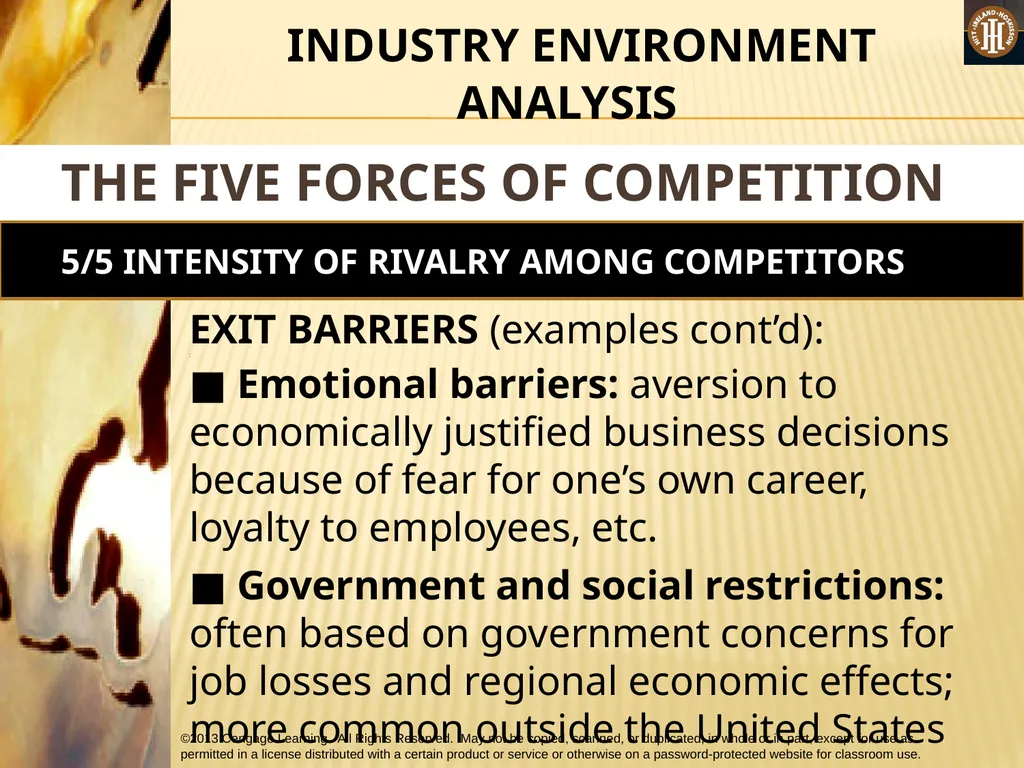
slide58. THE FIVE FORCES OF COMPETITION MODEL INDUSTRY ENVIRONMENT ANALYSIS 5/5 INTENSITY OF RIVALRY AMONG COMPETITORS EXIT BARRIERS (examples cont’d):
:
■ Emotional barriers: aversion to economically justified business decisions because of fear for one’s own career, loyalty to employees, etc.
■ Government and social restrictions: often based on government concerns for job losses and regional economic effects; more common outside the United States<br>
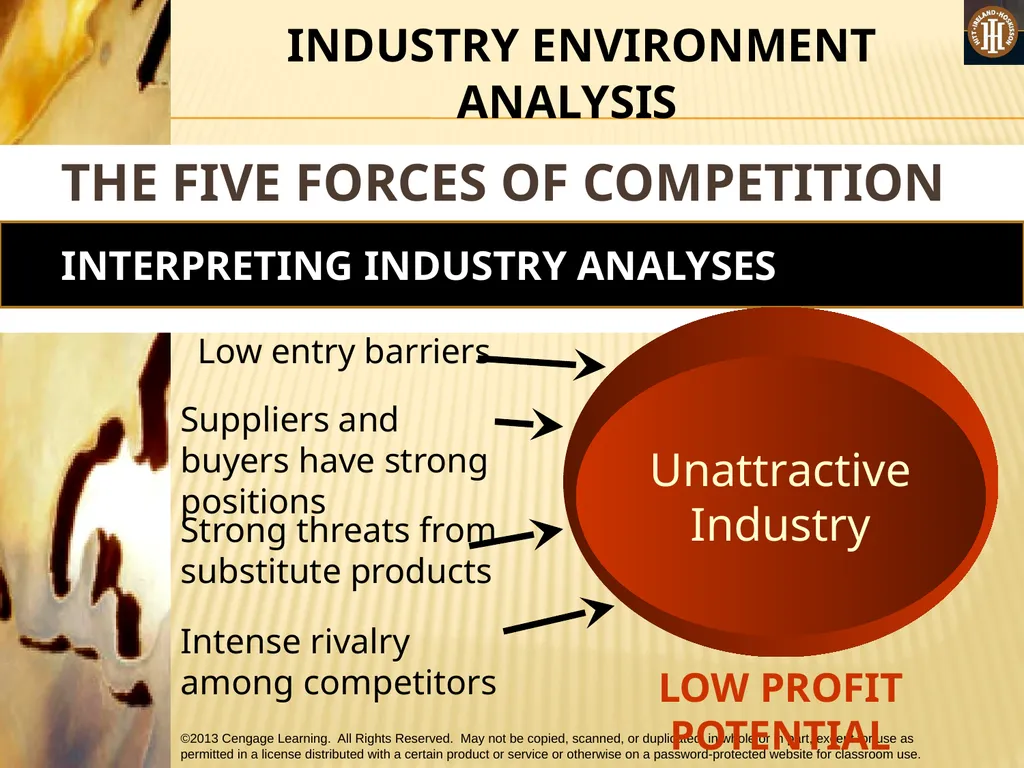
slide59. THE FIVE FORCES OF COMPETITION MODEL INDUSTRY ENVIRONMENT ANALYSIS INTERPRETING INDUSTRY ANALYSES Low entry barriers Suppliers and buyers have strong positions Strong threats from substitute products Intense rivalry among competitors LOW PROFIT POTENTIAL<br>
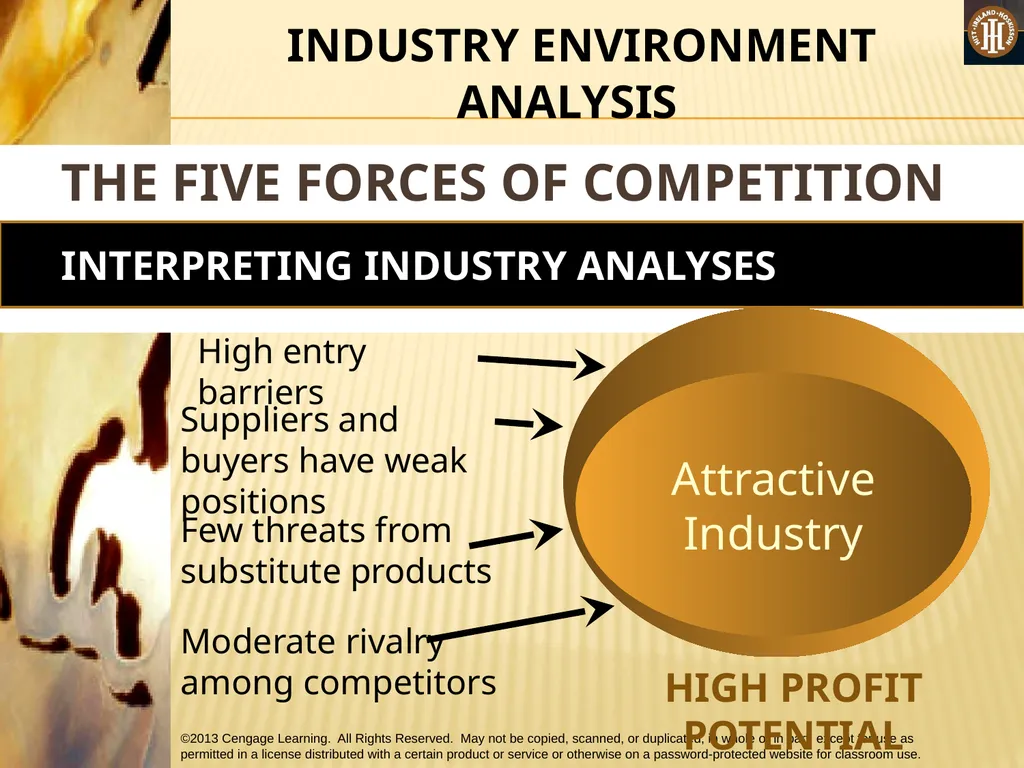
slide60. THE FIVE FORCES OF COMPETITION MODEL INDUSTRY ENVIRONMENT ANALYSIS INTERPRETING INDUSTRY ANALYSES High entry barriers Suppliers and buyers have weak positions Few threats from substitute products Moderate rivalry among competitors HIGH PROFIT POTENTIAL<br>
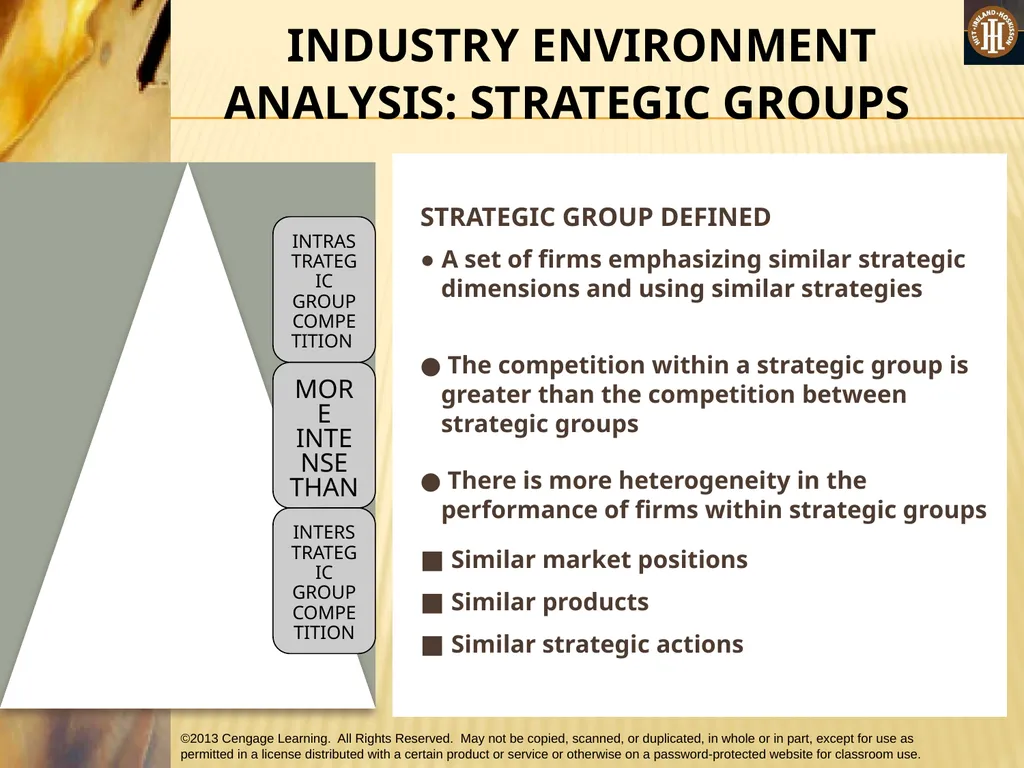
slide61. STRATEGIC GROUP DEFINED
● A set of firms emphasizing similar strategic dimensions and using similar strategies
● The competition within a strategic group is greater than the competition between strategic groups
● There is more heterogeneity in the performance of firms within strategic groups
■ Similar market positions
■ Similar products
■ Similar strategic actions INDUSTRY ENVIRONMENT ANALYSIS: STRATEGIC GROUPS<br>
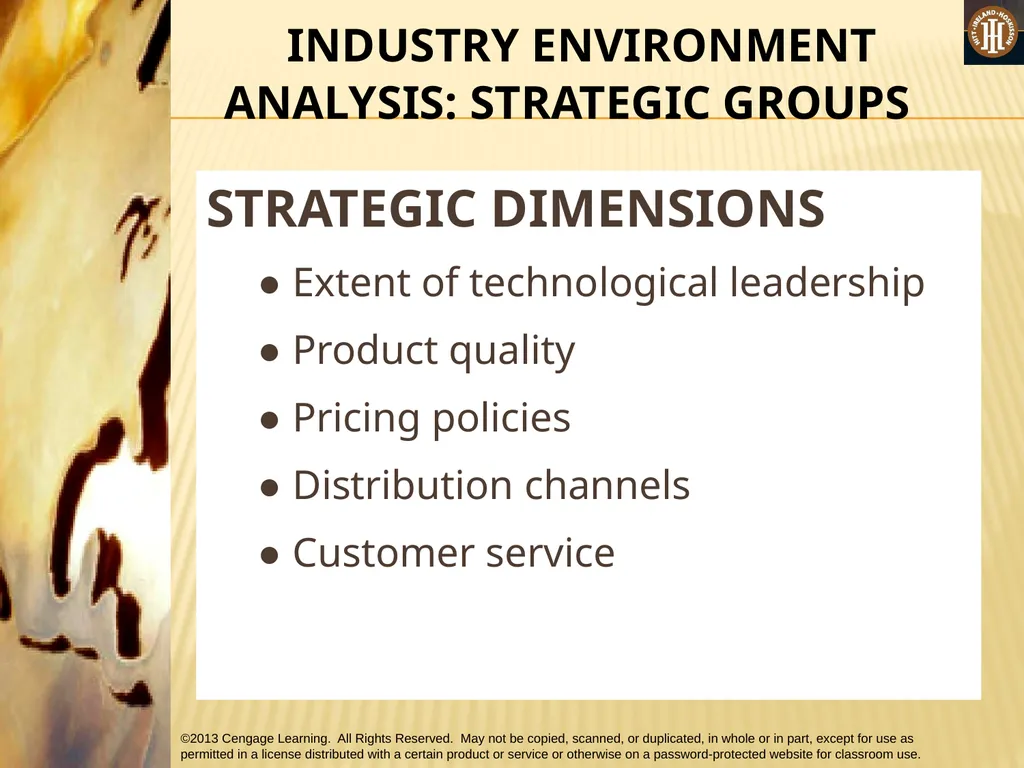
slide62. STRATEGIC DIMENSIONS
● Extent of technological leadership
● Product quality
● Pricing policies
● Distribution channels
● Customer service INDUSTRY ENVIRONMENT ANALYSIS: STRATEGIC GROUPS<br>
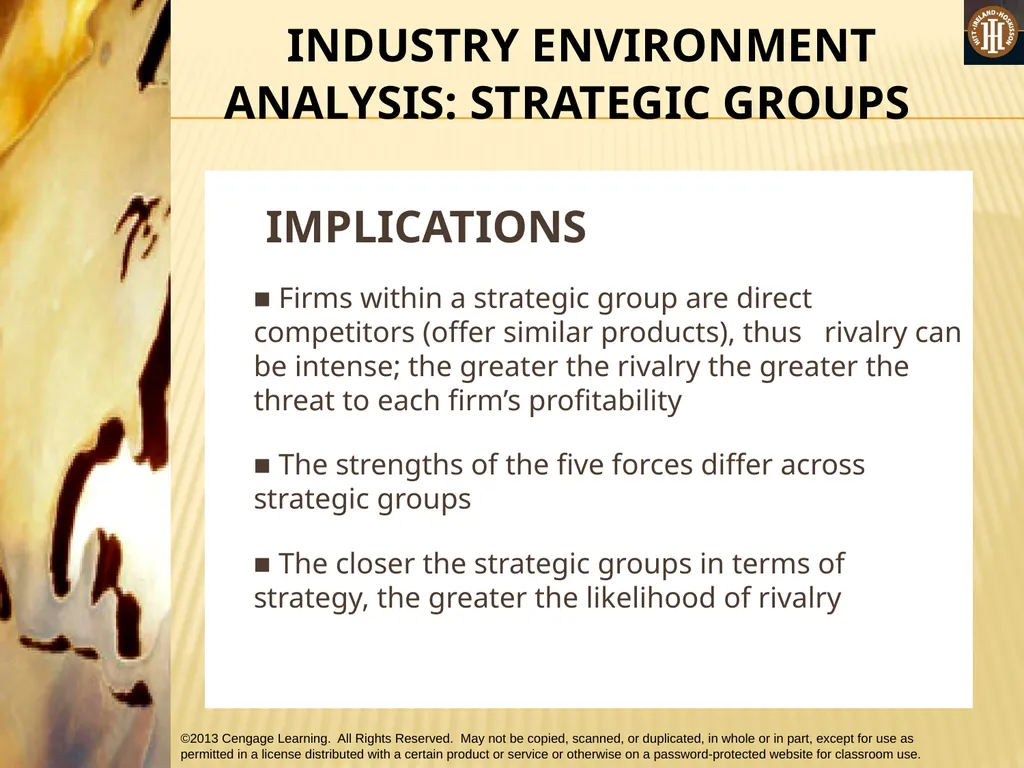
slide63. IMPLICATIONS
■ Firms within a strategic group are direct competitors (offer similar products), thus rivalry can be intense; the greater the rivalry the greater the threat to each firm’s profitability
■ The strengths of the five forces differ across strategic groups
■ The closer the strategic groups in terms of strategy, the greater the likelihood of rivalry INDUSTRY ENVIRONMENT ANALYSIS: STRATEGIC GROUPS<br>
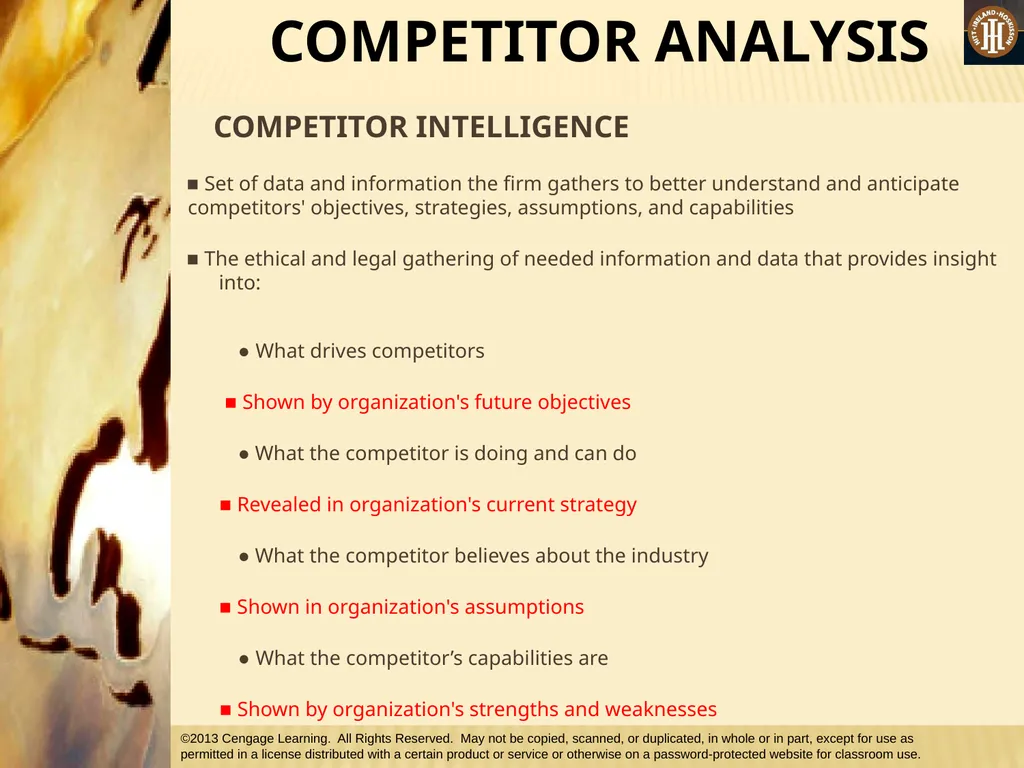
slide64. COMPETITOR INTELLIGENCE
■ Set of data and information the firm gathers to better understand and anticipate competitors' objectives, strategies, assumptions, and capabilities
■ The ethical and legal gathering of needed information and data that provides insight into:
● What drives competitors
■ Shown by organization's future objectives
● What the competitor is doing and can do
■ Revealed in organization's current strategy
● What the competitor believes about the industry
■ Shown in organization's assumptions
● What the competitor’s capabilities are
■ Shown by organization's strengths and weaknesses COMPETITOR ANALYSIS<br>
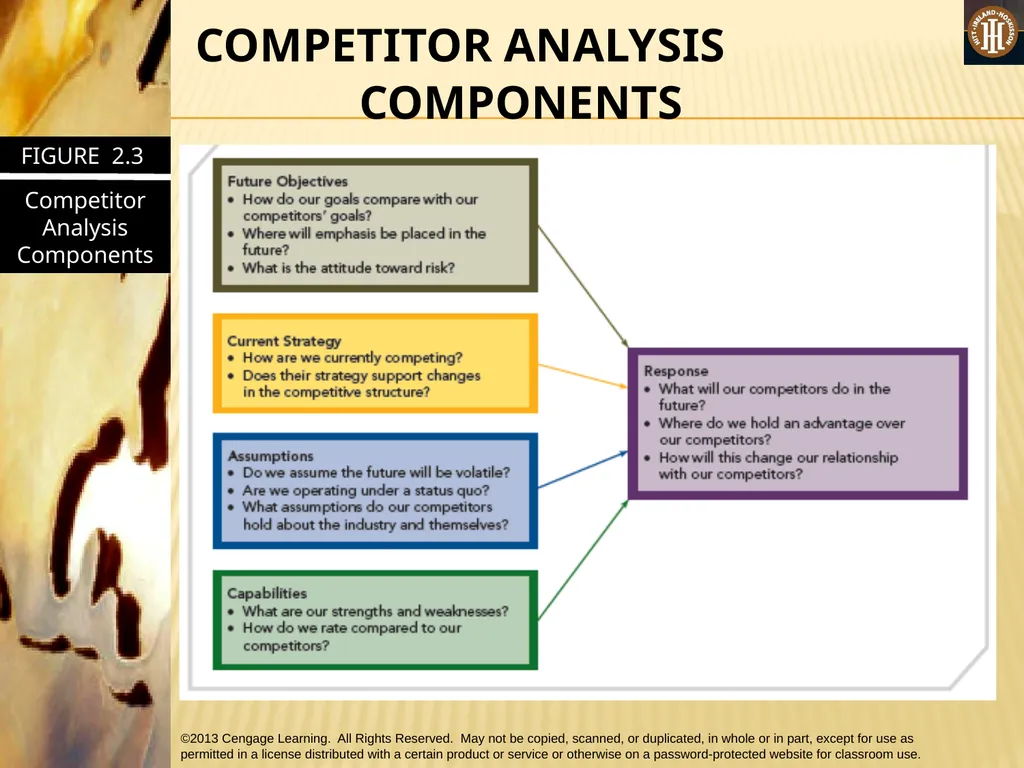
slide65. COMPETITOR ANALYSIS COMPONENTS FIGURE 2.3
Competitor Analysis Components<br>
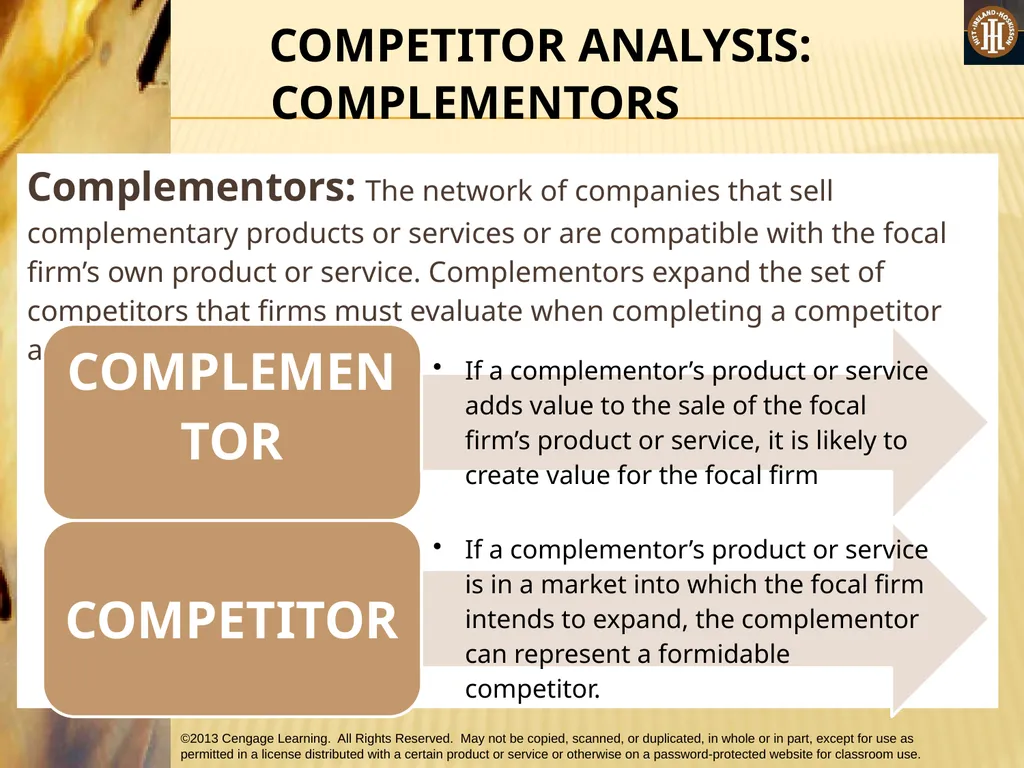
slide66. Complementors: The network of companies that sell complementary products or services or are compatible with the focal firm’s own product or service. Complementors expand the set of competitors that firms must evaluate when completing a competitor analysis COMPETITOR ANALYSIS: COMPLEMENTORS<br>
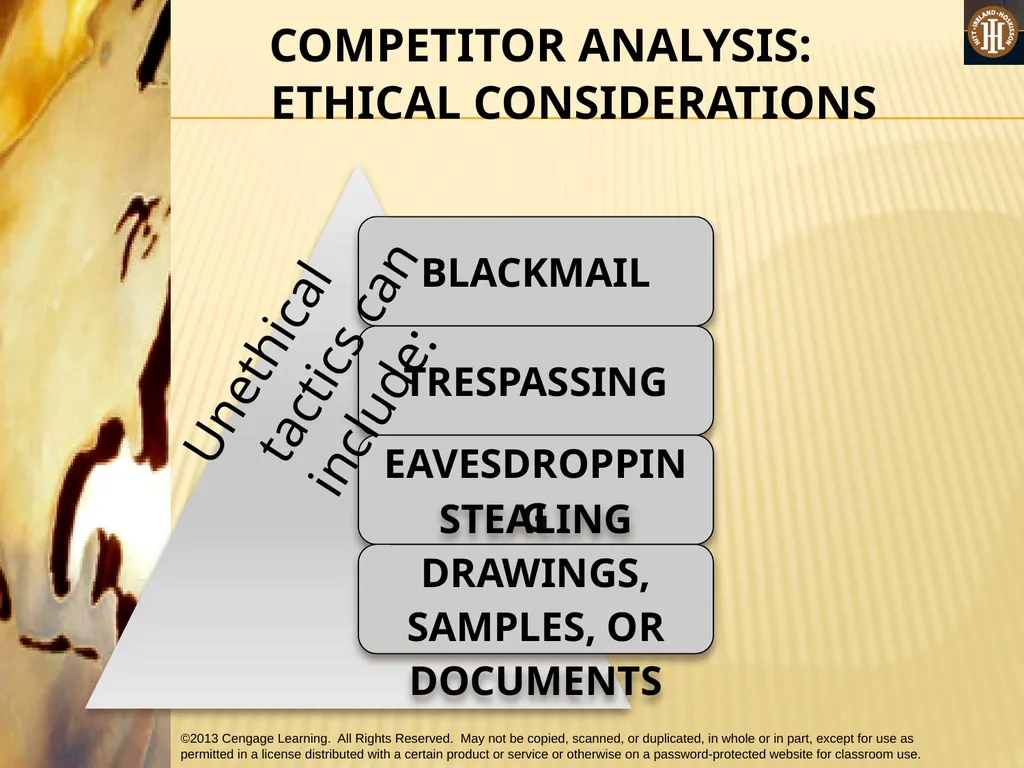
slide67. COMPETITOR ANALYSIS: ETHICAL CONSIDERATIONS Unethical tactics can include:<br>
slide2. THE STRATEGIC MANAGEMENT PROCESS<br>
slide3. KNOWLEDGE OBJECTIVES<br>
slide4. KNOWLEDGE OBJECTIVES<br>
slide5. IMPORTANT DEFINITIONS A firm’s EXTERNAL ENVIRONMENT is broken down into three parts:
● General
● Industry
● Competitor
A firm’s strategic actions are influenced by the conditions in all three parts.<br>
slide6. IMPORTANT DEFINITIONS ● General Environment
Dimensions in the broader society that influence an industry and the firms within it
● Industry Environment
Set of factors that directly influences a firm and its competitive actions and response
● Competitor Environment
Focuses on each company against which a firm directly competes<br>
slide7. THE EXTERNAL ENVIRONMENT FIGURE 2.1 The External Environment<br>
slide8. External environment affects a firm’s strategic actions
●BP seeks to expand its oil reserves after the Deepwater Horizon oil and gas drilling platform disaster in the Gulf of Mexico by forming joint ventures in Russia with Rosneft Corporation and in India with Reliance Industries.
●BP’s strategic actions are also affected by conditions in other segments of its general environment: e.g., the political/legal, social/cultural, and physical environment segments. BRITISH PETROLEUM (BP) OPENING CASE<br>
slide9. A firm’s external environment creates:
● OPPORTUNITIES
e.g., the opportunity for BP to enter other global markets, and
● THREATS
e.g., the possibility that additional regulations in its markets will reduce opportunities for BP to extract oil and gas
Collectively, opportunities and threats affect a firm’s strategic actions. THE EXTERNAL ENVIRONMENT<br>
slide10. THE EXTERNAL ENVIRONMENT MATCHING<br>
slide11. ●The General Environment is grouped into seven environmental segments:
[1] Demographic
[2] Economic
[3] Political/Legal
[4] Sociocultural
[5] Technological
[6] Global
[7] Physical
●To successfully deal with uncertainty in the external environment and achieve strategic competitiveness, firms must be aware of and understand these segments. THE EXTERNAL ENVIRONMENT
GENERAL<br>
slide12. ● Firms cannot directly CONTROL the general environment’s segments.
● However, these segments influence the actions that firms take.
● Successful firms learn how to gather the information needed to understand all segments and their implications for selecting and implementing the firm’s strategies. THE EXTERNAL ENVIRONMENT
GENERAL<br>
slide13. THE DEMOGRAPHIC SEGMENT
Demographic segments are commonly analyzed on a global basis because of their potential effects across countries’ borders and because many firms compete in global markets.
Demographic Segment
Population size
Age structure
Geographic distribution
Ethnic mix
Income distribution THE EXTERNAL ENVIRONMENT
GENERAL SEGMENTS AND ELEMENTS<br>
slide14. Economic Segment
Inflation rates
Interest rates
Trade deficits or surpluses
Budget deficits or surpluses
Personal savings rate
Business savings rates
Gross domestic product THE EXTERNAL ENVIRONMENT
GENERAL SEGMENTS AND ELEMENTS THE ECONOMIC SEGMENT
This segment refers to the nature and direction of the economy in which a firm competes or may compete. Firms generally seek to compete in relatively stable economies with strong growth potential. With globalization and the interconnectedness of nations, firms must scan, monitor, forecast, and assess the health of their host nation and the health of the economies outside their host nation.<br>
slide15. THE POLITICAL/LEGAL SEGMENT
This segment represents how organizations and governments mutually try to influence each other, and how firms try to understand these influences (current and projected) on their strategic actions.
Political/Legal Segment
Antitrust laws
Taxation laws
Deregulation philosophies
Labor training laws
Educational philosophies and policies THE EXTERNAL ENVIRONMENT
GENERAL SEGMENTS AND ELEMENTS<br>
slide16. THE SOCIOCULTURAL SEGMENT
The sociocultural segment is concerned with a society’s attitudes and cultural values. Because attitudes and values form the cornerstone of a society, they often drive demographic, economic, political/legal, and technological conditions and changes.
Sociocultural Segment
Women in the workforce
Workforce
Diversity attitudes about the quality of work life
Shifts in work and career preferences
Shifts in product and service preference characteristics THE EXTERNAL ENVIRONMENT
GENERAL SEGMENTS AND ELEMENTS<br>
slide17. Technological Segment
Product innovations
New communication technologies
Applications of knowledge
Focus of private and government-supported R&D expenditures THE EXTERNAL ENVIRONMENT
GENERAL SEGMENTS AND ELEMENTS THE TECHNOLOGICAL SEGMENT
Technological changes occur through new products, processes, and materials. The technological segment includes the activities involved in creating new knowledge and translating that knowledge into new outputs, products, processes, and materials. Given the rapid pace of technological change and risk of disruption, it is vital for firms to study this segment.<br>
slide18. THE GLOBAL SEGMENT
Markets and consumers are more global. This segment includes relevant new global markets, existing markets that are changing, important international political events, and critical cultural and institutional characteristics of global markets.
Global Segment
Important political events
Critical global markets
Newly industrialized countries
Different cultural and institutional attributes THE EXTERNAL ENVIRONMENT
GENERAL SEGMENTS AND ELEMENTS<br>
slide19. THE PHYSICAL ENVIRONMENT SEGMENT
Concerned with trends oriented to sustaining the world’s physical environment, firms recognize that ecological, social, and economic systems interactively influence what happens in this particular segment. This segment refers to potential and actual changes in the physical environment and business practices that are intended to positively respond to and deal with those changes.
Physical Environment Segment
Energy consumption
Practices used to develop energy sources
Renewable energy efforts
Minimizing a firm’s environmental footprint
Availability of water as a resource
Producing environmentally friendly products
Reacting to natural or man-made disasters THE EXTERNAL ENVIRONMENT
GENERAL SEGMENTS AND ELEMENTS<br>
slide20. THE PHYSICAL ENVIRONMENT SEGMENT
Strategic Focus: Firms’ Efforts to Take Care of the Physical Environment in Which They Compete
● The examples noted in this Strategic Focus: Siemens AG, McDonald’s, Procter & Gamble, and GE signify a growing commitment by firms around the globe in response to emerging trends in the physical environment segment.
● In addition to positively responding to the observed trends in this segment of the general environment, there is some evidence that firms engaging in these types of behaviors outperform those failing to do so.
● This emerging evidence suggests that these behaviors benefit companies, their stakeholders, and the physical environment in which they operate. THE EXTERNAL ENVIRONMENT
GENERAL SEGMENTS AND ELEMENTS EXAMPLE<br>
slide21. External environments are:
Turbulent
Complex
Global
Uncertain
Ambiguous
Incomplete
Firms engage in external environmental analysis to better understand and cope with their environments.
This analysis has four parts:
scanning, monitoring, forecasting, and assessing. EXTERNAL ENVIRONMENTAL ANALYSIS<br>
slide22. EXTERNAL ENVIRONMENTAL ANALYSIS Analyzing the external environment is a difficult, yet significant, activity.<br>
slide23. EXTERNAL ENVIRONMENTAL ANALYSIS ● Identifying opportunities and threats is an important objective of studying the general environment.
● OPPORTUNITY is a condition in the general environment that if exploited effectively, helps a company achieve strategic competitiveness.
EXAMPLE: Procter & Gamble (P&G) is reorienting beauty products to better serve both men and women.<br>
slide24. EXTERNAL ENVIRONMENTAL ANALYSIS ● THREAT is a condition in the general environment that may hinder a company’s efforts to achieve strategic competitiveness.
EXAMPLE: Microsoft is experiencing a severe external threat as smartphones are expected to surpass personal computer (PC) sales in the near future.<br>
slide25. EXTERNAL ENVIRONMENTAL ANALYSIS Firms use several sources to analyze the general environment:
trade publications
newspapers
business publications
academic research
public polls
trade shows
suppliers
customers
employees
People in boundary-spanning positions can obtain a great deal of this type of information.
Examples: salespersons, purchasing managers, public relations directors, and customer service representatives, each of whom interacts with external constituents<br>
slide26. EXTERNAL ENVIRONMENTAL ANALYSIS: SCANNING<br>
slide27. EXTERNAL ENVIRONMENTAL ANALYSIS: MONITORING<br>
slide28. EXTERNAL ENVIRONMENTAL ANALYSIS: FORECASTING<br>
slide29. EXTERNAL ENVIRONMENTAL ANALYSIS: ASSESSING<br>
slide30. An INDUSTRY is a group of firms that produce similar products or offer similar services that are close substitutes.
Compared with the general environment, the industry environment has a more direct effect on the firm’s:
■ Strategic competitiveness
■ Ability to earn above-average returns INDUSTRY ENVIRONMENT ANALYSIS<br>
slide31. An industry’s profit potential is a function of the five forces of competition:
■ The threats posed by new entrants
■ The power of suppliers
■ The power of buyers
■ Product substitutes
■ The intensity of rivalry among competitors
Strategies are chosen, in part, because of the influence of an industry’s characteristics. INDUSTRY ENVIRONMENT ANALYSIS<br>
slide32. INDUSTRY ENVIRONMENT ANALYSIS FIGURE 2.2
The Five Forces of Competition Model<br>
slide33. THE FIVE FORCES OF COMPETITION MODEL INDUSTRY ENVIRONMENT ANALYSIS ● The five forces model of competition expands the arena for competitive analysis. Historically, firms concentrated only on direct competitors.
● Today, firms must study many industries, as competitors are defined more broadly. For example, the communications industry now encompasses media companies, telecoms, entertainment companies, and smartphone producers.<br>
slide34. THE FIVE FORCES OF COMPETITION MODEL INDUSTRY ENVIRONMENT ANALYSIS ● Can threaten market share of existing competitors
● May stimulate additional production capacity
● New competitors may force existing firms to be more efficient and to learn how to compete on new dimensions
● Entry barriers make it difficult for new firms to enter an industry and often place them at a competitive disadvantage even when they are able to enter 1/5 THREAT OF NEW ENTRANTS: BARRIERS TO ENTRY<br>
slide35. THE FIVE FORCES OF COMPETITION MODEL INDUSTRY ENVIRONMENT ANALYSIS ● High entry barriers tend to increase the returns for existing firms in the industry and may allow some firms to dominate the industry
● Industry incumbents want to maintain high entry barriers in order to discourage potential competitors from entering the industry 1/5 THREAT OF NEW ENTRANTS: BARRIERS TO ENTRY<br>
slide36. THE FIVE FORCES OF COMPETITION MODEL INDUSTRY ENVIRONMENT ANALYSIS 1/5 THREAT OF NEW ENTRANTS: BARRIERS TO ENTRY FUNCTION OF TWO FACTORS
1 BARRIERS TO ENTRY
● Economies of scale
● Product differentiation
● Capital requirements
● Switching costs
● Access to distribution channels
● Cost disadvantages independent of scale
● Government policy
2 EXPECTED RETALIATION<br>
slide37. THE FIVE FORCES OF COMPETITION MODEL INDUSTRY ENVIRONMENT ANALYSIS 1/5 THREAT OF NEW ENTRANTS: BARRIERS TO ENTRY ECONOMIES OF SCALE
● Marginal improvements in efficiency that a firm experiences as it incrementally increases its size
● Economies of scale can be developed in most business functions, such as marketing, manufacturing, research and development, and purchasing<br>
slide38. THE FIVE FORCES OF COMPETITION MODEL INDUSTRY ENVIRONMENT ANALYSIS 1/5 THREAT OF NEW ENTRANTS: BARRIERS TO ENTRY ECONOMIES OF SCALE (cont’d)
FACTORS (advantages/disadvantages) related to large- and small-scale entry
● Flexibility in pricing and market share
● Costs related to scale economies
● Competitor retaliation
● Flexible manufacturing systems diminishes the effectiveness of economies scale to act as a barrier<br>
slide39. THE FIVE FORCES OF COMPETITION MODEL INDUSTRY ENVIRONMENT ANALYSIS 1/5 THREAT OF NEW ENTRANTS: BARRIERS TO ENTRY PRODUCT DIFFERENTIATION
● Unique products
● Customer loyalty
● New entrants frequently offer products at lower prices<br>
slide40. THE FIVE FORCES OF COMPETITION MODEL INDUSTRY ENVIRONMENT ANALYSIS 1/5 THREAT OF NEW ENTRANTS: BARRIERS TO ENTRY CAPITAL REQUIREMENTS
● Differ according to industry
● Availability of capital
● Physical facilities/Inventories/Marketing activities
● Knowledge requirements<br>
slide41. THE FIVE FORCES OF COMPETITION MODEL INDUSTRY ENVIRONMENT ANALYSIS 1/5 THREAT OF NEW ENTRANTS: BARRIERS TO ENTRY SWITCHING COSTS
One-time costs customers incur when they buy from a different supplier
■ New equipment
■ Retraining employees
■ Psychological costs of ending a supplier relationship<br>
slide42. THE FIVE FORCES OF COMPETITION MODEL INDUSTRY ENVIRONMENT ANALYSIS 1/5 THREAT OF NEW ENTRANTS: BARRIERS TO ENTRY ACCESS TO DISTRIBUTION CHANNELS
● Stocking or shelf space
● Price breaks/Cooperative advertising allowances
● Less of a barrier for products that can be sold on the Internet<br>
slide43. THE FIVE FORCES OF COMPETITION MODEL INDUSTRY ENVIRONMENT ANALYSIS 1/5 THREAT OF NEW ENTRANTS: BARRIERS TO ENTRY COST DISADVANTAGES INDEPENDENT OF SCALE
● Proprietary product technology
● Favorable access to raw materials
● Desirable locations<br>
slide44. THE FIVE FORCES OF COMPETITION MODEL INDUSTRY ENVIRONMENT ANALYSIS 1/5 THREAT OF NEW ENTRANTS: BARRIERS TO ENTRY GOVERNMENT POLICY
● Licensing and permit requirements
● Regulation/Deregulation of industries
● Antitrust violations resulting from industry dominance<br>
slide45. THE FIVE FORCES OF COMPETITION MODEL INDUSTRY ENVIRONMENT ANALYSIS 1/5 THREAT OF NEW ENTRANTS: BARRIERS TO ENTRY EXPECTED RETALIATION
Vigorous retaliation can be expected when the existing firm has a major stake in the industry.
■ It has fixed assets with few, if any, alternative uses
■ It has substantial resources
■ When industry growth is slow or constrained
● Locating market niches not being served by incumbents allows the new entrant to avoid entry barriers
● Small entrepreneurial firms are generally best suited for identifying and serving neglected market segments<br>
slide46. THE FIVE FORCES OF COMPETITION MODEL INDUSTRY ENVIRONMENT ANALYSIS 2/5 BARGAINING POWER OF SUPPLIERS SUPPLIER POWER INCREASES WHEN:
● Suppliers are large and few in number
● Suitable substitute products are not available
● Industry firms are not a significant customer for the suppliers
● Suppliers’ goods are critical to buyers’ marketplace success<br>
slide47. THE FIVE FORCES OF COMPETITION MODEL INDUSTRY ENVIRONMENT ANALYSIS 2/5 BARGAINING POWER OF SUPPLIERS SUPPLIER POWER INCREASES WHEN (cont’d):
● Suppliers’ products create high switching costs
● Suppliers have substantial resources and provide a highly differentiated product
● Suppliers pose a credible threat to integrate forward into the buyers’ industry<br>
slide48. THE FIVE FORCES OF COMPETITION MODEL INDUSTRY ENVIRONMENT ANALYSIS 3/5 BARGAINING POWER OF BUYERS BUYER POWER INCREASES WHEN:
● Buyers purchase a large portion of an industry’s total output
● Buyers’ purchases are a significant portion of a seller’s annual revenues
● Switching costs are low (to other industry product)<br>
slide49. THE FIVE FORCES OF COMPETITION MODEL INDUSTRY ENVIRONMENT ANALYSIS 3/5 BARGAINING POWER OF BUYERS BUYER POWER INCREASES WHEN (cont’d):
● The industry’s products are undifferentiated or standardized
● Buyers pose a credible threat to integrate backward into the sellers’ industry<br>
slide50. THE FIVE FORCES OF COMPETITION MODEL INDUSTRY ENVIRONMENT ANALYSIS 4/5 THREAT OF SUBSTITUTE PRODUCTS THREAT OF SUBSTITUTE PRODUCTS INCREASES WHEN:
● Buyers face few switching costs
● The substitute product’s price is lower
● Substitute product’s quality and performance are equal to or greater than the existing product
● Differentiated industry products that are valued by customers reduce this threat<br>
slide51. THE FIVE FORCES OF COMPETITION MODEL INDUSTRY ENVIRONMENT ANALYSIS 4/5 THREAT OF SUBSTITUTE PRODUCTS FUNCTION OF A SUBSTITUTE
● Places a ceiling on prices firms can charge
● Goods or services outside a given industry perform the same or similar functions at a competitive price (e.g., plastic has replaced steel in many applications)<br>
slide52. THE FIVE FORCES OF COMPETITION MODEL INDUSTRY ENVIRONMENT ANALYSIS 5/5 INTENSITY OF RIVALRY AMONG COMPETITORS INDUSTRY RESTRUCTURED THROUGH COMPETITORS
STRATEGIC FOCUS: The Multi-Industry Battle for Mobile and Home Digital Computing and Entertainment
● The process of new technology creation, utilization, and commercialization ultimately leads to changes in organizational patterns, and in particular, strategic alliances and mergers and acquisitions as firms restructure themselves around the opportunities being created.<br>
slide53. THE FIVE FORCES OF COMPETITION MODEL INDUSTRY ENVIRONMENT ANALYSIS 5/5 INTENSITY OF RIVALRY AMONG COMPETITORS INDUSTRY RESTRUCTURED THROUGH COMPETITORS (cont’d)
● Competitor analysis must examine how such technological changes will lead to convergence of competitors or other firms and associated organizational changes and the possible re-creation of a new set of industry competitors, buyers, and suppliers.<br>
slide54. THE FIVE FORCES OF COMPETITION MODEL INDUSTRY ENVIRONMENT ANALYSIS 5/5 INTENSITY OF RIVALRY AMONG COMPETITORS INDUSTRY RIVALRY
● Competitors are rarely homogeneous; they differ in resources and capabilities and seek to differentiate themselves from competitors
● Firms seek to differentiate their products in ways that customers value and in which the firms have a competitive advantage
● Common rivalry dimensions:
■ Price
■ Service after the sale
■ Innovation<br>
slide55. THE FIVE FORCES OF COMPETITION MODEL INDUSTRY ENVIRONMENT ANALYSIS 5/5 INTENSITY OF RIVALRY AMONG COMPETITORS INDUSTRY RIVALRY INTENSIFIES WITH:
● Numerous or equally balanced competitors
● Slow industry growth
● High fixed costs or high storage costs
● Lack of differentiation opportunities or low switching costs
● High strategic stakes
● High exit barriers<br>
slide56. THE FIVE FORCES OF COMPETITION MODEL INDUSTRY ENVIRONMENT ANALYSIS 5/5 INTENSITY OF RIVALRY AMONG COMPETITORS EXIT BARRIERS
High exit barriers prevent competitors from leaving the industry
EXAMPLES
■ Specialized assets: assets with values linked to a particular business
■ Fixed costs of exit: such as labor agreements<br>
slide57. THE FIVE FORCES OF COMPETITION MODEL INDUSTRY ENVIRONMENT ANALYSIS 5/5 INTENSITY OF RIVALRY AMONG COMPETITORS EXIT BARRIERS (examples cont’d):
■ Strategic interrelationships: relationships of mutual dependence, such as those between one business and other parts of a company’s operations, including shared facilities and access to financial markets<br>
slide58. THE FIVE FORCES OF COMPETITION MODEL INDUSTRY ENVIRONMENT ANALYSIS 5/5 INTENSITY OF RIVALRY AMONG COMPETITORS EXIT BARRIERS (examples cont’d):
:
■ Emotional barriers: aversion to economically justified business decisions because of fear for one’s own career, loyalty to employees, etc.
■ Government and social restrictions: often based on government concerns for job losses and regional economic effects; more common outside the United States<br>
slide59. THE FIVE FORCES OF COMPETITION MODEL INDUSTRY ENVIRONMENT ANALYSIS INTERPRETING INDUSTRY ANALYSES Low entry barriers Suppliers and buyers have strong positions Strong threats from substitute products Intense rivalry among competitors LOW PROFIT POTENTIAL<br>
slide60. THE FIVE FORCES OF COMPETITION MODEL INDUSTRY ENVIRONMENT ANALYSIS INTERPRETING INDUSTRY ANALYSES High entry barriers Suppliers and buyers have weak positions Few threats from substitute products Moderate rivalry among competitors HIGH PROFIT POTENTIAL<br>
slide61. STRATEGIC GROUP DEFINED
● A set of firms emphasizing similar strategic dimensions and using similar strategies
● The competition within a strategic group is greater than the competition between strategic groups
● There is more heterogeneity in the performance of firms within strategic groups
■ Similar market positions
■ Similar products
■ Similar strategic actions INDUSTRY ENVIRONMENT ANALYSIS: STRATEGIC GROUPS<br>
slide62. STRATEGIC DIMENSIONS
● Extent of technological leadership
● Product quality
● Pricing policies
● Distribution channels
● Customer service INDUSTRY ENVIRONMENT ANALYSIS: STRATEGIC GROUPS<br>
slide63. IMPLICATIONS
■ Firms within a strategic group are direct competitors (offer similar products), thus rivalry can be intense; the greater the rivalry the greater the threat to each firm’s profitability
■ The strengths of the five forces differ across strategic groups
■ The closer the strategic groups in terms of strategy, the greater the likelihood of rivalry INDUSTRY ENVIRONMENT ANALYSIS: STRATEGIC GROUPS<br>
slide64. COMPETITOR INTELLIGENCE
■ Set of data and information the firm gathers to better understand and anticipate competitors' objectives, strategies, assumptions, and capabilities
■ The ethical and legal gathering of needed information and data that provides insight into:
● What drives competitors
■ Shown by organization's future objectives
● What the competitor is doing and can do
■ Revealed in organization's current strategy
● What the competitor believes about the industry
■ Shown in organization's assumptions
● What the competitor’s capabilities are
■ Shown by organization's strengths and weaknesses COMPETITOR ANALYSIS<br>
slide65. COMPETITOR ANALYSIS COMPONENTS FIGURE 2.3
Competitor Analysis Components<br>
slide66. Complementors: The network of companies that sell complementary products or services or are compatible with the focal firm’s own product or service. Complementors expand the set of competitors that firms must evaluate when completing a competitor analysis COMPETITOR ANALYSIS: COMPLEMENTORS<br>
slide67. COMPETITOR ANALYSIS: ETHICAL CONSIDERATIONS Unethical tactics can include:<br>