
PART 2: STRATEGIC ACTIONS: STRATEGY FORMULATION
LD
Published · 58 slides · 0 views

1 / 1























Description
PART 2: STRATEGIC ACTIONS: STRATEGY FORMULATION CHAPTER 7 ACQUISITION AND RESTRUCTURING STRATEGIES THE STRATEGIC MANAGEMENT PROCESS KNOWLEDGE OBJECTIVES KNOWLEDGE OBJECTIVES TECHNOLOGY GIANTS ACQUISITION STRATEGIES AND THEIR OUTCOMES
Related Topics
Share
Embed code
Download this presentation From Below
"PART 2: STRATEGIC ACTIONS: STRATEGY FORMULATION" is the property of its rightful owner. Permission is granted to download and print the materials on this website for personal, non-commercial use only, and to display it on your personal computer provided you do not modify the materials and that you retain all copyright notices contained in the materials. By downloading content from our website, you accept the terms of this agreement.
Presentation Transcript
01
PART 2: STRATEGIC ACTIONS:
STRATEGY FORMULATION CHAPTER 7 ACQUISITION AND RESTRUCTURING STRATEGIES<br>
STRATEGY FORMULATION CHAPTER 7 ACQUISITION AND RESTRUCTURING STRATEGIES<br>
02
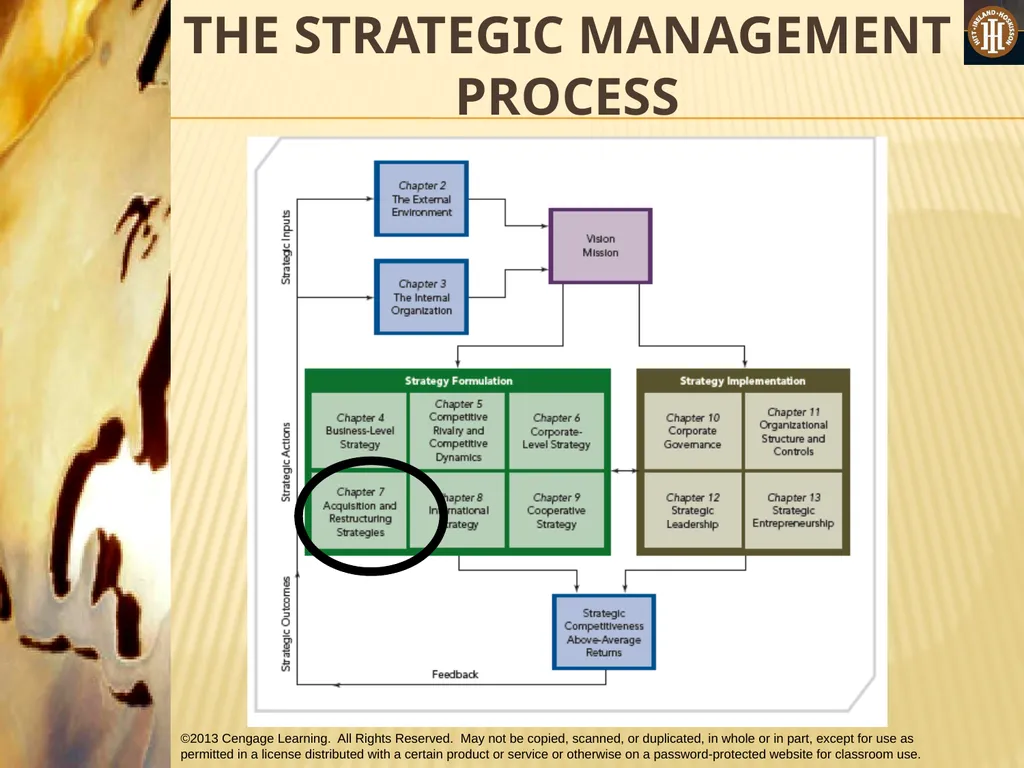
THE STRATEGIC MANAGEMENT PROCESS<br>
03
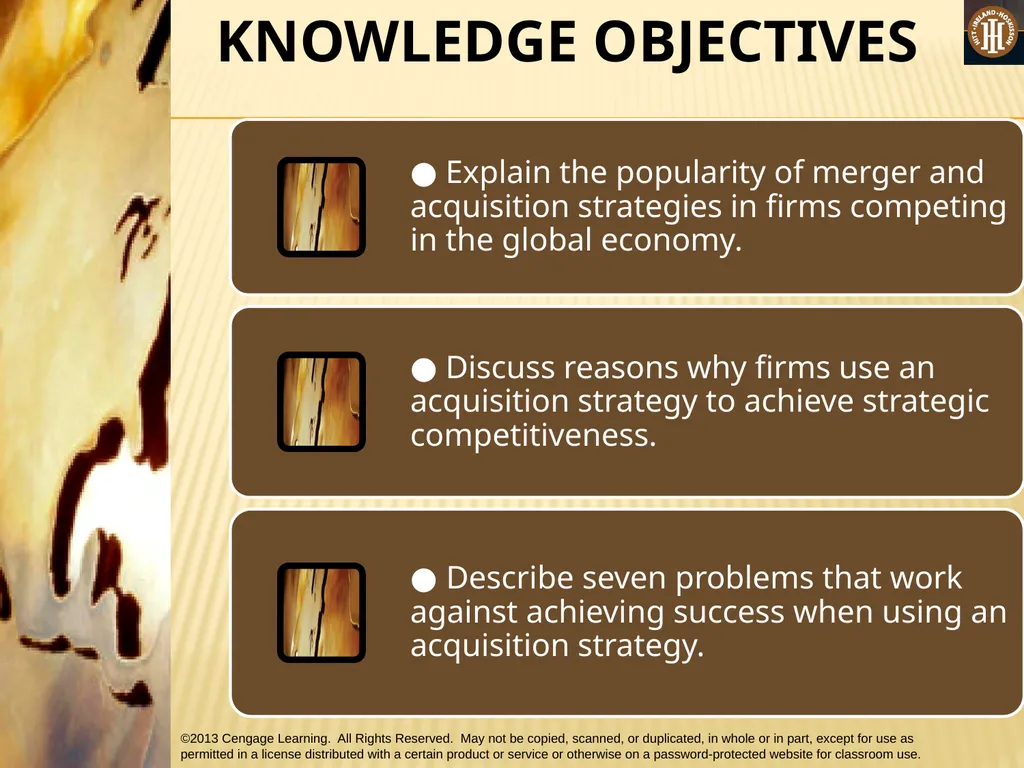
KNOWLEDGE OBJECTIVES<br>
04
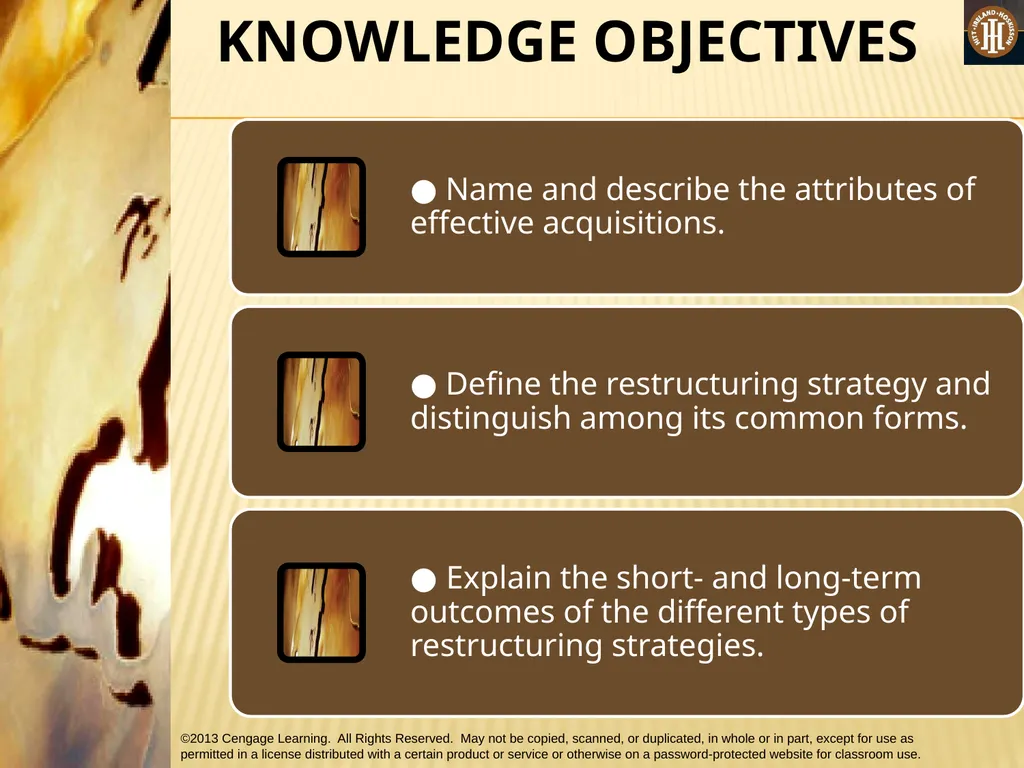
KNOWLEDGE OBJECTIVES<br>
05
TECHNOLOGY GIANTS’ ACQUISITION STRATEGIES AND THEIR OUTCOMES ■ Online social networks, such as Facebook, have caused Procter & Gamble (P&G) to reallocate their advertising resources away from television to more digital formats.
■ When Microsoft announced that it would acquire Skype Global S.A.R.L., the leading Internet telecommunications company for $8.5 billion, there were both positive and negative attributions about the deal in the media. OPENING CASE<br>
■ When Microsoft announced that it would acquire Skype Global S.A.R.L., the leading Internet telecommunications company for $8.5 billion, there were both positive and negative attributions about the deal in the media. OPENING CASE<br>
06
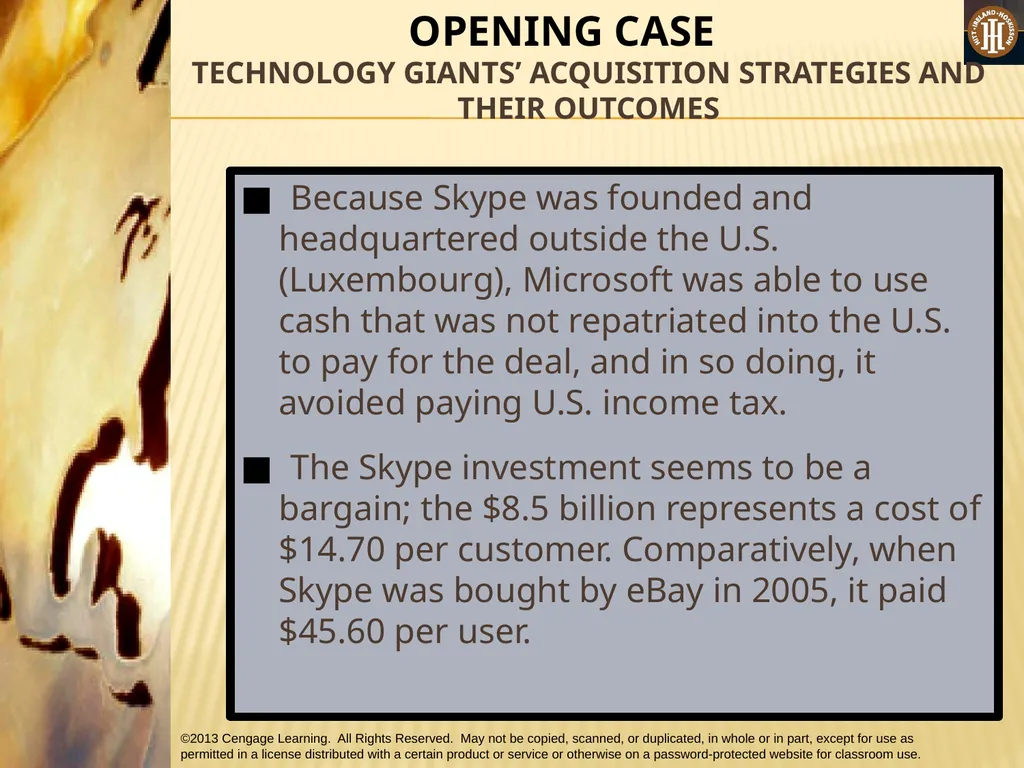
TECHNOLOGY GIANTS’ ACQUISITION STRATEGIES AND THEIR OUTCOMES ■ Because Skype was founded and headquartered outside the U.S. (Luxembourg), Microsoft was able to use cash that was not repatriated into the U.S. to pay for the deal, and in so doing, it avoided paying U.S. income tax.
■ The Skype investment seems to be a bargain; the $8.5 billion represents a cost of $14.70 per customer. Comparatively, when Skype was bought by eBay in 2005, it paid $45.60 per user. OPENING CASE<br>
■ The Skype investment seems to be a bargain; the $8.5 billion represents a cost of $14.70 per customer. Comparatively, when Skype was bought by eBay in 2005, it paid $45.60 per user. OPENING CASE<br>
07
TECHNOLOGY GIANTS’ ACQUISITION STRATEGIES AND THEIR OUTCOMES CHALLENGES:
● Whether Microsoft will be able to utilize the service and integrate it into its focus on business customers relative to the consumer focus of Skype
● Whether Microsoft will be able to incorporate the Skype service into its various devices and software platforms OPENING CASE<br>
● Whether Microsoft will be able to utilize the service and integrate it into its focus on business customers relative to the consumer focus of Skype
● Whether Microsoft will be able to incorporate the Skype service into its various devices and software platforms OPENING CASE<br>
08
TECHNOLOGY GIANTS’ ACQUISITION STRATEGIES AND THEIR OUTCOMES DEFENSIVE RATIONALE
● If Microsoft did not buy Skype, it may have ended up in the hands of a competitor such as Google, who might be able to use it to strengthen its ecosystem at the expense of Microsoft.
OFFENSIVE STRATEGY
● Google’s acquisition strategy is usually to acquire earlier-stage companies than Microsoft’s deal to acquire Skype. Google purchased YouTube for $1.6 billion in 2006. OPENING CASE<br>
● If Microsoft did not buy Skype, it may have ended up in the hands of a competitor such as Google, who might be able to use it to strengthen its ecosystem at the expense of Microsoft.
OFFENSIVE STRATEGY
● Google’s acquisition strategy is usually to acquire earlier-stage companies than Microsoft’s deal to acquire Skype. Google purchased YouTube for $1.6 billion in 2006. OPENING CASE<br>
09
TECHNOLOGY GIANTS’ ACQUISITION STRATEGIES AND THEIR OUTCOMES ■ Facebook has a somewhat different approach to acquisitions, having recently purchased Snaptu. Snaptu provides application software for services such as Facebook, Twitter, and LinkedIn, which allows these services to be featured on phones.
■ Facebook has made 11 acquisitions since 2007; however, almost none of the acquired companies’ services has survived as independent businesses. OPENING CASE<br>
■ Facebook has made 11 acquisitions since 2007; however, almost none of the acquired companies’ services has survived as independent businesses. OPENING CASE<br>
10
TECHNOLOGY GIANTS’ ACQUISITION STRATEGIES AND THEIR OUTCOMES ■ Online commerce is moving into a consumer-oriented retail phase, of which firms such as Facebook and Amazon are seeking to take advantage.
■ Acquisitions are a quick way to move into the space that these tech giants see evolving, such as Microsoft seeking to broaden its communication base, Google expanding beyond search to experiment with new models of advertising, and Facebook’s attempts to learn from the human capital that they are able to acquire. OPENING CASE<br>
■ Acquisitions are a quick way to move into the space that these tech giants see evolving, such as Microsoft seeking to broaden its communication base, Google expanding beyond search to experiment with new models of advertising, and Facebook’s attempts to learn from the human capital that they are able to acquire. OPENING CASE<br>
11
Popular strategy in the U.S. for many years
Source of firm growth and above-average returns
Some believe that M&A strategies played a central role in the restructuring of U.S. businesses during the 1980s and 1990s and that they continue generating benefits in the twenty-first century POPULARITY OF MERGER AND ACQUISITION STRATEGIES<br>
Source of firm growth and above-average returns
Some believe that M&A strategies played a central role in the restructuring of U.S. businesses during the 1980s and 1990s and that they continue generating benefits in the twenty-first century POPULARITY OF MERGER AND ACQUISITION STRATEGIES<br>
12
Heavily influenced by external environment
Tight credit markets
Political changes in foreign countries’ orientation toward M&A
During the recent financial crisis, tightened credit markets made it more difficult for firms to complete “megadeals” (> $10 billion)
Then U.S. deals picked up in 2011, where “first-quarter deal volume rose 45% to $290.8 billion, compared with $200.6 billion” in 2010 POPULARITY OF MERGER AND ACQUISITION STRATEGIES<br>
Tight credit markets
Political changes in foreign countries’ orientation toward M&A
During the recent financial crisis, tightened credit markets made it more difficult for firms to complete “megadeals” (> $10 billion)
Then U.S. deals picked up in 2011, where “first-quarter deal volume rose 45% to $290.8 billion, compared with $200.6 billion” in 2010 POPULARITY OF MERGER AND ACQUISITION STRATEGIES<br>
13
Cross-border acquisitions heighten during currency imbalances, from strong currency countries to weaker currency countries, such as the U.S.
Firms use M&A strategies to create value for all stakeholders
M&A value creation applies equally to all strategies (business-level, corporate-level, international, and cooperative) POPULARITY OF MERGER AND ACQUISITION STRATEGIES<br>
Firms use M&A strategies to create value for all stakeholders
M&A value creation applies equally to all strategies (business-level, corporate-level, international, and cooperative) POPULARITY OF MERGER AND ACQUISITION STRATEGIES<br>
14
Can be used because of uncertainty in the competitive landscape
Increase market power because of competitive threat
Spread risk due to uncertain environment
Shift core business into different markets
Manage industry and regulatory changes
Intent:
Increase firm’s strategic competitiveness and value; historically returns are close to zero so it rarely works as planned POPULARITY OF MERGER AND ACQUISITION STRATEGIES<br>
Increase market power because of competitive threat
Spread risk due to uncertain environment
Shift core business into different markets
Manage industry and regulatory changes
Intent:
Increase firm’s strategic competitiveness and value; historically returns are close to zero so it rarely works as planned POPULARITY OF MERGER AND ACQUISITION STRATEGIES<br>
15
M&A value creation is challenging
GOOD NEWS: Shareholders of ACQUIRED firms often earn above-average returns from acquisitions
BAD NEWS: Shareholders of ACQUIRING firms earn returns that are close to zero: In 2/3 of all acquisitions, the acquiring firm’s stock price fell immediately after the intended transaction was announced
This negative response reflects investors’ skepticism about projected synergies being captured POPULARITY OF MERGER AND ACQUISITION STRATEGIES<br>
GOOD NEWS: Shareholders of ACQUIRED firms often earn above-average returns from acquisitions
BAD NEWS: Shareholders of ACQUIRING firms earn returns that are close to zero: In 2/3 of all acquisitions, the acquiring firm’s stock price fell immediately after the intended transaction was announced
This negative response reflects investors’ skepticism about projected synergies being captured POPULARITY OF MERGER AND ACQUISITION STRATEGIES<br>
16
MERGERS, ACQUISITIONS, AND TAKEOVERS: WHAT ARE THE DIFFERENCES? MERGER
Two firms agree to integrate their operations on a relatively co-equal basis
There are few TRUE mergers because one firm usually dominates in terms of market share, size, or asset value
ACQUISITION
One firm buys a controlling, 100 percent interest in another firm with the intent of making the acquired firm a subsidiary business within its portfolio<br>
Two firms agree to integrate their operations on a relatively co-equal basis
There are few TRUE mergers because one firm usually dominates in terms of market share, size, or asset value
ACQUISITION
One firm buys a controlling, 100 percent interest in another firm with the intent of making the acquired firm a subsidiary business within its portfolio<br>
17
MERGERS, ACQUISITIONS, AND TAKEOVERS: WHAT ARE THE DIFFERENCES? TAKEOVER
Special type of acquisition strategy wherein the target firm did not solicit the acquiring firm's bid
HOSTILE TAKEOVER
Unfriendly takeover that is undesired by the target firm
RATIONALE FOR STRATEGY
Pre-announcement returns of hostile takeovers are largely anticipated and associated with a significant increase in the bidder’s and target’s share price<br>
Special type of acquisition strategy wherein the target firm did not solicit the acquiring firm's bid
HOSTILE TAKEOVER
Unfriendly takeover that is undesired by the target firm
RATIONALE FOR STRATEGY
Pre-announcement returns of hostile takeovers are largely anticipated and associated with a significant increase in the bidder’s and target’s share price<br>
18
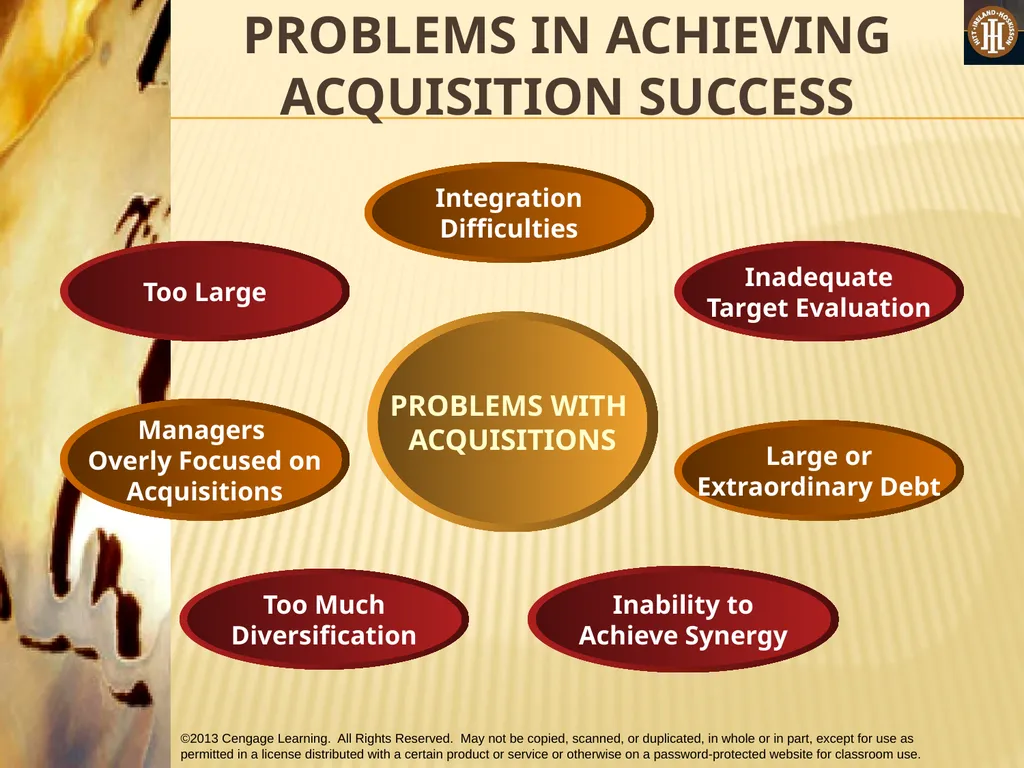
REASONS FOR ACQUISITIONS AND PROBLEMS IN ACHIEVING SUCCESS FIGURE 7.1
Reasons for Acquisitions and Problems in Achieving Success<br>
Reasons for Acquisitions and Problems in Achieving Success<br>
19
REASONS FOR ACQUISITIONS Increased Market Power Market Leadership results from Market Power
Factors increasing market power:
● The ability to sell goods or services above competitive levels
● Costs of primary or support activities are below those of competitors
● Size of the firm, resources, and capabilities to compete in the market and share of the market
● Purchase of a competitor, a supplier, a distributor, or a business in a highly related industry<br>
Factors increasing market power:
● The ability to sell goods or services above competitive levels
● Costs of primary or support activities are below those of competitors
● Size of the firm, resources, and capabilities to compete in the market and share of the market
● Purchase of a competitor, a supplier, a distributor, or a business in a highly related industry<br>
20
REASONS FOR ACQUISITIONS Increased Market Power Market power is increased by:
●Horizontal acquisitions: other firms in the same industry
McDonald’s acquisition of Boston Market (successful?)
●Vertical acquisitions: suppliers or distributors of the acquiring firm
Walt Disney Company’s acquisition of Fox Family Worldwide
●Related acquisitions: firms in related industries<br>
●Horizontal acquisitions: other firms in the same industry
McDonald’s acquisition of Boston Market (successful?)
●Vertical acquisitions: suppliers or distributors of the acquiring firm
Walt Disney Company’s acquisition of Fox Family Worldwide
●Related acquisitions: firms in related industries<br>
21
REASONS FOR ACQUISITIONS Increased Market Power Acquirer and acquired companies compete in the same industry
Firm’s market power is increased by exploiting:
Cost-based synergies
Revenue-based synergies
Acquisitions with similar characteristics result in higher performance than those with dissimilar characteristics Similar characteristics:
Strategy
Managerial styles
Resource allocation patterns
Previous alliance management experience<br>
Firm’s market power is increased by exploiting:
Cost-based synergies
Revenue-based synergies
Acquisitions with similar characteristics result in higher performance than those with dissimilar characteristics Similar characteristics:
Strategy
Managerial styles
Resource allocation patterns
Previous alliance management experience<br>
22
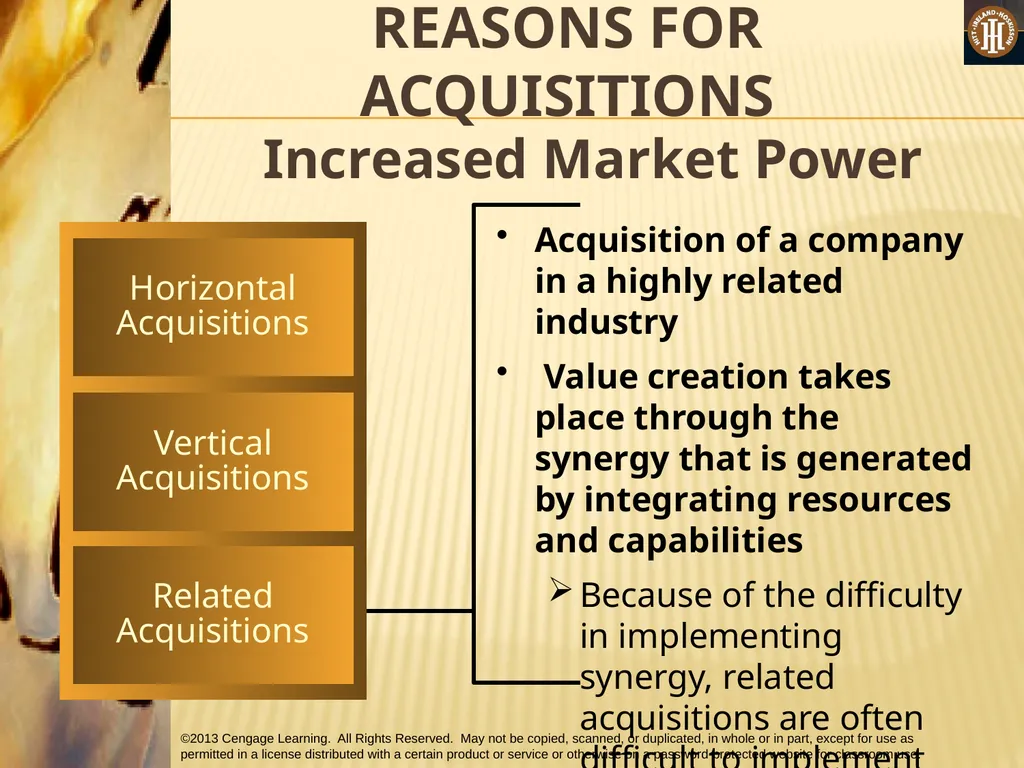
REASONS FOR ACQUISITIONS Increased Market Power Acquisition of a supplier or distributor of one or more of the firm’s goods or services
Increases a firm’s market power by controlling additional parts of the value chain<br>
Increases a firm’s market power by controlling additional parts of the value chain<br>
23
REASONS FOR ACQUISITIONS Increased Market Power Acquisition of a company in a highly related industry
Value creation takes place through the synergy that is generated by integrating resources and capabilities
Because of the difficulty in implementing synergy, related acquisitions are often difficult to implement<br>
Value creation takes place through the synergy that is generated by integrating resources and capabilities
Because of the difficulty in implementing synergy, related acquisitions are often difficult to implement<br>
24
REASONS FOR ACQUISITIONS Increased Market Power
Horizontal, Vertical, and Related Acquisitions
Acquisitions intended to increase market power are subject to:
Regulatory review
Analysis by financial markets<br>
Horizontal, Vertical, and Related Acquisitions
Acquisitions intended to increase market power are subject to:
Regulatory review
Analysis by financial markets<br>
25
REASONS FOR ACQUISITIONS Overcoming Entry Barriers Entry Barriers
Factors associated with the market or with the firms operating in it that increase the expense and difficulty faced by new ventures trying to enter that market
Economies of scale
Differentiated products
Cross-Border Acquisitions
Acquisitions made between companies with headquarters in different countries
Are often made to overcome entry barriers
Can be difficult to negotiate and operate because of the differences in foreign cultures<br>
Factors associated with the market or with the firms operating in it that increase the expense and difficulty faced by new ventures trying to enter that market
Economies of scale
Differentiated products
Cross-Border Acquisitions
Acquisitions made between companies with headquarters in different countries
Are often made to overcome entry barriers
Can be difficult to negotiate and operate because of the differences in foreign cultures<br>
26
REASONS FOR ACQUISITIONS Cross-Border Acquisitions In the current global competitive landscape, firms from other nations may use an acquisition strategy more frequently than firms in North America and Europe.
The Strategic Focus underscores the different approaches to cross-border acquisitions by Chinese, Indian, and Brazilian corporations.<br>
The Strategic Focus underscores the different approaches to cross-border acquisitions by Chinese, Indian, and Brazilian corporations.<br>
27
REASONS FOR ACQUISITIONS Cost of New Product Development and Increased Speed to Market Internal development of new products is often perceived as high-risk activity.
Acquisitions allow a firm to gain access to new and current products that are new to the firm.
Compared with internal product development, acquisitions:
Are less costly
Have faster market penetration
Have more predictable returns due to the acquired firms’ experience with the products<br>
Acquisitions allow a firm to gain access to new and current products that are new to the firm.
Compared with internal product development, acquisitions:
Are less costly
Have faster market penetration
Have more predictable returns due to the acquired firms’ experience with the products<br>
28
REASONS FOR ACQUISITIONS Lower Risk Compared to Developing New Products Outcomes for an acquisition can be more easily and accurately estimated than the outcomes of an internal product development process.
Acquisition strategies are a common means of avoiding risky internal ventures and risky R&D investments.
Acquisitions may become a substitute for innovation, and thus should always be strategic rather than defensive in nature.<br>
Acquisition strategies are a common means of avoiding risky internal ventures and risky R&D investments.
Acquisitions may become a substitute for innovation, and thus should always be strategic rather than defensive in nature.<br>
29
REASONS FOR ACQUISITIONS Increased Diversification Using acquisitions to diversify a firm is the quickest and easiest way to change its portfolio of businesses.
Both related diversification and unrelated diversification strategies can be implemented through acquisitions.
The more related the acquired firm is to the acquiring firm, the greater is the probability that the acquisition will be successful.<br>
Both related diversification and unrelated diversification strategies can be implemented through acquisitions.
The more related the acquired firm is to the acquiring firm, the greater is the probability that the acquisition will be successful.<br>
30
REASONS FOR ACQUISITIONS Reshaping the Firm’s Competitive Scope An acquisition can:
Reduce the negative effect of an intense rivalry on a firm’s financial performance.
Reduce a firm’s dependence on one or more products or markets.
Reducing a company’s dependence on specific markets alters the firm’s competitive scope<br>
Reduce the negative effect of an intense rivalry on a firm’s financial performance.
Reduce a firm’s dependence on one or more products or markets.
Reducing a company’s dependence on specific markets alters the firm’s competitive scope<br>
31
REASONS FOR ACQUISITIONS Learning and Developing New Capabilities An acquiring firm can gain capabilities that the firm does not currently possess:
Special technological capability
A broader knowledge base
Reduced inertia
Firms should acquire other firms with different but related and complementary capabilities in order to build their own knowledge base<br>
Special technological capability
A broader knowledge base
Reduced inertia
Firms should acquire other firms with different but related and complementary capabilities in order to build their own knowledge base<br>
32
PROBLEMS IN ACHIEVING ACQUISITION SUCCESS<br>
33
PROBLEMS IN ACHIEVING ACQUISITION SUCCESS ● Acquisition strategies are not problem-free, even when pursued for value-creating reasons.
● Research suggests:
20% of all mergers and acquisitions are successful
60% produce disappointing results
20% are clear failures, with technology acquisitions reporting even higher failure rates<br>
● Research suggests:
20% of all mergers and acquisitions are successful
60% produce disappointing results
20% are clear failures, with technology acquisitions reporting even higher failure rates<br>
34
PROBLEMS IN ACHIEVING ACQUISITION SUCCESS Greater acquisition success accrues to firms able to:
1. select the “right” target
2. avoid paying too high a premium (by doing appropriate due diligence)
3. integrate the operations of the acquiring and target firm effectively
4. retain the target firm’s human capital, as illustrated by Facebook’s approach described in the opening case<br>
1. select the “right” target
2. avoid paying too high a premium (by doing appropriate due diligence)
3. integrate the operations of the acquiring and target firm effectively
4. retain the target firm’s human capital, as illustrated by Facebook’s approach described in the opening case<br>
35
PROBLEMS IN ACHIEVING ACQUISITION SUCCESS Integration Difficulties Integration challenges include:
Melding two disparate corporate cultures
Linking different financial and control systems
Building effective working relationships (particularly when management styles differ)
Resolving problems regarding the status of the newly acquired firm’s executives
Loss of key personnel weakening the acquired firm’s capabilities and reducing its value<br>
Melding two disparate corporate cultures
Linking different financial and control systems
Building effective working relationships (particularly when management styles differ)
Resolving problems regarding the status of the newly acquired firm’s executives
Loss of key personnel weakening the acquired firm’s capabilities and reducing its value<br>
36
PROBLEMS IN ACHIEVING ACQUISITION SUCCESS Inadequate Evaluation of Target Due Diligence
The process of evaluating a target firm for acquisition
Ineffective due diligence may result in paying an excessive premium for the target company
Evaluation requires examining:
The financing of the intended transaction
The differences in culture between the firms
The tax consequences of the transaction
Actions necessary to meld the two workforces
BOTH the accuracy of the financial position and accounting standards used AND the quality of the strategic fit and the ability of the acquiring firm to effectively integrate the target<br>
The process of evaluating a target firm for acquisition
Ineffective due diligence may result in paying an excessive premium for the target company
Evaluation requires examining:
The financing of the intended transaction
The differences in culture between the firms
The tax consequences of the transaction
Actions necessary to meld the two workforces
BOTH the accuracy of the financial position and accounting standards used AND the quality of the strategic fit and the ability of the acquiring firm to effectively integrate the target<br>
37
PROBLEMS IN ACHIEVING ACQUISITION SUCCESS Large or Extraordinary Debt Junk bonds: Financing option whereby risky acquisitions are financed with money (debt) that provides a large potential return to lenders (bondholders)
High debt (e.g., junk bonds) can:
Increase the likelihood of bankruptcy
Lead to a downgrade of the firm’s credit rating
Preclude investment in activities that contribute to the firm’s long-term success such as:
Research and development
Human resource training
Marketing<br>
High debt (e.g., junk bonds) can:
Increase the likelihood of bankruptcy
Lead to a downgrade of the firm’s credit rating
Preclude investment in activities that contribute to the firm’s long-term success such as:
Research and development
Human resource training
Marketing<br>
38
PROBLEMS IN ACHIEVING ACQUISITION SUCCESS Inability to Achieve Synergy Synergy: when assets are worth more when used in conjunction with each other than when they are used separately
Synergy is created by the efficiencies derived from economies of scale and economies of scope and by sharing resources (e.g., human capital and knowledge) across the businesses in the merged firm.
Firms experience transaction costs when they use acquisition strategies to create synergy
Firms tend to underestimate indirect costs when evaluating a potential acquisition<br>
Synergy is created by the efficiencies derived from economies of scale and economies of scope and by sharing resources (e.g., human capital and knowledge) across the businesses in the merged firm.
Firms experience transaction costs when they use acquisition strategies to create synergy
Firms tend to underestimate indirect costs when evaluating a potential acquisition<br>
39
PROBLEMS IN ACHIEVING ACQUISITION SUCCESS Inability to Achieve Synergy Private synergy: when the combination and integration of the acquiring and acquired firms’ assets yields capabilities and core competencies that could not be developed by combining and integrating either firm’s assets with another company
Advantage: It is difficult for competitors to understand and imitate
Disadvantage: It is also difficult to create<br>
Advantage: It is difficult for competitors to understand and imitate
Disadvantage: It is also difficult to create<br>
40
PROBLEMS IN ACHIEVING ACQUISITION SUCCESS Too Much Diversification Diversified firms must process more information of greater diversity.
Increased operational scope created by diversification may cause managers to rely too much on financial rather than strategic controls to evaluate business units’ performances
Strategic focus shifts to short-term performance
Acquisitions may become substitutes for innovation<br>
Increased operational scope created by diversification may cause managers to rely too much on financial rather than strategic controls to evaluate business units’ performances
Strategic focus shifts to short-term performance
Acquisitions may become substitutes for innovation<br>
41
PROBLEMS IN ACHIEVING ACQUISITION SUCCESS Too Much Diversification Overdiversification
Related diversification requires more information processing than does unrelated diversification
Due to the additional information processing, related diversified firms become overdiversified with fewer business units than do unrelated diversifiers
Overdiversification leads to a decline in performance, after which business units are often divested
Even when a firm is not overdiversified, a high level of diversification can have a negative effect on its long-term performance<br>
Related diversification requires more information processing than does unrelated diversification
Due to the additional information processing, related diversified firms become overdiversified with fewer business units than do unrelated diversifiers
Overdiversification leads to a decline in performance, after which business units are often divested
Even when a firm is not overdiversified, a high level of diversification can have a negative effect on its long-term performance<br>
42
PROBLEMS IN ACHIEVING ACQUISITION SUCCESS Managers Overly Focused on Acquisitions WHY: MORE FUN TO MAKE THE DEALS THAN TO RUN THE COMPANY
Managers invest substantial time and energy in acquisition strategies in:
Searching for viable acquisition candidates
Completing effective due-diligence processes
Preparing for negotiations
Managing the integration process after the acquisition is completed<br>
Managers invest substantial time and energy in acquisition strategies in:
Searching for viable acquisition candidates
Completing effective due-diligence processes
Preparing for negotiations
Managing the integration process after the acquisition is completed<br>
43
PROBLEMS IN ACHIEVING ACQUISITION SUCCESS Managers Overly Focused on Acquisitions Managers in target firms operate in a state of virtual suspended animation during an acquisition.
Executives may become hesitant to make decisions with long-term consequences until negotiations have been completed.
The acquisition process can create a short-term perspective and a greater aversion to risk among executives in the target firm.<br>
Executives may become hesitant to make decisions with long-term consequences until negotiations have been completed.
The acquisition process can create a short-term perspective and a greater aversion to risk among executives in the target firm.<br>
44
PROBLEMS IN ACHIEVING ACQUISITION SUCCESS Too Large Additional costs and complexity of management may exceed the benefits of the economies of scale and additional market power, creating diseconomies of scope
More bureaucratic controls result from size:
Formal rules and policies ensure consistency of decisions and actions
Formalized controls often lead to relatively rigid and standardized managerial behavior
The firm may produce less innovation<br>
More bureaucratic controls result from size:
Formal rules and policies ensure consistency of decisions and actions
Formalized controls often lead to relatively rigid and standardized managerial behavior
The firm may produce less innovation<br>
45
EFFECTIVE ACQUISITIONS TABLE 7.1
Attributes of Successful Acquisitions<br>
Attributes of Successful Acquisitions<br>
46
EFFECTIVE ACQUISITION STRATEGIES Complementary Assets/Resources Buying firms with assets that meet current needs to build competitiveness Friendly
Acquisitions Friendly deals make integration go more smoothly Due Diligence/Careful Selection Process Deliberate evaluation and negotiations are more likely to lead to easy integration and building synergies Maintain Financial Slack Provide enough additional financial resources so that profitable projects may be capitalized upon rather than forgone<br>
47
EFFECTIVE ACQUISITION STRATEGIES Attributes Results Low-to-Moderate Debt Merged firm maintains financial flexibility Flexibility Has experience at managing change and is flexible and adaptable Sustained
Emphasis
on Innovation Continue to invest in R&D as part of the firm’s overall strategy<br>
48
RESTRUCTURING A strategy through which a firm changes its set of businesses or financial structure
Failure of an acquisition strategy often precedes a restructuring strategy
Restructuring may occur because of changes in the external or internal environments
Restructuring strategies:
Downsizing
Downscoping
Leveraged buyouts<br>
Failure of an acquisition strategy often precedes a restructuring strategy
Restructuring may occur because of changes in the external or internal environments
Restructuring strategies:
Downsizing
Downscoping
Leveraged buyouts<br>
49
RESTRUCTURING<br>
50
RESTRUCTURING<br>
51
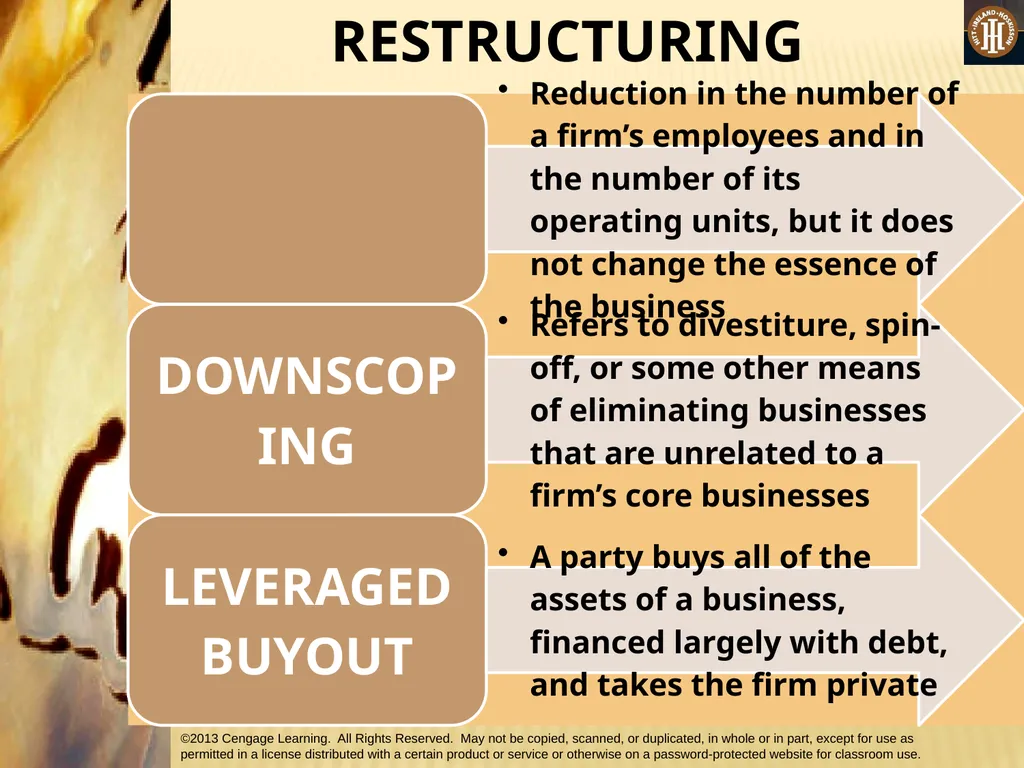
RESTRUCTURING Downsizing: a reduction in the number of a firm’s employees and sometimes in the number of its operating units
May or may not change the composition of businesses in the company’s portfolio
Typical reasons for downsizing:
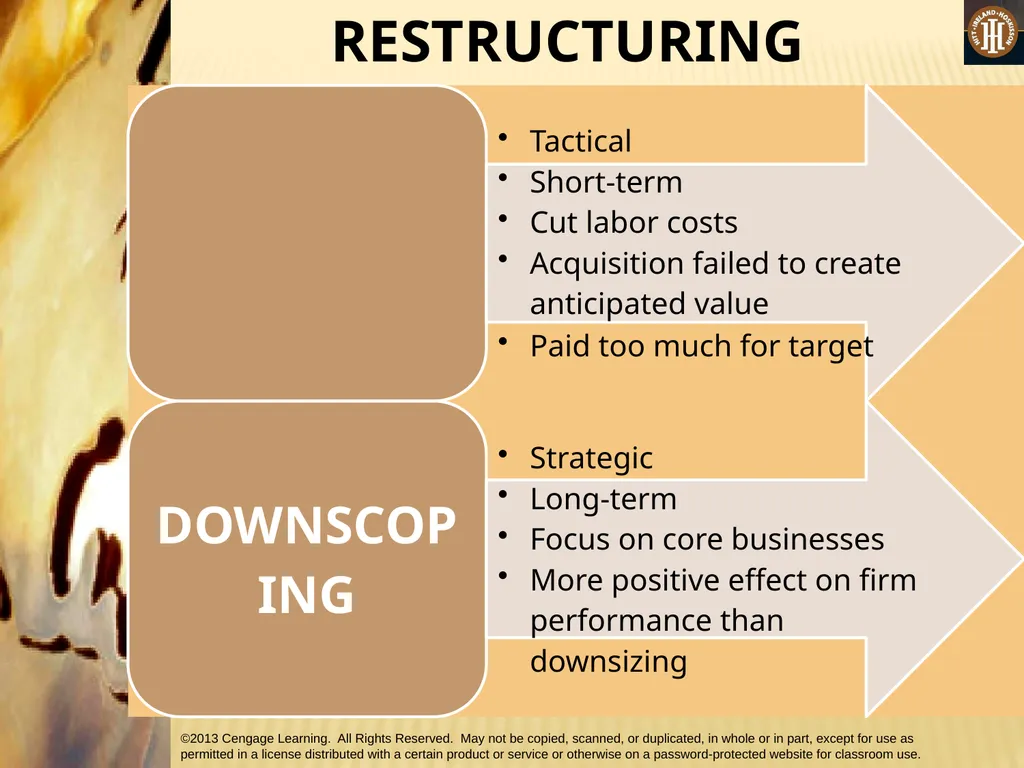
Expectation of improved profitability from labor cost reductions
Desire or necessity for more efficient operations<br>
May or may not change the composition of businesses in the company’s portfolio
Typical reasons for downsizing:
Expectation of improved profitability from labor cost reductions
Desire or necessity for more efficient operations<br>
52
RESTRUCTURING Downscoping: a divestiture, spin-off or other means of eliminating businesses unrelated to a firm’s core businesses
A set of actions that causes a firm to strategically refocus on its core businesses and reduce the diversity of its business portfolio
May be accompanied by downsizing, but must avoid eliminating key employees
Smaller firm can be more effectively managed by the top management team<br>
A set of actions that causes a firm to strategically refocus on its core businesses and reduce the diversity of its business portfolio
May be accompanied by downsizing, but must avoid eliminating key employees
Smaller firm can be more effectively managed by the top management team<br>
53
RESTRUCTURING DOWNSCOPING AND GLOBALIZATION
U.S. firms use downscoping more frequently than do European companies
Conglomerate-building has been the trend in Europe, Latin America, and Asia
Some Asian and Latin American conglomerates have begun to adopt Western corporate strategies, i.e., refocusing on their core businesses
Downscoping has occurred simultaneously with globalization and market liberalization, which have greatly enhanced competition<br>
U.S. firms use downscoping more frequently than do European companies
Conglomerate-building has been the trend in Europe, Latin America, and Asia
Some Asian and Latin American conglomerates have begun to adopt Western corporate strategies, i.e., refocusing on their core businesses
Downscoping has occurred simultaneously with globalization and market liberalization, which have greatly enhanced competition<br>
54
RESTRUCTURING Leveraged Buyouts (LBOs): one party buys all of a firm's assets in order to take the firm private (or no longer trade the firm's shares publicly)
● Private equity firm: firm that facilitates or engages in taking a public firm private
Significant amounts of debt may be incurred to finance the buyout
Immediate sale of non-core assets to pare down debt
● Can correct for managerial mistakes
Managers making decisions that serve their own interests rather than those of shareholders<br>
● Private equity firm: firm that facilitates or engages in taking a public firm private
Significant amounts of debt may be incurred to finance the buyout
Immediate sale of non-core assets to pare down debt
● Can correct for managerial mistakes
Managers making decisions that serve their own interests rather than those of shareholders<br>
55
RESTRUCTURING LEVERAGED BUYOUTS (LBOs)
● Three types of LBOs
Management buyouts (MBOs)
Employee buyouts (EBOs)
Whole-firm buyouts
● MBOs, moreso than EBOs and whole-firm buyouts, lead to downscoping, increased strategic focus, and improved performance
● Why LBOs?
■ Protection against a capricious financial market
■ Allows owners to focus on developing innovations and bringing them to market
■ A form of firm rebirth to facilitate entrepreneurial efforts<br>
● Three types of LBOs
Management buyouts (MBOs)
Employee buyouts (EBOs)
Whole-firm buyouts
● MBOs, moreso than EBOs and whole-firm buyouts, lead to downscoping, increased strategic focus, and improved performance
● Why LBOs?
■ Protection against a capricious financial market
■ Allows owners to focus on developing innovations and bringing them to market
■ A form of firm rebirth to facilitate entrepreneurial efforts<br>
56
RESTRUCTURING LEVERAGED BUYOUTS (LBOs)
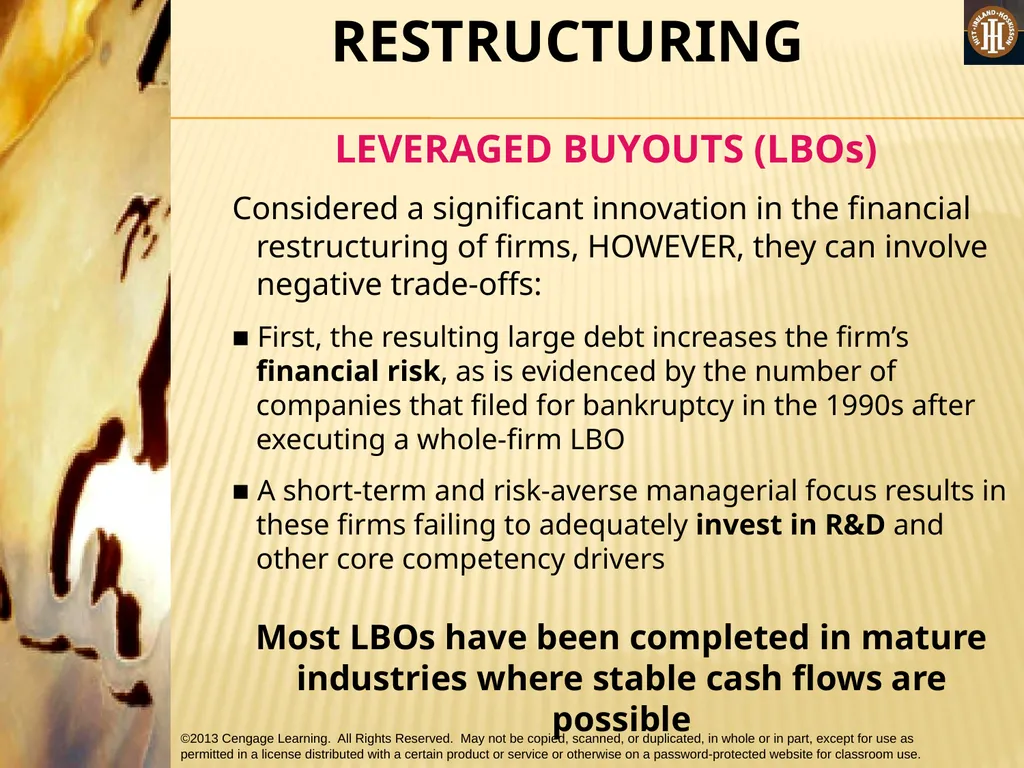
Considered a significant innovation in the financial restructuring of firms, HOWEVER, they can involve negative trade-offs:
■ First, the resulting large debt increases the firm’s financial risk, as is evidenced by the number of companies that filed for bankruptcy in the 1990s after executing a whole-firm LBO
■ A short-term and risk-averse managerial focus results in these firms failing to adequately invest in R&D and other core competency drivers
Most LBOs have been completed in mature industries where stable cash flows are possible<br>
Considered a significant innovation in the financial restructuring of firms, HOWEVER, they can involve negative trade-offs:
■ First, the resulting large debt increases the firm’s financial risk, as is evidenced by the number of companies that filed for bankruptcy in the 1990s after executing a whole-firm LBO
■ A short-term and risk-averse managerial focus results in these firms failing to adequately invest in R&D and other core competency drivers
Most LBOs have been completed in mature industries where stable cash flows are possible<br>
57
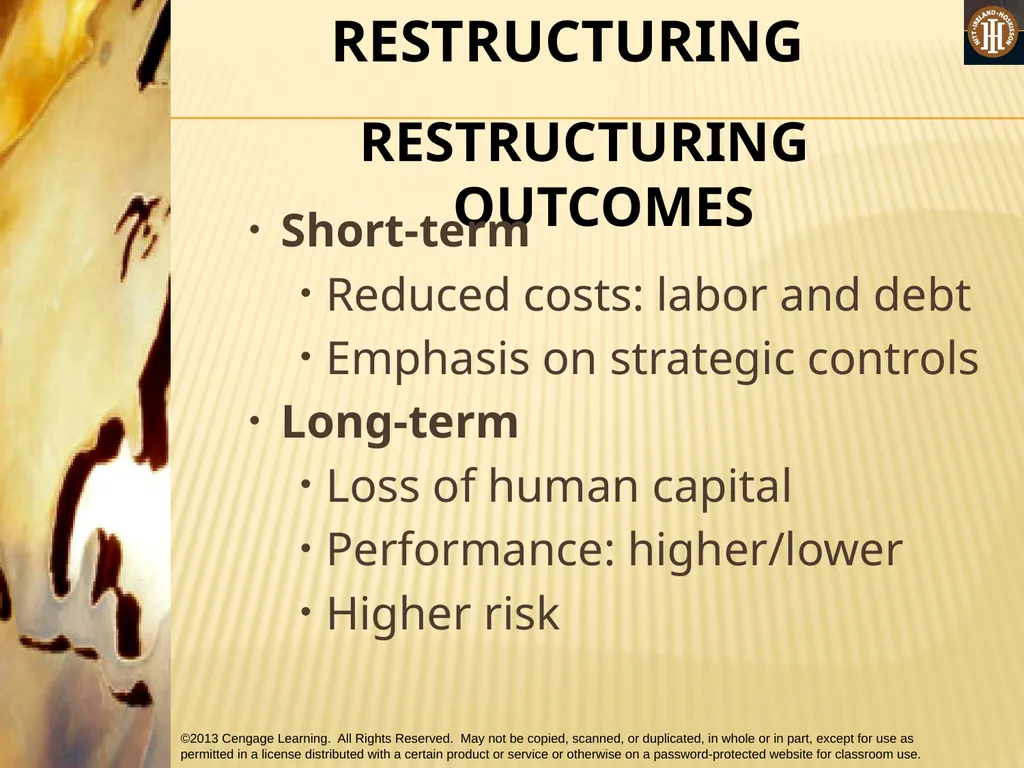
RESTRUCTURING RESTRUCTURING OUTCOMES Short-term
Reduced costs: labor and debt
Emphasis on strategic controls
Long-term
Loss of human capital
Performance: higher/lower
Higher risk<br>
Reduced costs: labor and debt
Emphasis on strategic controls
Long-term
Loss of human capital
Performance: higher/lower
Higher risk<br>
58
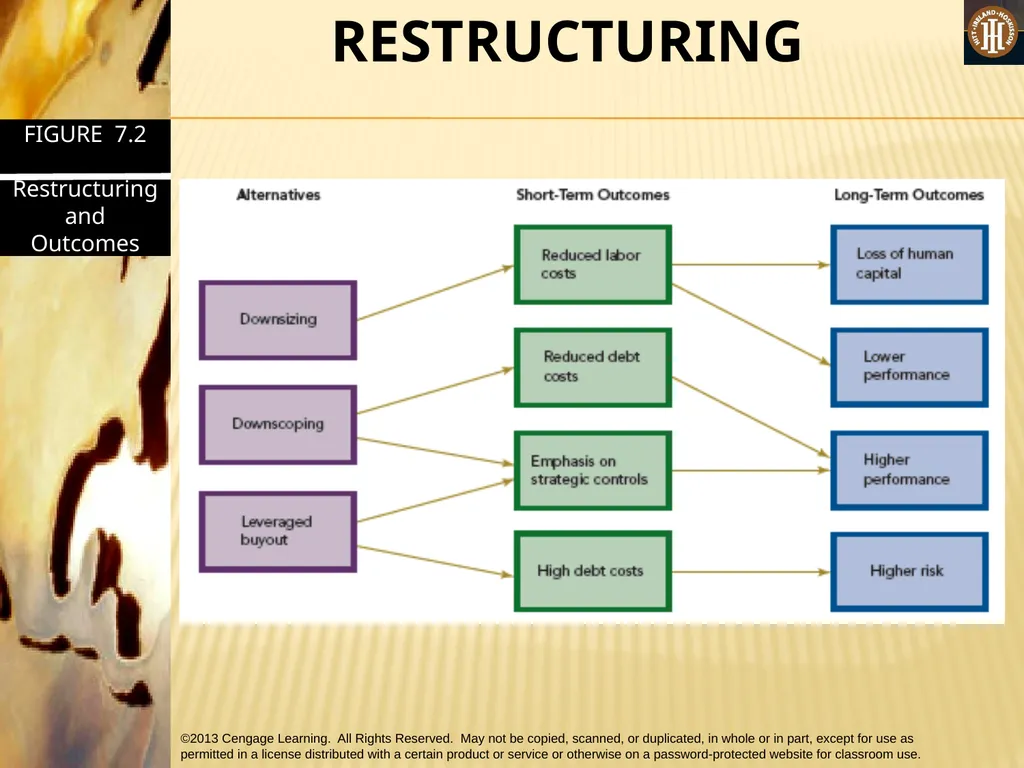
RESTRUCTURING FIGURE 7.2
Restructuring and Outcomes<br>
Restructuring and Outcomes<br>