
Part 2 Syphilis Testing: Selection and
SN
Published · 56 slides · 0 views
1 / 1






Description
Part 2 Syphilis Testing: Selection and Interpretation Marguerite A. Urban, MD University of Rochester Infectious Diseases Monroe County STD Clinic I have no conflicts to declare Disclosure Objectives Identify the currently available
Related Topics
Share
Embed code
Download this presentation From Below
"Part 2 Syphilis Testing: Selection and" is the property of its rightful owner. Permission is granted to download and print the materials on this website for personal, non-commercial use only, and to display it on your personal computer provided you do not modify the materials and that you retain all copyright notices contained in the materials. By downloading content from our website, you accept the terms of this agreement.
Presentation Transcript
01
Part 2 Syphilis Testing: Selection and Interpretation Marguerite A. Urban, MD
University of Rochester Infectious Diseases
Monroe County STD Clinic<br>
University of Rochester Infectious Diseases
Monroe County STD Clinic<br>
02
I have no conflicts to declare Disclosure<br>
03
Objectives Identify the currently available diagnostic tests for syphilis
Understand the differences between the traditional syphilis testing algorithm and the newer reverse syphilis testing algorithm
Understand the need for follow up syphilis tests after treatment
Describe the role of health departments in maintaining serology registries<br>
Understand the differences between the traditional syphilis testing algorithm and the newer reverse syphilis testing algorithm
Understand the need for follow up syphilis tests after treatment
Describe the role of health departments in maintaining serology registries<br>
04
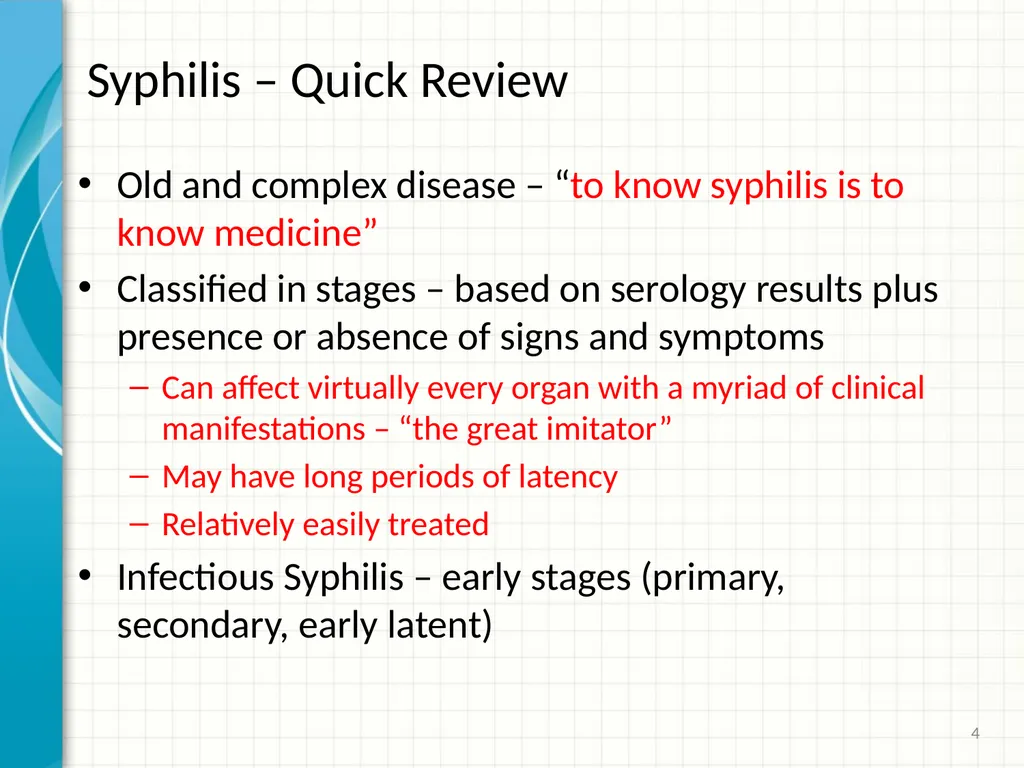
4 Syphilis – Quick Review Old and complex disease – “to know syphilis is to know medicine”
Classified in stages – based on serology results plus presence or absence of signs and symptoms
Can affect virtually every organ with a myriad of clinical manifestations – “the great imitator”
May have long periods of latency
Relatively easily treated
Infectious Syphilis – early stages (primary, secondary, early latent)<br>
Classified in stages – based on serology results plus presence or absence of signs and symptoms
Can affect virtually every organ with a myriad of clinical manifestations – “the great imitator”
May have long periods of latency
Relatively easily treated
Infectious Syphilis – early stages (primary, secondary, early latent)<br>
05
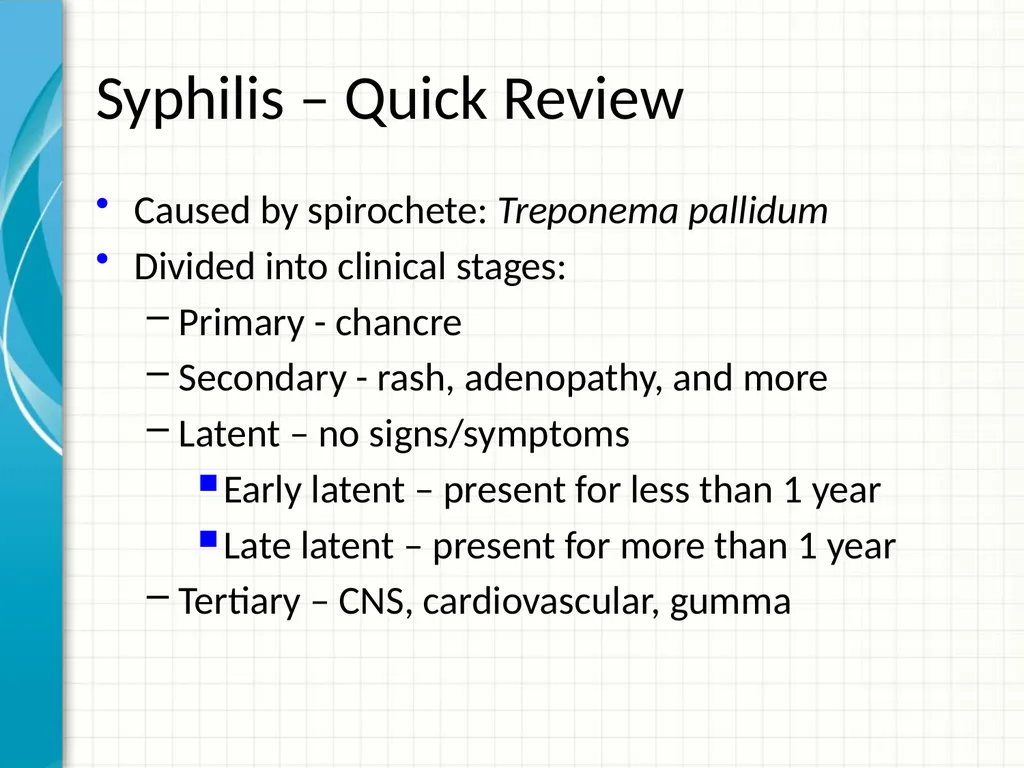
Syphilis – Quick Review Caused by spirochete: Treponema pallidum
Divided into clinical stages:
Primary - chancre
Secondary - rash, adenopathy, and more
Latent – no signs/symptoms
Early latent – present for less than 1 year
Late latent – present for more than 1 year
Tertiary – CNS, cardiovascular, gumma<br>
Divided into clinical stages:
Primary - chancre
Secondary - rash, adenopathy, and more
Latent – no signs/symptoms
Early latent – present for less than 1 year
Late latent – present for more than 1 year
Tertiary – CNS, cardiovascular, gumma<br>
06
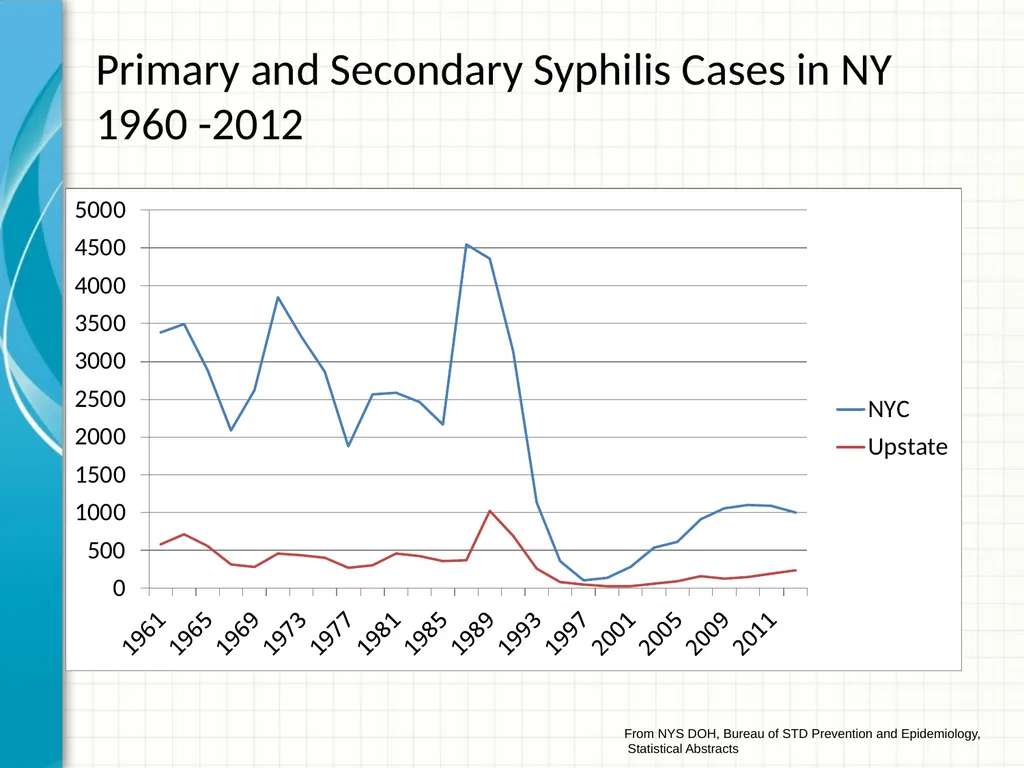
Primary and Secondary Syphilis Cases in NY
1960 -2012 From NYS DOH, Bureau of STD Prevention and Epidemiology,
Statistical Abstracts<br>
Statistical Abstracts<br>
07
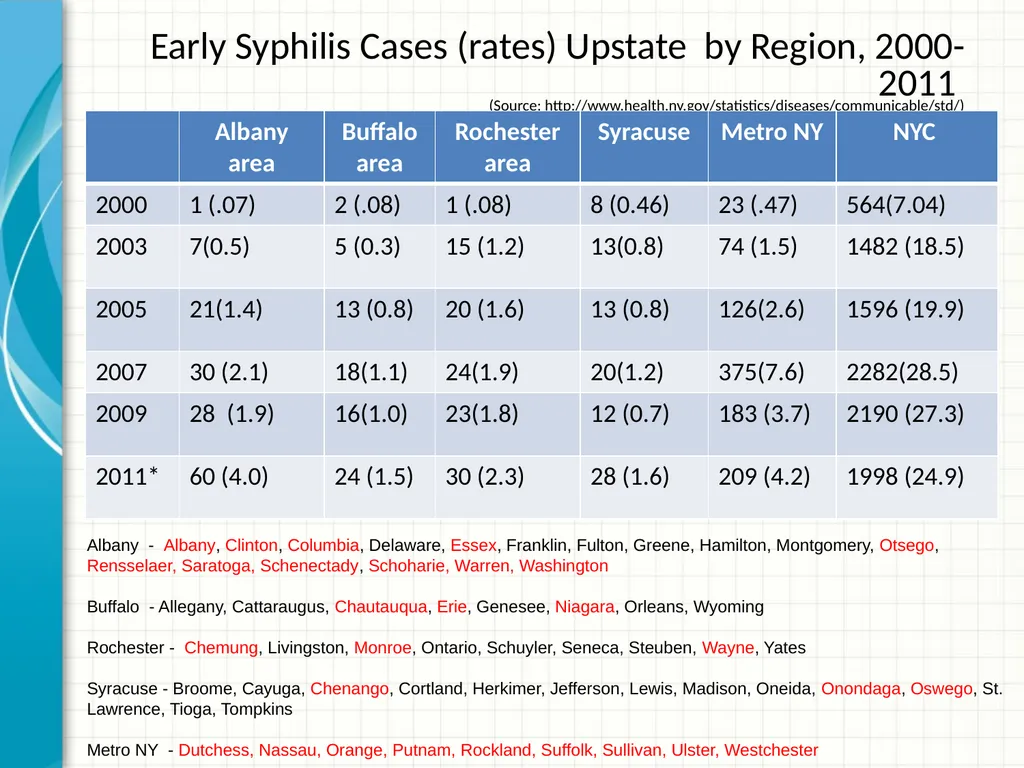
Early Syphilis Cases (rates) Upstate by Region, 2000-2011
(Source: http://www.health.ny.gov/statistics/diseases/communicable/std/) Albany - Albany, Clinton, Columbia, Delaware, Essex, Franklin, Fulton, Greene, Hamilton, Montgomery, Otsego, Rensselaer, Saratoga, Schenectady, Schoharie, Warren, Washington
Buffalo - Allegany, Cattaraugus, Chautauqua, Erie, Genesee, Niagara, Orleans, Wyoming
Rochester - Chemung, Livingston, Monroe, Ontario, Schuyler, Seneca, Steuben, Wayne, Yates
Syracuse - Broome, Cayuga, Chenango, Cortland, Herkimer, Jefferson, Lewis, Madison, Oneida, Onondaga, Oswego, St. Lawrence, Tioga, Tompkins
Metro NY - Dutchess, Nassau, Orange, Putnam, Rockland, Suffolk, Sullivan, Ulster, Westchester<br>
Buffalo - Allegany, Cattaraugus, Chautauqua, Erie, Genesee, Niagara, Orleans, Wyoming
Rochester - Chemung, Livingston, Monroe, Ontario, Schuyler, Seneca, Steuben, Wayne, Yates
Syracuse - Broome, Cayuga, Chenango, Cortland, Herkimer, Jefferson, Lewis, Madison, Oneida, Onondaga, Oswego, St. Lawrence, Tioga, Tompkins
Metro NY - Dutchess, Nassau, Orange, Putnam, Rockland, Suffolk, Sullivan, Ulster, Westchester<br>
08
CHBT (585) 753-5382 - www.chbt.org<br>
09
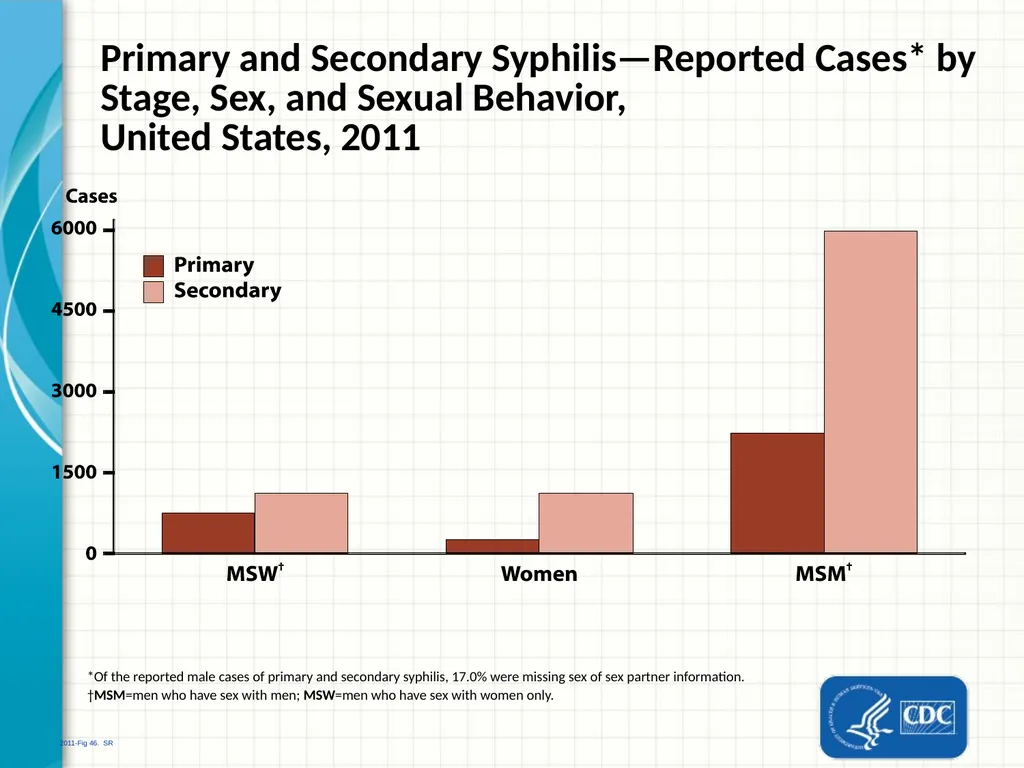
Primary and Secondary Syphilis—Reported Cases* by Stage, Sex, and Sexual Behavior,
United States, 2011 *Of the reported male cases of primary and secondary syphilis, 17.0% were missing sex of sex partner information.
†MSM=men who have sex with men; MSW=men who have sex with women only. 2011-Fig 46. SR<br>
†MSM=men who have sex with men; MSW=men who have sex with women only. 2011-Fig 46. SR<br>
10
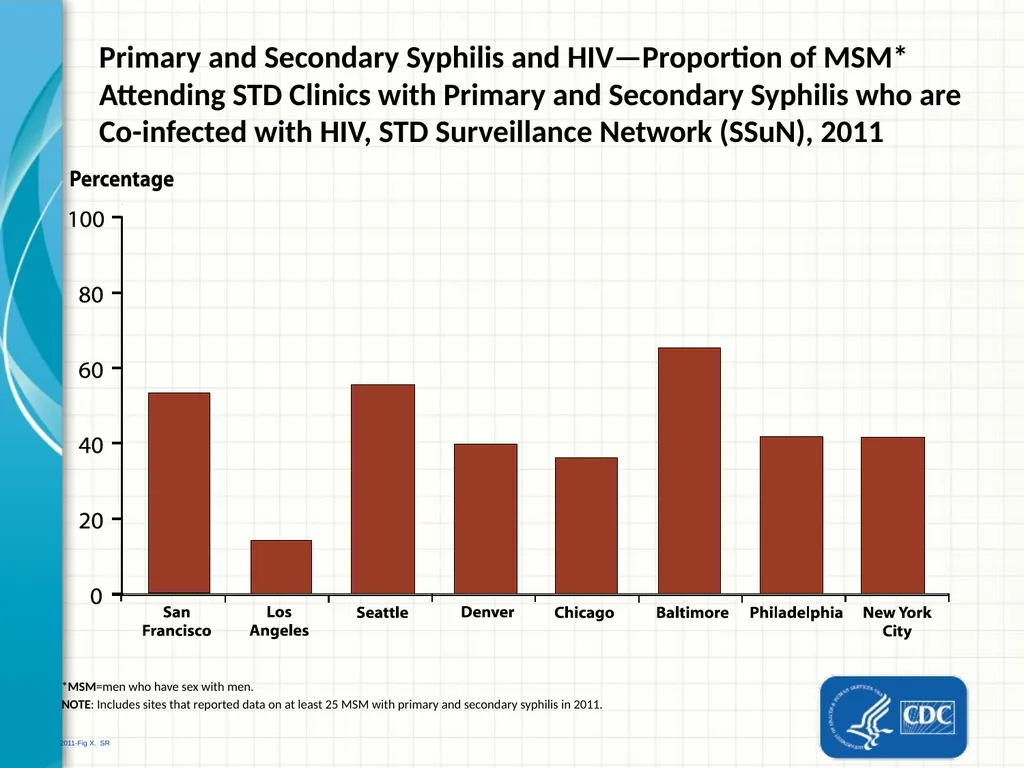
Primary and Secondary Syphilis and HIV—Proportion of MSM* Attending STD Clinics with Primary and Secondary Syphilis who are Co-infected with HIV, STD Surveillance Network (SSuN), 2011 *MSM=men who have sex with men.
NOTE: Includes sites that reported data on at least 25 MSM with primary and secondary syphilis in 2011. 2011-Fig X. SR<br>
NOTE: Includes sites that reported data on at least 25 MSM with primary and secondary syphilis in 2011. 2011-Fig X. SR<br>
11
The Diagnosis of Infectious Diseases Recognize characteristic Clinical Syndrome associated with particular infectious agents and hopefully confirm through some microbiology
Identify organism
Visualize organism (microscopy, gram stain, other stains, EM)
Culture
Detection of organism through other microbiologic techniques
Immune assays, NAATs (PCR)
Identify immune response to organism
Detection of antibody or other immune response (eg. PPD)<br>
Identify organism
Visualize organism (microscopy, gram stain, other stains, EM)
Culture
Detection of organism through other microbiologic techniques
Immune assays, NAATs (PCR)
Identify immune response to organism
Detection of antibody or other immune response (eg. PPD)<br>
12
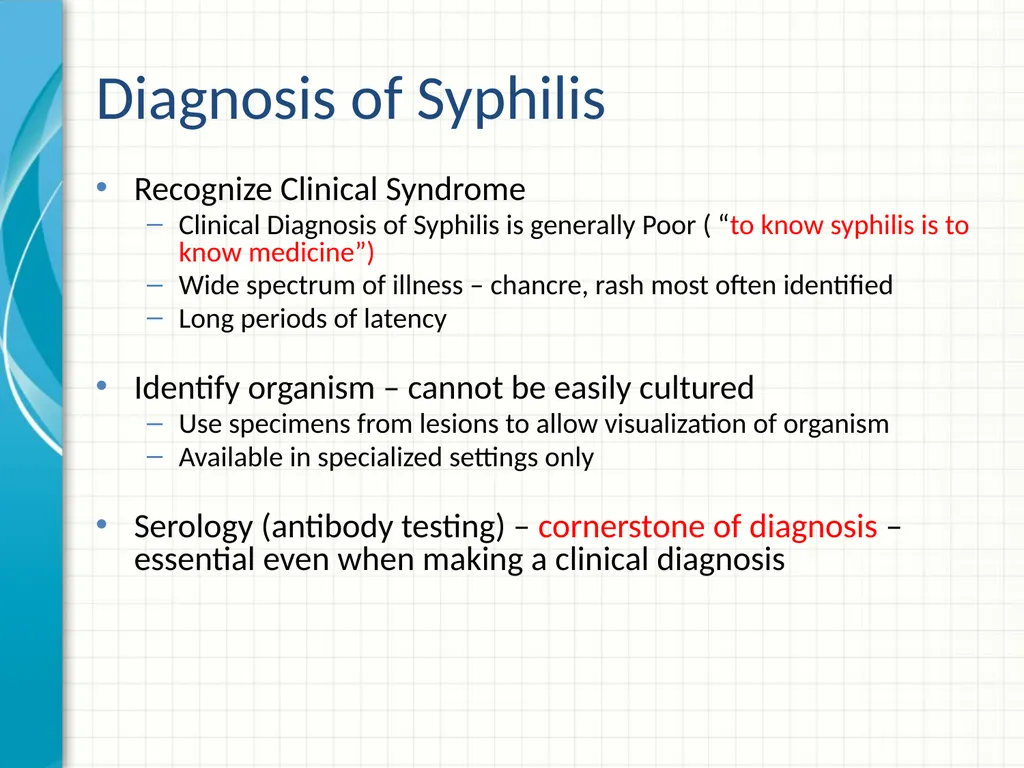
Diagnosis of Syphilis Recognize Clinical Syndrome
Clinical Diagnosis of Syphilis is generally Poor ( “to know syphilis is to know medicine”)
Wide spectrum of illness – chancre, rash most often identified
Long periods of latency
Identify organism – cannot be easily cultured
Use specimens from lesions to allow visualization of organism
Available in specialized settings only
Serology (antibody testing) – cornerstone of diagnosis – essential even when making a clinical diagnosis<br>
Clinical Diagnosis of Syphilis is generally Poor ( “to know syphilis is to know medicine”)
Wide spectrum of illness – chancre, rash most often identified
Long periods of latency
Identify organism – cannot be easily cultured
Use specimens from lesions to allow visualization of organism
Available in specialized settings only
Serology (antibody testing) – cornerstone of diagnosis – essential even when making a clinical diagnosis<br>
13
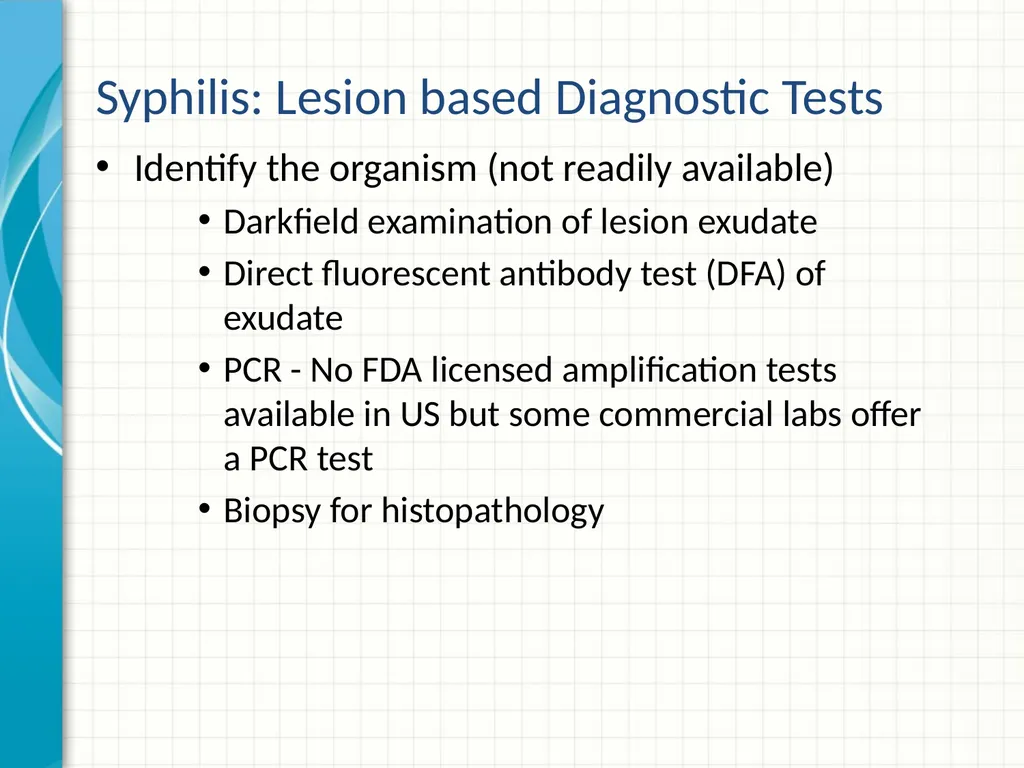
Syphilis: Lesion based Diagnostic Tests Identify the organism (not readily available)
Darkfield examination of lesion exudate
Direct fluorescent antibody test (DFA) of exudate
PCR - No FDA licensed amplification tests available in US but some commercial labs offer a PCR test
Biopsy for histopathology<br>
Darkfield examination of lesion exudate
Direct fluorescent antibody test (DFA) of exudate
PCR - No FDA licensed amplification tests available in US but some commercial labs offer a PCR test
Biopsy for histopathology<br>
14
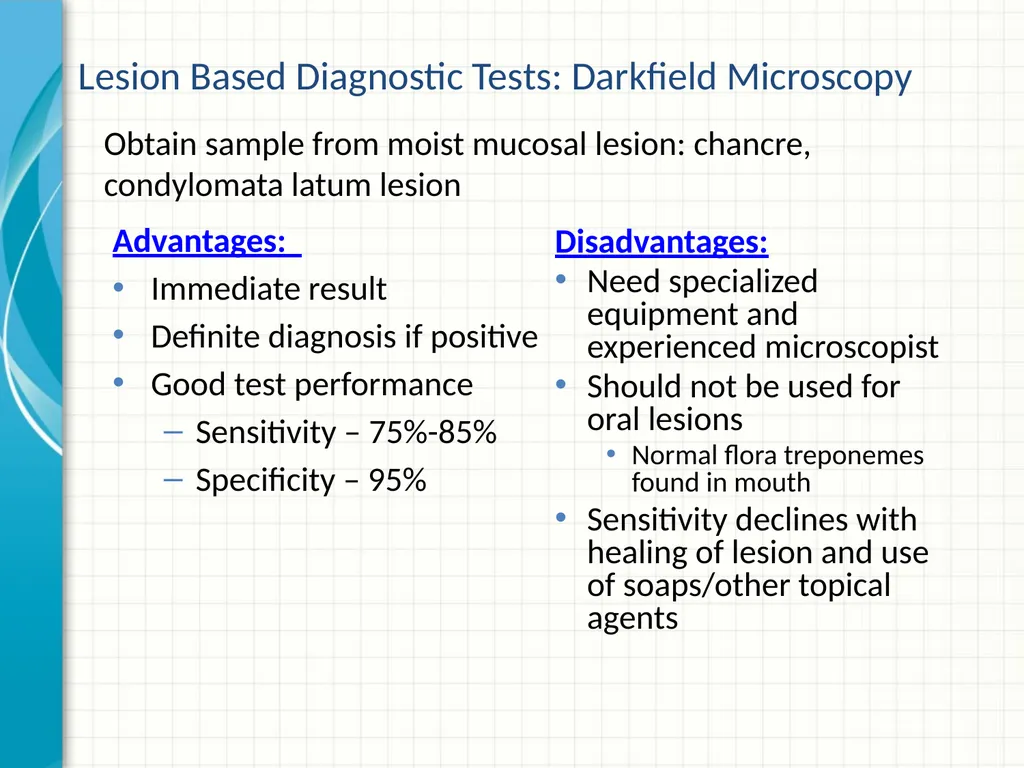
Lesion Based Diagnostic Tests: Darkfield Microscopy Advantages:
Immediate result
Definite diagnosis if positive
Good test performance
Sensitivity – 75%-85%
Specificity – 95% Disadvantages:
Need specialized equipment and experienced microscopist
Should not be used for oral lesions
Normal flora treponemes found in mouth
Sensitivity declines with healing of lesion and use of soaps/other topical agents Obtain sample from moist mucosal lesion: chancre, condylomata latum lesion<br>
Immediate result
Definite diagnosis if positive
Good test performance
Sensitivity – 75%-85%
Specificity – 95% Disadvantages:
Need specialized equipment and experienced microscopist
Should not be used for oral lesions
Normal flora treponemes found in mouth
Sensitivity declines with healing of lesion and use of soaps/other topical agents Obtain sample from moist mucosal lesion: chancre, condylomata latum lesion<br>
15
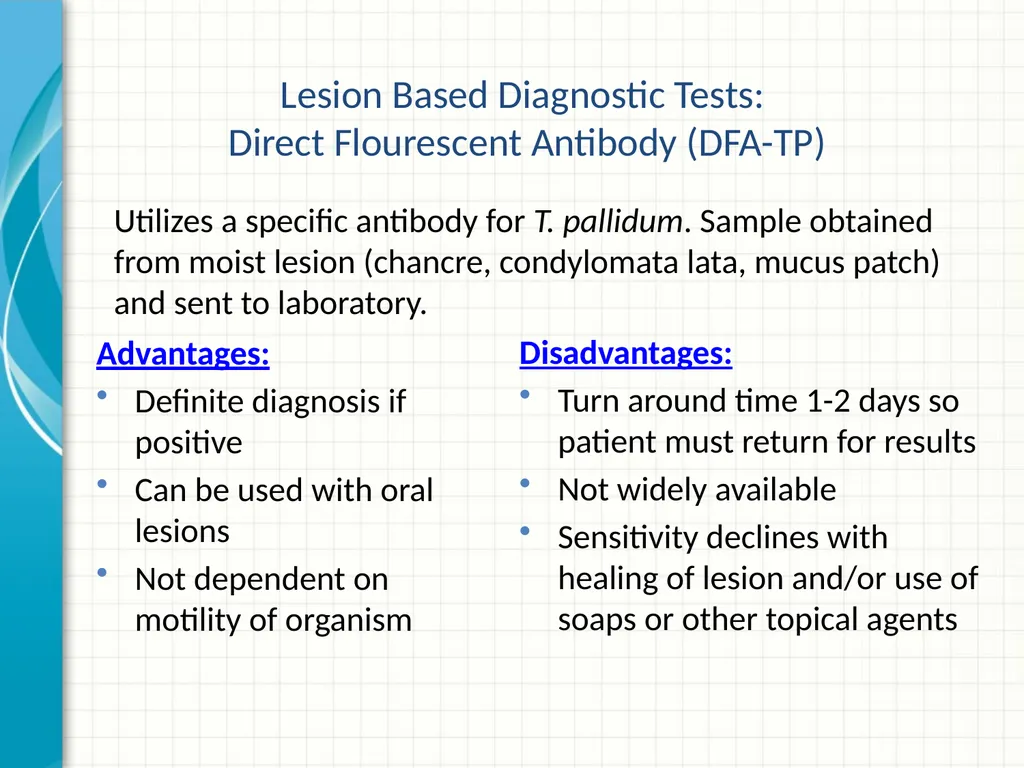
Lesion Based Diagnostic Tests:
Direct Flourescent Antibody (DFA-TP) Advantages:
Definite diagnosis if positive
Can be used with oral lesions
Not dependent on motility of organism Disadvantages:
Turn around time 1-2 days so patient must return for results
Not widely available
Sensitivity declines with healing of lesion and/or use of soaps or other topical agents Utilizes a specific antibody for T. pallidum. Sample obtained from moist lesion (chancre, condylomata lata, mucus patch) and sent to laboratory.<br>
Definite diagnosis if positive
Can be used with oral lesions
Not dependent on motility of organism Disadvantages:
Turn around time 1-2 days so patient must return for results
Not widely available
Sensitivity declines with healing of lesion and/or use of soaps or other topical agents Utilizes a specific antibody for T. pallidum. Sample obtained from moist lesion (chancre, condylomata lata, mucus patch) and sent to laboratory.<br>
16
Treponema pallidum
Darkfield microscopy DFA microscopy Histopathology<br>
17
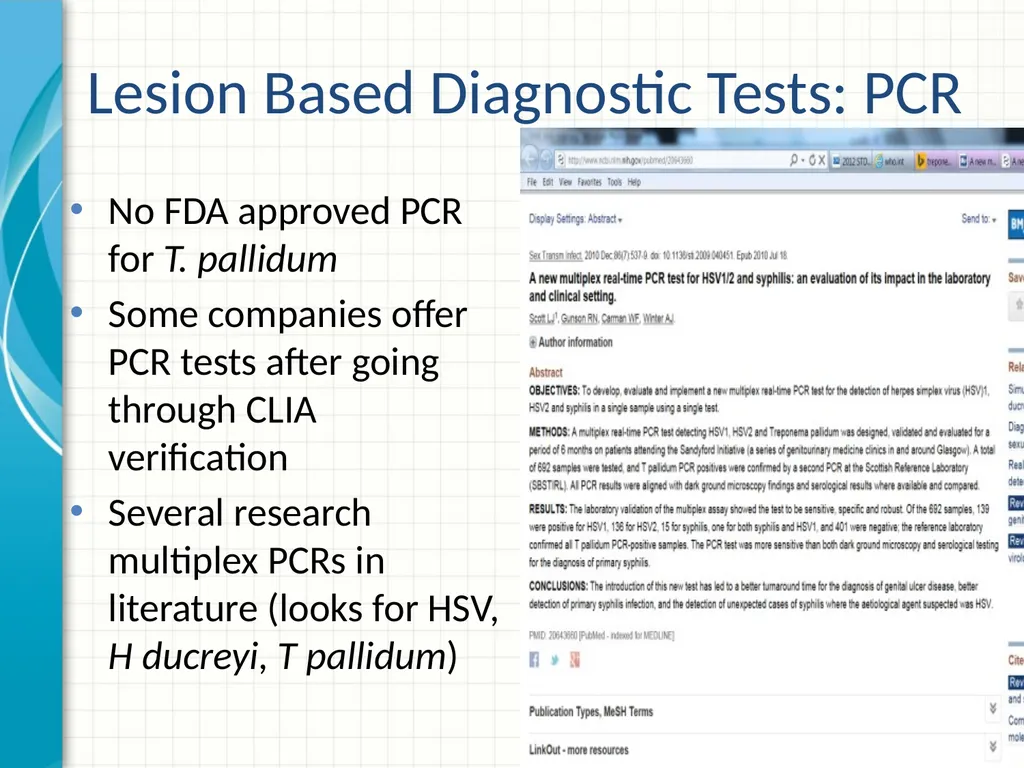
Lesion Based Diagnostic Tests: PCR No FDA approved PCR for T. pallidum
Some companies offer PCR tests after going through CLIA verification
Several research multiplex PCRs in literature (looks for HSV, H ducreyi, T pallidum)<br>
Some companies offer PCR tests after going through CLIA verification
Several research multiplex PCRs in literature (looks for HSV, H ducreyi, T pallidum)<br>
18
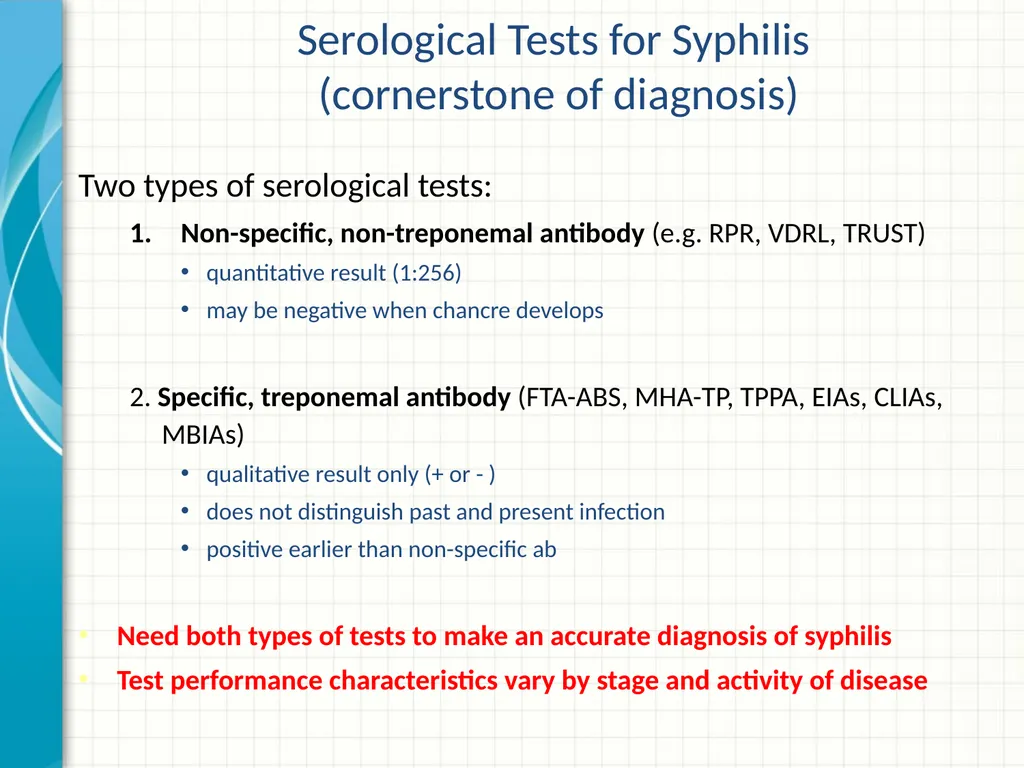
Serological Tests for Syphilis
(cornerstone of diagnosis) Two types of serological tests:
Non-specific, non-treponemal antibody (e.g. RPR, VDRL, TRUST)
quantitative result (1:256)
may be negative when chancre develops
2. Specific, treponemal antibody (FTA-ABS, MHA-TP, TPPA, EIAs, CLIAs, MBIAs)
qualitative result only (+ or - )
does not distinguish past and present infection
positive earlier than non-specific ab
Need both types of tests to make an accurate diagnosis of syphilis
Test performance characteristics vary by stage and activity of disease<br>
Non-specific, non-treponemal antibody (e.g. RPR, VDRL, TRUST)
quantitative result (1:256)
may be negative when chancre develops
2. Specific, treponemal antibody (FTA-ABS, MHA-TP, TPPA, EIAs, CLIAs, MBIAs)
qualitative result only (+ or - )
does not distinguish past and present infection
positive earlier than non-specific ab
Need both types of tests to make an accurate diagnosis of syphilis
Test performance characteristics vary by stage and activity of disease<br>
19
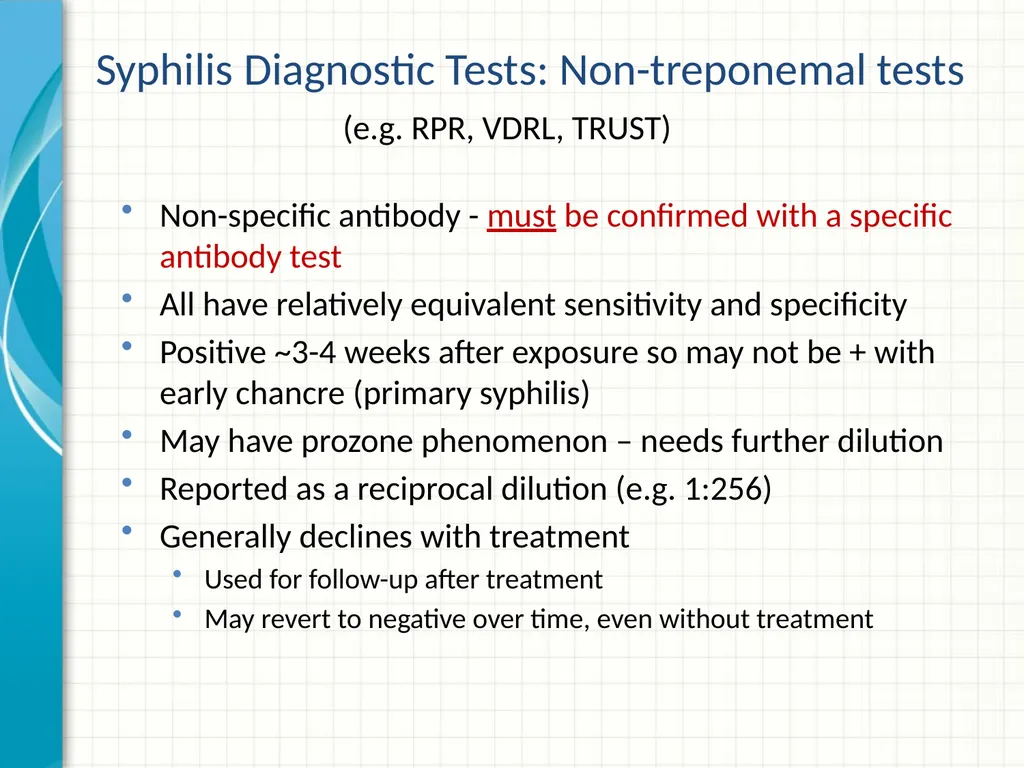
Syphilis Diagnostic Tests: Non-treponemal tests
(e.g. RPR, VDRL, TRUST) Non-specific antibody - must be confirmed with a specific antibody test
All have relatively equivalent sensitivity and specificity
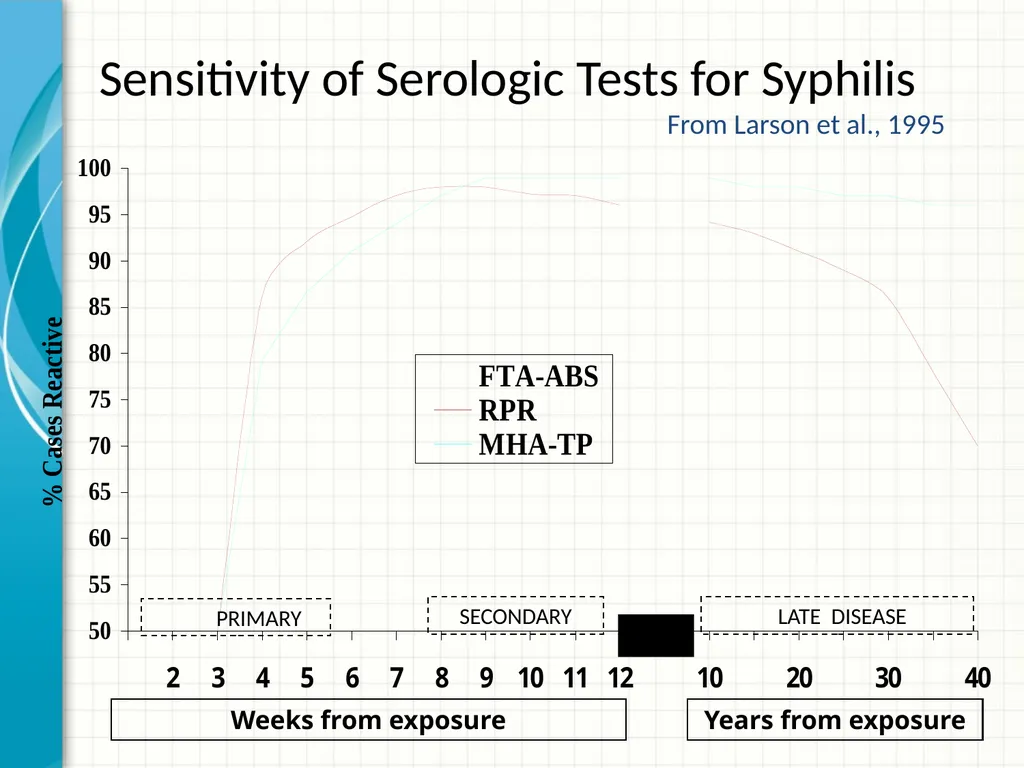
Positive ~3-4 weeks after exposure so may not be + with early chancre (primary syphilis)
May have prozone phenomenon – needs further dilution
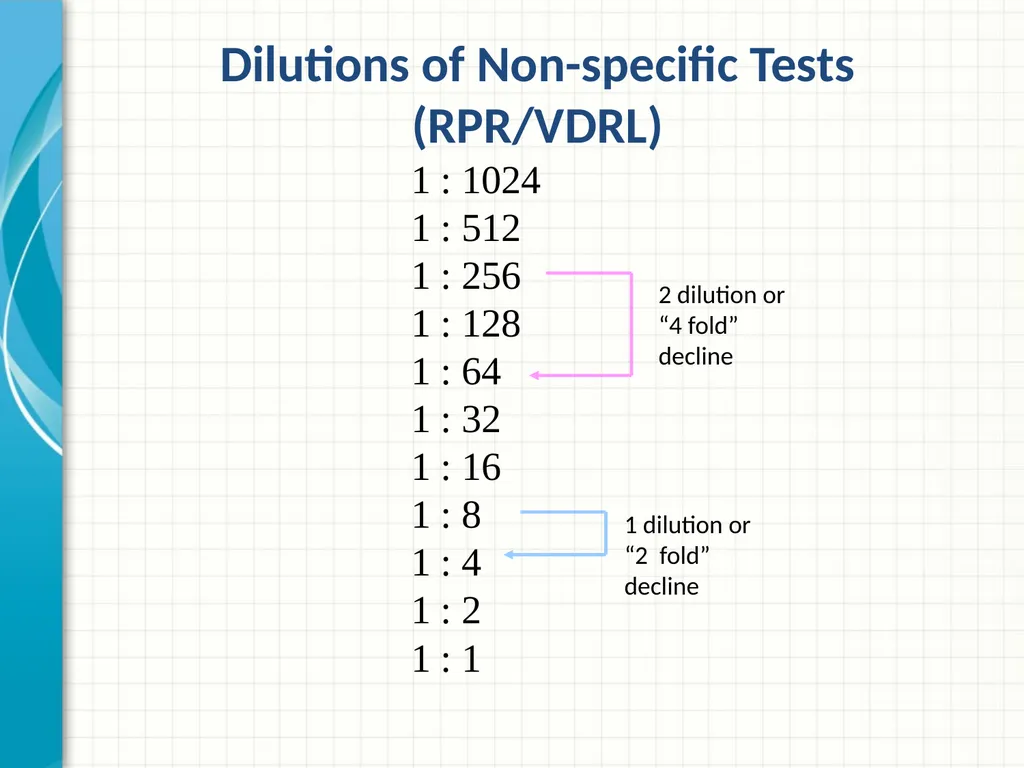
Reported as a reciprocal dilution (e.g. 1:256)
Generally declines with treatment
Used for follow-up after treatment
May revert to negative over time, even without treatment<br>
All have relatively equivalent sensitivity and specificity
Positive ~3-4 weeks after exposure so may not be + with early chancre (primary syphilis)
May have prozone phenomenon – needs further dilution
Reported as a reciprocal dilution (e.g. 1:256)
Generally declines with treatment
Used for follow-up after treatment
May revert to negative over time, even without treatment<br>
20
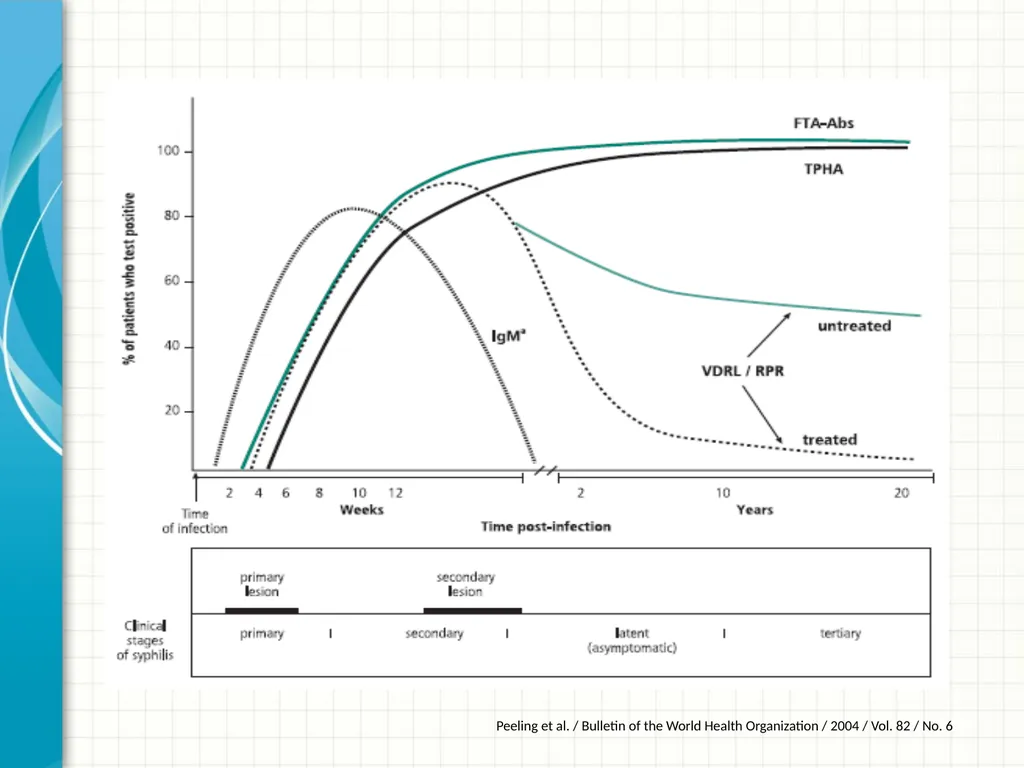
Sensitivity of Serologic Tests for Syphilis Weeks from exposure Years from exposure PRIMARY SECONDARY LATE DISEASE From Larsen et al, Clinical Microbiology Reviews, 1995<br>
21
1 : 1024
1 : 512
1 : 256
1 : 128
1 : 64
1 : 32
1 : 16
1 : 8
1 : 4
1 : 2
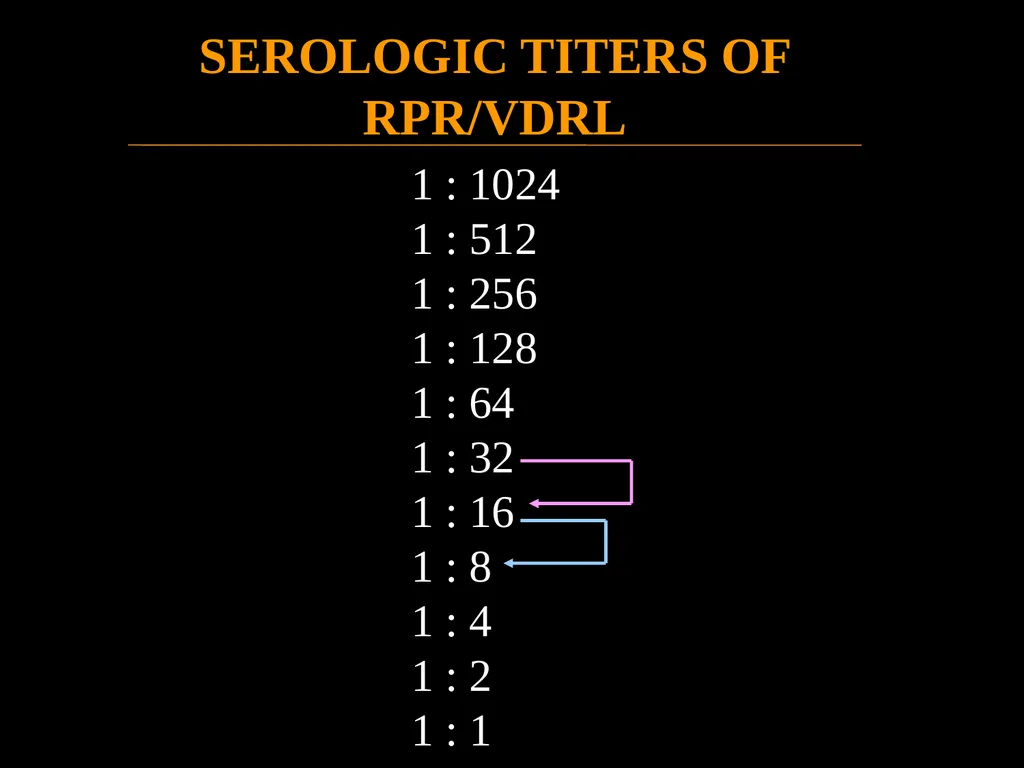
1 : 1 Dilutions of Non-specific Tests (RPR/VDRL) 2 dilution or “4 fold” decline 1 dilution or “2 fold” decline<br>
1 : 512
1 : 256
1 : 128
1 : 64
1 : 32
1 : 16
1 : 8
1 : 4
1 : 2
1 : 1 Dilutions of Non-specific Tests (RPR/VDRL) 2 dilution or “4 fold” decline 1 dilution or “2 fold” decline<br>
22
Syphilis Diagnostic Tests: Treponemal Antibody Tests
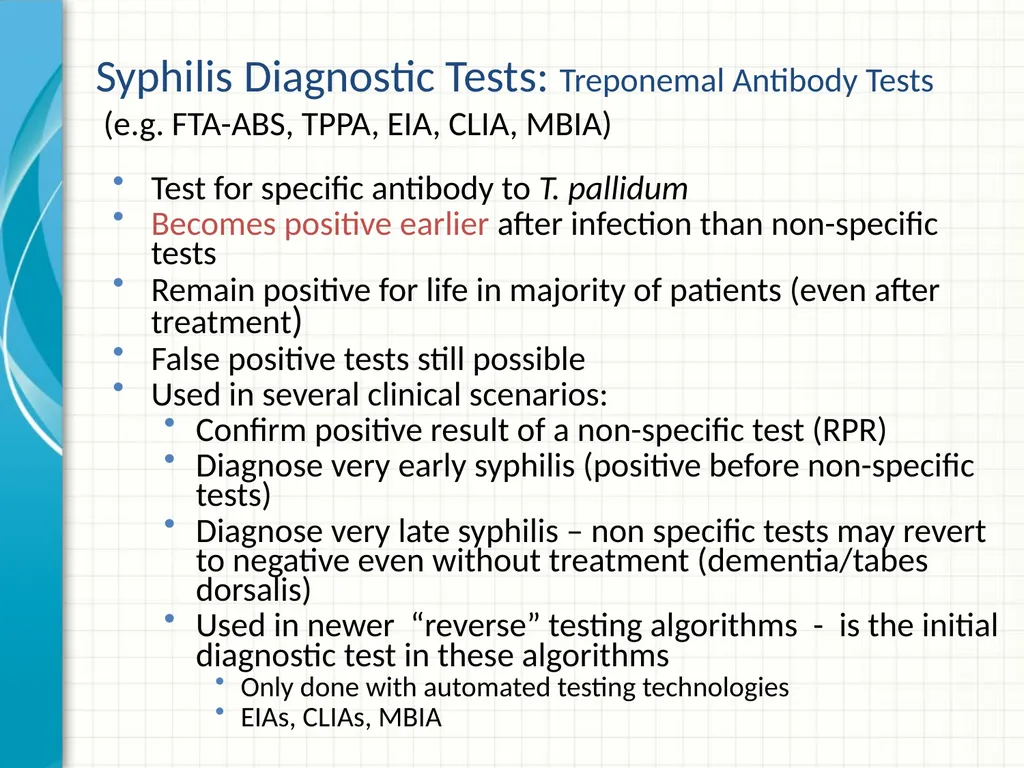
(e.g. FTA-ABS, TPPA, EIA, CLIA, MBIA) Test for specific antibody to T. pallidum
Becomes positive earlier after infection than non-specific tests
Remain positive for life in majority of patients (even after treatment)
False positive tests still possible
Used in several clinical scenarios:
Confirm positive result of a non-specific test (RPR)
Diagnose very early syphilis (positive before non-specific tests)
Diagnose very late syphilis – non specific tests may revert to negative even without treatment (dementia/tabes dorsalis)
Used in newer “reverse” testing algorithms - is the initial diagnostic test in these algorithms
Only done with automated testing technologies
EIAs, CLIAs, MBIA<br>
Becomes positive earlier after infection than non-specific tests
Remain positive for life in majority of patients (even after treatment)
False positive tests still possible
Used in several clinical scenarios:
Confirm positive result of a non-specific test (RPR)
Diagnose very early syphilis (positive before non-specific tests)
Diagnose very late syphilis – non specific tests may revert to negative even without treatment (dementia/tabes dorsalis)
Used in newer “reverse” testing algorithms - is the initial diagnostic test in these algorithms
Only done with automated testing technologies
EIAs, CLIAs, MBIA<br>
23
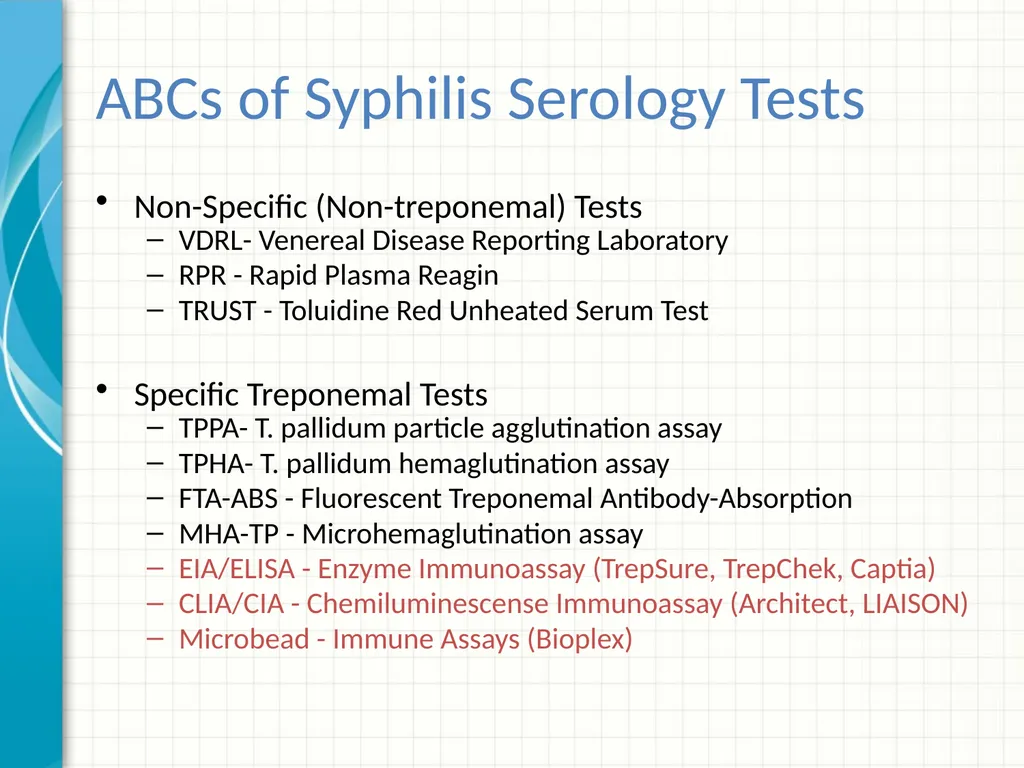
ABCs of Syphilis Serology Tests Non-Specific (Non-treponemal) Tests
VDRL- Venereal Disease Reporting Laboratory
RPR - Rapid Plasma Reagin
TRUST - Toluidine Red Unheated Serum Test
Specific Treponemal Tests
TPPA- T. pallidum particle agglutination assay
TPHA- T. pallidum hemaglutination assay
FTA-ABS - Fluorescent Treponemal Antibody-Absorption
MHA-TP - Microhemaglutination assay
EIA/ELISA - Enzyme Immunoassay (TrepSure, TrepChek, Captia)
CLIA/CIA - Chemiluminescense Immunoassay (Architect, LIAISON)
Microbead - Immune Assays (Bioplex)<br>
VDRL- Venereal Disease Reporting Laboratory
RPR - Rapid Plasma Reagin
TRUST - Toluidine Red Unheated Serum Test
Specific Treponemal Tests
TPPA- T. pallidum particle agglutination assay
TPHA- T. pallidum hemaglutination assay
FTA-ABS - Fluorescent Treponemal Antibody-Absorption
MHA-TP - Microhemaglutination assay
EIA/ELISA - Enzyme Immunoassay (TrepSure, TrepChek, Captia)
CLIA/CIA - Chemiluminescense Immunoassay (Architect, LIAISON)
Microbead - Immune Assays (Bioplex)<br>
24
Sensitivity of Serologic Tests for Syphilis Weeks from exposure Years from exposure PRIMARY SECONDARY LATE DISEASE From Larson et al., 1995<br>
25
Peeling et al. / Bulletin of the World Health Organization / 2004 / Vol. 82 / No. 6<br>
26
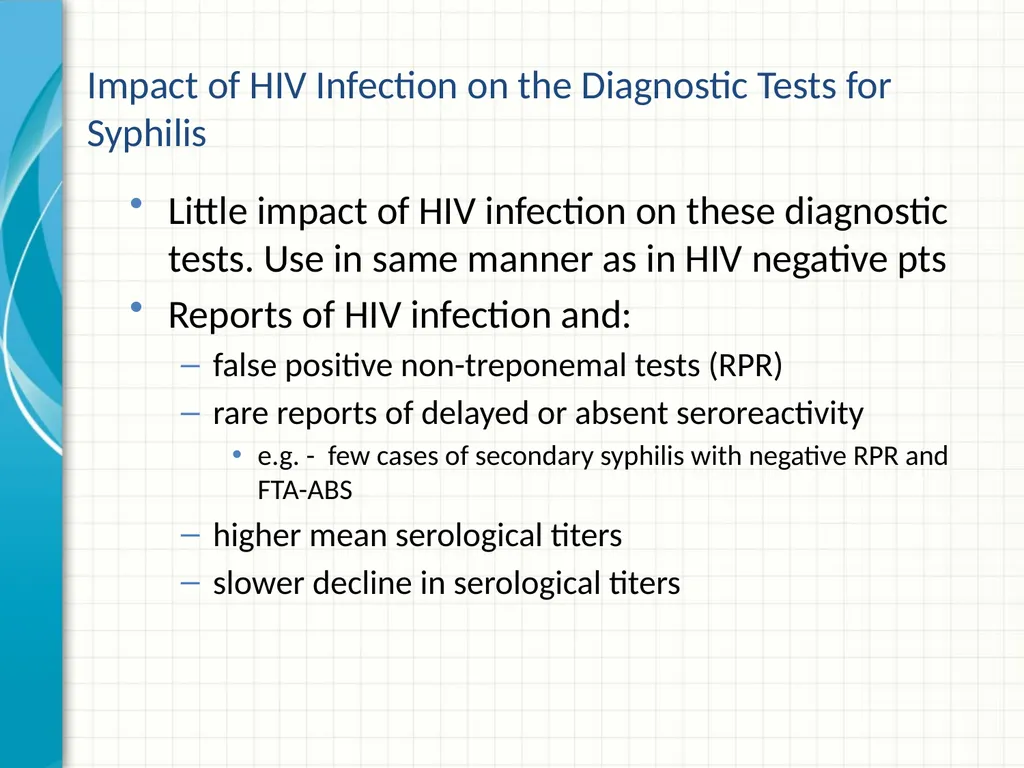
Impact of HIV Infection on the Diagnostic Tests for Syphilis Little impact of HIV infection on these diagnostic tests. Use in same manner as in HIV negative pts
Reports of HIV infection and:
false positive non-treponemal tests (RPR)
rare reports of delayed or absent seroreactivity
e.g. - few cases of secondary syphilis with negative RPR and FTA-ABS
higher mean serological titers
slower decline in serological titers<br>
Reports of HIV infection and:
false positive non-treponemal tests (RPR)
rare reports of delayed or absent seroreactivity
e.g. - few cases of secondary syphilis with negative RPR and FTA-ABS
higher mean serological titers
slower decline in serological titers<br>
27
Causes of False-Positive Reactions
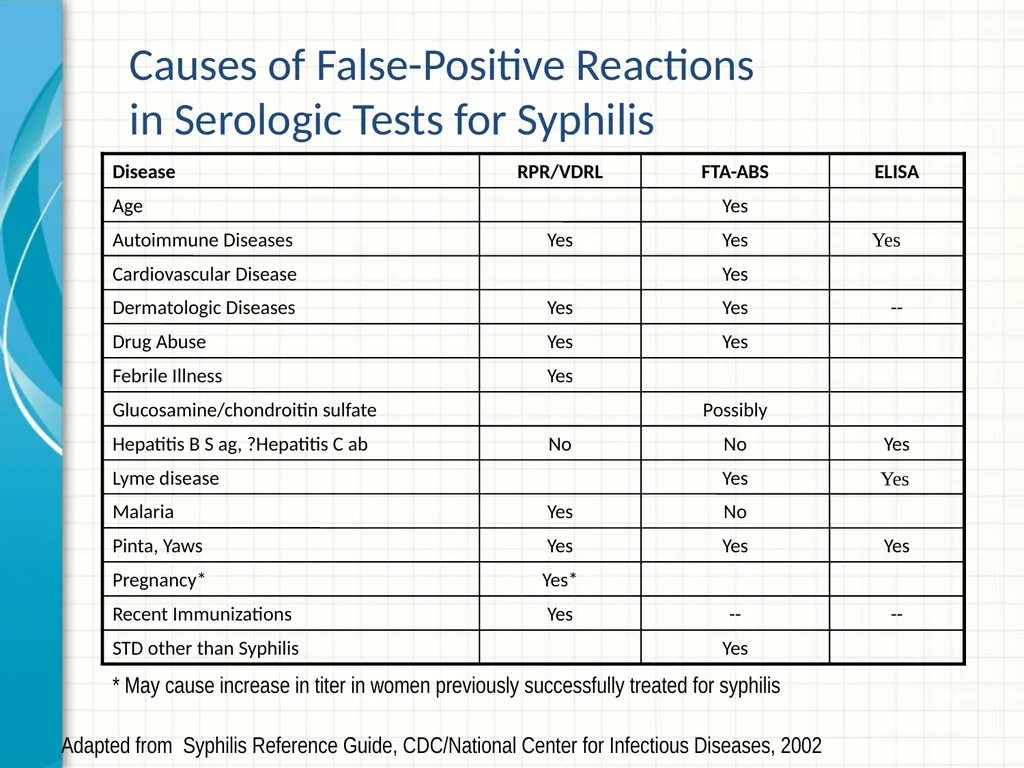
in Serologic Tests for Syphilis Adapted from Syphilis Reference Guide, CDC/National Center for Infectious Diseases, 2002 * May cause increase in titer in women previously successfully treated for syphilis Yes Yes<br>
28
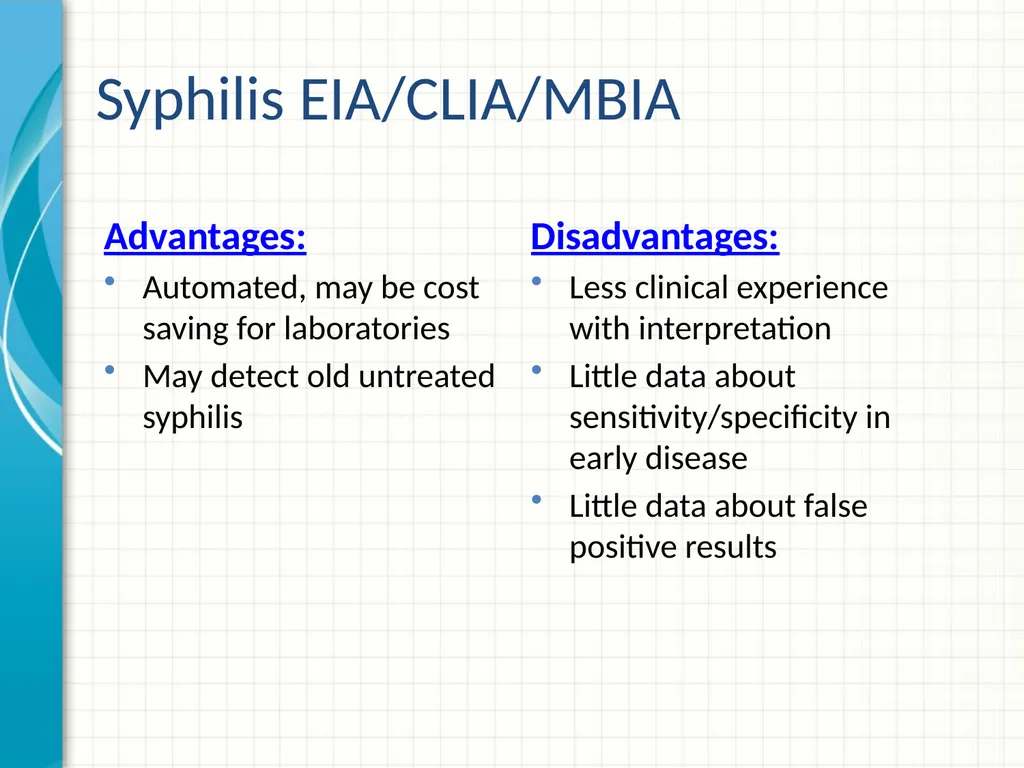
Syphilis EIA/CLIA/MBIA Advantages:
Automated, may be cost saving for laboratories
May detect old untreated syphilis Disadvantages:
Less clinical experience with interpretation
Little data about sensitivity/specificity in early disease
Little data about false positive results<br>
Automated, may be cost saving for laboratories
May detect old untreated syphilis Disadvantages:
Less clinical experience with interpretation
Little data about sensitivity/specificity in early disease
Little data about false positive results<br>
29
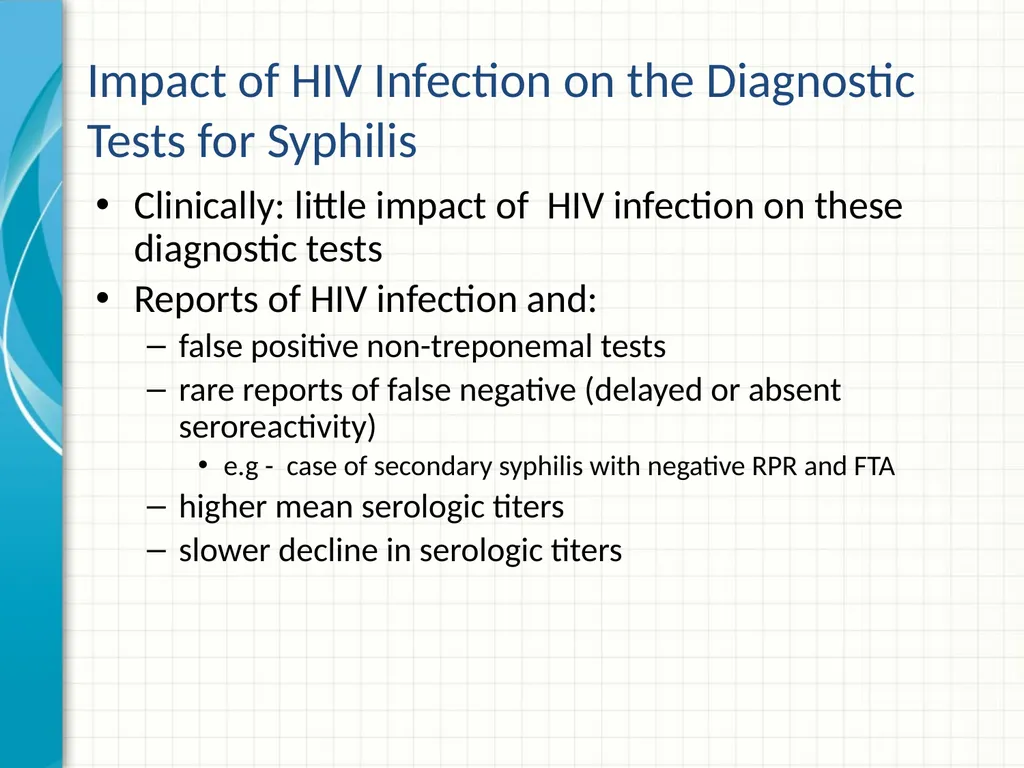
Impact of HIV Infection on the Diagnostic Tests for Syphilis Clinically: little impact of HIV infection on these diagnostic tests
Reports of HIV infection and:
false positive non-treponemal tests
rare reports of false negative (delayed or absent seroreactivity)
e.g - case of secondary syphilis with negative RPR and FTA
higher mean serologic titers
slower decline in serologic titers<br>
Reports of HIV infection and:
false positive non-treponemal tests
rare reports of false negative (delayed or absent seroreactivity)
e.g - case of secondary syphilis with negative RPR and FTA
higher mean serologic titers
slower decline in serologic titers<br>
30
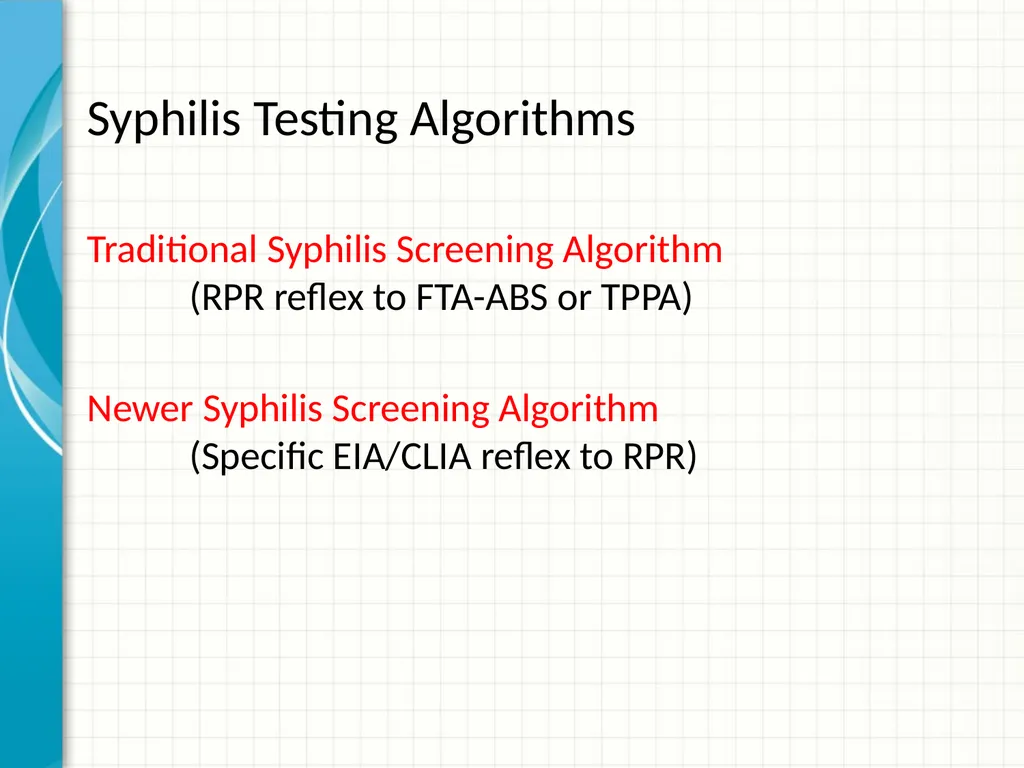
Syphilis Testing Algorithms Traditional Syphilis Screening Algorithm
(RPR reflex to FTA-ABS or TPPA)
Newer Syphilis Screening Algorithm (Specific EIA/CLIA reflex to RPR)<br>
Newer Syphilis Screening Algorithm (Specific EIA/CLIA reflex to RPR)<br>
31
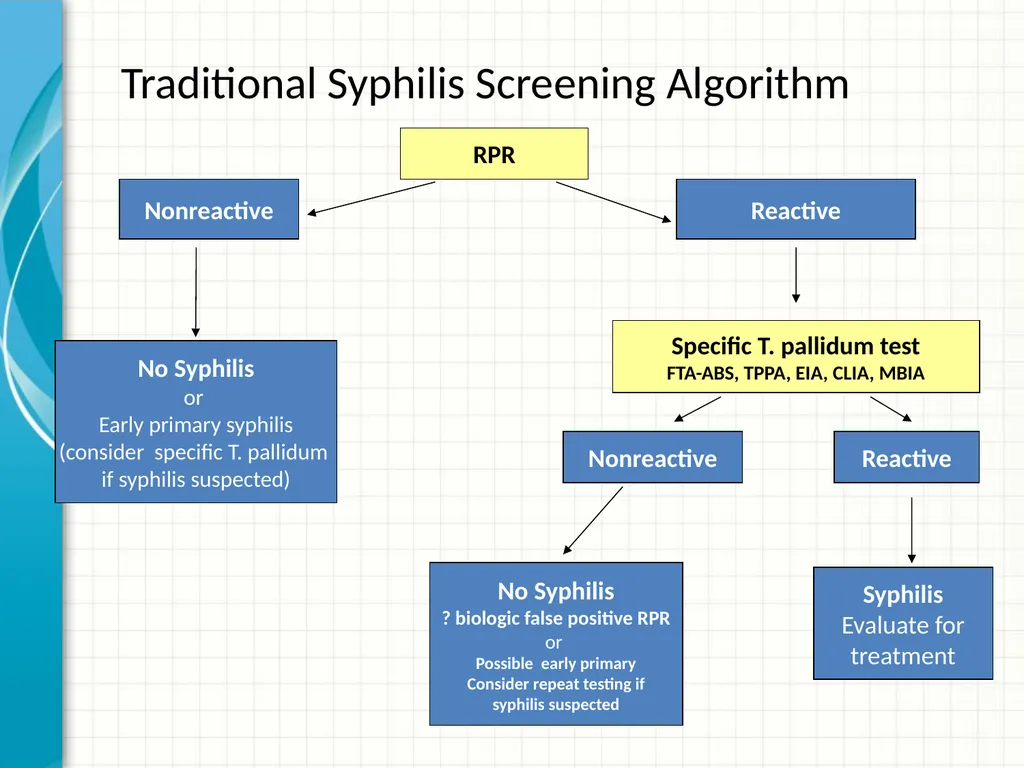
Traditional Syphilis Screening Algorithm No Syphilis
or
Early primary syphilis
(consider specific T. pallidum
if syphilis suspected) Specific T. pallidum test
FTA-ABS, TPPA, EIA, CLIA, MBIA Reactive Syphilis
Evaluate for
treatment Nonreactive TPPA or FTA-abs No Syphilis
? biologic false positive RPR
or
Possible early primary
Consider repeat testing if
syphilis suspected RPR Nonreactive Reactive<br>
or
Early primary syphilis
(consider specific T. pallidum
if syphilis suspected) Specific T. pallidum test
FTA-ABS, TPPA, EIA, CLIA, MBIA Reactive Syphilis
Evaluate for
treatment Nonreactive TPPA or FTA-abs No Syphilis
? biologic false positive RPR
or
Possible early primary
Consider repeat testing if
syphilis suspected RPR Nonreactive Reactive<br>
32
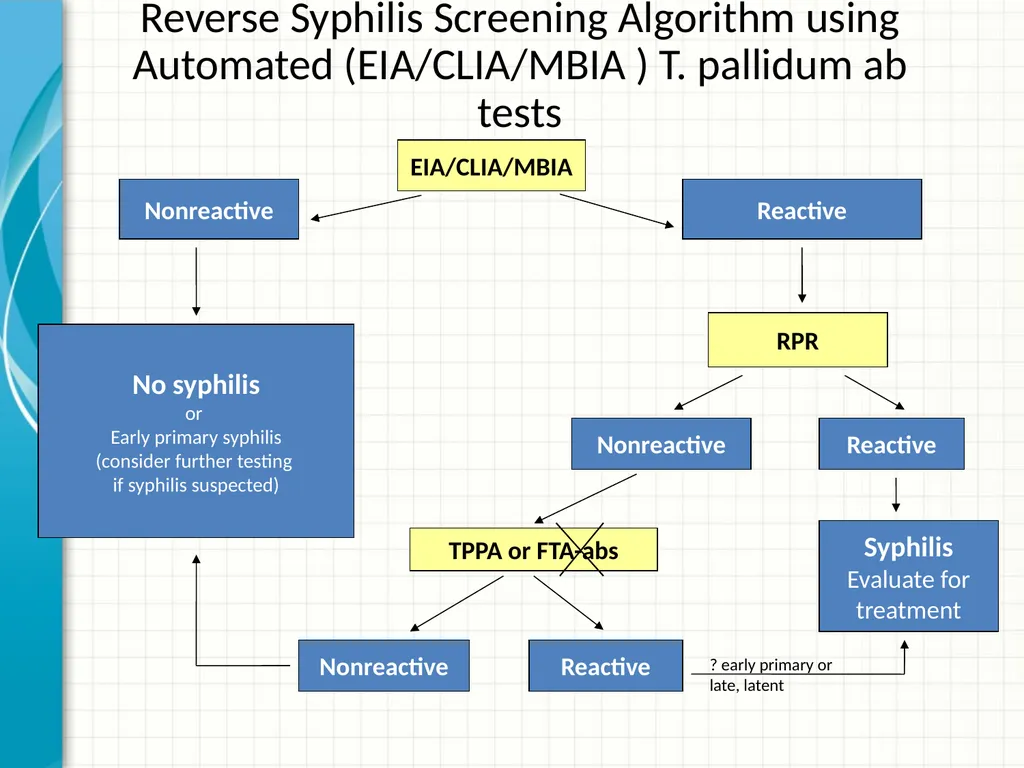
No syphilis
or
Early primary syphilis
(consider further testing
if syphilis suspected) Reverse Syphilis Screening Algorithm using Automated (EIA/CLIA/MBIA ) T. pallidum ab tests RPR Reactive Syphilis
Evaluate for
treatment Nonreactive TPPA or FTA-abs Nonreactive Reactive EIA/CLIA/MBIA Nonreactive Reactive ? early primary or late, latent<br>
or
Early primary syphilis
(consider further testing
if syphilis suspected) Reverse Syphilis Screening Algorithm using Automated (EIA/CLIA/MBIA ) T. pallidum ab tests RPR Reactive Syphilis
Evaluate for
treatment Nonreactive TPPA or FTA-abs Nonreactive Reactive EIA/CLIA/MBIA Nonreactive Reactive ? early primary or late, latent<br>
33
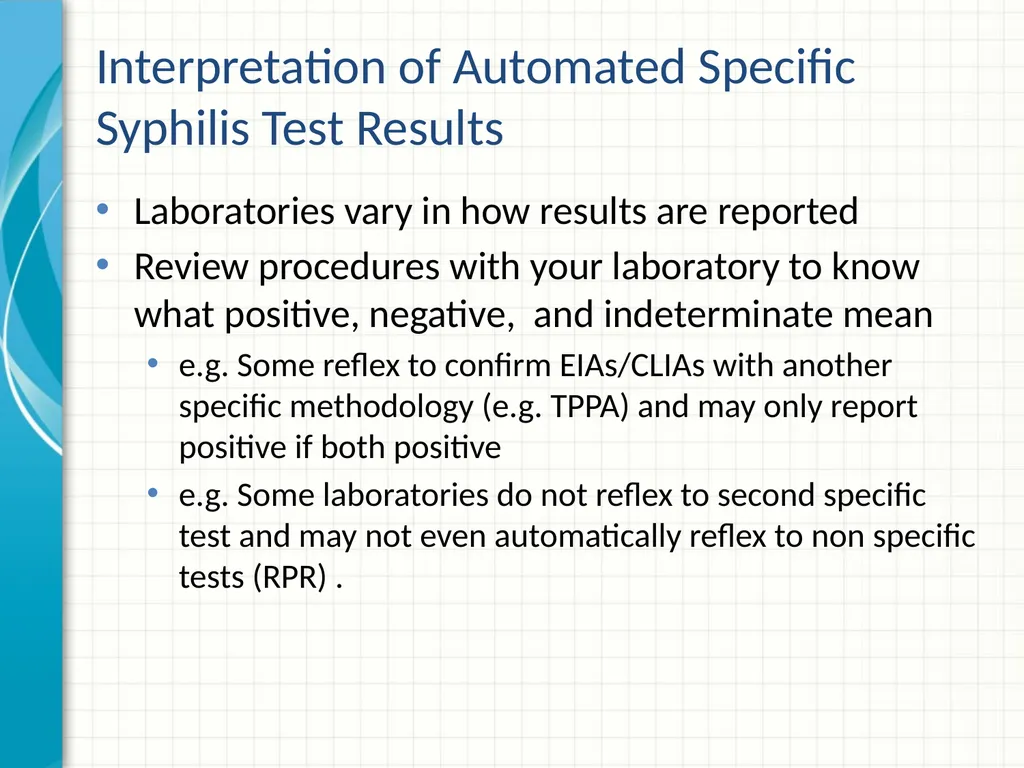
Interpretation of Automated Specific Syphilis Test Results Laboratories vary in how results are reported
Review procedures with your laboratory to know what positive, negative, and indeterminate mean
e.g. Some reflex to confirm EIAs/CLIAs with another specific methodology (e.g. TPPA) and may only report positive if both positive
e.g. Some laboratories do not reflex to second specific test and may not even automatically reflex to non specific tests (RPR) .<br>
Review procedures with your laboratory to know what positive, negative, and indeterminate mean
e.g. Some reflex to confirm EIAs/CLIAs with another specific methodology (e.g. TPPA) and may only report positive if both positive
e.g. Some laboratories do not reflex to second specific test and may not even automatically reflex to non specific tests (RPR) .<br>
34
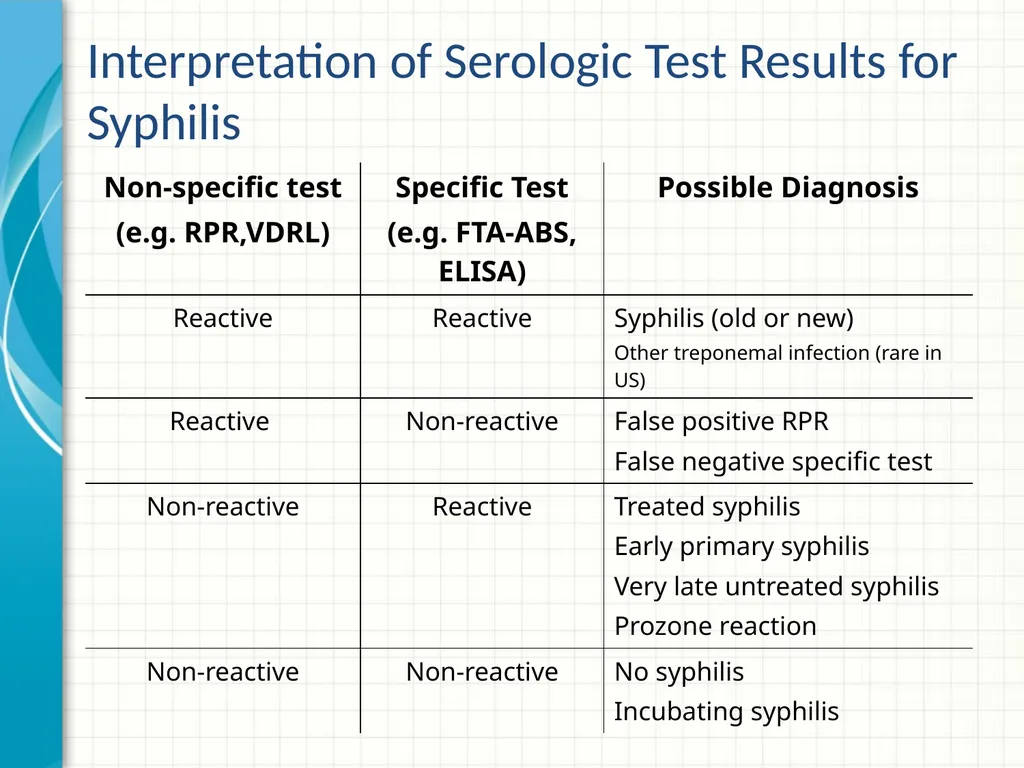
Interpretation of Serologic Test Results for Syphilis<br>
35
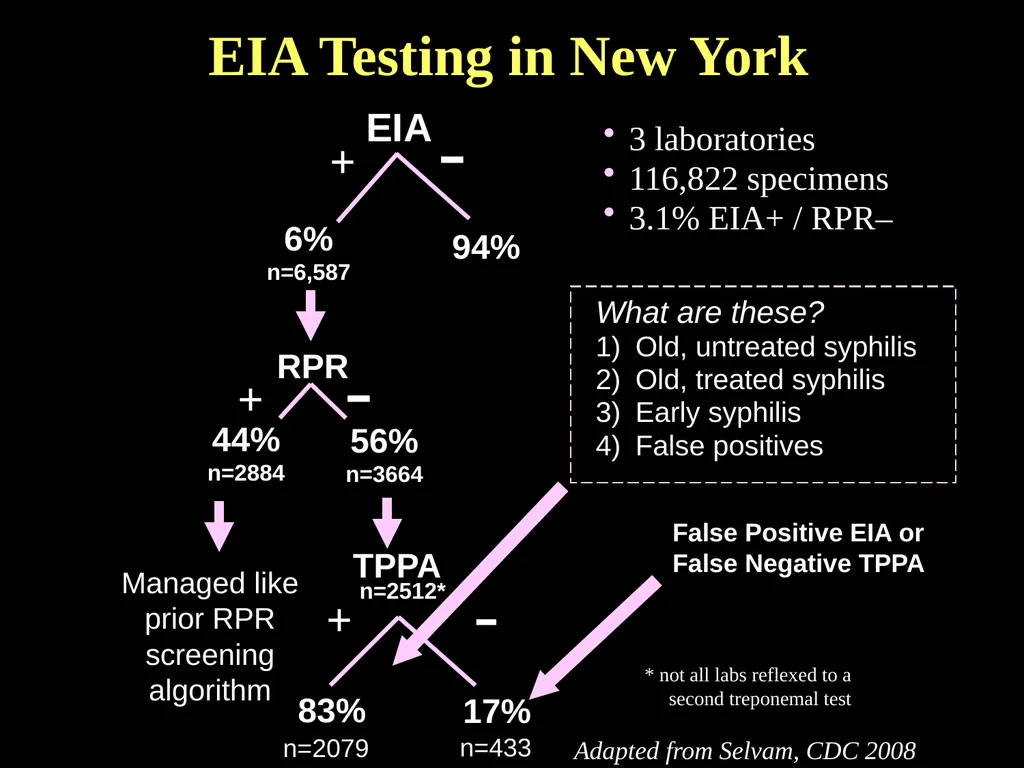
EIA 6%
n=6,587 94% 3 laboratories
116,822 specimens
3.1% EIA+ / RPR– EIA Testing in New York RPR + - Adapted from Selvam, CDC 2008 * not all labs reflexed to a second treponemal test<br>
116,822 specimens
3.1% EIA+ / RPR– EIA Testing in New York RPR + - Adapted from Selvam, CDC 2008 * not all labs reflexed to a second treponemal test<br>
36
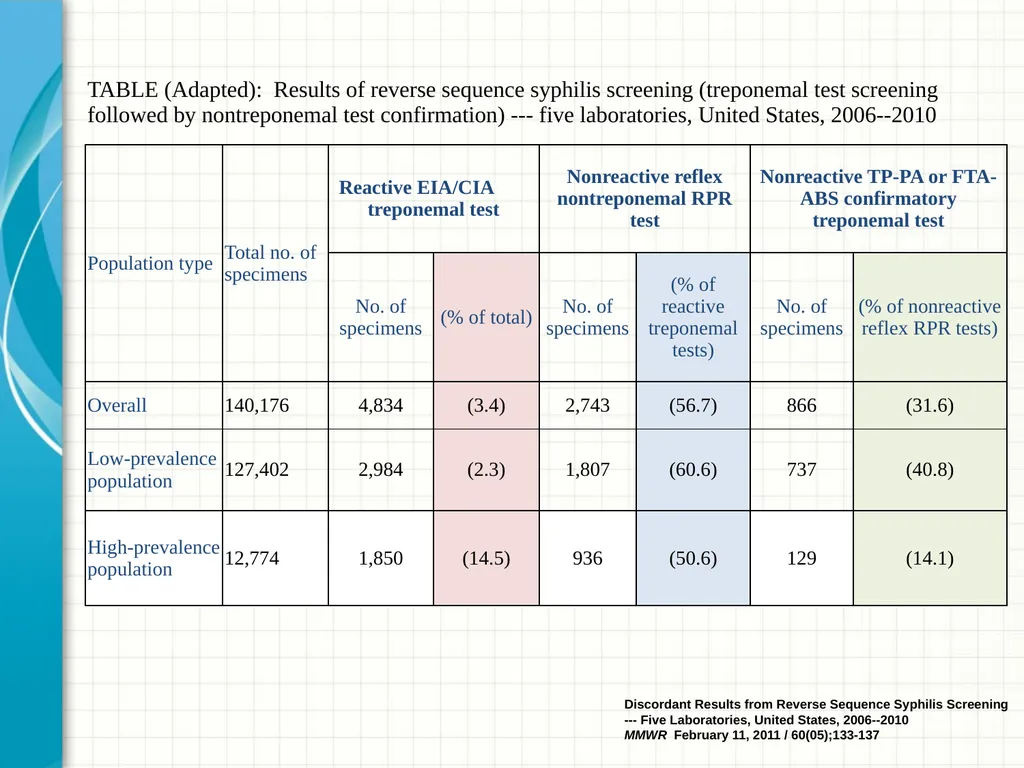
Discordant Results from Reverse Sequence Syphilis Screening --- Five Laboratories, United States, 2006--2010
MMWR February 11, 2011 / 60(05);133-137<br>
MMWR February 11, 2011 / 60(05);133-137<br>
37
Discordant Results from Reverse Sequence Syphilis Screening --- Five Laboratories, United States, 2006--2010
MMWR February 11, 2011 / 60(05);133-137<br>
MMWR February 11, 2011 / 60(05);133-137<br>
38
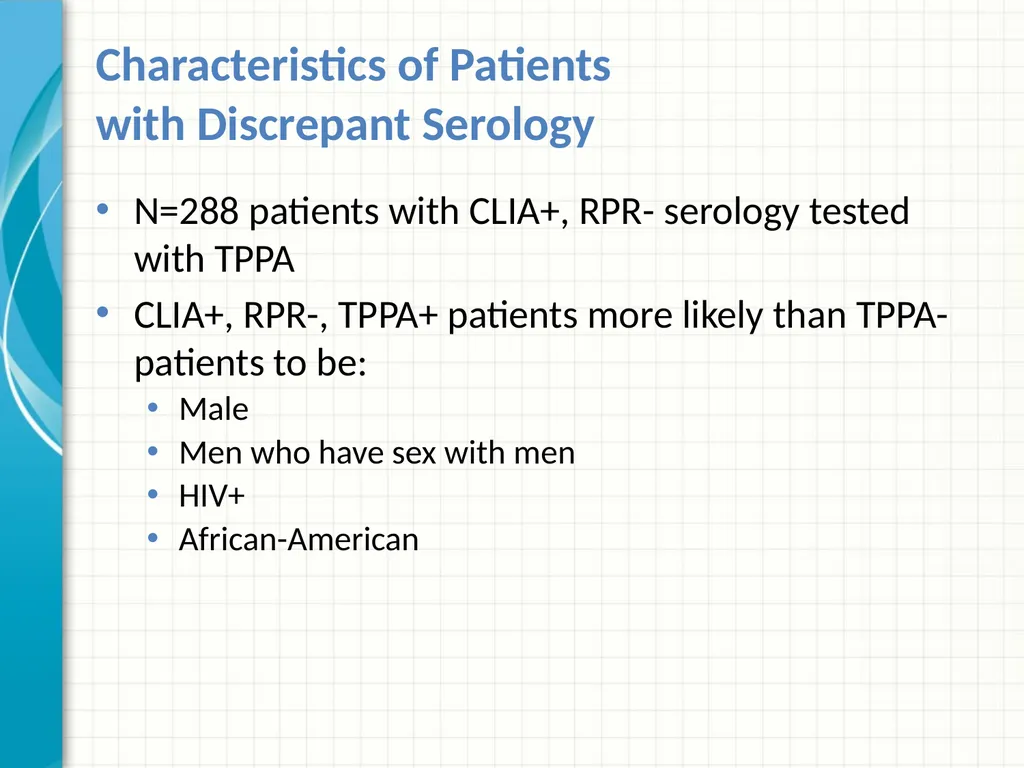
Characteristics of Patients
with Discrepant Serology N=288 patients with CLIA+, RPR- serology tested with TPPA
CLIA+, RPR-, TPPA+ patients more likely than TPPA- patients to be:
Male
Men who have sex with men
HIV+
African-American<br>
CLIA+, RPR-, TPPA+ patients more likely than TPPA- patients to be:
Male
Men who have sex with men
HIV+
African-American<br>
39
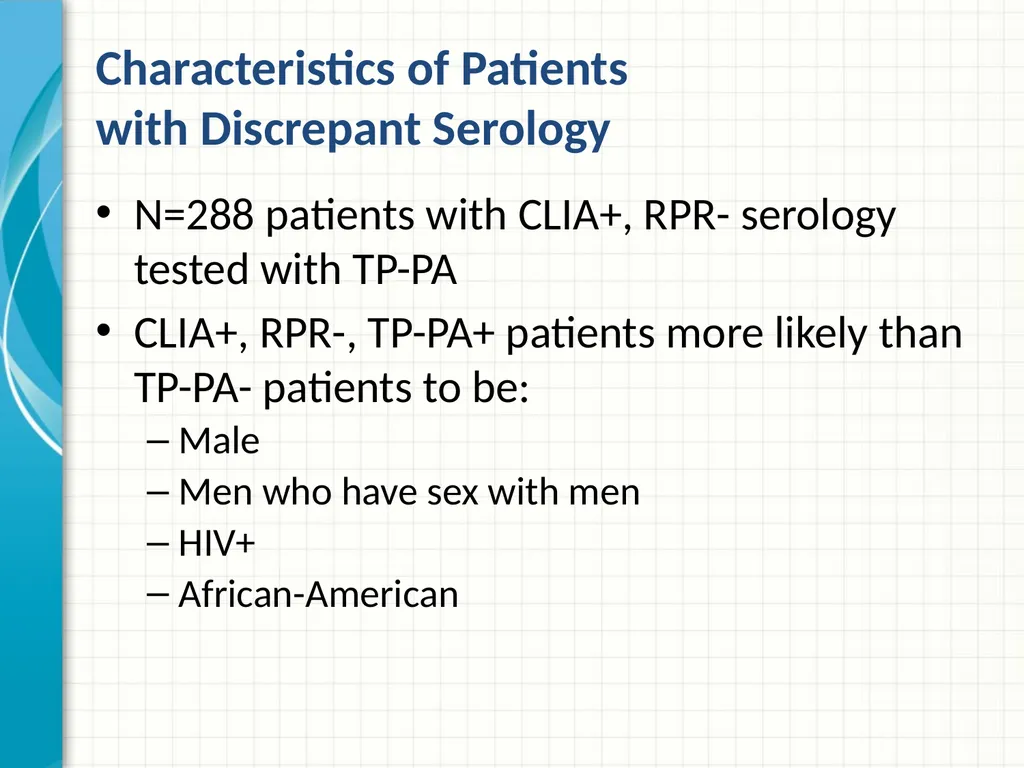
Characteristics of Patients
with Discrepant Serology N=288 patients with CLIA+, RPR- serology tested with TP-PA
CLIA+, RPR-, TP-PA+ patients more likely than TP-PA- patients to be:
Male
Men who have sex with men
HIV+
African-American<br>
CLIA+, RPR-, TP-PA+ patients more likely than TP-PA- patients to be:
Male
Men who have sex with men
HIV+
African-American<br>
40
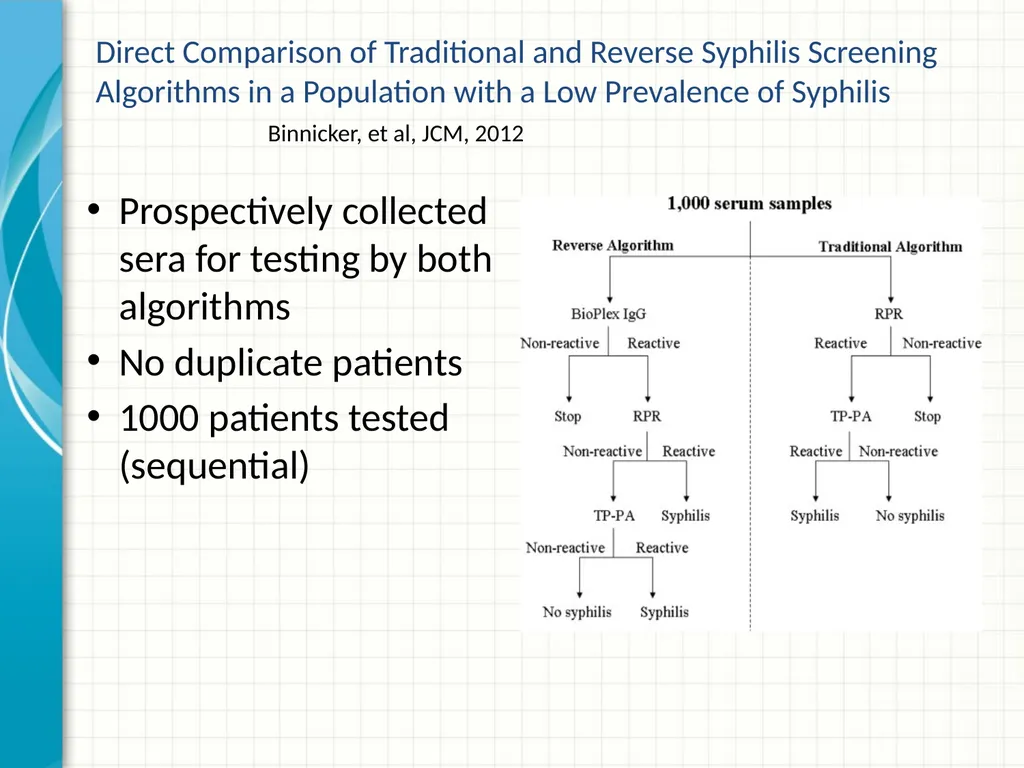
Direct Comparison of Traditional and Reverse Syphilis Screening Algorithms in a Population with a Low Prevalence of Syphilis Binnicker, et al, JCM, 2012 Prospectively collected sera for testing by both algorithms
No duplicate patients
1000 patients tested (sequential)<br>
No duplicate patients
1000 patients tested (sequential)<br>
41
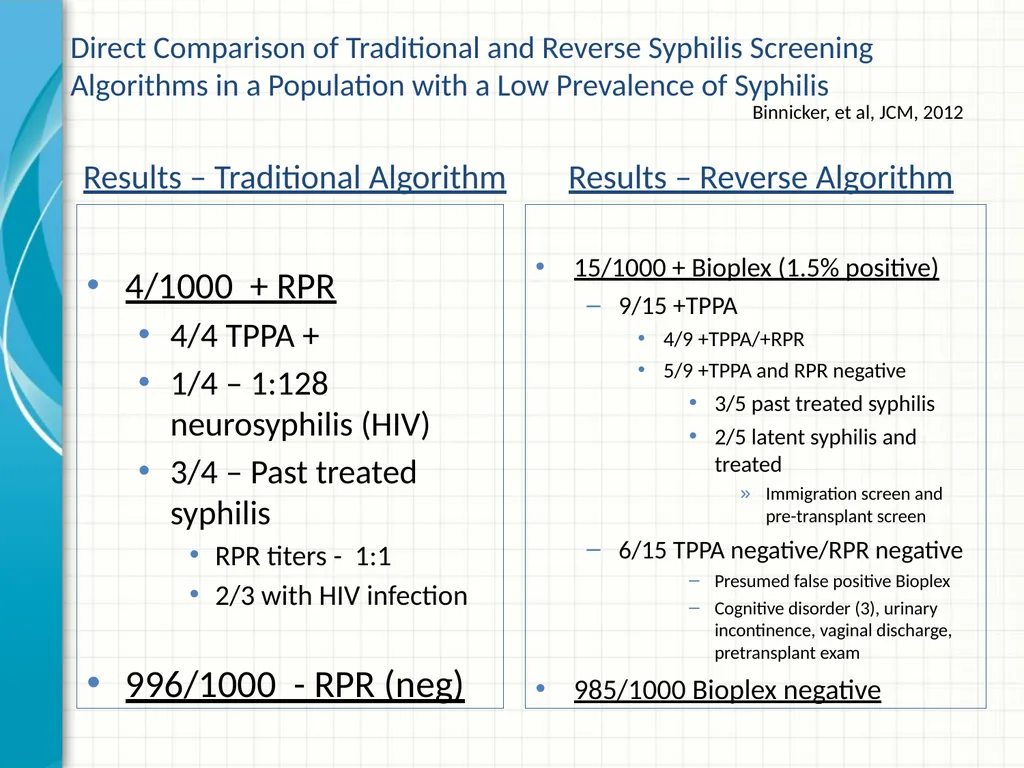
Results – Traditional Algorithm Results – Reverse Algorithm 4/1000 + RPR
4/4 TPPA +
1/4 – 1:128 neurosyphilis (HIV)
3/4 – Past treated syphilis
RPR titers - 1:1
2/3 with HIV infection
996/1000 - RPR (neg) 15/1000 + Bioplex (1.5% positive)
9/15 +TPPA
4/9 +TPPA/+RPR
5/9 +TPPA and RPR negative
3/5 past treated syphilis
2/5 latent syphilis and treated
Immigration screen and pre-transplant screen
6/15 TPPA negative/RPR negative
Presumed false positive Bioplex
Cognitive disorder (3), urinary incontinence, vaginal discharge, pretransplant exam
985/1000 Bioplex negative Direct Comparison of Traditional and Reverse Syphilis Screening Algorithms in a Population with a Low Prevalence of Syphilis Binnicker, et al, JCM, 2012<br>
4/4 TPPA +
1/4 – 1:128 neurosyphilis (HIV)
3/4 – Past treated syphilis
RPR titers - 1:1
2/3 with HIV infection
996/1000 - RPR (neg) 15/1000 + Bioplex (1.5% positive)
9/15 +TPPA
4/9 +TPPA/+RPR
5/9 +TPPA and RPR negative
3/5 past treated syphilis
2/5 latent syphilis and treated
Immigration screen and pre-transplant screen
6/15 TPPA negative/RPR negative
Presumed false positive Bioplex
Cognitive disorder (3), urinary incontinence, vaginal discharge, pretransplant exam
985/1000 Bioplex negative Direct Comparison of Traditional and Reverse Syphilis Screening Algorithms in a Population with a Low Prevalence of Syphilis Binnicker, et al, JCM, 2012<br>
42
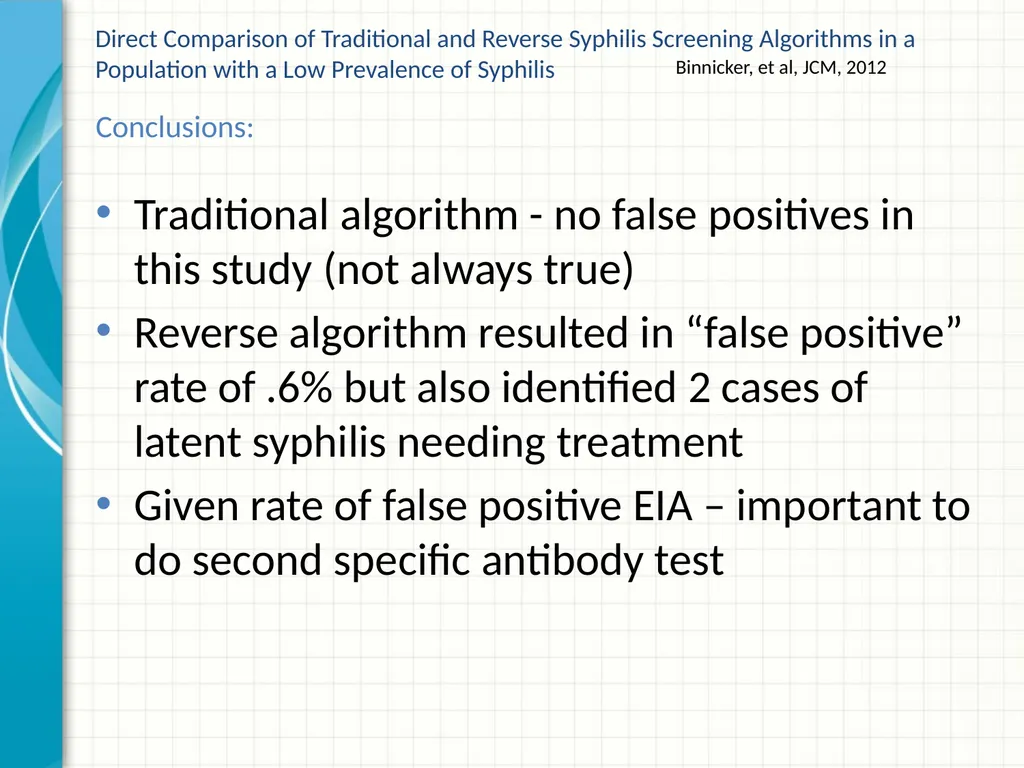
Conclusions: Traditional algorithm - no false positives in this study (not always true)
Reverse algorithm resulted in “false positive” rate of .6% but also identified 2 cases of latent syphilis needing treatment
Given rate of false positive EIA – important to do second specific antibody test Direct Comparison of Traditional and Reverse Syphilis Screening Algorithms in a Population with a Low Prevalence of Syphilis Binnicker, et al, JCM, 2012<br>
Reverse algorithm resulted in “false positive” rate of .6% but also identified 2 cases of latent syphilis needing treatment
Given rate of false positive EIA – important to do second specific antibody test Direct Comparison of Traditional and Reverse Syphilis Screening Algorithms in a Population with a Low Prevalence of Syphilis Binnicker, et al, JCM, 2012<br>
43
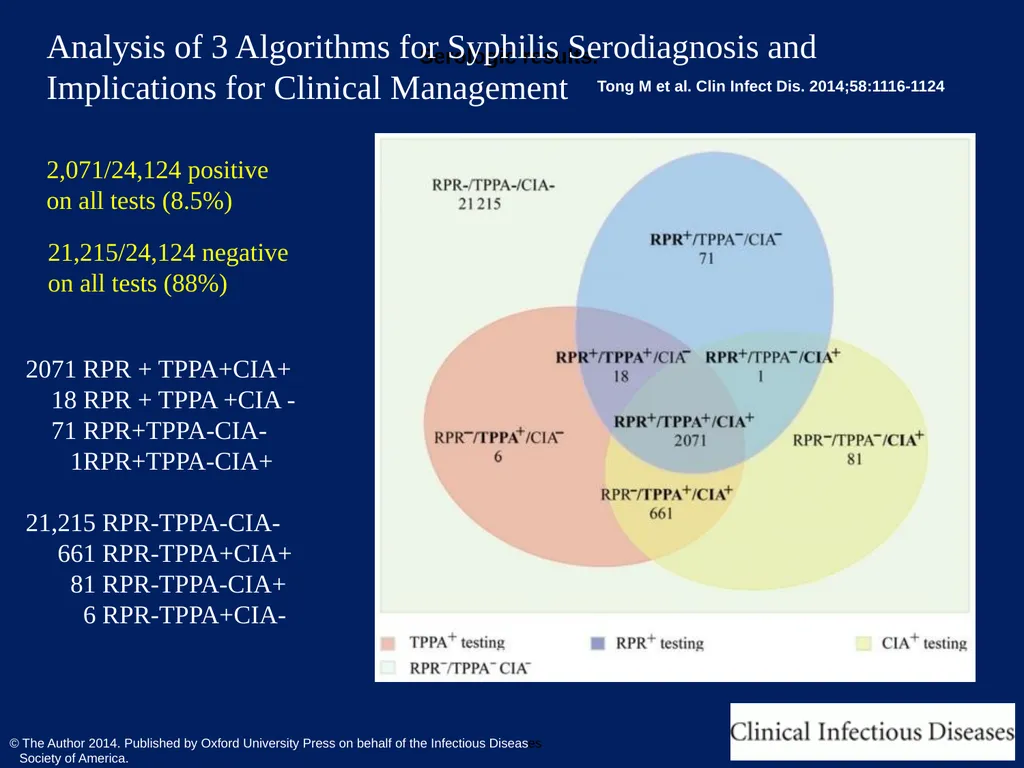
Serologic results. Tong M et al. Clin Infect Dis. 2014;58:1116-1124 © The Author 2014. Published by Oxford University Press on behalf of the Infectious Diseases Society of America. 21,215/24,124 negative on all tests (88%) 2,071/24,124 positive
on all tests (8.5%) 2071 RPR + TPPA+CIA+
18 RPR + TPPA +CIA -
71 RPR+TPPA-CIA-
1RPR+TPPA-CIA+
21,215 RPR-TPPA-CIA-
661 RPR-TPPA+CIA+
81 RPR-TPPA-CIA+
6 RPR-TPPA+CIA- Analysis of 3 Algorithms for Syphilis Serodiagnosis and Implications for Clinical Management<br>
on all tests (8.5%) 2071 RPR + TPPA+CIA+
18 RPR + TPPA +CIA -
71 RPR+TPPA-CIA-
1RPR+TPPA-CIA+
21,215 RPR-TPPA-CIA-
661 RPR-TPPA+CIA+
81 RPR-TPPA-CIA+
6 RPR-TPPA+CIA- Analysis of 3 Algorithms for Syphilis Serodiagnosis and Implications for Clinical Management<br>
44
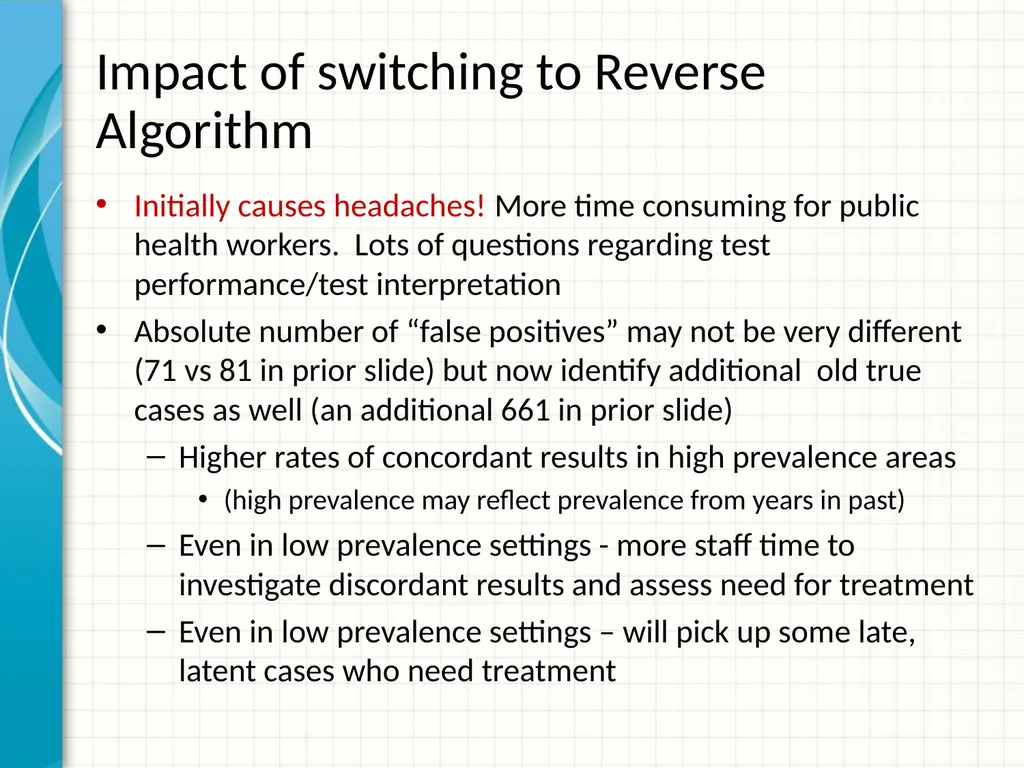
Impact of switching to Reverse Algorithm Initially causes headaches! More time consuming for public health workers. Lots of questions regarding test performance/test interpretation
Absolute number of “false positives” may not be very different (71 vs 81 in prior slide) but now identify additional old true cases as well (an additional 661 in prior slide)
Higher rates of concordant results in high prevalence areas
(high prevalence may reflect prevalence from years in past)
Even in low prevalence settings - more staff time to investigate discordant results and assess need for treatment
Even in low prevalence settings – will pick up some late, latent cases who need treatment<br>
Absolute number of “false positives” may not be very different (71 vs 81 in prior slide) but now identify additional old true cases as well (an additional 661 in prior slide)
Higher rates of concordant results in high prevalence areas
(high prevalence may reflect prevalence from years in past)
Even in low prevalence settings - more staff time to investigate discordant results and assess need for treatment
Even in low prevalence settings – will pick up some late, latent cases who need treatment<br>
45
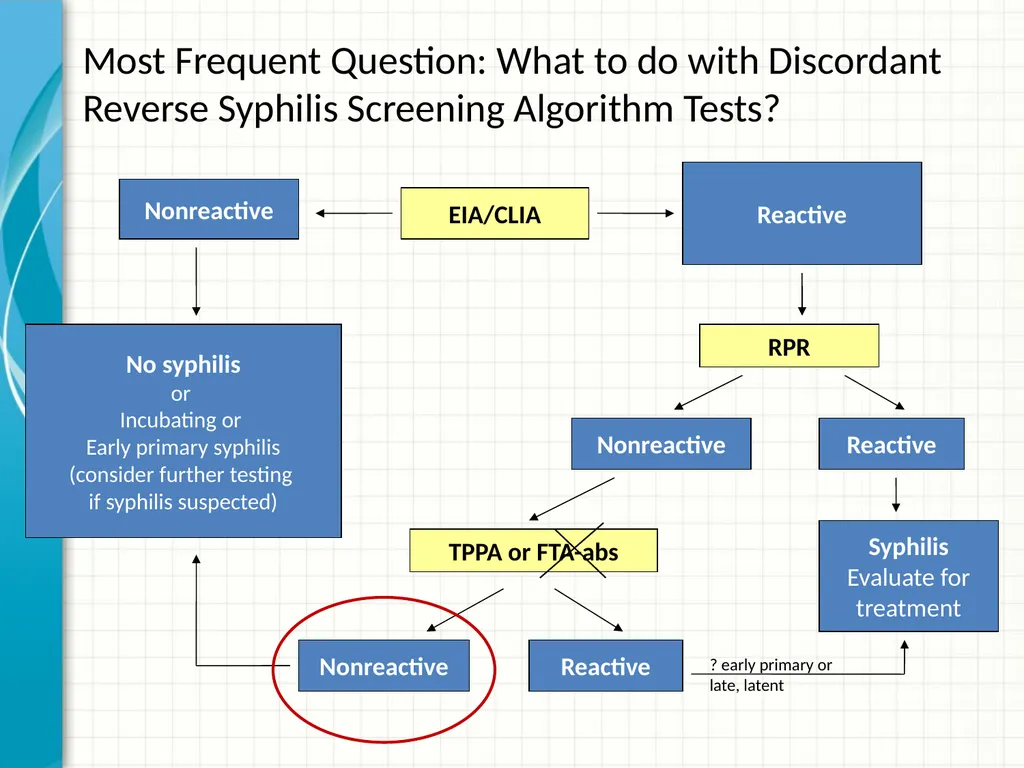
No syphilis
or
Incubating or
Early primary syphilis
(consider further testing
if syphilis suspected) Most Frequent Question: What to do with Discordant Reverse Syphilis Screening Algorithm Tests? RPR Reactive Syphilis
Evaluate for
treatment Nonreactive TPPA or FTA-abs Nonreactive Reactive EIA/CLIA Nonreactive Reactive ? early primary or late, latent<br>
or
Incubating or
Early primary syphilis
(consider further testing
if syphilis suspected) Most Frequent Question: What to do with Discordant Reverse Syphilis Screening Algorithm Tests? RPR Reactive Syphilis
Evaluate for
treatment Nonreactive TPPA or FTA-abs Nonreactive Reactive EIA/CLIA Nonreactive Reactive ? early primary or late, latent<br>
46
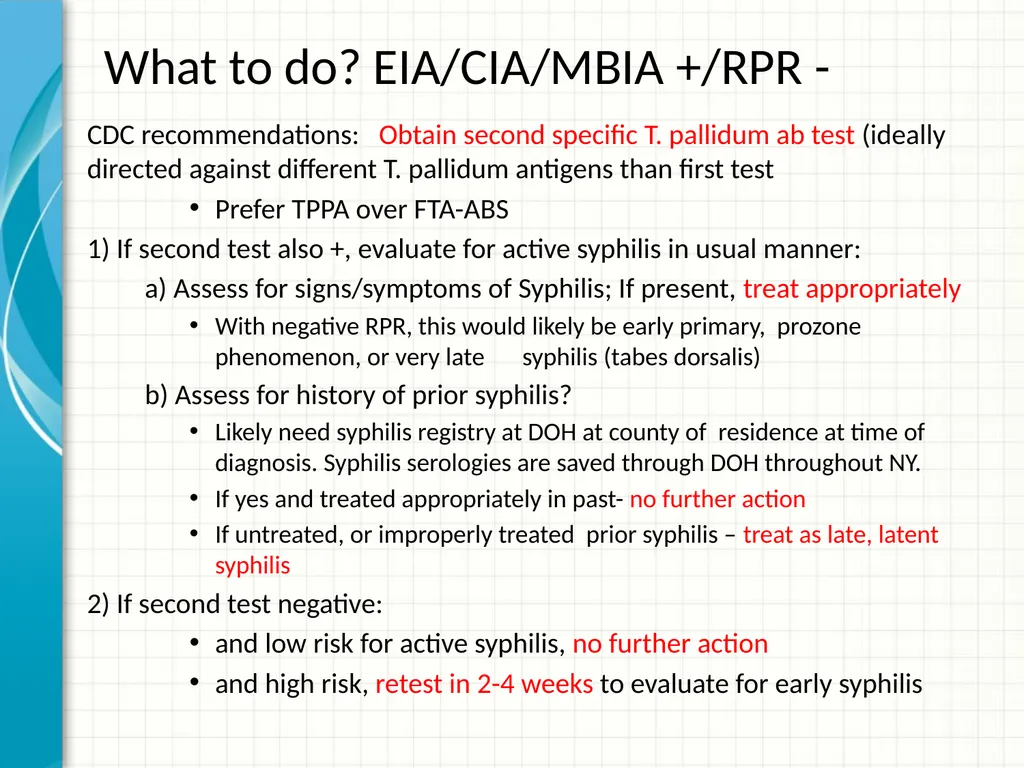
What to do? EIA/CIA/MBIA +/RPR - CDC recommendations: Obtain second specific T. pallidum ab test (ideally directed against different T. pallidum antigens than first test
Prefer TPPA over FTA-ABS
1) If second test also +, evaluate for active syphilis in usual manner:
a) Assess for signs/symptoms of Syphilis; If present, treat appropriately
With negative RPR, this would likely be early primary, prozone phenomenon, or very late syphilis (tabes dorsalis)
b) Assess for history of prior syphilis?
Likely need syphilis registry at DOH at county of residence at time of diagnosis. Syphilis serologies are saved through DOH throughout NY.
If yes and treated appropriately in past- no further action
If untreated, or improperly treated prior syphilis – treat as late, latent syphilis
2) If second test negative:
and low risk for active syphilis, no further action
and high risk, retest in 2-4 weeks to evaluate for early syphilis<br>
Prefer TPPA over FTA-ABS
1) If second test also +, evaluate for active syphilis in usual manner:
a) Assess for signs/symptoms of Syphilis; If present, treat appropriately
With negative RPR, this would likely be early primary, prozone phenomenon, or very late syphilis (tabes dorsalis)
b) Assess for history of prior syphilis?
Likely need syphilis registry at DOH at county of residence at time of diagnosis. Syphilis serologies are saved through DOH throughout NY.
If yes and treated appropriately in past- no further action
If untreated, or improperly treated prior syphilis – treat as late, latent syphilis
2) If second test negative:
and low risk for active syphilis, no further action
and high risk, retest in 2-4 weeks to evaluate for early syphilis<br>
47
Response to Therapy by Syphilis Stage:
The Details – must use quantitative tests (RPR) “Treatment failure can occur with any regimen. However, assessing response to treatment frequently is difficult, and definitive criteria for cure or failure have not been established.” CDC STD Treatment Guidelines, 2010
RPRs may decline more slowly for persons who previously have had syphilis
Those with persistent or recurrent signs/symptoms or who have a sustained fourfold increase in RPR “probably failed treatment or were re-infected.”
Retreat and reevaluate for HIV infection and LP<br>
RPRs may decline more slowly for persons who previously have had syphilis
Those with persistent or recurrent signs/symptoms or who have a sustained fourfold increase in RPR “probably failed treatment or were re-infected.”
Retreat and reevaluate for HIV infection and LP<br>
48
1 : 1024
1 : 512
1 : 256
1 : 128
1 : 64
1 : 32
1 : 16
1 : 8
1 : 4
1 : 2
1 : 1 SEROLOGIC TITERS OF RPR/VDRL<br>
1 : 512
1 : 256
1 : 128
1 : 64
1 : 32
1 : 16
1 : 8
1 : 4
1 : 2
1 : 1 SEROLOGIC TITERS OF RPR/VDRL<br>
49
Response to Therapy by Syphilis Stage:
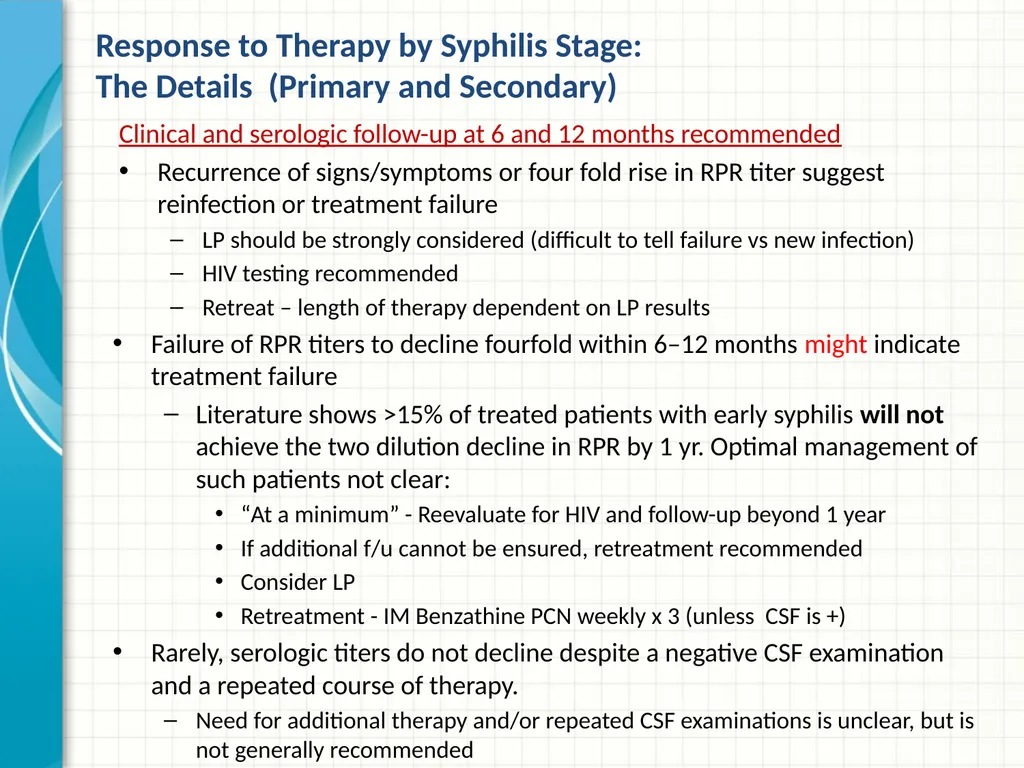
The Details (Primary and Secondary) Clinical and serologic follow-up at 6 and 12 months recommended
Recurrence of signs/symptoms or four fold rise in RPR titer suggest reinfection or treatment failure
LP should be strongly considered (difficult to tell failure vs new infection)
HIV testing recommended
Retreat – length of therapy dependent on LP results
Failure of RPR titers to decline fourfold within 6–12 months might indicate treatment failure
Literature shows >15% of treated patients with early syphilis will not achieve the two dilution decline in RPR by 1 yr. Optimal management of such patients not clear:
“At a minimum” - Reevaluate for HIV and follow-up beyond 1 year
If additional f/u cannot be ensured, retreatment recommended
Consider LP
Retreatment - IM Benzathine PCN weekly x 3 (unless CSF is +)
Rarely, serologic titers do not decline despite a negative CSF examination and a repeated course of therapy.
Need for additional therapy and/or repeated CSF examinations is unclear, but is not generally recommended<br>
Recurrence of signs/symptoms or four fold rise in RPR titer suggest reinfection or treatment failure
LP should be strongly considered (difficult to tell failure vs new infection)
HIV testing recommended
Retreat – length of therapy dependent on LP results
Failure of RPR titers to decline fourfold within 6–12 months might indicate treatment failure
Literature shows >15% of treated patients with early syphilis will not achieve the two dilution decline in RPR by 1 yr. Optimal management of such patients not clear:
“At a minimum” - Reevaluate for HIV and follow-up beyond 1 year
If additional f/u cannot be ensured, retreatment recommended
Consider LP
Retreatment - IM Benzathine PCN weekly x 3 (unless CSF is +)
Rarely, serologic titers do not decline despite a negative CSF examination and a repeated course of therapy.
Need for additional therapy and/or repeated CSF examinations is unclear, but is not generally recommended<br>
50
Response to Therapy by Syphilis Stage:
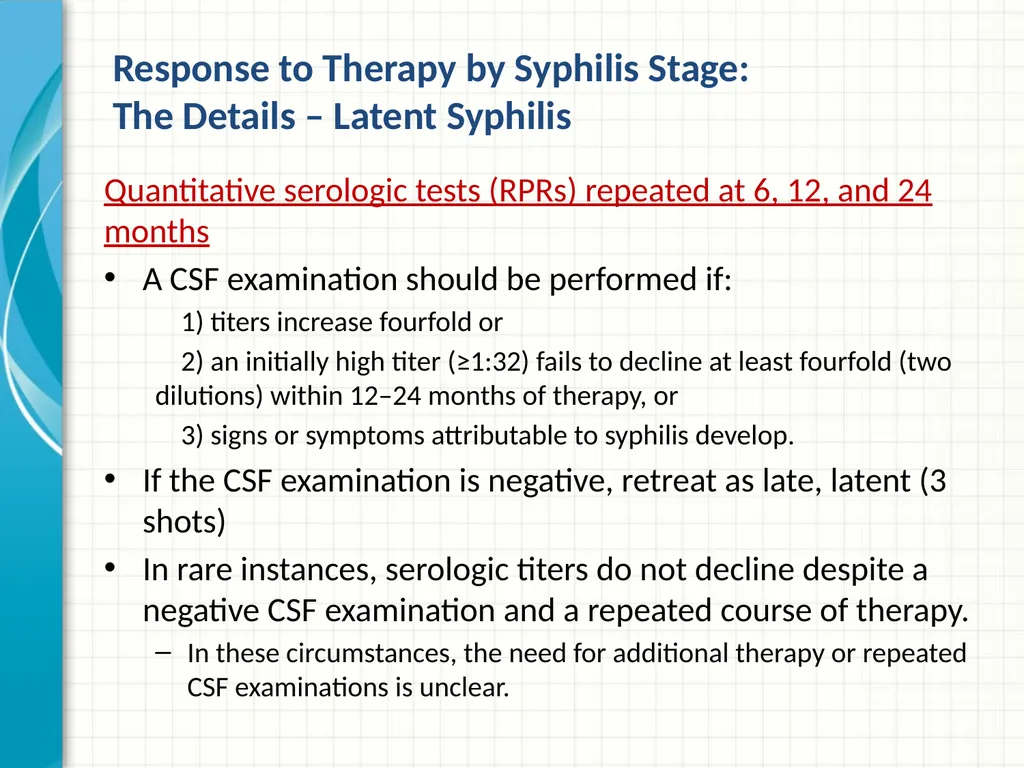
The Details – Latent Syphilis Quantitative serologic tests (RPRs) repeated at 6, 12, and 24 months
A CSF examination should be performed if:
1) titers increase fourfold or
2) an initially high titer (≥1:32) fails to decline at least fourfold (two dilutions) within 12–24 months of therapy, or
3) signs or symptoms attributable to syphilis develop.
If the CSF examination is negative, retreat as late, latent (3 shots)
In rare instances, serologic titers do not decline despite a negative CSF examination and a repeated course of therapy.
In these circumstances, the need for additional therapy or repeated CSF examinations is unclear.<br>
A CSF examination should be performed if:
1) titers increase fourfold or
2) an initially high titer (≥1:32) fails to decline at least fourfold (two dilutions) within 12–24 months of therapy, or
3) signs or symptoms attributable to syphilis develop.
If the CSF examination is negative, retreat as late, latent (3 shots)
In rare instances, serologic titers do not decline despite a negative CSF examination and a repeated course of therapy.
In these circumstances, the need for additional therapy or repeated CSF examinations is unclear.<br>
51
Response to Therapy by Syphilis Stage:
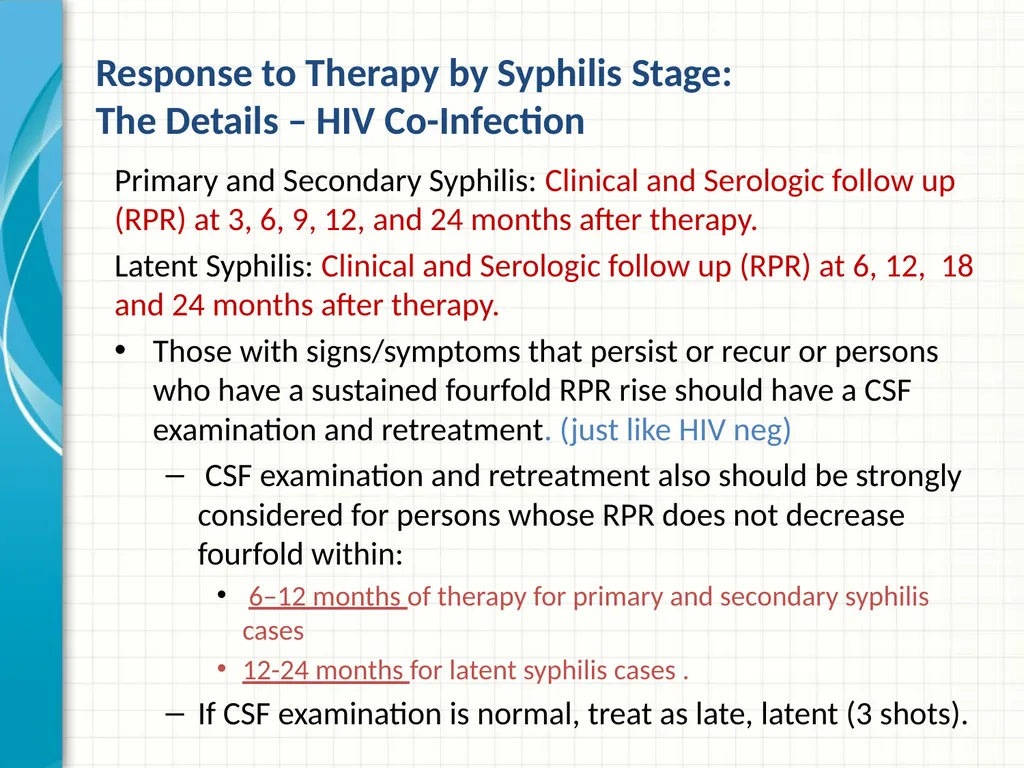
The Details – HIV Co-Infection Primary and Secondary Syphilis: Clinical and Serologic follow up (RPR) at 3, 6, 9, 12, and 24 months after therapy.
Latent Syphilis: Clinical and Serologic follow up (RPR) at 6, 12, 18 and 24 months after therapy.
Those with signs/symptoms that persist or recur or persons who have a sustained fourfold RPR rise should have a CSF examination and retreatment. (just like HIV neg)
CSF examination and retreatment also should be strongly considered for persons whose RPR does not decrease fourfold within:
6–12 months of therapy for primary and secondary syphilis cases
12-24 months for latent syphilis cases .
If CSF examination is normal, treat as late, latent (3 shots).<br>
Latent Syphilis: Clinical and Serologic follow up (RPR) at 6, 12, 18 and 24 months after therapy.
Those with signs/symptoms that persist or recur or persons who have a sustained fourfold RPR rise should have a CSF examination and retreatment. (just like HIV neg)
CSF examination and retreatment also should be strongly considered for persons whose RPR does not decrease fourfold within:
6–12 months of therapy for primary and secondary syphilis cases
12-24 months for latent syphilis cases .
If CSF examination is normal, treat as late, latent (3 shots).<br>
52
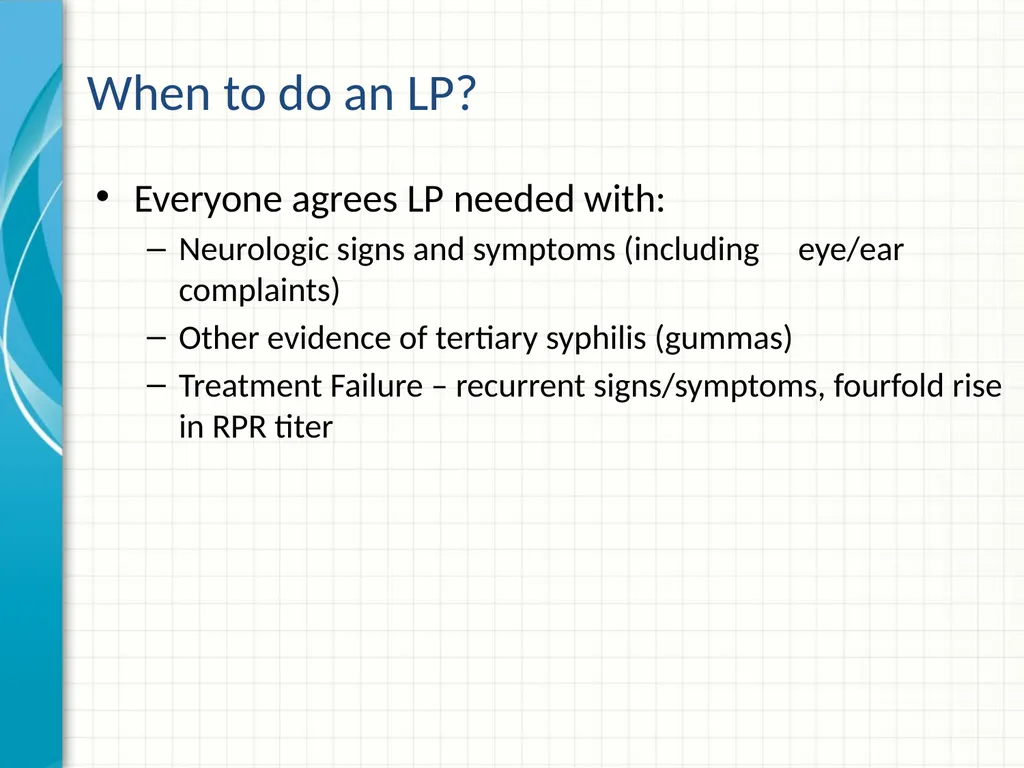
When to do an LP? Everyone agrees LP needed with:
Neurologic signs and symptoms (including eye/ear complaints)
Other evidence of tertiary syphilis (gummas)
Treatment Failure – recurrent signs/symptoms, fourfold rise in RPR titer<br>
Neurologic signs and symptoms (including eye/ear complaints)
Other evidence of tertiary syphilis (gummas)
Treatment Failure – recurrent signs/symptoms, fourfold rise in RPR titer<br>
53
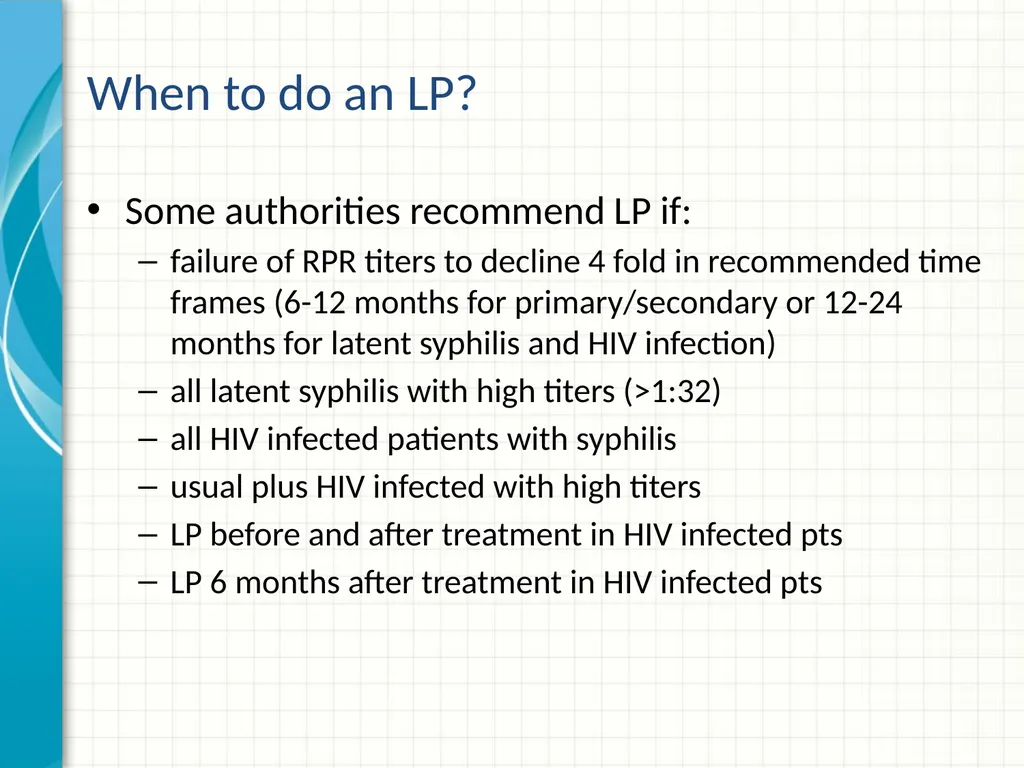
When to do an LP? Some authorities recommend LP if:
failure of RPR titers to decline 4 fold in recommended time frames (6-12 months for primary/secondary or 12-24 months for latent syphilis and HIV infection)
all latent syphilis with high titers (>1:32)
all HIV infected patients with syphilis
usual plus HIV infected with high titers
LP before and after treatment in HIV infected pts
LP 6 months after treatment in HIV infected pts<br>
failure of RPR titers to decline 4 fold in recommended time frames (6-12 months for primary/secondary or 12-24 months for latent syphilis and HIV infection)
all latent syphilis with high titers (>1:32)
all HIV infected patients with syphilis
usual plus HIV infected with high titers
LP before and after treatment in HIV infected pts
LP 6 months after treatment in HIV infected pts<br>
54
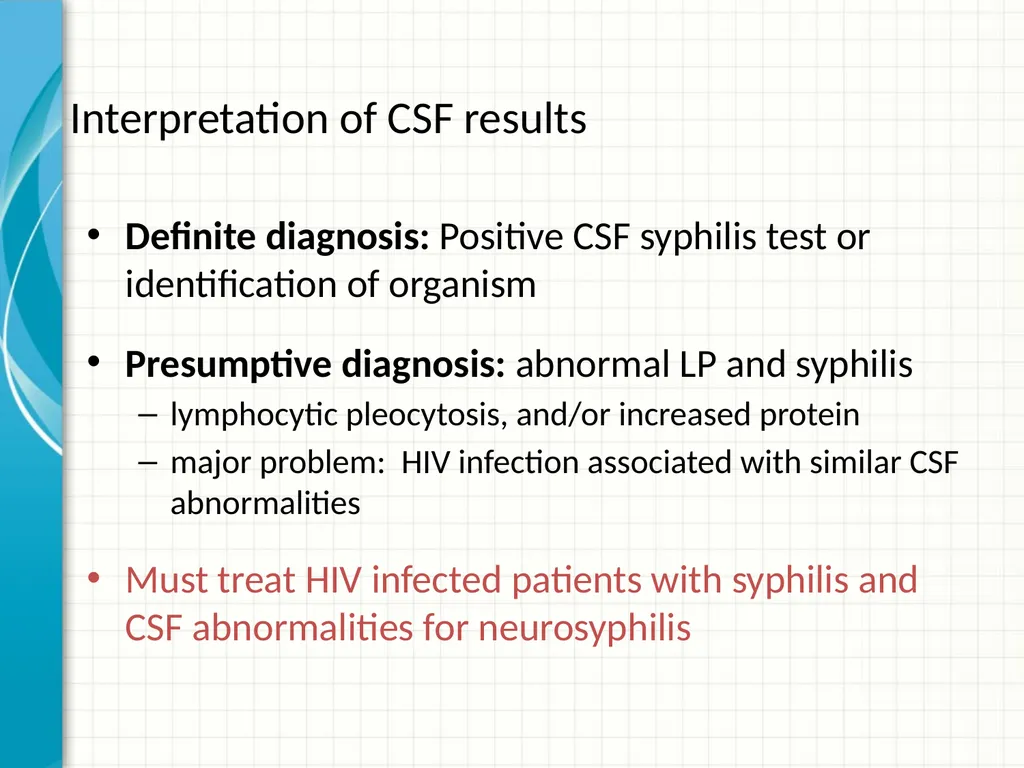
Interpretation of CSF results Definite diagnosis: Positive CSF syphilis test or identification of organism
Presumptive diagnosis: abnormal LP and syphilis
lymphocytic pleocytosis, and/or increased protein
major problem: HIV infection associated with similar CSF abnormalities
Must treat HIV infected patients with syphilis and CSF abnormalities for neurosyphilis<br>
Presumptive diagnosis: abnormal LP and syphilis
lymphocytic pleocytosis, and/or increased protein
major problem: HIV infection associated with similar CSF abnormalities
Must treat HIV infected patients with syphilis and CSF abnormalities for neurosyphilis<br>
55
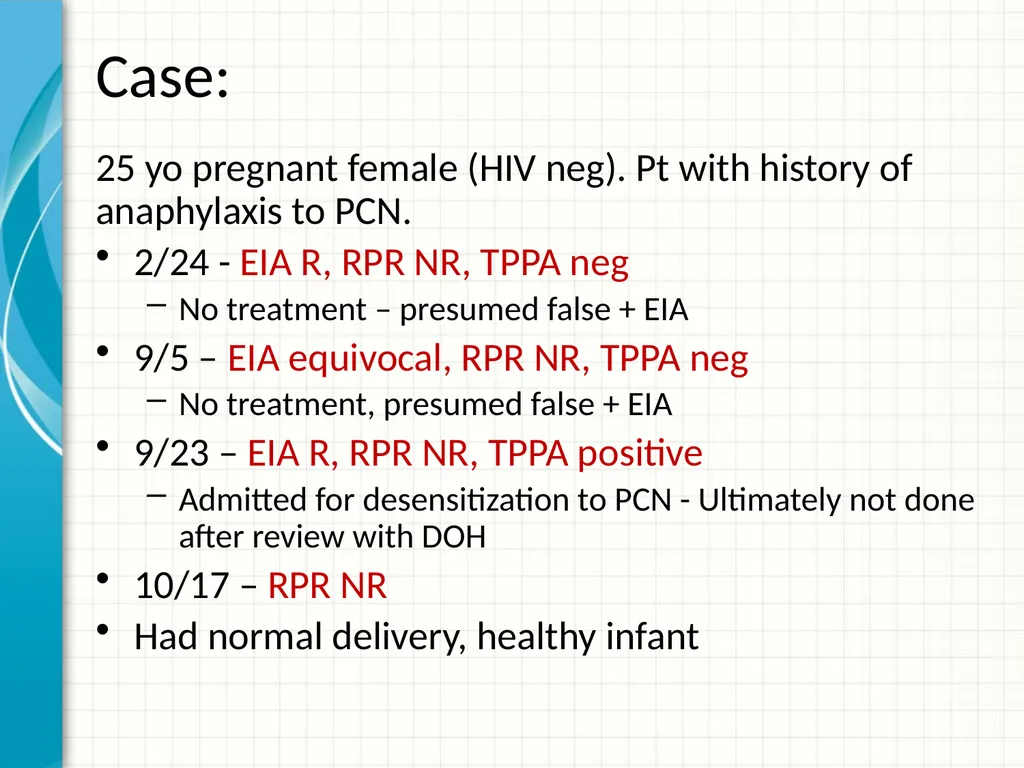
Case: 25 yo pregnant female (HIV neg). Pt with history of anaphylaxis to PCN.
2/24 - EIA R, RPR NR, TPPA neg
No treatment – presumed false + EIA
9/5 – EIA equivocal, RPR NR, TPPA neg
No treatment, presumed false + EIA
9/23 – EIA R, RPR NR, TPPA positive
Admitted for desensitization to PCN - Ultimately not done after review with DOH
10/17 – RPR NR
Had normal delivery, healthy infant<br>
2/24 - EIA R, RPR NR, TPPA neg
No treatment – presumed false + EIA
9/5 – EIA equivocal, RPR NR, TPPA neg
No treatment, presumed false + EIA
9/23 – EIA R, RPR NR, TPPA positive
Admitted for desensitization to PCN - Ultimately not done after review with DOH
10/17 – RPR NR
Had normal delivery, healthy infant<br>
56
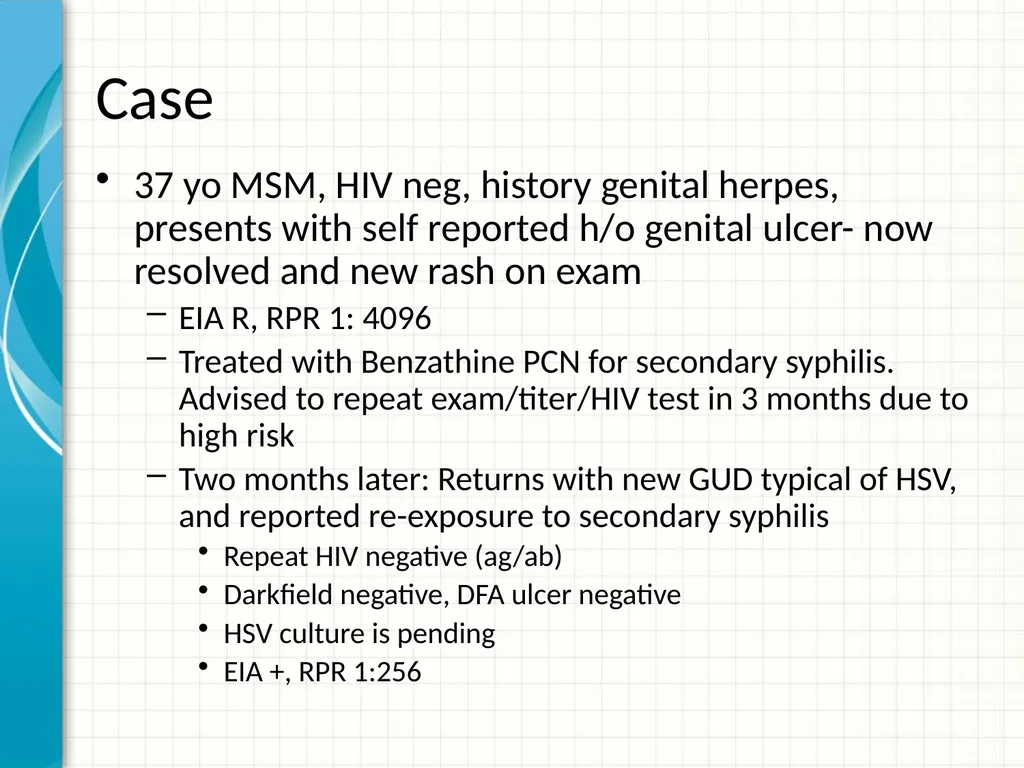
Case 37 yo MSM, HIV neg, history genital herpes, presents with self reported h/o genital ulcer- now resolved and new rash on exam
EIA R, RPR 1: 4096
Treated with Benzathine PCN for secondary syphilis. Advised to repeat exam/titer/HIV test in 3 months due to high risk
Two months later: Returns with new GUD typical of HSV, and reported re-exposure to secondary syphilis
Repeat HIV negative (ag/ab)
Darkfield negative, DFA ulcer negative
HSV culture is pending
EIA +, RPR 1:256<br>
EIA R, RPR 1: 4096
Treated with Benzathine PCN for secondary syphilis. Advised to repeat exam/titer/HIV test in 3 months due to high risk
Two months later: Returns with new GUD typical of HSV, and reported re-exposure to secondary syphilis
Repeat HIV negative (ag/ab)
Darkfield negative, DFA ulcer negative
HSV culture is pending
EIA +, RPR 1:256<br>
57
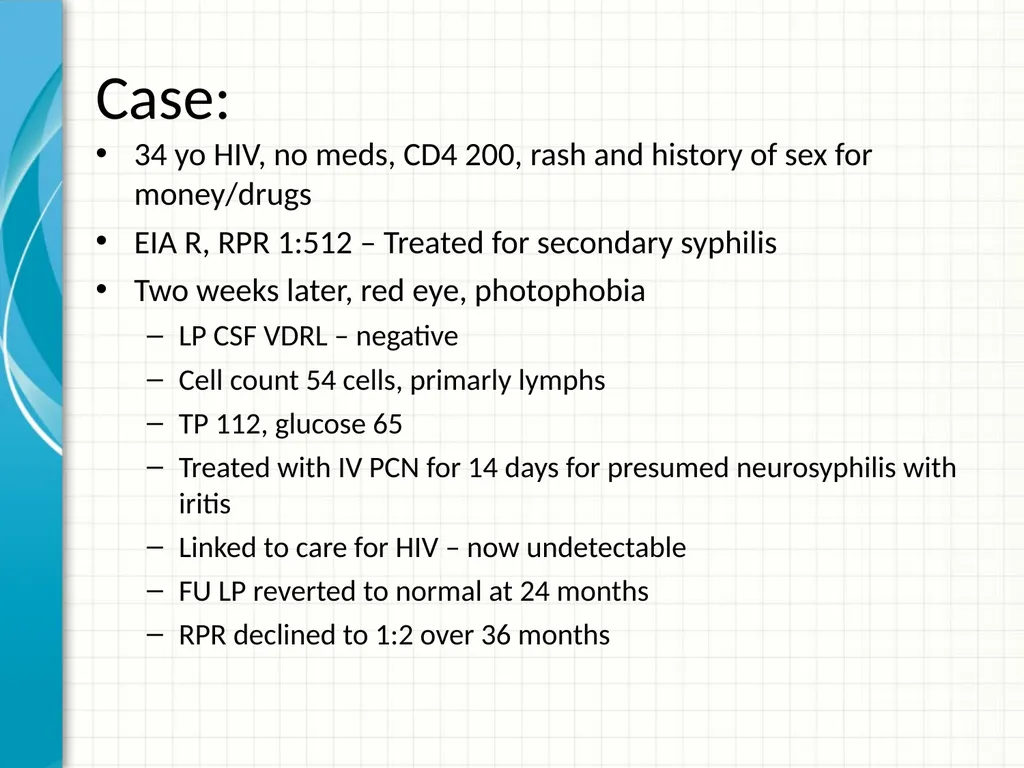
Case: 34 yo HIV, no meds, CD4 200, rash and history of sex for money/drugs
EIA R, RPR 1:512 – Treated for secondary syphilis
Two weeks later, red eye, photophobia
LP CSF VDRL – negative
Cell count 54 cells, primarly lymphs
TP 112, glucose 65
Treated with IV PCN for 14 days for presumed neurosyphilis with iritis
Linked to care for HIV – now undetectable
FU LP reverted to normal at 24 months
RPR declined to 1:2 over 36 months<br>
EIA R, RPR 1:512 – Treated for secondary syphilis
Two weeks later, red eye, photophobia
LP CSF VDRL – negative
Cell count 54 cells, primarly lymphs
TP 112, glucose 65
Treated with IV PCN for 14 days for presumed neurosyphilis with iritis
Linked to care for HIV – now undetectable
FU LP reverted to normal at 24 months
RPR declined to 1:2 over 36 months<br>
58
Questions?
Please send questions via email to: STD@CEITRAINING.ORG
AND NOW AVAILABLE:
STD CLINICAL CONSULTATION CALLS:
866-637-2342<br>
Please send questions via email to: STD@CEITRAINING.ORG
AND NOW AVAILABLE:
STD CLINICAL CONSULTATION CALLS:
866-637-2342<br>