
PART 3: STRATEGIC ACTIONS: STRATEGY IMPLEMENTATION
Description: PART 3: STRATEGIC ACTIONS: STRATEGY IMPLEMENTATION CHAPTER 11 ORGANIZATIONAL STRUCTURE AND CONTROLS THE STRATEGIC MANAGEMENT PROCESS KNOWLEDGE OBJECTIVES KNOWLEDGE OBJECTIVES ANOTHER ONE BITES THE DUST: BORDERS DECLARES BANKRUPTCY Founded
Related Topics
Download Presentation
"PART 3: STRATEGIC ACTIONS: STRATEGY IMPLEMENTATION" is the property of its rightful owner. Permission is granted to download and print the materials on this website for personal, non-commercial use only, and to display it on your personal computer provided you do not modify the materials and that you retain all copyright notices contained in the materials. By downloading content from our website, you accept the terms of this agreement.
Presentation Transcript
slide1. PART 3: STRATEGIC ACTIONS:
STRATEGY IMPLEMENTATION CHAPTER 11 ORGANIZATIONAL STRUCTURE AND CONTROLS<br>
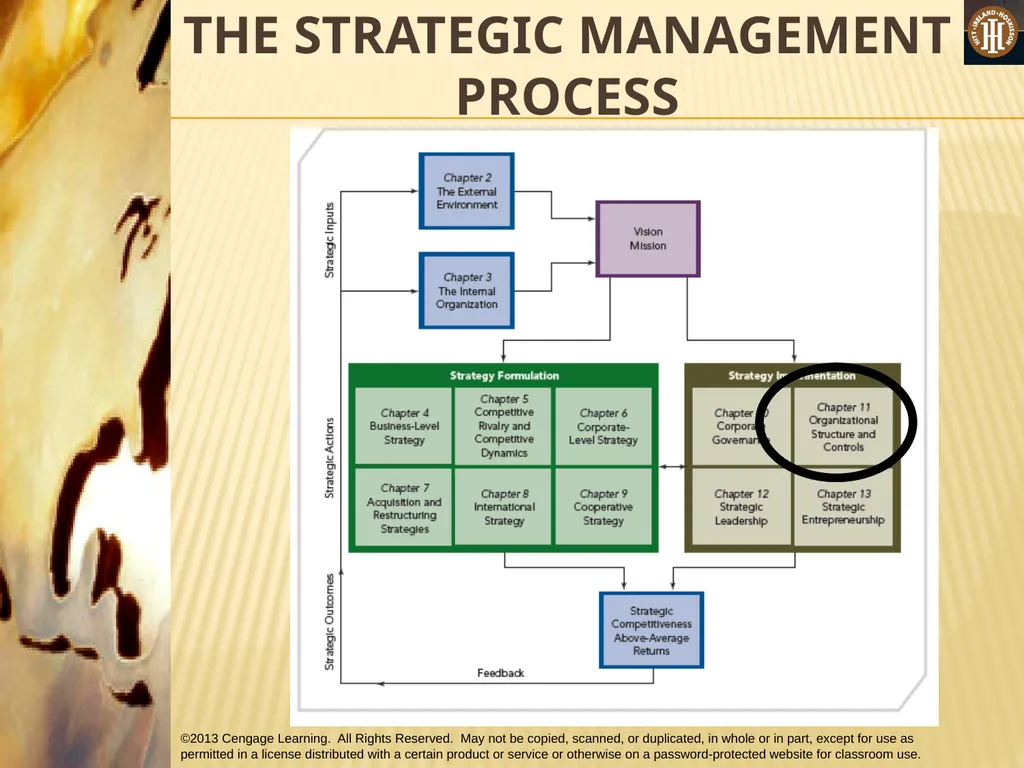
slide2. THE STRATEGIC MANAGEMENT PROCESS<br>
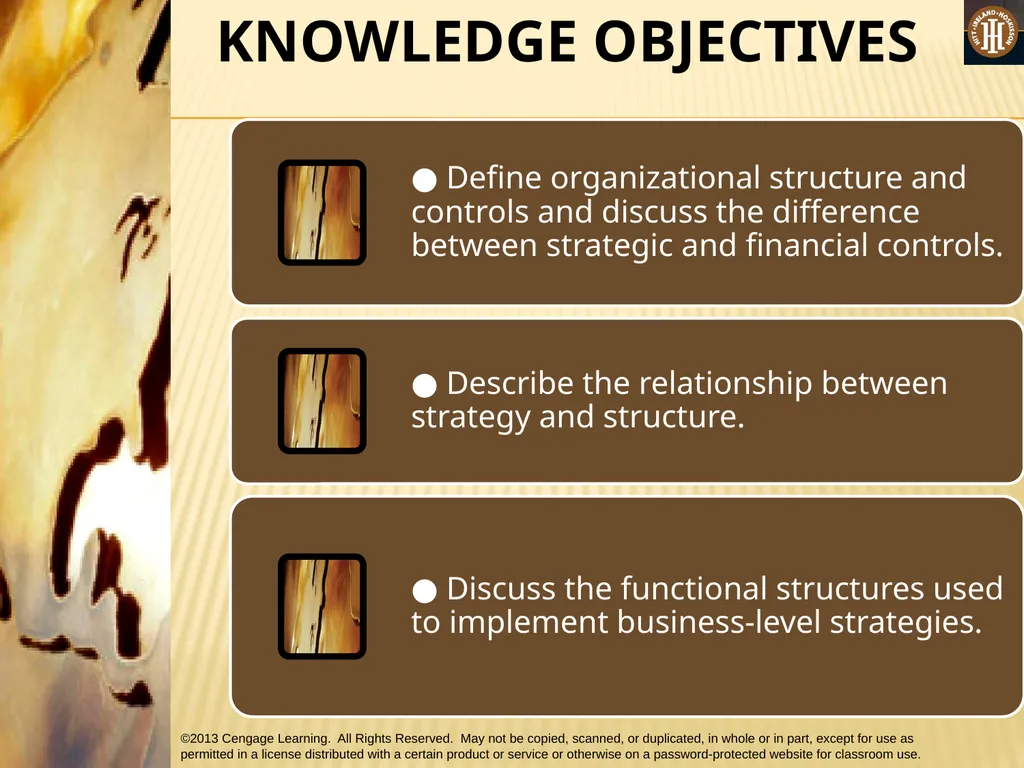
slide3. KNOWLEDGE OBJECTIVES<br>
slide4. KNOWLEDGE OBJECTIVES<br>
slide5. ANOTHER ONE BITES THE DUST: BORDERS DECLARES BANKRUPTCY ■ Founded in 1971, one of the original superstore book retailing chains, Borders, declared bankruptcy in 2011 with debts of $1.293 billion and assets of $1.275 billion.
■ This case underscores the importance of strategy implementation. While Borders crafted an innovative strategy with knowledgeable employees, a world-class inventory system, and even espresso before Starbucks made it popular, their implementation was their Achilles’ heel. OPENING CASE<br>
slide6. ANOTHER ONE BITES THE DUST: BORDERS DECLARES BANKRUPTCY ■ Initial strategy worked well
● 1991 - Borders sold the relatively small bookstore chain and inventory system to Kmart
● 1995 - Borders was spun off with an IPO
■ Bankruptcy through a series of blunders
● International diversification reduced Borders’ focus on the most lucrative book retailing market in the U.S.
● When Barnes & Noble developed the capability to sell online, Borders outsourced this to Amazon, which sent customers and business to a major competitor. OPENING CASE<br>
slide7. ANOTHER ONE BITES THE DUST: BORDERS DECLARES BANKRUPTCY ■ 2007- a Borders store in Madison, Wisconsin, had no Internet!
■ Borders had incredibly bad management, especially at the higher levels of the firm
■ It was unable to correct these problems because of an inadequate structure and a focus on financial engineering (financial controls), both of which crippled its ability to respond effectively to changes in the marketplace and to implement its strategies (e.g., international strategy) effectively OPENING CASE<br>
slide8. INTRODUCTION Strategy may be implemented via:
Structure
Reward mechanisms
Organizational culture
Leadership
This chapter focuses on structure.
IMPORTANT: The match or degree of fit between strategy and structure influences the firm’s ability to earn above-average return.<br>
slide9. INTRODUCTION ● Organizational structure and controls provide the framework within which strategies (business, corporate, international and cooperative) are used
● No one structure is the best for all organizations
● The choice of structure and controls should support the strategic goals of the firm
● Structure will change as the strategy of the organization changes
● Effective strategic leadership means selecting the appropriate structure.<br>
slide10. ORGANIZATIONAL STRUCTURE AND CONTROLS Structure and Firm Performance
Research suggests that performance declines when the firm’s strategy is not matched with the most appropriate structure and controls
Example: CEO Jeffrey Immelt recognized the need to match strategy and structure during the recent economic downturn, as evidenced by the restructuring alignments in GE Capital, GE’s financial service group<br>
slide11. ORGANIZATIONAL STRUCTURE Organizational structure
Specifies the firm’s formal reporting relationships, procedures, controls, and authority and decision-making processes
Specifies the work to be done and how to do it, given the firm’s strategy or strategies
Is the pivotal component of effective strategy implementation
It is critical to match organizational structure to the firm’s strategy<br>
slide12. ORGANIZATIONAL STRUCTURE Strategy pioneer Alfred Chandler found organizations change their structures when inefficiencies force them to.
A firm’s strategy is supported when its structure is properly aligned to its strategy
Two considerations regarding alignment
Structural stability: capacity firm requires to consistently and predictably manage its daily work routines
Structural flexibility: opportunity to explore competitive advantages firm will need to be successful in the future Source: A. Chandler, 1962, Strategy and Structure, Cambridge, MA: MIT Press.<br>
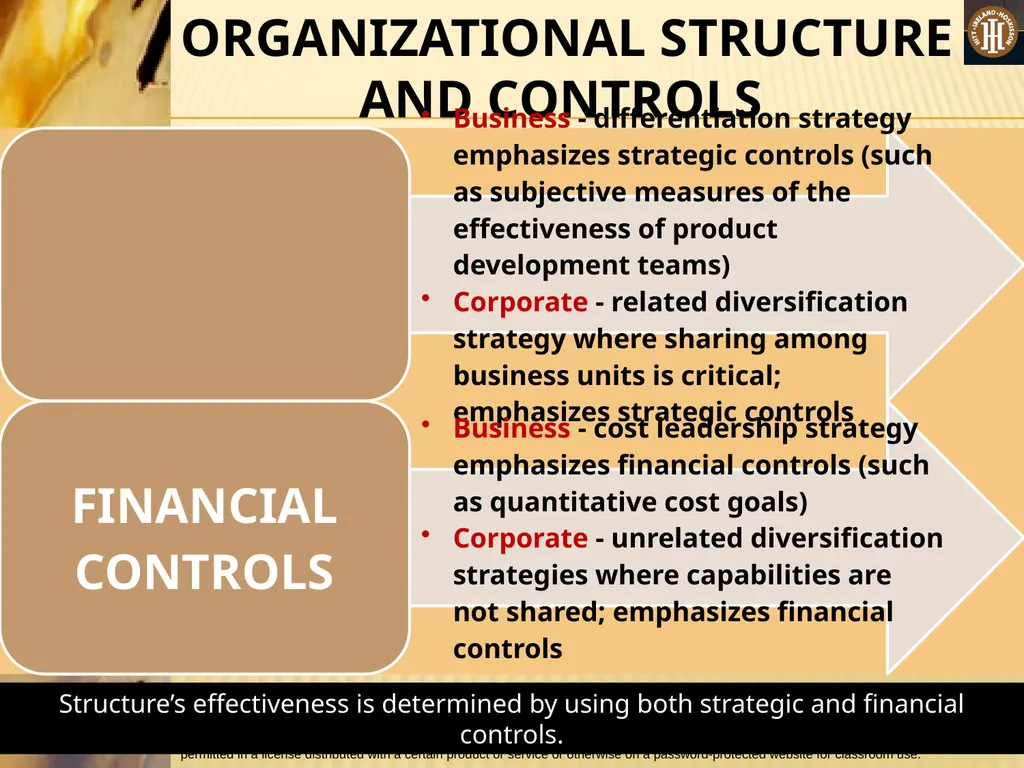
slide13. ORGANIZATIONAL CONTROLS Controls guide the use of strategy, indicate how to compare actual results with expected results, and suggest corrective actions to take when the difference is unacceptable.
Two types:
Strategic Controls
Financial Controls<br>
slide14. STRATEGIC CONTROLS Largely SUBJECTIVE criteria intended to verify that the firm is using appropriate strategies for the conditions in the external environment and the company’s competitive advantages.
Are concerned with examining the fit between:
What the firm might do (opportunities in its external environment)
What the firm can do (competitive advantages)
Evaluate the degree to which the firm focuses on the requirements to implement strategy
Business-level: primary and support activities
Corporate-level (related): sharing of knowledge, markets, and technologies across businesses
Focus on the content of strategic actions<br>
slide15. FINANCIAL CONTROLS Largely OBJECTIVE criteria used to measure firm’s performance against previously established quantitative standards
Focus on short-term financial outcomes
Include accounting-based measures
ROI (return on investment)
ROA (return on assets)
Include market-based measures
EVA (economic value added)
Produce risk-averse managerial decisions
Are essential when a firm pursues a strategy with unrelated diversification<br>
slide16. ORGANIZATIONAL STRUCTURE AND CONTROLS Structure’s effectiveness is determined by using both strategic and financial controls.<br>
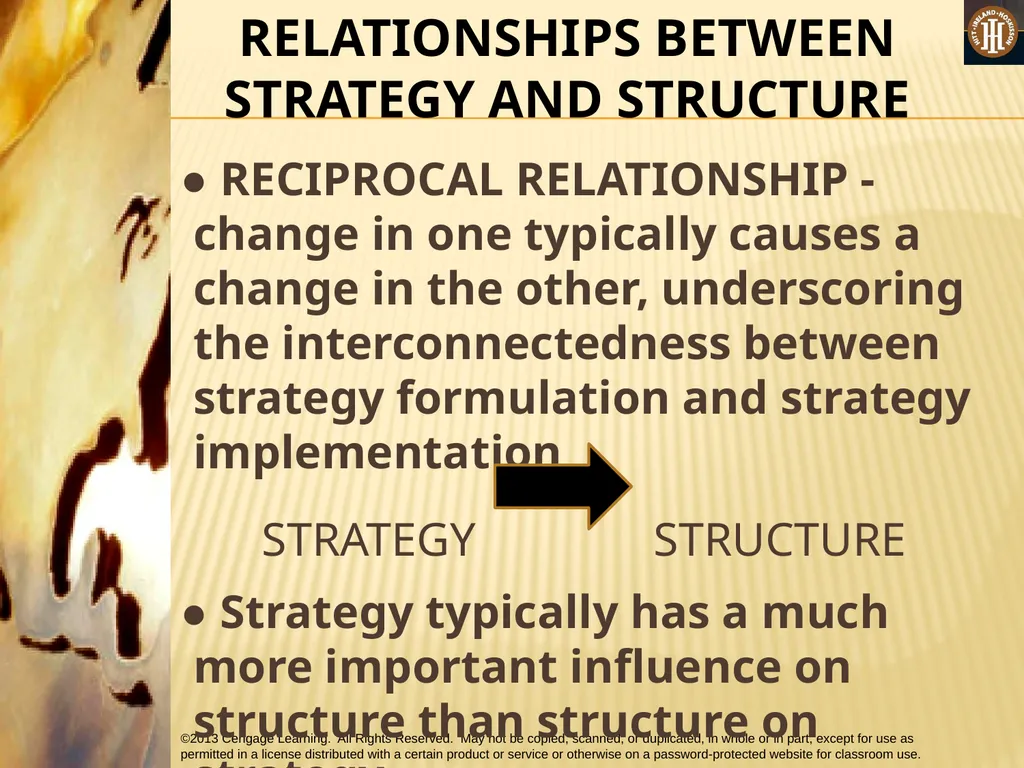
slide17. RELATIONSHIPS BETWEEN STRATEGY AND STRUCTURE ● RECIPROCAL RELATIONSHIP - change in one typically causes a change in the other, underscoring the interconnectedness between strategy formulation and strategy implementation
STRATEGY STRUCTURE
● Strategy typically has a much more important influence on structure than structure on strategy<br>
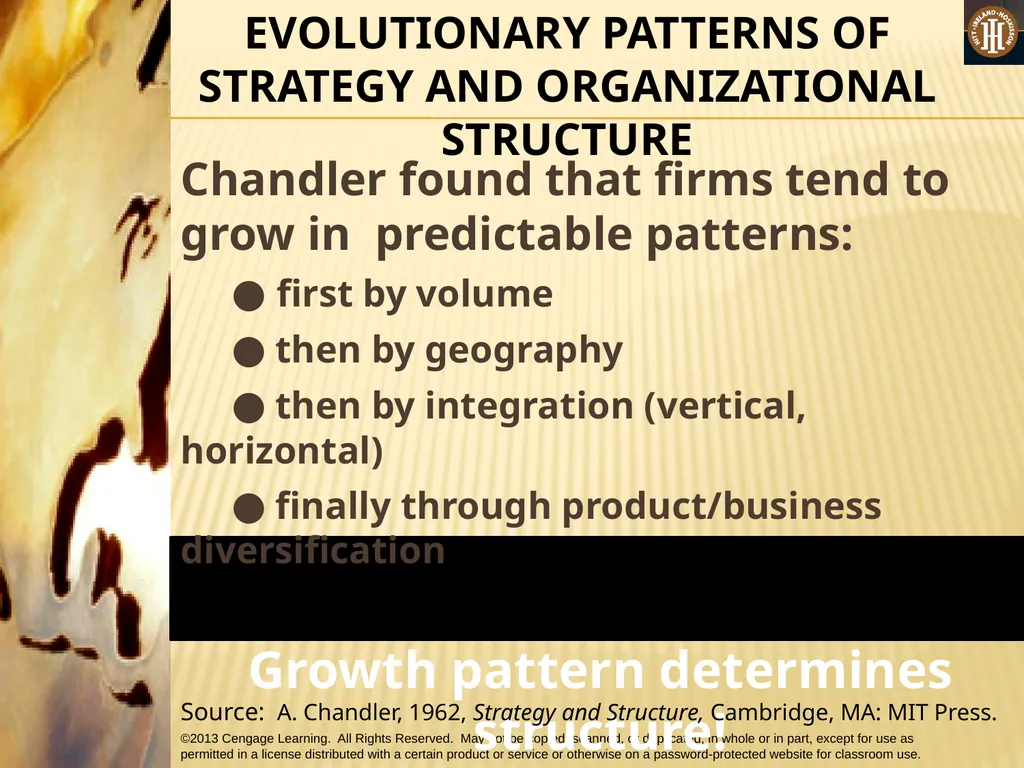
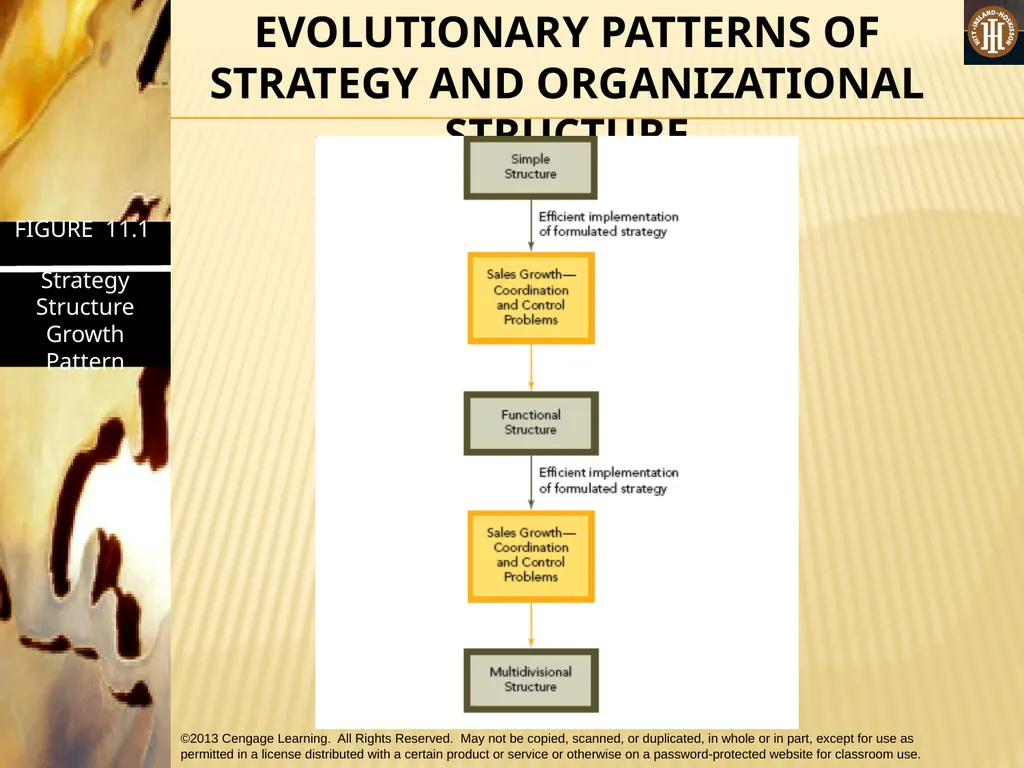
slide18. EVOLUTIONARY PATTERNS OF STRATEGY AND ORGANIZATIONAL STRUCTURE Chandler found that firms tend to grow in predictable patterns:
● first by volume
● then by geography
● then by integration (vertical, horizontal)
● finally through product/business diversification
Growth pattern determines structure!
1 – Chandler, 1962 Source: A. Chandler, 1962, Strategy and Structure, Cambridge, MA: MIT Press.<br>
slide19. EVOLUTIONARY PATTERNS OF STRATEGY AND ORGANIZATIONAL STRUCTURE ■ Firms typically alter their structure as they grow in size and complexity
■ Three key structural forms used to implement strategies:
Simple structure
Functional structure
Multidivisional structure (M-form)<br>
slide20. EVOLUTIONARY PATTERNS OF STRATEGY AND ORGANIZATIONAL STRUCTURE FIGURE 11.1
Strategy Structure Growth Pattern<br>
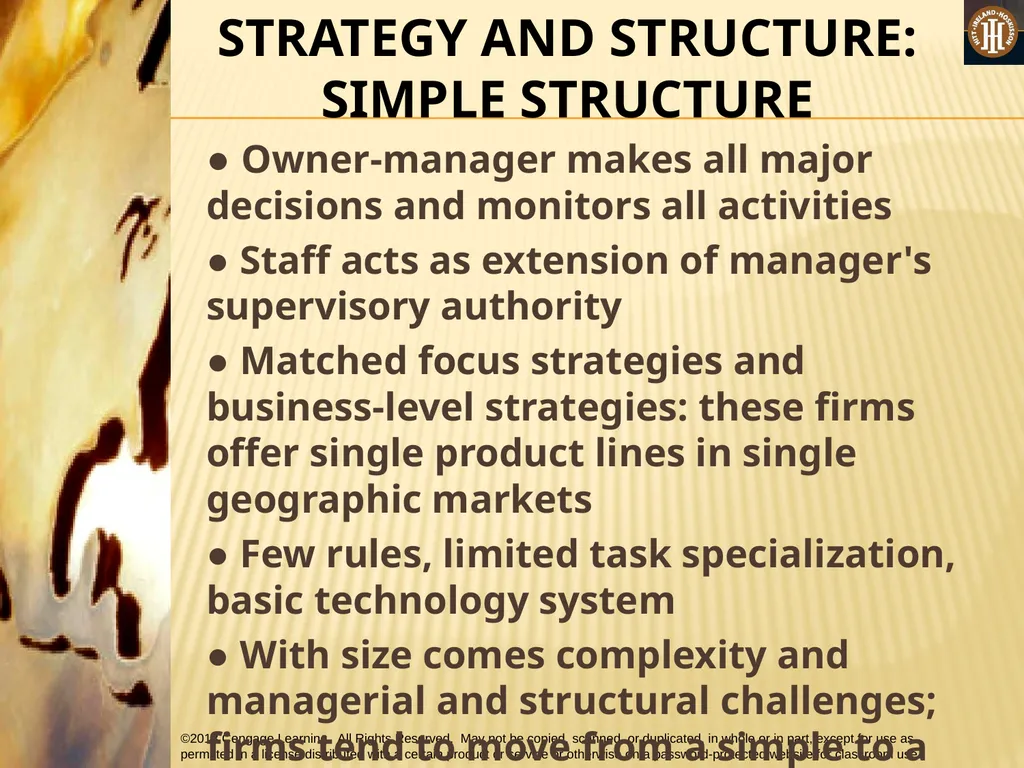
slide21. STRATEGY AND STRUCTURE: SIMPLE STRUCTURE ● Owner-manager makes all major decisions and monitors all activities
● Staff acts as extension of manager's supervisory authority
● Matched focus strategies and business-level strategies: these firms offer single product lines in single geographic markets
● Few rules, limited task specialization, basic technology system
● With size comes complexity and managerial and structural challenges; firms tend to move from a simple to a functional structure<br>
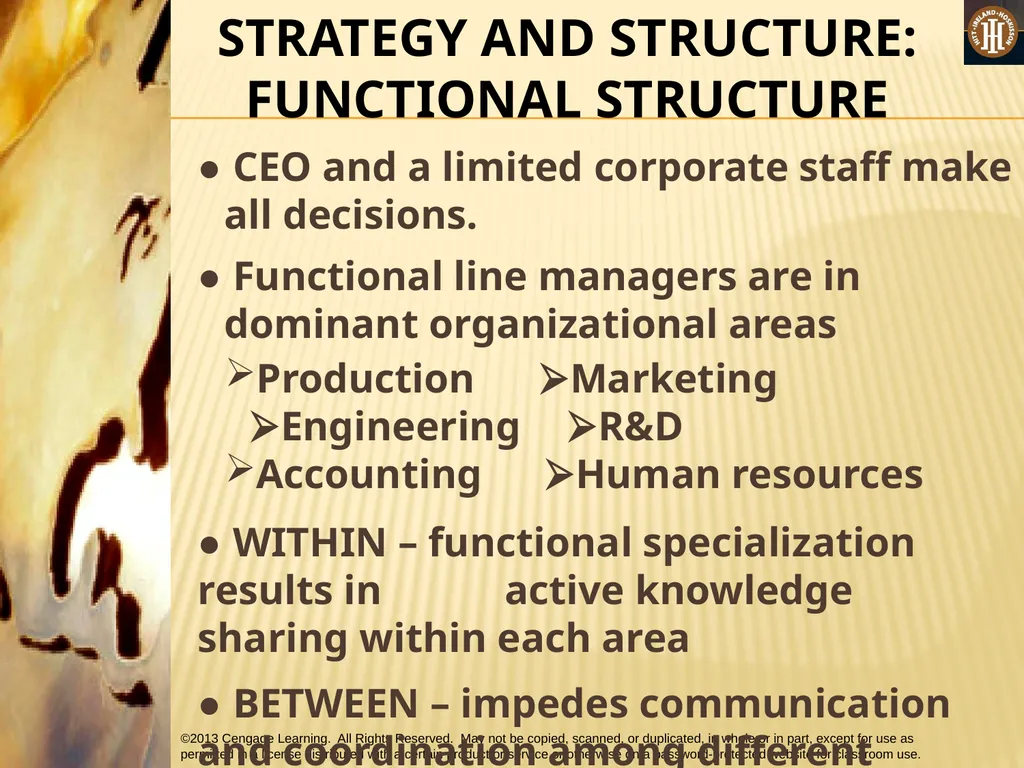
slide22. STRATEGY AND STRUCTURE: FUNCTIONAL STRUCTURE ● CEO and a limited corporate staff make all decisions.
● Functional line managers are in dominant organizational areas
Production Marketing
Engineering R&D
Accounting Human resources
● WITHIN – functional specialization results in active knowledge sharing within each area
● BETWEEN – impedes communication and coordination among different functional areas<br>
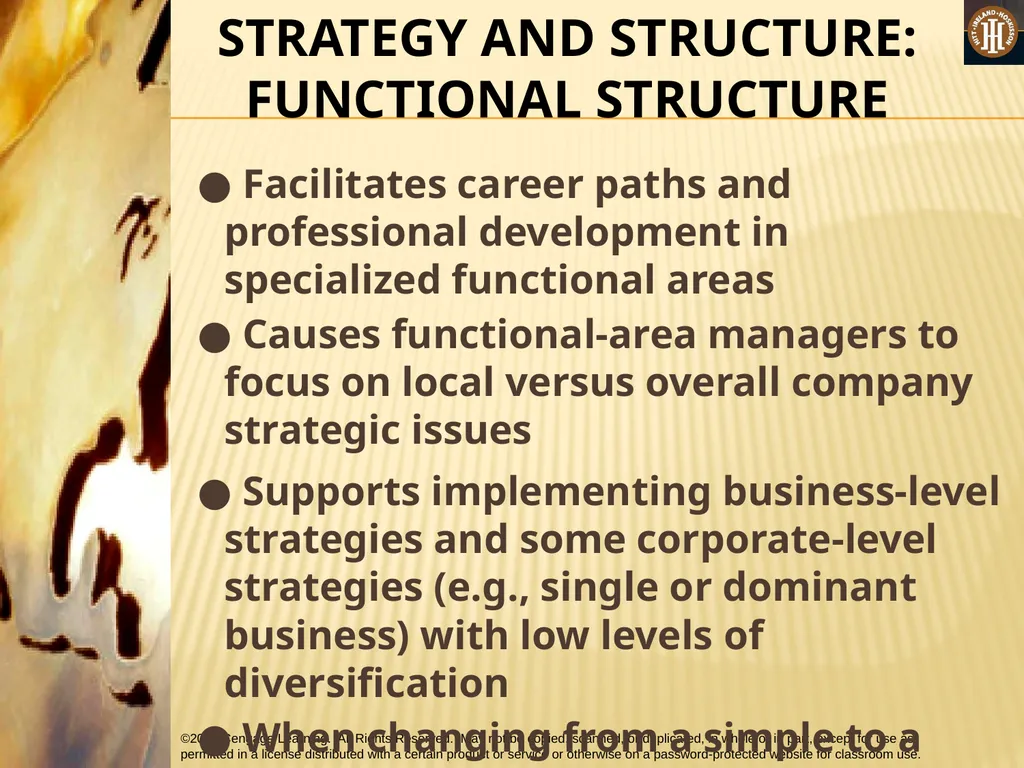
slide23. STRATEGY AND STRUCTURE: FUNCTIONAL STRUCTURE ● Facilitates career paths and professional development in specialized functional areas
● Causes functional-area managers to focus on local versus overall company strategic issues
● Supports implementing business-level strategies and some corporate-level strategies (e.g., single or dominant business) with low levels of diversification
● When changing from a simple to a functional structure, need to focus on and avoid value-destroying bureaucratic procedures<br>
slide24. STRATEGY AND STRUCTURE: MULTIDIVISIONAL (M-FORM) STRUCTURE ● Operating divisions each represent a separate business or profit center
● Top corporate officer delegates responsibilities for day-to-day operations and business-unit strategies to division managers
● Ties together all operating divisions
● Each division represents a separate business or profit center with its own functional hierarchy
● Each division is responsible for daily operations
● Business-unit strategy is delegated to the division<br>
slide25. STRATEGY AND STRUCTURE: MULTIDIVISIONAL (M-FORM) STRUCTURE Appropriate structure as firms DIVERSIFY
Three Major Benefits
● Simplifies the problem of control through more accurate monitoring of the performance of each business
● Facilitates comparisons between divisions, which improves the resource allocation process
● Stimulates managers of poorly performing divisions to look for ways of improving performance<br>
slide26. STRATEGY AND STRUCTURE: THE RIGHT STRUCTURE IT DEPENDS
● No one organizational structure (simple, functional, or multidivisional) is inherently superior to the others
● The firm must select a structure that is “right” for the chosen strategy
● Managers develop proper matches between strategies and organizational structures rather than searching for an “optimal” structure<br>
slide27. MATCHES BETWEEN BUSINESS-LEVEL STRATEGIES AND THE FUNCTIONAL STRUCTURE Firms use different forms of the functional organizational structure to support their strategy
Business-level strategies are:
Cost leadership (broad or focused)
Differentiation (broad or focused)
Integrated cost leadership/differentiation
Structural choices are:
Simple
Functional
Multidivisional<br>
slide28. MATCHES BETWEEN BUSINESS-LEVEL STRATEGIES AND THE FUNCTIONAL STRUCTURE The choice of structure is influenced by structural characteristics needed to compete:
Specialization: the type and number of jobs required to complete the work of the firm
Centralization: the degree to which decision-making authority is retained at higher managerial levels
Formalization: the degree to which formal rules and procedures govern work<br>
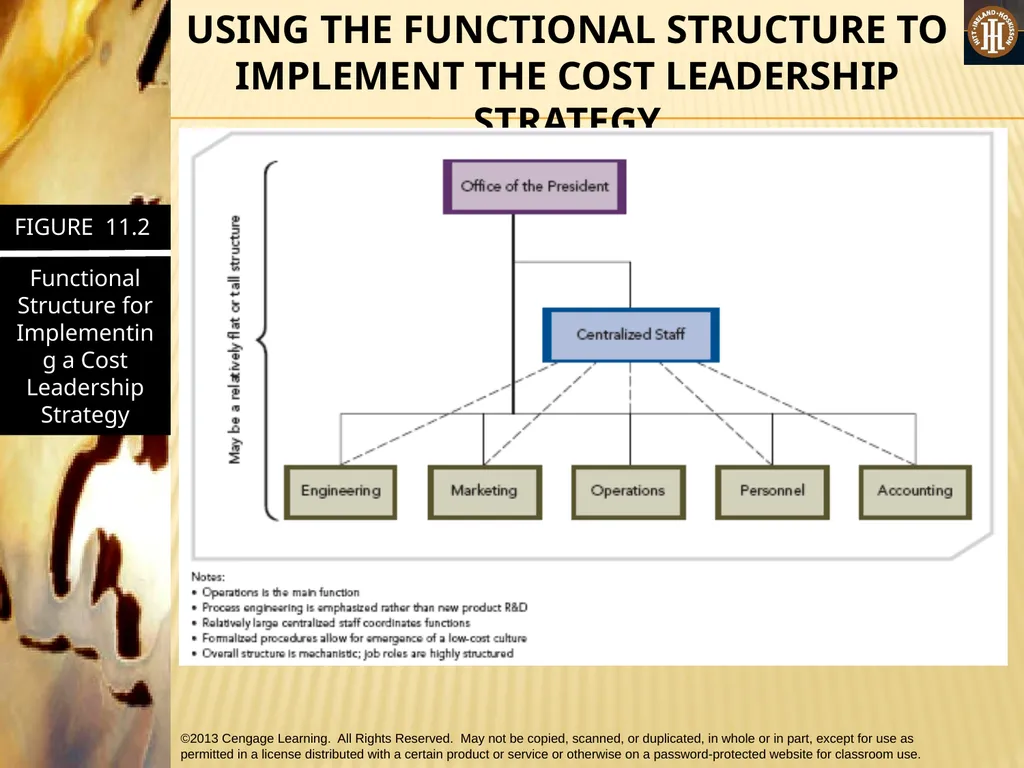
slide29. USING THE FUNCTIONAL STRUCTURE TO IMPLEMENT THE COST LEADERSHIP STRATEGY FIGURE 11.2
Functional Structure for Implementing a Cost Leadership Strategy<br>
slide30. USING THE FUNCTIONAL STRUCTURE TO IMPLEMENT THE COST LEADERSHIP STRATEGY The choice of structure is influenced by structural characteristics:
Specialization: departments are designed around areas of expertise—engineering to accounting
Centralization: highly centralized; staff are all together
Formalization: reporting roles are clearly defined; simple lines of communication<br>
slide31. USING THE FUNCTIONAL STRUCTURE TO IMPLEMENT THE COST LEADERSHIP STRATEGY Cost leadership and the functional structure results:
Operations is the main function
Process engineering is emphasized rather than new product R&D
Few decision-making and authority layers
Centralized corporate staff
Highly formalized rules and procedures Low-cost culture
Centralized staff decision-making authority
Job specialization
Simple reporting relationships
Overall structure is mechanistic; structured job roles<br>
slide32. USING THE FUNCTIONAL STRUCTURE TO IMPLEMENT THE COST LEADERSHIP STRATEGY Cost Leadership and Five Forces of Competition
Low-cost position is a valuable defense against rivals
Powerful customers can demand reduced prices
Cost leaders are in a position to absorb supplier price increases and relationship demands, and to force suppliers to hold down their prices
Continuously improving levels of efficiency and cost reduction can be difficult to replicate and serve as significant entry barriers to potential competitors
Cost leaders hold an attractive position in terms of product substitutes, with the flexibility to lower prices to retain customers<br>
slide33. USING THE FUNCTIONAL STRUCTURE TO IMPLEMENT THE COST LEADERSHIP STRATEGY Cost leadership strategy risks
Processes can become obsolete
Focus on cost reductions can come at the expense of understanding customer perceptions and needs
Strategy could be imitated, requiring the firm to increase the value offered to retain customers<br>
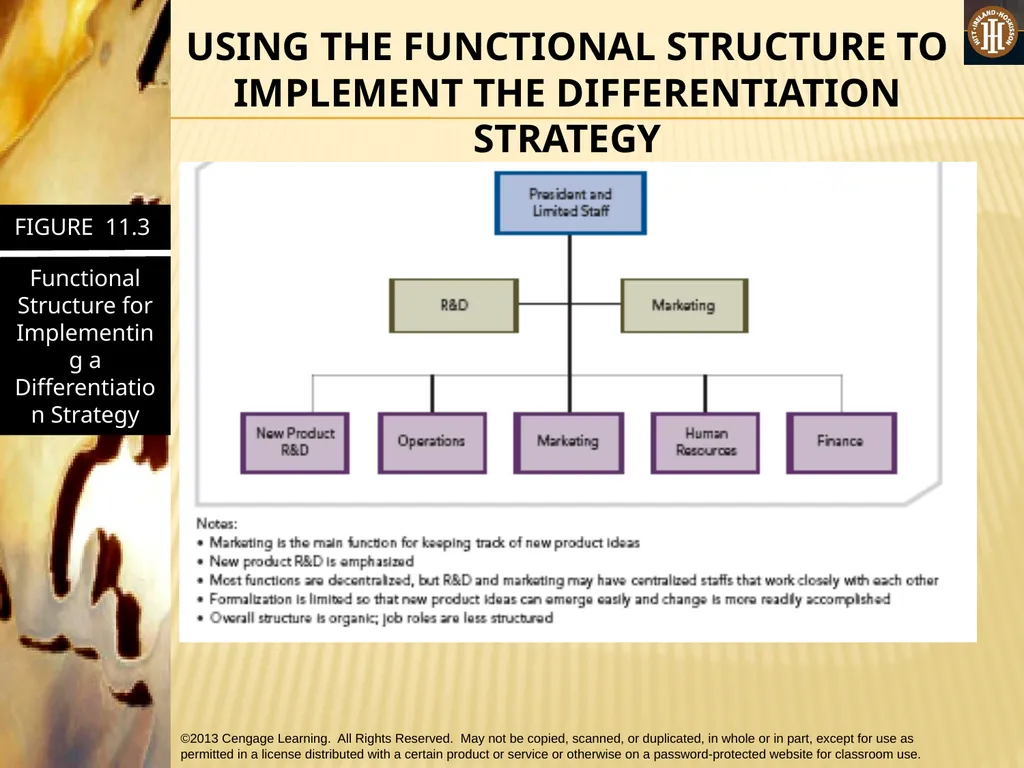
slide34. USING THE FUNCTIONAL STRUCTURE TO IMPLEMENT THE DIFFERENTIATION STRATEGY FIGURE 11.3
Functional Structure for Implementing a Differentiation Strategy<br>
slide35. USING THE FUNCTIONAL STRUCTURE TO IMPLEMENT THE DIFFERENTIATION STRATEGY The choice of structure is influenced by structural characteristics
Specialization: departments are designed around areas of expertise—engineering to accounting
Centralization: the key departments are coordinated through a highly centralized office that reflects a focus on product design and marketing; otherwise DECENTRALIZED
Formalization: reporting roles are clearly defined; simple lines of communication<br>
slide36. USING THE FUNCTIONAL STRUCTURE TO IMPLEMENT THE DIFFERENTIATION STRATEGY Differentiation and the functional structure results:
Marketing is the main function; new product ideas
New product R&D is emphasized
Most functions are decentralized, but R&D and marketing may have centralized staffs
Cross-functional product development teams
Complex and flexible reporting relationships
Development-oriented culture
Decentralized decision making
Broad job descriptions
Informal rules and procedures
Overall structure is organic; less structured job roles<br>
slide37. USING THE FUNCTIONAL STRUCTURE TO IMPLEMENT THE DIFFERENTIATION STRATEGY Differentiation strategy should deliver:
An integrated set of actions designed by a firm to produce or deliver goods or services at an acceptable cost that customers perceive as being different in ways that are important to them
Target customers – perceived product value
Customized products – differentiating as many features as possible
Unusual features include responsive customer service, rapid product innovations, technological leadership, perceived prestige and status, different tastes, engineering design, performance<br>
slide38. USING THE FUNCTIONAL STRUCTURE TO IMPLEMENT THE DIFFERENTIATION STRATEGY Differentiation and Five Forces of Competition
Customer loyalty: the most valuable defense against rivals
Unique products reduce customer sensitivity to raised prices
High margins (for differentiated products) insulate firm from supplier influence
Significant entry barriers: customer loyalty and product uniqueness
Firms with customers loyal to their products are positioned effectively against product substitutes<br>
slide39. USING THE FUNCTIONAL STRUCTURE TO IMPLEMENT THE DIFFERENTIATION STRATEGY Differentiation strategy risks
Price differential for differentiated product may be perceived as too large
Firms’ means of differentiation may cease to provide value for which customers are willing to pay a premium price (successful rival imitation)
Experience can narrow customers' perceptions of the value of a product's differentiated features
Counterfeit goods may appear in the marketplace<br>
slide40. USING THE FUNCTIONAL STRUCTURE TO IMPLEMENT THE INTEGRATED COST LEADERSHIP/ DIFFERENTIATION STRATEGY These firms create value through both low cost and uniqueness:
Relatively low product cost through an emphasis on production and process engineering, with infrequent product changes
Reasonable sources of differentiation based on new-product R&D
Difficult to implement, but frequently used in the global economy<br>
slide41. USING THE FUNCTIONAL STRUCTURE TO IMPLEMENT THE INTEGRATED COST LEADERSHIP/ DIFFERENTIATION STRATEGY Challenges due to primary/support activities
Need to successfully combine specialization, formalization, and centralization
Decision-making patterns that are partially centralized and partially decentralized
Semi-specialized jobs
Rules and procedures that allow both formal and informal job behaviors<br>
slide42. MATCHES BETWEEN CORPORATE-LEVEL STRATEGIES AND THE MULTIDIVISIONAL STRUCTURE A firm’s continuing success that leads to:
Product diversification, or
Market diversification, or
Both product and market diversification
Increasing diversification creates problems beyond the scope of the functional structure:
Information processing
Coordination
Control<br>
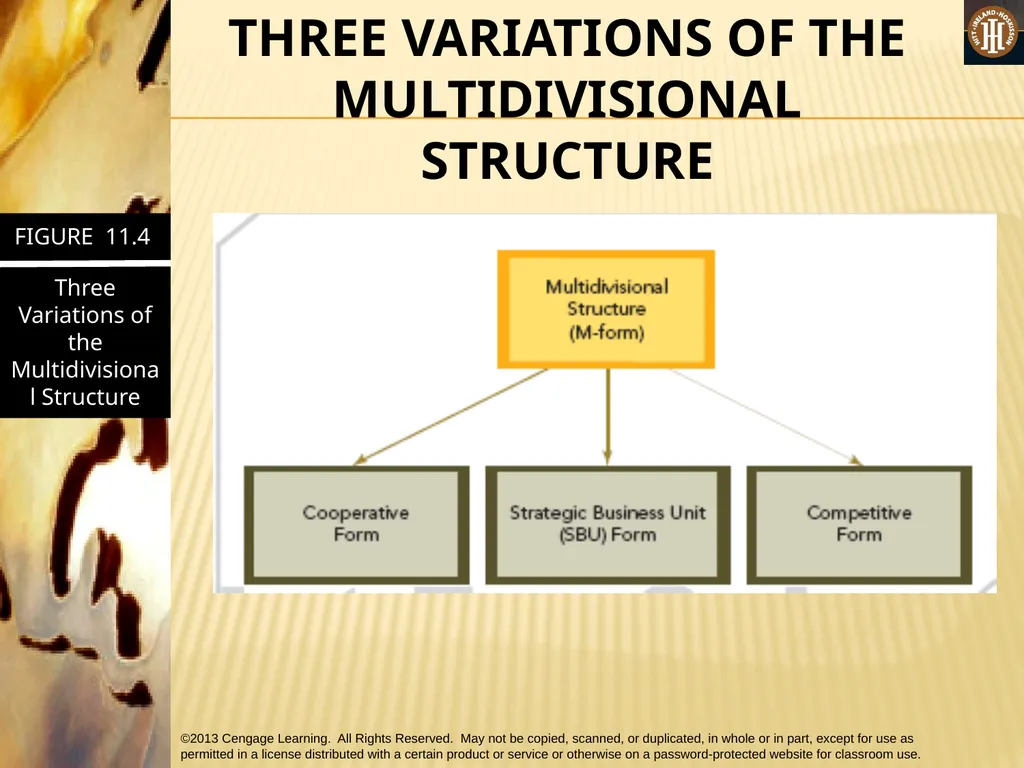
slide43. MATCHES BETWEEN CORPORATE-LEVEL STRATEGIES AND THE MULTIDIVISIONAL STRUCTURE Diversification strategy requires firm to change from a functional structure to a multidivisional structure
Different levels of diversification create the need for implementation of a unique form of the multidivisional structure
Matrix organization may evolve- organizational structure in which a dual structure combines both functional specialization and business product or project specialization.<br>
slide44. THREE VARIATIONS OF THE MULTIDIVISIONAL STRUCTURE FIGURE 11.4
Three Variations of the Multidivisional Structure<br>
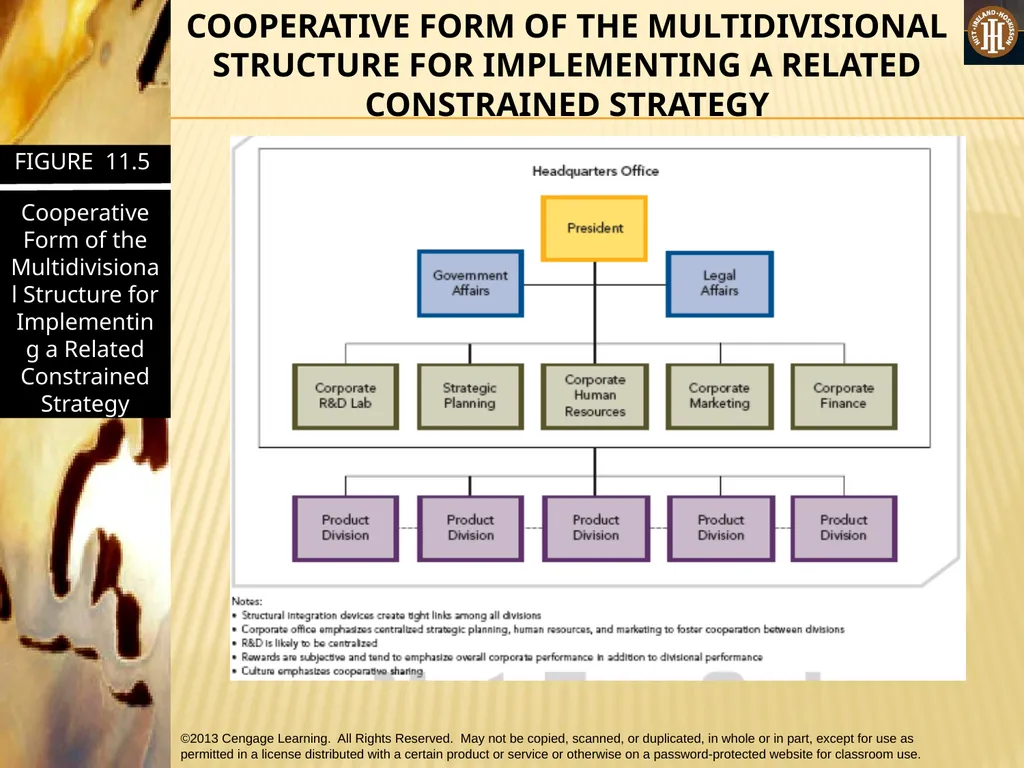
slide45. COOPERATIVE FORM OF THE MULTIDIVISIONAL STRUCTURE FOR IMPLEMENTING A RELATED CONSTRAINED STRATEGY FIGURE 11.5
Cooperative Form of the Multidivisional Structure for Implementing a Related Constrained Strategy<br>
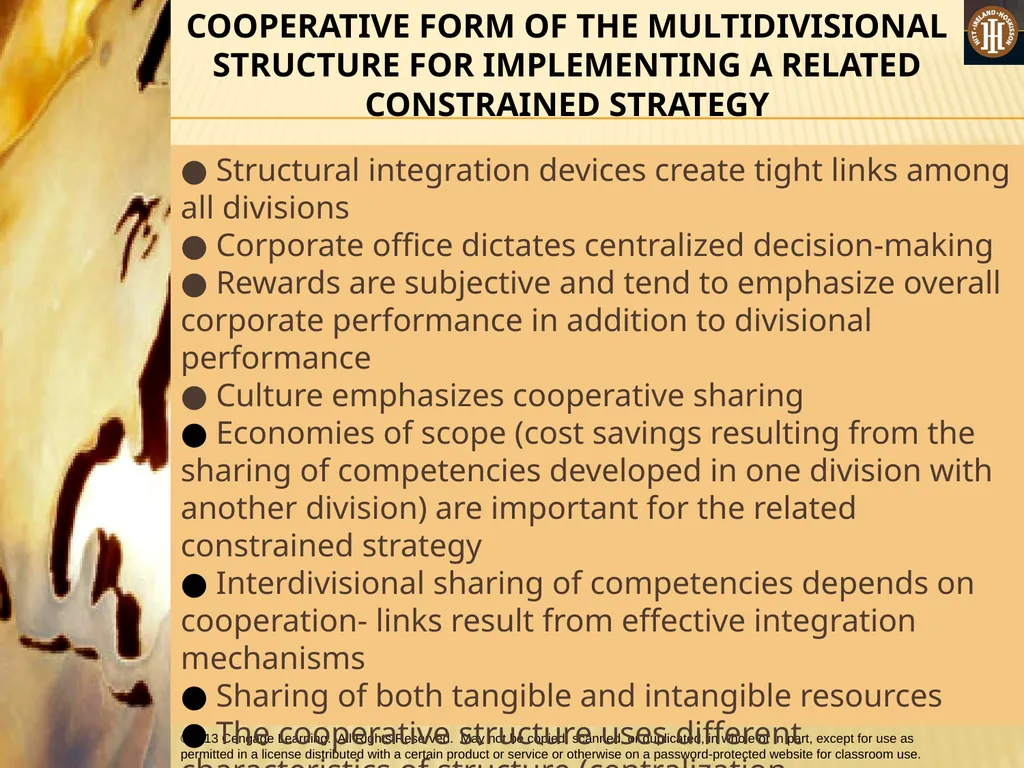
slide46. COOPERATIVE FORM OF THE MULTIDIVISIONAL STRUCTURE FOR IMPLEMENTING A RELATED CONSTRAINED STRATEGY ● Structural integration devices create tight links among all divisions
● Corporate office dictates centralized decision-making
● Rewards are subjective and tend to emphasize overall corporate performance in addition to divisional performance
● Culture emphasizes cooperative sharing
● Economies of scope (cost savings resulting from the sharing of competencies developed in one division with another division) are important for the related constrained strategy
● Interdivisional sharing of competencies depends on cooperation- links result from effective integration mechanisms
● Sharing of both tangible and intangible resources
● The cooperative structure uses different characteristics of structure (centralization, standardization, and formalization) as integrating mechanisms to facilitate interdivisional cooperation<br>
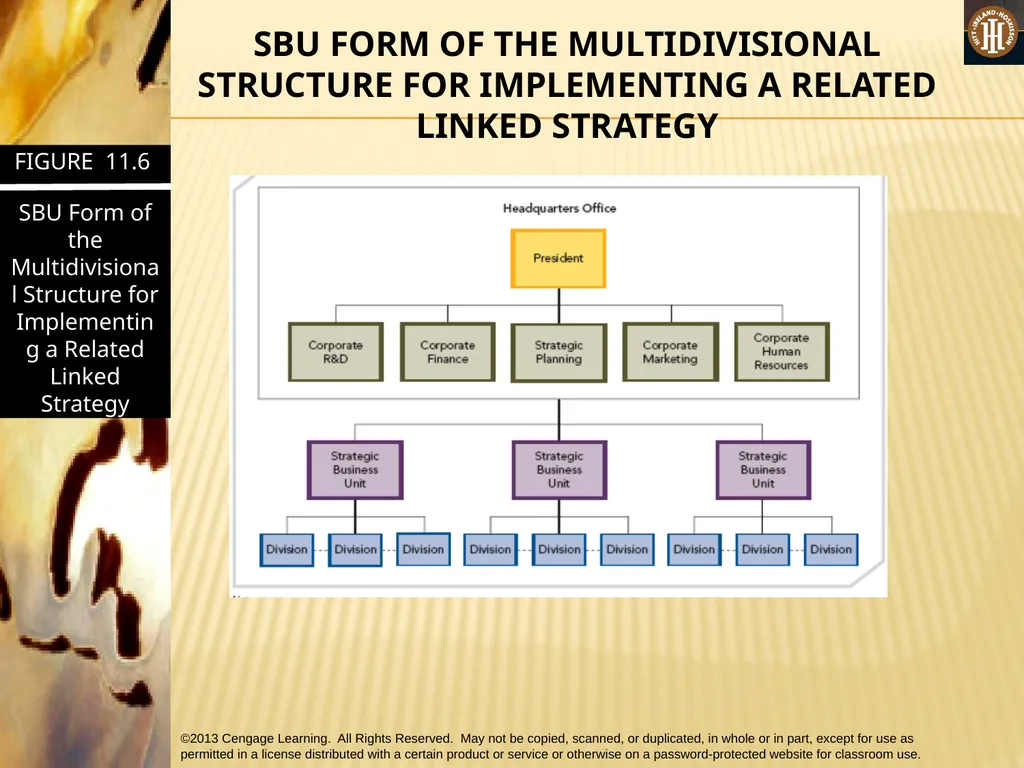
slide47. SBU FORM OF THE MULTIDIVISIONAL STRUCTURE FOR IMPLEMENTING A RELATED LINKED STRATEGY FIGURE 11.6
SBU Form of the Multidivisional Structure for Implementing a Related Linked Strategy<br>
slide48. SBU FORM OF THE MULTIDIVISIONAL STRUCTURE FOR IMPLEMENTING A RELATED LINKED STRATEGY ● Firms that share fewer resources and assets among their businesses, concentrating on the transfer of knowledge and competencies among the businesses (related linked strategy)
● Organization structure with three levels to support the implementation diversification strategy:
Corporate headquarters
Strategic business units (SBUs)
Divisions under each SBU<br>
slide49. SBU FORM OF THE MULTIDIVISIONAL STRUCTURE FOR IMPLEMENTING A RELATED LINKED STRATEGY ● SBU divisions related in terms of shared products/markets
● Divisions of one SBU have little in common with divisions of other SBUs
● Divisions within each SBU share product or market competencies to develop economies of scope
● Integrations used in cooperative form are equally effective for the SBU form
● Each SBU is a profit center; has its own budget for staff to foster integration
● Financial controls are more vital for evaluating performance<br>
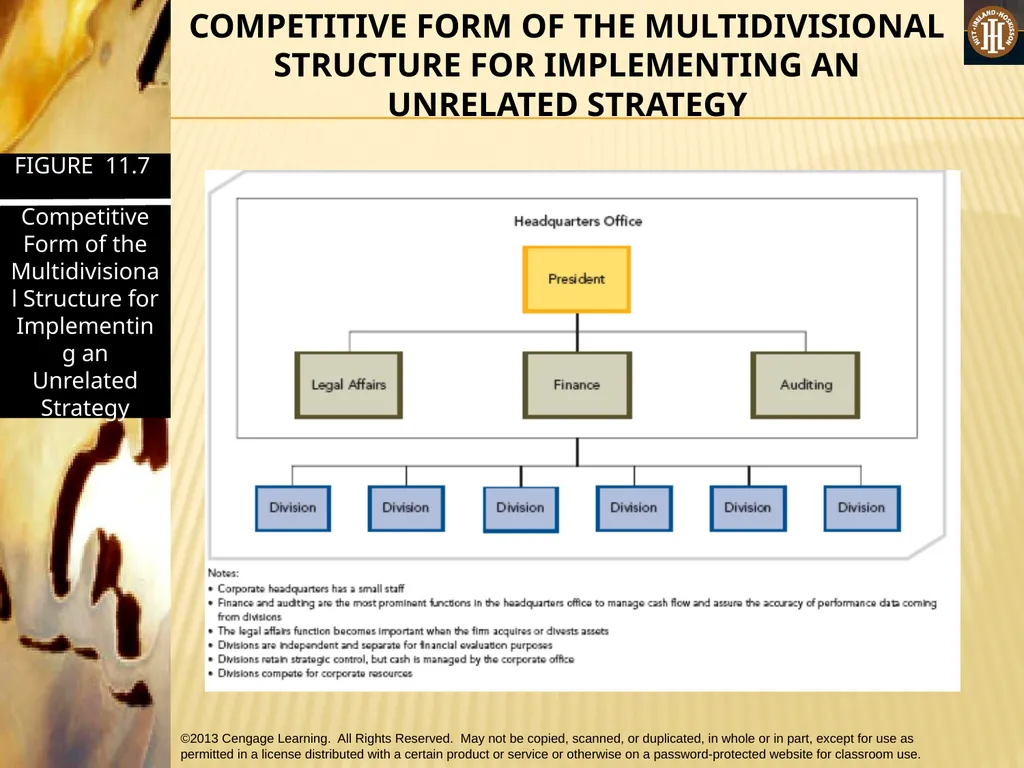
slide50. COMPETITIVE FORM OF THE MULTIDIVISIONAL STRUCTURE FOR IMPLEMENTING AN UNRELATED STRATEGY FIGURE 11.7
Competitive Form of the Multidivisional Structure for Implementing an Unrelated Strategy<br>
slide51. COMPETITIVE FORM OF THE MULTIDIVISIONAL STRUCTURE FOR IMPLEMENTING AN UNRELATED STRATEGY ● Financial economies are pivotal for the unrelated strategy
Creates value through two types of financial economies
▪ Cost savings realized through improved allocations of financial resources based on investments inside or outside firm
▪ Efficient internal capital market allocation: restructuring of acquired assets
● The efficient internal capital market is the key for this strategy, and requires divisional competition rather than cooperation.
● Specific performance expectations and accountability for independent divisions stimulate internal competition for future resources
● Divisions are independent and separate for financial evaluation purposes; and retain strategic control<br>
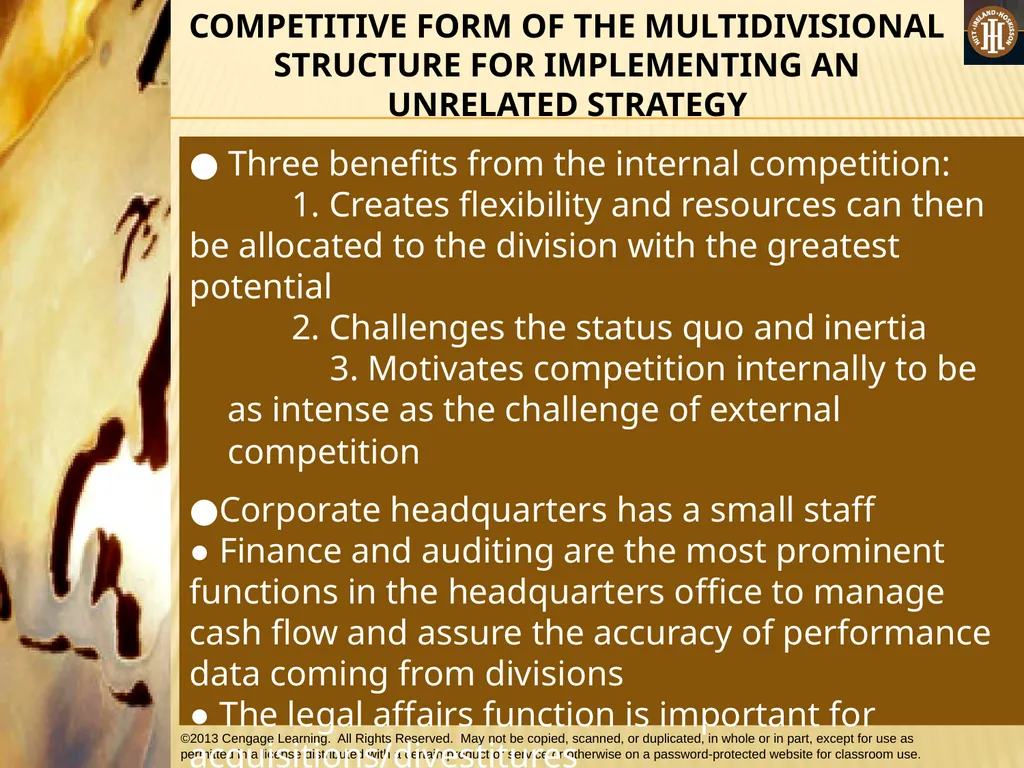
slide52. COMPETITIVE FORM OF THE MULTIDIVISIONAL STRUCTURE FOR IMPLEMENTING AN UNRELATED STRATEGY ● Three benefits from the internal competition:
1. Creates flexibility and resources can then be allocated to the division with the greatest potential
2. Challenges the status quo and inertia
3. Motivates competition internally to be as intense as the challenge of external competition
●Corporate headquarters has a small staff
● Finance and auditing are the most prominent functions in the headquarters office to manage cash flow and assure the accuracy of performance data coming from divisions
● The legal affairs function is important for acquisitions/divestitures<br>
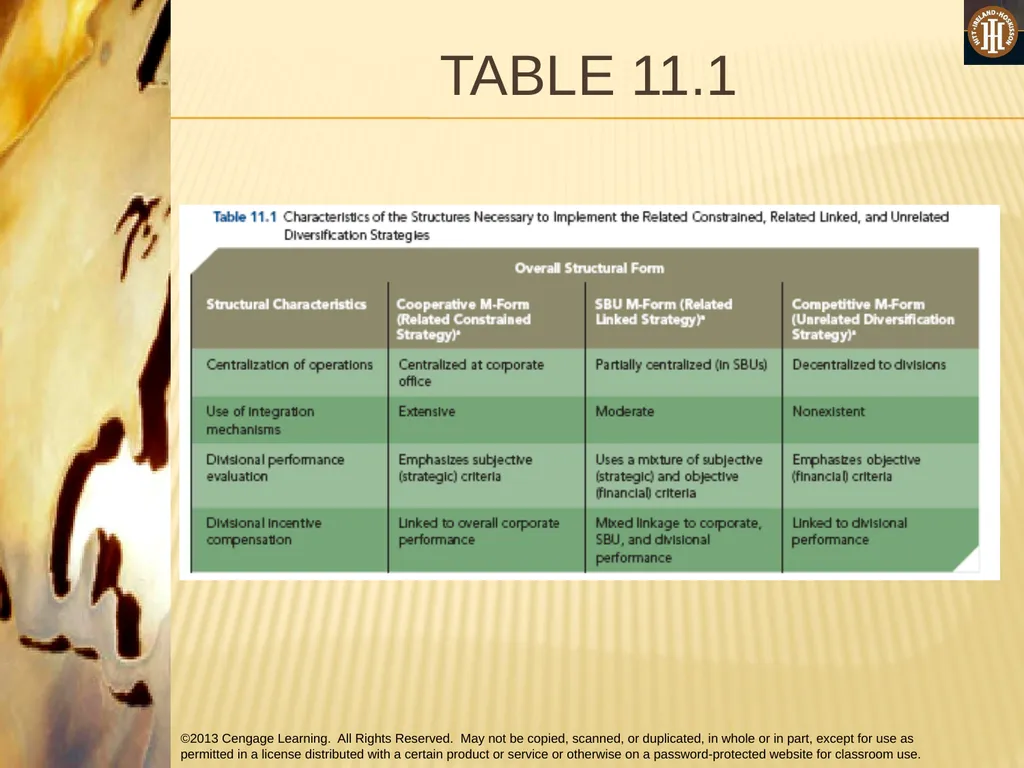
slide53. Table 11.1<br>
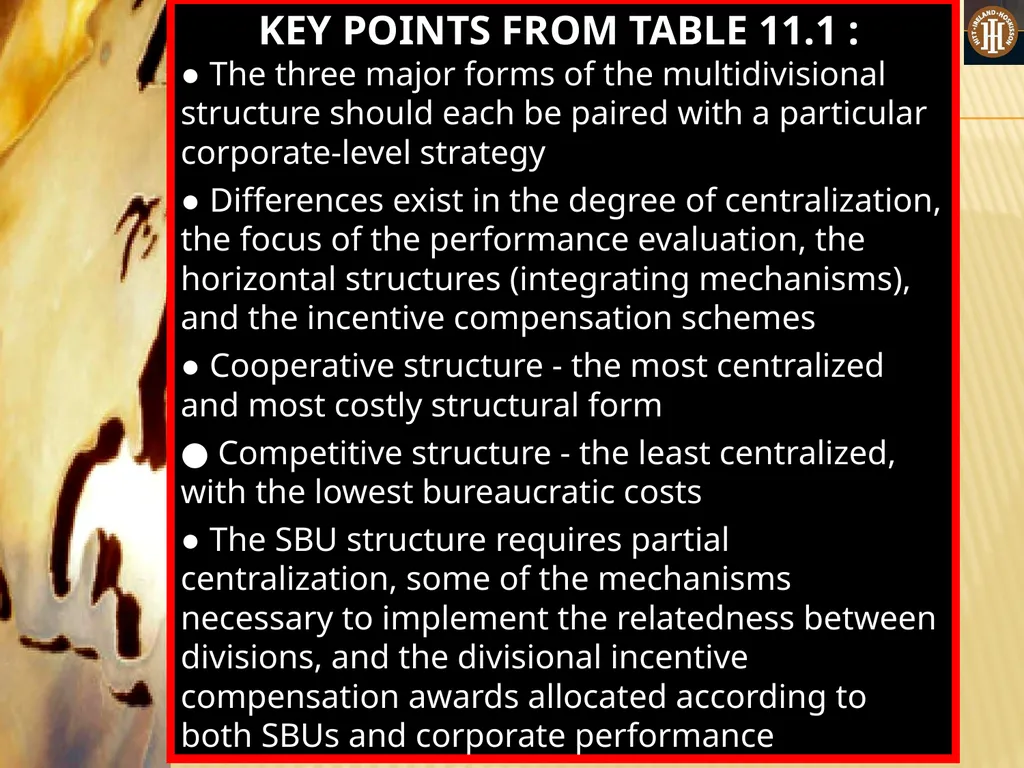
slide54. KEY POINTS FROM TABLE 11.1 :
● The three major forms of the multidivisional structure should each be paired with a particular corporate-level strategy
● Differences exist in the degree of centralization, the focus of the performance evaluation, the horizontal structures (integrating mechanisms), and the incentive compensation schemes
● Cooperative structure - the most centralized and most costly structural form
● Competitive structure - the least centralized, with the lowest bureaucratic costs
● The SBU structure requires partial centralization, some of the mechanisms necessary to implement the relatedness between divisions, and the divisional incentive compensation awards allocated according to both SBUs and corporate performance<br>
slide55. MATCHES BETWEEN INTERNATIONAL STRATEGIES AND WORLDWIDE STRUCTURE International strategies allow the firm to search for new:
Markets
Resources
Core competencies
Technologies
Three primary international strategies:
Multidomestic
Global
Transnational<br>
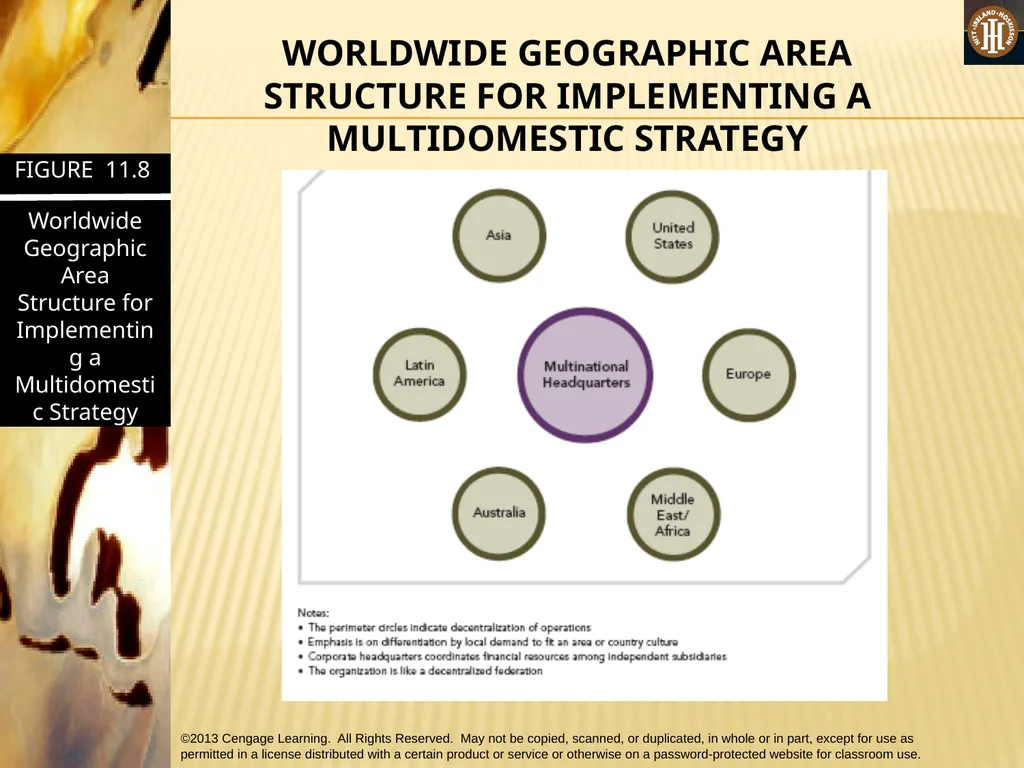
slide56. WORLDWIDE GEOGRAPHIC AREA STRUCTURE FOR IMPLEMENTING A MULTIDOMESTIC STRATEGY FIGURE 11.8
Worldwide Geographic Area Structure for Implementing a Multidomestic Strategy<br>
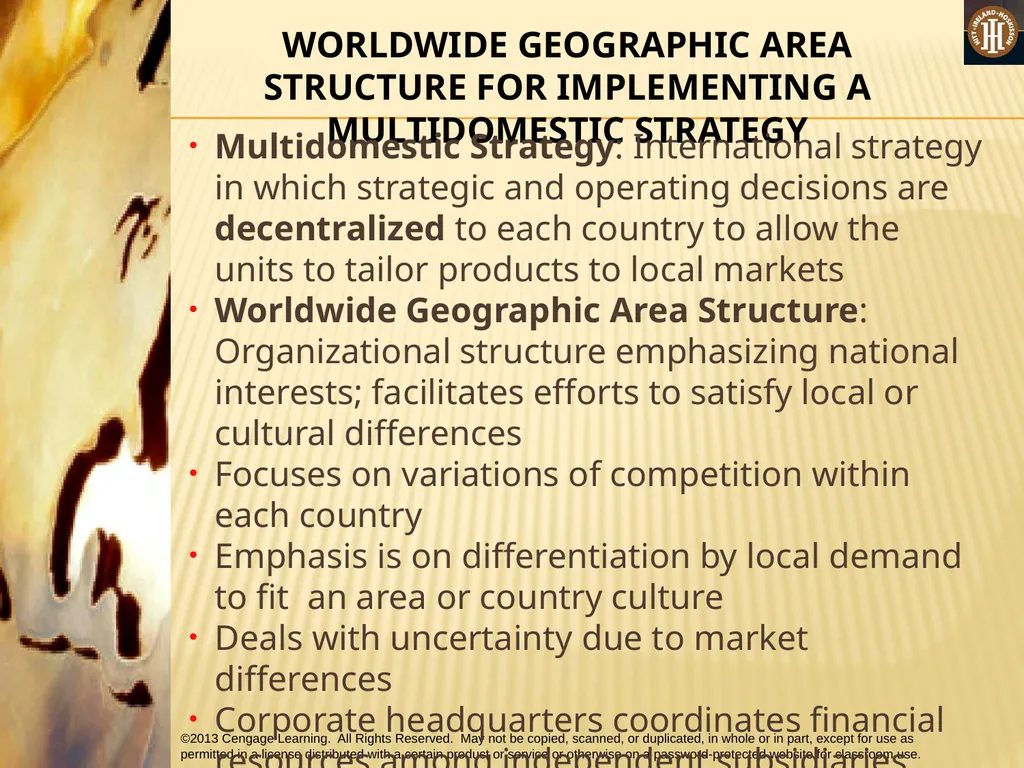
slide57. WORLDWIDE GEOGRAPHIC AREA STRUCTURE FOR IMPLEMENTING A MULTIDOMESTIC STRATEGY Multidomestic Strategy: International strategy in which strategic and operating decisions are decentralized to each country to allow the units to tailor products to local markets
Worldwide Geographic Area Structure: Organizational structure emphasizing national interests; facilitates efforts to satisfy local or cultural differences
Focuses on variations of competition within each country
Emphasis is on differentiation by local demand to fit an area or country culture
Deals with uncertainty due to market differences
Corporate headquarters coordinates financial resources among independent subsidiaries<br>
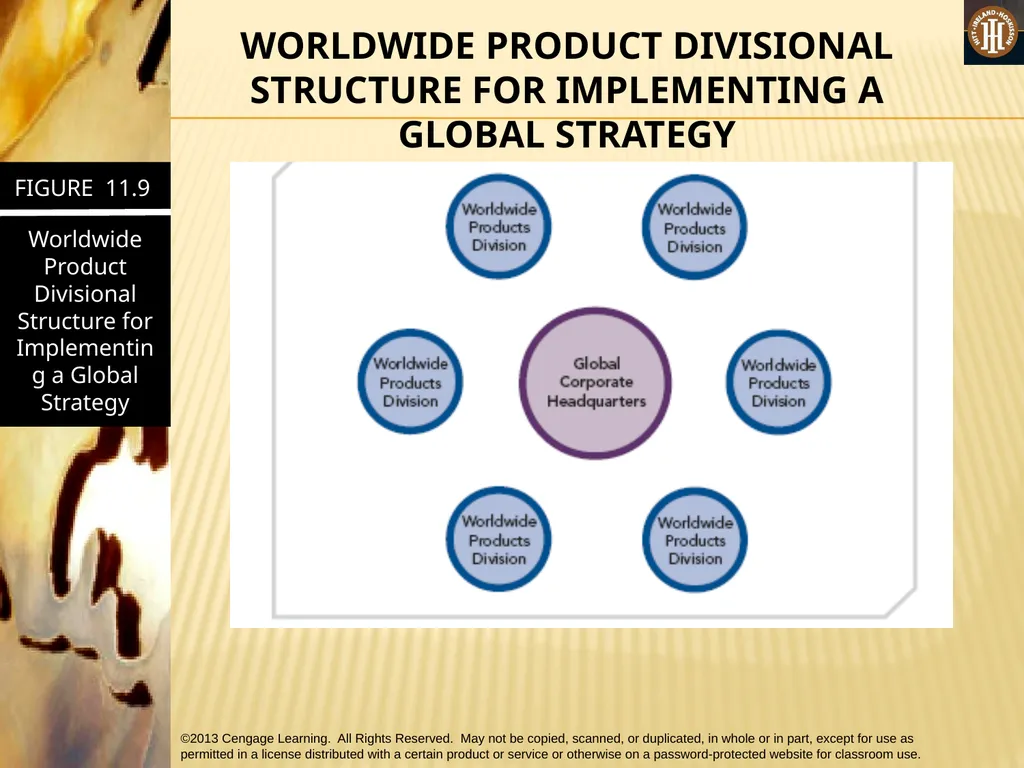
slide58. WORLDWIDE PRODUCT DIVISIONAL STRUCTURE FOR IMPLEMENTING A GLOBAL STRATEGY FIGURE 11.9
Worldwide Product Divisional Structure for Implementing a Global Strategy<br>
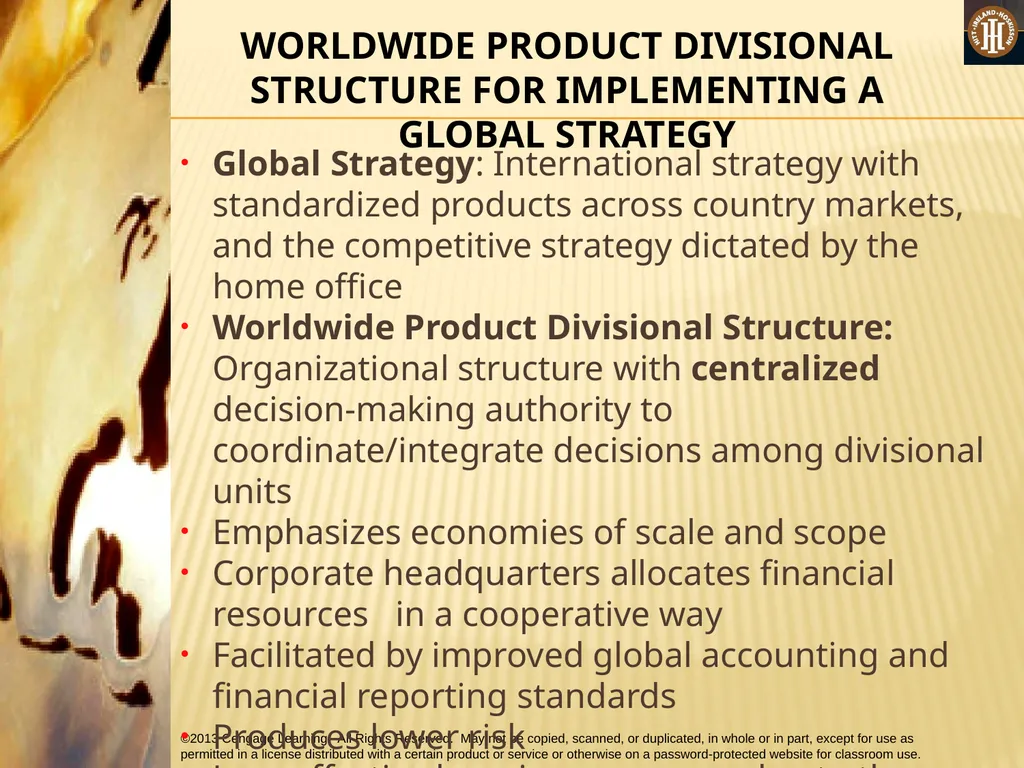
slide59. WORLDWIDE PRODUCT DIVISIONAL STRUCTURE FOR IMPLEMENTING A GLOBAL STRATEGY Global Strategy: International strategy with standardized products across country markets, and the competitive strategy dictated by the home office
Worldwide Product Divisional Structure: Organizational structure with centralized decision-making authority to coordinate/integrate decisions among divisional units
Emphasizes economies of scale and scope
Corporate headquarters allocates financial resources in a cooperative way
Facilitated by improved global accounting and financial reporting standards
Produces lower risk
Less effective learning processes due to the pressures to conform and standardize<br>
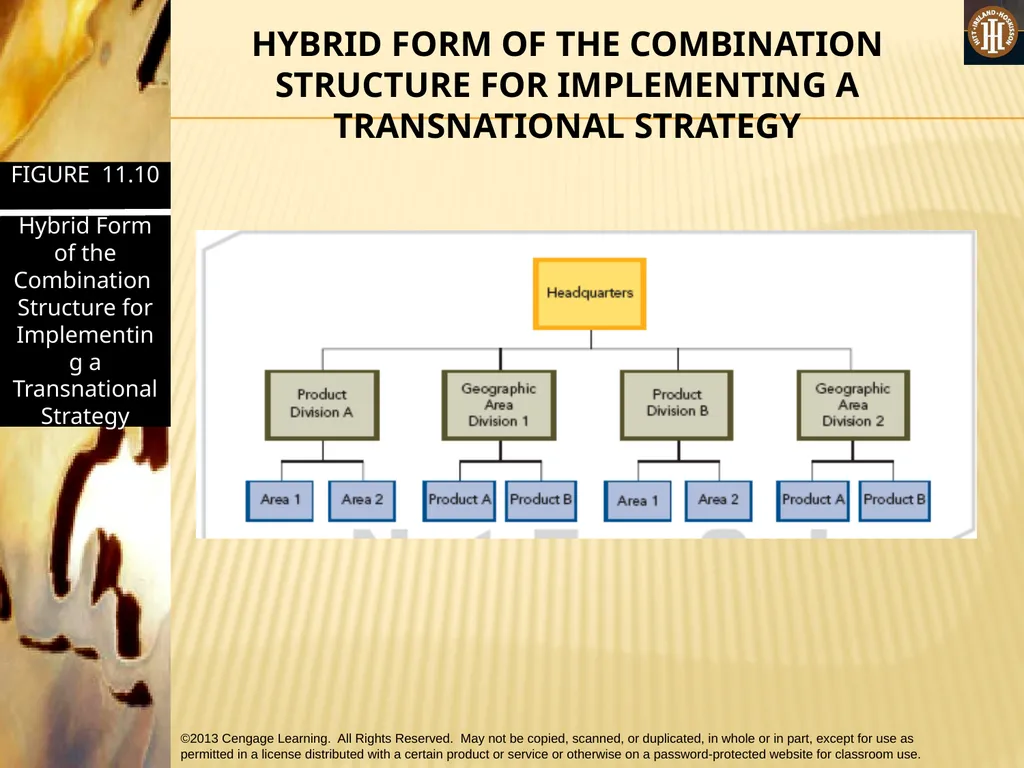
slide60. HYBRID FORM OF THE COMBINATION STRUCTURE FOR IMPLEMENTING A TRANSNATIONAL STRATEGY FIGURE 11.10
Hybrid Form of the Combination Structure for Implementing a Transnational Strategy<br>
slide61. HYBRID FORM OF THE COMBINATION STRUCTURE FOR IMPLEMENTING A TRANSNATIONAL STRATEGY Transnational strategy: international strategy through which the firm seeks to achieve both global efficiency and local responsiveness; usually implemented through global matrix structure and hybrid global design
Flexible coordination: building a shared vision and individual commitment through an integrated network
Combination structure: organizational structure in which characteristics and mechanisms are drawn from both the worldwide geographic area structure and the worldwide product divisional structure (used to implement transnational strategy)<br>
slide62. HYBRID FORM OF THE COMBINATION STRUCTURE FOR IMPLEMENTING A TRANSNATIONAL STRATEGY Assets and operations may be centralized/decentralized
Functions may be integrated/nonintegrated
Relationships may be formal/informal
Coordination mechanisms may leverage efficiency/flexibility
Mandates to subsidiaries may be global/ specialized-contribution/localized-implementation
There are competing objectives when a worldwide combination structure is used to implement a transnational strategy<br>
slide63. MATCHES BETWEEN COOPERATIVE STRATEGIES AND NETWORK STRUCTURES Greater levels of environmental complexity and uncertainty in today’s competitive environment are causing more firms to use cooperative strategies such as strategic alliances and joint ventures
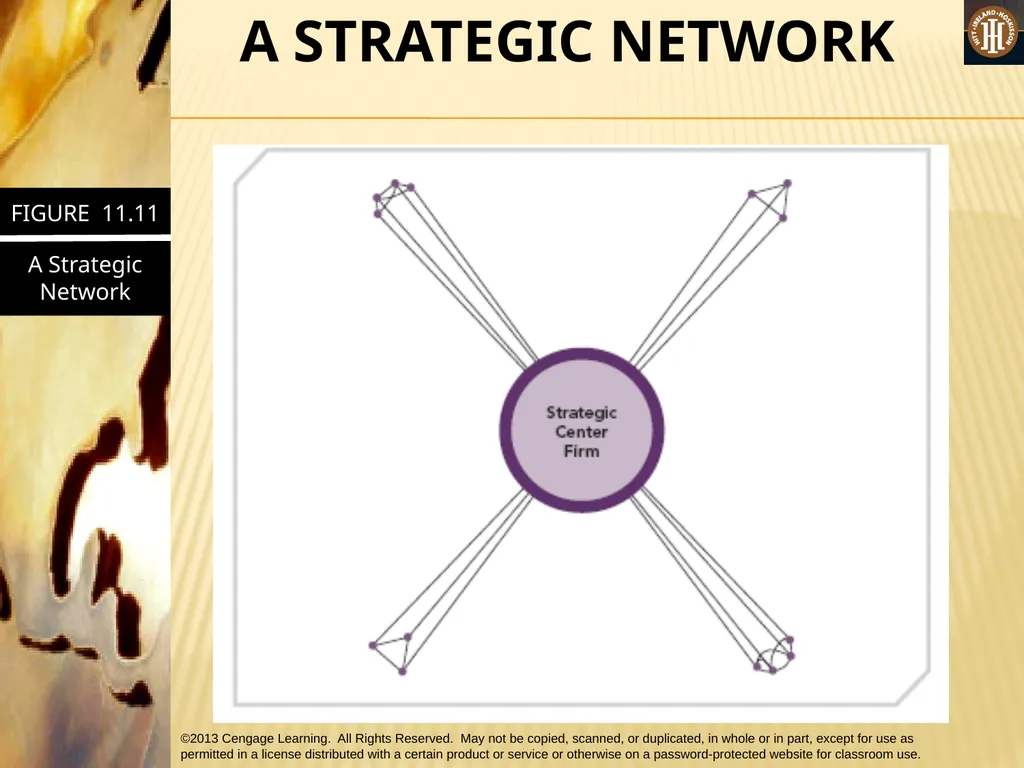
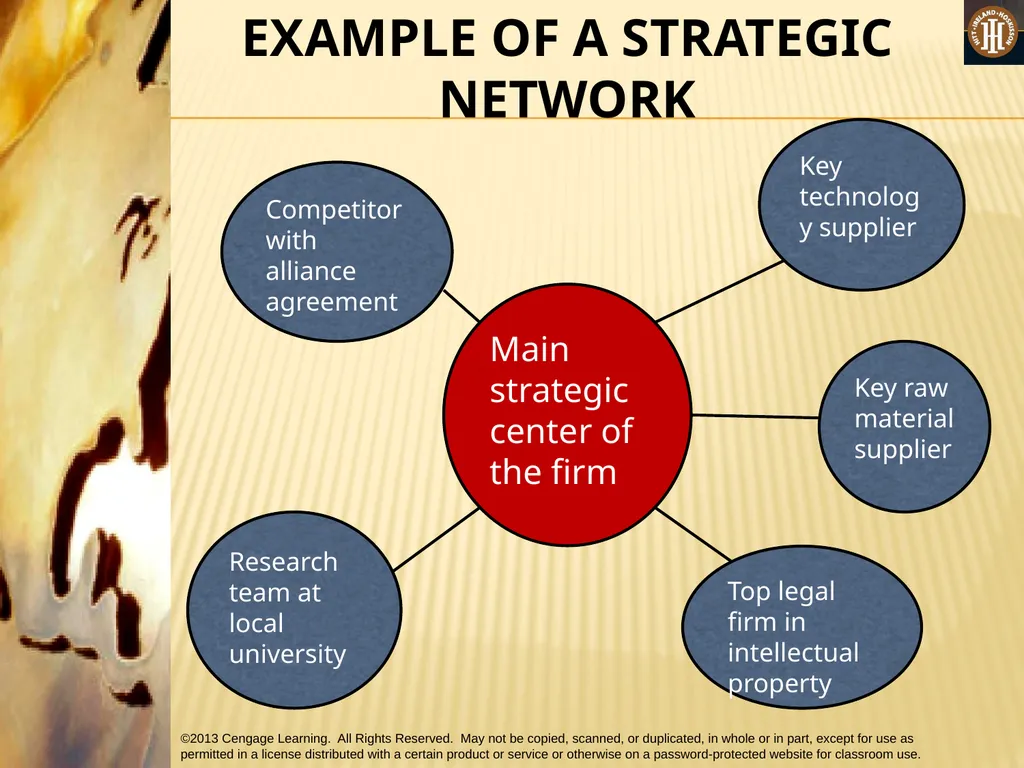
Strategic network: group of firms that form around a core to create value by participating in multiple cooperative arrangements
Used to implement business-level, corporate-level, and international cooperative strategies
Strategic Center Firm has four primary tasks:
1. Strategic outsourcing
2. Competencies
3. Technology
4. Race to learn<br>
slide64. A STRATEGIC NETWORK FIGURE 11.11
A Strategic Network<br>
slide65. EXAMPLE OF A STRATEGIC NETWORK Main strategic center of the firm Key raw material supplier Competitor with alliance agreement Research team at local university Top legal firm in intellectual property Key technology supplier<br>
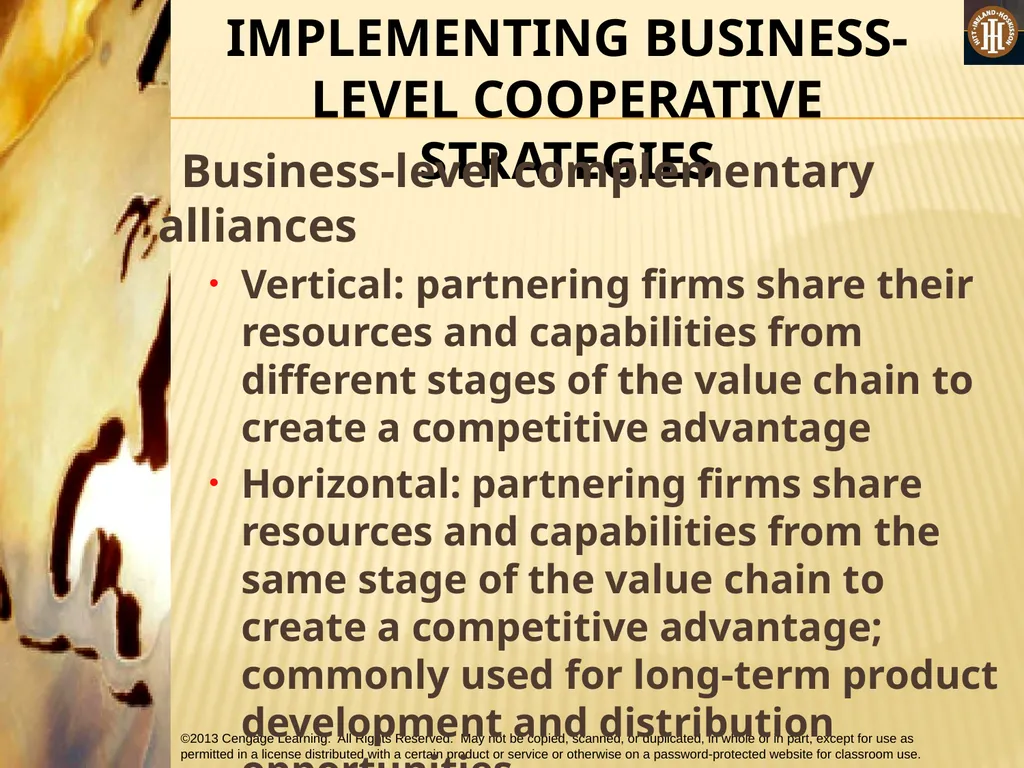
slide66. IMPLEMENTING BUSINESS-LEVEL COOPERATIVE STRATEGIES Business-level complementary alliances
Vertical: partnering firms share their resources and capabilities from different stages of the value chain to create a competitive advantage
Horizontal: partnering firms share resources and capabilities from the same stage of the value chain to create a competitive advantage; commonly used for long-term product development and distribution opportunities<br>
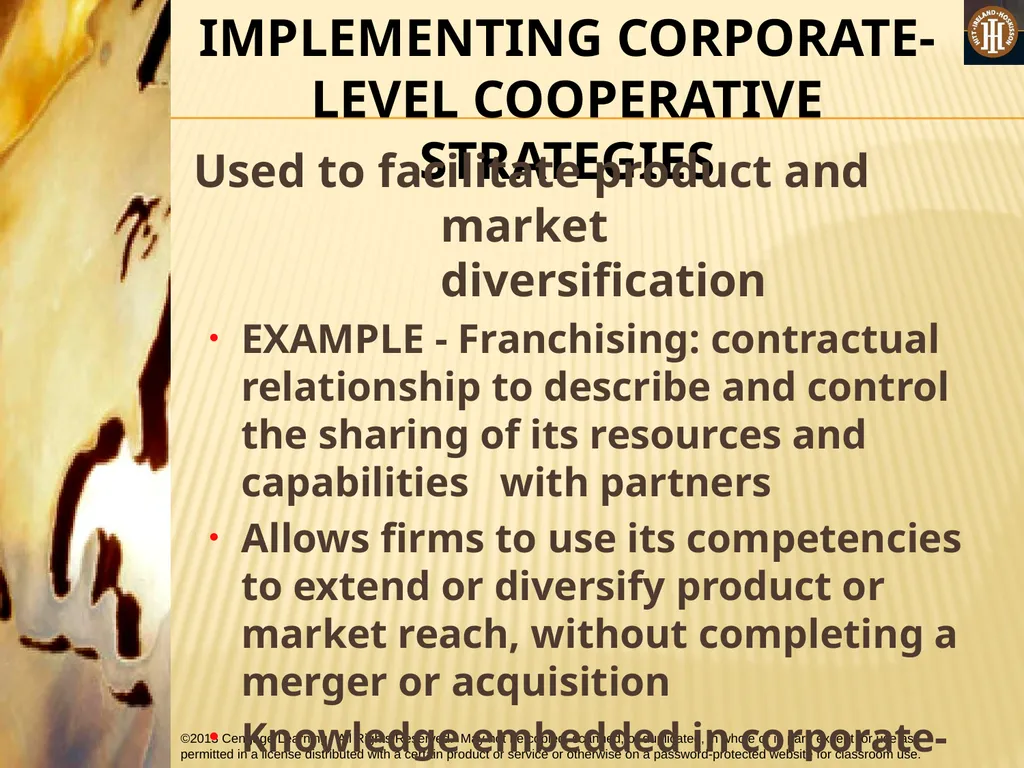
slide67. IMPLEMENTING CORPORATE-LEVEL COOPERATIVE STRATEGIES Used to facilitate product and market diversification
EXAMPLE - Franchising: contractual relationship to describe and control the sharing of its resources and capabilities with partners
Allows firms to use its competencies to extend or diversify product or market reach, without completing a merger or acquisition
Knowledge embedded in corporate-level cooperative strategies facilitates synergy<br>
slide68. IMPLEMENTING INTERNATIONAL COOPERATIVE STRATEGIES Strategic networks formed to implement cooperative strategies resulting in firms competing in several different countries
Distributed strategic networks: organizational structure used to manage international cooperative strategies
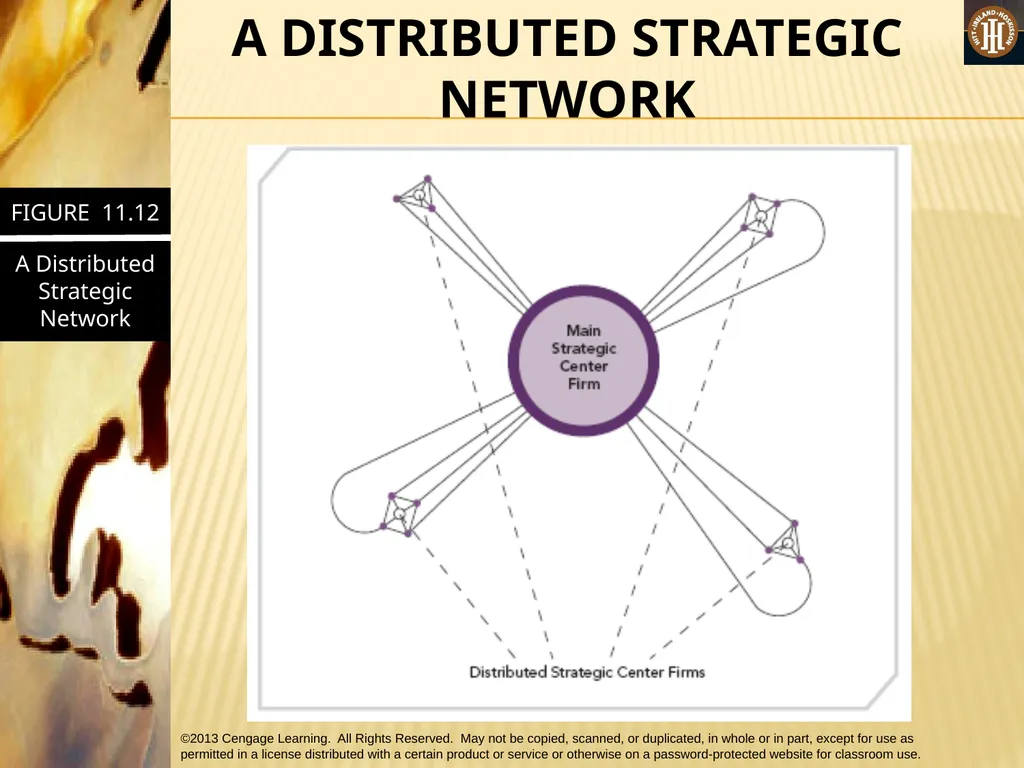
Several regional strategic center firms are included in the distributed network to manage partner firms’ multiple cooperative arrangements<br>
slide69. A DISTRIBUTED STRATEGIC NETWORK FIGURE 11.12
A Distributed Strategic Network<br>
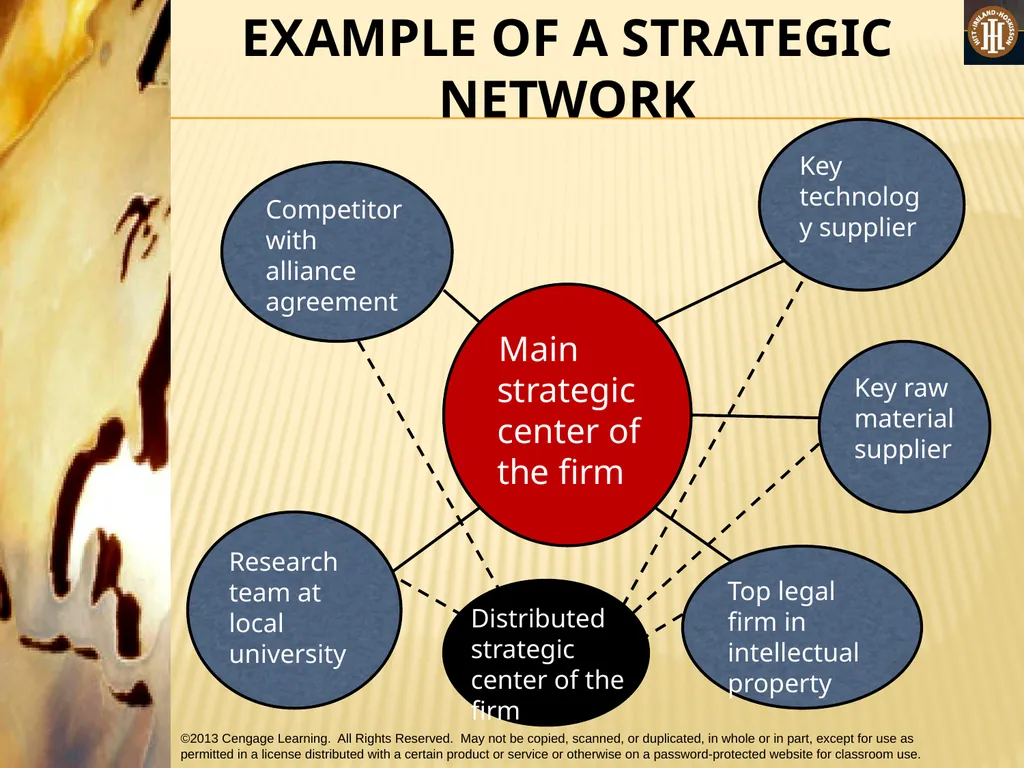
slide70. EXAMPLE OF A STRATEGIC NETWORK Main strategic center of the firm Key raw material supplier Competitor with alliance agreement Research team at local university Top legal firm in intellectual property Key technology supplier Distributed strategic center of the firm<br>
STRATEGY IMPLEMENTATION CHAPTER 11 ORGANIZATIONAL STRUCTURE AND CONTROLS<br>
slide2. THE STRATEGIC MANAGEMENT PROCESS<br>
slide3. KNOWLEDGE OBJECTIVES<br>
slide4. KNOWLEDGE OBJECTIVES<br>
slide5. ANOTHER ONE BITES THE DUST: BORDERS DECLARES BANKRUPTCY ■ Founded in 1971, one of the original superstore book retailing chains, Borders, declared bankruptcy in 2011 with debts of $1.293 billion and assets of $1.275 billion.
■ This case underscores the importance of strategy implementation. While Borders crafted an innovative strategy with knowledgeable employees, a world-class inventory system, and even espresso before Starbucks made it popular, their implementation was their Achilles’ heel. OPENING CASE<br>
slide6. ANOTHER ONE BITES THE DUST: BORDERS DECLARES BANKRUPTCY ■ Initial strategy worked well
● 1991 - Borders sold the relatively small bookstore chain and inventory system to Kmart
● 1995 - Borders was spun off with an IPO
■ Bankruptcy through a series of blunders
● International diversification reduced Borders’ focus on the most lucrative book retailing market in the U.S.
● When Barnes & Noble developed the capability to sell online, Borders outsourced this to Amazon, which sent customers and business to a major competitor. OPENING CASE<br>
slide7. ANOTHER ONE BITES THE DUST: BORDERS DECLARES BANKRUPTCY ■ 2007- a Borders store in Madison, Wisconsin, had no Internet!
■ Borders had incredibly bad management, especially at the higher levels of the firm
■ It was unable to correct these problems because of an inadequate structure and a focus on financial engineering (financial controls), both of which crippled its ability to respond effectively to changes in the marketplace and to implement its strategies (e.g., international strategy) effectively OPENING CASE<br>
slide8. INTRODUCTION Strategy may be implemented via:
Structure
Reward mechanisms
Organizational culture
Leadership
This chapter focuses on structure.
IMPORTANT: The match or degree of fit between strategy and structure influences the firm’s ability to earn above-average return.<br>
slide9. INTRODUCTION ● Organizational structure and controls provide the framework within which strategies (business, corporate, international and cooperative) are used
● No one structure is the best for all organizations
● The choice of structure and controls should support the strategic goals of the firm
● Structure will change as the strategy of the organization changes
● Effective strategic leadership means selecting the appropriate structure.<br>
slide10. ORGANIZATIONAL STRUCTURE AND CONTROLS Structure and Firm Performance
Research suggests that performance declines when the firm’s strategy is not matched with the most appropriate structure and controls
Example: CEO Jeffrey Immelt recognized the need to match strategy and structure during the recent economic downturn, as evidenced by the restructuring alignments in GE Capital, GE’s financial service group<br>
slide11. ORGANIZATIONAL STRUCTURE Organizational structure
Specifies the firm’s formal reporting relationships, procedures, controls, and authority and decision-making processes
Specifies the work to be done and how to do it, given the firm’s strategy or strategies
Is the pivotal component of effective strategy implementation
It is critical to match organizational structure to the firm’s strategy<br>
slide12. ORGANIZATIONAL STRUCTURE Strategy pioneer Alfred Chandler found organizations change their structures when inefficiencies force them to.
A firm’s strategy is supported when its structure is properly aligned to its strategy
Two considerations regarding alignment
Structural stability: capacity firm requires to consistently and predictably manage its daily work routines
Structural flexibility: opportunity to explore competitive advantages firm will need to be successful in the future Source: A. Chandler, 1962, Strategy and Structure, Cambridge, MA: MIT Press.<br>
slide13. ORGANIZATIONAL CONTROLS Controls guide the use of strategy, indicate how to compare actual results with expected results, and suggest corrective actions to take when the difference is unacceptable.
Two types:
Strategic Controls
Financial Controls<br>
slide14. STRATEGIC CONTROLS Largely SUBJECTIVE criteria intended to verify that the firm is using appropriate strategies for the conditions in the external environment and the company’s competitive advantages.
Are concerned with examining the fit between:
What the firm might do (opportunities in its external environment)
What the firm can do (competitive advantages)
Evaluate the degree to which the firm focuses on the requirements to implement strategy
Business-level: primary and support activities
Corporate-level (related): sharing of knowledge, markets, and technologies across businesses
Focus on the content of strategic actions<br>
slide15. FINANCIAL CONTROLS Largely OBJECTIVE criteria used to measure firm’s performance against previously established quantitative standards
Focus on short-term financial outcomes
Include accounting-based measures
ROI (return on investment)
ROA (return on assets)
Include market-based measures
EVA (economic value added)
Produce risk-averse managerial decisions
Are essential when a firm pursues a strategy with unrelated diversification<br>
slide16. ORGANIZATIONAL STRUCTURE AND CONTROLS Structure’s effectiveness is determined by using both strategic and financial controls.<br>
slide17. RELATIONSHIPS BETWEEN STRATEGY AND STRUCTURE ● RECIPROCAL RELATIONSHIP - change in one typically causes a change in the other, underscoring the interconnectedness between strategy formulation and strategy implementation
STRATEGY STRUCTURE
● Strategy typically has a much more important influence on structure than structure on strategy<br>
slide18. EVOLUTIONARY PATTERNS OF STRATEGY AND ORGANIZATIONAL STRUCTURE Chandler found that firms tend to grow in predictable patterns:
● first by volume
● then by geography
● then by integration (vertical, horizontal)
● finally through product/business diversification
Growth pattern determines structure!
1 – Chandler, 1962 Source: A. Chandler, 1962, Strategy and Structure, Cambridge, MA: MIT Press.<br>
slide19. EVOLUTIONARY PATTERNS OF STRATEGY AND ORGANIZATIONAL STRUCTURE ■ Firms typically alter their structure as they grow in size and complexity
■ Three key structural forms used to implement strategies:
Simple structure
Functional structure
Multidivisional structure (M-form)<br>
slide20. EVOLUTIONARY PATTERNS OF STRATEGY AND ORGANIZATIONAL STRUCTURE FIGURE 11.1
Strategy Structure Growth Pattern<br>
slide21. STRATEGY AND STRUCTURE: SIMPLE STRUCTURE ● Owner-manager makes all major decisions and monitors all activities
● Staff acts as extension of manager's supervisory authority
● Matched focus strategies and business-level strategies: these firms offer single product lines in single geographic markets
● Few rules, limited task specialization, basic technology system
● With size comes complexity and managerial and structural challenges; firms tend to move from a simple to a functional structure<br>
slide22. STRATEGY AND STRUCTURE: FUNCTIONAL STRUCTURE ● CEO and a limited corporate staff make all decisions.
● Functional line managers are in dominant organizational areas
Production Marketing
Engineering R&D
Accounting Human resources
● WITHIN – functional specialization results in active knowledge sharing within each area
● BETWEEN – impedes communication and coordination among different functional areas<br>
slide23. STRATEGY AND STRUCTURE: FUNCTIONAL STRUCTURE ● Facilitates career paths and professional development in specialized functional areas
● Causes functional-area managers to focus on local versus overall company strategic issues
● Supports implementing business-level strategies and some corporate-level strategies (e.g., single or dominant business) with low levels of diversification
● When changing from a simple to a functional structure, need to focus on and avoid value-destroying bureaucratic procedures<br>
slide24. STRATEGY AND STRUCTURE: MULTIDIVISIONAL (M-FORM) STRUCTURE ● Operating divisions each represent a separate business or profit center
● Top corporate officer delegates responsibilities for day-to-day operations and business-unit strategies to division managers
● Ties together all operating divisions
● Each division represents a separate business or profit center with its own functional hierarchy
● Each division is responsible for daily operations
● Business-unit strategy is delegated to the division<br>
slide25. STRATEGY AND STRUCTURE: MULTIDIVISIONAL (M-FORM) STRUCTURE Appropriate structure as firms DIVERSIFY
Three Major Benefits
● Simplifies the problem of control through more accurate monitoring of the performance of each business
● Facilitates comparisons between divisions, which improves the resource allocation process
● Stimulates managers of poorly performing divisions to look for ways of improving performance<br>
slide26. STRATEGY AND STRUCTURE: THE RIGHT STRUCTURE IT DEPENDS
● No one organizational structure (simple, functional, or multidivisional) is inherently superior to the others
● The firm must select a structure that is “right” for the chosen strategy
● Managers develop proper matches between strategies and organizational structures rather than searching for an “optimal” structure<br>
slide27. MATCHES BETWEEN BUSINESS-LEVEL STRATEGIES AND THE FUNCTIONAL STRUCTURE Firms use different forms of the functional organizational structure to support their strategy
Business-level strategies are:
Cost leadership (broad or focused)
Differentiation (broad or focused)
Integrated cost leadership/differentiation
Structural choices are:
Simple
Functional
Multidivisional<br>
slide28. MATCHES BETWEEN BUSINESS-LEVEL STRATEGIES AND THE FUNCTIONAL STRUCTURE The choice of structure is influenced by structural characteristics needed to compete:
Specialization: the type and number of jobs required to complete the work of the firm
Centralization: the degree to which decision-making authority is retained at higher managerial levels
Formalization: the degree to which formal rules and procedures govern work<br>
slide29. USING THE FUNCTIONAL STRUCTURE TO IMPLEMENT THE COST LEADERSHIP STRATEGY FIGURE 11.2
Functional Structure for Implementing a Cost Leadership Strategy<br>
slide30. USING THE FUNCTIONAL STRUCTURE TO IMPLEMENT THE COST LEADERSHIP STRATEGY The choice of structure is influenced by structural characteristics:
Specialization: departments are designed around areas of expertise—engineering to accounting
Centralization: highly centralized; staff are all together
Formalization: reporting roles are clearly defined; simple lines of communication<br>
slide31. USING THE FUNCTIONAL STRUCTURE TO IMPLEMENT THE COST LEADERSHIP STRATEGY Cost leadership and the functional structure results:
Operations is the main function
Process engineering is emphasized rather than new product R&D
Few decision-making and authority layers
Centralized corporate staff
Highly formalized rules and procedures Low-cost culture
Centralized staff decision-making authority
Job specialization
Simple reporting relationships
Overall structure is mechanistic; structured job roles<br>
slide32. USING THE FUNCTIONAL STRUCTURE TO IMPLEMENT THE COST LEADERSHIP STRATEGY Cost Leadership and Five Forces of Competition
Low-cost position is a valuable defense against rivals
Powerful customers can demand reduced prices
Cost leaders are in a position to absorb supplier price increases and relationship demands, and to force suppliers to hold down their prices
Continuously improving levels of efficiency and cost reduction can be difficult to replicate and serve as significant entry barriers to potential competitors
Cost leaders hold an attractive position in terms of product substitutes, with the flexibility to lower prices to retain customers<br>
slide33. USING THE FUNCTIONAL STRUCTURE TO IMPLEMENT THE COST LEADERSHIP STRATEGY Cost leadership strategy risks
Processes can become obsolete
Focus on cost reductions can come at the expense of understanding customer perceptions and needs
Strategy could be imitated, requiring the firm to increase the value offered to retain customers<br>
slide34. USING THE FUNCTIONAL STRUCTURE TO IMPLEMENT THE DIFFERENTIATION STRATEGY FIGURE 11.3
Functional Structure for Implementing a Differentiation Strategy<br>
slide35. USING THE FUNCTIONAL STRUCTURE TO IMPLEMENT THE DIFFERENTIATION STRATEGY The choice of structure is influenced by structural characteristics
Specialization: departments are designed around areas of expertise—engineering to accounting
Centralization: the key departments are coordinated through a highly centralized office that reflects a focus on product design and marketing; otherwise DECENTRALIZED
Formalization: reporting roles are clearly defined; simple lines of communication<br>
slide36. USING THE FUNCTIONAL STRUCTURE TO IMPLEMENT THE DIFFERENTIATION STRATEGY Differentiation and the functional structure results:
Marketing is the main function; new product ideas
New product R&D is emphasized
Most functions are decentralized, but R&D and marketing may have centralized staffs
Cross-functional product development teams
Complex and flexible reporting relationships
Development-oriented culture
Decentralized decision making
Broad job descriptions
Informal rules and procedures
Overall structure is organic; less structured job roles<br>
slide37. USING THE FUNCTIONAL STRUCTURE TO IMPLEMENT THE DIFFERENTIATION STRATEGY Differentiation strategy should deliver:
An integrated set of actions designed by a firm to produce or deliver goods or services at an acceptable cost that customers perceive as being different in ways that are important to them
Target customers – perceived product value
Customized products – differentiating as many features as possible
Unusual features include responsive customer service, rapid product innovations, technological leadership, perceived prestige and status, different tastes, engineering design, performance<br>
slide38. USING THE FUNCTIONAL STRUCTURE TO IMPLEMENT THE DIFFERENTIATION STRATEGY Differentiation and Five Forces of Competition
Customer loyalty: the most valuable defense against rivals
Unique products reduce customer sensitivity to raised prices
High margins (for differentiated products) insulate firm from supplier influence
Significant entry barriers: customer loyalty and product uniqueness
Firms with customers loyal to their products are positioned effectively against product substitutes<br>
slide39. USING THE FUNCTIONAL STRUCTURE TO IMPLEMENT THE DIFFERENTIATION STRATEGY Differentiation strategy risks
Price differential for differentiated product may be perceived as too large
Firms’ means of differentiation may cease to provide value for which customers are willing to pay a premium price (successful rival imitation)
Experience can narrow customers' perceptions of the value of a product's differentiated features
Counterfeit goods may appear in the marketplace<br>
slide40. USING THE FUNCTIONAL STRUCTURE TO IMPLEMENT THE INTEGRATED COST LEADERSHIP/ DIFFERENTIATION STRATEGY These firms create value through both low cost and uniqueness:
Relatively low product cost through an emphasis on production and process engineering, with infrequent product changes
Reasonable sources of differentiation based on new-product R&D
Difficult to implement, but frequently used in the global economy<br>
slide41. USING THE FUNCTIONAL STRUCTURE TO IMPLEMENT THE INTEGRATED COST LEADERSHIP/ DIFFERENTIATION STRATEGY Challenges due to primary/support activities
Need to successfully combine specialization, formalization, and centralization
Decision-making patterns that are partially centralized and partially decentralized
Semi-specialized jobs
Rules and procedures that allow both formal and informal job behaviors<br>
slide42. MATCHES BETWEEN CORPORATE-LEVEL STRATEGIES AND THE MULTIDIVISIONAL STRUCTURE A firm’s continuing success that leads to:
Product diversification, or
Market diversification, or
Both product and market diversification
Increasing diversification creates problems beyond the scope of the functional structure:
Information processing
Coordination
Control<br>
slide43. MATCHES BETWEEN CORPORATE-LEVEL STRATEGIES AND THE MULTIDIVISIONAL STRUCTURE Diversification strategy requires firm to change from a functional structure to a multidivisional structure
Different levels of diversification create the need for implementation of a unique form of the multidivisional structure
Matrix organization may evolve- organizational structure in which a dual structure combines both functional specialization and business product or project specialization.<br>
slide44. THREE VARIATIONS OF THE MULTIDIVISIONAL STRUCTURE FIGURE 11.4
Three Variations of the Multidivisional Structure<br>
slide45. COOPERATIVE FORM OF THE MULTIDIVISIONAL STRUCTURE FOR IMPLEMENTING A RELATED CONSTRAINED STRATEGY FIGURE 11.5
Cooperative Form of the Multidivisional Structure for Implementing a Related Constrained Strategy<br>
slide46. COOPERATIVE FORM OF THE MULTIDIVISIONAL STRUCTURE FOR IMPLEMENTING A RELATED CONSTRAINED STRATEGY ● Structural integration devices create tight links among all divisions
● Corporate office dictates centralized decision-making
● Rewards are subjective and tend to emphasize overall corporate performance in addition to divisional performance
● Culture emphasizes cooperative sharing
● Economies of scope (cost savings resulting from the sharing of competencies developed in one division with another division) are important for the related constrained strategy
● Interdivisional sharing of competencies depends on cooperation- links result from effective integration mechanisms
● Sharing of both tangible and intangible resources
● The cooperative structure uses different characteristics of structure (centralization, standardization, and formalization) as integrating mechanisms to facilitate interdivisional cooperation<br>
slide47. SBU FORM OF THE MULTIDIVISIONAL STRUCTURE FOR IMPLEMENTING A RELATED LINKED STRATEGY FIGURE 11.6
SBU Form of the Multidivisional Structure for Implementing a Related Linked Strategy<br>
slide48. SBU FORM OF THE MULTIDIVISIONAL STRUCTURE FOR IMPLEMENTING A RELATED LINKED STRATEGY ● Firms that share fewer resources and assets among their businesses, concentrating on the transfer of knowledge and competencies among the businesses (related linked strategy)
● Organization structure with three levels to support the implementation diversification strategy:
Corporate headquarters
Strategic business units (SBUs)
Divisions under each SBU<br>
slide49. SBU FORM OF THE MULTIDIVISIONAL STRUCTURE FOR IMPLEMENTING A RELATED LINKED STRATEGY ● SBU divisions related in terms of shared products/markets
● Divisions of one SBU have little in common with divisions of other SBUs
● Divisions within each SBU share product or market competencies to develop economies of scope
● Integrations used in cooperative form are equally effective for the SBU form
● Each SBU is a profit center; has its own budget for staff to foster integration
● Financial controls are more vital for evaluating performance<br>
slide50. COMPETITIVE FORM OF THE MULTIDIVISIONAL STRUCTURE FOR IMPLEMENTING AN UNRELATED STRATEGY FIGURE 11.7
Competitive Form of the Multidivisional Structure for Implementing an Unrelated Strategy<br>
slide51. COMPETITIVE FORM OF THE MULTIDIVISIONAL STRUCTURE FOR IMPLEMENTING AN UNRELATED STRATEGY ● Financial economies are pivotal for the unrelated strategy
Creates value through two types of financial economies
▪ Cost savings realized through improved allocations of financial resources based on investments inside or outside firm
▪ Efficient internal capital market allocation: restructuring of acquired assets
● The efficient internal capital market is the key for this strategy, and requires divisional competition rather than cooperation.
● Specific performance expectations and accountability for independent divisions stimulate internal competition for future resources
● Divisions are independent and separate for financial evaluation purposes; and retain strategic control<br>
slide52. COMPETITIVE FORM OF THE MULTIDIVISIONAL STRUCTURE FOR IMPLEMENTING AN UNRELATED STRATEGY ● Three benefits from the internal competition:
1. Creates flexibility and resources can then be allocated to the division with the greatest potential
2. Challenges the status quo and inertia
3. Motivates competition internally to be as intense as the challenge of external competition
●Corporate headquarters has a small staff
● Finance and auditing are the most prominent functions in the headquarters office to manage cash flow and assure the accuracy of performance data coming from divisions
● The legal affairs function is important for acquisitions/divestitures<br>
slide53. Table 11.1<br>
slide54. KEY POINTS FROM TABLE 11.1 :
● The three major forms of the multidivisional structure should each be paired with a particular corporate-level strategy
● Differences exist in the degree of centralization, the focus of the performance evaluation, the horizontal structures (integrating mechanisms), and the incentive compensation schemes
● Cooperative structure - the most centralized and most costly structural form
● Competitive structure - the least centralized, with the lowest bureaucratic costs
● The SBU structure requires partial centralization, some of the mechanisms necessary to implement the relatedness between divisions, and the divisional incentive compensation awards allocated according to both SBUs and corporate performance<br>
slide55. MATCHES BETWEEN INTERNATIONAL STRATEGIES AND WORLDWIDE STRUCTURE International strategies allow the firm to search for new:
Markets
Resources
Core competencies
Technologies
Three primary international strategies:
Multidomestic
Global
Transnational<br>
slide56. WORLDWIDE GEOGRAPHIC AREA STRUCTURE FOR IMPLEMENTING A MULTIDOMESTIC STRATEGY FIGURE 11.8
Worldwide Geographic Area Structure for Implementing a Multidomestic Strategy<br>
slide57. WORLDWIDE GEOGRAPHIC AREA STRUCTURE FOR IMPLEMENTING A MULTIDOMESTIC STRATEGY Multidomestic Strategy: International strategy in which strategic and operating decisions are decentralized to each country to allow the units to tailor products to local markets
Worldwide Geographic Area Structure: Organizational structure emphasizing national interests; facilitates efforts to satisfy local or cultural differences
Focuses on variations of competition within each country
Emphasis is on differentiation by local demand to fit an area or country culture
Deals with uncertainty due to market differences
Corporate headquarters coordinates financial resources among independent subsidiaries<br>
slide58. WORLDWIDE PRODUCT DIVISIONAL STRUCTURE FOR IMPLEMENTING A GLOBAL STRATEGY FIGURE 11.9
Worldwide Product Divisional Structure for Implementing a Global Strategy<br>
slide59. WORLDWIDE PRODUCT DIVISIONAL STRUCTURE FOR IMPLEMENTING A GLOBAL STRATEGY Global Strategy: International strategy with standardized products across country markets, and the competitive strategy dictated by the home office
Worldwide Product Divisional Structure: Organizational structure with centralized decision-making authority to coordinate/integrate decisions among divisional units
Emphasizes economies of scale and scope
Corporate headquarters allocates financial resources in a cooperative way
Facilitated by improved global accounting and financial reporting standards
Produces lower risk
Less effective learning processes due to the pressures to conform and standardize<br>
slide60. HYBRID FORM OF THE COMBINATION STRUCTURE FOR IMPLEMENTING A TRANSNATIONAL STRATEGY FIGURE 11.10
Hybrid Form of the Combination Structure for Implementing a Transnational Strategy<br>
slide61. HYBRID FORM OF THE COMBINATION STRUCTURE FOR IMPLEMENTING A TRANSNATIONAL STRATEGY Transnational strategy: international strategy through which the firm seeks to achieve both global efficiency and local responsiveness; usually implemented through global matrix structure and hybrid global design
Flexible coordination: building a shared vision and individual commitment through an integrated network
Combination structure: organizational structure in which characteristics and mechanisms are drawn from both the worldwide geographic area structure and the worldwide product divisional structure (used to implement transnational strategy)<br>
slide62. HYBRID FORM OF THE COMBINATION STRUCTURE FOR IMPLEMENTING A TRANSNATIONAL STRATEGY Assets and operations may be centralized/decentralized
Functions may be integrated/nonintegrated
Relationships may be formal/informal
Coordination mechanisms may leverage efficiency/flexibility
Mandates to subsidiaries may be global/ specialized-contribution/localized-implementation
There are competing objectives when a worldwide combination structure is used to implement a transnational strategy<br>
slide63. MATCHES BETWEEN COOPERATIVE STRATEGIES AND NETWORK STRUCTURES Greater levels of environmental complexity and uncertainty in today’s competitive environment are causing more firms to use cooperative strategies such as strategic alliances and joint ventures
Strategic network: group of firms that form around a core to create value by participating in multiple cooperative arrangements
Used to implement business-level, corporate-level, and international cooperative strategies
Strategic Center Firm has four primary tasks:
1. Strategic outsourcing
2. Competencies
3. Technology
4. Race to learn<br>
slide64. A STRATEGIC NETWORK FIGURE 11.11
A Strategic Network<br>
slide65. EXAMPLE OF A STRATEGIC NETWORK Main strategic center of the firm Key raw material supplier Competitor with alliance agreement Research team at local university Top legal firm in intellectual property Key technology supplier<br>
slide66. IMPLEMENTING BUSINESS-LEVEL COOPERATIVE STRATEGIES Business-level complementary alliances
Vertical: partnering firms share their resources and capabilities from different stages of the value chain to create a competitive advantage
Horizontal: partnering firms share resources and capabilities from the same stage of the value chain to create a competitive advantage; commonly used for long-term product development and distribution opportunities<br>
slide67. IMPLEMENTING CORPORATE-LEVEL COOPERATIVE STRATEGIES Used to facilitate product and market diversification
EXAMPLE - Franchising: contractual relationship to describe and control the sharing of its resources and capabilities with partners
Allows firms to use its competencies to extend or diversify product or market reach, without completing a merger or acquisition
Knowledge embedded in corporate-level cooperative strategies facilitates synergy<br>
slide68. IMPLEMENTING INTERNATIONAL COOPERATIVE STRATEGIES Strategic networks formed to implement cooperative strategies resulting in firms competing in several different countries
Distributed strategic networks: organizational structure used to manage international cooperative strategies
Several regional strategic center firms are included in the distributed network to manage partner firms’ multiple cooperative arrangements<br>
slide69. A DISTRIBUTED STRATEGIC NETWORK FIGURE 11.12
A Distributed Strategic Network<br>
slide70. EXAMPLE OF A STRATEGIC NETWORK Main strategic center of the firm Key raw material supplier Competitor with alliance agreement Research team at local university Top legal firm in intellectual property Key technology supplier Distributed strategic center of the firm<br>