
Part 4 Software 1 Part IV: Software Part 4
T
Published · 43 slides · 0 views
1 / 1
Description
Part 4 Software 1 Part IV: Software Part 4 Software 2 Why Software? Why is software as important to security as crypto, access control, protocols? Virtually all information security features are implemented in software If your software
Related Topics
Share
Embed code
Download this presentation From Below
"Part 4 Software 1 Part IV: Software Part 4" is the property of its rightful owner. Permission is granted to download and print the materials on this website for personal, non-commercial use only, and to display it on your personal computer provided you do not modify the materials and that you retain all copyright notices contained in the materials. By downloading content from our website, you accept the terms of this agreement.
Presentation Transcript
01
Part 4 Software 1 Part IV: Software<br>
02
Part 4 Software 2 Why Software? Why is software as important to security as crypto, access control, protocols?
Virtually all information security features are implemented in software
If your software is subject to attack, your security can be broken
Regardless of strength of crypto, access control, or protocols
Software is a poor foundation for security Bad Software is Ubiquitous (found everywhere)
NASA Mars Lander (cost $165 million)
Crashed into Mars due to…error in converting English and Metric units of measure
Denver airport
Baggage handling system very buggy software
Delayed airport opening by 11 months
Cost of delay exceeded $1 million/day
What happened to person responsible for this fiasco?
What about the recent Boeing 737 MAX 8 crashes??
flight control operations
MCAS System<br>
Virtually all information security features are implemented in software
If your software is subject to attack, your security can be broken
Regardless of strength of crypto, access control, or protocols
Software is a poor foundation for security Bad Software is Ubiquitous (found everywhere)
NASA Mars Lander (cost $165 million)
Crashed into Mars due to…error in converting English and Metric units of measure
Denver airport
Baggage handling system very buggy software
Delayed airport opening by 11 months
Cost of delay exceeded $1 million/day
What happened to person responsible for this fiasco?
What about the recent Boeing 737 MAX 8 crashes??
flight control operations
MCAS System<br>
03
Chapter 11:
Software Flaws and Malware If automobiles had followed the same development cycle as the computer,
a Rolls-Royce would today cost $100, get a million miles per gallon,
and explode once a year, killing everyone inside.
Robert X. Cringely
My software never has bugs. It just develops random features.
Anonymous Part 4 Software 3<br>
a Rolls-Royce would today cost $100, get a million miles per gallon,
and explode once a year, killing everyone inside.
Robert X. Cringely
My software never has bugs. It just develops random features.
Anonymous Part 4 Software 3<br>
04
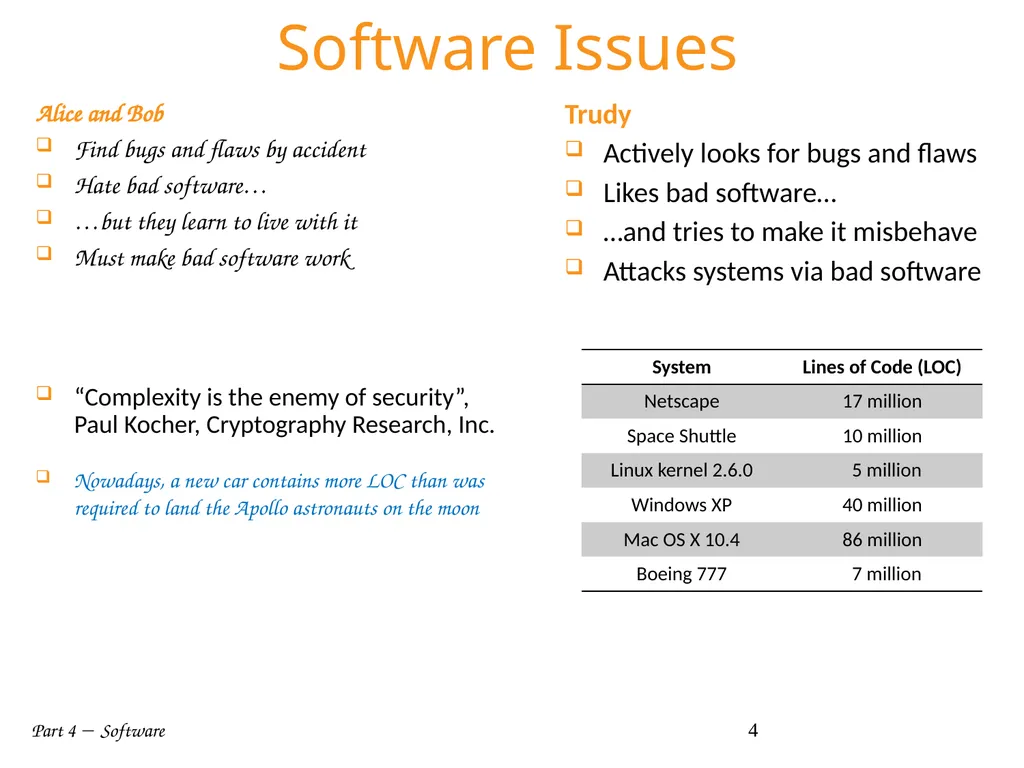
Part 4 Software 4 Software Issues Trudy
Actively looks for bugs and flaws
Likes bad software…
…and tries to make it misbehave
Attacks systems via bad software Alice and Bob
Find bugs and flaws by accident
Hate bad software…
…but they learn to live with it
Must make bad software work “Complexity is the enemy of security”, Paul Kocher, Cryptography Research, Inc. Nowadays, a new car contains more LOC than was required to land the Apollo astronauts on the moon<br>
Actively looks for bugs and flaws
Likes bad software…
…and tries to make it misbehave
Attacks systems via bad software Alice and Bob
Find bugs and flaws by accident
Hate bad software…
…but they learn to live with it
Must make bad software work “Complexity is the enemy of security”, Paul Kocher, Cryptography Research, Inc. Nowadays, a new car contains more LOC than was required to land the Apollo astronauts on the moon<br>
05
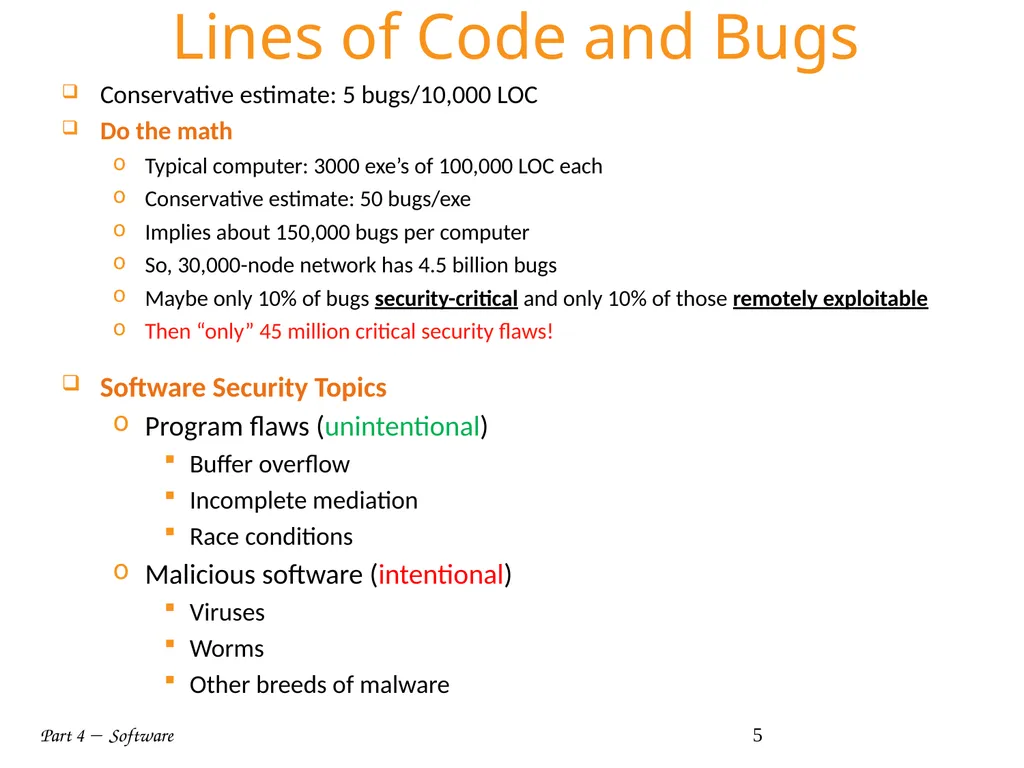
Part 4 Software 5 Lines of Code and Bugs Conservative estimate: 5 bugs/10,000 LOC
Do the math
Typical computer: 3000 exe’s of 100,000 LOC each
Conservative estimate: 50 bugs/exe
Implies about 150,000 bugs per computer
So, 30,000-node network has 4.5 billion bugs
Maybe only 10% of bugs security-critical and only 10% of those remotely exploitable
Then “only” 45 million critical security flaws! Software Security Topics
Program flaws (unintentional)
Buffer overflow
Incomplete mediation
Race conditions
Malicious software (intentional)
Viruses
Worms
Other breeds of malware<br>
Do the math
Typical computer: 3000 exe’s of 100,000 LOC each
Conservative estimate: 50 bugs/exe
Implies about 150,000 bugs per computer
So, 30,000-node network has 4.5 billion bugs
Maybe only 10% of bugs security-critical and only 10% of those remotely exploitable
Then “only” 45 million critical security flaws! Software Security Topics
Program flaws (unintentional)
Buffer overflow
Incomplete mediation
Race conditions
Malicious software (intentional)
Viruses
Worms
Other breeds of malware<br>
06
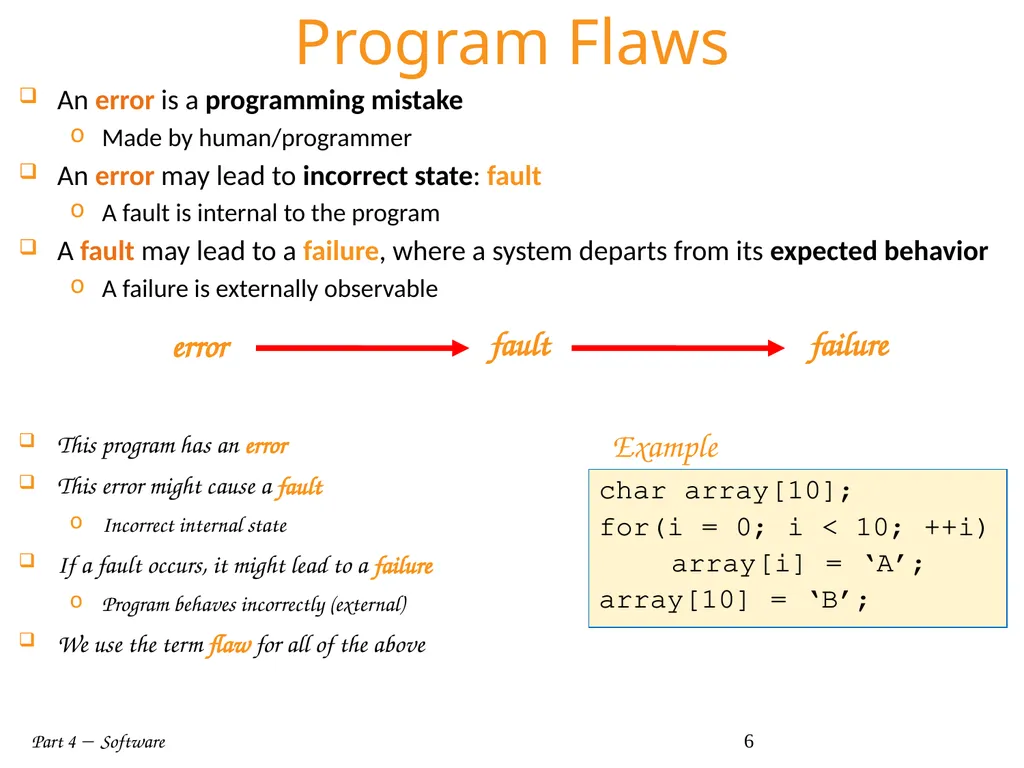
Part 4 Software 6 Program Flaws An error is a programming mistake
Made by human/programmer
An error may lead to incorrect state: fault
A fault is internal to the program
A fault may lead to a failure, where a system departs from its expected behavior
A failure is externally observable error fault failure This program has an error
This error might cause a fault
Incorrect internal state
If a fault occurs, it might lead to a failure
Program behaves incorrectly (external)
We use the term flaw for all of the above<br>
Made by human/programmer
An error may lead to incorrect state: fault
A fault is internal to the program
A fault may lead to a failure, where a system departs from its expected behavior
A failure is externally observable error fault failure This program has an error
This error might cause a fault
Incorrect internal state
If a fault occurs, it might lead to a failure
Program behaves incorrectly (external)
We use the term flaw for all of the above<br>
07
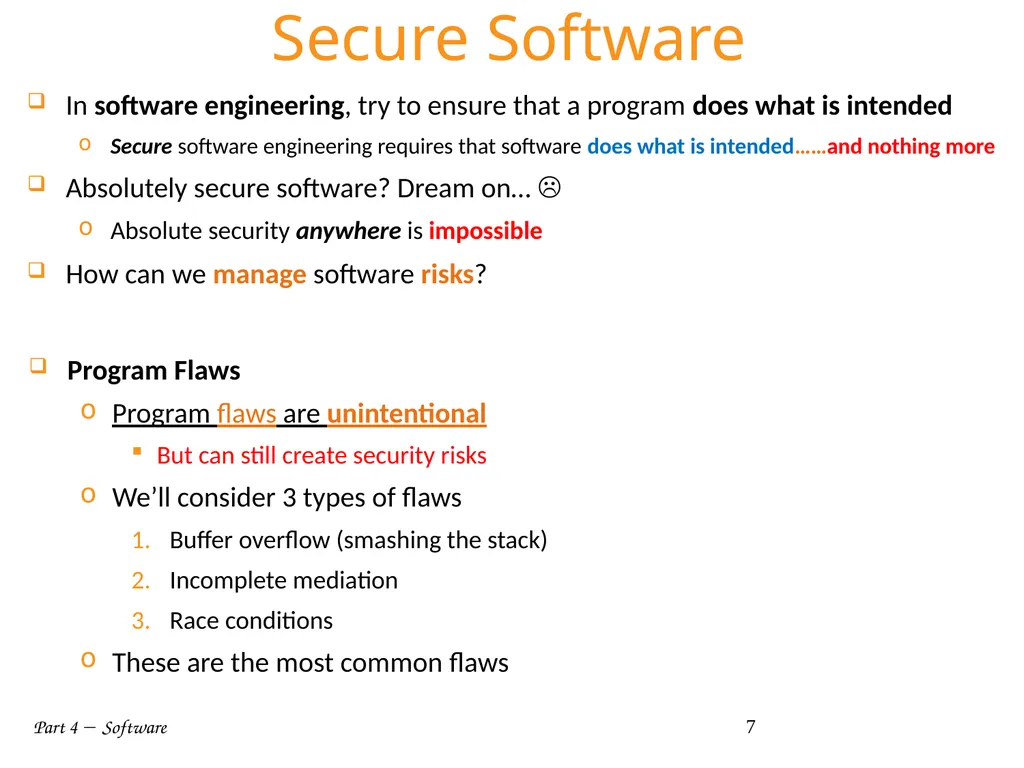
Part 4 Software 7 Secure Software In software engineering, try to ensure that a program does what is intended
Secure software engineering requires that software does what is intended……and nothing more
Absolutely secure software? Dream on…
Absolute security anywhere is impossible
How can we manage software risks? Program Flaws
Program flaws are unintentional
But can still create security risks
We’ll consider 3 types of flaws
Buffer overflow (smashing the stack)
Incomplete mediation
Race conditions
These are the most common flaws<br>
Secure software engineering requires that software does what is intended……and nothing more
Absolutely secure software? Dream on…
Absolute security anywhere is impossible
How can we manage software risks? Program Flaws
Program flaws are unintentional
But can still create security risks
We’ll consider 3 types of flaws
Buffer overflow (smashing the stack)
Incomplete mediation
Race conditions
These are the most common flaws<br>
08
Part 4 Software 8 1. Buffer Overflow<br>
09
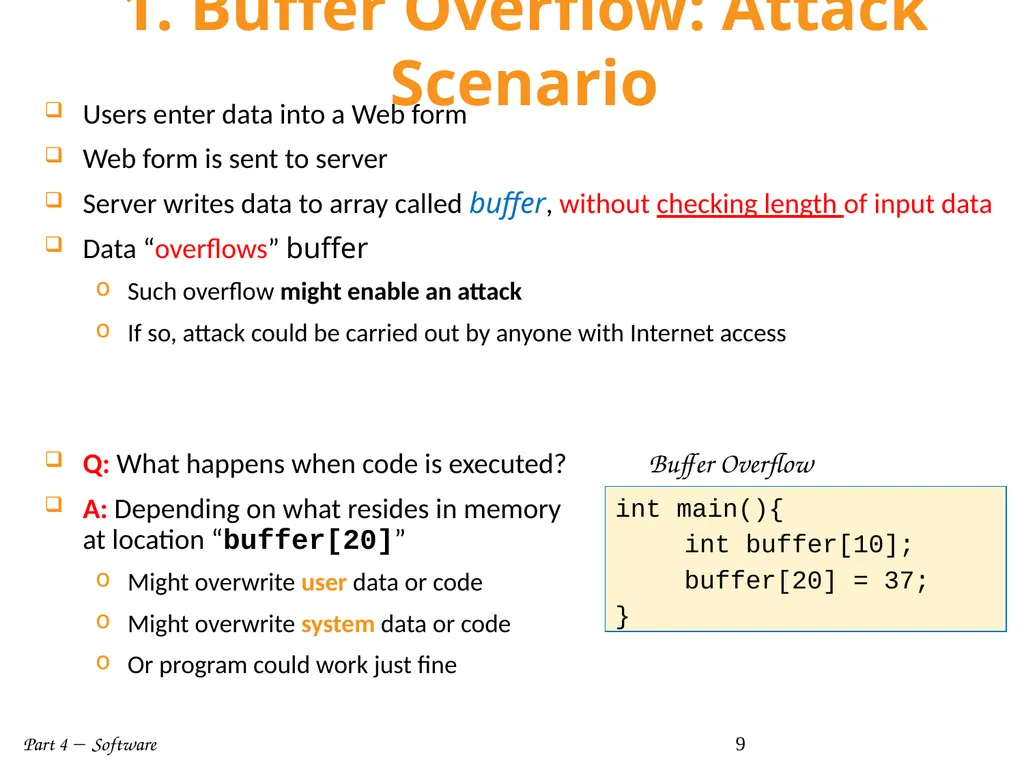
Part 4 Software 9 1. Buffer Overflow: Attack Scenario Users enter data into a Web form
Web form is sent to server
Server writes data to array called buffer, without checking length of input data
Data “overflows” buffer
Such overflow might enable an attack
If so, attack could be carried out by anyone with Internet access Q: What happens when code is executed?
A: Depending on what resides in memory at location “buffer[20]”
Might overwrite user data or code
Might overwrite system data or code
Or program could work just fine<br>
Web form is sent to server
Server writes data to array called buffer, without checking length of input data
Data “overflows” buffer
Such overflow might enable an attack
If so, attack could be carried out by anyone with Internet access Q: What happens when code is executed?
A: Depending on what resides in memory at location “buffer[20]”
Might overwrite user data or code
Might overwrite system data or code
Or program could work just fine<br>
10
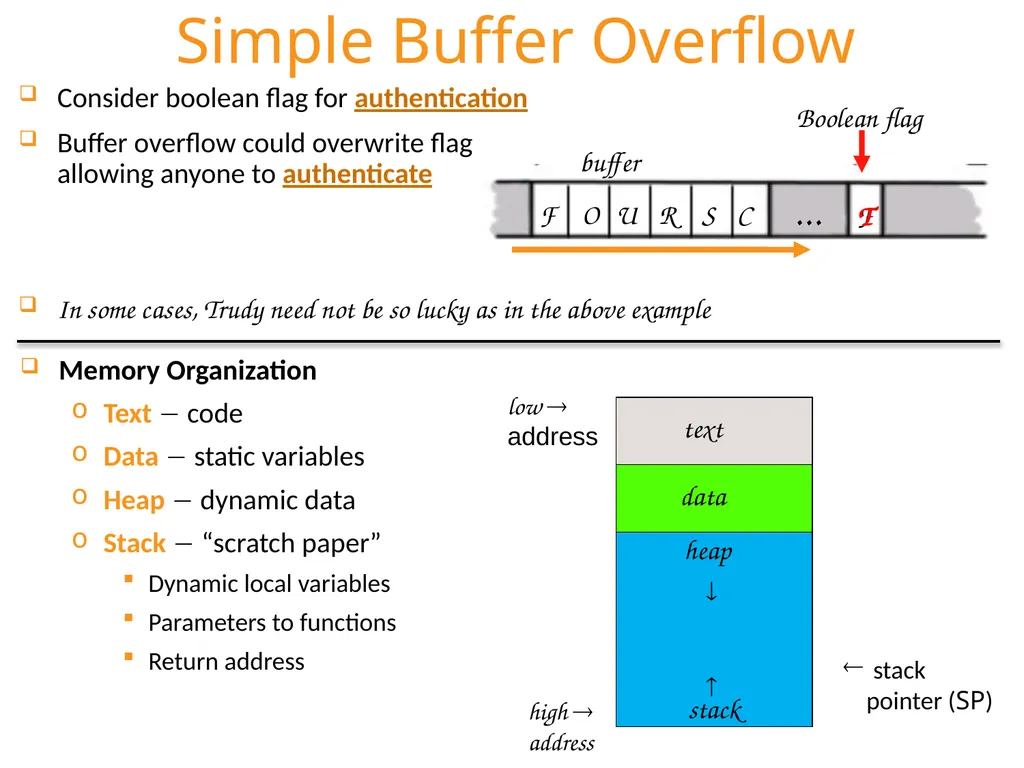
Simple Buffer Overflow Consider boolean flag for authentication
Buffer overflow could overwrite flag allowing anyone to authenticate buffer F T F O U R S C … Boolean flag In some cases, Trudy need not be so lucky as in the above example Memory Organization
Text code
Data static variables
Heap dynamic data
Stack “scratch paper”
Dynamic local variables
Parameters to functions
Return address<br>
Buffer overflow could overwrite flag allowing anyone to authenticate buffer F T F O U R S C … Boolean flag In some cases, Trudy need not be so lucky as in the above example Memory Organization
Text code
Data static variables
Heap dynamic data
Stack “scratch paper”
Dynamic local variables
Parameters to functions
Return address<br>
11
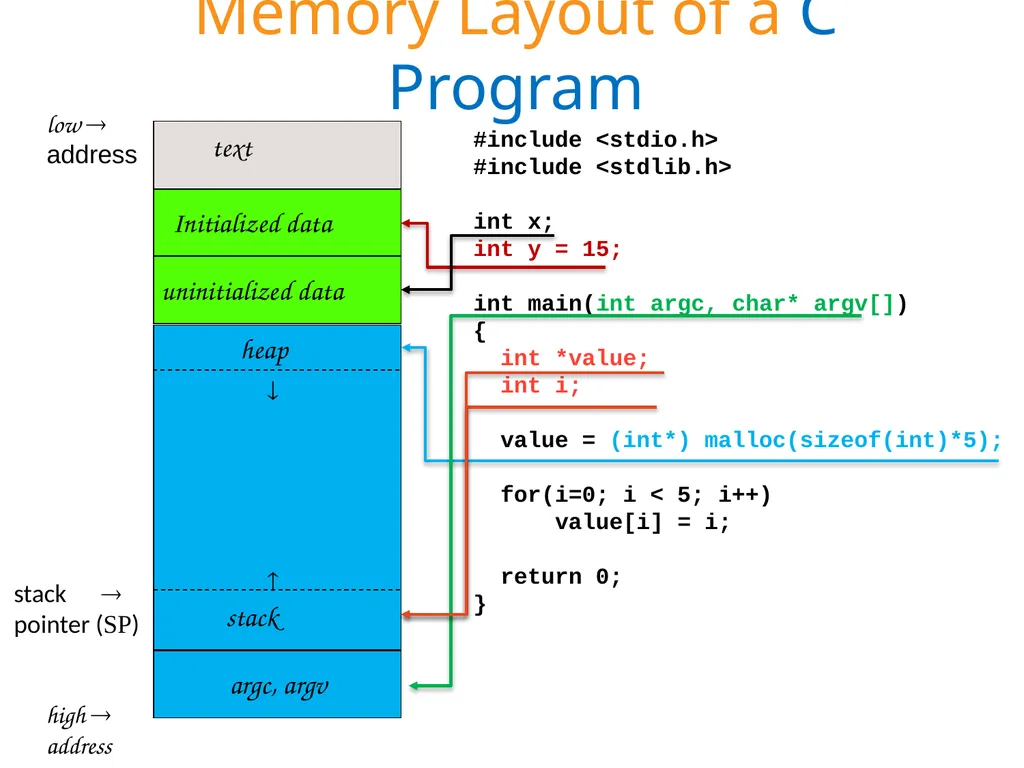
Memory Layout of a C Program stack heap
Initialized data text high
address low
address stack
pointer (SP) uninitialized data argc, argv #include <stdio.h>
#include <stdlib.h>
int x;
int y = 15;
int main(int argc, char* argv[])
{
int *value;
int i;
value = (int*) malloc(sizeof(int)*5);
for(i=0; i < 5; i++)
value[i] = i;
return 0;
}<br>
Initialized data text high
address low
address stack
pointer (SP) uninitialized data argc, argv #include <stdio.h>
#include <stdlib.h>
int x;
int y = 15;
int main(int argc, char* argv[])
{
int *value;
int i;
value = (int*) malloc(sizeof(int)*5);
for(i=0; i < 5; i++)
value[i] = i;
return 0;
}<br>
12
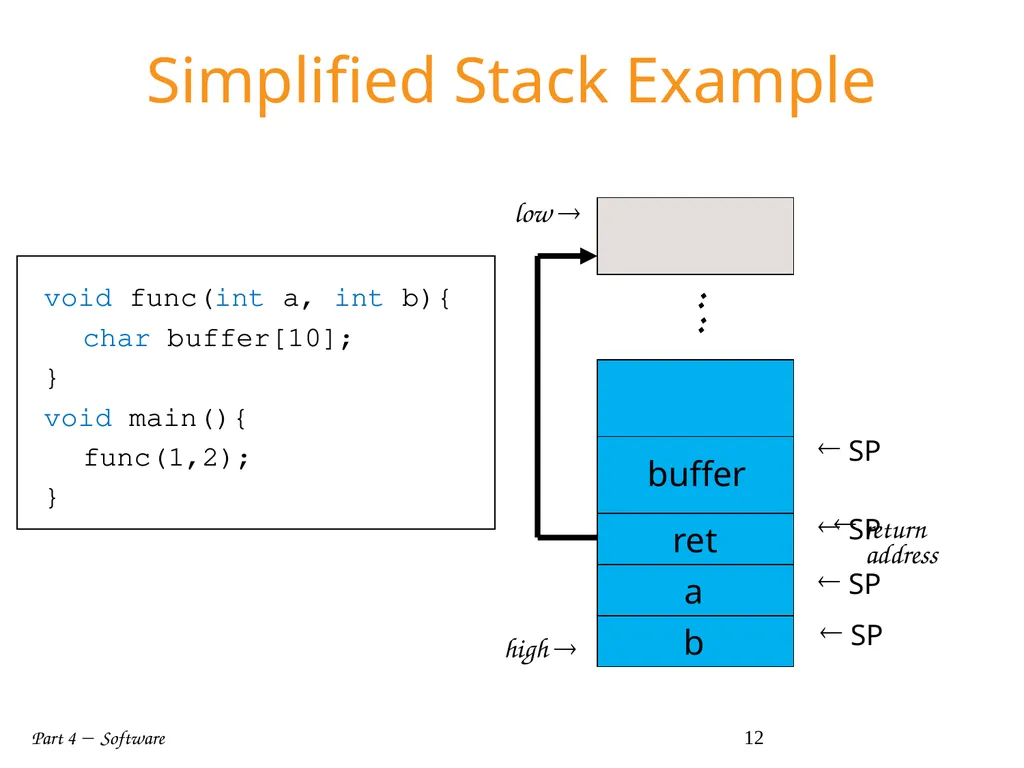
Part 4 Software 12 Simplified Stack Example high void func(int a, int b){
char buffer[10];
}
void main(){
func(1,2);
} :
: buffer ret a b return
address low SP SP SP SP<br>
char buffer[10];
}
void main(){
func(1,2);
} :
: buffer ret a b return
address low SP SP SP SP<br>
13
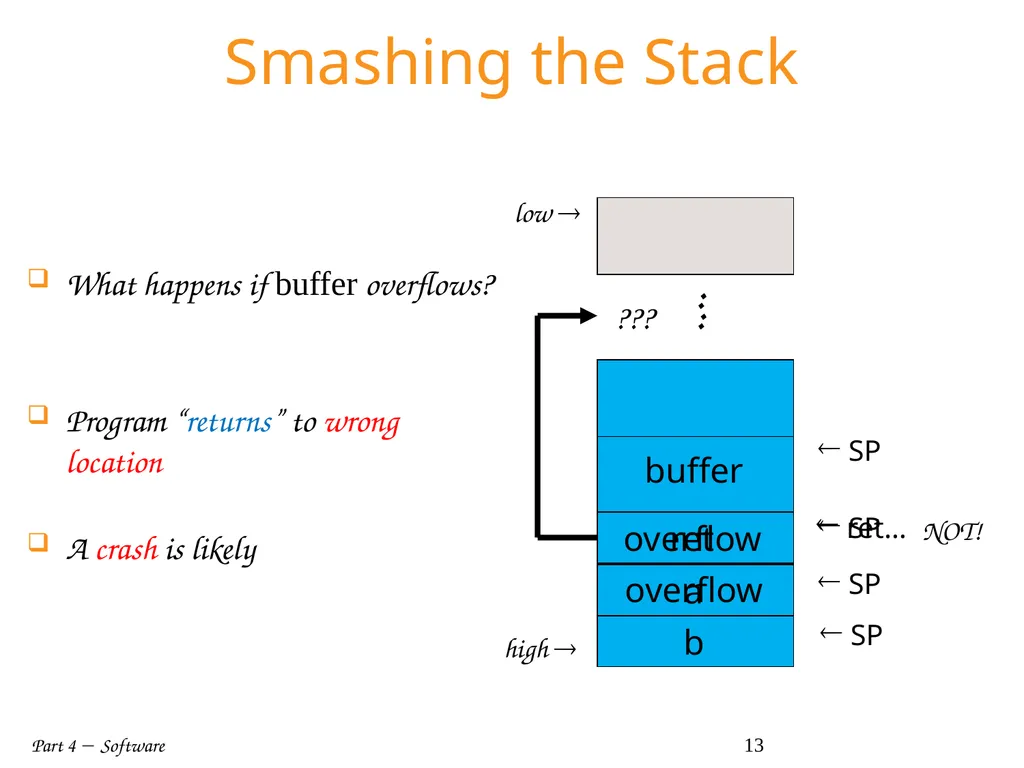
Part 4 Software 13 Smashing the Stack high What happens if buffer overflows? :
: buffer a b ret… low SP SP SP SP ret overflow Program “returns” to wrong location NOT! ??? A crash is likely overflow<br>
: buffer a b ret… low SP SP SP SP ret overflow Program “returns” to wrong location NOT! ??? A crash is likely overflow<br>
14
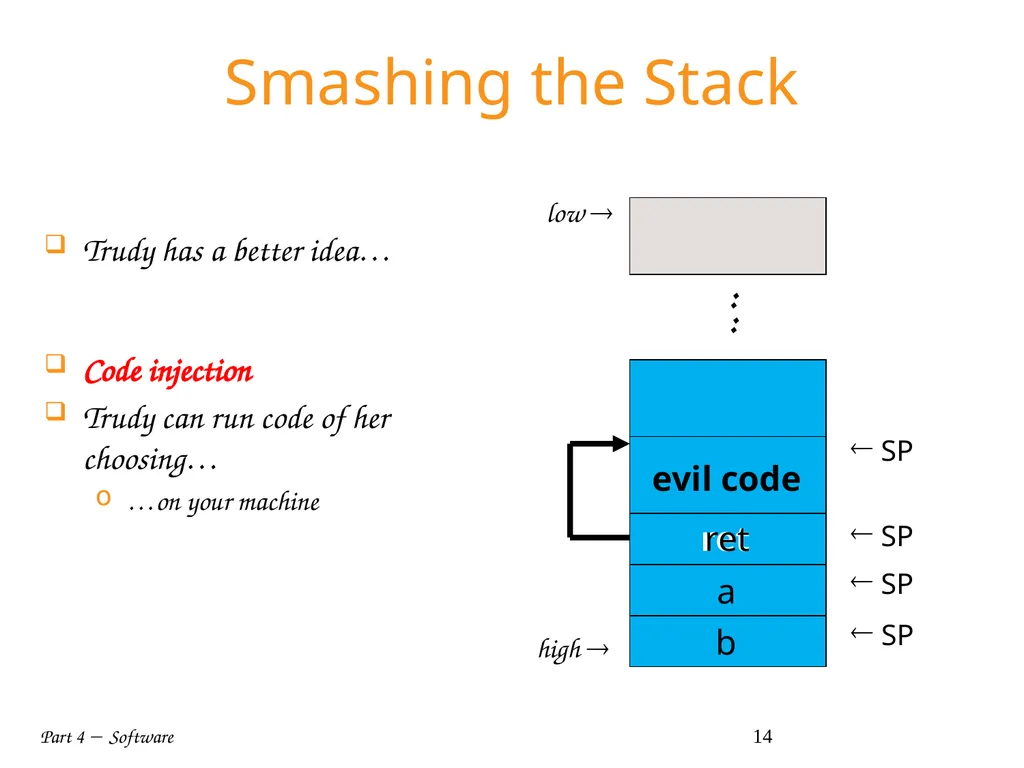
Part 4 Software 14 Smashing the Stack high Trudy has a better idea… :
: evil code a b low SP SP SP SP ret ret Code injection
Trudy can run code of her choosing…
…on your machine<br>
: evil code a b low SP SP SP SP ret ret Code injection
Trudy can run code of her choosing…
…on your machine<br>
15
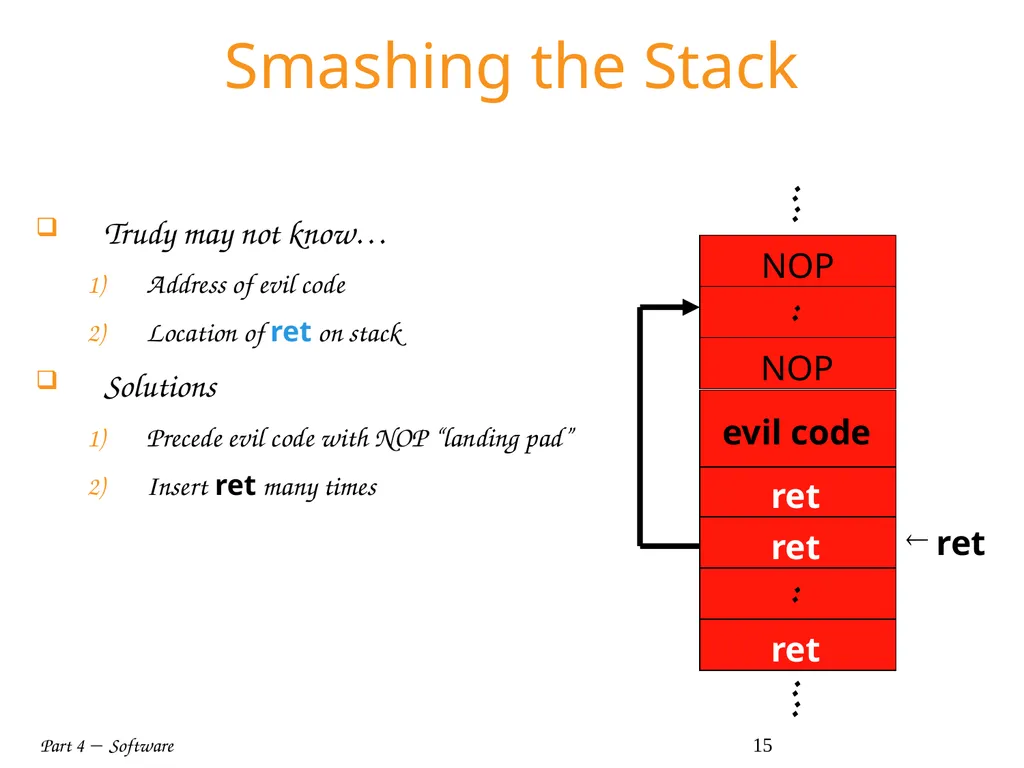
Part 4 Software 15 Smashing the Stack Trudy may not know…
Address of evil code
Location of ret on stack
Solutions
Precede evil code with NOP “landing pad”
Insert ret many times evil code :
: :
: ret ret : NOP NOP : ret ret<br>
Address of evil code
Location of ret on stack
Solutions
Precede evil code with NOP “landing pad”
Insert ret many times evil code :
: :
: ret ret : NOP NOP : ret ret<br>
16
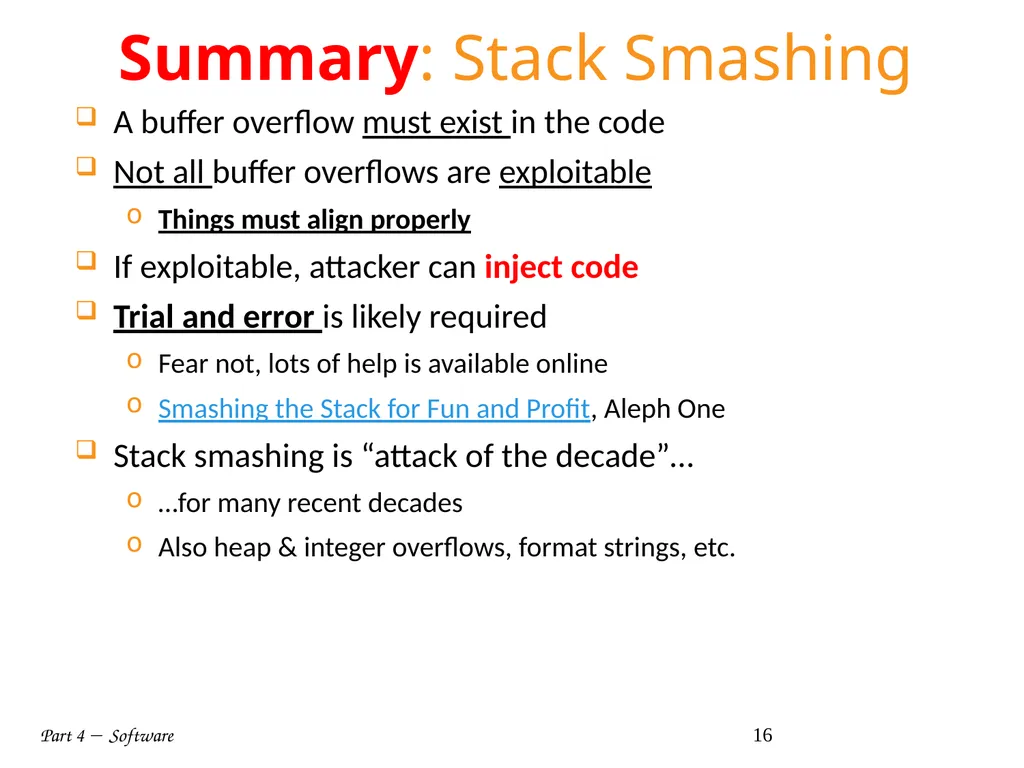
Part 4 Software 16 Summary: Stack Smashing A buffer overflow must exist in the code
Not all buffer overflows are exploitable
Things must align properly
If exploitable, attacker can inject code
Trial and error is likely required
Fear not, lots of help is available online
Smashing the Stack for Fun and Profit, Aleph One
Stack smashing is “attack of the decade”…
…for many recent decades
Also heap & integer overflows, format strings, etc.<br>
Not all buffer overflows are exploitable
Things must align properly
If exploitable, attacker can inject code
Trial and error is likely required
Fear not, lots of help is available online
Smashing the Stack for Fun and Profit, Aleph One
Stack smashing is “attack of the decade”…
…for many recent decades
Also heap & integer overflows, format strings, etc.<br>
17
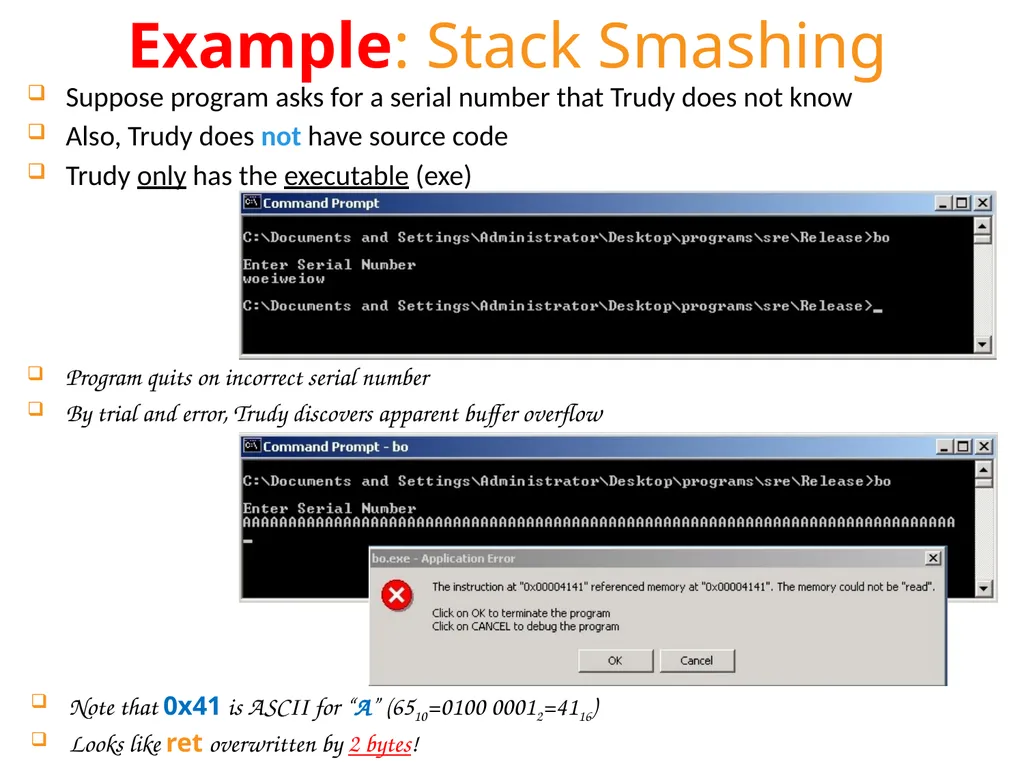
Example: Stack Smashing Suppose program asks for a serial number that Trudy does not know
Also, Trudy does not have source code
Trudy only has the executable (exe) Program quits on incorrect serial number By trial and error, Trudy discovers apparent buffer overflow Note that 0x41 is ASCII for “A” (6510=0100 00012=4116)
Looks like ret overwritten by 2 bytes!<br>
Also, Trudy does not have source code
Trudy only has the executable (exe) Program quits on incorrect serial number By trial and error, Trudy discovers apparent buffer overflow Note that 0x41 is ASCII for “A” (6510=0100 00012=4116)
Looks like ret overwritten by 2 bytes!<br>
18
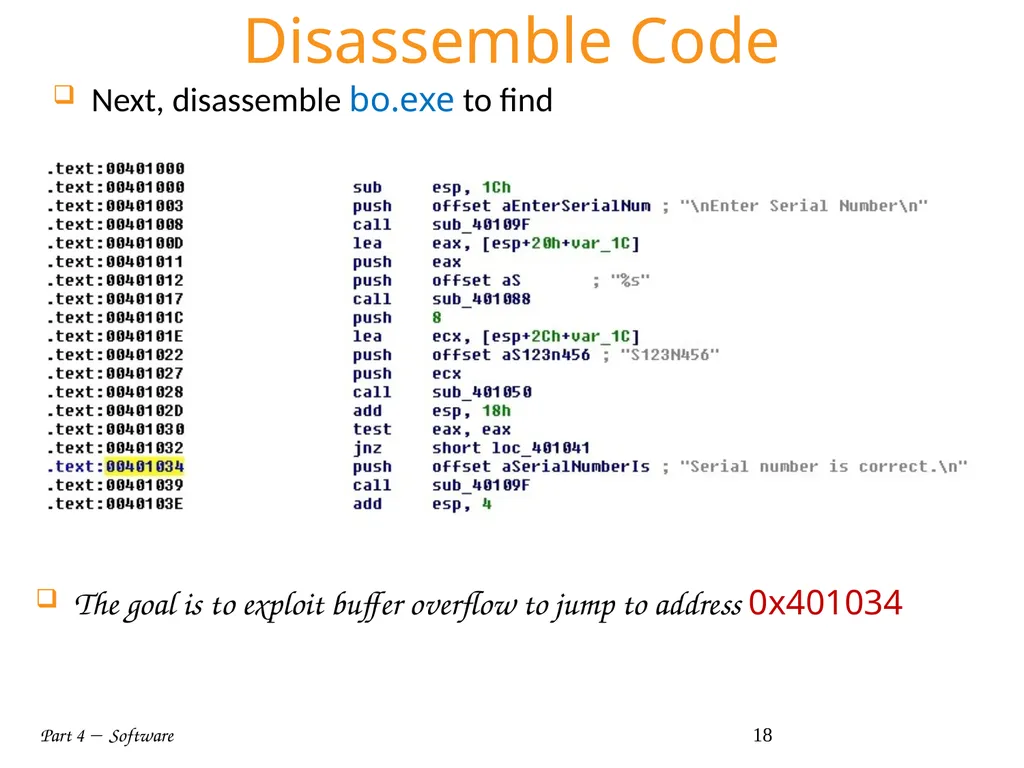
Part 4 Software 18 Disassemble Code Next, disassemble bo.exe to find The goal is to exploit buffer overflow to jump to address 0x401034<br>
19
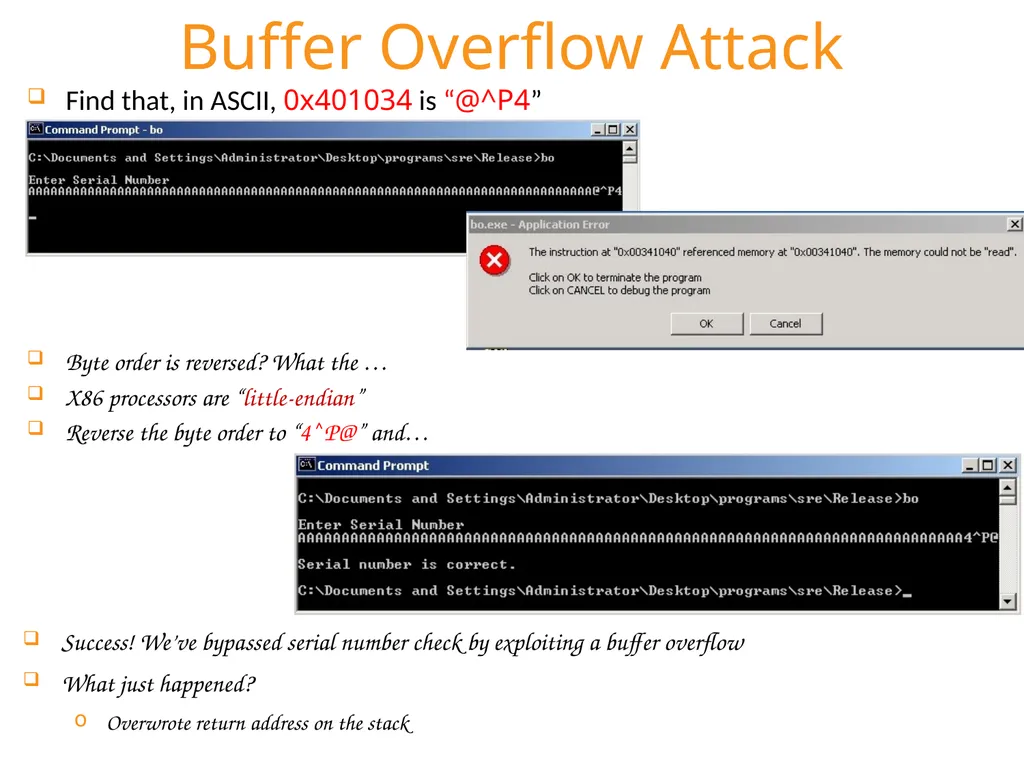
Buffer Overflow Attack Find that, in ASCII, 0x401034 is “@^P4” Byte order is reversed? What the …
X86 processors are “little-endian” Reverse the byte order to “4^P@” and… Success! We’ve bypassed serial number check by exploiting a buffer overflow
What just happened?
Overwrote return address on the stack<br>
X86 processors are “little-endian” Reverse the byte order to “4^P@” and… Success! We’ve bypassed serial number check by exploiting a buffer overflow
What just happened?
Overwrote return address on the stack<br>
20
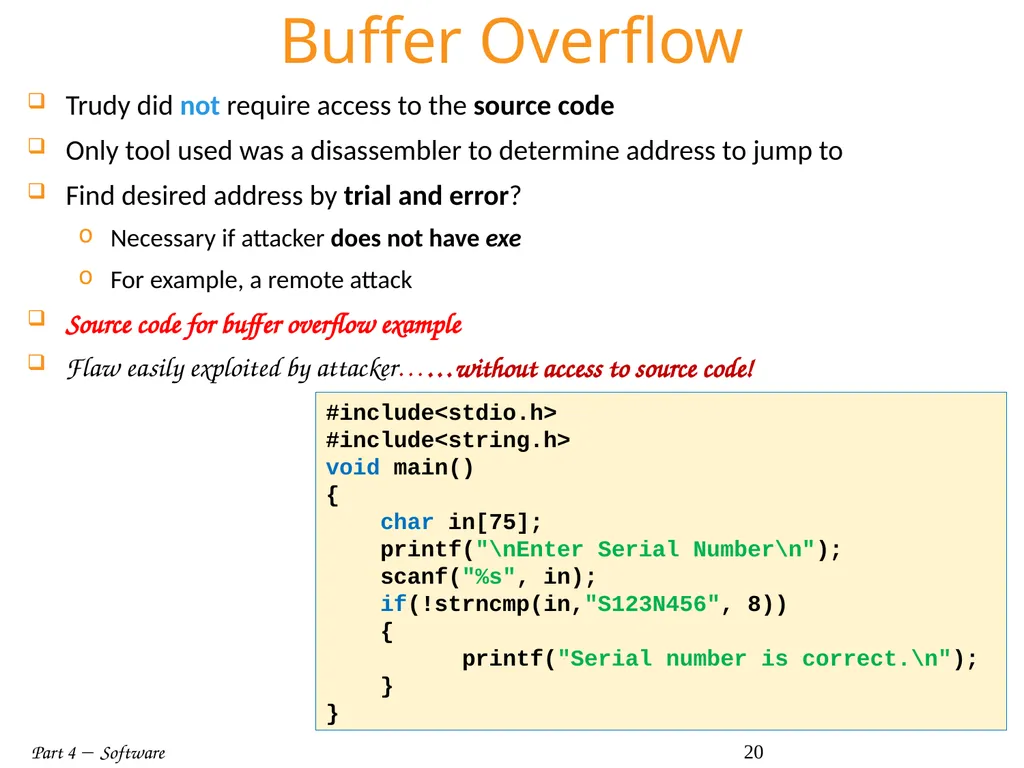
Part 4 Software 20 Buffer Overflow Trudy did not require access to the source code
Only tool used was a disassembler to determine address to jump to
Find desired address by trial and error?
Necessary if attacker does not have exe
For example, a remote attack Source code for buffer overflow example Flaw easily exploited by attacker……without access to source code! #include<stdio.h>
#include<string.h>
void main()
{
char in[75];
printf("\nEnter Serial Number\n");
scanf("%s", in);
if(!strncmp(in,"S123N456", 8))
{
printf("Serial number is correct.\n");
}
}<br>
Only tool used was a disassembler to determine address to jump to
Find desired address by trial and error?
Necessary if attacker does not have exe
For example, a remote attack Source code for buffer overflow example Flaw easily exploited by attacker……without access to source code! #include<stdio.h>
#include<string.h>
void main()
{
char in[75];
printf("\nEnter Serial Number\n");
scanf("%s", in);
if(!strncmp(in,"S123N456", 8))
{
printf("Serial number is correct.\n");
}
}<br>
21
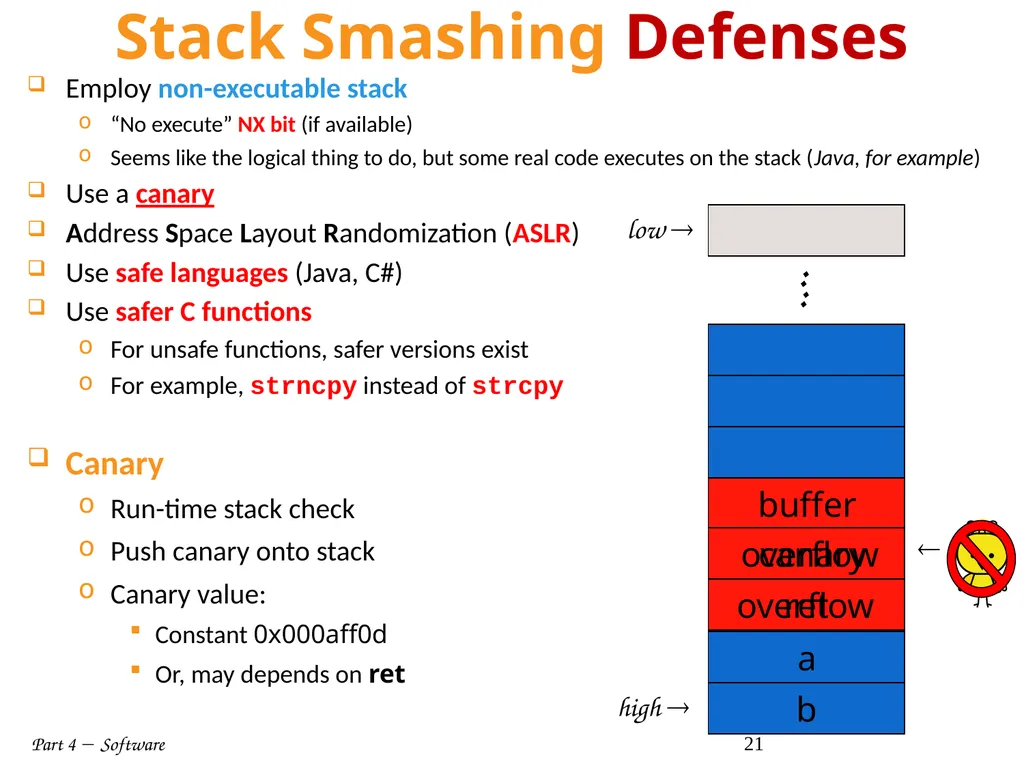
Part 4 Software 21 Stack Smashing Defenses Employ non-executable stack
“No execute” NX bit (if available)
Seems like the logical thing to do, but some real code executes on the stack (Java, for example)
Use a canary
Address Space Layout Randomization (ASLR)
Use safe languages (Java, C#)
Use safer C functions
For unsafe functions, safer versions exist
For example, strncpy instead of strcpy Canary
Run-time stack check
Push canary onto stack
Canary value:
Constant 0x000aff0d
Or, may depends on ret high :
: buffer a b low overflow ret canary overflow<br>
“No execute” NX bit (if available)
Seems like the logical thing to do, but some real code executes on the stack (Java, for example)
Use a canary
Address Space Layout Randomization (ASLR)
Use safe languages (Java, C#)
Use safer C functions
For unsafe functions, safer versions exist
For example, strncpy instead of strcpy Canary
Run-time stack check
Push canary onto stack
Canary value:
Constant 0x000aff0d
Or, may depends on ret high :
: buffer a b low overflow ret canary overflow<br>
22
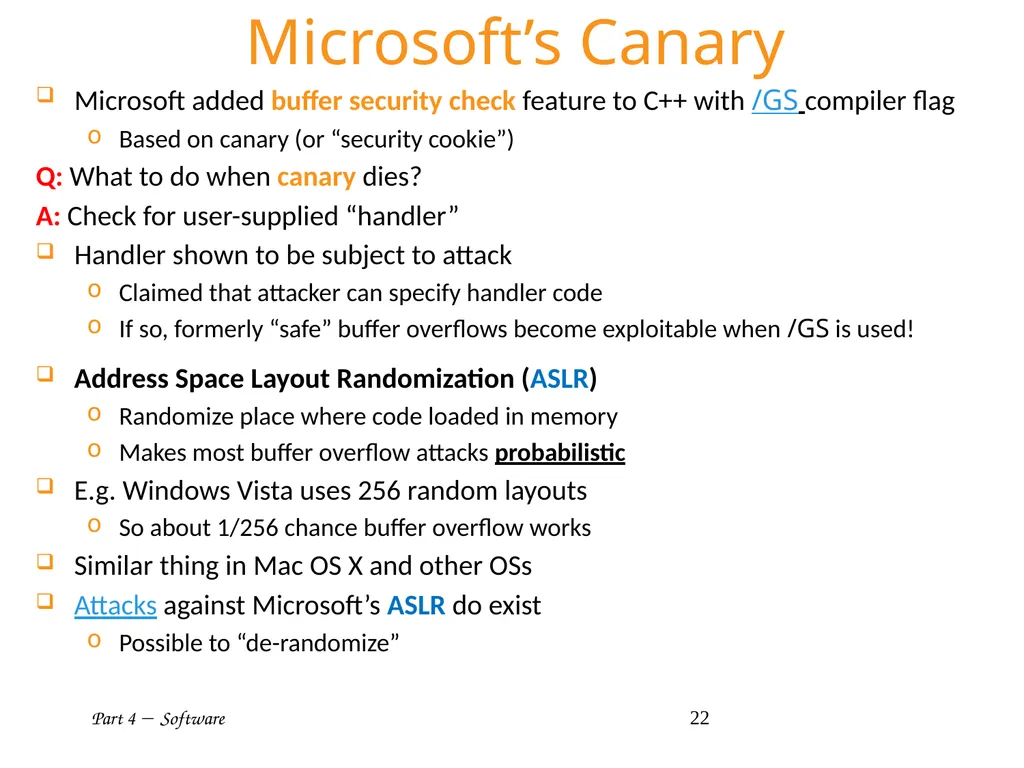
Part 4 Software 22 Microsoft’s Canary Microsoft added buffer security check feature to C++ with /GS compiler flag
Based on canary (or “security cookie”)
Q: What to do when canary dies?
A: Check for user-supplied “handler”
Handler shown to be subject to attack
Claimed that attacker can specify handler code
If so, formerly “safe” buffer overflows become exploitable when /GS is used! Address Space Layout Randomization (ASLR)
Randomize place where code loaded in memory
Makes most buffer overflow attacks probabilistic
E.g. Windows Vista uses 256 random layouts
So about 1/256 chance buffer overflow works
Similar thing in Mac OS X and other OSs
Attacks against Microsoft’s ASLR do exist
Possible to “de-randomize”<br>
Based on canary (or “security cookie”)
Q: What to do when canary dies?
A: Check for user-supplied “handler”
Handler shown to be subject to attack
Claimed that attacker can specify handler code
If so, formerly “safe” buffer overflows become exploitable when /GS is used! Address Space Layout Randomization (ASLR)
Randomize place where code loaded in memory
Makes most buffer overflow attacks probabilistic
E.g. Windows Vista uses 256 random layouts
So about 1/256 chance buffer overflow works
Similar thing in Mac OS X and other OSs
Attacks against Microsoft’s ASLR do exist
Possible to “de-randomize”<br>
23
Part 4 Software 23 Summary: Buffer Overflow A major security threat yesterday, today, and tomorrow
The good news?
It is possible to reduce overflow attacks
safe languages
NX bit
ASLR
education
etc.
The bad news?
Buffer overflows will exist for a long time
Why?
Legacy code,
bad development practices,
clever attacks,
etc.<br>
The good news?
It is possible to reduce overflow attacks
safe languages
NX bit
ASLR
education
etc.
The bad news?
Buffer overflows will exist for a long time
Why?
Legacy code,
bad development practices,
clever attacks,
etc.<br>
24
Part 4 Software 24 2. Incomplete Mediation<br>
25
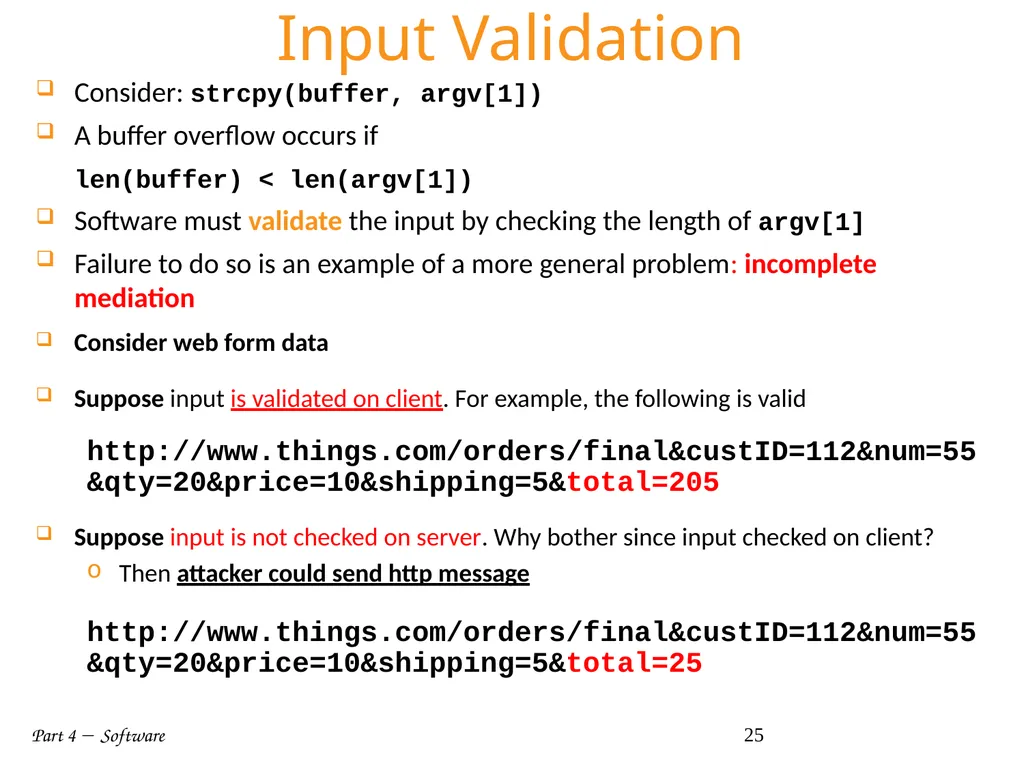
Part 4 Software 25 Input Validation Consider: strcpy(buffer, argv[1])
A buffer overflow occurs if
len(buffer) < len(argv[1])
Software must validate the input by checking the length of argv[1]
Failure to do so is an example of a more general problem: incomplete mediation Consider web form data
Suppose input is validated on client. For example, the following is valid
http://www.things.com/orders/final&custID=112&num=55 &qty=20&price=10&shipping=5&total=205
Suppose input is not checked on server. Why bother since input checked on client?
Then attacker could send http message
http://www.things.com/orders/final&custID=112&num=55 &qty=20&price=10&shipping=5&total=25<br>
A buffer overflow occurs if
len(buffer) < len(argv[1])
Software must validate the input by checking the length of argv[1]
Failure to do so is an example of a more general problem: incomplete mediation Consider web form data
Suppose input is validated on client. For example, the following is valid
http://www.things.com/orders/final&custID=112&num=55 &qty=20&price=10&shipping=5&total=205
Suppose input is not checked on server. Why bother since input checked on client?
Then attacker could send http message
http://www.things.com/orders/final&custID=112&num=55 &qty=20&price=10&shipping=5&total=25<br>
26
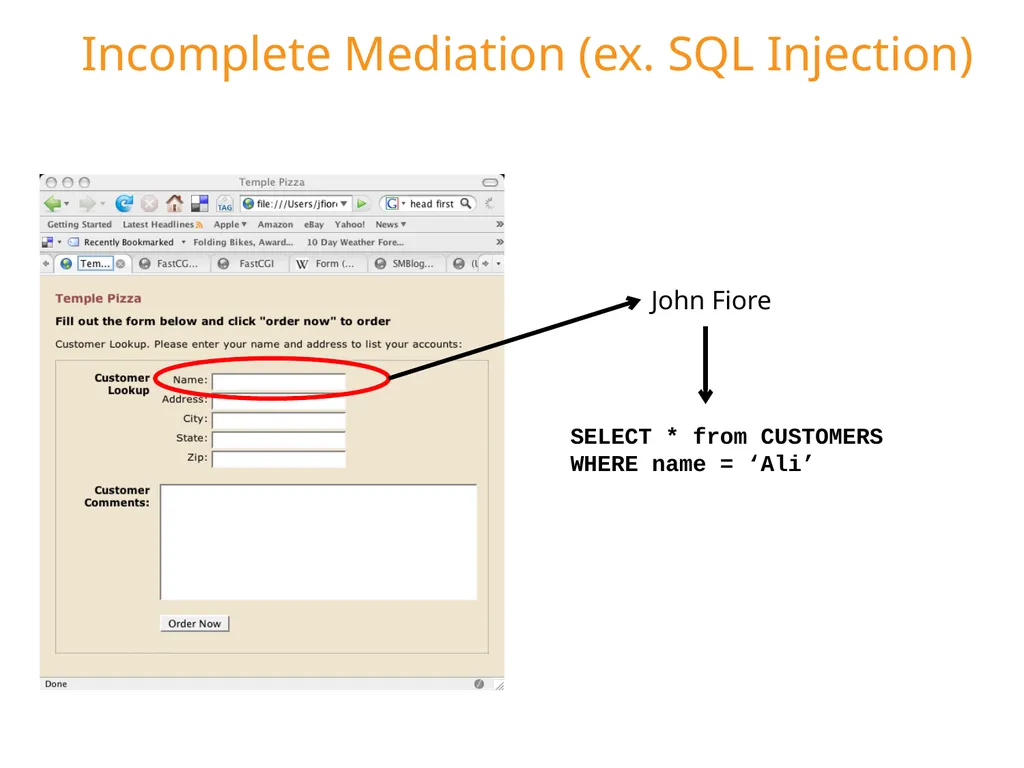
Incomplete Mediation (ex. SQL Injection) John Fiore SELECT * from CUSTOMERS
WHERE name = ‘Ali’<br>
WHERE name = ‘Ali’<br>
27
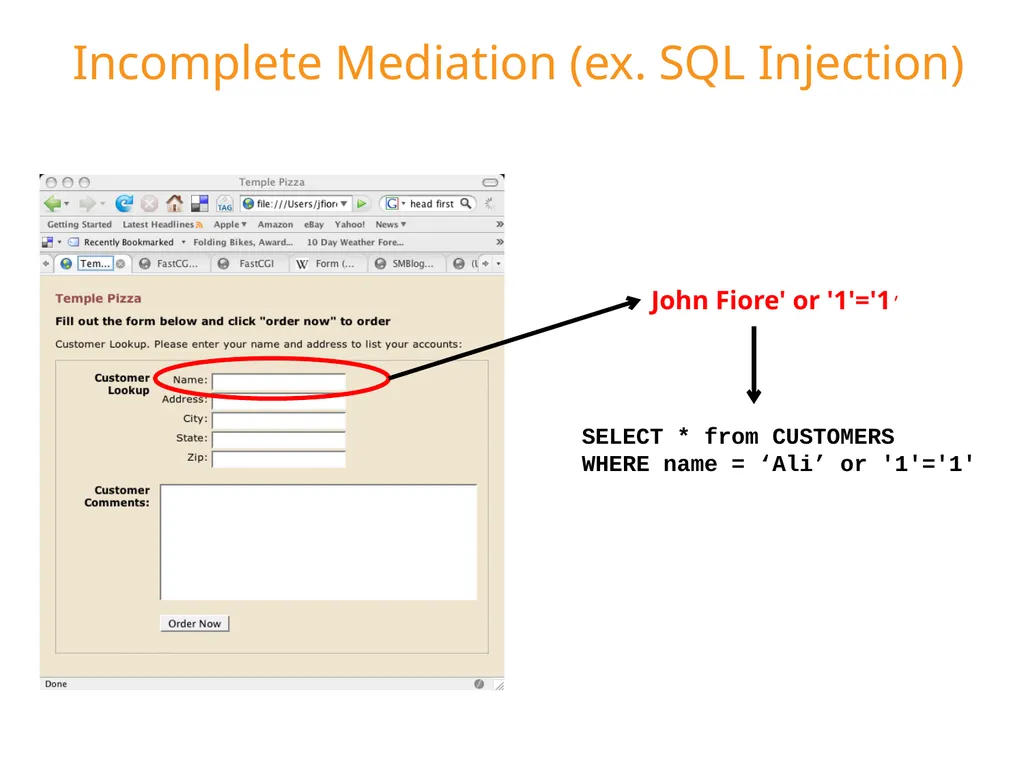
Incomplete Mediation (ex. SQL Injection) John Fiore' or '1'='1' SELECT * from CUSTOMERS
WHERE name = ‘Ali’ or '1'='1'<br>
WHERE name = ‘Ali’ or '1'='1'<br>
28
Part 4 Software 28 3. Race Conditions Security processes should be atomic
Occur “all at once”
Race conditions can arise when security-critical process occurs in stages
The term race condition refers to a "race" between the attacker and the next stage of the process
Attacker makes change between stages
Often, between stage that gives authorization, but before stage that transfers ownership
Example: Unix mkdir
The outdated version of the Unix command mkdir, which creates a new directory
Thus, the directory is created in stages—
there is a stage that determines authorization
followed by a stage that transfers ownership<br>
Occur “all at once”
Race conditions can arise when security-critical process occurs in stages
The term race condition refers to a "race" between the attacker and the next stage of the process
Attacker makes change between stages
Often, between stage that gives authorization, but before stage that transfers ownership
Example: Unix mkdir
The outdated version of the Unix command mkdir, which creates a new directory
Thus, the directory is created in stages—
there is a stage that determines authorization
followed by a stage that transfers ownership<br>
29
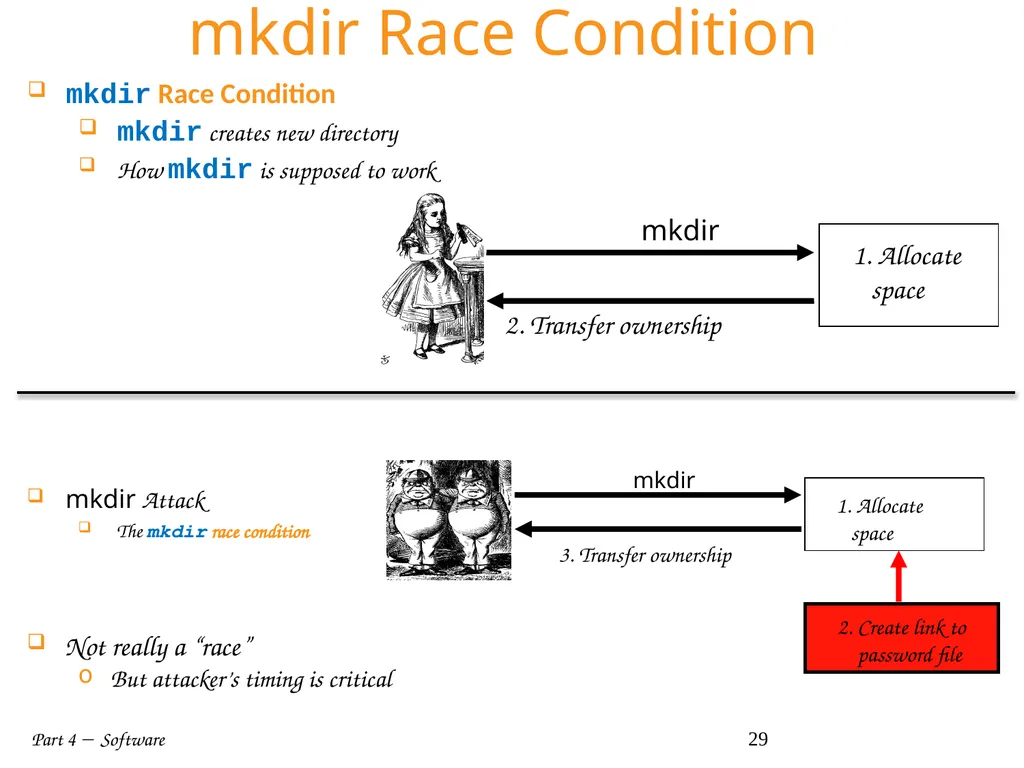
Part 4 Software 29 Not really a “race”
But attacker’s timing is critical 1. Allocate
space mkdir 3. Transfer ownership 2. Create link to
password file mkdir Attack
The mkdir race condition mkdir Race Condition 1. Allocate
space mkdir 2. Transfer ownership mkdir Race Condition
mkdir creates new directory
How mkdir is supposed to work<br>
But attacker’s timing is critical 1. Allocate
space mkdir 3. Transfer ownership 2. Create link to
password file mkdir Attack
The mkdir race condition mkdir Race Condition 1. Allocate
space mkdir 2. Transfer ownership mkdir Race Condition
mkdir creates new directory
How mkdir is supposed to work<br>
30
Part 4 Software 30 Race Conditions Race conditions are common
Race conditions may be more prevalent than buffer overflows
But race conditions harder to exploit
Buffer overflow is “low hanging fruit” today
To prevent race conditions, make security-critical processes atomic
Occur all at once, not in stages
Not always easy to accomplish in practice<br>
Race conditions may be more prevalent than buffer overflows
But race conditions harder to exploit
Buffer overflow is “low hanging fruit” today
To prevent race conditions, make security-critical processes atomic
Occur all at once, not in stages
Not always easy to accomplish in practice<br>
31
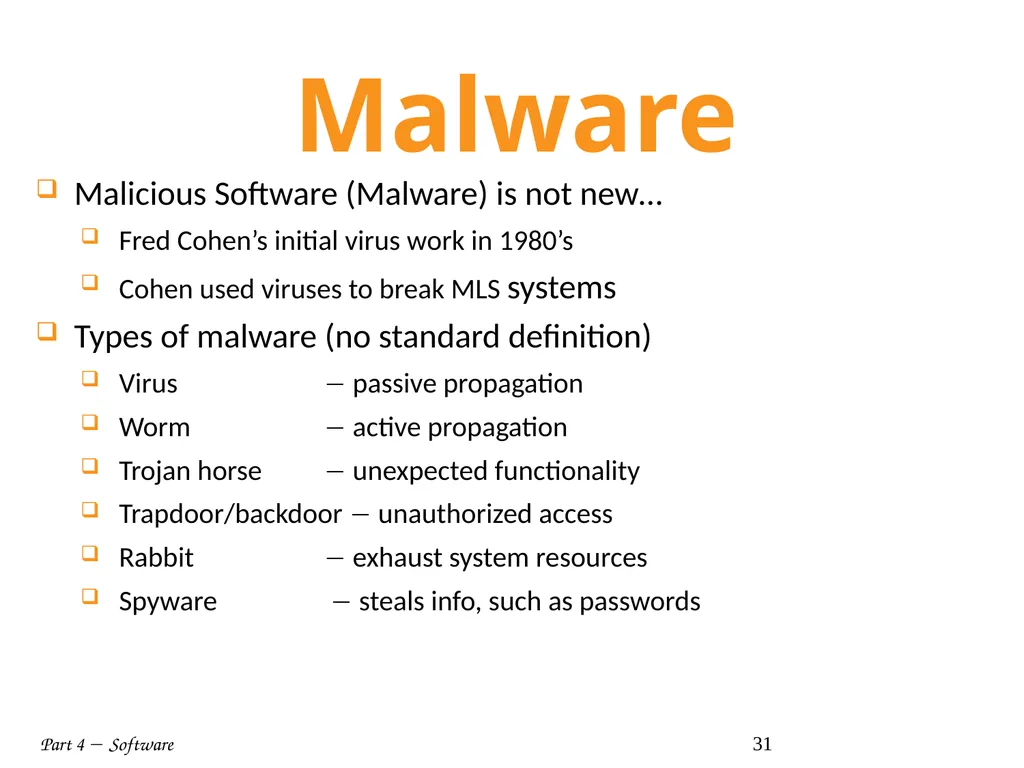
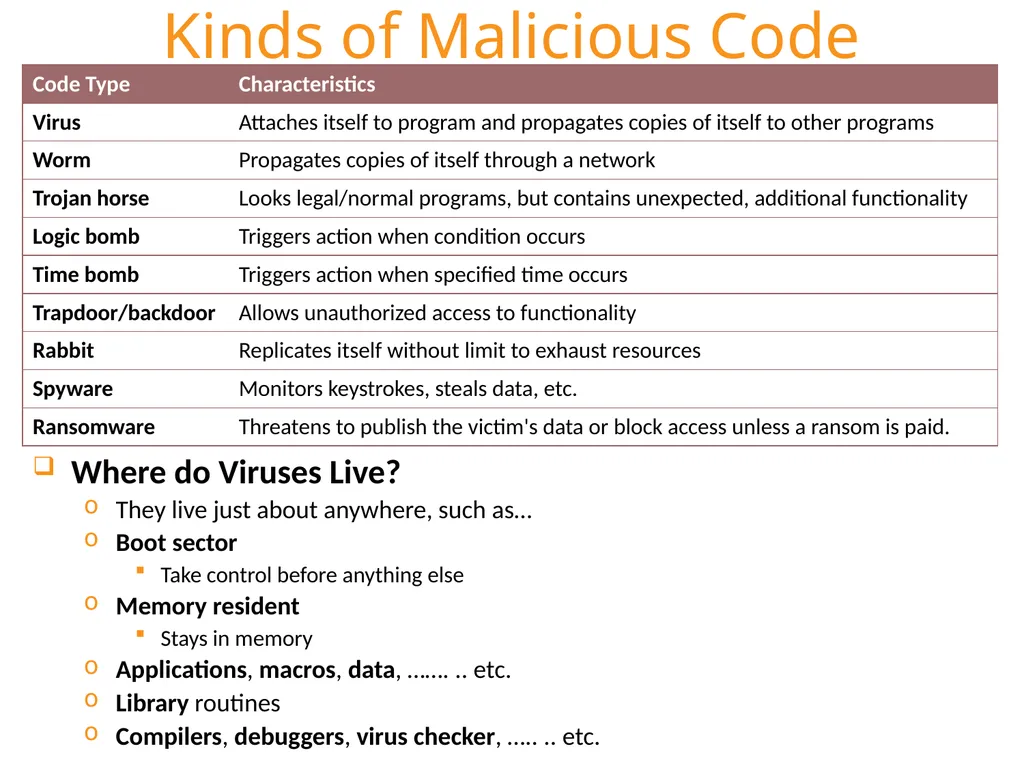
Part 4 Software 31 Malware Malicious Software (Malware) is not new…
Fred Cohen’s initial virus work in 1980’s
Cohen used viruses to break MLS systems
Types of malware (no standard definition)
Virus passive propagation
Worm active propagation
Trojan horse unexpected functionality
Trapdoor/backdoor unauthorized access
Rabbit exhaust system resources
Spyware steals info, such as passwords<br>
Fred Cohen’s initial virus work in 1980’s
Cohen used viruses to break MLS systems
Types of malware (no standard definition)
Virus passive propagation
Worm active propagation
Trojan horse unexpected functionality
Trapdoor/backdoor unauthorized access
Rabbit exhaust system resources
Spyware steals info, such as passwords<br>
32
Kinds of Malicious Code Where do Viruses Live?
They live just about anywhere, such as…
Boot sector
Take control before anything else
Memory resident
Stays in memory
Applications, macros, data, ……. .. etc.
Library routines
Compilers, debuggers, virus checker, ….. .. etc.<br>
They live just about anywhere, such as…
Boot sector
Take control before anything else
Memory resident
Stays in memory
Applications, macros, data, ……. .. etc.
Library routines
Compilers, debuggers, virus checker, ….. .. etc.<br>
33
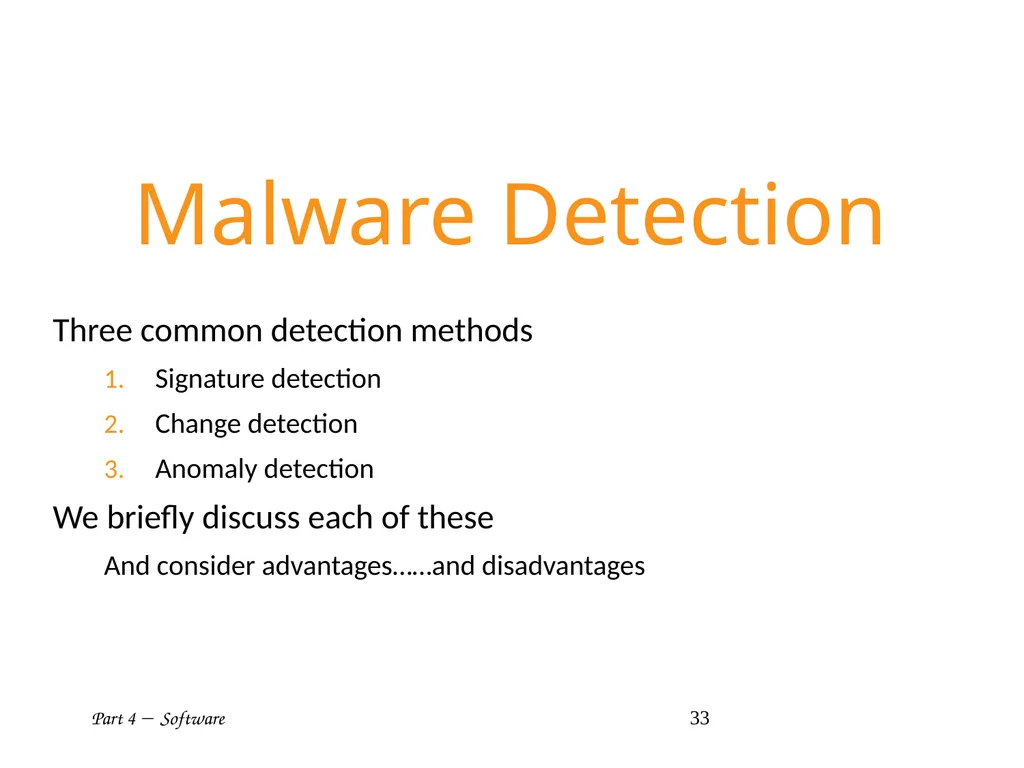
Malware Detection Three common detection methods
Signature detection
Change detection
Anomaly detection
We briefly discuss each of these
And consider advantages……and disadvantages Part 4 Software 33<br>
Signature detection
Change detection
Anomaly detection
We briefly discuss each of these
And consider advantages……and disadvantages Part 4 Software 33<br>
34
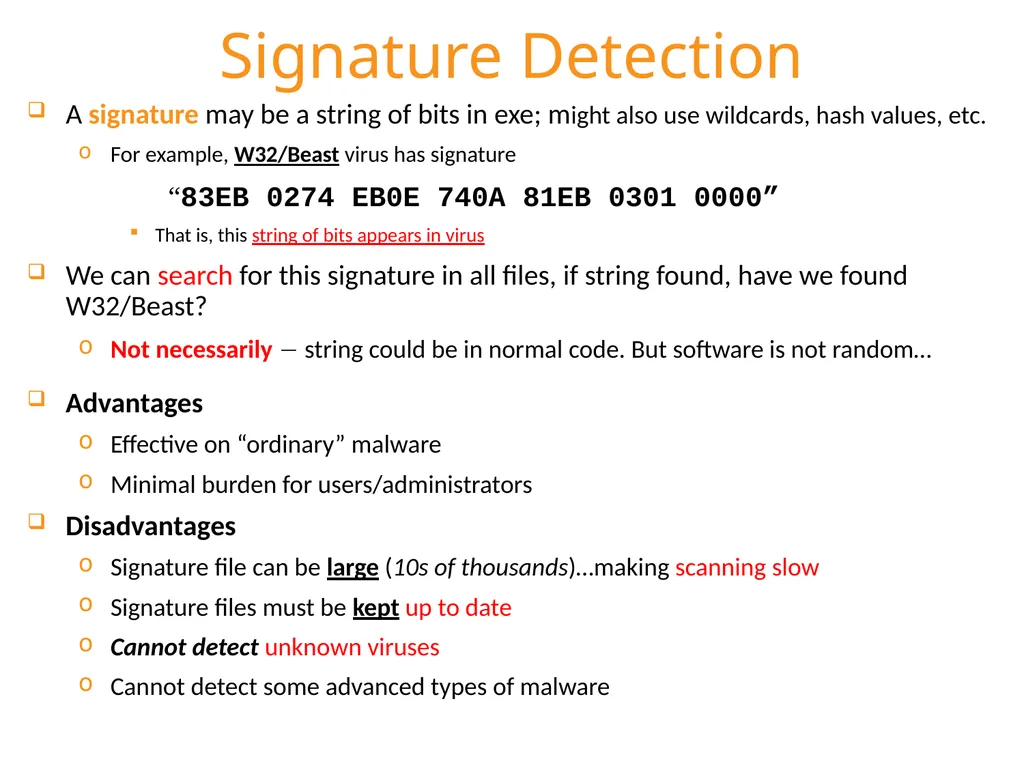
Signature Detection A signature may be a string of bits in exe; might also use wildcards, hash values, etc.
For example, W32/Beast virus has signature
“83EB 0274 EB0E 740A 81EB 0301 0000”
That is, this string of bits appears in virus
We can search for this signature in all files, if string found, have we found W32/Beast?
Not necessarily string could be in normal code. But software is not random… Advantages
Effective on “ordinary” malware
Minimal burden for users/administrators
Disadvantages
Signature file can be large (10s of thousands)…making scanning slow
Signature files must be kept up to date
Cannot detect unknown viruses
Cannot detect some advanced types of malware<br>
For example, W32/Beast virus has signature
“83EB 0274 EB0E 740A 81EB 0301 0000”
That is, this string of bits appears in virus
We can search for this signature in all files, if string found, have we found W32/Beast?
Not necessarily string could be in normal code. But software is not random… Advantages
Effective on “ordinary” malware
Minimal burden for users/administrators
Disadvantages
Signature file can be large (10s of thousands)…making scanning slow
Signature files must be kept up to date
Cannot detect unknown viruses
Cannot detect some advanced types of malware<br>
35
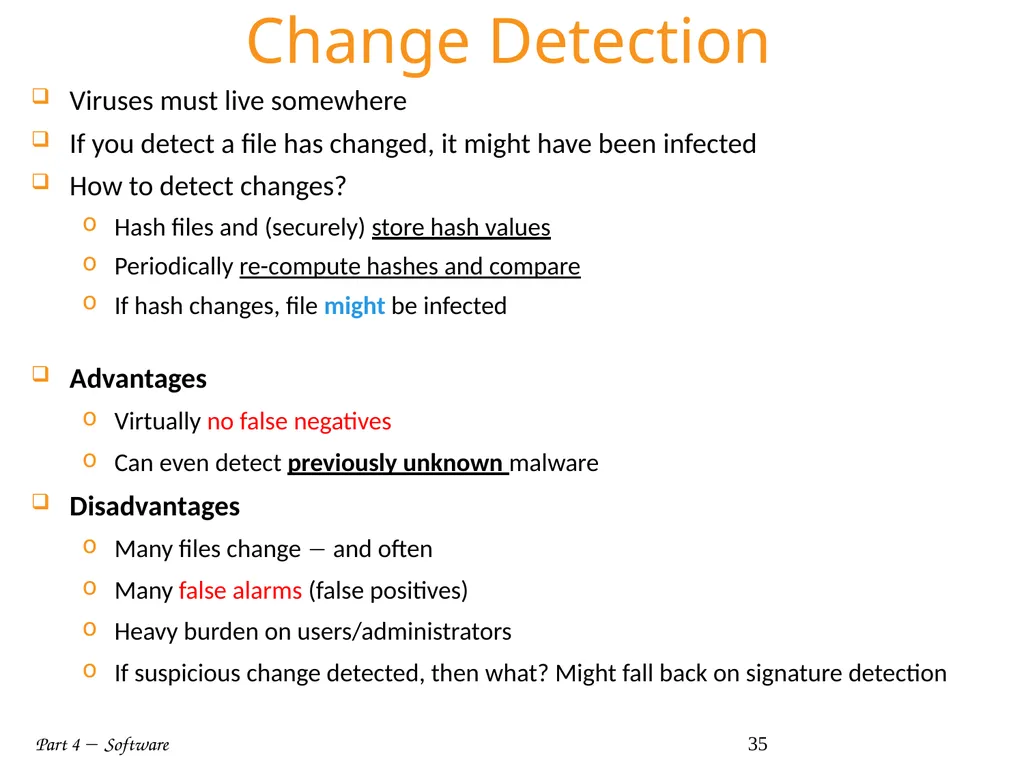
Part 4 Software 35 Change Detection Viruses must live somewhere
If you detect a file has changed, it might have been infected
How to detect changes?
Hash files and (securely) store hash values
Periodically re-compute hashes and compare
If hash changes, file might be infected Advantages
Virtually no false negatives
Can even detect previously unknown malware
Disadvantages
Many files change and often
Many false alarms (false positives)
Heavy burden on users/administrators
If suspicious change detected, then what? Might fall back on signature detection<br>
If you detect a file has changed, it might have been infected
How to detect changes?
Hash files and (securely) store hash values
Periodically re-compute hashes and compare
If hash changes, file might be infected Advantages
Virtually no false negatives
Can even detect previously unknown malware
Disadvantages
Many files change and often
Many false alarms (false positives)
Heavy burden on users/administrators
If suspicious change detected, then what? Might fall back on signature detection<br>
36
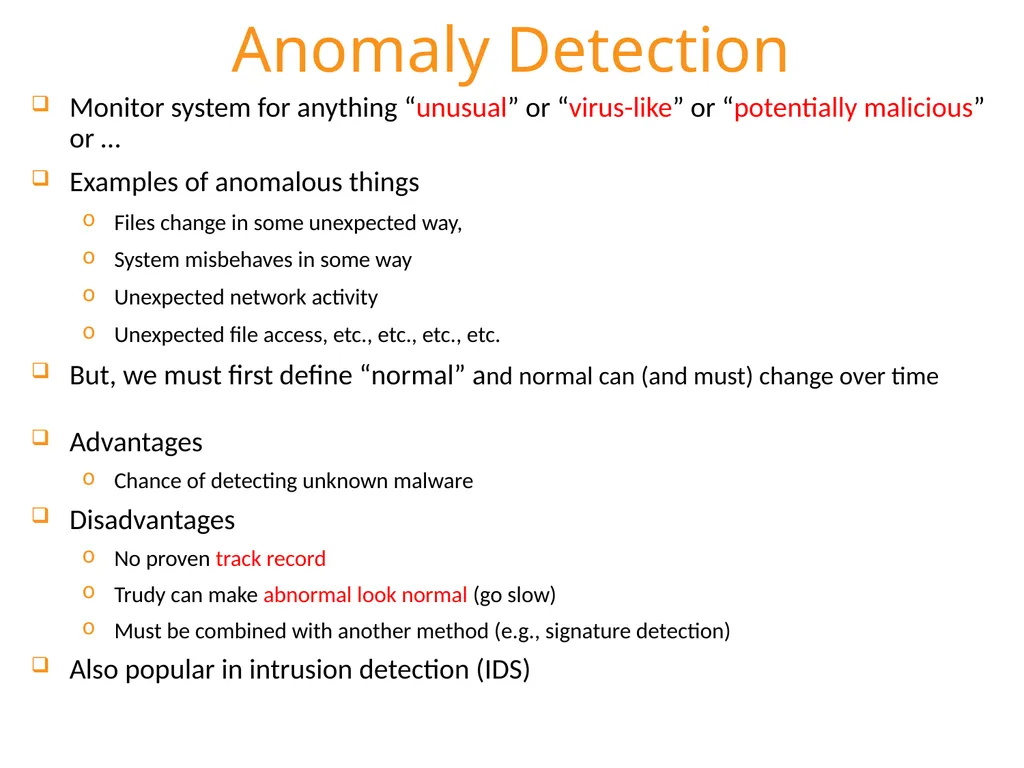
Anomaly Detection Monitor system for anything “unusual” or “virus-like” or “potentially malicious” or …
Examples of anomalous things
Files change in some unexpected way,
System misbehaves in some way
Unexpected network activity
Unexpected file access, etc., etc., etc., etc.
But, we must first define “normal” and normal can (and must) change over time Advantages
Chance of detecting unknown malware
Disadvantages
No proven track record
Trudy can make abnormal look normal (go slow)
Must be combined with another method (e.g., signature detection)
Also popular in intrusion detection (IDS)<br>
Examples of anomalous things
Files change in some unexpected way,
System misbehaves in some way
Unexpected network activity
Unexpected file access, etc., etc., etc., etc.
But, we must first define “normal” and normal can (and must) change over time Advantages
Chance of detecting unknown malware
Disadvantages
No proven track record
Trudy can make abnormal look normal (go slow)
Must be combined with another method (e.g., signature detection)
Also popular in intrusion detection (IDS)<br>
37
Part 4 Software 37 Miscellaneous Software-Based Attacks<br>
38
Part 4 Software 38 Miscellaneous Attacks Numerous attacks involve software
We’ll discuss a few issues that do not fit into previous categories
Salami attack
Linearization attack
Time bomb
Can you ever trust software?<br>
We’ll discuss a few issues that do not fit into previous categories
Salami attack
Linearization attack
Time bomb
Can you ever trust software?<br>
39
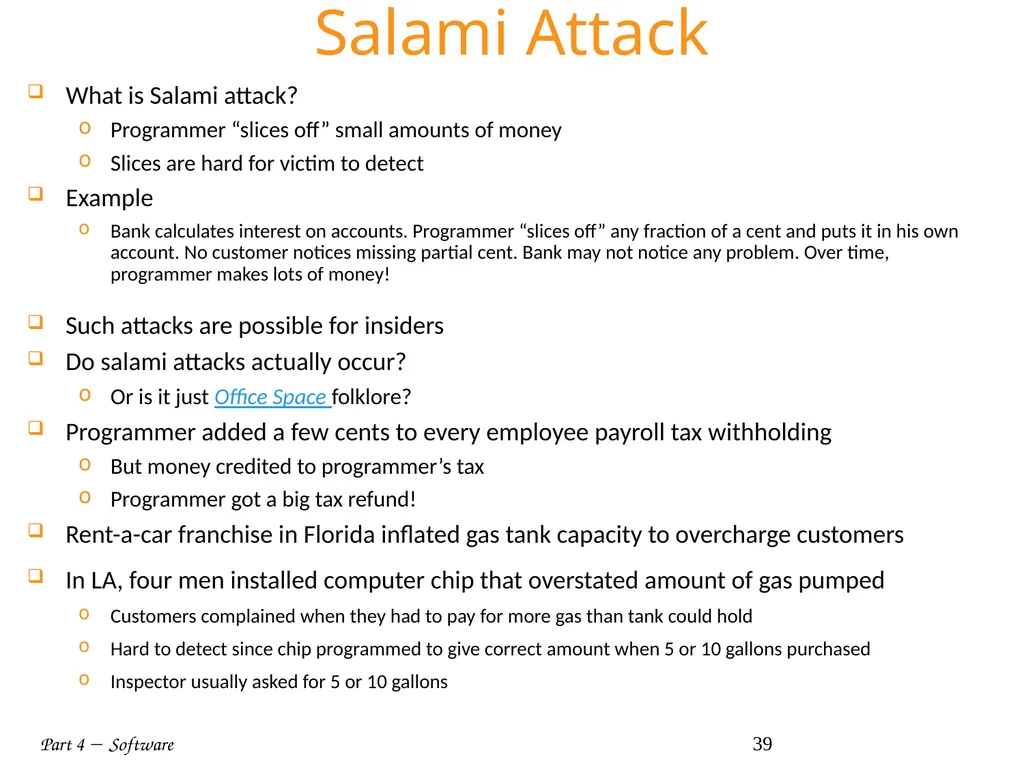
Part 4 Software 39 Salami Attack What is Salami attack?
Programmer “slices off” small amounts of money
Slices are hard for victim to detect
Example
Bank calculates interest on accounts. Programmer “slices off” any fraction of a cent and puts it in his own account. No customer notices missing partial cent. Bank may not notice any problem. Over time, programmer makes lots of money! Such attacks are possible for insiders
Do salami attacks actually occur?
Or is it just Office Space folklore?
Programmer added a few cents to every employee payroll tax withholding
But money credited to programmer’s tax
Programmer got a big tax refund!
Rent-a-car franchise in Florida inflated gas tank capacity to overcharge customers In LA, four men installed computer chip that overstated amount of gas pumped
Customers complained when they had to pay for more gas than tank could hold
Hard to detect since chip programmed to give correct amount when 5 or 10 gallons purchased
Inspector usually asked for 5 or 10 gallons<br>
Programmer “slices off” small amounts of money
Slices are hard for victim to detect
Example
Bank calculates interest on accounts. Programmer “slices off” any fraction of a cent and puts it in his own account. No customer notices missing partial cent. Bank may not notice any problem. Over time, programmer makes lots of money! Such attacks are possible for insiders
Do salami attacks actually occur?
Or is it just Office Space folklore?
Programmer added a few cents to every employee payroll tax withholding
But money credited to programmer’s tax
Programmer got a big tax refund!
Rent-a-car franchise in Florida inflated gas tank capacity to overcharge customers In LA, four men installed computer chip that overstated amount of gas pumped
Customers complained when they had to pay for more gas than tank could hold
Hard to detect since chip programmed to give correct amount when 5 or 10 gallons purchased
Inspector usually asked for 5 or 10 gallons<br>
40
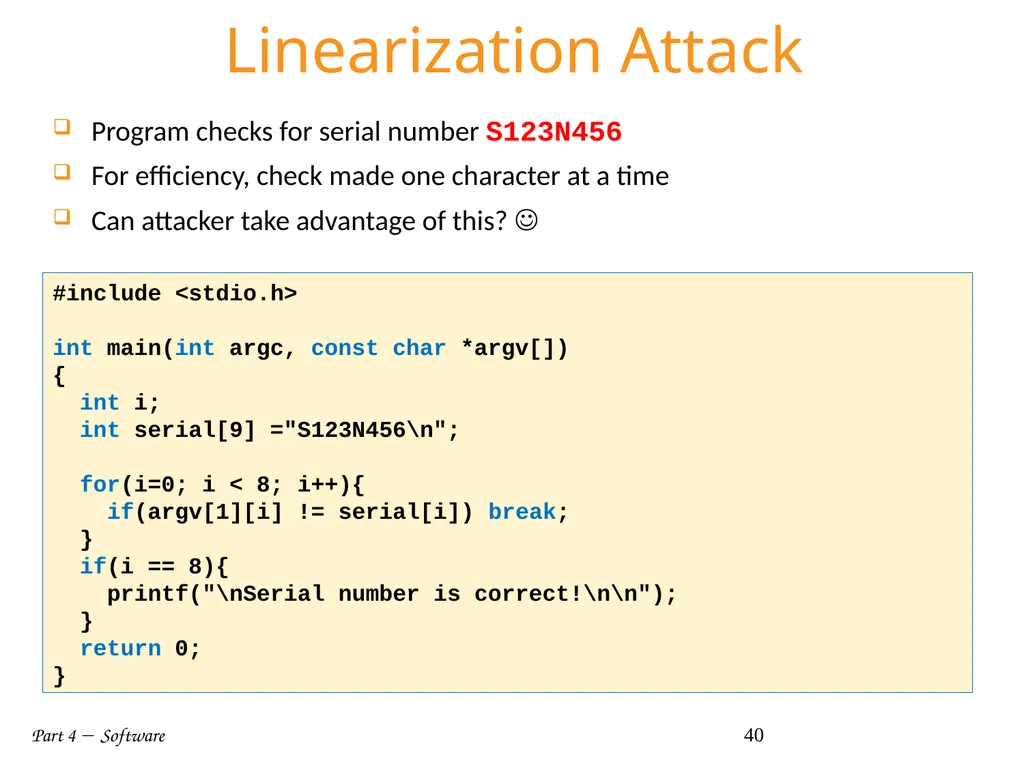
Part 4 Software 40 Linearization Attack Program checks for serial number S123N456
For efficiency, check made one character at a time
Can attacker take advantage of this? #include <stdio.h>
int main(int argc, const char *argv[])
{
int i;
int serial[9] ="S123N456\n";
for(i=0; i < 8; i++){
if(argv[1][i] != serial[i]) break;
}
if(i == 8){
printf("\nSerial number is correct!\n\n");
}
return 0;
}<br>
For efficiency, check made one character at a time
Can attacker take advantage of this? #include <stdio.h>
int main(int argc, const char *argv[])
{
int i;
int serial[9] ="S123N456\n";
for(i=0; i < 8; i++){
if(argv[1][i] != serial[i]) break;
}
if(i == 8){
printf("\nSerial number is correct!\n\n");
}
return 0;
}<br>
41
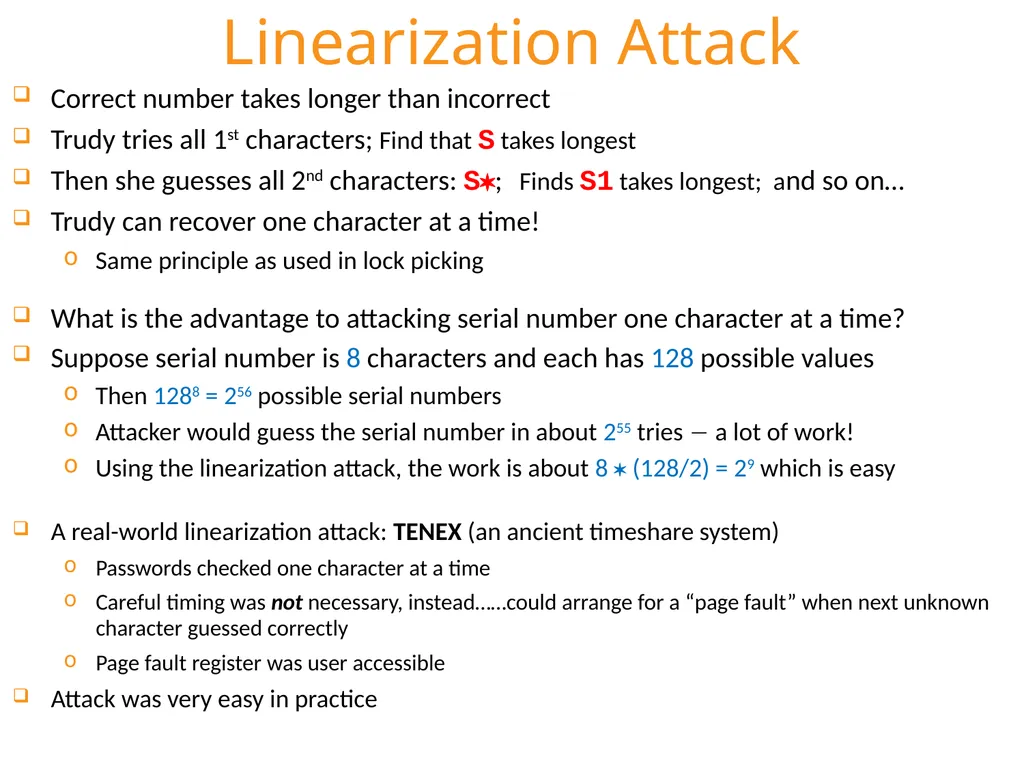
Linearization Attack Correct number takes longer than incorrect
Trudy tries all 1st characters; Find that S takes longest
Then she guesses all 2nd characters: S; Finds S1 takes longest; and so on…
Trudy can recover one character at a time!
Same principle as used in lock picking What is the advantage to attacking serial number one character at a time?
Suppose serial number is 8 characters and each has 128 possible values
Then 1288 = 256 possible serial numbers
Attacker would guess the serial number in about 255 tries a lot of work!
Using the linearization attack, the work is about 8 (128/2) = 29 which is easy A real-world linearization attack: TENEX (an ancient timeshare system)
Passwords checked one character at a time
Careful timing was not necessary, instead……could arrange for a “page fault” when next unknown character guessed correctly
Page fault register was user accessible
Attack was very easy in practice<br>
Trudy tries all 1st characters; Find that S takes longest
Then she guesses all 2nd characters: S; Finds S1 takes longest; and so on…
Trudy can recover one character at a time!
Same principle as used in lock picking What is the advantage to attacking serial number one character at a time?
Suppose serial number is 8 characters and each has 128 possible values
Then 1288 = 256 possible serial numbers
Attacker would guess the serial number in about 255 tries a lot of work!
Using the linearization attack, the work is about 8 (128/2) = 29 which is easy A real-world linearization attack: TENEX (an ancient timeshare system)
Passwords checked one character at a time
Careful timing was not necessary, instead……could arrange for a “page fault” when next unknown character guessed correctly
Page fault register was user accessible
Attack was very easy in practice<br>
42
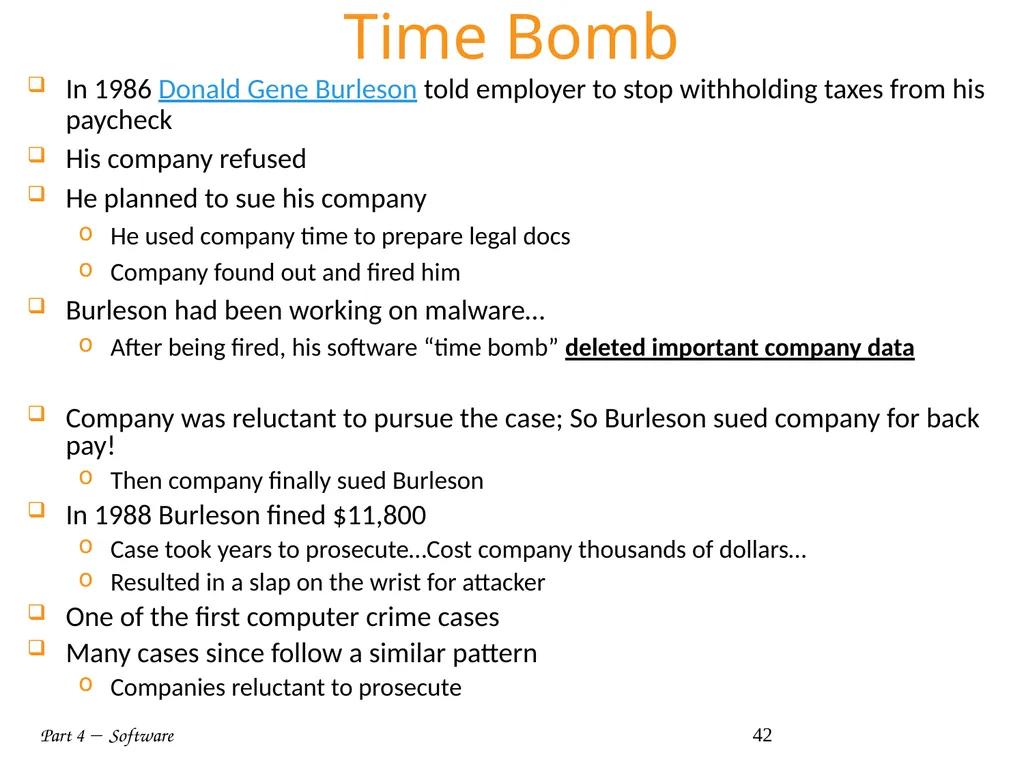
Part 4 Software 42 Time Bomb In 1986 Donald Gene Burleson told employer to stop withholding taxes from his paycheck
His company refused
He planned to sue his company
He used company time to prepare legal docs
Company found out and fired him
Burleson had been working on malware…
After being fired, his software “time bomb” deleted important company data Company was reluctant to pursue the case; So Burleson sued company for back pay!
Then company finally sued Burleson
In 1988 Burleson fined $11,800
Case took years to prosecute…Cost company thousands of dollars…
Resulted in a slap on the wrist for attacker
One of the first computer crime cases
Many cases since follow a similar pattern
Companies reluctant to prosecute<br>
His company refused
He planned to sue his company
He used company time to prepare legal docs
Company found out and fired him
Burleson had been working on malware…
After being fired, his software “time bomb” deleted important company data Company was reluctant to pursue the case; So Burleson sued company for back pay!
Then company finally sued Burleson
In 1988 Burleson fined $11,800
Case took years to prosecute…Cost company thousands of dollars…
Resulted in a slap on the wrist for attacker
One of the first computer crime cases
Many cases since follow a similar pattern
Companies reluctant to prosecute<br>
43
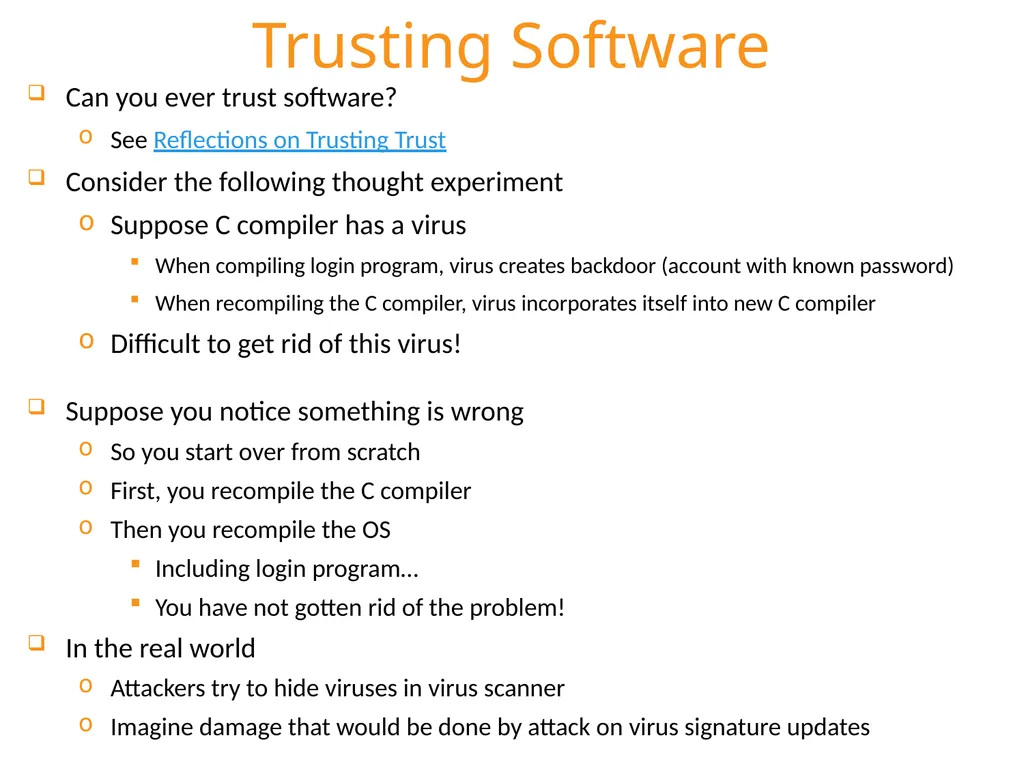
Trusting Software Can you ever trust software?
See Reflections on Trusting Trust
Consider the following thought experiment
Suppose C compiler has a virus
When compiling login program, virus creates backdoor (account with known password)
When recompiling the C compiler, virus incorporates itself into new C compiler
Difficult to get rid of this virus! Suppose you notice something is wrong
So you start over from scratch
First, you recompile the C compiler
Then you recompile the OS
Including login program…
You have not gotten rid of the problem!
In the real world
Attackers try to hide viruses in virus scanner
Imagine damage that would be done by attack on virus signature updates<br>
See Reflections on Trusting Trust
Consider the following thought experiment
Suppose C compiler has a virus
When compiling login program, virus creates backdoor (account with known password)
When recompiling the C compiler, virus incorporates itself into new C compiler
Difficult to get rid of this virus! Suppose you notice something is wrong
So you start over from scratch
First, you recompile the C compiler
Then you recompile the OS
Including login program…
You have not gotten rid of the problem!
In the real world
Attackers try to hide viruses in virus scanner
Imagine damage that would be done by attack on virus signature updates<br>