
Part one: Screening tool Practitioner Toolkit To
Description: Part one: Screening tool Practitioner Toolkit To support identification of children young people who may be vulnerable to exploitation Updated October 2022 Contents Introduction Purpose of Toolkit Overview What is Child Exploitation?
Related Topics
Download Presentation
"Part one: Screening tool Practitioner Toolkit To" is the property of its rightful owner. Permission is granted to download and print the materials on this website for personal, non-commercial use only, and to display it on your personal computer provided you do not modify the materials and that you retain all copyright notices contained in the materials. By downloading content from our website, you accept the terms of this agreement.
Presentation Transcript
slide1. Part one: Screening tool Practitioner Toolkit
To support identification of children & young people who may be vulnerable to exploitation Updated October 2022<br>
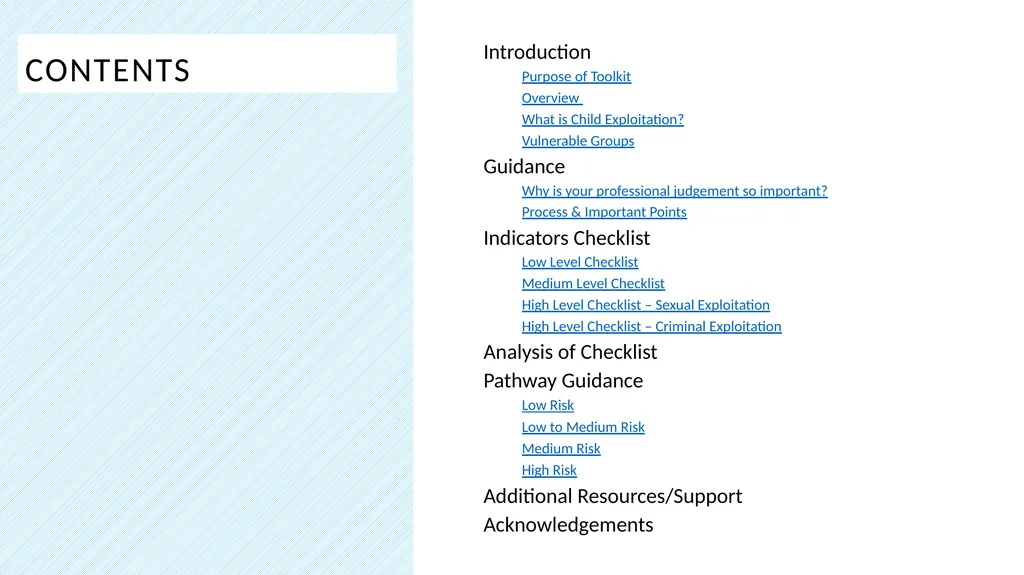
slide2. Contents Introduction
Purpose of Toolkit
Overview
What is Child Exploitation?
Vulnerable Groups
Guidance
Why is your professional judgement so important?
Process & Important Points
Indicators Checklist
Low Level Checklist
Medium Level Checklist
High Level Checklist – Sexual Exploitation
High Level Checklist – Criminal Exploitation
Analysis of Checklist
Pathway Guidance
Low Risk
Low to Medium Risk
Medium Risk
High Risk
Additional Resources/Support
Acknowledgements<br>
slide3. Purpose of toolkit To assist safeguarding practitioners/leads to consider the health, welfare and safety of a child/young person for whom there are concerns that they may be vulnerable to exploitation, including Child Sexual Exploitation (CSE); Child Criminal Exploitation (CCE); and/or association with gangs, youth violence.
Whilst elements of this toolkit relate more to use within educational settings, the toolkit can be utilised by all partners in a way that suits individual agency needs.
The toolkit:
supports professional decision making about the level of risk
helps identify an appropriate response
provides a framework and suggestions for educational settings, to assist in developing a whole school approach to embedding preventative education and learning into the curriculum.
The indicators and resources referred to within this toolkit cover many safeguarding issues, due to their interconnectivity.<br>
slide4. Overview The Toolkit is divided in to two parts:
Part One – Screening Tool
This provides a screening template, analysis and pathway guidance to address children/young people’s immediate unmet needs.
The indicators checklist can be applied to all children (male and female) under the age of 18 years (or up to the age of 25 years for children with special educational needs or disabilities (SEND)).
Part Two - Resources Hub
For use within the curriculum, 1:1 work with children and young people, information for parents and carers and to develop staff training and knowledge of these areas.<br>
slide5. What is child exploitation? Exploitation, is a form of abuse where an individual or group takes advantage of an imbalance of power to coerce, manipulate or deceive a child or young person into sexual or criminal activity in exchange for something the victim needs or wants, and/or for the financial advantage or increased status of the perpetrator or facilitator.
Child exploitation typically involves physical violence, threats of violence and intimidation. Involvement is usually characterised by the child or young person’s limited availability of choice as result of their social, economic or emotional vulnerability.
The victim may have been exploited even if the activity appears consensual.
Exploitation does not always involve physical contact, it can also occur through the use of technology.
It is a multi-faceted and complex type of abuse which comes in many forms which often are layered and interconnected.<br>
slide6. Vulnerable groups It is important to remember that all children and young people can fall victim to exploitation, regardless of their family background or other circumstances, we know that perpetrators often target our more vulnerable children. Identifying the risk factors that make children and young people more susceptible enables us to identify who is at the greatest risk.
Some young people may be vulnerable to exploitation due to their circumstances or personal attributes, and may be specifically targeted by exploiters, for example young people:
with special educational needs or disabilities (SEND) or an Education Health and Care Plan (EHCP)
who are looked after or leaving care, particularly those in residential care with interrupted care histories
who are Separated Migrant Children (formerly known as Unaccompanied Asylum Seeking Children (UASC))
who have experienced abuse or trauma and/or known to social care services
who are excluded from mainstream education, on part-time timetables, electively home educated (EHE), attending an Education Support Centre (ESC)
with mental health or emotional wellbeing issues
with substance misuse issues
who are involved in gang activity, anti-social or criminal offending behaviours
who are living in unstable accommodation or have had an unstable home environment
who regularly go missing from home, care settings or educational settings.
This is not an exhaustive list, and these risk factors should not be looked at in isolation - a multiplicity of risk factors is likely to exist for a child who is vulnerable to exploitation. The list should be used as a guide to aid professional judgement in identification, referral and assessment of young people.<br>
slide7. Guidance Start with the ‘low level’ category indicators checklist and tick any indicators that apply, before moving onto ‘medium level’ and ‘high level’ checklists.
Supporting evidence must be included to explain the rationale for ticking the relevant indicator.
When assessing a child or young person’s risk of exploitation, it is essential to highlight if the concerns and the information being provided is current or historic. If the concern or information is historic but relevant, you should evidence how this relates to the current assessed risk.
All of the indicators should be considered in order to get a broad picture of the young person’s level of involvement in exploitation.
The indicator checklist must only be used to assist your decision making alongside your professional judgement.
Consider this:
One tick in a high risk category or several in low risk can both indicate a serious risk of significant harm to a child, alternatively this might be an indication of other concerns that require addressing via the child’s overall plan, or by accessing early help support. It is therefore important to provide analysis to evidence how the assessment of an individual risk indicator has been achieved.<br>
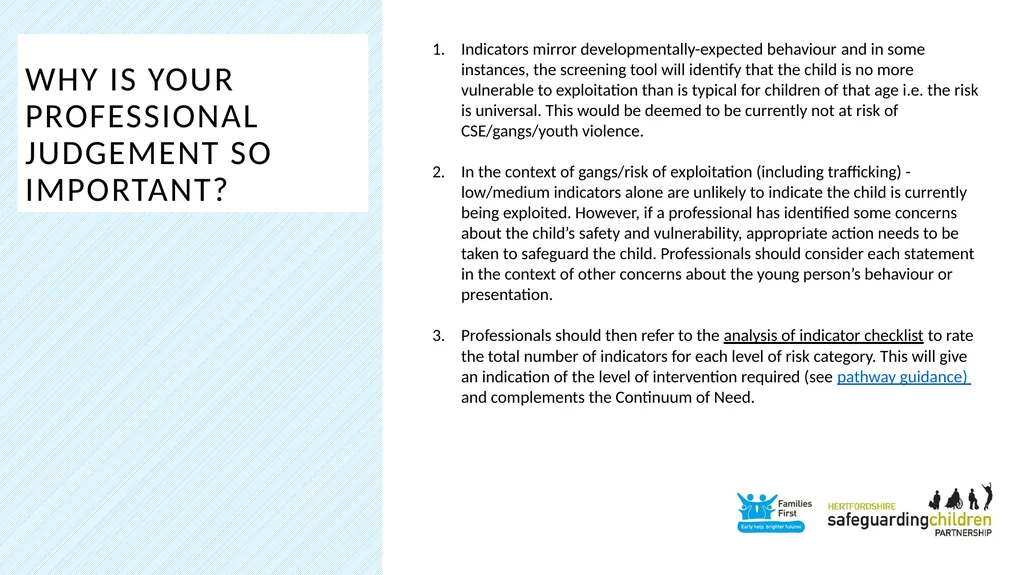
slide8. Why is your professional judgement so important? Indicators mirror developmentally-expected behaviour and in some instances, the screening tool will identify that the child is no more vulnerable to exploitation than is typical for children of that age i.e. the risk is universal. This would be deemed to be currently not at risk of CSE/gangs/youth violence.
In the context of gangs/risk of exploitation (including trafficking) - low/medium indicators alone are unlikely to indicate the child is currently being exploited. However, if a professional has identified some concerns about the child’s safety and vulnerability, appropriate action needs to be taken to safeguard the child. Professionals should consider each statement in the context of other concerns about the young person’s behaviour or presentation.
Professionals should then refer to the analysis of indicator checklist to rate the total number of indicators for each level of risk category. This will give an indication of the level of intervention required (see pathway guidance) and complements the Continuum of Need.<br>
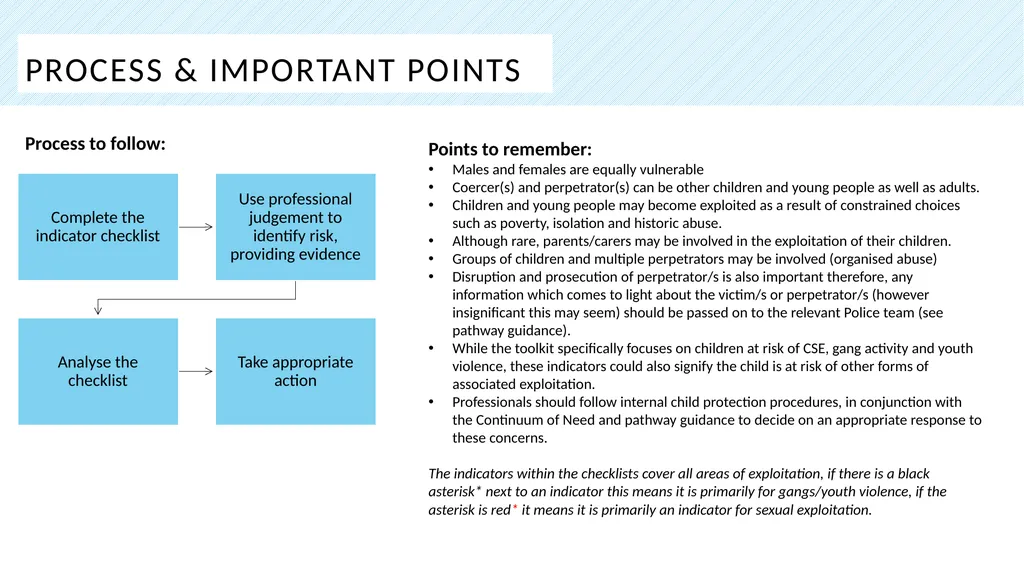
slide9. Process & important points Process to follow: Points to remember:
Males and females are equally vulnerable
Coercer(s) and perpetrator(s) can be other children and young people as well as adults.
Children and young people may become exploited as a result of constrained choices such as poverty, isolation and historic abuse.
Although rare, parents/carers may be involved in the exploitation of their children.
Groups of children and multiple perpetrators may be involved (organised abuse)
Disruption and prosecution of perpetrator/s is also important therefore, any information which comes to light about the victim/s or perpetrator/s (however insignificant this may seem) should be passed on to the relevant Police team (see pathway guidance).
While the toolkit specifically focuses on children at risk of CSE, gang activity and youth violence, these indicators could also signify the child is at risk of other forms of associated exploitation.
Professionals should follow internal child protection procedures, in conjunction with the Continuum of Need and pathway guidance to decide on an appropriate response to these concerns.
The indicators within the checklists cover all areas of exploitation, if there is a black asterisk* next to an indicator this means it is primarily for gangs/youth violence, if the asterisk is red* it means it is primarily an indicator for sexual exploitation.<br>
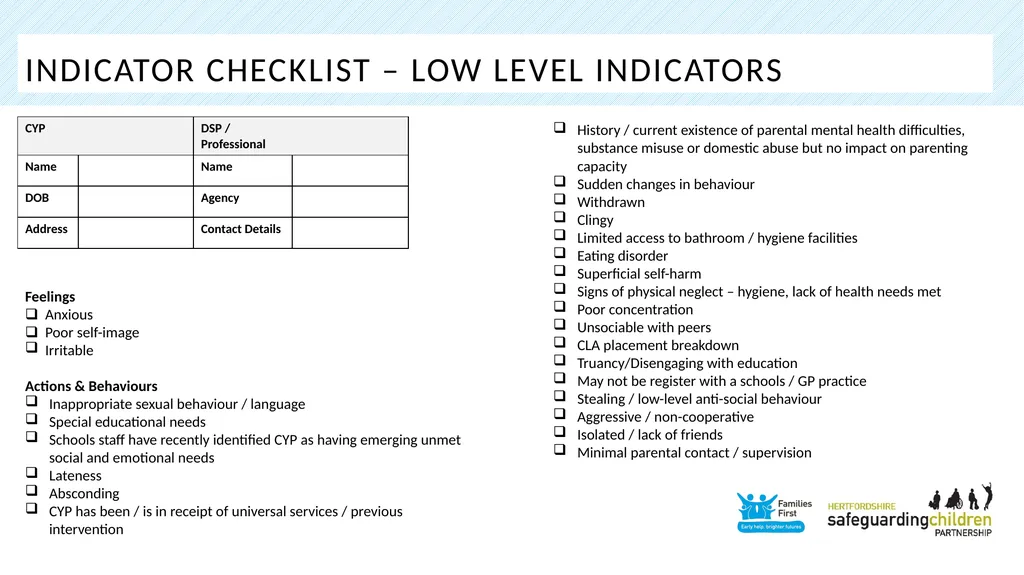
slide10. Indicator checklist – Low Level Indicators Feelings
Anxious
Poor self-image
Irritable
Actions & Behaviours
Inappropriate sexual behaviour / language
Special educational needs
Schools staff have recently identified CYP as having emerging unmet social and emotional needs
Lateness
Absconding
CYP has been / is in receipt of universal services / previous intervention History / current existence of parental mental health difficulties, substance misuse or domestic abuse but no impact on parenting capacity
Sudden changes in behaviour
Withdrawn
Clingy
Limited access to bathroom / hygiene facilities
Eating disorder
Superficial self-harm
Signs of physical neglect – hygiene, lack of health needs met
Poor concentration
Unsociable with peers
CLA placement breakdown
Truancy/Disengaging with education
May not be register with a schools / GP practice
Stealing / low-level anti-social behaviour
Aggressive / non-cooperative
Isolated / lack of friends
Minimal parental contact / supervision<br>
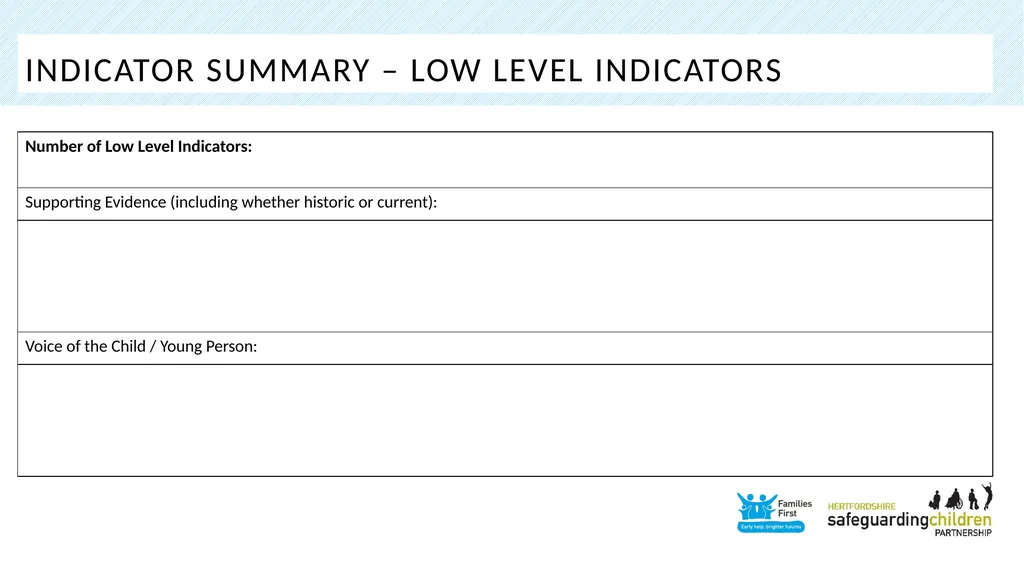
slide11. Indicator summary – low level indicators<br>
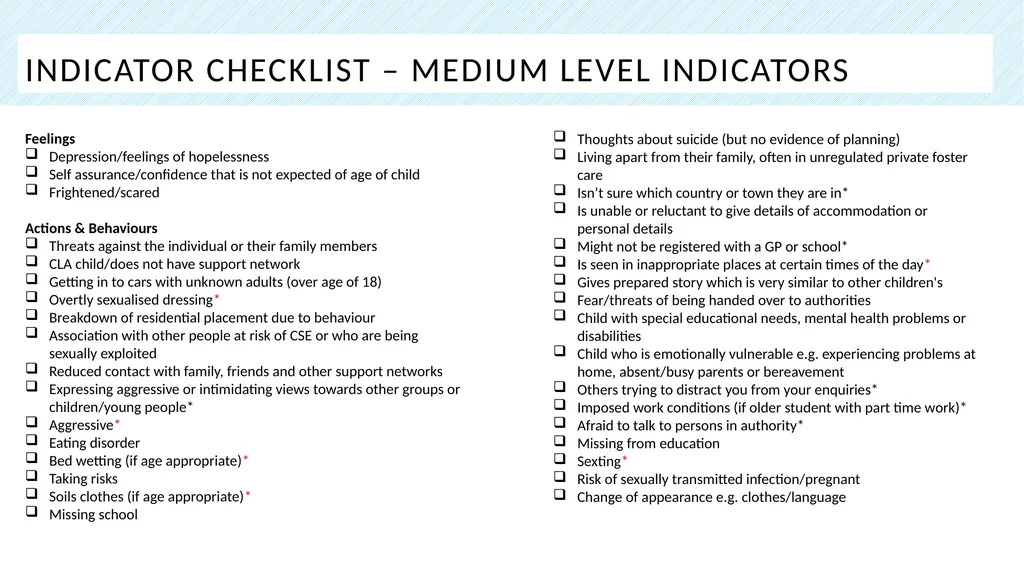
slide12. Indicator checklist – medium Level Indicators Feelings
Depression/feelings of hopelessness
Self assurance/confidence that is not expected of age of child
Frightened/scared
Actions & Behaviours
Threats against the individual or their family members
CLA child/does not have support network
Getting in to cars with unknown adults (over age of 18)
Overtly sexualised dressing*
Breakdown of residential placement due to behaviour
Association with other people at risk of CSE or who are being sexually exploited
Reduced contact with family, friends and other support networks
Expressing aggressive or intimidating views towards other groups or children/young people*
Aggressive*
Eating disorder
Bed wetting (if age appropriate)*
Taking risks
Soils clothes (if age appropriate)*
Missing school Thoughts about suicide (but no evidence of planning)
Living apart from their family, often in unregulated private foster care
Isn’t sure which country or town they are in*
Is unable or reluctant to give details of accommodation or personal details
Might not be registered with a GP or school*
Is seen in inappropriate places at certain times of the day*
Gives prepared story which is very similar to other children's
Fear/threats of being handed over to authorities
Child with special educational needs, mental health problems or disabilities
Child who is emotionally vulnerable e.g. experiencing problems at home, absent/busy parents or bereavement
Others trying to distract you from your enquiries*
Imposed work conditions (if older student with part time work)*
Afraid to talk to persons in authority*
Missing from education
Sexting*
Risk of sexually transmitted infection/pregnant
Change of appearance e.g. clothes/language<br>
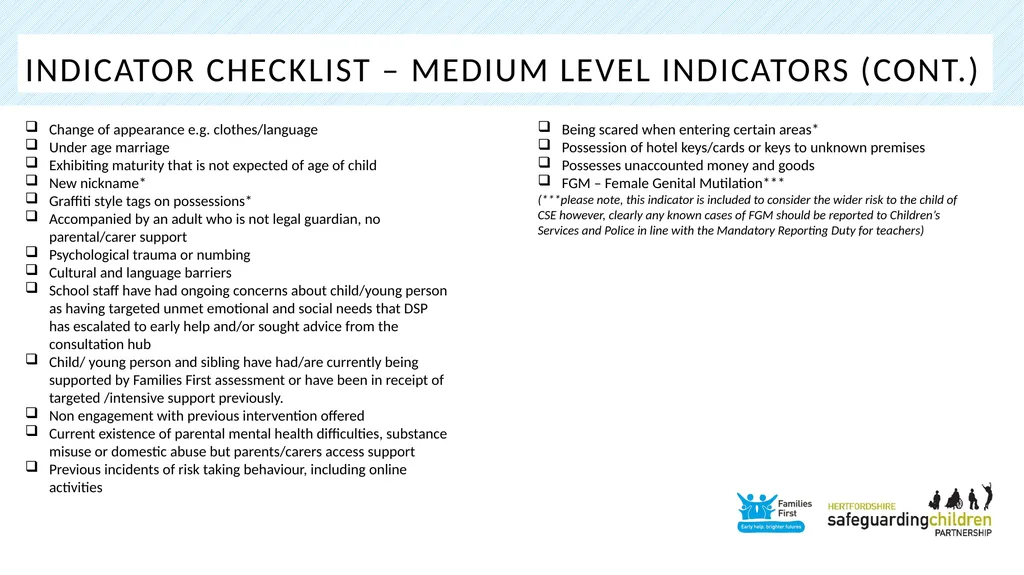
slide13. Indicator checklist – medium Level Indicators (cont.) Change of appearance e.g. clothes/language
Under age marriage
Exhibiting maturity that is not expected of age of child
New nickname*
Graffiti style tags on possessions*
Accompanied by an adult who is not legal guardian, no parental/carer support
Psychological trauma or numbing
Cultural and language barriers
School staff have had ongoing concerns about child/young person as having targeted unmet emotional and social needs that DSP has escalated to early help and/or sought advice from the consultation hub
Child/ young person and sibling have had/are currently being supported by Families First assessment or have been in receipt of targeted /intensive support previously.
Non engagement with previous intervention offered
Current existence of parental mental health difficulties, substance misuse or domestic abuse but parents/carers access support
Previous incidents of risk taking behaviour, including online activities Being scared when entering certain areas*
Possession of hotel keys/cards or keys to unknown premises
Possesses unaccounted money and goods
FGM – Female Genital Mutilation***
(***please note, this indicator is included to consider the wider risk to the child of CSE however, clearly any known cases of FGM should be reported to Children’s Services and Police in line with the Mandatory Reporting Duty for teachers)<br>
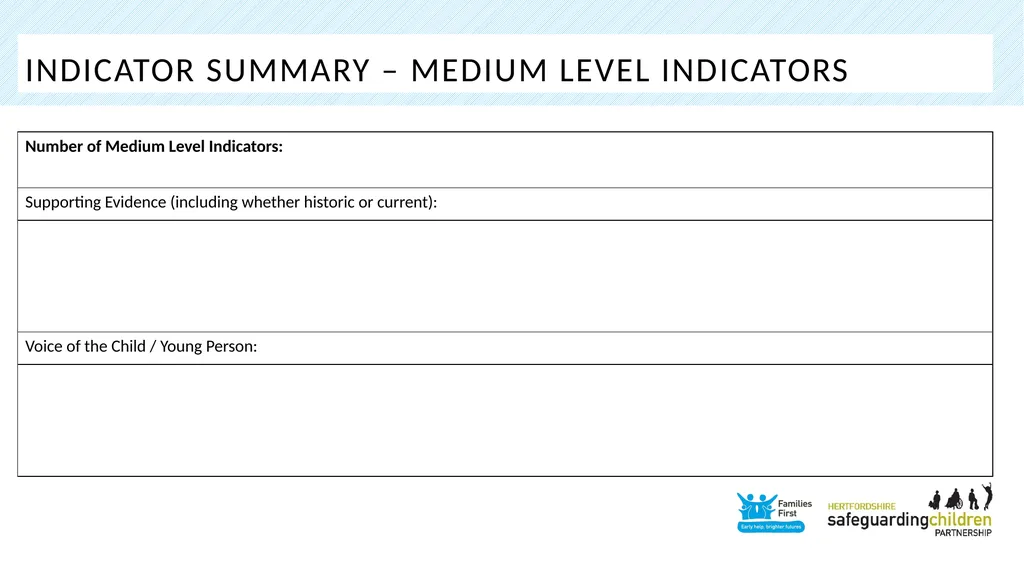
slide14. Indicator summary – Medium level indicators<br>
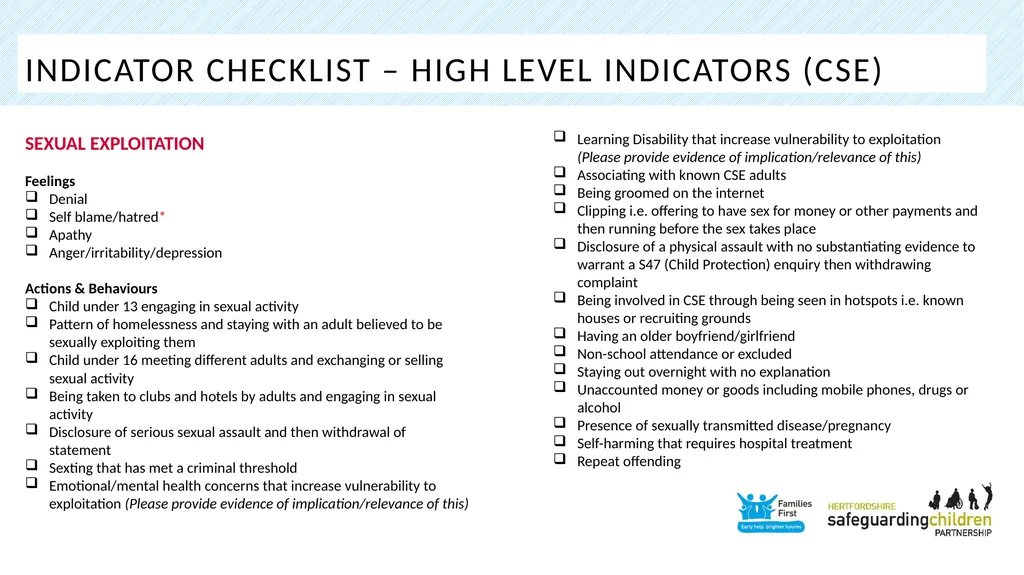
slide15. Indicator checklist – high Level Indicators (CSE) SEXUAL EXPLOITATION
Feelings
Denial
Self blame/hatred*
Apathy
Anger/irritability/depression
Actions & Behaviours
Child under 13 engaging in sexual activity
Pattern of homelessness and staying with an adult believed to be sexually exploiting them
Child under 16 meeting different adults and exchanging or selling sexual activity
Being taken to clubs and hotels by adults and engaging in sexual activity
Disclosure of serious sexual assault and then withdrawal of statement
Sexting that has met a criminal threshold
Emotional/mental health concerns that increase vulnerability to exploitation (Please provide evidence of implication/relevance of this) Learning Disability that increase vulnerability to exploitation (Please provide evidence of implication/relevance of this)
Associating with known CSE adults
Being groomed on the internet
Clipping i.e. offering to have sex for money or other payments and then running before the sex takes place
Disclosure of a physical assault with no substantiating evidence to warrant a S47 (Child Protection) enquiry then withdrawing complaint
Being involved in CSE through being seen in hotspots i.e. known houses or recruiting grounds
Having an older boyfriend/girlfriend
Non-school attendance or excluded
Staying out overnight with no explanation
Unaccounted money or goods including mobile phones, drugs or alcohol
Presence of sexually transmitted disease/pregnancy
Self-harming that requires hospital treatment
Repeat offending<br>
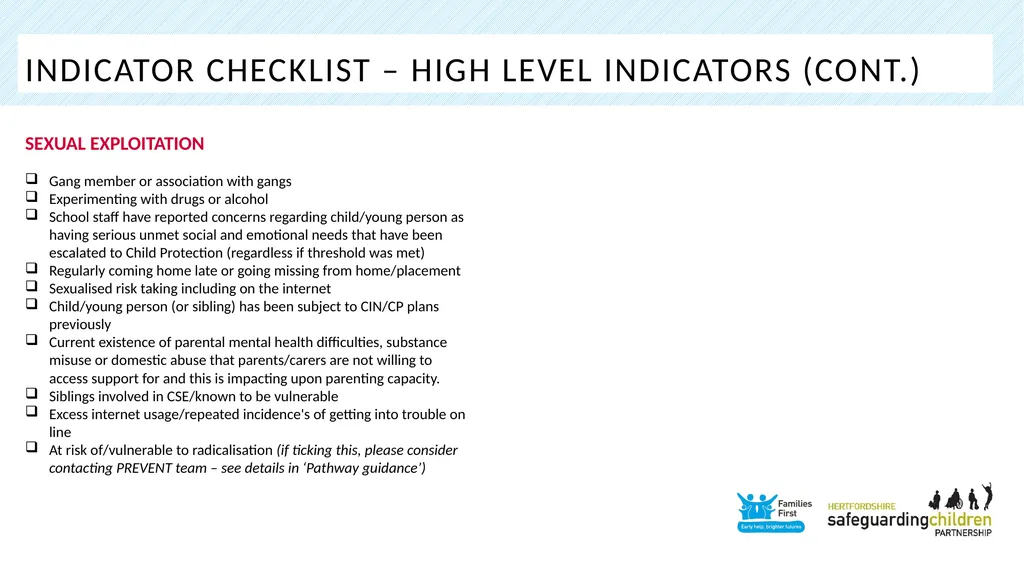
slide16. Indicator checklist – high Level Indicators (Cont.) SEXUAL EXPLOITATION
Gang member or association with gangs
Experimenting with drugs or alcohol
School staff have reported concerns regarding child/young person as having serious unmet social and emotional needs that have been escalated to Child Protection (regardless if threshold was met)
Regularly coming home late or going missing from home/placement
Sexualised risk taking including on the internet
Child/young person (or sibling) has been subject to CIN/CP plans previously
Current existence of parental mental health difficulties, substance misuse or domestic abuse that parents/carers are not willing to access support for and this is impacting upon parenting capacity.
Siblings involved in CSE/known to be vulnerable
Excess internet usage/repeated incidence's of getting into trouble on line
At risk of/vulnerable to radicalisation (if ticking this, please consider contacting PREVENT team – see details in ‘Pathway guidance’)<br>
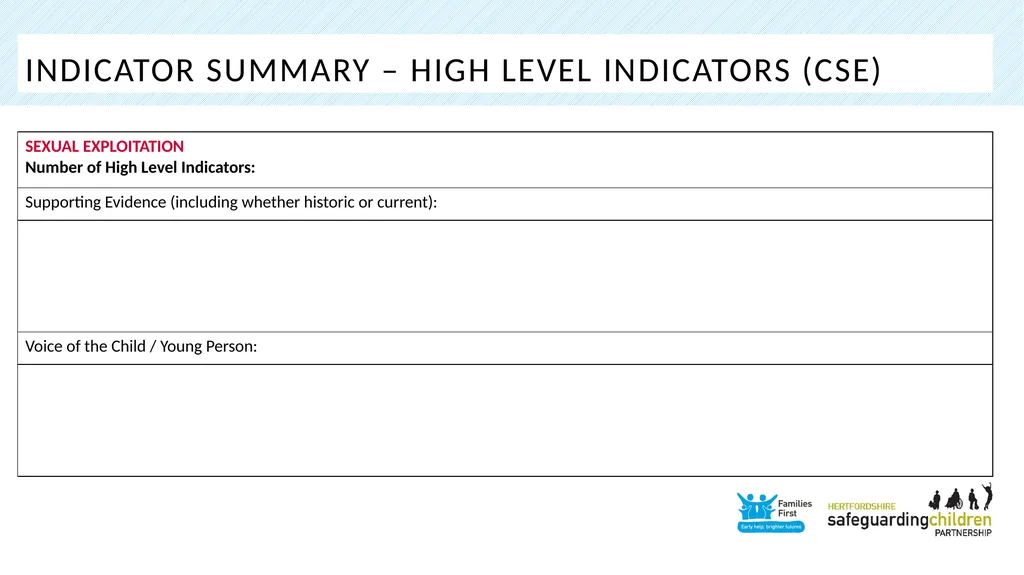
slide17. Indicator summary – HIGH level indicators (CSE)<br>
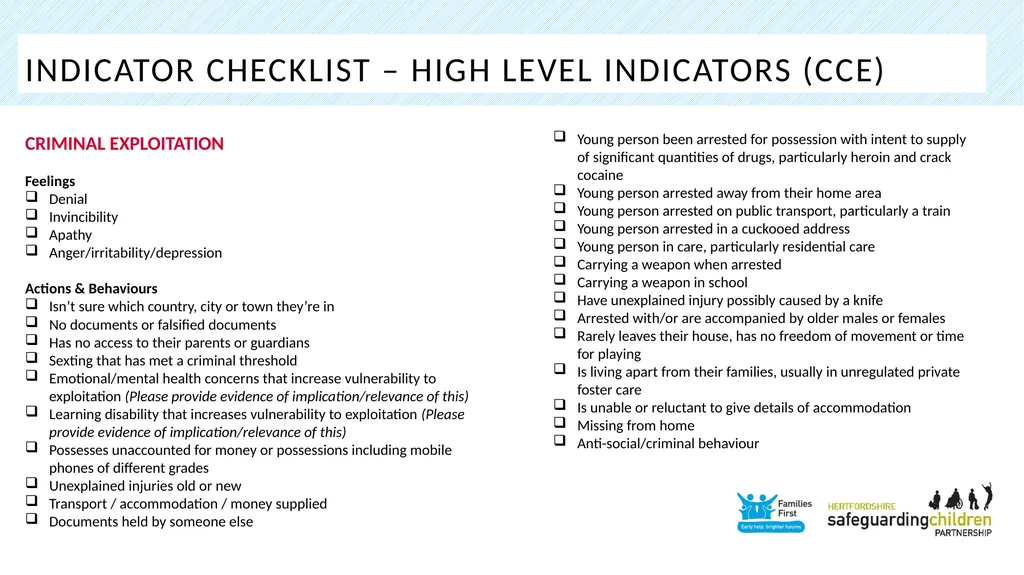
slide18. Indicator checklist – high Level Indicators (CCE) CRIMINAL EXPLOITATION
Feelings
Denial
Invincibility
Apathy
Anger/irritability/depression
Actions & Behaviours
Isn’t sure which country, city or town they’re in
No documents or falsified documents
Has no access to their parents or guardians
Sexting that has met a criminal threshold
Emotional/mental health concerns that increase vulnerability to exploitation (Please provide evidence of implication/relevance of this)
Learning disability that increases vulnerability to exploitation (Please provide evidence of implication/relevance of this)
Possesses unaccounted for money or possessions including mobile phones of different grades
Unexplained injuries old or new
Transport / accommodation / money supplied
Documents held by someone else Young person been arrested for possession with intent to supply of significant quantities of drugs, particularly heroin and crack cocaine
Young person arrested away from their home area
Young person arrested on public transport, particularly a train
Young person arrested in a cuckooed address
Young person in care, particularly residential care
Carrying a weapon when arrested
Carrying a weapon in school
Have unexplained injury possibly caused by a knife
Arrested with/or are accompanied by older males or females
Rarely leaves their house, has no freedom of movement or time for playing
Is living apart from their families, usually in unregulated private foster care
Is unable or reluctant to give details of accommodation
Missing from home
Anti-social/criminal behaviour<br>
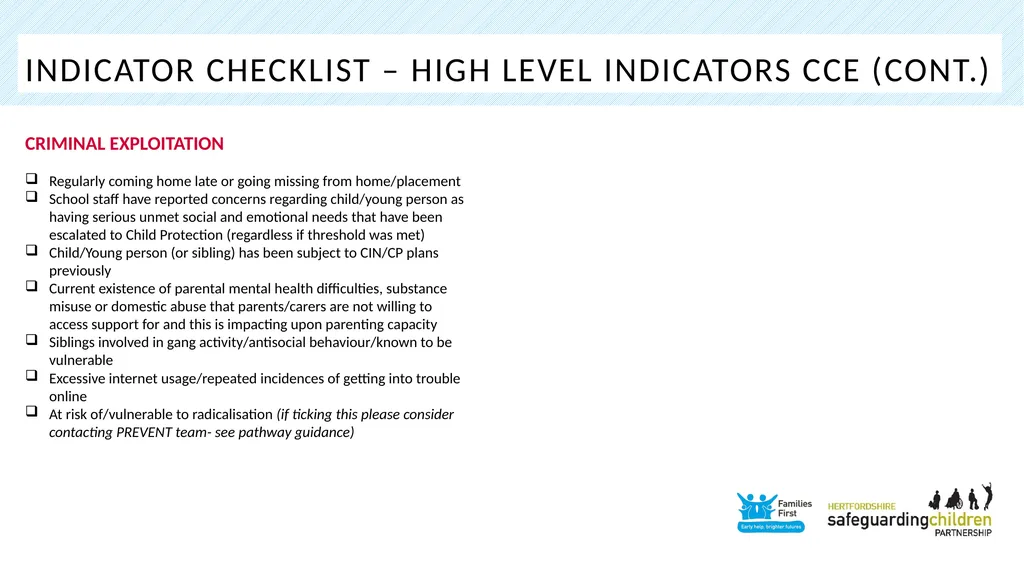
slide19. Indicator checklist – high Level Indicators CCE (cont.) CRIMINAL EXPLOITATION
Regularly coming home late or going missing from home/placement
School staff have reported concerns regarding child/young person as having serious unmet social and emotional needs that have been escalated to Child Protection (regardless if threshold was met)
Child/Young person (or sibling) has been subject to CIN/CP plans previously
Current existence of parental mental health difficulties, substance misuse or domestic abuse that parents/carers are not willing to access support for and this is impacting upon parenting capacity
Siblings involved in gang activity/antisocial behaviour/known to be vulnerable
Excessive internet usage/repeated incidences of getting into trouble online
At risk of/vulnerable to radicalisation (if ticking this please consider contacting PREVENT team- see pathway guidance)<br>
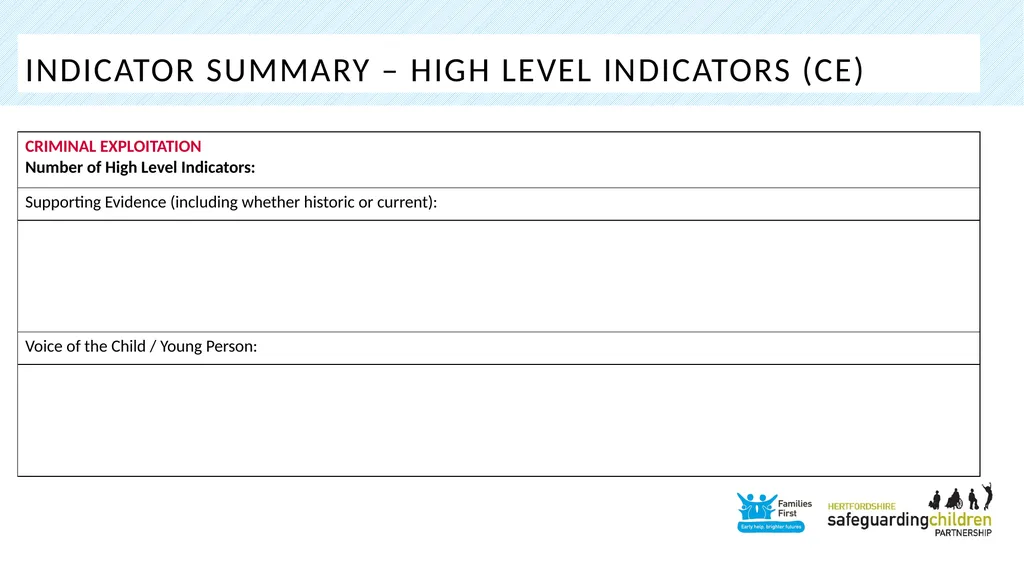
slide20. Indicator summary – HIGH level indicators (CE)<br>
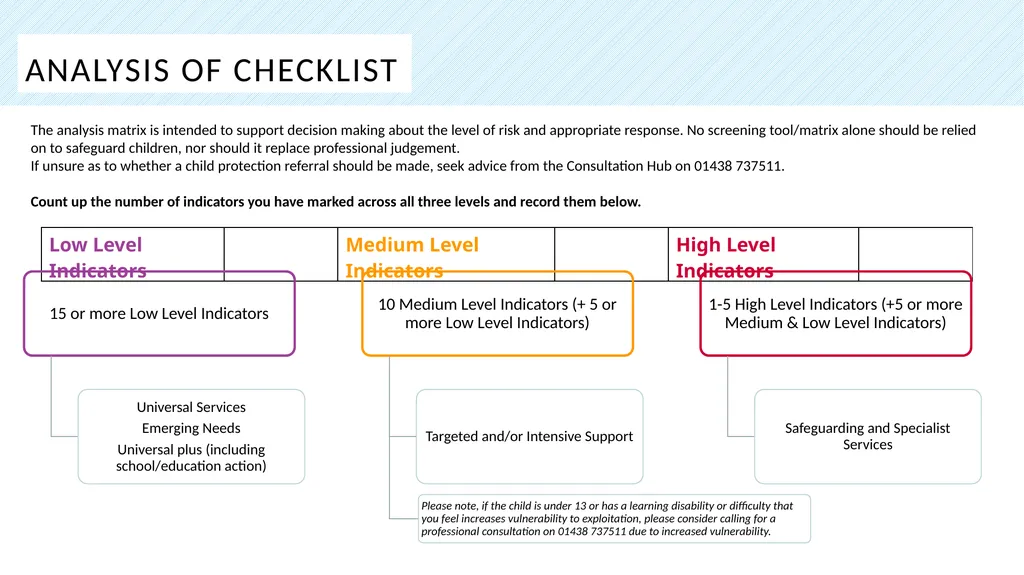
slide21. Analysis of checklist The analysis matrix is intended to support decision making about the level of risk and appropriate response. No screening tool/matrix alone should be relied on to safeguard children, nor should it replace professional judgement.
If unsure as to whether a child protection referral should be made, seek advice from the Consultation Hub on 01438 737511.
Count up the number of indicators you have marked across all three levels and record them below.<br>
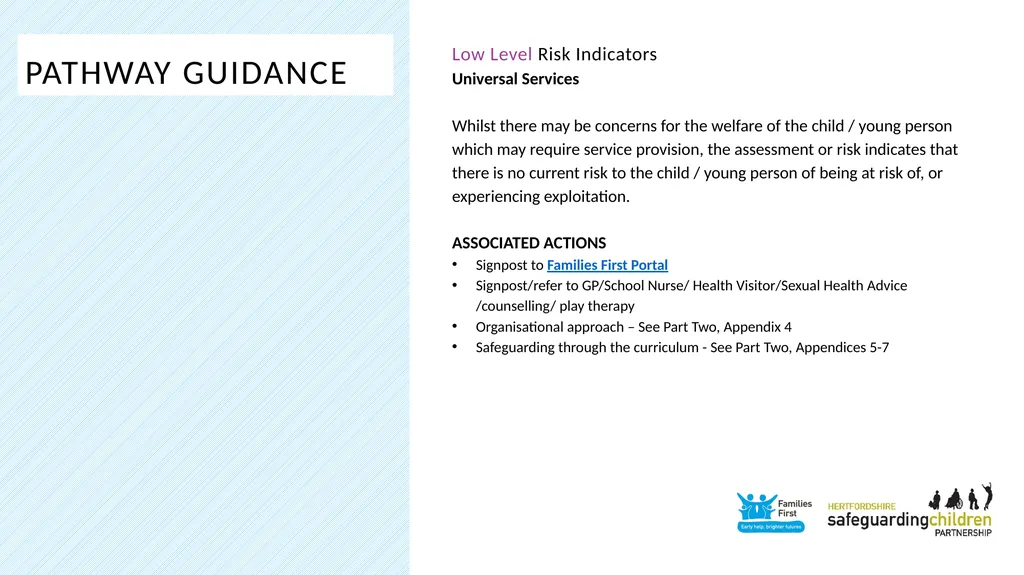
slide22. Pathway guidance Low Level Risk Indicators
Universal Services
Whilst there may be concerns for the welfare of the child / young person which may require service provision, the assessment or risk indicates that there is no current risk to the child / young person of being at risk of, or experiencing exploitation.
ASSOCIATED ACTIONS
Signpost to Families First Portal
Signpost/refer to GP/School Nurse/ Health Visitor/Sexual Health Advice /counselling/ play therapy
Organisational approach – See Part Two, Appendix 4
Safeguarding through the curriculum - See Part Two, Appendices 5-7<br>
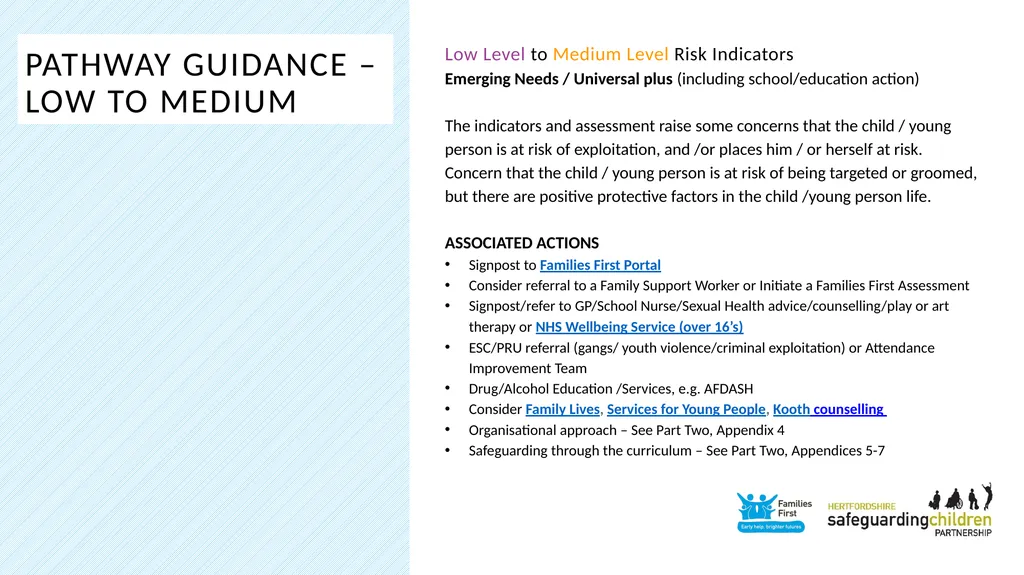
slide23. Pathway guidance – Low to Medium Low Level to Medium Level Risk Indicators
Emerging Needs / Universal plus (including school/education action)
The indicators and assessment raise some concerns that the child / young person is at risk of exploitation, and /or places him / or herself at risk. Concern that the child / young person is at risk of being targeted or groomed, but there are positive protective factors in the child /young person life.
ASSOCIATED ACTIONS
Signpost to Families First Portal
Consider referral to a Family Support Worker or Initiate a Families First Assessment
Signpost/refer to GP/School Nurse/Sexual Health advice/counselling/play or art therapy or NHS Wellbeing Service (over 16’s)
ESC/PRU referral (gangs/ youth violence/criminal exploitation) or Attendance Improvement Team
Drug/Alcohol Education /Services, e.g. AFDASH
Consider Family Lives, Services for Young People, Kooth counselling
Organisational approach – See Part Two, Appendix 4
Safeguarding through the curriculum – See Part Two, Appendices 5-7<br>
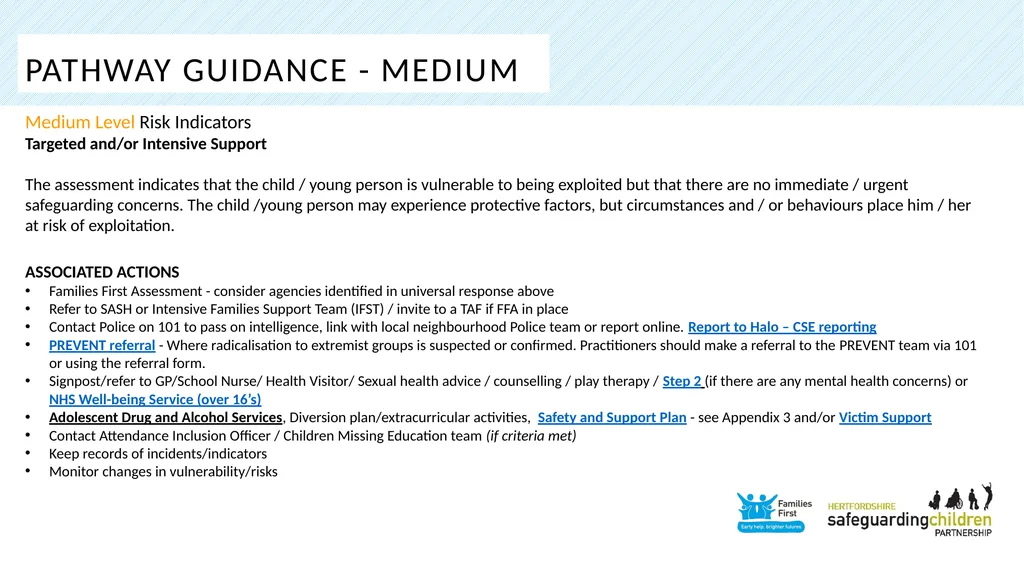
slide24. Pathway guidance - Medium Medium Level Risk Indicators
Targeted and/or Intensive Support
The assessment indicates that the child / young person is vulnerable to being exploited but that there are no immediate / urgent safeguarding concerns. The child /young person may experience protective factors, but circumstances and / or behaviours place him / her at risk of exploitation.
ASSOCIATED ACTIONS
Families First Assessment - consider agencies identified in universal response above
Refer to SASH or Intensive Families Support Team (IFST) / invite to a TAF if FFA in place
Contact Police on 101 to pass on intelligence, link with local neighbourhood Police team or report online. Report to Halo – CSE reporting
PREVENT referral - Where radicalisation to extremist groups is suspected or confirmed. Practitioners should make a referral to the PREVENT team via 101 or using the referral form.
Signpost/refer to GP/School Nurse/ Health Visitor/ Sexual health advice / counselling / play therapy / Step 2 (if there are any mental health concerns) or NHS Well-being Service (over 16’s)
Adolescent Drug and Alcohol Services, Diversion plan/extracurricular activities, Safety and Support Plan - see Appendix 3 and/or Victim Support
Contact Attendance Inclusion Officer / Children Missing Education team (if criteria met)
Keep records of incidents/indicators
Monitor changes in vulnerability/risks<br>
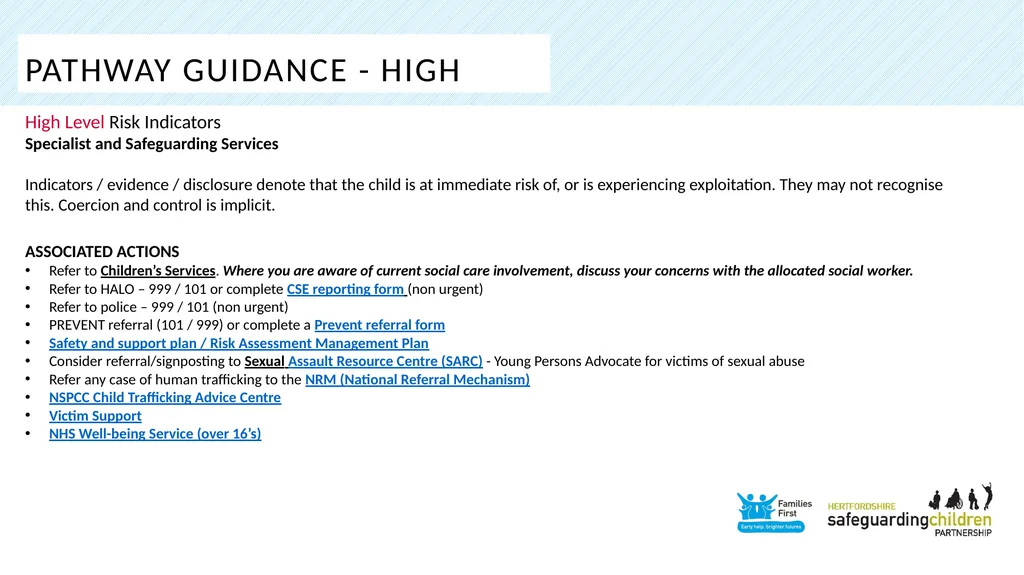
slide25. Pathway guidance - high High Level Risk Indicators
Specialist and Safeguarding Services
Indicators / evidence / disclosure denote that the child is at immediate risk of, or is experiencing exploitation. They may not recognise this. Coercion and control is implicit.
ASSOCIATED ACTIONS
Refer to Children’s Services. Where you are aware of current social care involvement, discuss your concerns with the allocated social worker.
Refer to HALO – 999 / 101 or complete CSE reporting form (non urgent)
Refer to police – 999 / 101 (non urgent)
PREVENT referral (101 / 999) or complete a Prevent referral form
Safety and support plan / Risk Assessment Management Plan
Consider referral/signposting to Sexual Assault Resource Centre (SARC) - Young Persons Advocate for victims of sexual abuse
Refer any case of human trafficking to the NRM (National Referral Mechanism)
NSPCC Child Trafficking Advice Centre
Victim Support
NHS Well-being Service (over 16’s)<br>
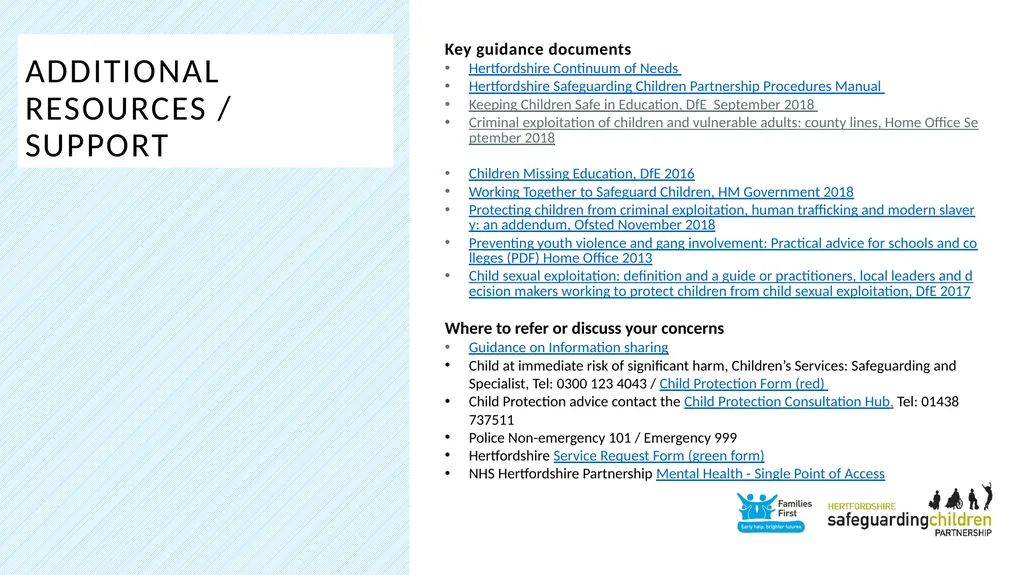
slide26. Additional Resources / support Key guidance documents
Hertfordshire Continuum of Needs
Hertfordshire Safeguarding Children Partnership Procedures Manual
Keeping Children Safe in Education, DfE September 2018
Criminal exploitation of children and vulnerable adults: county lines, Home Office September 2018
Children Missing Education, DfE 2016
Working Together to Safeguard Children, HM Government 2018
Protecting children from criminal exploitation, human trafficking and modern slavery: an addendum, Ofsted November 2018
Preventing youth violence and gang involvement: Practical advice for schools and colleges (PDF) Home Office 2013
Child sexual exploitation: definition and a guide or practitioners, local leaders and decision makers working to protect children from child sexual exploitation, DfE 2017
Where to refer or discuss your concerns
Guidance on Information sharing
Child at immediate risk of significant harm, Children’s Services: Safeguarding and Specialist, Tel: 0300 123 4043 / Child Protection Form (red)
Child Protection advice contact the Child Protection Consultation Hub, Tel: 01438 737511
Police Non-emergency 101 / Emergency 999
Hertfordshire Service Request Form (green form)
NHS Hertfordshire Partnership Mental Health - Single Point of Access<br>
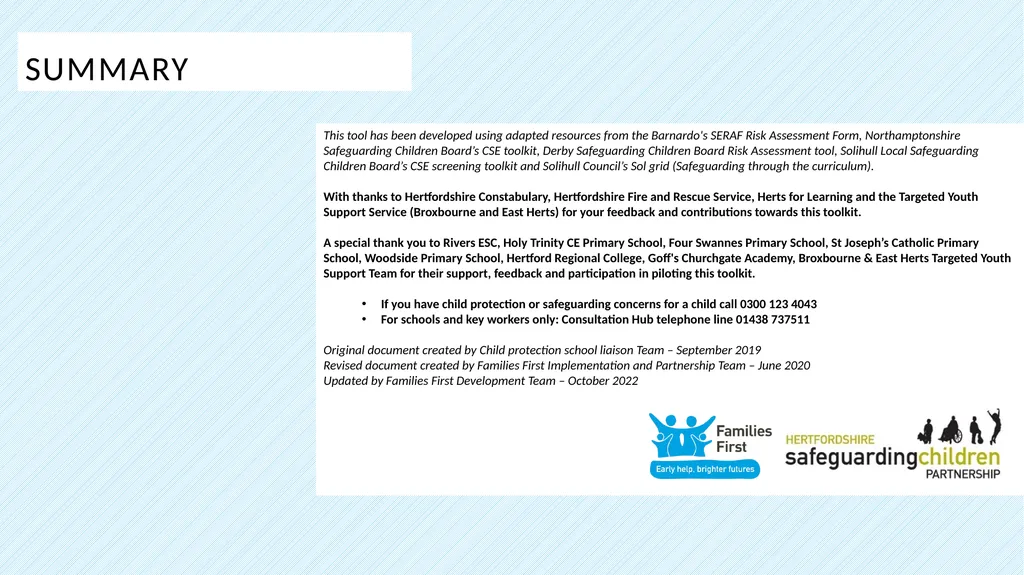
slide27. Summary This tool has been developed using adapted resources from the Barnardo's SERAF Risk Assessment Form, Northamptonshire Safeguarding Children Board’s CSE toolkit, Derby Safeguarding Children Board Risk Assessment tool, Solihull Local Safeguarding Children Board’s CSE screening toolkit and Solihull Council’s Sol grid (Safeguarding through the curriculum).
With thanks to Hertfordshire Constabulary, Hertfordshire Fire and Rescue Service, Herts for Learning and the Targeted Youth Support Service (Broxbourne and East Herts) for your feedback and contributions towards this toolkit.
A special thank you to Rivers ESC, Holy Trinity CE Primary School, Four Swannes Primary School, St Joseph’s Catholic Primary School, Woodside Primary School, Hertford Regional College, Goff's Churchgate Academy, Broxbourne & East Herts Targeted Youth Support Team for their support, feedback and participation in piloting this toolkit.
If you have child protection or safeguarding concerns for a child call 0300 123 4043
For schools and key workers only: Consultation Hub telephone line 01438 737511
Original document created by Child protection school liaison Team – September 2019
Revised document created by Families First Implementation and Partnership Team – June 2020
Updated by Families First Development Team – October 2022<br>
To support identification of children & young people who may be vulnerable to exploitation Updated October 2022<br>
slide2. Contents Introduction
Purpose of Toolkit
Overview
What is Child Exploitation?
Vulnerable Groups
Guidance
Why is your professional judgement so important?
Process & Important Points
Indicators Checklist
Low Level Checklist
Medium Level Checklist
High Level Checklist – Sexual Exploitation
High Level Checklist – Criminal Exploitation
Analysis of Checklist
Pathway Guidance
Low Risk
Low to Medium Risk
Medium Risk
High Risk
Additional Resources/Support
Acknowledgements<br>
slide3. Purpose of toolkit To assist safeguarding practitioners/leads to consider the health, welfare and safety of a child/young person for whom there are concerns that they may be vulnerable to exploitation, including Child Sexual Exploitation (CSE); Child Criminal Exploitation (CCE); and/or association with gangs, youth violence.
Whilst elements of this toolkit relate more to use within educational settings, the toolkit can be utilised by all partners in a way that suits individual agency needs.
The toolkit:
supports professional decision making about the level of risk
helps identify an appropriate response
provides a framework and suggestions for educational settings, to assist in developing a whole school approach to embedding preventative education and learning into the curriculum.
The indicators and resources referred to within this toolkit cover many safeguarding issues, due to their interconnectivity.<br>
slide4. Overview The Toolkit is divided in to two parts:
Part One – Screening Tool
This provides a screening template, analysis and pathway guidance to address children/young people’s immediate unmet needs.
The indicators checklist can be applied to all children (male and female) under the age of 18 years (or up to the age of 25 years for children with special educational needs or disabilities (SEND)).
Part Two - Resources Hub
For use within the curriculum, 1:1 work with children and young people, information for parents and carers and to develop staff training and knowledge of these areas.<br>
slide5. What is child exploitation? Exploitation, is a form of abuse where an individual or group takes advantage of an imbalance of power to coerce, manipulate or deceive a child or young person into sexual or criminal activity in exchange for something the victim needs or wants, and/or for the financial advantage or increased status of the perpetrator or facilitator.
Child exploitation typically involves physical violence, threats of violence and intimidation. Involvement is usually characterised by the child or young person’s limited availability of choice as result of their social, economic or emotional vulnerability.
The victim may have been exploited even if the activity appears consensual.
Exploitation does not always involve physical contact, it can also occur through the use of technology.
It is a multi-faceted and complex type of abuse which comes in many forms which often are layered and interconnected.<br>
slide6. Vulnerable groups It is important to remember that all children and young people can fall victim to exploitation, regardless of their family background or other circumstances, we know that perpetrators often target our more vulnerable children. Identifying the risk factors that make children and young people more susceptible enables us to identify who is at the greatest risk.
Some young people may be vulnerable to exploitation due to their circumstances or personal attributes, and may be specifically targeted by exploiters, for example young people:
with special educational needs or disabilities (SEND) or an Education Health and Care Plan (EHCP)
who are looked after or leaving care, particularly those in residential care with interrupted care histories
who are Separated Migrant Children (formerly known as Unaccompanied Asylum Seeking Children (UASC))
who have experienced abuse or trauma and/or known to social care services
who are excluded from mainstream education, on part-time timetables, electively home educated (EHE), attending an Education Support Centre (ESC)
with mental health or emotional wellbeing issues
with substance misuse issues
who are involved in gang activity, anti-social or criminal offending behaviours
who are living in unstable accommodation or have had an unstable home environment
who regularly go missing from home, care settings or educational settings.
This is not an exhaustive list, and these risk factors should not be looked at in isolation - a multiplicity of risk factors is likely to exist for a child who is vulnerable to exploitation. The list should be used as a guide to aid professional judgement in identification, referral and assessment of young people.<br>
slide7. Guidance Start with the ‘low level’ category indicators checklist and tick any indicators that apply, before moving onto ‘medium level’ and ‘high level’ checklists.
Supporting evidence must be included to explain the rationale for ticking the relevant indicator.
When assessing a child or young person’s risk of exploitation, it is essential to highlight if the concerns and the information being provided is current or historic. If the concern or information is historic but relevant, you should evidence how this relates to the current assessed risk.
All of the indicators should be considered in order to get a broad picture of the young person’s level of involvement in exploitation.
The indicator checklist must only be used to assist your decision making alongside your professional judgement.
Consider this:
One tick in a high risk category or several in low risk can both indicate a serious risk of significant harm to a child, alternatively this might be an indication of other concerns that require addressing via the child’s overall plan, or by accessing early help support. It is therefore important to provide analysis to evidence how the assessment of an individual risk indicator has been achieved.<br>
slide8. Why is your professional judgement so important? Indicators mirror developmentally-expected behaviour and in some instances, the screening tool will identify that the child is no more vulnerable to exploitation than is typical for children of that age i.e. the risk is universal. This would be deemed to be currently not at risk of CSE/gangs/youth violence.
In the context of gangs/risk of exploitation (including trafficking) - low/medium indicators alone are unlikely to indicate the child is currently being exploited. However, if a professional has identified some concerns about the child’s safety and vulnerability, appropriate action needs to be taken to safeguard the child. Professionals should consider each statement in the context of other concerns about the young person’s behaviour or presentation.
Professionals should then refer to the analysis of indicator checklist to rate the total number of indicators for each level of risk category. This will give an indication of the level of intervention required (see pathway guidance) and complements the Continuum of Need.<br>
slide9. Process & important points Process to follow: Points to remember:
Males and females are equally vulnerable
Coercer(s) and perpetrator(s) can be other children and young people as well as adults.
Children and young people may become exploited as a result of constrained choices such as poverty, isolation and historic abuse.
Although rare, parents/carers may be involved in the exploitation of their children.
Groups of children and multiple perpetrators may be involved (organised abuse)
Disruption and prosecution of perpetrator/s is also important therefore, any information which comes to light about the victim/s or perpetrator/s (however insignificant this may seem) should be passed on to the relevant Police team (see pathway guidance).
While the toolkit specifically focuses on children at risk of CSE, gang activity and youth violence, these indicators could also signify the child is at risk of other forms of associated exploitation.
Professionals should follow internal child protection procedures, in conjunction with the Continuum of Need and pathway guidance to decide on an appropriate response to these concerns.
The indicators within the checklists cover all areas of exploitation, if there is a black asterisk* next to an indicator this means it is primarily for gangs/youth violence, if the asterisk is red* it means it is primarily an indicator for sexual exploitation.<br>
slide10. Indicator checklist – Low Level Indicators Feelings
Anxious
Poor self-image
Irritable
Actions & Behaviours
Inappropriate sexual behaviour / language
Special educational needs
Schools staff have recently identified CYP as having emerging unmet social and emotional needs
Lateness
Absconding
CYP has been / is in receipt of universal services / previous intervention History / current existence of parental mental health difficulties, substance misuse or domestic abuse but no impact on parenting capacity
Sudden changes in behaviour
Withdrawn
Clingy
Limited access to bathroom / hygiene facilities
Eating disorder
Superficial self-harm
Signs of physical neglect – hygiene, lack of health needs met
Poor concentration
Unsociable with peers
CLA placement breakdown
Truancy/Disengaging with education
May not be register with a schools / GP practice
Stealing / low-level anti-social behaviour
Aggressive / non-cooperative
Isolated / lack of friends
Minimal parental contact / supervision<br>
slide11. Indicator summary – low level indicators<br>
slide12. Indicator checklist – medium Level Indicators Feelings
Depression/feelings of hopelessness
Self assurance/confidence that is not expected of age of child
Frightened/scared
Actions & Behaviours
Threats against the individual or their family members
CLA child/does not have support network
Getting in to cars with unknown adults (over age of 18)
Overtly sexualised dressing*
Breakdown of residential placement due to behaviour
Association with other people at risk of CSE or who are being sexually exploited
Reduced contact with family, friends and other support networks
Expressing aggressive or intimidating views towards other groups or children/young people*
Aggressive*
Eating disorder
Bed wetting (if age appropriate)*
Taking risks
Soils clothes (if age appropriate)*
Missing school Thoughts about suicide (but no evidence of planning)
Living apart from their family, often in unregulated private foster care
Isn’t sure which country or town they are in*
Is unable or reluctant to give details of accommodation or personal details
Might not be registered with a GP or school*
Is seen in inappropriate places at certain times of the day*
Gives prepared story which is very similar to other children's
Fear/threats of being handed over to authorities
Child with special educational needs, mental health problems or disabilities
Child who is emotionally vulnerable e.g. experiencing problems at home, absent/busy parents or bereavement
Others trying to distract you from your enquiries*
Imposed work conditions (if older student with part time work)*
Afraid to talk to persons in authority*
Missing from education
Sexting*
Risk of sexually transmitted infection/pregnant
Change of appearance e.g. clothes/language<br>
slide13. Indicator checklist – medium Level Indicators (cont.) Change of appearance e.g. clothes/language
Under age marriage
Exhibiting maturity that is not expected of age of child
New nickname*
Graffiti style tags on possessions*
Accompanied by an adult who is not legal guardian, no parental/carer support
Psychological trauma or numbing
Cultural and language barriers
School staff have had ongoing concerns about child/young person as having targeted unmet emotional and social needs that DSP has escalated to early help and/or sought advice from the consultation hub
Child/ young person and sibling have had/are currently being supported by Families First assessment or have been in receipt of targeted /intensive support previously.
Non engagement with previous intervention offered
Current existence of parental mental health difficulties, substance misuse or domestic abuse but parents/carers access support
Previous incidents of risk taking behaviour, including online activities Being scared when entering certain areas*
Possession of hotel keys/cards or keys to unknown premises
Possesses unaccounted money and goods
FGM – Female Genital Mutilation***
(***please note, this indicator is included to consider the wider risk to the child of CSE however, clearly any known cases of FGM should be reported to Children’s Services and Police in line with the Mandatory Reporting Duty for teachers)<br>
slide14. Indicator summary – Medium level indicators<br>
slide15. Indicator checklist – high Level Indicators (CSE) SEXUAL EXPLOITATION
Feelings
Denial
Self blame/hatred*
Apathy
Anger/irritability/depression
Actions & Behaviours
Child under 13 engaging in sexual activity
Pattern of homelessness and staying with an adult believed to be sexually exploiting them
Child under 16 meeting different adults and exchanging or selling sexual activity
Being taken to clubs and hotels by adults and engaging in sexual activity
Disclosure of serious sexual assault and then withdrawal of statement
Sexting that has met a criminal threshold
Emotional/mental health concerns that increase vulnerability to exploitation (Please provide evidence of implication/relevance of this) Learning Disability that increase vulnerability to exploitation (Please provide evidence of implication/relevance of this)
Associating with known CSE adults
Being groomed on the internet
Clipping i.e. offering to have sex for money or other payments and then running before the sex takes place
Disclosure of a physical assault with no substantiating evidence to warrant a S47 (Child Protection) enquiry then withdrawing complaint
Being involved in CSE through being seen in hotspots i.e. known houses or recruiting grounds
Having an older boyfriend/girlfriend
Non-school attendance or excluded
Staying out overnight with no explanation
Unaccounted money or goods including mobile phones, drugs or alcohol
Presence of sexually transmitted disease/pregnancy
Self-harming that requires hospital treatment
Repeat offending<br>
slide16. Indicator checklist – high Level Indicators (Cont.) SEXUAL EXPLOITATION
Gang member or association with gangs
Experimenting with drugs or alcohol
School staff have reported concerns regarding child/young person as having serious unmet social and emotional needs that have been escalated to Child Protection (regardless if threshold was met)
Regularly coming home late or going missing from home/placement
Sexualised risk taking including on the internet
Child/young person (or sibling) has been subject to CIN/CP plans previously
Current existence of parental mental health difficulties, substance misuse or domestic abuse that parents/carers are not willing to access support for and this is impacting upon parenting capacity.
Siblings involved in CSE/known to be vulnerable
Excess internet usage/repeated incidence's of getting into trouble on line
At risk of/vulnerable to radicalisation (if ticking this, please consider contacting PREVENT team – see details in ‘Pathway guidance’)<br>
slide17. Indicator summary – HIGH level indicators (CSE)<br>
slide18. Indicator checklist – high Level Indicators (CCE) CRIMINAL EXPLOITATION
Feelings
Denial
Invincibility
Apathy
Anger/irritability/depression
Actions & Behaviours
Isn’t sure which country, city or town they’re in
No documents or falsified documents
Has no access to their parents or guardians
Sexting that has met a criminal threshold
Emotional/mental health concerns that increase vulnerability to exploitation (Please provide evidence of implication/relevance of this)
Learning disability that increases vulnerability to exploitation (Please provide evidence of implication/relevance of this)
Possesses unaccounted for money or possessions including mobile phones of different grades
Unexplained injuries old or new
Transport / accommodation / money supplied
Documents held by someone else Young person been arrested for possession with intent to supply of significant quantities of drugs, particularly heroin and crack cocaine
Young person arrested away from their home area
Young person arrested on public transport, particularly a train
Young person arrested in a cuckooed address
Young person in care, particularly residential care
Carrying a weapon when arrested
Carrying a weapon in school
Have unexplained injury possibly caused by a knife
Arrested with/or are accompanied by older males or females
Rarely leaves their house, has no freedom of movement or time for playing
Is living apart from their families, usually in unregulated private foster care
Is unable or reluctant to give details of accommodation
Missing from home
Anti-social/criminal behaviour<br>
slide19. Indicator checklist – high Level Indicators CCE (cont.) CRIMINAL EXPLOITATION
Regularly coming home late or going missing from home/placement
School staff have reported concerns regarding child/young person as having serious unmet social and emotional needs that have been escalated to Child Protection (regardless if threshold was met)
Child/Young person (or sibling) has been subject to CIN/CP plans previously
Current existence of parental mental health difficulties, substance misuse or domestic abuse that parents/carers are not willing to access support for and this is impacting upon parenting capacity
Siblings involved in gang activity/antisocial behaviour/known to be vulnerable
Excessive internet usage/repeated incidences of getting into trouble online
At risk of/vulnerable to radicalisation (if ticking this please consider contacting PREVENT team- see pathway guidance)<br>
slide20. Indicator summary – HIGH level indicators (CE)<br>
slide21. Analysis of checklist The analysis matrix is intended to support decision making about the level of risk and appropriate response. No screening tool/matrix alone should be relied on to safeguard children, nor should it replace professional judgement.
If unsure as to whether a child protection referral should be made, seek advice from the Consultation Hub on 01438 737511.
Count up the number of indicators you have marked across all three levels and record them below.<br>
slide22. Pathway guidance Low Level Risk Indicators
Universal Services
Whilst there may be concerns for the welfare of the child / young person which may require service provision, the assessment or risk indicates that there is no current risk to the child / young person of being at risk of, or experiencing exploitation.
ASSOCIATED ACTIONS
Signpost to Families First Portal
Signpost/refer to GP/School Nurse/ Health Visitor/Sexual Health Advice /counselling/ play therapy
Organisational approach – See Part Two, Appendix 4
Safeguarding through the curriculum - See Part Two, Appendices 5-7<br>
slide23. Pathway guidance – Low to Medium Low Level to Medium Level Risk Indicators
Emerging Needs / Universal plus (including school/education action)
The indicators and assessment raise some concerns that the child / young person is at risk of exploitation, and /or places him / or herself at risk. Concern that the child / young person is at risk of being targeted or groomed, but there are positive protective factors in the child /young person life.
ASSOCIATED ACTIONS
Signpost to Families First Portal
Consider referral to a Family Support Worker or Initiate a Families First Assessment
Signpost/refer to GP/School Nurse/Sexual Health advice/counselling/play or art therapy or NHS Wellbeing Service (over 16’s)
ESC/PRU referral (gangs/ youth violence/criminal exploitation) or Attendance Improvement Team
Drug/Alcohol Education /Services, e.g. AFDASH
Consider Family Lives, Services for Young People, Kooth counselling
Organisational approach – See Part Two, Appendix 4
Safeguarding through the curriculum – See Part Two, Appendices 5-7<br>
slide24. Pathway guidance - Medium Medium Level Risk Indicators
Targeted and/or Intensive Support
The assessment indicates that the child / young person is vulnerable to being exploited but that there are no immediate / urgent safeguarding concerns. The child /young person may experience protective factors, but circumstances and / or behaviours place him / her at risk of exploitation.
ASSOCIATED ACTIONS
Families First Assessment - consider agencies identified in universal response above
Refer to SASH or Intensive Families Support Team (IFST) / invite to a TAF if FFA in place
Contact Police on 101 to pass on intelligence, link with local neighbourhood Police team or report online. Report to Halo – CSE reporting
PREVENT referral - Where radicalisation to extremist groups is suspected or confirmed. Practitioners should make a referral to the PREVENT team via 101 or using the referral form.
Signpost/refer to GP/School Nurse/ Health Visitor/ Sexual health advice / counselling / play therapy / Step 2 (if there are any mental health concerns) or NHS Well-being Service (over 16’s)
Adolescent Drug and Alcohol Services, Diversion plan/extracurricular activities, Safety and Support Plan - see Appendix 3 and/or Victim Support
Contact Attendance Inclusion Officer / Children Missing Education team (if criteria met)
Keep records of incidents/indicators
Monitor changes in vulnerability/risks<br>
slide25. Pathway guidance - high High Level Risk Indicators
Specialist and Safeguarding Services
Indicators / evidence / disclosure denote that the child is at immediate risk of, or is experiencing exploitation. They may not recognise this. Coercion and control is implicit.
ASSOCIATED ACTIONS
Refer to Children’s Services. Where you are aware of current social care involvement, discuss your concerns with the allocated social worker.
Refer to HALO – 999 / 101 or complete CSE reporting form (non urgent)
Refer to police – 999 / 101 (non urgent)
PREVENT referral (101 / 999) or complete a Prevent referral form
Safety and support plan / Risk Assessment Management Plan
Consider referral/signposting to Sexual Assault Resource Centre (SARC) - Young Persons Advocate for victims of sexual abuse
Refer any case of human trafficking to the NRM (National Referral Mechanism)
NSPCC Child Trafficking Advice Centre
Victim Support
NHS Well-being Service (over 16’s)<br>
slide26. Additional Resources / support Key guidance documents
Hertfordshire Continuum of Needs
Hertfordshire Safeguarding Children Partnership Procedures Manual
Keeping Children Safe in Education, DfE September 2018
Criminal exploitation of children and vulnerable adults: county lines, Home Office September 2018
Children Missing Education, DfE 2016
Working Together to Safeguard Children, HM Government 2018
Protecting children from criminal exploitation, human trafficking and modern slavery: an addendum, Ofsted November 2018
Preventing youth violence and gang involvement: Practical advice for schools and colleges (PDF) Home Office 2013
Child sexual exploitation: definition and a guide or practitioners, local leaders and decision makers working to protect children from child sexual exploitation, DfE 2017
Where to refer or discuss your concerns
Guidance on Information sharing
Child at immediate risk of significant harm, Children’s Services: Safeguarding and Specialist, Tel: 0300 123 4043 / Child Protection Form (red)
Child Protection advice contact the Child Protection Consultation Hub, Tel: 01438 737511
Police Non-emergency 101 / Emergency 999
Hertfordshire Service Request Form (green form)
NHS Hertfordshire Partnership Mental Health - Single Point of Access<br>
slide27. Summary This tool has been developed using adapted resources from the Barnardo's SERAF Risk Assessment Form, Northamptonshire Safeguarding Children Board’s CSE toolkit, Derby Safeguarding Children Board Risk Assessment tool, Solihull Local Safeguarding Children Board’s CSE screening toolkit and Solihull Council’s Sol grid (Safeguarding through the curriculum).
With thanks to Hertfordshire Constabulary, Hertfordshire Fire and Rescue Service, Herts for Learning and the Targeted Youth Support Service (Broxbourne and East Herts) for your feedback and contributions towards this toolkit.
A special thank you to Rivers ESC, Holy Trinity CE Primary School, Four Swannes Primary School, St Joseph’s Catholic Primary School, Woodside Primary School, Hertford Regional College, Goff's Churchgate Academy, Broxbourne & East Herts Targeted Youth Support Team for their support, feedback and participation in piloting this toolkit.
If you have child protection or safeguarding concerns for a child call 0300 123 4043
For schools and key workers only: Consultation Hub telephone line 01438 737511
Original document created by Child protection school liaison Team – September 2019
Revised document created by Families First Implementation and Partnership Team – June 2020
Updated by Families First Development Team – October 2022<br>