
Participating Effectively in District and College
LO
Published · 34 slides · 0 views

1 / 1
Description
Participating Effectively in District and College Governance: An Update of The ASCCCCCLC Participating Effectively and Scenarios Documents Dolores Davison, ASCCC President Larry Galizio, CCLC President David Morse, ASCCC Past President
Related Topics
Share
Embed code
Download this presentation From Below
"Participating Effectively in District and College" is the property of its rightful owner. Permission is granted to download and print the materials on this website for personal, non-commercial use only, and to display it on your personal computer provided you do not modify the materials and that you retain all copyright notices contained in the materials. By downloading content from our website, you accept the terms of this agreement.
Presentation Transcript
01
Participating Effectively in District and College Governance: An Update of The ASCCC/CCLC Participating Effectively and Scenarios Documents Dolores Davison, ASCCC President
Larry Galizio, CCLC President
David Morse, ASCCC Past President 2014-16<br>
Larry Galizio, CCLC President
David Morse, ASCCC Past President 2014-16<br>
02
Introductions and Overview Collegiality in Action Visits
History of the participating effectively and scenario documents
Process for revision of the documents
Possible uses for the scenarios
Sample scenarios discussion<br>
History of the participating effectively and scenario documents
Process for revision of the documents
Possible uses for the scenarios
Sample scenarios discussion<br>
03
Collegiality in Action Program Joint program of ASCCC and CCLC
Formerly called technical assistance
Name changed to emphasize the the visit does not have to come in a time of tension or conflict. It can be simply training and reminders.
General structure of level one visits
Differences in visits during the pandemic<br>
Formerly called technical assistance
Name changed to emphasize the the visit does not have to come in a time of tension or conflict. It can be simply training and reminders.
General structure of level one visits
Differences in visits during the pandemic<br>
04
Collegiality in Action Program Recent topics raised in CIA visits
Governance
Faculty appointments to committees
Grant-funded employees
Guided pathways
Many others<br>
Governance
Faculty appointments to committees
Grant-funded employees
Guided pathways
Many others<br>
05
Collegiality in Action Program More detailed and in-depth visits are possible to address serious issues
Possible future changes
Possible inclusion of staff and student representatives<br>
Possible future changes
Possible inclusion of staff and student representatives<br>
06
Document History Created in 1992 to help districts implement the governance mandates in AB 1725 (Vasconcellos, 1988)
Revised in 1998
Used at senate events for many years
Revised in 2020<br>
Revised in 1998
Used at senate events for many years
Revised in 2020<br>
07
Document Revision Process John Stanskas directed David Morse to lead a revision in Fall 2019
Larry Galizio and David discussed appointing a single CEO to co-lead but decided wide input was better
Contacted several CEOs, CIOs, CSSO, CBOs, CHROs, and former ASCCC presidents for input and ideas
Scenarios edited, updated and added
Documents approved by ASCCC and CCLC Boards in spring 2020<br>
Larry Galizio and David discussed appointing a single CEO to co-lead but decided wide input was better
Contacted several CEOs, CIOs, CSSO, CBOs, CHROs, and former ASCCC presidents for input and ideas
Scenarios edited, updated and added
Documents approved by ASCCC and CCLC Boards in spring 2020<br>
08
Uses for the Documents Included in Collegiality in Action visits and other assistance
Discussions on issues at campuses
Local senate training<br>
Discussions on issues at campuses
Local senate training<br>
09
Remember the Context These documents are intended as guidance
They are not, in many cases, absolute ”right” answers but rather good practice
The difference between “must” and “should”
All state-level guidance must be considered in the local context<br>
They are not, in many cases, absolute ”right” answers but rather good practice
The difference between “must” and “should”
All state-level guidance must be considered in the local context<br>
10
Examples from Participating Effectively in District and College Governance 1. QUESTION: What is meant by the term “shared governance?”
“Shared governance” is not a term that appears in law or regulation. Education Code §70902(b)(7) calls on the California Community Colleges Board of Governors to enact regulations to “ensure faculty, staff, and students...the right to participate effectively in district and college governance” and, further, to ensure “the right of academic senates to assume primary responsibility for making recommendations in the areas of curriculum and academic standards.”
The intent of the legislature in enacting this section of AB 1725 (Vasconcellos, 1988) was “to authorize more responsibility for faculty members in duties that are incidental to their primary professional duties” and to assure that “increased faculty involvement in institutional governance and decision making” does not conflict with faculty rights in collective bargaining (Section 4n). This shared involvement in the decision-making process does not necessarily imply total agreement, nor does it abrogate the ultimate decision making responsibility of the local governing board. (cont.)<br>
“Shared governance” is not a term that appears in law or regulation. Education Code §70902(b)(7) calls on the California Community Colleges Board of Governors to enact regulations to “ensure faculty, staff, and students...the right to participate effectively in district and college governance” and, further, to ensure “the right of academic senates to assume primary responsibility for making recommendations in the areas of curriculum and academic standards.”
The intent of the legislature in enacting this section of AB 1725 (Vasconcellos, 1988) was “to authorize more responsibility for faculty members in duties that are incidental to their primary professional duties” and to assure that “increased faculty involvement in institutional governance and decision making” does not conflict with faculty rights in collective bargaining (Section 4n). This shared involvement in the decision-making process does not necessarily imply total agreement, nor does it abrogate the ultimate decision making responsibility of the local governing board. (cont.)<br>
11
Examples from Participating Effectively in District and College Governance 1. QUESTION: What is meant by the term “shared governance?” (cont.)
Title 5 §§51023.7 and 51023.5 state requirements for the “effective participation” of students and staff, respectively, in the development of recommendations to the governing board. Title 5 §53203 requires the governing board to “consult collegially” with the academic senate on academic and professional matters as defined in §53200.
Consequently, the more precise terms call for the governing board to assure “effective participation” of students and staff and to “consult collegially” with academic senates. Later questions will give guidance on these two processes. The term “shared governance” can take on many meanings, and thus its use may better be curtailed in favor of the more precise terms.<br>
Title 5 §§51023.7 and 51023.5 state requirements for the “effective participation” of students and staff, respectively, in the development of recommendations to the governing board. Title 5 §53203 requires the governing board to “consult collegially” with the academic senate on academic and professional matters as defined in §53200.
Consequently, the more precise terms call for the governing board to assure “effective participation” of students and staff and to “consult collegially” with academic senates. Later questions will give guidance on these two processes. The term “shared governance” can take on many meanings, and thus its use may better be curtailed in favor of the more precise terms.<br>
12
Examples from Participating Effectively in District and College Governance 22. QUESTION: Can a CEO make faculty appointments to committees, task forces, or other groups dealing with academic and professional matters?
No. Title 5 §53203(f) requires that appointments of faculty to groups dealing with academic and professional matters be made by the academic senate after consultation with the CEO or the CEO’s designee. Furthermore, consultation is required in establishing committees if the purpose of the committee is to develop policy or procedures related to an academic and professional matter or as part of the basic governance structures set forth in the board’s policy on collegial consultation. See Chancellor’s Office Legal Opinion M 97-20, October 23, 1997.<br>
No. Title 5 §53203(f) requires that appointments of faculty to groups dealing with academic and professional matters be made by the academic senate after consultation with the CEO or the CEO’s designee. Furthermore, consultation is required in establishing committees if the purpose of the committee is to develop policy or procedures related to an academic and professional matter or as part of the basic governance structures set forth in the board’s policy on collegial consultation. See Chancellor’s Office Legal Opinion M 97-20, October 23, 1997.<br>
13
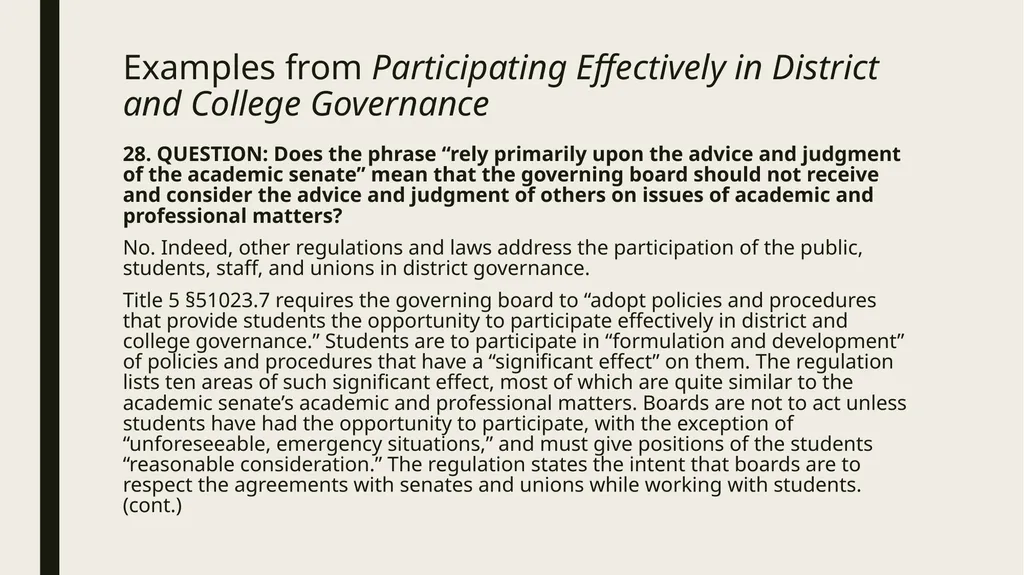
Examples from Participating Effectively in District and College Governance 28. QUESTION: Does the phrase “rely primarily upon the advice and judgment of the academic senate” mean that the governing board should not receive and consider the advice and judgment of others on issues of academic and professional matters?
No. Indeed, other regulations and laws address the participation of the public, students, staff, and unions in district governance.
Title 5 §51023.7 requires the governing board to “adopt policies and procedures that provide students the opportunity to participate effectively in district and college governance.” Students are to participate in “formulation and development” of policies and procedures that have a “significant effect” on them. The regulation lists ten areas of such significant effect, most of which are quite similar to the academic senate’s academic and professional matters. Boards are not to act unless students have had the opportunity to participate, with the exception of “unforeseeable, emergency situations,” and must give positions of the students “reasonable consideration.” The regulation states the intent that boards are to respect the agreements with senates and unions while working with students. (cont.)<br>
No. Indeed, other regulations and laws address the participation of the public, students, staff, and unions in district governance.
Title 5 §51023.7 requires the governing board to “adopt policies and procedures that provide students the opportunity to participate effectively in district and college governance.” Students are to participate in “formulation and development” of policies and procedures that have a “significant effect” on them. The regulation lists ten areas of such significant effect, most of which are quite similar to the academic senate’s academic and professional matters. Boards are not to act unless students have had the opportunity to participate, with the exception of “unforeseeable, emergency situations,” and must give positions of the students “reasonable consideration.” The regulation states the intent that boards are to respect the agreements with senates and unions while working with students. (cont.)<br>
14
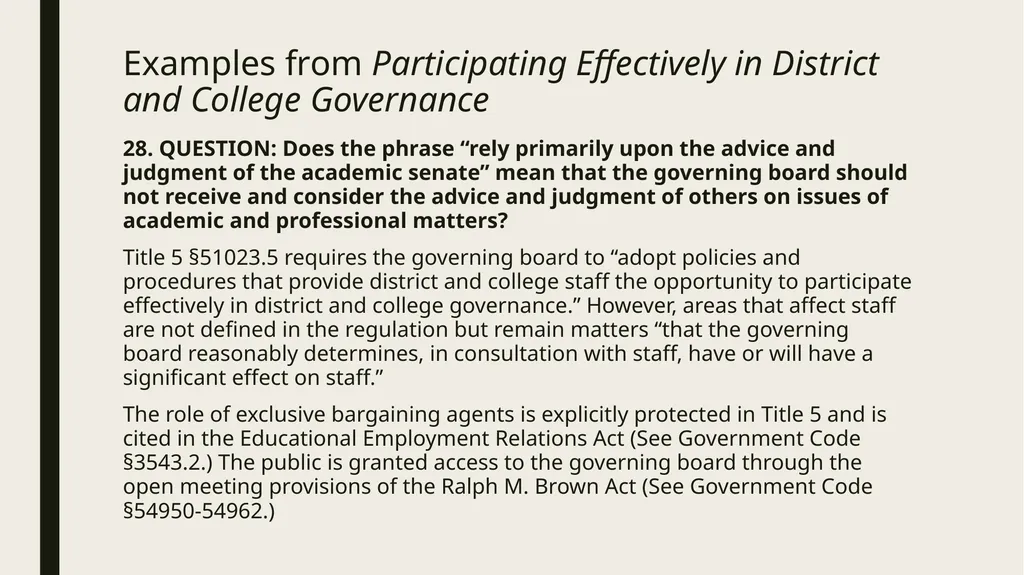
Examples from Participating Effectively in District and College Governance 28. QUESTION: Does the phrase “rely primarily upon the advice and judgment of the academic senate” mean that the governing board should not receive and consider the advice and judgment of others on issues of academic and professional matters?
Title 5 §51023.5 requires the governing board to “adopt policies and procedures that provide district and college staff the opportunity to participate effectively in district and college governance.” However, areas that affect staff are not defined in the regulation but remain matters “that the governing board reasonably determines, in consultation with staff, have or will have a significant effect on staff.”
The role of exclusive bargaining agents is explicitly protected in Title 5 and is cited in the Educational Employment Relations Act (See Government Code §3543.2.) The public is granted access to the governing board through the open meeting provisions of the Ralph M. Brown Act (See Government Code §54950-54962.)<br>
Title 5 §51023.5 requires the governing board to “adopt policies and procedures that provide district and college staff the opportunity to participate effectively in district and college governance.” However, areas that affect staff are not defined in the regulation but remain matters “that the governing board reasonably determines, in consultation with staff, have or will have a significant effect on staff.”
The role of exclusive bargaining agents is explicitly protected in Title 5 and is cited in the Educational Employment Relations Act (See Government Code §3543.2.) The public is granted access to the governing board through the open meeting provisions of the Ralph M. Brown Act (See Government Code §54950-54962.)<br>
15
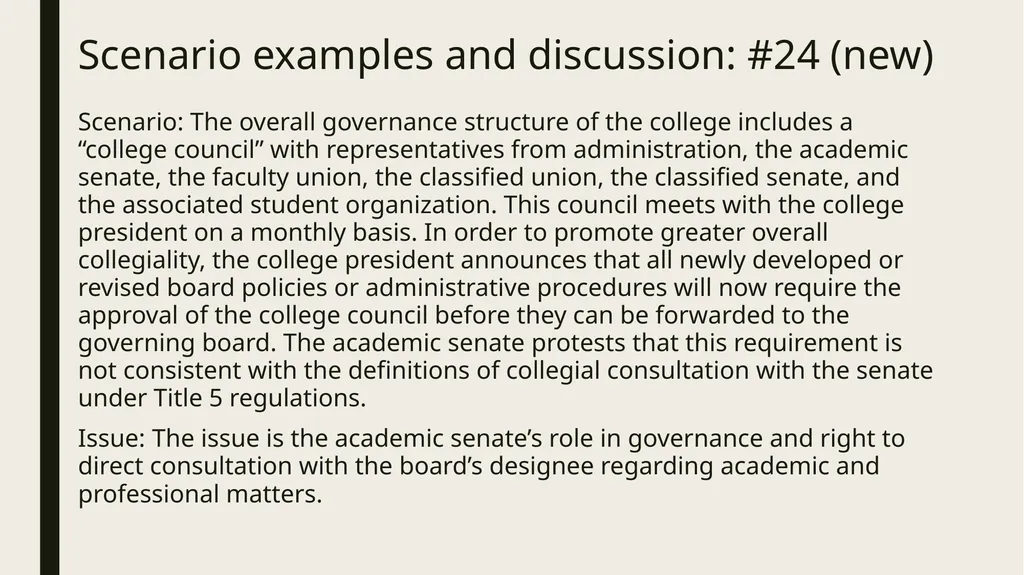
Scenario examples and discussion: #24 (new) Scenario: The overall governance structure of the college includes a “college council” with representatives from administration, the academic senate, the faculty union, the classified union, the classified senate, and the associated student organization. This council meets with the college president on a monthly basis. In order to promote greater overall collegiality, the college president announces that all newly developed or revised board policies or administrative procedures will now require the approval of the college council before they can be forwarded to the governing board. The academic senate protests that this requirement is not consistent with the definitions of collegial consultation with the senate under Title 5 regulations.
Issue: The issue is the academic senate’s role in governance and right to direct consultation with the board’s designee regarding academic and professional matters.<br>
Issue: The issue is the academic senate’s role in governance and right to direct consultation with the board’s designee regarding academic and professional matters.<br>
16
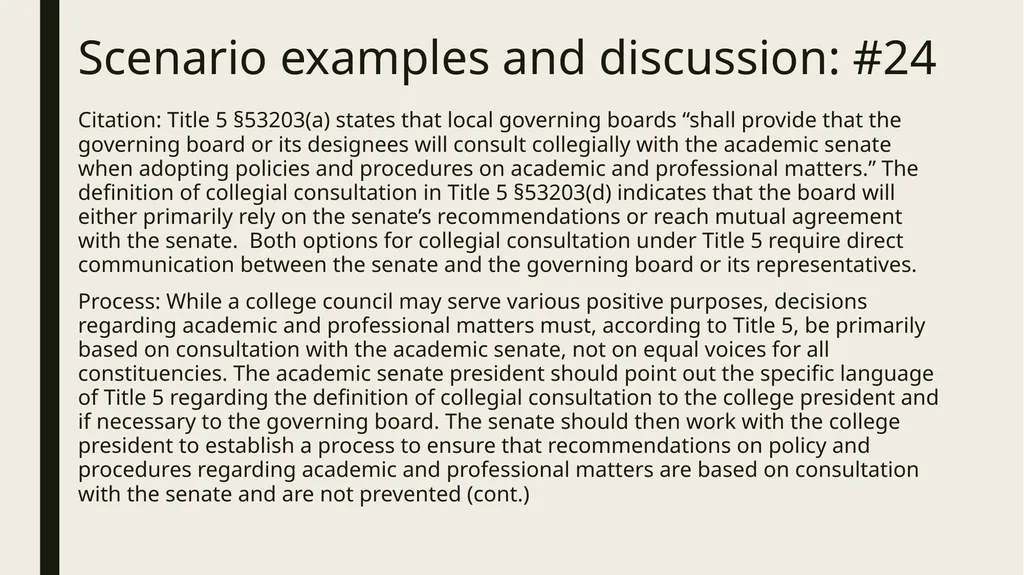
Scenario examples and discussion: #24 Citation: Title 5 §53203(a) states that local governing boards “shall provide that the governing board or its designees will consult collegially with the academic senate when adopting policies and procedures on academic and professional matters.” The definition of collegial consultation in Title 5 §53203(d) indicates that the board will either primarily rely on the senate’s recommendations or reach mutual agreement with the senate. Both options for collegial consultation under Title 5 require direct communication between the senate and the governing board or its representatives.
Process: While a college council may serve various positive purposes, decisions regarding academic and professional matters must, according to Title 5, be primarily based on consultation with the academic senate, not on equal voices for all constituencies. The academic senate president should point out the specific language of Title 5 regarding the definition of collegial consultation to the college president and if necessary to the governing board. The senate should then work with the college president to establish a process to ensure that recommendations on policy and procedures regarding academic and professional matters are based on consultation with the senate and are not prevented (cont.)<br>
Process: While a college council may serve various positive purposes, decisions regarding academic and professional matters must, according to Title 5, be primarily based on consultation with the academic senate, not on equal voices for all constituencies. The academic senate president should point out the specific language of Title 5 regarding the definition of collegial consultation to the college president and if necessary to the governing board. The senate should then work with the college president to establish a process to ensure that recommendations on policy and procedures regarding academic and professional matters are based on consultation with the senate and are not prevented (cont.)<br>
17
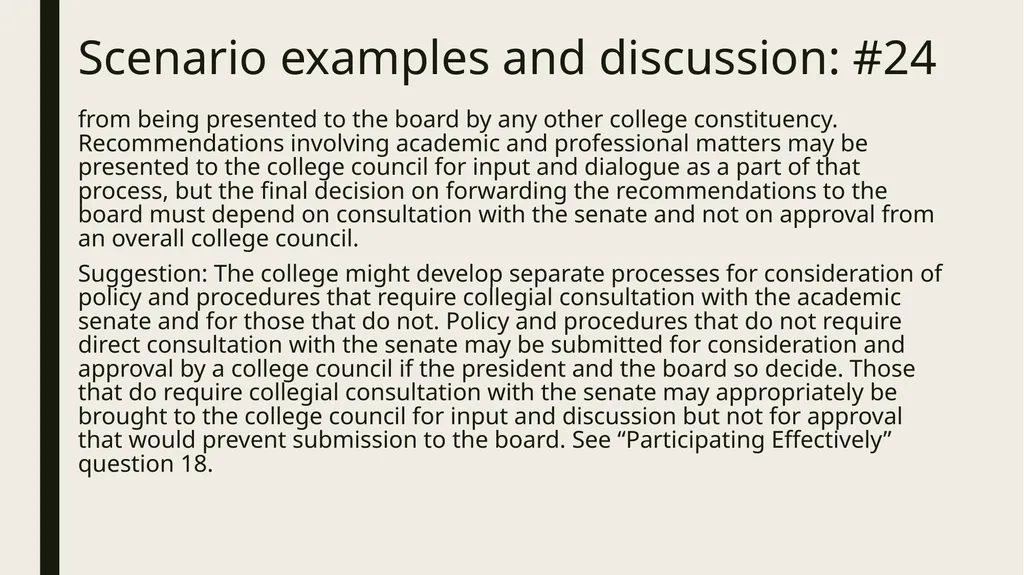
Scenario examples and discussion: #24 from being presented to the board by any other college constituency. Recommendations involving academic and professional matters may be presented to the college council for input and dialogue as a part of that process, but the final decision on forwarding the recommendations to the board must depend on consultation with the senate and not on approval from an overall college council.
Suggestion: The college might develop separate processes for consideration of policy and procedures that require collegial consultation with the academic senate and for those that do not. Policy and procedures that do not require direct consultation with the senate may be submitted for consideration and approval by a college council if the president and the board so decide. Those that do require collegial consultation with the senate may appropriately be brought to the college council for input and discussion but not for approval that would prevent submission to the board. See “Participating Effectively” question 18.<br>
Suggestion: The college might develop separate processes for consideration of policy and procedures that require collegial consultation with the academic senate and for those that do not. Policy and procedures that do not require direct consultation with the senate may be submitted for consideration and approval by a college council if the president and the board so decide. Those that do require collegial consultation with the senate may appropriately be brought to the college council for input and discussion but not for approval that would prevent submission to the board. See “Participating Effectively” question 18.<br>
18
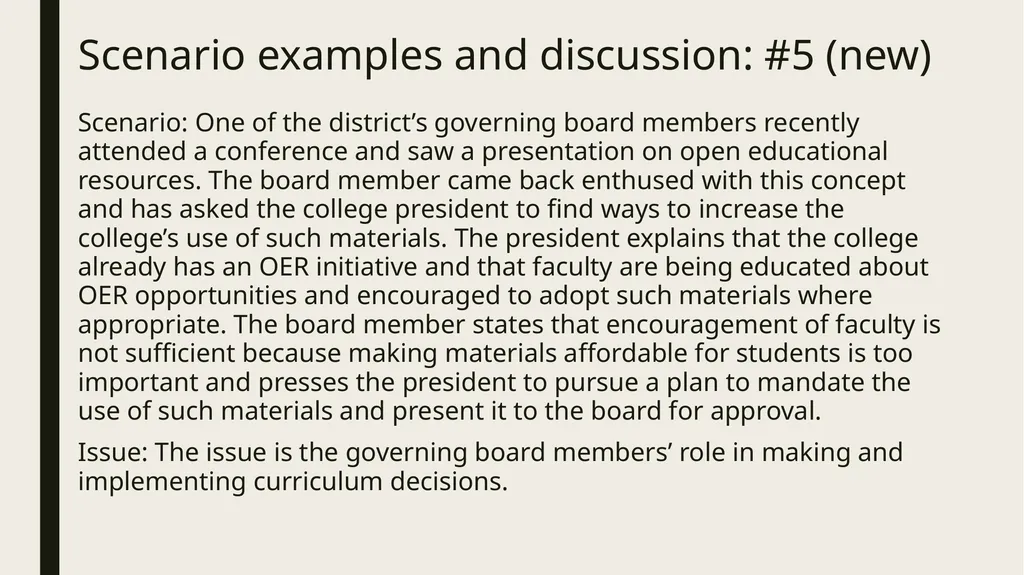
Scenario examples and discussion: #5 (new) Scenario: One of the district’s governing board members recently attended a conference and saw a presentation on open educational resources. The board member came back enthused with this concept and has asked the college president to find ways to increase the college’s use of such materials. The president explains that the college already has an OER initiative and that faculty are being educated about OER opportunities and encouraged to adopt such materials where appropriate. The board member states that encouragement of faculty is not sufficient because making materials affordable for students is too important and presses the president to pursue a plan to mandate the use of such materials and present it to the board for approval.
Issue: The issue is the governing board members’ role in making and implementing curriculum decisions.<br>
Issue: The issue is the governing board members’ role in making and implementing curriculum decisions.<br>
19
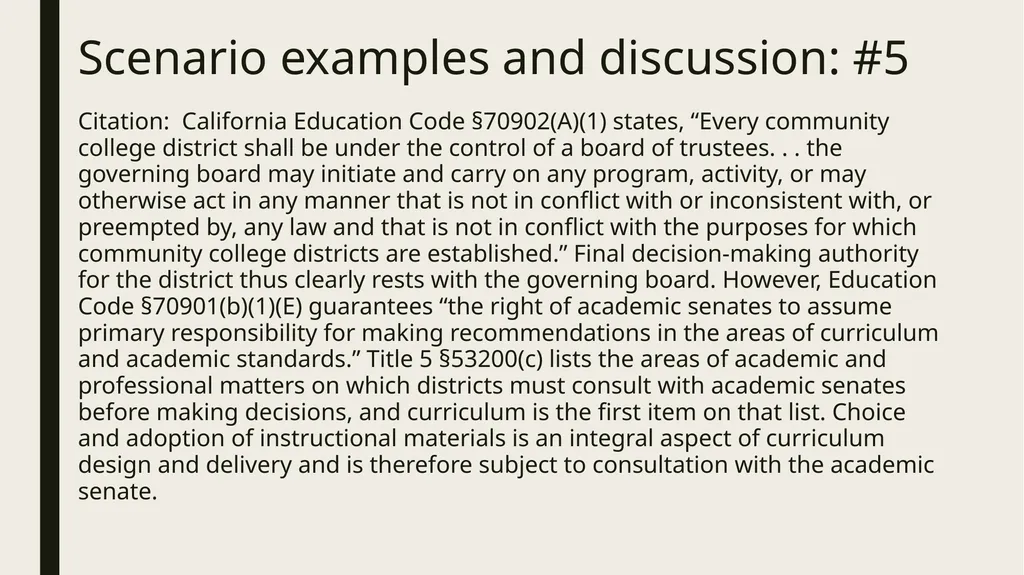
Scenario examples and discussion: #5 Citation: California Education Code §70902(A)(1) states, “Every community college district shall be under the control of a board of trustees. . . the governing board may initiate and carry on any program, activity, or may otherwise act in any manner that is not in conflict with or inconsistent with, or preempted by, any law and that is not in conflict with the purposes for which community college districts are established.” Final decision-making authority for the district thus clearly rests with the governing board. However, Education Code §70901(b)(1)(E) guarantees “the right of academic senates to assume primary responsibility for making recommendations in the areas of curriculum and academic standards.” Title 5 §53200(c) lists the areas of academic and professional matters on which districts must consult with academic senates before making decisions, and curriculum is the first item on that list. Choice and adoption of instructional materials is an integral aspect of curriculum design and delivery and is therefore subject to consultation with the academic senate.<br>
20
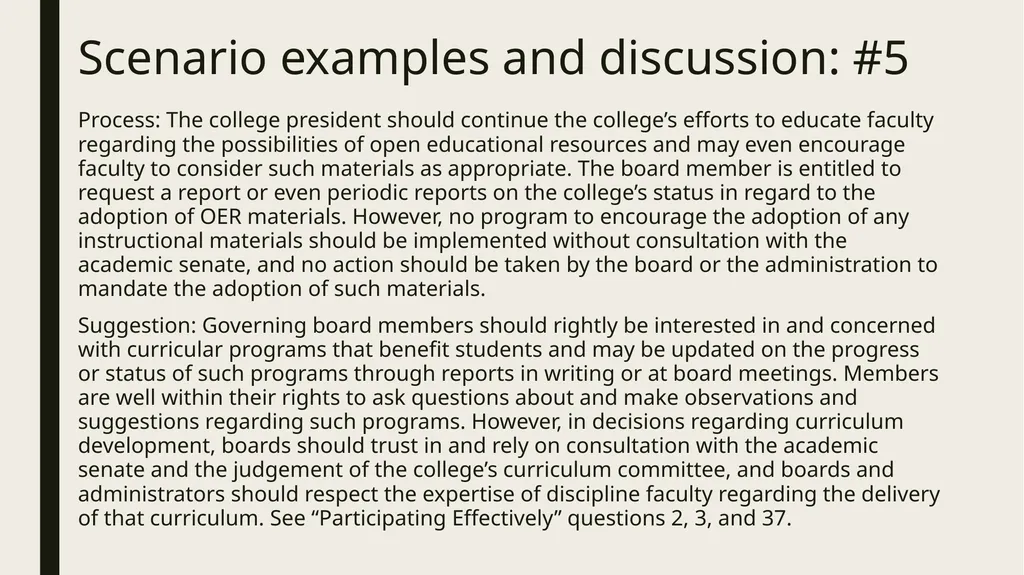
Scenario examples and discussion: #5 Process: The college president should continue the college’s efforts to educate faculty regarding the possibilities of open educational resources and may even encourage faculty to consider such materials as appropriate. The board member is entitled to request a report or even periodic reports on the college’s status in regard to the adoption of OER materials. However, no program to encourage the adoption of any instructional materials should be implemented without consultation with the academic senate, and no action should be taken by the board or the administration to mandate the adoption of such materials.
Suggestion: Governing board members should rightly be interested in and concerned with curricular programs that benefit students and may be updated on the progress or status of such programs through reports in writing or at board meetings. Members are well within their rights to ask questions about and make observations and suggestions regarding such programs. However, in decisions regarding curriculum development, boards should trust in and rely on consultation with the academic senate and the judgement of the college’s curriculum committee, and boards and administrators should respect the expertise of discipline faculty regarding the delivery of that curriculum. See “Participating Effectively” questions 2, 3, and 37.<br>
Suggestion: Governing board members should rightly be interested in and concerned with curricular programs that benefit students and may be updated on the progress or status of such programs through reports in writing or at board meetings. Members are well within their rights to ask questions about and make observations and suggestions regarding such programs. However, in decisions regarding curriculum development, boards should trust in and rely on consultation with the academic senate and the judgement of the college’s curriculum committee, and boards and administrators should respect the expertise of discipline faculty regarding the delivery of that curriculum. See “Participating Effectively” questions 2, 3, and 37.<br>
21
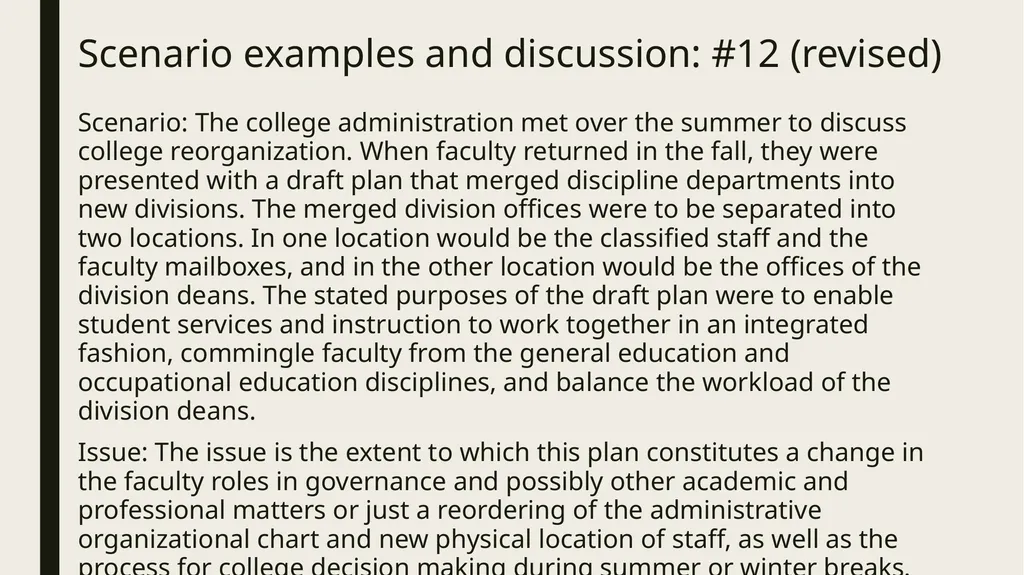
Scenario examples and discussion: #12 (revised) Scenario: The college administration met over the summer to discuss college reorganization. When faculty returned in the fall, they were presented with a draft plan that merged discipline departments into new divisions. The merged division offices were to be separated into two locations. In one location would be the classified staff and the faculty mailboxes, and in the other location would be the offices of the division deans. The stated purposes of the draft plan were to enable student services and instruction to work together in an integrated fashion, commingle faculty from the general education and occupational education disciplines, and balance the workload of the division deans.
Issue: The issue is the extent to which this plan constitutes a change in the faculty roles in governance and possibly other academic and professional matters or just a reordering of the administrative organizational chart and new physical location of staff, as well as the process for college decision making during summer or winter breaks.<br>
Issue: The issue is the extent to which this plan constitutes a change in the faculty roles in governance and possibly other academic and professional matters or just a reordering of the administrative organizational chart and new physical location of staff, as well as the process for college decision making during summer or winter breaks.<br>
22
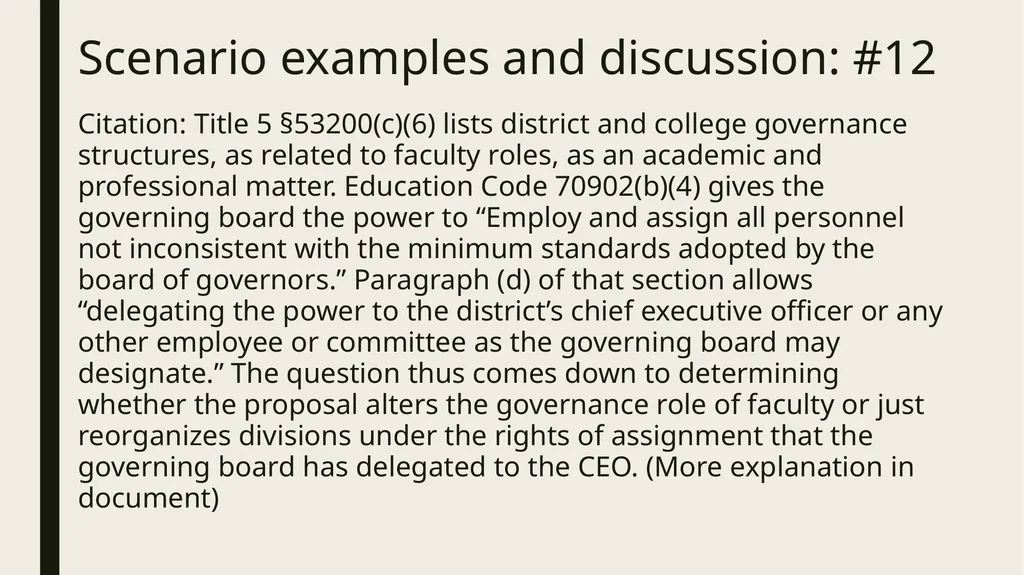
Scenario examples and discussion: #12 Citation: Title 5 §53200(c)(6) lists district and college governance structures, as related to faculty roles, as an academic and professional matter. Education Code 70902(b)(4) gives the governing board the power to “Employ and assign all personnel not inconsistent with the minimum standards adopted by the board of governors.” Paragraph (d) of that section allows “delegating the power to the district’s chief executive officer or any other employee or committee as the governing board may designate.” The question thus comes down to determining whether the proposal alters the governance role of faculty or just reorganizes divisions under the rights of assignment that the governing board has delegated to the CEO. (More explanation in document)<br>
23
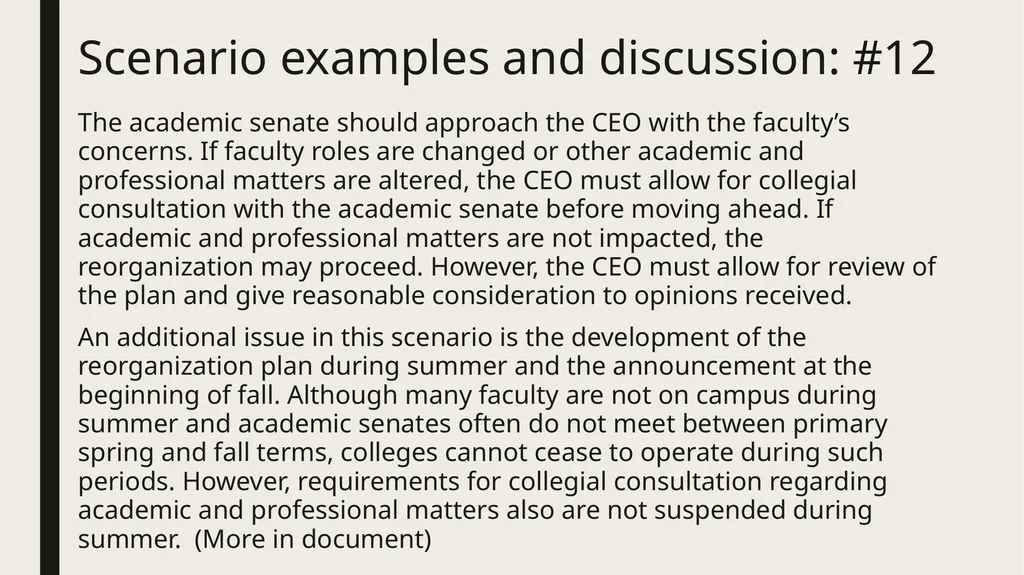
Scenario examples and discussion: #12 The academic senate should approach the CEO with the faculty’s concerns. If faculty roles are changed or other academic and professional matters are altered, the CEO must allow for collegial consultation with the academic senate before moving ahead. If academic and professional matters are not impacted, the reorganization may proceed. However, the CEO must allow for review of the plan and give reasonable consideration to opinions received.
An additional issue in this scenario is the development of the reorganization plan during summer and the announcement at the beginning of fall. Although many faculty are not on campus during summer and academic senates often do not meet between primary spring and fall terms, colleges cannot cease to operate during such periods. However, requirements for collegial consultation regarding academic and professional matters also are not suspended during summer. (More in document)<br>
An additional issue in this scenario is the development of the reorganization plan during summer and the announcement at the beginning of fall. Although many faculty are not on campus during summer and academic senates often do not meet between primary spring and fall terms, colleges cannot cease to operate during such periods. However, requirements for collegial consultation regarding academic and professional matters also are not suspended during summer. (More in document)<br>
24
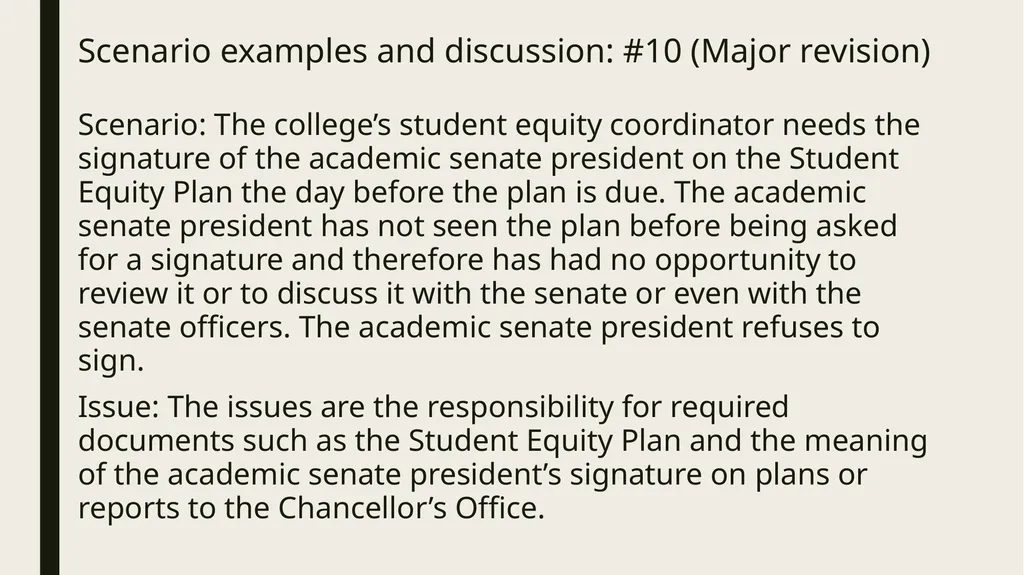
Scenario examples and discussion: #10 (Major revision) Scenario: The college’s student equity coordinator needs the signature of the academic senate president on the Student Equity Plan the day before the plan is due. The academic senate president has not seen the plan before being asked for a signature and therefore has had no opportunity to review it or to discuss it with the senate or even with the senate officers. The academic senate president refuses to sign.
Issue: The issues are the responsibility for required documents such as the Student Equity Plan and the meaning of the academic senate president’s signature on plans or reports to the Chancellor’s Office.<br>
Issue: The issues are the responsibility for required documents such as the Student Equity Plan and the meaning of the academic senate president’s signature on plans or reports to the Chancellor’s Office.<br>
25
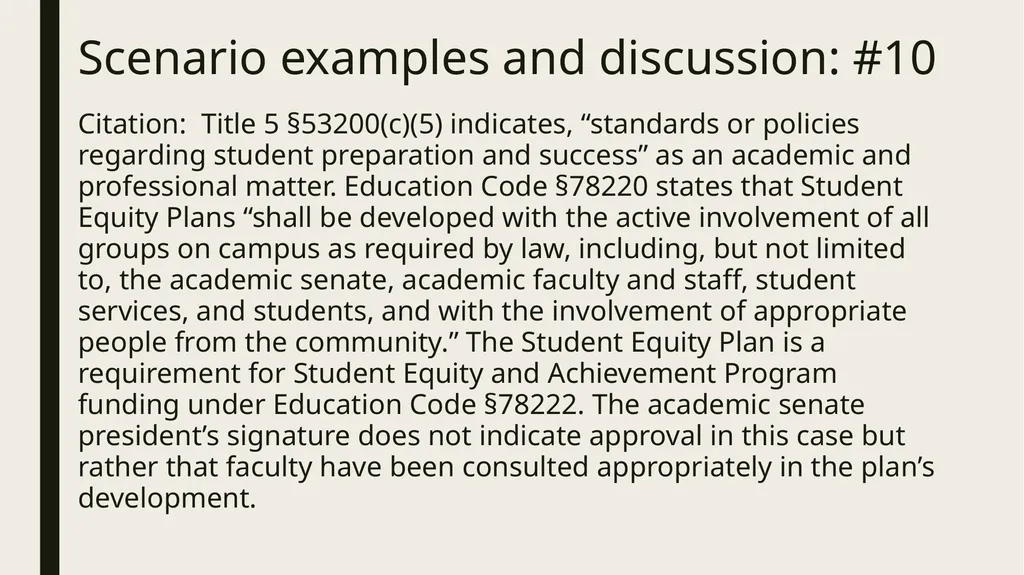
Scenario examples and discussion: #10 Citation: Title 5 §53200(c)(5) indicates, “standards or policies regarding student preparation and success” as an academic and professional matter. Education Code §78220 states that Student Equity Plans “shall be developed with the active involvement of all groups on campus as required by law, including, but not limited to, the academic senate, academic faculty and staff, student services, and students, and with the involvement of appropriate people from the community.” The Student Equity Plan is a requirement for Student Equity and Achievement Program funding under Education Code §78222. The academic senate president’s signature does not indicate approval in this case but rather that faculty have been consulted appropriately in the plan’s development.<br>
26
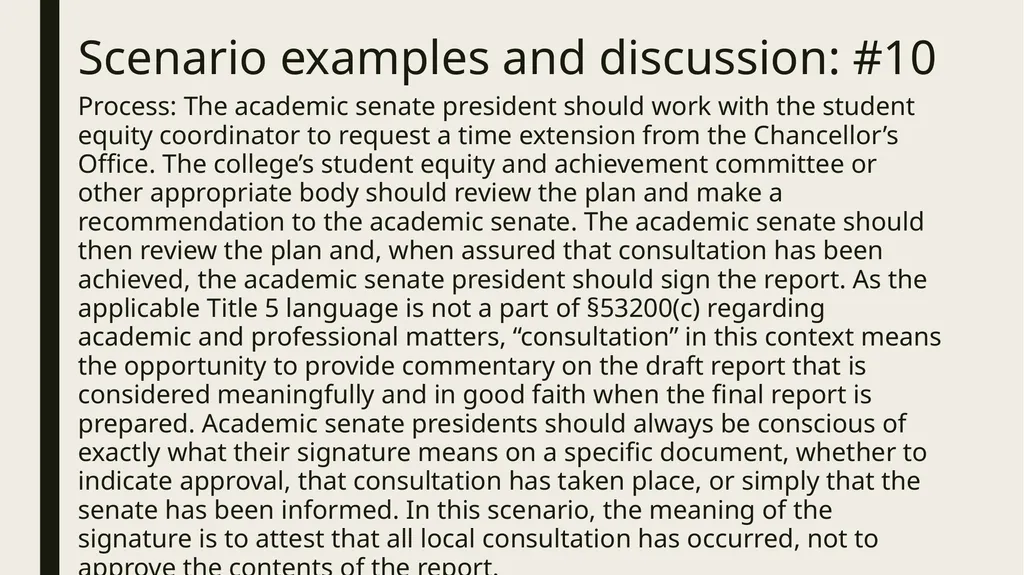
Scenario examples and discussion: #10 Process: The academic senate president should work with the student equity coordinator to request a time extension from the Chancellor’s Office. The college’s student equity and achievement committee or other appropriate body should review the plan and make a recommendation to the academic senate. The academic senate should then review the plan and, when assured that consultation has been achieved, the academic senate president should sign the report. As the applicable Title 5 language is not a part of §53200(c) regarding academic and professional matters, “consultation” in this context means the opportunity to provide commentary on the draft report that is considered meaningfully and in good faith when the final report is prepared. Academic senate presidents should always be conscious of exactly what their signature means on a specific document, whether to indicate approval, that consultation has taken place, or simply that the senate has been informed. In this scenario, the meaning of the signature is to attest that all local consultation has occurred, not to approve the contents of the report.<br>
27
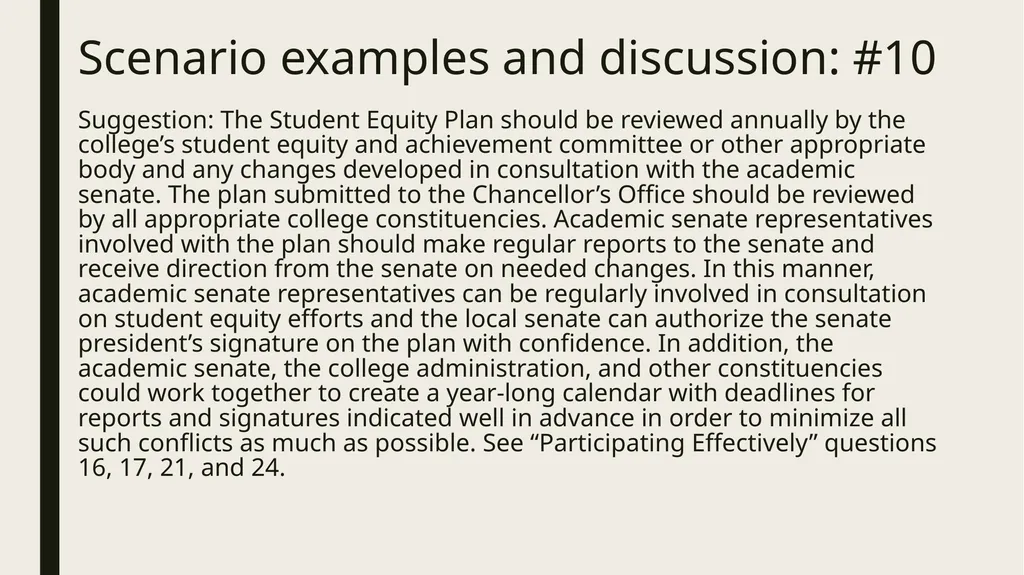
Scenario examples and discussion: #10 Suggestion: The Student Equity Plan should be reviewed annually by the college’s student equity and achievement committee or other appropriate body and any changes developed in consultation with the academic senate. The plan submitted to the Chancellor’s Office should be reviewed by all appropriate college constituencies. Academic senate representatives involved with the plan should make regular reports to the senate and receive direction from the senate on needed changes. In this manner, academic senate representatives can be regularly involved in consultation on student equity efforts and the local senate can authorize the senate president’s signature on the plan with confidence. In addition, the academic senate, the college administration, and other constituencies could work together to create a year-long calendar with deadlines for reports and signatures indicated well in advance in order to minimize all such conflicts as much as possible. See “Participating Effectively” questions 16, 17, 21, and 24.<br>
28
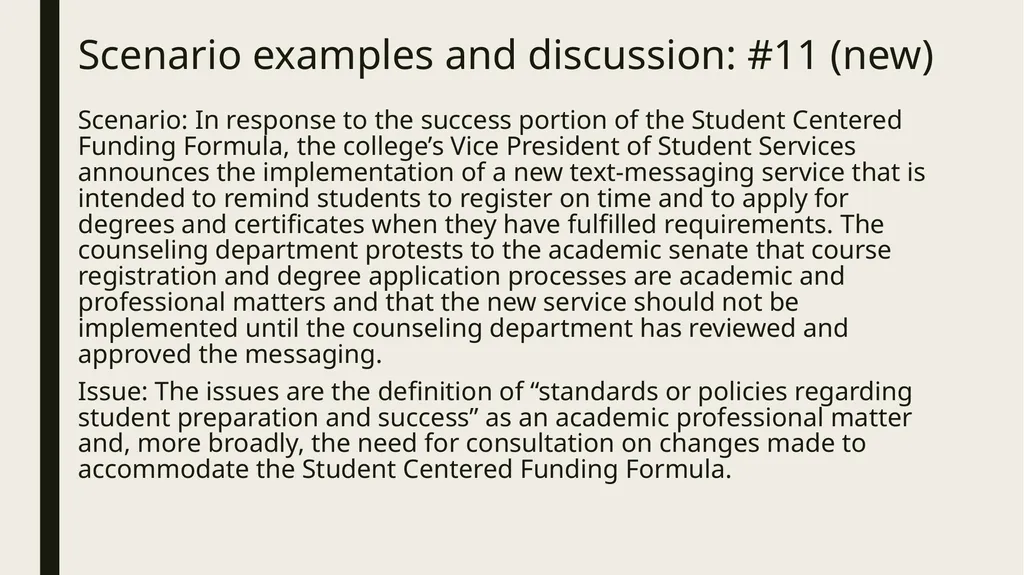
Scenario examples and discussion: #11 (new) Scenario: In response to the success portion of the Student Centered Funding Formula, the college’s Vice President of Student Services announces the implementation of a new text-messaging service that is intended to remind students to register on time and to apply for degrees and certificates when they have fulfilled requirements. The counseling department protests to the academic senate that course registration and degree application processes are academic and professional matters and that the new service should not be implemented until the counseling department has reviewed and approved the messaging.
Issue: The issues are the definition of “standards or policies regarding student preparation and success” as an academic professional matter and, more broadly, the need for consultation on changes made to accommodate the Student Centered Funding Formula.<br>
Issue: The issues are the definition of “standards or policies regarding student preparation and success” as an academic professional matter and, more broadly, the need for consultation on changes made to accommodate the Student Centered Funding Formula.<br>
29
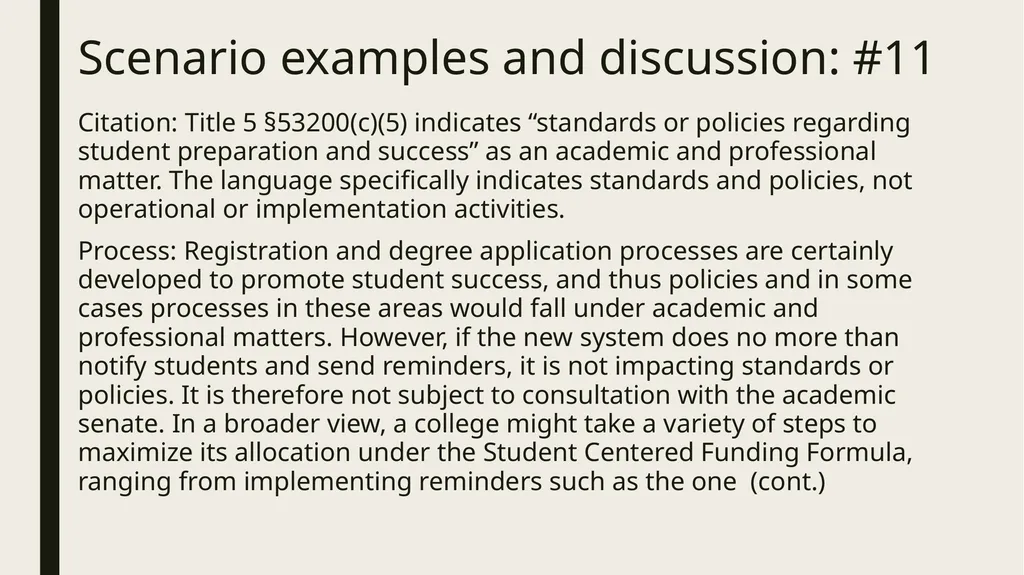
Scenario examples and discussion: #11 Citation: Title 5 §53200(c)(5) indicates “standards or policies regarding student preparation and success” as an academic and professional matter. The language specifically indicates standards and policies, not operational or implementation activities.
Process: Registration and degree application processes are certainly developed to promote student success, and thus policies and in some cases processes in these areas would fall under academic and professional matters. However, if the new system does no more than notify students and send reminders, it is not impacting standards or policies. It is therefore not subject to consultation with the academic senate. In a broader view, a college might take a variety of steps to maximize its allocation under the Student Centered Funding Formula, ranging from implementing reminders such as the one (cont.)<br>
Process: Registration and degree application processes are certainly developed to promote student success, and thus policies and in some cases processes in these areas would fall under academic and professional matters. However, if the new system does no more than notify students and send reminders, it is not impacting standards or policies. It is therefore not subject to consultation with the academic senate. In a broader view, a college might take a variety of steps to maximize its allocation under the Student Centered Funding Formula, ranging from implementing reminders such as the one (cont.)<br>
30
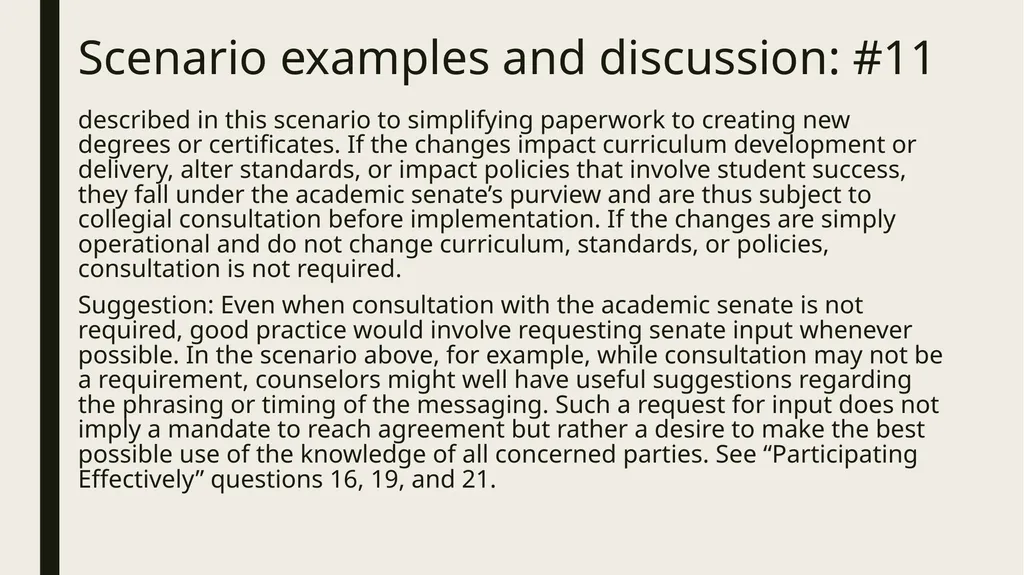
Scenario examples and discussion: #11 described in this scenario to simplifying paperwork to creating new degrees or certificates. If the changes impact curriculum development or delivery, alter standards, or impact policies that involve student success, they fall under the academic senate’s purview and are thus subject to collegial consultation before implementation. If the changes are simply operational and do not change curriculum, standards, or policies, consultation is not required.
Suggestion: Even when consultation with the academic senate is not required, good practice would involve requesting senate input whenever possible. In the scenario above, for example, while consultation may not be a requirement, counselors might well have useful suggestions regarding the phrasing or timing of the messaging. Such a request for input does not imply a mandate to reach agreement but rather a desire to make the best possible use of the knowledge of all concerned parties. See “Participating Effectively” questions 16, 19, and 21.<br>
Suggestion: Even when consultation with the academic senate is not required, good practice would involve requesting senate input whenever possible. In the scenario above, for example, while consultation may not be a requirement, counselors might well have useful suggestions regarding the phrasing or timing of the messaging. Such a request for input does not imply a mandate to reach agreement but rather a desire to make the best possible use of the knowledge of all concerned parties. See “Participating Effectively” questions 16, 19, and 21.<br>
31
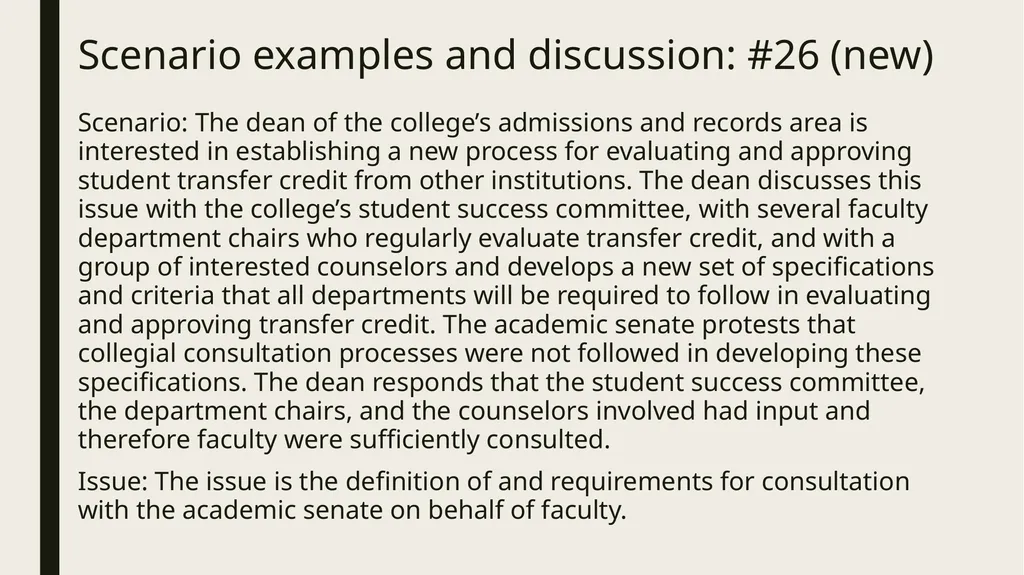
Scenario examples and discussion: #26 (new) Scenario: The dean of the college’s admissions and records area is interested in establishing a new process for evaluating and approving student transfer credit from other institutions. The dean discusses this issue with the college’s student success committee, with several faculty department chairs who regularly evaluate transfer credit, and with a group of interested counselors and develops a new set of specifications and criteria that all departments will be required to follow in evaluating and approving transfer credit. The academic senate protests that collegial consultation processes were not followed in developing these specifications. The dean responds that the student success committee, the department chairs, and the counselors involved had input and therefore faculty were sufficiently consulted.
Issue: The issue is the definition of and requirements for consultation with the academic senate on behalf of faculty.<br>
Issue: The issue is the definition of and requirements for consultation with the academic senate on behalf of faculty.<br>
32
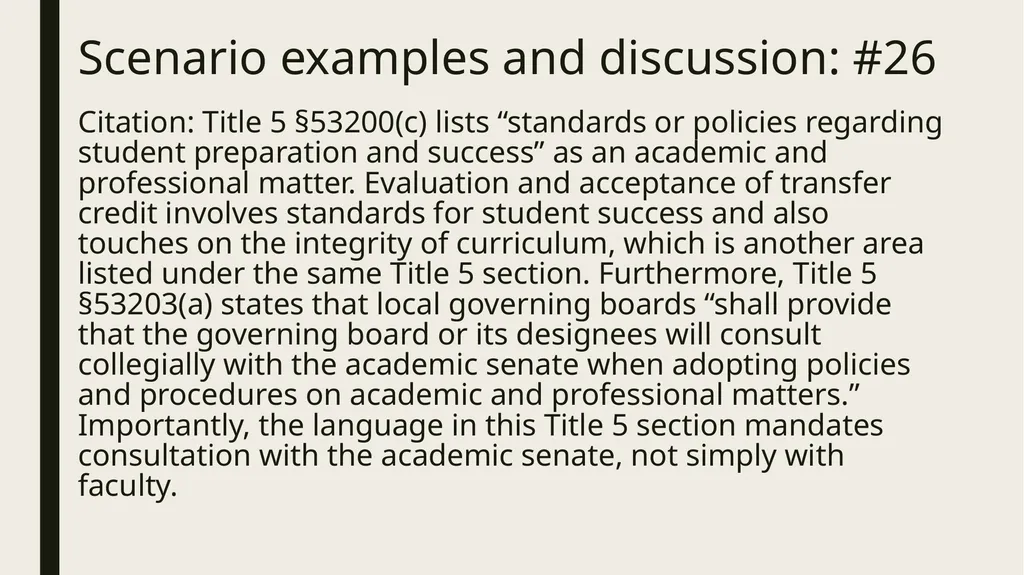
Scenario examples and discussion: #26 Citation: Title 5 §53200(c) lists “standards or policies regarding student preparation and success” as an academic and professional matter. Evaluation and acceptance of transfer credit involves standards for student success and also touches on the integrity of curriculum, which is another area listed under the same Title 5 section. Furthermore, Title 5 §53203(a) states that local governing boards “shall provide that the governing board or its designees will consult collegially with the academic senate when adopting policies and procedures on academic and professional matters.” Importantly, the language in this Title 5 section mandates consultation with the academic senate, not simply with faculty.<br>
33
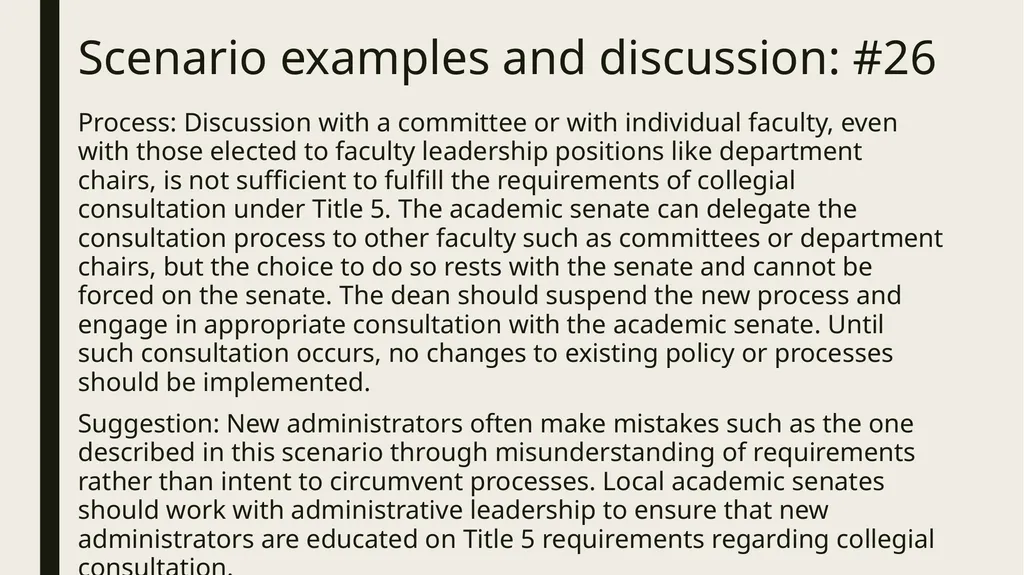
Scenario examples and discussion: #26 Process: Discussion with a committee or with individual faculty, even with those elected to faculty leadership positions like department chairs, is not sufficient to fulfill the requirements of collegial consultation under Title 5. The academic senate can delegate the consultation process to other faculty such as committees or department chairs, but the choice to do so rests with the senate and cannot be forced on the senate. The dean should suspend the new process and engage in appropriate consultation with the academic senate. Until such consultation occurs, no changes to existing policy or processes should be implemented.
Suggestion: New administrators often make mistakes such as the one described in this scenario through misunderstanding of requirements rather than intent to circumvent processes. Local academic senates should work with administrative leadership to ensure that new administrators are educated on Title 5 requirements regarding collegial consultation.<br>
Suggestion: New administrators often make mistakes such as the one described in this scenario through misunderstanding of requirements rather than intent to circumvent processes. Local academic senates should work with administrative leadership to ensure that new administrators are educated on Title 5 requirements regarding collegial consultation.<br>
34
Reactions and Comments Thank you for joining us
Contact information:
David Morse: dmorse@lbcc.edu
Larry Galizio: Galizio@ccleague.org
Dolores Davison: info@asccc.org<br>
Contact information:
David Morse: dmorse@lbcc.edu
Larry Galizio: Galizio@ccleague.org
Dolores Davison: info@asccc.org<br>