
Particle Theory Overview Nick Evans (Southampton)
NS
Published · 19 slides · 0 views

1 / 1

Description
Particle Theory Overview Nick Evans (Southampton) The CG round for 2023-26 is just being announced. 22 rise in funding has made for a good period. The PPGP(T) Panel Nick Evans, Southampton (Chair) (QFTstrings) Richard Ball - Edinburgh
Related Topics
Share
Embed code
Download this presentation From Below
"Particle Theory Overview Nick Evans (Southampton)" is the property of its rightful owner. Permission is granted to download and print the materials on this website for personal, non-commercial use only, and to display it on your personal computer provided you do not modify the materials and that you retain all copyright notices contained in the materials. By downloading content from our website, you accept the terms of this agreement.
Presentation Transcript
01
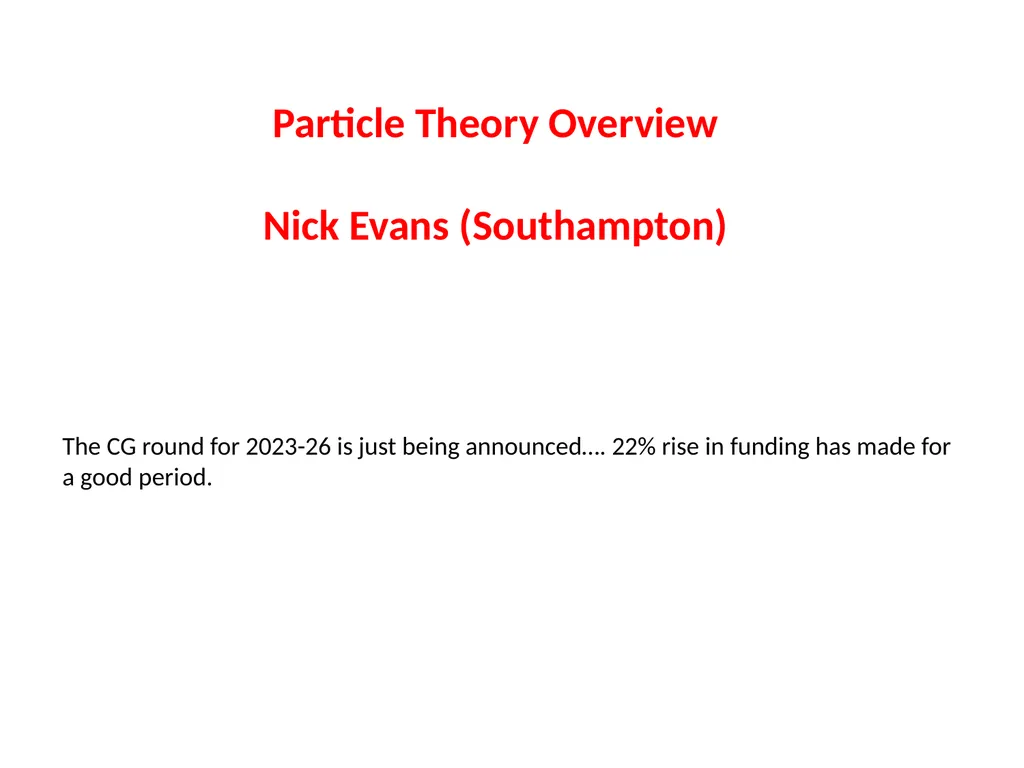
Particle Theory Overview
Nick Evans (Southampton) The CG round for 2023-26 is just being announced…. 22% rise in funding has made for a good period.<br>
02
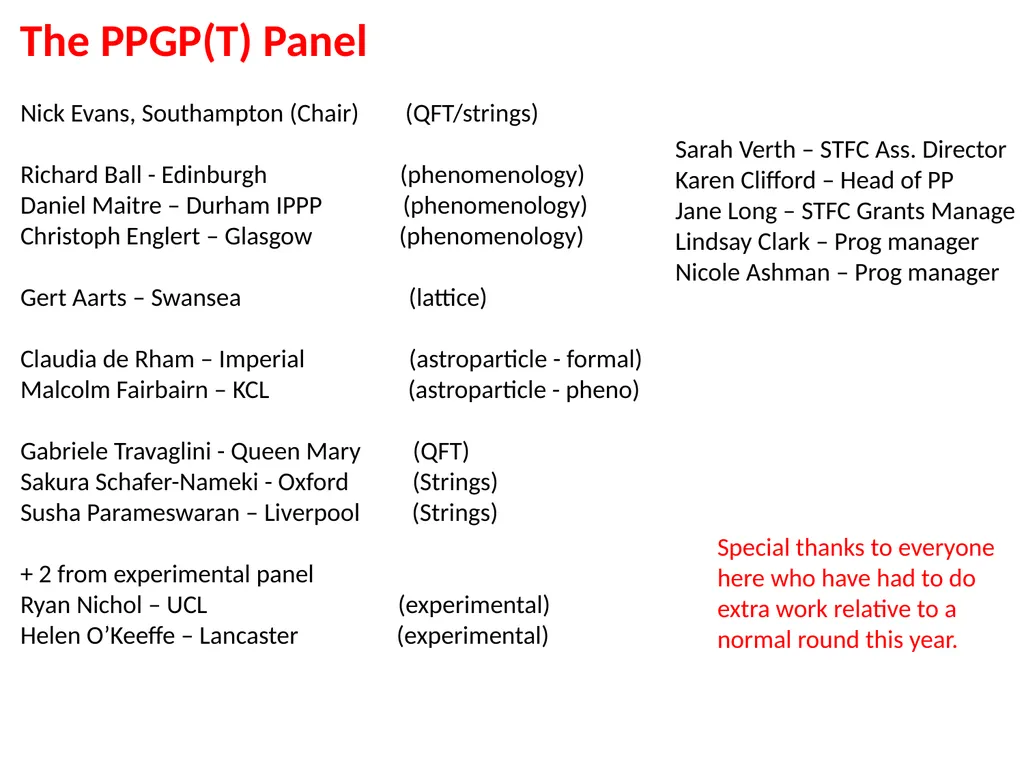
The PPGP(T) Panel
Nick Evans, Southampton (Chair) (QFT/strings)
Richard Ball - Edinburgh (phenomenology)
Daniel Maitre – Durham IPPP (phenomenology)
Christoph Englert – Glasgow (phenomenology)
Gert Aarts – Swansea (lattice)
Claudia de Rham – Imperial (astroparticle - formal)
Malcolm Fairbairn – KCL (astroparticle - pheno)
Gabriele Travaglini - Queen Mary (QFT)
Sakura Schafer-Nameki - Oxford (Strings)
Susha Parameswaran – Liverpool (Strings)
+ 2 from experimental panel
Ryan Nichol – UCL (experimental)
Helen O’Keeffe – Lancaster (experimental) Sarah Verth – STFC Ass. Director
Karen Clifford – Head of PP
Jane Long – STFC Grants Manage
Lindsay Clark – Prog manager
Nicole Ashman – Prog manager Special thanks to everyone here who have had to do extra work relative to a normal round this year.<br>
Nick Evans, Southampton (Chair) (QFT/strings)
Richard Ball - Edinburgh (phenomenology)
Daniel Maitre – Durham IPPP (phenomenology)
Christoph Englert – Glasgow (phenomenology)
Gert Aarts – Swansea (lattice)
Claudia de Rham – Imperial (astroparticle - formal)
Malcolm Fairbairn – KCL (astroparticle - pheno)
Gabriele Travaglini - Queen Mary (QFT)
Sakura Schafer-Nameki - Oxford (Strings)
Susha Parameswaran – Liverpool (Strings)
+ 2 from experimental panel
Ryan Nichol – UCL (experimental)
Helen O’Keeffe – Lancaster (experimental) Sarah Verth – STFC Ass. Director
Karen Clifford – Head of PP
Jane Long – STFC Grants Manage
Lindsay Clark – Prog manager
Nicole Ashman – Prog manager Special thanks to everyone here who have had to do extra work relative to a normal round this year.<br>
03
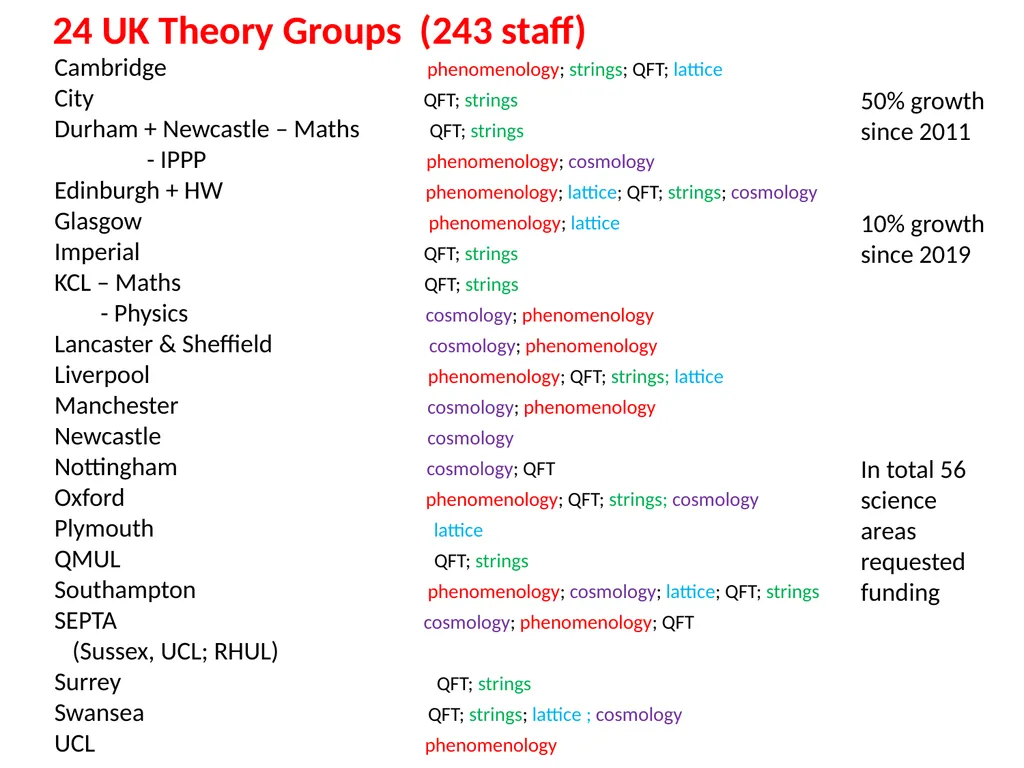
24 UK Theory Groups (243 staff) Cambridge phenomenology; strings; QFT; lattice
City QFT; strings
Durham + Newcastle – Maths QFT; strings
- IPPP phenomenology; cosmology
Edinburgh + HW phenomenology; lattice; QFT; strings; cosmology
Glasgow phenomenology; lattice
Imperial QFT; strings
KCL – Maths QFT; strings
- Physics cosmology; phenomenology
Lancaster & Sheffield cosmology; phenomenology
Liverpool phenomenology; QFT; strings; lattice
Manchester cosmology; phenomenology
Newcastle cosmology
Nottingham cosmology; QFT
Oxford phenomenology; QFT; strings; cosmology
Plymouth lattice
QMUL QFT; strings
Southampton phenomenology; cosmology; lattice; QFT; strings
SEPTA cosmology; phenomenology; QFT
(Sussex, UCL; RHUL)
Surrey QFT; strings
Swansea QFT; strings; lattice ; cosmology
UCL phenomenology 50% growth since 2011
10% growth since 2019
In total 56 science areas requested funding<br>
City QFT; strings
Durham + Newcastle – Maths QFT; strings
- IPPP phenomenology; cosmology
Edinburgh + HW phenomenology; lattice; QFT; strings; cosmology
Glasgow phenomenology; lattice
Imperial QFT; strings
KCL – Maths QFT; strings
- Physics cosmology; phenomenology
Lancaster & Sheffield cosmology; phenomenology
Liverpool phenomenology; QFT; strings; lattice
Manchester cosmology; phenomenology
Newcastle cosmology
Nottingham cosmology; QFT
Oxford phenomenology; QFT; strings; cosmology
Plymouth lattice
QMUL QFT; strings
Southampton phenomenology; cosmology; lattice; QFT; strings
SEPTA cosmology; phenomenology; QFT
(Sussex, UCL; RHUL)
Surrey QFT; strings
Swansea QFT; strings; lattice ; cosmology
UCL phenomenology 50% growth since 2011
10% growth since 2019
In total 56 science areas requested funding<br>
04
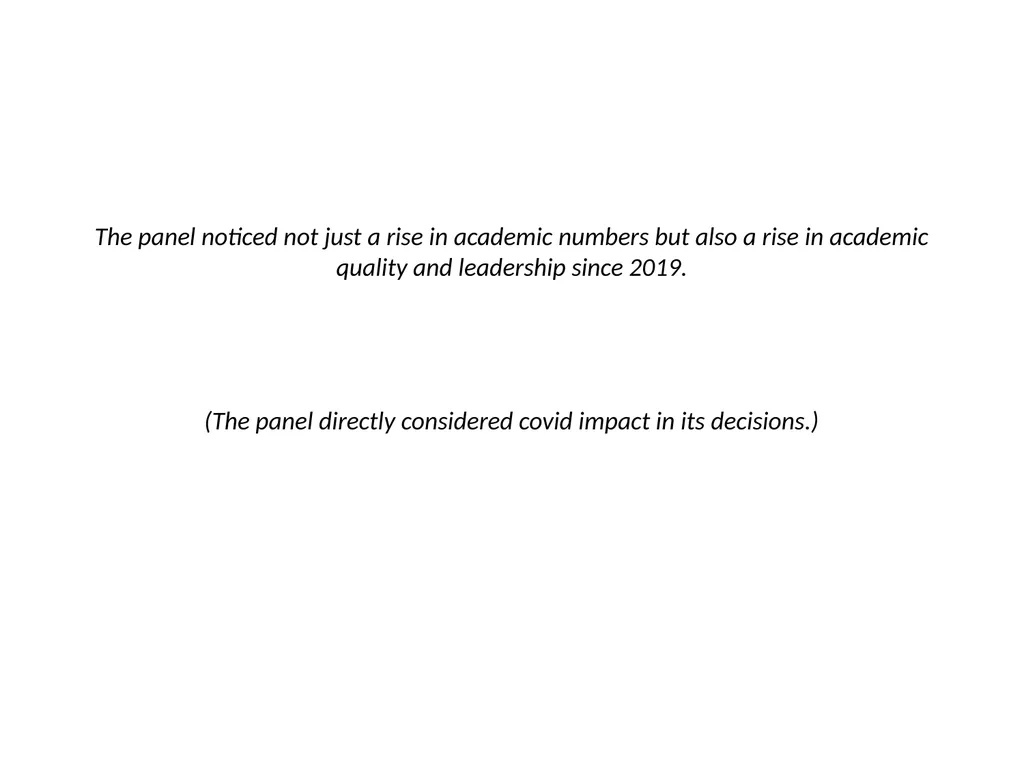
The panel noticed not just a rise in academic numbers but also a rise in academic quality and leadership since 2019.
(The panel directly considered covid impact in its decisions.)<br>
(The panel directly considered covid impact in its decisions.)<br>
05
Phenomenology Guides search strategies & communicates theory and experimental constraints
IPPP lead for UK.
Parton distribution functions
Monte Carlo development - HERWIG, SHERPA
AI/Machine Learning for data and models
Precision SM – SMEFT
- QCD - N3LO
- higgs – NLO & N3LO computations
- neutrino (with many expts)
- flavour (with LHCb and NA62 and g-2)
Model building – naturalness; discrete flavour symmetries
NOTE: no precision experiment can be done without a robust theoretical prediction!<br>
IPPP lead for UK.
Parton distribution functions
Monte Carlo development - HERWIG, SHERPA
AI/Machine Learning for data and models
Precision SM – SMEFT
- QCD - N3LO
- higgs – NLO & N3LO computations
- neutrino (with many expts)
- flavour (with LHCb and NA62 and g-2)
Model building – naturalness; discrete flavour symmetries
NOTE: no precision experiment can be done without a robust theoretical prediction!<br>
06
Lattice Including QED and isospin-breaking effects
Precision calculations of Standard Model phenomenology, such as:
Nucleon structure
Kaon/D physics and rare decays
b-physics
𝜇 g-2
Hadron resonances and multihadron scattering
BSM studies using non-QCD theories – composite higgs, DM, holographic cosmology
ML & quantum simulation for lattice field theories 〗 Crucial for precision tests of SM and search for BSM signals<br>
Precision calculations of Standard Model phenomenology, such as:
Nucleon structure
Kaon/D physics and rare decays
b-physics
𝜇 g-2
Hadron resonances and multihadron scattering
BSM studies using non-QCD theories – composite higgs, DM, holographic cosmology
ML & quantum simulation for lattice field theories 〗 Crucial for precision tests of SM and search for BSM signals<br>
07
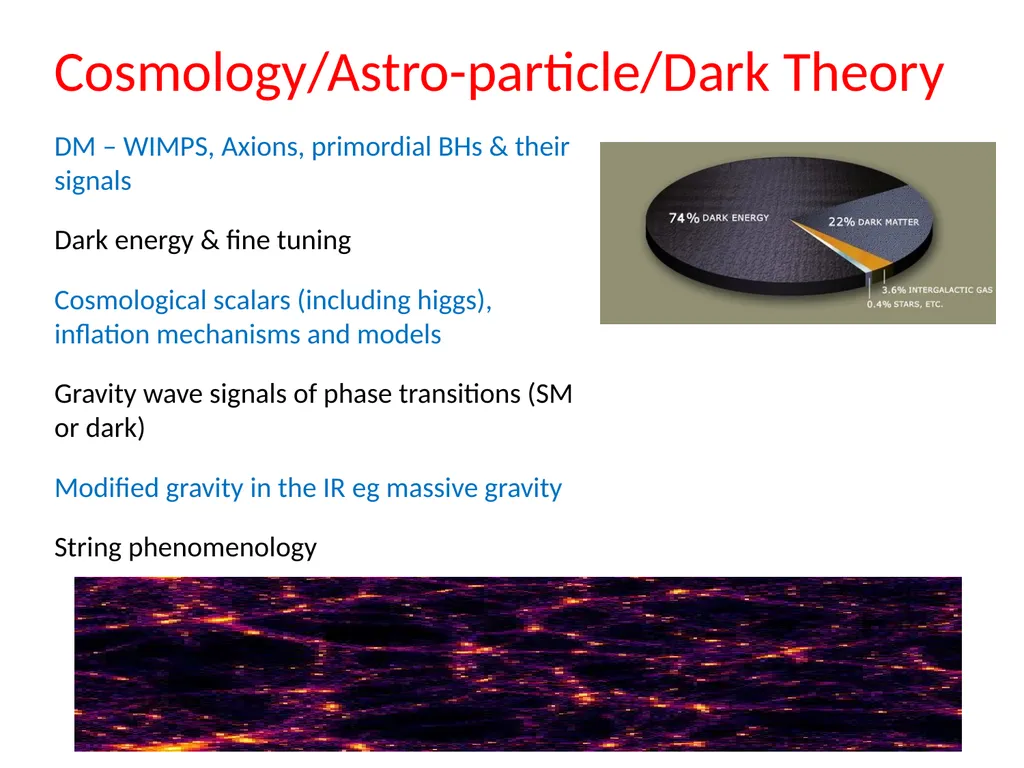
DM – WIMPS, Axions, primordial BHs & their signals
Dark energy & fine tuning
Cosmological scalars (including higgs), inflation mechanisms and models
Gravity wave signals of phase transitions (SM or dark)
Modified gravity in the IR eg massive gravity
String phenomenology Cosmology/Astro-particle/Dark Theory<br>
Dark energy & fine tuning
Cosmological scalars (including higgs), inflation mechanisms and models
Gravity wave signals of phase transitions (SM or dark)
Modified gravity in the IR eg massive gravity
String phenomenology Cosmology/Astro-particle/Dark Theory<br>
08
* Supersymmetric gauge theories
* Conformal theories (IR fixed points and UV asymptotic safety)
* Integrable models eg N=4 SYM – large sectors have been exactly solved even at
strong coupling
* Bootstrap methods in conformal models
* Amplitude methods – escaping Feynman Diagrams and efficient computation
* Using amplitudes for gravity wave signals – double copy method Quantum Field Theory<br>
* Conformal theories (IR fixed points and UV asymptotic safety)
* Integrable models eg N=4 SYM – large sectors have been exactly solved even at
strong coupling
* Bootstrap methods in conformal models
* Amplitude methods – escaping Feynman Diagrams and efficient computation
* Using amplitudes for gravity wave signals – double copy method Quantum Field Theory<br>
09
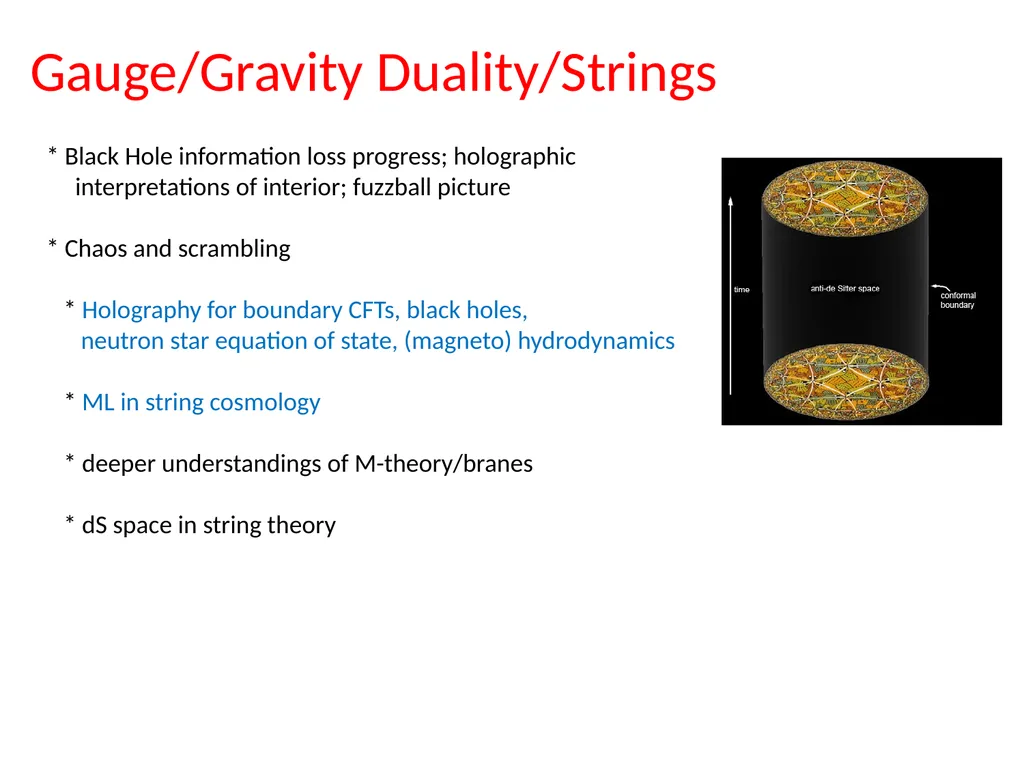
* Black Hole information loss progress; holographic
interpretations of interior; fuzzball picture
* Chaos and scrambling
* Holography for boundary CFTs, black holes,
neutron star equation of state, (magneto) hydrodynamics
* ML in string cosmology
* deeper understandings of M-theory/branes
* dS space in string theory Gauge/Gravity Duality/Strings<br>
interpretations of interior; fuzzball picture
* Chaos and scrambling
* Holography for boundary CFTs, black holes,
neutron star equation of state, (magneto) hydrodynamics
* ML in string cosmology
* deeper understandings of M-theory/branes
* dS space in string theory Gauge/Gravity Duality/Strings<br>
10
Initial Process We originally had to plan around flat (+ inflation) cash…
We have inherited funding only 2/3rds of academics – this is very uncomfortable – “death of the balanced pathway” “beware leadership roles” “beware trying to strike out in a new direction”
Given increasing academic numbers – best we could hope was to preserve this. Increasing academic numbers remains a boon for the community.
We expect PIs to use their funding to support full groups not just named academics
Overheads (only) up 3% vs 2019.
Our strategic guidance from STFC Theory Review is to protect and grow RA numbers
we hoped to protect RA numbers
The only way to free money is to continue to pressure academic time – we declared this to be a computed variable after the preservation of the programme – it came out at 4% (down from 8%) - clearly fEC is dead… groups are still growing which suggests there is understanding in Universities…. not ideal…<br>
We have inherited funding only 2/3rds of academics – this is very uncomfortable – “death of the balanced pathway” “beware leadership roles” “beware trying to strike out in a new direction”
Given increasing academic numbers – best we could hope was to preserve this. Increasing academic numbers remains a boon for the community.
We expect PIs to use their funding to support full groups not just named academics
Overheads (only) up 3% vs 2019.
Our strategic guidance from STFC Theory Review is to protect and grow RA numbers
we hoped to protect RA numbers
The only way to free money is to continue to pressure academic time – we declared this to be a computed variable after the preservation of the programme – it came out at 4% (down from 8%) - clearly fEC is dead… groups are still growing which suggests there is understanding in Universities…. not ideal…<br>
11
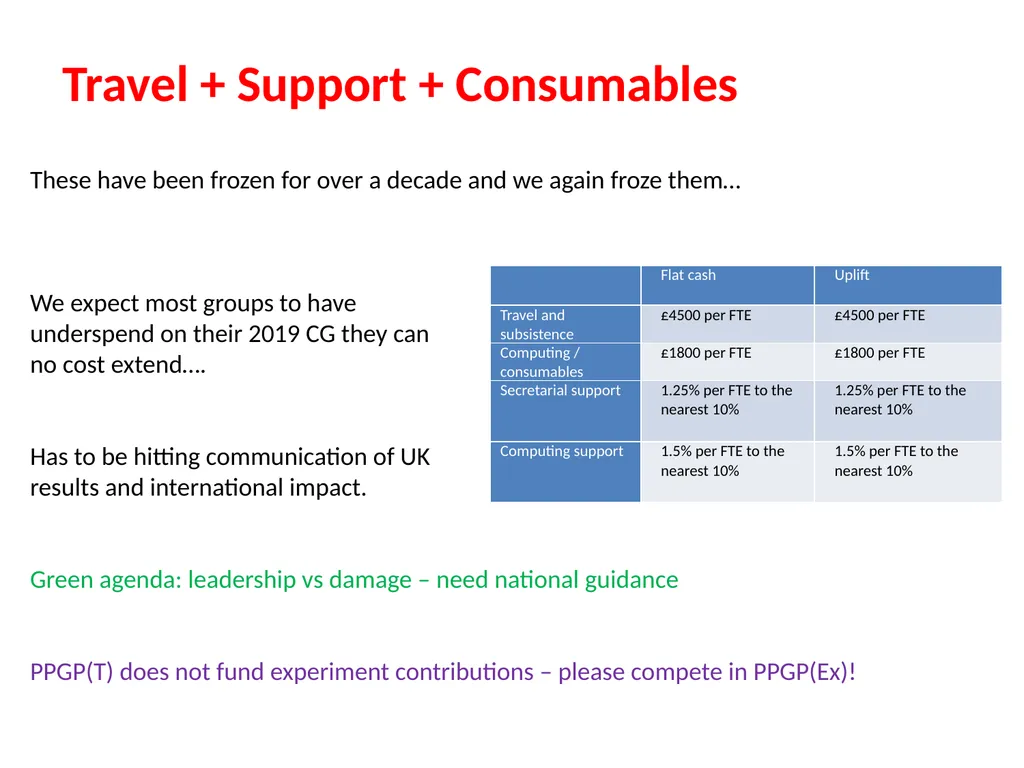
Travel + Support + Consumables These have been frozen for over a decade and we again froze them…
We expect most groups to have
underspend on their 2019 CG they can
no cost extend….
Has to be hitting communication of UK
results and international impact.
Green agenda: leadership vs damage – need national guidance
PPGP(T) does not fund experiment contributions – please compete in PPGP(Ex)!<br>
We expect most groups to have
underspend on their 2019 CG they can
no cost extend….
Has to be hitting communication of UK
results and international impact.
Green agenda: leadership vs damage – need national guidance
PPGP(T) does not fund experiment contributions – please compete in PPGP(Ex)!<br>
12
IPPP & Virtual Centres Science Board moved IPPP core funding to a separate panel and PPGP(T) did not assess the core work.
Pre-covid PPGP(T) had encouraged the set up of
Lattice Strings Cosmology Virtual Centres
To encourage cohesion in the community a la IPPP… they valiantly tried online…. Considered a positive addition to the community.
The panel renewed their funding to allow them a shot in the post covid period!<br>
Pre-covid PPGP(T) had encouraged the set up of
Lattice Strings Cosmology Virtual Centres
To encourage cohesion in the community a la IPPP… they valiantly tried online…. Considered a positive addition to the community.
The panel renewed their funding to allow them a shot in the post covid period!<br>
13
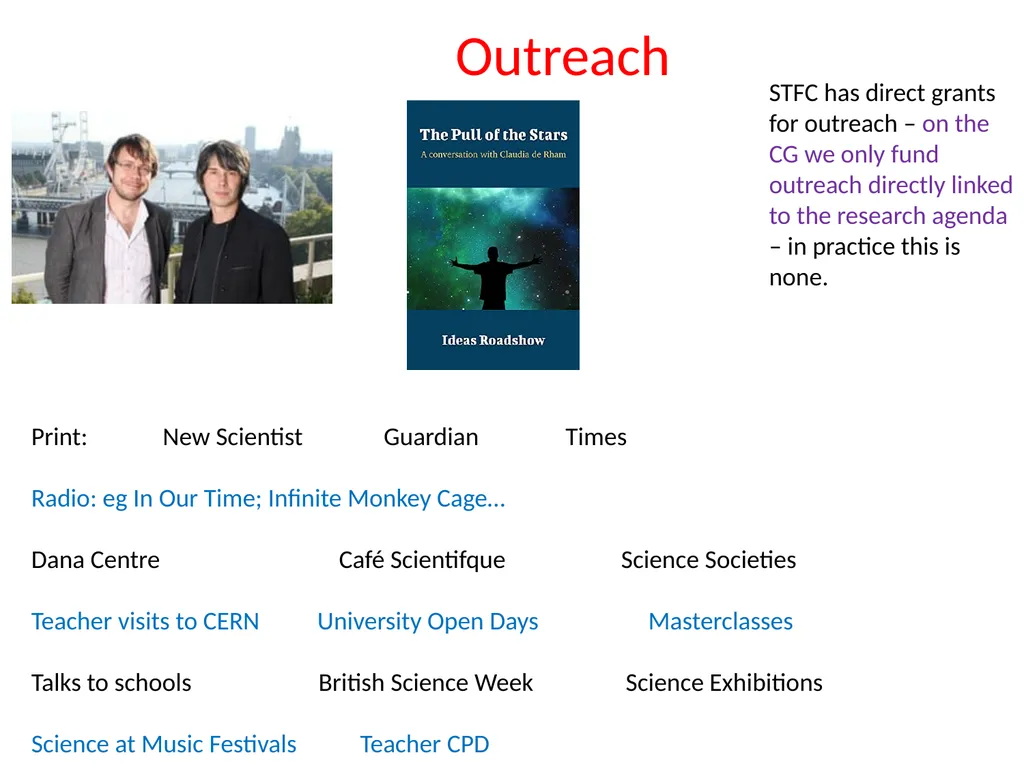
Outreach Print: New Scientist Guardian Times
Radio: eg In Our Time; Infinite Monkey Cage…
Dana Centre Café Scientifque Science Societies
Teacher visits to CERN University Open Days Masterclasses
Talks to schools British Science Week Science Exhibitions
Science at Music Festivals Teacher CPD STFC has direct grants for outreach – on the CG we only fund outreach directly linked to the research agenda – in practice this is none.<br>
Radio: eg In Our Time; Infinite Monkey Cage…
Dana Centre Café Scientifque Science Societies
Teacher visits to CERN University Open Days Masterclasses
Talks to schools British Science Week Science Exhibitions
Science at Music Festivals Teacher CPD STFC has direct grants for outreach – on the CG we only fund outreach directly linked to the research agenda – in practice this is none.<br>
14
Flat cash programme
164 funded academics
124 RA years awarded according to quality; panel scored; panel discussed for 2 days.
The panel considered this a meagre programme Scientific/Technical Excellence
International Competitiveness
Strategic Value within STFC Programme
Scientific Leadership, planning project management
Social and Economic Impact<br>
164 funded academics
124 RA years awarded according to quality; panel scored; panel discussed for 2 days.
The panel considered this a meagre programme Scientific/Technical Excellence
International Competitiveness
Strategic Value within STFC Programme
Scientific Leadership, planning project management
Social and Economic Impact<br>
15
+22% to core programme
£18M -> £22M Thanks to STFC & UKRI for making the core case<br>
16
The panel was expecting a rise and had discussed how to use it:
raising fEC would give 100% to Universities; yet we couldn’t raise it sufficiently to change academics’ lives.
We could fund more academics – again essentially gifting the money to Universities – nevertheless we did revisit the border line and funded 10 or so more academics including ECRs
Funding 55 further RA years would directly increase science output and give Universities additional overheads – 1 3 year RA for every 4 acaedmics
More travel funds were considered (covid under spend)… left as mop up of left over…
We went to Science Board to approve this decision.
Then we rescored and reconvened to assign the additional money.<br>
raising fEC would give 100% to Universities; yet we couldn’t raise it sufficiently to change academics’ lives.
We could fund more academics – again essentially gifting the money to Universities – nevertheless we did revisit the border line and funded 10 or so more academics including ECRs
Funding 55 further RA years would directly increase science output and give Universities additional overheads – 1 3 year RA for every 4 acaedmics
More travel funds were considered (covid under spend)… left as mop up of left over…
We went to Science Board to approve this decision.
Then we rescored and reconvened to assign the additional money.<br>
17
The proposed RA increase (+45%) did mean some of the largest top scored (well resourced) groups had not put in sufficient RA cases… a few have not got 1-2 years of proportionate funding…
However, the CG allows a balanced distribution of resource.
An additional round of funding would have brought delays; overly favoured the top scoring groups; and been an administrative pain all round….
The panel believes its proposed assignment makes excellent use of the resource
* we raised many 2 year positions to 3 years
* larger groups were funded more proportionately
* some smaller groups awarded RAs that have potential to hugely increase
productivity.
We hope overall that the community will be happy with the additional funding available.<br>
However, the CG allows a balanced distribution of resource.
An additional round of funding would have brought delays; overly favoured the top scoring groups; and been an administrative pain all round….
The panel believes its proposed assignment makes excellent use of the resource
* we raised many 2 year positions to 3 years
* larger groups were funded more proportionately
* some smaller groups awarded RAs that have potential to hugely increase
productivity.
We hope overall that the community will be happy with the additional funding available.<br>
18
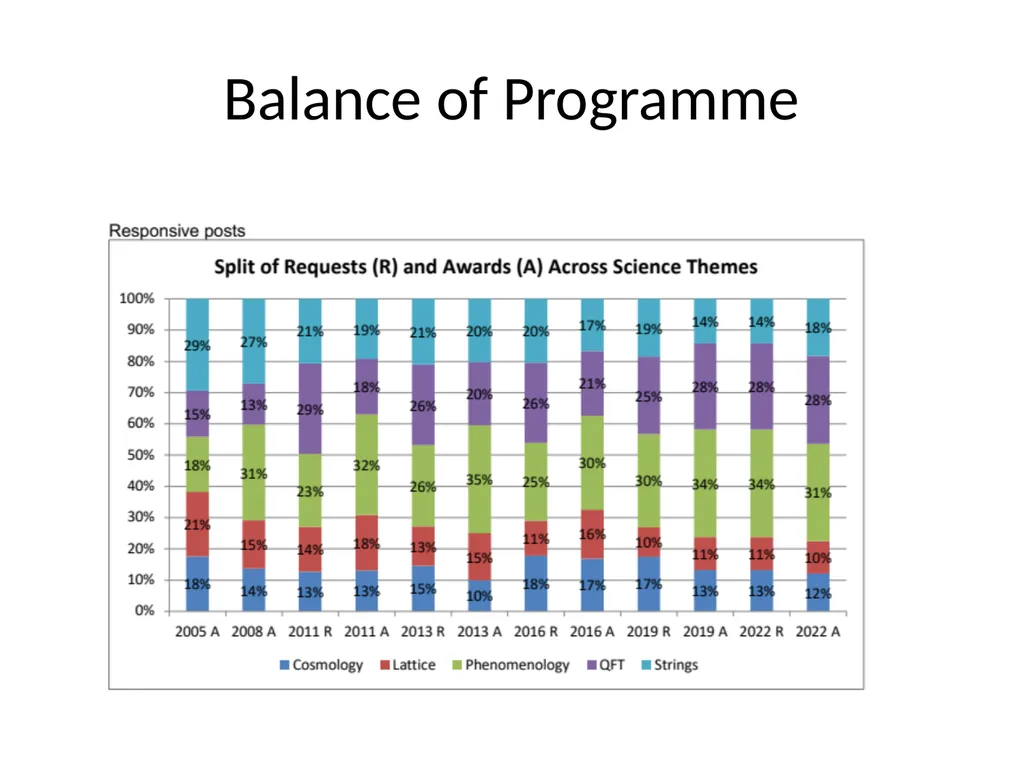
Balance of Programme<br>
19
Overview & Outlook The panel thinks the uplift has placed STFC support for particle theory at a sensible level for the size of the field.
We hope it will raise moral and research output.
We think the UK theory community is growing in science leadership and will exploit the funding superbly.
Full economic cost is a problem still – it’s not funded sufficiently. There’s only one more bite left in it to protect the programme from inflation (10%+!!)… (some panels fund far fewer academics at a higher level but that’s the same problem rewritten!)
The community is likely to keep growing and further pressure funding decisions.<br>
We hope it will raise moral and research output.
We think the UK theory community is growing in science leadership and will exploit the funding superbly.
Full economic cost is a problem still – it’s not funded sufficiently. There’s only one more bite left in it to protect the programme from inflation (10%+!!)… (some panels fund far fewer academics at a higher level but that’s the same problem rewritten!)
The community is likely to keep growing and further pressure funding decisions.<br>