
Partnering with a Clinical Trial Unit: Key to a
FD
Published · 48 slides · 0 views

1 / 1

Description
Partnering with a Clinical Trial Unit: Key to a successful trial Information for potential Chief Investigators Cancer CTU Group Summary What is a CTU? What does a CTU do not do? Why work with a CTU? What are the benefits of partnering
Related Topics
Share
Embed code
Download this presentation From Below
"Partnering with a Clinical Trial Unit: Key to a" is the property of its rightful owner. Permission is granted to download and print the materials on this website for personal, non-commercial use only, and to display it on your personal computer provided you do not modify the materials and that you retain all copyright notices contained in the materials. By downloading content from our website, you accept the terms of this agreement.
Presentation Transcript
01
Partnering with a Clinical Trial Unit:
Key to a successful trial Information for potential Chief Investigators Cancer CTU Group<br>
02
Summary What is a CTU?
What does a CTU do / not do?
Why work with a CTU?
What are the benefits of partnering with a CTU?
When to engage with a CTU
What to expect from the CI role
CTU = Clinical Trial Unit
CI = Chief Investigator<br>
What does a CTU do / not do?
Why work with a CTU?
What are the benefits of partnering with a CTU?
When to engage with a CTU
What to expect from the CI role
CTU = Clinical Trial Unit
CI = Chief Investigator<br>
03
What is a CTU?<br>
04
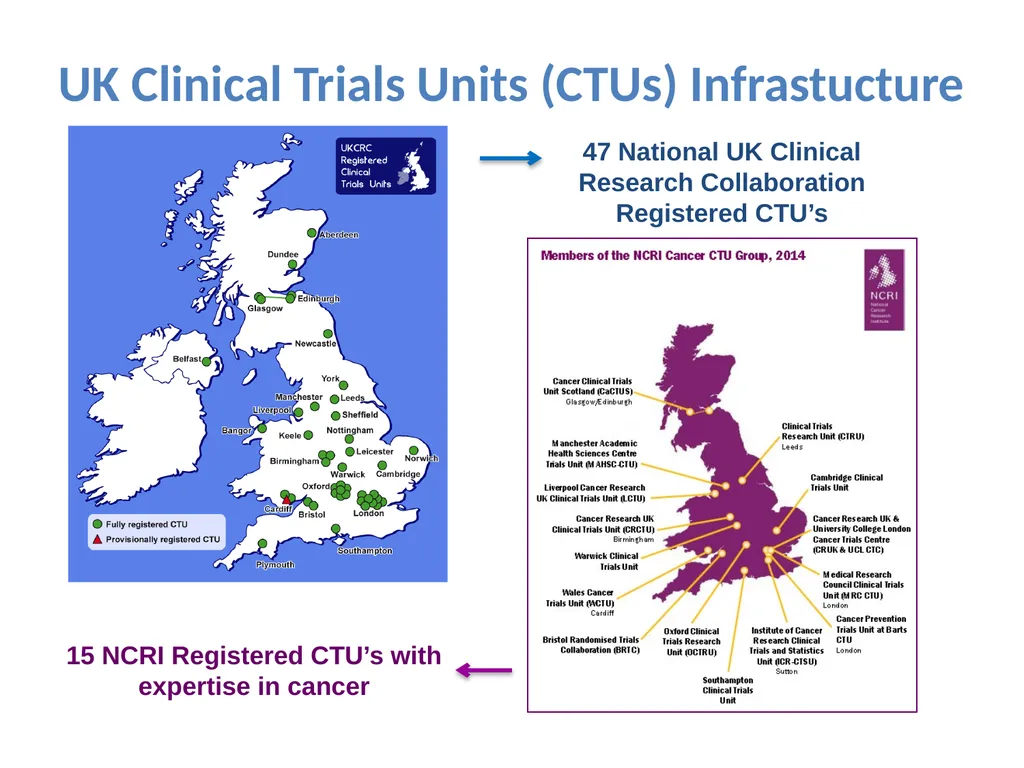
UK Clinical Trials Units (CTUs) Infrastucture 15 NCRI Registered CTU’s with expertise in cancer 47 National UK Clinical Research Collaboration Registered CTU’s<br>
05
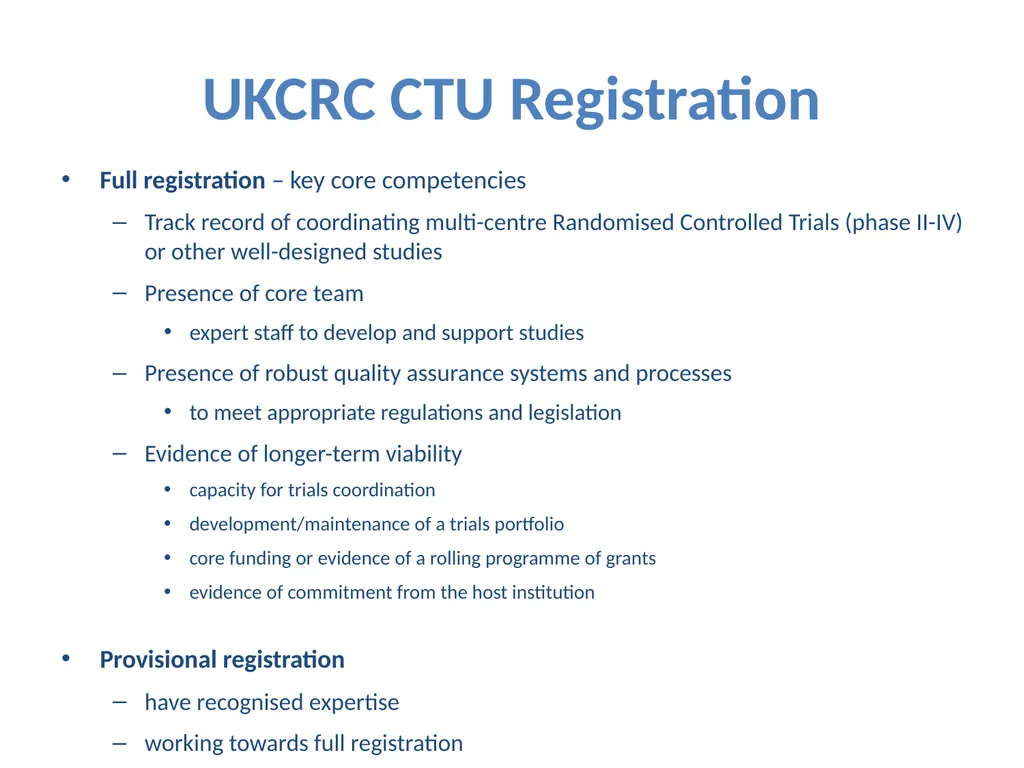
UKCRC CTU Registration Full registration – key core competencies
Track record of coordinating multi-centre Randomised Controlled Trials (phase II-IV) or other well-designed studies
Presence of core team
expert staff to develop and support studies
Presence of robust quality assurance systems and processes
to meet appropriate regulations and legislation
Evidence of longer-term viability
capacity for trials coordination
development/maintenance of a trials portfolio
core funding or evidence of a rolling programme of grants
evidence of commitment from the host institution
Provisional registration
have recognised expertise
working towards full registration<br>
Track record of coordinating multi-centre Randomised Controlled Trials (phase II-IV) or other well-designed studies
Presence of core team
expert staff to develop and support studies
Presence of robust quality assurance systems and processes
to meet appropriate regulations and legislation
Evidence of longer-term viability
capacity for trials coordination
development/maintenance of a trials portfolio
core funding or evidence of a rolling programme of grants
evidence of commitment from the host institution
Provisional registration
have recognised expertise
working towards full registration<br>
06
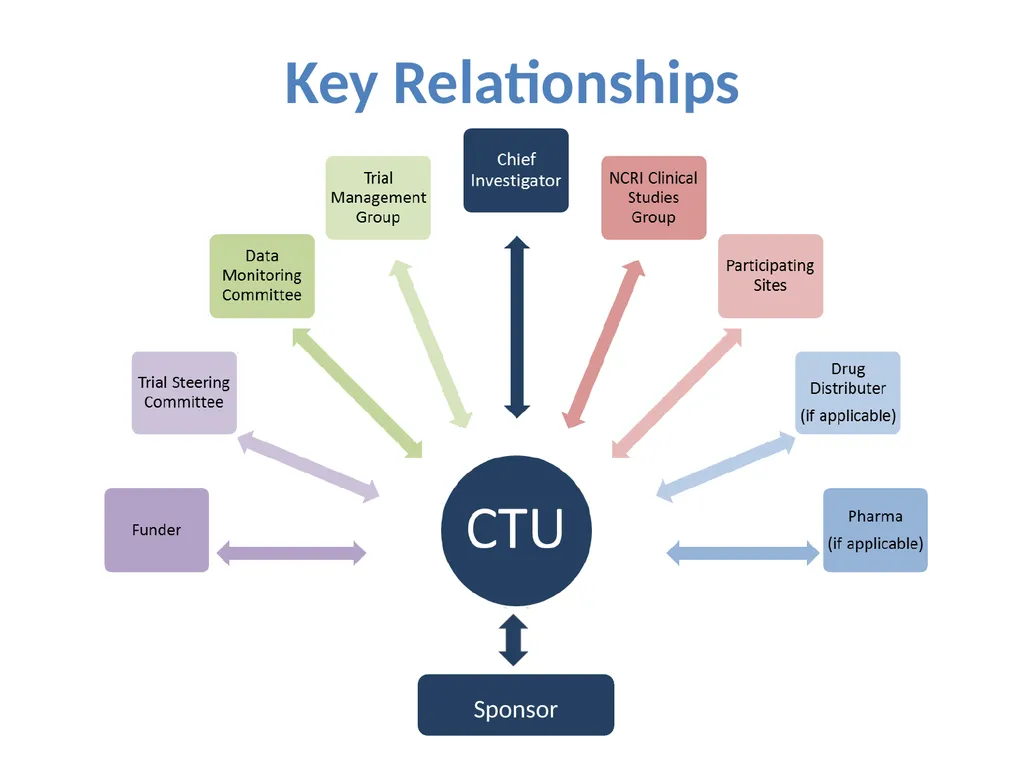
Key Relationships Sponsor<br>
07
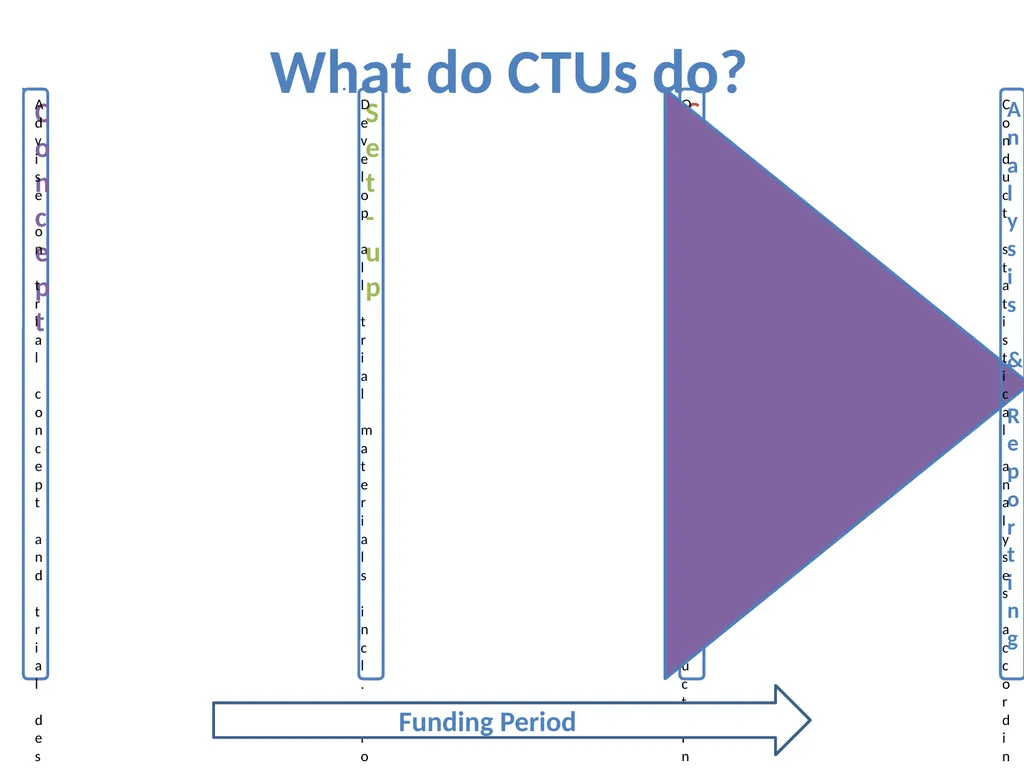
What do CTUs do? Funding Period<br>
08
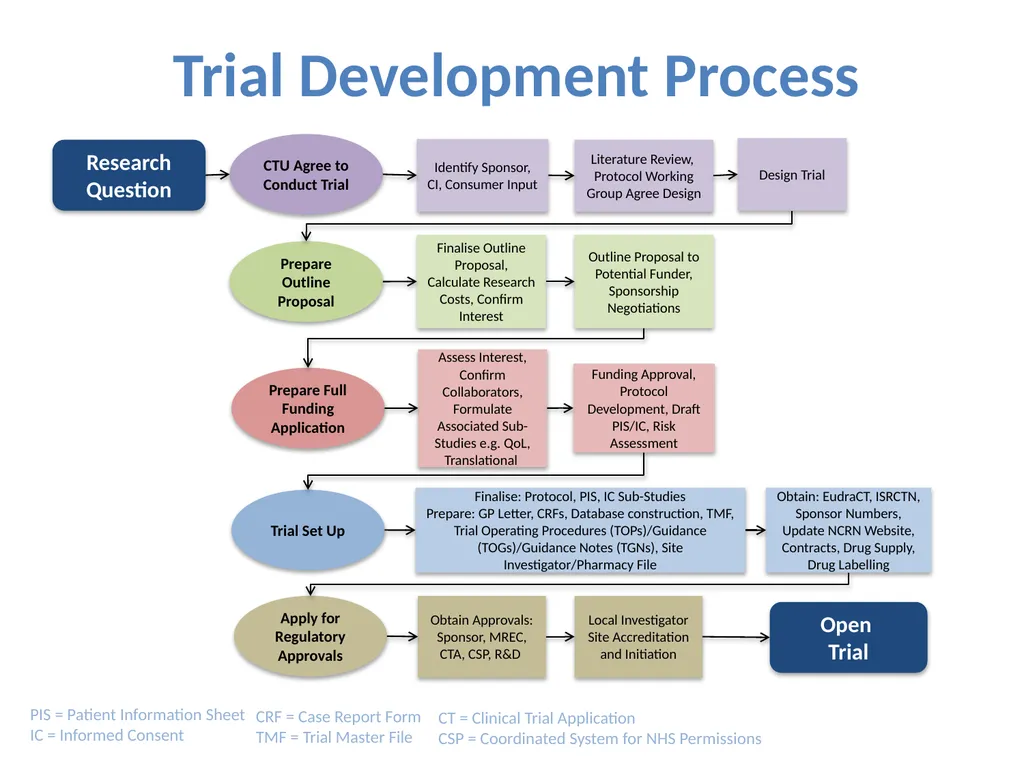
Trial Development Process CT = Clinical Trial Application
CSP = Coordinated System for NHS Permissions CRF = Case Report Form
TMF = Trial Master File PIS = Patient Information Sheet
IC = Informed Consent<br>
CSP = Coordinated System for NHS Permissions CRF = Case Report Form
TMF = Trial Master File PIS = Patient Information Sheet
IC = Informed Consent<br>
09
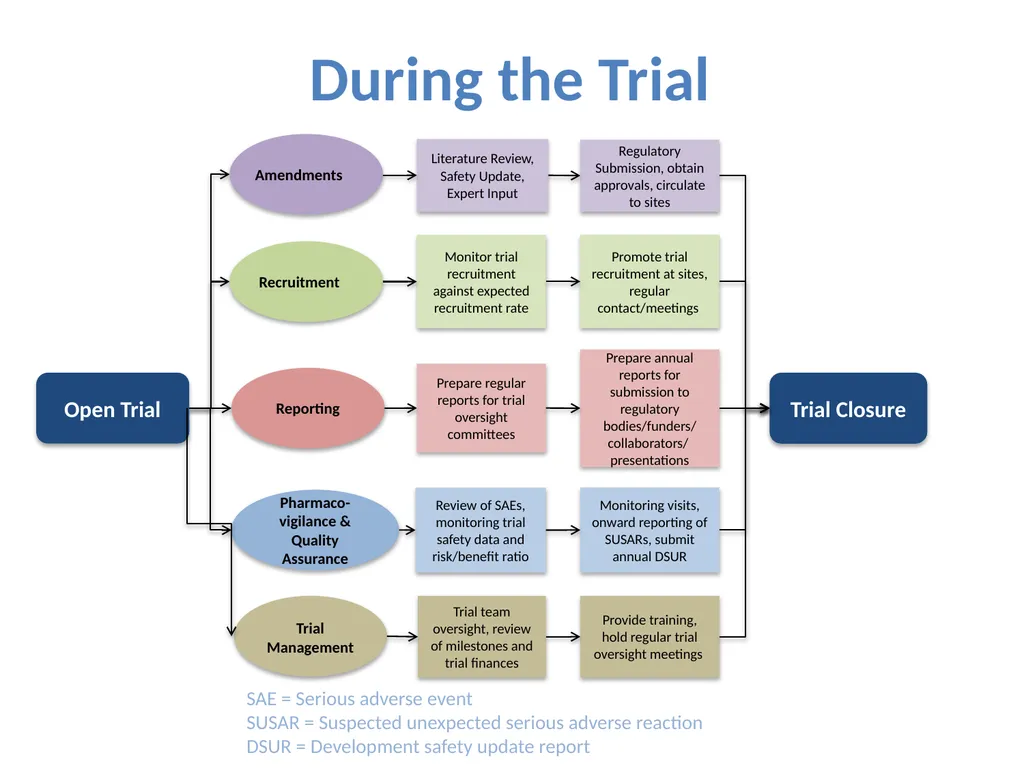
During the Trial SAE = Serious adverse event
SUSAR = Suspected unexpected serious adverse reaction
DSUR = Development safety update report<br>
SUSAR = Suspected unexpected serious adverse reaction
DSUR = Development safety update report<br>
10
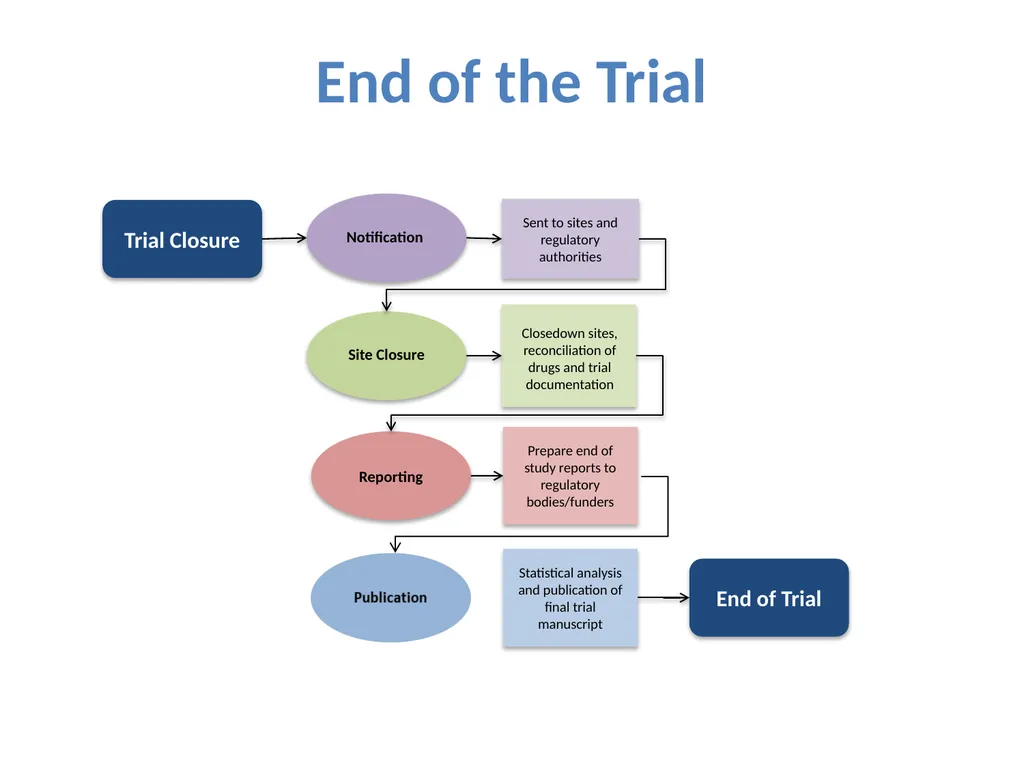
End of the Trial Statistical analysis and publication of final trial manuscript Closedown sites, reconciliation of drugs and trial documentation<br>
11
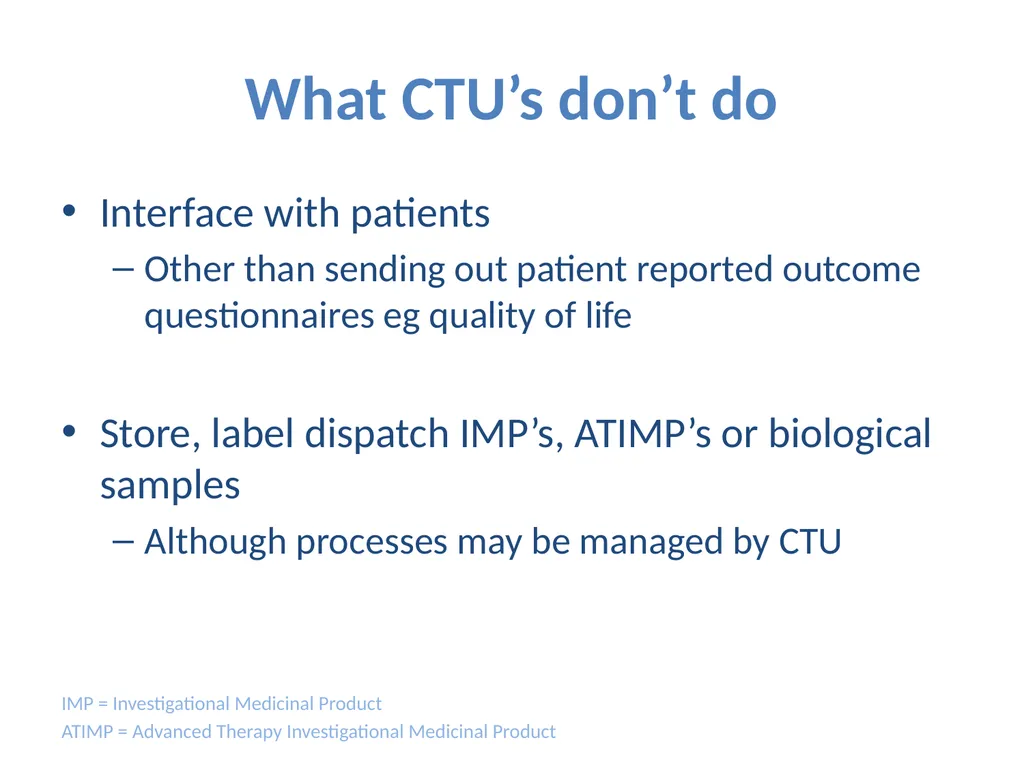
What CTU’s don’t do Interface with patients
Other than sending out patient reported outcome questionnaires eg quality of life
Store, label dispatch IMP’s, ATIMP’s or biological samples
Although processes may be managed by CTU
IMP = Investigational Medicinal Product
ATIMP = Advanced Therapy Investigational Medicinal Product<br>
Other than sending out patient reported outcome questionnaires eg quality of life
Store, label dispatch IMP’s, ATIMP’s or biological samples
Although processes may be managed by CTU
IMP = Investigational Medicinal Product
ATIMP = Advanced Therapy Investigational Medicinal Product<br>
12
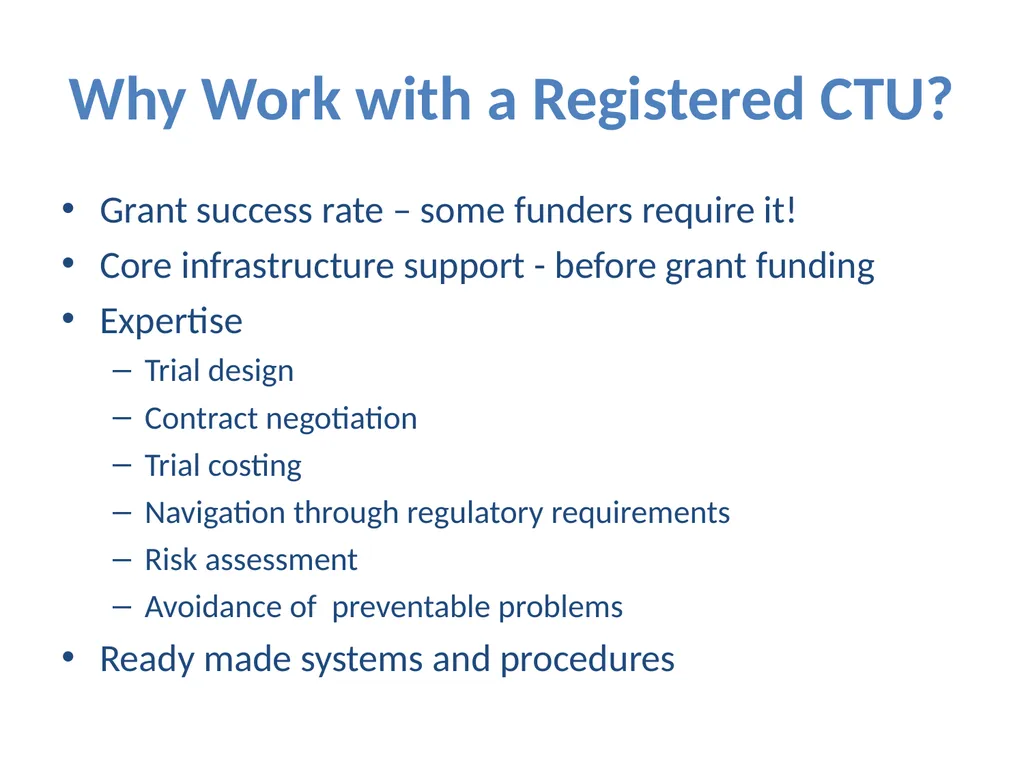
Why Work with a Registered CTU? Grant success rate – some funders require it!
Core infrastructure support - before grant funding
Expertise
Trial design
Contract negotiation
Trial costing
Navigation through regulatory requirements
Risk assessment
Avoidance of preventable problems
Ready made systems and procedures<br>
Core infrastructure support - before grant funding
Expertise
Trial design
Contract negotiation
Trial costing
Navigation through regulatory requirements
Risk assessment
Avoidance of preventable problems
Ready made systems and procedures<br>
13
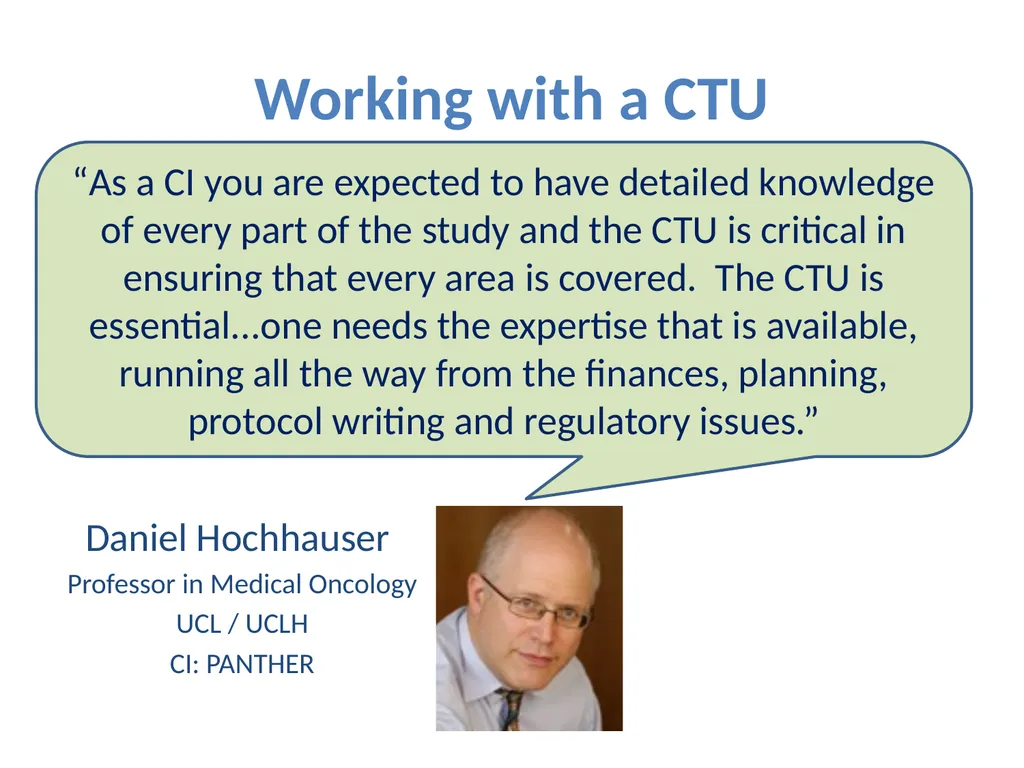
Working with a CTU Daniel Hochhauser
Professor in Medical Oncology
UCL / UCLH
CI: PANTHER “As a CI you are expected to have detailed knowledge of every part of the study and the CTU is critical in ensuring that every area is covered. The CTU is essential...one needs the expertise that is available, running all the way from the finances, planning, protocol writing and regulatory issues.”<br>
Professor in Medical Oncology
UCL / UCLH
CI: PANTHER “As a CI you are expected to have detailed knowledge of every part of the study and the CTU is critical in ensuring that every area is covered. The CTU is essential...one needs the expertise that is available, running all the way from the finances, planning, protocol writing and regulatory issues.”<br>
14
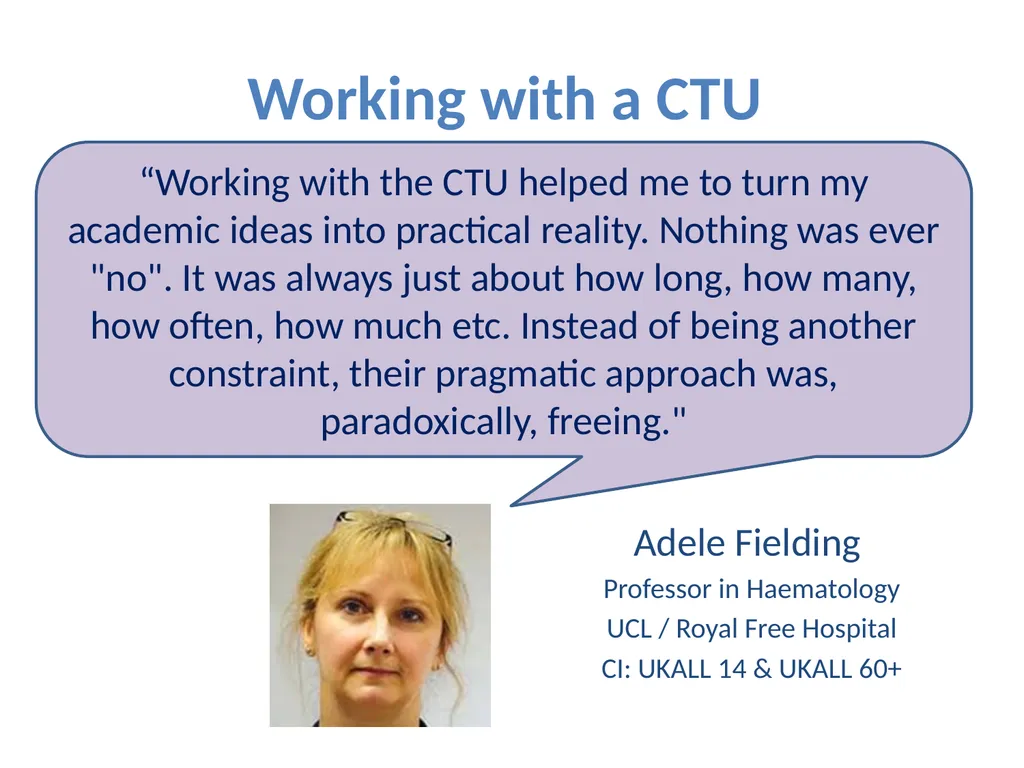
Working with a CTU Adele Fielding
Professor in Haematology
UCL / Royal Free Hospital
CI: UKALL 14 & UKALL 60+ “Working with the CTU helped me to turn my academic ideas into practical reality. Nothing was ever "no". It was always just about how long, how many, how often, how much etc. Instead of being another constraint, their pragmatic approach was, paradoxically, freeing."<br>
Professor in Haematology
UCL / Royal Free Hospital
CI: UKALL 14 & UKALL 60+ “Working with the CTU helped me to turn my academic ideas into practical reality. Nothing was ever "no". It was always just about how long, how many, how often, how much etc. Instead of being another constraint, their pragmatic approach was, paradoxically, freeing."<br>
15
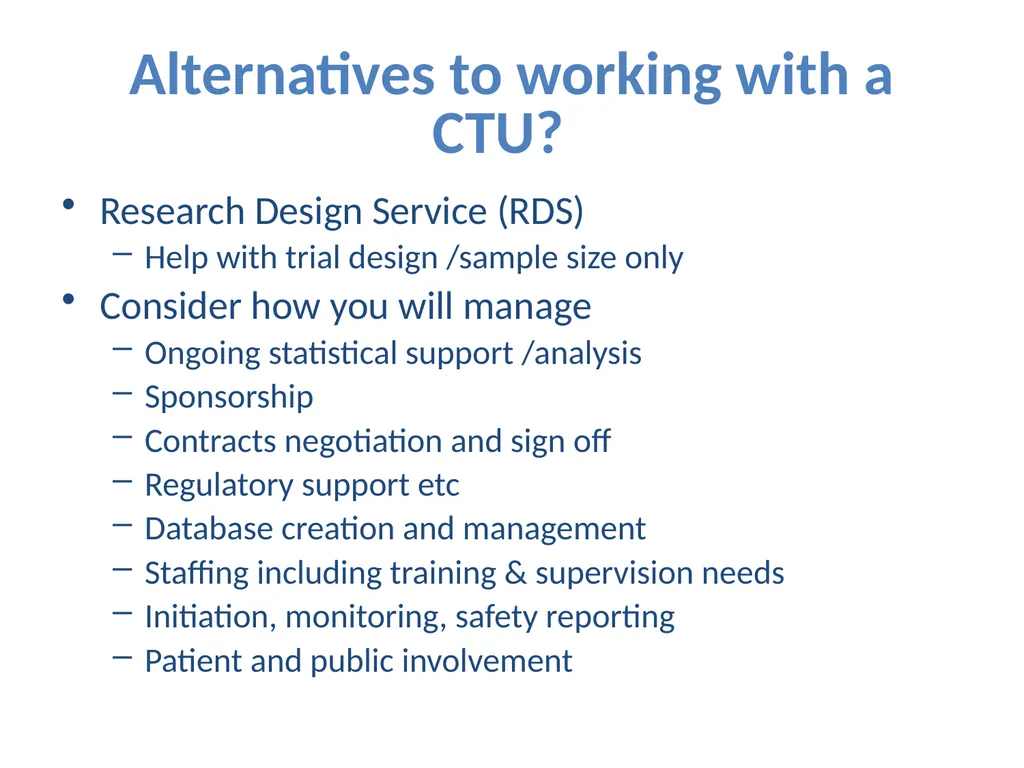
Alternatives to working with a CTU? Research Design Service (RDS)
Help with trial design /sample size only
Consider how you will manage
Ongoing statistical support /analysis
Sponsorship
Contracts negotiation and sign off
Regulatory support etc
Database creation and management
Staffing including training & supervision needs
Initiation, monitoring, safety reporting
Patient and public involvement<br>
Help with trial design /sample size only
Consider how you will manage
Ongoing statistical support /analysis
Sponsorship
Contracts negotiation and sign off
Regulatory support etc
Database creation and management
Staffing including training & supervision needs
Initiation, monitoring, safety reporting
Patient and public involvement<br>
16
Benefits of working with a CTU<br>
17
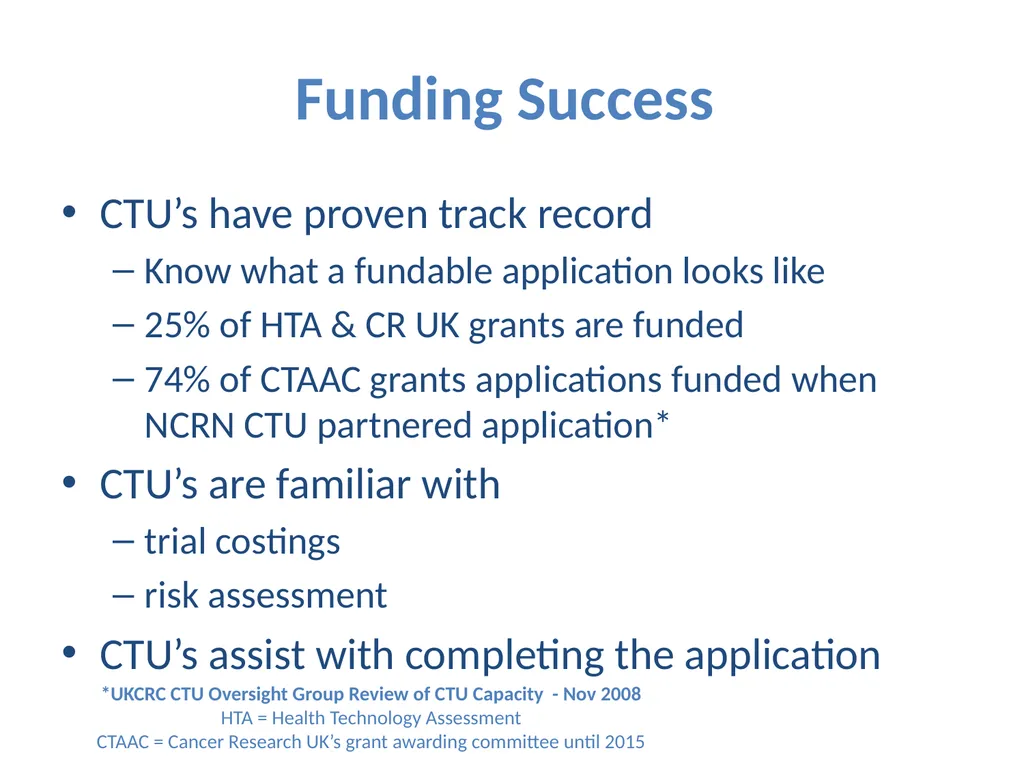
Funding Success CTU’s have proven track record
Know what a fundable application looks like
25% of HTA & CR UK grants are funded
74% of CTAAC grants applications funded when NCRN CTU partnered application*
CTU’s are familiar with
trial costings
risk assessment
CTU’s assist with completing the application *UKCRC CTU Oversight Group Review of CTU Capacity - Nov 2008
HTA = Health Technology Assessment
CTAAC = Cancer Research UK’s grant awarding committee until 2015<br>
Know what a fundable application looks like
25% of HTA & CR UK grants are funded
74% of CTAAC grants applications funded when NCRN CTU partnered application*
CTU’s are familiar with
trial costings
risk assessment
CTU’s assist with completing the application *UKCRC CTU Oversight Group Review of CTU Capacity - Nov 2008
HTA = Health Technology Assessment
CTAAC = Cancer Research UK’s grant awarding committee until 2015<br>
18
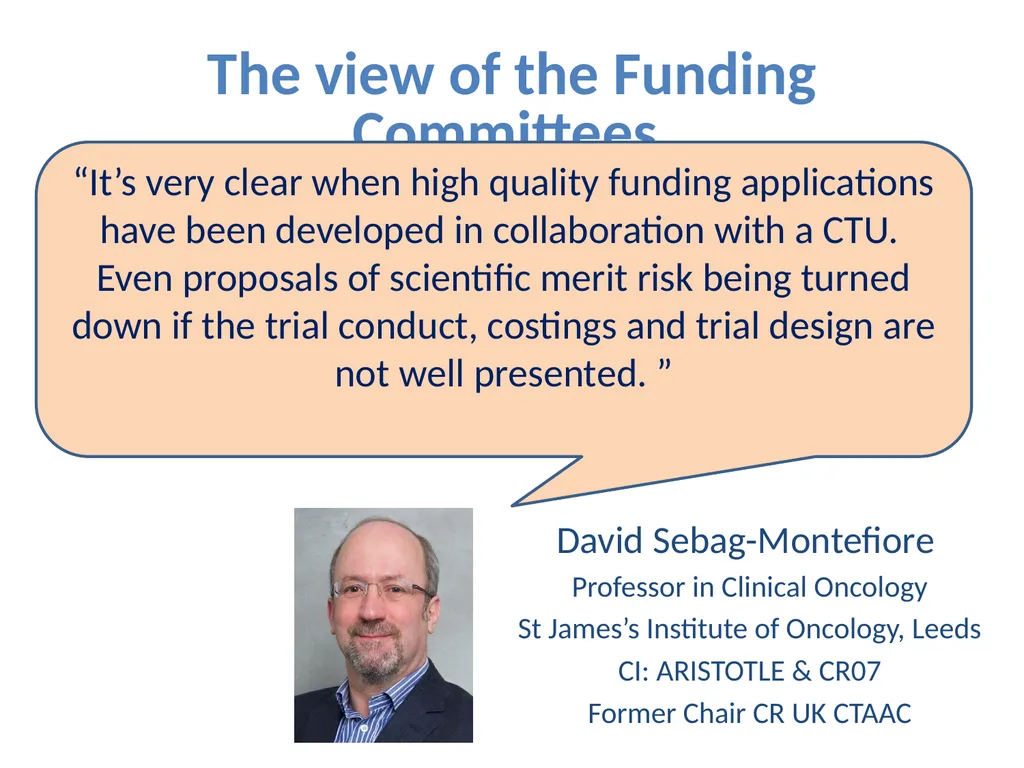
The view of the Funding Committees David Sebag-Montefiore
Professor in Clinical Oncology
St James’s Institute of Oncology, Leeds
CI: ARISTOTLE & CR07
Former Chair CR UK CTAAC “It’s very clear when high quality funding applications have been developed in collaboration with a CTU. Even proposals of scientific merit risk being turned down if the trial conduct, costings and trial design are not well presented. ”<br>
Professor in Clinical Oncology
St James’s Institute of Oncology, Leeds
CI: ARISTOTLE & CR07
Former Chair CR UK CTAAC “It’s very clear when high quality funding applications have been developed in collaboration with a CTU. Even proposals of scientific merit risk being turned down if the trial conduct, costings and trial design are not well presented. ”<br>
19
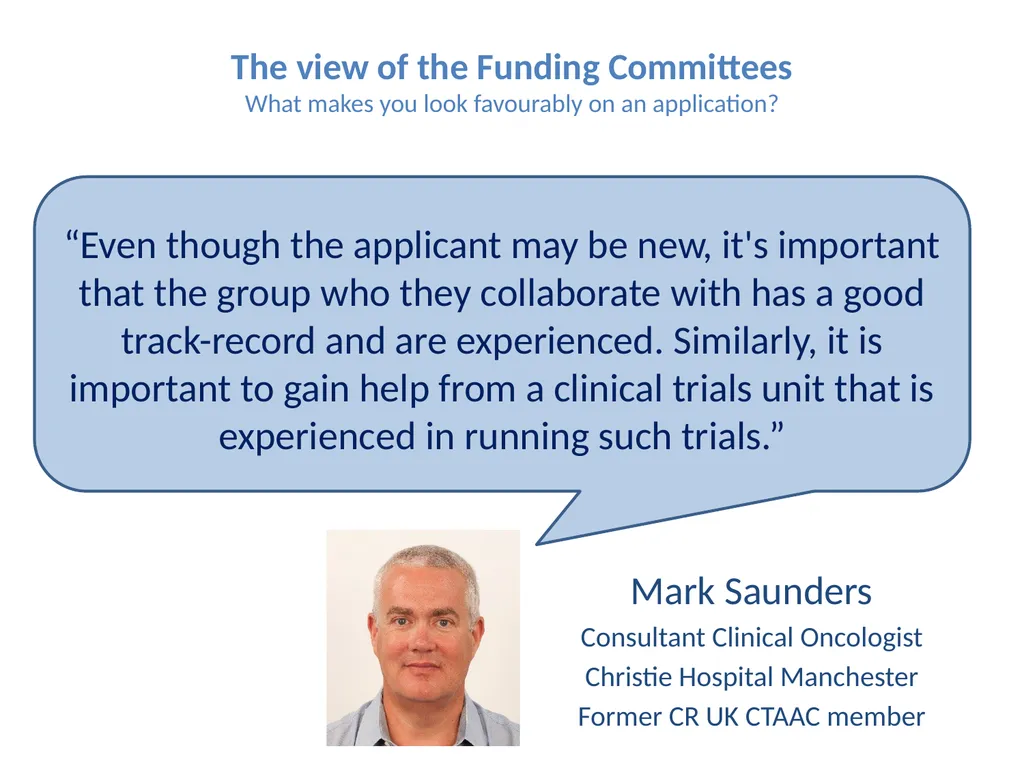
The view of the Funding Committees
What makes you look favourably on an application? Mark Saunders
Consultant Clinical Oncologist
Christie Hospital Manchester
Former CR UK CTAAC member “Even though the applicant may be new, it's important that the group who they collaborate with has a good track-record and are experienced. Similarly, it is important to gain help from a clinical trials unit that is experienced in running such trials.”<br>
Consultant Clinical Oncologist
Christie Hospital Manchester
Former CR UK CTAAC member “Even though the applicant may be new, it's important that the group who they collaborate with has a good track-record and are experienced. Similarly, it is important to gain help from a clinical trials unit that is experienced in running such trials.”<br>
20
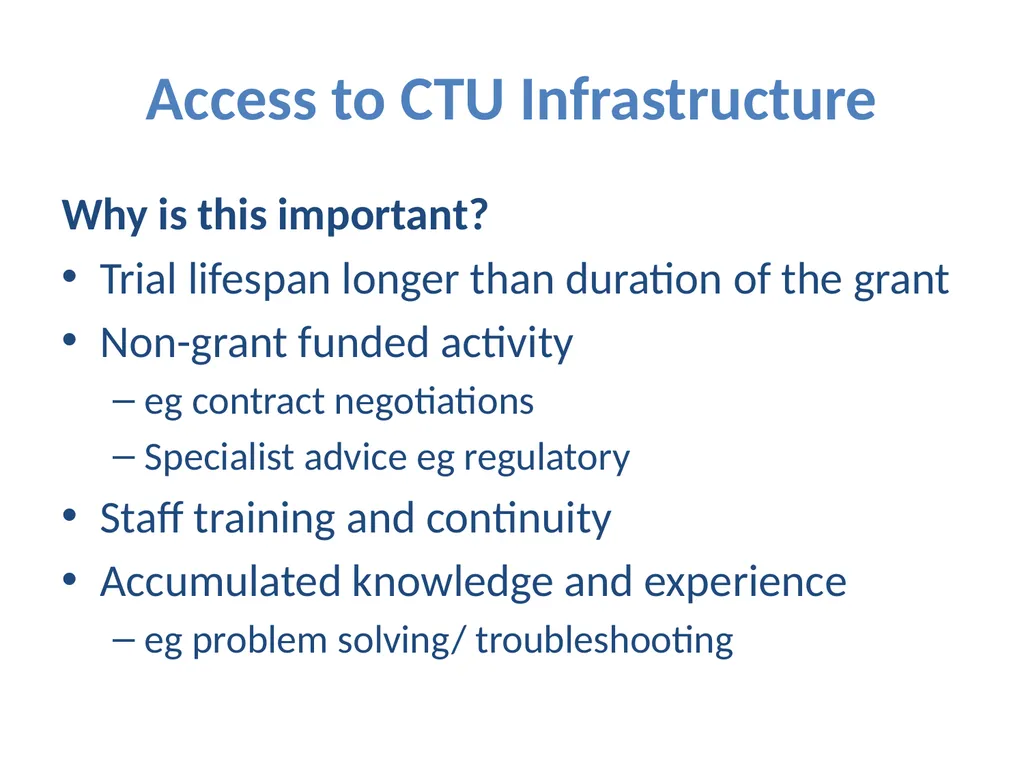
Access to CTU Infrastructure Why is this important?
Trial lifespan longer than duration of the grant
Non-grant funded activity
eg contract negotiations
Specialist advice eg regulatory
Staff training and continuity
Accumulated knowledge and experience
eg problem solving/ troubleshooting<br>
Trial lifespan longer than duration of the grant
Non-grant funded activity
eg contract negotiations
Specialist advice eg regulatory
Staff training and continuity
Accumulated knowledge and experience
eg problem solving/ troubleshooting<br>
21
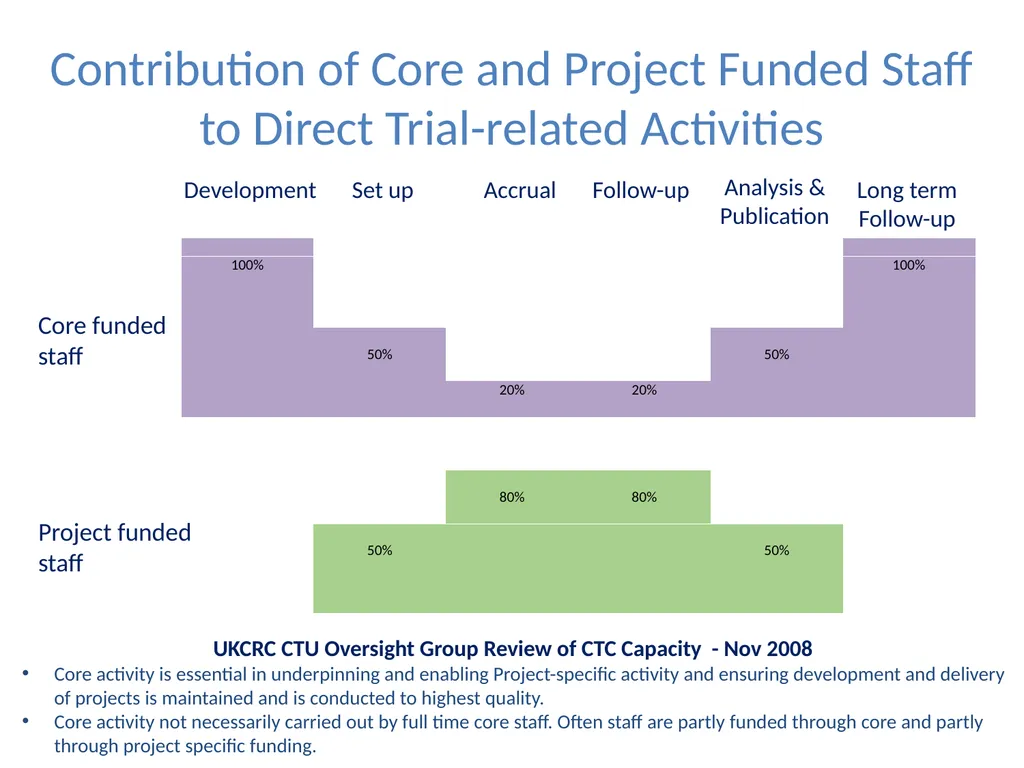
Contribution of Core and Project Funded Staff to Direct Trial-related Activities Core funded staff Project funded staff Development Set up Accrual Follow-up Analysis & Publication Long term Follow-up UKCRC CTU Oversight Group Review of CTC Capacity - Nov 2008
Core activity is essential in underpinning and enabling Project-specific activity and ensuring development and delivery of projects is maintained and is conducted to highest quality.
Core activity not necessarily carried out by full time core staff. Often staff are partly funded through core and partly through project specific funding.<br>
Core activity is essential in underpinning and enabling Project-specific activity and ensuring development and delivery of projects is maintained and is conducted to highest quality.
Core activity not necessarily carried out by full time core staff. Often staff are partly funded through core and partly through project specific funding.<br>
22
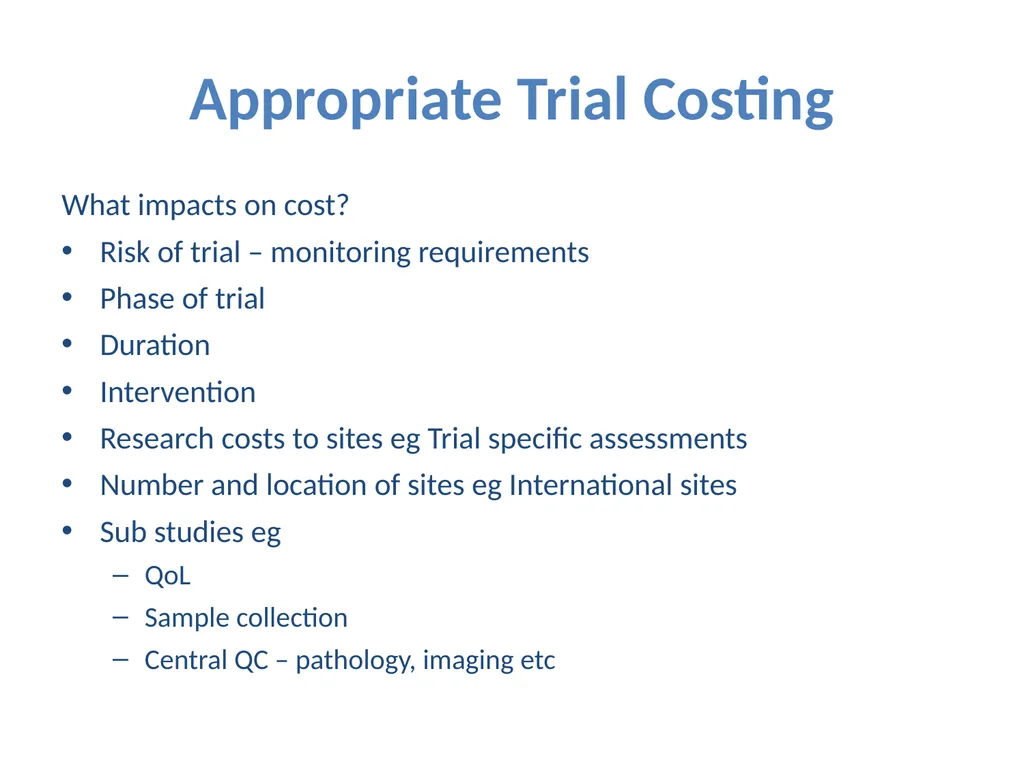
Appropriate Trial Costing What impacts on cost?
Risk of trial – monitoring requirements
Phase of trial
Duration
Intervention
Research costs to sites eg Trial specific assessments
Number and location of sites eg International sites
Sub studies eg
QoL
Sample collection
Central QC – pathology, imaging etc<br>
Risk of trial – monitoring requirements
Phase of trial
Duration
Intervention
Research costs to sites eg Trial specific assessments
Number and location of sites eg International sites
Sub studies eg
QoL
Sample collection
Central QC – pathology, imaging etc<br>
23
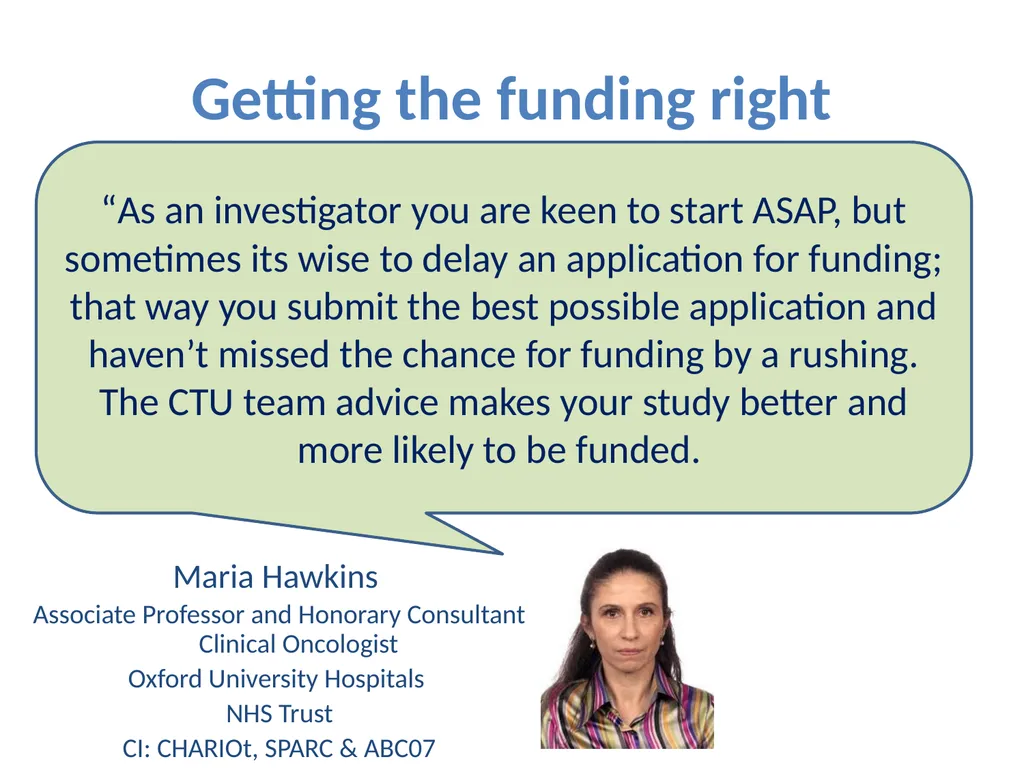
Getting the funding right Maria Hawkins
Associate Professor and Honorary Consultant Clinical Oncologist
Oxford University Hospitals
NHS Trust
CI: CHARIOt, SPARC & ABC07 “As an investigator you are keen to start ASAP, but sometimes its wise to delay an application for funding; that way you submit the best possible application and haven’t missed the chance for funding by a rushing. The CTU team advice makes your study better and more likely to be funded.<br>
Associate Professor and Honorary Consultant Clinical Oncologist
Oxford University Hospitals
NHS Trust
CI: CHARIOt, SPARC & ABC07 “As an investigator you are keen to start ASAP, but sometimes its wise to delay an application for funding; that way you submit the best possible application and haven’t missed the chance for funding by a rushing. The CTU team advice makes your study better and more likely to be funded.<br>
24
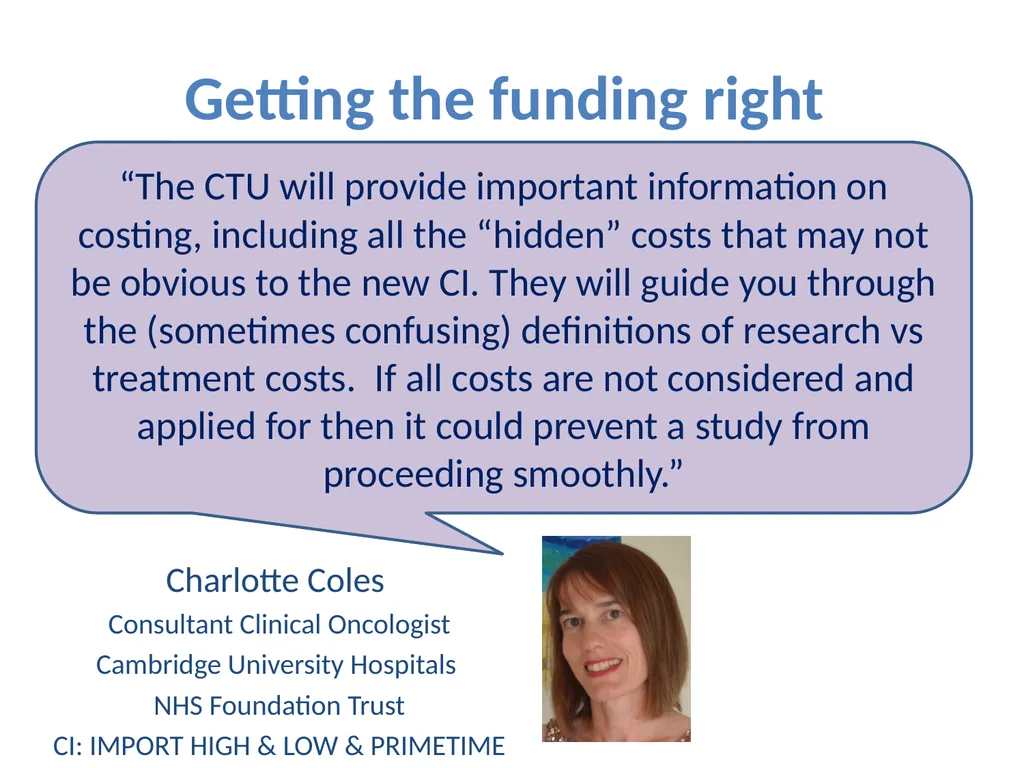
Getting the funding right Charlotte Coles
Consultant Clinical Oncologist
Cambridge University Hospitals
NHS Foundation Trust
CI: IMPORT HIGH & LOW & PRIMETIME “The CTU will provide important information on costing, including all the “hidden” costs that may not be obvious to the new CI. They will guide you through the (sometimes confusing) definitions of research vs treatment costs. If all costs are not considered and applied for then it could prevent a study from proceeding smoothly.”<br>
Consultant Clinical Oncologist
Cambridge University Hospitals
NHS Foundation Trust
CI: IMPORT HIGH & LOW & PRIMETIME “The CTU will provide important information on costing, including all the “hidden” costs that may not be obvious to the new CI. They will guide you through the (sometimes confusing) definitions of research vs treatment costs. If all costs are not considered and applied for then it could prevent a study from proceeding smoothly.”<br>
25
Grant funding Why do CTU’s vary?
Core support from funder may reduce cost
Institutional overheads<br>
Core support from funder may reduce cost
Institutional overheads<br>
26
CTU Funding requirements
Why does it cost so much? Staffing (FTE depending on trial complexity)
Trial manager
Statistical support
Database construction
Data management
Regulatory and Quality Management
Running expenses
Computer, software, etc
Administrative costs<br>
Trial manager
Statistical support
Database construction
Data management
Regulatory and Quality Management
Running expenses
Computer, software, etc
Administrative costs<br>
27
Non-CTU costs Site costs
Intervention
IMP distribution
Translational research
Don’t ask for too little
Underfunding impacts on trial success
Understaffed
Patient safety at risk
May cause delays
Unethical!<br>
Intervention
IMP distribution
Translational research
Don’t ask for too little
Underfunding impacts on trial success
Understaffed
Patient safety at risk
May cause delays
Unethical!<br>
28
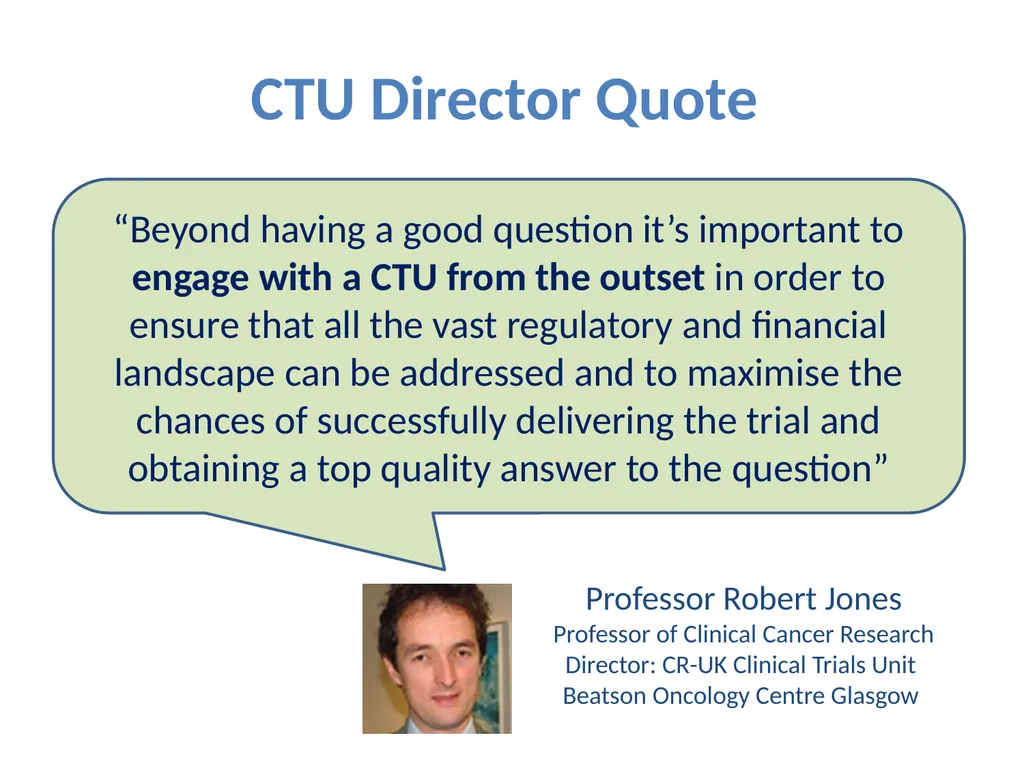
CTU Director Quote “Beyond having a good question it’s important to engage with a CTU from the outset in order to ensure that all the vast regulatory and financial landscape can be addressed and to maximise the chances of successfully delivering the trial and obtaining a top quality answer to the question” Professor Robert Jones
Professor of Clinical Cancer Research
Director: CR-UK Clinical Trials Unit
Beatson Oncology Centre Glasgow<br>
Professor of Clinical Cancer Research
Director: CR-UK Clinical Trials Unit
Beatson Oncology Centre Glasgow<br>
29
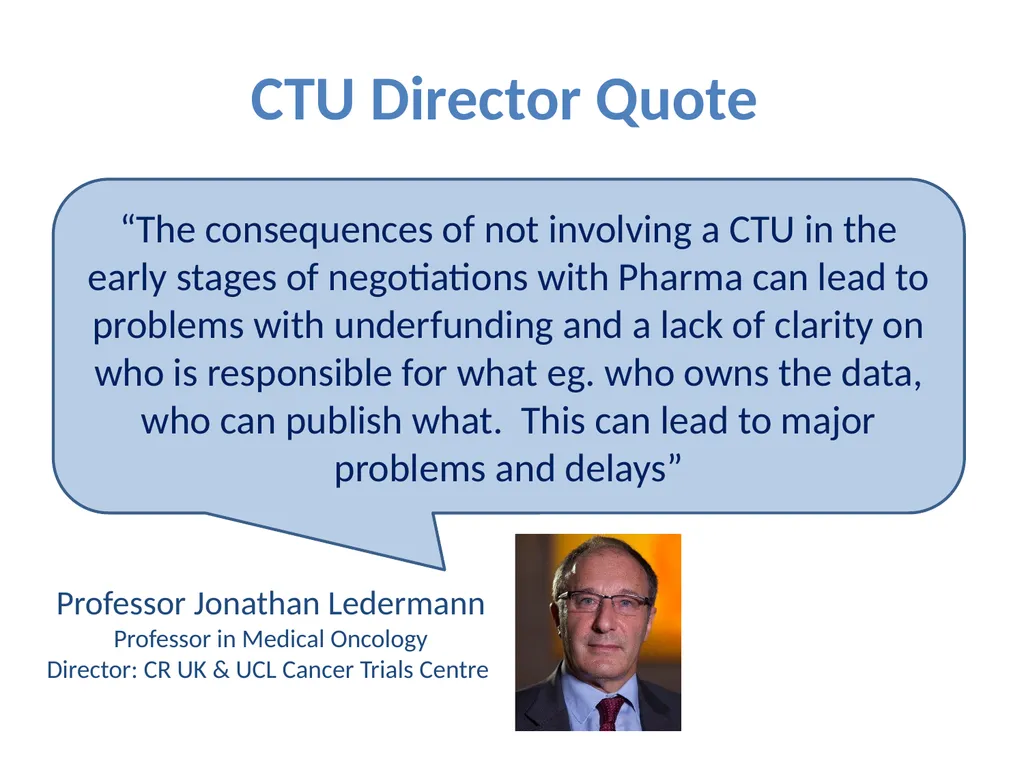
CTU Director Quote “The consequences of not involving a CTU in the early stages of negotiations with Pharma can lead to problems with underfunding and a lack of clarity on who is responsible for what eg. who owns the data, who can publish what. This can lead to major problems and delays” Professor Jonathan Ledermann
Professor in Medical Oncology
Director: CR UK & UCL Cancer Trials Centre<br>
Professor in Medical Oncology
Director: CR UK & UCL Cancer Trials Centre<br>
30
Negotiating with Industry
How can a CTU help? Prior experience with a variety of companies
Understanding the pitfalls
Requesting realistic funding
Contract negotiation
Understanding the wider implications
Investigational Medicinal Product management
What works<br>
Understanding the pitfalls
Requesting realistic funding
Contract negotiation
Understanding the wider implications
Investigational Medicinal Product management
What works<br>
31
When to engage with a CTU? Right from the start!
Why?
It’s not just about trial design
Contracts
Costings
Navigating the regulations<br>
Why?
It’s not just about trial design
Contracts
Costings
Navigating the regulations<br>
32
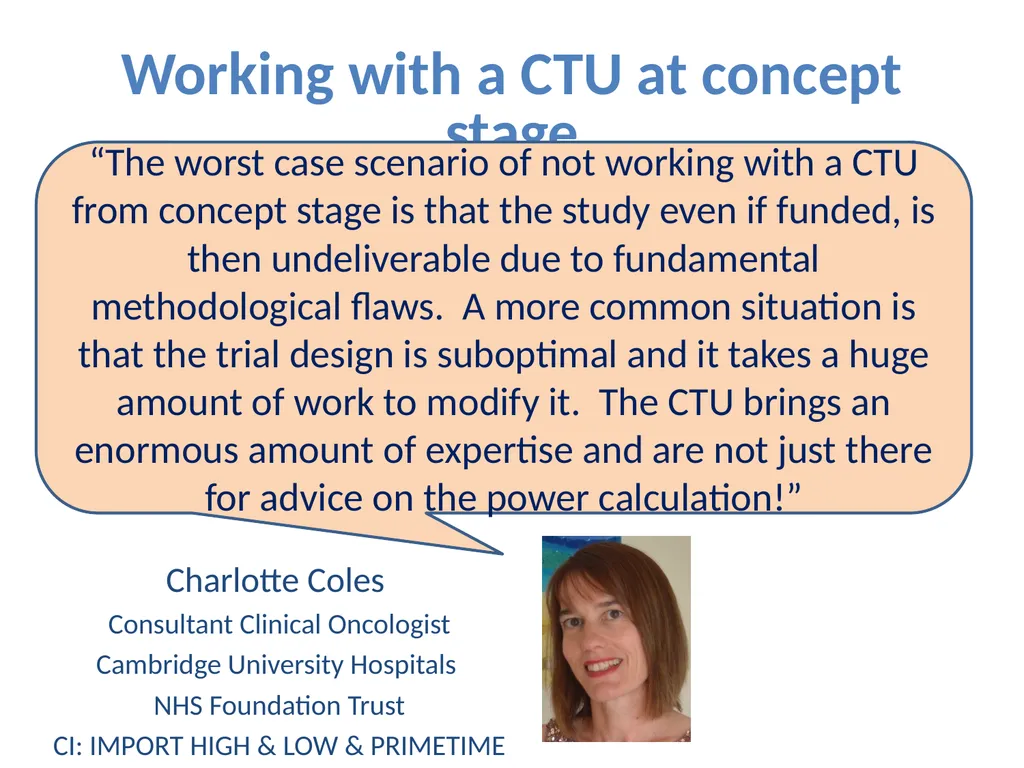
Working with a CTU at concept stage Charlotte Coles
Consultant Clinical Oncologist
Cambridge University Hospitals
NHS Foundation Trust
CI: IMPORT HIGH & LOW & PRIMETIME “The worst case scenario of not working with a CTU from concept stage is that the study even if funded, is then undeliverable due to fundamental methodological flaws. A more common situation is that the trial design is suboptimal and it takes a huge amount of work to modify it. The CTU brings an enormous amount of expertise and are not just there for advice on the power calculation!”<br>
Consultant Clinical Oncologist
Cambridge University Hospitals
NHS Foundation Trust
CI: IMPORT HIGH & LOW & PRIMETIME “The worst case scenario of not working with a CTU from concept stage is that the study even if funded, is then undeliverable due to fundamental methodological flaws. A more common situation is that the trial design is suboptimal and it takes a huge amount of work to modify it. The CTU brings an enormous amount of expertise and are not just there for advice on the power calculation!”<br>
33
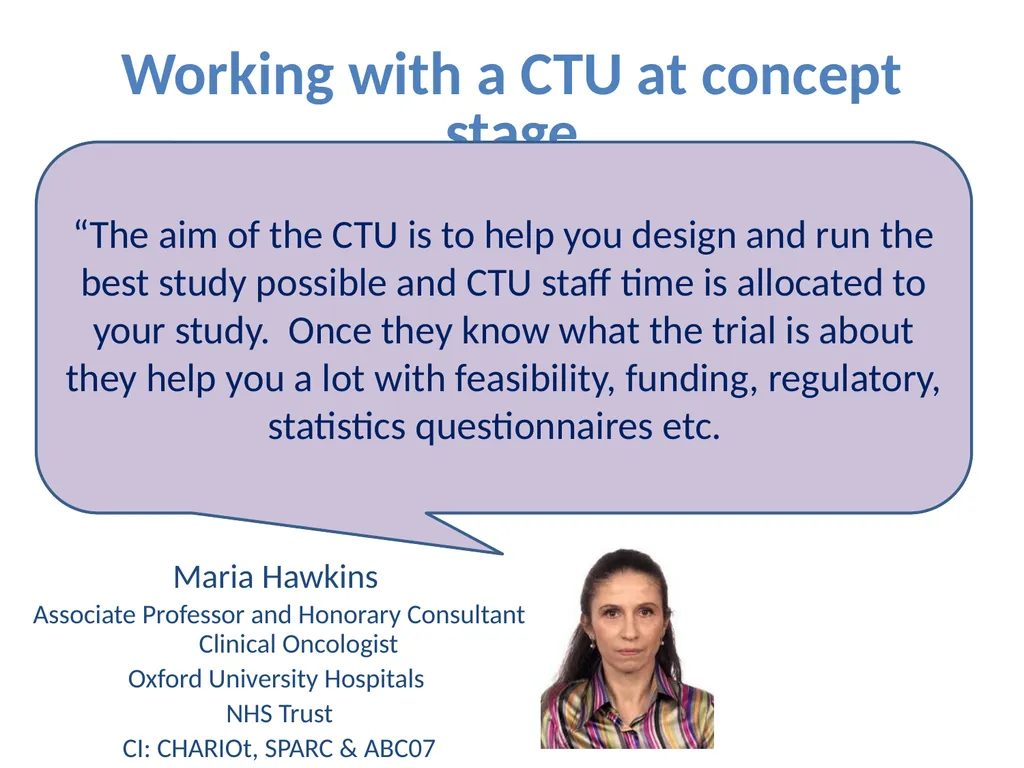
Working with a CTU at concept stage Maria Hawkins
Associate Professor and Honorary Consultant Clinical Oncologist
Oxford University Hospitals
NHS Trust
CI: CHARIOt, SPARC & ABC07 “The aim of the CTU is to help you design and run the best study possible and CTU staff time is allocated to your study. Once they know what the trial is about they help you a lot with feasibility, funding, regulatory, statistics questionnaires etc.<br>
Associate Professor and Honorary Consultant Clinical Oncologist
Oxford University Hospitals
NHS Trust
CI: CHARIOt, SPARC & ABC07 “The aim of the CTU is to help you design and run the best study possible and CTU staff time is allocated to your study. Once they know what the trial is about they help you a lot with feasibility, funding, regulatory, statistics questionnaires etc.<br>
34
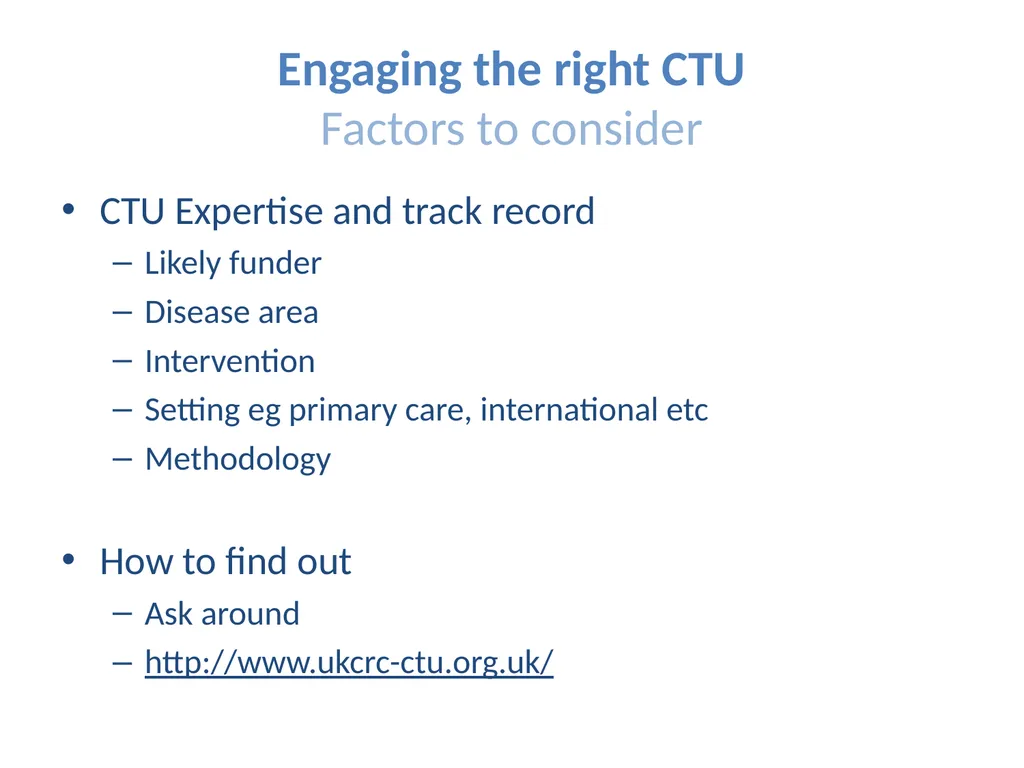
Engaging the right CTU
Factors to consider CTU Expertise and track record
Likely funder
Disease area
Intervention
Setting eg primary care, international etc
Methodology
How to find out
Ask around
http://www.ukcrc-ctu.org.uk/<br>
Likely funder
Disease area
Intervention
Setting eg primary care, international etc
Methodology
How to find out
Ask around
http://www.ukcrc-ctu.org.uk/<br>
35
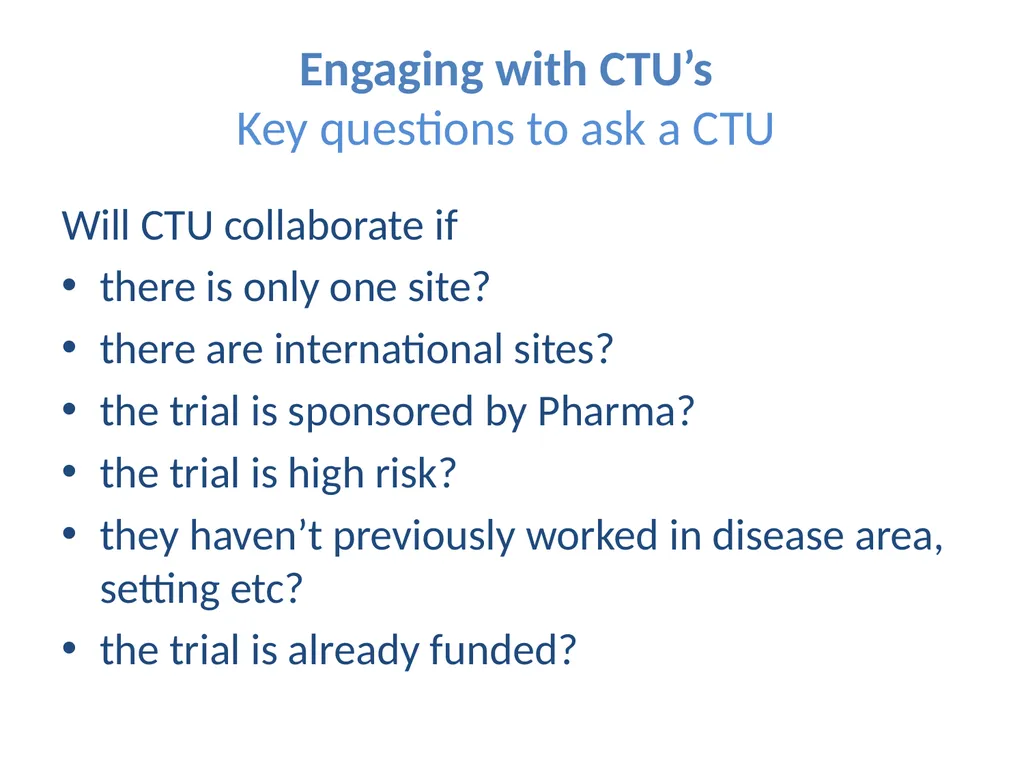
Engaging with CTU’s
Key questions to ask a CTU Will CTU collaborate if
there is only one site?
there are international sites?
the trial is sponsored by Pharma?
the trial is high risk?
they haven’t previously worked in disease area, setting etc?
the trial is already funded?<br>
there is only one site?
there are international sites?
the trial is sponsored by Pharma?
the trial is high risk?
they haven’t previously worked in disease area, setting etc?
the trial is already funded?<br>
36
What types of trials do CTU’s take on? Depends on the CTU!
CTU’s are the best option if the trial
is multicentre
involves an Investigational Medicinal Product (AT/IMP)
is high risk
is in a disease, trial intervention / outcomes area in which the CTU already has expertise<br>
CTU’s are the best option if the trial
is multicentre
involves an Investigational Medicinal Product (AT/IMP)
is high risk
is in a disease, trial intervention / outcomes area in which the CTU already has expertise<br>
37
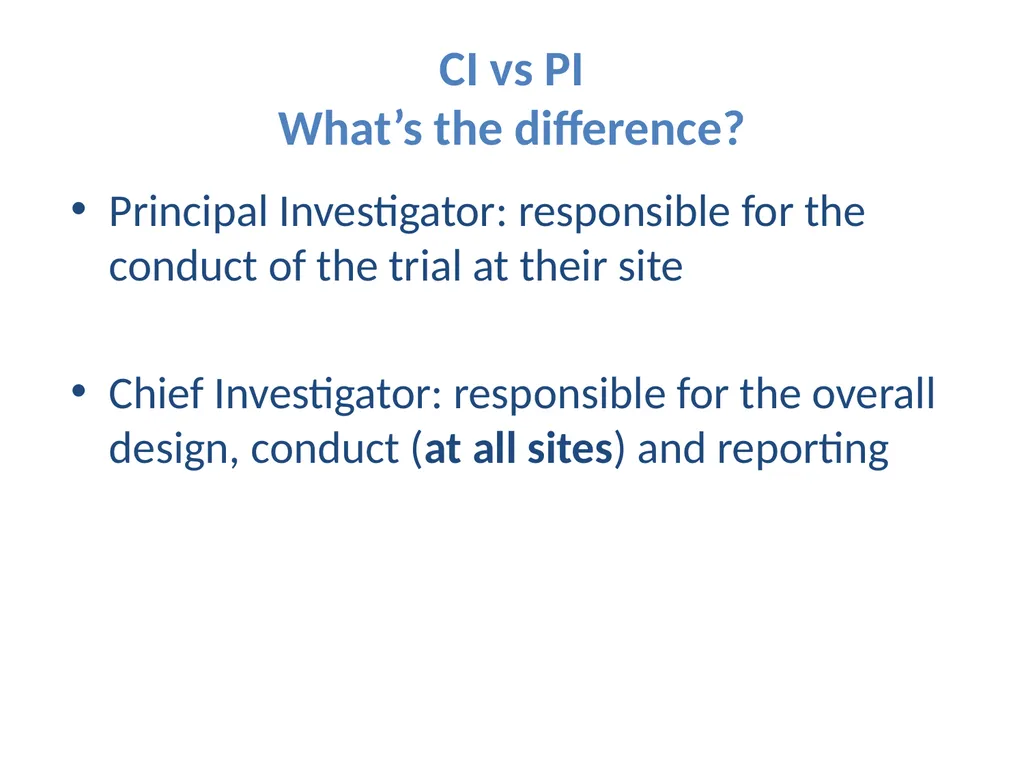
CI vs PI
What’s the difference? Principal Investigator: responsible for the conduct of the trial at their site
Chief Investigator: responsible for the overall design, conduct (at all sites) and reporting<br>
Chief Investigator: responsible for the overall design, conduct (at all sites) and reporting<br>
38
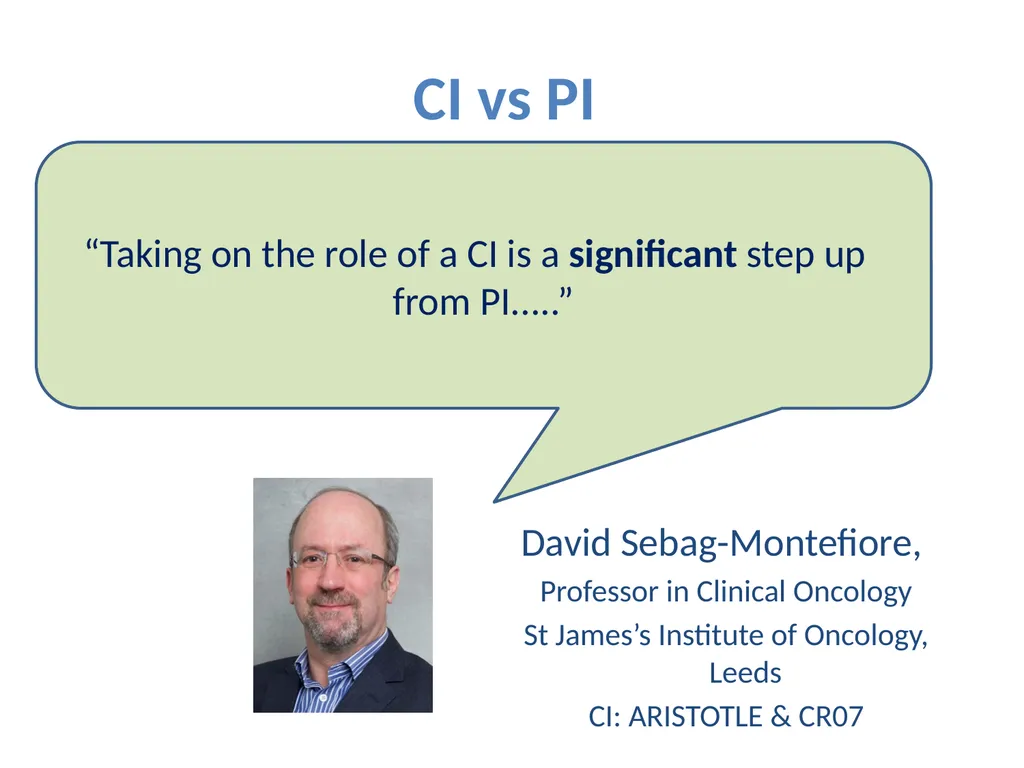
CI vs PI David Sebag-Montefiore,
Professor in Clinical Oncology
St James’s Institute of Oncology, Leeds
CI: ARISTOTLE & CR07 “Taking on the role of a CI is a significant step up from PI.....”<br>
Professor in Clinical Oncology
St James’s Institute of Oncology, Leeds
CI: ARISTOTLE & CR07 “Taking on the role of a CI is a significant step up from PI.....”<br>
39
CI vs PI
What’s the difference? Additional responsibilities
Trial oversight / management of whole trial
Protocol development and trial design
Funding
Trial Master File and all essential documents
Data base validation and data management
Regulatory submission and compliance
Ethics submission
Risk assessment / Safety / IMP Oversight
Annual / End of trial Reports<br>
Trial oversight / management of whole trial
Protocol development and trial design
Funding
Trial Master File and all essential documents
Data base validation and data management
Regulatory submission and compliance
Ethics submission
Risk assessment / Safety / IMP Oversight
Annual / End of trial Reports<br>
40
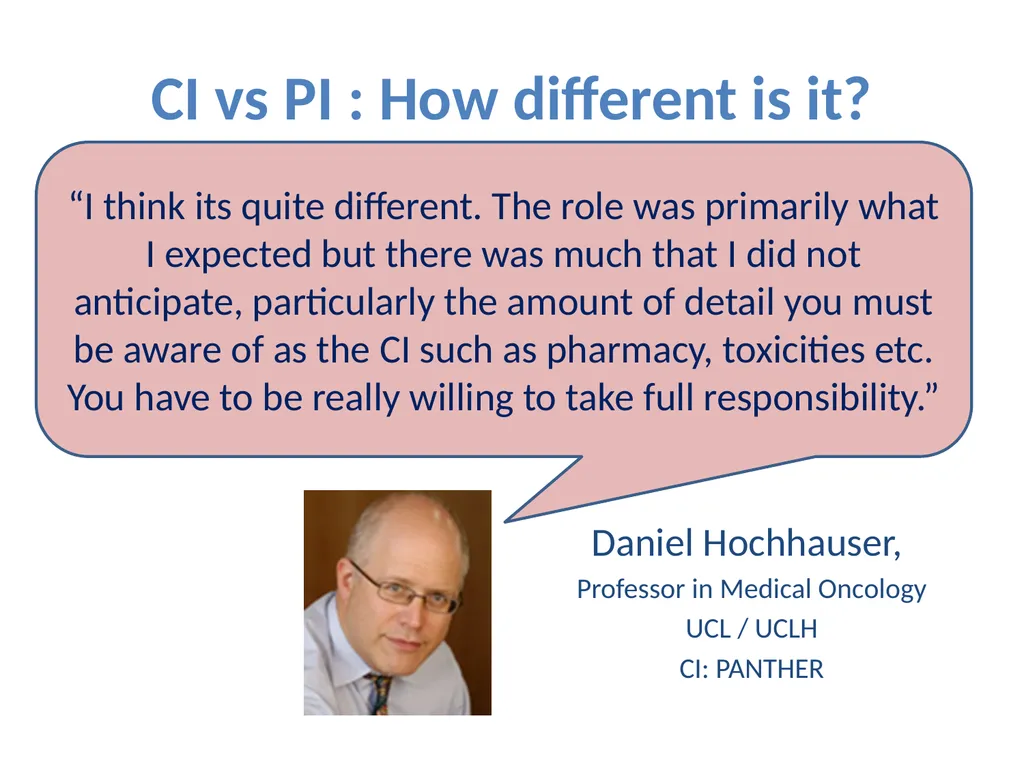
CI vs PI : How different is it? Daniel Hochhauser,
Professor in Medical Oncology
UCL / UCLH
CI: PANTHER “I think its quite different. The role was primarily what I expected but there was much that I did not anticipate, particularly the amount of detail you must be aware of as the CI such as pharmacy, toxicities etc.
You have to be really willing to take full responsibility.”<br>
Professor in Medical Oncology
UCL / UCLH
CI: PANTHER “I think its quite different. The role was primarily what I expected but there was much that I did not anticipate, particularly the amount of detail you must be aware of as the CI such as pharmacy, toxicities etc.
You have to be really willing to take full responsibility.”<br>
41
Time Commitment for CI’s Prior to funding
Very variable but start >3 month ahead of deadline
It can take over a year to determine the right design
Post funding
Estimate 2-4 hours a week - very variable
Allow time to establish good working relationships
CTU staff
TMG
Site PI’s
Availability for troubleshooting
Queries on eligibility, protocol, safety etc<br>
Very variable but start >3 month ahead of deadline
It can take over a year to determine the right design
Post funding
Estimate 2-4 hours a week - very variable
Allow time to establish good working relationships
CTU staff
TMG
Site PI’s
Availability for troubleshooting
Queries on eligibility, protocol, safety etc<br>
42
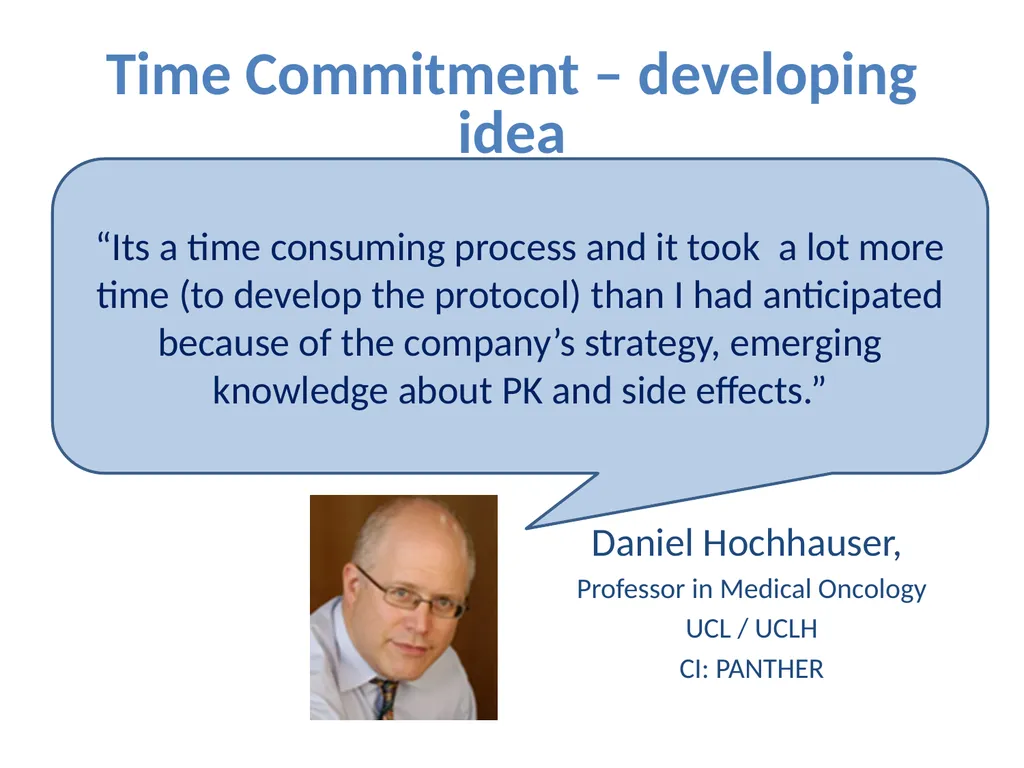
Time Commitment – developing idea Daniel Hochhauser,
Professor in Medical Oncology
UCL / UCLH
CI: PANTHER “Its a time consuming process and it took a lot more time (to develop the protocol) than I had anticipated because of the company’s strategy, emerging knowledge about PK and side effects.”<br>
Professor in Medical Oncology
UCL / UCLH
CI: PANTHER “Its a time consuming process and it took a lot more time (to develop the protocol) than I had anticipated because of the company’s strategy, emerging knowledge about PK and side effects.”<br>
43
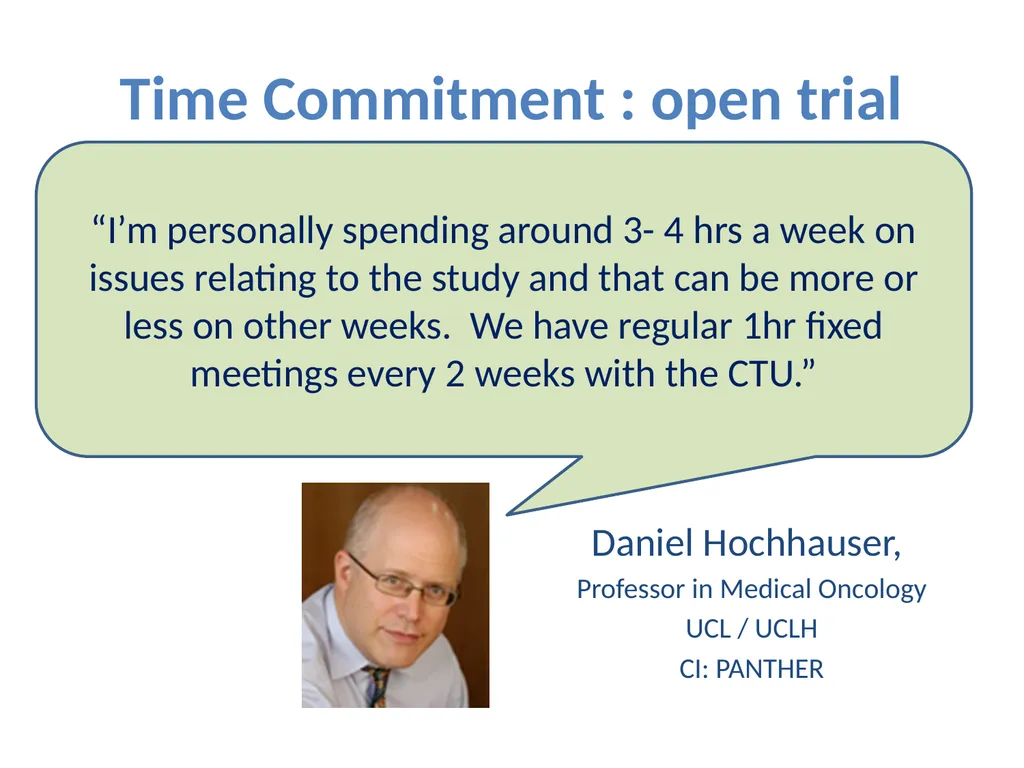
Time Commitment : open trial Daniel Hochhauser,
Professor in Medical Oncology
UCL / UCLH
CI: PANTHER “I’m personally spending around 3- 4 hrs a week on issues relating to the study and that can be more or less on other weeks. We have regular 1hr fixed meetings every 2 weeks with the CTU.”<br>
Professor in Medical Oncology
UCL / UCLH
CI: PANTHER “I’m personally spending around 3- 4 hrs a week on issues relating to the study and that can be more or less on other weeks. We have regular 1hr fixed meetings every 2 weeks with the CTU.”<br>
44
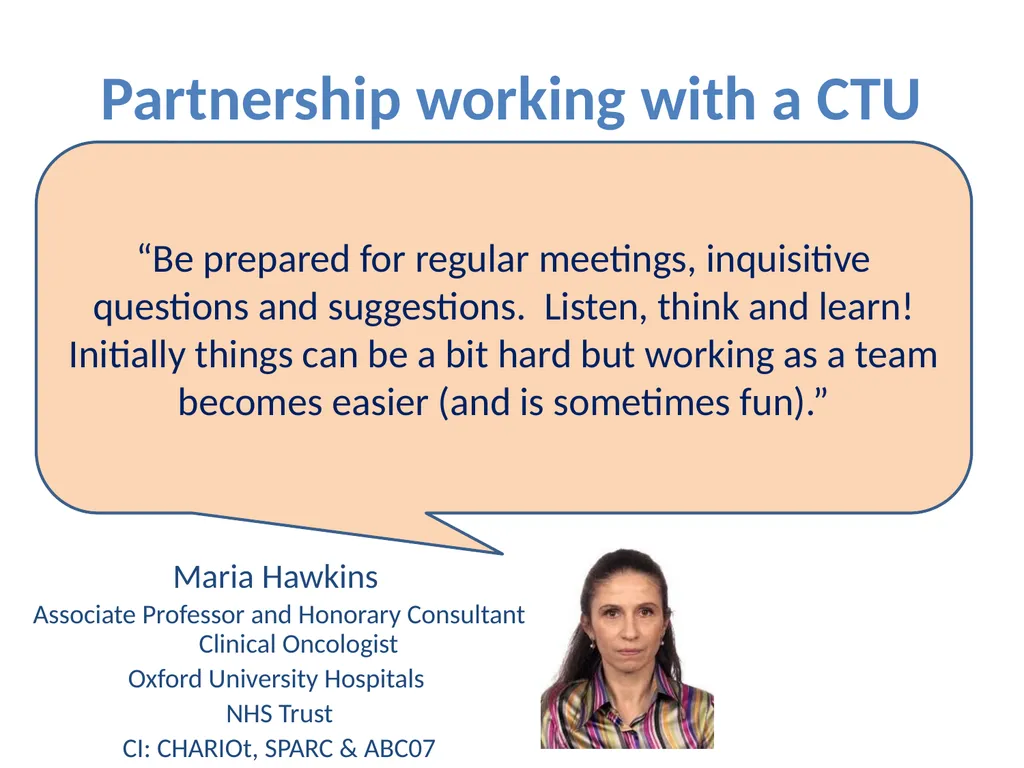
Partnership working with a CTU Maria Hawkins
Associate Professor and Honorary Consultant Clinical Oncologist
Oxford University Hospitals
NHS Trust
CI: CHARIOt, SPARC & ABC07 “Be prepared for regular meetings, inquisitive questions and suggestions. Listen, think and learn! Initially things can be a bit hard but working as a team becomes easier (and is sometimes fun).”<br>
Associate Professor and Honorary Consultant Clinical Oncologist
Oxford University Hospitals
NHS Trust
CI: CHARIOt, SPARC & ABC07 “Be prepared for regular meetings, inquisitive questions and suggestions. Listen, think and learn! Initially things can be a bit hard but working as a team becomes easier (and is sometimes fun).”<br>
45
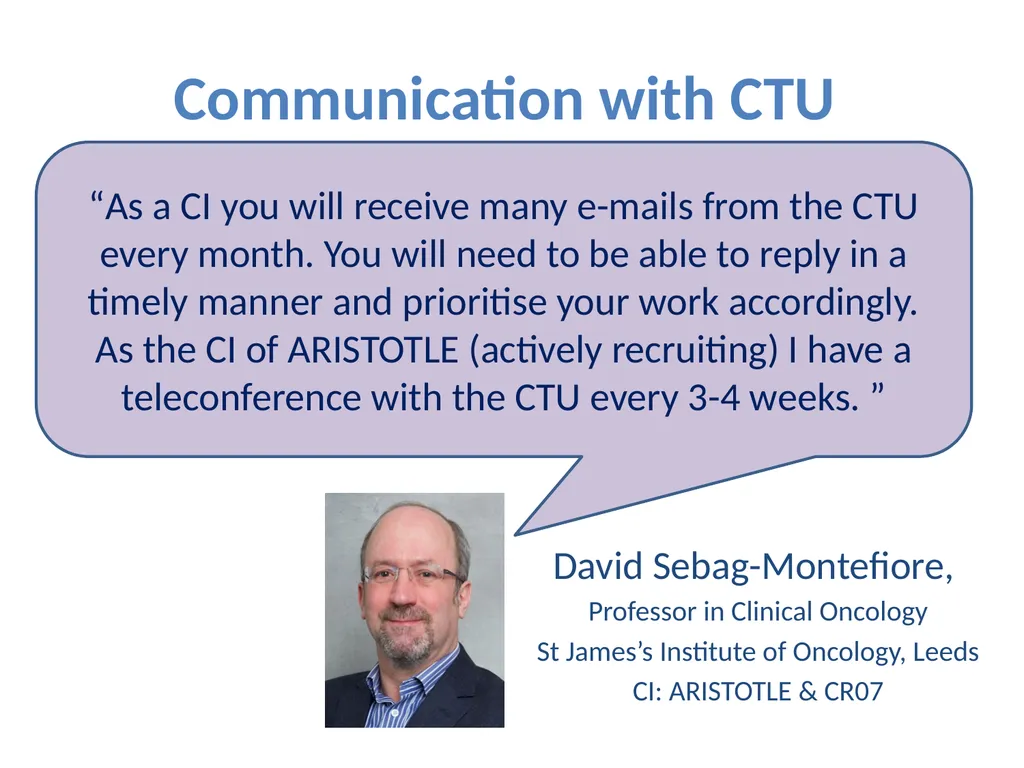
Communication with CTU David Sebag-Montefiore,
Professor in Clinical Oncology
St James’s Institute of Oncology, Leeds
CI: ARISTOTLE & CR07 “As a CI you will receive many e-mails from the CTU every month. You will need to be able to reply in a timely manner and prioritise your work accordingly.
As the CI of ARISTOTLE (actively recruiting) I have a teleconference with the CTU every 3-4 weeks. ”<br>
Professor in Clinical Oncology
St James’s Institute of Oncology, Leeds
CI: ARISTOTLE & CR07 “As a CI you will receive many e-mails from the CTU every month. You will need to be able to reply in a timely manner and prioritise your work accordingly.
As the CI of ARISTOTLE (actively recruiting) I have a teleconference with the CTU every 3-4 weeks. ”<br>
46
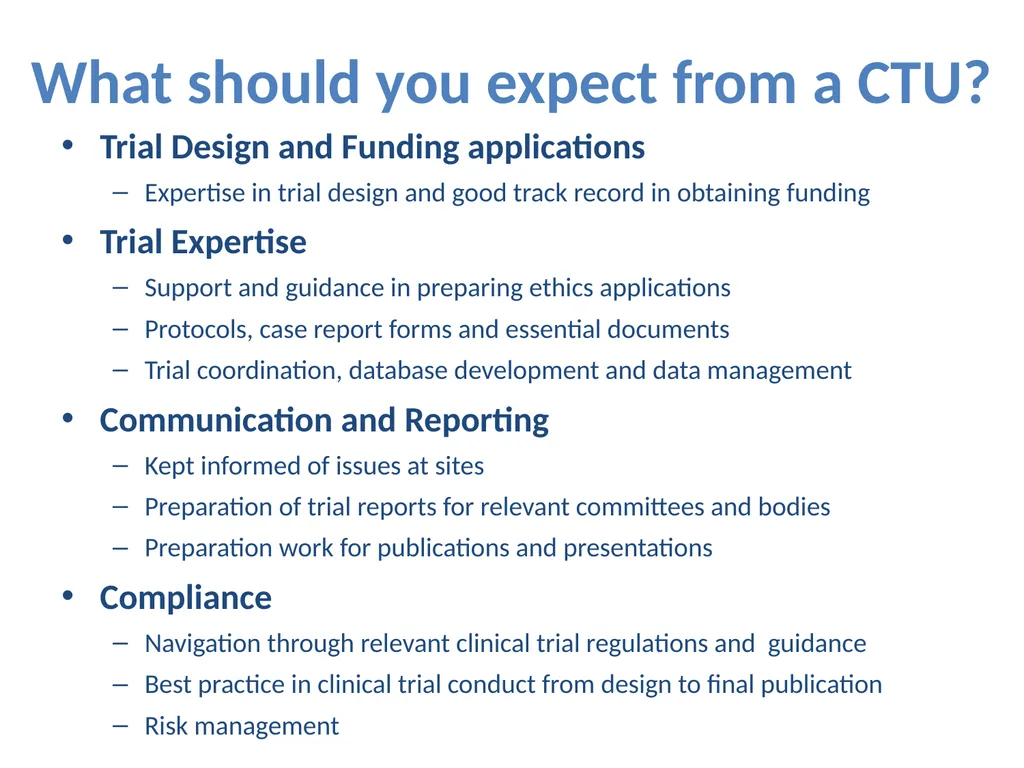
What should you expect from a CTU? Trial Design and Funding applications
Expertise in trial design and good track record in obtaining funding
Trial Expertise
Support and guidance in preparing ethics applications
Protocols, case report forms and essential documents
Trial coordination, database development and data management
Communication and Reporting
Kept informed of issues at sites
Preparation of trial reports for relevant committees and bodies
Preparation work for publications and presentations
Compliance
Navigation through relevant clinical trial regulations and guidance
Best practice in clinical trial conduct from design to final publication
Risk management<br>
Expertise in trial design and good track record in obtaining funding
Trial Expertise
Support and guidance in preparing ethics applications
Protocols, case report forms and essential documents
Trial coordination, database development and data management
Communication and Reporting
Kept informed of issues at sites
Preparation of trial reports for relevant committees and bodies
Preparation work for publications and presentations
Compliance
Navigation through relevant clinical trial regulations and guidance
Best practice in clinical trial conduct from design to final publication
Risk management<br>
47
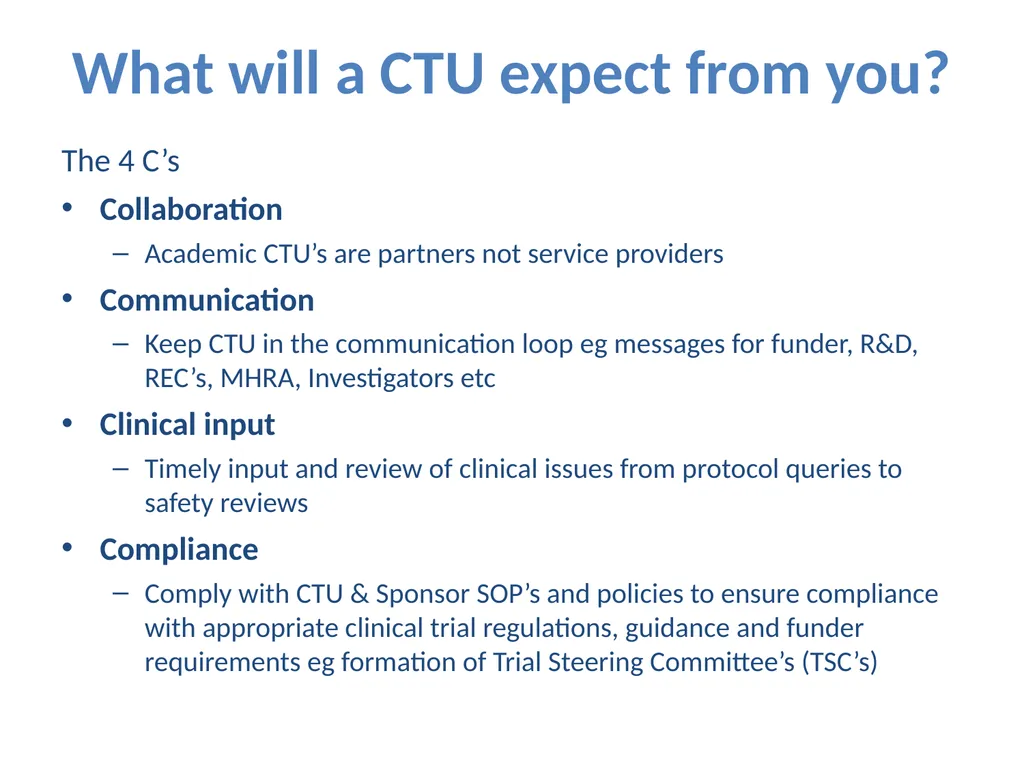
What will a CTU expect from you? The 4 C’s
Collaboration
Academic CTU’s are partners not service providers
Communication
Keep CTU in the communication loop eg messages for funder, R&D, REC’s, MHRA, Investigators etc
Clinical input
Timely input and review of clinical issues from protocol queries to safety reviews
Compliance
Comply with CTU & Sponsor SOP’s and policies to ensure compliance with appropriate clinical trial regulations, guidance and funder requirements eg formation of Trial Steering Committee’s (TSC’s)<br>
Collaboration
Academic CTU’s are partners not service providers
Communication
Keep CTU in the communication loop eg messages for funder, R&D, REC’s, MHRA, Investigators etc
Clinical input
Timely input and review of clinical issues from protocol queries to safety reviews
Compliance
Comply with CTU & Sponsor SOP’s and policies to ensure compliance with appropriate clinical trial regulations, guidance and funder requirements eg formation of Trial Steering Committee’s (TSC’s)<br>
48
Acknowledgements Concept and Construction of Slides
Helen Meadows
Cancer Research UK & UCL Cancer Trials Centre
Claire Snowdon
Institute of Cancer Clinical Trials Research & Statistics Unit (ICR-CTSU)
Additional thanks to
All chief investigators
Sue Tebbs
Comprehensive CTU @ UCL for slides 11, 46, 47
Senior Staff at
Cancer Research UK & UCL Cancer Trials Centre
Institute of Cancer Clinical Trials Research & Statistics Unit (ICR-CTSU) Cancer CTU Group<br>
Helen Meadows
Cancer Research UK & UCL Cancer Trials Centre
Claire Snowdon
Institute of Cancer Clinical Trials Research & Statistics Unit (ICR-CTSU)
Additional thanks to
All chief investigators
Sue Tebbs
Comprehensive CTU @ UCL for slides 11, 46, 47
Senior Staff at
Cancer Research UK & UCL Cancer Trials Centre
Institute of Cancer Clinical Trials Research & Statistics Unit (ICR-CTSU) Cancer CTU Group<br>