
Pass-through Entity’s Oversight Responsibilities

Description: Pass-through Entitys Oversight Responsibilities for Subrecipients TRAINING Office of the Chief Financial Officer Office of Justice Programs Topics Slide Number Definitions . . . . . . . . . . . . . . . . . . . . . . . . . . . . . . . . 5
Related Topics
Download Presentation
"Pass-through Entity’s Oversight Responsibilities" is the property of its rightful owner. Permission is granted to download and print the materials on this website for personal, non-commercial use only, and to display it on your personal computer provided you do not modify the materials and that you retain all copyright notices contained in the materials. By downloading content from our website, you accept the terms of this agreement.
Presentation Transcript
slide1. Pass-through Entity’s Oversight Responsibilities for Subrecipients TRAINING Office of the
Chief Financial Officer
Office of Justice Programs<br>
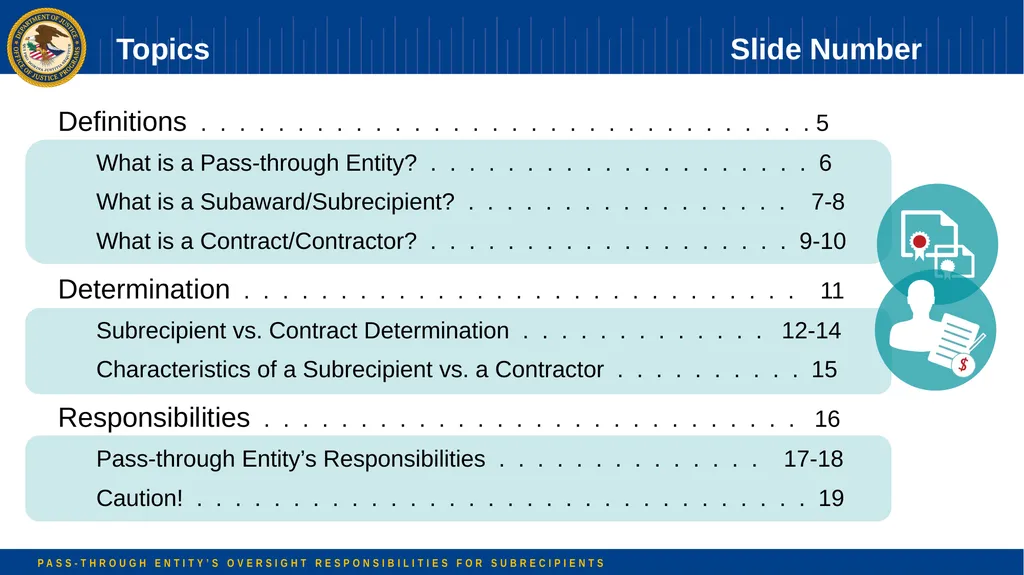
slide2. Topics Slide Number Definitions . . . . . . . . . . . . . . . . . . . . . . . . . . . . . . . . 5
What is a Pass-through Entity? . . . . . . . . . . . . . . . . . . . . 6
What is a Subaward/Subrecipient? . . . . . . . . . . . . . . . . . 7-8
What is a Contract/Contractor? . . . . . . . . . . . . . . . . . . . 9-10
Determination . . . . . . . . . . . . . . . . . . . . . . . . . . . . . 11
Subrecipient vs. Contract Determination . . . . . . . . . . . . . 12-14
Characteristics of a Subrecipient vs. a Contractor . . . . . . . . . . 15
Responsibilities . . . . . . . . . . . . . . . . . . . . . . . . . . . . 16
Pass-through Entity’s Responsibilities . . . . . . . . . . . . . . 17-18
Caution! . . . . . . . . . . . . . . . . . . . . . . . . . . . . . . . . 19<br>
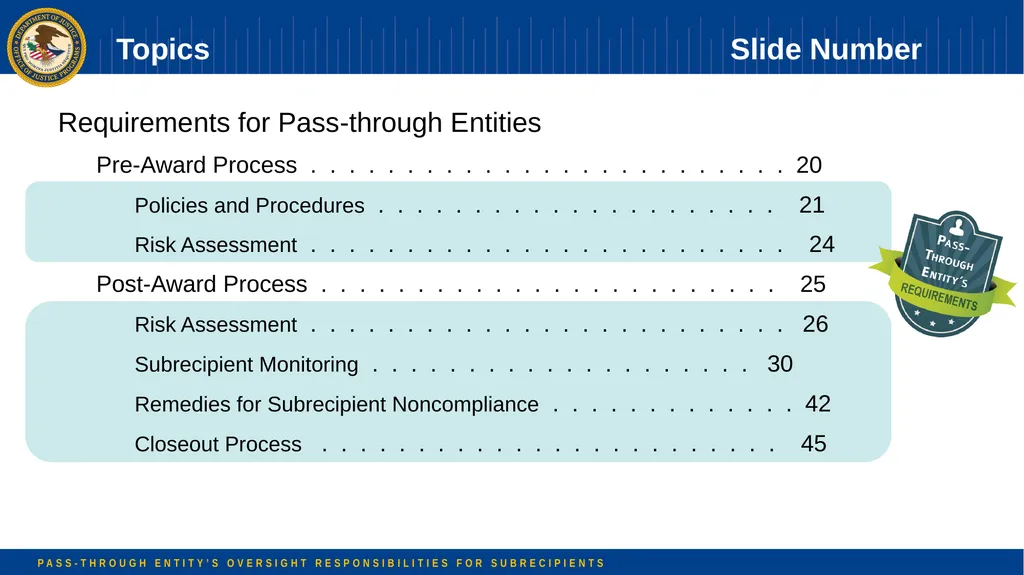
slide3. Topics Slide Number Requirements for Pass-through Entities
Pre-Award Process . . . . . . . . . . . . . . . . . . . . . . . . . 20
Policies and Procedures . . . . . . . . . . . . . . . . . . . . . 21
Risk Assessment . . . . . . . . . . . . . . . . . . . . . . . . . 24
Post-Award Process . . . . . . . . . . . . . . . . . . . . . . . . 25
Risk Assessment . . . . . . . . . . . . . . . . . . . . . . . . . 26
Subrecipient Monitoring . . . . . . . . . . . . . . . . . . . . 30
Remedies for Subrecipient Noncompliance . . . . . . . . . . . . . 42
Closeout Process . . . . . . . . . . . . . . . . . . . . . . . . 45<br>
slide4. Topics Slide Number Recurring OIG/DOJ Findings . . . . . . . . . . . . . . . . . . . . 48
Resources . . . . . . . . . . . . . . . . . . . . . . . . . . . . . . . 51
Contact Information . . . . . . . . . . . . . . . . . . . . . . . . . 57
OJP OCFO . . . . . . . . . . . . . . . . . . . . . . . . . . . . . . 57<br>
slide5. Definitions Pass-through Entity
Subaward / Subrecipient
Contract / Contractor<br>
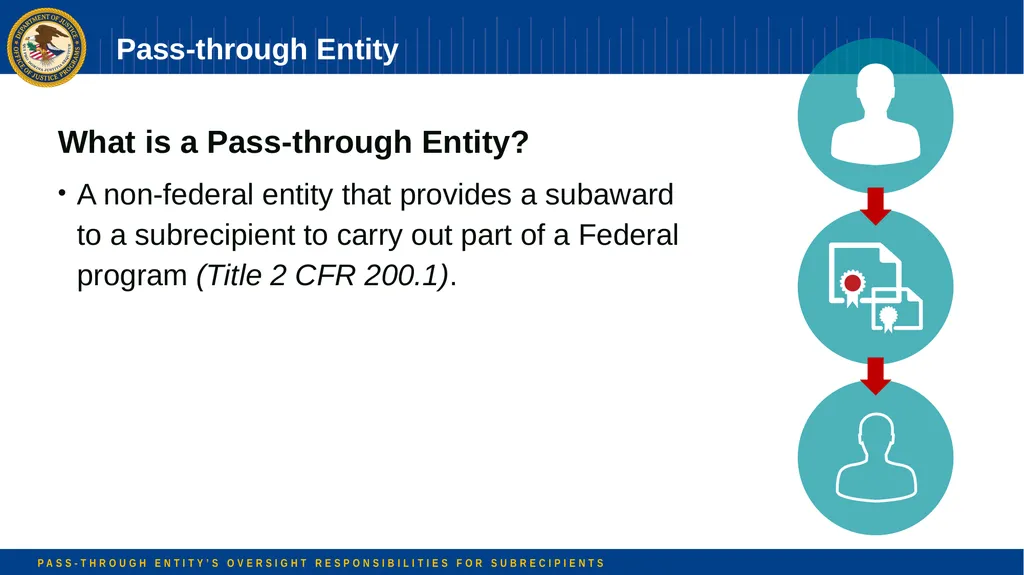
slide6. Pass-through Entity What is a Pass-through Entity?
A non-federal entity that provides a subaward to a subrecipient to carry out part of a Federal program (Title 2 CFR 200.1).<br>
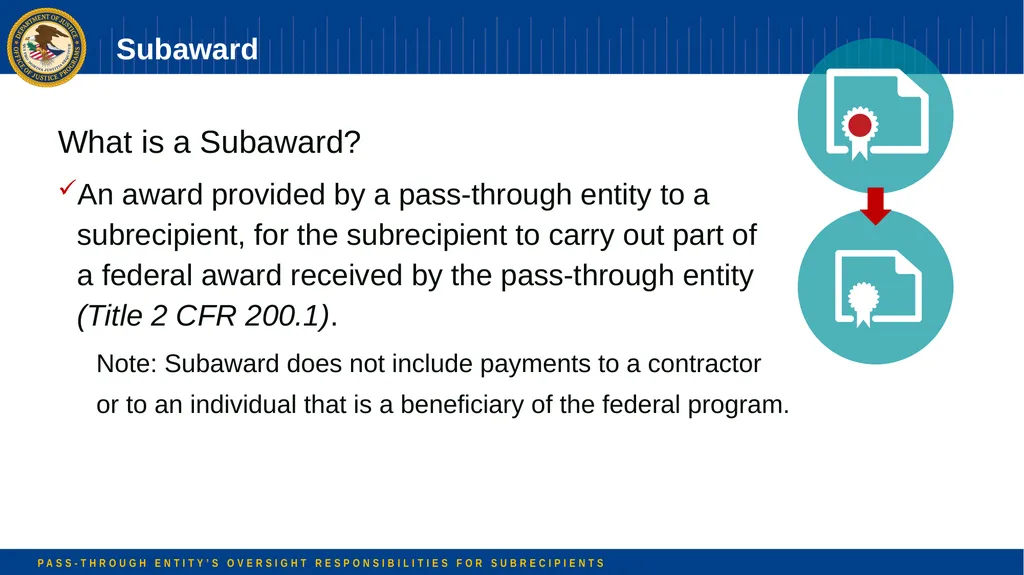
slide7. Subaward What is a Subaward?
An award provided by a pass-through entity to a subrecipient, for the subrecipient to carry out part of a federal award received by the pass-through entity (Title 2 CFR 200.1).
Note: Subaward does not include payments to a contractor or to an individual that is a beneficiary of the federal program.<br>
slide8. Subrecipient What is a Subrecipient?
A non-federal entity that receives a subaward from a pass-through entity to carry out part of a federal program (Title 2 CFR 200.1).<br>
slide9. Contract What is a Contract?
A legal instrument by which a non-federal entity purchases property or services needed to carry out the project or program under a federal award. The term as used in this part does not include a legal instrument, even if the non-federal entity considers it a contract, when the substance of the transaction meets the definition of a Federal award or subaward (Title 2 CFR 200.1).<br>
slide10. Contractor What is a Contractor?
An entity that receives a contract as defined in Contract on previous slide (Title 2 CFR 200.1).<br>
slide11. Subrecipient vs. Contractor Determination<br>
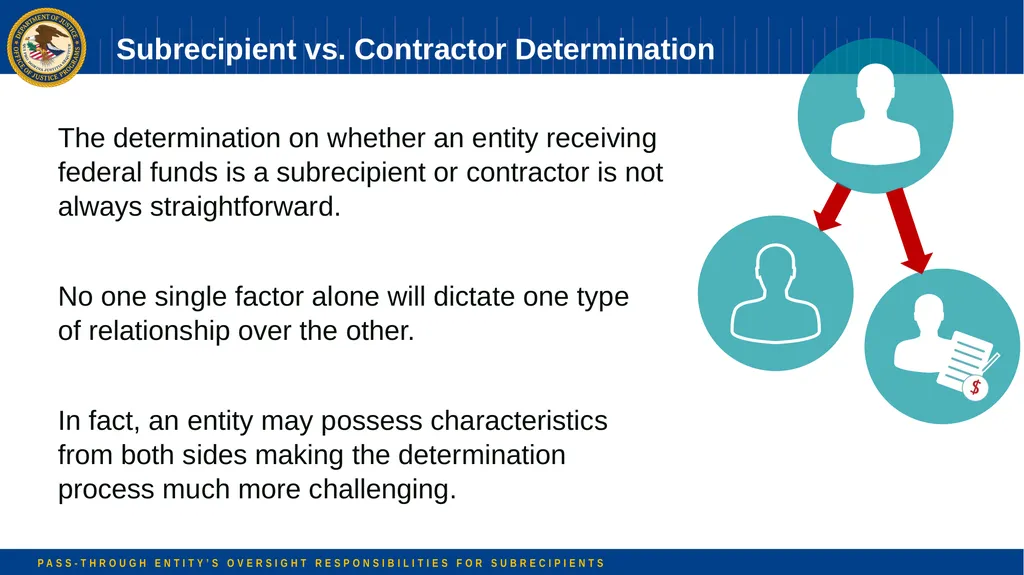
slide12. Subrecipient vs. Contractor Determination The determination on whether an entity receiving federal funds is a subrecipient or contractor is not always straightforward.
No one single factor alone will dictate one type of relationship over the other.
In fact, an entity may possess characteristics from both sides making the determination process much more challenging.<br>
slide13. Subrecipient vs. Contractor Determination The “form” (i.e. MOU, contract, etc.) is less important to the examination of a relationship than its “substance.”
“Substance” refers to the characteristics of the arrangement and whether it cast the party receiving the funds in the role of a subrecipient or a contractor.<br>
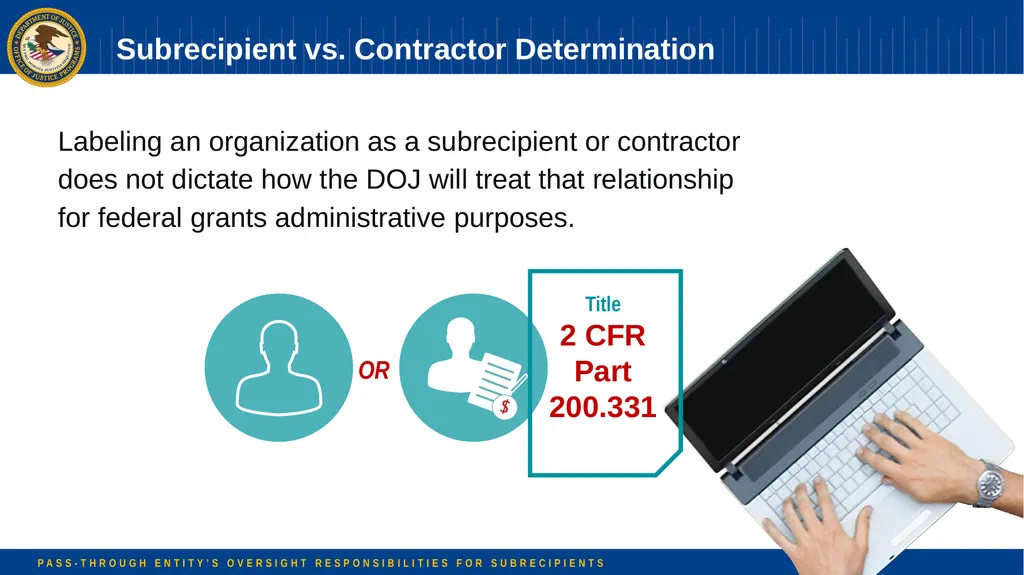
slide14. Subrecipient vs. Contractor Determination Labeling an organization as a subrecipient or contractor does not dictate how the DOJ will treat that relationship for federal grants administrative purposes. Title
2 CFR Part 200.331 OR<br>
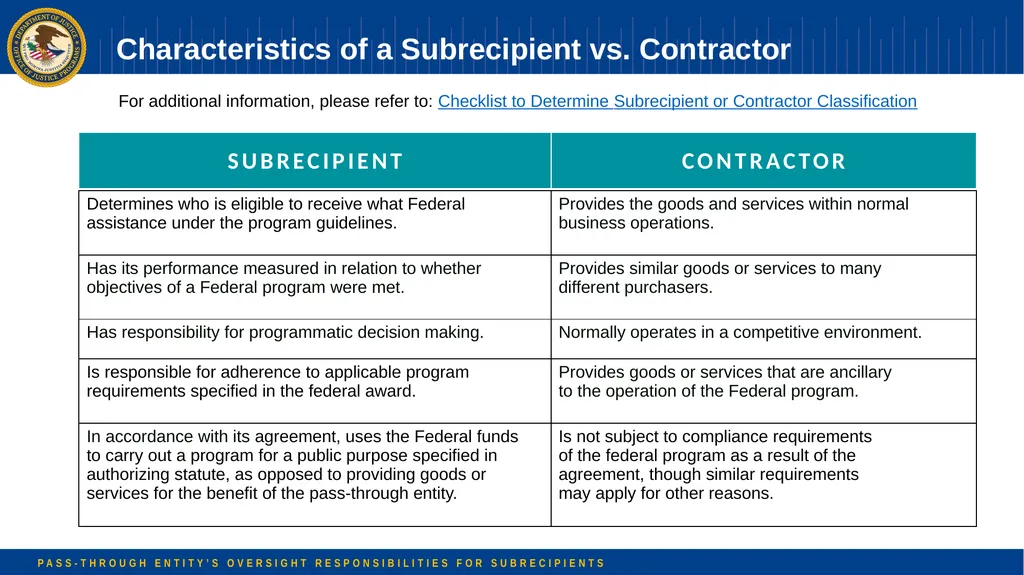
slide15. Characteristics of a Subrecipient vs. Contractor For additional information, please refer to: Checklist to Determine Subrecipient or Contractor Classification<br>
slide16. Pass-through Entity’s Responsibilities<br>
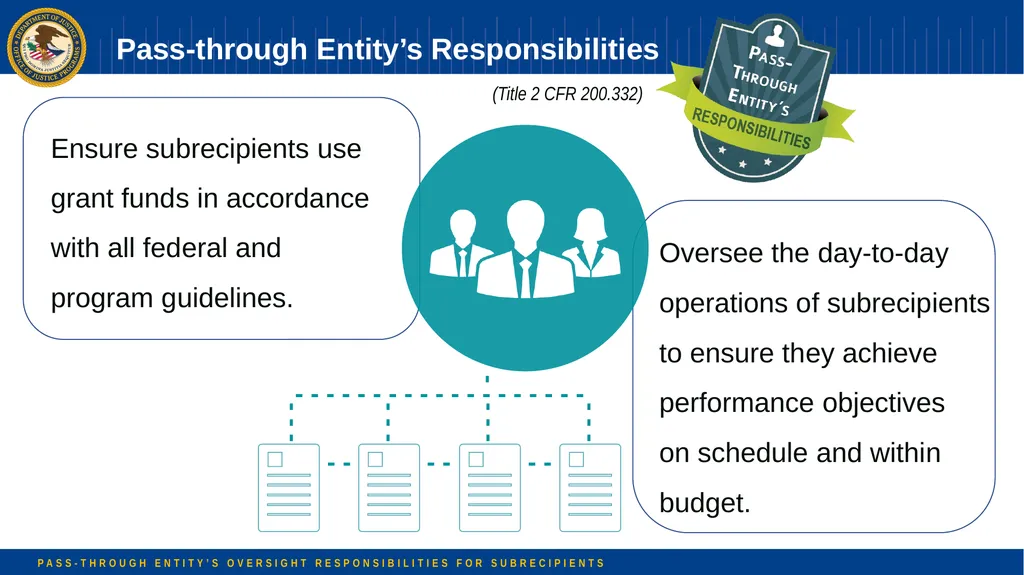
slide17. Pass-through Entity’s Responsibilities Oversee the day-to-day operations of subrecipients to ensure they achieve performance objectives on schedule and within budget. - - - - - - - - - - - - - - - - - - - - - - - - - - - - - - - - - - - - - - (Title 2 CFR 200.332)<br>
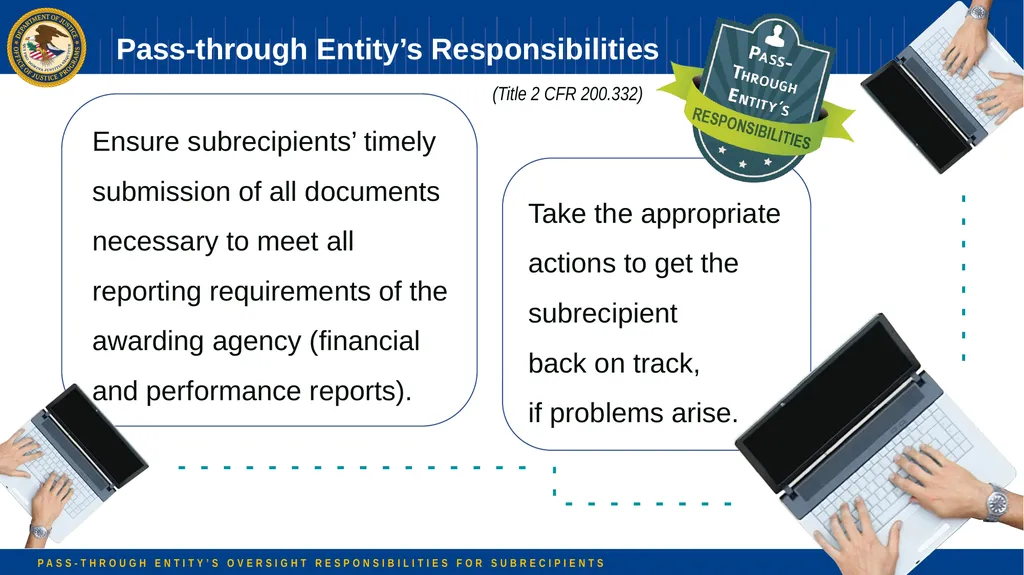
slide18. Pass-through Entity’s Responsibilities Take the appropriate actions to get the subrecipient back on track, if problems arise. - - - - - - - - - - - - - - - - - - - - - - - - - - - - - - - - - - (Title 2 CFR 200.332)<br>
slide19. Pass-through Entity’s Responsibilities The use of subrecipients does not relieve the pass-through entity of its responsibilities.<br>
slide20. Pre-award Process Pass-through Entity’s Requirements<br>
slide21. Pre-award Process Policies and procedures must be in writing and clearly describe the pass-through entity’s responsibility for managing subrecipient’s activities throughout the award lifecycle. A pass-through entity must have established policies and procedures on how subawards will be made and subrecipients managed.<br>
slide22. Pre-award Process A pass-through entity must:
Decide upon the appropriate instrument for the services needed (i.e., subaward, contract, etc.) (Title 2 CFR 200.201)
Have a method for announcing the specific funding opportunities, eligibility requirements and the allotted timeframe to apply.
Have a process for reviewing each subrecipient’s eligibility for federal funding.
Include the criteria to be used to evaluate each application.<br>
slide23. Pre-award Process A pass-through entity must:
Ensure that subrecipients are not suspended or debarred by the federal government prior to making the award.
Clearly identify the federal award information, compliance requirements, applicable terms and conditions, and any supplemental requirements imposed by the pass-through entity.
Include specific award identification data elements such as subrecipient name and entity identifier, federal award identification number, and federal award date. (Title 2 CFR 200.332(a))<br>
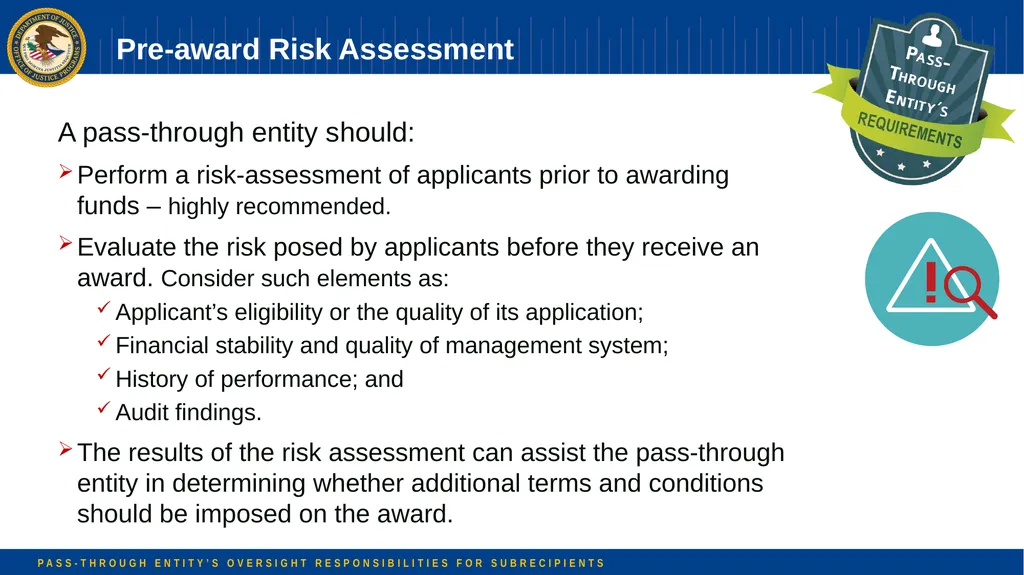
slide24. Pre-award Risk Assessment A pass-through entity should:
Perform a risk-assessment of applicants prior to awarding funds – highly recommended.
Evaluate the risk posed by applicants before they receive an award. Consider such elements as:
Applicant’s eligibility or the quality of its application;
Financial stability and quality of management system;
History of performance; and
Audit findings.
The results of the risk assessment can assist the pass-through entity in determining whether additional terms and conditions should be imposed on the award.<br>
slide25. Post-award Process Risk Assessment Pass-through Entity’s Requirements<br>
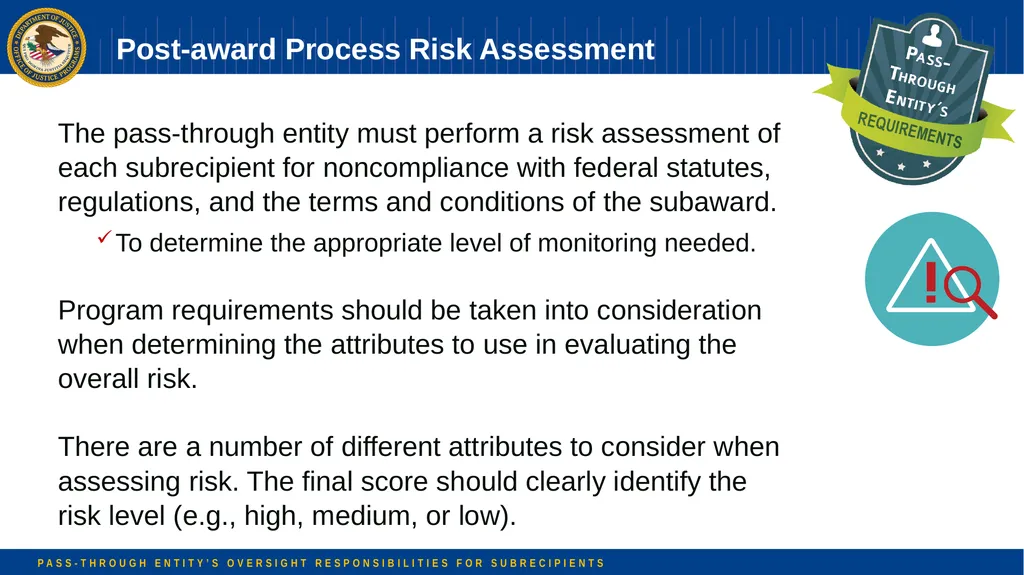
slide26. Post-award Process Risk Assessment The pass-through entity must perform a risk assessment of each subrecipient for noncompliance with federal statutes, regulations, and the terms and conditions of the subaward.
To determine the appropriate level of monitoring needed.
Program requirements should be taken into consideration when determining the attributes to use in evaluating the overall risk.
There are a number of different attributes to consider when assessing risk. The final score should clearly identify the risk level (e.g., high, medium, or low).<br>
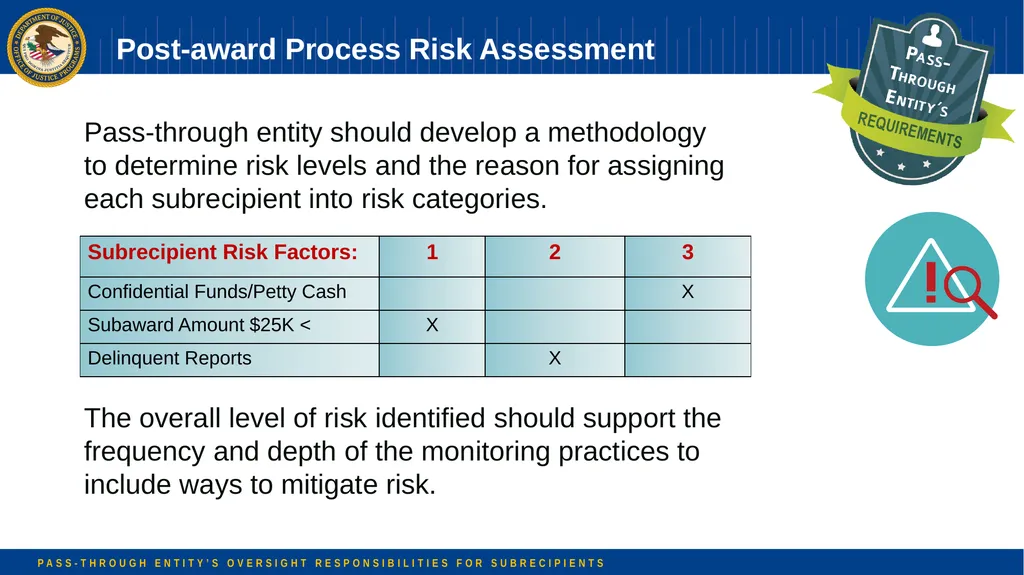
slide27. Post-award Process Risk Assessment Pass-through entity should develop a methodology to determine risk levels and the reason for assigning each subrecipient into risk categories.
The overall level of risk identified should support the frequency and depth of the monitoring practices to include ways to mitigate risk.<br>
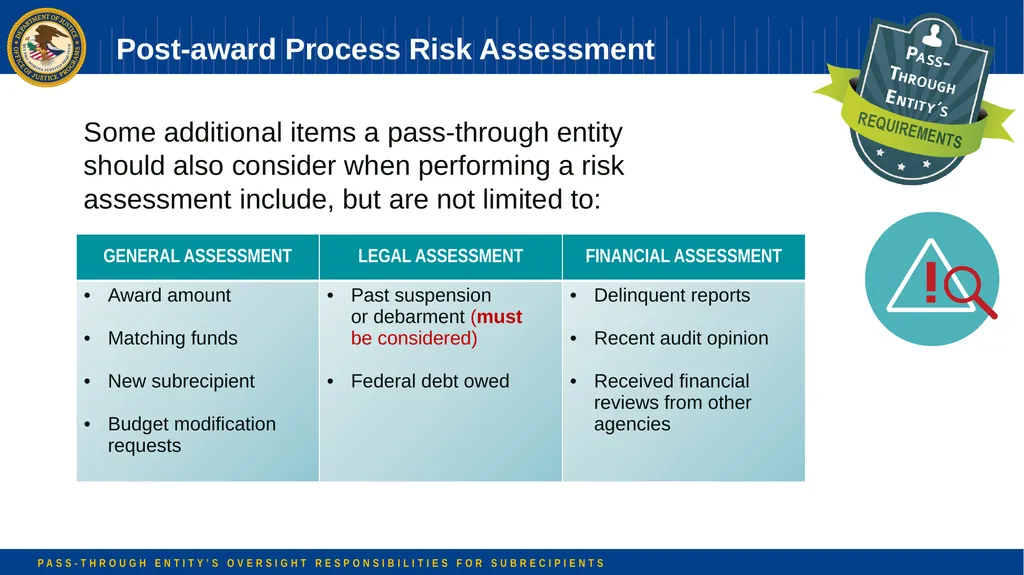
slide28. Post-award Process Risk Assessment Some additional items a pass-through entity should also consider when performing a risk assessment include, but are not limited to:<br>
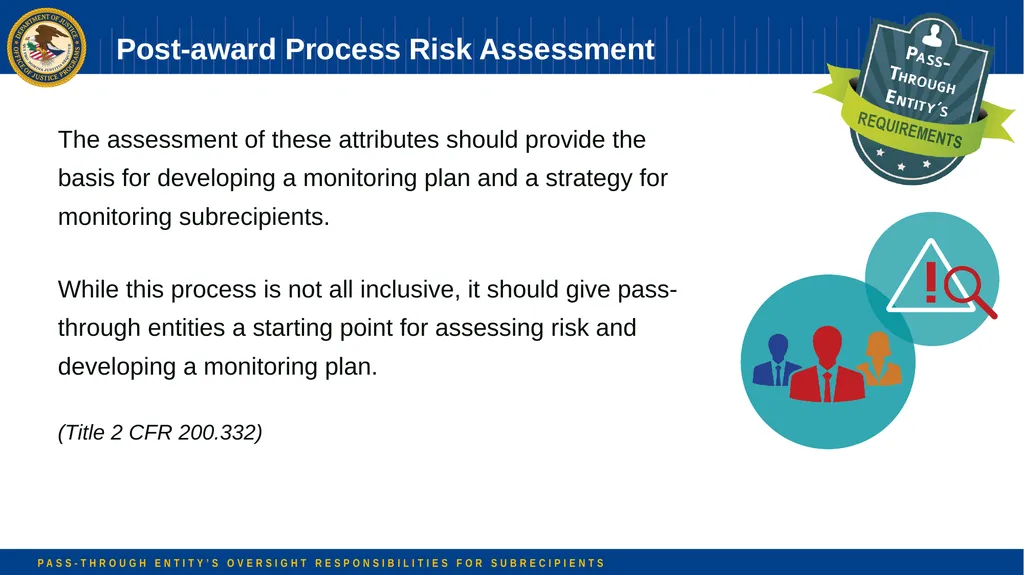
slide29. Post-award Process Risk Assessment The assessment of these attributes should provide the basis for developing a monitoring plan and a strategy for monitoring subrecipients.
While this process is not all inclusive, it should give pass-through entities a starting point for assessing risk and developing a monitoring plan. (Title 2 CFR 200.332)<br>
slide30. Post-award Process Subrecipient Monitoring Pass-through Entity’s Requirements<br>
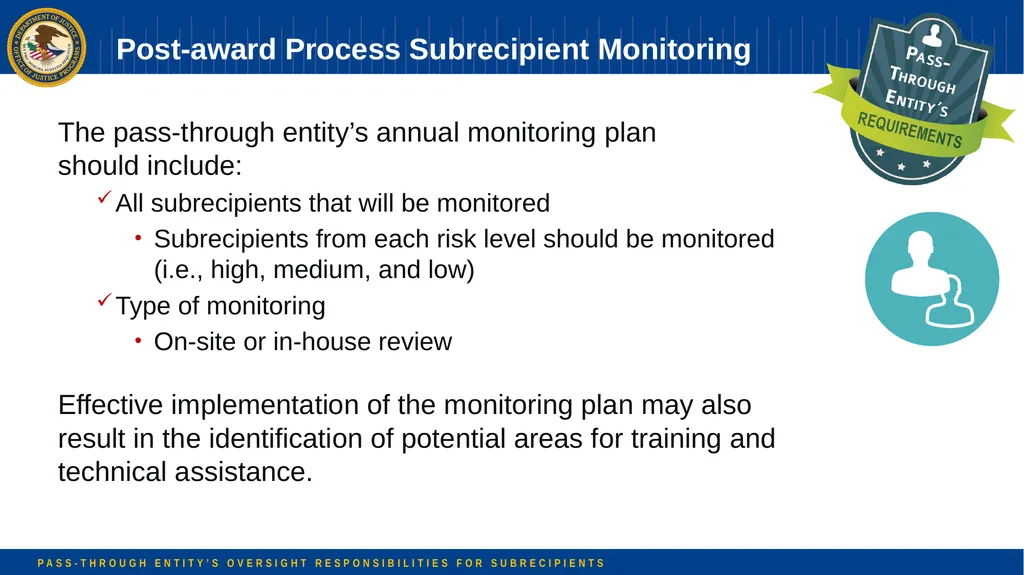
slide31. Post-award Process Subrecipient Monitoring The pass-through entity’s annual monitoring plan should include:
All subrecipients that will be monitored
Subrecipients from each risk level should be monitored (i.e., high, medium, and low)
Type of monitoring
On-site or in-house review
Effective implementation of the monitoring plan may also result in the identification of potential areas for training and technical assistance.<br>
slide32. Post-award Process Subrecipient Monitoring Pass-through entities should develop monitoring objectives to ensure subrecipients:
Carry out program activities as stipulated in the subaward;
Have adequate internal controls to protect federal funds;
Claim reimbursement for costs that are allowable, reasonable, allocable, and necessary under program guidelines;
Identify any conflicts of interest that exist; and
Maintain required supporting documentation/records.<br>
slide33. Post-award Process Subrecipient Monitoring In preparation for an on-site visit, the pass-through entity should review all documentation, such as:
Subrecipient’s application for funding;
Written agreement with the subrecipient;
Financial and progress reports;
Drawdown history (payments made to the subrecipient); and
Copies of recent audit reports.
The result of this review may inform the pass-through entity about the subrecipient’s operations and identify potential problem areas to examine during the on-site visit. (Title 2 CFR 200.332)<br>
slide34. Post-award Process Subrecipient Monitoring BEST PRACTICES
Notification
Entrance conference
Supporting documentation, data gathering and analysis
Exit conference
Follow-up
Corrective action plan (if applicable)
Closure of site visit<br>
slide35. Post-award Process Subrecipient Monitoring BEST PRACTICES
Notification—Send a formal notification letter at least several weeks before the visit (if possible) to:
Confirm dates and scope of review
Provide details of documentation needed for the review
Specify expected timeframe for the review
Ensure key officials are available during the review<br>
slide36. Post-award Process Subrecipient Monitoring BEST PRACTICES
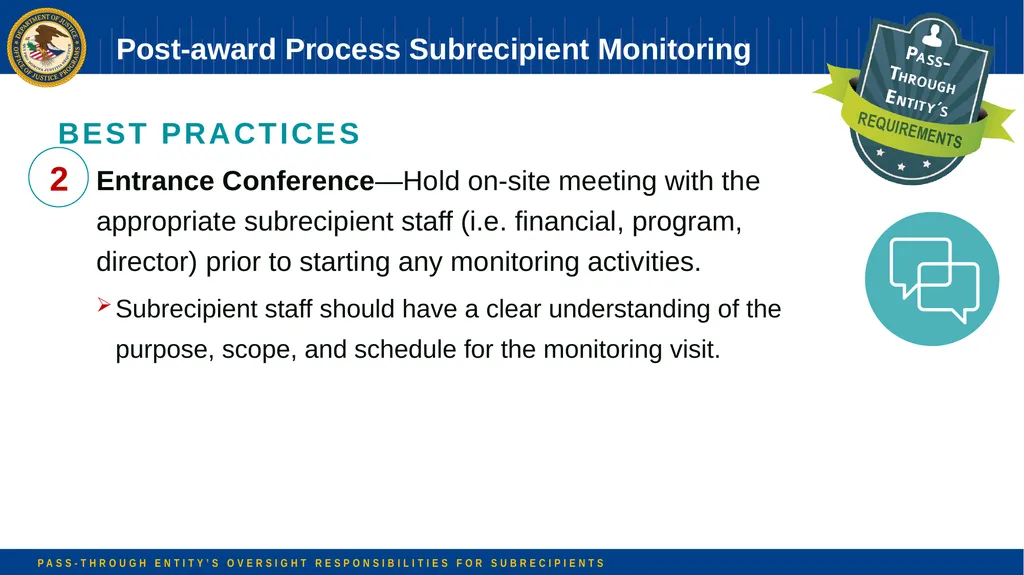
Entrance Conference—Hold on-site meeting with the appropriate subrecipient staff (i.e. financial, program, director) prior to starting any monitoring activities.
Subrecipient staff should have a clear understanding of the purpose, scope, and schedule for the monitoring visit.<br>
slide37. Post-award Process Subrecipient Monitoring BEST PRACTICES
Documentation, Data Gathering and Analysis— Track each step followed during the review process, document conversations with subrecipient staff, and inspect the progress of the actual project/program.<br>
slide38. Post-award Process Subrecipient Monitoring BEST PRACTICES
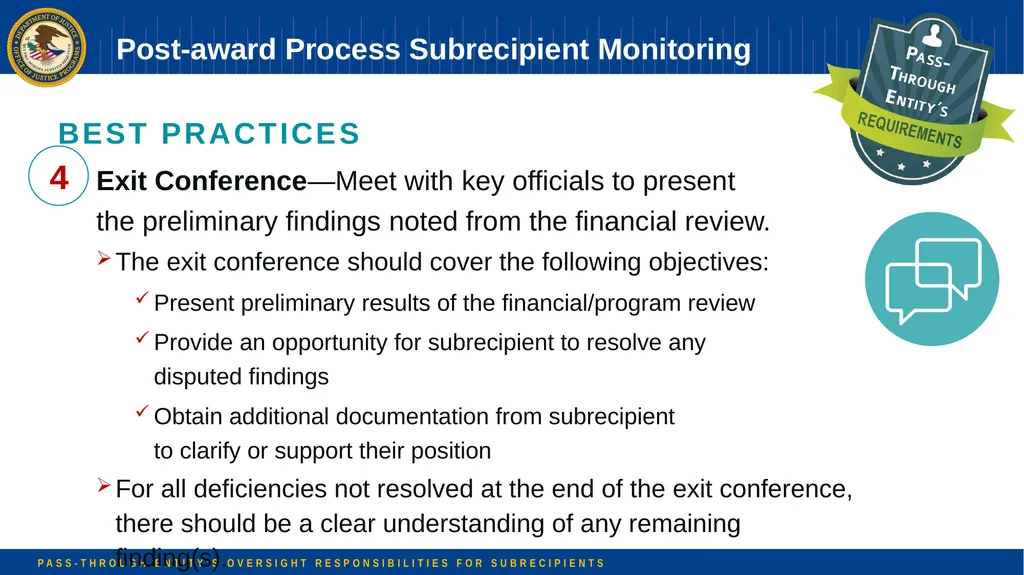
Exit Conference—Meet with key officials to present the preliminary findings noted from the financial review.
The exit conference should cover the following objectives:
Present preliminary results of the financial/program review
Provide an opportunity for subrecipient to resolve any disputed findings
Obtain additional documentation from subrecipient to clarify or support their position
For all deficiencies not resolved at the end of the exit conference, there should be a clear understanding of any remaining finding(s).<br>
slide39. Post-award Process Subrecipient Monitoring BEST PRACTICES
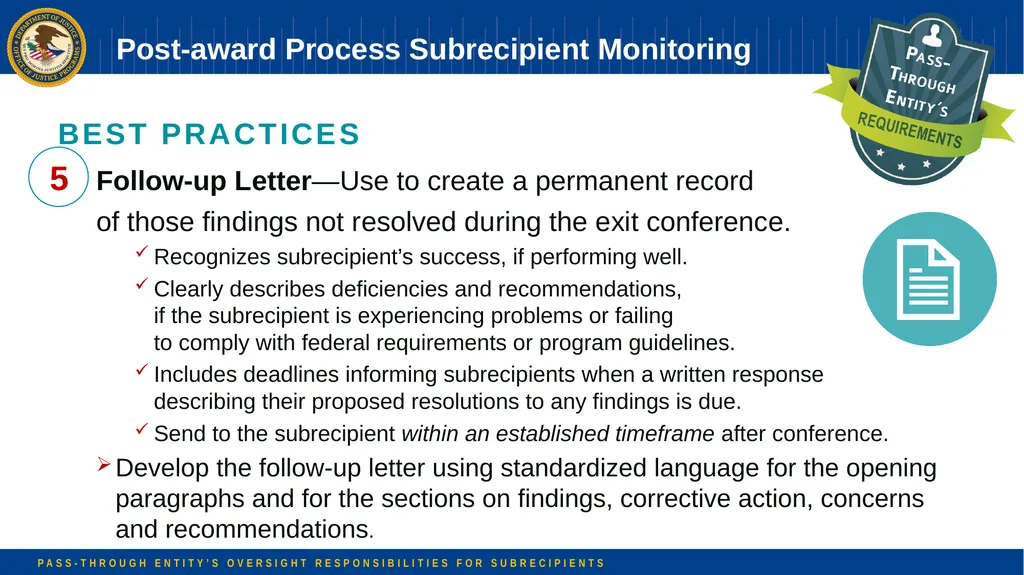
Follow-up Letter—Use to create a permanent record of those findings not resolved during the exit conference.
Recognizes subrecipient’s success, if performing well.
Clearly describes deficiencies and recommendations, if the subrecipient is experiencing problems or failing to comply with federal requirements or program guidelines.
Includes deadlines informing subrecipients when a written response describing their proposed resolutions to any findings is due.
Send to the subrecipient within an established timeframe after conference.
Develop the follow-up letter using standardized language for the opening paragraphs and for the sections on findings, corrective action, concerns and recommendations.<br>
slide40. Post-award Process Subrecipient Monitoring BEST PRACTICES
Corrective Action Plan—Subrecipient must submit a plan identifying deficiencies resolved and any remaining action needed.
If any findings were not corrected or partially corrected, the reason and timeframe for each resolution must be included.<br>
slide41. Post-award Process Subrecipient Monitoring BEST PRACTICES
Closure of Site Visit—If adequate documentation is received to resolve each finding, send a closure letter to close the site visit.<br>
slide42. Post-award Process Remedies for Subrecipient Noncompliance Pass-through Entity’s Requirements<br>
slide43. Post-award Remedies for Noncompliance If a subrecipient doesn’t comply with federal statutes, regulations or the terms and conditions of the subaward, the pass-through entity may impose additional conditions (2 CFR 200.339).<br>
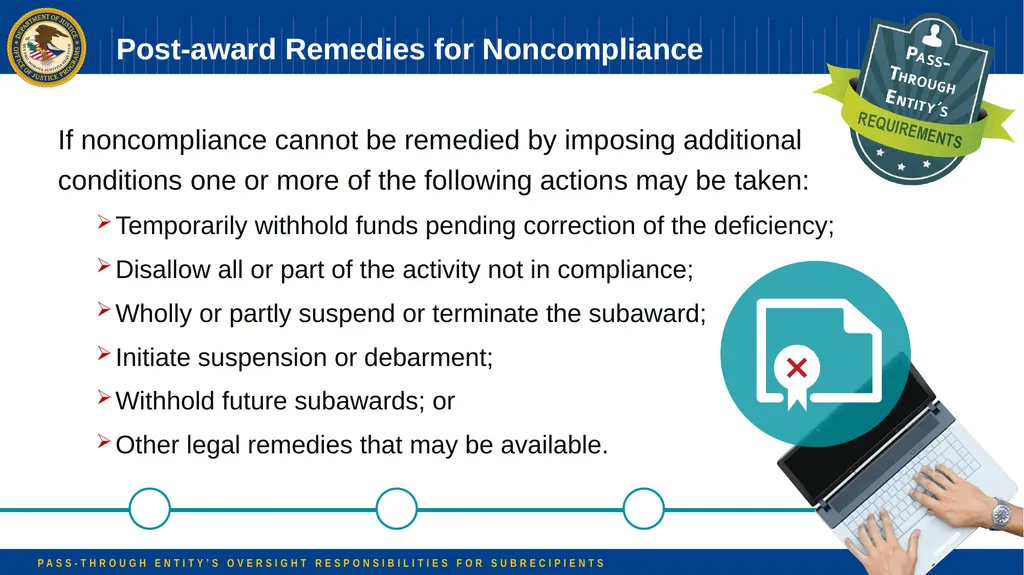
slide44. If noncompliance cannot be remedied by imposing additional conditions one or more of the following actions may be taken:
Temporarily withhold funds pending correction of the deficiency;
Disallow all or part of the activity not in compliance;
Wholly or partly suspend or terminate the subaward;
Initiate suspension or debarment;
Withhold future subawards; or
Other legal remedies that may be available. Post-award Remedies for Noncompliance<br>
slide45. Post-award Process Close-out Requirements Pass-through Entity’s Requirements<br>
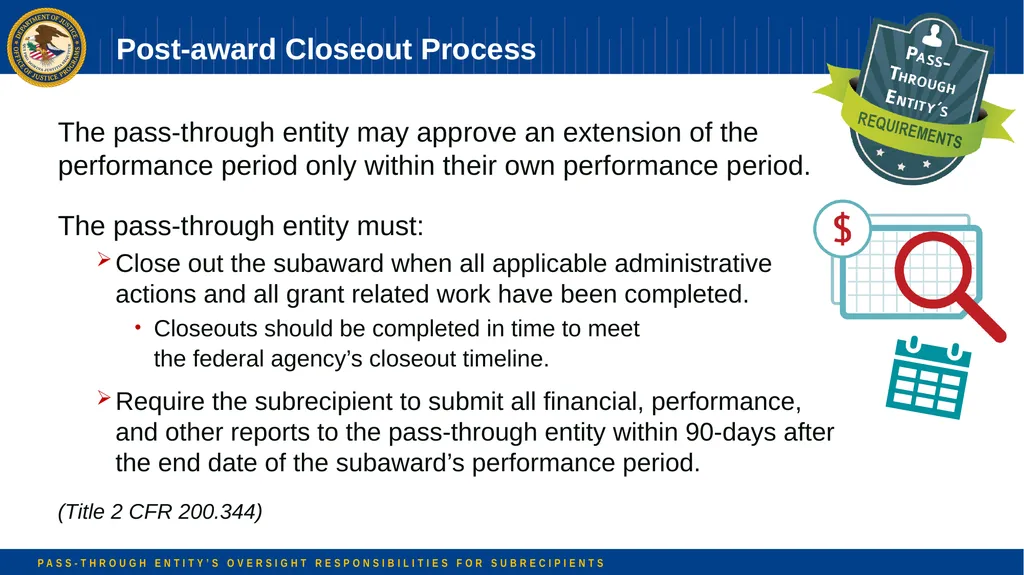
slide46. The pass-through entity may approve an extension of the performance period only within their own performance period.
The pass-through entity must:
Close out the subaward when all applicable administrative actions and all grant related work have been completed.
Closeouts should be completed in time to meet the federal agency’s closeout timeline.
Require the subrecipient to submit all financial, performance, and other reports to the pass-through entity within 90-days after the end date of the subaward’s performance period. Post-award Closeout Process (Title 2 CFR 200.344)<br>
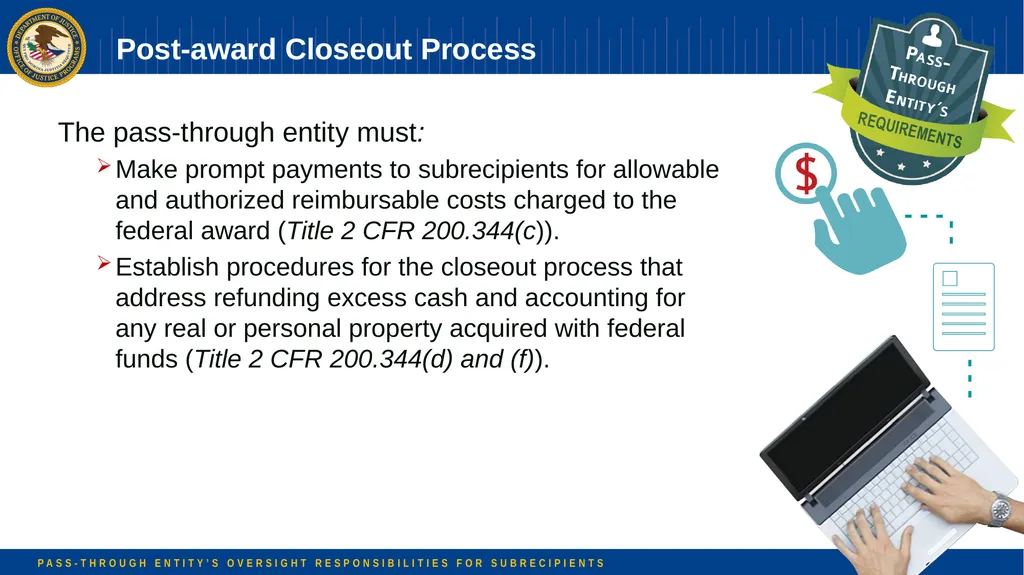
slide47. The pass-through entity must:
Make prompt payments to subrecipients for allowable and authorized reimbursable costs charged to the federal award (Title 2 CFR 200.344(c)).
Establish procedures for the closeout process that address refunding excess cash and accounting for any real or personal property acquired with federal funds (Title 2 CFR 200.344(d) and (f)). Post-award Closeout Process - - - - - - - -<br>
slide48. Recurring OIG Findings<br>
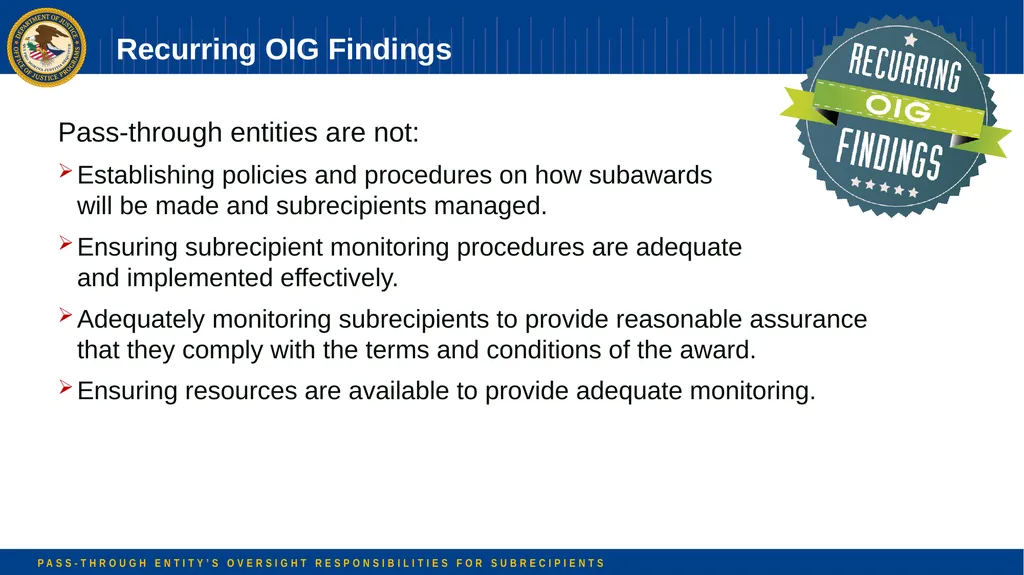
slide49. Recurring OIG Findings Pass-through entities are not:
Establishing policies and procedures on how subawards will be made and subrecipients managed.
Ensuring subrecipient monitoring procedures are adequate and implemented effectively.
Adequately monitoring subrecipients to provide reasonable assurance that they comply with the terms and conditions of the award.
Ensuring resources are available to provide adequate monitoring.<br>
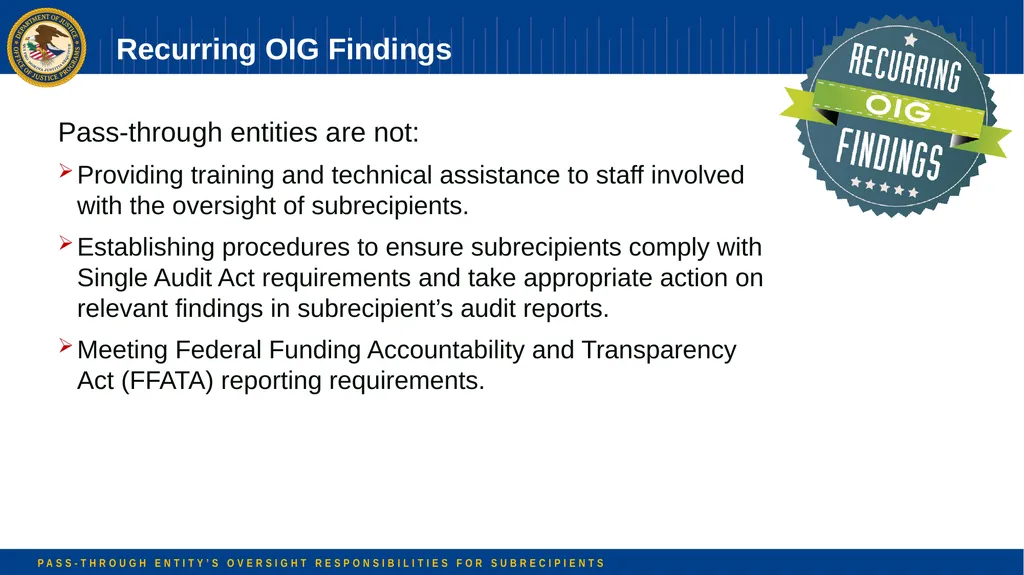
slide50. Recurring OIG Findings Pass-through entities are not:
Providing training and technical assistance to staff involved with the oversight of subrecipients.
Establishing procedures to ensure subrecipients comply with Single Audit Act requirements and take appropriate action on relevant findings in subrecipient’s audit reports.
Meeting Federal Funding Accountability and Transparency Act (FFATA) reporting requirements.<br>
slide51. REST ASSURED
THERE ARE
RESOURCES<br>
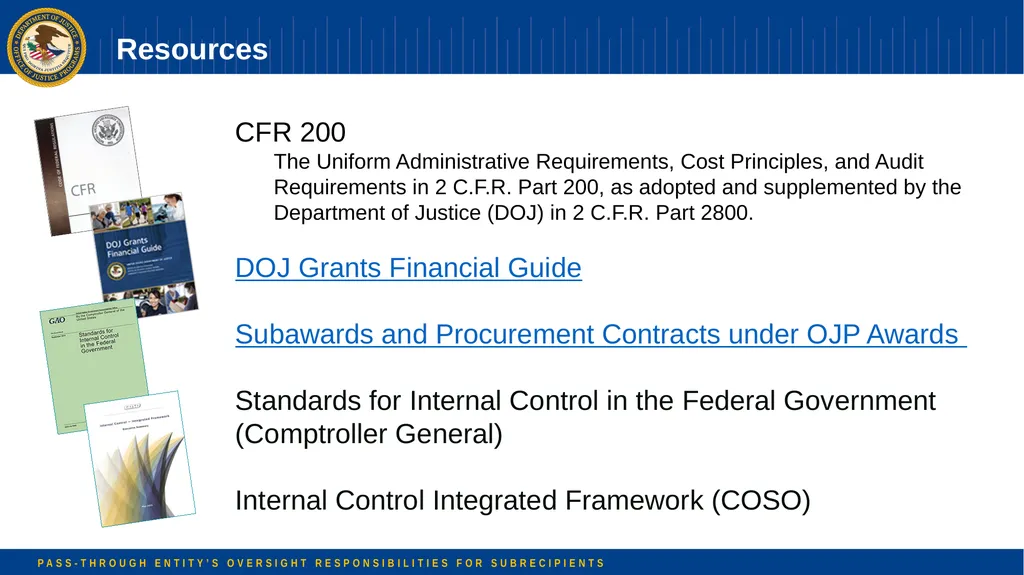
slide52. CFR 200
The Uniform Administrative Requirements, Cost Principles, and Audit Requirements in 2 C.F.R. Part 200, as adopted and supplemented by the Department of Justice (DOJ) in 2 C.F.R. Part 2800.
DOJ Grants Financial Guide
Subawards and Procurement Contracts under OJP Awards
Standards for Internal Control in the Federal Government (Comptroller General)
Internal Control Integrated Framework (COSO) Resources<br>
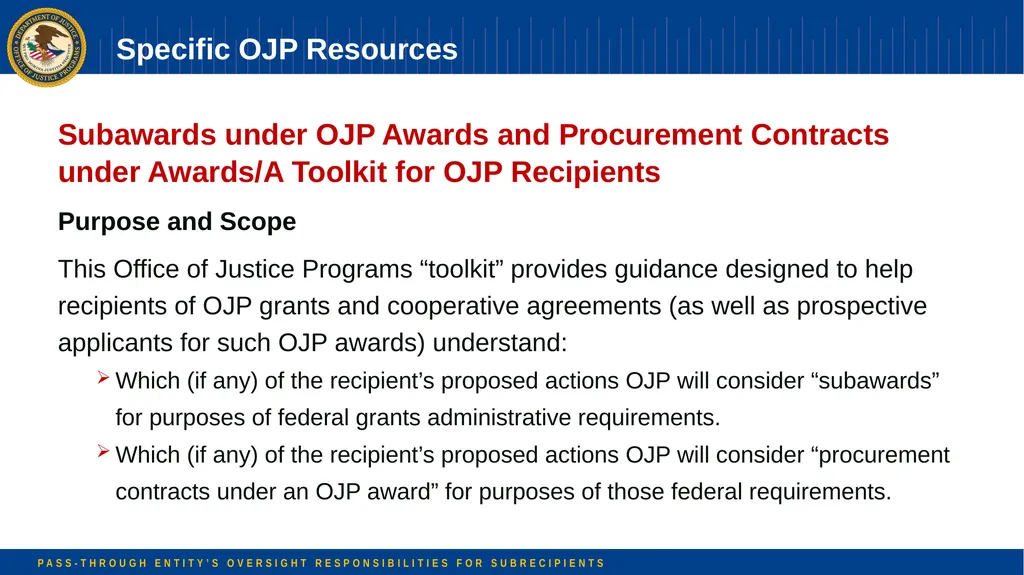
slide53. Specific OJP Resources Subawards under OJP Awards and Procurement Contracts under Awards/A Toolkit for OJP Recipients
Purpose and Scope
This Office of Justice Programs “toolkit” provides guidance designed to help recipients of OJP grants and cooperative agreements (as well as prospective applicants for such OJP awards) understand:
Which (if any) of the recipient’s proposed actions OJP will consider “subawards” for purposes of federal grants administrative requirements.
Which (if any) of the recipient’s proposed actions OJP will consider “procurement contracts under an OJP award” for purposes of those federal requirements.<br>
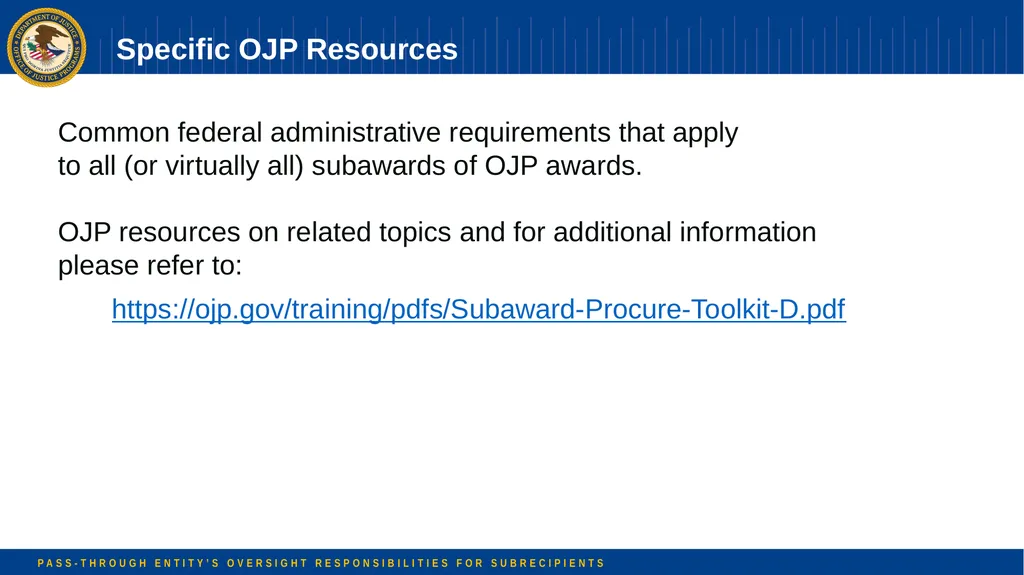
slide54. Specific OJP Resources Common federal administrative requirements that apply to all (or virtually all) subawards of OJP awards.
OJP resources on related topics and for additional information please refer to:
https://ojp.gov/training/pdfs/Subaward-Procure-Toolkit-D.pdf<br>
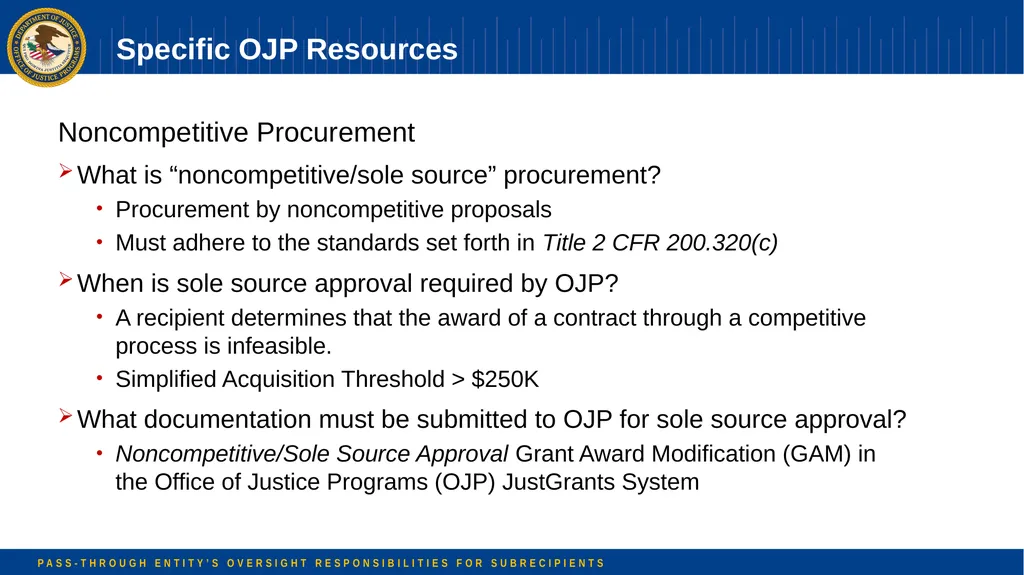
slide55. Specific OJP Resources Noncompetitive Procurement
What is “noncompetitive/sole source” procurement?
Procurement by noncompetitive proposals
Must adhere to the standards set forth in Title 2 CFR 200.320(c)
When is sole source approval required by OJP?
A recipient determines that the award of a contract through a competitive process is infeasible.
Simplified Acquisition Threshold > $250K
What documentation must be submitted to OJP for sole source approval?
Noncompetitive/Sole Source Approval Grant Award Modification (GAM) in the Office of Justice Programs (OJP) JustGrants System<br>
slide56. Specific OJP Resources What is sole source review checklist?
A tool to assess the merits of a sole source approval request
For additional information, please refer to the Sole Source Justification Fact Sheet:
https://ojp.gov/training/pdfs/Sole-Source-FactSheet-C.pdf<br>
slide57. Contact Information Michael Williams - OJP/OCFO
(202) 305-2584
Michael.Williams4@usdoj.gov or DOJFinancialTraining@usdoj.gov
OCFO Customer Service Center
Monday through Friday
8:30 a.m.–6:00 p.m. (EST)
1 (800) 458-0786 or (202) 305-9988
FAX (202) 353-9279
OCFO email Address: Ask.ocfo@usdoj.gov
For program specific questions, contact your program manager.<br>
slide58. ? ? ? ? ? ? No Question is a Dumb Question<br>
Office of Justice Programs<br>
slide2. Topics Slide Number Definitions . . . . . . . . . . . . . . . . . . . . . . . . . . . . . . . . 5
What is a Pass-through Entity? . . . . . . . . . . . . . . . . . . . . 6
What is a Subaward/Subrecipient? . . . . . . . . . . . . . . . . . 7-8
What is a Contract/Contractor? . . . . . . . . . . . . . . . . . . . 9-10
Determination . . . . . . . . . . . . . . . . . . . . . . . . . . . . . 11
Subrecipient vs. Contract Determination . . . . . . . . . . . . . 12-14
Characteristics of a Subrecipient vs. a Contractor . . . . . . . . . . 15
Responsibilities . . . . . . . . . . . . . . . . . . . . . . . . . . . . 16
Pass-through Entity’s Responsibilities . . . . . . . . . . . . . . 17-18
Caution! . . . . . . . . . . . . . . . . . . . . . . . . . . . . . . . . 19<br>
slide3. Topics Slide Number Requirements for Pass-through Entities
Pre-Award Process . . . . . . . . . . . . . . . . . . . . . . . . . 20
Policies and Procedures . . . . . . . . . . . . . . . . . . . . . 21
Risk Assessment . . . . . . . . . . . . . . . . . . . . . . . . . 24
Post-Award Process . . . . . . . . . . . . . . . . . . . . . . . . 25
Risk Assessment . . . . . . . . . . . . . . . . . . . . . . . . . 26
Subrecipient Monitoring . . . . . . . . . . . . . . . . . . . . 30
Remedies for Subrecipient Noncompliance . . . . . . . . . . . . . 42
Closeout Process . . . . . . . . . . . . . . . . . . . . . . . . 45<br>
slide4. Topics Slide Number Recurring OIG/DOJ Findings . . . . . . . . . . . . . . . . . . . . 48
Resources . . . . . . . . . . . . . . . . . . . . . . . . . . . . . . . 51
Contact Information . . . . . . . . . . . . . . . . . . . . . . . . . 57
OJP OCFO . . . . . . . . . . . . . . . . . . . . . . . . . . . . . . 57<br>
slide5. Definitions Pass-through Entity
Subaward / Subrecipient
Contract / Contractor<br>
slide6. Pass-through Entity What is a Pass-through Entity?
A non-federal entity that provides a subaward to a subrecipient to carry out part of a Federal program (Title 2 CFR 200.1).<br>
slide7. Subaward What is a Subaward?
An award provided by a pass-through entity to a subrecipient, for the subrecipient to carry out part of a federal award received by the pass-through entity (Title 2 CFR 200.1).
Note: Subaward does not include payments to a contractor or to an individual that is a beneficiary of the federal program.<br>
slide8. Subrecipient What is a Subrecipient?
A non-federal entity that receives a subaward from a pass-through entity to carry out part of a federal program (Title 2 CFR 200.1).<br>
slide9. Contract What is a Contract?
A legal instrument by which a non-federal entity purchases property or services needed to carry out the project or program under a federal award. The term as used in this part does not include a legal instrument, even if the non-federal entity considers it a contract, when the substance of the transaction meets the definition of a Federal award or subaward (Title 2 CFR 200.1).<br>
slide10. Contractor What is a Contractor?
An entity that receives a contract as defined in Contract on previous slide (Title 2 CFR 200.1).<br>
slide11. Subrecipient vs. Contractor Determination<br>
slide12. Subrecipient vs. Contractor Determination The determination on whether an entity receiving federal funds is a subrecipient or contractor is not always straightforward.
No one single factor alone will dictate one type of relationship over the other.
In fact, an entity may possess characteristics from both sides making the determination process much more challenging.<br>
slide13. Subrecipient vs. Contractor Determination The “form” (i.e. MOU, contract, etc.) is less important to the examination of a relationship than its “substance.”
“Substance” refers to the characteristics of the arrangement and whether it cast the party receiving the funds in the role of a subrecipient or a contractor.<br>
slide14. Subrecipient vs. Contractor Determination Labeling an organization as a subrecipient or contractor does not dictate how the DOJ will treat that relationship for federal grants administrative purposes. Title
2 CFR Part 200.331 OR<br>
slide15. Characteristics of a Subrecipient vs. Contractor For additional information, please refer to: Checklist to Determine Subrecipient or Contractor Classification<br>
slide16. Pass-through Entity’s Responsibilities<br>
slide17. Pass-through Entity’s Responsibilities Oversee the day-to-day operations of subrecipients to ensure they achieve performance objectives on schedule and within budget. - - - - - - - - - - - - - - - - - - - - - - - - - - - - - - - - - - - - - - (Title 2 CFR 200.332)<br>
slide18. Pass-through Entity’s Responsibilities Take the appropriate actions to get the subrecipient back on track, if problems arise. - - - - - - - - - - - - - - - - - - - - - - - - - - - - - - - - - - (Title 2 CFR 200.332)<br>
slide19. Pass-through Entity’s Responsibilities The use of subrecipients does not relieve the pass-through entity of its responsibilities.<br>
slide20. Pre-award Process Pass-through Entity’s Requirements<br>
slide21. Pre-award Process Policies and procedures must be in writing and clearly describe the pass-through entity’s responsibility for managing subrecipient’s activities throughout the award lifecycle. A pass-through entity must have established policies and procedures on how subawards will be made and subrecipients managed.<br>
slide22. Pre-award Process A pass-through entity must:
Decide upon the appropriate instrument for the services needed (i.e., subaward, contract, etc.) (Title 2 CFR 200.201)
Have a method for announcing the specific funding opportunities, eligibility requirements and the allotted timeframe to apply.
Have a process for reviewing each subrecipient’s eligibility for federal funding.
Include the criteria to be used to evaluate each application.<br>
slide23. Pre-award Process A pass-through entity must:
Ensure that subrecipients are not suspended or debarred by the federal government prior to making the award.
Clearly identify the federal award information, compliance requirements, applicable terms and conditions, and any supplemental requirements imposed by the pass-through entity.
Include specific award identification data elements such as subrecipient name and entity identifier, federal award identification number, and federal award date. (Title 2 CFR 200.332(a))<br>
slide24. Pre-award Risk Assessment A pass-through entity should:
Perform a risk-assessment of applicants prior to awarding funds – highly recommended.
Evaluate the risk posed by applicants before they receive an award. Consider such elements as:
Applicant’s eligibility or the quality of its application;
Financial stability and quality of management system;
History of performance; and
Audit findings.
The results of the risk assessment can assist the pass-through entity in determining whether additional terms and conditions should be imposed on the award.<br>
slide25. Post-award Process Risk Assessment Pass-through Entity’s Requirements<br>
slide26. Post-award Process Risk Assessment The pass-through entity must perform a risk assessment of each subrecipient for noncompliance with federal statutes, regulations, and the terms and conditions of the subaward.
To determine the appropriate level of monitoring needed.
Program requirements should be taken into consideration when determining the attributes to use in evaluating the overall risk.
There are a number of different attributes to consider when assessing risk. The final score should clearly identify the risk level (e.g., high, medium, or low).<br>
slide27. Post-award Process Risk Assessment Pass-through entity should develop a methodology to determine risk levels and the reason for assigning each subrecipient into risk categories.
The overall level of risk identified should support the frequency and depth of the monitoring practices to include ways to mitigate risk.<br>
slide28. Post-award Process Risk Assessment Some additional items a pass-through entity should also consider when performing a risk assessment include, but are not limited to:<br>
slide29. Post-award Process Risk Assessment The assessment of these attributes should provide the basis for developing a monitoring plan and a strategy for monitoring subrecipients.
While this process is not all inclusive, it should give pass-through entities a starting point for assessing risk and developing a monitoring plan. (Title 2 CFR 200.332)<br>
slide30. Post-award Process Subrecipient Monitoring Pass-through Entity’s Requirements<br>
slide31. Post-award Process Subrecipient Monitoring The pass-through entity’s annual monitoring plan should include:
All subrecipients that will be monitored
Subrecipients from each risk level should be monitored (i.e., high, medium, and low)
Type of monitoring
On-site or in-house review
Effective implementation of the monitoring plan may also result in the identification of potential areas for training and technical assistance.<br>
slide32. Post-award Process Subrecipient Monitoring Pass-through entities should develop monitoring objectives to ensure subrecipients:
Carry out program activities as stipulated in the subaward;
Have adequate internal controls to protect federal funds;
Claim reimbursement for costs that are allowable, reasonable, allocable, and necessary under program guidelines;
Identify any conflicts of interest that exist; and
Maintain required supporting documentation/records.<br>
slide33. Post-award Process Subrecipient Monitoring In preparation for an on-site visit, the pass-through entity should review all documentation, such as:
Subrecipient’s application for funding;
Written agreement with the subrecipient;
Financial and progress reports;
Drawdown history (payments made to the subrecipient); and
Copies of recent audit reports.
The result of this review may inform the pass-through entity about the subrecipient’s operations and identify potential problem areas to examine during the on-site visit. (Title 2 CFR 200.332)<br>
slide34. Post-award Process Subrecipient Monitoring BEST PRACTICES
Notification
Entrance conference
Supporting documentation, data gathering and analysis
Exit conference
Follow-up
Corrective action plan (if applicable)
Closure of site visit<br>
slide35. Post-award Process Subrecipient Monitoring BEST PRACTICES
Notification—Send a formal notification letter at least several weeks before the visit (if possible) to:
Confirm dates and scope of review
Provide details of documentation needed for the review
Specify expected timeframe for the review
Ensure key officials are available during the review<br>
slide36. Post-award Process Subrecipient Monitoring BEST PRACTICES
Entrance Conference—Hold on-site meeting with the appropriate subrecipient staff (i.e. financial, program, director) prior to starting any monitoring activities.
Subrecipient staff should have a clear understanding of the purpose, scope, and schedule for the monitoring visit.<br>
slide37. Post-award Process Subrecipient Monitoring BEST PRACTICES
Documentation, Data Gathering and Analysis— Track each step followed during the review process, document conversations with subrecipient staff, and inspect the progress of the actual project/program.<br>
slide38. Post-award Process Subrecipient Monitoring BEST PRACTICES
Exit Conference—Meet with key officials to present the preliminary findings noted from the financial review.
The exit conference should cover the following objectives:
Present preliminary results of the financial/program review
Provide an opportunity for subrecipient to resolve any disputed findings
Obtain additional documentation from subrecipient to clarify or support their position
For all deficiencies not resolved at the end of the exit conference, there should be a clear understanding of any remaining finding(s).<br>
slide39. Post-award Process Subrecipient Monitoring BEST PRACTICES
Follow-up Letter—Use to create a permanent record of those findings not resolved during the exit conference.
Recognizes subrecipient’s success, if performing well.
Clearly describes deficiencies and recommendations, if the subrecipient is experiencing problems or failing to comply with federal requirements or program guidelines.
Includes deadlines informing subrecipients when a written response describing their proposed resolutions to any findings is due.
Send to the subrecipient within an established timeframe after conference.
Develop the follow-up letter using standardized language for the opening paragraphs and for the sections on findings, corrective action, concerns and recommendations.<br>
slide40. Post-award Process Subrecipient Monitoring BEST PRACTICES
Corrective Action Plan—Subrecipient must submit a plan identifying deficiencies resolved and any remaining action needed.
If any findings were not corrected or partially corrected, the reason and timeframe for each resolution must be included.<br>
slide41. Post-award Process Subrecipient Monitoring BEST PRACTICES
Closure of Site Visit—If adequate documentation is received to resolve each finding, send a closure letter to close the site visit.<br>
slide42. Post-award Process Remedies for Subrecipient Noncompliance Pass-through Entity’s Requirements<br>
slide43. Post-award Remedies for Noncompliance If a subrecipient doesn’t comply with federal statutes, regulations or the terms and conditions of the subaward, the pass-through entity may impose additional conditions (2 CFR 200.339).<br>
slide44. If noncompliance cannot be remedied by imposing additional conditions one or more of the following actions may be taken:
Temporarily withhold funds pending correction of the deficiency;
Disallow all or part of the activity not in compliance;
Wholly or partly suspend or terminate the subaward;
Initiate suspension or debarment;
Withhold future subawards; or
Other legal remedies that may be available. Post-award Remedies for Noncompliance<br>
slide45. Post-award Process Close-out Requirements Pass-through Entity’s Requirements<br>
slide46. The pass-through entity may approve an extension of the performance period only within their own performance period.
The pass-through entity must:
Close out the subaward when all applicable administrative actions and all grant related work have been completed.
Closeouts should be completed in time to meet the federal agency’s closeout timeline.
Require the subrecipient to submit all financial, performance, and other reports to the pass-through entity within 90-days after the end date of the subaward’s performance period. Post-award Closeout Process (Title 2 CFR 200.344)<br>
slide47. The pass-through entity must:
Make prompt payments to subrecipients for allowable and authorized reimbursable costs charged to the federal award (Title 2 CFR 200.344(c)).
Establish procedures for the closeout process that address refunding excess cash and accounting for any real or personal property acquired with federal funds (Title 2 CFR 200.344(d) and (f)). Post-award Closeout Process - - - - - - - -<br>
slide48. Recurring OIG Findings<br>
slide49. Recurring OIG Findings Pass-through entities are not:
Establishing policies and procedures on how subawards will be made and subrecipients managed.
Ensuring subrecipient monitoring procedures are adequate and implemented effectively.
Adequately monitoring subrecipients to provide reasonable assurance that they comply with the terms and conditions of the award.
Ensuring resources are available to provide adequate monitoring.<br>
slide50. Recurring OIG Findings Pass-through entities are not:
Providing training and technical assistance to staff involved with the oversight of subrecipients.
Establishing procedures to ensure subrecipients comply with Single Audit Act requirements and take appropriate action on relevant findings in subrecipient’s audit reports.
Meeting Federal Funding Accountability and Transparency Act (FFATA) reporting requirements.<br>
slide51. REST ASSURED
THERE ARE
RESOURCES<br>
slide52. CFR 200
The Uniform Administrative Requirements, Cost Principles, and Audit Requirements in 2 C.F.R. Part 200, as adopted and supplemented by the Department of Justice (DOJ) in 2 C.F.R. Part 2800.
DOJ Grants Financial Guide
Subawards and Procurement Contracts under OJP Awards
Standards for Internal Control in the Federal Government (Comptroller General)
Internal Control Integrated Framework (COSO) Resources<br>
slide53. Specific OJP Resources Subawards under OJP Awards and Procurement Contracts under Awards/A Toolkit for OJP Recipients
Purpose and Scope
This Office of Justice Programs “toolkit” provides guidance designed to help recipients of OJP grants and cooperative agreements (as well as prospective applicants for such OJP awards) understand:
Which (if any) of the recipient’s proposed actions OJP will consider “subawards” for purposes of federal grants administrative requirements.
Which (if any) of the recipient’s proposed actions OJP will consider “procurement contracts under an OJP award” for purposes of those federal requirements.<br>
slide54. Specific OJP Resources Common federal administrative requirements that apply to all (or virtually all) subawards of OJP awards.
OJP resources on related topics and for additional information please refer to:
https://ojp.gov/training/pdfs/Subaward-Procure-Toolkit-D.pdf<br>
slide55. Specific OJP Resources Noncompetitive Procurement
What is “noncompetitive/sole source” procurement?
Procurement by noncompetitive proposals
Must adhere to the standards set forth in Title 2 CFR 200.320(c)
When is sole source approval required by OJP?
A recipient determines that the award of a contract through a competitive process is infeasible.
Simplified Acquisition Threshold > $250K
What documentation must be submitted to OJP for sole source approval?
Noncompetitive/Sole Source Approval Grant Award Modification (GAM) in the Office of Justice Programs (OJP) JustGrants System<br>
slide56. Specific OJP Resources What is sole source review checklist?
A tool to assess the merits of a sole source approval request
For additional information, please refer to the Sole Source Justification Fact Sheet:
https://ojp.gov/training/pdfs/Sole-Source-FactSheet-C.pdf<br>
slide57. Contact Information Michael Williams - OJP/OCFO
(202) 305-2584
Michael.Williams4@usdoj.gov or DOJFinancialTraining@usdoj.gov
OCFO Customer Service Center
Monday through Friday
8:30 a.m.–6:00 p.m. (EST)
1 (800) 458-0786 or (202) 305-9988
FAX (202) 353-9279
OCFO email Address: Ask.ocfo@usdoj.gov
For program specific questions, contact your program manager.<br>
slide58. ? ? ? ? ? ? No Question is a Dumb Question<br>