PathSim: Meta Path-Based Top-K Similarity Search in Heterogeneous Information Networks Yizhou Sun Jiawei Han Xifeng Yan Philip S. Yu Tianyi Wu University of Illinois at Urbana-Champaign, Urbana, IL University of California at Santa
"PathSim: Meta Path-Based Top-K Similarity Search" is the property of its rightful owner. Permission is granted to
download and print the materials on this website for personal, non-commercial use only, and to display it
on your personal computer provided you do not modify the materials and that you retain all copyright
notices contained in the materials. By downloading content from our website, you accept the terms of this
agreement.
Presentation Transcript
01
PathSim: Meta Path-Based Top-K Similarity Search in Heterogeneous Information Networks Yizhou Sun† Jiawei Han† Xifeng Yan‡ Philip S. Yu§ Tianyi Wu⋄
† University of Illinois at Urbana-Champaign, Urbana, IL
‡ University of California at Santa Barbara, Santa Barbara, CA
§ University of Illinois at Chicago, Chicago, IL
⋄ Microsoft Corporation, Redmond, WA 8/28/2011 1<br>
02
Content Background and Motivation
Meta Path-based Similarity Framework
PathSim: A Novel Meta Path-Based Similarity Measure
Online Query Processing for Top-K Similarity Search
Experiments
Conclusions 8/28/2011 2<br>
03
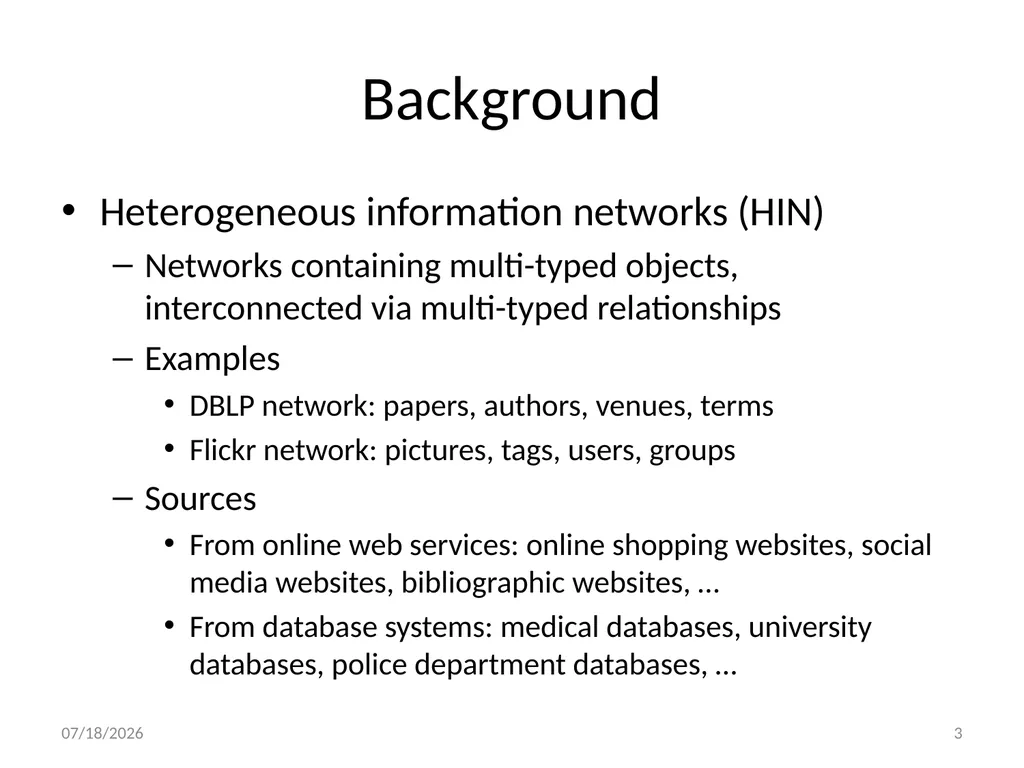
Background Heterogeneous information networks (HIN)
Networks containing multi-typed objects, interconnected via multi-typed relationships
Examples
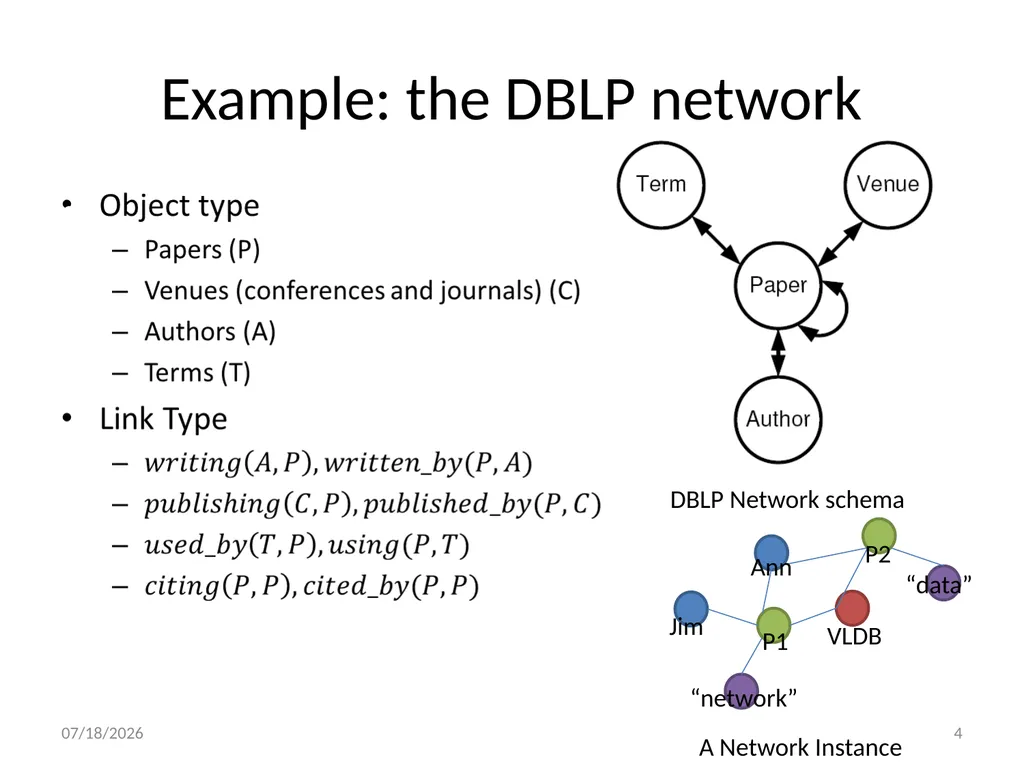
DBLP network: papers, authors, venues, terms
Flickr network: pictures, tags, users, groups
Sources
From online web services: online shopping websites, social media websites, bibliographic websites, …
From database systems: medical databases, university databases, police department databases, … 8/30/2011 3<br>
04
Example: the DBLP network 8/31/2011 4 DBLP Network schema A Network Instance VLDB P1 P2 Ann Jim “network” “data”<br>
05
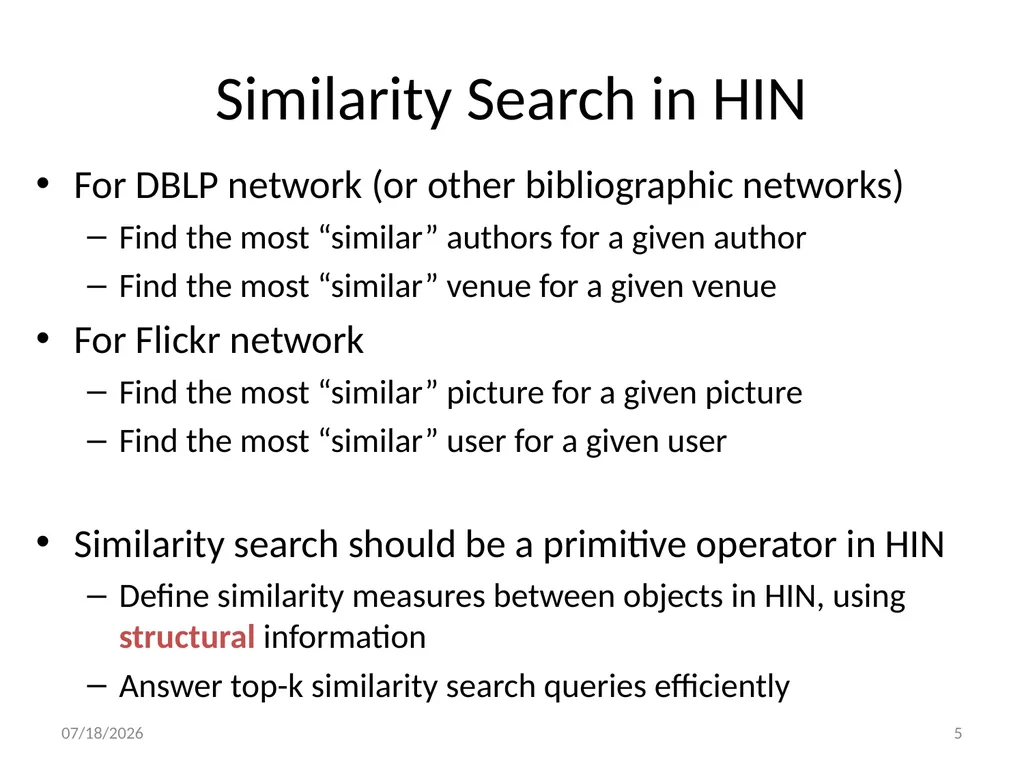
Similarity Search in HIN For DBLP network (or other bibliographic networks)
Find the most “similar” authors for a given author
Find the most “similar” venue for a given venue
For Flickr network
Find the most “similar” picture for a given picture
Find the most “similar” user for a given user
Similarity search should be a primitive operator in HIN
Define similarity measures between objects in HIN, using structural information
Answer top-k similarity search queries efficiently 8/31/2011 5<br>
06
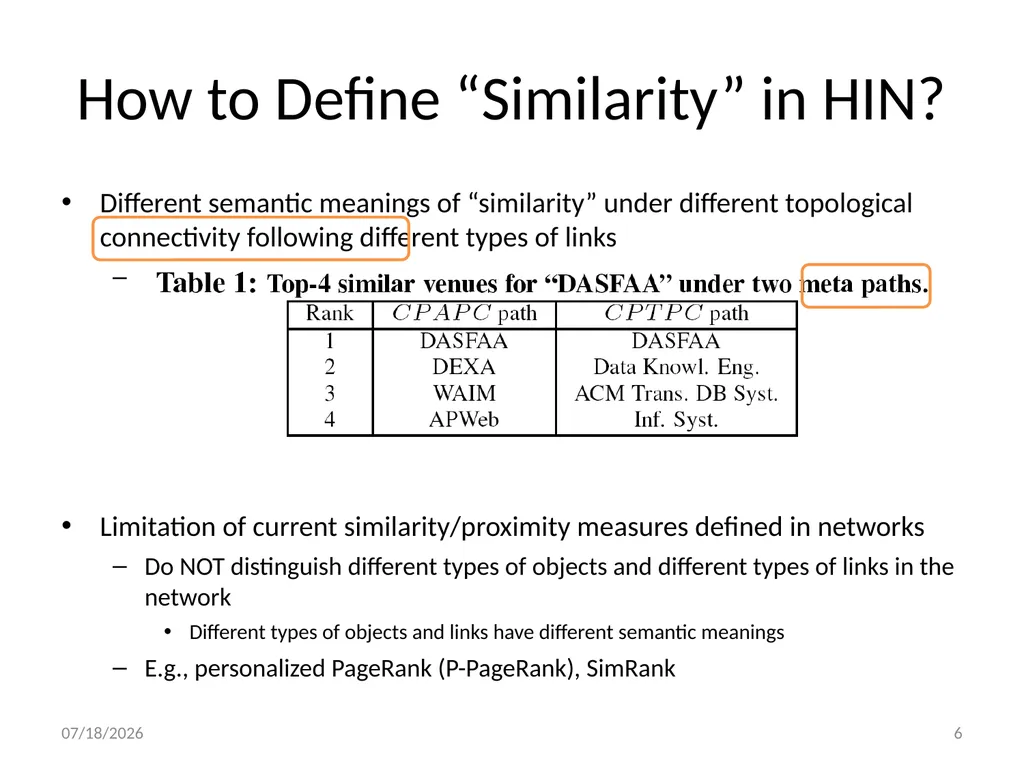
How to Define “Similarity” in HIN? Different semantic meanings of “similarity” under different topological connectivity following different types of links
Limitation of current similarity/proximity measures defined in networks
Do NOT distinguish different types of objects and different types of links in the network
Different types of objects and links have different semantic meanings
E.g., personalized PageRank (P-PageRank), SimRank 8/31/2011 6<br>
07
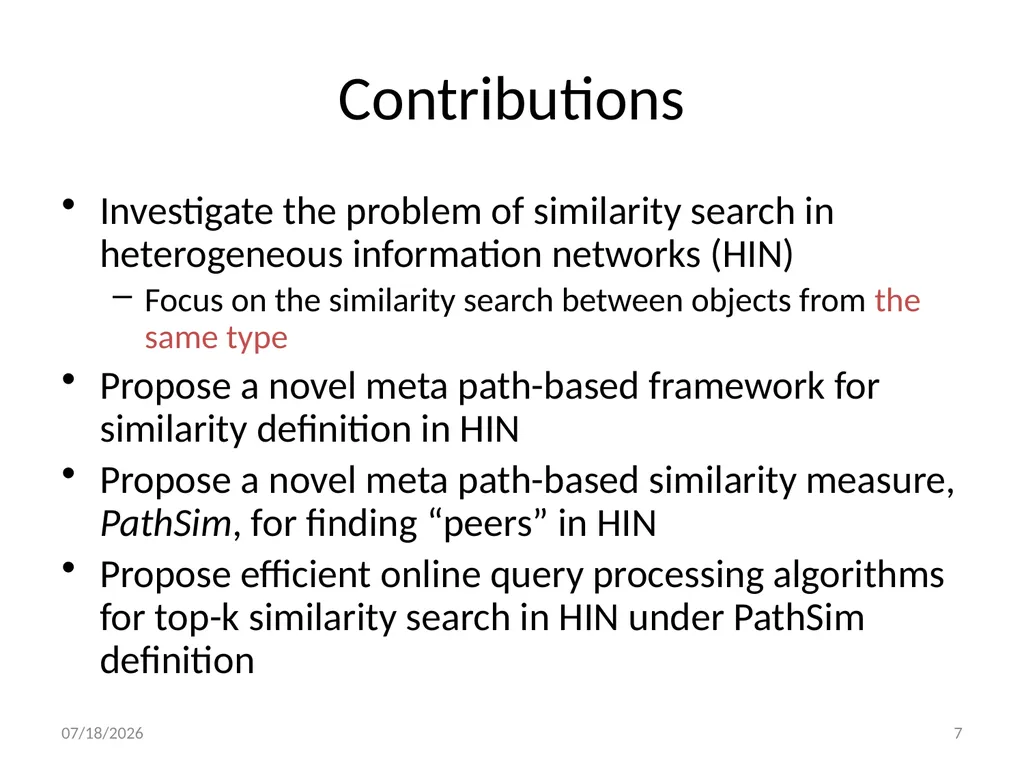
Contributions Investigate the problem of similarity search in heterogeneous information networks (HIN)
Focus on the similarity search between objects from the same type
Propose a novel meta path-based framework for similarity definition in HIN
Propose a novel meta path-based similarity measure, PathSim, for finding “peers” in HIN
Propose efficient online query processing algorithms for top-k similarity search in HIN under PathSim definition 8/28/2011 7<br>
08
Content Background and Motivation
Meta Path-based Similarity Framework
PathSim: A Novel Meta Path-Based Similarity Measure
Online Query Processing for Top-K Similarity Search
Experiments
Conclusions 8/30/2011 8<br>
09
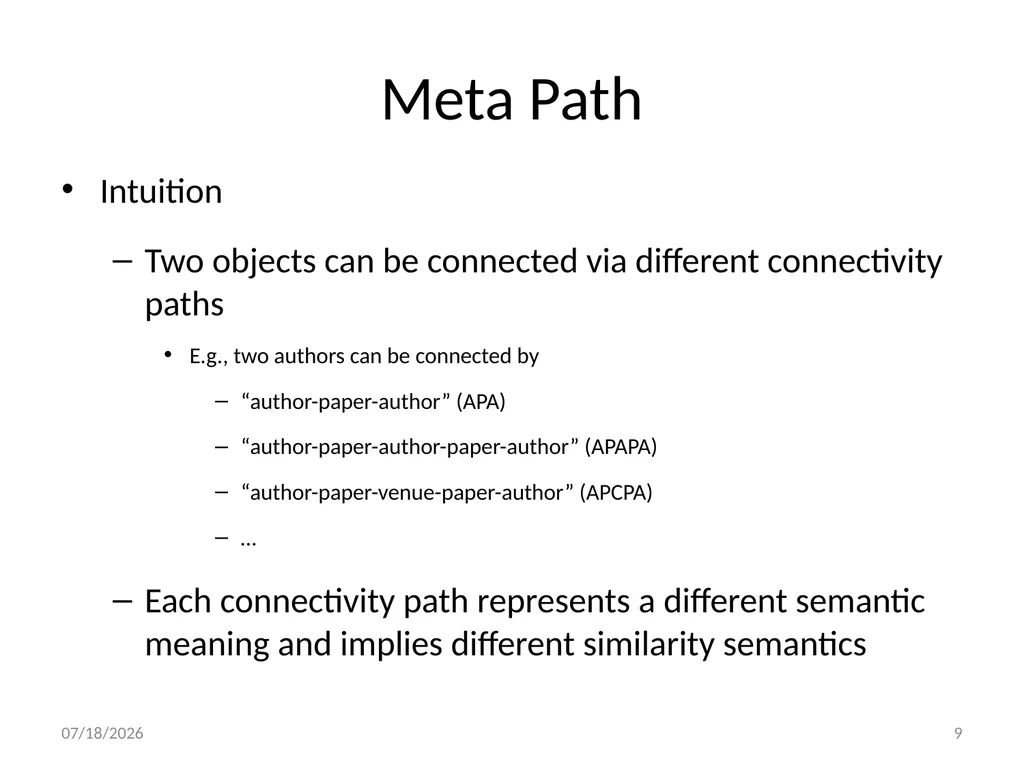
Meta Path Intuition
Two objects can be connected via different connectivity paths
E.g., two authors can be connected by
“author-paper-author” (APA)
“author-paper-author-paper-author” (APAPA)
“author-paper-venue-paper-author” (APCPA)
…
Each connectivity path represents a different semantic meaning and implies different similarity semantics 8/28/2011 9<br>
10
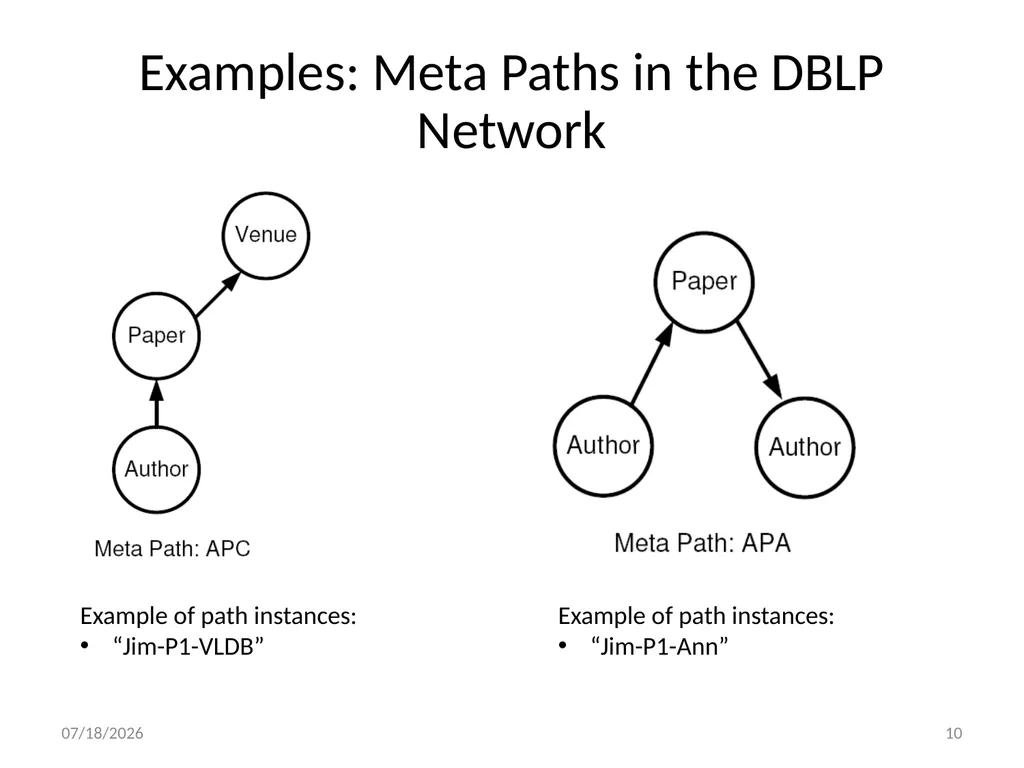
Examples: Meta Paths in the DBLP Network 8/29/2011 10 Example of path instances:
“Jim-P1-VLDB” Example of path instances:
“Jim-P1-Ann”<br>
11
Different Views of Meta Paths 8/31/2011 11<br>
12
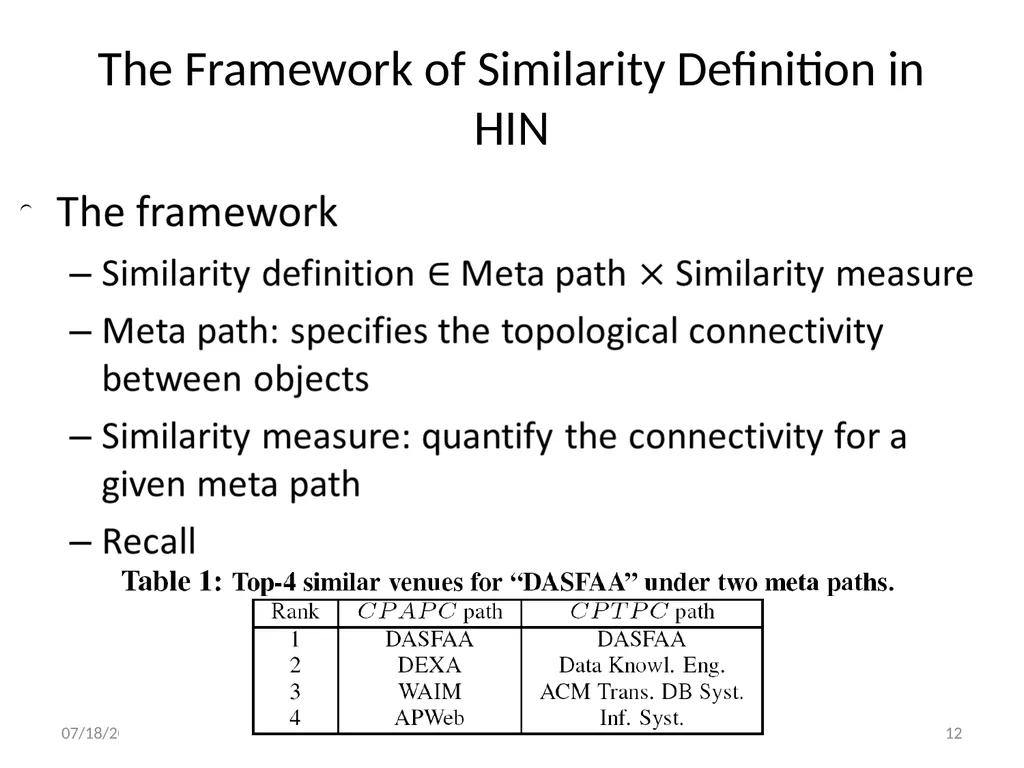
The Framework of Similarity Definition in HIN 8/28/2011 12<br>
13
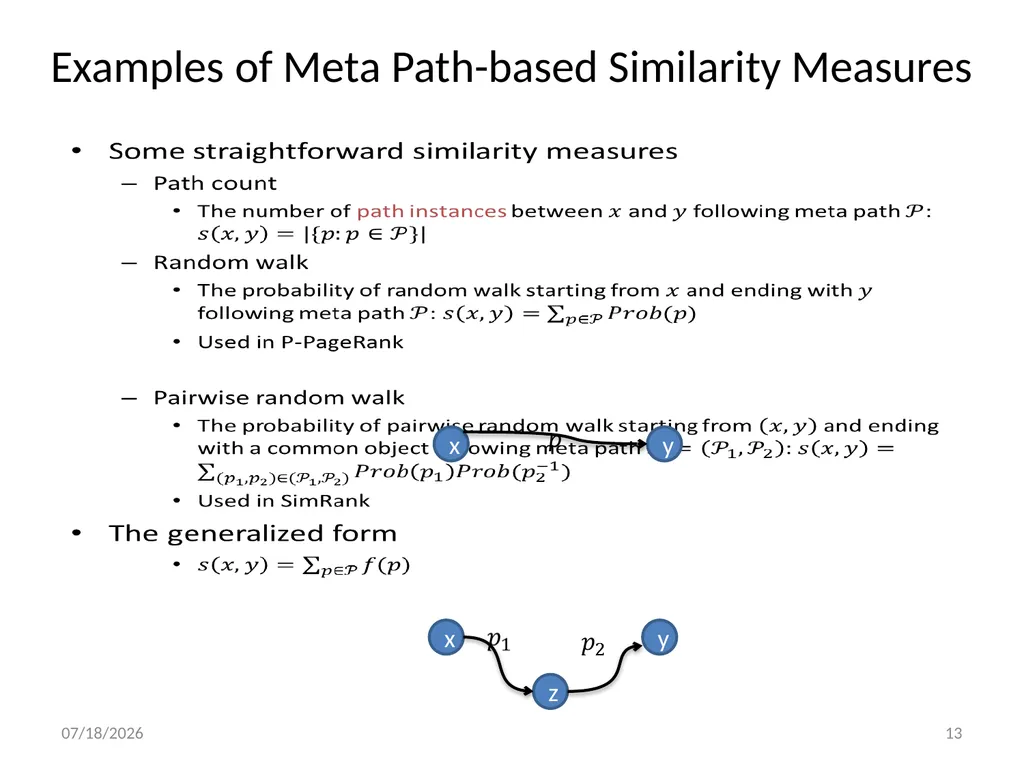
Examples of Meta Path-based Similarity Measures 8/29/2011 13<br>
14
Content Background and Motivation
Meta Path-based Similarity Framework
PathSim: A Novel Meta Path-Based Similarity Measure
Online Query Processing for Top-K Similarity Search
Experiments
Conclusions 8/30/2011 14<br>
15
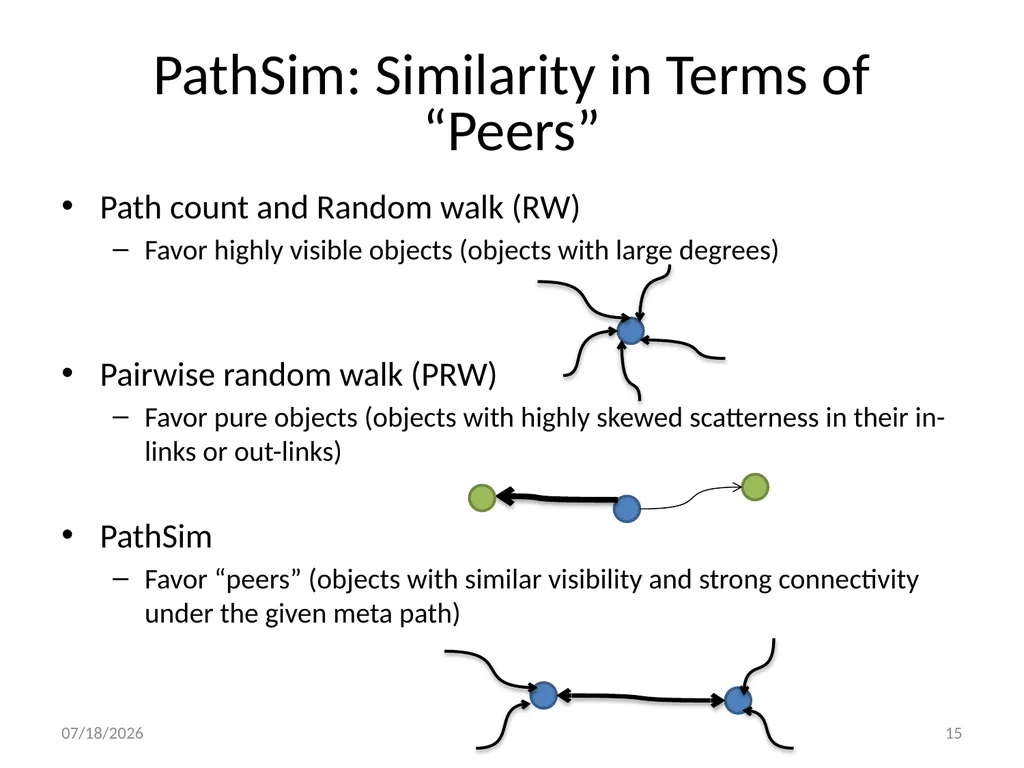
PathSim: Similarity in Terms of “Peers” Path count and Random walk (RW)
Favor highly visible objects (objects with large degrees)
Pairwise random walk (PRW)
Favor pure objects (objects with highly skewed scatterness in their in-links or out-links)
PathSim
Favor “peers” (objects with similar visibility and strong connectivity under the given meta path) 8/29/2011 15<br>
16
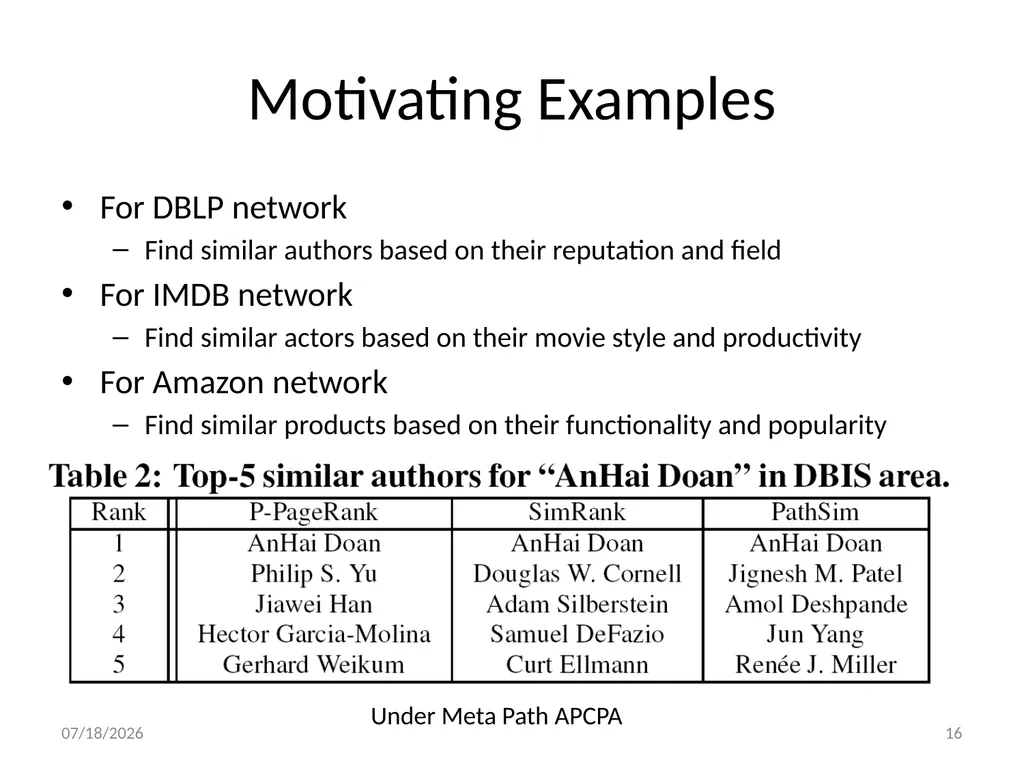
Motivating Examples For DBLP network
Find similar authors based on their reputation and field
For IMDB network
Find similar actors based on their movie style and productivity
For Amazon network
Find similar products based on their functionality and popularity 8/29/2011 16 Under Meta Path APCPA<br>
17
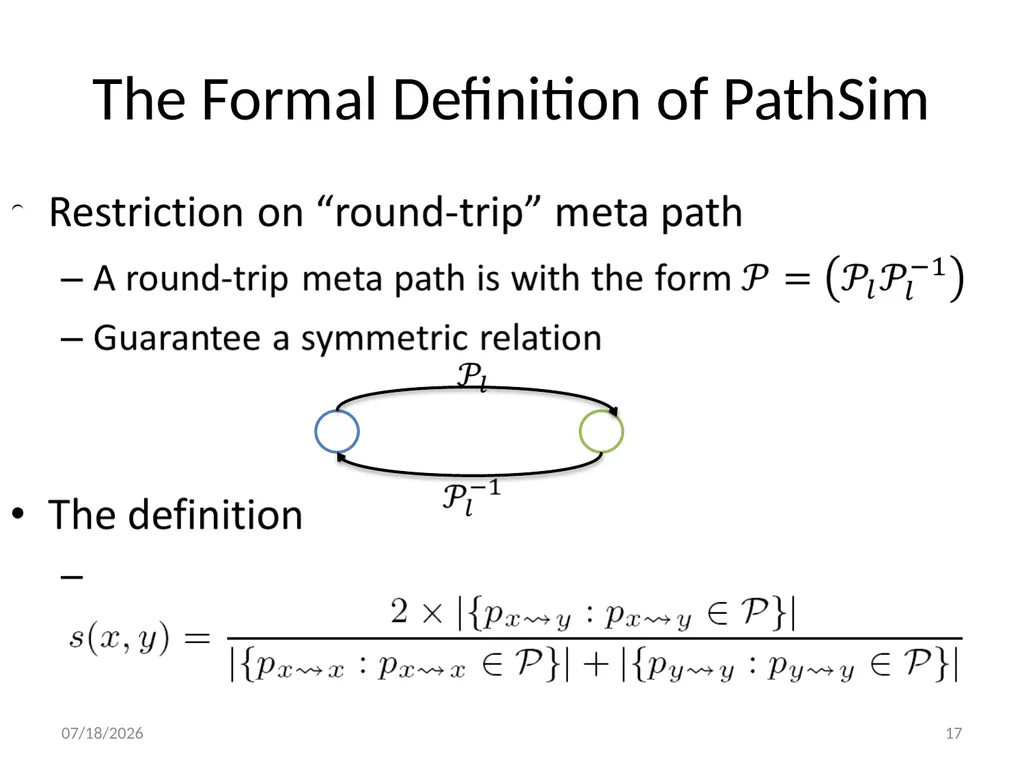
The Formal Definition of PathSim 8/29/2011 17<br>
18
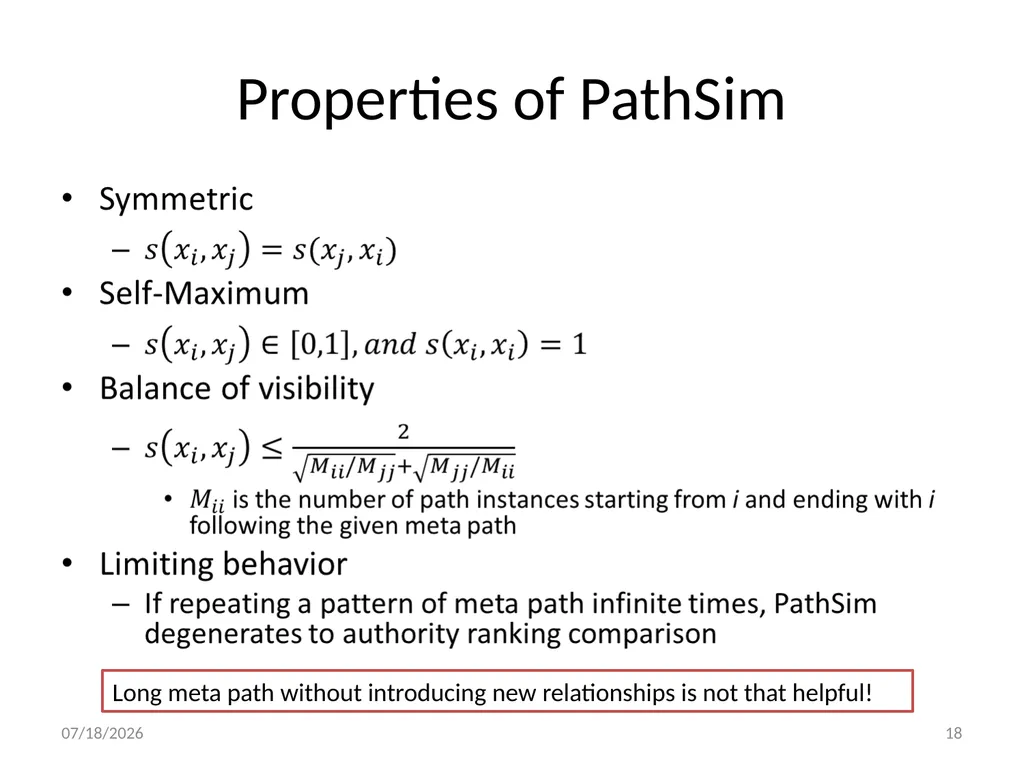
Properties of PathSim 8/30/2011 18 Long meta path without introducing new relationships is not that helpful!<br>
19
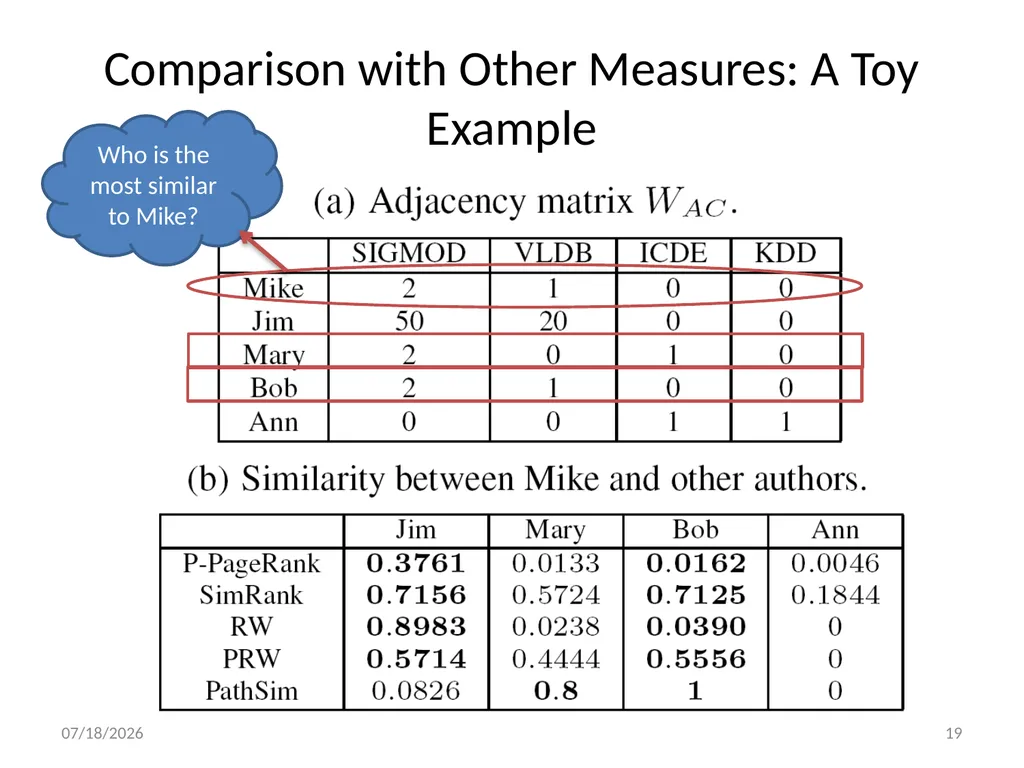
Comparison with Other Measures: A Toy Example 8/31/2011 19 Who is the most similar to Mike?<br>
20
Content Background and Motivation
Meta Path-based Similarity Framework
PathSim: A Novel Meta Path-Based Similarity Measure
Online Query Processing for Top-K Similarity Search
Experiments
Conclusions 8/30/2011 20<br>
21
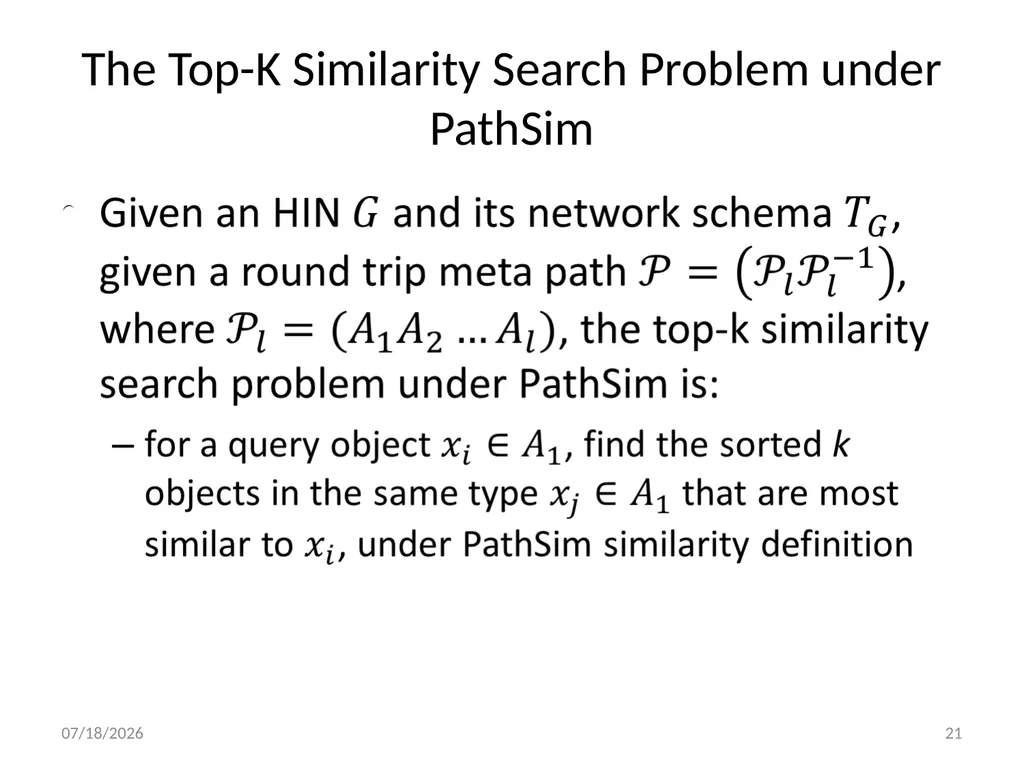
The Top-K Similarity Search Problem under PathSim 8/30/2011 21<br>
22
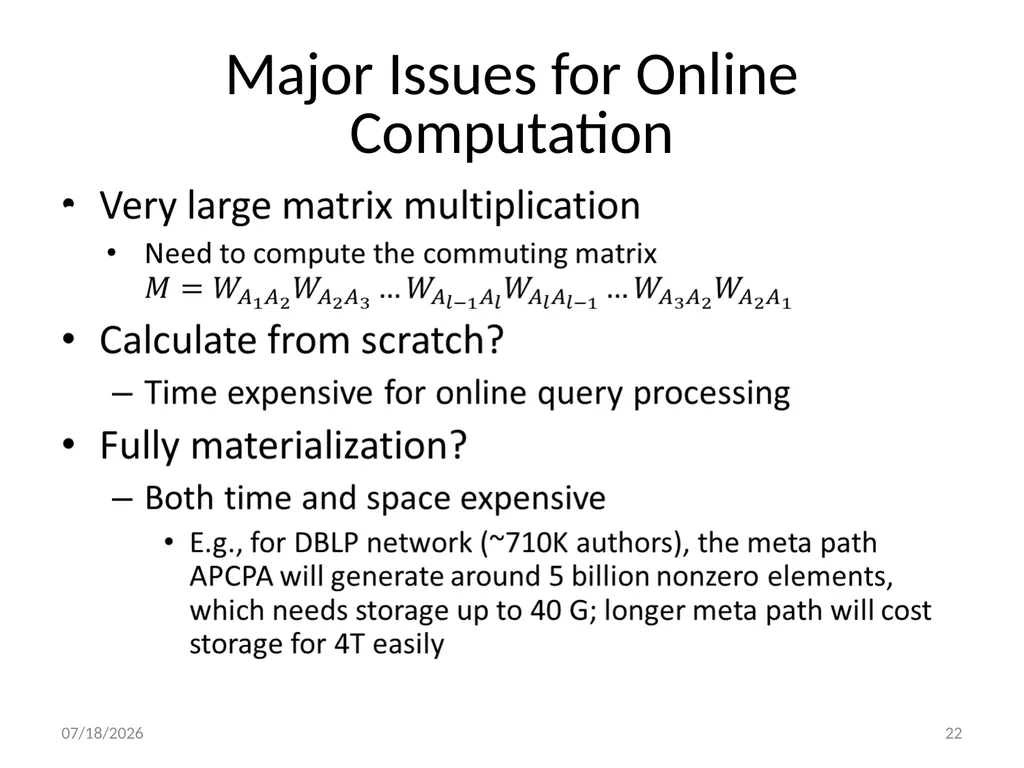
Major Issues for Online Computation 8/31/2011 22<br>
23
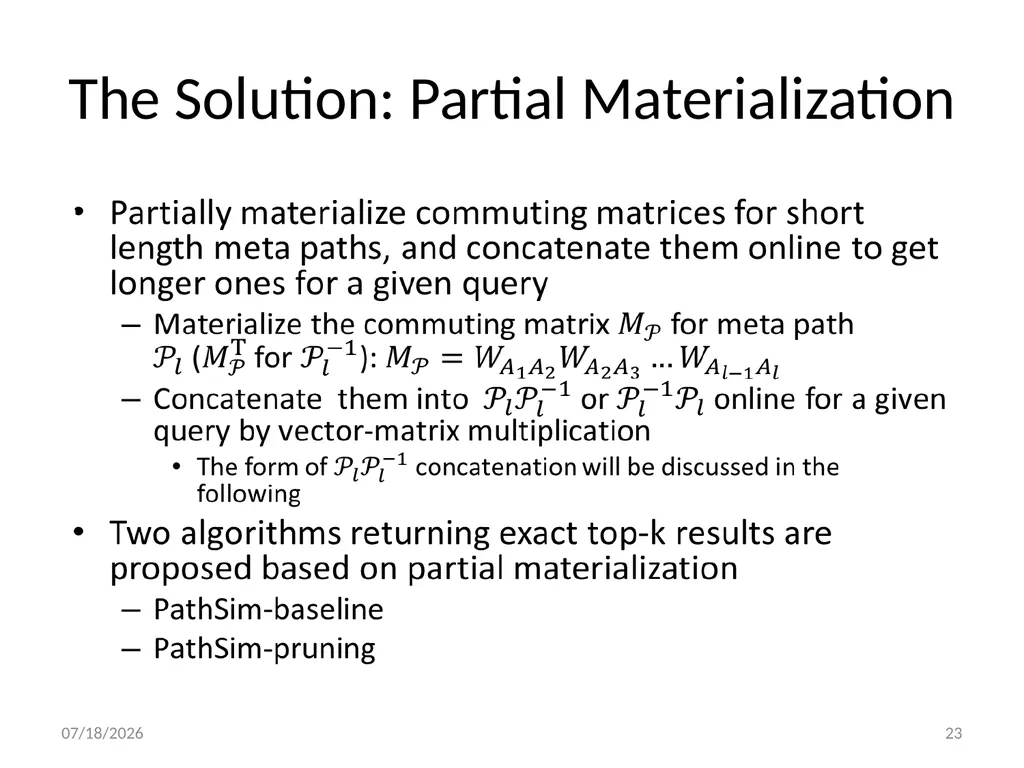
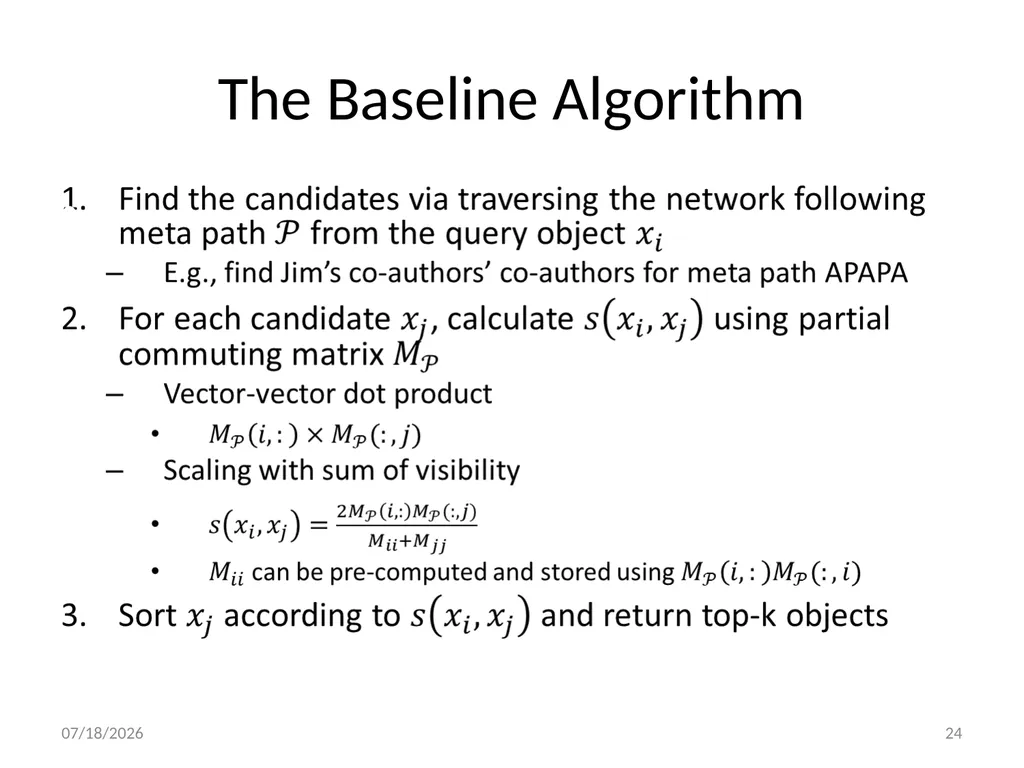
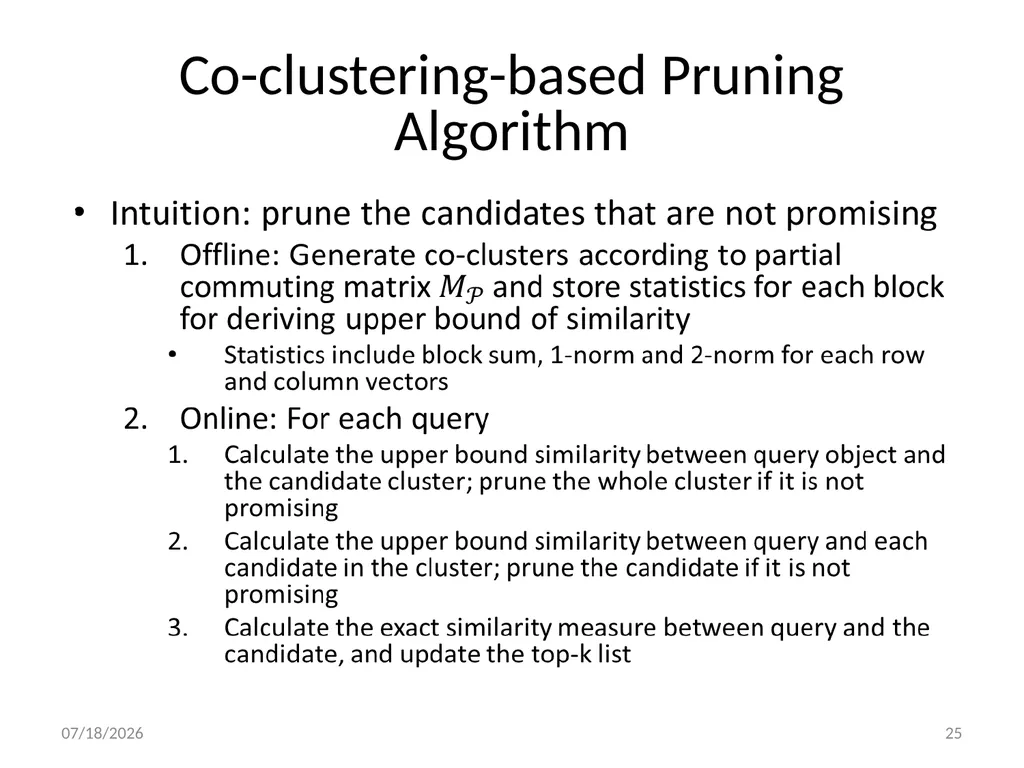
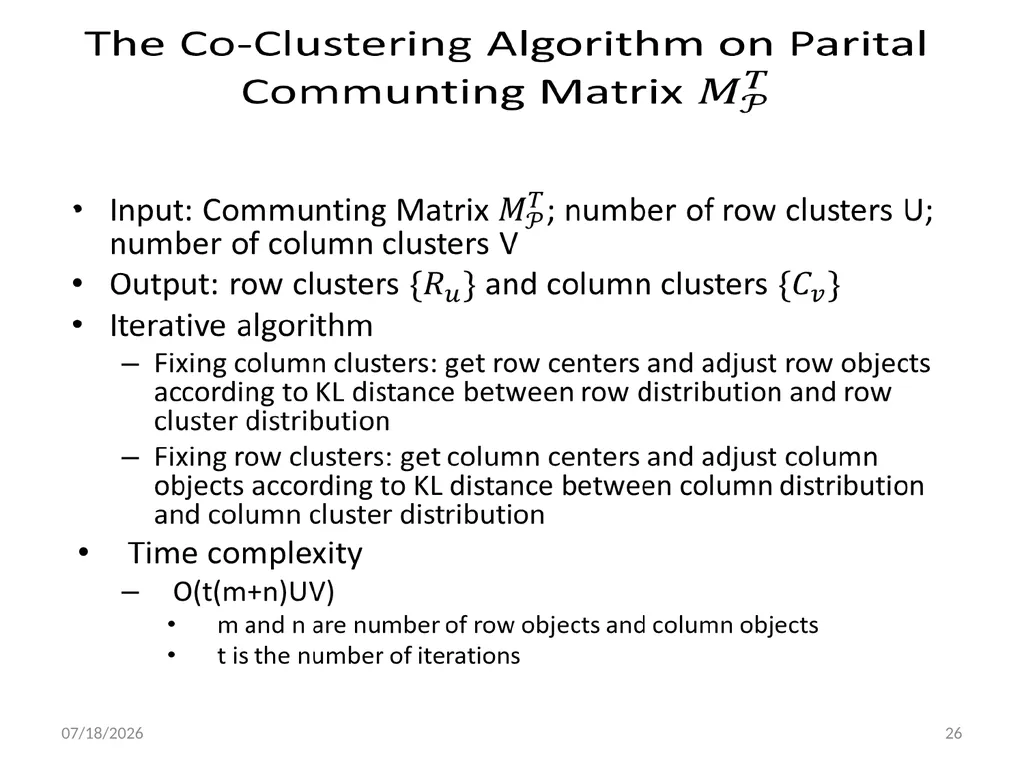
The Solution: Partial Materialization 8/31/2011 23<br>
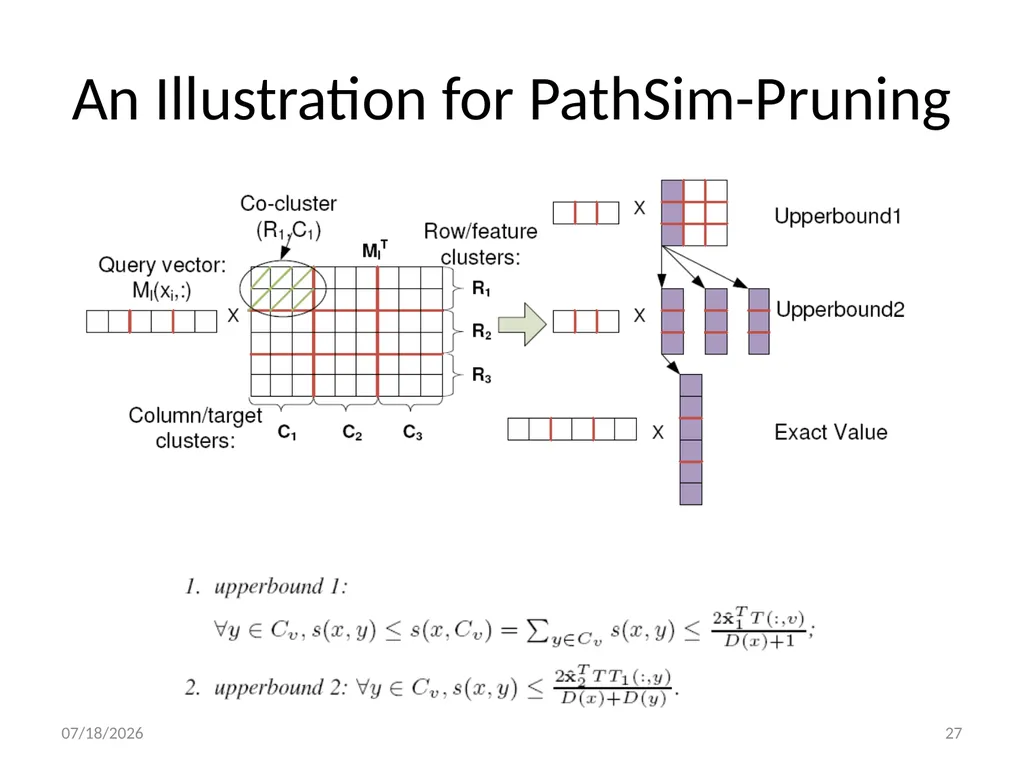
An Illustration for PathSim-Pruning 8/30/2011 27<br>
28
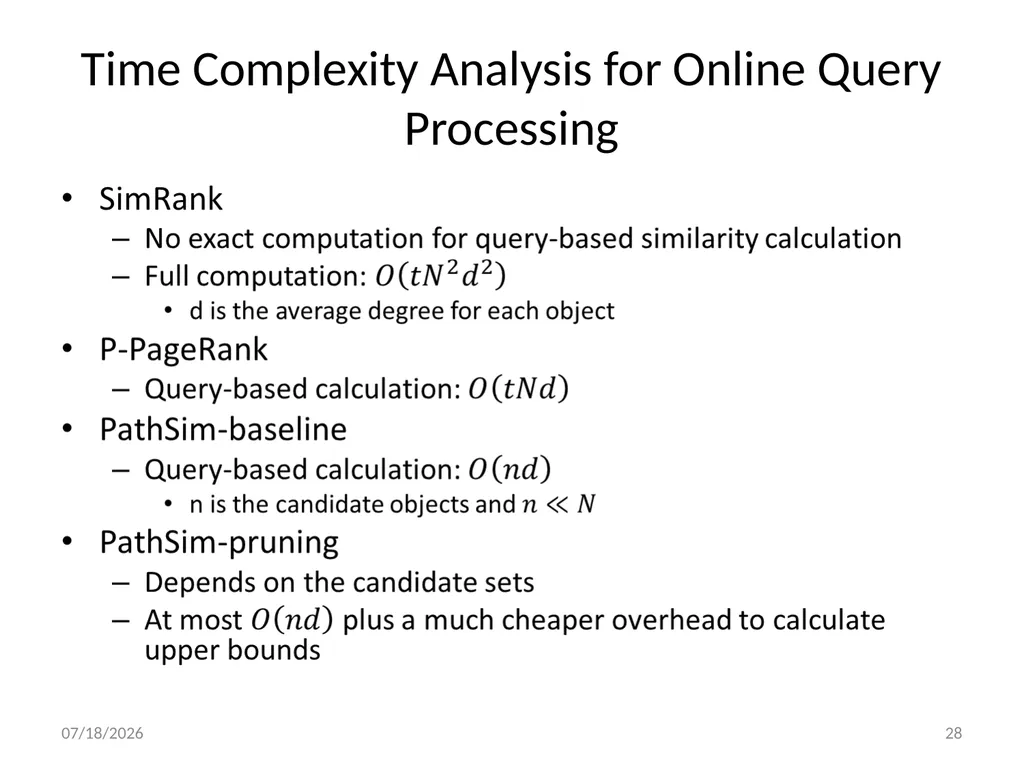
Time Complexity Analysis for Online Query Processing 8/30/2011 28<br>
29
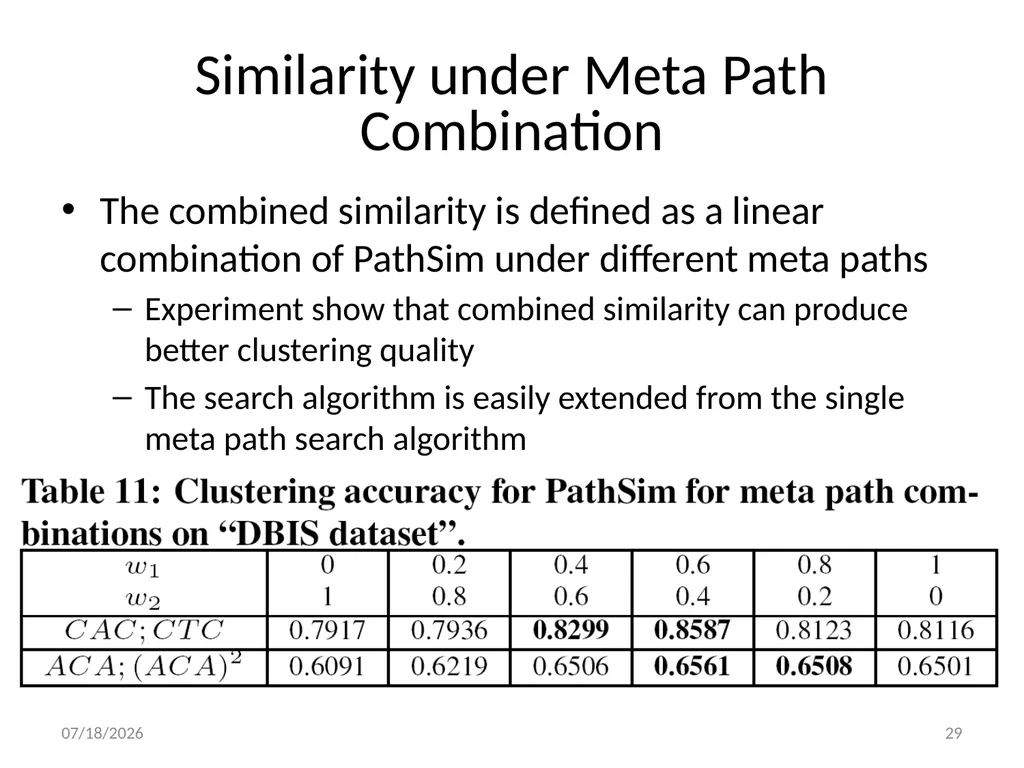
Similarity under Meta Path Combination The combined similarity is defined as a linear combination of PathSim under different meta paths
Experiment show that combined similarity can produce better clustering quality
The search algorithm is easily extended from the single meta path search algorithm 8/29/2011 29<br>
30
Content Background and Motivation
Meta Path-based Similarity Framework
PathSim: A Novel Meta Path-Based Similarity Measure
Online Query Processing for Top-K Similarity Search
Experiments
Conclusions 8/30/2011 30<br>
31
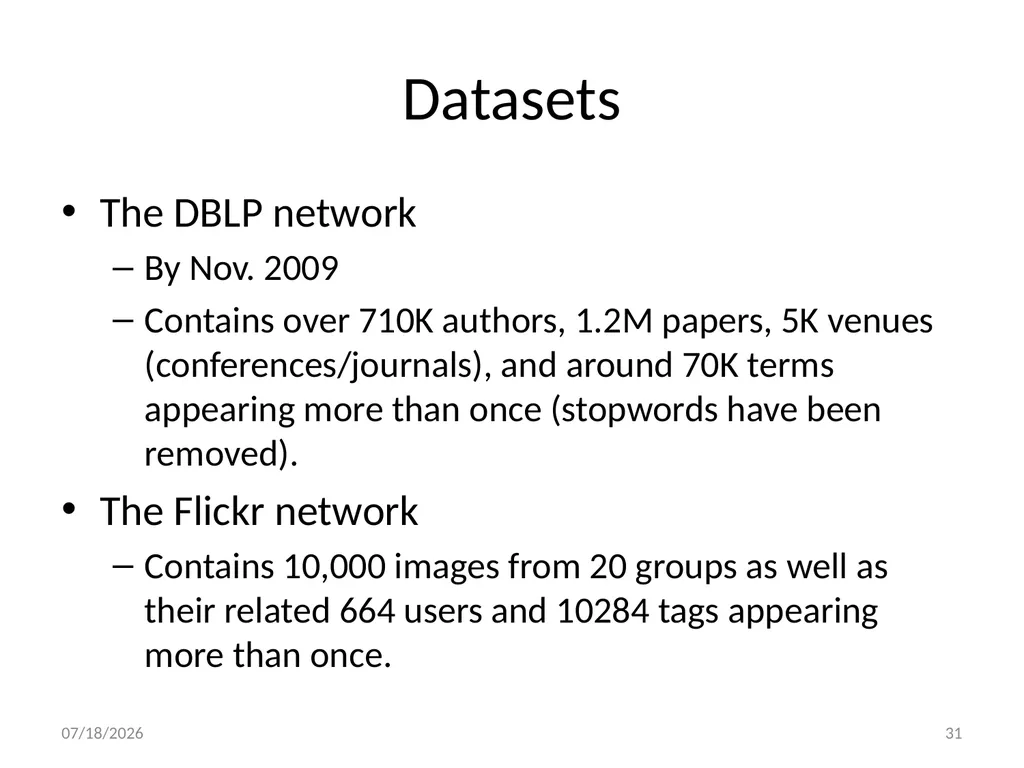
Datasets The DBLP network
By Nov. 2009
Contains over 710K authors, 1.2M papers, 5K venues (conferences/journals), and around 70K terms appearing more than once (stopwords have been removed).
The Flickr network
Contains 10,000 images from 20 groups as well as their related 664 users and 10284 tags appearing more than once. 8/30/2011 31<br>
32
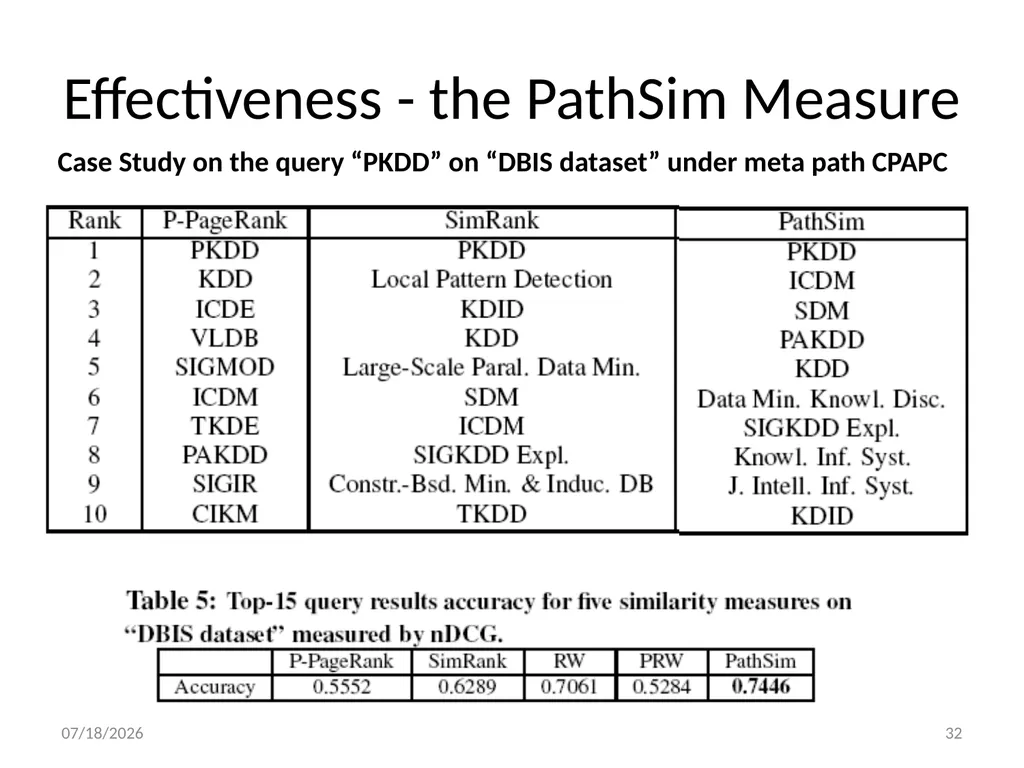
Effectiveness - the PathSim Measure 8/29/2011 32 Case Study on the query “PKDD” on “DBIS dataset” under meta path CPAPC<br>
33
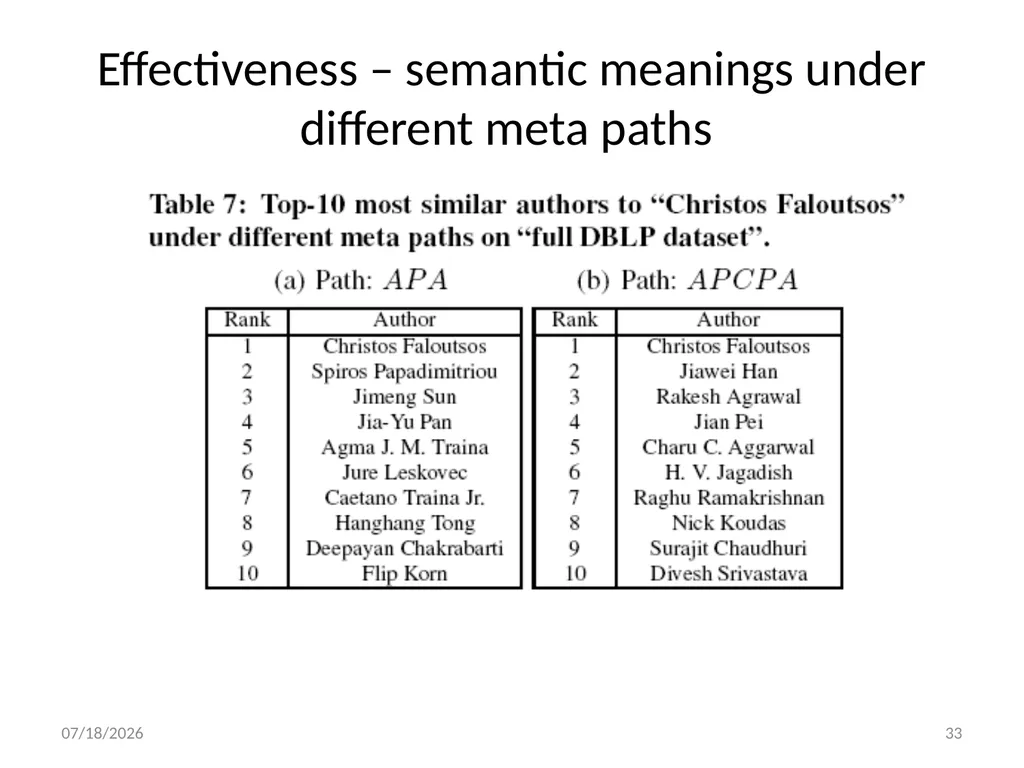
Effectiveness – semantic meanings under different meta paths 8/30/2011 33<br>
34
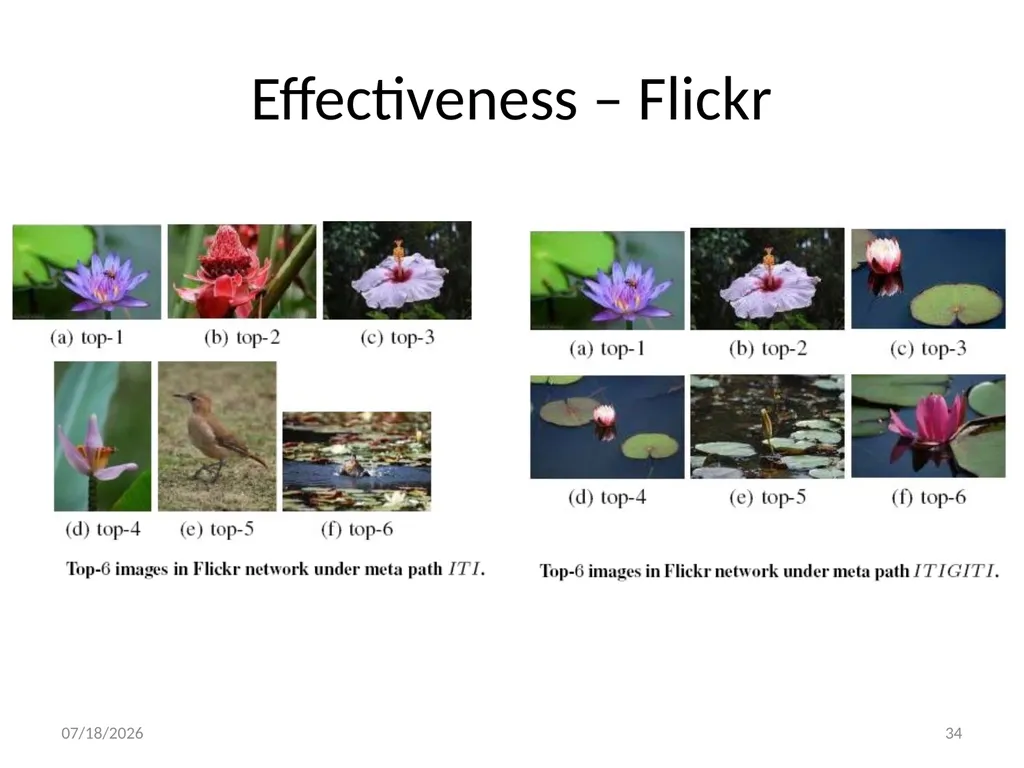
Effectiveness – Flickr 8/30/2011 34<br>
35
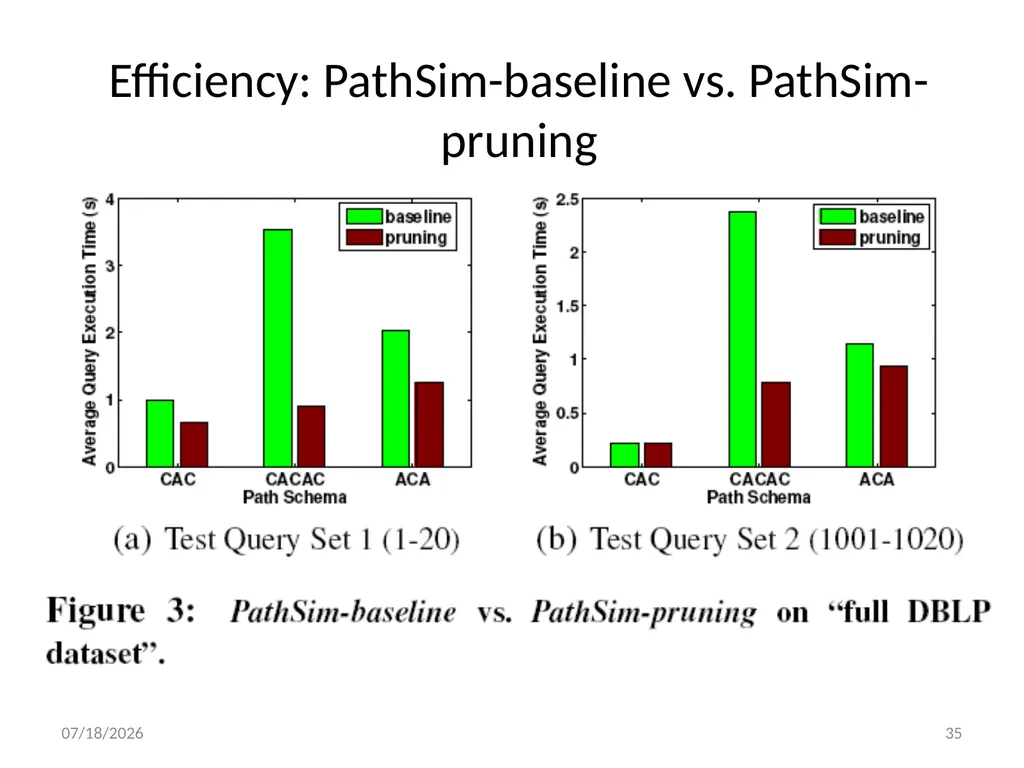
Efficiency: PathSim-baseline vs. PathSim-pruning 8/30/2011 35<br>
36
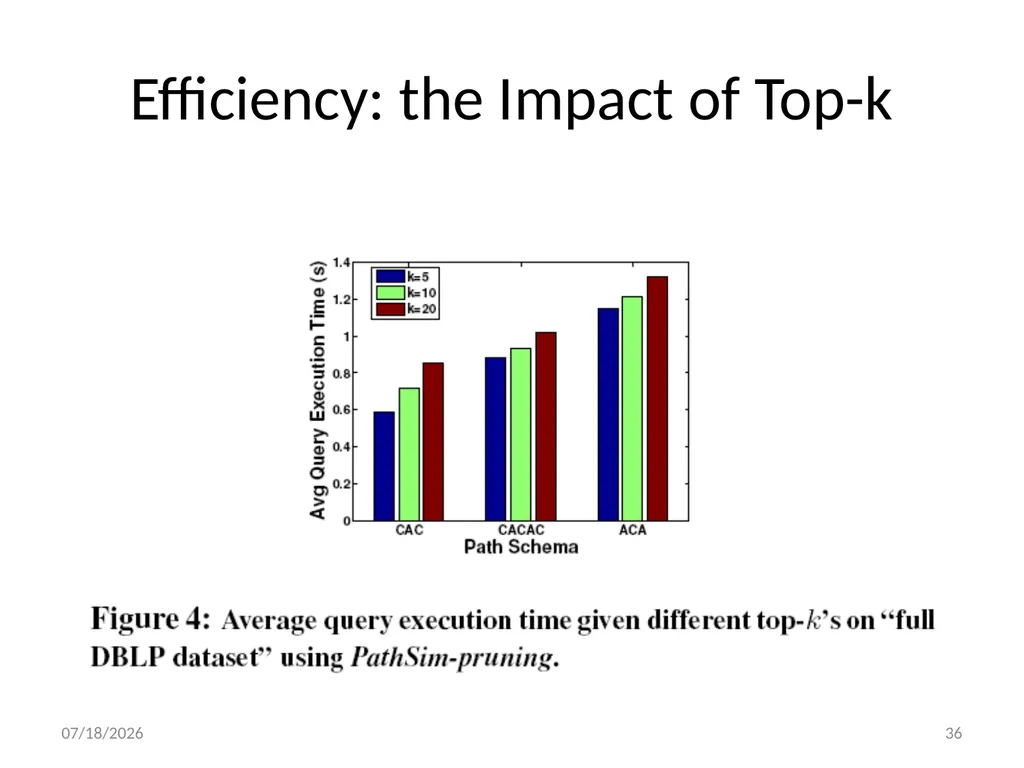
Efficiency: the Impact of Top-k 8/30/2011 36<br>
37
Content Background and Motivation
Meta Path-based Similarity Framework
PathSim: A Novel Meta Path-Based Similarity Measure
Online Query Processing for Top-K Similarity Search
Experiments
Conclusions 8/30/2011 37<br>
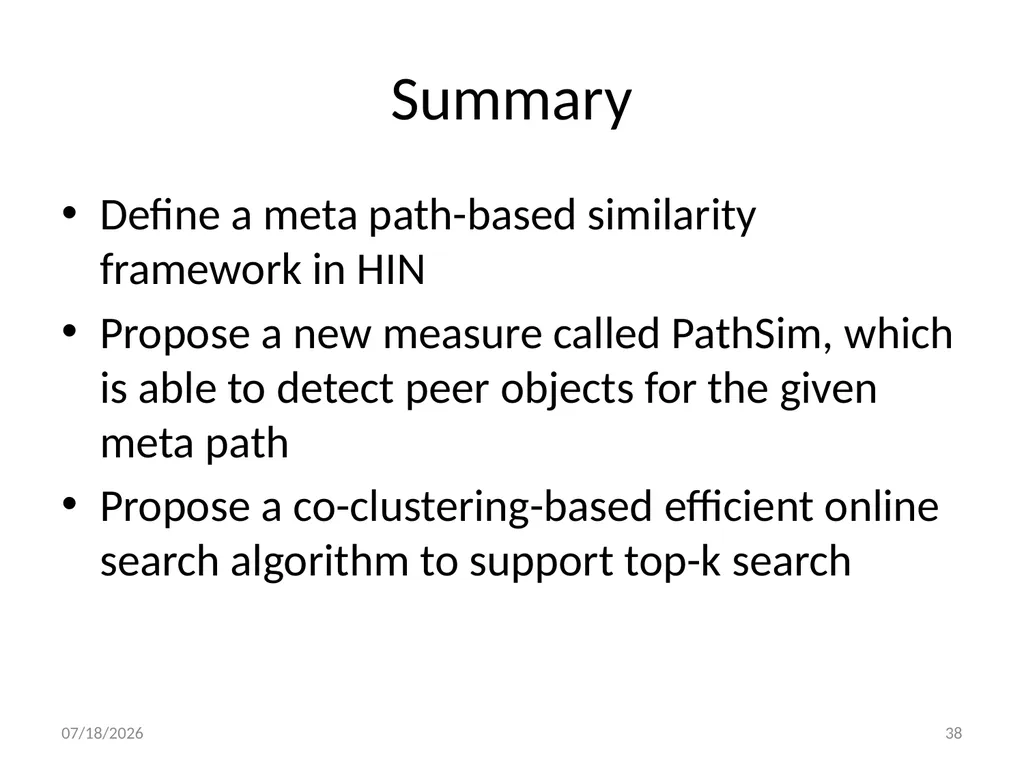
38
Summary Define a meta path-based similarity framework in HIN
Propose a new measure called PathSim, which is able to detect peer objects for the given meta path
Propose a co-clustering-based efficient online search algorithm to support top-k search 8/30/2011 38<br>
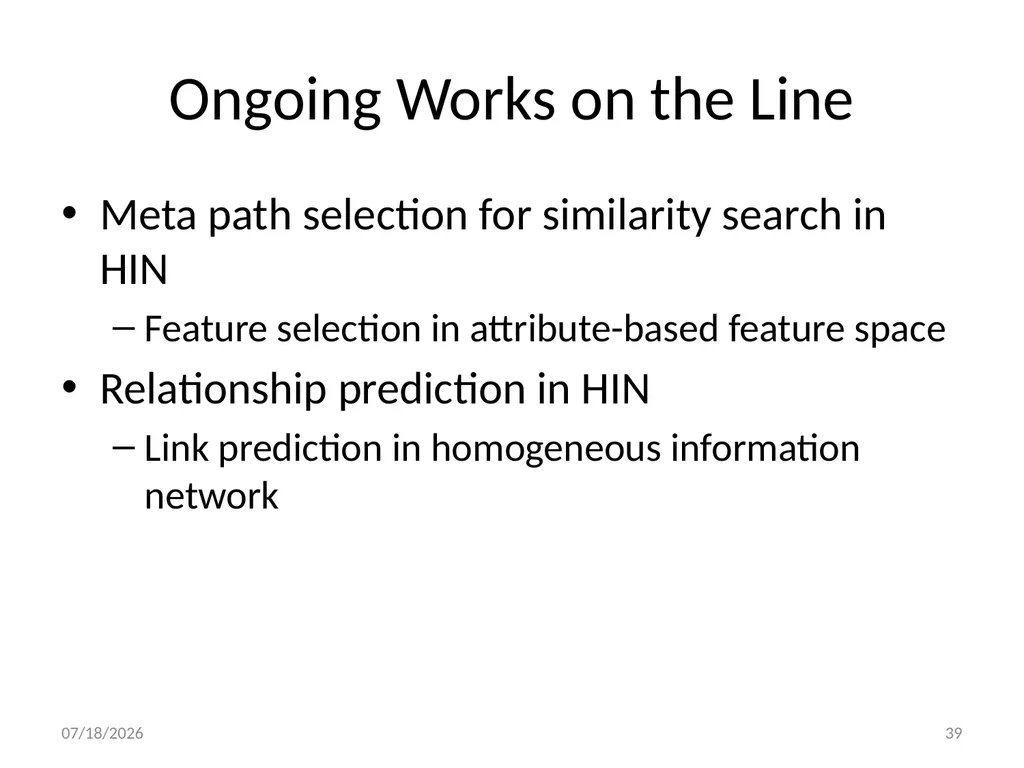
39
Ongoing Works on the Line Meta path selection for similarity search in HIN
Feature selection in attribute-based feature space
Relationship prediction in HIN
Link prediction in homogeneous information network 8/28/2011 39<br>