
Pediatric Emergencies CHAPTER 36: Focused Lecture
TA
Published · 229 slides · 0 views

1 / 1








Description
Pediatric Emergencies CHAPTER 36: Focused Lecture National EMS Education Standard Competencies (1 of 8) Special Patient Populations Applies a fundamental knowledge of growth, development, aging, and assessment findings to provide basic and
Related Topics
Share
Embed code
Download this presentation From Below
"Pediatric Emergencies CHAPTER 36: Focused Lecture" is the property of its rightful owner. Permission is granted to download and print the materials on this website for personal, non-commercial use only, and to display it on your personal computer provided you do not modify the materials and that you retain all copyright notices contained in the materials. By downloading content from our website, you accept the terms of this agreement.
Presentation Transcript
01
Pediatric Emergencies CHAPTER 36: Focused Lecture<br>
02
National EMS Education Standard Competencies (1 of 8) Special Patient Populations
Applies a fundamental knowledge of growth, development, aging, and assessment findings to provide basic and selected advanced emergency care and transportation for a patient with special needs.<br>
Applies a fundamental knowledge of growth, development, aging, and assessment findings to provide basic and selected advanced emergency care and transportation for a patient with special needs.<br>
03
National EMS Education Standard Competencies (2 of 8) Pediatrics
Age-related assessment findings, age-related and developmental-stage-related assessment and treatment modifications for pediatric-specific major diseases and/or emergencies:
Upper airway obstruction
Lower airway reactive disease<br>
Age-related assessment findings, age-related and developmental-stage-related assessment and treatment modifications for pediatric-specific major diseases and/or emergencies:
Upper airway obstruction
Lower airway reactive disease<br>
04
National EMS Education Standard Competencies (3 of 8) Respiratory distress/failure/arrest
Shock
Seizures
Sudden infant death syndrome
Gastrointestinal disease<br>
Shock
Seizures
Sudden infant death syndrome
Gastrointestinal disease<br>
05
National EMS Education Standard Competencies (4 of 8) Patients With Special Challenges
Recognizing and reporting abuse and neglect
Health care implications of
Abuse
Neglect
Homelessness
Poverty<br>
Recognizing and reporting abuse and neglect
Health care implications of
Abuse
Neglect
Homelessness
Poverty<br>
06
National EMS Education Standard Competencies (5 of 8) Health care implications of
Bariatrics
Technology dependent
Hospice/terminally ill
Tracheostomy care/dysfunction
Home care
Sensory deficit/loss
Developmental disability<br>
Bariatrics
Technology dependent
Hospice/terminally ill
Tracheostomy care/dysfunction
Home care
Sensory deficit/loss
Developmental disability<br>
07
National EMS Education Standard Competencies (6 of 8) Trauma
Applies fundamental knowledge to provide basic and selected advanced emergency care and transportation based on assessment findings for an acutely injured patient.<br>
Applies fundamental knowledge to provide basic and selected advanced emergency care and transportation based on assessment findings for an acutely injured patient.<br>
08
National EMS Education Standard Competencies (7 of 8) Special Considerations in Trauma
Recognition and management of trauma in
Pregnant patient
Pediatric patient
Geriatric patient<br>
Recognition and management of trauma in
Pregnant patient
Pediatric patient
Geriatric patient<br>
09
National EMS Education Standard Competencies (8 of 8) Special Considerations in Trauma
Pathophysiology, assessment, and management of trauma in the
Pregnant patient
Pediatric patient
Geriatric patient
Cognitively impaired patient<br>
Pathophysiology, assessment, and management of trauma in the
Pregnant patient
Pediatric patient
Geriatric patient
Cognitively impaired patient<br>
10
Introduction (1 of 2) Pediatric emergencies account for a relatively small percentage of an EMS system’s call volume.
Not uncommon to experience anxiety when responding to calls involving a pediatric patient<br>
Not uncommon to experience anxiety when responding to calls involving a pediatric patient<br>
11
Introduction (2 of 2) Be prepared to deal with parents or caregivers.
Sometimes they provide vital information; other times, they are of little assistance to you.
Children are not simply small adults.
Have special needs that require assessment and management strategies<br>
Sometimes they provide vital information; other times, they are of little assistance to you.
Children are not simply small adults.
Have special needs that require assessment and management strategies<br>
12
Communication With the Patient and the Family (1 of 2) You may have multiple patients to treat.
Family members or caregivers often need help and support.
May become angry or demanding
A calm parent helps contribute to a calm child.<br>
Family members or caregivers often need help and support.
May become angry or demanding
A calm parent helps contribute to a calm child.<br>
13
Communication With the Patient and the Family (2 of 2) Remain compassionate, calm, and professional.
When possible, allow parents or caregivers to participate in the care of the child.
Allow children who are not critically injured to remain on a parent or caregiver’s lap.<br>
When possible, allow parents or caregivers to participate in the care of the child.
Allow children who are not critically injured to remain on a parent or caregiver’s lap.<br>
14
The Infant (1 of 9) Infancy: First year of life
Neonatal or newborn period: First month after birth
0 to 2 months
Infants younger than 2 months spend most of their time sleeping or eating.
Respond mainly to physical stimuli, such as light, warmth, hunger, and sound<br>
Neonatal or newborn period: First month after birth
0 to 2 months
Infants younger than 2 months spend most of their time sleeping or eating.
Respond mainly to physical stimuli, such as light, warmth, hunger, and sound<br>
15
The Infant (2 of 9) Aroused easily from a sleeping state
Head control is limited.
Predisposed to hypothermia
Crying is a main mode of expression.
Basic needs consist of being warm, dry, and fed.<br>
Head control is limited.
Predisposed to hypothermia
Crying is a main mode of expression.
Basic needs consist of being warm, dry, and fed.<br>
16
The Infant (3 of 9) 2 to 6 months
Spend more time awake
More active and social
Recognize caregivers
Voluntary smiles and increasing eye contact are common.
By 4 months of age, infants are able to hold their heads up.<br>
Spend more time awake
More active and social
Recognize caregivers
Voluntary smiles and increasing eye contact are common.
By 4 months of age, infants are able to hold their heads up.<br>
17
The Infant (4 of 9) Healthy infants will have:
Strong sucking reflex
Active extremity movement
Vigorous cry
Lack of eye contact can be a sign of significant illness, depressed mental status, or a delay in development.<br>
Strong sucking reflex
Active extremity movement
Vigorous cry
Lack of eye contact can be a sign of significant illness, depressed mental status, or a delay in development.<br>
18
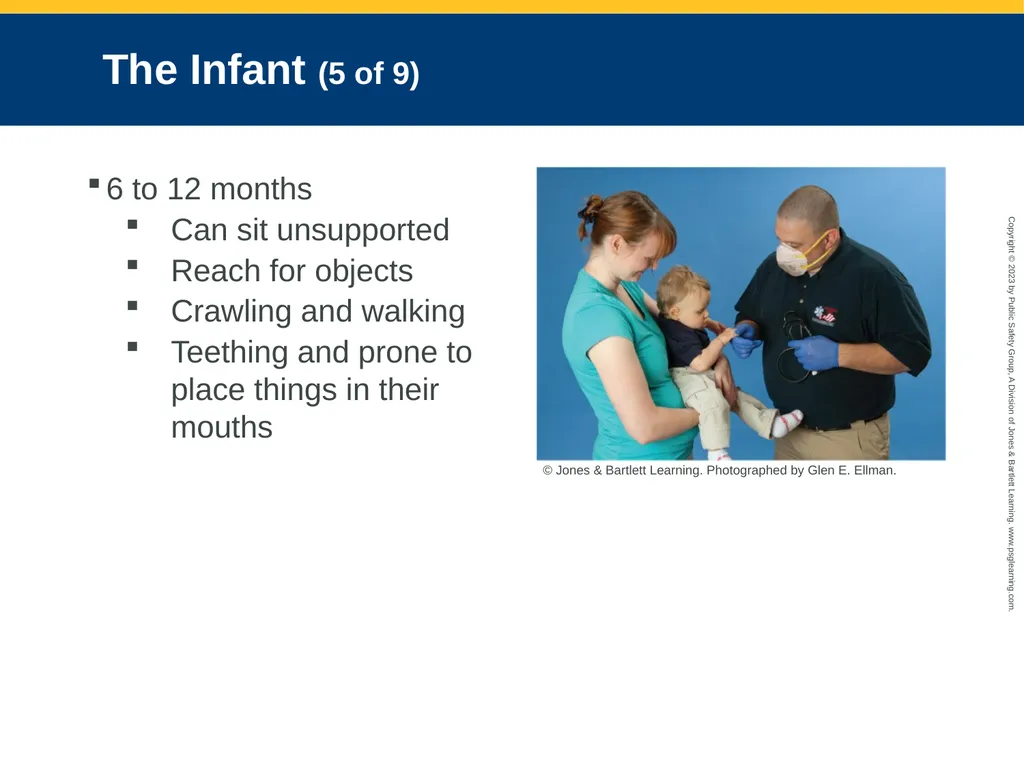
The Infant (5 of 9) 6 to 12 months
Can sit unsupported
Reach for objects
Crawling and walking
Teething and prone to place things in their mouths © Jones & Bartlett Learning. Photographed by Glen E. Ellman.<br>
Can sit unsupported
Reach for objects
Crawling and walking
Teething and prone to place things in their mouths © Jones & Bartlett Learning. Photographed by Glen E. Ellman.<br>
19
The Infant (6 of 9) Babbling is common.
By 12 months they learn their first word.
May cry if they are separated from their parents or caregivers
Separation anxiety is common.
Persistent crying or irritability can be symptoms of serious illness.<br>
By 12 months they learn their first word.
May cry if they are separated from their parents or caregivers
Separation anxiety is common.
Persistent crying or irritability can be symptoms of serious illness.<br>
20
The Infant (7 of 9) Assessment of the infant
Child’s appearance, work of breathing, and circulation are measured using pediatric assessment triangle.
Respect a caregiver’s perception that “something is wrong.”
Nonspecific concerns about a young infant’s behavior, feeding, or sleep patterns may be tip-offs to a serious underlying illness or injury.<br>
Child’s appearance, work of breathing, and circulation are measured using pediatric assessment triangle.
Respect a caregiver’s perception that “something is wrong.”
Nonspecific concerns about a young infant’s behavior, feeding, or sleep patterns may be tip-offs to a serious underlying illness or injury.<br>
21
The Infant (8 of 9) By 6 months, babies should make eye contact.
Lack of eye contact may be a sign of significant illness or of depressed mental status or delayed development.
Infants approaching age 12 months are at risk for foreign body aspiration and poisoning.
Make sure that your hands and stethoscope are warm.<br>
Lack of eye contact may be a sign of significant illness or of depressed mental status or delayed development.
Infants approaching age 12 months are at risk for foreign body aspiration and poisoning.
Make sure that your hands and stethoscope are warm.<br>
22
The Infant (9 of 9) Be opportunistic with your examination.
If the child is quiet, listen to the heart and lungs first.
If a young infant starts crying, let the baby suck on a pacifier or gloved finger.
Jingling keys or shining a penlight may distract an older infant.
Explain each procedure to the parent or caregiver before you perform it.<br>
If the child is quiet, listen to the heart and lungs first.
If a young infant starts crying, let the baby suck on a pacifier or gloved finger.
Jingling keys or shining a penlight may distract an older infant.
Explain each procedure to the parent or caregiver before you perform it.<br>
23
The Toddler (1 of 5) 1 to 3 years of age
12 to 18 months
Injuries increase because of exploratory nature and fearlessness.
Begin to imitate behaviors of older children and parents
Know major body parts when you point to them
May not be able to fully chew their food<br>
12 to 18 months
Injuries increase because of exploratory nature and fearlessness.
Begin to imitate behaviors of older children and parents
Know major body parts when you point to them
May not be able to fully chew their food<br>
24
The Toddler (2 of 5) 18 to 24 months
Mind is developing rapidly.
Able to name a common object that you point to
Understand cause and effect
Balance and gait improve rapidly.
Tend to cling to their parents or caregivers and often have an object that comforts them<br>
Mind is developing rapidly.
Able to name a common object that you point to
Understand cause and effect
Balance and gait improve rapidly.
Tend to cling to their parents or caregivers and often have an object that comforts them<br>
25
The Toddler (3 of 5) Assessment of the toddler
Begins with assessment of interactions with the caregiver, vocalizations, and mobility, measured through PAT
Persistent crying or irritability can be a symptom of serious illness.
Increased mobility in this age group increases their exposure to physical dangers and injury.<br>
Begins with assessment of interactions with the caregiver, vocalizations, and mobility, measured through PAT
Persistent crying or irritability can be a symptom of serious illness.
Increased mobility in this age group increases their exposure to physical dangers and injury.<br>
26
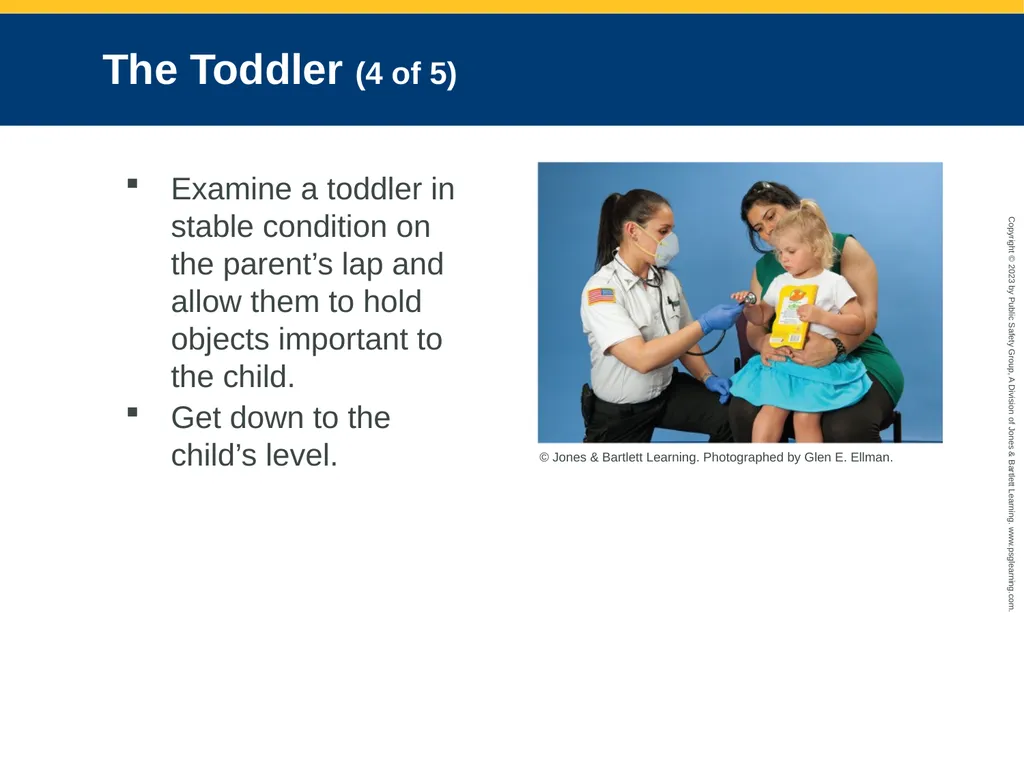
The Toddler (4 of 5) Examine a toddler in stable condition on the parent’s lap and allow them to hold objects important to the child.
Get down to the child’s level. © Jones & Bartlett Learning. Photographed by Glen E. Ellman.<br>
Get down to the child’s level. © Jones & Bartlett Learning. Photographed by Glen E. Ellman.<br>
27
The Toddler (5 of 5) Be creative when performing an examination on a toddler with stranger anxiety:
Have a parent to lift the shirt and press on the abdomen.
Use play and distraction techniques whenever possible.
Offer limited choices when possible.
Consider performing more upsetting parts of the examination last.<br>
Have a parent to lift the shirt and press on the abdomen.
Use play and distraction techniques whenever possible.
Offer limited choices when possible.
Consider performing more upsetting parts of the examination last.<br>
28
The Preschool-Age Child (1 of 2) Ages 3 to 6 years
Understand directions
Be much more specific in describing their sensations
Identify painful areas when asked
Risk of foreign body aspiration continues to be high. © Jones & Bartlett Learning.<br>
Understand directions
Be much more specific in describing their sensations
Identify painful areas when asked
Risk of foreign body aspiration continues to be high. © Jones & Bartlett Learning.<br>
29
The Preschool-Age Child (2 of 2) Assessment
Take advantage of child’s curiosity and desire to cooperate.
Offer to take turns listening to the heart and lungs.
Respect the child’s modesty and only expose as much as is necessary.
Offer simple choices.
Tell the child what you are going to do.
Avoid yes or no questions.
Set limits on behavior if the child acts out.<br>
Take advantage of child’s curiosity and desire to cooperate.
Offer to take turns listening to the heart and lungs.
Respect the child’s modesty and only expose as much as is necessary.
Offer simple choices.
Tell the child what you are going to do.
Avoid yes or no questions.
Set limits on behavior if the child acts out.<br>
30
The School-Age Child (1 of 2) Children aged 6 to 12 years begin to act more like adults.
Think in concrete terms
Respond sensibly to questions
Help take care of themselves<br>
Think in concrete terms
Respond sensibly to questions
Help take care of themselves<br>
31
The School-Age Child (2 of 2) Assessment
Can understand the difference between emotional and physical pain
Give simple explanations about the cause of the pain and what will be done about it.
Give appropriate choices and control whenever possible.
Games and conversation may distract patients.
Rewarding the school-age child after completion of a procedure can be very helpful.<br>
Can understand the difference between emotional and physical pain
Give simple explanations about the cause of the pain and what will be done about it.
Give appropriate choices and control whenever possible.
Games and conversation may distract patients.
Rewarding the school-age child after completion of a procedure can be very helpful.<br>
32
The Adolescent (1 of 3) Aged 12 to 18 years
Able to think abstractly and participate in decision making
Puberty begins, and can be difficult
Struggling with issues of independence, body image, sexuality, and peer pressure<br>
Able to think abstractly and participate in decision making
Puberty begins, and can be difficult
Struggling with issues of independence, body image, sexuality, and peer pressure<br>
33
The Adolescent (2 of 3) Assessment of the adolescent
Should be treated as an adult
Address the patient.
Encourage questions and involvement.
Provide accurate information.
Address concerns and fears about lasting effects of their injuries—especially cosmetic.
Find out their interests and get them talking about them.<br>
Should be treated as an adult
Address the patient.
Encourage questions and involvement.
Provide accurate information.
Address concerns and fears about lasting effects of their injuries—especially cosmetic.
Find out their interests and get them talking about them.<br>
34
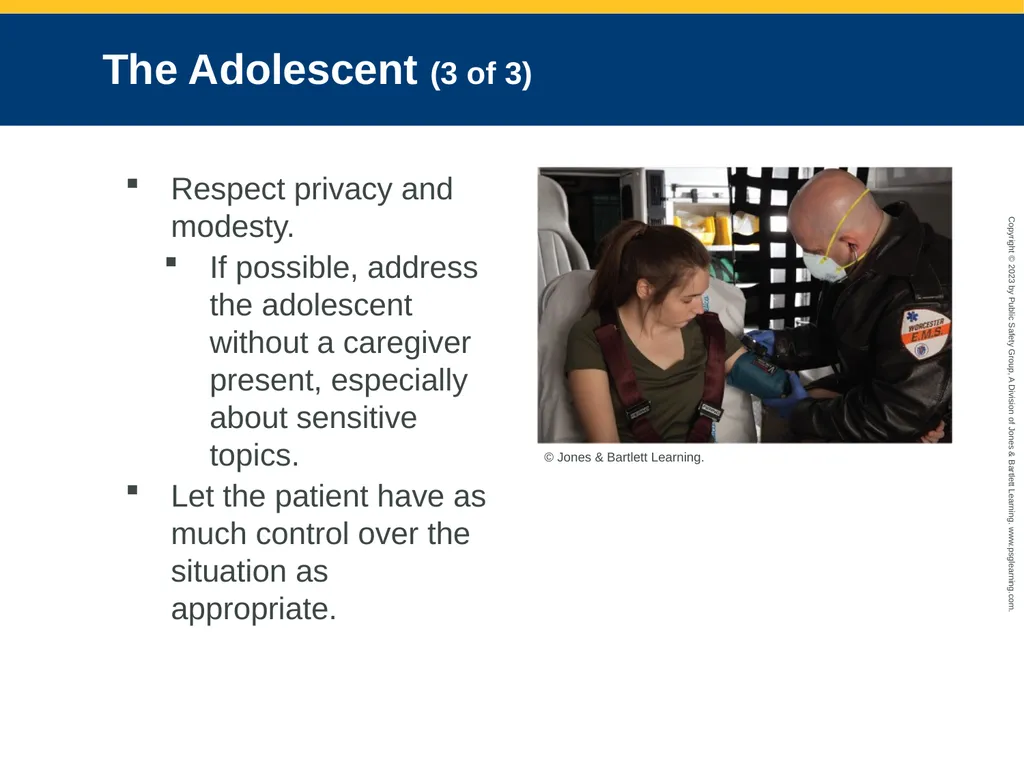
The Adolescent (3 of 3) Respect privacy and modesty.
If possible, address the adolescent without a caregiver present, especially about sensitive topics.
Let the patient have as much control over the situation as appropriate. © Jones & Bartlett Learning.<br>
If possible, address the adolescent without a caregiver present, especially about sensitive topics.
Let the patient have as much control over the situation as appropriate. © Jones & Bartlett Learning.<br>
35
Anatomy, Physiology, and Pathophysiology Bodies grow and change very rapidly during childhood.
Anatomic and physiologic changes and differences can create difficulties with your assessment of the child if you do not understand them.<br>
Anatomic and physiologic changes and differences can create difficulties with your assessment of the child if you do not understand them.<br>
36
The Respiratory System (1 of 6) Airway
Smaller in diameter and shorter in length
Tongue takes up more room in oropharynx and can easily block the airway.
Epiglottis is a floppy, narrow, U-shaped structure larger than an adult’s.
Larynx is higher and more anterior.
Trachea is smaller in diameter.<br>
Smaller in diameter and shorter in length
Tongue takes up more room in oropharynx and can easily block the airway.
Epiglottis is a floppy, narrow, U-shaped structure larger than an adult’s.
Larynx is higher and more anterior.
Trachea is smaller in diameter.<br>
37
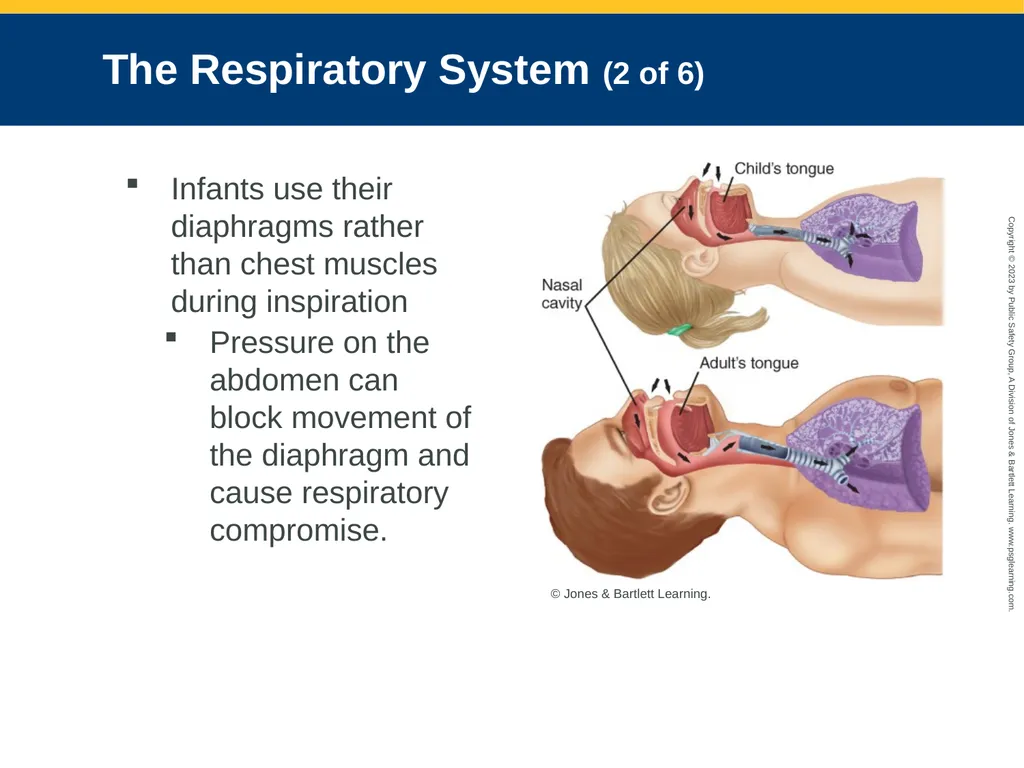
The Respiratory System (2 of 6) Infants use their diaphragms rather than chest muscles during inspiration
Pressure on the abdomen can block movement of the diaphragm and cause respiratory compromise. © Jones & Bartlett Learning.<br>
Pressure on the abdomen can block movement of the diaphragm and cause respiratory compromise. © Jones & Bartlett Learning.<br>
38
The Respiratory System (3 of 6) Tissues of lungs are more fragile.
Ribs are more cartilaginous.
Substantial compression injuries to the chest may injure vital intrathoracic organs.
Respiratory muscles are more immature and fatigue more quickly than an adult’s.
Functional residual capacity is smaller, resulting in proportionally smaller oxygen reserves.<br>
Ribs are more cartilaginous.
Substantial compression injuries to the chest may injure vital intrathoracic organs.
Respiratory muscles are more immature and fatigue more quickly than an adult’s.
Functional residual capacity is smaller, resulting in proportionally smaller oxygen reserves.<br>
39
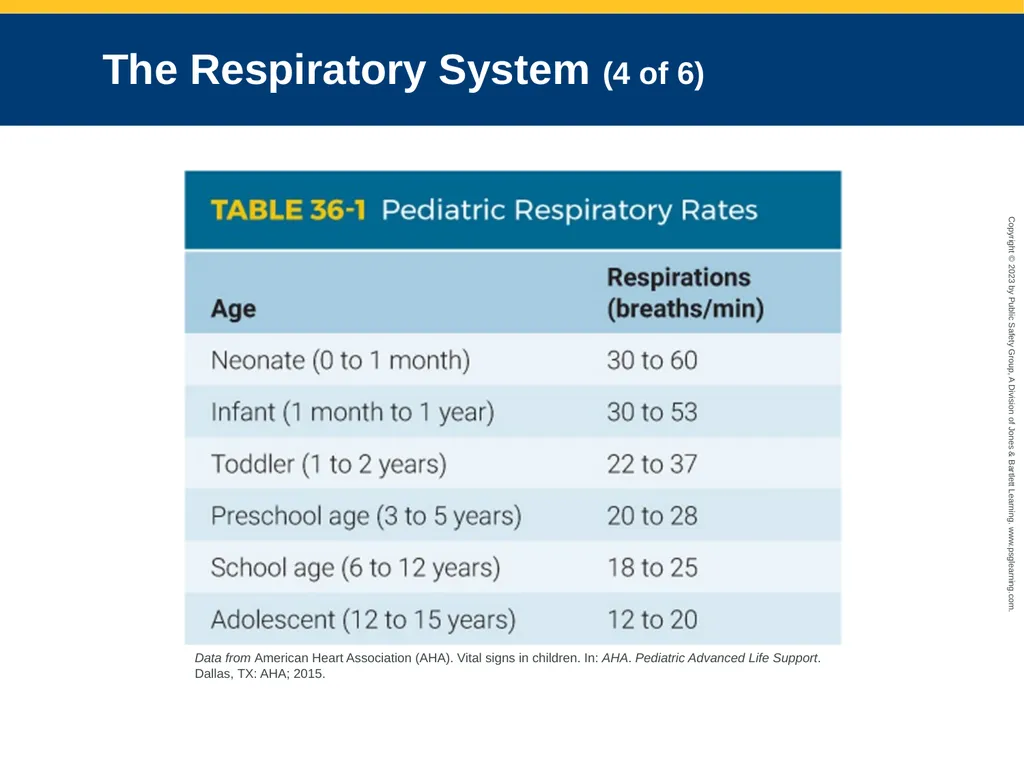
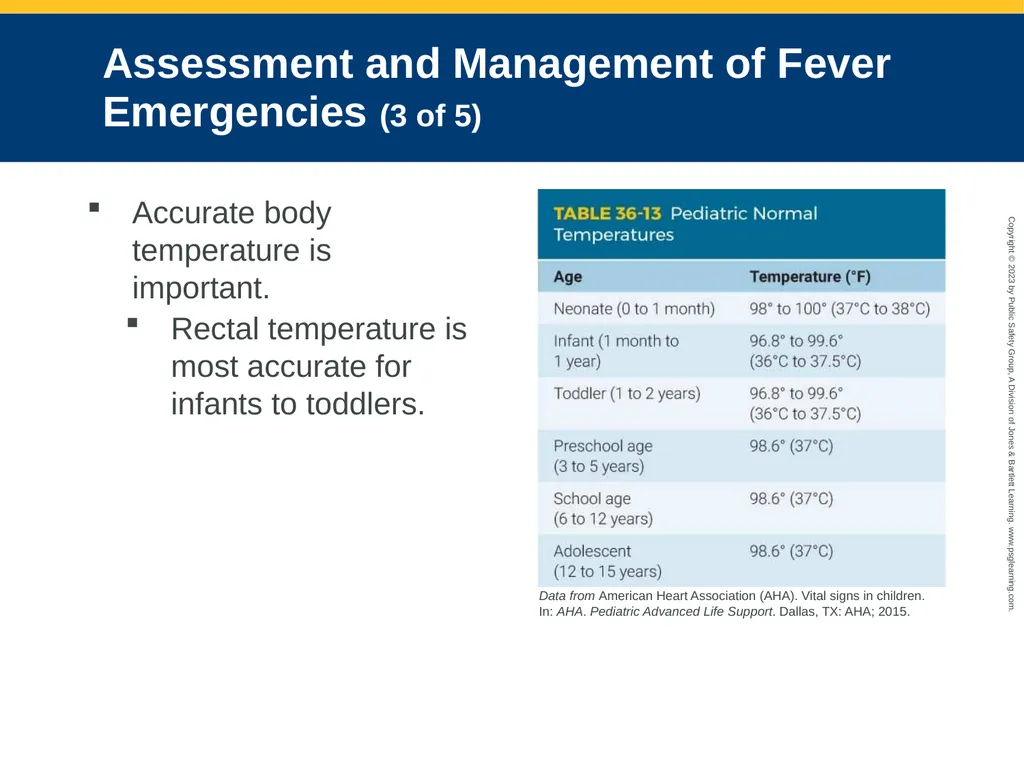
The Respiratory System (4 of 6) Data from American Heart Association (AHA). Vital signs in children. In: AHA. Pediatric Advanced Life Support. Dallas, TX: AHA; 2015.<br>
40
The Respiratory System (5 of 6) Gastric distention results in hypoventilation and increased risk of regurgitation with aspiration.
Remember:
Keep nares clear in infants younger than 6 months.
Avoid hyperextension of the neck.
Keep the airway clear of all secretions.
Use care when managing the airway.<br>
Remember:
Keep nares clear in infants younger than 6 months.
Avoid hyperextension of the neck.
Keep the airway clear of all secretions.
Use care when managing the airway.<br>
41
The Respiratory System (6 of 6) Infants and children are highly susceptible to hypoxia because of:
Decreased oxygen reserves
Increased oxygen demand
Easily fatigued respiratory muscles
Use a larger bag to ventilate a pediatric patient.
Use only enough pressure to achieve visible chest rise.<br>
Decreased oxygen reserves
Increased oxygen demand
Easily fatigued respiratory muscles
Use a larger bag to ventilate a pediatric patient.
Use only enough pressure to achieve visible chest rise.<br>
42
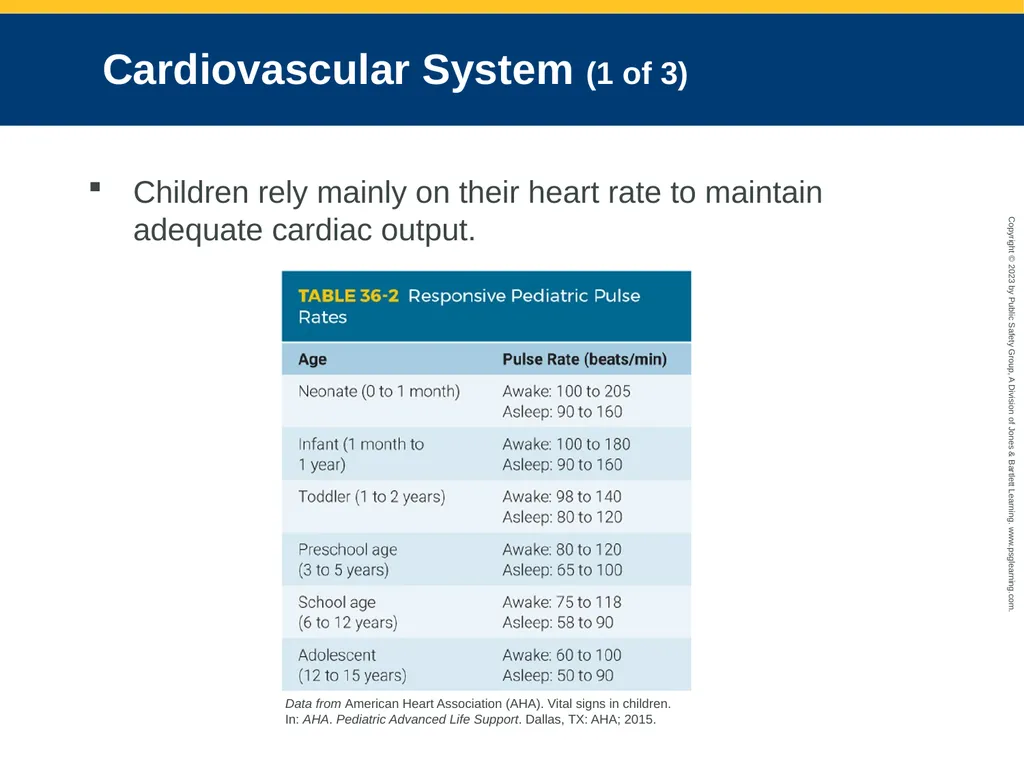
Cardiovascular System (1 of 3) Children rely mainly on their heart rate to maintain adequate cardiac output. Data from American Heart Association (AHA). Vital signs in children. In: AHA. Pediatric Advanced Life Support. Dallas, TX: AHA; 2015.<br>
43
Cardiovascular System (2 of 3) Children have a larger circulating blood volume than adults.
Injured children can maintain their blood pressure for longer periods than adults, even though they are in shock.
Suspect shock when an infant or child presents with tachycardia.<br>
Injured children can maintain their blood pressure for longer periods than adults, even though they are in shock.
Suspect shock when an infant or child presents with tachycardia.<br>
44
Cardiovascular System (3 of 3) Bradycardia usually indicates severe hypoxia.
Hypotension often indicates impending cardiopulmonary arrest.
Signs of vasoconstriction include:
Weak peripheral pulses
Delayed capillary refill
Pale, cool extremities<br>
Hypotension often indicates impending cardiopulmonary arrest.
Signs of vasoconstriction include:
Weak peripheral pulses
Delayed capillary refill
Pale, cool extremities<br>
45
The Nervous System (1 of 2) Brain and spinal cord are not as well protected.
Neural tissue and vasculature are fragile and susceptible to bleeding from injury.
Subarachnoid space in a child is smaller than in an adult.
Bruising and damage to the brain may be the result of head momentum.<br>
Neural tissue and vasculature are fragile and susceptible to bleeding from injury.
Subarachnoid space in a child is smaller than in an adult.
Bruising and damage to the brain may be the result of head momentum.<br>
46
The Nervous System (2 of 2) Brain requires nearly twice the cerebral blood flow as an adult brain.
Neural tissue and vasculature are fragile and prone to bleeding from injury.
Head injuries are greatly exacerbated by hypoxia and hypotension.
Spinal cord injuries are less common.<br>
Neural tissue and vasculature are fragile and prone to bleeding from injury.
Head injuries are greatly exacerbated by hypoxia and hypotension.
Spinal cord injuries are less common.<br>
47
Musculoskeletal System (1 of 4) Bones are softer and more porous until adolescence.
Treat any sprain or strain as though a fracture exists, and immobilize the injury accordingly.
Injury to the epiphyseal plate or puncture of growth plate may result in abnormalities in normal bone growth and development.<br>
Treat any sprain or strain as though a fracture exists, and immobilize the injury accordingly.
Injury to the epiphyseal plate or puncture of growth plate may result in abnormalities in normal bone growth and development.<br>
48
Musculoskeletal System (2 of 4) Head is proportionally larger.
During infancy, the anterior and posterior fontanelles are open.
Infants may experience excessive heat loss as a result of the larger size of the head.<br>
During infancy, the anterior and posterior fontanelles are open.
Infants may experience excessive heat loss as a result of the larger size of the head.<br>
49
Musculoskeletal System (3 of 4) Special care must be taken when positioning a child’s airway.
In children younger than 3 years, place a thin layer of padding under the shoulders and/or back to obtain a neutral position.
In seriously ill children older than 3 years, place a thin layer of padding under the occiput and a thicker layer under the shoulders and/or upper back to obtain a sniffing position.<br>
In children younger than 3 years, place a thin layer of padding under the shoulders and/or back to obtain a neutral position.
In seriously ill children older than 3 years, place a thin layer of padding under the occiput and a thicker layer under the shoulders and/or upper back to obtain a sniffing position.<br>
50
Musculoskeletal System (4 of 4) Fontanelles
Bulging suggests increased intracranial pressure
Sunken suggests dehydration<br>
Bulging suggests increased intracranial pressure
Sunken suggests dehydration<br>
51
The Gastrointestinal System Abdominal musculature is immature and offers less protection to solid, vascular organs.
Pediatric patients are at higher risk for splenic and hepatic injuries than adults.
Multiple organ injuries are more common.<br>
Pediatric patients are at higher risk for splenic and hepatic injuries than adults.
Multiple organ injuries are more common.<br>
52
The Integumentary System Infants and children:
Have thinner and more elastic skin
Larger body surface area–to–body mass ratio
Less subcutaneous (fatty) tissue
Can contribute to increased:
Risk of injuries following exposure to temperature extremes
Risk of hypothermia and dehydration
Severity of burns<br>
Have thinner and more elastic skin
Larger body surface area–to–body mass ratio
Less subcutaneous (fatty) tissue
Can contribute to increased:
Risk of injuries following exposure to temperature extremes
Risk of hypothermia and dehydration
Severity of burns<br>
53
Metabolic Differences (1 of 2) Infants and children have limited stores of glycogen and glucose.
Rapidly depleted
Risk of hypothermia is further increased due to larger surface area–to–body mass ratio.
Lack the ability to shiver<br>
Rapidly depleted
Risk of hypothermia is further increased due to larger surface area–to–body mass ratio.
Lack the ability to shiver<br>
54
Metabolic Differences (2 of 2) Significant hypovolemia and electrolyte derangements are more common due to severe vomiting and diarrhea.
Keep the child warm during transport.
Prevent loss of body heat, including covering the child’s head.
Newborns should not be overwarmed.<br>
Keep the child warm during transport.
Prevent loss of body heat, including covering the child’s head.
Newborns should not be overwarmed.<br>
55
Pediatric Assessment (1 of 32) Rely on the parent or caregiver to obtain as much information as you can.
Scene size-up
Modify assessment of child based on age.
Collect information from dispatch on:
Age and sex of the child
Location of the scene
Nature of illness
Mechanism of injury (MOI)
Chief complaint<br>
Scene size-up
Modify assessment of child based on age.
Collect information from dispatch on:
Age and sex of the child
Location of the scene
Nature of illness
Mechanism of injury (MOI)
Chief complaint<br>
56
Pediatric Assessment (2 of 32) Scene safety
Observe hazards or potential hazards.
Resist temptation to hastily approach the patient if you know it is a child.
Assume the MOI was significant enough to cause head or neck injuries if no other information is possible.<br>
Observe hazards or potential hazards.
Resist temptation to hastily approach the patient if you know it is a child.
Assume the MOI was significant enough to cause head or neck injuries if no other information is possible.<br>
57
Pediatric Assessment (3 of 32) Scene safety (cont’d)
Your index of suspicion for abuse should increase when there is:
Conflicting information from parents or caregivers
Bruises or other injuries inconsistent with MOI
Injuries that are inconsistent with child’s age and developmental abilities.
Observe and note the parents’ or caregivers’ interaction with the child.<br>
Your index of suspicion for abuse should increase when there is:
Conflicting information from parents or caregivers
Bruises or other injuries inconsistent with MOI
Injuries that are inconsistent with child’s age and developmental abilities.
Observe and note the parents’ or caregivers’ interaction with the child.<br>
58
Pediatric Assessment (4 of 32) Primary survey
Identify and treat immediate or potential life threats.
Use PAT to form a general impression.
A structured assessment tool that allows you to rapidly form a general impression without touching the patient
Should take about 15 to 30 seconds
Conducted prior to assessing the ABCDEs<br>
Identify and treat immediate or potential life threats.
Use PAT to form a general impression.
A structured assessment tool that allows you to rapidly form a general impression without touching the patient
Should take about 15 to 30 seconds
Conducted prior to assessing the ABCDEs<br>
59
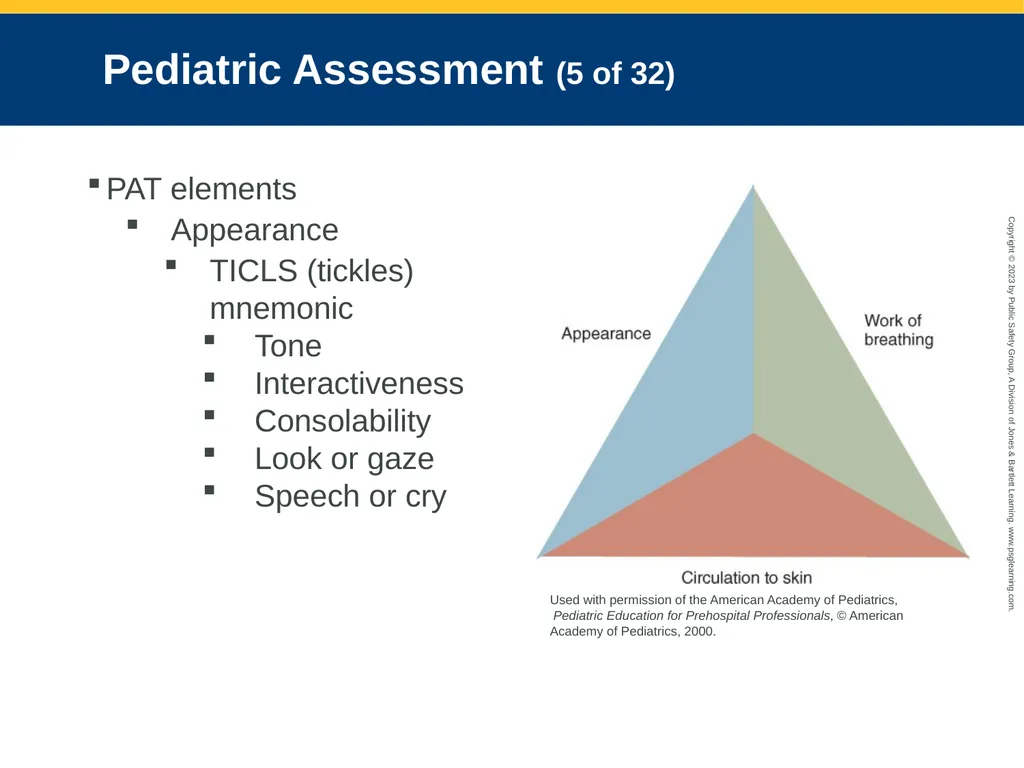
Pediatric Assessment (5 of 32) PAT elements
Appearance
TICLS (tickles) mnemonic
Tone
Interactiveness
Consolability
Look or gaze
Speech or cry Used with permission of the American Academy of Pediatrics,
Pediatric Education for Prehospital Professionals, © American
Academy of Pediatrics, 2000.<br>
Appearance
TICLS (tickles) mnemonic
Tone
Interactiveness
Consolability
Look or gaze
Speech or cry Used with permission of the American Academy of Pediatrics,
Pediatric Education for Prehospital Professionals, © American
Academy of Pediatrics, 2000.<br>
60
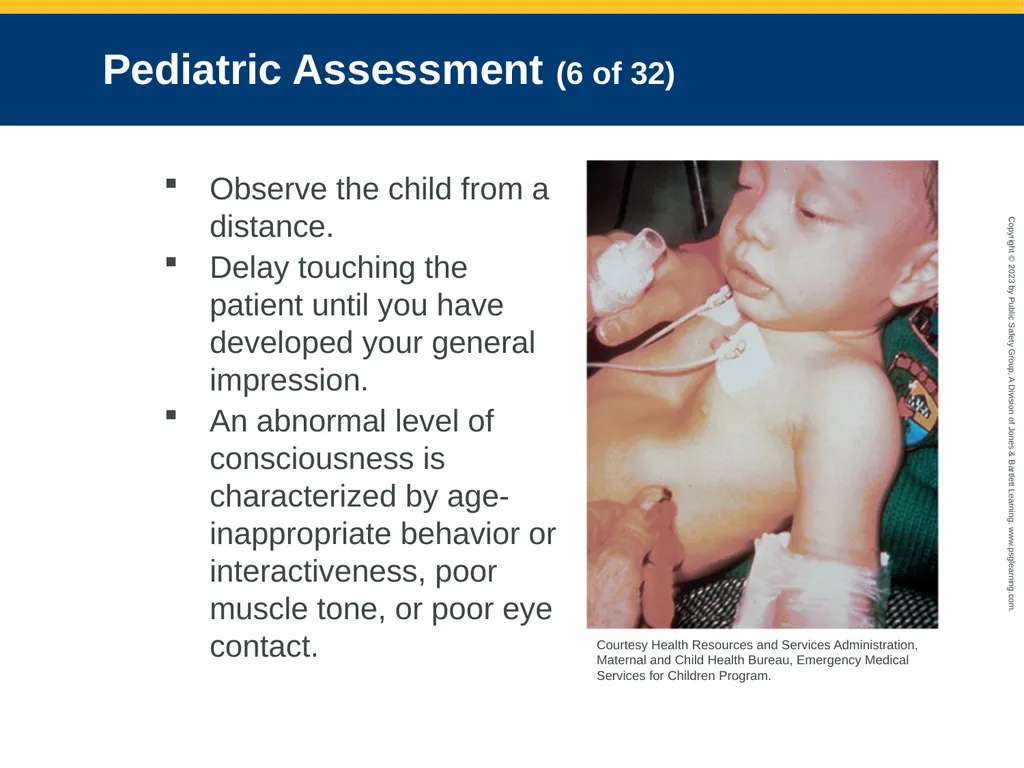
Pediatric Assessment (6 of 32) Observe the child from a distance.
Delay touching the patient until you have developed your general impression.
An abnormal level of consciousness is characterized by age-inappropriate behavior or interactiveness, poor muscle tone, or poor eye contact. Courtesy Health Resources and Services Administration, Maternal and Child Health Bureau, Emergency Medical Services for Children Program.<br>
Delay touching the patient until you have developed your general impression.
An abnormal level of consciousness is characterized by age-inappropriate behavior or interactiveness, poor muscle tone, or poor eye contact. Courtesy Health Resources and Services Administration, Maternal and Child Health Bureau, Emergency Medical Services for Children Program.<br>
61
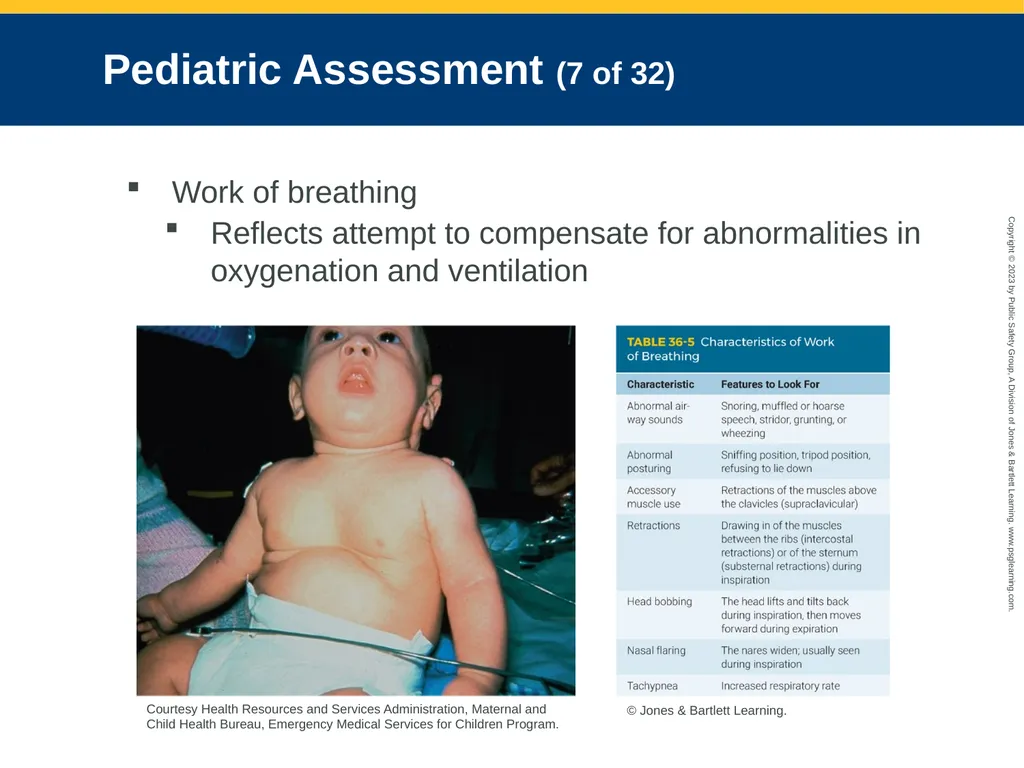
Pediatric Assessment (7 of 32) Work of breathing
Reflects attempt to compensate for abnormalities in oxygenation and ventilation Courtesy Health Resources and Services Administration, Maternal and Child Health Bureau, Emergency Medical Services for Children Program. © Jones & Bartlett Learning.<br>
Reflects attempt to compensate for abnormalities in oxygenation and ventilation Courtesy Health Resources and Services Administration, Maternal and Child Health Bureau, Emergency Medical Services for Children Program. © Jones & Bartlett Learning.<br>
62
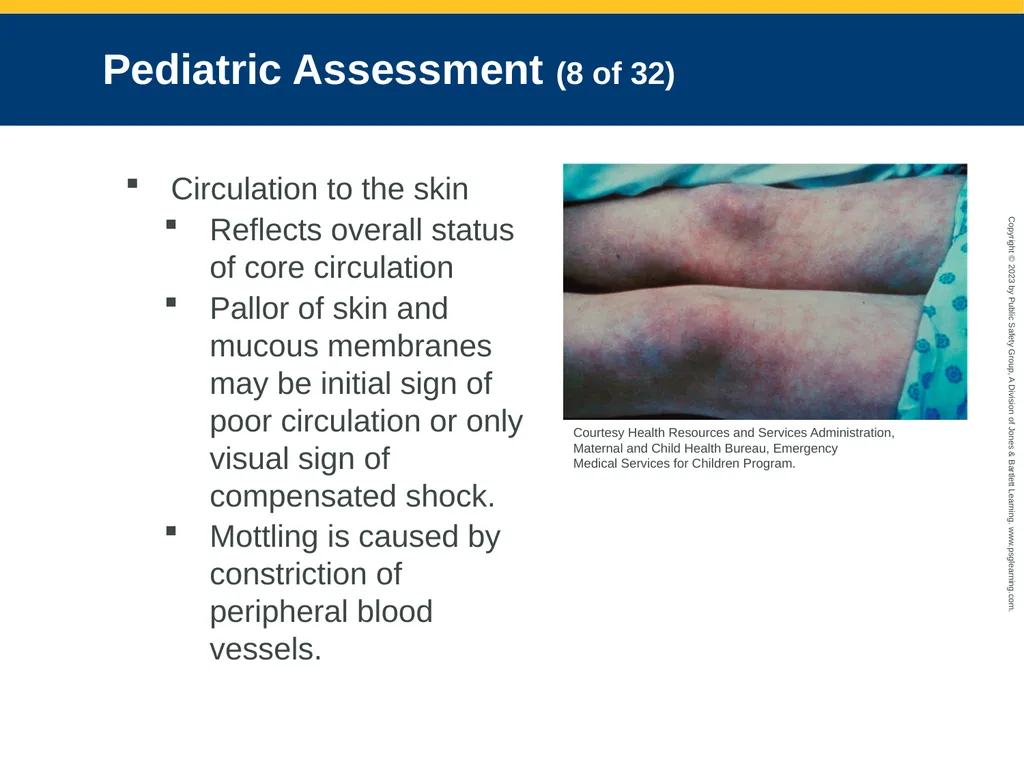
Pediatric Assessment (8 of 32) Circulation to the skin
Reflects overall status of core circulation
Pallor of skin and mucous membranes may be initial sign of poor circulation or only visual sign of compensated shock.
Mottling is caused by constriction of peripheral blood vessels. Courtesy Health Resources and Services Administration,
Maternal and Child Health Bureau, Emergency
Medical Services for Children Program.<br>
Reflects overall status of core circulation
Pallor of skin and mucous membranes may be initial sign of poor circulation or only visual sign of compensated shock.
Mottling is caused by constriction of peripheral blood vessels. Courtesy Health Resources and Services Administration,
Maternal and Child Health Bureau, Emergency
Medical Services for Children Program.<br>
63
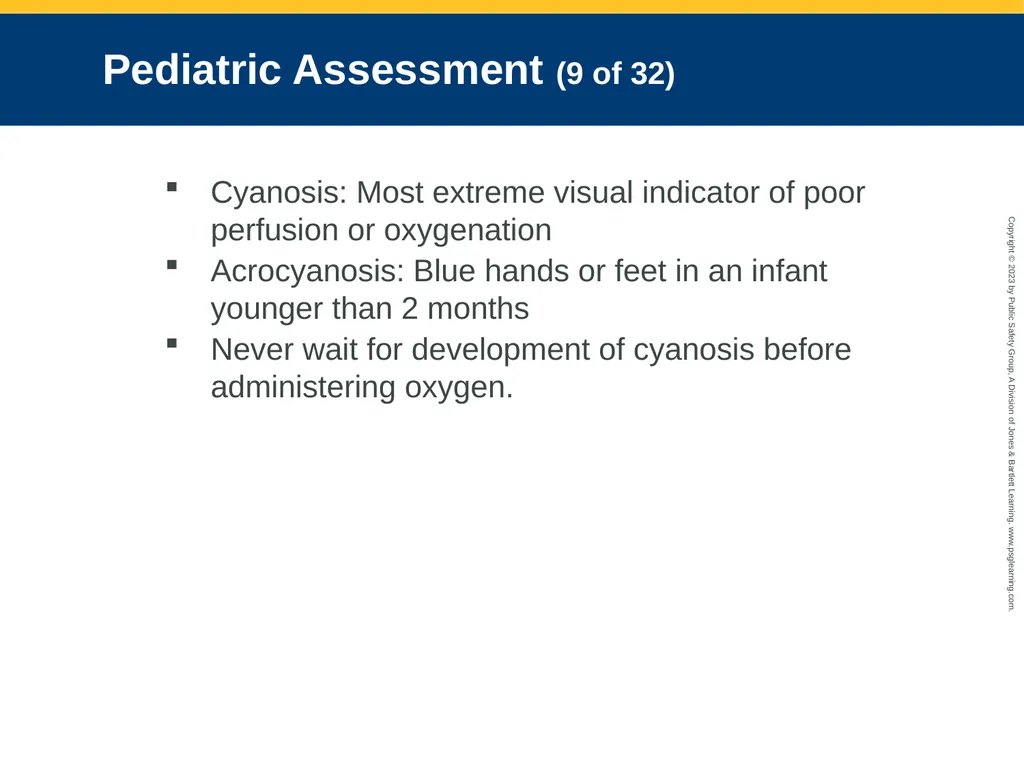
Pediatric Assessment (9 of 32) Cyanosis: Most extreme visual indicator of poor perfusion or oxygenation
Acrocyanosis: Blue hands or feet in an infant younger than 2 months
Never wait for development of cyanosis before administering oxygen.<br>
Acrocyanosis: Blue hands or feet in an infant younger than 2 months
Never wait for development of cyanosis before administering oxygen.<br>
64
Pediatric Assessment (10 of 32) Stay or go
If patient is unstable, assess ABCDEs, treat any life threats, and transport immediately.
If patient is stable, continue with the remainder of the patient assessment process.<br>
If patient is unstable, assess ABCDEs, treat any life threats, and transport immediately.
If patient is stable, continue with the remainder of the patient assessment process.<br>
65
Pediatric Assessment (11 of 32) Hands-on ABCDEs
Assessment of the vital functions:
Airway
Breathing
Circulation
Disability
Exposure
Treat any immediate or potential threats to life.
If you suspect cardiac arrest, the order is CABDE.<br>
Assessment of the vital functions:
Airway
Breathing
Circulation
Disability
Exposure
Treat any immediate or potential threats to life.
If you suspect cardiac arrest, the order is CABDE.<br>
66
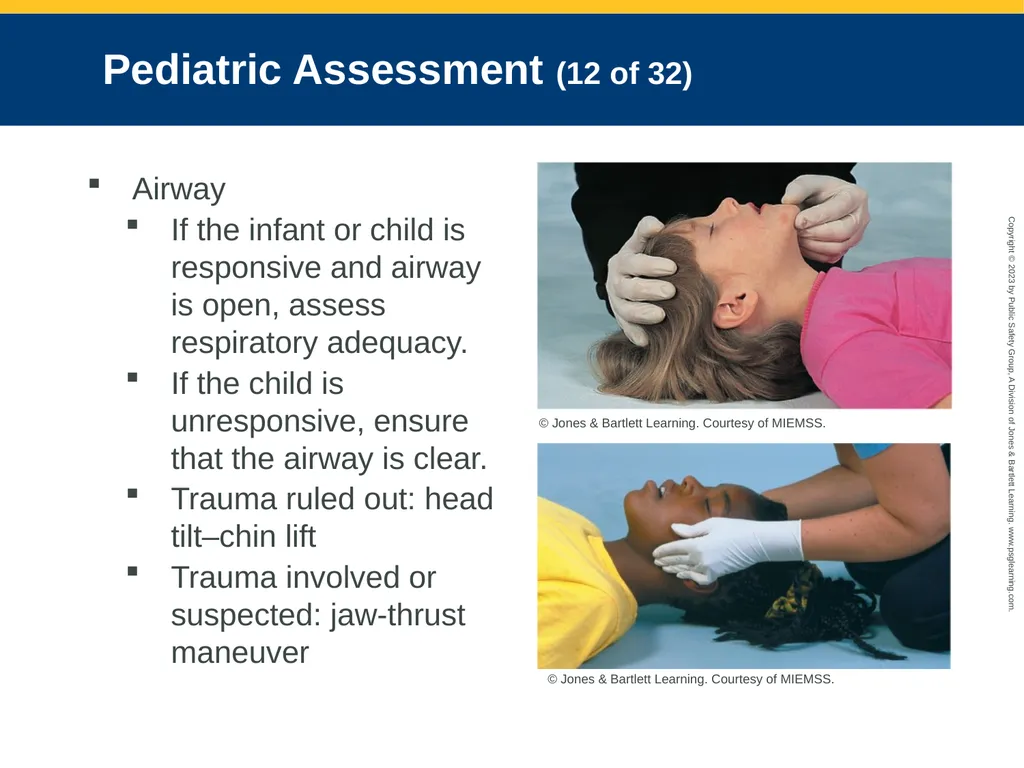
Pediatric Assessment (12 of 32) Airway
If the infant or child is responsive and airway is open, assess respiratory adequacy.
If the child is unresponsive, ensure that the airway is clear.
Trauma ruled out: head tilt–chin lift
Trauma involved or suspected: jaw-thrust maneuver © Jones & Bartlett Learning. Courtesy of MIEMSS. © Jones & Bartlett Learning. Courtesy of MIEMSS.<br>
If the infant or child is responsive and airway is open, assess respiratory adequacy.
If the child is unresponsive, ensure that the airway is clear.
Trauma ruled out: head tilt–chin lift
Trauma involved or suspected: jaw-thrust maneuver © Jones & Bartlett Learning. Courtesy of MIEMSS. © Jones & Bartlett Learning. Courtesy of MIEMSS.<br>
67
Pediatric Assessment (13 of 32) Breathing
Calculate respiratory rate.
Auscultate breath sounds.
Check pulse oximetry for oxygen saturation.
Note the degree of air movement at the nose and mouth.
Determine whether chest is rising adequately and symmetrically.
Assess the respiratory rate and effort.
Listen for abnormal respiratory sounds and note signs of increased respiratory effort.<br>
Calculate respiratory rate.
Auscultate breath sounds.
Check pulse oximetry for oxygen saturation.
Note the degree of air movement at the nose and mouth.
Determine whether chest is rising adequately and symmetrically.
Assess the respiratory rate and effort.
Listen for abnormal respiratory sounds and note signs of increased respiratory effort.<br>
68
Pediatric Assessment (14 of 32) As child begins to tire, retractions become weak and ineffective.
Bradypnea is an ominous sign and indicates impending respiratory arrest.
Be prepared to begin ventilatory assistance.<br>
Bradypnea is an ominous sign and indicates impending respiratory arrest.
Be prepared to begin ventilatory assistance.<br>
69
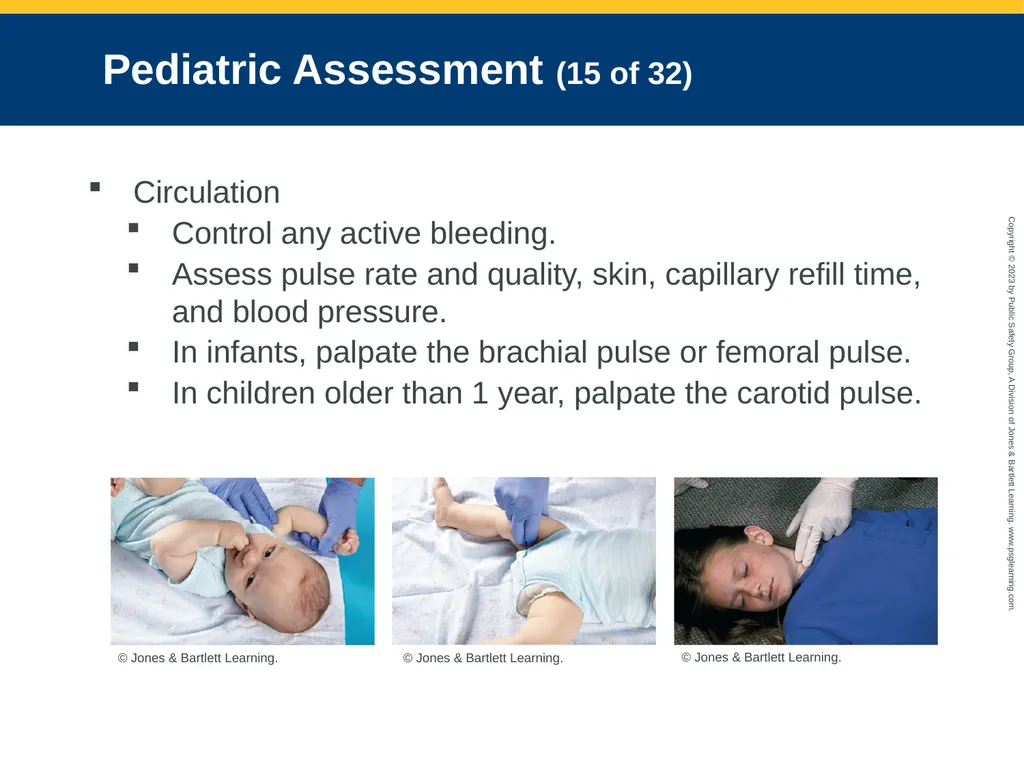
Pediatric Assessment (15 of 32) Circulation
Control any active bleeding.
Assess pulse rate and quality, skin, capillary refill time, and blood pressure.
In infants, palpate the brachial pulse or femoral pulse.
In children older than 1 year, palpate the carotid pulse. © Jones & Bartlett Learning. © Jones & Bartlett Learning. © Jones & Bartlett Learning.<br>
Control any active bleeding.
Assess pulse rate and quality, skin, capillary refill time, and blood pressure.
In infants, palpate the brachial pulse or femoral pulse.
In children older than 1 year, palpate the carotid pulse. © Jones & Bartlett Learning. © Jones & Bartlett Learning. © Jones & Bartlett Learning.<br>
70
Pediatric Assessment (16 of 32) Note the rate and quality of the pulse.
Weak or absent peripheral pulses indicate decreased perfusion.
Weak central pulses indicate significant hypotension and decompensated shock.
The absence of a central pulse indicates the immediate need for CPR.
Interpret the heart rate within the context of the overall history of the patient, PAT, and primary survey.<br>
Weak or absent peripheral pulses indicate decreased perfusion.
Weak central pulses indicate significant hypotension and decompensated shock.
The absence of a central pulse indicates the immediate need for CPR.
Interpret the heart rate within the context of the overall history of the patient, PAT, and primary survey.<br>
71
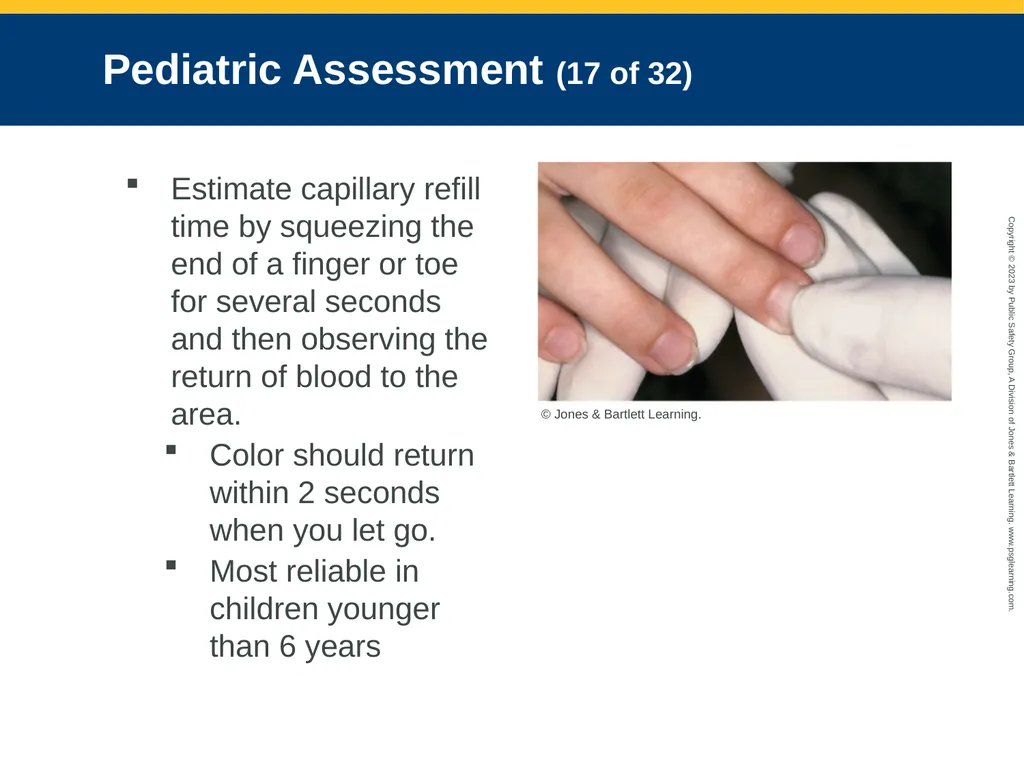
Pediatric Assessment (17 of 32) Estimate capillary refill time by squeezing the end of a finger or toe for several seconds and then observing the return of blood to the area.
Color should return within 2 seconds when you let go.
Most reliable in children younger than 6 years © Jones & Bartlett Learning.<br>
Color should return within 2 seconds when you let go.
Most reliable in children younger than 6 years © Jones & Bartlett Learning.<br>
72
Pediatric Assessment (18 of 32) Disability
Use AVPU scale or Pediatric Glasgow Coma Scale.
Check the responses of each pupil to a direct beam of light.<br>
Use AVPU scale or Pediatric Glasgow Coma Scale.
Check the responses of each pupil to a direct beam of light.<br>
73
Pediatric Assessment (19 of 32) Note any neurologic motor deficit.
Consider the age of the patient.
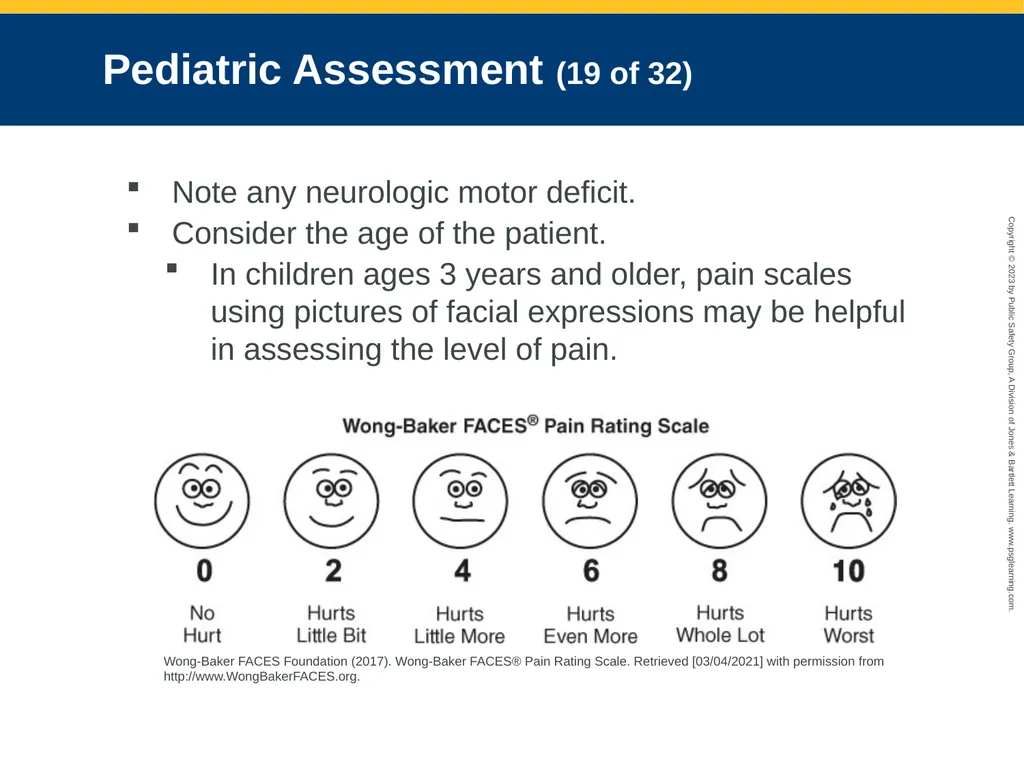
In children ages 3 years and older, pain scales using pictures of facial expressions may be helpful in assessing the level of pain. Wong-Baker FACES Foundation (2017). Wong-Baker FACES® Pain Rating Scale. Retrieved [03/04/2021] with permission from http://www.WongBakerFACES.org.<br>
Consider the age of the patient.
In children ages 3 years and older, pain scales using pictures of facial expressions may be helpful in assessing the level of pain. Wong-Baker FACES Foundation (2017). Wong-Baker FACES® Pain Rating Scale. Retrieved [03/04/2021] with permission from http://www.WongBakerFACES.org.<br>
74
Pediatric Assessment (20 of 32) Exposure
PAT requires caregiver to remove part of the pediatric patient’s clothing to allow observation of face, chest wall, and skin.
Be careful to avoid heat loss.<br>
PAT requires caregiver to remove part of the pediatric patient’s clothing to allow observation of face, chest wall, and skin.
Be careful to avoid heat loss.<br>
75
Pediatric Assessment (21 of 32) Transport decision
Transport immediately if:
Scene is unsafe for the child
Significant MOI
History compatible with a serious illness
Physical abnormality noted during the primary survey
Potentially serious anatomic abnormality
Level of consciousness<br>
Transport immediately if:
Scene is unsafe for the child
Significant MOI
History compatible with a serious illness
Physical abnormality noted during the primary survey
Potentially serious anatomic abnormality
Level of consciousness<br>
76
Pediatric Assessment (22 of 32) When making a transport decision, consider:
Type of clinical problem
Expected benefits of ALS treatment in the field
Treatment and transport protocols
Your comfort level
Transport time to the hospital<br>
Type of clinical problem
Expected benefits of ALS treatment in the field
Treatment and transport protocols
Your comfort level
Transport time to the hospital<br>
77
Pediatric Assessment (23 of 32) If child’s condition is urgent:
Initiate immediate transport.
Conduct additional assessment and treatment en route to the hospital.
If child’s condition is stable:
Perform a secondary assessment at the scene.
Provide additional treatment.
Transport.<br>
Initiate immediate transport.
Conduct additional assessment and treatment en route to the hospital.
If child’s condition is stable:
Perform a secondary assessment at the scene.
Provide additional treatment.
Transport.<br>
78
Pediatric Assessment (24 of 32) Not appropriate to secure a pediatric patient in a car seat when the patient:
Has to be immobilized on a long board
Requires splinting that does not fit the car seat
Is unstable and requires airway or ventilator support
Is in cardiopulmonary arrest<br>
Has to be immobilized on a long board
Requires splinting that does not fit the car seat
Is unstable and requires airway or ventilator support
Is in cardiopulmonary arrest<br>
79
Pediatric Assessment (25 of 32) History taking
Provide emotional support.
When speaking to child, use appropriate terminology.
When speaking with a parent or caregiver, use simple, nonmedical terms.
Allow sick and injured children to express feelings.<br>
Provide emotional support.
When speaking to child, use appropriate terminology.
When speaking with a parent or caregiver, use simple, nonmedical terms.
Allow sick and injured children to express feelings.<br>
80
Pediatric Assessment (26 of 32) Investigate the chief complaint.
Approach to history will depend on age of patient.
Information on sexual activity, possibility of pregnancy, or illicit drug or alcohol use should be obtained from an older adolescent.
Questioning about immediate illness or injury should be based on child’s chief complaint.<br>
Approach to history will depend on age of patient.
Information on sexual activity, possibility of pregnancy, or illicit drug or alcohol use should be obtained from an older adolescent.
Questioning about immediate illness or injury should be based on child’s chief complaint.<br>
81
Pediatric Assessment (27 of 32) If the parent or caregiver is unable to accompany you to the hospital, obtain a name and phone number.
SAMPLE history
Same as an adult’s
OPQRST-I
History of present illness and current symptoms
For both SAMPLE history and OPQRST-I, questions based on patient’s age and developmental stage<br>
SAMPLE history
Same as an adult’s
OPQRST-I
History of present illness and current symptoms
For both SAMPLE history and OPQRST-I, questions based on patient’s age and developmental stage<br>
82
Pediatric Assessment (28 of 32) Secondary assessment
Performed at the scene unless condition dictates immediate transport
Physical examinations
Full-body exam
Use DCAP-BTLS mnemonic.
Examination focuses on area of body affected.
Assess infants, toddlers, and preschool-age children starting at feet and ending at head.<br>
Performed at the scene unless condition dictates immediate transport
Physical examinations
Full-body exam
Use DCAP-BTLS mnemonic.
Examination focuses on area of body affected.
Assess infants, toddlers, and preschool-age children starting at feet and ending at head.<br>
83
Pediatric Assessment (29 of 32) Extent of physical examination may include:
Head
Pupils
Nose
Ears
Mouth
Neck
Chest
Back
Abdomen
Extremities
Capillary refill
Level of hydration<br>
Head
Pupils
Nose
Ears
Mouth
Neck
Chest
Back
Abdomen
Extremities
Capillary refill
Level of hydration<br>
84
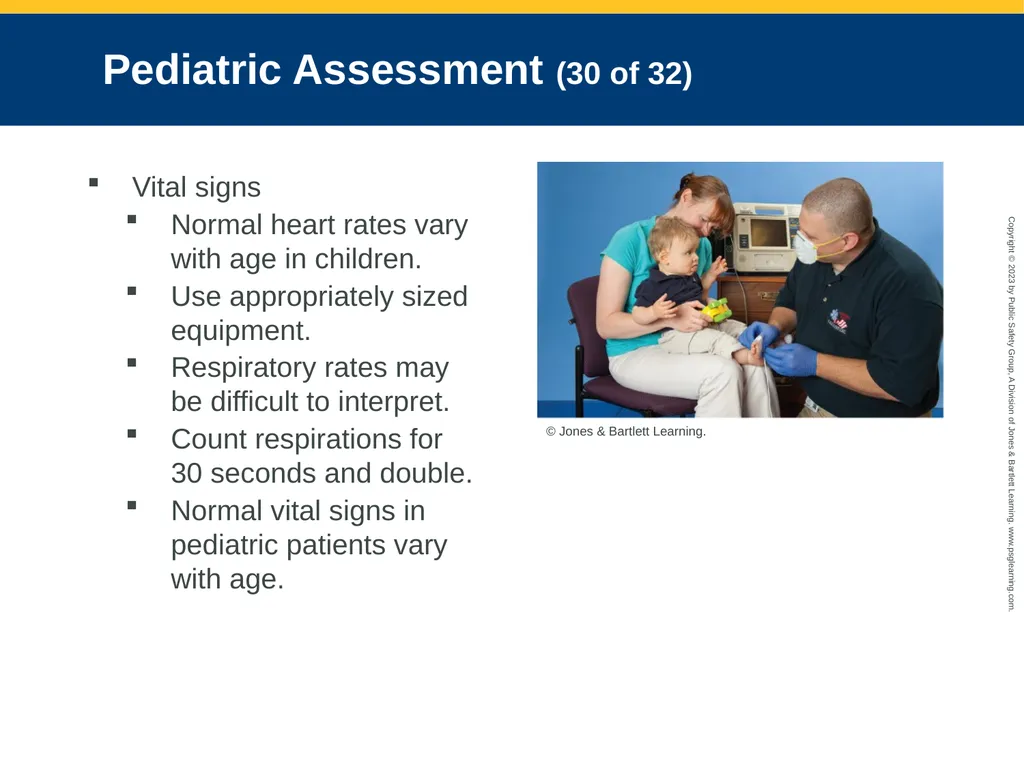
Pediatric Assessment (30 of 32) Vital signs
Normal heart rates vary with age in children.
Use appropriately sized equipment.
Respiratory rates may be difficult to interpret.
Count respirations for 30 seconds and double.
Normal vital signs in pediatric patients vary with age. © Jones & Bartlett Learning.<br>
Normal heart rates vary with age in children.
Use appropriately sized equipment.
Respiratory rates may be difficult to interpret.
Count respirations for 30 seconds and double.
Normal vital signs in pediatric patients vary with age. © Jones & Bartlett Learning.<br>
85
Pediatric Assessment (31 of 32) Reassessment
Reassess child’s condition as the situation dictates.
Continually monitor respiratory effort, skin color and condition, and level of consciousness or interactiveness.
Frequently assess oxygen saturation and vital signs.
Repeat primary survey and adjust treatment.<br>
Reassess child’s condition as the situation dictates.
Continually monitor respiratory effort, skin color and condition, and level of consciousness or interactiveness.
Frequently assess oxygen saturation and vital signs.
Repeat primary survey and adjust treatment.<br>
86
Pediatric Assessment (32 of 32) Interventions
Always consider getting help from the parent or caregiver.
Communicate and document all relevant information.<br>
Always consider getting help from the parent or caregiver.
Communicate and document all relevant information.<br>
87
Assessment and Management of Respiratory Emergencies (1 of 5) Infants have a limited ability to compensate for respiratory insults.
When you are faced with a respiratory emergency, determine the severity of the disease.<br>
When you are faced with a respiratory emergency, determine the severity of the disease.<br>
88
Assessment and Management of Respiratory Emergencies (2 of 5) Signs of respiratory distress
Pallor or mottled color
Irritability, anxiety, restlessness
Respiratory rate faster than normal for age
Retractions
Abdominal breathing
Nasal flaring
Inspiratory stridor
Grunting
Mild tachycardia<br>
Pallor or mottled color
Irritability, anxiety, restlessness
Respiratory rate faster than normal for age
Retractions
Abdominal breathing
Nasal flaring
Inspiratory stridor
Grunting
Mild tachycardia<br>
89
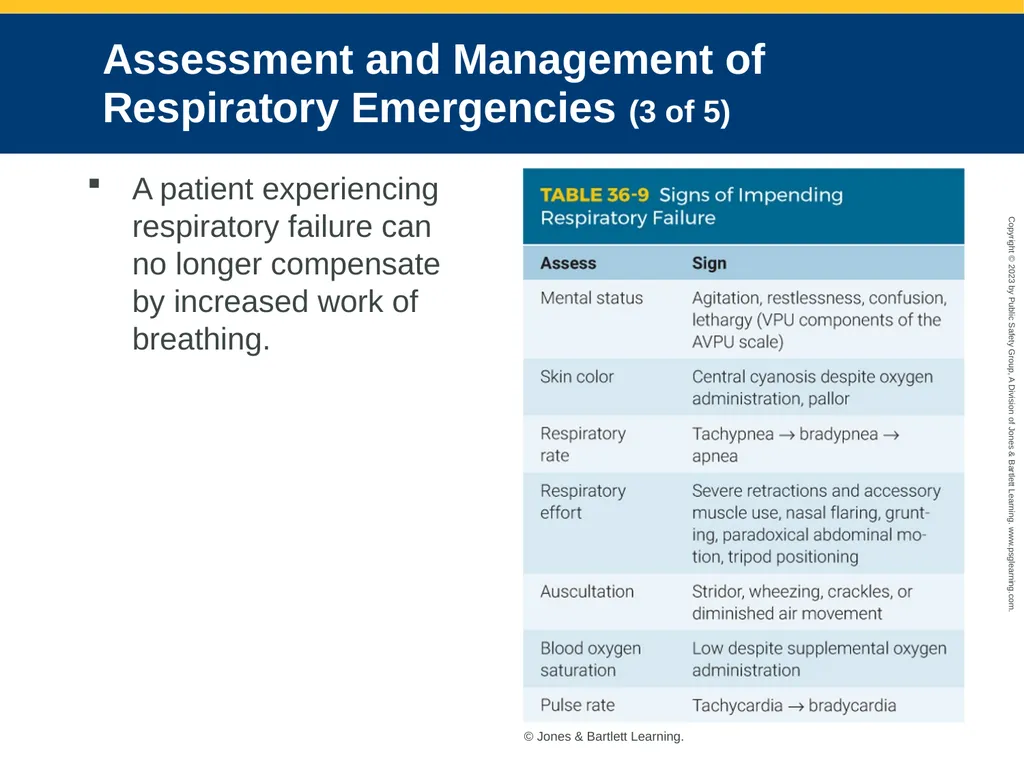
Assessment and Management of Respiratory Emergencies (3 of 5) A patient experiencing respiratory failure can no longer compensate by increased work of breathing. © Jones & Bartlett Learning.<br>
90
Assessment and Management of Respiratory Emergencies (4 of 5) Respiratory arrest
Administer immediate bag-mask ventilation with supplemental oxygen.
Resuscitation of a child from respiratory arrest is often successful.<br>
Administer immediate bag-mask ventilation with supplemental oxygen.
Resuscitation of a child from respiratory arrest is often successful.<br>
91
Assessment and Management of Respiratory Emergencies (5 of 5) Consider the following:
Give supplemental oxygen.
Perform electrocardiographic monitoring if there are no signs of clinical improvement.
Establish IV access.
Airway should be managed in least invasive way.<br>
Give supplemental oxygen.
Perform electrocardiographic monitoring if there are no signs of clinical improvement.
Establish IV access.
Airway should be managed in least invasive way.<br>
92
Upper Airway Emergencies (1 of 4) Signs and symptoms: Decreased or absent breath sounds and stridor
Foreign body aspiration or obstruction
Can be caused by any object they can fit into their mouth.
Blood, vomitus, or other secretions can also cause airway obstruction. © Jones & Bartlett Learning. Photographed by Kimberly Potvin.<br>
Foreign body aspiration or obstruction
Can be caused by any object they can fit into their mouth.
Blood, vomitus, or other secretions can also cause airway obstruction. © Jones & Bartlett Learning. Photographed by Kimberly Potvin.<br>
93
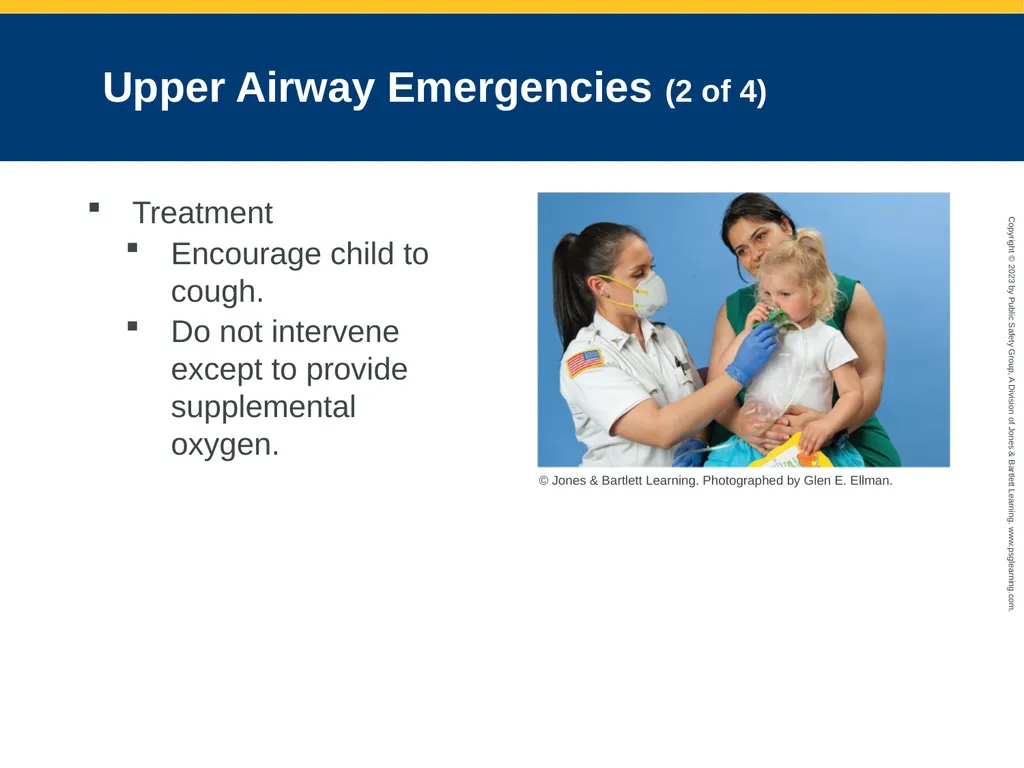
Upper Airway Emergencies (2 of 4) Treatment
Encourage child to cough.
Do not intervene except to provide supplemental oxygen. © Jones & Bartlett Learning. Photographed by Glen E. Ellman.<br>
Encourage child to cough.
Do not intervene except to provide supplemental oxygen. © Jones & Bartlett Learning. Photographed by Glen E. Ellman.<br>
94
Upper Airway Emergencies (3 of 4) Clear airway immediately if you see signs of a severe airway obstruction.
Ineffective cough (no sound)
Inability to speak or cry
Increasing respiratory difficulty, with stridor
Cyanosis
Loss of consciousness
Perform up to five back blows followed by five chest thrusts.<br>
Ineffective cough (no sound)
Inability to speak or cry
Increasing respiratory difficulty, with stridor
Cyanosis
Loss of consciousness
Perform up to five back blows followed by five chest thrusts.<br>
95
Upper Airway Emergencies (4 of 4) If a child older than 1 year, perform abdominal thrusts (Heimlich maneuver).
Open the airway using tilt–chin lift maneuver.
Look inside the mouth to see if object is visible.
Never use finger sweeps if you cannot see the object.
Chest compressions relieve a severe airway obstruction in an unresponsive patient.<br>
Open the airway using tilt–chin lift maneuver.
Look inside the mouth to see if object is visible.
Never use finger sweeps if you cannot see the object.
Chest compressions relieve a severe airway obstruction in an unresponsive patient.<br>
96
Anaphylaxis (1 of 2) Potentially life-threatening allergic reaction
Triggered by exposure to an antigen
Onset of symptoms generally occurs immediately after the exposure.
Child may be in respiratory failure and shock when you arrive.
PAT may reveal an anxious child.<br>
Triggered by exposure to an antigen
Onset of symptoms generally occurs immediately after the exposure.
Child may be in respiratory failure and shock when you arrive.
PAT may reveal an anxious child.<br>
97
Anaphylaxis (2 of 2) Primary survey: Hives, swelling of lips and oral mucosa, stridor/wheezing, and diminished pulses
SAMPLE history may reveal recent contact with or ingestion of the agent.
“Gold standard” treatment for is epinephrine.<br>
SAMPLE history may reveal recent contact with or ingestion of the agent.
“Gold standard” treatment for is epinephrine.<br>
98
Croup (1 of 3) Infection of upper airway below level of the vocal cords
Primarily affects children 6 months to 3 years of age (mostly in fall and winter months)
Causes edema and progressive airway obstruction<br>
Primarily affects children 6 months to 3 years of age (mostly in fall and winter months)
Causes edema and progressive airway obstruction<br>
99
Croup (2 of 3) PAT will reveal an alert infant or toddler who has audible stridor with activity or agitation.
Be concerned about critical airway obstruction if a child with a history compatible with croup is sleepy or obtunded, or has significant respiratory distress or cyanosis.<br>
Be concerned about critical airway obstruction if a child with a history compatible with croup is sleepy or obtunded, or has significant respiratory distress or cyanosis.<br>
100
Croup (3 of 3) Allow the child to assume a position of comfort.
Humidified oxygen may be beneficial.
Call early for paramedic backup if nebulized epinephrine is needed.
Assisted ventilation with bag-mask ventilation will often succeed in overcoming the upper airway obstruction.<br>
Humidified oxygen may be beneficial.
Call early for paramedic backup if nebulized epinephrine is needed.
Assisted ventilation with bag-mask ventilation will often succeed in overcoming the upper airway obstruction.<br>
101
Epiglottitis (1 of 3) Inflammation of the supraglottic structures
Easily distinguishable using PAT
Child looks sick and will be anxious.
Work of breathing is increased, and pallor or cyanosis may be evident.
SAMPLE history will reveal a sudden onset of high fever and sore throat.<br>
Easily distinguishable using PAT
Child looks sick and will be anxious.
Work of breathing is increased, and pallor or cyanosis may be evident.
SAMPLE history will reveal a sudden onset of high fever and sore throat.<br>
102
Epiglottitis (2 of 3) Symptoms progress rapidly.
Ask about immunizations.
Get the child to an appropriate hospital with a maintainable airway.<br>
Ask about immunizations.
Get the child to an appropriate hospital with a maintainable airway.<br>
103
Epiglottitis (3 of 3) Allow the patient to assume a position of comfort, and provide supplemental oxygen if tolerated.
Do not attempt to look in the mouth.
Do not attempt IV access.
Be prepared with a bag-mask device in case of complete obstruction and need for assisted ventilation.
Alert personnel at the receiving facility.<br>
Do not attempt to look in the mouth.
Do not attempt IV access.
Be prepared with a bag-mask device in case of complete obstruction and need for assisted ventilation.
Alert personnel at the receiving facility.<br>
104
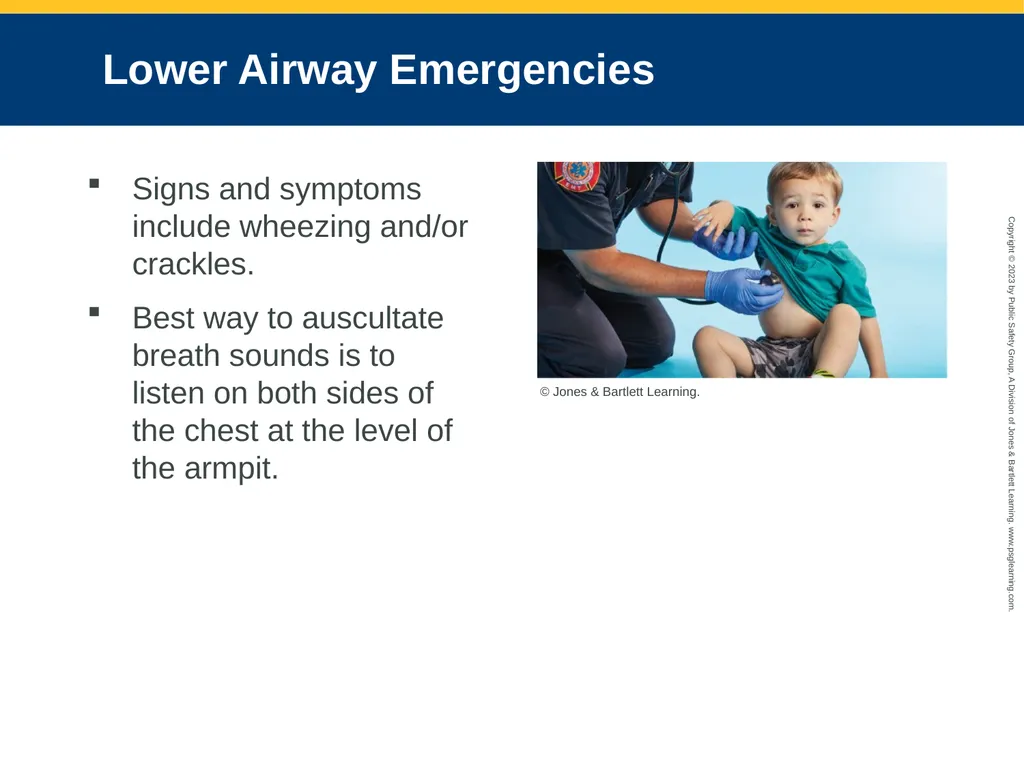
Lower Airway Emergencies Signs and symptoms include wheezing and/or crackles.
Best way to auscultate breath sounds is to listen on both sides of the chest at the level of the armpit. © Jones & Bartlett Learning.<br>
Best way to auscultate breath sounds is to listen on both sides of the chest at the level of the armpit. © Jones & Bartlett Learning.<br>
105
Asthma (1 of 7) Acute spasm and inflammation of bronchioles
Associated with excessive mucus production
Triggers include:
Upper respiratory infections
Allergies
Changes in environmental temperature
Smoke
Physical exertion, emotional stress<br>
Associated with excessive mucus production
Triggers include:
Upper respiratory infections
Allergies
Changes in environmental temperature
Smoke
Physical exertion, emotional stress<br>
106
Asthma (2 of 7) Acute asthma attack
Hyperreactive bronchioles become narrowed and cause reduction of airflow.
Immune system’s response triggers release of histamines.
As the attack progresses, expiratory airflow is further restricted.<br>
Hyperreactive bronchioles become narrowed and cause reduction of airflow.
Immune system’s response triggers release of histamines.
As the attack progresses, expiratory airflow is further restricted.<br>
107
Asthma (3 of 7) Signs and symptoms of an acute asthma attack vary and include:
Child sitting up in a preferential position
Obvious respiratory distress
Prolonged expiratory phase
Wheezing
Tachycardia
Tachypnea
Agitation<br>
Child sitting up in a preferential position
Obvious respiratory distress
Prolonged expiratory phase
Wheezing
Tachycardia
Tachypnea
Agitation<br>
108
Asthma (4 of 7) Administer oxygen by method most tolerated by the child.
You may assist with the medication or administer a nebulized beta-2 agonist per medical control.<br>
You may assist with the medication or administer a nebulized beta-2 agonist per medical control.<br>
109
Asthma (5 of 7) If child is showing signs of respiratory failure, begin assisted ventilations with a bag-mask device and 100% oxygen.
Endotracheal intubation may be necessary; call early for paramedic backup.<br>
Endotracheal intubation may be necessary; call early for paramedic backup.<br>
110
Asthma (6 of 7) Additional treatment includes:
Monitoring oxygen saturation level
Transporting promptly
Prolonged unrelieved attack may progress to status asthmaticus.
Minimal air movement
Dire emergency
Treatment is more aggressive and must be performed en route to the hospital.<br>
Monitoring oxygen saturation level
Transporting promptly
Prolonged unrelieved attack may progress to status asthmaticus.
Minimal air movement
Dire emergency
Treatment is more aggressive and must be performed en route to the hospital.<br>
111
Asthma (7 of 7) Symptoms include:
Respiratory failure
Hypoxia
Acidosis
Physical exhaustion
Requires assisted ventilations or advanced airway management<br>
Respiratory failure
Hypoxia
Acidosis
Physical exhaustion
Requires assisted ventilations or advanced airway management<br>
112
Pneumonia (1 of 3) Common disease that infects the lower airway and lungs
Commonly seen in infants, toddlers, and preschoolers
Usually caused by a virus
Recent history of cough or cold, or lower airway infection<br>
Commonly seen in infants, toddlers, and preschoolers
Usually caused by a virus
Recent history of cough or cold, or lower airway infection<br>
113
Pneumonia (2 of 3) Presentation may include:
Unusually rapid breathing, or breathing with grunting or wheezing sounds
Nasal flaring
Tachypnea
Crackles
Hypothermia or fever
Unilateral diminished breath sounds<br>
Unusually rapid breathing, or breathing with grunting or wheezing sounds
Nasal flaring
Tachypnea
Crackles
Hypothermia or fever
Unilateral diminished breath sounds<br>
114
Pneumonia (3 of 3) Primary treatment will be supportive.
Monitor airway and breathing status.
Administer supplemental oxygen if required.
Administer bronchodilator if child is wheezing.
Vascular access is generally not indicated.
If child’s condition warrants medication therapy, establish IV or IO access en route to the hospital.<br>
Monitor airway and breathing status.
Administer supplemental oxygen if required.
Administer bronchodilator if child is wheezing.
Vascular access is generally not indicated.
If child’s condition warrants medication therapy, establish IV or IO access en route to the hospital.<br>
115
Bronchiolitis (1 of 3) Viral infection
Results in inflammation and constriction of the bronchioles
Often caused by RSV
Occurs in the first 2 years of life
More common in males
Widespread in winter and early spring<br>
Results in inflammation and constriction of the bronchioles
Often caused by RSV
Occurs in the first 2 years of life
More common in males
Widespread in winter and early spring<br>
116
Bronchiolitis (2 of 3) Bronchioles become inflamed, swell, and fill with mucus.
Airways of infants and young children can become easily blocked.
Look for signs of dehydration.
Shortness of breath and fever may be present.<br>
Airways of infants and young children can become easily blocked.
Look for signs of dehydration.
Shortness of breath and fever may be present.<br>
117
Bronchiolitis (3 of 3) Treatment
Use a calm demeanor.
Allow for a position of comfort.
Treat airway and breathing problems as appropriate.
Humidified oxygen is helpful if available.
Be prepared to assist ventilations as needed.
Call early for paramedic backup for advanced airway management.<br>
Use a calm demeanor.
Allow for a position of comfort.
Treat airway and breathing problems as appropriate.
Humidified oxygen is helpful if available.
Be prepared to assist ventilations as needed.
Call early for paramedic backup for advanced airway management.<br>
118
Pertussis (1 of 2) Potentially deadly disease caused by a bacterium spread through respiratory droplets
As a result of vaccinations, it is less common in the United States.
Signs and symptoms are similar to a common cold: coughing, sneezing, and runny nose.<br>
As a result of vaccinations, it is less common in the United States.
Signs and symptoms are similar to a common cold: coughing, sneezing, and runny nose.<br>
119
Pertussis (2 of 2) As disease progresses, coughing becomes more severe and is characterized by the distinctive whoop sound heard during the inspiratory phase.
Keep the airway patent and transport.
Because it is contagious, follow standard precautions.<br>
Keep the airway patent and transport.
Because it is contagious, follow standard precautions.<br>
120
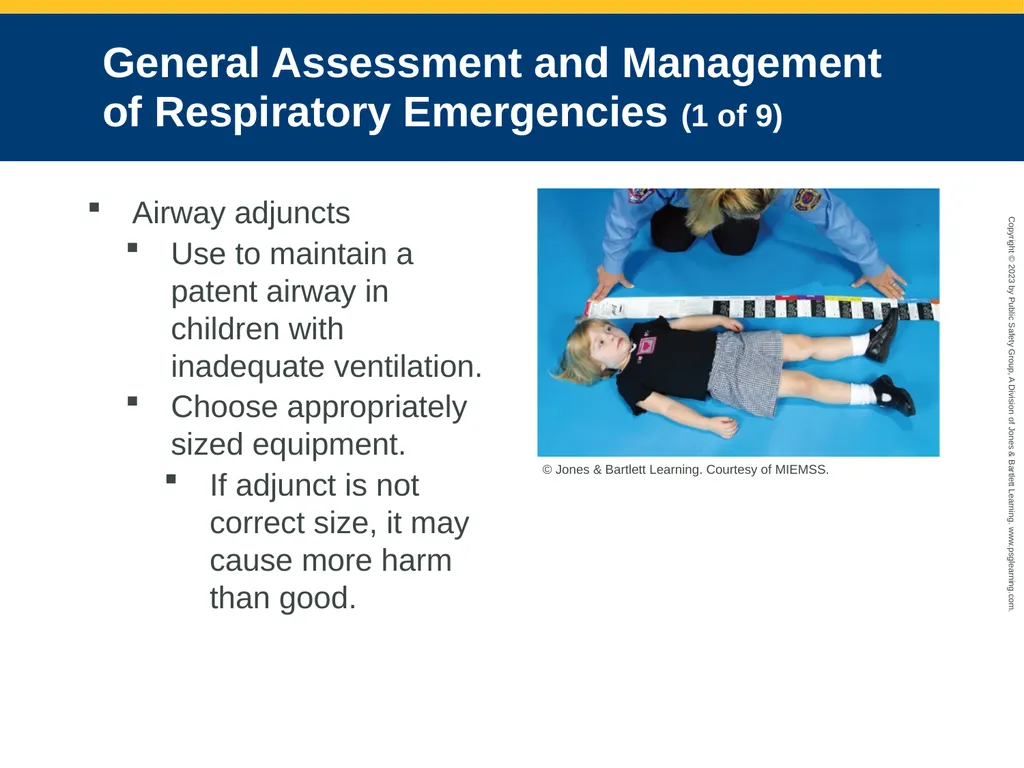
General Assessment and Management of Respiratory Emergencies (1 of 9) Airway adjuncts
Use to maintain a patent airway in children with inadequate ventilation.
Choose appropriately sized equipment.
If adjunct is not correct size, it may cause more harm than good. © Jones & Bartlett Learning. Courtesy of MIEMSS.<br>
Use to maintain a patent airway in children with inadequate ventilation.
Choose appropriately sized equipment.
If adjunct is not correct size, it may cause more harm than good. © Jones & Bartlett Learning. Courtesy of MIEMSS.<br>
121
General Assessment and Management of Respiratory Emergencies (2 of 9) Oropharyngeal airway
Used for patients who are unresponsive and in respiratory failure
Should not be used in responsive patients or those who have a gag reflex
Should not be used in children who have ingested a caustic or petroleum-based product
Avoid injuring the hard palate.<br>
Used for patients who are unresponsive and in respiratory failure
Should not be used in responsive patients or those who have a gag reflex
Should not be used in children who have ingested a caustic or petroleum-based product
Avoid injuring the hard palate.<br>
122
General Assessment and Management of Respiratory Emergencies (3 of 9) Nasopharyngeal airway
Used for responsive pediatric patients with respiratory failure
Rarely used in infants younger than 1 year
Should not be used in patients with:
Nasal obstruction
Facial trauma
Moderate to severe head trauma<br>
Used for responsive pediatric patients with respiratory failure
Rarely used in infants younger than 1 year
Should not be used in patients with:
Nasal obstruction
Facial trauma
Moderate to severe head trauma<br>
123
General Assessment and Management of Respiratory Emergencies (4 of 9) Oxygen delivery devices
All ill or injured infants and children should receive supplemental oxygen.
Method will be determined by the adequacy of the patient’s breathing, or tidal volume.<br>
All ill or injured infants and children should receive supplemental oxygen.
Method will be determined by the adequacy of the patient’s breathing, or tidal volume.<br>
124
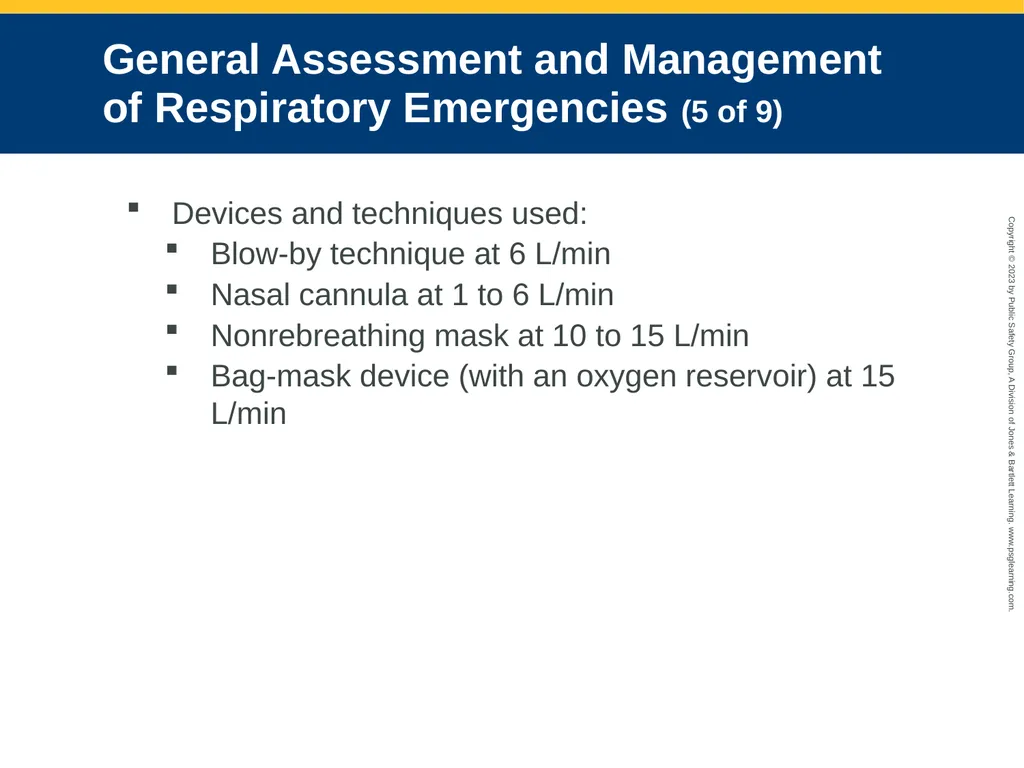
General Assessment and Management of Respiratory Emergencies (5 of 9) Devices and techniques used:
Blow-by technique at 6 L/min
Nasal cannula at 1 to 6 L/min
Nonrebreathing mask at 10 to 15 L/min
Bag-mask device (with an oxygen reservoir) at 15 L/min<br>
Blow-by technique at 6 L/min
Nasal cannula at 1 to 6 L/min
Nonrebreathing mask at 10 to 15 L/min
Bag-mask device (with an oxygen reservoir) at 15 L/min<br>
125
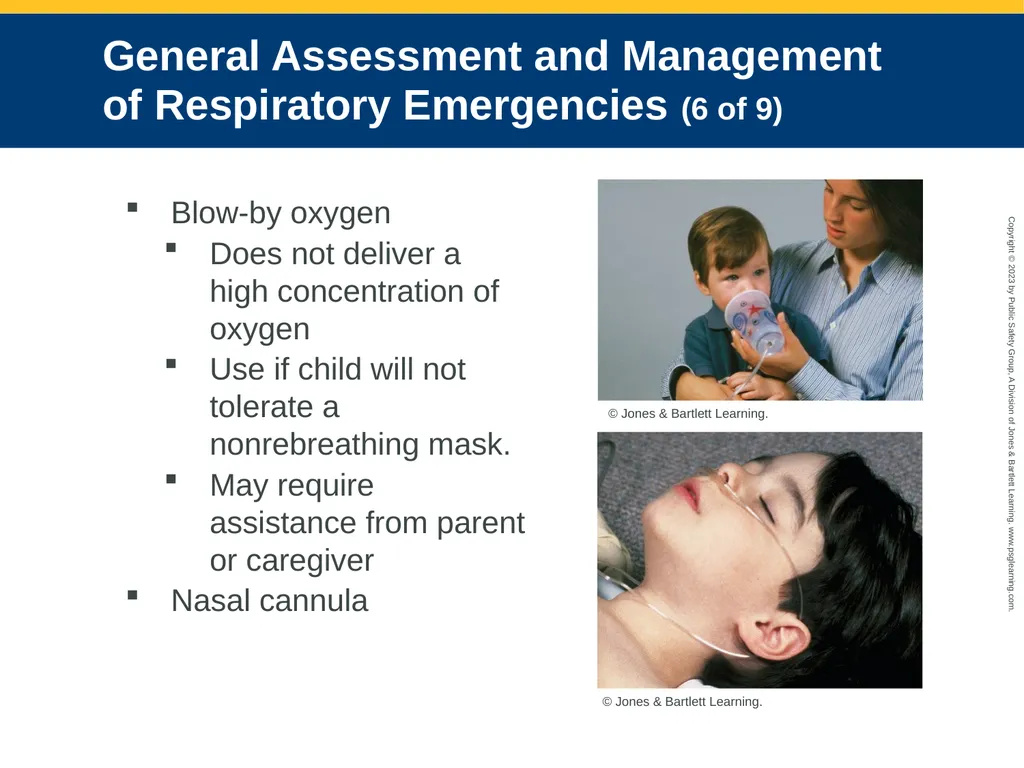
General Assessment and Management of Respiratory Emergencies (6 of 9) Blow-by oxygen
Does not deliver a high concentration of oxygen
Use if child will not tolerate a nonrebreathing mask.
May require assistance from parent or caregiver
Nasal cannula © Jones & Bartlett Learning. © Jones & Bartlett Learning.<br>
Does not deliver a high concentration of oxygen
Use if child will not tolerate a nonrebreathing mask.
May require assistance from parent or caregiver
Nasal cannula © Jones & Bartlett Learning. © Jones & Bartlett Learning.<br>
126
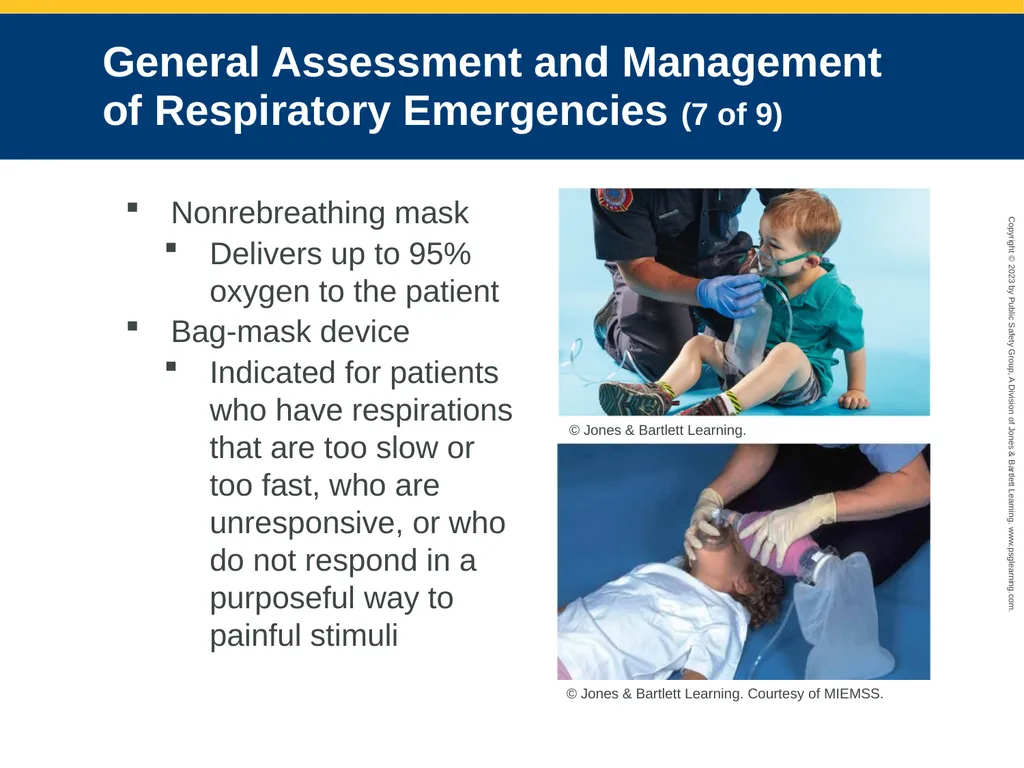
General Assessment and Management of Respiratory Emergencies (7 of 9) Nonrebreathing mask
Delivers up to 95% oxygen to the patient
Bag-mask device
Indicated for patients who have respirations that are too slow or too fast, who are unresponsive, or who do not respond in a purposeful way to painful stimuli © Jones & Bartlett Learning. © Jones & Bartlett Learning. Courtesy of MIEMSS.<br>
Delivers up to 95% oxygen to the patient
Bag-mask device
Indicated for patients who have respirations that are too slow or too fast, who are unresponsive, or who do not respond in a purposeful way to painful stimuli © Jones & Bartlett Learning. © Jones & Bartlett Learning. Courtesy of MIEMSS.<br>
127
General Assessment and Management of Respiratory Emergencies (8 of 9) Two-rescuer bag-mask device ventilation
Requires two AEMTs
Usually more effective in maintaining a tight seal
Ventilating the trauma patient is a two-person skill.<br>
Requires two AEMTs
Usually more effective in maintaining a tight seal
Ventilating the trauma patient is a two-person skill.<br>
128
General Assessment and Management of Respiratory Emergencies (9 of 9) Cardiopulmonary arrest
Most often associated with respiratory failure and arrest
Children become hypoxic and the hearts slow down, becoming more bradycardic.
Overall survival rate from cardiac arrest in the prehospital setting is low.
Ventilate early with high oxygen concentrations to avoid the development of cardiac arrest.<br>
Most often associated with respiratory failure and arrest
Children become hypoxic and the hearts slow down, becoming more bradycardic.
Overall survival rate from cardiac arrest in the prehospital setting is low.
Ventilate early with high oxygen concentrations to avoid the development of cardiac arrest.<br>
129
Assessment and Management of Circulation Emergencies (1 of 17) Shock
Develops when circulatory system is unable to deliver a sufficient amount of blood to the organs of the body
Children can compensate for shock longer than adults.
Hypotension occurs quickly and unpredictably, and may result in rapid deterioration to cardiopulmonary arrest.<br>
Develops when circulatory system is unable to deliver a sufficient amount of blood to the organs of the body
Children can compensate for shock longer than adults.
Hypotension occurs quickly and unpredictably, and may result in rapid deterioration to cardiopulmonary arrest.<br>
130
Assessment and Management of Circulation Emergencies (2 of 17) Common causes include hypovolemia, sepsis, allergic reactions, and poisonings.
Signs of shock
Tachycardia
Poor capillary refill time (greater than 2 seconds)
Mental status changes
Begin treating by assessing ABCDEs, intervening immediately as required.
Pediatric patients may not demonstrate a decrease in blood pressure until shock is severe.<br>
Signs of shock
Tachycardia
Poor capillary refill time (greater than 2 seconds)
Mental status changes
Begin treating by assessing ABCDEs, intervening immediately as required.
Pediatric patients may not demonstrate a decrease in blood pressure until shock is severe.<br>
131
Assessment and Management of Circulation Emergencies (3 of 17) Assessing circulation:
Changes in pulse rate, color, skin signs, and capillary refill time
Blood pressure is difficult to measure.
Cuff must be proper size
Value for normal blood pressure is age-specific.
May be normal with compensated shock
Low blood pressure is a sign of decompensated shock.<br>
Changes in pulse rate, color, skin signs, and capillary refill time
Blood pressure is difficult to measure.
Cuff must be proper size
Value for normal blood pressure is age-specific.
May be normal with compensated shock
Low blood pressure is a sign of decompensated shock.<br>
132
Assessment and Management of Circulation Emergencies (4 of 17) Determine when signs and symptoms first appeared
Decrease in urine output
Absence of tears, even when the child is crying
A sunken or depressed fontanelle
Changes in level of consciousness and behavior
Time should not be wasted performing field procedures.<br>
Decrease in urine output
Absence of tears, even when the child is crying
A sunken or depressed fontanelle
Changes in level of consciousness and behavior
Time should not be wasted performing field procedures.<br>
133
Assessment and Management of Circulation Emergencies (5 of 17) Anaphylactic shock
Anaphylaxis: Major allergic reaction that involves a generalized, multisystem response to an antigen
Common causes are insect stings, medications, or food.<br>
Anaphylaxis: Major allergic reaction that involves a generalized, multisystem response to an antigen
Common causes are insect stings, medications, or food.<br>
134
Assessment and Management of Circulation Emergencies (6 of 17) Signs and symptoms:
Hypoperfusion
Stridor and/or wheezing
Increased work of breathing
Altered appearance
Restlessness, agitation, and sometimes a sense of impending doom
Hives are usually present.<br>
Hypoperfusion
Stridor and/or wheezing
Increased work of breathing
Altered appearance
Restlessness, agitation, and sometimes a sense of impending doom
Hives are usually present.<br>
135
Assessment and Management of Circulation Emergencies (7 of 17) Treatment:
Maintain the airway and administer oxygen.
In stable patients, allow the parent or caregiver to assist in the positioning of the patient, oxygen delivery, and keeping the patient calm.
Transport promptly.
Administer epinephrine subcutaneously or via auto injector.
Obtain IV or IO access and administer 20 mL/kg isotonic crystalloid solution.
Call early for paramedic backup.<br>
Maintain the airway and administer oxygen.
In stable patients, allow the parent or caregiver to assist in the positioning of the patient, oxygen delivery, and keeping the patient calm.
Transport promptly.
Administer epinephrine subcutaneously or via auto injector.
Obtain IV or IO access and administer 20 mL/kg isotonic crystalloid solution.
Call early for paramedic backup.<br>
136
Assessment and Management of Circulation Emergencies (8 of 17) Bleeding disorders
Hemophilia: Congenital condition in which patient lacks one or more normal clotting factors of blood
Hereditary
Found predominantly in males
All injuries are potentially serious.
Transport immediately.<br>
Hemophilia: Congenital condition in which patient lacks one or more normal clotting factors of blood
Hereditary
Found predominantly in males
All injuries are potentially serious.
Transport immediately.<br>
137
Assessment and Management of Circulation Emergencies (9 of 17) Intravenous access
Not performed as frequently in children as in adults
Technique, indications, and contraindications are same as they are for adults.<br>
Not performed as frequently in children as in adults
Technique, indications, and contraindications are same as they are for adults.<br>
138
Assessment and Management of Circulation Emergencies (10 of 17) Catheters
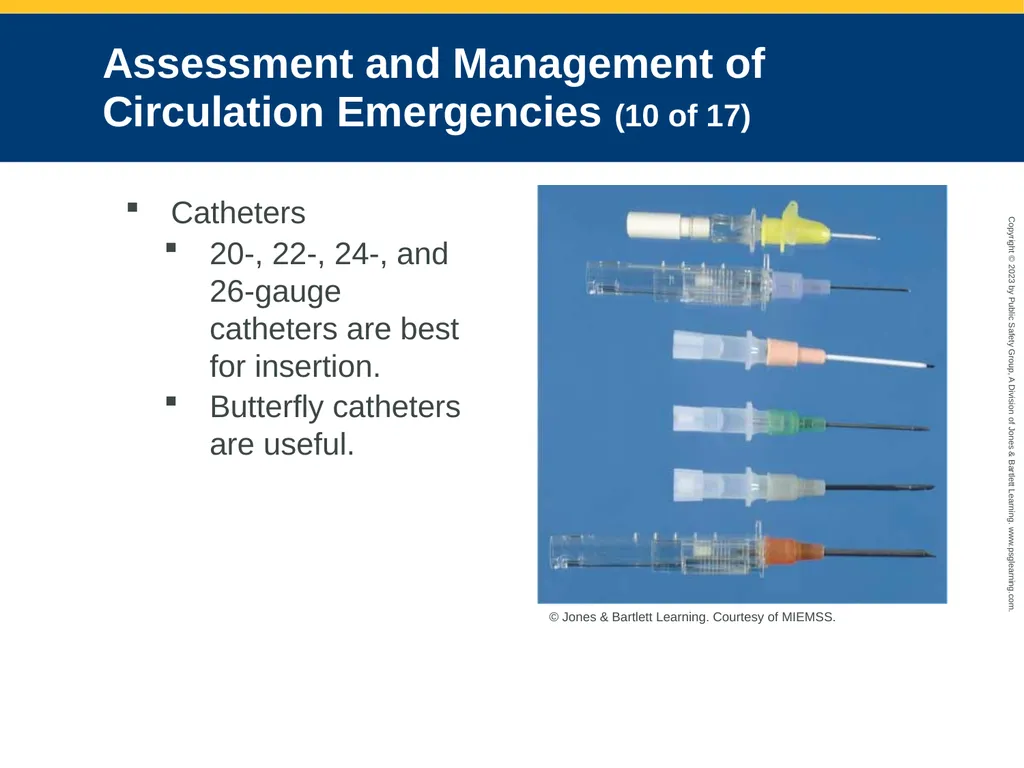
20-, 22-, 24-, and 26-gauge catheters are best for insertion.
Butterfly catheters are useful. © Jones & Bartlett Learning. Courtesy of MIEMSS.<br>
20-, 22-, 24-, and 26-gauge catheters are best for insertion.
Butterfly catheters are useful. © Jones & Bartlett Learning. Courtesy of MIEMSS.<br>
139
Assessment and Management of Circulation Emergencies (11 of 17) Administration sets
Fluid control is important.
Use a special type of microdrip set called a Volutrol (or Buretrol).
A regular microdrip administration set can also be used if Volutrol is not used.<br>
Fluid control is important.
Use a special type of microdrip set called a Volutrol (or Buretrol).
A regular microdrip administration set can also be used if Volutrol is not used.<br>
140
Assessment and Management of Circulation Emergencies (12 of 17) IV locations
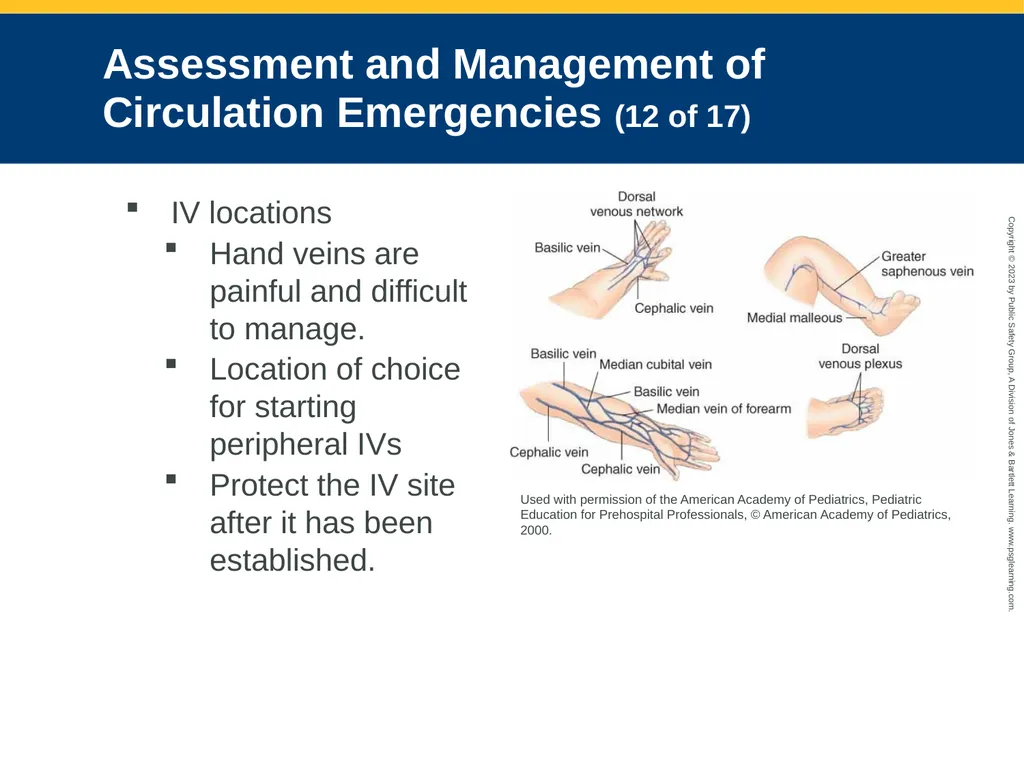
Hand veins are painful and difficult to manage.
Location of choice for starting peripheral IVs
Protect the IV site after it has been established. Used with permission of the American Academy of Pediatrics, Pediatric Education for Prehospital Professionals, © American Academy of Pediatrics, 2000.<br>
Hand veins are painful and difficult to manage.
Location of choice for starting peripheral IVs
Protect the IV site after it has been established. Used with permission of the American Academy of Pediatrics, Pediatric Education for Prehospital Professionals, © American Academy of Pediatrics, 2000.<br>
141
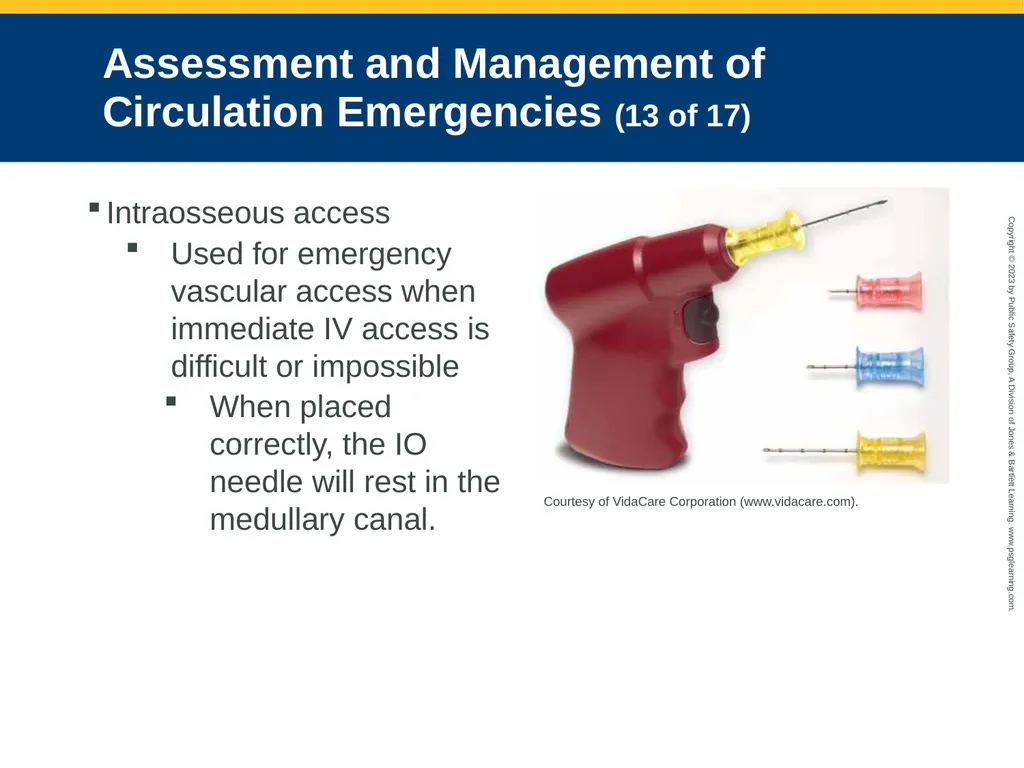
Assessment and Management of Circulation Emergencies (13 of 17) Intraosseous access
Used for emergency vascular access when immediate IV access is difficult or impossible
When placed correctly, the IO needle will rest in the medullary canal. Courtesy of VidaCare Corporation (www.vidacare.com).<br>
Used for emergency vascular access when immediate IV access is difficult or impossible
When placed correctly, the IO needle will rest in the medullary canal. Courtesy of VidaCare Corporation (www.vidacare.com).<br>
142
Assessment and Management of Circulation Emergencies (14 of 17) IO infusion is contradicted if a:
Secure IV is available
Possible fracture exists in the bone in which you plan to insert the IO needle
IO needle is usually inserted in the proximal tibia.
IO lines require full and careful stabilization.<br>
Secure IV is available
Possible fracture exists in the bone in which you plan to insert the IO needle
IO needle is usually inserted in the proximal tibia.
IO lines require full and careful stabilization.<br>
143
Assessment and Management of Circulation Emergencies (15 of 17) Potential complications:
Compartment syndrome
Failed infusion
Growth plate injury
Osteomyelitis
Skin infection
Bony fracture<br>
Compartment syndrome
Failed infusion
Growth plate injury
Osteomyelitis
Skin infection
Bony fracture<br>
144
Assessment and Management of Circulation Emergencies (16 of 17) Fluid resuscitation
Appropriate fluid administration is crucial.
IV fluids must be administered based on the child’s clinical condition.
If too much fluid is administered, overload can result.<br>
Appropriate fluid administration is crucial.
IV fluids must be administered based on the child’s clinical condition.
If too much fluid is administered, overload can result.<br>
145
Assessment and Management of Circulation Emergencies (17 of 17) If fluid volume is insufficient, it will not be effective in treating the child’s condition.
Fluid resuscitation for hypovolemic shock begins with an initial bolus of 20 mL/kg of an isotonic crystalloid solution, followed by a careful reassessment.<br>
Fluid resuscitation for hypovolemic shock begins with an initial bolus of 20 mL/kg of an isotonic crystalloid solution, followed by a careful reassessment.<br>
146
Assessment and Management of Neurologic Emergencies (1 of 14) Altered mental status
Several common causes
Hypoglycemia
Hypoxia
Seizure
Drug or alcohol ingestion<br>
Several common causes
Hypoglycemia
Hypoxia
Seizure
Drug or alcohol ingestion<br>
147
Assessment and Management of Neurologic Emergencies (2 of 14) Altered mental status (cont’d)
May be exhibited in many ways:
Lack of response to vocal commands and pain
Combative behavior
Confusion
Thrashing about
Drifting into and out of an alert state
Change in pitch and nature of the cry
Mnemonic AEIOU-TIPS<br>
May be exhibited in many ways:
Lack of response to vocal commands and pain
Combative behavior
Confusion
Thrashing about
Drifting into and out of an alert state
Change in pitch and nature of the cry
Mnemonic AEIOU-TIPS<br>
148
Assessment and Management of Neurologic Emergencies (3 of 14) Signs and symptoms vary from simple confusion to coma.
Management focuses on ABCs and transport.
If the level of consciousness is low, the child may not be able to protect the airway.
Ensure a patent airway and adequate breathing.<br>
Management focuses on ABCs and transport.
If the level of consciousness is low, the child may not be able to protect the airway.
Ensure a patent airway and adequate breathing.<br>
149
Assessment and Management of Neurologic Emergencies (4 of 14) Seizures
Common causes
Child abuse
Electrolyte imbalance
Fever
Hypoglycemia
Infection
Ingestion
Hypoxia
Medications
Poisoning
Seizure disorder
Recreational drug use
Head trauma
Idiopathic<br>
Common causes
Child abuse
Electrolyte imbalance
Fever
Hypoglycemia
Infection
Ingestion
Hypoxia
Medications
Poisoning
Seizure disorder
Recreational drug use
Head trauma
Idiopathic<br>
150
Assessment and Management of Neurologic Emergencies (5 of 14) May manifest in a variety of ways, depending on the age of the child
Seizures in infants can be very subtle.
In older children, seizures are more obvious and typically consist of repetitive muscle contractions and unresponsiveness.<br>
Seizures in infants can be very subtle.
In older children, seizures are more obvious and typically consist of repetitive muscle contractions and unresponsiveness.<br>
151
Assessment and Management of Neurologic Emergencies (6 of 14) Once a seizure stops, patient’s muscles relax and breathing becomes labored.
Postictal state
Seizures that continue every few minutes without regaining responsiveness or last longer than 30 minutes are referred to as status epilepticus.
Should be considered potentially life threatening<br>
Postictal state
Seizures that continue every few minutes without regaining responsiveness or last longer than 30 minutes are referred to as status epilepticus.
Should be considered potentially life threatening<br>
152
Assessment and Management of Neurologic Emergencies (7 of 14) Management
Securing and protecting the airway are priorities.
Position head to open airway.
Clear mouth with suction.
Consider placing the child in the recovery position if the child is vomiting and suction is inadequate. © Jones & Bartlett Learning.<br>
Securing and protecting the airway are priorities.
Position head to open airway.
Clear mouth with suction.
Consider placing the child in the recovery position if the child is vomiting and suction is inadequate. © Jones & Bartlett Learning.<br>
153
Assessment and Management of Neurologic Emergencies (8 of 14) Febrile seizures
Caused by an abrupt rise in body temperature
Most are result of fever alone
Characterized by generalized tonic-clonic seizure activity
Last less than 15 minutes with short or no postictal state
Determine if the patient has a history of past febrile seizures.<br>
Caused by an abrupt rise in body temperature
Most are result of fever alone
Characterized by generalized tonic-clonic seizure activity
Last less than 15 minutes with short or no postictal state
Determine if the patient has a history of past febrile seizures.<br>
154
Assessment and Management of Neurologic Emergencies (9 of 14) Management
Assess ABCDEs.
Provide cooling with tepid water.
Provide prompt transport.
Establish IV or IO access.
Obtain a blood glucose reading.
Administer glucose if the child is hypoglycemic. © American Academy of Orthopaedic Surgeons.<br>
Assess ABCDEs.
Provide cooling with tepid water.
Provide prompt transport.
Establish IV or IO access.
Obtain a blood glucose reading.
Administer glucose if the child is hypoglycemic. © American Academy of Orthopaedic Surgeons.<br>
155
Assessment and Management of Neurologic Emergencies (10 of 14) Meningitis
Inflammation of meninges
Caused by an infection by bacteria, viruses, fungi, or parasites
If left untreated, can lead to permanent brain damage or death.<br>
Inflammation of meninges
Caused by an infection by bacteria, viruses, fungi, or parasites
If left untreated, can lead to permanent brain damage or death.<br>
156
Assessment and Management of Neurologic Emergencies (11 of 14) People at greater risk:
Males
Newborn infants
Geriatric patients
Prior history of meningitis
Living in crowded conditions
Children who have not received proper immunizations
Compromised immune systems
History of trauma or brain surgery
Shunts, pins, or other foreign bodies within their brain or spinal cord<br>
Males
Newborn infants
Geriatric patients
Prior history of meningitis
Living in crowded conditions
Children who have not received proper immunizations
Compromised immune systems
History of trauma or brain surgery
Shunts, pins, or other foreign bodies within their brain or spinal cord<br>
157
Assessment and Management of Neurologic Emergencies (12 of 14) Signs and symptoms of meningitis vary, depending on the age of the patient.
Fever, headache, and altered level of consciousness, seizure
Infants younger than 2 to 3 months can have apnea, cyanosis, fever, a distinct high-pitched cry, or hypothermia.
Increasing irritability and a bulging fontanelle without crying<br>
Fever, headache, and altered level of consciousness, seizure
Infants younger than 2 to 3 months can have apnea, cyanosis, fever, a distinct high-pitched cry, or hypothermia.
Increasing irritability and a bulging fontanelle without crying<br>
158
Assessment and Management of Neurologic Emergencies (13 of 14) Neisseria meningitidis causes a rapid onset of meningitis symptoms, often leading to shock and death.
All patients should be considered highly contagious and infectious. © Mediscan/Alamy Stock Photo.<br>
All patients should be considered highly contagious and infectious. © Mediscan/Alamy Stock Photo.<br>
159
Assessment and Management of Neurologic Emergencies (14 of 14) Treatment:
Provide supplemental oxygen.
Assist with ventilations if necessary.
Reassess vital signs frequently.
If vital signs are unstable, obtain vascular access and administer IV fluids.<br>
Provide supplemental oxygen.
Assist with ventilations if necessary.
Reassess vital signs frequently.
If vital signs are unstable, obtain vascular access and administer IV fluids.<br>
160
Assessment and Management of Gastrointestinal Emergencies (1 of 3) Signs and symptoms may be vague.
Patients may not be able to pinpoint the exact site where the pain or discomfort originates.
Large amount of bleeding may occur within the abdominal cavity without any outward signs of shock.
Monitor for signs and symptoms of shock.
A common source of gastrointestinal upset is the ingestion of certain foods.<br>
Patients may not be able to pinpoint the exact site where the pain or discomfort originates.
Large amount of bleeding may occur within the abdominal cavity without any outward signs of shock.
Monitor for signs and symptoms of shock.
A common source of gastrointestinal upset is the ingestion of certain foods.<br>
161
Assessment and Management of Gastrointestinal Emergencies (2 of 3) Appendicitis is also common.
If untreated, it can lead to peritonitis or shock.
Presents with a fever and pain on palpation of the right lower abdominal quadrant
Rebound tenderness is a common sign.
Transport to the hospital for further evaluation.<br>
If untreated, it can lead to peritonitis or shock.
Presents with a fever and pain on palpation of the right lower abdominal quadrant
Rebound tenderness is a common sign.
Transport to the hospital for further evaluation.<br>
162
Assessment and Management of Gastrointestinal Emergencies (3 of 3) Obtain a thorough history from the parent or primary caregiver.
How many wet diapers has the child had today?
Is your child tolerating liquids, and is the child able to keep them down?
How many times has your child had diarrhea and for how long?
Are tears present when your child cries?<br>
How many wet diapers has the child had today?
Is your child tolerating liquids, and is the child able to keep them down?
How many times has your child had diarrhea and for how long?
Are tears present when your child cries?<br>
163
Assessment and Management of Toxicologic Emergencies (1 of 6) Poisoning is common among children.
Can occur by ingesting, inhaling, injecting, or absorbing a toxic substance<br>
Can occur by ingesting, inhaling, injecting, or absorbing a toxic substance<br>
164
Assessment and Management of Toxicologic Emergencies (2 of 6) Common sources of poisoning:
Alcohol
Aspirin, acetaminophen
Household cleaning products
Houseplants
Iron
Prescription medications
Illicit drugs
Vitamins
Signs and symptoms of poisoning vary widely, depending on the substance and the age and weight of the child.<br>
Alcohol
Aspirin, acetaminophen
Household cleaning products
Houseplants
Iron
Prescription medications
Illicit drugs
Vitamins
Signs and symptoms of poisoning vary widely, depending on the substance and the age and weight of the child.<br>
165
Assessment and Management of Toxicologic Emergencies (3 of 6) The patient may appear normal at first, or may be confused, sleepy, or unresponsive.
May result from being fed a harmful substance or child abuse
May be exposed to drugs and poisons © Jones & Bartlett Learning.<br>
May result from being fed a harmful substance or child abuse
May be exposed to drugs and poisons © Jones & Bartlett Learning.<br>
166
Assessment and Management of Toxicologic Emergencies (4 of 6) After primary survey and immediate life threats are addressed, ask:
What is the substance(s) involved?
Approximately how much of the substance was ingested or involved in the exposure?
What time did the incident occur?
Has the child vomited?
How much does the child weigh?
Are there any changes in behavior or level of consciousness?<br>
What is the substance(s) involved?
Approximately how much of the substance was ingested or involved in the exposure?
What time did the incident occur?
Has the child vomited?
How much does the child weigh?
Are there any changes in behavior or level of consciousness?<br>
167
Assessment and Management of Toxicologic Emergencies (5 of 6) Treatment
Perform external decontamination.
Remove tablets or fragments from the patient’s mouth.
Wash or brush the poison from the skin.
Assess and maintain ABCs.
If child demonstrates signs and symptoms of shock, position the child supine, keep the child warm, and transport promptly.<br>
Perform external decontamination.
Remove tablets or fragments from the patient’s mouth.
Wash or brush the poison from the skin.
Assess and maintain ABCs.
If child demonstrates signs and symptoms of shock, position the child supine, keep the child warm, and transport promptly.<br>
168
Assessment and Management of Toxicologic Emergencies (6 of 6) Give activated charcoal, if approved by medical control.
Not indicated for patients who have ingested an acid, an alkali, or a petroleum product
Not recommended for patients who have a decreased level of consciousness and cannot protect their airway
Usual dose for a child is 0.5 to 1 g of activated charcoal per kilogram of body weight.<br>
Not indicated for patients who have ingested an acid, an alkali, or a petroleum product
Not recommended for patients who have a decreased level of consciousness and cannot protect their airway
Usual dose for a child is 0.5 to 1 g of activated charcoal per kilogram of body weight.<br>
169
Assessment and Management of Dehydration Emergencies (1 of 2) Vomiting and diarrhea are the most common causes of dehydration.
Young children can compensate by decreasing blood flow to the extremities and directing it to vital organs. Courtesy of Ronald Dieckmann, M.D.<br>
Young children can compensate by decreasing blood flow to the extremities and directing it to vital organs. Courtesy of Ronald Dieckmann, M.D.<br>
170
Assessment and Management of Dehydration Emergencies (2 of 2) Treatment
Assess ABCDEs and obtain baseline vital signs.
Transport if signs are moderate to severe.<br>
Assess ABCDEs and obtain baseline vital signs.
Transport if signs are moderate to severe.<br>
171
Assessment and Management of Fever Emergencies (1 of 5) Common reason caregivers call 9-1-1
Increase in body temperature, usually in response to an infection
Temperatures of 100.4°F (38°C) or higher are considered abnormal.
Rarely life threatening<br>
Increase in body temperature, usually in response to an infection
Temperatures of 100.4°F (38°C) or higher are considered abnormal.
Rarely life threatening<br>
172
Assessment and Management of Fever Emergencies (2 of 5) Common causes
Infection
Status epilepticus
Neoplasm (cancer)
Drug ingestion (aspirin)
Collagen vascular disease, including arthritis and systemic lupus erythematosus
High environmental temperature
Hyperthermia: Increase in body temperature caused by an inability of the body to cool itself<br>
Infection
Status epilepticus
Neoplasm (cancer)
Drug ingestion (aspirin)
Collagen vascular disease, including arthritis and systemic lupus erythematosus
High environmental temperature
Hyperthermia: Increase in body temperature caused by an inability of the body to cool itself<br>
173
Assessment and Management of Fever Emergencies (3 of 5) Accurate body temperature is important.
Rectal temperature is most accurate for infants to toddlers. Data from American Heart Association (AHA). Vital signs in children.
In: AHA. Pediatric Advanced Life Support. Dallas, TX: AHA; 2015.<br>
Rectal temperature is most accurate for infants to toddlers. Data from American Heart Association (AHA). Vital signs in children.
In: AHA. Pediatric Advanced Life Support. Dallas, TX: AHA; 2015.<br>
174
Assessment and Management of Fever Emergencies (4 of 5) Fever can have several causes.
Signs and symptoms:
Respiratory distress
Shock
Stiff neck
Rash
Skin hot to the touch
Flushed cheeks
Seizures
Sensitivity to light
Bulging fontanelles in infants<br>
Signs and symptoms:
Respiratory distress
Shock
Stiff neck
Rash
Skin hot to the touch
Flushed cheeks
Seizures
Sensitivity to light
Bulging fontanelles in infants<br>
175
Assessment and Management of Fever Emergencies (5 of 5) Provide immediate transport and manage the patient’s ABCs.
Unless associated with shock or severe dehydration, IV therapy is generally not necessary.<br>
Unless associated with shock or severe dehydration, IV therapy is generally not necessary.<br>
176
Assessment and Management of Hypoglycemia Emergencies (1 of 5) A life-threatening emergency that requires immediate treatment
If unrecognized or treatment is delayed, permanent brain damage or death can result.
Signs and symptoms:
Hunger
Malaise
Tachycardia
Tachypnea
Diaphoresis
Tremors<br>
If unrecognized or treatment is delayed, permanent brain damage or death can result.
Signs and symptoms:
Hunger
Malaise
Tachycardia
Tachypnea
Diaphoresis
Tremors<br>
177
Assessment and Management of Hypoglycemia Emergencies (2 of 5) Severity depends on how low the blood glucose level has dropped.
Obtain a blood glucose reading.<br>
Obtain a blood glucose reading.<br>
178
Assessment and Management of Hypoglycemia Emergencies (3 of 5) Ask child with a known history of diabetes:
Have you taken your insulin today? If so, what was the dosage?
Has your medication recently changed?
When was the last time that you ate? What did you eat?
Have you been playing outside or otherwise exerting yourself?<br>
Have you taken your insulin today? If so, what was the dosage?
Has your medication recently changed?
When was the last time that you ate? What did you eat?
Have you been playing outside or otherwise exerting yourself?<br>
179
Assessment and Management of Hypoglycemia Emergencies (4 of 5) Administer 100% oxygen or assist ventilation if needed.
Monitor vital signs closely.
If child is responsive and alert enough to swallow, administer oral glucose as allowed by local protocol.<br>
Monitor vital signs closely.
If child is responsive and alert enough to swallow, administer oral glucose as allowed by local protocol.<br>
180
Assessment and Management of Hypoglycemia Emergencies (5 of 5) If child has an altered mental status or is incapable of swallowing, administer IV glucose.
If an IV cannot be established, insert an IO needle.
Repeat a blood glucose reading 10 to 15 minutes following the administration of glucose.<br>
If an IV cannot be established, insert an IO needle.
Repeat a blood glucose reading 10 to 15 minutes following the administration of glucose.<br>
181
Assessment and Management of Hyperglycemia Emergencies (1 of 4) Hyperglycemia can either be the presenting problem with new-onset diabetes mellitus or it may occur as a complication in a child with a known history of diabetes.
If not recognized or promptly treated, it can result in severe dehydration and DKA.<br>
If not recognized or promptly treated, it can result in severe dehydration and DKA.<br>
182
Assessment and Management of Hyperglycemia Emergencies (2 of 4) Typically find that a dose of insulin was missed, a greater proportion of food was eaten compared with the dose of insulin, or an insulin pump malfunctioned
Signs and symptoms depend on the level of blood glucose.<br>
Signs and symptoms depend on the level of blood glucose.<br>
183
Assessment and Management of Hyperglycemia Emergencies (3 of 4) Management
Administer 100% oxygen or assisted ventilation if needed.
Monitor vital signs closely.
Obtain IV access, and administer 20-mL/kg boluses of normal saline or lactated Ringer solution as needed.
Children with hyperglycemia and DKA are often severely dehydrated.<br>
Administer 100% oxygen or assisted ventilation if needed.
Monitor vital signs closely.
Obtain IV access, and administer 20-mL/kg boluses of normal saline or lactated Ringer solution as needed.
Children with hyperglycemia and DKA are often severely dehydrated.<br>
184
Assessment and Management of Hyperglycemia Emergencies (4 of 4) Closely monitor the patient’s ABCs.
Immediate transport.
If you are unable to obtain IV access, insert an IO needle.
If the patient’s respiratory status deteriorates, call for paramedic backup.<br>
Immediate transport.
If you are unable to obtain IV access, insert an IO needle.
If the patient’s respiratory status deteriorates, call for paramedic backup.<br>
185
Assessment and Management of Drowning Emergencies (1 of 5) Drowning is the number one cause of unintentional death among children ages 1 to 4 in the United States.
Children often fall into swimming pools and lakes, but many drown in bathtubs and even buckets of water.
Alcohol is a frequent factor among adolescents.<br>
Children often fall into swimming pools and lakes, but many drown in bathtubs and even buckets of water.
Alcohol is a frequent factor among adolescents.<br>
186
Assessment and Management of Drowning Emergencies (2 of 5) Principal cause of injury that results from drowning is lack of oxygen.
Submersion in icy water can cause hypothermia.
Diving into water increases the risk of neck and spinal cord injuries.<br>
Submersion in icy water can cause hypothermia.
Diving into water increases the risk of neck and spinal cord injuries.<br>
187
Assessment and Management of Drowning Emergencies (3 of 5) Signs and symptoms vary based on type and length of submersion:
Coughing
Choking
Airway obstruction
Difficulty breathing
Altered mental status
Seizure activity
Unresponsiveness
Fast, slow, or no pulse
Pale, cyanotic skin
Abdominal distention<br>
Coughing
Choking
Airway obstruction
Difficulty breathing
Altered mental status
Seizure activity
Unresponsiveness
Fast, slow, or no pulse
Pale, cyanotic skin
Abdominal distention<br>
188
Assessment and Management of Drowning Emergencies (4 of 5) Management
Ensure your own safety when rescuing the patient from the water.
Assess and manage ABCs.
Contact a paramedic crew if needed.
Administer 100% oxygen or assisted ventilations if required.<br>
Ensure your own safety when rescuing the patient from the water.
Assess and manage ABCs.
Contact a paramedic crew if needed.
Administer 100% oxygen or assisted ventilations if required.<br>
189
Assessment and Management of Drowning Emergencies (5 of 5) Be prepared to apply suction.
Apply a cervical collar if trauma is suspected and place the patient on a backboard.
Perform CPR on an unresponsive patient in cardiopulmonary arrest.<br>
Apply a cervical collar if trauma is suspected and place the patient on a backboard.
Perform CPR on an unresponsive patient in cardiopulmonary arrest.<br>
190
Pediatric Trauma Emergencies and Management (1 of 15) Trauma is number one cause of death of children in the United States.
Infants and toddlers are most commonly hurt as a result of unintentional suffocation, drowning, falls, or abuse.
Common causes include motor vehicle crashes, falls, gunshot wounds, blunt injuries, and sport activities.<br>
Infants and toddlers are most commonly hurt as a result of unintentional suffocation, drowning, falls, or abuse.
Common causes include motor vehicle crashes, falls, gunshot wounds, blunt injuries, and sport activities.<br>
191
Pediatric Trauma Emergencies and Management (2 of 15) Psychological differences
Children are less mature psychologically than adults.
Children are often injured because of underdeveloped judgment and lack of experience.<br>
Children are less mature psychologically than adults.
Children are often injured because of underdeveloped judgment and lack of experience.<br>
192
Pediatric Trauma Emergencies and Management (3 of 15) Physical differences
Location of injuries may differ from that of an adult for same type of accident.
Bones and soft tissues are less well developed than those of adults.<br>
Location of injuries may differ from that of an adult for same type of accident.
Bones and soft tissues are less well developed than those of adults.<br>
193
Pediatric Trauma Emergencies and Management (4 of 15) Injury patterns
Vehicle collisions
Area struck depends on:
Child’s height
Final position of the bumper at time of impact
Children typically sustain high-energy injuries to the head, spine, abdomen, pelvis, or legs.<br>
Vehicle collisions
Area struck depends on:
Child’s height
Final position of the bumper at time of impact
Children typically sustain high-energy injuries to the head, spine, abdomen, pelvis, or legs.<br>
194
Pediatric Trauma Emergencies and Management (5 of 15) Injuries to specific body systems
Head injuries
Scalp and facial vessels can bleed easily and may cause a great deal of blood loss.
Signs and symptoms are similar to an adult with some important differences.
Nausea and vomiting are common in children.
Easy to mistake for abdominal injury or illness<br>
Head injuries
Scalp and facial vessels can bleed easily and may cause a great deal of blood loss.
Signs and symptoms are similar to an adult with some important differences.
Nausea and vomiting are common in children.
Easy to mistake for abdominal injury or illness<br>
195
Pediatric Trauma Emergencies and Management (6 of 15) Immobilization
Necessary for all children who have possible head or spinal injuries.
Immobilization can be difficult.
If the patient is unstable, has major injuries, or the car seat is damaged, the child must be removed from the car seat and immobilized on a short backboard or pediatric immobilization device.
A cervical collar is used when immobilizing an infant or toddler.<br>
Necessary for all children who have possible head or spinal injuries.
Immobilization can be difficult.
If the patient is unstable, has major injuries, or the car seat is damaged, the child must be removed from the car seat and immobilized on a short backboard or pediatric immobilization device.
A cervical collar is used when immobilizing an infant or toddler.<br>
196
Pediatric Trauma Emergencies and Management (7 of 15) Chest injuries
Result of blunt trauma
Even though there is no external sign of injury, there may be significant injuries within the chest.
Managed in the same manner as adults © Jones & Bartlett Learning.<br>
Result of blunt trauma
Even though there is no external sign of injury, there may be significant injuries within the chest.
Managed in the same manner as adults © Jones & Bartlett Learning.<br>
197
Pediatric Trauma Emergencies and Management (8 of 15) Abdominal injuries
Common in children
Can have a serious injury without early external evidence of a problem
Monitor for signs and symptoms of shock.<br>
Common in children
Can have a serious injury without early external evidence of a problem
Monitor for signs and symptoms of shock.<br>
198
Pediatric Trauma Emergencies and Management (9 of 15) © Jones & Bartlett Learning.<br>
199
Pediatric Trauma Emergencies and Management (10 of 15) Injuries of the extremities
Growth plates are potential weak spots in the bone and are often injured.
Managed in same manner as adults
Painful deformed limbs with evidence of broken bones should be splinted.
Specialized splinting equipment should only be used if it fits.
Do not attempt to use adult immobilization devices unless the child is large enough to properly fit in the device.<br>
Growth plates are potential weak spots in the bone and are often injured.
Managed in same manner as adults
Painful deformed limbs with evidence of broken bones should be splinted.
Specialized splinting equipment should only be used if it fits.
Do not attempt to use adult immobilization devices unless the child is large enough to properly fit in the device.<br>
200
Pediatric Trauma Emergencies and Management (11 of 15) Burns
Considered more serious than burns to adults
Have more surface area relative to total body mass
Do not tolerate burns as well as adults
More likely to go into shock, develop hypothermia, and experience airway problems<br>
Considered more serious than burns to adults
Have more surface area relative to total body mass
Do not tolerate burns as well as adults
More likely to go into shock, develop hypothermia, and experience airway problems<br>
201
Pediatric Trauma Emergencies and Management (12 of 15) Common ways in which children are burned:
Exposure to hot substances
Hot items on a stove
Exposure to caustic substances © Jones & Bartlett Learning.<br>
Exposure to hot substances
Hot items on a stove
Exposure to caustic substances © Jones & Bartlett Learning.<br>
202
Pediatric Trauma Emergencies and Management (13 of 15) Infection is a common problem following a burn injury in a child.
Managed in the same manner as adults
Administer 20-mL/kg boluses of normal saline or lactated Ringer solution if the child is in shock. © Jones & Bartlett Learning.<br>
Managed in the same manner as adults
Administer 20-mL/kg boluses of normal saline or lactated Ringer solution if the child is in shock. © Jones & Bartlett Learning.<br>
203
Pediatric Trauma Emergencies and Management (14 of 15) Fluid management
Large-bore IV catheters should be inserted into a large peripheral vein.
Never delay transport for the purpose of starting an IV line.
To maintain perfusion, administer an initial bolus of 20 mL/kg using an isotonic crystalloid solution.
If IV access cannot be obtained, insert an IO needle.<br>
Large-bore IV catheters should be inserted into a large peripheral vein.
Never delay transport for the purpose of starting an IV line.
To maintain perfusion, administer an initial bolus of 20 mL/kg using an isotonic crystalloid solution.
If IV access cannot be obtained, insert an IO needle.<br>
204
Pediatric Trauma Emergencies and Management (15 of 15) Pain management
First step: Recognizing pain
Wong-Baker FACES pain scale
Limited to:
Positioning
Ice packs
Extremity elevation
Nitrous oxide administration as allowed by local protocols
Provide emotional support.<br>
First step: Recognizing pain
Wong-Baker FACES pain scale
Limited to:
Positioning
Ice packs
Extremity elevation
Nitrous oxide administration as allowed by local protocols
Provide emotional support.<br>
205
Disaster Management (1 of 3) JumpSTART triage system
Intended for patients younger than 8 years and weighing less than 100 pounds
Four triage categories © Lou Romig MD, 2002.<br>
Intended for patients younger than 8 years and weighing less than 100 pounds
Four triage categories © Lou Romig MD, 2002.<br>
206
Disaster Management (2 of 3) Decision points include:
Able to walk (except in infants)
Green: Minor, not in need of immediate treatment
Presence of spontaneous breathing, with a peripheral pulse, and appropriately responsive to painful stimuli
Yellow: Delayed treatment<br>
Able to walk (except in infants)
Green: Minor, not in need of immediate treatment
Presence of spontaneous breathing, with a peripheral pulse, and appropriately responsive to painful stimuli
Yellow: Delayed treatment<br>
207
Disaster Management (3 of 3) Apneic and responsive to positioning or rescue breathing, respiratory failure, breathing but pulseless, or inappropriately responsive to painful stimuli
Red: Immediate response
Apneic and without pulse, or apneic and unresponsive to rescue breathing
Black: Considered deceased or expectant deceased<br>
Red: Immediate response
Apneic and without pulse, or apneic and unresponsive to rescue breathing
Black: Considered deceased or expectant deceased<br>
208
Child Abuse and Neglect (1 of 11) Any improper or excessive action that injures or otherwise harms a child or infant
Includes physical abuse, sexual abuse, neglect, and emotional abuse
Your responsibility to report suspected abuse to law enforcement or child protection agencies.<br>
Includes physical abuse, sexual abuse, neglect, and emotional abuse
Your responsibility to report suspected abuse to law enforcement or child protection agencies.<br>
209
Child Abuse and Neglect (2 of 11) Signs of abuse
Record all findings, including any statements made by parents or caregivers or others on the scene.
If you suspect physical or sexual abuse, ask:
Injury typical for developmental level of the child?
Method of injury reported consistent with child’s injuries?
Parent or caregiver behaving appropriately?<br>
Record all findings, including any statements made by parents or caregivers or others on the scene.
If you suspect physical or sexual abuse, ask:
Injury typical for developmental level of the child?
Method of injury reported consistent with child’s injuries?
Parent or caregiver behaving appropriately?<br>
210
Child Abuse and Neglect (3 of 11) Evidence of drinking or drug use at scene?
Delay in seeking care for child?
Good relationship between child and parent or caregiver?
Multiple injuries at different stages of healing?
Any unusual marks or bruises that may have been caused by cigarettes, heating grates, or branding injuries?
Several types of injuries, such as burns, fractures, and bruises?<br>
Delay in seeking care for child?
Good relationship between child and parent or caregiver?
Multiple injuries at different stages of healing?
Any unusual marks or bruises that may have been caused by cigarettes, heating grates, or branding injuries?
Several types of injuries, such as burns, fractures, and bruises?<br>
211
Child Abuse and Neglect (4 of 11) Any burns on the hands or feet that involve a glove distribution?
Unexplained decreased level of consciousness?
Is child clean and an age-appropriate weight?
Any rectal or vaginal bleeding?
What does the home look like? Clean or dirty? Is it warm or cold? Is there adequate food? Courtesy of Ronald Dieckmann, MD. Courtesy of Ronald Dieckmann, MD.<br>
Unexplained decreased level of consciousness?
Is child clean and an age-appropriate weight?
Any rectal or vaginal bleeding?
What does the home look like? Clean or dirty? Is it warm or cold? Is there adequate food? Courtesy of Ronald Dieckmann, MD. Courtesy of Ronald Dieckmann, MD.<br>
212
Child Abuse and Neglect (5 of 11) Bruises
Observe color and location. © Jones & Bartlett Learning.<br>
Observe color and location. © Jones & Bartlett Learning.<br>
213
Child Abuse and Neglect (6 of 11) Burns
Burns to the penis, testicles, vagina, or buttocks are usually inflicted by someone else.
Suspect abuse if child has cigarette burns or grid pattern burns.
Fractures
Fractures of humerus or femur do not normally occur without major trauma.<br>
Burns to the penis, testicles, vagina, or buttocks are usually inflicted by someone else.
Suspect abuse if child has cigarette burns or grid pattern burns.
Fractures
Fractures of humerus or femur do not normally occur without major trauma.<br>
214
Child Abuse and Neglect (7 of 11) Shaken baby syndrome
Infants may sustain life-threatening head trauma by being shaken or struck in the head.
Bleeding within head and damage to cervical spine.
Infant will be found unresponsive, often without evidence of external trauma.<br>
Infants may sustain life-threatening head trauma by being shaken or struck in the head.
Bleeding within head and damage to cervical spine.
Infant will be found unresponsive, often without evidence of external trauma.<br>
215
Child Abuse and Neglect (8 of 11) Neglect
Refusal or failure on the part of the caregiver to provide life necessities
Children are often dirty or too thin or appear developmentally delayed because of lack of stimulation.<br>
Refusal or failure on the part of the caregiver to provide life necessities
Children are often dirty or too thin or appear developmentally delayed because of lack of stimulation.<br>
216
Child Abuse and Neglect (9 of 11) Symptoms and other indicators of abuse
Abused children may appear withdrawn, fearful, or hostile.
Parent or caregiver may reveal a history of “accidents.”
AEMTs in all states must report suspected abuse.<br>
Abused children may appear withdrawn, fearful, or hostile.
Parent or caregiver may reveal a history of “accidents.”
AEMTs in all states must report suspected abuse.<br>
217
Child Abuse and Neglect (10 of 11) Sexual abuse
Children of any age and of either sex can be subjected to sexual abuse.
Assessment
Should be limited to determining the type of dressing any injuries require
Treat any bruises or fractures.
Do not examine genitalia of a young child unless there is evidence of bleeding.<br>
Children of any age and of either sex can be subjected to sexual abuse.
Assessment
Should be limited to determining the type of dressing any injuries require
Treat any bruises or fractures.
Do not examine genitalia of a young child unless there is evidence of bleeding.<br>
218
Child Abuse and Neglect (11 of 11) Do not allow child to wash, urinate, or defecate before a physician completes a physical exam.
If possible, ensure that an AEMT or police officer of the same gender remains with the child.
Maintain professional composure.
Obtain as much information as possible from the child and any witnesses.
Record any information carefully and completely on the patient care report.<br>
If possible, ensure that an AEMT or police officer of the same gender remains with the child.
Maintain professional composure.
Obtain as much information as possible from the child and any witnesses.
Record any information carefully and completely on the patient care report.<br>
219
Death of a Child (1 of 11) Death of a child from any cause poses special challenges.
Be prepared to offer a high level of support and understanding.
Initiate CPR and transport the child.
Be alert for signs of posttraumatic stress: nightmares, restlessness, difficulty sleeping, lack of appetite, or a constant need for food.
Consider need for professional help if these signs or symptoms continue.<br>
Be prepared to offer a high level of support and understanding.
Initiate CPR and transport the child.
Be alert for signs of posttraumatic stress: nightmares, restlessness, difficulty sleeping, lack of appetite, or a constant need for food.
Consider need for professional help if these signs or symptoms continue.<br>
220
Death of a Child (2 of 11) Sudden infant death syndrome
Unexpected death of an infant or a young child when cause of death remains unexplained
In 2018, approximately 1,300 deaths were attributed to SIDS.
Impossible to predict SIDS, but risk factors include:
Mother smoked during pregnancy or anyone smokes around the infant
Low birth weight
Baby is placed on stomach with loose bedding<br>
Unexpected death of an infant or a young child when cause of death remains unexplained
In 2018, approximately 1,300 deaths were attributed to SIDS.
Impossible to predict SIDS, but risk factors include:
Mother smoked during pregnancy or anyone smokes around the infant
Low birth weight
Baby is placed on stomach with loose bedding<br>
221
Death of a Child (3 of 11) Death as the result of SIDS can occur at any time of day.
Usually discovered in morning when parents or caregivers go to check on the infant
Faced with three tasks:
Assessment of the scene
Assessment and management of the patient
Communication and support of the family<br>
Usually discovered in morning when parents or caregivers go to check on the infant
Faced with three tasks:
Assessment of the scene
Assessment and management of the patient
Communication and support of the family<br>
222
Death of a Child (4 of 11) Scene assessment
Carefully inspect environment, noting condition of the scene where the infant or young child was found
Assessment of the scene should concentrate on:
Signs of illness, including medications, humidifiers, or thermometers
General condition of the house
Signs of poor hygiene
Family interaction
Site where the infant was discovered<br>
Carefully inspect environment, noting condition of the scene where the infant or young child was found
Assessment of the scene should concentrate on:
Signs of illness, including medications, humidifiers, or thermometers
General condition of the house
Signs of poor hygiene
Family interaction
Site where the infant was discovered<br>
223
Death of a Child (5 of 11) Assessment and management
SIDS is a diagnosis of exclusion.
Other causes for such a condition include:
Accidental suffocation or strangulation in bed
Overwhelming infection
Child abuse
Airway obstruction (foreign object/infection)
Meningitis, hypoglycemia
Accidental or intentional poisoning
Congenital metabolic defects<br>
SIDS is a diagnosis of exclusion.
Other causes for such a condition include:
Accidental suffocation or strangulation in bed
Overwhelming infection
Child abuse
Airway obstruction (foreign object/infection)
Meningitis, hypoglycemia
Accidental or intentional poisoning
Congenital metabolic defects<br>
224
Death of a Child (6 of 11) Assessment and management remain the same.
Begin with assessment of the ABCDEs.
Patient may show signs of postmortem changes.
If child shows these signs, call medical control.<br>
Begin with assessment of the ABCDEs.
Patient may show signs of postmortem changes.
If child shows these signs, call medical control.<br>
225
Death of a Child (7 of 11) Pay special attention to any marks or bruises on the child before performing any procedures, including CPR.
Note any intervention (such as CPR) that was done before your arrival.<br>
Note any intervention (such as CPR) that was done before your arrival.<br>
226
Death of a Child (8 of 11) Communication and support of the family
Always introduce yourself to the child’s parents or caregivers and ask the child’s name, date of birth, and medical history.
If decision is made to start or stop resuscitation efforts, inform the family immediately.<br>
Always introduce yourself to the child’s parents or caregivers and ask the child’s name, date of birth, and medical history.
If decision is made to start or stop resuscitation efforts, inform the family immediately.<br>
227
Death of a Child (9 of 11) Do not speculate on cause of the child’s death.
Allow family to express their grief in ways that may differ from your own practices.
Parents often have questions that you should be prepared to answer.<br>
Allow family to express their grief in ways that may differ from your own practices.
Parents often have questions that you should be prepared to answer.<br>
228
Death of a Child (10 of 11) Brief resolved unexplained event (BRUE)
Infants who are not breathing and are cyanotic and unresponsive when found sometimes resume breathing and color with stimulation.
Classic BRUE is characterized by:
Distinct change in muscle tone
Choking or gagging<br>
Infants who are not breathing and are cyanotic and unresponsive when found sometimes resume breathing and color with stimulation.
Classic BRUE is characterized by:
Distinct change in muscle tone
Choking or gagging<br>
229
Death of a Child (11 of 11) After the event, child may appear healthy and show no signs of illness or distress.
Pay strict attention to airway management.
Assess the infant’s history and environment.
Allow caregivers to ride in the ambulance.<br>
Pay strict attention to airway management.
Assess the infant’s history and environment.
Allow caregivers to ride in the ambulance.<br>