
Pediatric Malignant Diseases Committee: The
MJ
Published · 23 slides · 0 views

1 / 1



Description
Pediatric Malignant Diseases Committee: The CAR-CURE Trial Leslie S. Kean, MD, PhD Conflict of Interest Disclosure Leslie Kean: Novartis: SAB, BMS: research funding, Gilead: Research funding and SAB, BEAM: research funding 2 Committee
Related Topics
Share
Embed code
Download this presentation From Below
"Pediatric Malignant Diseases Committee: The" is the property of its rightful owner. Permission is granted to download and print the materials on this website for personal, non-commercial use only, and to display it on your personal computer provided you do not modify the materials and that you retain all copyright notices contained in the materials. By downloading content from our website, you accept the terms of this agreement.
Presentation Transcript
01
Pediatric Malignant Diseases Committee: The CAR-CURE Trial Leslie S. Kean, MD, PhD<br>
02
Conflict of Interest Disclosure Leslie Kean: Novartis: SAB, BMS: research funding, Gilead: Research funding and SAB, BEAM: research funding 2<br>
03
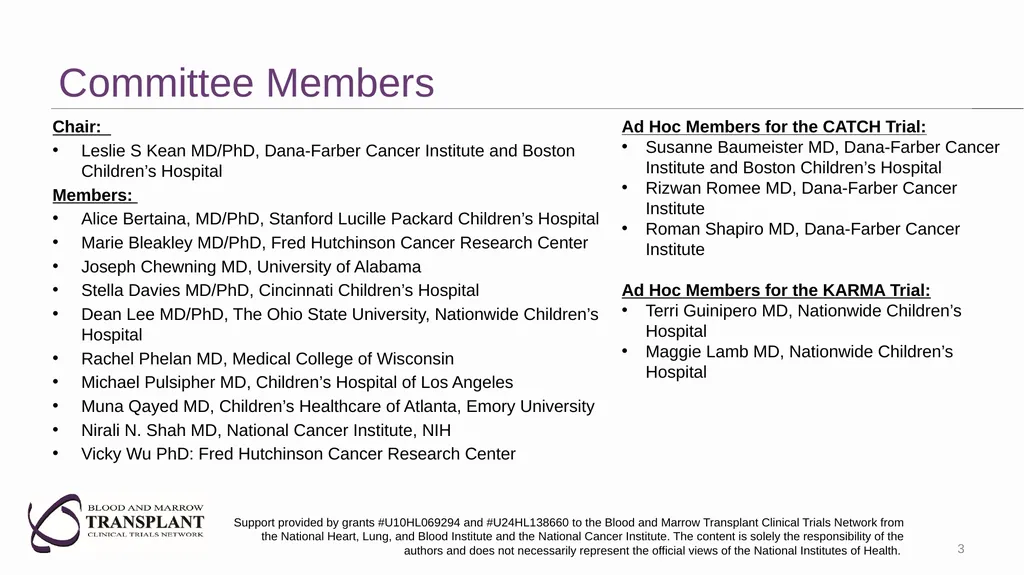
Committee Members Chair:
Leslie S Kean MD/PhD, Dana-Farber Cancer Institute and Boston Children’s Hospital
Members:
Alice Bertaina, MD/PhD, Stanford Lucille Packard Children’s Hospital
Marie Bleakley MD/PhD, Fred Hutchinson Cancer Research Center
Joseph Chewning MD, University of Alabama
Stella Davies MD/PhD, Cincinnati Children’s Hospital
Dean Lee MD/PhD, The Ohio State University, Nationwide Children’s Hospital
Rachel Phelan MD, Medical College of Wisconsin
Michael Pulsipher MD, Children’s Hospital of Los Angeles
Muna Qayed MD, Children’s Healthcare of Atlanta, Emory University
Nirali N. Shah MD, National Cancer Institute, NIH
Vicky Wu PhD: Fred Hutchinson Cancer Research Center Support provided by grants #U10HL069294 and #U24HL138660 to the Blood and Marrow Transplant Clinical Trials Network from the National Heart, Lung, and Blood Institute and the National Cancer Institute. The content is solely the responsibility of the authors and does not necessarily represent the official views of the National Institutes of Health. 3 Ad Hoc Members for the CATCH Trial:
Susanne Baumeister MD, Dana-Farber Cancer Institute and Boston Children’s Hospital
Rizwan Romee MD, Dana-Farber Cancer Institute
Roman Shapiro MD, Dana-Farber Cancer Institute
Ad Hoc Members for the KARMA Trial:
Terri Guinipero MD, Nationwide Children’s Hospital
Maggie Lamb MD, Nationwide Children’s Hospital<br>
Leslie S Kean MD/PhD, Dana-Farber Cancer Institute and Boston Children’s Hospital
Members:
Alice Bertaina, MD/PhD, Stanford Lucille Packard Children’s Hospital
Marie Bleakley MD/PhD, Fred Hutchinson Cancer Research Center
Joseph Chewning MD, University of Alabama
Stella Davies MD/PhD, Cincinnati Children’s Hospital
Dean Lee MD/PhD, The Ohio State University, Nationwide Children’s Hospital
Rachel Phelan MD, Medical College of Wisconsin
Michael Pulsipher MD, Children’s Hospital of Los Angeles
Muna Qayed MD, Children’s Healthcare of Atlanta, Emory University
Nirali N. Shah MD, National Cancer Institute, NIH
Vicky Wu PhD: Fred Hutchinson Cancer Research Center Support provided by grants #U10HL069294 and #U24HL138660 to the Blood and Marrow Transplant Clinical Trials Network from the National Heart, Lung, and Blood Institute and the National Cancer Institute. The content is solely the responsibility of the authors and does not necessarily represent the official views of the National Institutes of Health. 3 Ad Hoc Members for the CATCH Trial:
Susanne Baumeister MD, Dana-Farber Cancer Institute and Boston Children’s Hospital
Rizwan Romee MD, Dana-Farber Cancer Institute
Roman Shapiro MD, Dana-Farber Cancer Institute
Ad Hoc Members for the KARMA Trial:
Terri Guinipero MD, Nationwide Children’s Hospital
Maggie Lamb MD, Nationwide Children’s Hospital<br>
04
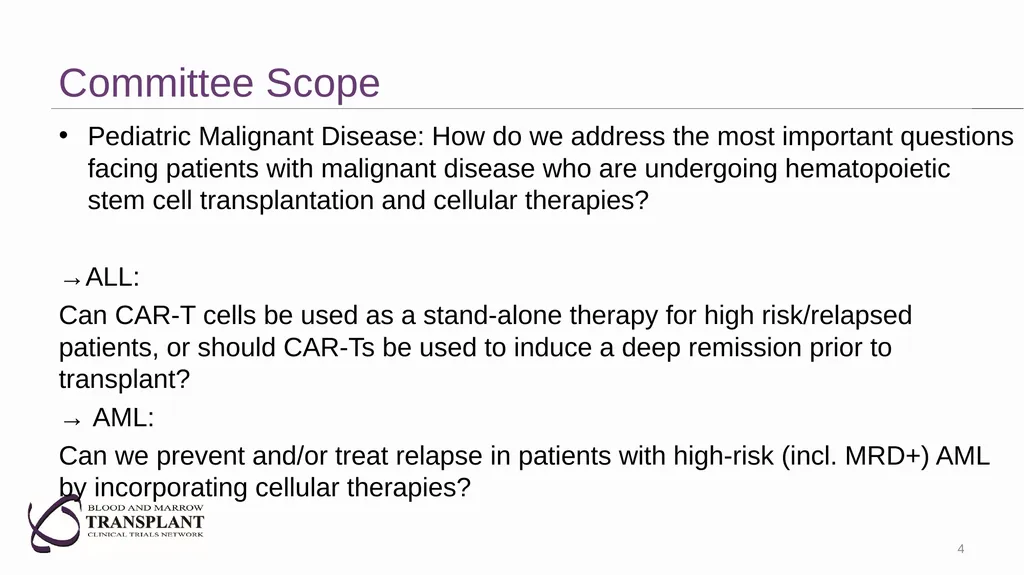
Committee Scope Pediatric Malignant Disease: How do we address the most important questions facing patients with malignant disease who are undergoing hematopoietic stem cell transplantation and cellular therapies?
→ALL:
Can CAR-T cells be used as a stand-alone therapy for high risk/relapsed patients, or should CAR-Ts be used to induce a deep remission prior to transplant?
→ AML:
Can we prevent and/or treat relapse in patients with high-risk (incl. MRD+) AML by incorporating cellular therapies? 4<br>
→ALL:
Can CAR-T cells be used as a stand-alone therapy for high risk/relapsed patients, or should CAR-Ts be used to induce a deep remission prior to transplant?
→ AML:
Can we prevent and/or treat relapse in patients with high-risk (incl. MRD+) AML by incorporating cellular therapies? 4<br>
05
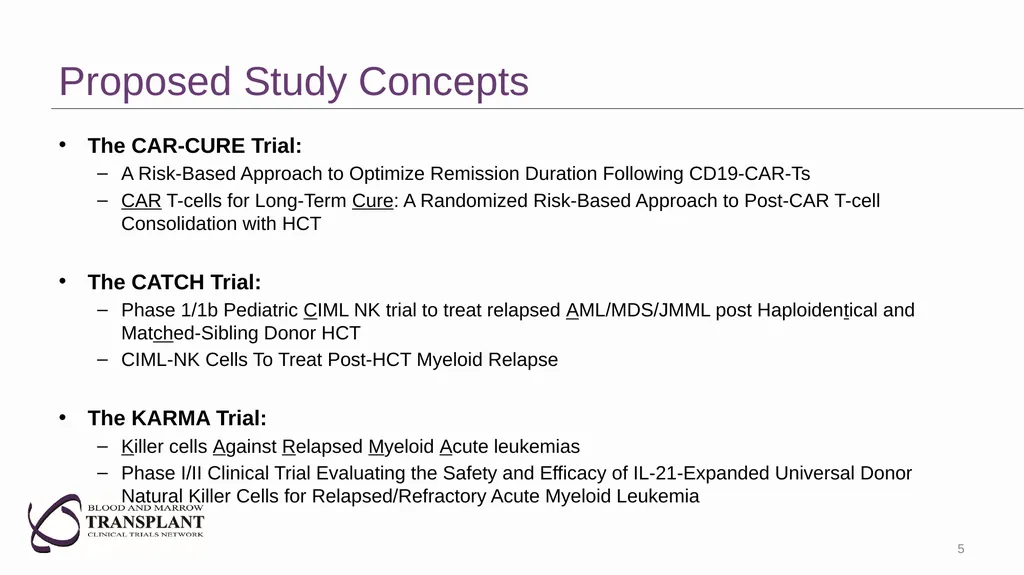
Proposed Study Concepts The CAR-CURE Trial:
A Risk-Based Approach to Optimize Remission Duration Following CD19-CAR-Ts
CAR T-cells for Long-Term Cure: A Randomized Risk-Based Approach to Post-CAR T-cell Consolidation with HCT
The CATCH Trial:
Phase 1/1b Pediatric CIML NK trial to treat relapsed AML/MDS/JMML post Haploidentical and Matched-Sibling Donor HCT
CIML-NK Cells To Treat Post-HCT Myeloid Relapse
The KARMA Trial:
Killer cells Against Relapsed Myeloid Acute leukemias
Phase I/II Clinical Trial Evaluating the Safety and Efficacy of IL-21-Expanded Universal Donor Natural Killer Cells for Relapsed/Refractory Acute Myeloid Leukemia 5<br>
A Risk-Based Approach to Optimize Remission Duration Following CD19-CAR-Ts
CAR T-cells for Long-Term Cure: A Randomized Risk-Based Approach to Post-CAR T-cell Consolidation with HCT
The CATCH Trial:
Phase 1/1b Pediatric CIML NK trial to treat relapsed AML/MDS/JMML post Haploidentical and Matched-Sibling Donor HCT
CIML-NK Cells To Treat Post-HCT Myeloid Relapse
The KARMA Trial:
Killer cells Against Relapsed Myeloid Acute leukemias
Phase I/II Clinical Trial Evaluating the Safety and Efficacy of IL-21-Expanded Universal Donor Natural Killer Cells for Relapsed/Refractory Acute Myeloid Leukemia 5<br>
06
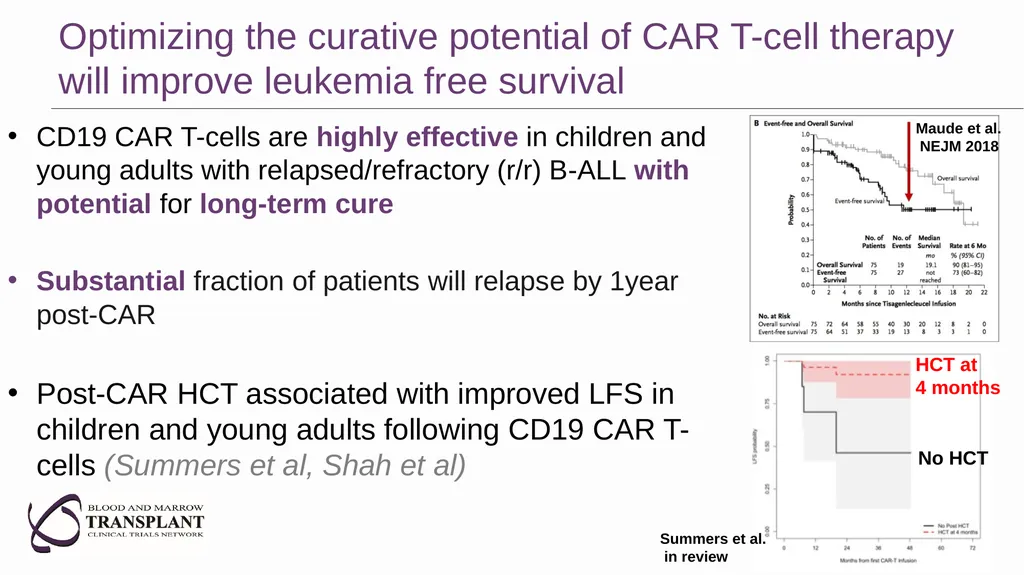
CD19 CAR T-cells are highly effective in children and young adults with relapsed/refractory (r/r) B-ALL with potential for long-term cure
Substantial fraction of patients will relapse by 1year post-CAR
Post-CAR HCT associated with improved LFS in children and young adults following CD19 CAR T-cells (Summers et al, Shah et al) 6 Optimizing the curative potential of CAR T-cell therapy will improve leukemia free survival HCT at
4 months No HCT Maude et al.
NEJM 2018 Summers et al.
in review<br>
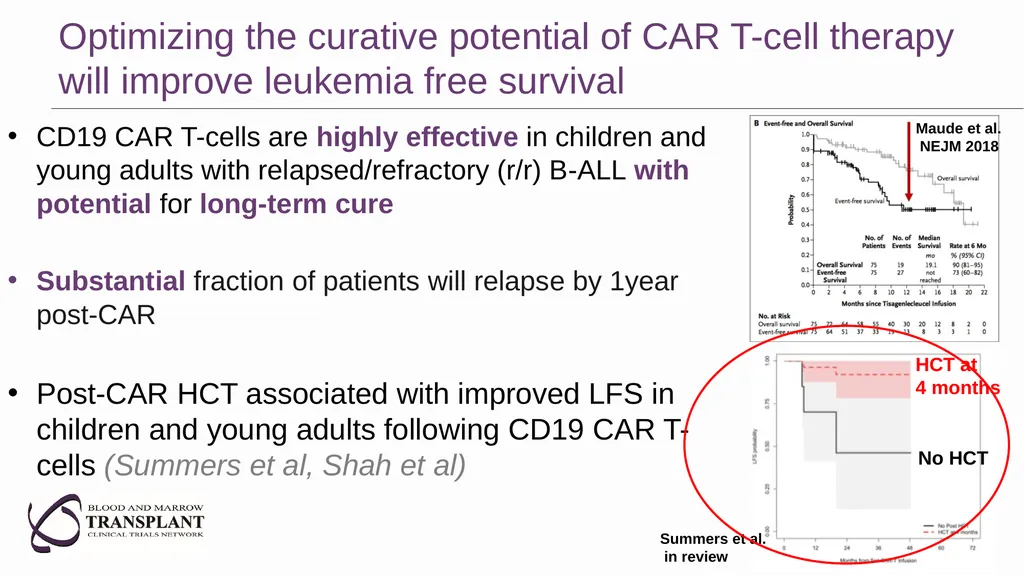
Substantial fraction of patients will relapse by 1year post-CAR
Post-CAR HCT associated with improved LFS in children and young adults following CD19 CAR T-cells (Summers et al, Shah et al) 6 Optimizing the curative potential of CAR T-cell therapy will improve leukemia free survival HCT at
4 months No HCT Maude et al.
NEJM 2018 Summers et al.
in review<br>
07
CD19 CAR T-cells are highly effective in children and young adults with relapsed/refractory (r/r) B-ALL with potential for long-term cure
Substantial fraction of patients will relapse by 1year post-CAR
Post-CAR HCT associated with improved LFS in children and young adults following CD19 CAR T-cells (Summers et al, Shah et al) 7 Optimizing the curative potential of CAR T-cell therapy will improve leukemia free survival HCT at
4 months No HCT Maude et al.
NEJM 2018 Summers et al.
in review<br>
Substantial fraction of patients will relapse by 1year post-CAR
Post-CAR HCT associated with improved LFS in children and young adults following CD19 CAR T-cells (Summers et al, Shah et al) 7 Optimizing the curative potential of CAR T-cell therapy will improve leukemia free survival HCT at
4 months No HCT Maude et al.
NEJM 2018 Summers et al.
in review<br>
08
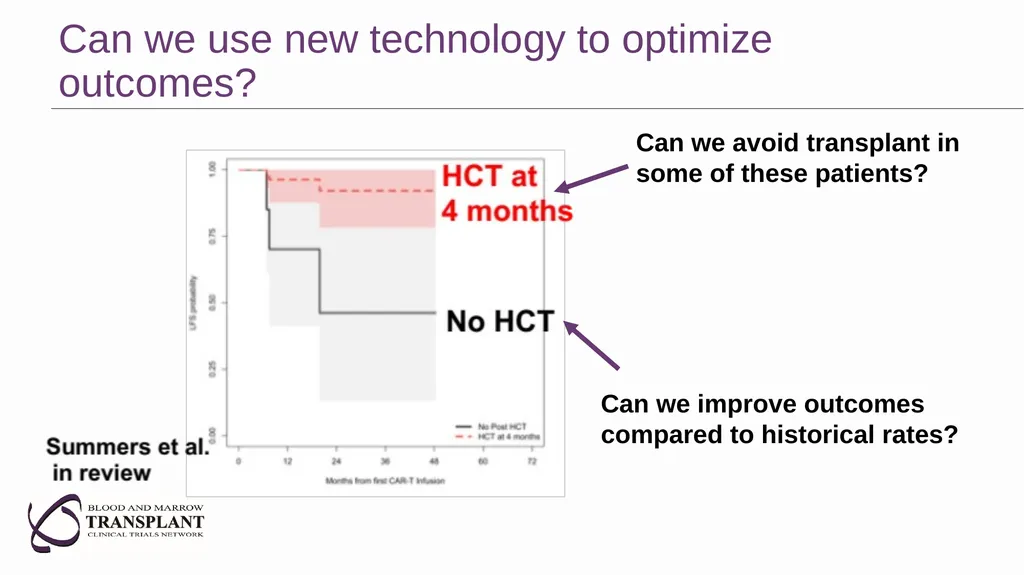
Can we use new technology to optimize outcomes? Can we avoid transplant in
some of these patients? Can we improve outcomes
compared to historical rates?<br>
some of these patients? Can we improve outcomes
compared to historical rates?<br>
09
The CAR-CURE Trial: Overview A standardized approach incorporating serial monitoring of biologic factors to risk-stratify those at high risk of post-CAR relapse will be able to:
Direct high-risk patents to HCT and improve their leukemia free survival (LFS)
Avoid HCT in those who will achieve long-term cure with CAR T-cells alone
Risk-based HCT would ideally lead to avoidance of HCT in 50% patients while directing those highly likely to relapse to HCT 9<br>
Direct high-risk patents to HCT and improve their leukemia free survival (LFS)
Avoid HCT in those who will achieve long-term cure with CAR T-cells alone
Risk-based HCT would ideally lead to avoidance of HCT in 50% patients while directing those highly likely to relapse to HCT 9<br>
10
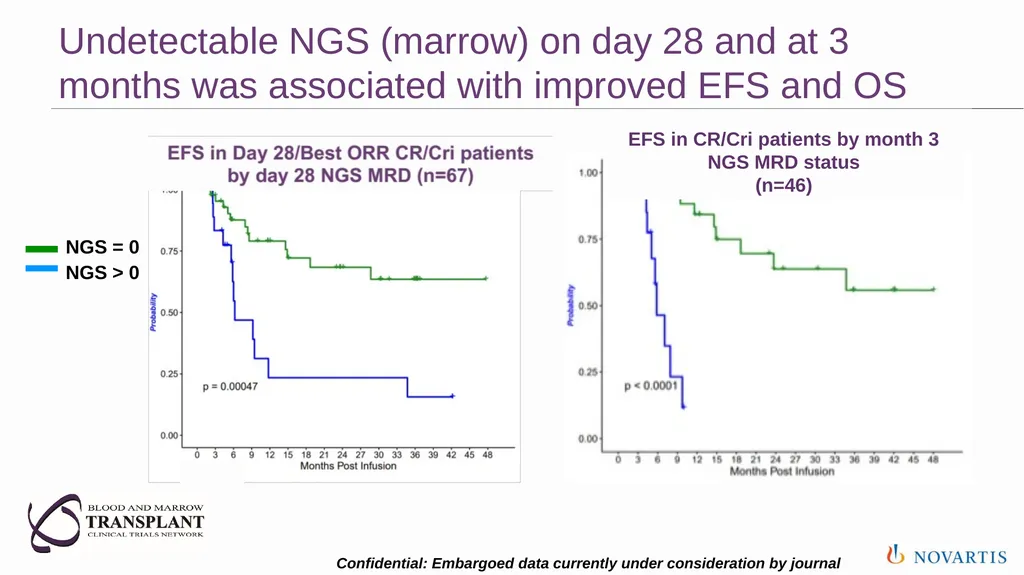
Undetectable NGS (marrow) on day 28 and at 3 months was associated with improved EFS and OS 10 Confidential: Embargoed data currently under consideration by journal EFS in CR/Cri patients by month 3 NGS MRD status
(n=46)<br>
(n=46)<br>
11
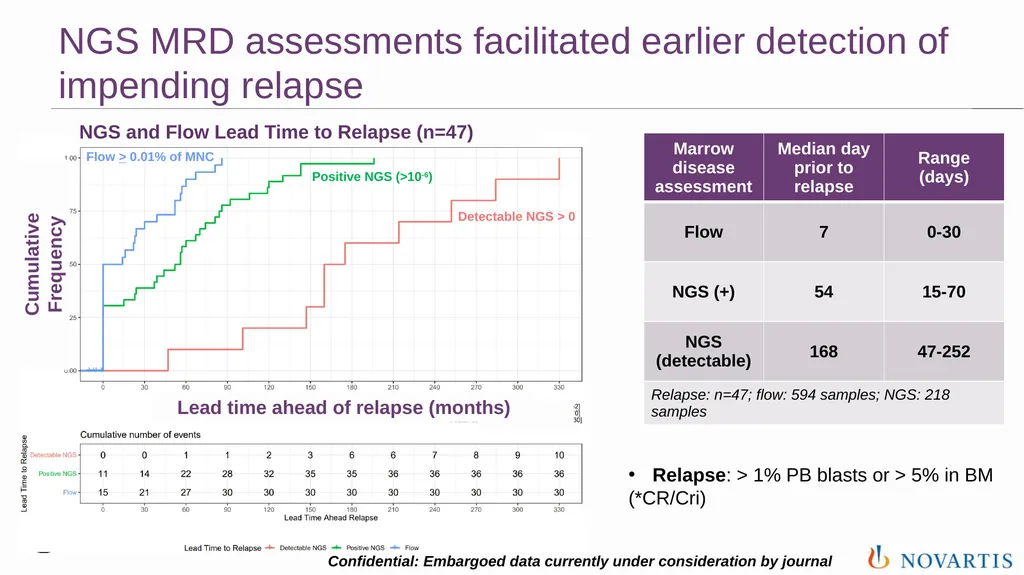
NGS MRD assessments facilitated earlier detection of impending relapse 11 NGS and Flow Lead Time to Relapse (n=47) Detectable NGS > 0 Positive NGS (>10-6) Flow > 0.01% of MNC Cumulative Frequency Confidential: Embargoed data currently under consideration by journal Relapse: > 1% PB blasts or > 5% in BM
(*CR/Cri) Lead time ahead of relapse (months)<br>
(*CR/Cri) Lead time ahead of relapse (months)<br>
12
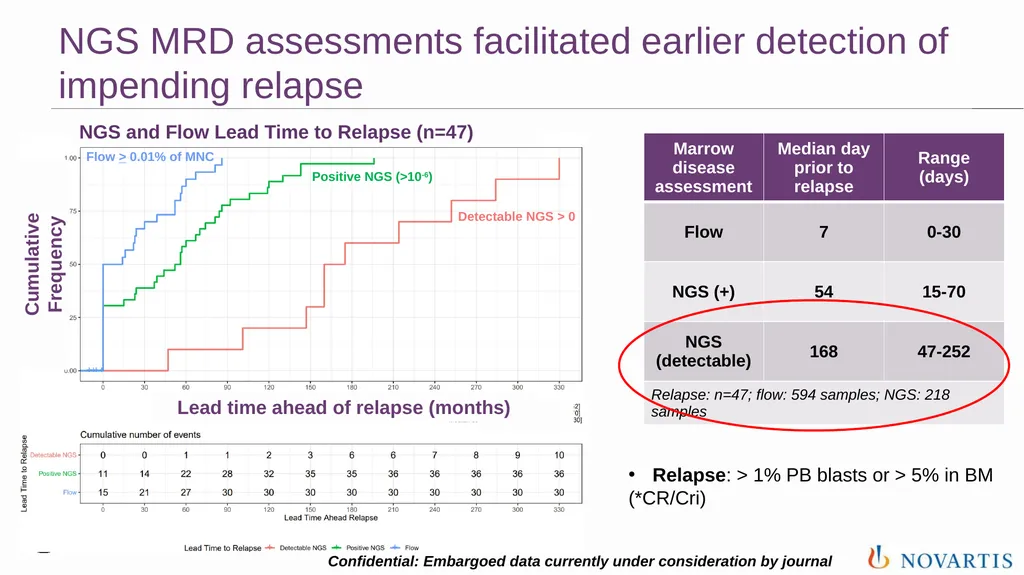
NGS MRD assessments facilitated earlier detection of impending relapse 12 NGS and Flow Lead Time to Relapse (n=47) Detectable NGS > 0 Positive NGS (>10-6) Flow > 0.01% of MNC Cumulative Frequency Confidential: Embargoed data currently under consideration by journal Relapse: > 1% PB blasts or > 5% in BM
(*CR/Cri) Lead time ahead of relapse (months)<br>
(*CR/Cri) Lead time ahead of relapse (months)<br>
13
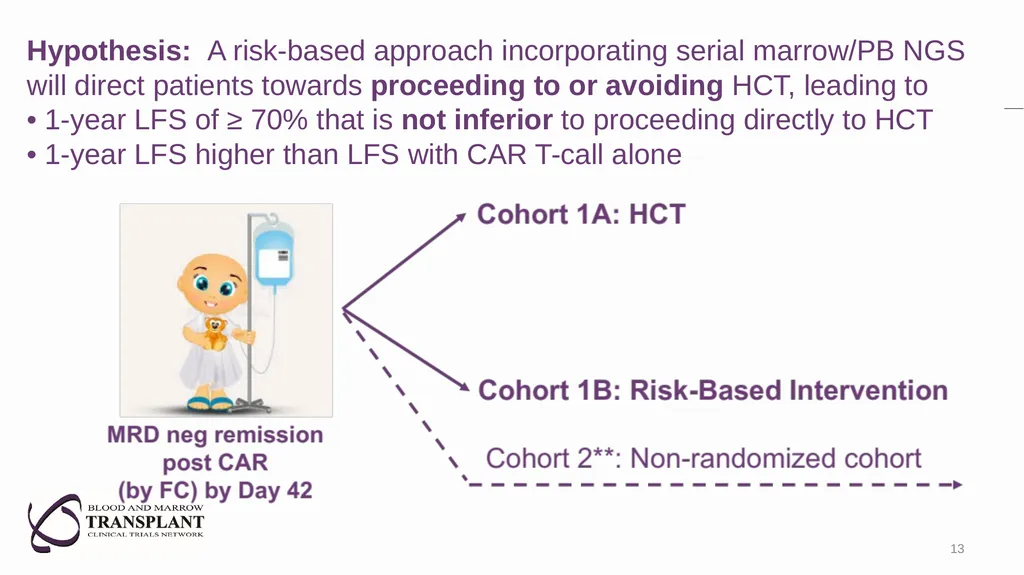
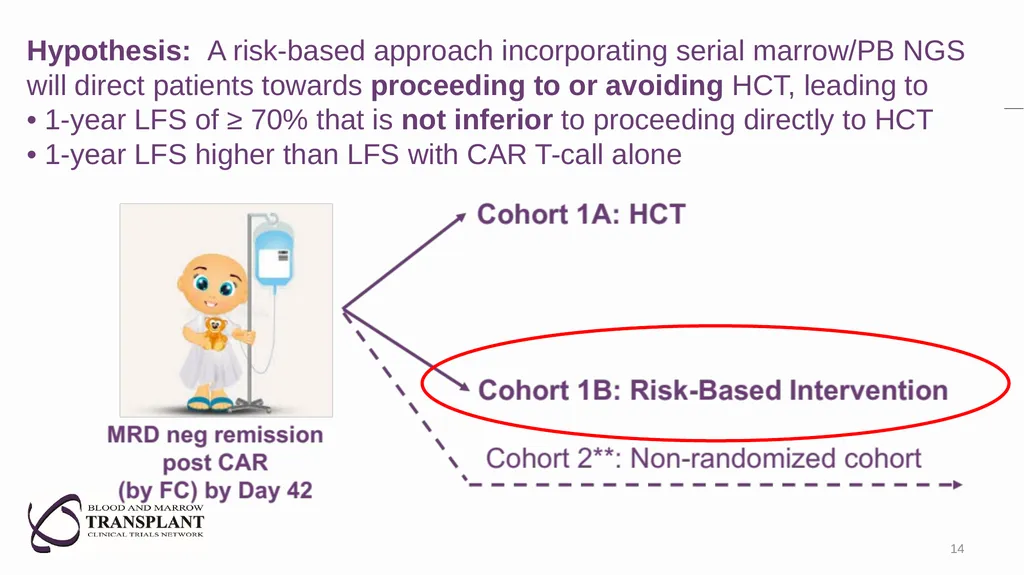
Hypothesis: A risk-based approach incorporating serial marrow/PB NGS will direct patients towards proceeding to or avoiding HCT, leading to
• 1-year LFS of ≥ 70% that is not inferior to proceeding directly to HCT • 1-year LFS higher than LFS with CAR T-call alone 13<br>
14
Hypothesis: A risk-based approach incorporating serial marrow/PB NGS will direct patients towards proceeding to or avoiding HCT, leading to
• 1-year LFS of ≥ 70% that is not inferior to proceeding directly to HCT • 1-year LFS higher than LFS with CAR T-call alone 14<br>
15
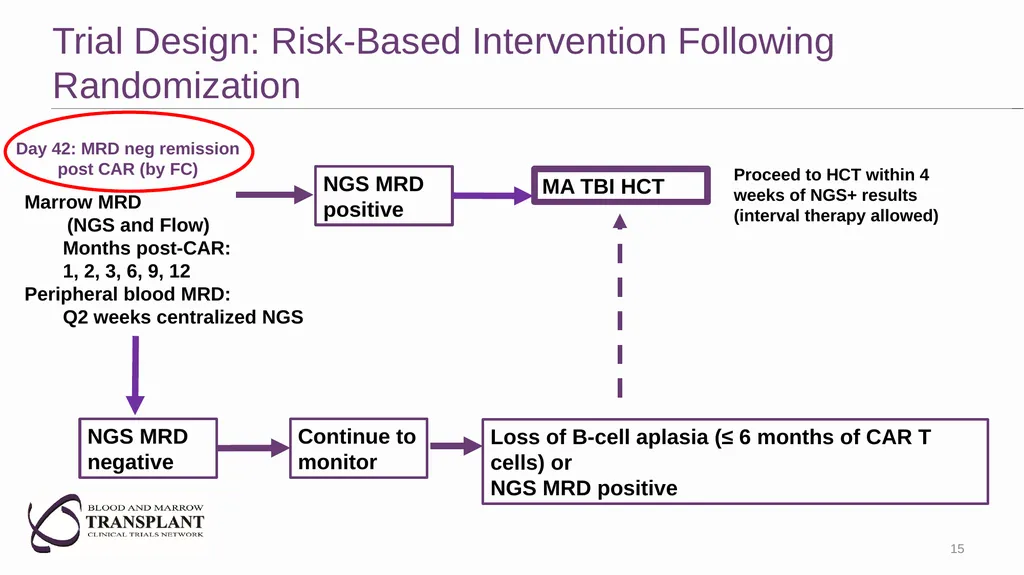
Trial Design: Risk-Based Intervention Following Randomization 15 NGS MRD negative Continue to monitor Loss of B-cell aplasia (≤ 6 months of CAR T cells) or
NGS MRD positive Day 42: MRD neg remission post CAR (by FC) MA TBI HCT NGS MRD positive Marrow MRD
(NGS and Flow)
Months post-CAR:
1, 2, 3, 6, 9, 12
Peripheral blood MRD:
Q2 weeks centralized NGS Proceed to HCT within 4 weeks of NGS+ results
(interval therapy allowed)<br>
NGS MRD positive Day 42: MRD neg remission post CAR (by FC) MA TBI HCT NGS MRD positive Marrow MRD
(NGS and Flow)
Months post-CAR:
1, 2, 3, 6, 9, 12
Peripheral blood MRD:
Q2 weeks centralized NGS Proceed to HCT within 4 weeks of NGS+ results
(interval therapy allowed)<br>
16
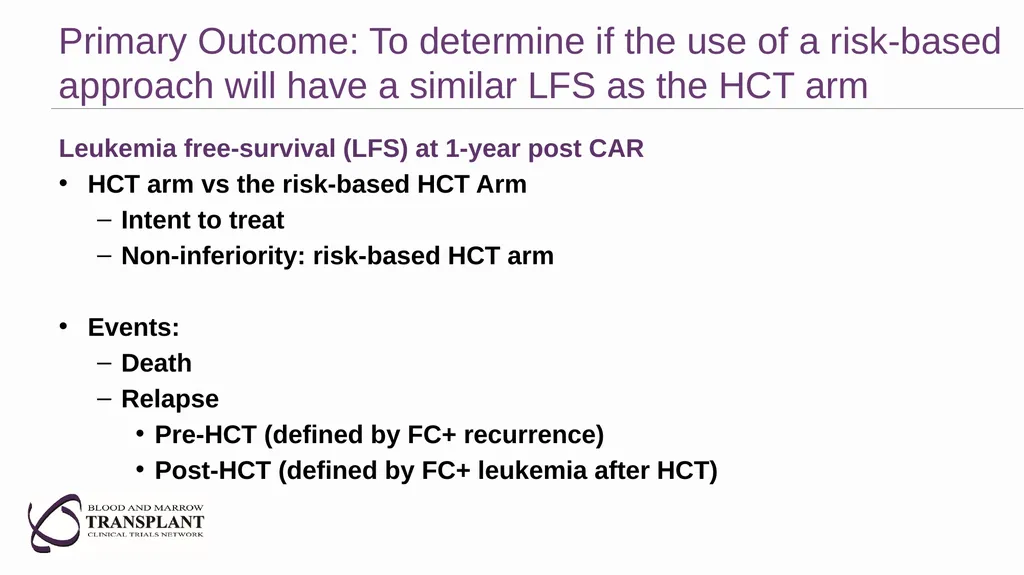
Primary Outcome: To determine if the use of a risk-based approach will have a similar LFS as the HCT arm Leukemia free-survival (LFS) at 1-year post CAR
HCT arm vs the risk-based HCT Arm
Intent to treat
Non-inferiority: risk-based HCT arm
Events:
Death
Relapse
Pre-HCT (defined by FC+ recurrence)
Post-HCT (defined by FC+ leukemia after HCT)<br>
HCT arm vs the risk-based HCT Arm
Intent to treat
Non-inferiority: risk-based HCT arm
Events:
Death
Relapse
Pre-HCT (defined by FC+ recurrence)
Post-HCT (defined by FC+ leukemia after HCT)<br>
17
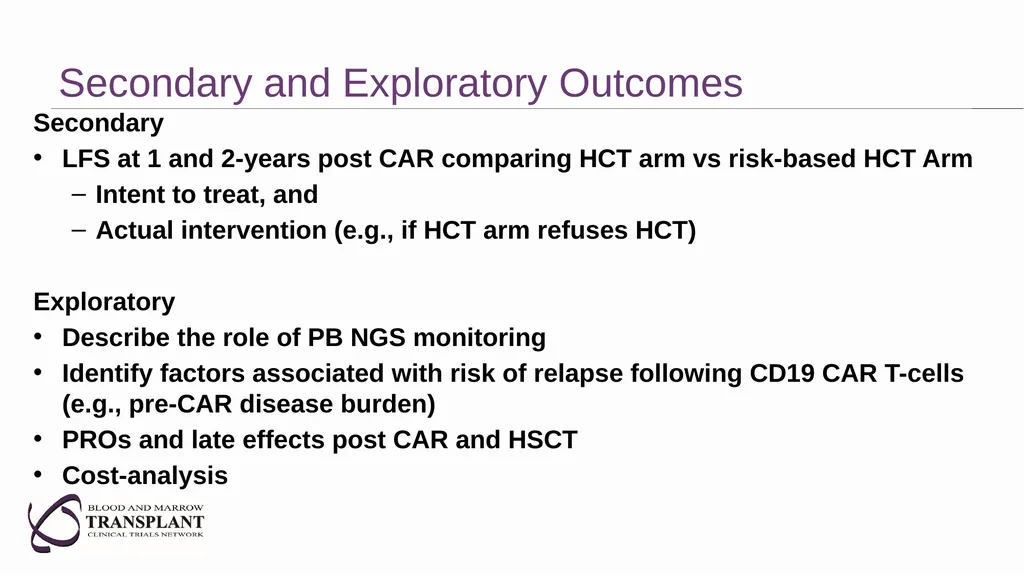
Secondary and Exploratory Outcomes Secondary
LFS at 1 and 2-years post CAR comparing HCT arm vs risk-based HCT Arm
Intent to treat, and
Actual intervention (e.g., if HCT arm refuses HCT)
Exploratory
Describe the role of PB NGS monitoring
Identify factors associated with risk of relapse following CD19 CAR T-cells (e.g., pre-CAR disease burden)
PROs and late effects post CAR and HSCT
Cost-analysis<br>
LFS at 1 and 2-years post CAR comparing HCT arm vs risk-based HCT Arm
Intent to treat, and
Actual intervention (e.g., if HCT arm refuses HCT)
Exploratory
Describe the role of PB NGS monitoring
Identify factors associated with risk of relapse following CD19 CAR T-cells (e.g., pre-CAR disease burden)
PROs and late effects post CAR and HSCT
Cost-analysis<br>
18
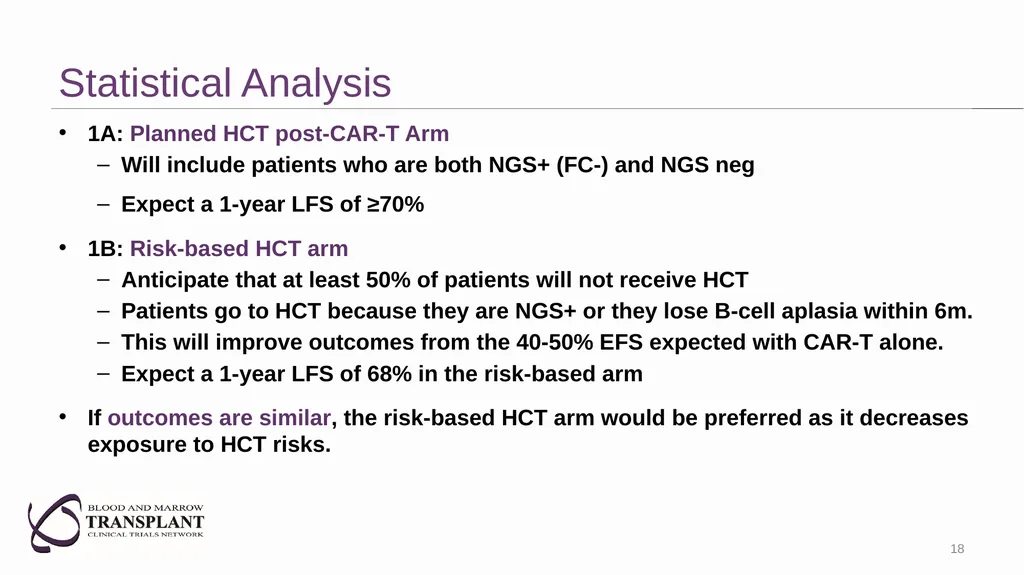
Statistical Analysis 1A: Planned HCT post-CAR-T Arm
Will include patients who are both NGS+ (FC-) and NGS neg
Expect a 1-year LFS of ≥70%
1B: Risk-based HCT arm
Anticipate that at least 50% of patients will not receive HCT
Patients go to HCT because they are NGS+ or they lose B-cell aplasia within 6m.
This will improve outcomes from the 40-50% EFS expected with CAR-T alone.
Expect a 1-year LFS of 68% in the risk-based arm
If outcomes are similar, the risk-based HCT arm would be preferred as it decreases exposure to HCT risks. 18<br>
Will include patients who are both NGS+ (FC-) and NGS neg
Expect a 1-year LFS of ≥70%
1B: Risk-based HCT arm
Anticipate that at least 50% of patients will not receive HCT
Patients go to HCT because they are NGS+ or they lose B-cell aplasia within 6m.
This will improve outcomes from the 40-50% EFS expected with CAR-T alone.
Expect a 1-year LFS of 68% in the risk-based arm
If outcomes are similar, the risk-based HCT arm would be preferred as it decreases exposure to HCT risks. 18<br>
19
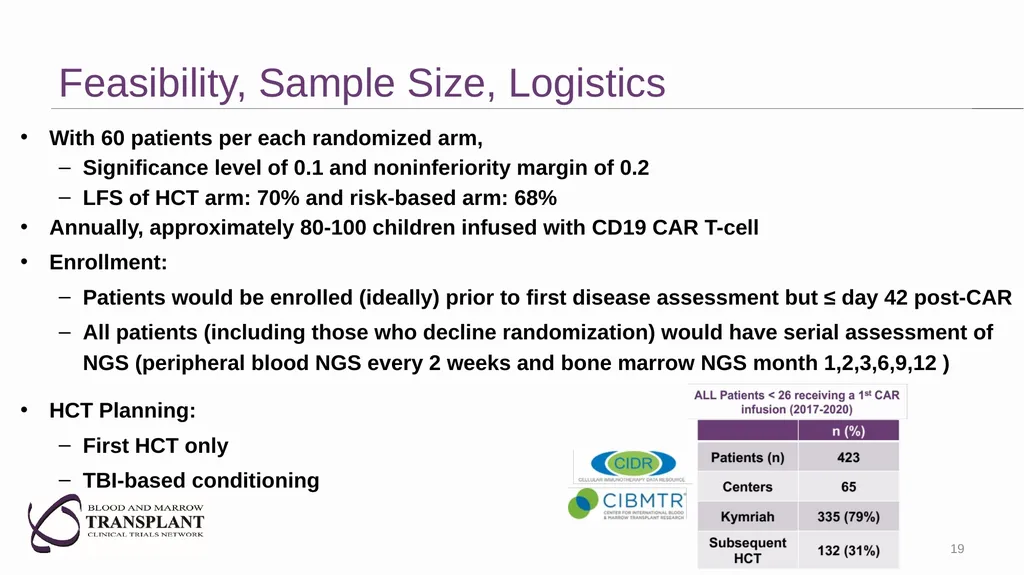
Feasibility, Sample Size, Logistics With 60 patients per each randomized arm,
Significance level of 0.1 and noninferiority margin of 0.2
LFS of HCT arm: 70% and risk-based arm: 68%
Annually, approximately 80-100 children infused with CD19 CAR T-cell
Enrollment:
Patients would be enrolled (ideally) prior to first disease assessment but ≤ day 42 post-CAR
All patients (including those who decline randomization) would have serial assessment of NGS (peripheral blood NGS every 2 weeks and bone marrow NGS month 1,2,3,6,9,12 )
HCT Planning:
First HCT only
TBI-based conditioning 19<br>
Significance level of 0.1 and noninferiority margin of 0.2
LFS of HCT arm: 70% and risk-based arm: 68%
Annually, approximately 80-100 children infused with CD19 CAR T-cell
Enrollment:
Patients would be enrolled (ideally) prior to first disease assessment but ≤ day 42 post-CAR
All patients (including those who decline randomization) would have serial assessment of NGS (peripheral blood NGS every 2 weeks and bone marrow NGS month 1,2,3,6,9,12 )
HCT Planning:
First HCT only
TBI-based conditioning 19<br>
20
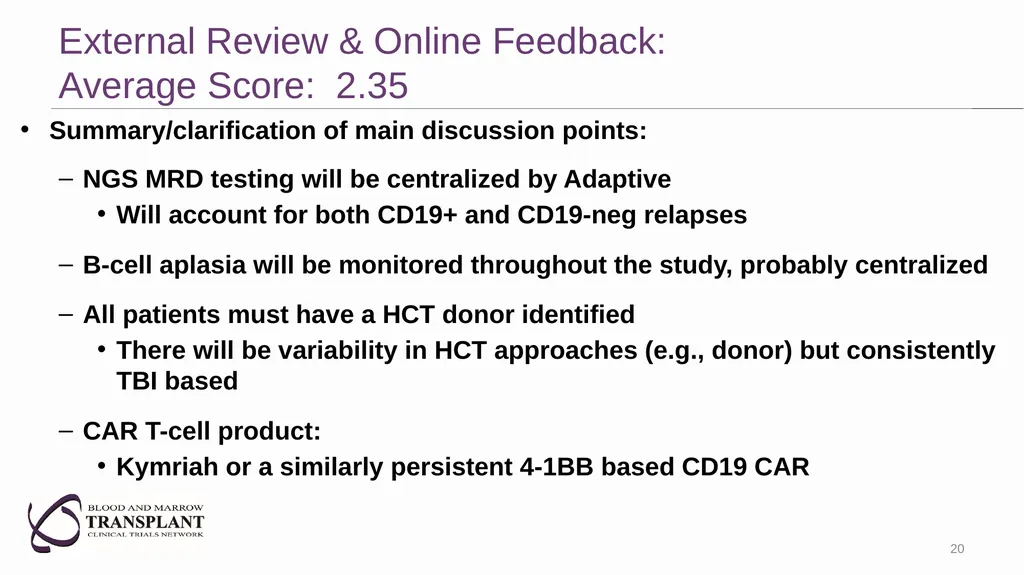
External Review & Online Feedback:
Average Score: 2.35 Summary/clarification of main discussion points:
NGS MRD testing will be centralized by Adaptive
Will account for both CD19+ and CD19-neg relapses
B-cell aplasia will be monitored throughout the study, probably centralized
All patients must have a HCT donor identified
There will be variability in HCT approaches (e.g., donor) but consistently TBI based
CAR T-cell product:
Kymriah or a similarly persistent 4-1BB based CD19 CAR 20<br>
NGS MRD testing will be centralized by Adaptive
Will account for both CD19+ and CD19-neg relapses
B-cell aplasia will be monitored throughout the study, probably centralized
All patients must have a HCT donor identified
There will be variability in HCT approaches (e.g., donor) but consistently TBI based
CAR T-cell product:
Kymriah or a similarly persistent 4-1BB based CD19 CAR 20<br>
21
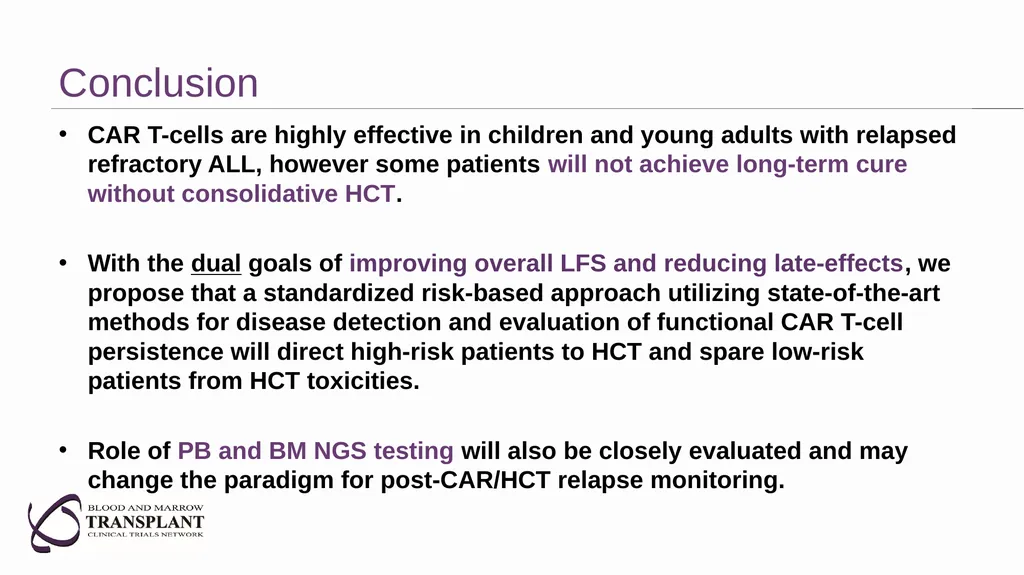
Conclusion CAR T-cells are highly effective in children and young adults with relapsed refractory ALL, however some patients will not achieve long-term cure without consolidative HCT.
With the dual goals of improving overall LFS and reducing late-effects, we propose that a standardized risk-based approach utilizing state-of-the-art methods for disease detection and evaluation of functional CAR T-cell persistence will direct high-risk patients to HCT and spare low-risk patients from HCT toxicities.
Role of PB and BM NGS testing will also be closely evaluated and may change the paradigm for post-CAR/HCT relapse monitoring.<br>
With the dual goals of improving overall LFS and reducing late-effects, we propose that a standardized risk-based approach utilizing state-of-the-art methods for disease detection and evaluation of functional CAR T-cell persistence will direct high-risk patients to HCT and spare low-risk patients from HCT toxicities.
Role of PB and BM NGS testing will also be closely evaluated and may change the paradigm for post-CAR/HCT relapse monitoring.<br>
22
Q&A Session 22<br>
23
23<br>