
Peer Review-Compliance with ethical standards Ca


Description: Peer Review-Compliance with ethical standards Ca pAWAN kUMAR agarwaL 30th march 2024- EIRC ICAI madanlalassociatesgmail.com What is PEER REVIEW As per Clause 2 (14) of the Peer Review Guideline, 2022 Peer Review - means an examination and
Related Topics
Download Presentation
"Peer Review-Compliance with ethical standards Ca" is the property of its rightful owner. Permission is granted to download and print the materials on this website for personal, non-commercial use only, and to display it on your personal computer provided you do not modify the materials and that you retain all copyright notices contained in the materials. By downloading content from our website, you accept the terms of this agreement.
Presentation Transcript
slide1. Peer Review-Compliance with ethical standards Ca pAWAN kUMAR agarwaL 30th march 2024- EIRC ICAI madanlalassociates@gmail.com<br>
slide2. What is PEER REVIEW As per Clause 2 (14) of the Peer Review Guideline, 2022
Peer Review - means an examination and review of the systems and procedures to determine whether the same have been put in place by the Practice Unit for ensuring the quality of assurance services as envisaged by the Technical, Professional and Ethical Standards as applicable including Audit Quality Maturity Model wherever applicable or any other regulatory requirements as may be prescribed by the Council or any Committee and whether the same were consistently applied during the period under review Ca pAWAN kUMAR agarwaL madanlalassociates@gmail.com<br>
slide3. Definition Examination and review -----
Of the systems and procedures
To determine -----
whether such systems and procedures have been put in place by the Practice Unit (and also to see that such systems and procedures are adhered and working properly)
To ensure
the Quality of the assurance services
Quality to be examined with what
Various Technical Standards (as applicable)
Various Professional Standards (as applicable)
Ethical Standards (as applicable)
Audit Quality Maturity Model (AQMM) (wherever applicable)
Digital Competency Maturity Model (DCMM) (optional-but very much effective, )
Other regulatory requirements as may be prescribed by the
Council of ICAI or
Committee of ICAI
Whether the same (above) were consistently applied during the period under review Ca pAWAN kUMAR agarwaL madanlalassociates@gmail.com<br>
slide4. Therefore, in short, the term “peer review” may be construed as review of work done by a professional, by another similar professional (peer),
Peer Review process is based on the principle of systematic monitoring of the procedures adopted and records maintained while carrying out audit & assurance services in the course of one’s professional responsibility to ensure and sustain quality
Peer Review is primarily directed towards ensuring as well as enhancing the quality of audit and assurance services of Chartered Accountants in Practice.
Peer Review of a Practice Unit is conducted by an independent evaluator known as a Peer Reviewer
The Peer Review process is intended to review the quality control framework of the Practice Unit as well as proper and consistent application of such control frameworks across engagement samples selected for review [Clause 3(2)] Ca pAWAN kUMAR agarwaL madanlalassociates@gmail.com In Brief<br>
slide5. The main objective of Peer Review is to ensure that in carrying out the assurance service assignments, the members of the Institute –
comply with Technical, Professional and Ethical Standards as applicable including other regulatory requirements thereto and
have in place proper systems including documentation thereof, to amply demonstrate the quality of the assurance services. [Clause 3(3)]
It is important to note that Peer Review does not seek to redefine the scope and authority of any of the Technical, Professional and Ethical Standards but only seeks to ensure that they are implemented, both in letter and spirit.
Therefore, the objective is to maintain and enhance the quality of assurance services by providing appropriate guidance rather than simply pointing out deficiencies of the Practice Unit. Ca pAWAN kUMAR agarwaL madanlalassociates@gmail.com Objective<br>
slide6. SCOPE of Peer Review Ca pAWAN kUMAR agarwaL madanlalassociates@gmail.com<br>
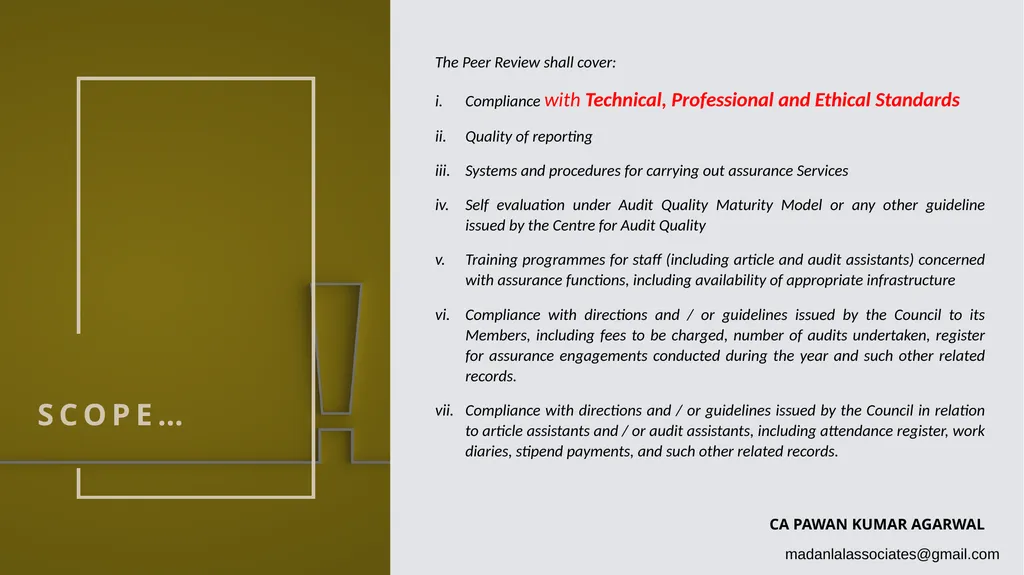
slide7. SCOPE… The Peer Review shall cover:
Compliance with Technical, Professional and Ethical Standards
Quality of reporting
Systems and procedures for carrying out assurance Services
Self evaluation under Audit Quality Maturity Model or any other guideline issued by the Centre for Audit Quality
Training programmes for staff (including article and audit assistants) concerned with assurance functions, including availability of appropriate infrastructure
Compliance with directions and / or guidelines issued by the Council to its Members, including fees to be charged, number of audits undertaken, register for assurance engagements conducted during the year and such other related records.
Compliance with directions and / or guidelines issued by the Council in relation to article assistants and / or audit assistants, including attendance register, work diaries, stipend payments, and such other related records. Ca pAWAN kUMAR agarwaL madanlalassociates@gmail.com<br>
slide8. SCOPE… The Peer Review process shall apply to all the assurance engagements signed by a Practice Unit during the period under review.
Once a Practice Unit is subjected to Peer Review, its assurance engagement records, working papers, pertaining to the Peer Review Period shall be subject to examination and review by the Peer Reviewer.
A Practice Unit having one or more branches at various locations in India may opt to get the Peer Review of any branch or branches conducted by a Branch Peer Reviewer. The Reviewer conducting the Peer Review of the Head Office shall consider the report of the Branch Peer Reviewer and shall issue a consolidated report for the Practice Unit Ca pAWAN kUMAR agarwaL madanlalassociates@gmail.com<br>
slide9. CODE OF ETHICS
(Clause by Clause-Sch I & II) 9 CA Pawan Kumar Agarwal
madanlalassociates@gmail.com 30th March 2024
EIRC- ICAI 9<br>
slide10. 10 Disclaimer :
The views expressed in the presentation is exclusively that of the author.
The information contained herein is of a general nature and is not intended to address the circumstances of any particular individual or entity.
Although we endeavour to provide accurate and timely information, there can be no guarantee that such information is accurate as of the date it is received or that it will continue to be accurate in the future.
The presenter is in no case liable for any damages incurred by relying on the ideas implemented without adequate consultation.<br>
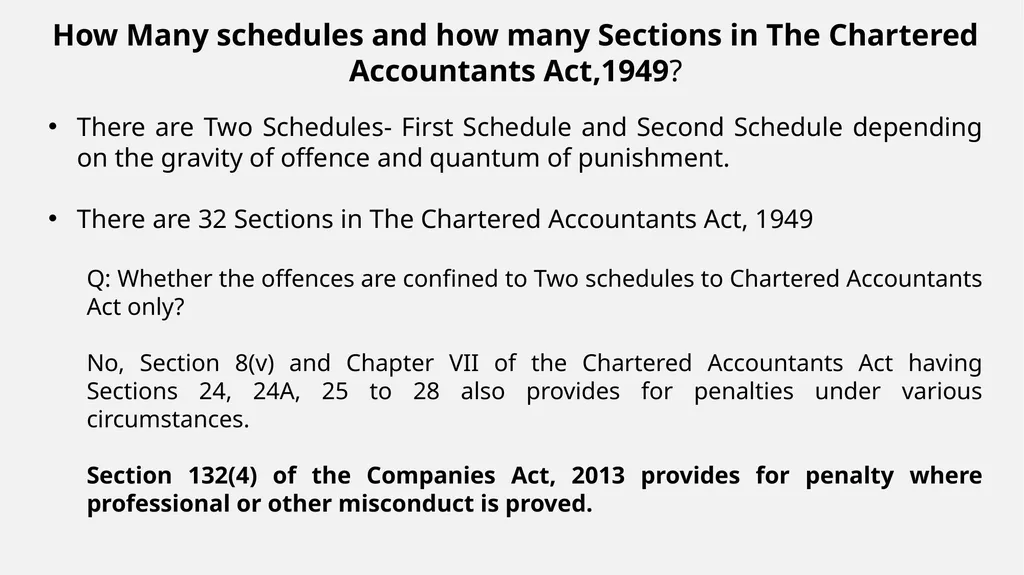
slide11. How Many schedules and how many Sections in The Chartered Accountants Act,1949?
There are Two Schedules- First Schedule and Second Schedule depending on the gravity of offence and quantum of punishment.
There are 32 Sections in The Chartered Accountants Act, 1949
Q: Whether the offences are confined to Two schedules to Chartered Accountants Act only?
No, Section 8(v) and Chapter VII of the Chartered Accountants Act having Sections 24, 24A, 25 to 28 also provides for penalties under various circumstances.
Section 132(4) of the Companies Act, 2013 provides for penalty where professional or other misconduct is proved.<br>
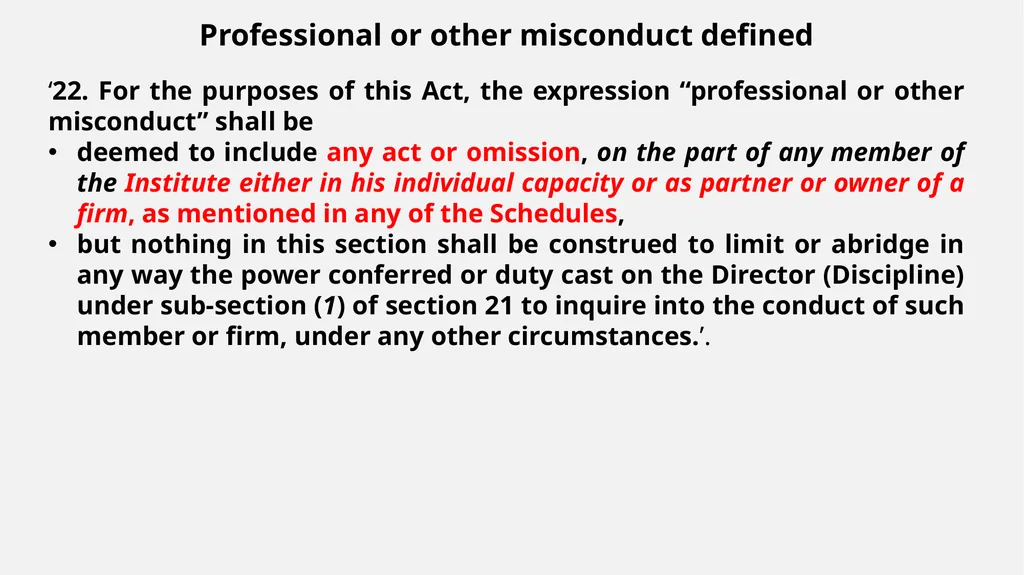
slide12. Professional or other misconduct defined
‘22. For the purposes of this Act, the expression “professional or other misconduct” shall be
deemed to include any act or omission, on the part of any member of the Institute either in his individual capacity or as partner or owner of a firm, as mentioned in any of the Schedules,
but nothing in this section shall be construed to limit or abridge in any way the power conferred or duty cast on the Director (Discipline) under sub-section (1) of section 21 to inquire into the conduct of such member or firm, under any other circumstances.’.<br>
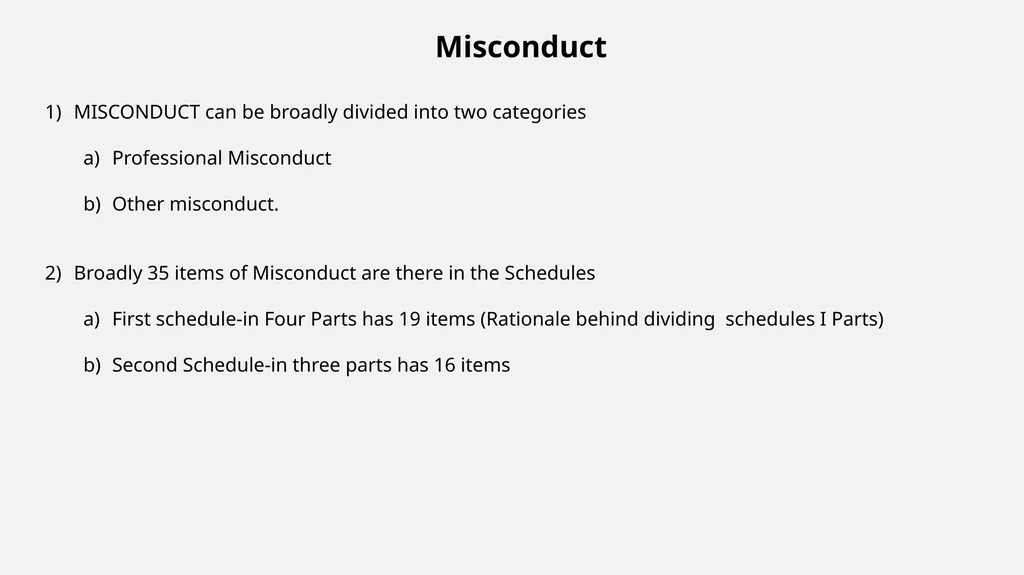
slide13. Misconduct
MISCONDUCT can be broadly divided into two categories
Professional Misconduct
Other misconduct.
Broadly 35 items of Misconduct are there in the Schedules
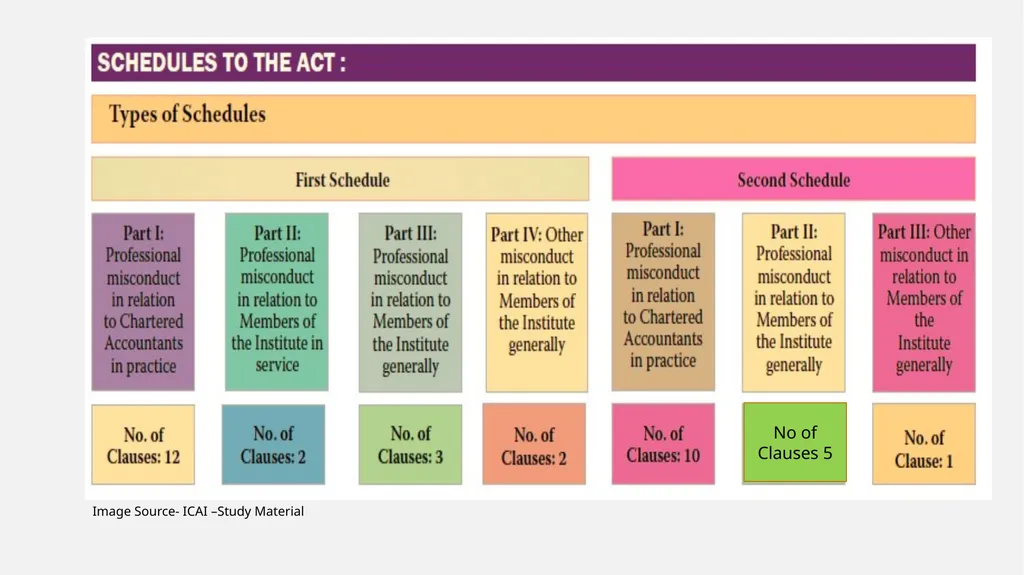
First schedule-in Four Parts has 19 items (Rationale behind dividing schedules I Parts)
Second Schedule-in three parts has 16 items<br>
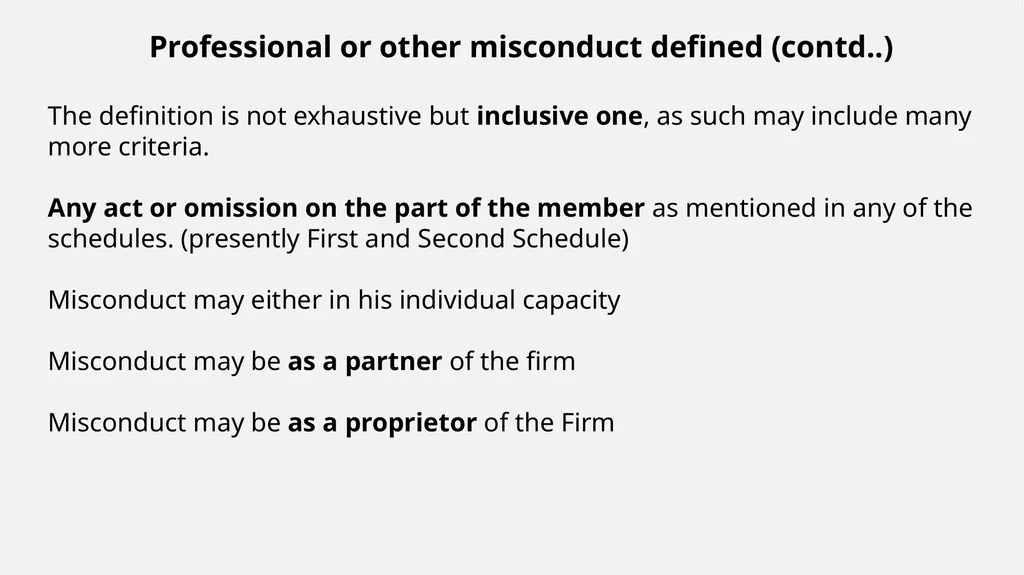
slide14. Professional or other misconduct defined (contd..)
The definition is not exhaustive but inclusive one, as such may include many more criteria.
Any act or omission on the part of the member as mentioned in any of the schedules. (presently First and Second Schedule)
Misconduct may either in his individual capacity
Misconduct may be as a partner of the firm
Misconduct may be as a proprietor of the Firm<br>
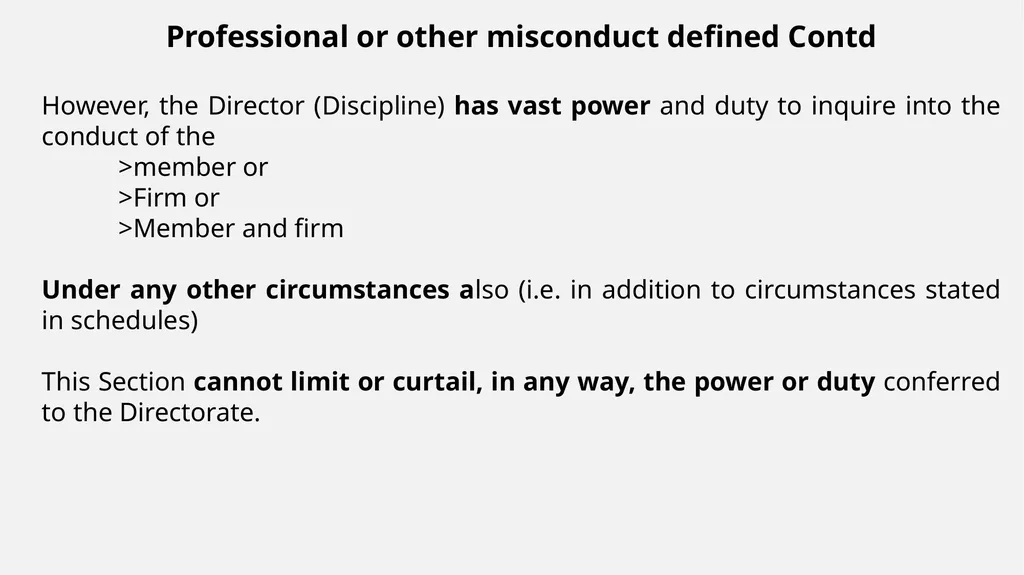
slide15. Professional or other misconduct defined Contd
However, the Director (Discipline) has vast power and duty to inquire into the conduct of the
>member or
>Firm or
>Member and firm
Under any other circumstances also (i.e. in addition to circumstances stated in schedules)
This Section cannot limit or curtail, in any way, the power or duty conferred to the Directorate.<br>
slide16. What constitutes `misconduct
under any other circumstances’ has to be determined on case to case basis
keeping in view the facts of the circumstances of each case.
Fraud, intention to deceive and committing an act which affects the public or society at large could be in the ambit of such misconduct.<br>
slide18. WHAT IS THE RATIONAL BEHIND DIVIDING SCHEDULES INTO PARTS?
First Schedule
Part I- 12 Clauses-Professional misconduct-members in Practice
Part II- 2 Clauses - Professional misconduct-members in Service
Part III-3 Clauses – Professional misconduct -generally (all members)
Part IV-2 Clauses- other misconduct -generally (all members)<br>
slide19. WHAT IS THE RATIONAL BEHIND DIVIDING SCHEDULES INTO PARTS? Contd….
Second Schedule
Part I- 10 clauses-Professional misconduct-members in Practice
Part II-5 clauses - Professional misconduct- generally (all members)
Part III-1 Clause -other misconduct -generally (all members)<br>
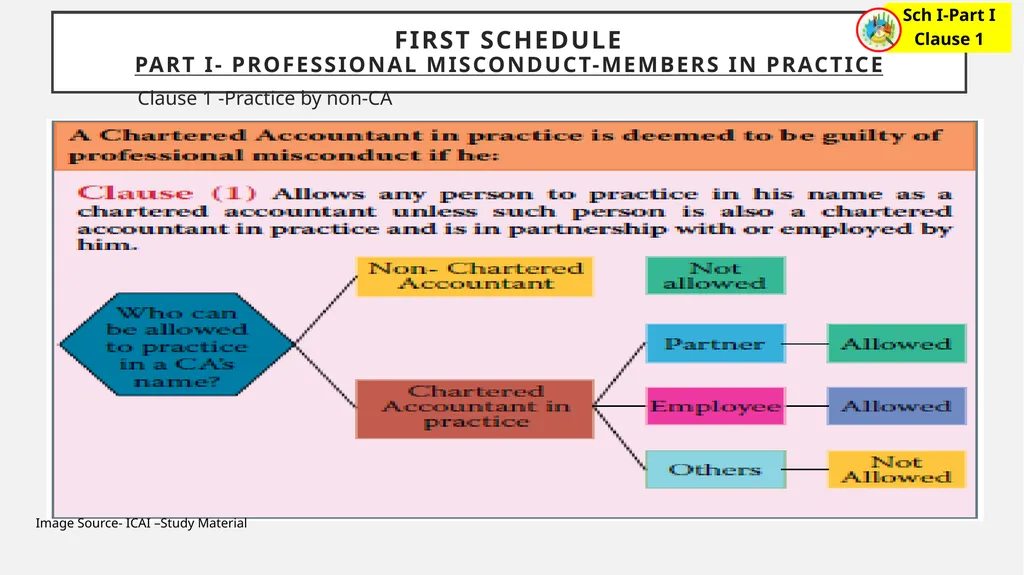
slide20. FIRST SCHEDULE Part I- Professional misconduct-Members in Practice Clause 1 -Practice by non-CA<br>
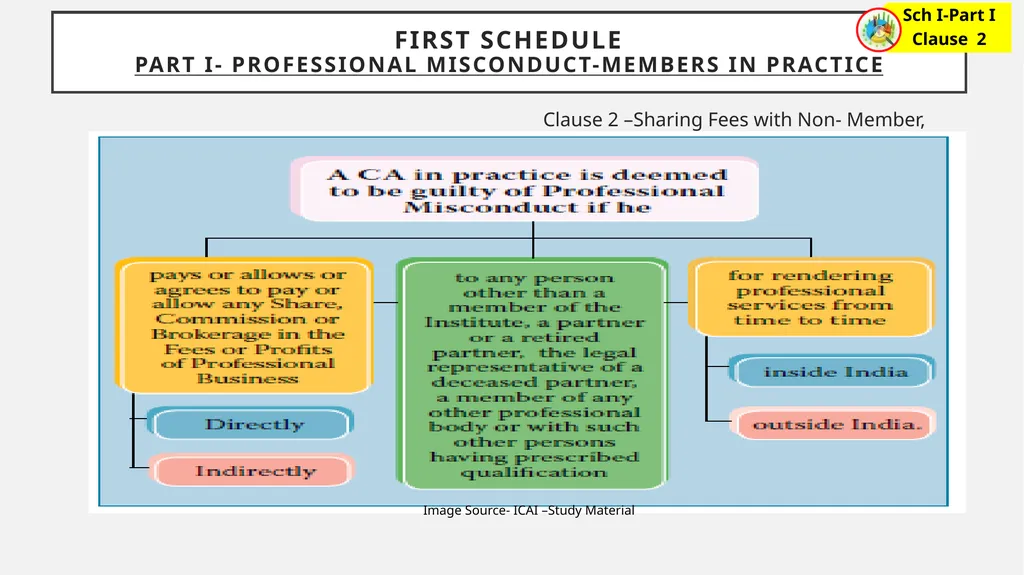
slide21. FIRST SCHEDULE Part I- Professional misconduct-Members in Practice Clause 2 –Sharing Fees with Non- Member, directly, indirectly<br>
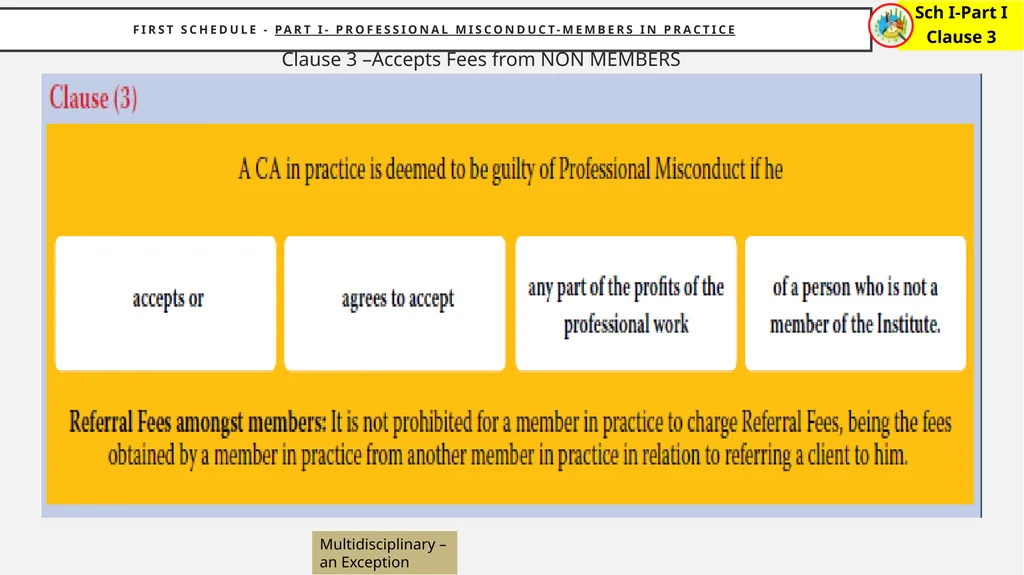
slide22. FIRST SCHEDULE - Part I- Professional misconduct-Members in Practice Clause 3 –Accepts Fees from NON MEMBERS Multidisciplinary – an Exception<br>
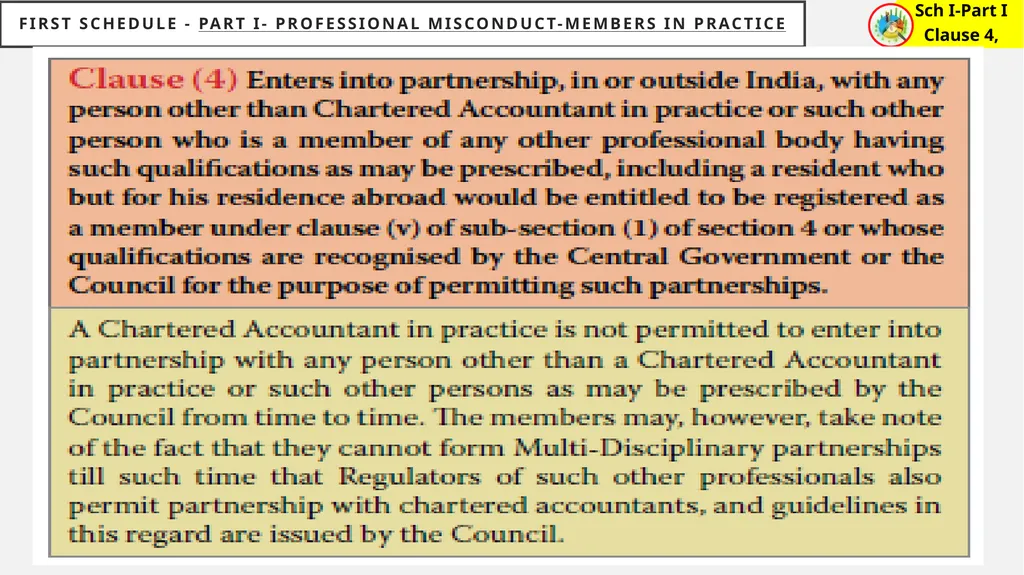
slide23. FIRST SCHEDULE - Part I- Professional misconduct-Members in Practice Clause 4 –Partnership with Non Member<br>
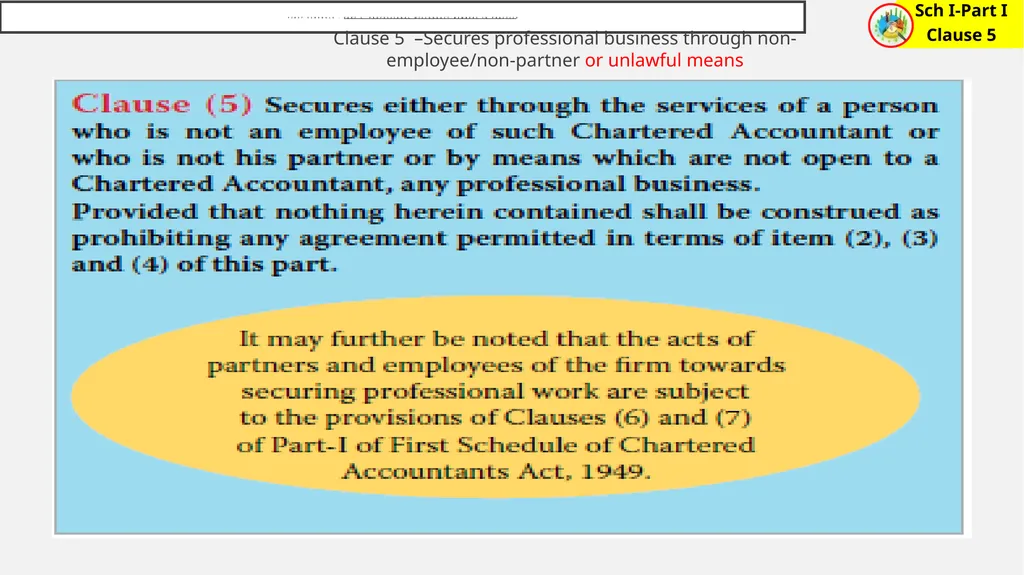
slide24. FIRST SCHEDULE - Part I- Professional misconduct-Members in Practice Clause 5 –Secures professional business through non- employee/non-partner or unlawful means<br>
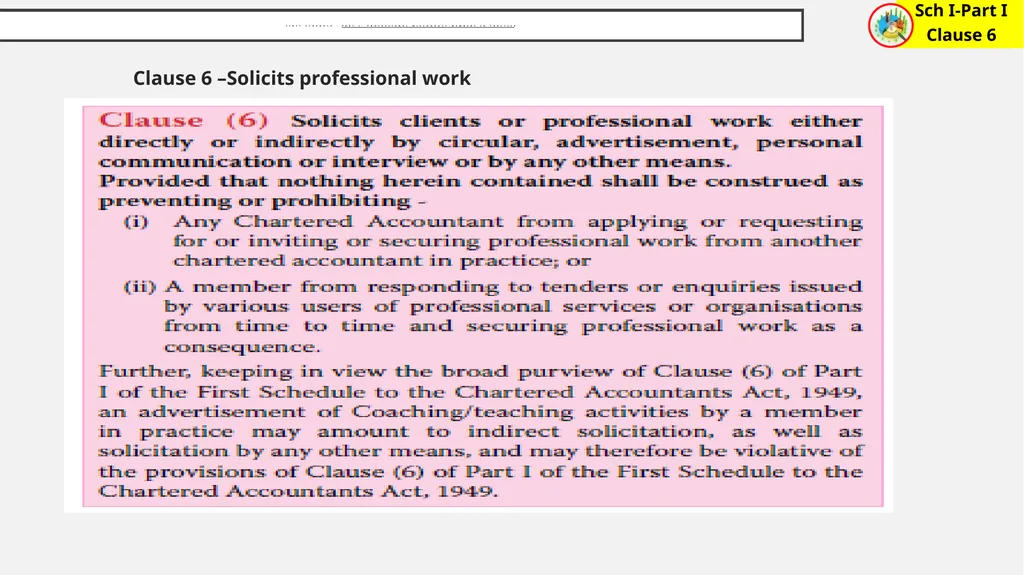
slide25. FIRST SCHEDULE - Part I- Professional misconduct-Members in Practice Clause 6 –Solicits professional work<br>
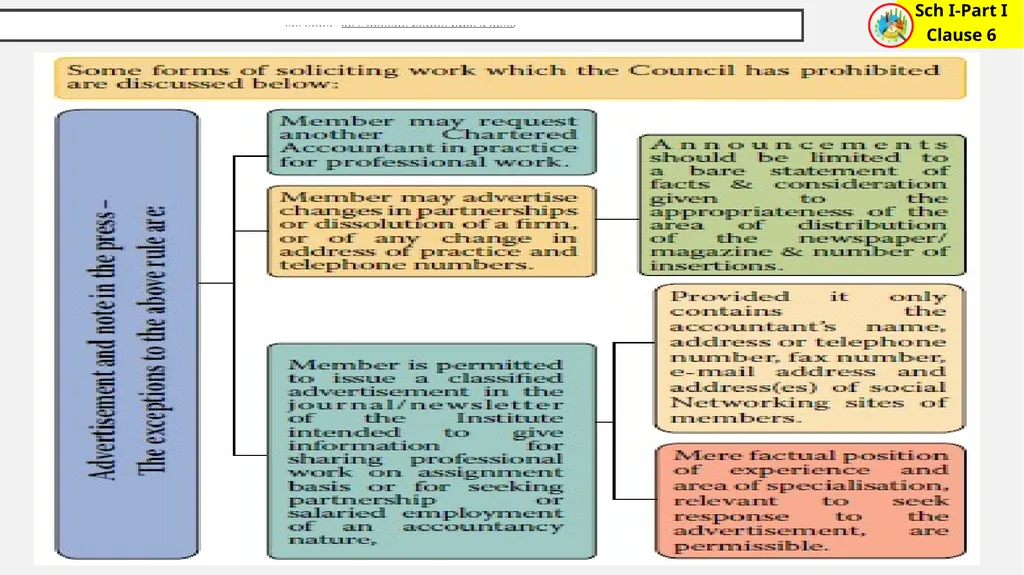
slide26. FIRST SCHEDULE - Part I- Professional misconduct-Members in Practice<br>
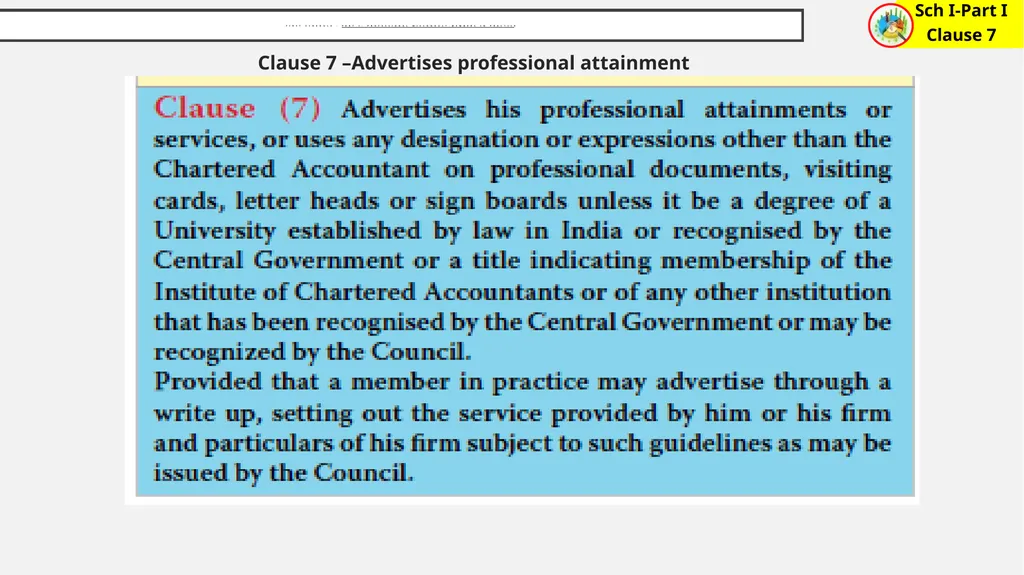
slide27. FIRST SCHEDULE - Part I- Professional misconduct-Members in Practice Clause 7 –Advertises professional attainment<br>
slide28. FIRST SCHEDULE.. In brief
Part I- 12 items-Professional misconduct-members in Practice
Practice by non-chartered accountant
Shares fees with non-Member
Accepts fees from non-Member
Enters into partnership with non-Member
Secures professional business through non- employee/non-partner or unlawful means<br>
slide29. FIRST SCHEDULE .. In brief (CONTD)
Part I- 12 items-Professional misconduct-members in Practice… contd….
Solicits professional work
Advertises professional attainment
Fails to communicate with outgoing auditor – Refer New FAQ by ICAI- clarifying certain aspects
Professional courtesy is not only sole reason
Opportunity to know reason and safe guard own interest
Reasons for non acceptance- non-payment of undisputed fees, non compliance of Sec 139 to 141 of Co.Act’
Qualified Report<br>
slide30. FIRST SCHEDULE .. In brief (CONTD)
Part I- 12 items-Professional misconduct-members in Practice… contd….
9. Non compliance of Sec 139 to 141 of Co Act, 2013
The incoming Auditor should ensure that appropriate procedure has been followed for his appointment(so that applicable law is complied and also, at a later stage no objection is raised by any one)
The procedure may vary for first appointment, casual vacancy, joint audit,
10. Charging/offering to charge, Accept/ offers to accept- fees based on percentage/ contingency (refer Regulation 192 for exceptions)<br>
slide31. FIRST SCHEDULE .. In brief (CONTD)
Part I- 12 items-Professional misconduct-members in Practice
Engages in any other occupation (director simplicitor but he/partner not auditor; Regulation 190A (General or specific permission) and Regulation191 may be referred for relaxations/conditions)
Allows non - Member/non-partner to sign documents on his/ firm’s behalf. (except routine documents on which a professional opinion or authentication is not required)<br>
slide32. FIRST SCHEDULE .. In brief (CONTD)
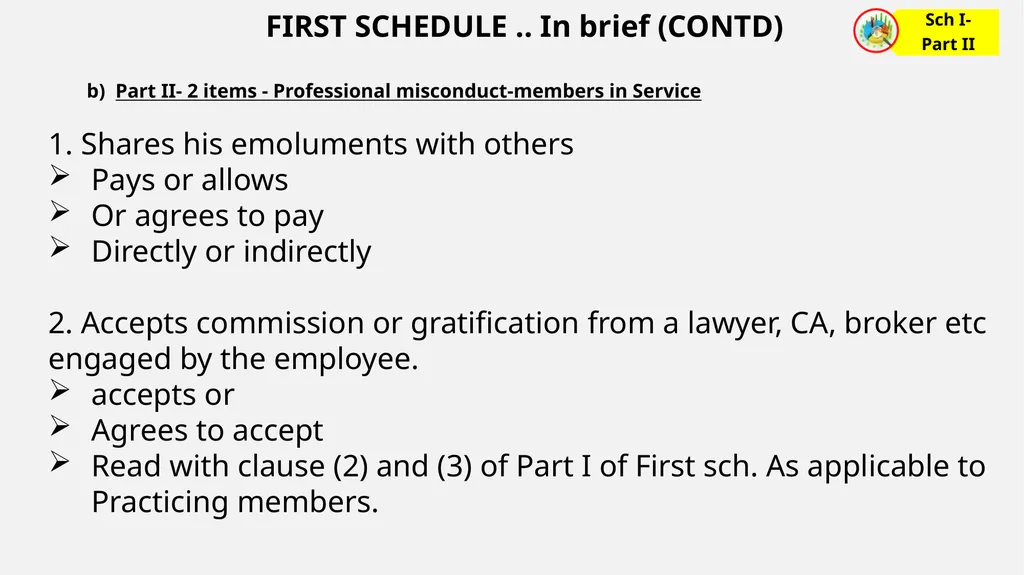
Part II- 2 items - Professional misconduct-members in Service
1. Shares his emoluments with others
Pays or allows
Or agrees to pay
Directly or indirectly
2. Accepts commission or gratification from a lawyer, CA, broker etc engaged by the employee.
accepts or
Agrees to accept
Read with clause (2) and (3) of Part I of First sch. As applicable to Practicing members.<br>
slide33. FIRST SCHEDULE .. In brief (CONTD)
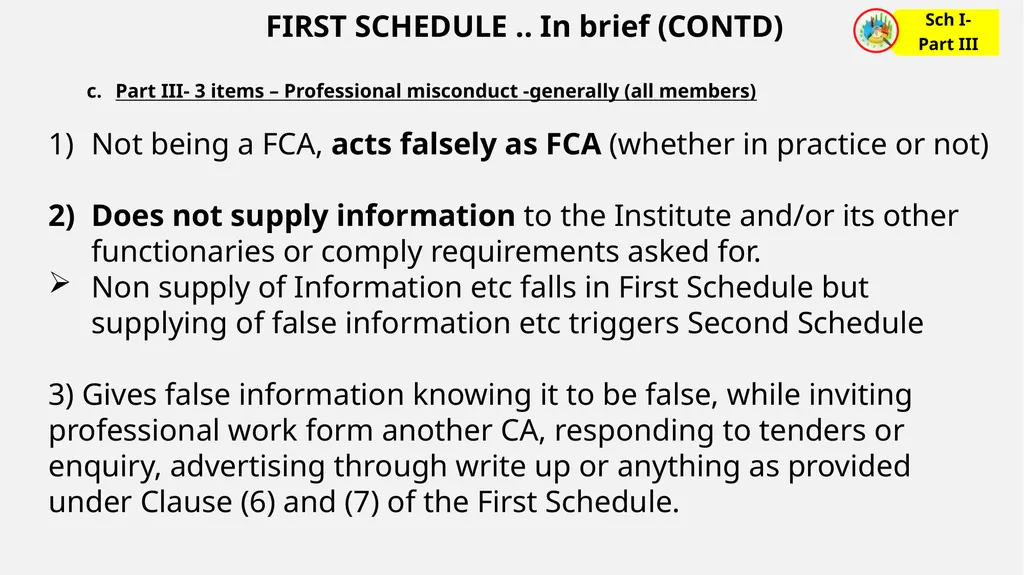
Part III- 3 items – Professional misconduct -generally (all members)
Not being a FCA, acts falsely as FCA (whether in practice or not)
Does not supply information to the Institute and/or its other functionaries or comply requirements asked for.
Non supply of Information etc falls in First Schedule but supplying of false information etc triggers Second Schedule
3) Gives false information knowing it to be false, while inviting professional work form another CA, responding to tenders or enquiry, advertising through write up or anything as provided under Clause (6) and (7) of the First Schedule.<br>
slide34. FIRST SCHEDULE .. In brief (CONTD)
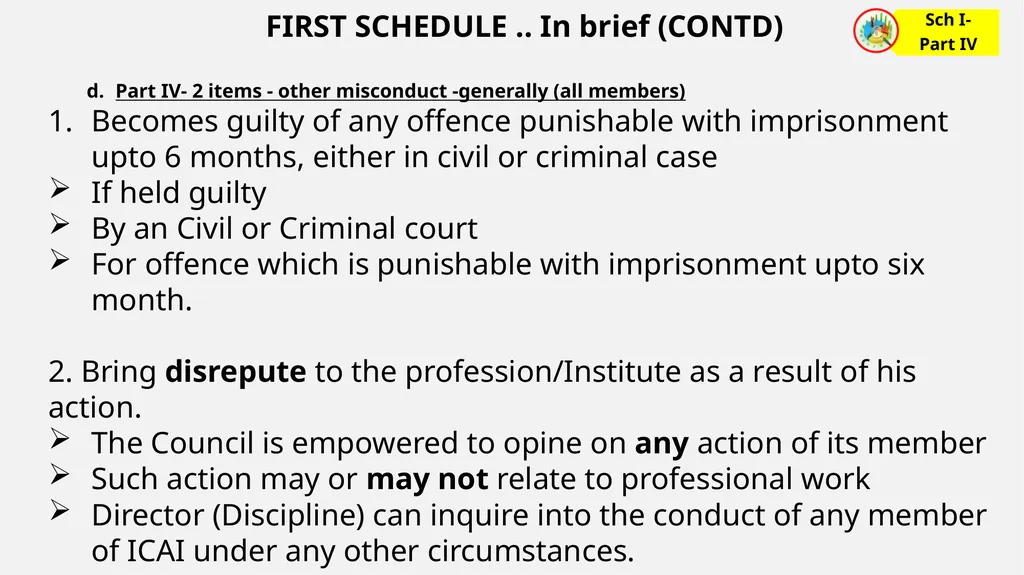
Part IV- 2 items - other misconduct -generally (all members)
Becomes guilty of any offence punishable with imprisonment upto 6 months, either in civil or criminal case
If held guilty
By an Civil or Criminal court
For offence which is punishable with imprisonment upto six month.
2. Bring disrepute to the profession/Institute as a result of his action.
The Council is empowered to opine on any action of its member
Such action may or may not relate to professional work
Director (Discipline) can inquire into the conduct of any member of ICAI under any other circumstances.<br>
slide35. SECOND SCHEDULE .. In brief
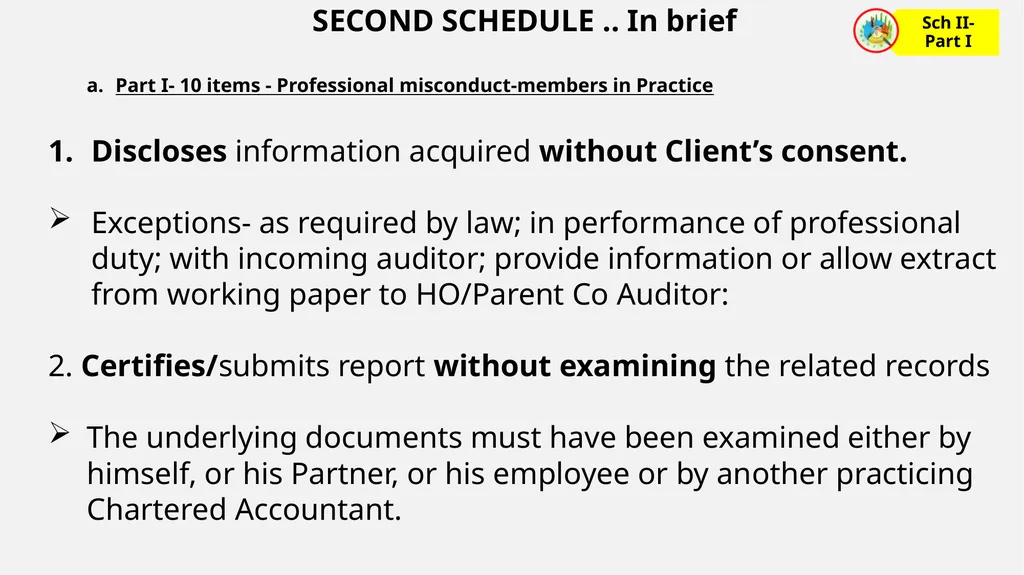
Part I- 10 items - Professional misconduct-members in Practice
Discloses information acquired without Client’s consent.
Exceptions- as required by law; in performance of professional duty; with incoming auditor; provide information or allow extract from working paper to HO/Parent Co Auditor:
2. Certifies/submits report without examining the related records
The underlying documents must have been examined either by himself, or his Partner, or his employee or by another practicing Chartered Accountant.<br>
slide36. SECOND SCHEDULE .. In brief
Part I- 10 items - Professional misconduct-members in Practice
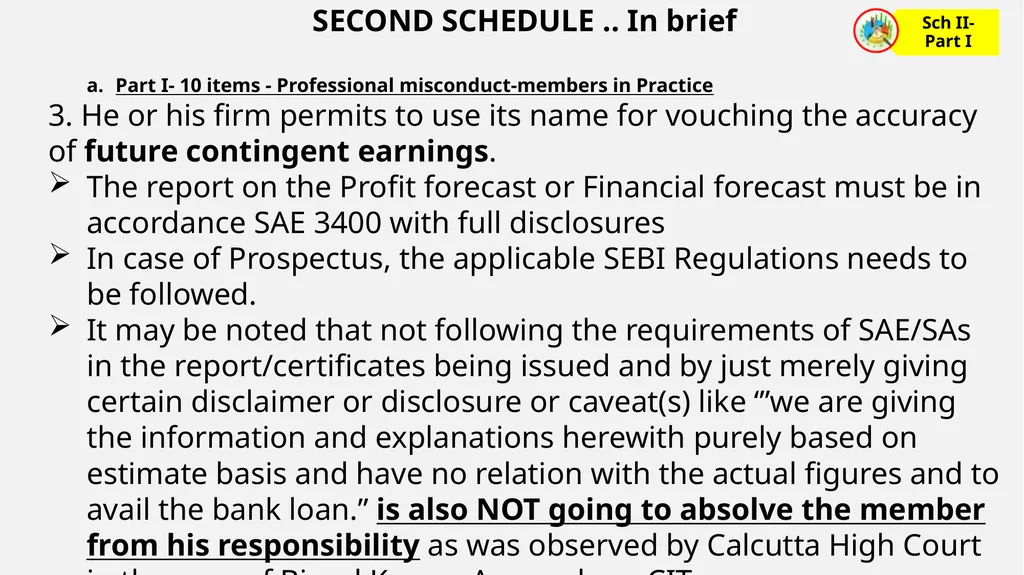
3. He or his firm permits to use its name for vouching the accuracy of future contingent earnings.
The report on the Profit forecast or Financial forecast must be in accordance SAE 3400 with full disclosures
In case of Prospectus, the applicable SEBI Regulations needs to be followed.
It may be noted that not following the requirements of SAE/SAs in the report/certificates being issued and by just merely giving certain disclaimer or disclosure or caveat(s) like ‘”we are giving the information and explanations herewith purely based on estimate basis and have no relation with the actual figures and to avail the bank loan.” is also NOT going to absolve the member from his responsibility as was observed by Calcutta High Court in the case of Binod Kumar Agarwala vs CIT.<br>
slide37. SECOND SCHEDULE .. In brief
Part I- 10 items - Professional misconduct-members in Practice
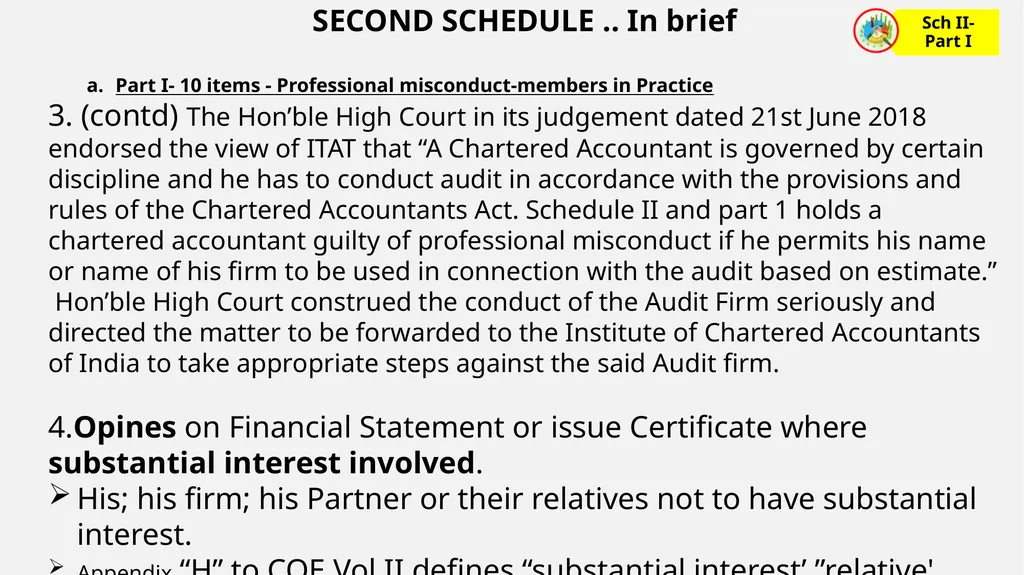
3. (contd) The Hon’ble High Court in its judgement dated 21st June 2018 endorsed the view of ITAT that “A Chartered Accountant is governed by certain discipline and he has to conduct audit in accordance with the provisions and rules of the Chartered Accountants Act. Schedule II and part 1 holds a chartered accountant guilty of professional misconduct if he permits his name or name of his firm to be used in connection with the audit based on estimate.” Hon’ble High Court construed the conduct of the Audit Firm seriously and directed the matter to be forwarded to the Institute of Chartered Accountants of India to take appropriate steps against the said Audit firm.
4.Opines on Financial Statement or issue Certificate where substantial interest involved.
His; his firm; his Partner or their relatives not to have substantial interest.
Appendix “H” to COE Vol II defines “substantial interest’,”relative'<br>
slide38. SECOND SCHEDULE .. In brief (Contd)
Part I- 10 items - Professional misconduct-members in Practice
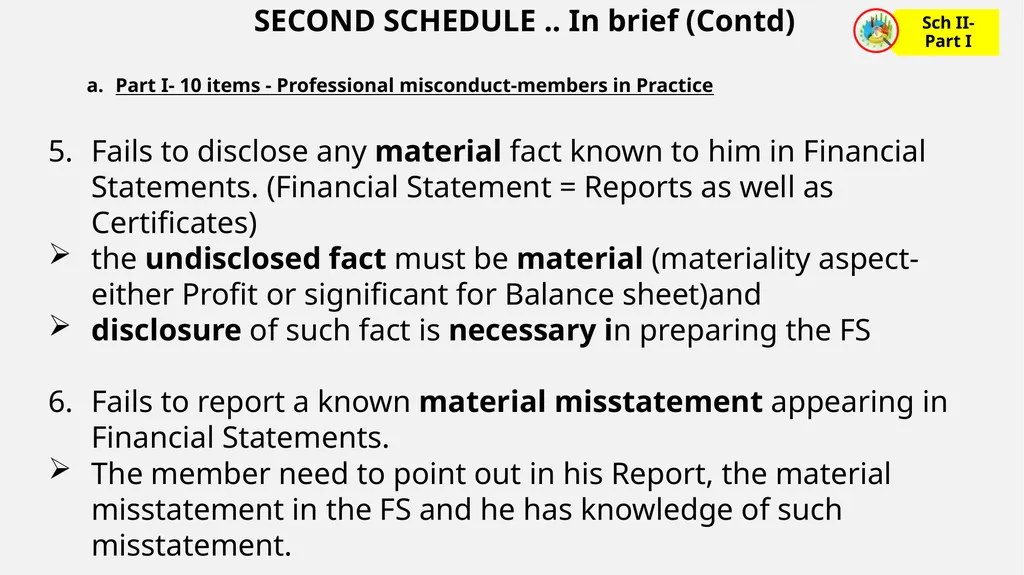
Fails to disclose any material fact known to him in Financial Statements. (Financial Statement = Reports as well as Certificates)
the undisclosed fact must be material (materiality aspect-either Profit or significant for Balance sheet)and
disclosure of such fact is necessary in preparing the FS
Fails to report a known material misstatement appearing in Financial Statements.
The member need to point out in his Report, the material misstatement in the FS and he has knowledge of such misstatement.<br>
slide39. SECOND SCHEDULE .. In brief (Contd)
Part I- 10 items - Professional misconduct-members in Practice
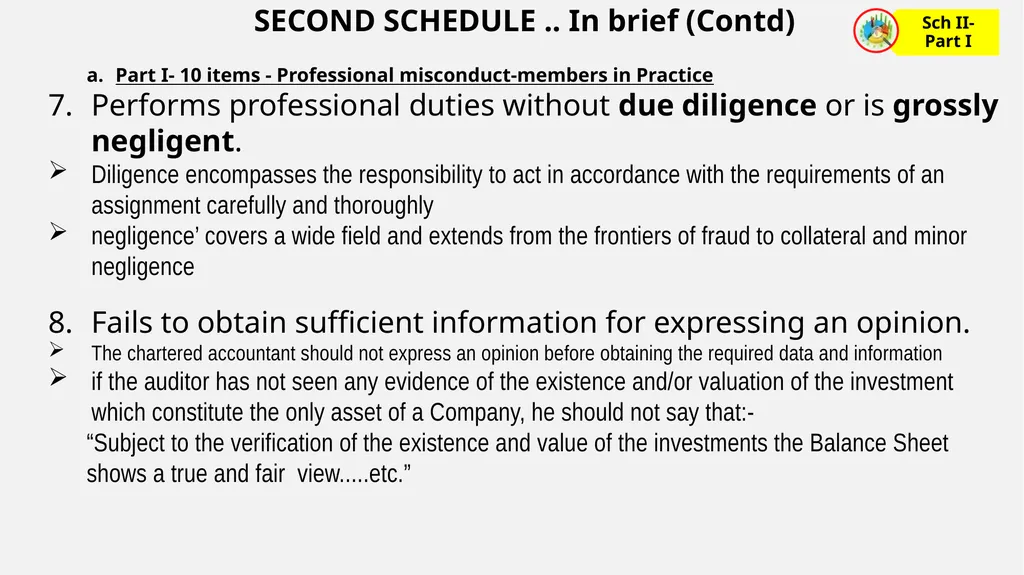
Performs professional duties without due diligence or is grossly negligent.
Diligence encompasses the responsibility to act in accordance with the requirements of an assignment carefully and thoroughly
negligence’ covers a wide field and extends from the frontiers of fraud to collateral and minor negligence
Fails to obtain sufficient information for expressing an opinion.
The chartered accountant should not express an opinion before obtaining the required data and information
if the auditor has not seen any evidence of the existence and/or valuation of the investment which constitute the only asset of a Company, he should not say that:-
“Subject to the verification of the existence and value of the investments the Balance Sheet shows a true and fair view.....etc.”<br>
slide40. SECOND SCHEDULE .. In brief (Contd)
Part I- 10 items - Professional misconduct-members in Practice
Fails to invite attention to any material departure from the generally accepted procedure of audit (GAAP) applicable to the circumstances
the audit should be performed in accordance with “generally accepted procedure of audit applicable to the circumstances” and if for any reason the auditor has not been able to perform the audit in accordance with such procedure, his report should draw attention to the material departures from such procedures
10. Keeps client’s money without opening separate bank account.
a member may be entrusted with moneys belonging to his client (other than fees or remuneration or money meant to be expended). If he should receive such funds, it would be his duty to deposit them in a separate banking account, and to utilise such funds only in accordance with the instructions of the client or for the purposes intended by the client within a reasonable time.<br>
slide41. SECOND SCHEDULE (Contd)
Part II- 5 items - Professional misconduct- generally (all members)
Contravenes any of the provisions of the Chartered Accountants Act/Regulations & Guidelines issued by the Council.(Brahmastra)
The Council is empowered to issue guidelines in exercise of the power conferred by clause (1) of this Part.
It is an authority for the Council to issue guidelines for extending the scope of misconduct to cover acts or omissions not already dealt with in the various clauses of the two schedules
Being an employee, discloses employer’s confidential information (acquired in course of employment) without permission or except as and when required by law or permitted by employer.
The confidential information cannot be disclosed by member even after cessation of his employment.<br>
slide42. SECOND SCHEDULE (Contd)
Part II- 5 items - Professional misconduct- generally (all members)
Provides false information to the Institute and its different authorities.
the member should not furnish any particulars knowing them to be false in any information, statement, return or form to be submitted
to the Institute or Council or any of its Committees, Director (Discipline), Board of Discipline, Disciplinary Committee, Quality Review Board or the Appellate Authority<br>
slide43. SECOND SCHEDULE (Contd)
Part II- 5 items - Professional misconduct- generally (all members)
Defalcates/embezzles money received in professional capacity.
acts as an auditor of the company in contravention of the provisions of the Companies Act, 2013.
This clause was newly inserted vide amendment dated 18th April, 2022.
Contravention of any of the provisions of Companies Act, 2013 by the member of ICAI may trigger this clause.<br>
slide44. SECOND SCHEDULE .. In brief (CONTD)
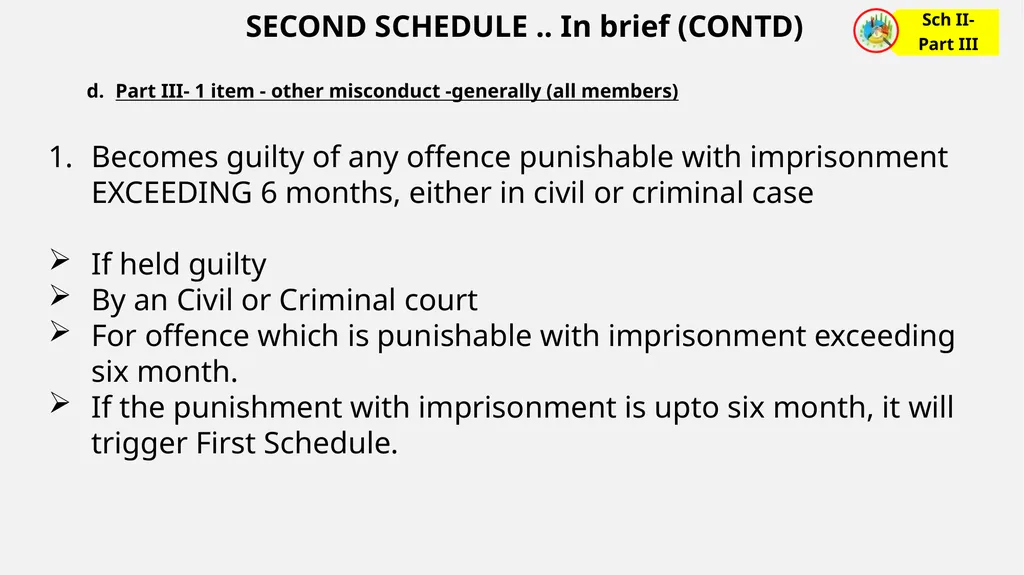
Part III- 1 item - other misconduct -generally (all members)
Becomes guilty of any offence punishable with imprisonment EXCEEDING 6 months, either in civil or criminal case
If held guilty
By an Civil or Criminal court
For offence which is punishable with imprisonment exceeding six month.
If the punishment with imprisonment is upto six month, it will trigger First Schedule.<br>
slide45. Any further Questions ??? 45 QUESTIONS ????<br>
slide46. Thank You 46 CA Pawan Kumar Agarwal
madanlalassociates@gmail.com
9830262464<br>
slide2. What is PEER REVIEW As per Clause 2 (14) of the Peer Review Guideline, 2022
Peer Review - means an examination and review of the systems and procedures to determine whether the same have been put in place by the Practice Unit for ensuring the quality of assurance services as envisaged by the Technical, Professional and Ethical Standards as applicable including Audit Quality Maturity Model wherever applicable or any other regulatory requirements as may be prescribed by the Council or any Committee and whether the same were consistently applied during the period under review Ca pAWAN kUMAR agarwaL madanlalassociates@gmail.com<br>
slide3. Definition Examination and review -----
Of the systems and procedures
To determine -----
whether such systems and procedures have been put in place by the Practice Unit (and also to see that such systems and procedures are adhered and working properly)
To ensure
the Quality of the assurance services
Quality to be examined with what
Various Technical Standards (as applicable)
Various Professional Standards (as applicable)
Ethical Standards (as applicable)
Audit Quality Maturity Model (AQMM) (wherever applicable)
Digital Competency Maturity Model (DCMM) (optional-but very much effective, )
Other regulatory requirements as may be prescribed by the
Council of ICAI or
Committee of ICAI
Whether the same (above) were consistently applied during the period under review Ca pAWAN kUMAR agarwaL madanlalassociates@gmail.com<br>
slide4. Therefore, in short, the term “peer review” may be construed as review of work done by a professional, by another similar professional (peer),
Peer Review process is based on the principle of systematic monitoring of the procedures adopted and records maintained while carrying out audit & assurance services in the course of one’s professional responsibility to ensure and sustain quality
Peer Review is primarily directed towards ensuring as well as enhancing the quality of audit and assurance services of Chartered Accountants in Practice.
Peer Review of a Practice Unit is conducted by an independent evaluator known as a Peer Reviewer
The Peer Review process is intended to review the quality control framework of the Practice Unit as well as proper and consistent application of such control frameworks across engagement samples selected for review [Clause 3(2)] Ca pAWAN kUMAR agarwaL madanlalassociates@gmail.com In Brief<br>
slide5. The main objective of Peer Review is to ensure that in carrying out the assurance service assignments, the members of the Institute –
comply with Technical, Professional and Ethical Standards as applicable including other regulatory requirements thereto and
have in place proper systems including documentation thereof, to amply demonstrate the quality of the assurance services. [Clause 3(3)]
It is important to note that Peer Review does not seek to redefine the scope and authority of any of the Technical, Professional and Ethical Standards but only seeks to ensure that they are implemented, both in letter and spirit.
Therefore, the objective is to maintain and enhance the quality of assurance services by providing appropriate guidance rather than simply pointing out deficiencies of the Practice Unit. Ca pAWAN kUMAR agarwaL madanlalassociates@gmail.com Objective<br>
slide6. SCOPE of Peer Review Ca pAWAN kUMAR agarwaL madanlalassociates@gmail.com<br>
slide7. SCOPE… The Peer Review shall cover:
Compliance with Technical, Professional and Ethical Standards
Quality of reporting
Systems and procedures for carrying out assurance Services
Self evaluation under Audit Quality Maturity Model or any other guideline issued by the Centre for Audit Quality
Training programmes for staff (including article and audit assistants) concerned with assurance functions, including availability of appropriate infrastructure
Compliance with directions and / or guidelines issued by the Council to its Members, including fees to be charged, number of audits undertaken, register for assurance engagements conducted during the year and such other related records.
Compliance with directions and / or guidelines issued by the Council in relation to article assistants and / or audit assistants, including attendance register, work diaries, stipend payments, and such other related records. Ca pAWAN kUMAR agarwaL madanlalassociates@gmail.com<br>
slide8. SCOPE… The Peer Review process shall apply to all the assurance engagements signed by a Practice Unit during the period under review.
Once a Practice Unit is subjected to Peer Review, its assurance engagement records, working papers, pertaining to the Peer Review Period shall be subject to examination and review by the Peer Reviewer.
A Practice Unit having one or more branches at various locations in India may opt to get the Peer Review of any branch or branches conducted by a Branch Peer Reviewer. The Reviewer conducting the Peer Review of the Head Office shall consider the report of the Branch Peer Reviewer and shall issue a consolidated report for the Practice Unit Ca pAWAN kUMAR agarwaL madanlalassociates@gmail.com<br>
slide9. CODE OF ETHICS
(Clause by Clause-Sch I & II) 9 CA Pawan Kumar Agarwal
madanlalassociates@gmail.com 30th March 2024
EIRC- ICAI 9<br>
slide10. 10 Disclaimer :
The views expressed in the presentation is exclusively that of the author.
The information contained herein is of a general nature and is not intended to address the circumstances of any particular individual or entity.
Although we endeavour to provide accurate and timely information, there can be no guarantee that such information is accurate as of the date it is received or that it will continue to be accurate in the future.
The presenter is in no case liable for any damages incurred by relying on the ideas implemented without adequate consultation.<br>
slide11. How Many schedules and how many Sections in The Chartered Accountants Act,1949?
There are Two Schedules- First Schedule and Second Schedule depending on the gravity of offence and quantum of punishment.
There are 32 Sections in The Chartered Accountants Act, 1949
Q: Whether the offences are confined to Two schedules to Chartered Accountants Act only?
No, Section 8(v) and Chapter VII of the Chartered Accountants Act having Sections 24, 24A, 25 to 28 also provides for penalties under various circumstances.
Section 132(4) of the Companies Act, 2013 provides for penalty where professional or other misconduct is proved.<br>
slide12. Professional or other misconduct defined
‘22. For the purposes of this Act, the expression “professional or other misconduct” shall be
deemed to include any act or omission, on the part of any member of the Institute either in his individual capacity or as partner or owner of a firm, as mentioned in any of the Schedules,
but nothing in this section shall be construed to limit or abridge in any way the power conferred or duty cast on the Director (Discipline) under sub-section (1) of section 21 to inquire into the conduct of such member or firm, under any other circumstances.’.<br>
slide13. Misconduct
MISCONDUCT can be broadly divided into two categories
Professional Misconduct
Other misconduct.
Broadly 35 items of Misconduct are there in the Schedules
First schedule-in Four Parts has 19 items (Rationale behind dividing schedules I Parts)
Second Schedule-in three parts has 16 items<br>
slide14. Professional or other misconduct defined (contd..)
The definition is not exhaustive but inclusive one, as such may include many more criteria.
Any act or omission on the part of the member as mentioned in any of the schedules. (presently First and Second Schedule)
Misconduct may either in his individual capacity
Misconduct may be as a partner of the firm
Misconduct may be as a proprietor of the Firm<br>
slide15. Professional or other misconduct defined Contd
However, the Director (Discipline) has vast power and duty to inquire into the conduct of the
>member or
>Firm or
>Member and firm
Under any other circumstances also (i.e. in addition to circumstances stated in schedules)
This Section cannot limit or curtail, in any way, the power or duty conferred to the Directorate.<br>
slide16. What constitutes `misconduct
under any other circumstances’ has to be determined on case to case basis
keeping in view the facts of the circumstances of each case.
Fraud, intention to deceive and committing an act which affects the public or society at large could be in the ambit of such misconduct.<br>
slide18. WHAT IS THE RATIONAL BEHIND DIVIDING SCHEDULES INTO PARTS?
First Schedule
Part I- 12 Clauses-Professional misconduct-members in Practice
Part II- 2 Clauses - Professional misconduct-members in Service
Part III-3 Clauses – Professional misconduct -generally (all members)
Part IV-2 Clauses- other misconduct -generally (all members)<br>
slide19. WHAT IS THE RATIONAL BEHIND DIVIDING SCHEDULES INTO PARTS? Contd….
Second Schedule
Part I- 10 clauses-Professional misconduct-members in Practice
Part II-5 clauses - Professional misconduct- generally (all members)
Part III-1 Clause -other misconduct -generally (all members)<br>
slide20. FIRST SCHEDULE Part I- Professional misconduct-Members in Practice Clause 1 -Practice by non-CA<br>
slide21. FIRST SCHEDULE Part I- Professional misconduct-Members in Practice Clause 2 –Sharing Fees with Non- Member, directly, indirectly<br>
slide22. FIRST SCHEDULE - Part I- Professional misconduct-Members in Practice Clause 3 –Accepts Fees from NON MEMBERS Multidisciplinary – an Exception<br>
slide23. FIRST SCHEDULE - Part I- Professional misconduct-Members in Practice Clause 4 –Partnership with Non Member<br>
slide24. FIRST SCHEDULE - Part I- Professional misconduct-Members in Practice Clause 5 –Secures professional business through non- employee/non-partner or unlawful means<br>
slide25. FIRST SCHEDULE - Part I- Professional misconduct-Members in Practice Clause 6 –Solicits professional work<br>
slide26. FIRST SCHEDULE - Part I- Professional misconduct-Members in Practice<br>
slide27. FIRST SCHEDULE - Part I- Professional misconduct-Members in Practice Clause 7 –Advertises professional attainment<br>
slide28. FIRST SCHEDULE.. In brief
Part I- 12 items-Professional misconduct-members in Practice
Practice by non-chartered accountant
Shares fees with non-Member
Accepts fees from non-Member
Enters into partnership with non-Member
Secures professional business through non- employee/non-partner or unlawful means<br>
slide29. FIRST SCHEDULE .. In brief (CONTD)
Part I- 12 items-Professional misconduct-members in Practice… contd….
Solicits professional work
Advertises professional attainment
Fails to communicate with outgoing auditor – Refer New FAQ by ICAI- clarifying certain aspects
Professional courtesy is not only sole reason
Opportunity to know reason and safe guard own interest
Reasons for non acceptance- non-payment of undisputed fees, non compliance of Sec 139 to 141 of Co.Act’
Qualified Report<br>
slide30. FIRST SCHEDULE .. In brief (CONTD)
Part I- 12 items-Professional misconduct-members in Practice… contd….
9. Non compliance of Sec 139 to 141 of Co Act, 2013
The incoming Auditor should ensure that appropriate procedure has been followed for his appointment(so that applicable law is complied and also, at a later stage no objection is raised by any one)
The procedure may vary for first appointment, casual vacancy, joint audit,
10. Charging/offering to charge, Accept/ offers to accept- fees based on percentage/ contingency (refer Regulation 192 for exceptions)<br>
slide31. FIRST SCHEDULE .. In brief (CONTD)
Part I- 12 items-Professional misconduct-members in Practice
Engages in any other occupation (director simplicitor but he/partner not auditor; Regulation 190A (General or specific permission) and Regulation191 may be referred for relaxations/conditions)
Allows non - Member/non-partner to sign documents on his/ firm’s behalf. (except routine documents on which a professional opinion or authentication is not required)<br>
slide32. FIRST SCHEDULE .. In brief (CONTD)
Part II- 2 items - Professional misconduct-members in Service
1. Shares his emoluments with others
Pays or allows
Or agrees to pay
Directly or indirectly
2. Accepts commission or gratification from a lawyer, CA, broker etc engaged by the employee.
accepts or
Agrees to accept
Read with clause (2) and (3) of Part I of First sch. As applicable to Practicing members.<br>
slide33. FIRST SCHEDULE .. In brief (CONTD)
Part III- 3 items – Professional misconduct -generally (all members)
Not being a FCA, acts falsely as FCA (whether in practice or not)
Does not supply information to the Institute and/or its other functionaries or comply requirements asked for.
Non supply of Information etc falls in First Schedule but supplying of false information etc triggers Second Schedule
3) Gives false information knowing it to be false, while inviting professional work form another CA, responding to tenders or enquiry, advertising through write up or anything as provided under Clause (6) and (7) of the First Schedule.<br>
slide34. FIRST SCHEDULE .. In brief (CONTD)
Part IV- 2 items - other misconduct -generally (all members)
Becomes guilty of any offence punishable with imprisonment upto 6 months, either in civil or criminal case
If held guilty
By an Civil or Criminal court
For offence which is punishable with imprisonment upto six month.
2. Bring disrepute to the profession/Institute as a result of his action.
The Council is empowered to opine on any action of its member
Such action may or may not relate to professional work
Director (Discipline) can inquire into the conduct of any member of ICAI under any other circumstances.<br>
slide35. SECOND SCHEDULE .. In brief
Part I- 10 items - Professional misconduct-members in Practice
Discloses information acquired without Client’s consent.
Exceptions- as required by law; in performance of professional duty; with incoming auditor; provide information or allow extract from working paper to HO/Parent Co Auditor:
2. Certifies/submits report without examining the related records
The underlying documents must have been examined either by himself, or his Partner, or his employee or by another practicing Chartered Accountant.<br>
slide36. SECOND SCHEDULE .. In brief
Part I- 10 items - Professional misconduct-members in Practice
3. He or his firm permits to use its name for vouching the accuracy of future contingent earnings.
The report on the Profit forecast or Financial forecast must be in accordance SAE 3400 with full disclosures
In case of Prospectus, the applicable SEBI Regulations needs to be followed.
It may be noted that not following the requirements of SAE/SAs in the report/certificates being issued and by just merely giving certain disclaimer or disclosure or caveat(s) like ‘”we are giving the information and explanations herewith purely based on estimate basis and have no relation with the actual figures and to avail the bank loan.” is also NOT going to absolve the member from his responsibility as was observed by Calcutta High Court in the case of Binod Kumar Agarwala vs CIT.<br>
slide37. SECOND SCHEDULE .. In brief
Part I- 10 items - Professional misconduct-members in Practice
3. (contd) The Hon’ble High Court in its judgement dated 21st June 2018 endorsed the view of ITAT that “A Chartered Accountant is governed by certain discipline and he has to conduct audit in accordance with the provisions and rules of the Chartered Accountants Act. Schedule II and part 1 holds a chartered accountant guilty of professional misconduct if he permits his name or name of his firm to be used in connection with the audit based on estimate.” Hon’ble High Court construed the conduct of the Audit Firm seriously and directed the matter to be forwarded to the Institute of Chartered Accountants of India to take appropriate steps against the said Audit firm.
4.Opines on Financial Statement or issue Certificate where substantial interest involved.
His; his firm; his Partner or their relatives not to have substantial interest.
Appendix “H” to COE Vol II defines “substantial interest’,”relative'<br>
slide38. SECOND SCHEDULE .. In brief (Contd)
Part I- 10 items - Professional misconduct-members in Practice
Fails to disclose any material fact known to him in Financial Statements. (Financial Statement = Reports as well as Certificates)
the undisclosed fact must be material (materiality aspect-either Profit or significant for Balance sheet)and
disclosure of such fact is necessary in preparing the FS
Fails to report a known material misstatement appearing in Financial Statements.
The member need to point out in his Report, the material misstatement in the FS and he has knowledge of such misstatement.<br>
slide39. SECOND SCHEDULE .. In brief (Contd)
Part I- 10 items - Professional misconduct-members in Practice
Performs professional duties without due diligence or is grossly negligent.
Diligence encompasses the responsibility to act in accordance with the requirements of an assignment carefully and thoroughly
negligence’ covers a wide field and extends from the frontiers of fraud to collateral and minor negligence
Fails to obtain sufficient information for expressing an opinion.
The chartered accountant should not express an opinion before obtaining the required data and information
if the auditor has not seen any evidence of the existence and/or valuation of the investment which constitute the only asset of a Company, he should not say that:-
“Subject to the verification of the existence and value of the investments the Balance Sheet shows a true and fair view.....etc.”<br>
slide40. SECOND SCHEDULE .. In brief (Contd)
Part I- 10 items - Professional misconduct-members in Practice
Fails to invite attention to any material departure from the generally accepted procedure of audit (GAAP) applicable to the circumstances
the audit should be performed in accordance with “generally accepted procedure of audit applicable to the circumstances” and if for any reason the auditor has not been able to perform the audit in accordance with such procedure, his report should draw attention to the material departures from such procedures
10. Keeps client’s money without opening separate bank account.
a member may be entrusted with moneys belonging to his client (other than fees or remuneration or money meant to be expended). If he should receive such funds, it would be his duty to deposit them in a separate banking account, and to utilise such funds only in accordance with the instructions of the client or for the purposes intended by the client within a reasonable time.<br>
slide41. SECOND SCHEDULE (Contd)
Part II- 5 items - Professional misconduct- generally (all members)
Contravenes any of the provisions of the Chartered Accountants Act/Regulations & Guidelines issued by the Council.(Brahmastra)
The Council is empowered to issue guidelines in exercise of the power conferred by clause (1) of this Part.
It is an authority for the Council to issue guidelines for extending the scope of misconduct to cover acts or omissions not already dealt with in the various clauses of the two schedules
Being an employee, discloses employer’s confidential information (acquired in course of employment) without permission or except as and when required by law or permitted by employer.
The confidential information cannot be disclosed by member even after cessation of his employment.<br>
slide42. SECOND SCHEDULE (Contd)
Part II- 5 items - Professional misconduct- generally (all members)
Provides false information to the Institute and its different authorities.
the member should not furnish any particulars knowing them to be false in any information, statement, return or form to be submitted
to the Institute or Council or any of its Committees, Director (Discipline), Board of Discipline, Disciplinary Committee, Quality Review Board or the Appellate Authority<br>
slide43. SECOND SCHEDULE (Contd)
Part II- 5 items - Professional misconduct- generally (all members)
Defalcates/embezzles money received in professional capacity.
acts as an auditor of the company in contravention of the provisions of the Companies Act, 2013.
This clause was newly inserted vide amendment dated 18th April, 2022.
Contravention of any of the provisions of Companies Act, 2013 by the member of ICAI may trigger this clause.<br>
slide44. SECOND SCHEDULE .. In brief (CONTD)
Part III- 1 item - other misconduct -generally (all members)
Becomes guilty of any offence punishable with imprisonment EXCEEDING 6 months, either in civil or criminal case
If held guilty
By an Civil or Criminal court
For offence which is punishable with imprisonment exceeding six month.
If the punishment with imprisonment is upto six month, it will trigger First Schedule.<br>
slide45. Any further Questions ??? 45 QUESTIONS ????<br>
slide46. Thank You 46 CA Pawan Kumar Agarwal
madanlalassociates@gmail.com
9830262464<br>