
People Power Safety STEP Refresher Training
NS
Published · 65 slides · 0 views

1 / 1


Description
People Power Safety STEP Refresher Training Instructor: Production Safety Quality Agenda: STEP Purpose Engagement STEP Process Participation Data Use Plan Quality STEP Purpose We will achieve Safety Through Everyones Participation. We
Related Topics
Share
Embed code
Download this presentation From Below
"People Power Safety STEP Refresher Training" is the property of its rightful owner. Permission is granted to download and print the materials on this website for personal, non-commercial use only, and to display it on your personal computer provided you do not modify the materials and that you retain all copyright notices contained in the materials. By downloading content from our website, you accept the terms of this agreement.
Presentation Transcript
01
People Power Safety STEP Refresher Training
Instructor:<br>
Instructor:<br>
02
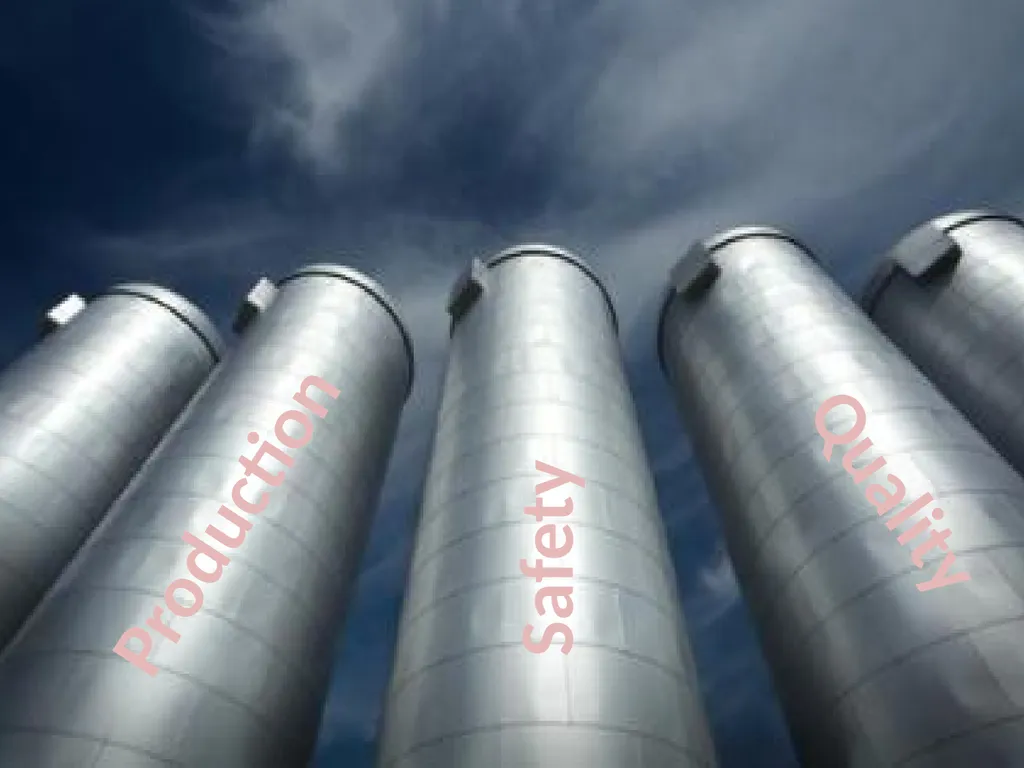
Production Safety Quality<br>
03
Agenda: STEP Purpose
Engagement
STEP Process
Participation
Data Use Plan
Quality<br>
Engagement
STEP Process
Participation
Data Use Plan
Quality<br>
04
STEP Purpose We will achieve…
Safety Through Everyone's Participation.
We will do this through actively engaging all employees to look out for the health and safety of each other.
We will identify and prevent situations that could result in serious injury or the loss of a life.
This information will be communicated on a regular bases with solutions and fixes.
We will strive to have better safety conversations<br>
We will do this through actively engaging all employees to look out for the health and safety of each other.
We will identify and prevent situations that could result in serious injury or the loss of a life.
This information will be communicated on a regular bases with solutions and fixes.
We will strive to have better safety conversations<br>
05
To create a dependable, repeatable method to measure safety successes using leading indicators instead of Recordable Injury Rate and Lost-Time Injuries. STEP Vision<br>
06
How do we Think about Safety? We need to shift our thinking: Safety is: #1 Priority or Core Value? Can Change Instantly Changes Over Time<br>
07
How is
Safety Motivated? Internal or External? (Responsibility) (Accountability)<br>
Safety Motivated? Internal or External? (Responsibility) (Accountability)<br>
08
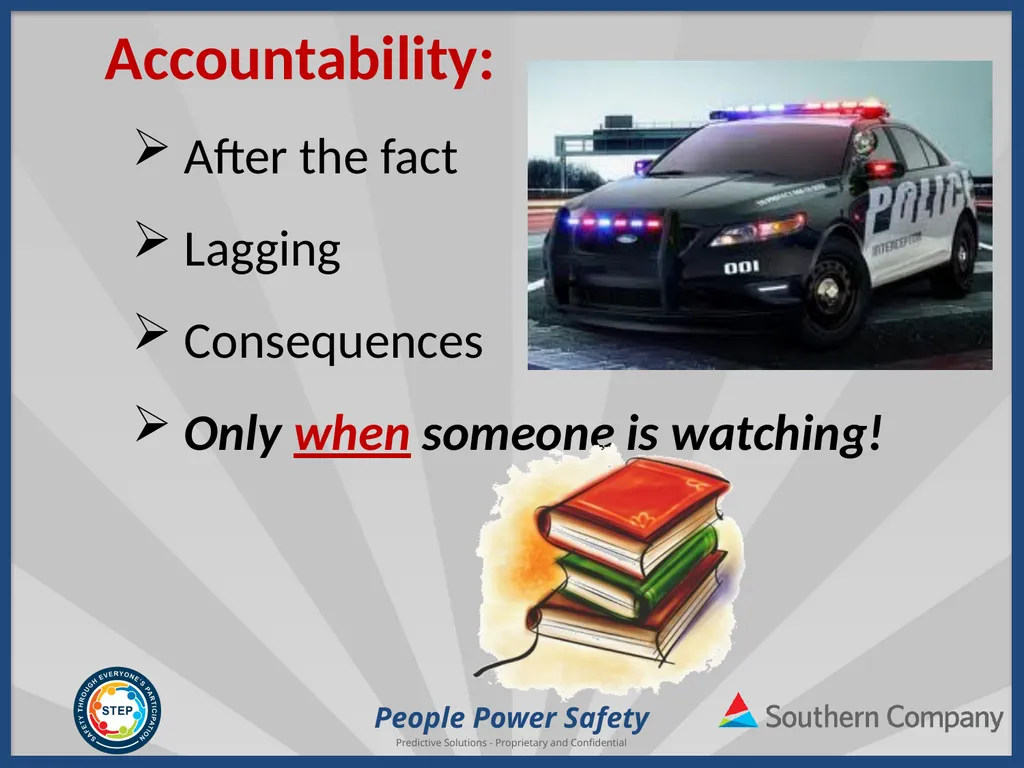
Accountability:
After the fact
Lagging
Consequences
Only when someone is watching!<br>
After the fact
Lagging
Consequences
Only when someone is watching!<br>
09
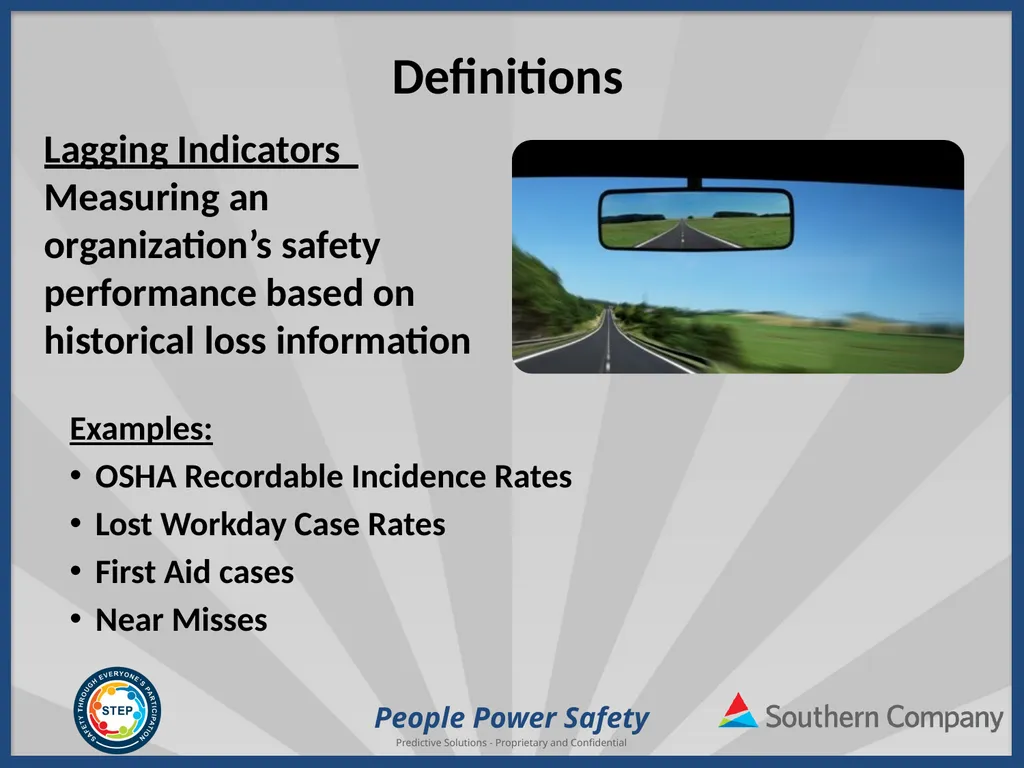
Definitions Examples:
OSHA Recordable Incidence Rates
Lost Workday Case Rates
First Aid cases
Near Misses Lagging Indicators
Measuring an organization’s safety performance based on historical loss information<br>
OSHA Recordable Incidence Rates
Lost Workday Case Rates
First Aid cases
Near Misses Lagging Indicators
Measuring an organization’s safety performance based on historical loss information<br>
10
Responsibility:
Before
Leading
Ownership
What you do… when no one is watching!<br>
Before
Leading
Ownership
What you do… when no one is watching!<br>
11
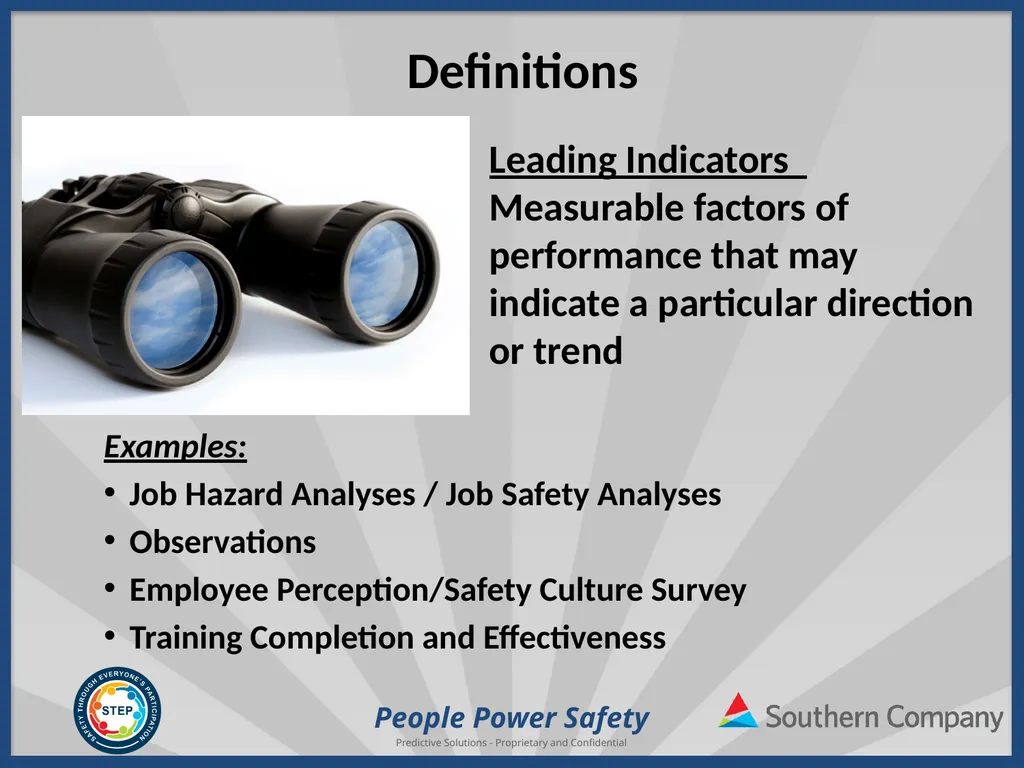
Examples:
Job Hazard Analyses / Job Safety Analyses
Observations
Employee Perception/Safety Culture Survey
Training Completion and Effectiveness Leading Indicators
Measurable factors of performance that may indicate a particular direction or trend Definitions<br>
Job Hazard Analyses / Job Safety Analyses
Observations
Employee Perception/Safety Culture Survey
Training Completion and Effectiveness Leading Indicators
Measurable factors of performance that may indicate a particular direction or trend Definitions<br>
12
We Want People to
Work Safely
Even When
No One is Watching!<br>
Work Safely
Even When
No One is Watching!<br>
13
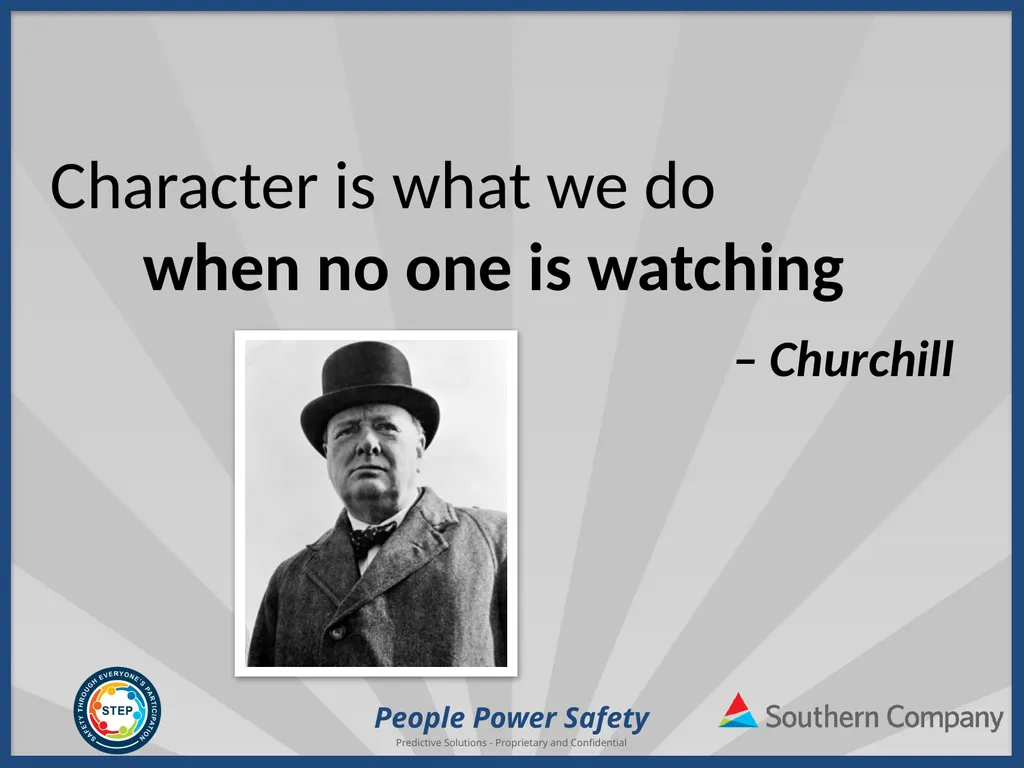
Character is what we do
when no one is watching – Churchill<br>
when no one is watching – Churchill<br>
14
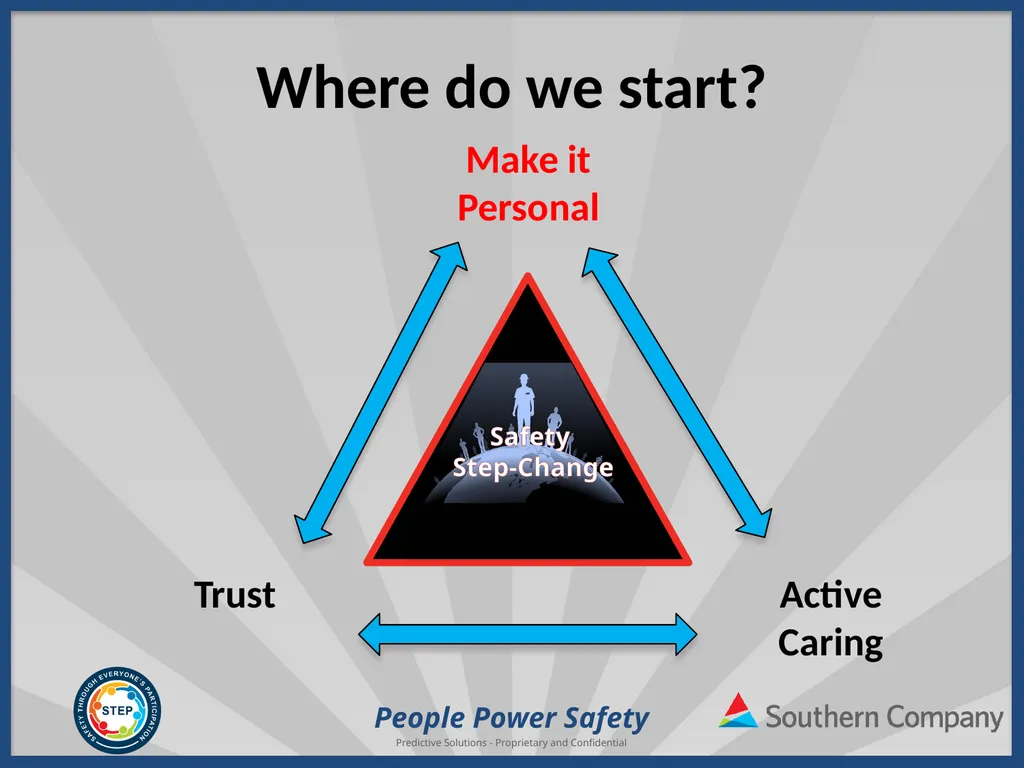
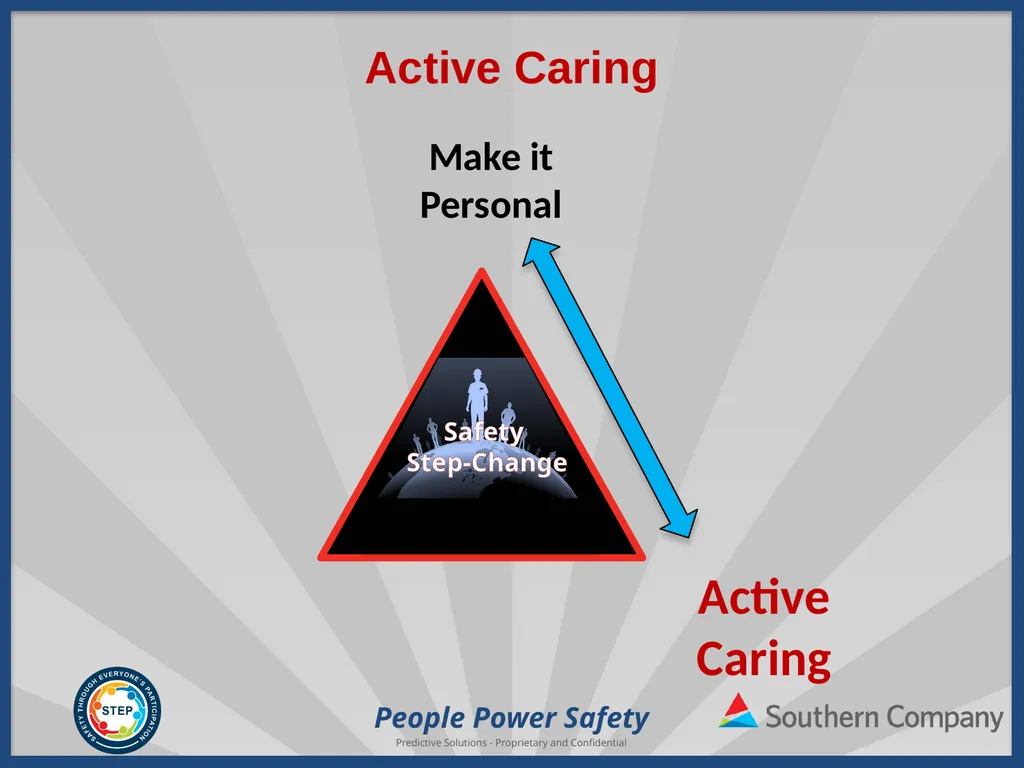
Where do we start? Make it Personal Trust Active Caring<br>
15
We will create a positive
change in our
Safety Culture by… Making Safety Personal …because People Power Safety<br>
change in our
Safety Culture by… Making Safety Personal …because People Power Safety<br>
16
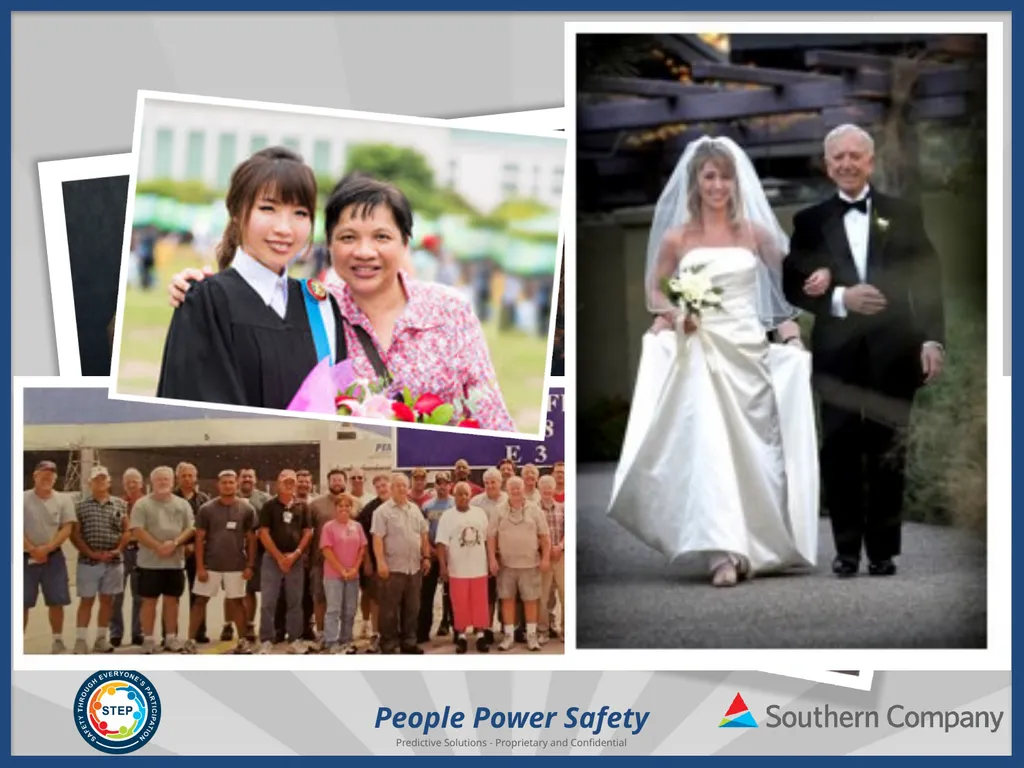
Why Should I work Safely?
Who Would Care
If I Was Injured?<br>
Who Would Care
If I Was Injured?<br>
17
Make it Personal Active Caring Active Caring<br>
18
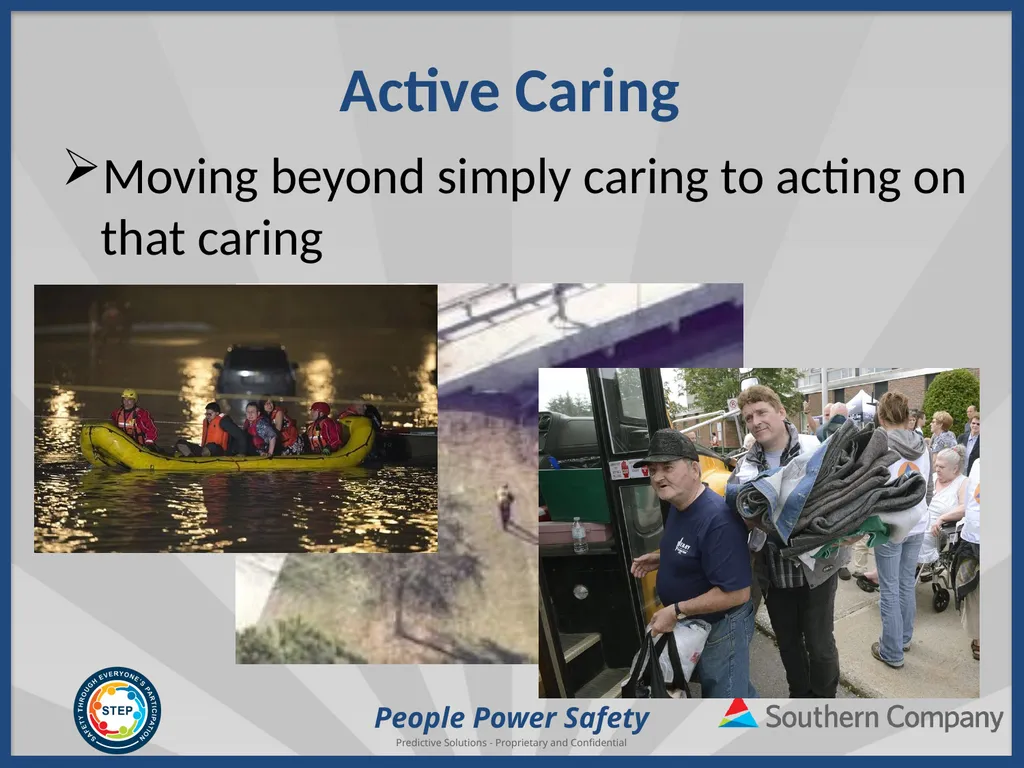
Active Caring Moving beyond simply caring to acting on that caring<br>
19
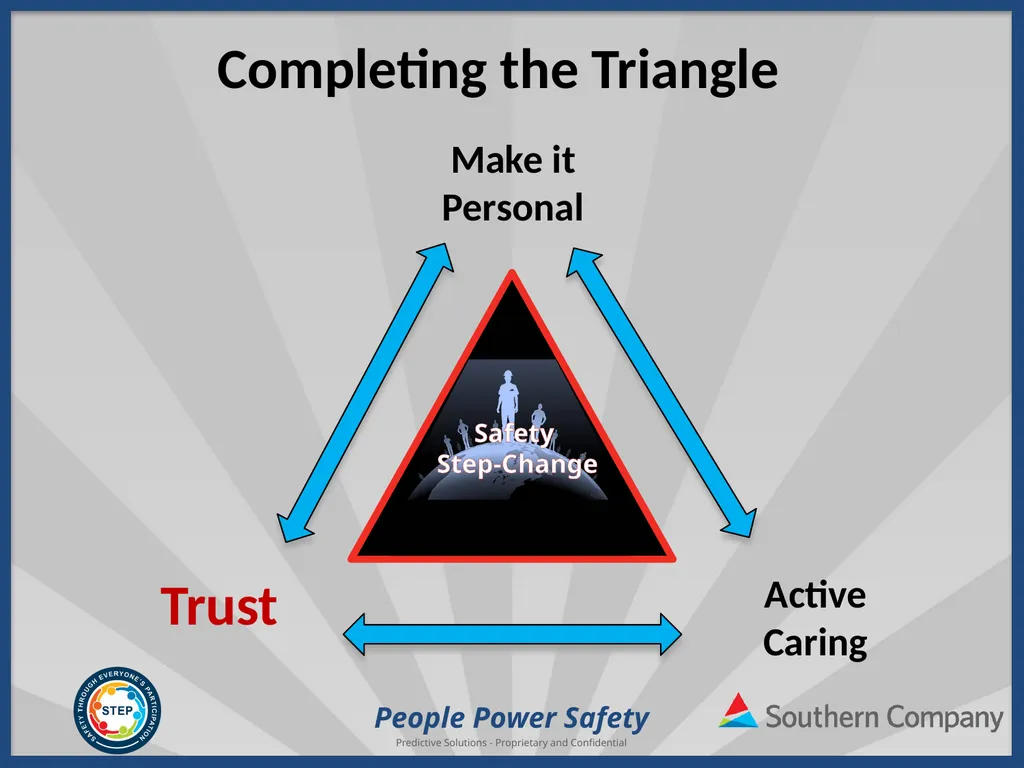
Completing the Triangle Make it Personal Trust Active Caring<br>
20
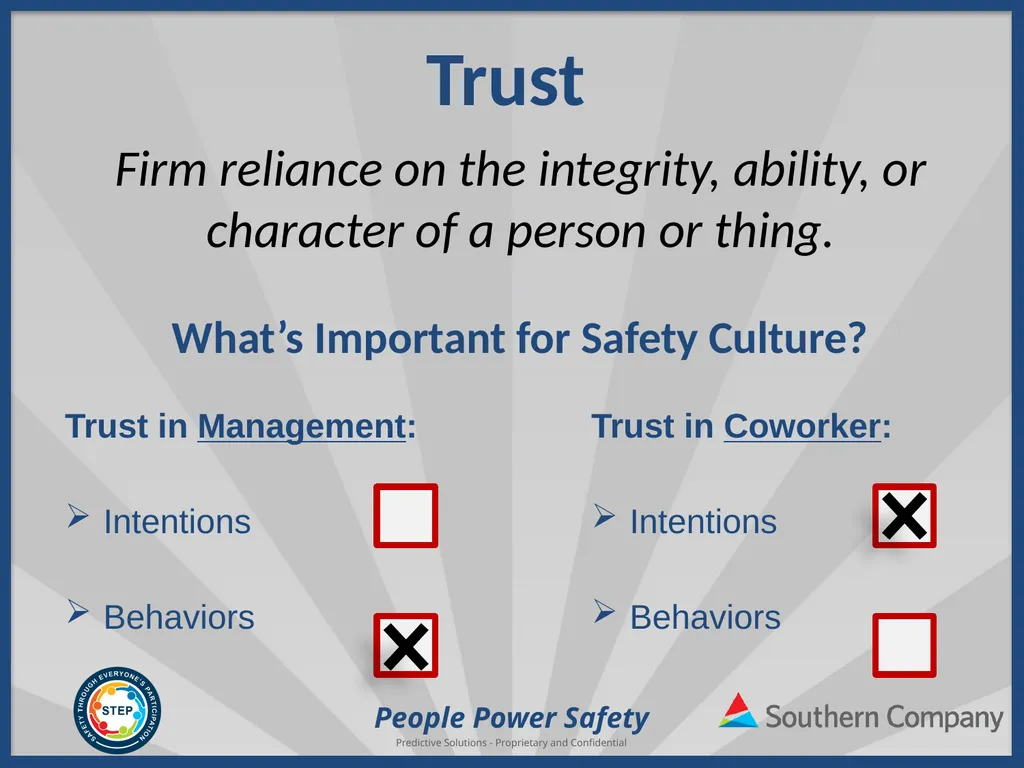
What’s Important for Safety Culture? Trust in Management:
Intentions
Behaviors Trust in Coworker:
Intentions
Behaviors Firm reliance on the integrity, ability, or character of a person or thing. Trust<br>
Intentions
Behaviors Trust in Coworker:
Intentions
Behaviors Firm reliance on the integrity, ability, or character of a person or thing. Trust<br>
21
Agenda: STEP Purpose
Engagement
STEP Process
Participation
Data Use Plan
Quality<br>
Engagement
STEP Process
Participation
Data Use Plan
Quality<br>
22
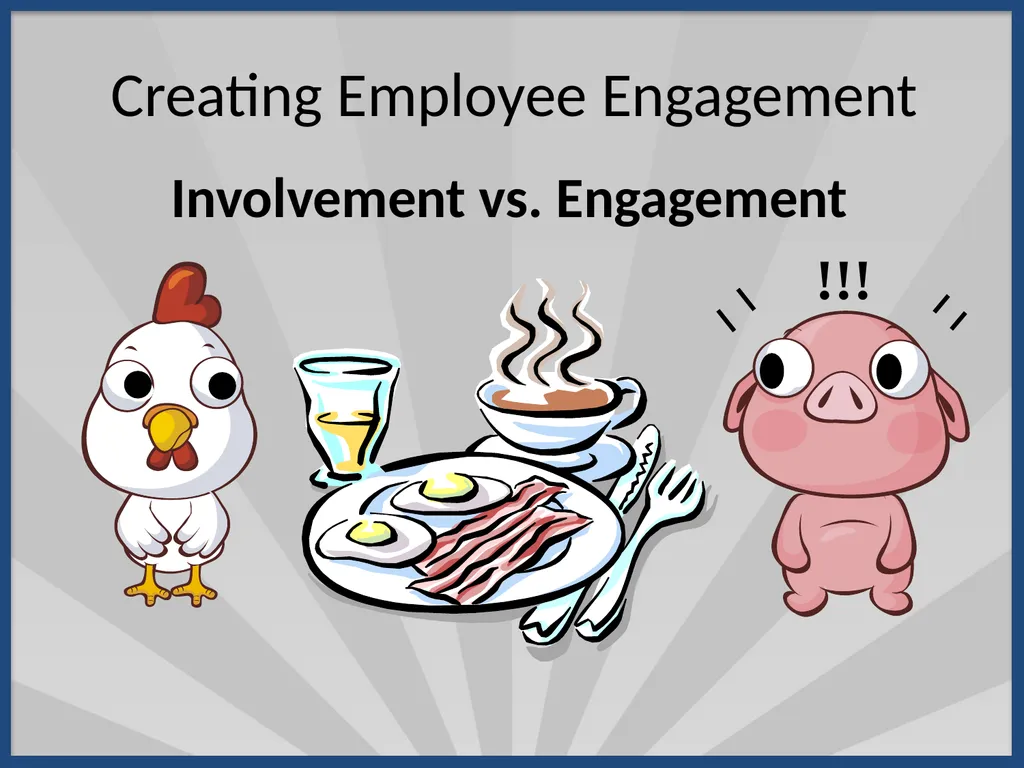
Creating Employee Engagement Involvement vs. Engagement<br>
23
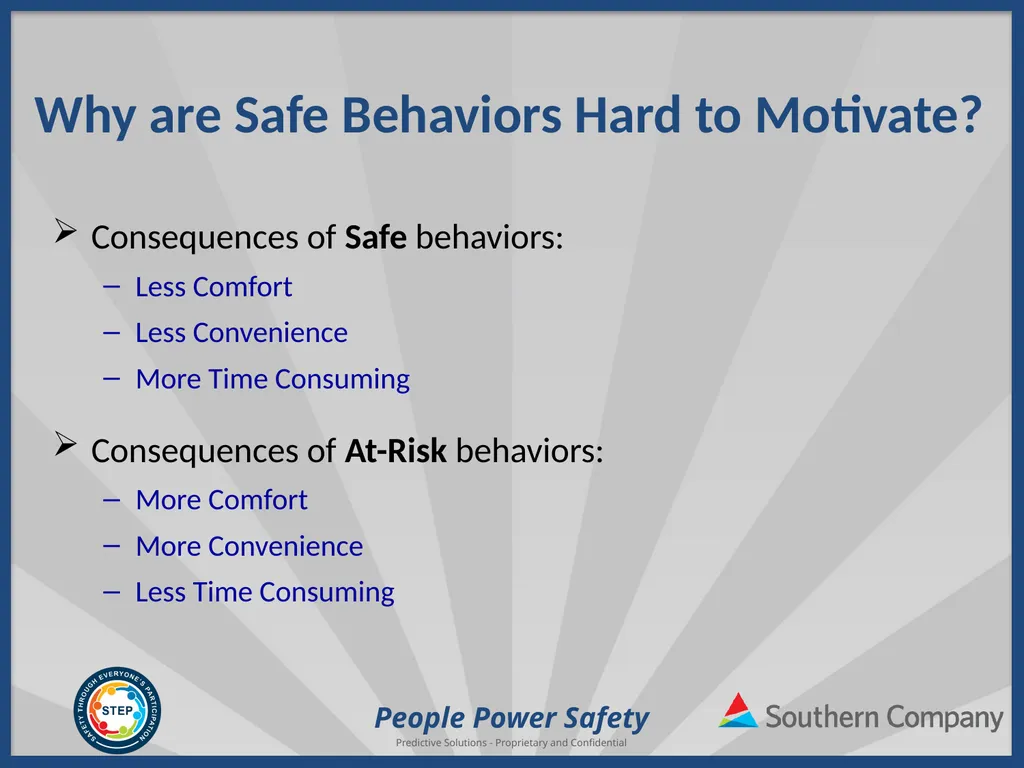
Consequences of Safe behaviors:
Less Comfort
Less Convenience
More Time Consuming
Consequences of At-Risk behaviors:
More Comfort
More Convenience
Less Time Consuming Why are Safe Behaviors Hard to Motivate?<br>
Less Comfort
Less Convenience
More Time Consuming
Consequences of At-Risk behaviors:
More Comfort
More Convenience
Less Time Consuming Why are Safe Behaviors Hard to Motivate?<br>
24
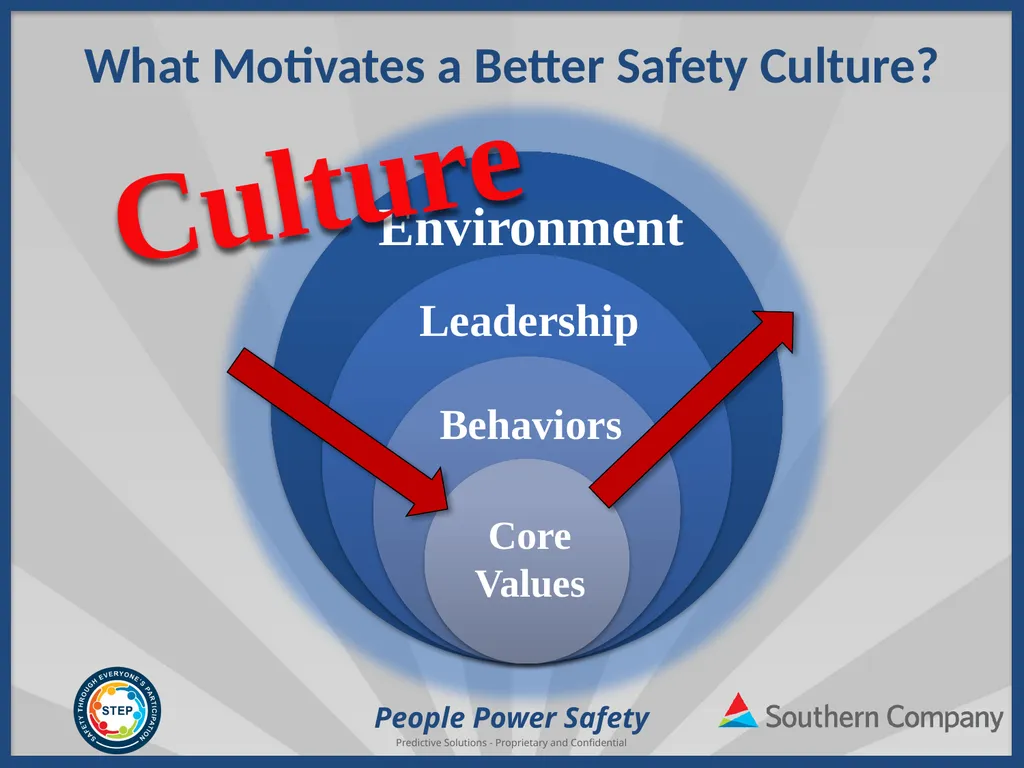
What Motivates a Better Safety Culture? Environment Leadership Behaviors Core
Values Culture<br>
Values Culture<br>
25
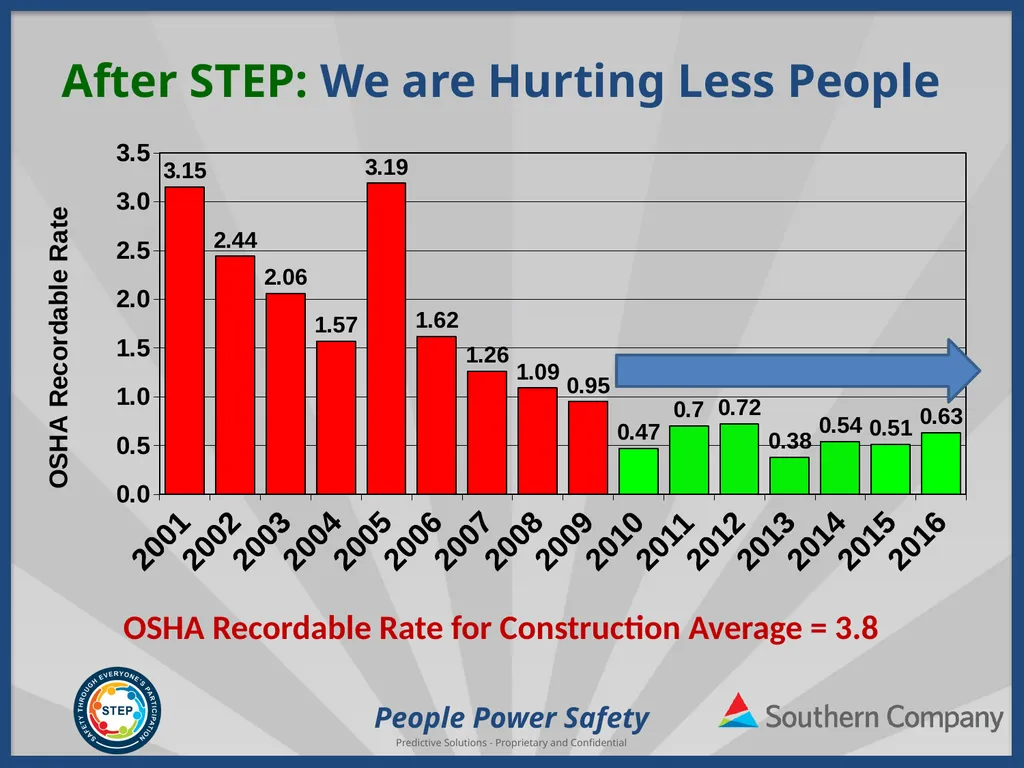
After STEP: We are Hurting Less People OSHA Recordable Rate for Construction Average = 3.8<br>
26
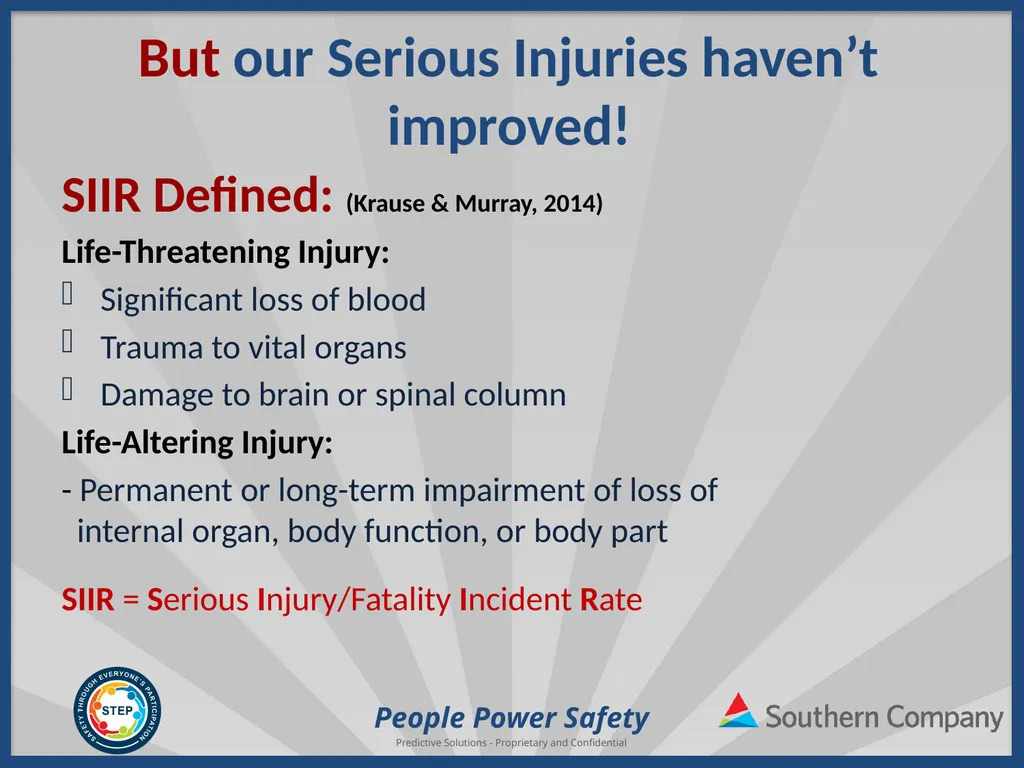
But our Serious Injuries haven’t improved! SIIR Defined: (Krause & Murray, 2014)
Life-Threatening Injury:
Significant loss of blood
Trauma to vital organs
Damage to brain or spinal column
Life-Altering Injury:
- Permanent or long-term impairment of loss of internal organ, body function, or body part
SIIR = Serious Injury/Fatality Incident Rate<br>
Life-Threatening Injury:
Significant loss of blood
Trauma to vital organs
Damage to brain or spinal column
Life-Altering Injury:
- Permanent or long-term impairment of loss of internal organ, body function, or body part
SIIR = Serious Injury/Fatality Incident Rate<br>
27
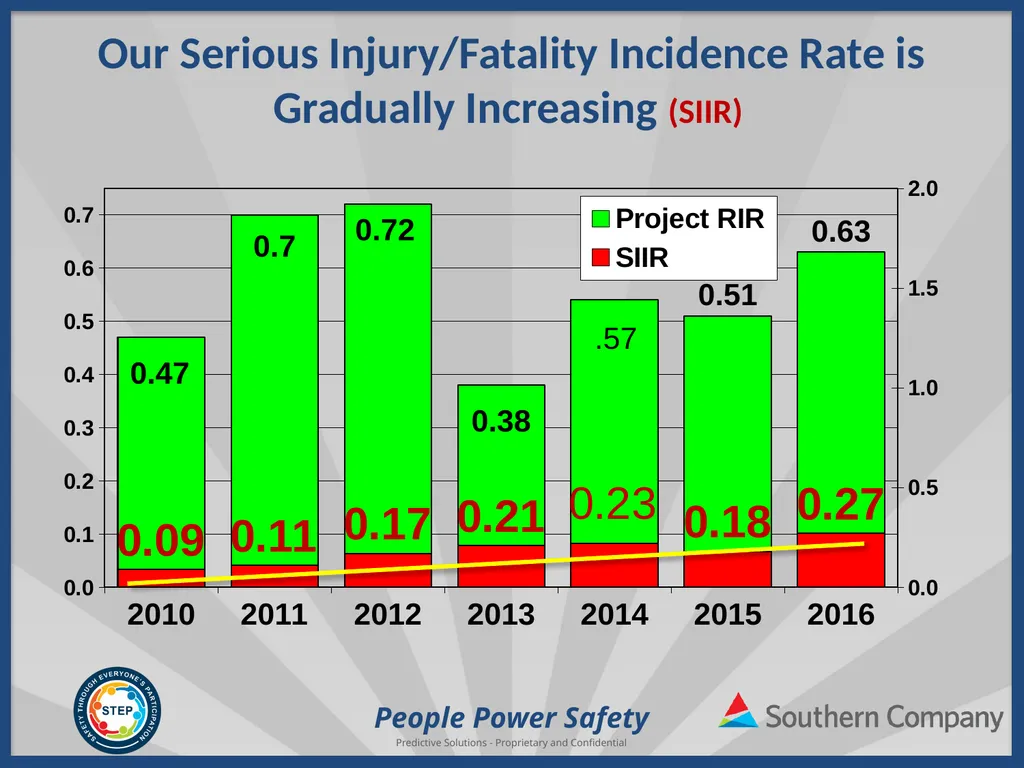
Our Serious Injury/Fatality Incidence Rate is Gradually Increasing (SIIR)<br>
28
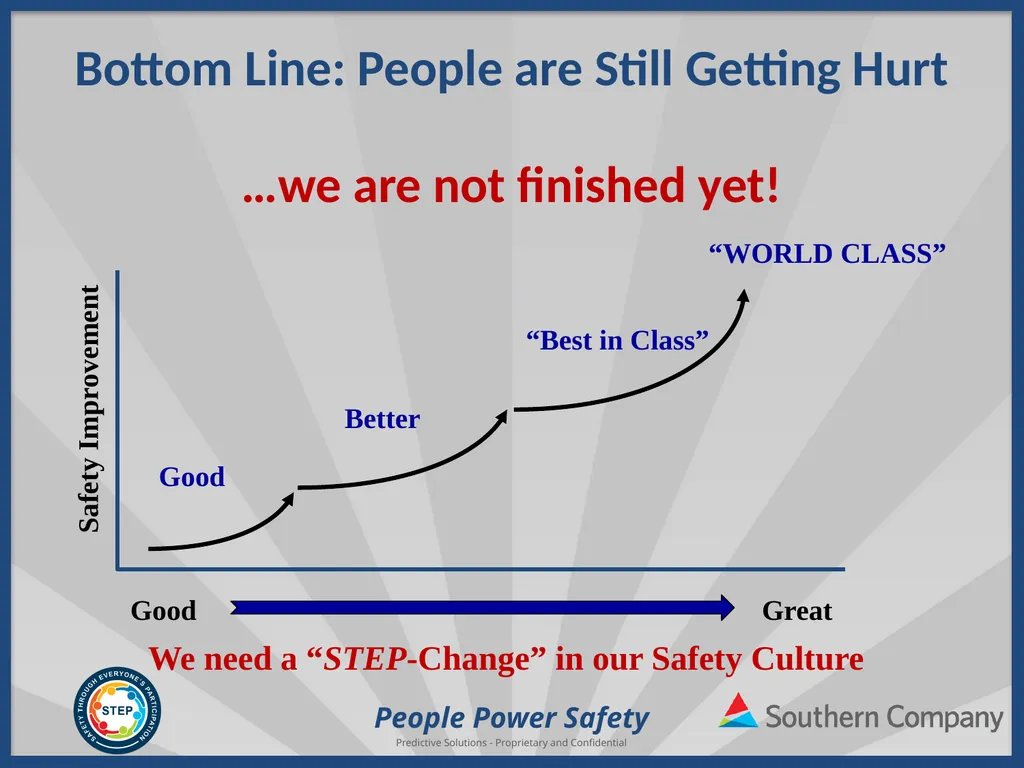
Bottom Line: People are Still Getting Hurt Good Better Good Great …we are not finished yet! We need a “STEP-Change” in our Safety Culture “Best in Class” “WORLD CLASS”<br>
29
Agenda: STEP Purpose
Engagement
STEP Process
Participation
Data Use Plan
Quality<br>
Engagement
STEP Process
Participation
Data Use Plan
Quality<br>
30
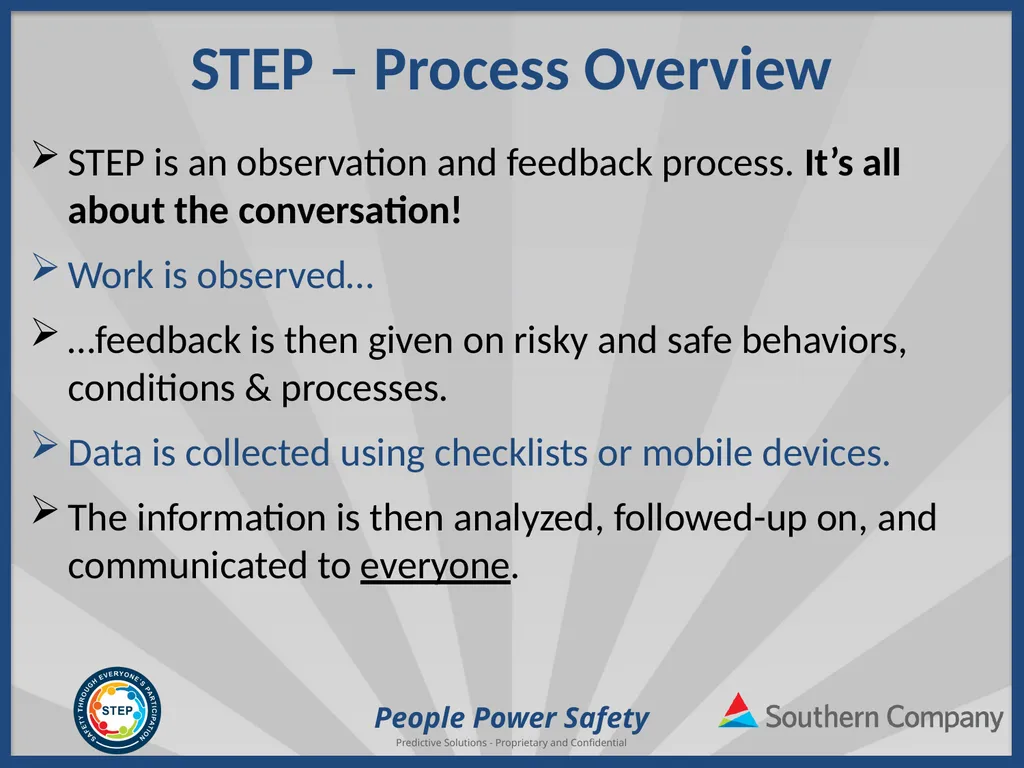
STEP – Process Overview STEP is an observation and feedback process. It’s all about the conversation!
Work is observed…
…feedback is then given on risky and safe behaviors, conditions & processes.
Data is collected using checklists or mobile devices.
The information is then analyzed, followed-up on, and communicated to everyone.<br>
Work is observed…
…feedback is then given on risky and safe behaviors, conditions & processes.
Data is collected using checklists or mobile devices.
The information is then analyzed, followed-up on, and communicated to everyone.<br>
31
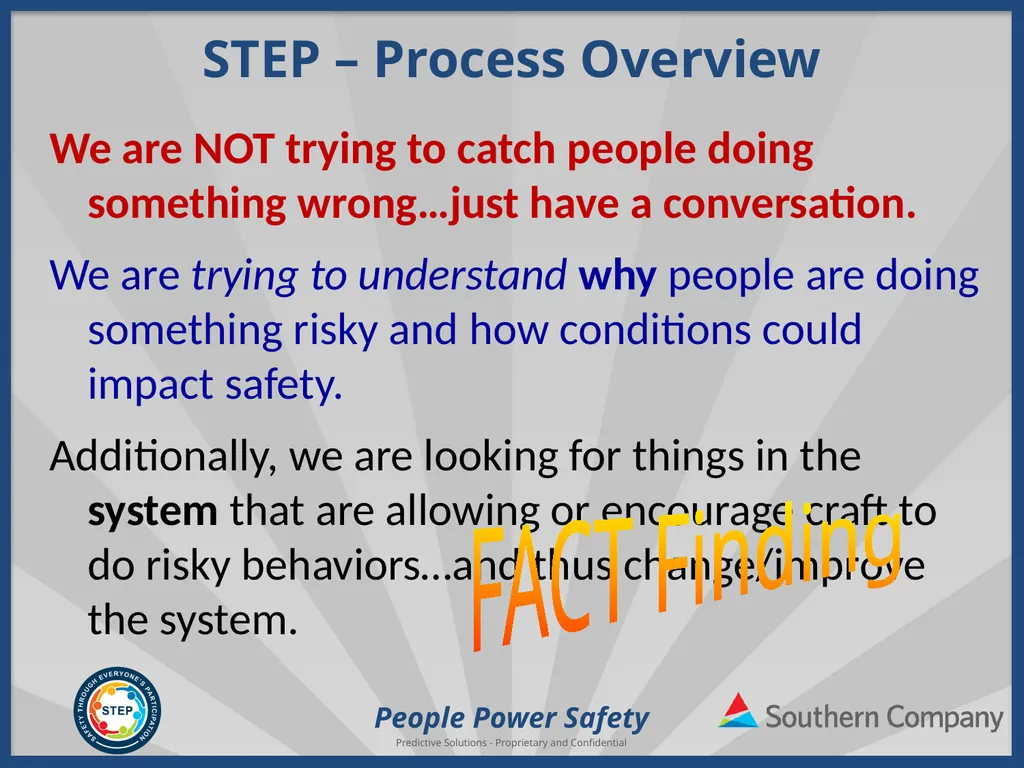
STEP – Process Overview We are NOT trying to catch people doing something wrong…just have a conversation.
We are trying to understand why people are doing something risky and how conditions could impact safety.
Additionally, we are looking for things in the system that are allowing or encourage craft to do risky behaviors…and thus change/improve the system. FACT Finding<br>
We are trying to understand why people are doing something risky and how conditions could impact safety.
Additionally, we are looking for things in the system that are allowing or encourage craft to do risky behaviors…and thus change/improve the system. FACT Finding<br>
32
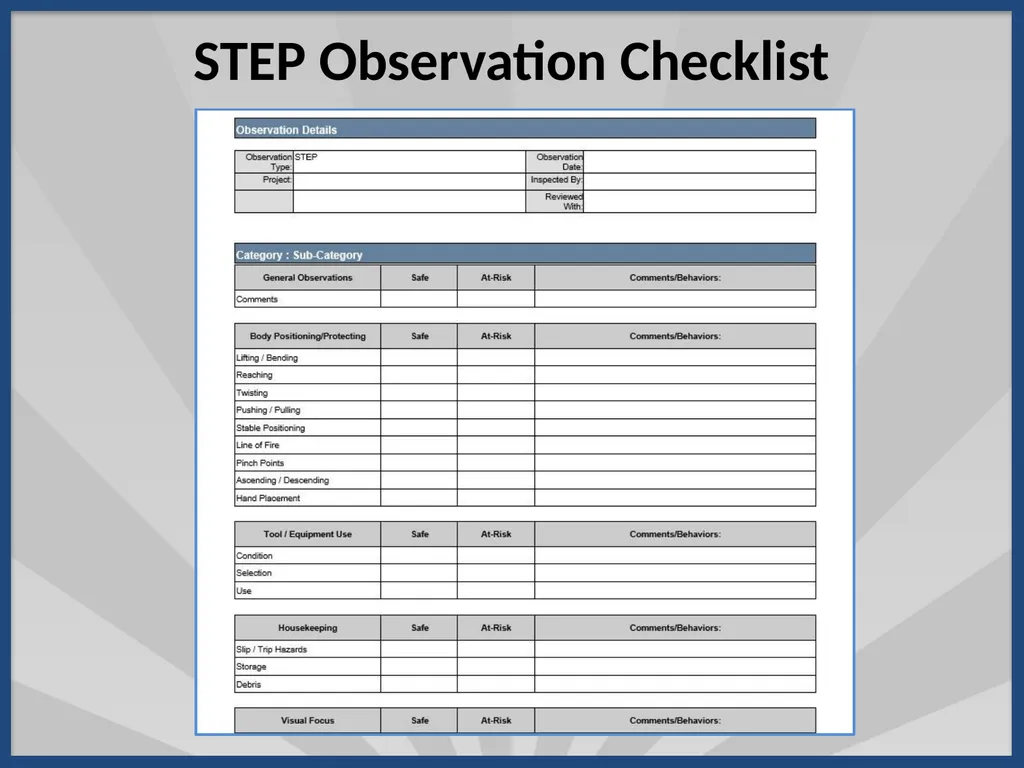
STEP Observation Checklist<br>
33
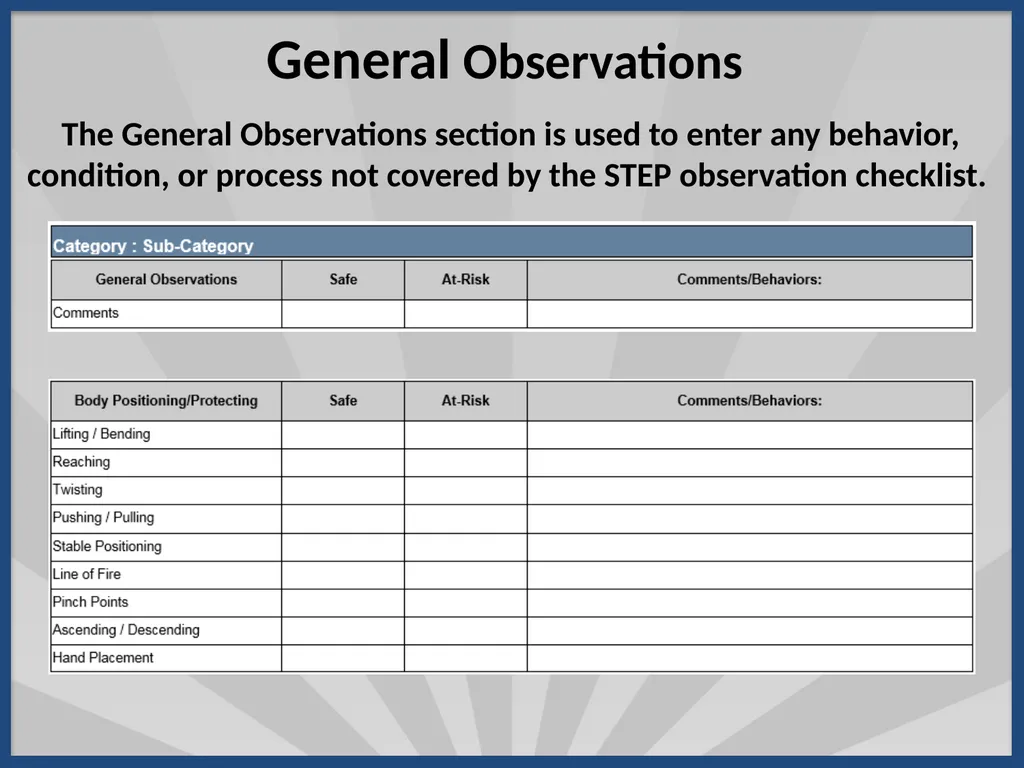
The General Observations section is used to enter any behavior, condition, or process not covered by the STEP observation checklist. General Observations<br>
34
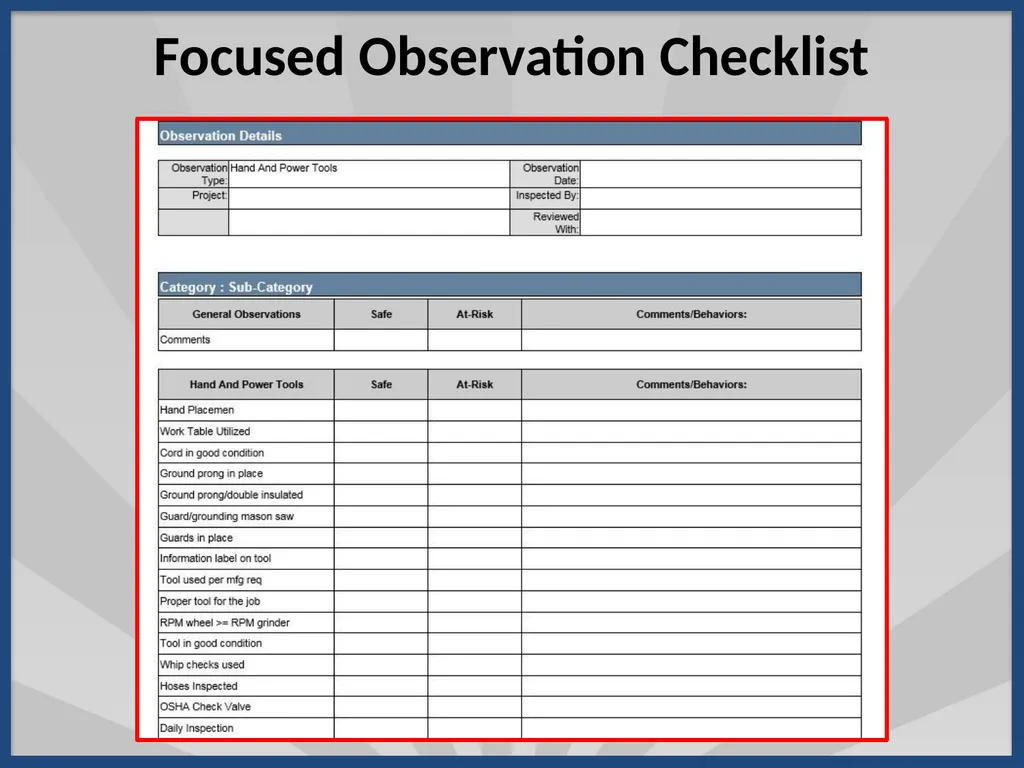
Focused Observation Checklist<br>
35
Feedback is a Key to Effective Leadership People have an internal drive to feel competent.
Leaders’ behaviors (verbal & non-verbal) can impact craft future performance.
Feedback can be a consequence and a powerful motivator.
Both informal and formal recognition can motivate employees.
Help them feel competent by giving quality recognition.
Any recognition (negative & positive) you give send a strong message for future performance.
Quality recognition can help build a teamwork atmosphere. 37<br>
Leaders’ behaviors (verbal & non-verbal) can impact craft future performance.
Feedback can be a consequence and a powerful motivator.
Both informal and formal recognition can motivate employees.
Help them feel competent by giving quality recognition.
Any recognition (negative & positive) you give send a strong message for future performance.
Quality recognition can help build a teamwork atmosphere. 37<br>
36
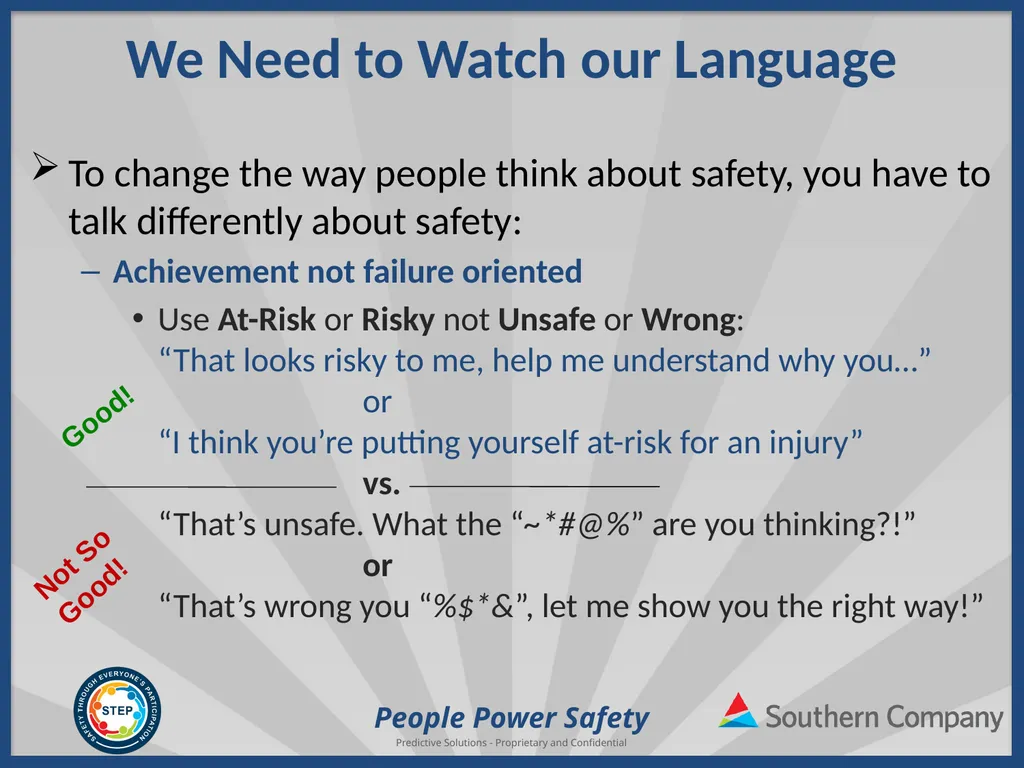
We Need to Watch our Language To change the way people think about safety, you have to talk differently about safety:
Achievement not failure oriented
Use At-Risk or Risky not Unsafe or Wrong: “That looks risky to me, help me understand why you…” or “I think you’re putting yourself at-risk for an injury” vs. “That’s unsafe. What the “~*#@%” are you thinking?!” or “That’s wrong you “%$*&”, let me show you the right way!” Good! Not So
Good!<br>
Achievement not failure oriented
Use At-Risk or Risky not Unsafe or Wrong: “That looks risky to me, help me understand why you…” or “I think you’re putting yourself at-risk for an injury” vs. “That’s unsafe. What the “~*#@%” are you thinking?!” or “That’s wrong you “%$*&”, let me show you the right way!” Good! Not So
Good!<br>
37
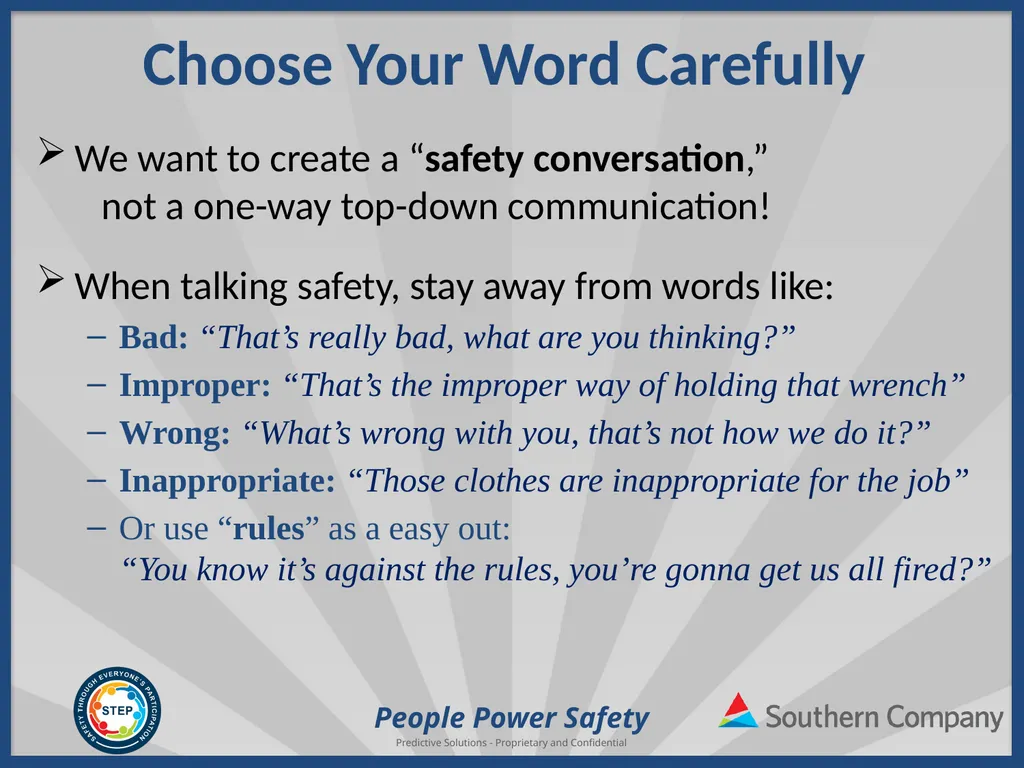
Choose Your Word Carefully We want to create a “safety conversation,”
not a one-way top-down communication!
When talking safety, stay away from words like:
Bad: “That’s really bad, what are you thinking?”
Improper: “That’s the improper way of holding that wrench”
Wrong: “What’s wrong with you, that’s not how we do it?”
Inappropriate: “Those clothes are inappropriate for the job”
Or use “rules” as a easy out: “You know it’s against the rules, you’re gonna get us all fired?”<br>
When talking safety, stay away from words like:
Bad: “That’s really bad, what are you thinking?”
Improper: “That’s the improper way of holding that wrench”
Wrong: “What’s wrong with you, that’s not how we do it?”
Inappropriate: “Those clothes are inappropriate for the job”
Or use “rules” as a easy out: “You know it’s against the rules, you’re gonna get us all fired?”<br>
38
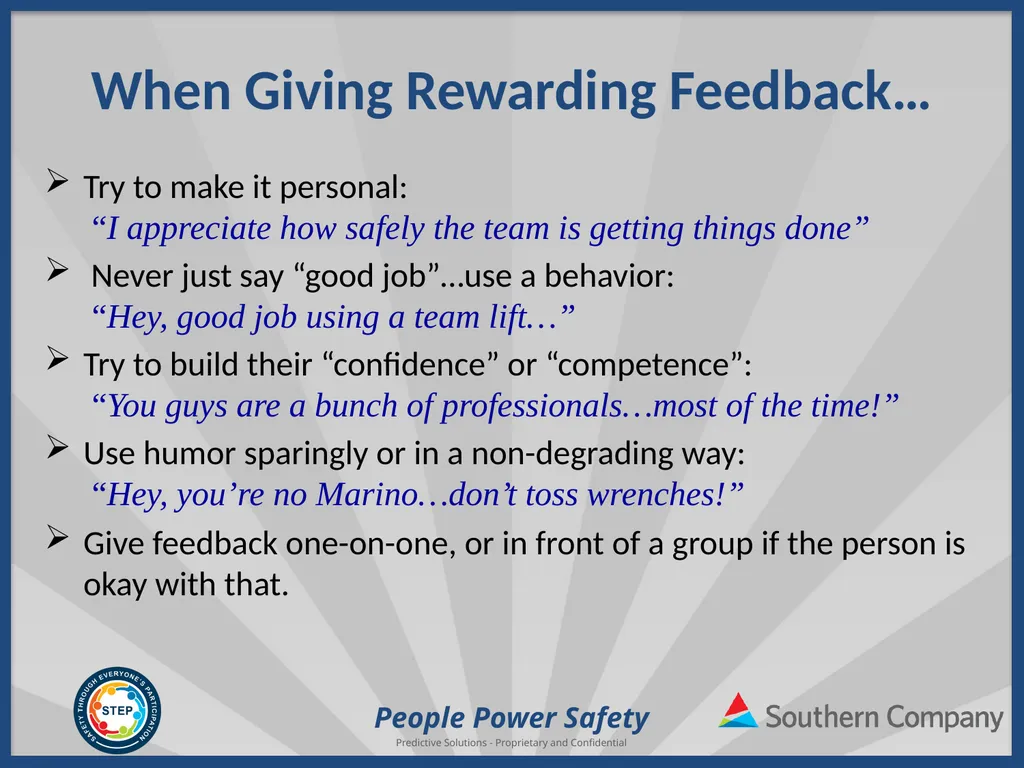
When Giving Rewarding Feedback… Try to make it personal:
“I appreciate how safely the team is getting things done”
Never just say “good job”…use a behavior: “Hey, good job using a team lift…”
Try to build their “confidence” or “competence”: “You guys are a bunch of professionals…most of the time!”
Use humor sparingly or in a non-degrading way: “Hey, you’re no Marino…don’t toss wrenches!”
Give feedback one-on-one, or in front of a group if the person is okay with that.<br>
Never just say “good job”…use a behavior: “Hey, good job using a team lift…”
Try to build their “confidence” or “competence”: “You guys are a bunch of professionals…most of the time!”
Use humor sparingly or in a non-degrading way: “Hey, you’re no Marino…don’t toss wrenches!”
Give feedback one-on-one, or in front of a group if the person is okay with that.<br>
39
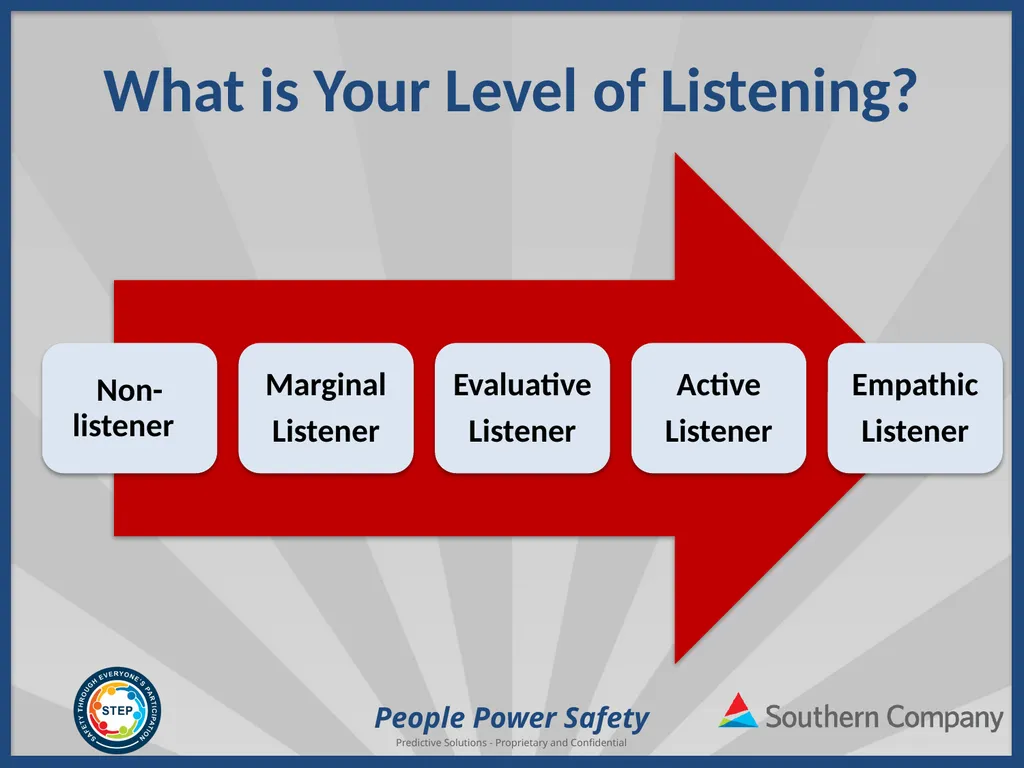
What is Your Level of Listening?<br>
40
Improve Your Listening Skills Pay Attention – focus on content, not delivery
Respond – seek clarification, question, paraphrase
Let speaker finish – don’t prepare what to say next
Main Ideas – facts, feelings, values, opinions
Eye Contact – focus on the speaker, not your watch<br>
Respond – seek clarification, question, paraphrase
Let speaker finish – don’t prepare what to say next
Main Ideas – facts, feelings, values, opinions
Eye Contact – focus on the speaker, not your watch<br>
41
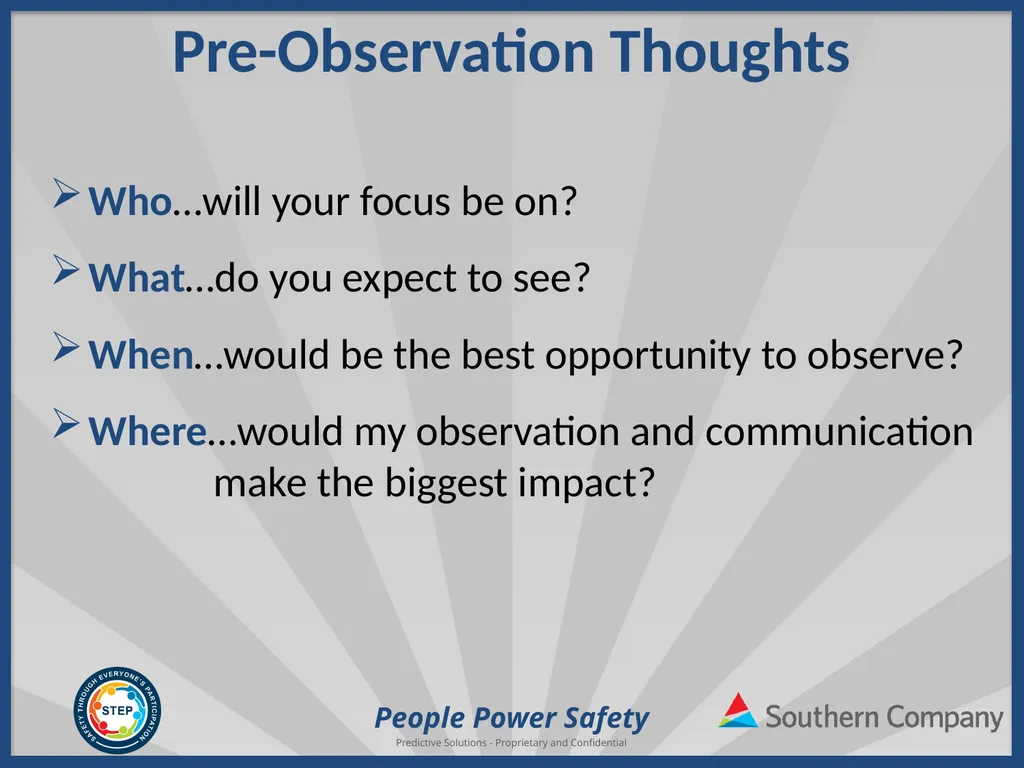
Pre-Observation Thoughts Who…will your focus be on?
What…do you expect to see?
When…would be the best opportunity to observe?
Where…would my observation and communication make the biggest impact?<br>
What…do you expect to see?
When…would be the best opportunity to observe?
Where…would my observation and communication make the biggest impact?<br>
42
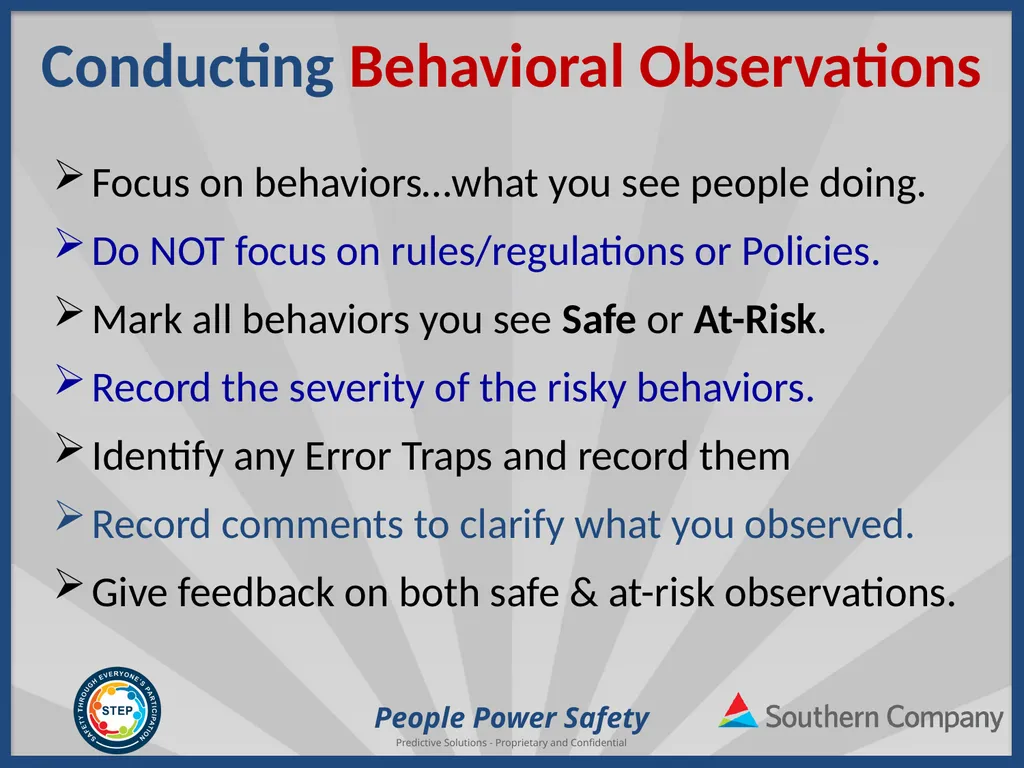
Conducting Behavioral Observations Focus on behaviors…what you see people doing.
Do NOT focus on rules/regulations or Policies.
Mark all behaviors you see Safe or At-Risk.
Record the severity of the risky behaviors.
Identify any Error Traps and record them
Record comments to clarify what you observed.
Give feedback on both safe & at-risk observations.<br>
Do NOT focus on rules/regulations or Policies.
Mark all behaviors you see Safe or At-Risk.
Record the severity of the risky behaviors.
Identify any Error Traps and record them
Record comments to clarify what you observed.
Give feedback on both safe & at-risk observations.<br>
43
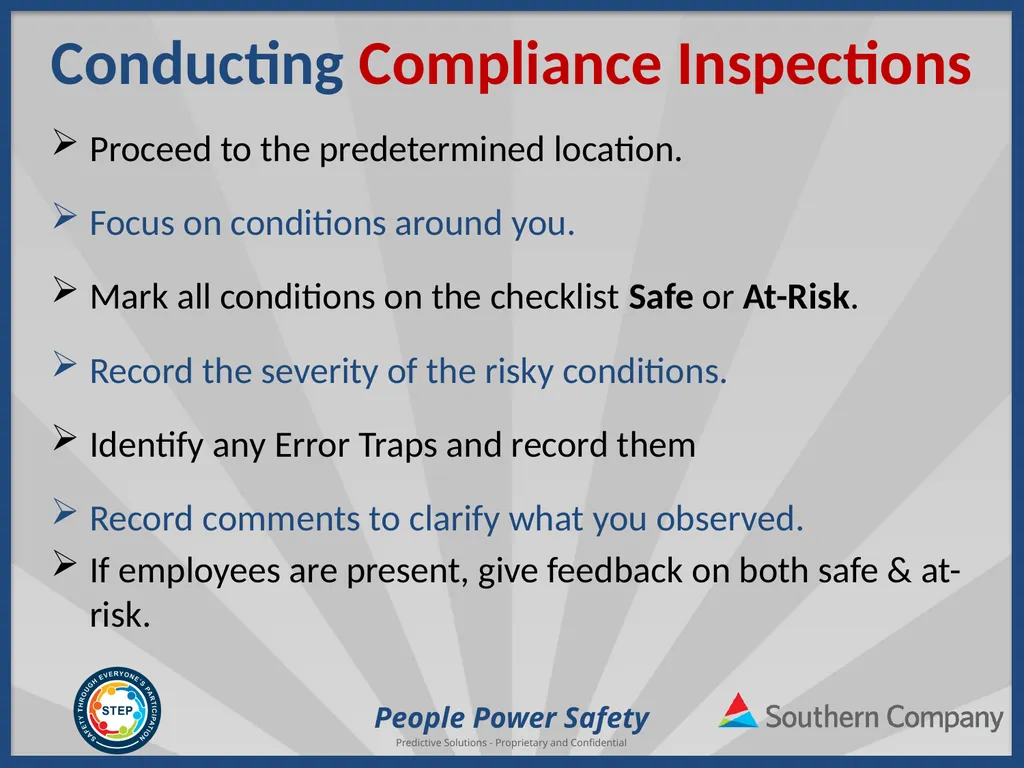
Conducting Compliance Inspections Proceed to the predetermined location.
Focus on conditions around you.
Mark all conditions on the checklist Safe or At-Risk.
Record the severity of the risky conditions.
Identify any Error Traps and record them
Record comments to clarify what you observed.
If employees are present, give feedback on both safe & at-risk.<br>
Focus on conditions around you.
Mark all conditions on the checklist Safe or At-Risk.
Record the severity of the risky conditions.
Identify any Error Traps and record them
Record comments to clarify what you observed.
If employees are present, give feedback on both safe & at-risk.<br>
44
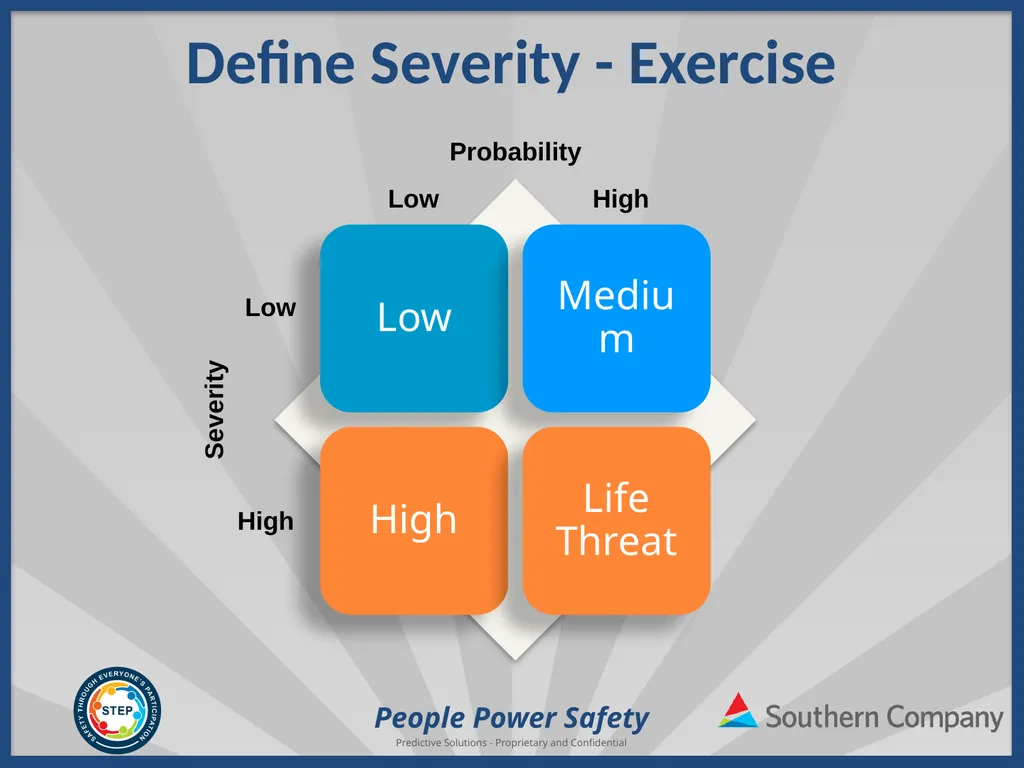
Define Severity - Exercise Probability Severity Low High Low High<br>
45
Agenda: STEP Purpose
Engagement
STEP Process
Participation
Data Use Plan
Quality<br>
Engagement
STEP Process
Participation
Data Use Plan
Quality<br>
46
STEP PARTICIPATION Improve Safety Culture through STEP observations and safety conversations
Safety Teams conduct observations
Monitor observation quality
STEP data communication IAW Data Use Plan
Improve contractor engagement / awareness
Improve Leadership engagement conversations
Conduct Focused Observations based on the data
Reduce probability of serious injuries & fatalities<br>
Safety Teams conduct observations
Monitor observation quality
STEP data communication IAW Data Use Plan
Improve contractor engagement / awareness
Improve Leadership engagement conversations
Conduct Focused Observations based on the data
Reduce probability of serious injuries & fatalities<br>
47
STEP Process: Participation Expectations Everyone will participate IAW management guidelines.
Participation can be individual, in pairs or in a group.
Each person will schedule their participation.
For instance:
Every Tuesday and Thursday
Two for Tuesday will be my “Paired Observation”
The team will schedule each day (AM / PM).
Based on the weekly look back/ahead, select a location, contractor, task, or floor as your target.
Complete the observation or inspection on paper or in the SafetyNet app immediately following the participation.<br>
Participation can be individual, in pairs or in a group.
Each person will schedule their participation.
For instance:
Every Tuesday and Thursday
Two for Tuesday will be my “Paired Observation”
The team will schedule each day (AM / PM).
Based on the weekly look back/ahead, select a location, contractor, task, or floor as your target.
Complete the observation or inspection on paper or in the SafetyNet app immediately following the participation.<br>
48
Who will do STEP Observations?
EVERYONE! All Southern Company staff included but not limited to: Plant Manager, Managers, Supervisors, Safety Committee, & Contractors
How many STEP observations are required?
Weekly, monthly, or quarterly observation rates will be determined by management. (Ex. Two observations per week)
Who do we observe?
Anyone in our work areas.
Do I have to give feedback?
YES! Feedback should be given to the person/s observed when appropriate. ANYONE HAS THE RIGHT TO STOP AT RISK BEHAVIOR! STEP PARTICIPATION<br>
EVERYONE! All Southern Company staff included but not limited to: Plant Manager, Managers, Supervisors, Safety Committee, & Contractors
How many STEP observations are required?
Weekly, monthly, or quarterly observation rates will be determined by management. (Ex. Two observations per week)
Who do we observe?
Anyone in our work areas.
Do I have to give feedback?
YES! Feedback should be given to the person/s observed when appropriate. ANYONE HAS THE RIGHT TO STOP AT RISK BEHAVIOR! STEP PARTICIPATION<br>
49
Predictive-Based Observations We are going to be more intentional with our safety observations.
Sometimes people walk around the workplace looking for things wrong.
Sometimes people do observations to check-off another item on their to-do list.
Much like a doctor, we need to read our project’s “vitals”, diagnose concerns, and then focus our observations.<br>
Sometimes people walk around the workplace looking for things wrong.
Sometimes people do observations to check-off another item on their to-do list.
Much like a doctor, we need to read our project’s “vitals”, diagnose concerns, and then focus our observations.<br>
50
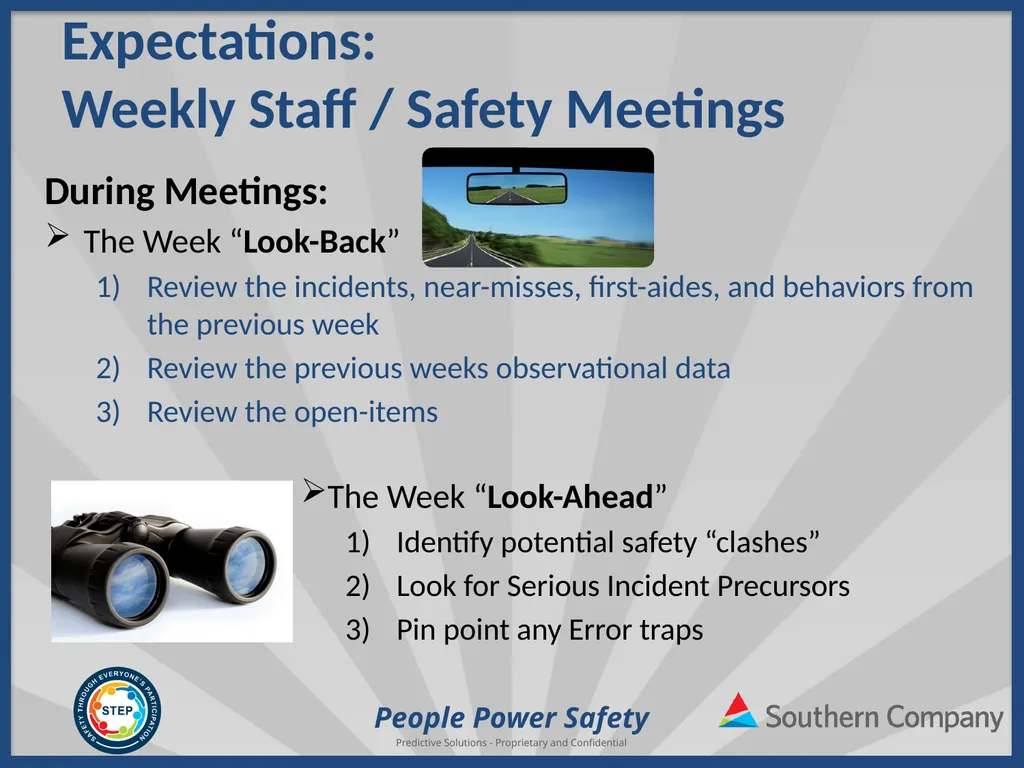
Expectations:
Weekly Staff / Safety Meetings During Meetings:
The Week “Look-Back”
Review the incidents, near-misses, first-aides, and behaviors from the previous week
Review the previous weeks observational data
Review the open-items
The Week “Look-Ahead”
Identify potential safety “clashes”
Look for Serious Incident Precursors
Pin point any Error traps<br>
The Week “Look-Back”
Review the incidents, near-misses, first-aides, and behaviors from the previous week
Review the previous weeks observational data
Review the open-items
The Week “Look-Ahead”
Identify potential safety “clashes”
Look for Serious Incident Precursors
Pin point any Error traps<br>
51
Predictive-Based Safety Once we have completed our Safety Diagnostics, we prescribe various types of observations.
Based on our data, we are attempting to predicting where a potential incident, injury, near-miss or error might occur.
Our tools to help our weekly focus are:
Serious Injury/Fatality Precursors
Error Traps
Project / Work Area considerations
Intuition<br>
Based on our data, we are attempting to predicting where a potential incident, injury, near-miss or error might occur.
Our tools to help our weekly focus are:
Serious Injury/Fatality Precursors
Error Traps
Project / Work Area considerations
Intuition<br>
52
Serious Injury/Fatality Precursors (SIIR) Confined space entry
Jobs that require clearance/lock-out tag-out
Excessive speed/distracted drivers
Working at height/elevations
Manual handling
Process instability or significant process upsets
Unexpected maintenance or changes
High potential energy jobs
Emergency shutdown procedures
Work under suspended loads
Machine guarding and barricades
Use of hot work permits, equipment and pipe opening of hazardous chemicals<br>
Jobs that require clearance/lock-out tag-out
Excessive speed/distracted drivers
Working at height/elevations
Manual handling
Process instability or significant process upsets
Unexpected maintenance or changes
High potential energy jobs
Emergency shutdown procedures
Work under suspended loads
Machine guarding and barricades
Use of hot work permits, equipment and pipe opening of hazardous chemicals<br>
53
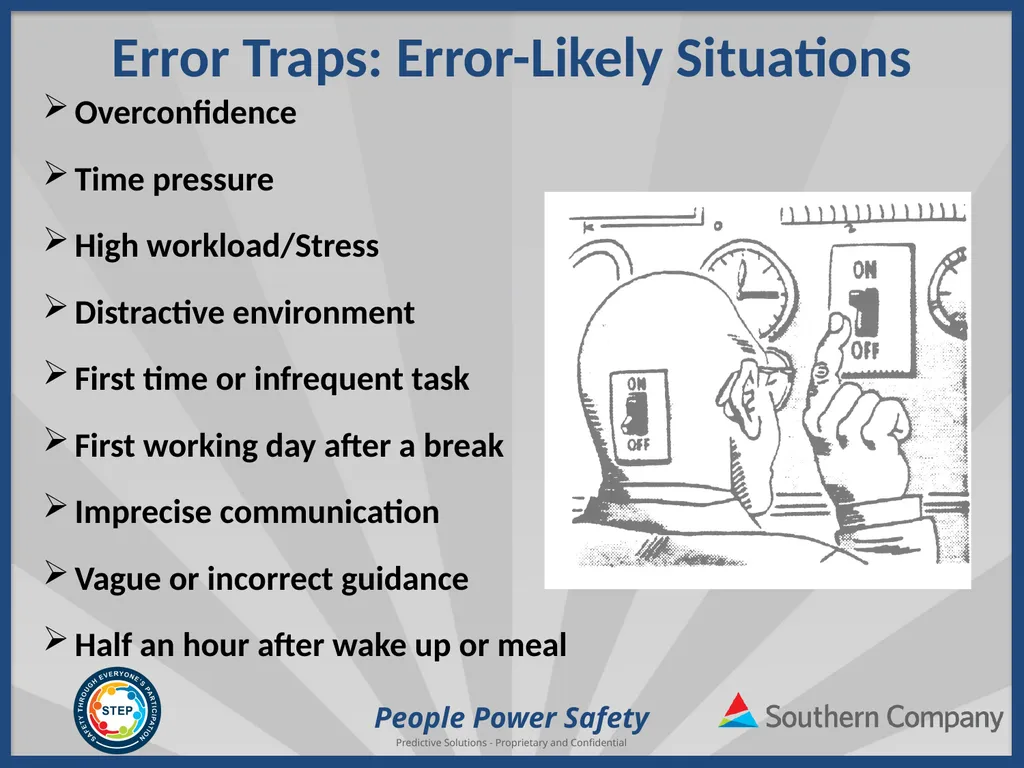
Error Traps: Error-Likely Situations Human Nature Overconfidence
Time pressure
High workload/Stress
Distractive environment
First time or infrequent task
First working day after a break
Imprecise communication
Vague or incorrect guidance
Half an hour after wake up or meal<br>
Time pressure
High workload/Stress
Distractive environment
First time or infrequent task
First working day after a break
Imprecise communication
Vague or incorrect guidance
Half an hour after wake up or meal<br>
54
Agenda: STEP Purpose
Engagement
STEP Process
Participation
Data Use Plan
Quality<br>
Engagement
STEP Process
Participation
Data Use Plan
Quality<br>
55
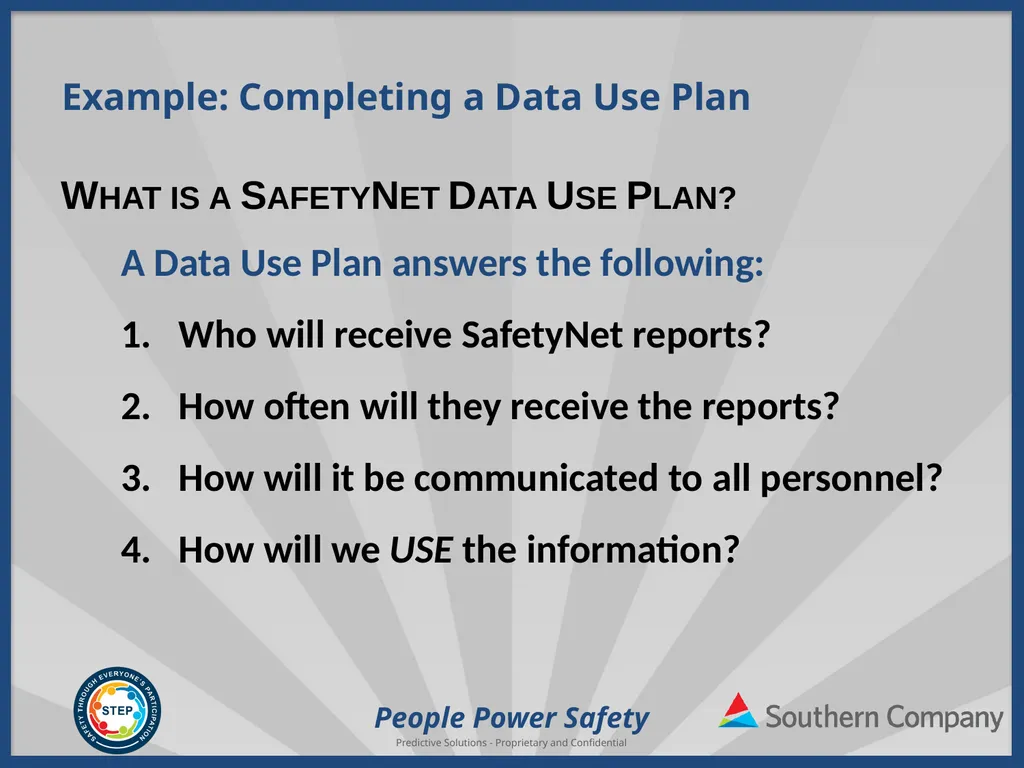
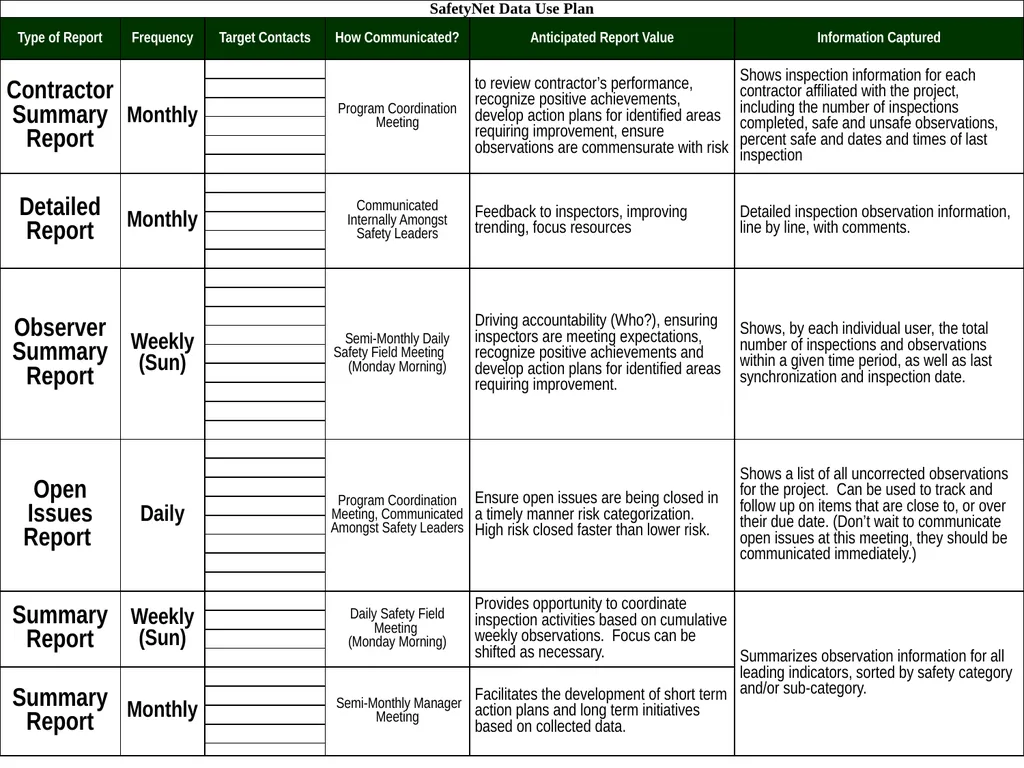
Example: Completing a Data Use Plan What is a SafetyNet Data Use Plan? A Data Use Plan answers the following:
Who will receive SafetyNet reports?
How often will they receive the reports?
How will it be communicated to all personnel?
How will we USE the information?<br>
Who will receive SafetyNet reports?
How often will they receive the reports?
How will it be communicated to all personnel?
How will we USE the information?<br>
56
Agenda: STEP Purpose
Engagement
STEP Process
Participation
Data Use Plan
Quality<br>
Engagement
STEP Process
Participation
Data Use Plan
Quality<br>
57
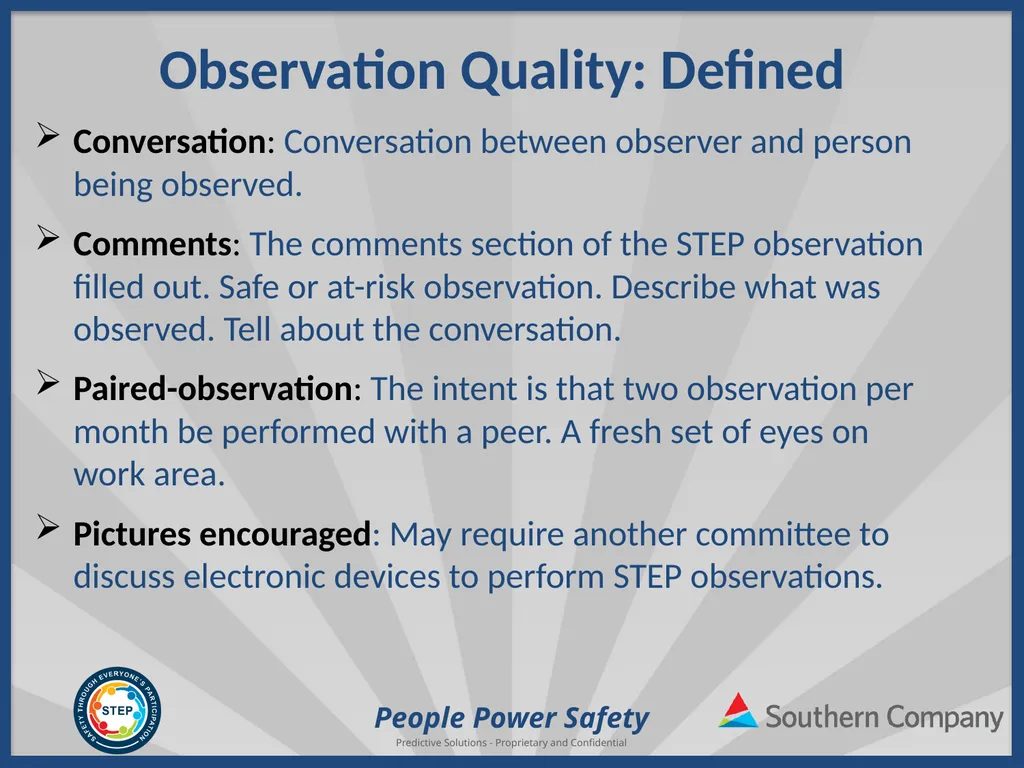
Observation Quality: Defined Conversation: Conversation between observer and person being observed.
Comments: The comments section of the STEP observation filled out. Safe or at-risk observation. Describe what was observed. Tell about the conversation.
Paired-observation: The intent is that two observation per month be performed with a peer. A fresh set of eyes on work area.
Pictures encouraged: May require another committee to discuss electronic devices to perform STEP observations.<br>
Comments: The comments section of the STEP observation filled out. Safe or at-risk observation. Describe what was observed. Tell about the conversation.
Paired-observation: The intent is that two observation per month be performed with a peer. A fresh set of eyes on work area.
Pictures encouraged: May require another committee to discuss electronic devices to perform STEP observations.<br>
58
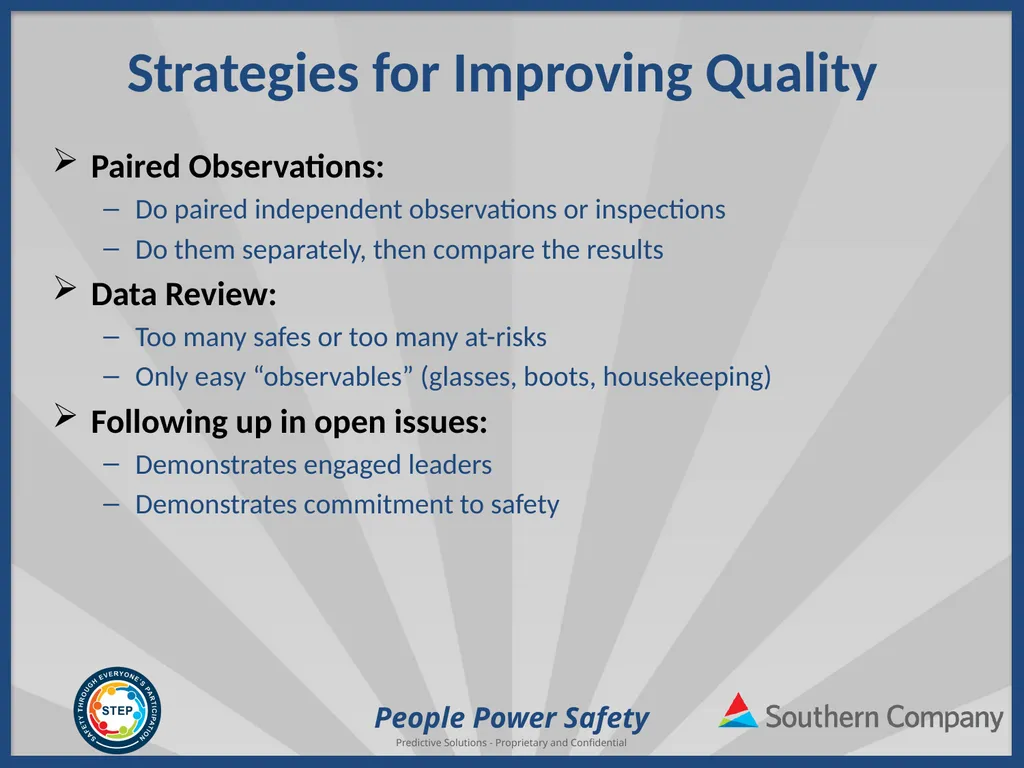
Strategies for Improving Quality Paired Observations:
Do paired independent observations or inspections
Do them separately, then compare the results
Data Review:
Too many safes or too many at-risks
Only easy “observables” (glasses, boots, housekeeping)
Following up in open issues:
Demonstrates engaged leaders
Demonstrates commitment to safety<br>
Do paired independent observations or inspections
Do them separately, then compare the results
Data Review:
Too many safes or too many at-risks
Only easy “observables” (glasses, boots, housekeeping)
Following up in open issues:
Demonstrates engaged leaders
Demonstrates commitment to safety<br>
59
Observation Quality Needs to be monitored just like everything else.
Avoid the venomous cycle.
Demonstrate leadership engagement
What’s important to you is important to them
Better data = Less people getting hurt!<br>
Avoid the venomous cycle.
Demonstrate leadership engagement
What’s important to you is important to them
Better data = Less people getting hurt!<br>
60
We Need to STOP
Reacting to Injuries… And START
Predicting Them!<br>
Reacting to Injuries… And START
Predicting Them!<br>
61
SafetyNet User Refresher LIVE
UPDATE<br>
UPDATE<br>
62
We Still Have Work to Do… People Power Safety<br>