
Performance of contract Definition Performance of



Description: Performance of contract Definition Performance of a contract consists in doing or causing to be done what the promisor has promised to do. A contract creates legal obligations. Performance of a contract means the carrying out of these
Related Topics
Download Presentation
"Performance of contract Definition Performance of" is the property of its rightful owner. Permission is granted to download and print the materials on this website for personal, non-commercial use only, and to display it on your personal computer provided you do not modify the materials and that you retain all copyright notices contained in the materials. By downloading content from our website, you accept the terms of this agreement.
Presentation Transcript
slide1. Performance of contract<br>
slide2. Definition
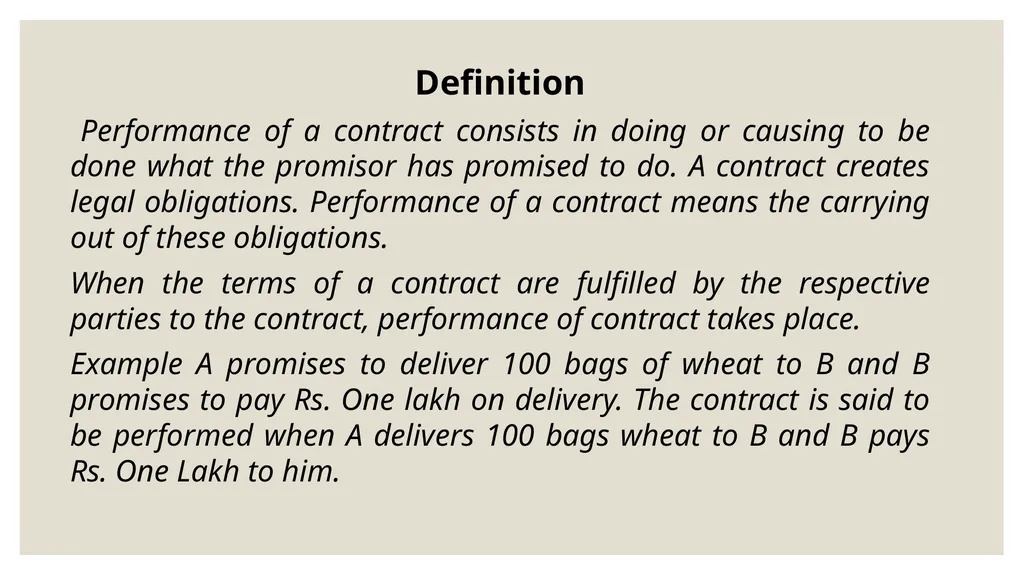
Performance of a contract consists in doing or causing to be done what the promisor has promised to do. A contract creates legal obligations. Performance of a contract means the carrying out of these obligations.
When the terms of a contract are fulfilled by the respective parties to the contract, performance of contract takes place.
Example A promises to deliver 100 bags of wheat to B and B promises to pay Rs. One lakh on delivery. The contract is said to be performed when A delivers 100 bags wheat to B and B pays Rs. One Lakh to him.<br>
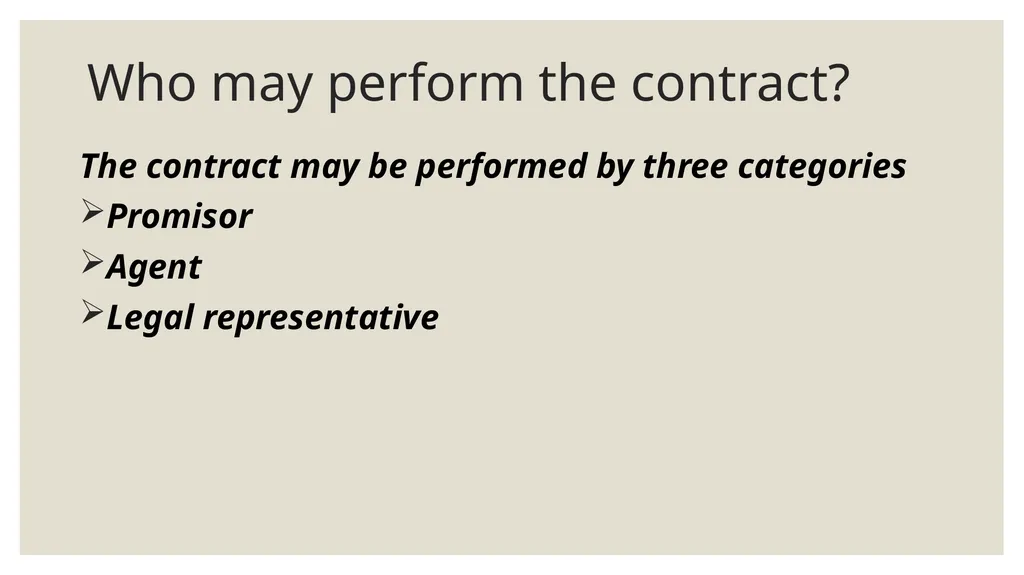
slide3. Who may perform the contract? The contract may be performed by three categories
Promisor
Agent
Legal representative<br>
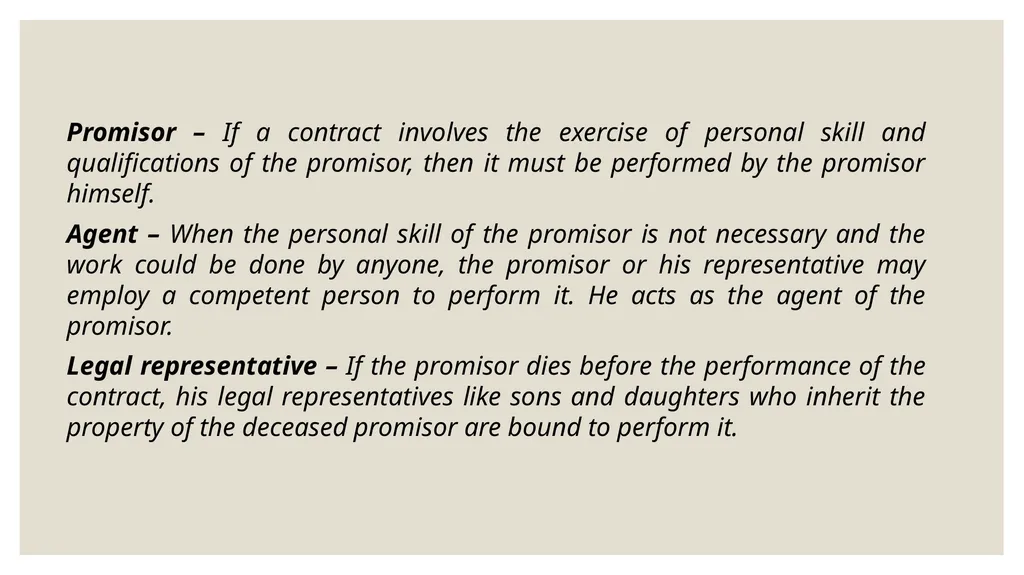
slide4. Promisor – If a contract involves the exercise of personal skill and qualifications of the promisor, then it must be performed by the promisor himself.
Agent – When the personal skill of the promisor is not necessary and the work could be done by anyone, the promisor or his representative may employ a competent person to perform it. He acts as the agent of the promisor.
Legal representative – If the promisor dies before the performance of the contract, his legal representatives like sons and daughters who inherit the property of the deceased promisor are bound to perform it.<br>
slide5. Who can demand performance
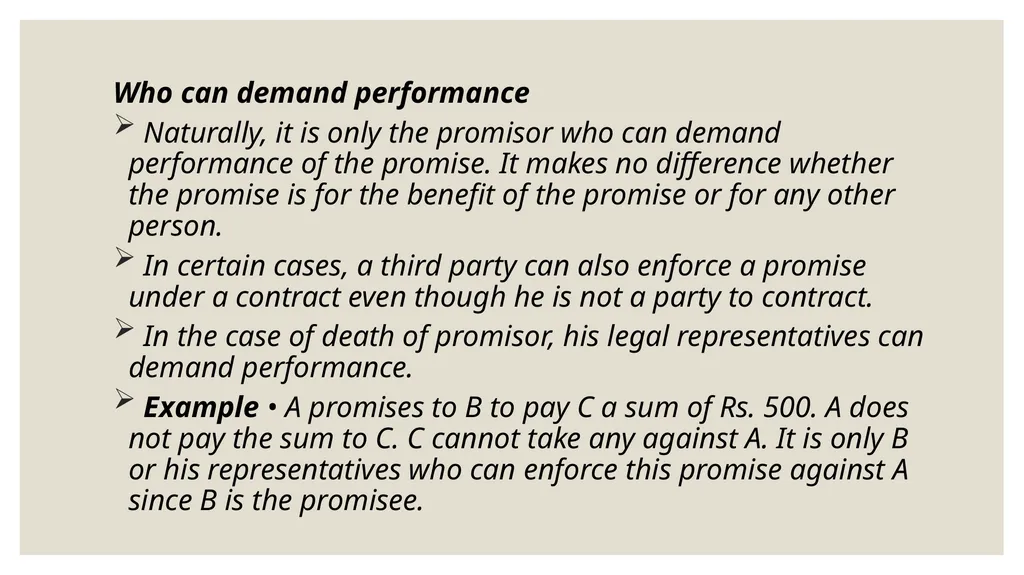
Naturally, it is only the promisor who can demand performance of the promise. It makes no difference whether the promise is for the benefit of the promise or for any other person.
In certain cases, a third party can also enforce a promise under a contract even though he is not a party to contract.
In the case of death of promisor, his legal representatives can demand performance.
Example • A promises to B to pay C a sum of Rs. 500. A does not pay the sum to C. C cannot take any against A. It is only B or his representatives who can enforce this promise against A since B is the promisee.<br>
slide6. Time and Place of performance
• It is for the parties of the contract to determine the time and place of performance of contract.
• The following rules regarding time and place of performance of a contract are discussed in the Contract Act.
Where the time is not fixed – According to section 46, where the contract is to be performed without any demand by the promise and where no time for performance is fixed, then the contract must be performed within a reasonable time
Example • A borrowed certain sum of money from B and B directed to pay the said sum to C, a third party. A also agreed to repay to C but A did not fulfill his promise for three years. It was held that the failure to pay the amount to C by A amounted to a breach of contract since a period of three years considered a reasonable time for performance<br>
slide7. Where the time is fixed – According to section 46, when a promise is to be performed on a certain day and the promisor has undertaken to perform it without application by the promise, the promisor may perform it at any time during the usual hours of business on such a day and at the place at which the promise ought to be performed. Example • X promises to deliver goods at Y’s godown on the lst of January. On that day, X brings the goods to Y’s godown, but after the usual hour for closing it. Hence the goods are not received. In this case, X has not performed his contract in time<br>
slide8. Place of performance – If the contract mentions a place, the contract must be performed at the place mentioned in the contract. If the place is not mentioned, the promisor must ask the promise to fix a reasonable place to perform the contract.<br>
slide2. Definition
Performance of a contract consists in doing or causing to be done what the promisor has promised to do. A contract creates legal obligations. Performance of a contract means the carrying out of these obligations.
When the terms of a contract are fulfilled by the respective parties to the contract, performance of contract takes place.
Example A promises to deliver 100 bags of wheat to B and B promises to pay Rs. One lakh on delivery. The contract is said to be performed when A delivers 100 bags wheat to B and B pays Rs. One Lakh to him.<br>
slide3. Who may perform the contract? The contract may be performed by three categories
Promisor
Agent
Legal representative<br>
slide4. Promisor – If a contract involves the exercise of personal skill and qualifications of the promisor, then it must be performed by the promisor himself.
Agent – When the personal skill of the promisor is not necessary and the work could be done by anyone, the promisor or his representative may employ a competent person to perform it. He acts as the agent of the promisor.
Legal representative – If the promisor dies before the performance of the contract, his legal representatives like sons and daughters who inherit the property of the deceased promisor are bound to perform it.<br>
slide5. Who can demand performance
Naturally, it is only the promisor who can demand performance of the promise. It makes no difference whether the promise is for the benefit of the promise or for any other person.
In certain cases, a third party can also enforce a promise under a contract even though he is not a party to contract.
In the case of death of promisor, his legal representatives can demand performance.
Example • A promises to B to pay C a sum of Rs. 500. A does not pay the sum to C. C cannot take any against A. It is only B or his representatives who can enforce this promise against A since B is the promisee.<br>
slide6. Time and Place of performance
• It is for the parties of the contract to determine the time and place of performance of contract.
• The following rules regarding time and place of performance of a contract are discussed in the Contract Act.
Where the time is not fixed – According to section 46, where the contract is to be performed without any demand by the promise and where no time for performance is fixed, then the contract must be performed within a reasonable time
Example • A borrowed certain sum of money from B and B directed to pay the said sum to C, a third party. A also agreed to repay to C but A did not fulfill his promise for three years. It was held that the failure to pay the amount to C by A amounted to a breach of contract since a period of three years considered a reasonable time for performance<br>
slide7. Where the time is fixed – According to section 46, when a promise is to be performed on a certain day and the promisor has undertaken to perform it without application by the promise, the promisor may perform it at any time during the usual hours of business on such a day and at the place at which the promise ought to be performed. Example • X promises to deliver goods at Y’s godown on the lst of January. On that day, X brings the goods to Y’s godown, but after the usual hour for closing it. Hence the goods are not received. In this case, X has not performed his contract in time<br>
slide8. Place of performance – If the contract mentions a place, the contract must be performed at the place mentioned in the contract. If the place is not mentioned, the promisor must ask the promise to fix a reasonable place to perform the contract.<br>