
PH251 Metaphysics Week 4. Substance, Substrata and
TG
Published · 31 slides · 0 views
1 / 1
Description
PH251 Metaphysics Week 4. Substance, Substrata and Bundles Introduction From the nature of time to things in time. Over the next two weeks we will begin to explore the category of substance, a category that is at the core of much
Related Topics
Share
Embed code
Download this presentation From Below
"PH251 Metaphysics Week 4. Substance, Substrata and" is the property of its rightful owner. Permission is granted to download and print the materials on this website for personal, non-commercial use only, and to display it on your personal computer provided you do not modify the materials and that you retain all copyright notices contained in the materials. By downloading content from our website, you accept the terms of this agreement.
Presentation Transcript
01
PH251 Metaphysics Week 4. Substance, Substrata and Bundles<br>
02
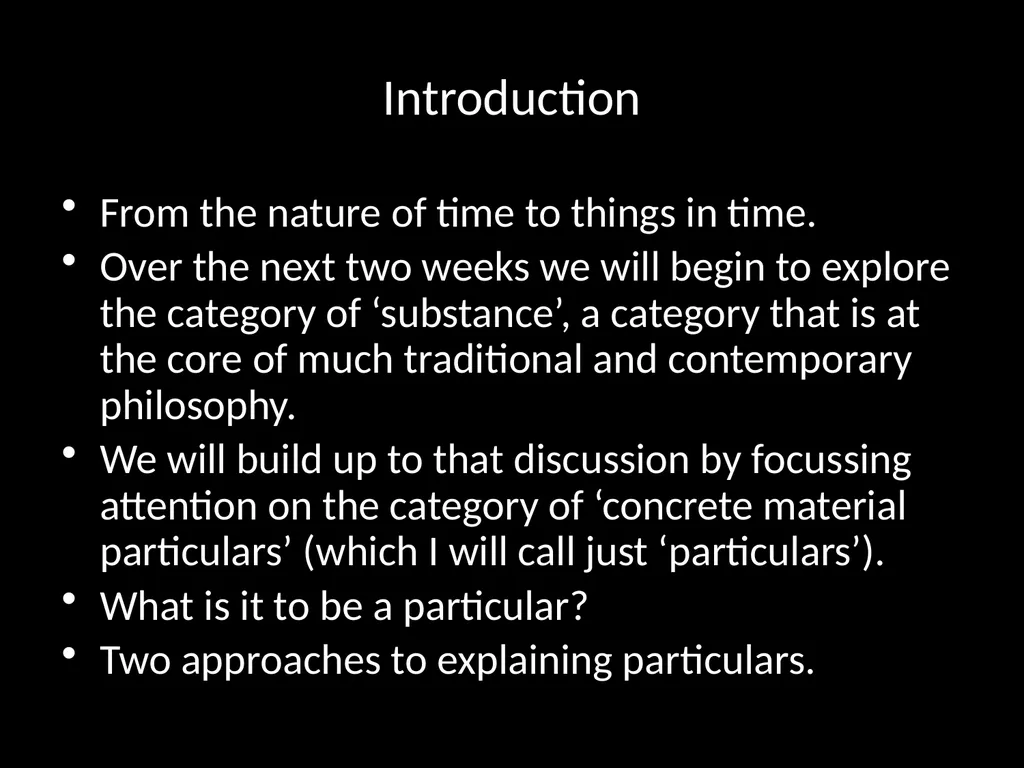
Introduction From the nature of time to things in time.
Over the next two weeks we will begin to explore the category of ‘substance’, a category that is at the core of much traditional and contemporary philosophy.
We will build up to that discussion by focussing attention on the category of ‘concrete material particulars’ (which I will call just ‘particulars’).
What is it to be a particular?
Two approaches to explaining particulars.<br>
Over the next two weeks we will begin to explore the category of ‘substance’, a category that is at the core of much traditional and contemporary philosophy.
We will build up to that discussion by focussing attention on the category of ‘concrete material particulars’ (which I will call just ‘particulars’).
What is it to be a particular?
Two approaches to explaining particulars.<br>
03
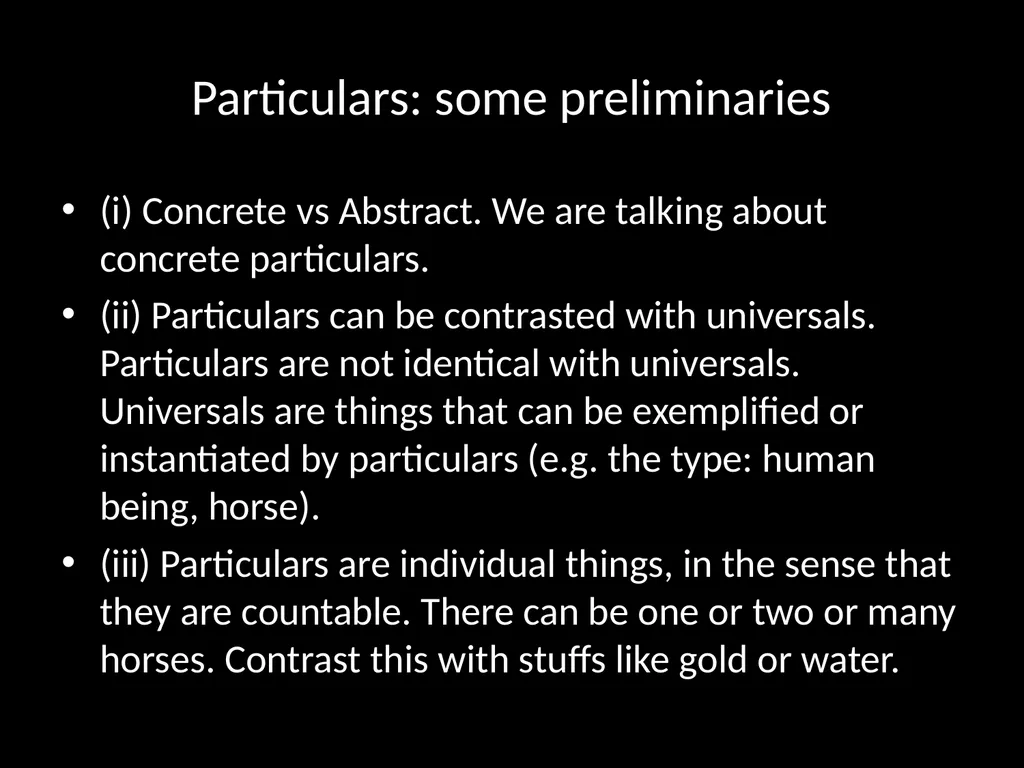
Particulars: some preliminaries (i) Concrete vs Abstract. We are talking about concrete particulars.
(ii) Particulars can be contrasted with universals. Particulars are not identical with universals. Universals are things that can be exemplified or instantiated by particulars (e.g. the type: human being, horse).
(iii) Particulars are individual things, in the sense that they are countable. There can be one or two or many horses. Contrast this with stuffs like gold or water.<br>
(ii) Particulars can be contrasted with universals. Particulars are not identical with universals. Universals are things that can be exemplified or instantiated by particulars (e.g. the type: human being, horse).
(iii) Particulars are individual things, in the sense that they are countable. There can be one or two or many horses. Contrast this with stuffs like gold or water.<br>
04
Some plausible working assumptions (i) Properties are the way that particulars are, or how particulars are modified. Particulars don’t themselves appear to be ways that things are, but they are the things that have those properties. So, particulars are not identical with properties. They have them.
(ii) Particulars are capable of undergoing change.<br>
(ii) Particulars are capable of undergoing change.<br>
05
The Nature of Particulars Suppose x is a particular
What is it for x to be a particular?<br>
What is it for x to be a particular?<br>
06
Bare particulars/substrata (ii) Bare particulars: x is a bare particular iff x does not possess any properties essentially (it can be conceived of as existing independently of the possession of any properties).
(iii) The bare particular view of particulars: x is a particular iff x is a ‘bare particular’ supporting or grounding a collection of properties.<br>
(iii) The bare particular view of particulars: x is a particular iff x is a ‘bare particular’ supporting or grounding a collection of properties.<br>
07
Aristotle on ‘substrata’ “Now, then, it has been said in outline what substance is, that it’s ‘that which isn’t (said) of a subject, but of which the other things (are said)’; but this can’t be all, for it is not enough; for this itself is unclear, and beyond that the matter becomes substance. For if this [=the matter] is not substance, it escapes us what else is. For the other things being stripped off, nothing [else] seems to be left over. For the other things are afflictions and products and potentialities of bodies,<br>
08
Aristotle on ‘substrata’ …or again length and breadth and depth are particular quantities (of bodies) but not substances—for the so-much is not substance—but rather, the primary thing to which these belong, that is substance. But length and breadth and depth being stripped off, we see nothing left over—unless it be something that is demarcated by the agency of these, so that the matter alone necessarily seems to be substance to those who are investigating in this way.” (Aristotle, Metaphysics, 1029a7-1029a30)<br>
09
Substrata in Locke’s Essay “Though in the mean time it be manifest, and every one upon Enquiry into his own thoughts, will find that he has no other Idea of any Substance, v.g. let it be Gold, Horse, Iron, Man, Vitriol, Bread, but what he has barely of those sensible Qualities, which he supposes to inhere, with a supposition of such a Substratum, as gives as it were a support to those Qualities, or simple Ideas, which he has observed to exist united together.<br>
10
Substrata in Locke’s Essay Thus the Idea of the Sun, What is it, but an aggregate of those several simple Ideas, Bright, Hot, Roundish, having a constant regular motion, at a certain distance from us, and, perhaps, some other; as he who thinks and discourses of the Sun, has been more or less accurate, in observing those sensible Qualities, Ideas, or Properties, which are in that thing, which he calls the Sun.” (Locke, Essay, II.Xxiii.§6)<br>
11
Basic Motivations Explains predication straightforwardly
Explains unity of the properties of a single object
Allows for qualitative duplicates<br>
Explains unity of the properties of a single object
Allows for qualitative duplicates<br>
12
Problems for the Bare Particular View A dilemma about ‘being bare’
Can we even make sense of the idea of a bare particular?
Epistemological and phenomenological problems<br>
Can we even make sense of the idea of a bare particular?
Epistemological and phenomenological problems<br>
13
A Dilemma (1) A dilemma for the bare particular conception. Being bare appears to be an essential property of particulars on the bare particular view.
Then either:
(a) Being bare is an essential property of particulars. In which case those particulars cannot be bare (for they possess one property essentially).
Or
(b) Being bare is not an essential property of a particular. In which case, it is not necessarily the case that the particular can be conceived to exist independent of all properties.
Response: Bare particulars don’t possess any non-trivial properties essentially.<br>
Then either:
(a) Being bare is an essential property of particulars. In which case those particulars cannot be bare (for they possess one property essentially).
Or
(b) Being bare is not an essential property of a particular. In which case, it is not necessarily the case that the particular can be conceived to exist independent of all properties.
Response: Bare particulars don’t possess any non-trivial properties essentially.<br>
14
Worries about the Intelligibility of Bare Particulars (2) Can we really make sense of the idea of a bare particular? What exactly is it to be something, without being anything essentially, or such that considered in itself, it has no properties or is not any determinate way at all? Any way that one might conceive of such things is such that it could be such a thing even lacking those properties, for any non-trivial property.
But is the idea really so unintelligible? The claim is not that bare particulars possess no properties. It is that for any non-trivial property they do not possess that essentially.<br>
But is the idea really so unintelligible? The claim is not that bare particulars possess no properties. It is that for any non-trivial property they do not possess that essentially.<br>
15
Epistemology and Bare Particulars “Currently (bare particular theory) is widely rejected. Underlying the many arguments supporting that rejection is a rather simple idea which Russell once expressed: “One is tempted to regard ‘This is red’ as a subject-predicate proposition, but if one does so, one finds that ‘this’ becomes a substance, an unknowable something in which predicates inhere…” Though awkwardly expressed, Russell’s point is clear: The individual character analysis (the bare particular theory) is at odds with the empirical tradition.<br>
16
Epistemology and Bare Particulars That is, if one claims that “this is red” is a subject-predicate proposition in the sense that “this” and “red” refer to unanalyzable entities of different ontological kinds, then one has violated the Principle of Acquaintance (PA), a basic tenet of empiricism. One is not acquainted with “a something” which could be construed as an entity of a kind different from red, except in the sense that this is a collection of the same kind of things as red, e.g. square and bright. The heart of Russell’s point is thus that the individuals of the individual-character (bare particular) analysis are unknowable in the sense that one is not directly acquainted with them. (Allaire (1963): 114)<br>
17
Epistemology and Bare Particulars The Principle of Acquaintance “The PA states that the indefinable terms of any “ontological” description must refer to entities with which one is directly acquainted.” (Allaire (1963): f.n. 2, pp.120)
What is the argument here?
(a) One is not directly acquainted with the particulars of the bare particular analysis.
(b) If one is not directly acquainted with the particulars of the bare particular analysis then the terms that purport to refer to them (“that” and “this”) do not have meaning.<br>
What is the argument here?
(a) One is not directly acquainted with the particulars of the bare particular analysis.
(b) If one is not directly acquainted with the particulars of the bare particular analysis then the terms that purport to refer to them (“that” and “this”) do not have meaning.<br>
18
Allaire (1963) on Acquaintance with Bare Particulars “Consider …the two (qualitatively indistinguishable) discs. When presented together, they are presented as numerically different. That difference is presented as is their sameness with respect to shape, (shade of) colour, and so on. What accounts for the difference is the numerically different individuals. No character (property) or group of characters (properties) can do that… (T)he two collections of characters—if one persists in speaking that way—are, as presented, numerically different. Clearly, therefore, something other than a character must also be presented.” (Allaire (1963): 119).<br>
19
Allaire (1963) on Acquaintance with Bare Particulars (a) If one is presented with two qualitatively indistinguishable discs at the same time, one experiences them as numerically distinct.
(b) If one experiences them as numerically distinct then ‘something other than a character’ (a property) must be presented.
(c) What it is that is presented is the ‘bare particular’.
But there is an alternative explanation.<br>
(b) If one experiences them as numerically distinct then ‘something other than a character’ (a property) must be presented.
(c) What it is that is presented is the ‘bare particular’.
But there is an alternative explanation.<br>
20
Bundle Theory (BT) What it is for x to be a particular is for x to be a ‘bundle’ (a collection) of properties.
(Berkeley, Hume, D. C. Williams (1953), Hochberg (1964), Castaneda (1974))<br>
(Berkeley, Hume, D. C. Williams (1953), Hochberg (1964), Castaneda (1974))<br>
21
Bundle Theory in Berkeley’s Principles “By sight I have the ideas of light and colours with their several degrees and variations. By touch I perceive, for example, hard and soft, heat and cold, motion and resistance, and of all these more and less either as to quantity or degree. Smelling furnishes me with odours; the palate with tastes, and hearing conveys sounds to the mind in all their variety of tone and composition.<br>
22
Bundle Theory in Berkeley’s Principles And as several of these are observed to accompany each other, they come to be marked by one name, and so to be reputed as one thing. Thus, for example, a certain colour, taste, smell, figure and consistence having been observed to go together, are accounted one distinct thing, signified by the name apple. Other collections of ideas constitute a stone, a tree, a book and the like sensible things..” (Berkeley, Principles, 1)<br>
23
Bundle Theory in Hume’s Treatise “We have therefore no idea of substance, distinct from that of a collection of particular qualities, nor have we any other meaning when we either talk of reason concerning it.
The idea of a substance as well as that of a mode, is nothing but a collection of simple ideas, that are united by the imagination, and have a particular name assigned them, by which we are able to recall, either to ourselves or others, that collection…<br>
The idea of a substance as well as that of a mode, is nothing but a collection of simple ideas, that are united by the imagination, and have a particular name assigned them, by which we are able to recall, either to ourselves or others, that collection…<br>
24
Bundle Theory in Hume’s Treatise But difference betwixt these ideas consists in this, that the particular qualities, which form a substance, are commonly refer’d to an unknown something, in which they are supposed to inhere; or granting this fiction should not take place, are at least supposed to be closely and inseparably connected by the relations of contiguity and causation.” Hume (Treatise, 1.1.6)<br>
25
Bundle Theory Properties are bundled together when they are ‘compresent’ or ‘collocated’.
Compresence or collocation is either taken to involve contiguity and causation (Hume) or taken to be basic.
On the Bundle Theory, x is F iff the collection of properties that x is identified with includes F.<br>
Compresence or collocation is either taken to involve contiguity and causation (Hume) or taken to be basic.
On the Bundle Theory, x is F iff the collection of properties that x is identified with includes F.<br>
26
Motivations for Bundle Theory Consistent with empiricist epistemology
Not self-refuting in a way that the bare particular view threatens to be.<br>
Not self-refuting in a way that the bare particular view threatens to be.<br>
27
Problems for Bundle Theory Failure of Identity of Indiscernibles
Impossible to explain change
General worries about ontological status of properties as particulars<br>
Impossible to explain change
General worries about ontological status of properties as particulars<br>
28
The Failure of the Identity of Indiscernibles The Identity of Indiscernibles (nb the difference from the indiscernibility of identicals)
(Id.Ind) For any x, and any y, if for any property F, x has F if and only if y has F, and y has F iff x has F, then x and y are identical.
An argument from the failure of (Id.Ind.)
(a) The Identity of Indiscernibles is false
(b) Were the bundle theory of particulars true, the Identity of Indiscernibles would be true.
(c) The bundle theory of particulars is false.
Max Black (1952) argues that it is possible that a universe contains two numerically distinct spheres, which are indistinguishable with respect to all of their properties.<br>
(Id.Ind) For any x, and any y, if for any property F, x has F if and only if y has F, and y has F iff x has F, then x and y are identical.
An argument from the failure of (Id.Ind.)
(a) The Identity of Indiscernibles is false
(b) Were the bundle theory of particulars true, the Identity of Indiscernibles would be true.
(c) The bundle theory of particulars is false.
Max Black (1952) argues that it is possible that a universe contains two numerically distinct spheres, which are indistinguishable with respect to all of their properties.<br>
29
Argument from the Impossibility of Change (a) S= Some particular or other
(b) The bundle of properties that S is identified with at t contains every property that S has at t. (Every property that we could attribute to S at that time by true predications or descriptions of him).
(c) Now, call that bundle of properties, (made up of P1, P2, P3, P4, P5…) bundle C.
(d) Any bundle of properties that contains different properties is not bundle C (it is a different bundle.
(e) If C is identical with S, then S cannot lose any properties. For the loss of any property from bundle C leads to the disappearance of (or extinction of) bundle C.<br>
(b) The bundle of properties that S is identified with at t contains every property that S has at t. (Every property that we could attribute to S at that time by true predications or descriptions of him).
(c) Now, call that bundle of properties, (made up of P1, P2, P3, P4, P5…) bundle C.
(d) Any bundle of properties that contains different properties is not bundle C (it is a different bundle.
(e) If C is identical with S, then S cannot lose any properties. For the loss of any property from bundle C leads to the disappearance of (or extinction of) bundle C.<br>
30
Worries about the Ontological Status of Properties and Particulars (a) Particulars are not things that can be possessed by anything.
(b) Properties are things that can be possessed by things (and exist by being possessed).
(c) Any bundle of properties would be capable of being possessed by something. (It could only have the same metaphysical status as the properties themselves).
(d) Therefore particulars cannot be bundles of properties.<br>
(b) Properties are things that can be possessed by things (and exist by being possessed).
(c) Any bundle of properties would be capable of being possessed by something. (It could only have the same metaphysical status as the properties themselves).
(d) Therefore particulars cannot be bundles of properties.<br>
31
Summary The bare particular view preserves a number of commonsense intuitions. But the notion of a bare particular remains obscure.
The bundle theory has difficulties with respect to individuation and identity
Next week: Another way?<br>
The bundle theory has difficulties with respect to individuation and identity
Next week: Another way?<br>