
Philippe Fournier-Viger
Description: Philippe Fournier-Viger http:www.philippe-Fournier-viger.com Discovering Rare Itemsets 1 Source code and datasets available in the SPMF library Introduction Pattern mining: using algorithms to discover interesting patterns in data. One of
Related Topics
Download Presentation
"Philippe Fournier-Viger" is the property of its rightful owner. Permission is granted to download and print the materials on this website for personal, non-commercial use only, and to display it on your personal computer provided you do not modify the materials and that you retain all copyright notices contained in the materials. By downloading content from our website, you accept the terms of this agreement.
Presentation Transcript
slide1. Philippe Fournier-Viger
http://www.philippe-Fournier-viger.com Discovering Rare Itemsets 1 Source code and datasets available in the SPMF library<br>
slide2. Introduction Pattern mining: using algorithms to discover interesting patterns in data.
One of the most important pattern mining task is frequent itemset mining.
It consists of finding sets of values (items) that appear frequently in the data (frequent itemsets).
Today, I will talk about the opposite problem of discovering rare itemsets. 2<br>
slide3. Frequent itemset mINING (brief review) 3<br>
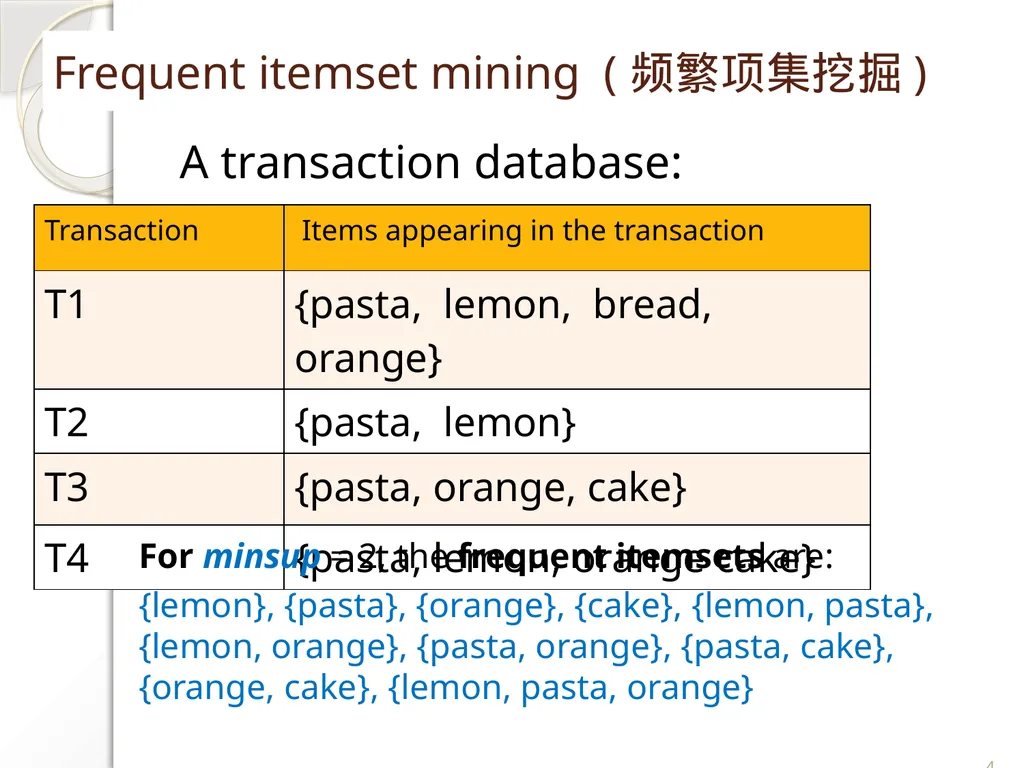
slide4. Frequent itemset mining (频繁项集挖掘) 4 A transaction database: For minsup = 2, the frequent itemsets are:
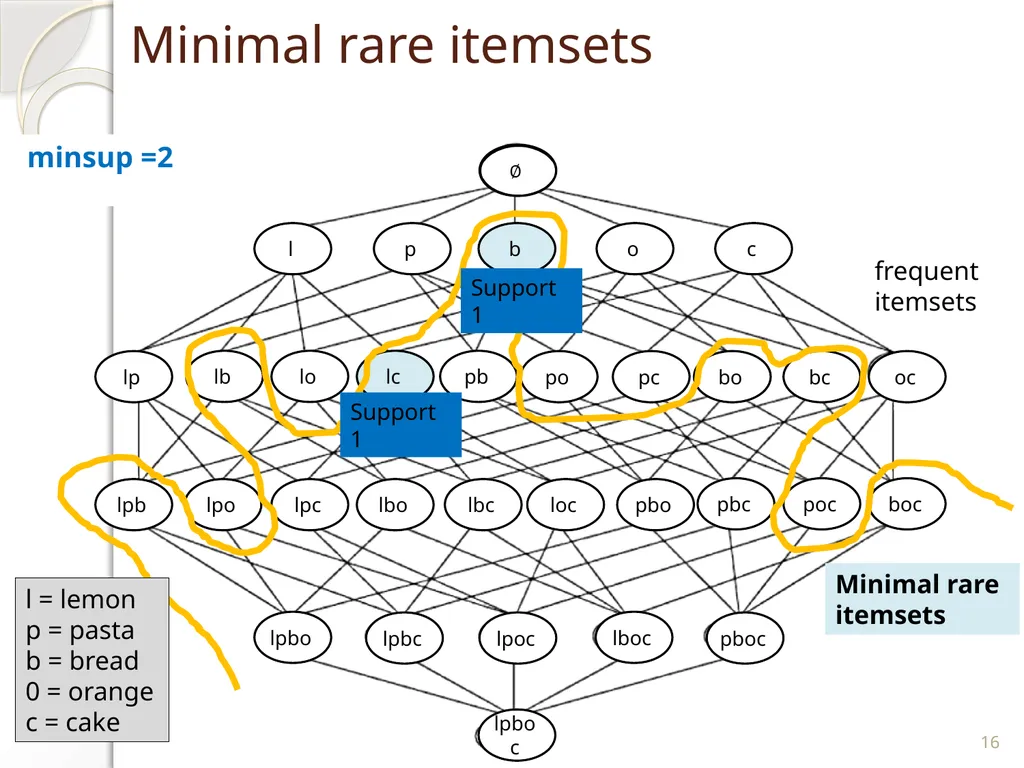
{lemon}, {pasta}, {orange}, {cake}, {lemon, pasta}, {lemon, orange}, {pasta, orange}, {pasta, cake}, {orange, cake}, {lemon, pasta, orange}<br>
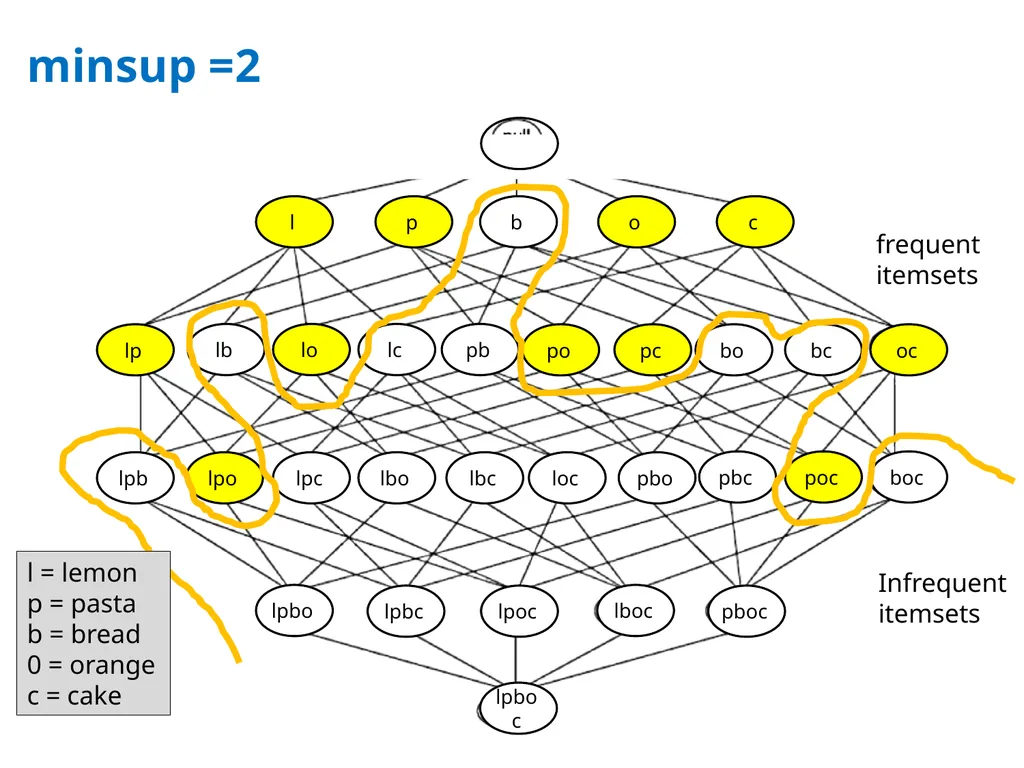
slide5. minsup =2 5 lpboc l p b o c lp lb lo lc pb po pc bo bc oc lpb lpo lpc lbo lbc loc pbo pbc poc boc lpbo lpbc lpoc lboc pboc frequent itemsets Infrequent
itemsets l = lemon
p = pasta
b = bread
0 = orange
c = cake<br>
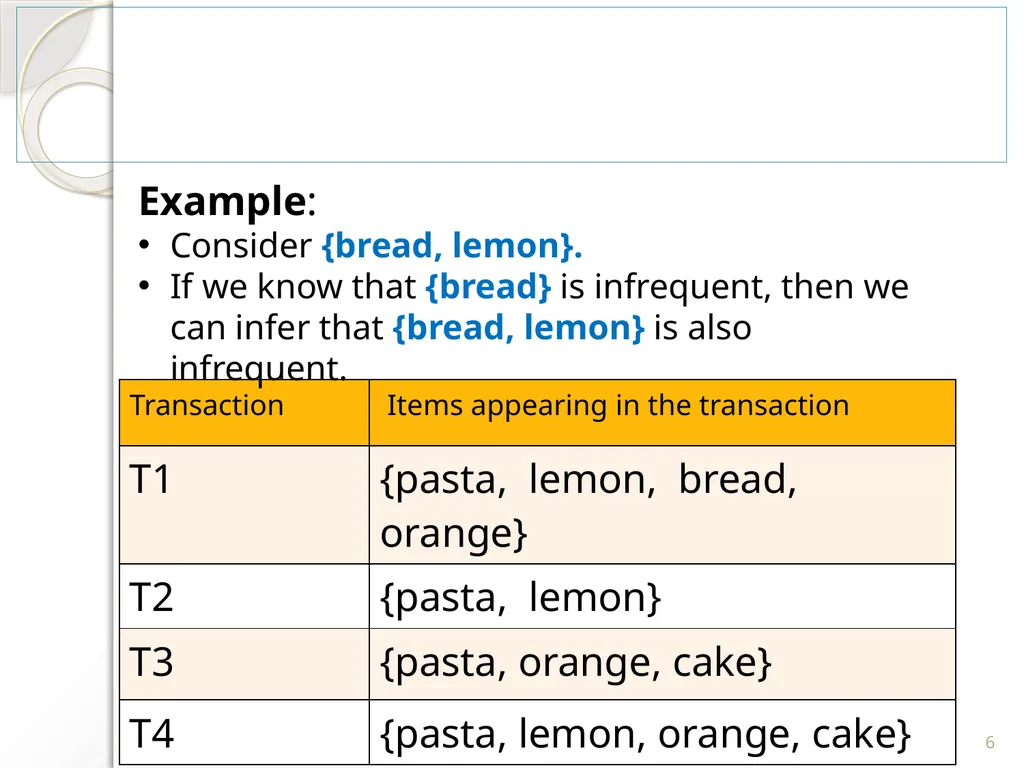
slide6. 6 Example:
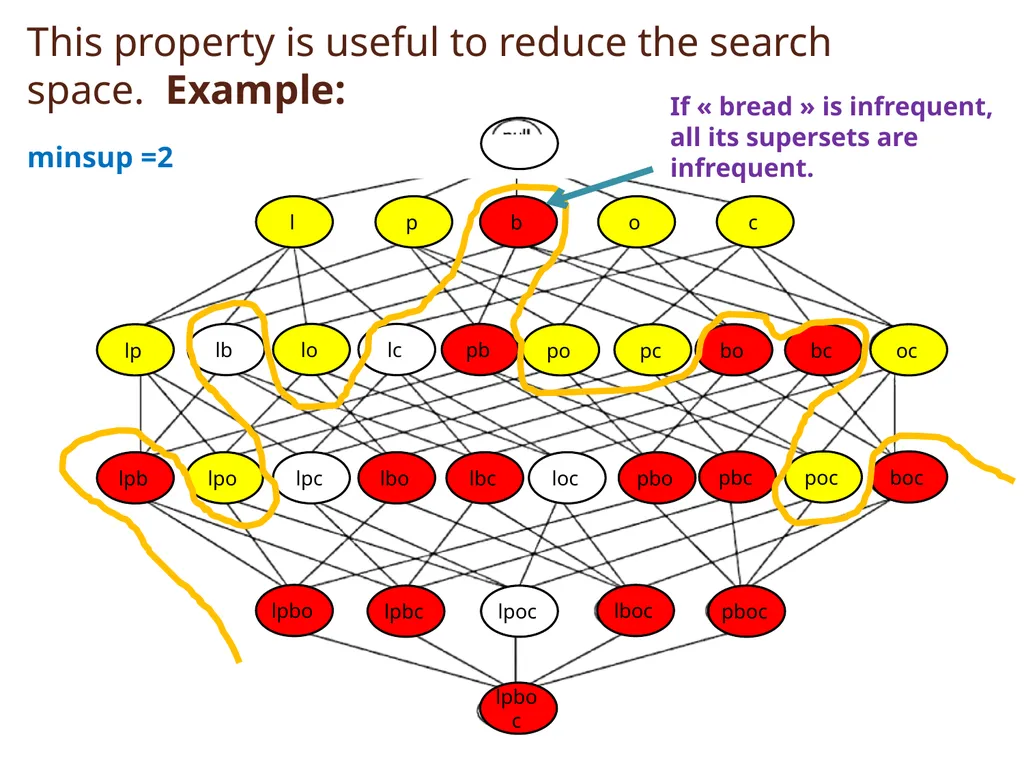
Consider {bread, lemon}.
If we know that {bread} is infrequent, then we can infer that {bread, lemon} is also infrequent.<br>
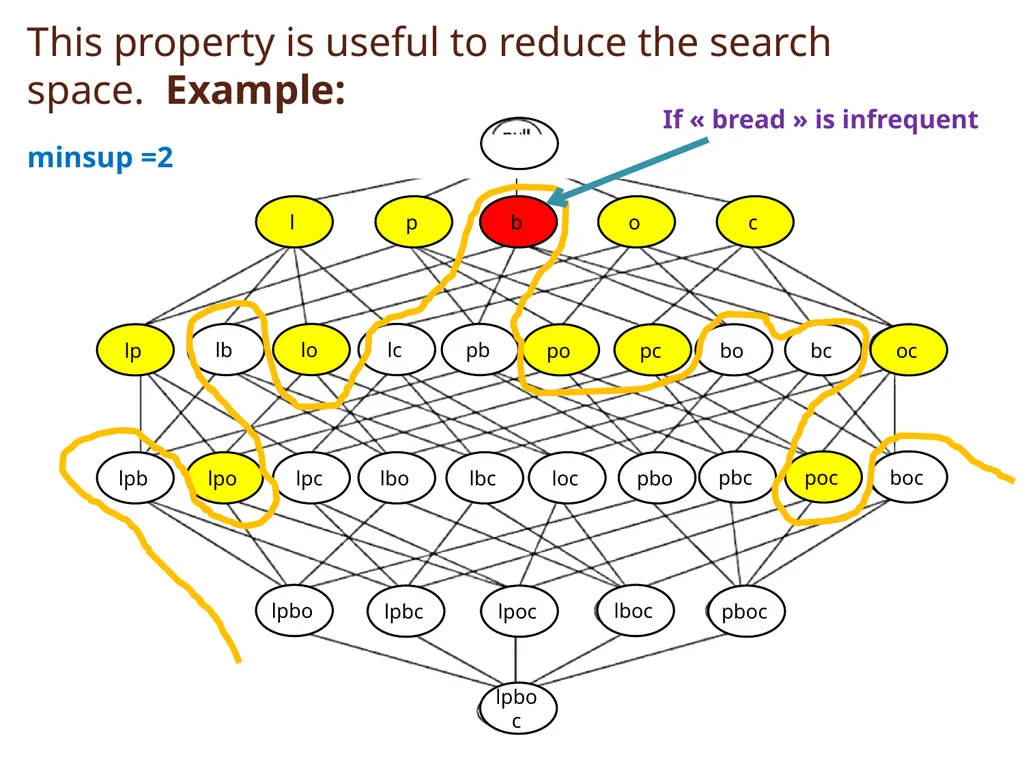
slide7. This property is useful to reduce the search space. Example: minsup =2 7 lpboc l p b o c lp lb lo lc pb po pc bo bc oc lpb lpo lpc lbo lbc loc pbo pbc poc boc lpbo lpbc lpoc lboc pboc If « bread » is infrequent<br>
slide8. minsup =2 8 lpboc l p b o c lp lb lo lc pb po pc bo bc oc lpb lpo lpc lbo lbc loc pbo pbc poc boc lpbo lpbc lpoc lboc pboc If « bread » is infrequent, all its supersets are infrequent. This property is useful to reduce the search space. Example:<br>
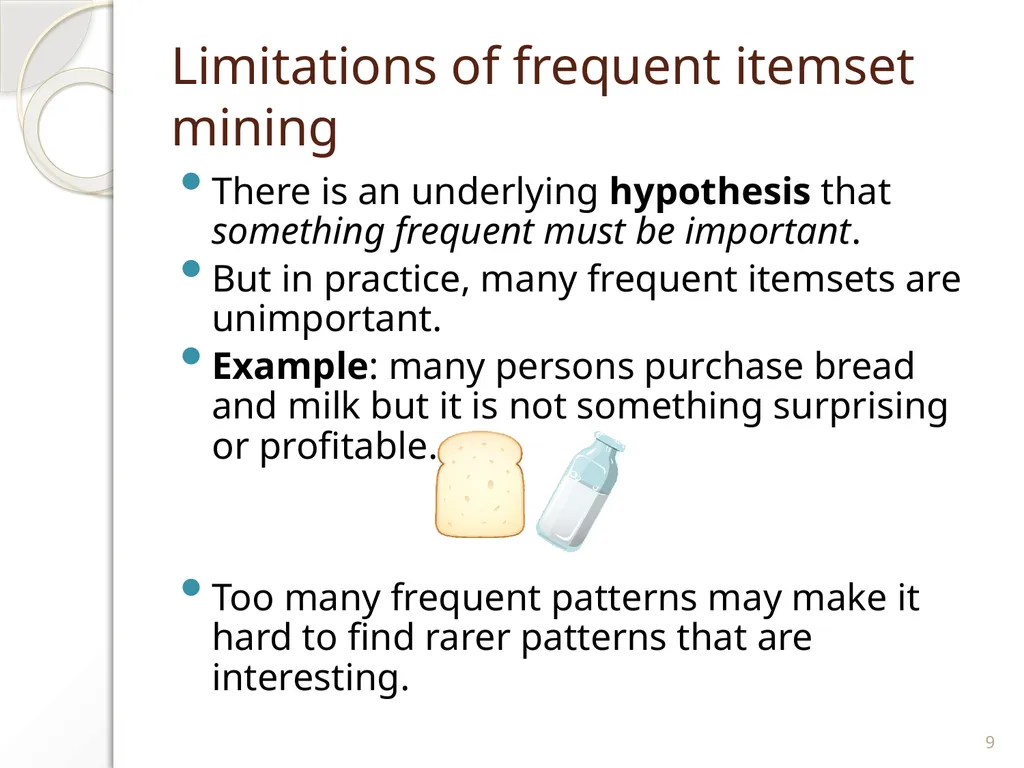
slide9. Limitations of frequent itemset mining There is an underlying hypothesis that something frequent must be important.
But in practice, many frequent itemsets are unimportant.
Example: many persons purchase bread and milk but it is not something surprising or profitable.
Too many frequent patterns may make it hard to find rarer patterns that are interesting. 9<br>
slide10. Rare pattern mINING 10<br>
slide11. Finding rare patterns We first need to define what is a rare pattern.
There are different definitions.
I will give an overview. 11<br>
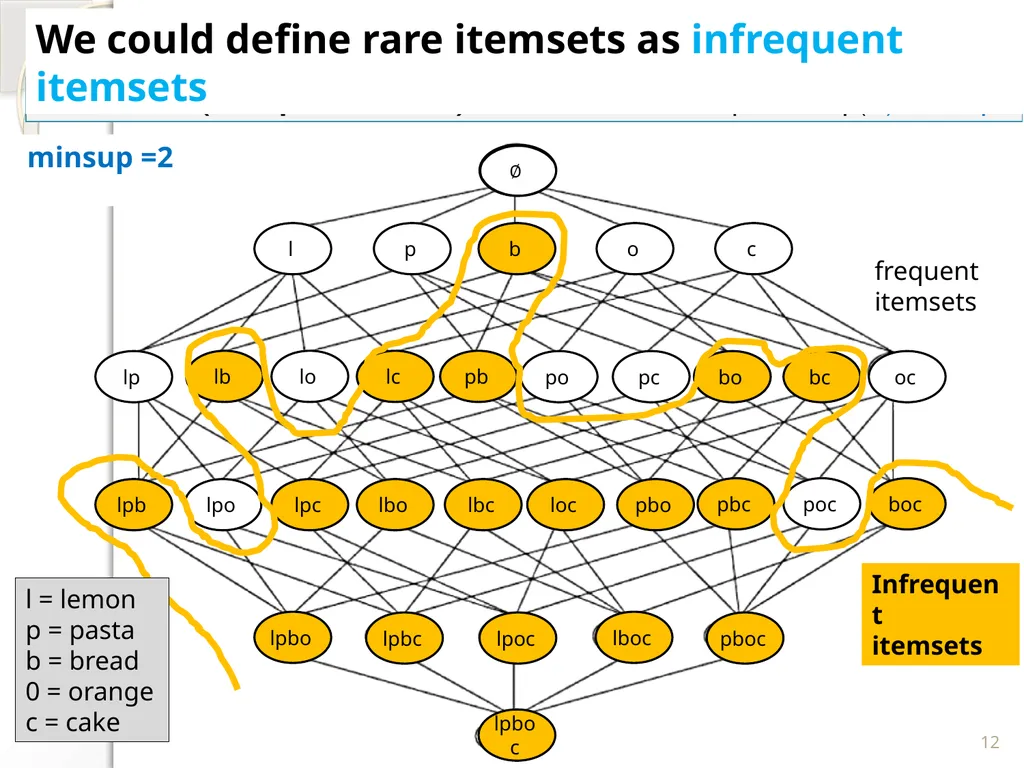
slide12. lpboc l p b o c lp lb lo lc pb po pc bo bc oc lpb lpo lpc lbo lbc loc pbo pbc poc boc lpbo lpbc lpoc lboc pboc frequent itemsets Infrequent
itemsets l = lemon
p = pasta
b = bread
0 = orange
c = cake 12 We could define rare itemsets as infrequent itemsets minsup =2<br>
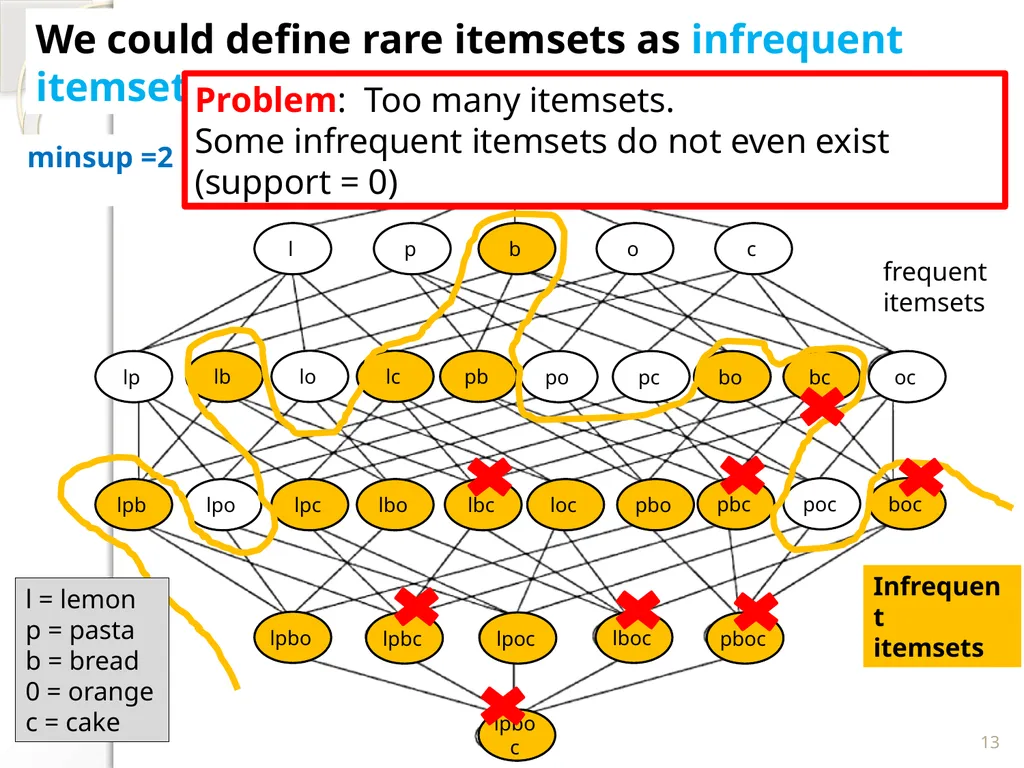
slide13. lpboc l p b o c lp lb lo lc pb po pc bo bc oc lpb lpo lpc lbo lbc loc pbo pbc poc boc lpbo lpbc lpoc lboc pboc frequent itemsets Infrequent
itemsets l = lemon
p = pasta
b = bread
0 = orange
c = cake 13 We could define rare itemsets as infrequent itemsets minsup =2 Problem: Too many itemsets. Some infrequent itemsets do not even exist (support = 0)<br>
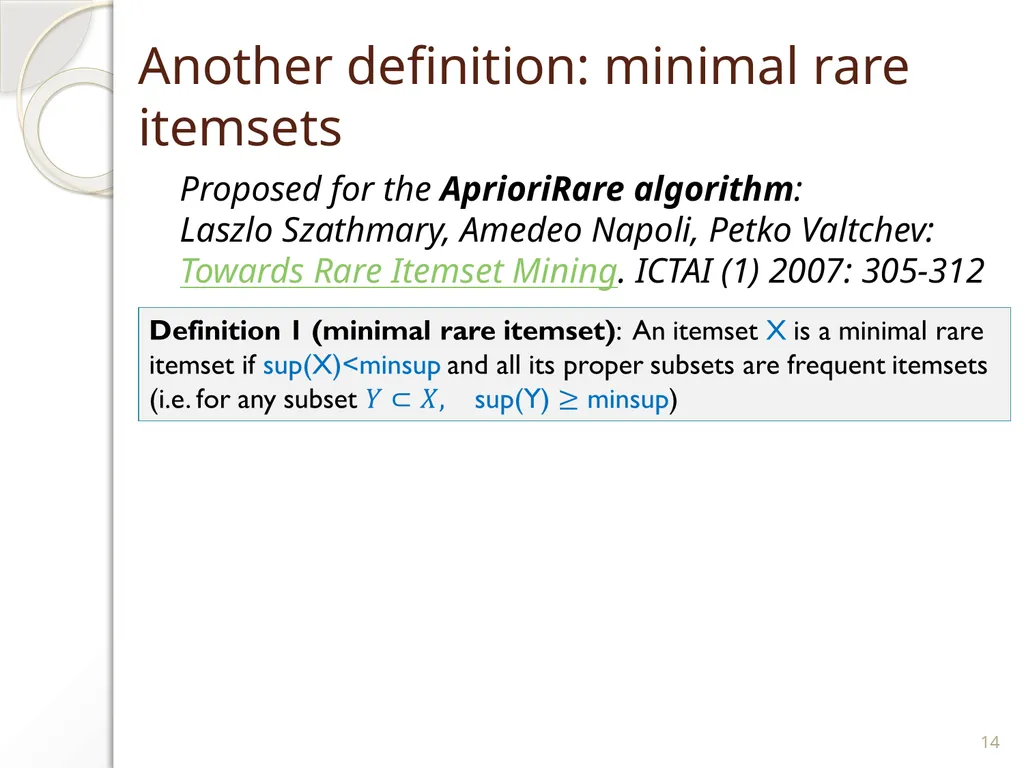
slide14. Another definition: minimal rare itemsets Proposed for the AprioriRare algorithm: Laszlo Szathmary, Amedeo Napoli, Petko Valtchev: Towards Rare Itemset Mining. ICTAI (1) 2007: 305-312 14<br>
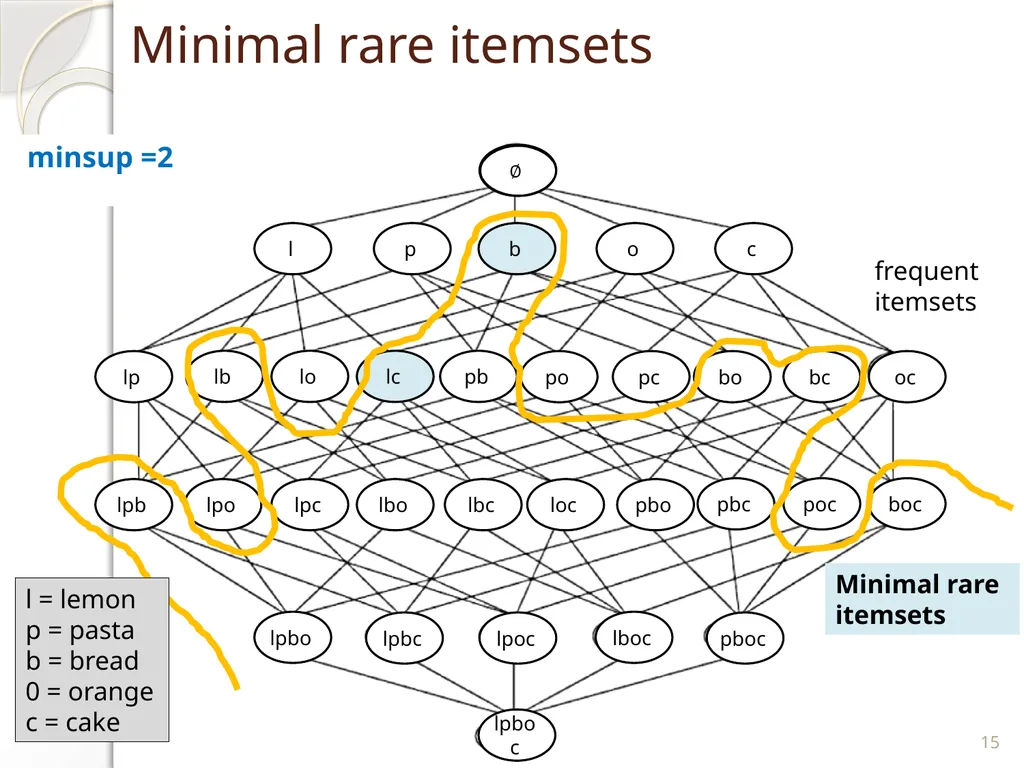
slide15. Minimal rare itemsets minsup =2 lpboc l p b o c lp lb lo lc pb po pc bo bc oc lpb lpo lpc lbo lbc loc pbo pbc poc boc lpbo lpbc lpoc lboc pboc frequent itemsets Minimal rare
itemsets l = lemon
p = pasta
b = bread
0 = orange
c = cake 15 minsup =2<br>
slide16. Minimal rare itemsets minsup =2 lpboc l p b o c lp lb lo lc pb po pc bo bc oc lpb lpo lpc lbo lbc loc pbo pbc poc boc lpbo lpbc lpoc lboc pboc frequent itemsets Minimal rare
itemsets l = lemon
p = pasta
b = bread
0 = orange
c = cake 16 minsup =2 Support 1 Support 1<br>
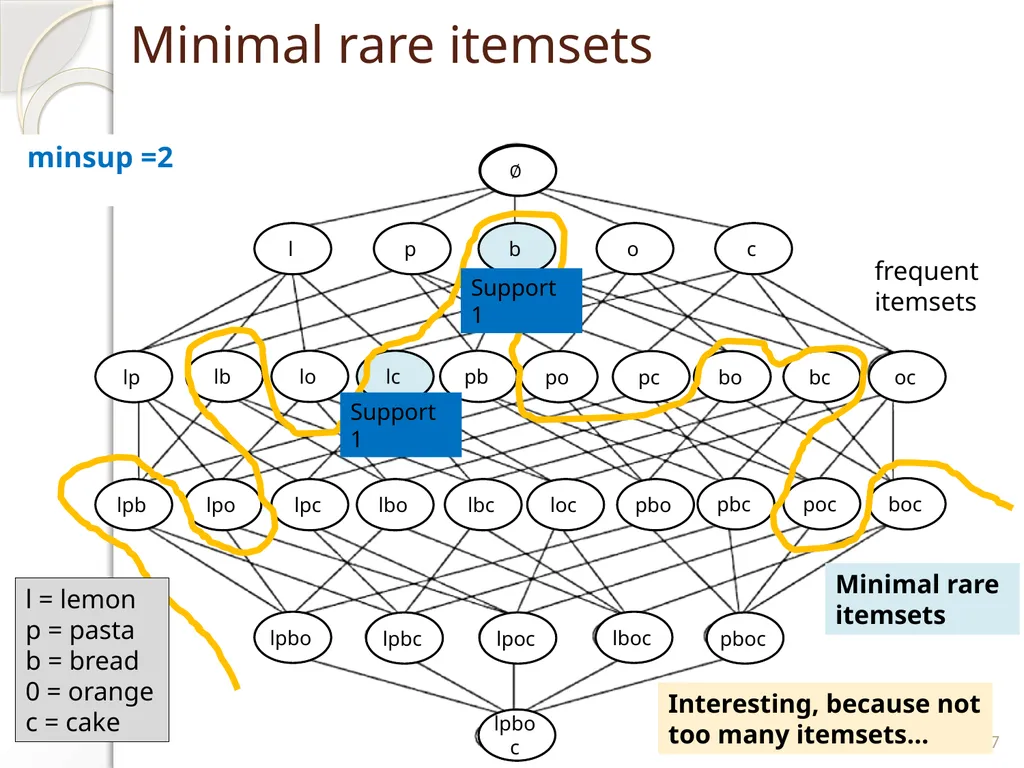
slide17. Minimal rare itemsets minsup =2 lpboc l p b o c lp lb lo lc pb po pc bo bc oc lpb lpo lpc lbo lbc loc pbo pbc poc boc lpbo lpbc lpoc lboc pboc frequent itemsets Minimal rare
itemsets l = lemon
p = pasta
b = bread
0 = orange
c = cake 17 minsup =2 Support 1 Support 1 Interesting, because not too many itemsets…<br>
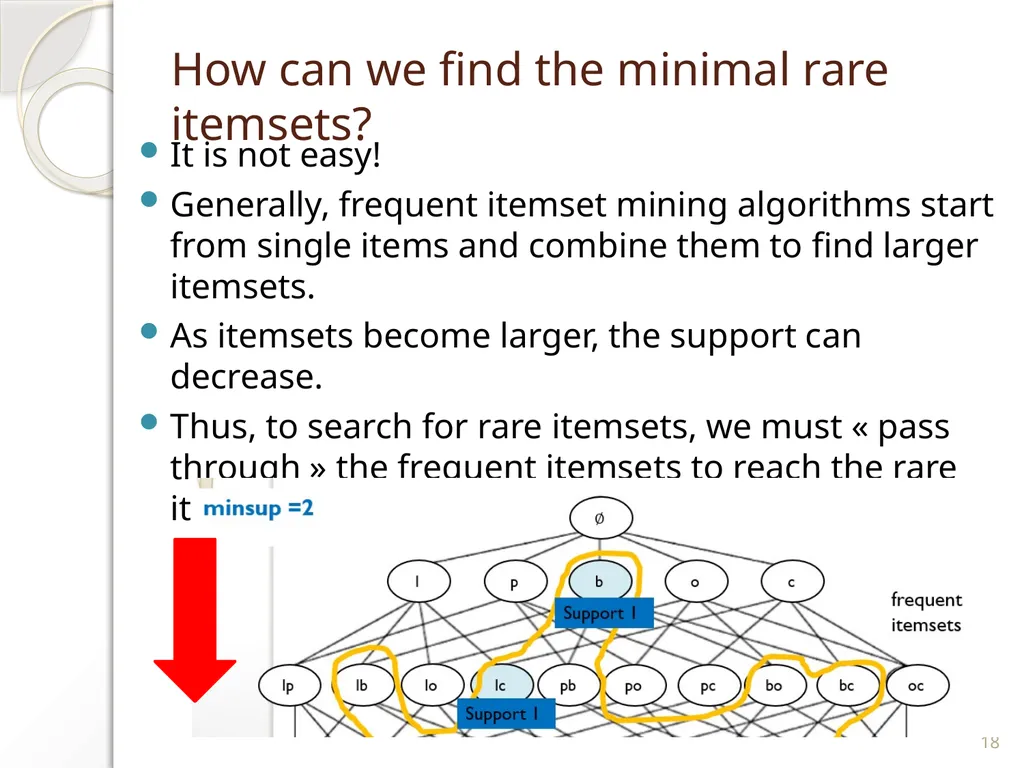
slide18. It is not easy!
Generally, frequent itemset mining algorithms start from single items and combine them to find larger itemsets.
As itemsets become larger, the support can decrease.
Thus, to search for rare itemsets, we must « pass through » the frequent itemsets to reach the rare itemsets. How? How can we find the minimal rare itemsets? 18<br>
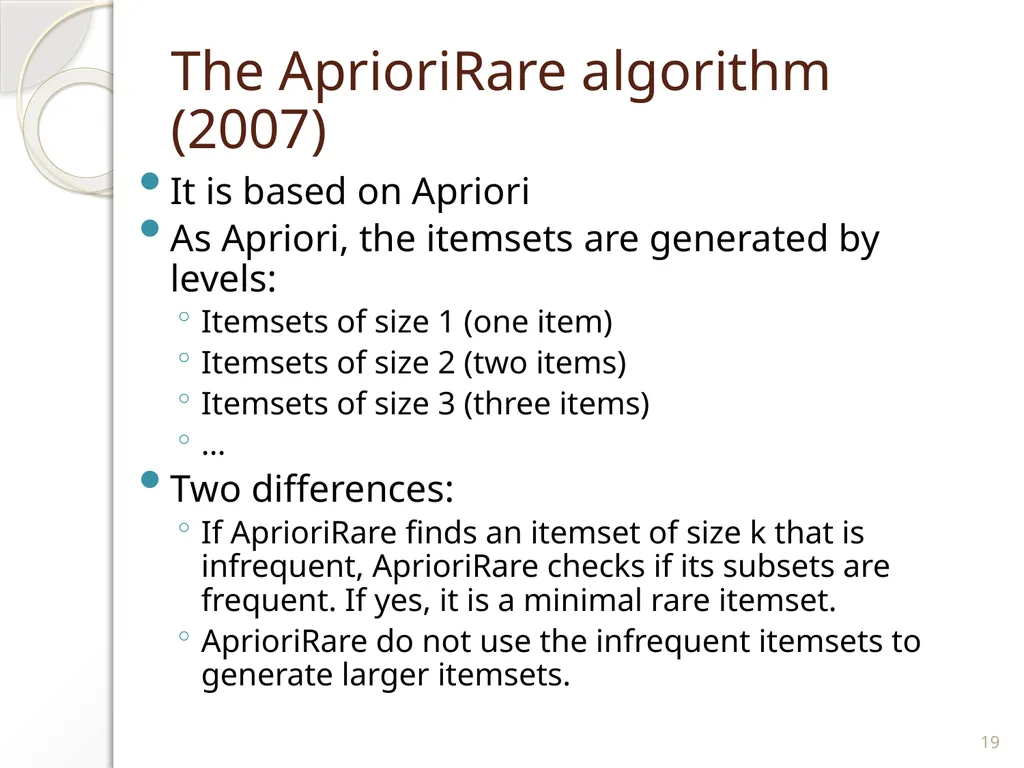
slide19. The AprioriRare algorithm (2007) It is based on Apriori
As Apriori, the itemsets are generated by levels:
Itemsets of size 1 (one item)
Itemsets of size 2 (two items)
Itemsets of size 3 (three items)
…
Two differences:
If AprioriRare finds an itemset of size k that is infrequent, AprioriRare checks if its subsets are frequent. If yes, it is a minimal rare itemset.
AprioriRare do not use the infrequent itemsets to generate larger itemsets. 19<br>
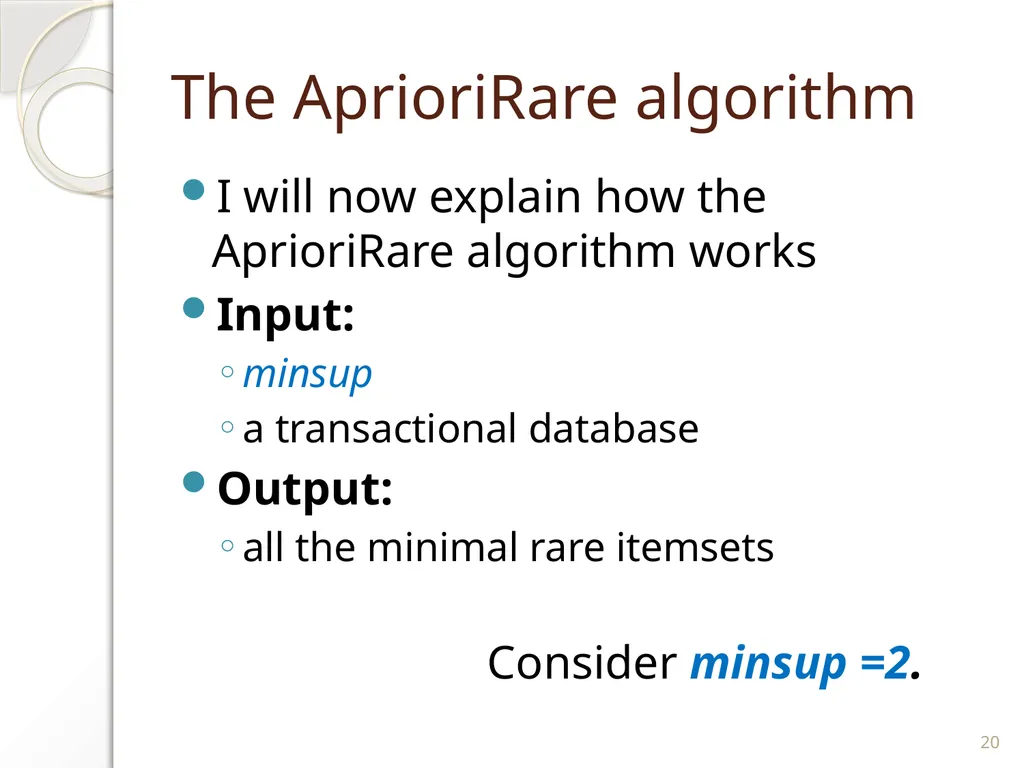
slide20. The AprioriRare algorithm I will now explain how the AprioriRare algorithm works
Input:
minsup
a transactional database
Output:
all the minimal rare itemsets
Consider minsup =2. 20<br>
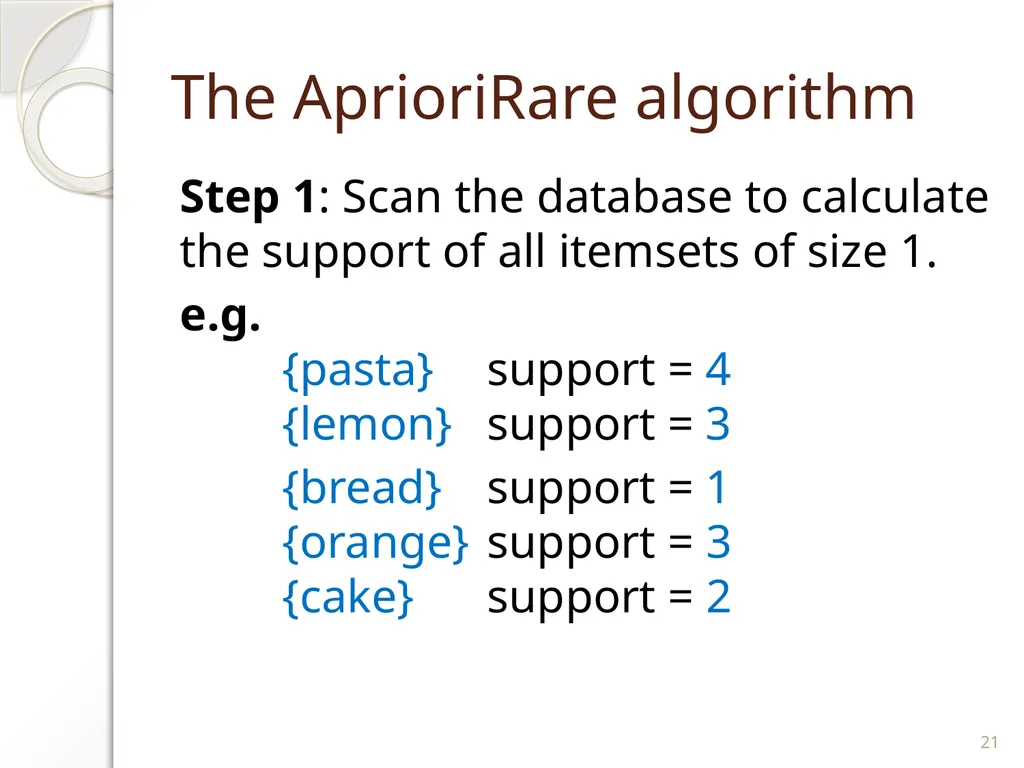
slide21. The AprioriRare algorithm Step 1: Scan the database to calculate the support of all itemsets of size 1.
e.g. {pasta} support = 4 {lemon} support = 3
{bread} support = 1 {orange} support = 3 {cake} support = 2 21<br>
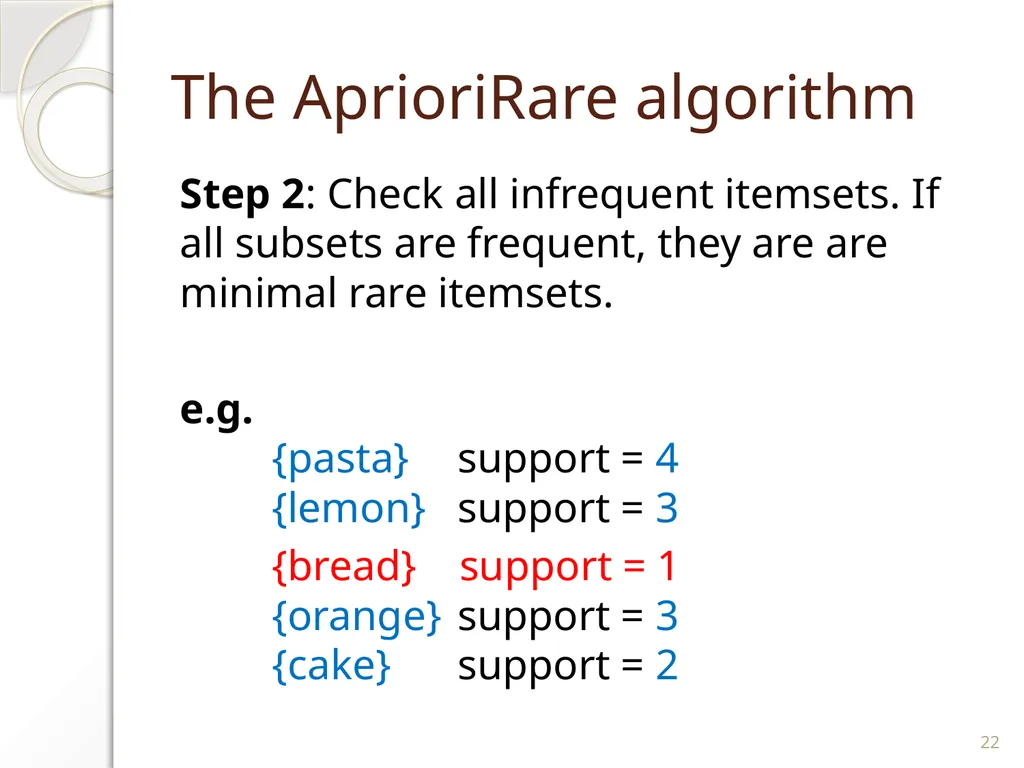
slide22. The AprioriRare algorithm Step 2: Check all infrequent itemsets. If all subsets are frequent, they are are minimal rare itemsets.
e.g. {pasta} support = 4 {lemon} support = 3
{bread} support = 1 {orange} support = 3 {cake} support = 2 22<br>
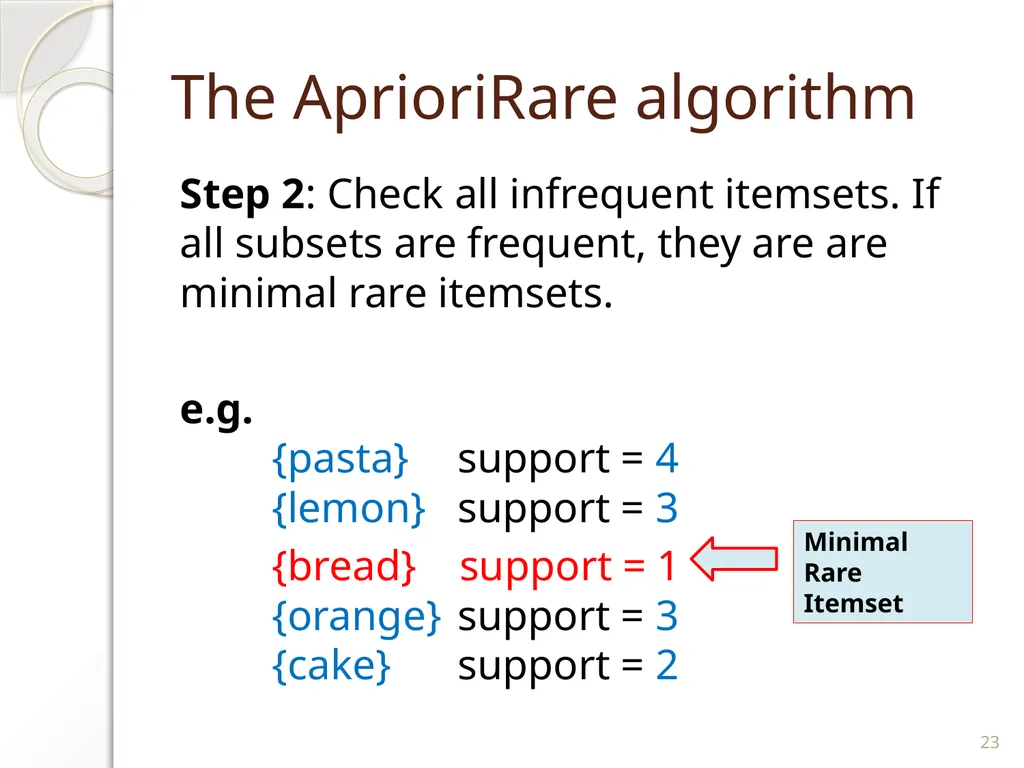
slide23. The AprioriRare algorithm Step 2: Check all infrequent itemsets. If all subsets are frequent, they are are minimal rare itemsets.
e.g. {pasta} support = 4 {lemon} support = 3
{bread} support = 1 {orange} support = 3 {cake} support = 2 23 Minimal Rare Itemset<br>
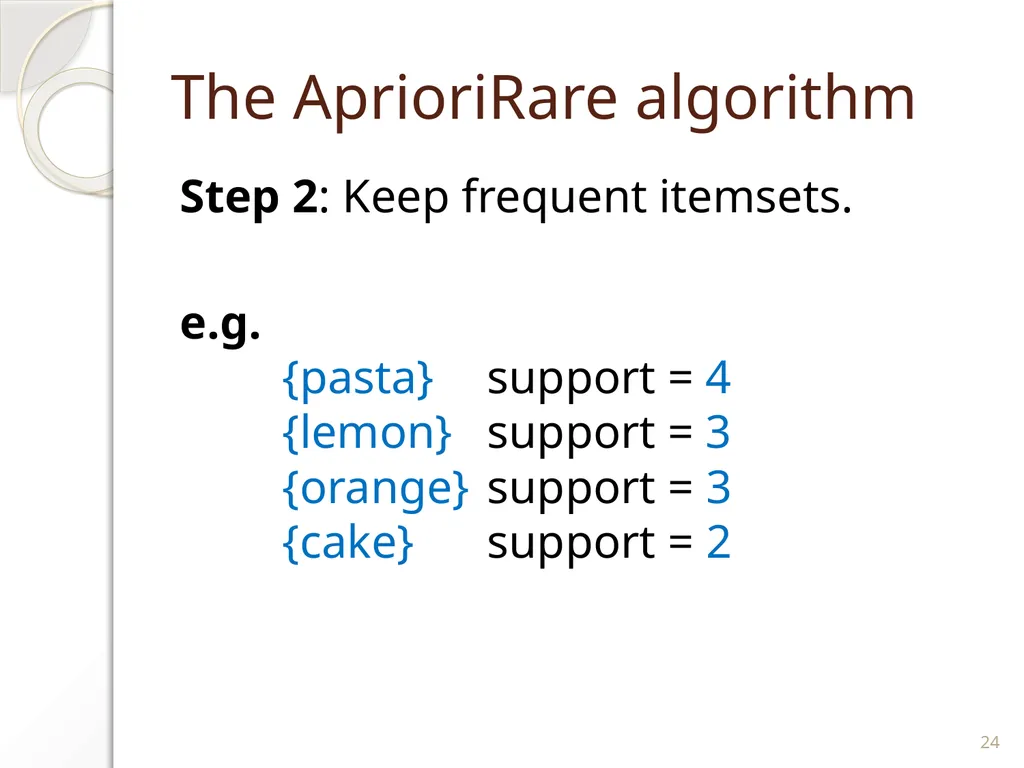
slide24. The AprioriRare algorithm Step 2: Keep frequent itemsets.
e.g. {pasta} support = 4 {lemon} support = 3 {orange} support = 3 {cake} support = 2 24<br>
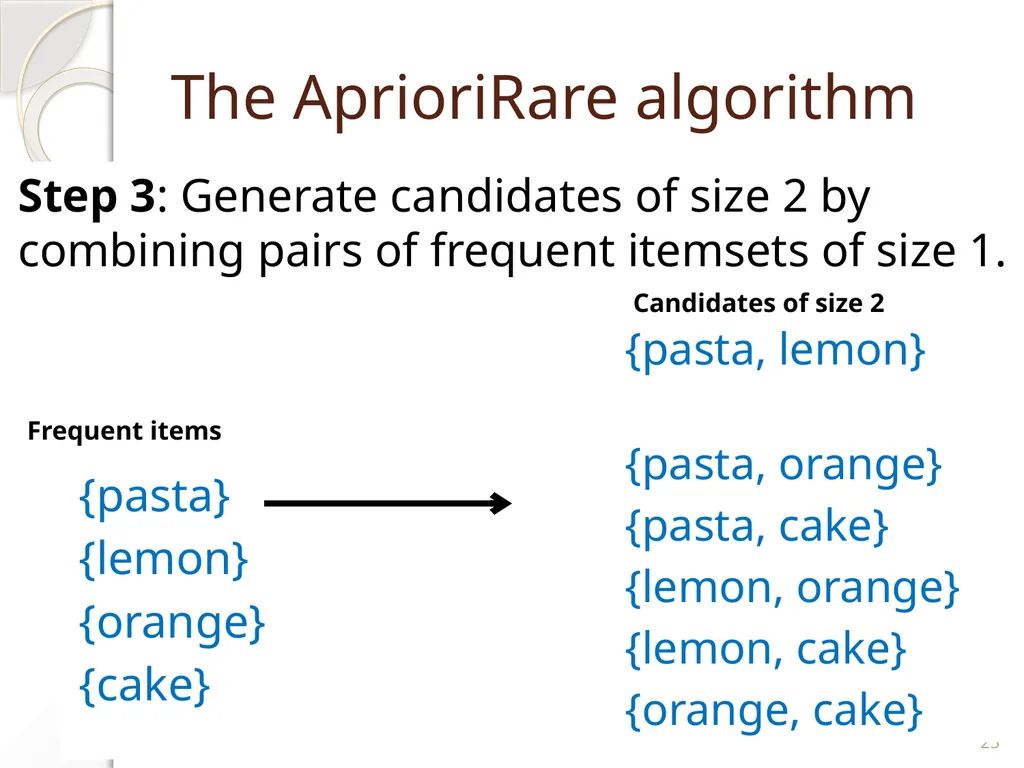
slide25. The AprioriRare algorithm Step 3: Generate candidates of size 2 by combining pairs of frequent itemsets of size 1. 25 {pasta}
{lemon}
{orange}
{cake} {pasta, lemon}
{pasta, orange}
{pasta, cake}
{lemon, orange}
{lemon, cake}
{orange, cake} Frequent items Candidates of size 2<br>
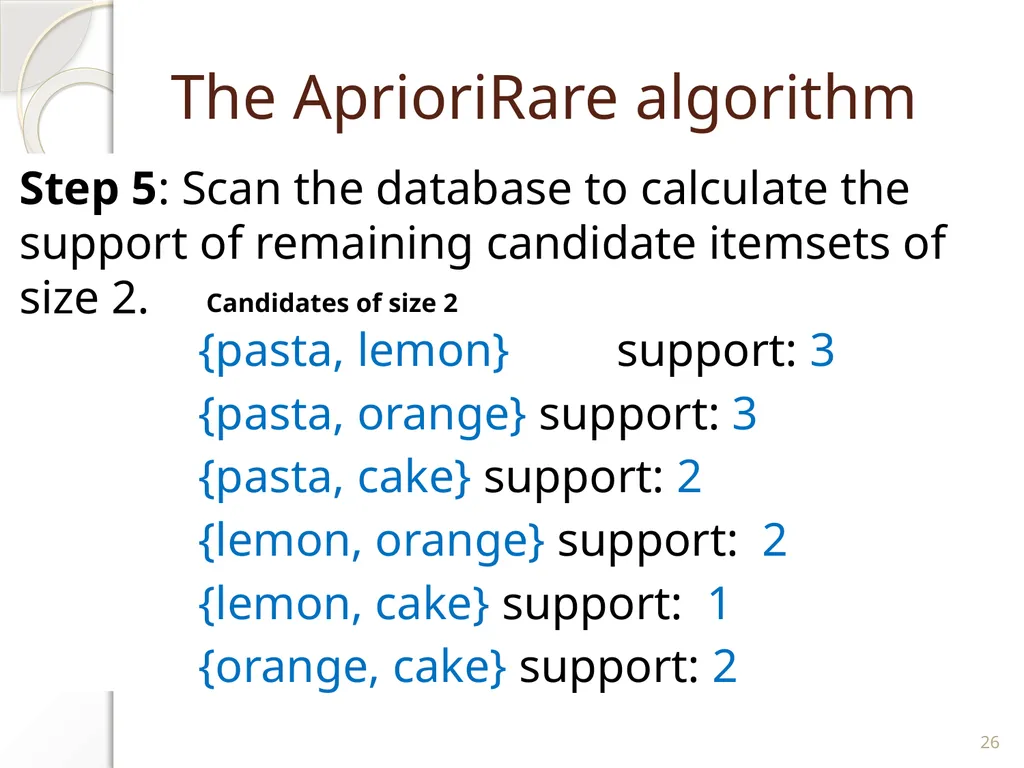
slide26. The AprioriRare algorithm Step 5: Scan the database to calculate the support of remaining candidate itemsets of size 2. 26 {pasta, lemon} support: 3
{pasta, orange} support: 3
{pasta, cake} support: 2
{lemon, orange} support: 2
{lemon, cake} support: 1
{orange, cake} support: 2 Candidates of size 2<br>
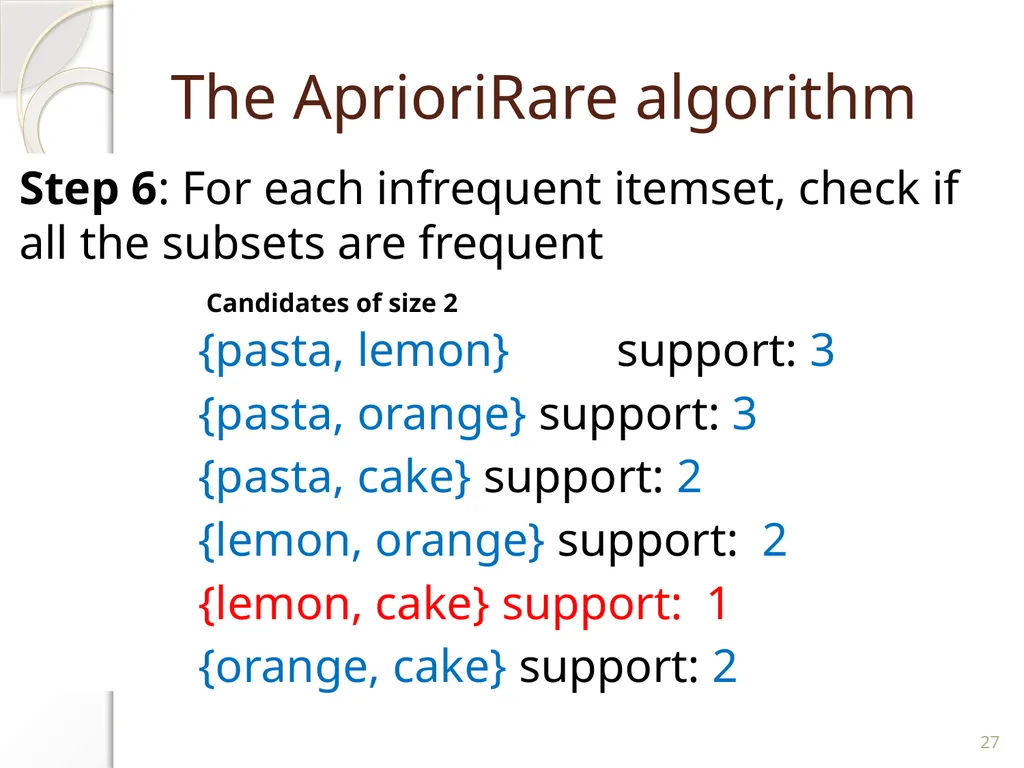
slide27. The AprioriRare algorithm Step 6: For each infrequent itemset, check if all the subsets are frequent 27 {pasta, lemon} support: 3
{pasta, orange} support: 3
{pasta, cake} support: 2
{lemon, orange} support: 2
{lemon, cake} support: 1
{orange, cake} support: 2 Candidates of size 2<br>
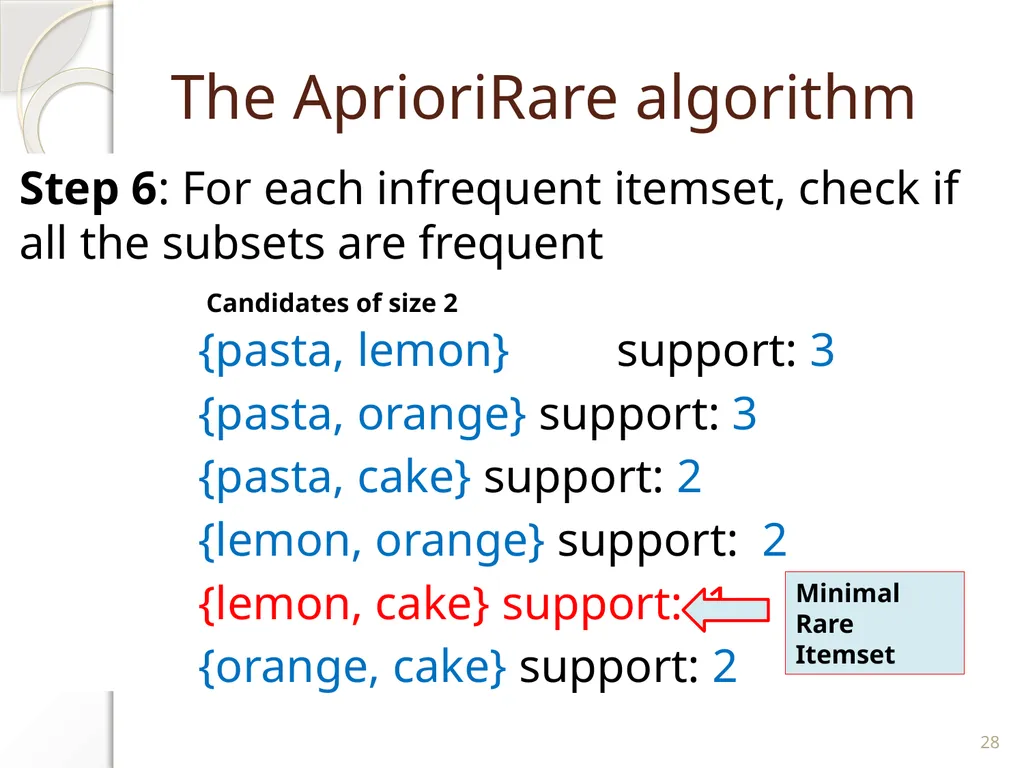
slide28. The AprioriRare algorithm Step 6: For each infrequent itemset, check if all the subsets are frequent 28 {pasta, lemon} support: 3
{pasta, orange} support: 3
{pasta, cake} support: 2
{lemon, orange} support: 2
{lemon, cake} support: 1
{orange, cake} support: 2 Candidates of size 2 Minimal Rare Itemset<br>
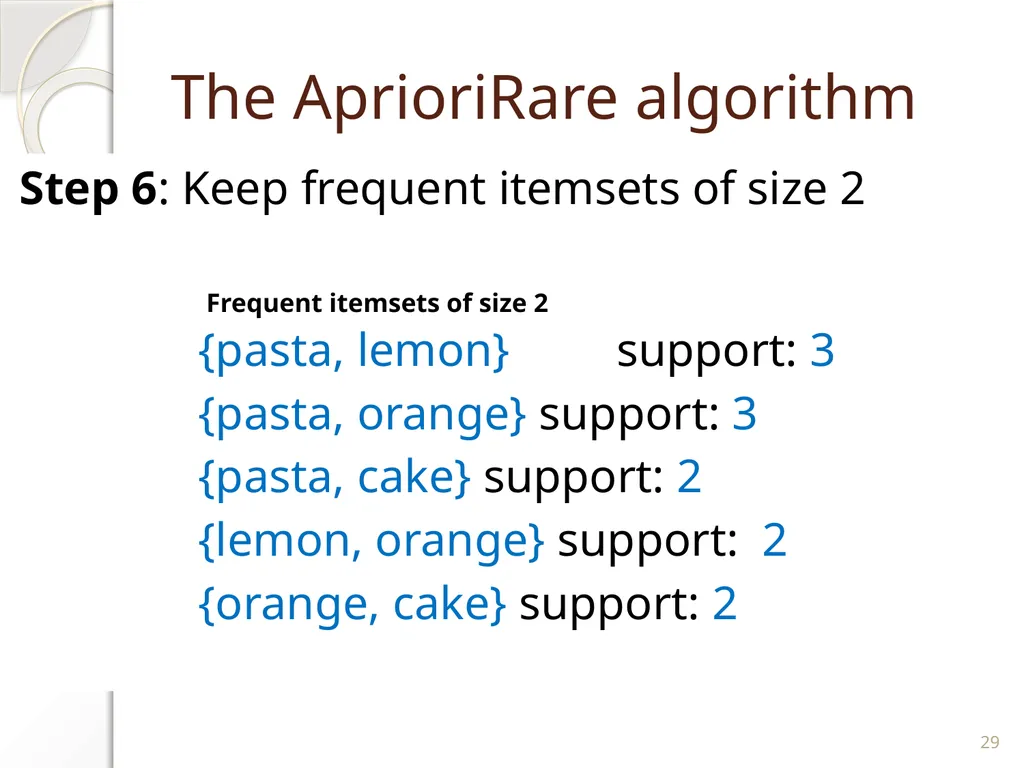
slide29. The AprioriRare algorithm Step 6: Keep frequent itemsets of size 2 29 {pasta, lemon} support: 3
{pasta, orange} support: 3
{pasta, cake} support: 2
{lemon, orange} support: 2
{orange, cake} support: 2 Frequent itemsets of size 2<br>
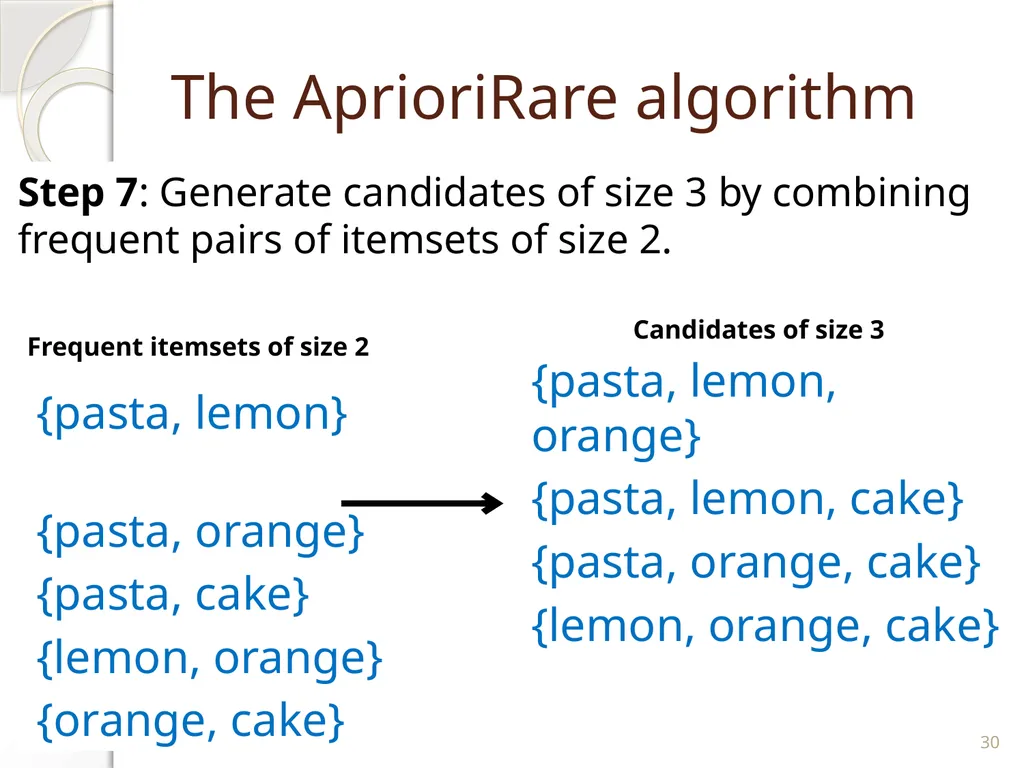
slide30. The AprioriRare algorithm Step 7: Generate candidates of size 3 by combining frequent pairs of itemsets of size 2. 30 {pasta, lemon}
{pasta, orange}
{pasta, cake}
{lemon, orange}
{orange, cake} Frequent itemsets of size 2 Candidates of size 3 {pasta, lemon, orange}
{pasta, lemon, cake}
{pasta, orange, cake}
{lemon, orange, cake}<br>
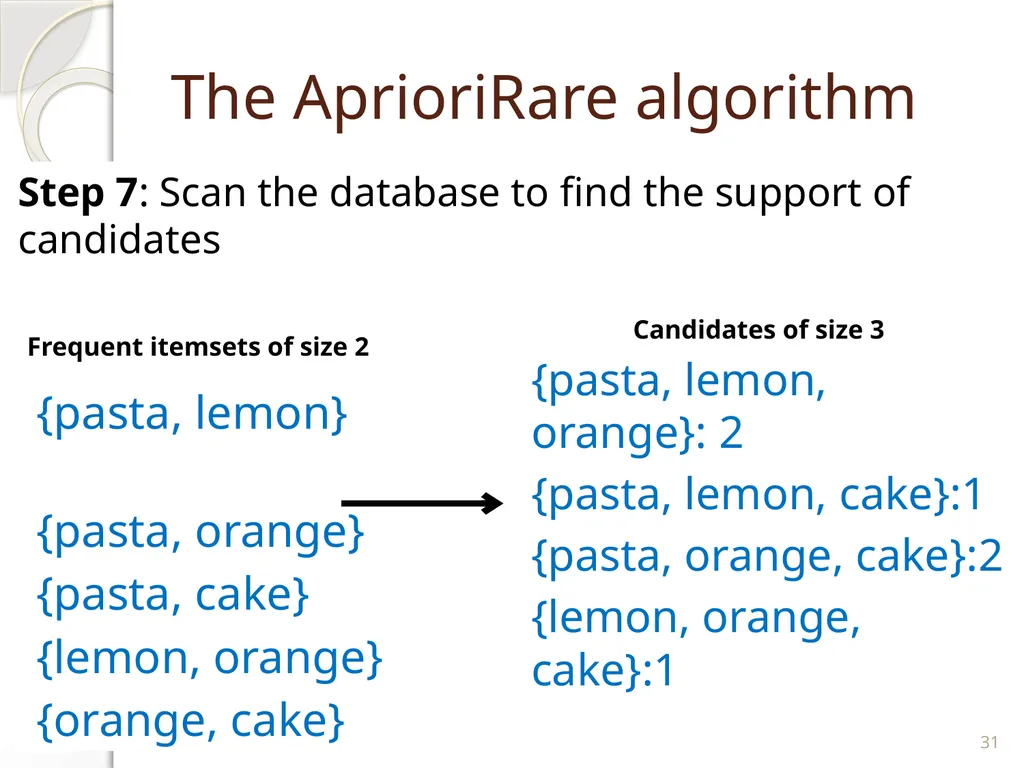
slide31. The AprioriRare algorithm Step 7: Scan the database to find the support of candidates 31 {pasta, lemon}
{pasta, orange}
{pasta, cake}
{lemon, orange}
{orange, cake} Frequent itemsets of size 2 Candidates of size 3 {pasta, lemon, orange}: 2
{pasta, lemon, cake}:1
{pasta, orange, cake}:2
{lemon, orange, cake}:1<br>
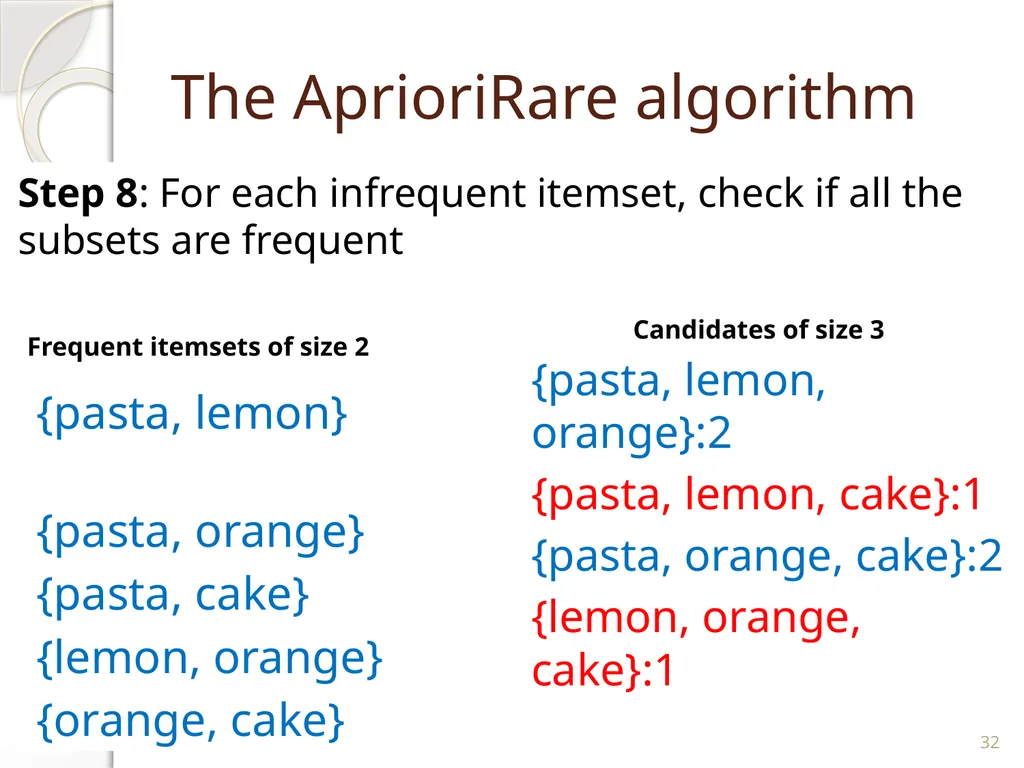
slide32. The AprioriRare algorithm Step 8: For each infrequent itemset, check if all the subsets are frequent 32 {pasta, lemon}
{pasta, orange}
{pasta, cake}
{lemon, orange}
{orange, cake} Frequent itemsets of size 2 Candidates of size 3 {pasta, lemon, orange}:2
{pasta, lemon, cake}:1
{pasta, orange, cake}:2
{lemon, orange, cake}:1<br>
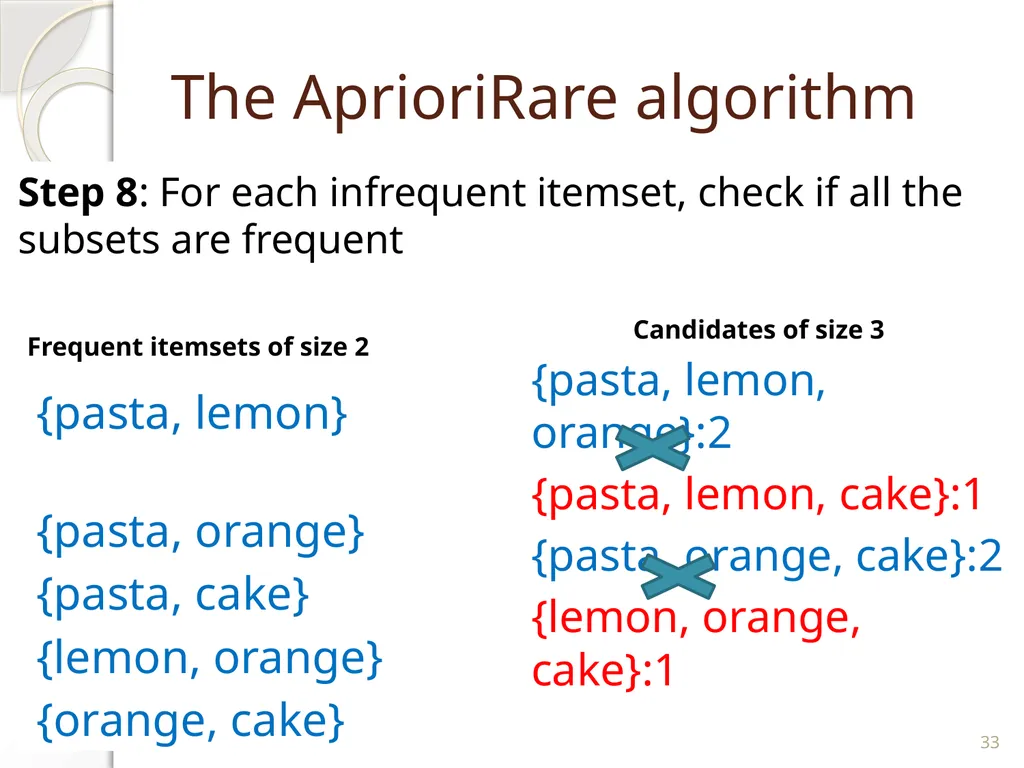
slide33. The AprioriRare algorithm Step 8: For each infrequent itemset, check if all the subsets are frequent 33 {pasta, lemon}
{pasta, orange}
{pasta, cake}
{lemon, orange}
{orange, cake} Frequent itemsets of size 2 Candidates of size 3 {pasta, lemon, orange}:2
{pasta, lemon, cake}:1
{pasta, orange, cake}:2
{lemon, orange, cake}:1<br>
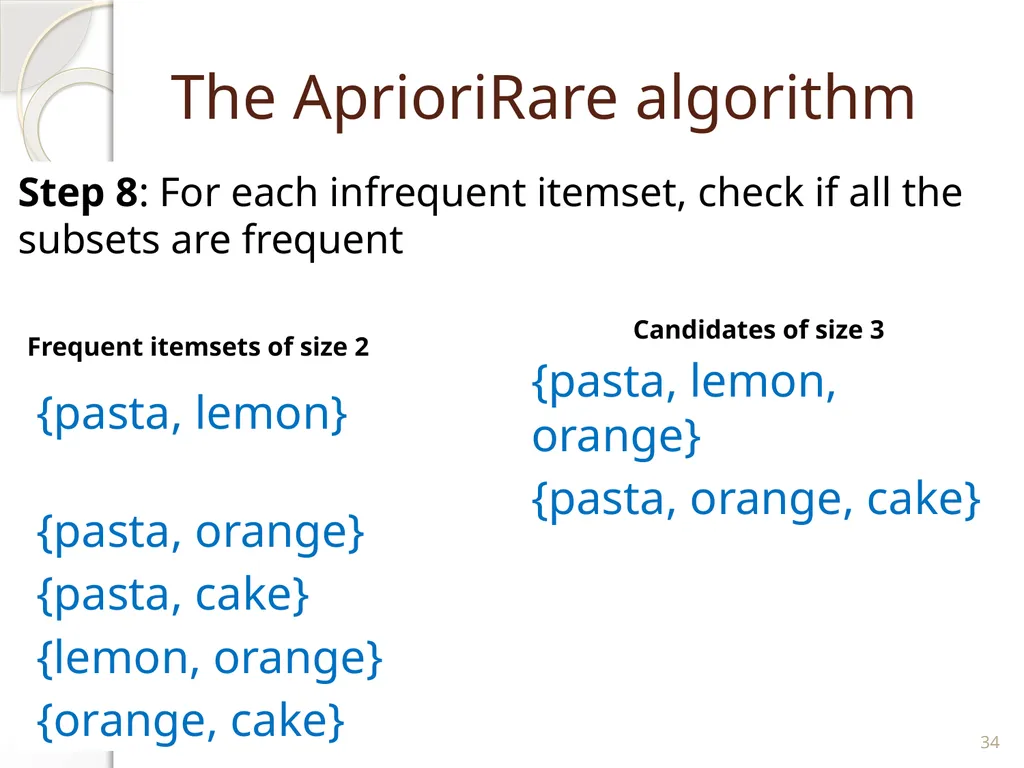
slide34. The AprioriRare algorithm Step 8: For each infrequent itemset, check if all the subsets are frequent 34 {pasta, lemon}
{pasta, orange}
{pasta, cake}
{lemon, orange}
{orange, cake} Frequent itemsets of size 2 Candidates of size 3 {pasta, lemon, orange}
{pasta, orange, cake}<br>
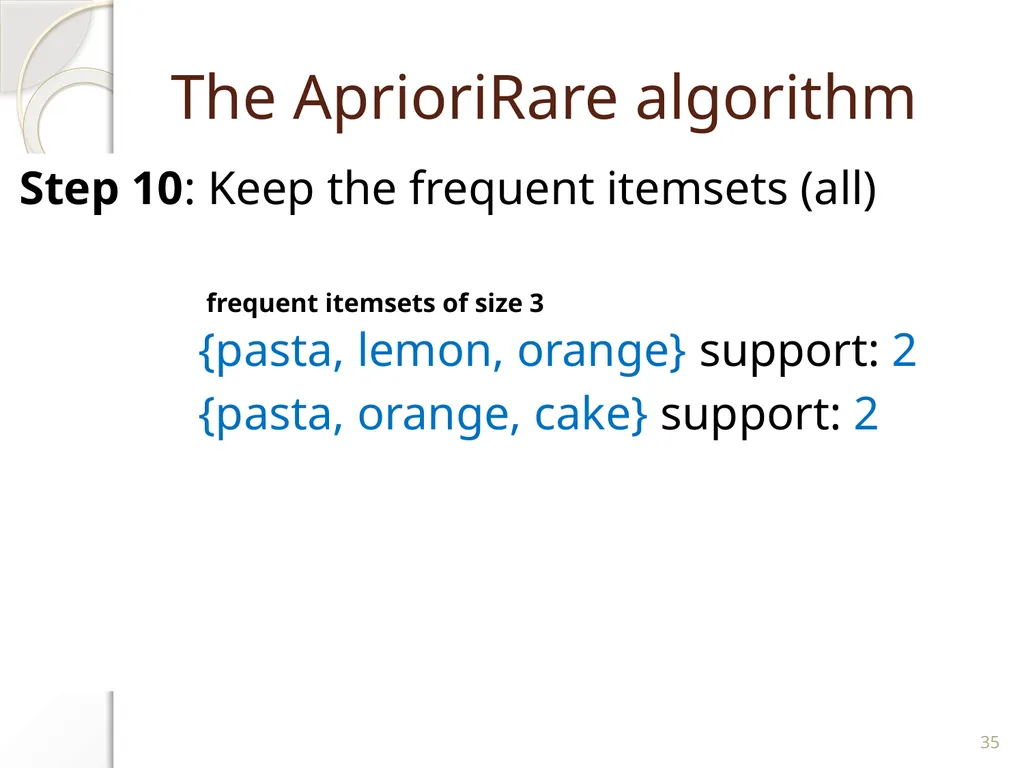
slide35. The AprioriRare algorithm Step 10: Keep the frequent itemsets (all) 35 {pasta, lemon, orange} support: 2
{pasta, orange, cake} support: 2 frequent itemsets of size 3<br>
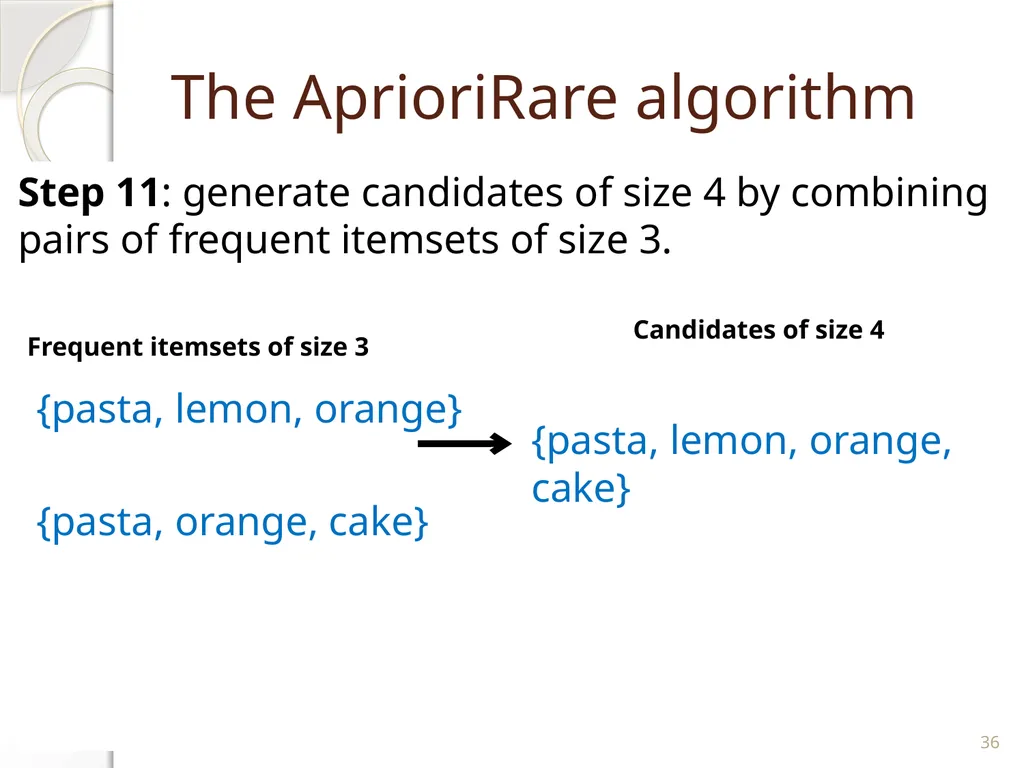
slide36. The AprioriRare algorithm Step 11: generate candidates of size 4 by combining pairs of frequent itemsets of size 3. 36 {pasta, lemon, orange}
{pasta, orange, cake} Frequent itemsets of size 3 Candidates of size 4 {pasta, lemon, orange, cake}<br>
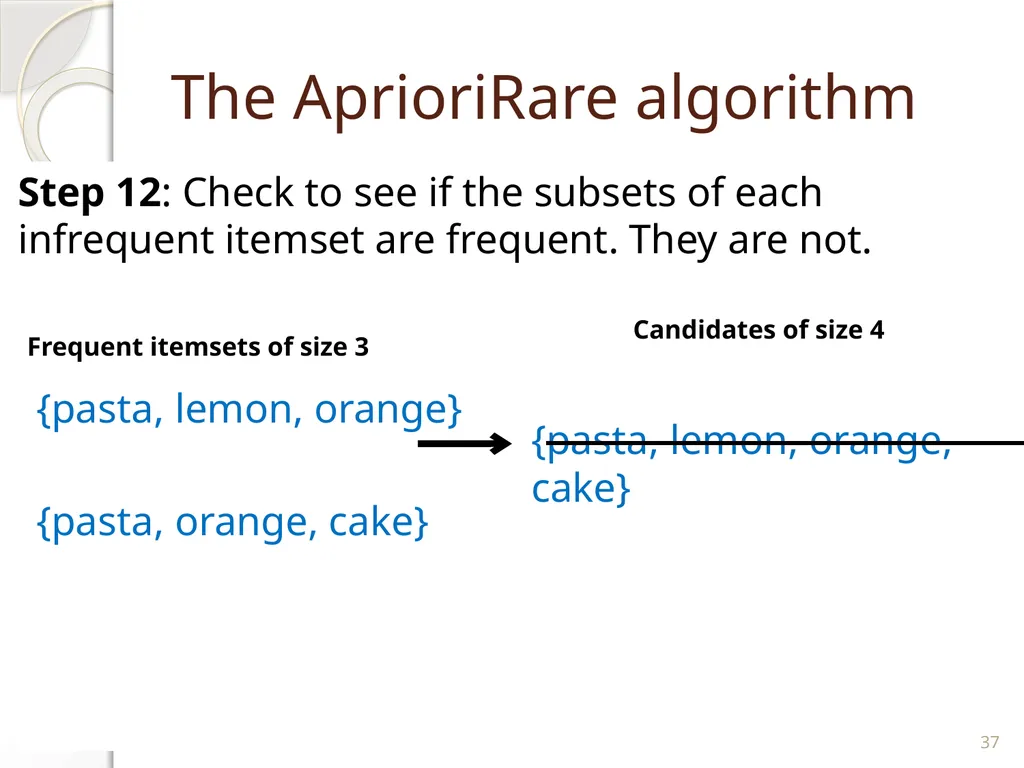
slide37. The AprioriRare algorithm Step 12: Check to see if the subsets of each infrequent itemset are frequent. They are not. 37 {pasta, lemon, orange}
{pasta, orange, cake} Frequent itemsets of size 3 Candidates of size 4 {pasta, lemon, orange, cake}<br>
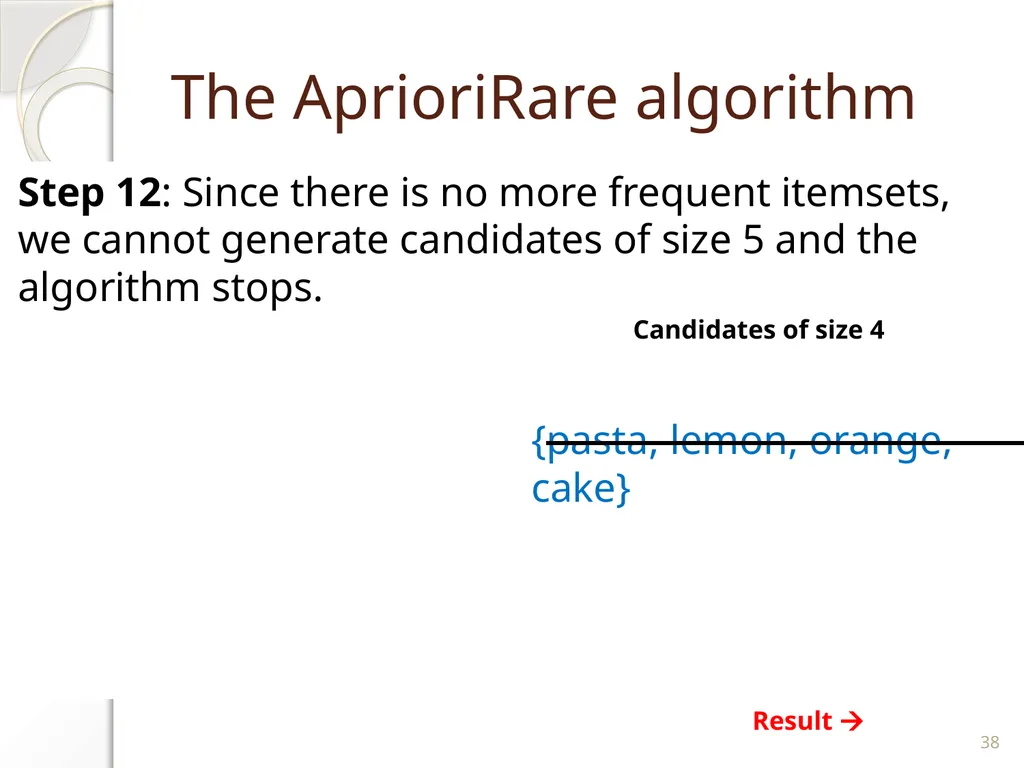
slide38. The AprioriRare algorithm Step 12: Since there is no more frequent itemsets, we cannot generate candidates of size 5 and the algorithm stops. 38 Candidates of size 4 {pasta, lemon, orange, cake} Result <br>
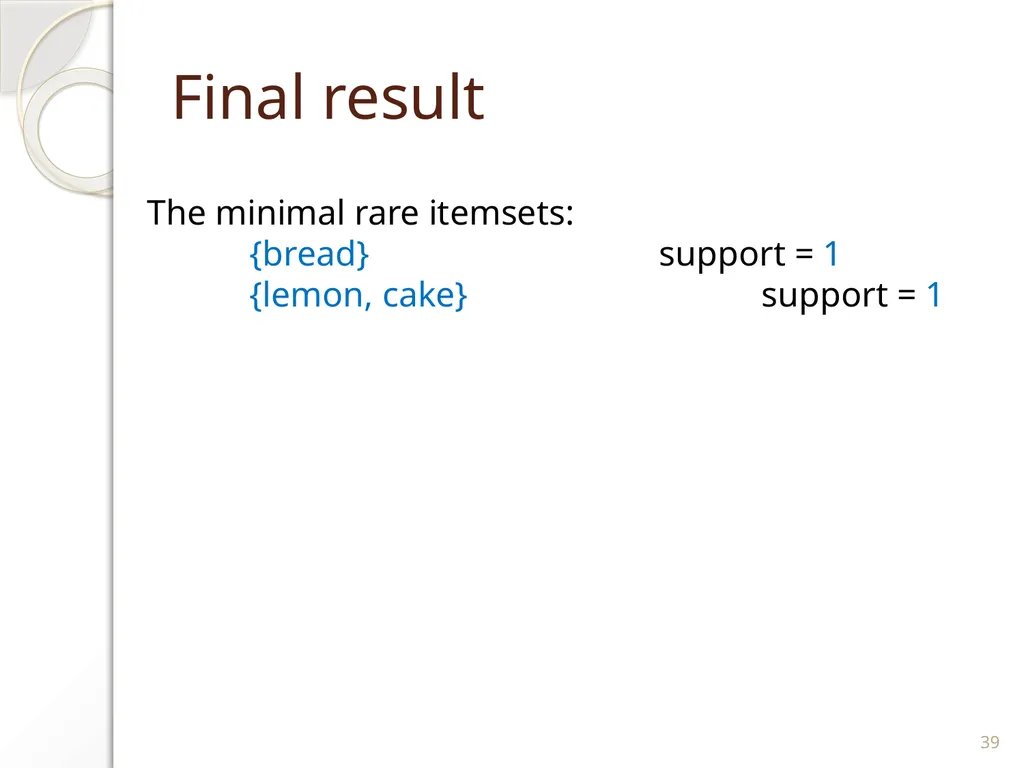
slide39. Final result 39 The minimal rare itemsets:
{bread} support = 1 {lemon, cake} support = 1<br>
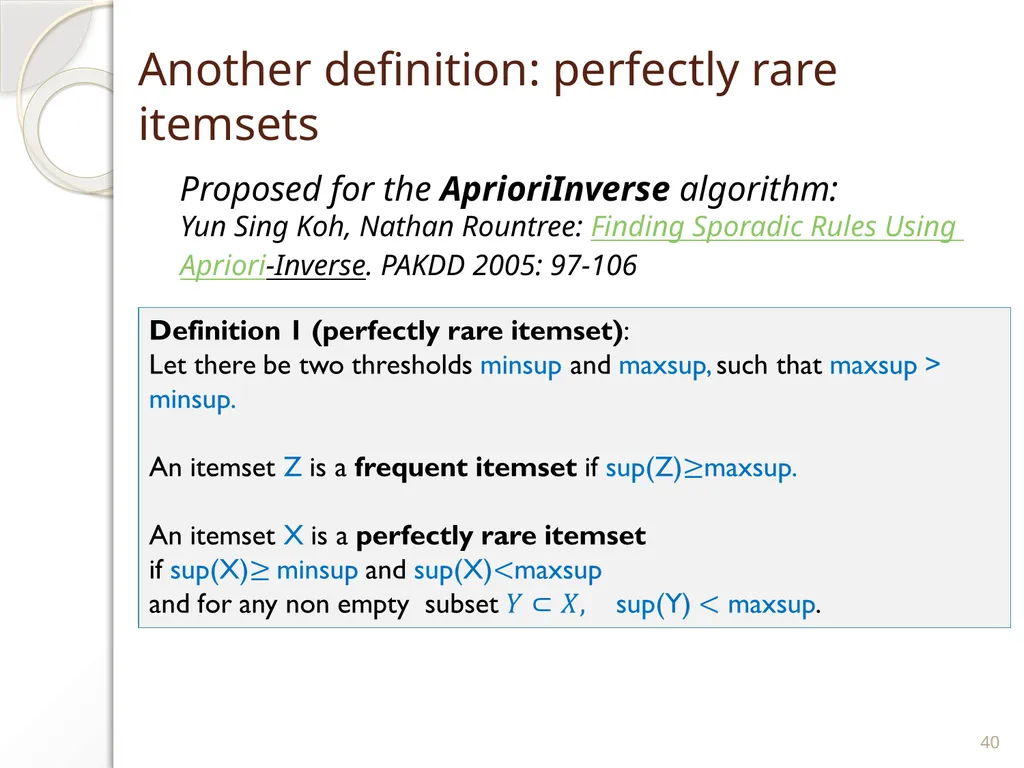
slide40. Another definition: perfectly rare itemsets Proposed for the AprioriInverse algorithm: Yun Sing Koh, Nathan Rountree: Finding Sporadic Rules Using Apriori-Inverse. PAKDD 2005: 97-106 40<br>
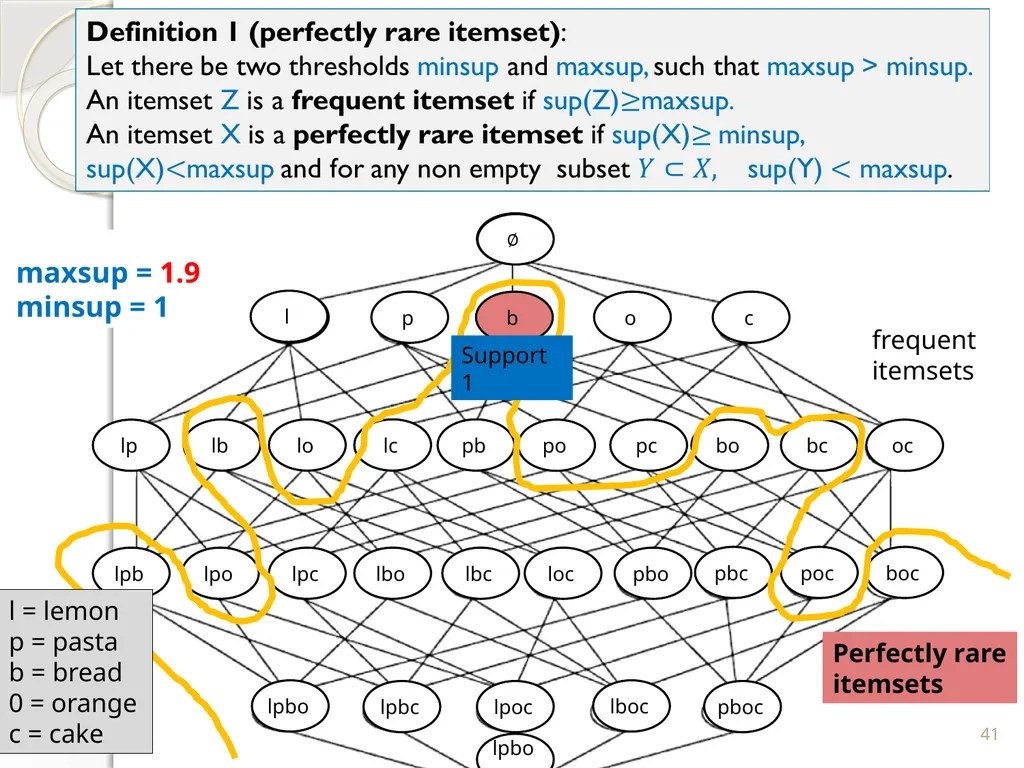
slide41. 41 lpboc l p b o c lp lb lo lc pb po pc bo bc oc lpb lpo lpc lbo lbc loc pbo pbc poc boc lpbo lpbc lpoc lboc pboc frequent itemsets Perfectly rare
itemsets l = lemon
p = pasta
b = bread
0 = orange
c = cake maxsup = 1.9
minsup = 1 l Support 1<br>
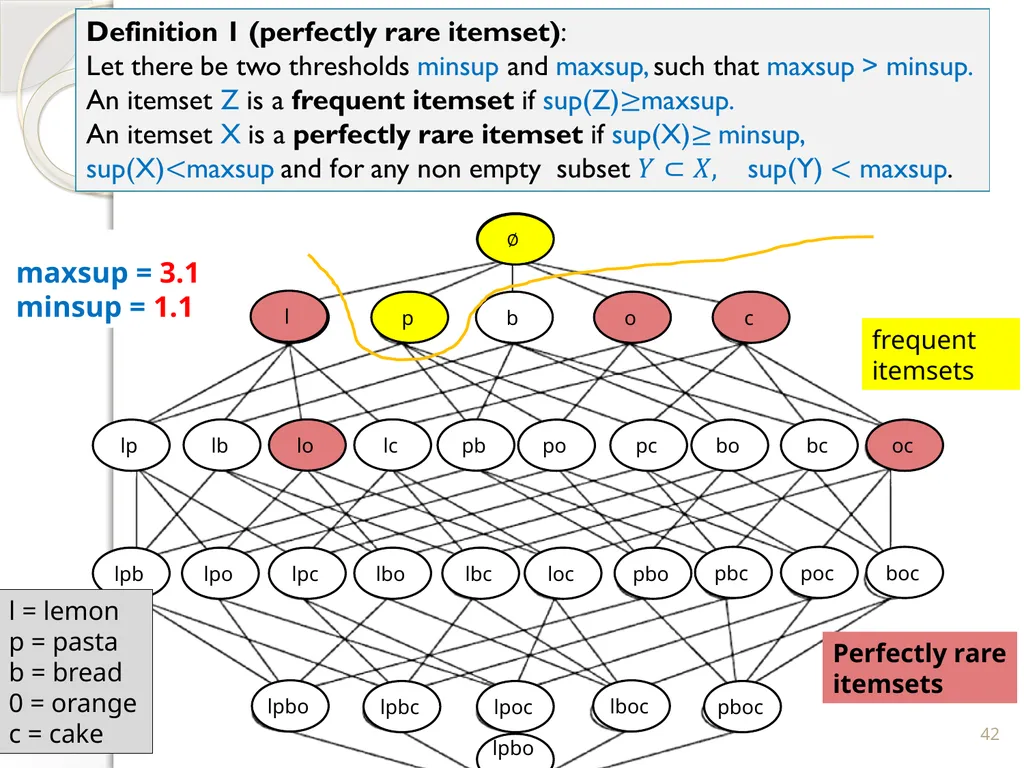
slide42. 42 lpboc l p b o c lp lb lo lc pb po pc bo bc oc lpb lpo lpc lbo lbc loc pbo pbc poc boc lpbo lpbc lpoc lboc pboc frequent itemsets Perfectly rare
itemsets l = lemon
p = pasta
b = bread
0 = orange
c = cake maxsup = 3.1
minsup = 1.1 l<br>
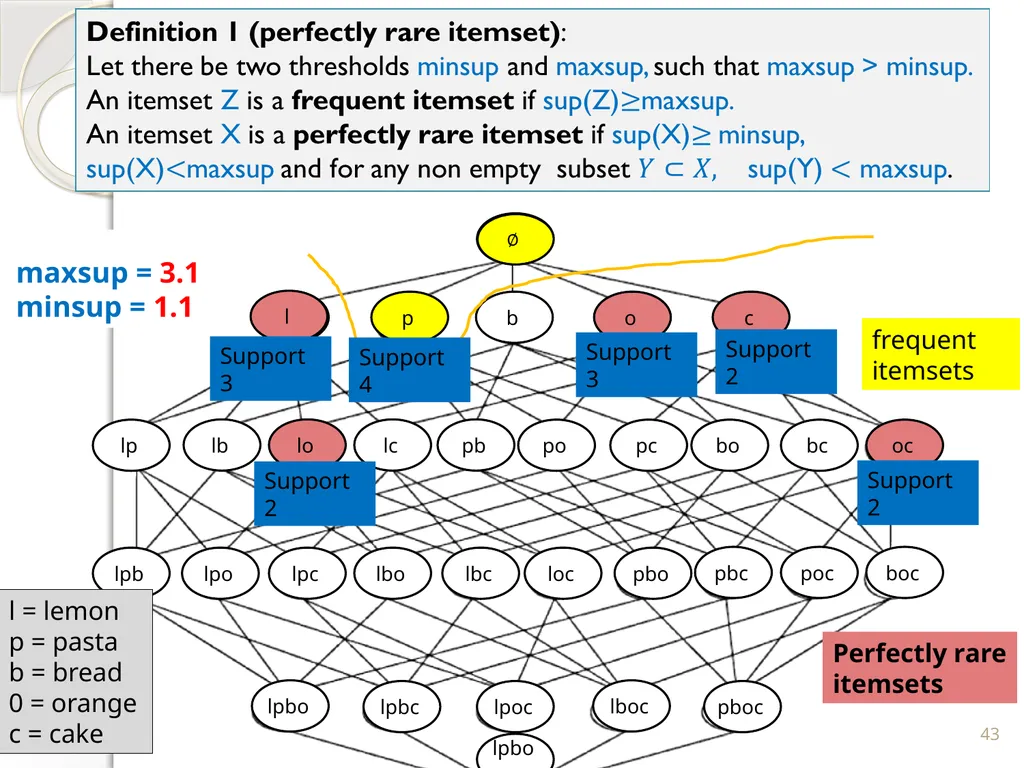
slide43. 43 lpboc l p b o c lp lb lo lc pb po pc bo bc oc lpb lpo lpc lbo lbc loc pbo pbc poc boc lpbo lpbc lpoc lboc pboc frequent itemsets Perfectly rare
itemsets l = lemon
p = pasta
b = bread
0 = orange
c = cake maxsup = 3.1
minsup = 1.1 l Support 3 Support 3 Support 2 Support 2 Support 2 Support 4<br>
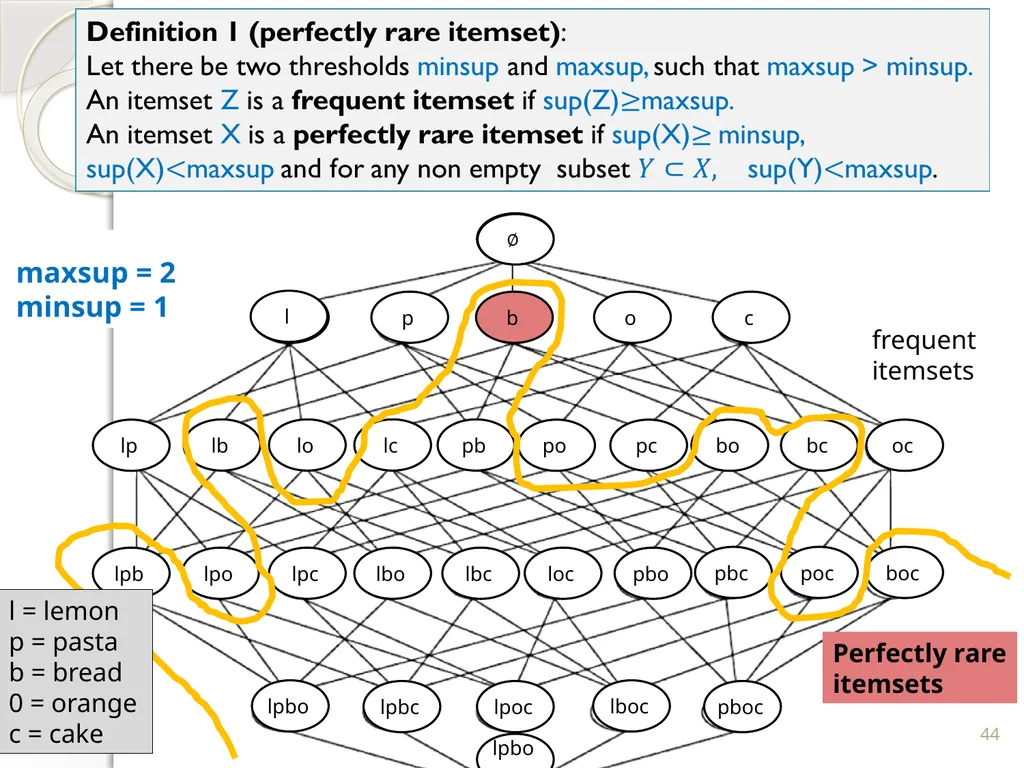
slide44. 44 lpboc l p b o c lp lb lo lc pb po pc bo bc oc lpb lpo lpc lbo lbc loc pbo pbc poc boc lpbo lpbc lpoc lboc pboc frequent itemsets Perfectly rare
itemsets l = lemon
p = pasta
b = bread
0 = orange
c = cake maxsup = 2
minsup = 1 l<br>
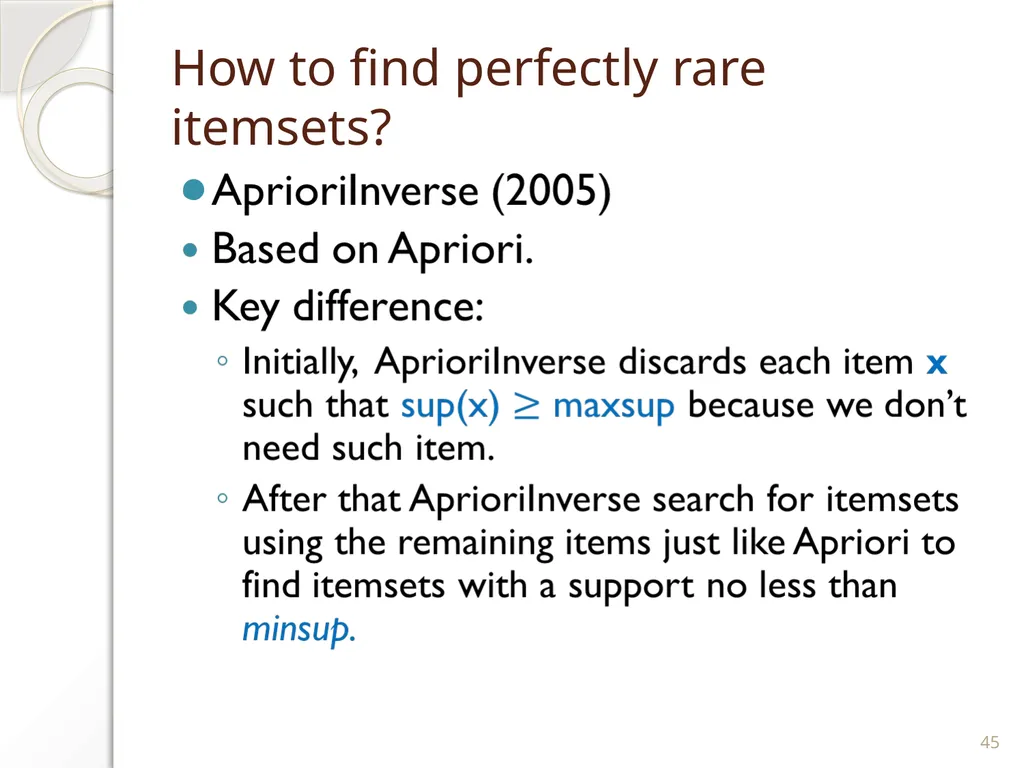
slide45. How to find perfectly rare itemsets? 45<br>
slide46. Conclusion This video has presented:
The problem of rare itemset mining
Three definitions of rare itemsets:
Infrequent itemsets
Minimal rare itemsets
Perfectly rare itemsets
Two algorithms:
AprioriRare
AprioriInverse
To find rare itemsets that are more interesting, we can also combine the concept of rare itemsets with that of correlated itemset (e.g. the CORI algorithm). 46<br>
slide2. Introduction Pattern mining: using algorithms to discover interesting patterns in data.
One of the most important pattern mining task is frequent itemset mining.
It consists of finding sets of values (items) that appear frequently in the data (frequent itemsets).
Today, I will talk about the opposite problem of discovering rare itemsets. 2<br>
slide3. Frequent itemset mINING (brief review) 3<br>
slide4. Frequent itemset mining (频繁项集挖掘) 4 A transaction database: For minsup = 2, the frequent itemsets are:
{lemon}, {pasta}, {orange}, {cake}, {lemon, pasta}, {lemon, orange}, {pasta, orange}, {pasta, cake}, {orange, cake}, {lemon, pasta, orange}<br>
slide5. minsup =2 5 lpboc l p b o c lp lb lo lc pb po pc bo bc oc lpb lpo lpc lbo lbc loc pbo pbc poc boc lpbo lpbc lpoc lboc pboc frequent itemsets Infrequent
itemsets l = lemon
p = pasta
b = bread
0 = orange
c = cake<br>
slide6. 6 Example:
Consider {bread, lemon}.
If we know that {bread} is infrequent, then we can infer that {bread, lemon} is also infrequent.<br>
slide7. This property is useful to reduce the search space. Example: minsup =2 7 lpboc l p b o c lp lb lo lc pb po pc bo bc oc lpb lpo lpc lbo lbc loc pbo pbc poc boc lpbo lpbc lpoc lboc pboc If « bread » is infrequent<br>
slide8. minsup =2 8 lpboc l p b o c lp lb lo lc pb po pc bo bc oc lpb lpo lpc lbo lbc loc pbo pbc poc boc lpbo lpbc lpoc lboc pboc If « bread » is infrequent, all its supersets are infrequent. This property is useful to reduce the search space. Example:<br>
slide9. Limitations of frequent itemset mining There is an underlying hypothesis that something frequent must be important.
But in practice, many frequent itemsets are unimportant.
Example: many persons purchase bread and milk but it is not something surprising or profitable.
Too many frequent patterns may make it hard to find rarer patterns that are interesting. 9<br>
slide10. Rare pattern mINING 10<br>
slide11. Finding rare patterns We first need to define what is a rare pattern.
There are different definitions.
I will give an overview. 11<br>
slide12. lpboc l p b o c lp lb lo lc pb po pc bo bc oc lpb lpo lpc lbo lbc loc pbo pbc poc boc lpbo lpbc lpoc lboc pboc frequent itemsets Infrequent
itemsets l = lemon
p = pasta
b = bread
0 = orange
c = cake 12 We could define rare itemsets as infrequent itemsets minsup =2<br>
slide13. lpboc l p b o c lp lb lo lc pb po pc bo bc oc lpb lpo lpc lbo lbc loc pbo pbc poc boc lpbo lpbc lpoc lboc pboc frequent itemsets Infrequent
itemsets l = lemon
p = pasta
b = bread
0 = orange
c = cake 13 We could define rare itemsets as infrequent itemsets minsup =2 Problem: Too many itemsets. Some infrequent itemsets do not even exist (support = 0)<br>
slide14. Another definition: minimal rare itemsets Proposed for the AprioriRare algorithm: Laszlo Szathmary, Amedeo Napoli, Petko Valtchev: Towards Rare Itemset Mining. ICTAI (1) 2007: 305-312 14<br>
slide15. Minimal rare itemsets minsup =2 lpboc l p b o c lp lb lo lc pb po pc bo bc oc lpb lpo lpc lbo lbc loc pbo pbc poc boc lpbo lpbc lpoc lboc pboc frequent itemsets Minimal rare
itemsets l = lemon
p = pasta
b = bread
0 = orange
c = cake 15 minsup =2<br>
slide16. Minimal rare itemsets minsup =2 lpboc l p b o c lp lb lo lc pb po pc bo bc oc lpb lpo lpc lbo lbc loc pbo pbc poc boc lpbo lpbc lpoc lboc pboc frequent itemsets Minimal rare
itemsets l = lemon
p = pasta
b = bread
0 = orange
c = cake 16 minsup =2 Support 1 Support 1<br>
slide17. Minimal rare itemsets minsup =2 lpboc l p b o c lp lb lo lc pb po pc bo bc oc lpb lpo lpc lbo lbc loc pbo pbc poc boc lpbo lpbc lpoc lboc pboc frequent itemsets Minimal rare
itemsets l = lemon
p = pasta
b = bread
0 = orange
c = cake 17 minsup =2 Support 1 Support 1 Interesting, because not too many itemsets…<br>
slide18. It is not easy!
Generally, frequent itemset mining algorithms start from single items and combine them to find larger itemsets.
As itemsets become larger, the support can decrease.
Thus, to search for rare itemsets, we must « pass through » the frequent itemsets to reach the rare itemsets. How? How can we find the minimal rare itemsets? 18<br>
slide19. The AprioriRare algorithm (2007) It is based on Apriori
As Apriori, the itemsets are generated by levels:
Itemsets of size 1 (one item)
Itemsets of size 2 (two items)
Itemsets of size 3 (three items)
…
Two differences:
If AprioriRare finds an itemset of size k that is infrequent, AprioriRare checks if its subsets are frequent. If yes, it is a minimal rare itemset.
AprioriRare do not use the infrequent itemsets to generate larger itemsets. 19<br>
slide20. The AprioriRare algorithm I will now explain how the AprioriRare algorithm works
Input:
minsup
a transactional database
Output:
all the minimal rare itemsets
Consider minsup =2. 20<br>
slide21. The AprioriRare algorithm Step 1: Scan the database to calculate the support of all itemsets of size 1.
e.g. {pasta} support = 4 {lemon} support = 3
{bread} support = 1 {orange} support = 3 {cake} support = 2 21<br>
slide22. The AprioriRare algorithm Step 2: Check all infrequent itemsets. If all subsets are frequent, they are are minimal rare itemsets.
e.g. {pasta} support = 4 {lemon} support = 3
{bread} support = 1 {orange} support = 3 {cake} support = 2 22<br>
slide23. The AprioriRare algorithm Step 2: Check all infrequent itemsets. If all subsets are frequent, they are are minimal rare itemsets.
e.g. {pasta} support = 4 {lemon} support = 3
{bread} support = 1 {orange} support = 3 {cake} support = 2 23 Minimal Rare Itemset<br>
slide24. The AprioriRare algorithm Step 2: Keep frequent itemsets.
e.g. {pasta} support = 4 {lemon} support = 3 {orange} support = 3 {cake} support = 2 24<br>
slide25. The AprioriRare algorithm Step 3: Generate candidates of size 2 by combining pairs of frequent itemsets of size 1. 25 {pasta}
{lemon}
{orange}
{cake} {pasta, lemon}
{pasta, orange}
{pasta, cake}
{lemon, orange}
{lemon, cake}
{orange, cake} Frequent items Candidates of size 2<br>
slide26. The AprioriRare algorithm Step 5: Scan the database to calculate the support of remaining candidate itemsets of size 2. 26 {pasta, lemon} support: 3
{pasta, orange} support: 3
{pasta, cake} support: 2
{lemon, orange} support: 2
{lemon, cake} support: 1
{orange, cake} support: 2 Candidates of size 2<br>
slide27. The AprioriRare algorithm Step 6: For each infrequent itemset, check if all the subsets are frequent 27 {pasta, lemon} support: 3
{pasta, orange} support: 3
{pasta, cake} support: 2
{lemon, orange} support: 2
{lemon, cake} support: 1
{orange, cake} support: 2 Candidates of size 2<br>
slide28. The AprioriRare algorithm Step 6: For each infrequent itemset, check if all the subsets are frequent 28 {pasta, lemon} support: 3
{pasta, orange} support: 3
{pasta, cake} support: 2
{lemon, orange} support: 2
{lemon, cake} support: 1
{orange, cake} support: 2 Candidates of size 2 Minimal Rare Itemset<br>
slide29. The AprioriRare algorithm Step 6: Keep frequent itemsets of size 2 29 {pasta, lemon} support: 3
{pasta, orange} support: 3
{pasta, cake} support: 2
{lemon, orange} support: 2
{orange, cake} support: 2 Frequent itemsets of size 2<br>
slide30. The AprioriRare algorithm Step 7: Generate candidates of size 3 by combining frequent pairs of itemsets of size 2. 30 {pasta, lemon}
{pasta, orange}
{pasta, cake}
{lemon, orange}
{orange, cake} Frequent itemsets of size 2 Candidates of size 3 {pasta, lemon, orange}
{pasta, lemon, cake}
{pasta, orange, cake}
{lemon, orange, cake}<br>
slide31. The AprioriRare algorithm Step 7: Scan the database to find the support of candidates 31 {pasta, lemon}
{pasta, orange}
{pasta, cake}
{lemon, orange}
{orange, cake} Frequent itemsets of size 2 Candidates of size 3 {pasta, lemon, orange}: 2
{pasta, lemon, cake}:1
{pasta, orange, cake}:2
{lemon, orange, cake}:1<br>
slide32. The AprioriRare algorithm Step 8: For each infrequent itemset, check if all the subsets are frequent 32 {pasta, lemon}
{pasta, orange}
{pasta, cake}
{lemon, orange}
{orange, cake} Frequent itemsets of size 2 Candidates of size 3 {pasta, lemon, orange}:2
{pasta, lemon, cake}:1
{pasta, orange, cake}:2
{lemon, orange, cake}:1<br>
slide33. The AprioriRare algorithm Step 8: For each infrequent itemset, check if all the subsets are frequent 33 {pasta, lemon}
{pasta, orange}
{pasta, cake}
{lemon, orange}
{orange, cake} Frequent itemsets of size 2 Candidates of size 3 {pasta, lemon, orange}:2
{pasta, lemon, cake}:1
{pasta, orange, cake}:2
{lemon, orange, cake}:1<br>
slide34. The AprioriRare algorithm Step 8: For each infrequent itemset, check if all the subsets are frequent 34 {pasta, lemon}
{pasta, orange}
{pasta, cake}
{lemon, orange}
{orange, cake} Frequent itemsets of size 2 Candidates of size 3 {pasta, lemon, orange}
{pasta, orange, cake}<br>
slide35. The AprioriRare algorithm Step 10: Keep the frequent itemsets (all) 35 {pasta, lemon, orange} support: 2
{pasta, orange, cake} support: 2 frequent itemsets of size 3<br>
slide36. The AprioriRare algorithm Step 11: generate candidates of size 4 by combining pairs of frequent itemsets of size 3. 36 {pasta, lemon, orange}
{pasta, orange, cake} Frequent itemsets of size 3 Candidates of size 4 {pasta, lemon, orange, cake}<br>
slide37. The AprioriRare algorithm Step 12: Check to see if the subsets of each infrequent itemset are frequent. They are not. 37 {pasta, lemon, orange}
{pasta, orange, cake} Frequent itemsets of size 3 Candidates of size 4 {pasta, lemon, orange, cake}<br>
slide38. The AprioriRare algorithm Step 12: Since there is no more frequent itemsets, we cannot generate candidates of size 5 and the algorithm stops. 38 Candidates of size 4 {pasta, lemon, orange, cake} Result <br>
slide39. Final result 39 The minimal rare itemsets:
{bread} support = 1 {lemon, cake} support = 1<br>
slide40. Another definition: perfectly rare itemsets Proposed for the AprioriInverse algorithm: Yun Sing Koh, Nathan Rountree: Finding Sporadic Rules Using Apriori-Inverse. PAKDD 2005: 97-106 40<br>
slide41. 41 lpboc l p b o c lp lb lo lc pb po pc bo bc oc lpb lpo lpc lbo lbc loc pbo pbc poc boc lpbo lpbc lpoc lboc pboc frequent itemsets Perfectly rare
itemsets l = lemon
p = pasta
b = bread
0 = orange
c = cake maxsup = 1.9
minsup = 1 l Support 1<br>
slide42. 42 lpboc l p b o c lp lb lo lc pb po pc bo bc oc lpb lpo lpc lbo lbc loc pbo pbc poc boc lpbo lpbc lpoc lboc pboc frequent itemsets Perfectly rare
itemsets l = lemon
p = pasta
b = bread
0 = orange
c = cake maxsup = 3.1
minsup = 1.1 l<br>
slide43. 43 lpboc l p b o c lp lb lo lc pb po pc bo bc oc lpb lpo lpc lbo lbc loc pbo pbc poc boc lpbo lpbc lpoc lboc pboc frequent itemsets Perfectly rare
itemsets l = lemon
p = pasta
b = bread
0 = orange
c = cake maxsup = 3.1
minsup = 1.1 l Support 3 Support 3 Support 2 Support 2 Support 2 Support 4<br>
slide44. 44 lpboc l p b o c lp lb lo lc pb po pc bo bc oc lpb lpo lpc lbo lbc loc pbo pbc poc boc lpbo lpbc lpoc lboc pboc frequent itemsets Perfectly rare
itemsets l = lemon
p = pasta
b = bread
0 = orange
c = cake maxsup = 2
minsup = 1 l<br>
slide45. How to find perfectly rare itemsets? 45<br>
slide46. Conclusion This video has presented:
The problem of rare itemset mining
Three definitions of rare itemsets:
Infrequent itemsets
Minimal rare itemsets
Perfectly rare itemsets
Two algorithms:
AprioriRare
AprioriInverse
To find rare itemsets that are more interesting, we can also combine the concept of rare itemsets with that of correlated itemset (e.g. the CORI algorithm). 46<br>