
Philosophical Society Members’ 2019 Weekend

Description: Philosophical Society Members 2019 Weekend Lecture Topic: The Hard Problem of Consciousness August 2019 Is this human real or synthetic? Paul Griffiths pdr.griffiths13gmail.com Simone de Beauvoir, The Second Sex, 1949 Let us not forget
Related Topics
Download Presentation
"Philosophical Society Members’ 2019 Weekend" is the property of its rightful owner. Permission is granted to download and print the materials on this website for personal, non-commercial use only, and to display it on your personal computer provided you do not modify the materials and that you retain all copyright notices contained in the materials. By downloading content from our website, you accept the terms of this agreement.
Presentation Transcript
slide1. Philosophical Society Members’ 2019 Weekend Lecture
Topic: The Hard Problem of Consciousness
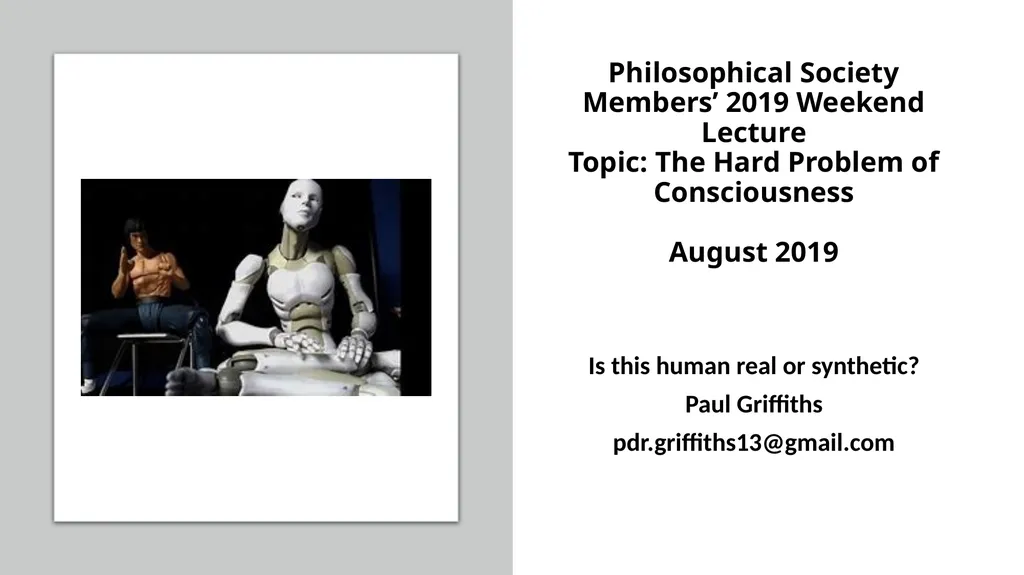
August 2019 Is this human real or synthetic?
Paul Griffiths
pdr.griffiths13@gmail.com<br>
slide2. Simone de Beauvoir, The Second Sex, 1949 “Let us not forget that our lack of imagination always depopulates the future; for us it is only an abstraction; each one of us deplores the absence there of the one that was himself” 2<br>
slide3. The research question Understanding the mind is, without a doubt, one of the most challenging problems that our species faces
How can we learn about human intelligence if we do not have any other benchmark intelligence to compare it with?
AI has been around for over four decades. However, in recent years there have been new developments in the form of machine learning
Supervised learning
Reinforced learning
Unsupervised learning
Once AI reaches the singularity point, where it is equal to human intelligence, how will we be able to distinguish a real human from a synthetic one? 3<br>
slide4. My approach to the question Requires a prior response to the question ‘What does it mean to be human?’
Attempt this by addressing the issue of consciousness as a possible definition of what it is to be human and whether consciousness is a demarcation between a real human and a synthetic one. 4<br>
slide5. Reflection on singularity The initial definition was the Turing test
‘Dogs sniff, people tell stories.’ Story telling was a quintessentially human trait and it clearly segregates humans from all other living species.
With the advent of chatbots, augmented reality, sophisticated voice recognition,…that may not be enough.
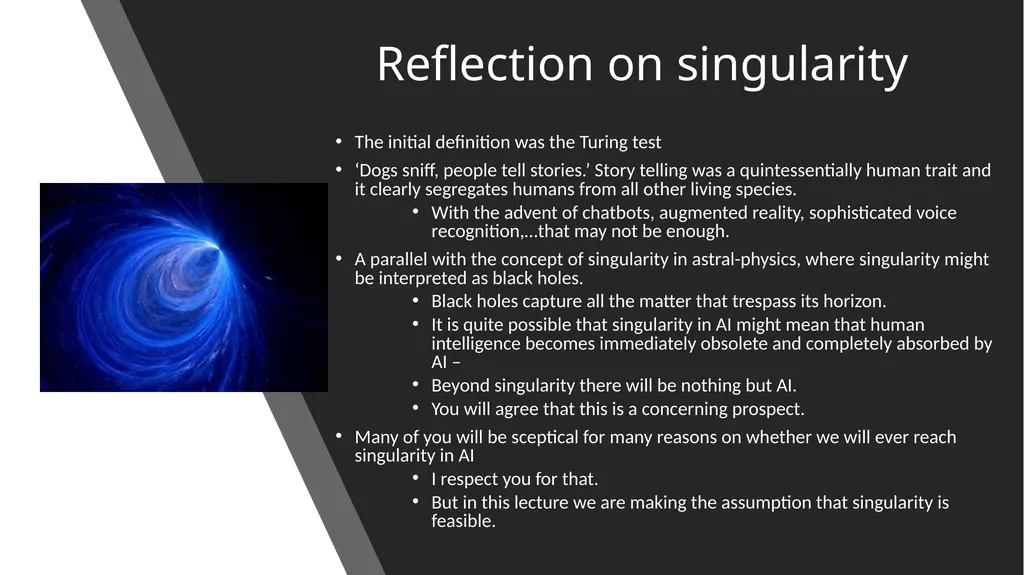
A parallel with the concept of singularity in astral-physics, where singularity might be interpreted as black holes.
Black holes capture all the matter that trespass its horizon.
It is quite possible that singularity in AI might mean that human intelligence becomes immediately obsolete and completely absorbed by AI –
Beyond singularity there will be nothing but AI.
You will agree that this is a concerning prospect.
Many of you will be sceptical for many reasons on whether we will ever reach singularity in AI
I respect you for that.
But in this lecture we are making the assumption that singularity is feasible. 5<br>
slide6. Will AI develop consciousness? There are different views on this, just as there are different views on why humans are conscious and how subjectivity arose in our species in the first place
Metaphysical schools: Consciousness is related to the soul or to the spirit, or derives from God, and is clearly distinguishable from the physical matter that constitutes our bodies
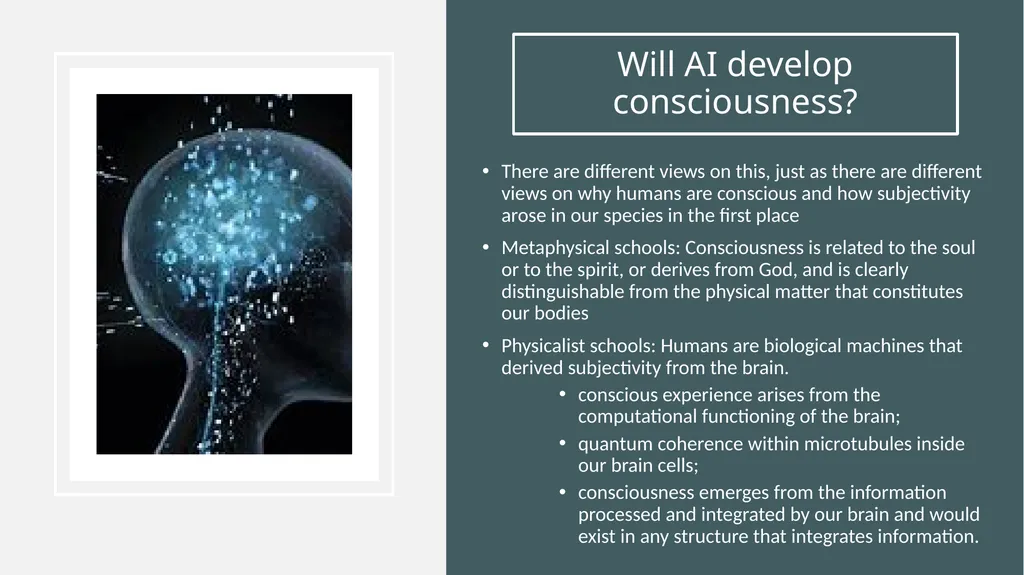
Physicalist schools: Humans are biological machines that derived subjectivity from the brain.
conscious experience arises from the computational functioning of the brain;
quantum coherence within microtubules inside our brain cells;
consciousness emerges from the information processed and integrated by our brain and would exist in any structure that integrates information. 6<br>
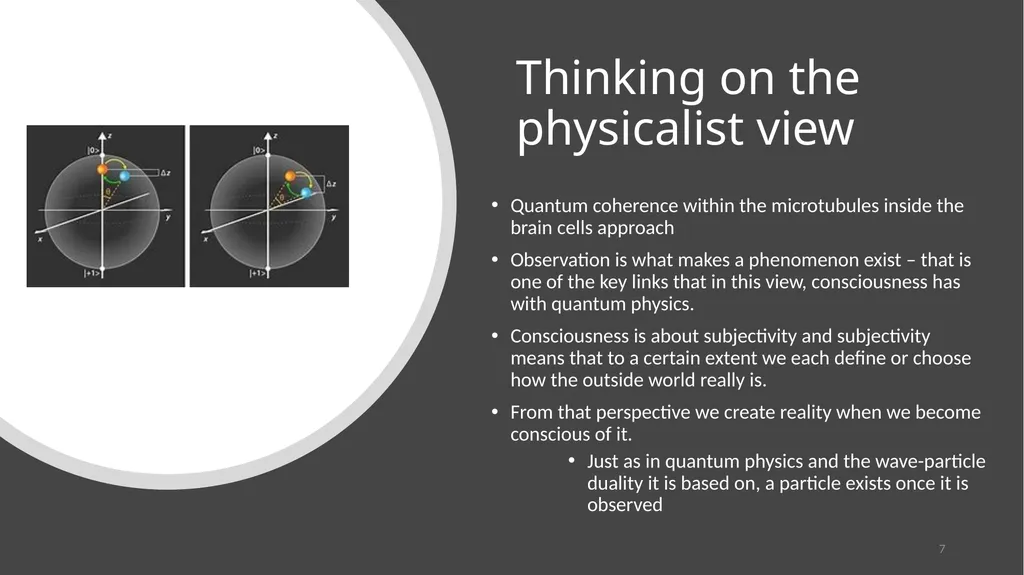
slide7. Thinking on the physicalist view Quantum coherence within the microtubules inside the brain cells approach
Observation is what makes a phenomenon exist – that is one of the key links that in this view, consciousness has with quantum physics.
Consciousness is about subjectivity and subjectivity means that to a certain extent we each define or choose how the outside world really is.
From that perspective we create reality when we become conscious of it.
Just as in quantum physics and the wave-particle duality it is based on, a particle exists once it is observed 7<br>
slide8. Superposition effect and Advanced Waves The electron has many potential positions with different probabilities of occurrence – in quantum physics we call this the superposition effect.
When we observe the electron, we pin down one of its multitude of potentials.
Klein-Gordon equation which is a derivation of Schrodinger’s equation:
𝐸𝛹 = √(𝑝2 +𝑚2𝛹)
p represents momentum and m represents mass
solving it results in a quadratic equation with two solutions, one positive and one negative.
In the physical world this is interpreted as that the positive solution is a wave/particle that moves forward in time (that is from past, to present to future) in line with entropy which defines the behaviour of large bodies in a tendency from order to chaos;
And another wave that moves ‘backwards’ in time at the micro-particle level according to a law that is called syntropy.
In syntropy the Universe tends away from chaos towards order.
The waves in response to syntropy are called Advanced Waves and they absorb and converge to concentrate matter and energy in very small spaces. 8<br>
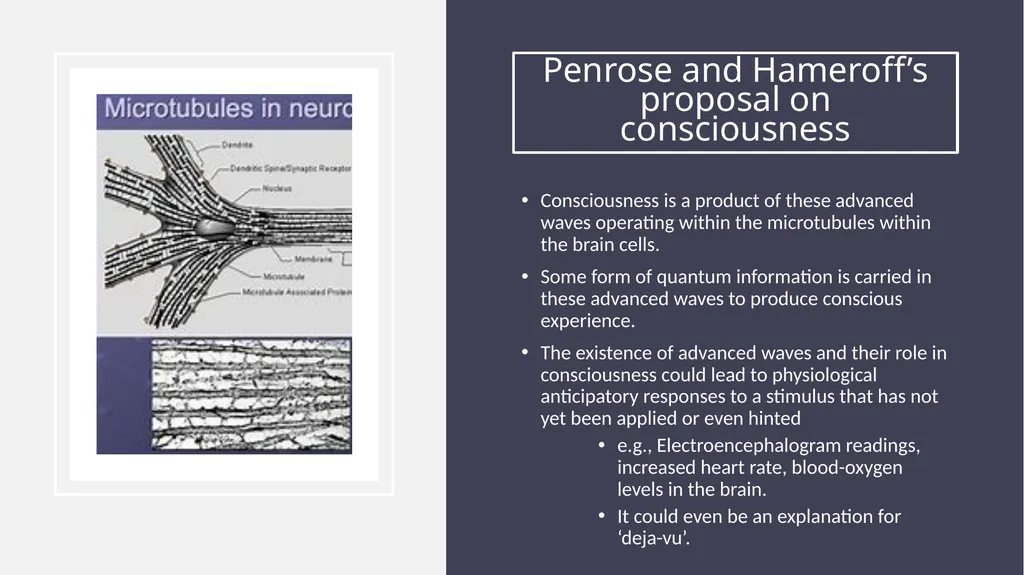
slide9. Penrose and Hameroff’s proposal on consciousness Consciousness is a product of these advanced waves operating within the microtubules within the brain cells.
Some form of quantum information is carried in these advanced waves to produce conscious experience.
The existence of advanced waves and their role in consciousness could lead to physiological anticipatory responses to a stimulus that has not yet been applied or even hinted
e.g., Electroencephalogram readings, increased heart rate, blood-oxygen levels in the brain.
It could even be an explanation for ‘deja-vu’. 9<br>
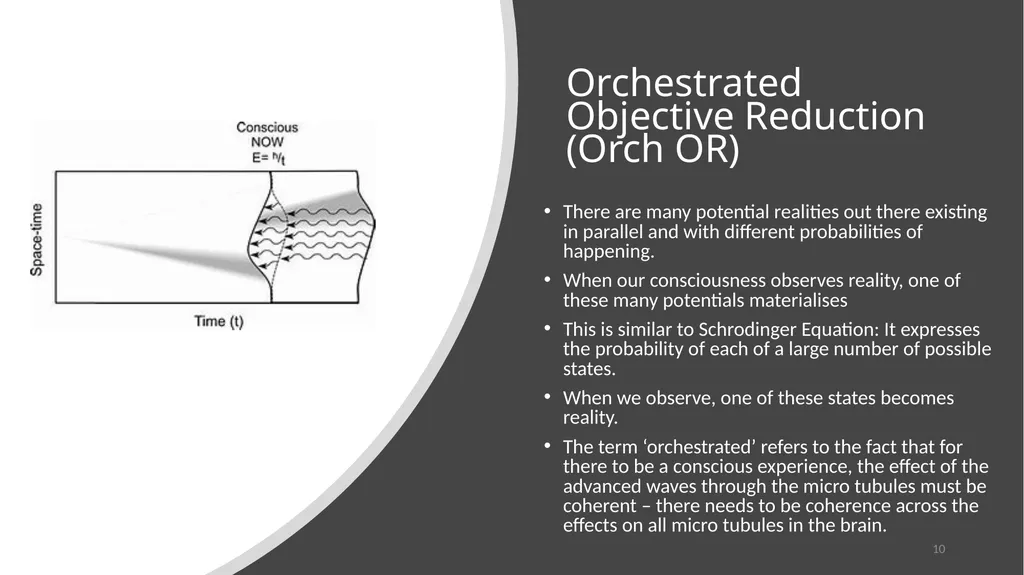
slide10. Orchestrated Objective Reduction (Orch OR) There are many potential realities out there existing in parallel and with different probabilities of happening.
When our consciousness observes reality, one of these many potentials materialises
This is similar to Schrodinger Equation: It expresses the probability of each of a large number of possible states.
When we observe, one of these states becomes reality.
The term ‘orchestrated’ refers to the fact that for there to be a conscious experience, the effect of the advanced waves through the micro tubules must be coherent – there needs to be coherence across the effects on all micro tubules in the brain. 10<br>
slide11. Conclusions In response to the question I set out to address, the development of consciousness could be what distinguishes real humans from synthetic ones.
Those aligned with the metaphysical stance will have little to worry about because in their view, AI will never develop consciousness and thus subjectivity and self-interest.
For them, consciousness will be the demarcation of human and synthetic intelligence.
However, I place myself squarely in the physicalist stance of consciousness, so I believe that it will not demark human from synthetic intelligence;
I worry about the derivations of AI spinning out of control.
I accept, however, that it could be the most powerful tool to better understand our own intelligence and consciousness.
From this perspective, humanity cannot stop developing AI, but it must do so with the utmost caution to keep this science under strict forms of governance,
ensuring that science remains under the checks and balances of conscience.
Notwithstanding, it will be a sorry day when AI swallows human intelligence like a black hole, or simply when it starts telling stories –
Humanity will fall in the deepest identity crisis! 11<br>
Paul Griffiths
pdr.griffiths13@gmail.com<br>
slide2. Simone de Beauvoir, The Second Sex, 1949 “Let us not forget that our lack of imagination always depopulates the future; for us it is only an abstraction; each one of us deplores the absence there of the one that was himself” 2<br>
slide3. The research question Understanding the mind is, without a doubt, one of the most challenging problems that our species faces
How can we learn about human intelligence if we do not have any other benchmark intelligence to compare it with?
AI has been around for over four decades. However, in recent years there have been new developments in the form of machine learning
Supervised learning
Reinforced learning
Unsupervised learning
Once AI reaches the singularity point, where it is equal to human intelligence, how will we be able to distinguish a real human from a synthetic one? 3<br>
slide4. My approach to the question Requires a prior response to the question ‘What does it mean to be human?’
Attempt this by addressing the issue of consciousness as a possible definition of what it is to be human and whether consciousness is a demarcation between a real human and a synthetic one. 4<br>
slide5. Reflection on singularity The initial definition was the Turing test
‘Dogs sniff, people tell stories.’ Story telling was a quintessentially human trait and it clearly segregates humans from all other living species.
With the advent of chatbots, augmented reality, sophisticated voice recognition,…that may not be enough.
A parallel with the concept of singularity in astral-physics, where singularity might be interpreted as black holes.
Black holes capture all the matter that trespass its horizon.
It is quite possible that singularity in AI might mean that human intelligence becomes immediately obsolete and completely absorbed by AI –
Beyond singularity there will be nothing but AI.
You will agree that this is a concerning prospect.
Many of you will be sceptical for many reasons on whether we will ever reach singularity in AI
I respect you for that.
But in this lecture we are making the assumption that singularity is feasible. 5<br>
slide6. Will AI develop consciousness? There are different views on this, just as there are different views on why humans are conscious and how subjectivity arose in our species in the first place
Metaphysical schools: Consciousness is related to the soul or to the spirit, or derives from God, and is clearly distinguishable from the physical matter that constitutes our bodies
Physicalist schools: Humans are biological machines that derived subjectivity from the brain.
conscious experience arises from the computational functioning of the brain;
quantum coherence within microtubules inside our brain cells;
consciousness emerges from the information processed and integrated by our brain and would exist in any structure that integrates information. 6<br>
slide7. Thinking on the physicalist view Quantum coherence within the microtubules inside the brain cells approach
Observation is what makes a phenomenon exist – that is one of the key links that in this view, consciousness has with quantum physics.
Consciousness is about subjectivity and subjectivity means that to a certain extent we each define or choose how the outside world really is.
From that perspective we create reality when we become conscious of it.
Just as in quantum physics and the wave-particle duality it is based on, a particle exists once it is observed 7<br>
slide8. Superposition effect and Advanced Waves The electron has many potential positions with different probabilities of occurrence – in quantum physics we call this the superposition effect.
When we observe the electron, we pin down one of its multitude of potentials.
Klein-Gordon equation which is a derivation of Schrodinger’s equation:
𝐸𝛹 = √(𝑝2 +𝑚2𝛹)
p represents momentum and m represents mass
solving it results in a quadratic equation with two solutions, one positive and one negative.
In the physical world this is interpreted as that the positive solution is a wave/particle that moves forward in time (that is from past, to present to future) in line with entropy which defines the behaviour of large bodies in a tendency from order to chaos;
And another wave that moves ‘backwards’ in time at the micro-particle level according to a law that is called syntropy.
In syntropy the Universe tends away from chaos towards order.
The waves in response to syntropy are called Advanced Waves and they absorb and converge to concentrate matter and energy in very small spaces. 8<br>
slide9. Penrose and Hameroff’s proposal on consciousness Consciousness is a product of these advanced waves operating within the microtubules within the brain cells.
Some form of quantum information is carried in these advanced waves to produce conscious experience.
The existence of advanced waves and their role in consciousness could lead to physiological anticipatory responses to a stimulus that has not yet been applied or even hinted
e.g., Electroencephalogram readings, increased heart rate, blood-oxygen levels in the brain.
It could even be an explanation for ‘deja-vu’. 9<br>
slide10. Orchestrated Objective Reduction (Orch OR) There are many potential realities out there existing in parallel and with different probabilities of happening.
When our consciousness observes reality, one of these many potentials materialises
This is similar to Schrodinger Equation: It expresses the probability of each of a large number of possible states.
When we observe, one of these states becomes reality.
The term ‘orchestrated’ refers to the fact that for there to be a conscious experience, the effect of the advanced waves through the micro tubules must be coherent – there needs to be coherence across the effects on all micro tubules in the brain. 10<br>
slide11. Conclusions In response to the question I set out to address, the development of consciousness could be what distinguishes real humans from synthetic ones.
Those aligned with the metaphysical stance will have little to worry about because in their view, AI will never develop consciousness and thus subjectivity and self-interest.
For them, consciousness will be the demarcation of human and synthetic intelligence.
However, I place myself squarely in the physicalist stance of consciousness, so I believe that it will not demark human from synthetic intelligence;
I worry about the derivations of AI spinning out of control.
I accept, however, that it could be the most powerful tool to better understand our own intelligence and consciousness.
From this perspective, humanity cannot stop developing AI, but it must do so with the utmost caution to keep this science under strict forms of governance,
ensuring that science remains under the checks and balances of conscience.
Notwithstanding, it will be a sorry day when AI swallows human intelligence like a black hole, or simply when it starts telling stories –
Humanity will fall in the deepest identity crisis! 11<br>