Philosophy 2030 Class #4 Title: Introduction to
Description: Philosophy 2030 Class 4 Title: Introduction to Ethics Instructor: Paul Dickey E-mail Address: pdickey2mccneb.edu Nina Rosenstand, The Moral of the Story: An Introduction to Ethics, 7th Edition, 2013. Assignment Due Today: Chapter 3, pp.
Related Topics
Download Presentation
"Philosophy 2030 Class #4 Title: Introduction to" is the property of its rightful owner. Permission is granted to download and print the materials on this website for personal, non-commercial use only, and to display it on your personal computer provided you do not modify the materials and that you retain all copyright notices contained in the materials. By downloading content from our website, you accept the terms of this agreement.
Presentation Transcript
slide1. Philosophy 2030
Class #4 Title: Introduction to Ethics
Instructor: Paul Dickey
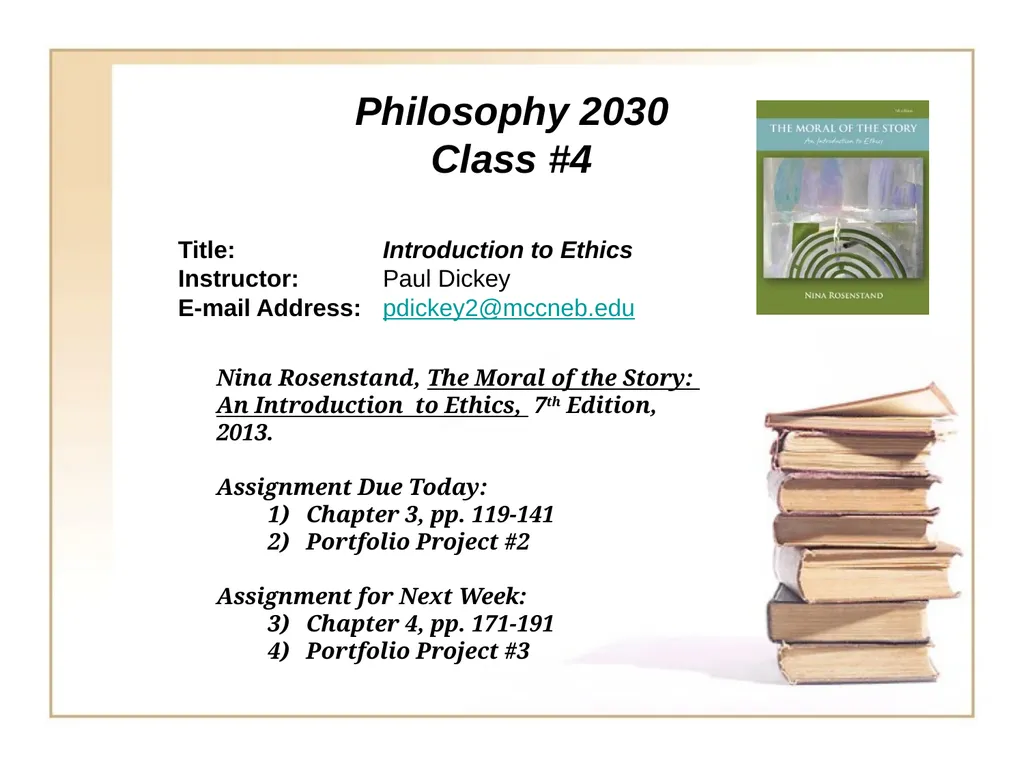
E-mail Address: pdickey2@mccneb.edu Nina Rosenstand, The Moral of the Story: An Introduction to Ethics, 7th Edition, 2013.
Assignment Due Today:
Chapter 3, pp. 119-141
Portfolio Project #2
Assignment for Next Week:
Chapter 4, pp. 171-191
Portfolio Project #3<br>
slide2. 2 Student Portfolio:
Assignment #3<br>
slide3. Pop Quiz !!!<br>
slide4. Chapter Three:
Two Fundamentally Different
Approaches to Morality
Ethical Relativism
vs
Absolutism (or Universalism)<br>
slide5. Various Points of View, 1 of 2
Moral Nihilism: There are no morally defensible points of view. There is no difference between right and wrong or “right” and “wrong” are “games.”
Moral Skepticism: We cannot know whether there are any moral truths.
Moral Subjectivism: Moral values are merely
inner states of a person and thus are not
justifiable to anyone but oneself.
NOTE: Although these views are different, all
three views share a common defect. They
have no way to resolve an issue of how a
person should conduct herself.<br>
slide6. Various Points of View, 2 of 2
Ethical Relativism: Moral views can be justified only within the nature of one’s culture.
Hard Universalism / Moral Absolutism.
There is a universal moral code which applies to all people, in all cultures, for all times.
Soft Universalism: At some level, there will be agreement between cultures on certain moral basics, although the actual expression or application of those basic values may differ.<br>
slide7. Morality Diversity / Moral Universals
Dr. Paul Bloom, Yale Diversity
https://class.coursera.org/moralities-001/lecture/31 Universals
https://class.coursera.org/moralities-001/lecture/33
(13:24)<br>
slide8. Moral or ethical relativism is the view that what is right or wrong depends upon one’s group or culture. It is a normative claim.
This claim is different than the claim of cultural relativism that what is believed to be right or wrong depends upon one’s group or culture based on the commonly accepted view known as the Diversity Thesis. Be on guard for someone arguing for the first claim but only supporting with premises and evidence the second claim. Cultural relativism is a factual claim.
A moral relativist, however, would ask a question such as is abortion right or wrong in the U.S. today? Clearly that is a different question than whether it is in fact practiced. Relativism<br>
slide9. Clearly, Moral Relativism should be distinguished from Subjectivism which argues that whether something is right or wrong depends upon the individual’s beliefs and basically denies the application of critical reasoning in ethics.
Some textbooks and thinkers do this by suggesting there are two kinds of ethical relativism:
1. conventional ethical relativism, and
2) subjective ethical relativism
They do this to emphasize that relativism and subjectivism both rely on human individuals to establish moral principles. We in this class prefer
to distinguish subjectivism from relativism to emphasize that relativism is a position that can be argued with the principles of logic and
argumentation and can avoid the inability to
resolve issues.<br>
slide10. The opposite of the moral relativist is the moral absolutist who would argue that fundamentally only one and only one correct morality exists.
What is right for Americans in the 20th century is what would have been right for all nations throughout history.
Although this view may seem too strong to argue on the basis of all moral judgments, it does seem somewhat reasonable in regard to certain fundamental moral judgments, e.g. slavery, pedophilia, etc. Absolutism<br>
slide11. Video:
Is Morality Relative?<br>
slide12. Note that Moral (or Ethical) Relativism and Universalism agree that: There is right and wrong and we can have agreed upon standards of determining one from the other.
All the following views are invalid:
a) Nihilism,
b) Skepticism,
c) Emotivism, or
d) Subjectivism,
none of which cannot provide any basis for common ground in developing ethical guidelines.<br>
slide13. Moral relativism though suggests that: There are multiple systems of morality, and with possible contradictions between them and without any means to resolve their differences.
Thus, all moral systems should respect the values inherent in other systems
Moral values are relative to time and place.<br>
slide14. What might be good or right about moral relativism?
Although it might not be the only way to foster tolerance between cultures, it definitely does encourage tolerance and teaches us to have restraint from imposing our values on cultures that do not accept them.
It often helps to reduce bigotry and force us to expand our own understanding beyond previously held, narrow points of view based on ethnocentrism.
It seems to encourage psychological and sociological (i.e. scientific) explanations of behavior that we did not previously understand.<br>
slide15. What might be good or right about moral relativism? (cont)
It seems to help each of us engage our fellow humans (who may be outside our “own group”) with more respect, admiration, and appreciation.
It recognizes that though we often think we make moral judgments that are universal, in fact the values that we relied on to make this argument was riddled with cultural biases and values.<br>
slide16. An argument for moral relativism:
P1. Ethical beliefs and practices differ profoundly
from one culture to another.
P2. If ethical beliefs and practices differ profoundly
from one culture to another, then the
fundamental principles governing what acts
are morally right or wrong vary from culture to
culture.
C. Therefore, the fundamental principles governing
what acts are morally right or wrong vary from
culture to culture.<br>
slide17. Another argument for moral relativism:
P1. Ethical beliefs and practices differ profoundly
from one culture to another.
P2. We should respect and not judge the ethical beliefs
and practices of others (especially when they have
good reasons for their moral claims).
C. Therefore, the fundamental principles governing
what acts are morally right or wrong vary from
culture to culture.<br>
slide18. Thus, we have seen that two standard and typical arguments for moral relativism fail. Now, can we as a class propose a valid argument for moral or ethical relativism?<br>
slide19. Now, what are some problems with moral or ethical relativism? then we would appear to have no basis to praise or criticize another culture for anything they do, including slavery, the holocaust, genocide.
then it would appear that whatever the majority of a culture wishes must be moral and any attempt to improve the culture (through civil rights, for example) is actually immoral.
then it would appear that what is moral is how people behave, not how they say they behave If moral relativism is true,<br>
slide20. Now, what are some problems with moral or ethical relativism? 4. then it would appear that actions become moral or cease to be moral based on changing “polls.”
then it would appear that acts become moral or cease to be moral based on who you admit into your “culture.” Does the U.S. have one culture or many? Is culture a matter of ethnicity, religion, or ???
then it would appear that even the idea of tolerance might not be a shared common value
how would we ever know it to be true? (discuss “problem of induction” or “proving a negative”) If moral relativism is true,<br>
slide21. One argument against moral relativism:
P1. Science once believed that the earth was flat and
thus by a principle of relativism applied to truth
similar to relativism applied to morals, we would
have concluded that at that time, the world was flat.
P2. The world is not flat and was not flat at any time.
C. Therefore, the relativistic viewpoint is fundamentally
flawed whether in terms of astronomy or ethics.
Just as the truth is not dependent upon what is
known at a given time, so morality is not dependent
upon one’s culture.<br>
slide22. Now, can we as a class propose a valid argument against moral or ethical relativism?<br>

Class #4 Title: Introduction to Ethics
Instructor: Paul Dickey
E-mail Address: pdickey2@mccneb.edu Nina Rosenstand, The Moral of the Story: An Introduction to Ethics, 7th Edition, 2013.
Assignment Due Today:
Chapter 3, pp. 119-141
Portfolio Project #2
Assignment for Next Week:
Chapter 4, pp. 171-191
Portfolio Project #3<br>
slide2. 2 Student Portfolio:
Assignment #3<br>
slide3. Pop Quiz !!!<br>
slide4. Chapter Three:
Two Fundamentally Different
Approaches to Morality
Ethical Relativism
vs
Absolutism (or Universalism)<br>
slide5. Various Points of View, 1 of 2
Moral Nihilism: There are no morally defensible points of view. There is no difference between right and wrong or “right” and “wrong” are “games.”
Moral Skepticism: We cannot know whether there are any moral truths.
Moral Subjectivism: Moral values are merely
inner states of a person and thus are not
justifiable to anyone but oneself.
NOTE: Although these views are different, all
three views share a common defect. They
have no way to resolve an issue of how a
person should conduct herself.<br>
slide6. Various Points of View, 2 of 2
Ethical Relativism: Moral views can be justified only within the nature of one’s culture.
Hard Universalism / Moral Absolutism.
There is a universal moral code which applies to all people, in all cultures, for all times.
Soft Universalism: At some level, there will be agreement between cultures on certain moral basics, although the actual expression or application of those basic values may differ.<br>
slide7. Morality Diversity / Moral Universals
Dr. Paul Bloom, Yale Diversity
https://class.coursera.org/moralities-001/lecture/31 Universals
https://class.coursera.org/moralities-001/lecture/33
(13:24)<br>
slide8. Moral or ethical relativism is the view that what is right or wrong depends upon one’s group or culture. It is a normative claim.
This claim is different than the claim of cultural relativism that what is believed to be right or wrong depends upon one’s group or culture based on the commonly accepted view known as the Diversity Thesis. Be on guard for someone arguing for the first claim but only supporting with premises and evidence the second claim. Cultural relativism is a factual claim.
A moral relativist, however, would ask a question such as is abortion right or wrong in the U.S. today? Clearly that is a different question than whether it is in fact practiced. Relativism<br>
slide9. Clearly, Moral Relativism should be distinguished from Subjectivism which argues that whether something is right or wrong depends upon the individual’s beliefs and basically denies the application of critical reasoning in ethics.
Some textbooks and thinkers do this by suggesting there are two kinds of ethical relativism:
1. conventional ethical relativism, and
2) subjective ethical relativism
They do this to emphasize that relativism and subjectivism both rely on human individuals to establish moral principles. We in this class prefer
to distinguish subjectivism from relativism to emphasize that relativism is a position that can be argued with the principles of logic and
argumentation and can avoid the inability to
resolve issues.<br>
slide10. The opposite of the moral relativist is the moral absolutist who would argue that fundamentally only one and only one correct morality exists.
What is right for Americans in the 20th century is what would have been right for all nations throughout history.
Although this view may seem too strong to argue on the basis of all moral judgments, it does seem somewhat reasonable in regard to certain fundamental moral judgments, e.g. slavery, pedophilia, etc. Absolutism<br>
slide11. Video:
Is Morality Relative?<br>
slide12. Note that Moral (or Ethical) Relativism and Universalism agree that: There is right and wrong and we can have agreed upon standards of determining one from the other.
All the following views are invalid:
a) Nihilism,
b) Skepticism,
c) Emotivism, or
d) Subjectivism,
none of which cannot provide any basis for common ground in developing ethical guidelines.<br>
slide13. Moral relativism though suggests that: There are multiple systems of morality, and with possible contradictions between them and without any means to resolve their differences.
Thus, all moral systems should respect the values inherent in other systems
Moral values are relative to time and place.<br>
slide14. What might be good or right about moral relativism?
Although it might not be the only way to foster tolerance between cultures, it definitely does encourage tolerance and teaches us to have restraint from imposing our values on cultures that do not accept them.
It often helps to reduce bigotry and force us to expand our own understanding beyond previously held, narrow points of view based on ethnocentrism.
It seems to encourage psychological and sociological (i.e. scientific) explanations of behavior that we did not previously understand.<br>
slide15. What might be good or right about moral relativism? (cont)
It seems to help each of us engage our fellow humans (who may be outside our “own group”) with more respect, admiration, and appreciation.
It recognizes that though we often think we make moral judgments that are universal, in fact the values that we relied on to make this argument was riddled with cultural biases and values.<br>
slide16. An argument for moral relativism:
P1. Ethical beliefs and practices differ profoundly
from one culture to another.
P2. If ethical beliefs and practices differ profoundly
from one culture to another, then the
fundamental principles governing what acts
are morally right or wrong vary from culture to
culture.
C. Therefore, the fundamental principles governing
what acts are morally right or wrong vary from
culture to culture.<br>
slide17. Another argument for moral relativism:
P1. Ethical beliefs and practices differ profoundly
from one culture to another.
P2. We should respect and not judge the ethical beliefs
and practices of others (especially when they have
good reasons for their moral claims).
C. Therefore, the fundamental principles governing
what acts are morally right or wrong vary from
culture to culture.<br>
slide18. Thus, we have seen that two standard and typical arguments for moral relativism fail. Now, can we as a class propose a valid argument for moral or ethical relativism?<br>
slide19. Now, what are some problems with moral or ethical relativism? then we would appear to have no basis to praise or criticize another culture for anything they do, including slavery, the holocaust, genocide.
then it would appear that whatever the majority of a culture wishes must be moral and any attempt to improve the culture (through civil rights, for example) is actually immoral.
then it would appear that what is moral is how people behave, not how they say they behave If moral relativism is true,<br>
slide20. Now, what are some problems with moral or ethical relativism? 4. then it would appear that actions become moral or cease to be moral based on changing “polls.”
then it would appear that acts become moral or cease to be moral based on who you admit into your “culture.” Does the U.S. have one culture or many? Is culture a matter of ethnicity, religion, or ???
then it would appear that even the idea of tolerance might not be a shared common value
how would we ever know it to be true? (discuss “problem of induction” or “proving a negative”) If moral relativism is true,<br>
slide21. One argument against moral relativism:
P1. Science once believed that the earth was flat and
thus by a principle of relativism applied to truth
similar to relativism applied to morals, we would
have concluded that at that time, the world was flat.
P2. The world is not flat and was not flat at any time.
C. Therefore, the relativistic viewpoint is fundamentally
flawed whether in terms of astronomy or ethics.
Just as the truth is not dependent upon what is
known at a given time, so morality is not dependent
upon one’s culture.<br>
slide22. Now, can we as a class propose a valid argument against moral or ethical relativism?<br>