
Photochemistry Definition : The branch of
NS
Published · 35 slides · 0 views

1 / 1
Description
Photochemistry Definition : The branch of chemistry which deals with the study of photochemical reaction is called photochemistry Photochemical Reaction -The reaction which takes place by absorption of the visible UV radiation. Thermal
Related Topics
Share
Embed code
Download this presentation From Below
"Photochemistry Definition : The branch of" is the property of its rightful owner. Permission is granted to download and print the materials on this website for personal, non-commercial use only, and to display it on your personal computer provided you do not modify the materials and that you retain all copyright notices contained in the materials. By downloading content from our website, you accept the terms of this agreement.
Presentation Transcript
01
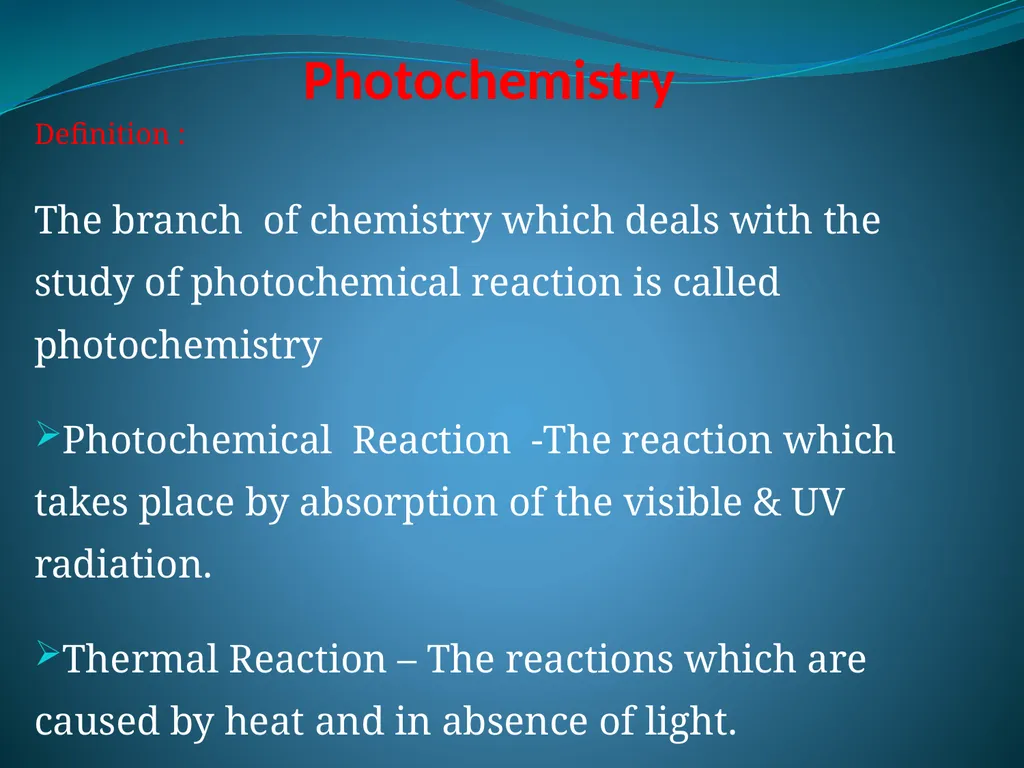
Photochemistry Definition :
The branch of chemistry which deals with the study of photochemical reaction is called photochemistry
Photochemical Reaction -The reaction which takes place by absorption of the visible & UV radiation.
Thermal Reaction – The reactions which are caused by heat and in absence of light.<br>
The branch of chemistry which deals with the study of photochemical reaction is called photochemistry
Photochemical Reaction -The reaction which takes place by absorption of the visible & UV radiation.
Thermal Reaction – The reactions which are caused by heat and in absence of light.<br>
02
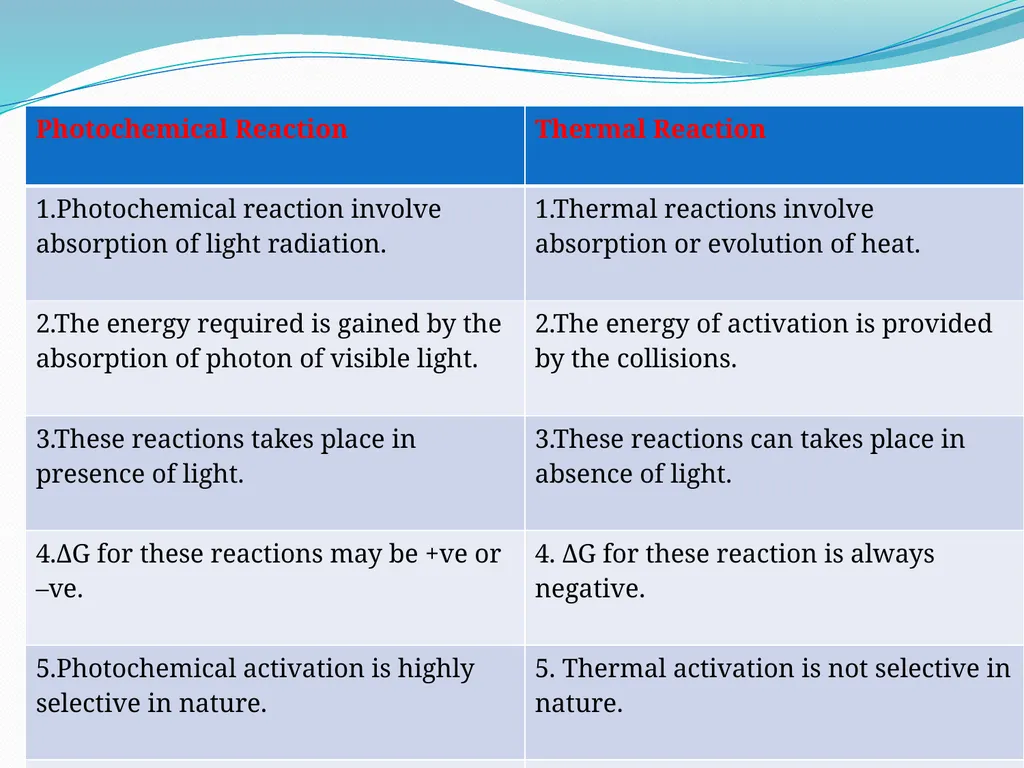
Difference between Photochemical and Thermal Reaction<br>
03
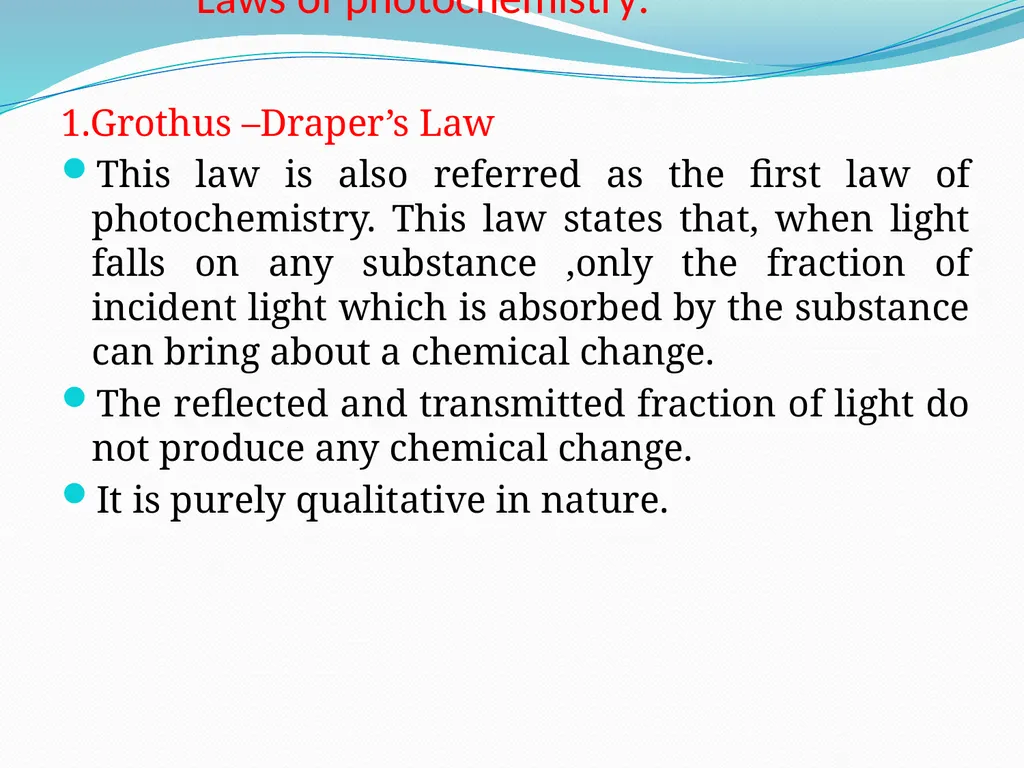
Laws of photochemistry: 1.Grothus –Draper’s Law
This law is also referred as the first law of photochemistry. This law states that, when light falls on any substance ,only the fraction of incident light which is absorbed by the substance can bring about a chemical change.
The reflected and transmitted fraction of light do not produce any chemical change.
It is purely qualitative in nature.<br>
This law is also referred as the first law of photochemistry. This law states that, when light falls on any substance ,only the fraction of incident light which is absorbed by the substance can bring about a chemical change.
The reflected and transmitted fraction of light do not produce any chemical change.
It is purely qualitative in nature.<br>
04
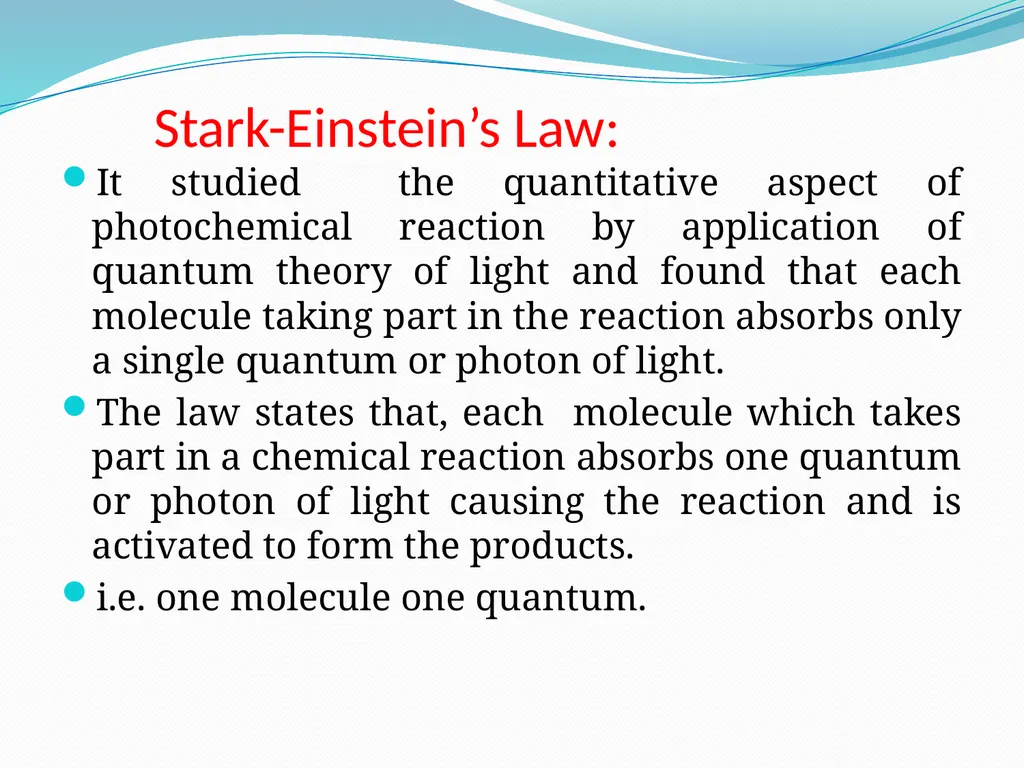
Stark-Einstein’s Law: It studied the quantitative aspect of photochemical reaction by application of quantum theory of light and found that each molecule taking part in the reaction absorbs only a single quantum or photon of light.
The law states that, each molecule which takes part in a chemical reaction absorbs one quantum or photon of light causing the reaction and is activated to form the products.
i.e. one molecule one quantum.<br>
The law states that, each molecule which takes part in a chemical reaction absorbs one quantum or photon of light causing the reaction and is activated to form the products.
i.e. one molecule one quantum.<br>
05
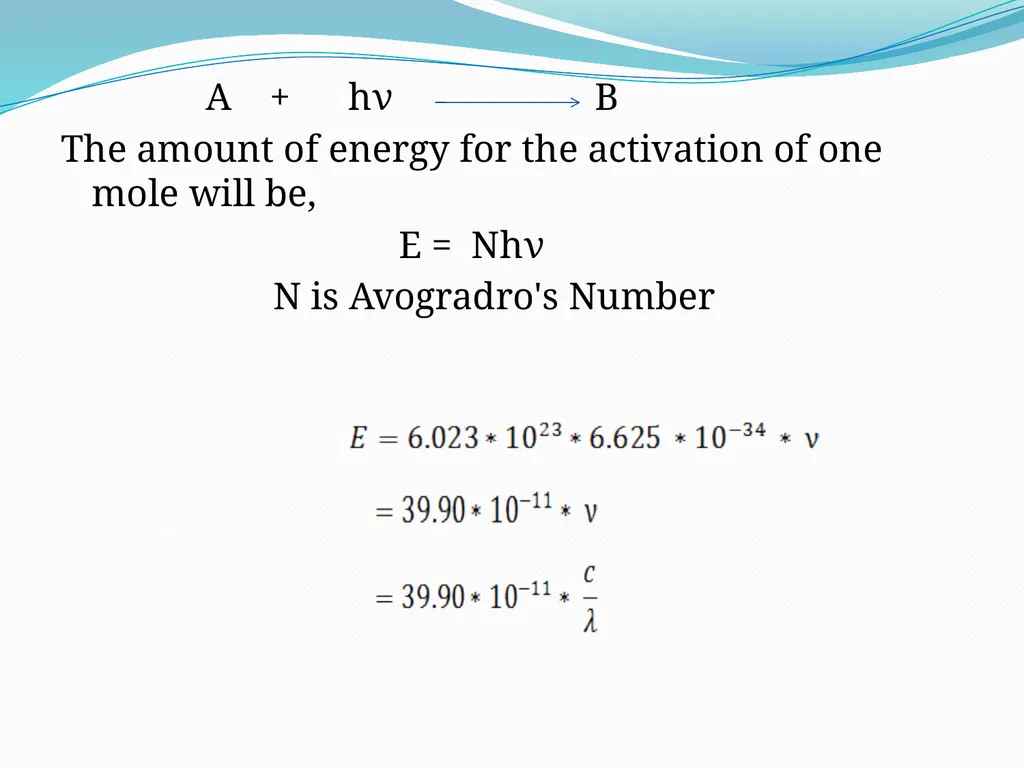
A + hν B
The amount of energy for the activation of one mole will be,
E = Nhν
N is Avogradro's Number<br>
The amount of energy for the activation of one mole will be,
E = Nhν
N is Avogradro's Number<br>
06
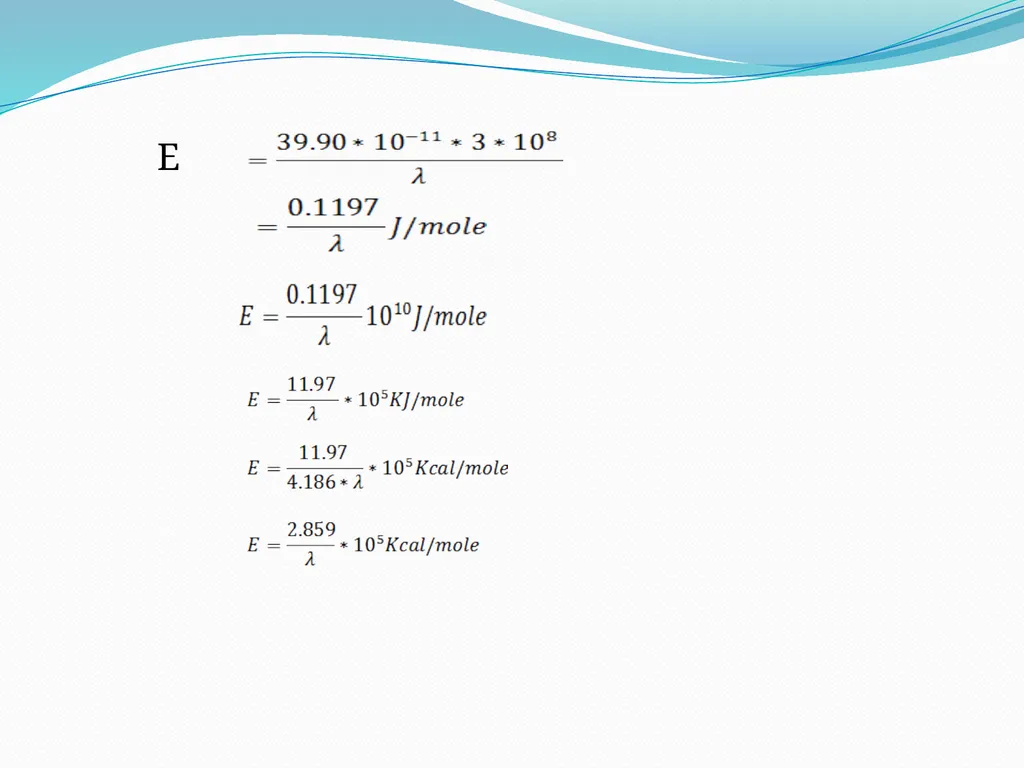
E<br>
07
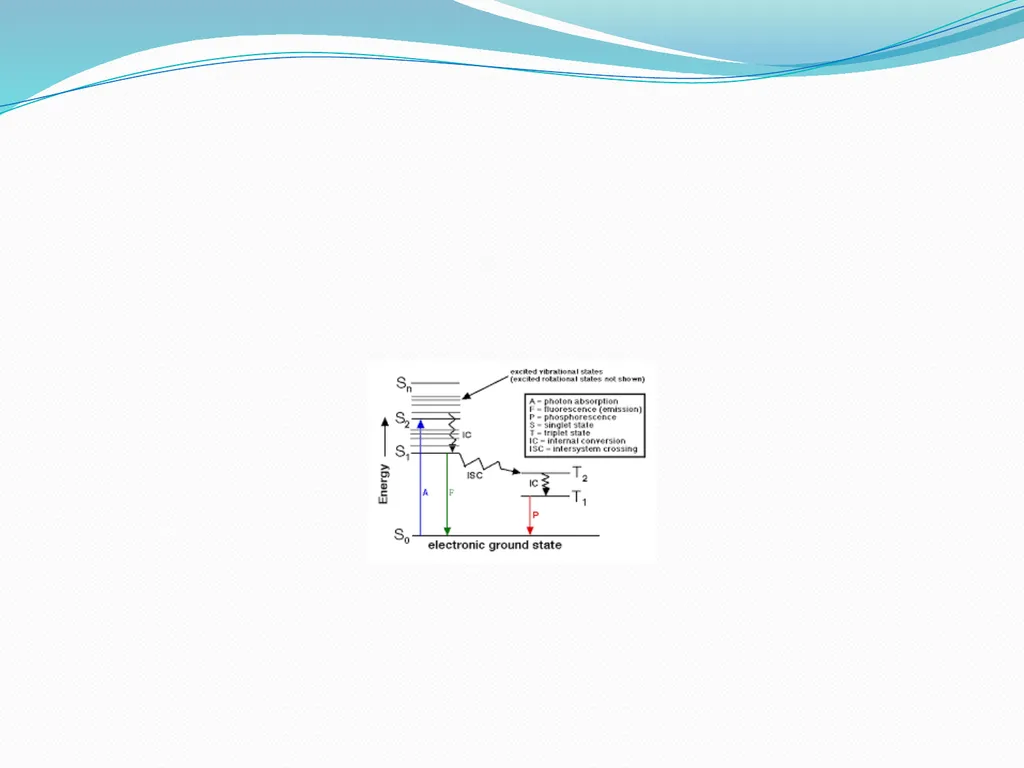
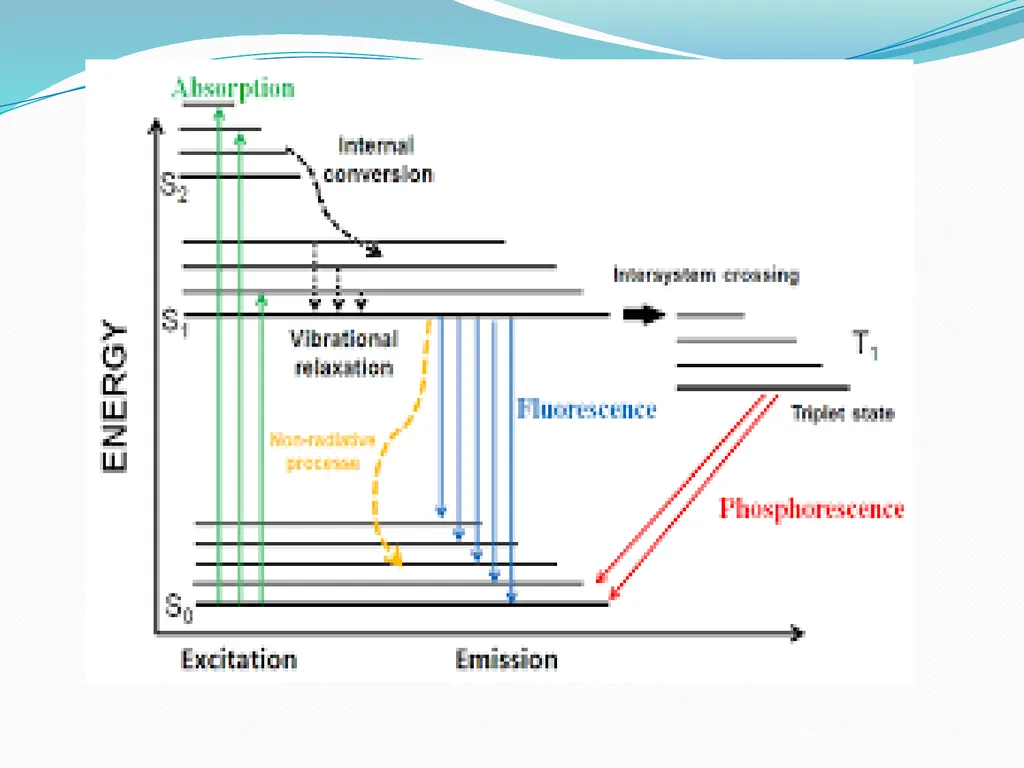
Jablonski Diagram : According to the Grothus –Draper’s law, only the light absorbed by a system can bring about a photochemical change. However it is not essential that the absorbed light must bring about a photochemical change. When conditions are not suitable for chemical change the absorbed light may be re-emitted in the form of heat or light radiation as shown in the Jablonski diagram.<br>
08
On absorption of light photon, the electron of the absorbing molecule may jump from S0 to S1, S2,or S3 …… singlet excited state depending upon the energy of photon absorbed.
Thus, after initial act of absorption,
A +hν A*
Where as ,
A is the molecule in the ground state
A* is the molecule in the excited state
The activated molecule returns to the ground state by dissipating its energy through the following types of processes.<br>
Thus, after initial act of absorption,
A +hν A*
Where as ,
A is the molecule in the ground state
A* is the molecule in the excited state
The activated molecule returns to the ground state by dissipating its energy through the following types of processes.<br>
09
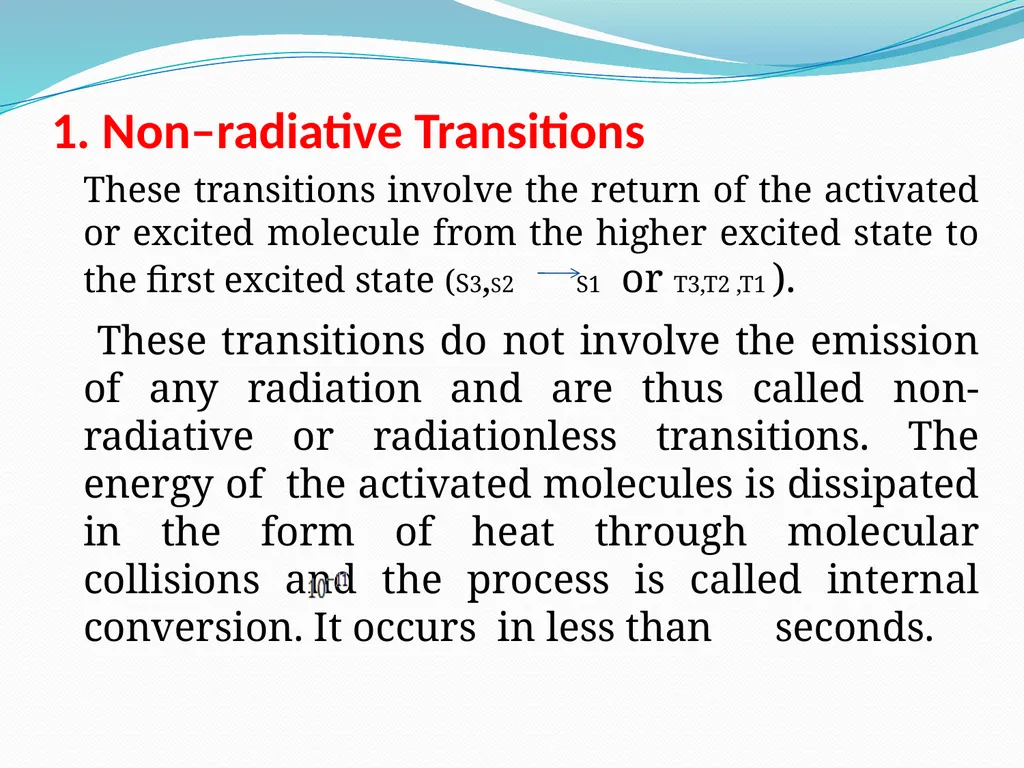
1. Non–radiative Transitions These transitions involve the return of the activated or excited molecule from the higher excited state to the first excited state (S3,S2 S1 or T3,T2 ,T1 ).
These transitions do not involve the emission of any radiation and are thus called non-radiative or radiationless transitions. The energy of the activated molecules is dissipated in the form of heat through molecular collisions and the process is called internal conversion. It occurs in less than seconds.<br>
These transitions do not involve the emission of any radiation and are thus called non-radiative or radiationless transitions. The energy of the activated molecules is dissipated in the form of heat through molecular collisions and the process is called internal conversion. It occurs in less than seconds.<br>
10
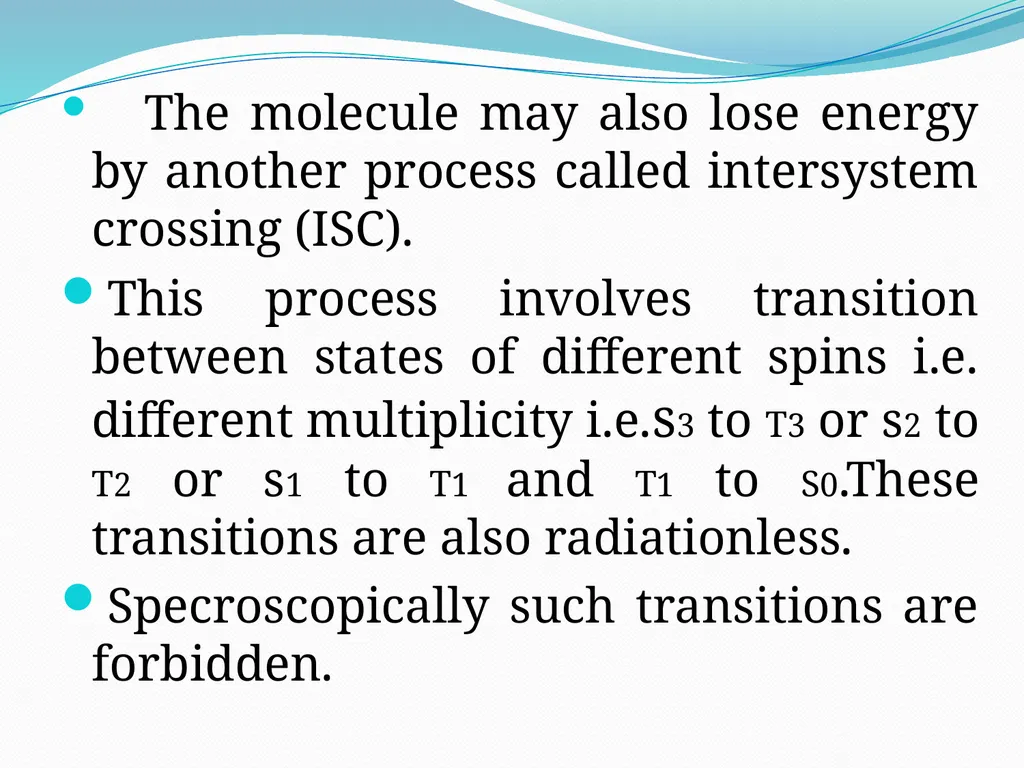
The molecule may also lose energy by another process called intersystem crossing (ISC).
This process involves transition between states of different spins i.e. different multiplicity i.e.s3 to T3 or s2 to T2 or s1 to T1 and T1 to S0.These transitions are also radiationless.
Specroscopically such transitions are forbidden.<br>
This process involves transition between states of different spins i.e. different multiplicity i.e.s3 to T3 or s2 to T2 or s1 to T1 and T1 to S0.These transitions are also radiationless.
Specroscopically such transitions are forbidden.<br>
11
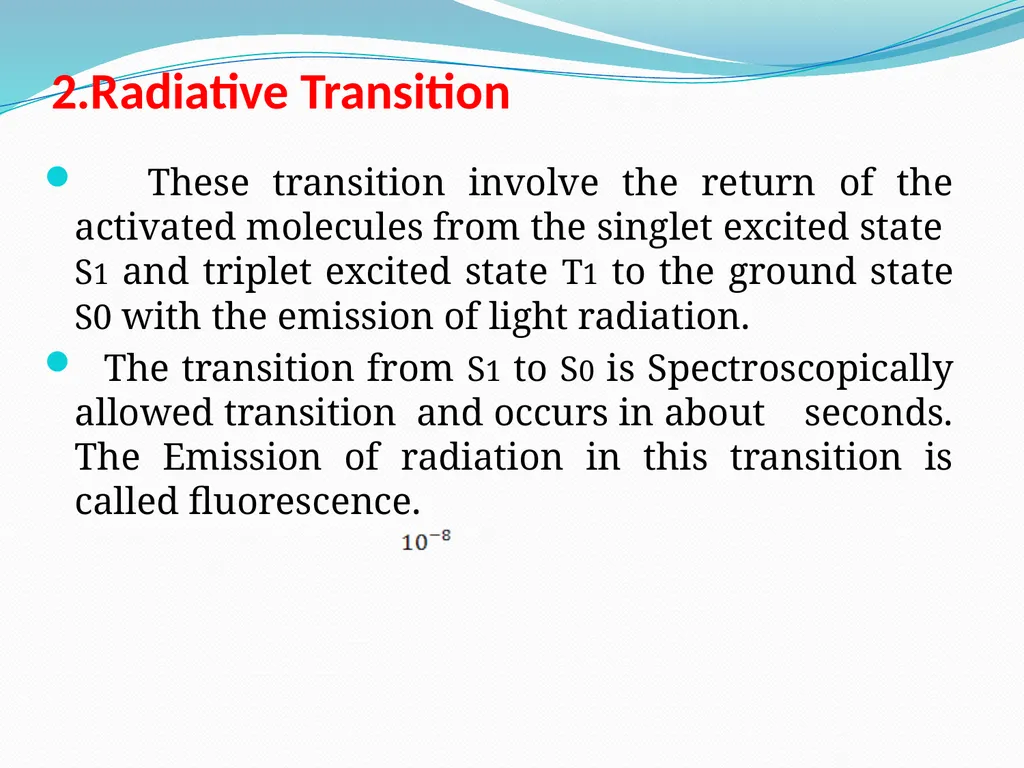
2.Radiative Transition These transition involve the return of the activated molecules from the singlet excited state S1 and triplet excited state T1 to the ground state S0 with the emission of light radiation.
The transition from S1 to S0 is Spectroscopically allowed transition and occurs in about seconds. The Emission of radiation in this transition is called fluorescence.<br>
The transition from S1 to S0 is Spectroscopically allowed transition and occurs in about seconds. The Emission of radiation in this transition is called fluorescence.<br>
12
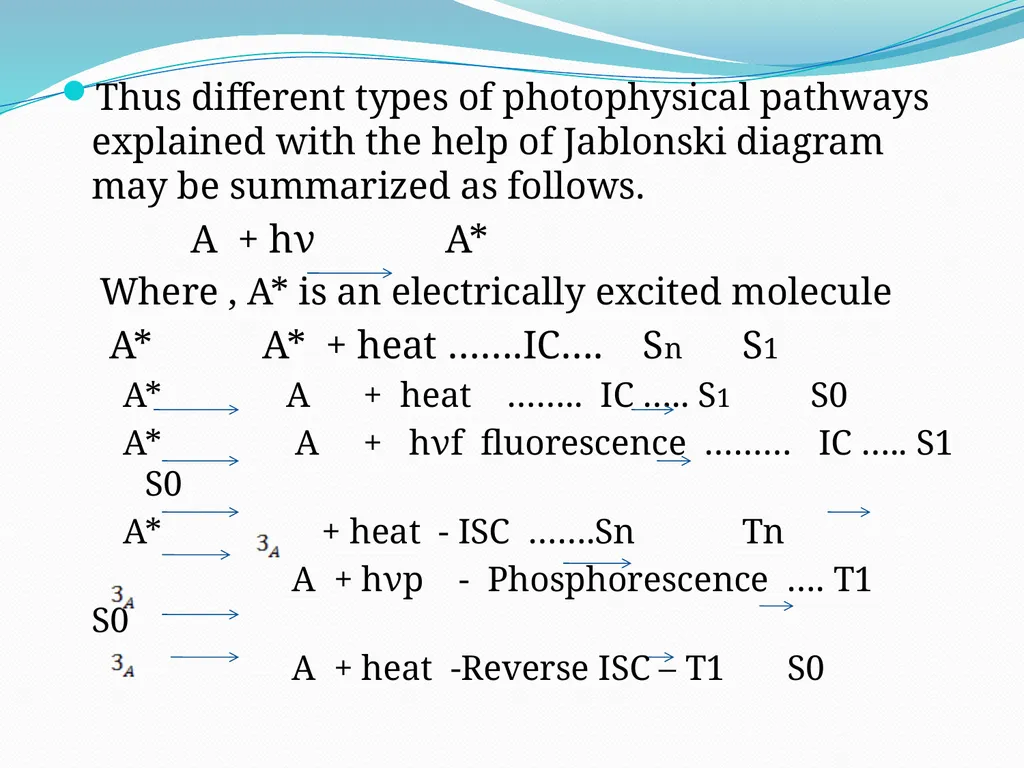
The transition from the triplet excited state T1 to the round state S0 is rather slow and emission of radiation in this transition is called phosphorescence. The life times of phosphorescence is much longer of the order of second or more because the transition involves spin inversion which needs time for its occurrence.
Both fluorescent and phosphorescent radiations are of lower frequencies than the incident exciting light because some part of light energy absorbed by the molecule is dissipated in the from of heat during the non-radiative transitions.<br>
Both fluorescent and phosphorescent radiations are of lower frequencies than the incident exciting light because some part of light energy absorbed by the molecule is dissipated in the from of heat during the non-radiative transitions.<br>
13
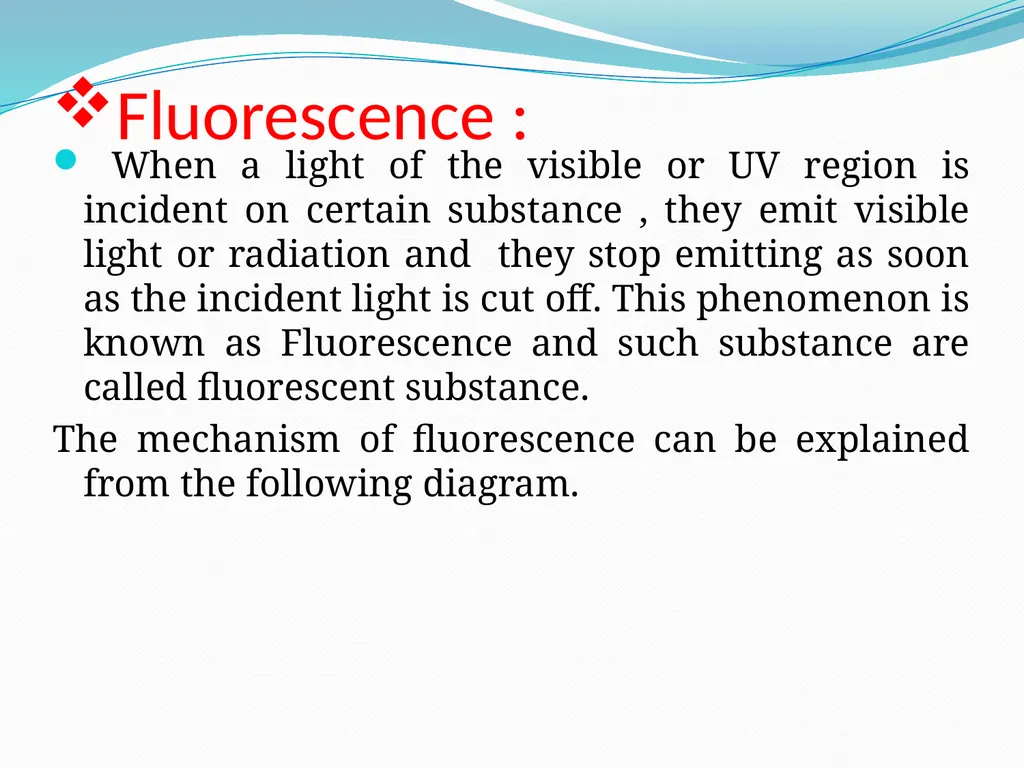
Thus different types of photophysical pathways explained with the help of Jablonski diagram may be summarized as follows.
A + hν A*
Where , A* is an electrically excited molecule
A* A* + heat …….IC…. Sn S1
A* A + heat …….. IC ….. S1 S0
A* A + hνf fluorescence ……… IC ….. S1 S0
A* + heat - ISC …….Sn Tn
A + hνp - Phosphorescence …. T1 S0
A + heat -Reverse ISC – T1 S0<br>
A + hν A*
Where , A* is an electrically excited molecule
A* A* + heat …….IC…. Sn S1
A* A + heat …….. IC ….. S1 S0
A* A + hνf fluorescence ……… IC ….. S1 S0
A* + heat - ISC …….Sn Tn
A + hνp - Phosphorescence …. T1 S0
A + heat -Reverse ISC – T1 S0<br>
14
Fluorescence : When a light of the visible or UV region is incident on certain substance , they emit visible light or radiation and they stop emitting as soon as the incident light is cut off. This phenomenon is known as Fluorescence and such substance are called fluorescent substance.
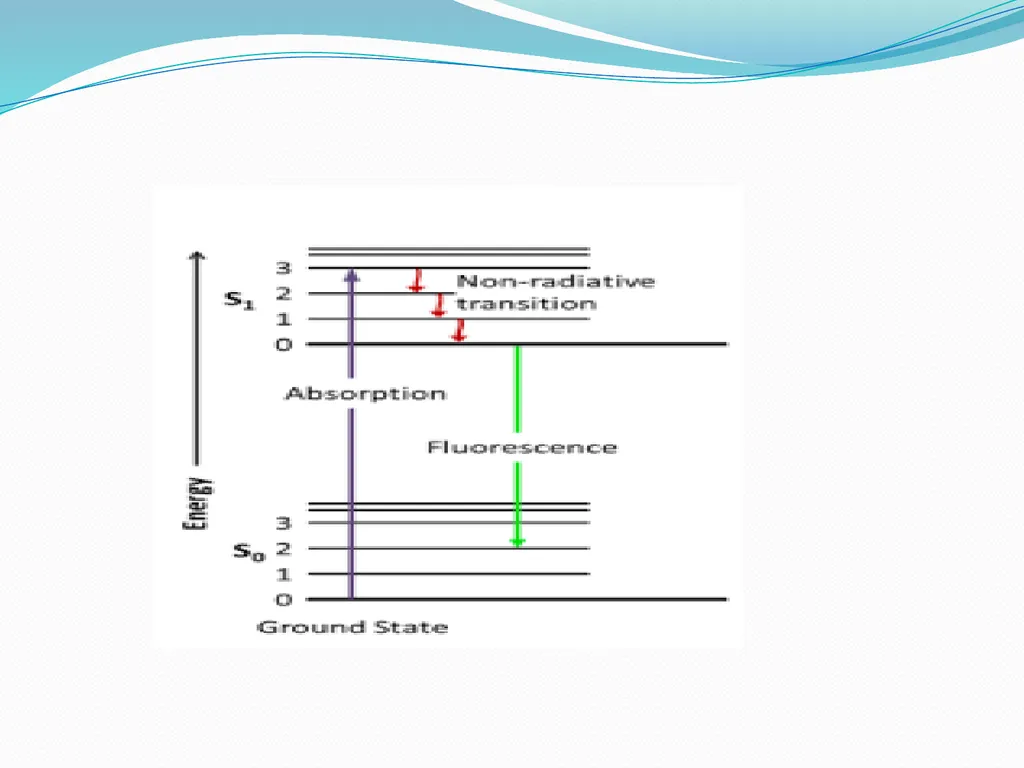
The mechanism of fluorescence can be explained from the following diagram.<br>
The mechanism of fluorescence can be explained from the following diagram.<br>
15
When a substance absorbs light energy, it will result in the excited state. i.e. electron moves from inner orbit to outer.
If the energy of incident light is not sufficient to eject the electron it will move in the excited singlet.
When these excited electrons return back to the ground singlet state, the light radiation is emitted within second.
Thus the successive stage in the fluorescence are<br>
If the energy of incident light is not sufficient to eject the electron it will move in the excited singlet.
When these excited electrons return back to the ground singlet state, the light radiation is emitted within second.
Thus the successive stage in the fluorescence are<br>
16
A + hν A* (excited state)
A* A* + hνf (fluorescence)
It is general Phenomenon caused by visible and UV light and exhibited by gases ,liquids and solids.
Different substances fluorescence with light of different wavelengths.
It depends upon the nature of the solvent and the presence of certain anions in solution.
Ex. Chlorophyll, petroleum,vapours of sodium, iodine acetone etc. shows fluorescence.<br>
A* A* + hνf (fluorescence)
It is general Phenomenon caused by visible and UV light and exhibited by gases ,liquids and solids.
Different substances fluorescence with light of different wavelengths.
It depends upon the nature of the solvent and the presence of certain anions in solution.
Ex. Chlorophyll, petroleum,vapours of sodium, iodine acetone etc. shows fluorescence.<br>
17
Applications: Determination of uranium in salts.
Determination of vitamin B1 and B2 in food samples.
Examination of food stuffs.
Fluorescent indicators
Fluorescent lamps.
Detection of ringworm
Diagnosis of internal oragans.<br>
Determination of vitamin B1 and B2 in food samples.
Examination of food stuffs.
Fluorescent indicators
Fluorescent lamps.
Detection of ringworm
Diagnosis of internal oragans.<br>
18
Phosphorescence : When light radiation is incident on certain substance ,they emit radiation for sometime ,even after the incident light is cut off. This type of delayed emission is called Phosphorescence and substance are called Phosphrescent substances.
For example
Zinc sulphide,alkaline earth sulphides, organic substances<br>
For example
Zinc sulphide,alkaline earth sulphides, organic substances<br>
19
When an incident light falls on a phosphorescent
Substance, its molecule absorbs energy and get excited to singlet state. under certain conditions these excited molecules may cross over to the excited triplet by non-radiative transition (ISC).
From excited triplet molecule returns to the ground state with the emission of radiation and phosphorescence occurs.This emission takes place very slowly and hence persists for some time.Thus, life time of phosphorescence is much longer( to 20 sec)than fluorescence ( sec).<br>
Substance, its molecule absorbs energy and get excited to singlet state. under certain conditions these excited molecules may cross over to the excited triplet by non-radiative transition (ISC).
From excited triplet molecule returns to the ground state with the emission of radiation and phosphorescence occurs.This emission takes place very slowly and hence persists for some time.Thus, life time of phosphorescence is much longer( to 20 sec)than fluorescence ( sec).<br>
20
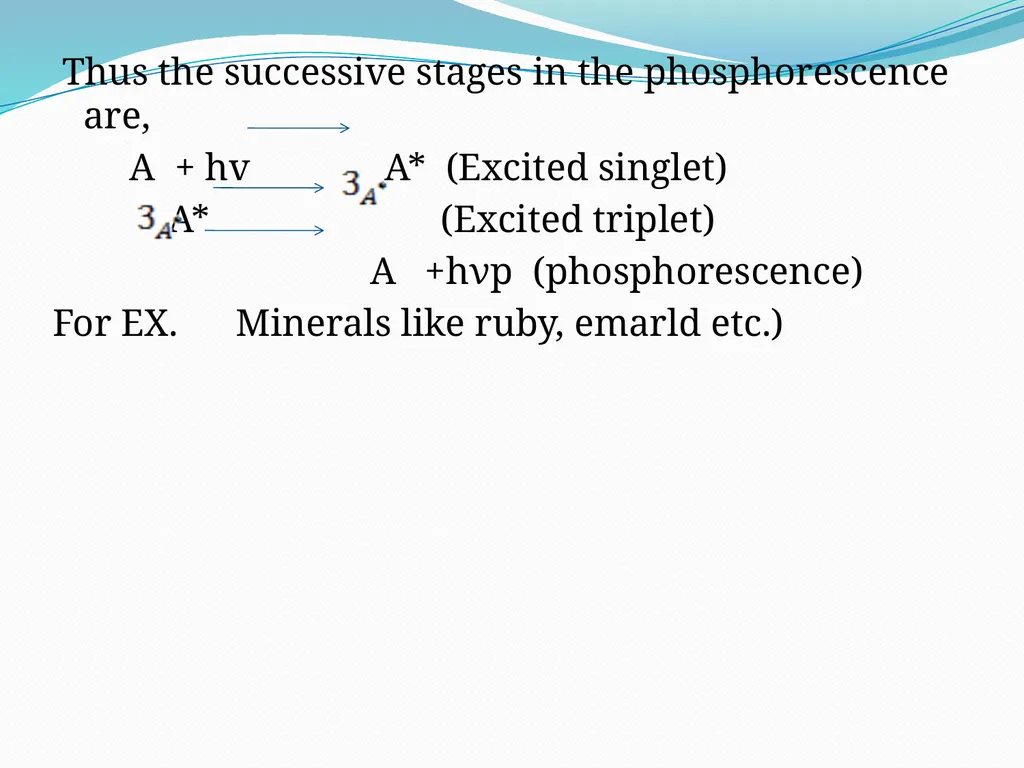
Thus the successive stages in the phosphorescence are,
A + hv A* (Excited singlet)
A* (Excited triplet)
A +hνp (phosphorescence)
For EX. Minerals like ruby, emarld etc.)<br>
A + hv A* (Excited singlet)
A* (Excited triplet)
A +hνp (phosphorescence)
For EX. Minerals like ruby, emarld etc.)<br>
21
Applications: 1. Determination of low concentration of cocaine , procaine, phenobarbital and chloropramazine in blood serum.
2. Determination of cocaine and atropine in urine.
3.Determination of aspirin in blood serum.
4. Separation of three alkaloids, nicotine, nornicotine and anabasine.
5.Paints containing 2.5% alkali chlorides with traces of sulphide of heavy metal are used for watch dials, electronic switches etc.<br>
2. Determination of cocaine and atropine in urine.
3.Determination of aspirin in blood serum.
4. Separation of three alkaloids, nicotine, nornicotine and anabasine.
5.Paints containing 2.5% alkali chlorides with traces of sulphide of heavy metal are used for watch dials, electronic switches etc.<br>
22
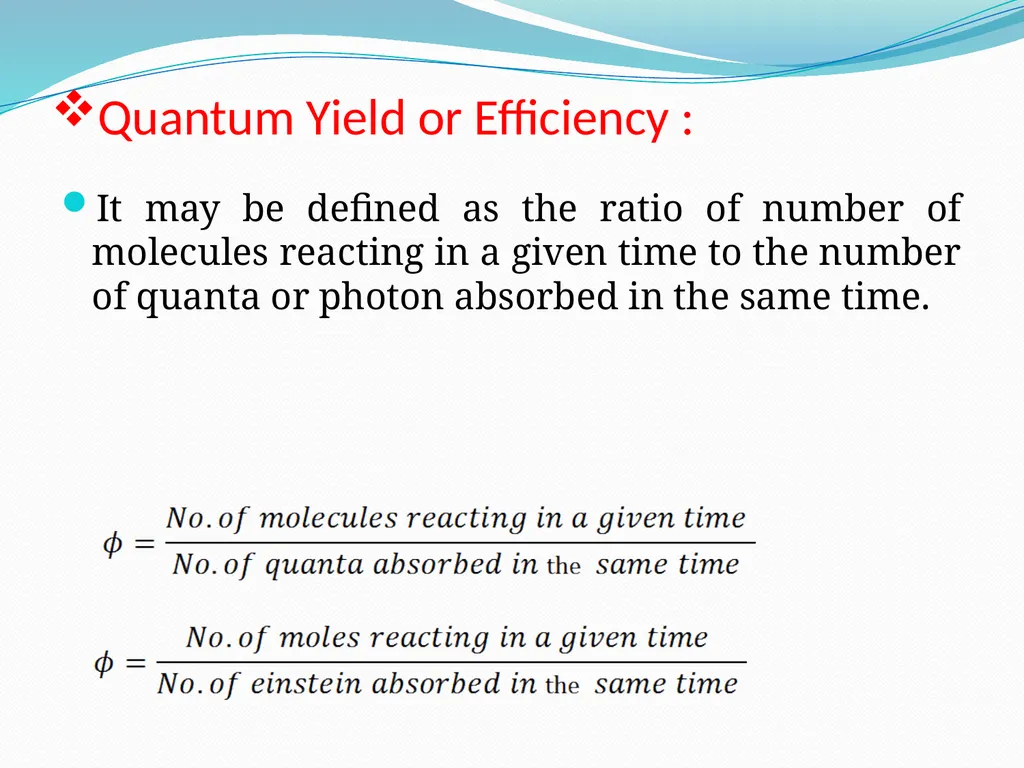
Quantum Yield or Efficiency : It may be defined as the ratio of number of molecules reacting in a given time to the number of quanta or photon absorbed in the same time.<br>
23
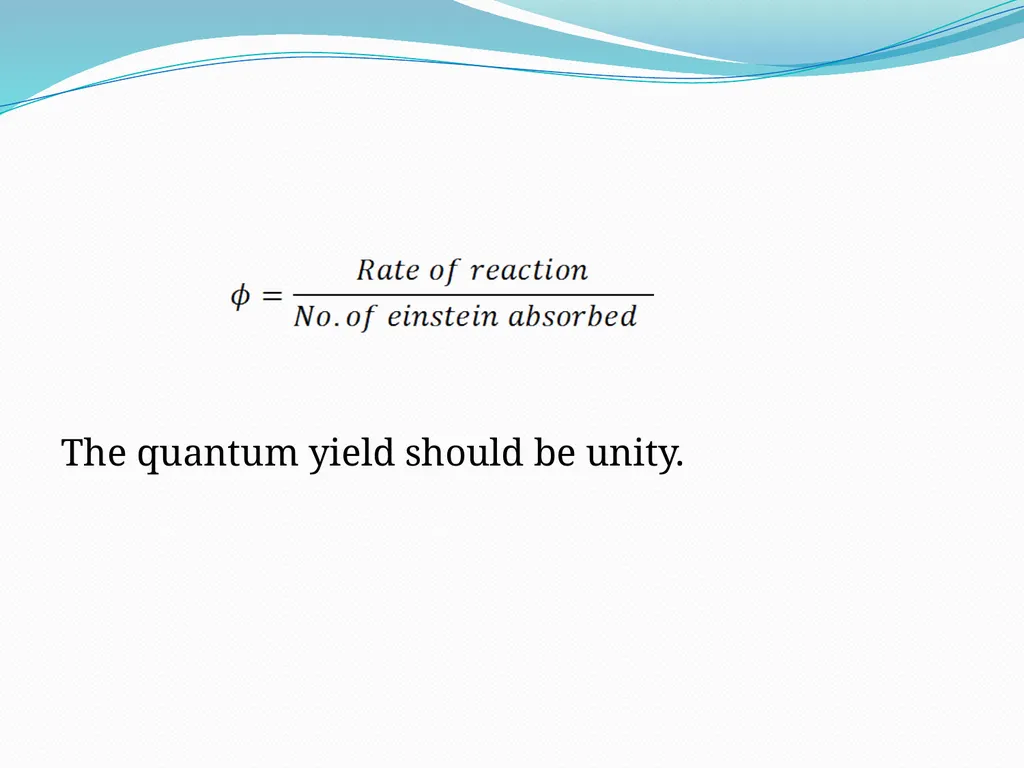
The quantum yield should be unity.<br>
24
High Quantum Yield : When one photon decomposes or forms more than one molecule the quantum yield is greater than one and is said to be high.
1.Secondary Reactions:-
A photon absorbed in a primary reaction dissociate one molecule of the reactant. But the excited atoms or molecules or free radicals produced in the primary reaction may start subsequent secondary reaction in which a further molecule is decomposed<br>
1.Secondary Reactions:-
A photon absorbed in a primary reaction dissociate one molecule of the reactant. But the excited atoms or molecules or free radicals produced in the primary reaction may start subsequent secondary reaction in which a further molecule is decomposed<br>
25
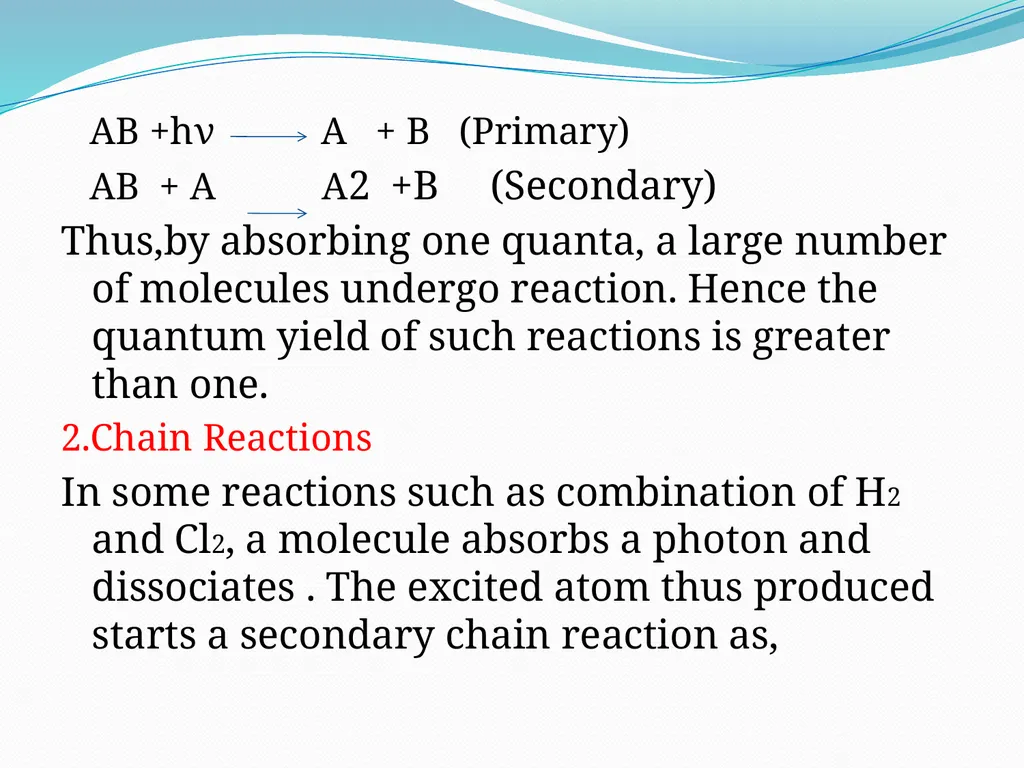
AB +hν A + B (Primary)
AB + A A2 +B (Secondary)
Thus,by absorbing one quanta, a large number of molecules undergo reaction. Hence the quantum yield of such reactions is greater than one.
2.Chain Reactions
In some reactions such as combination of H2 and Cl2, a molecule absorbs a photon and dissociates . The excited atom thus produced starts a secondary chain reaction as,<br>
AB + A A2 +B (Secondary)
Thus,by absorbing one quanta, a large number of molecules undergo reaction. Hence the quantum yield of such reactions is greater than one.
2.Chain Reactions
In some reactions such as combination of H2 and Cl2, a molecule absorbs a photon and dissociates . The excited atom thus produced starts a secondary chain reaction as,<br>
26
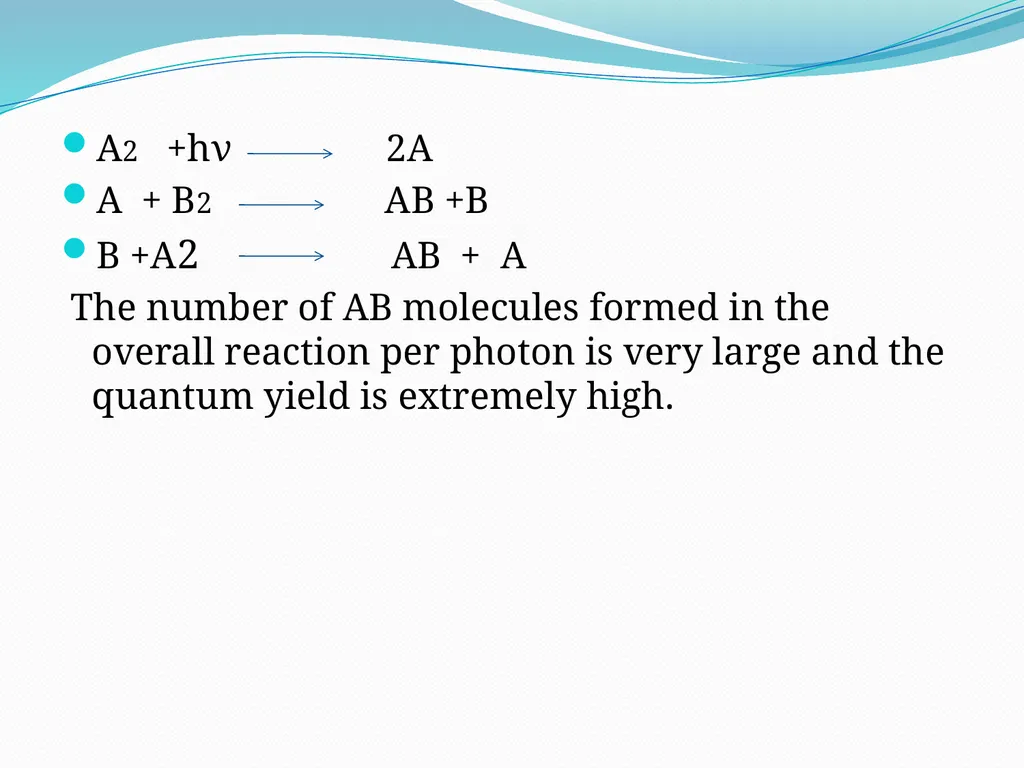
A2 +hν 2A
A + B2 AB +B
B +A2 AB + A
The number of AB molecules formed in the overall reaction per photon is very large and the quantum yield is extremely high.<br>
A + B2 AB +B
B +A2 AB + A
The number of AB molecules formed in the overall reaction per photon is very large and the quantum yield is extremely high.<br>
27
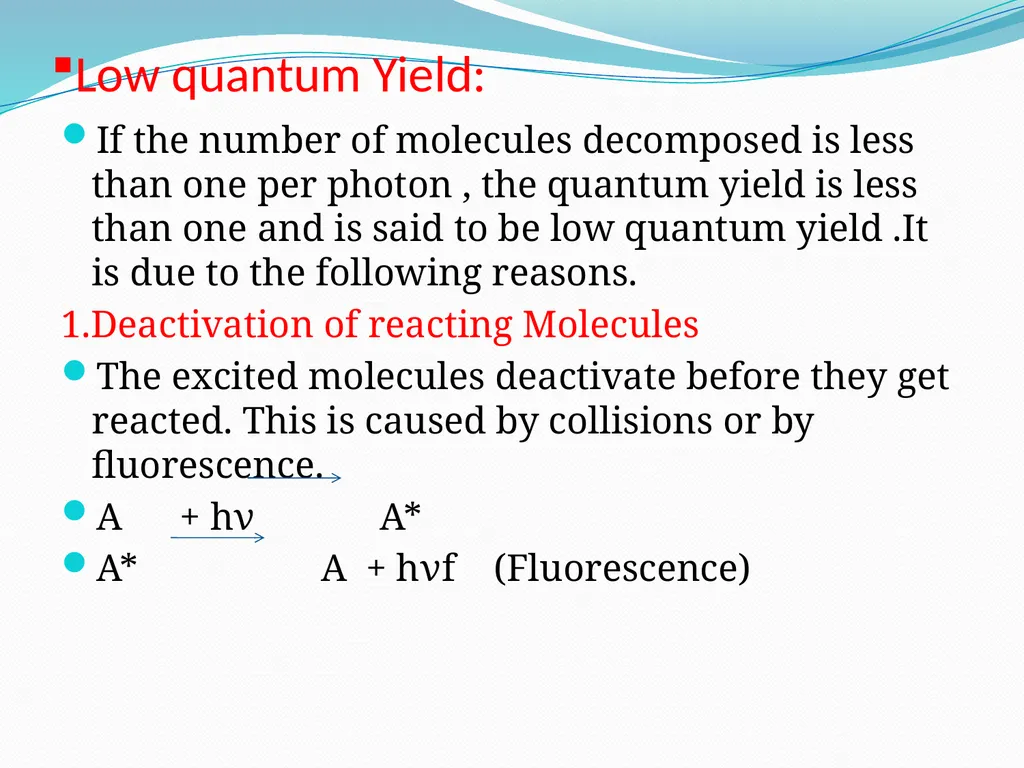
Low quantum Yield: If the number of molecules decomposed is less than one per photon , the quantum yield is less than one and is said to be low quantum yield .It is due to the following reasons.
1.Deactivation of reacting Molecules
The excited molecules deactivate before they get reacted. This is caused by collisions or by fluorescence.
A + hν A*
A* A + hνf (Fluorescence)<br>
1.Deactivation of reacting Molecules
The excited molecules deactivate before they get reacted. This is caused by collisions or by fluorescence.
A + hν A*
A* A + hνf (Fluorescence)<br>
28
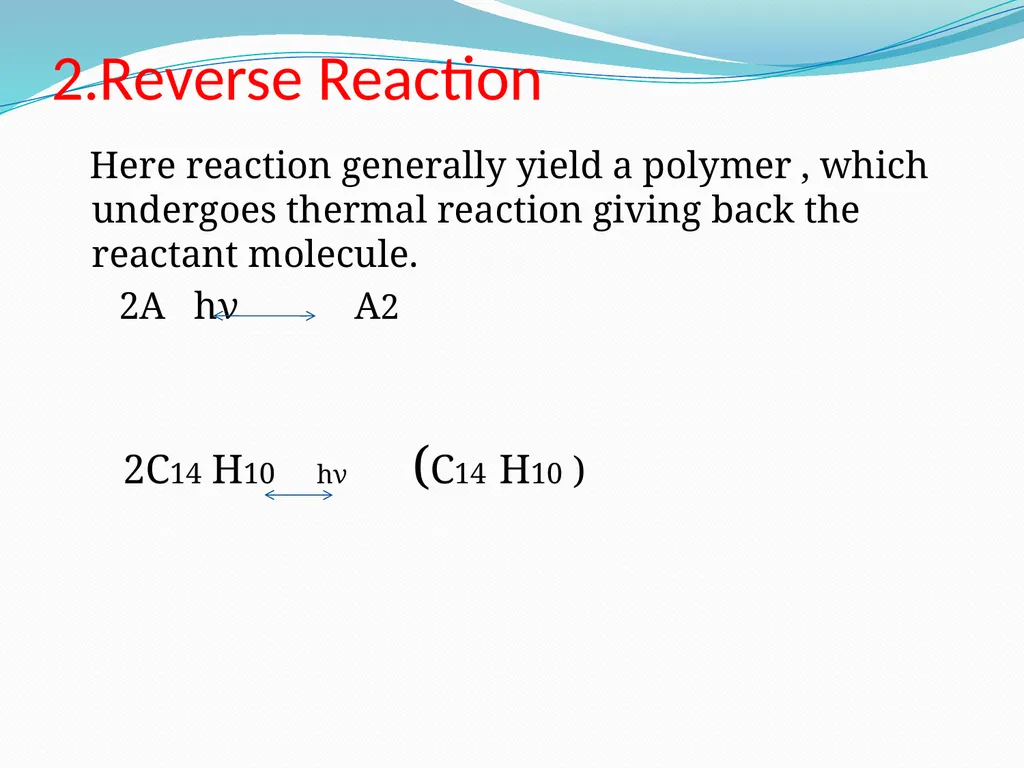
2.Reverse Reaction Here reaction generally yield a polymer , which undergoes thermal reaction giving back the reactant molecule.
2A hν A2
2C14 H10 hν (C14 H10 )<br>
2A hν A2
2C14 H10 hν (C14 H10 )<br>
29
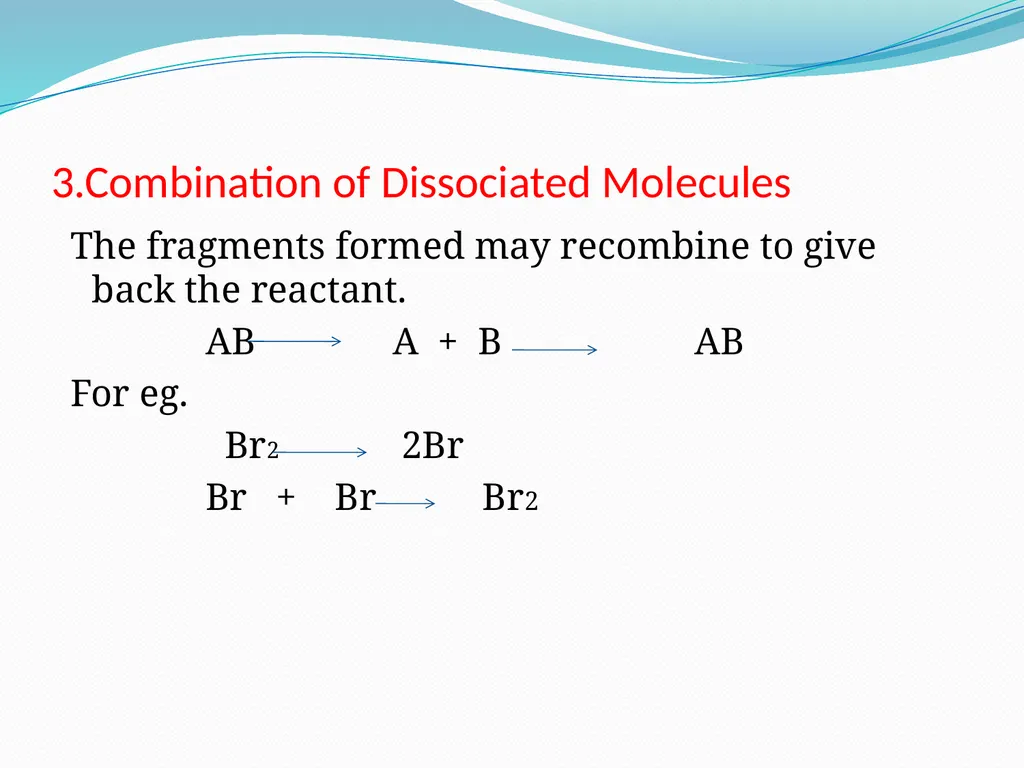
3.Combination of Dissociated Molecules The fragments formed may recombine to give back the reactant.
AB A + B AB
For eg.
Br2 2Br
Br + Br Br2<br>
AB A + B AB
For eg.
Br2 2Br
Br + Br Br2<br>
30
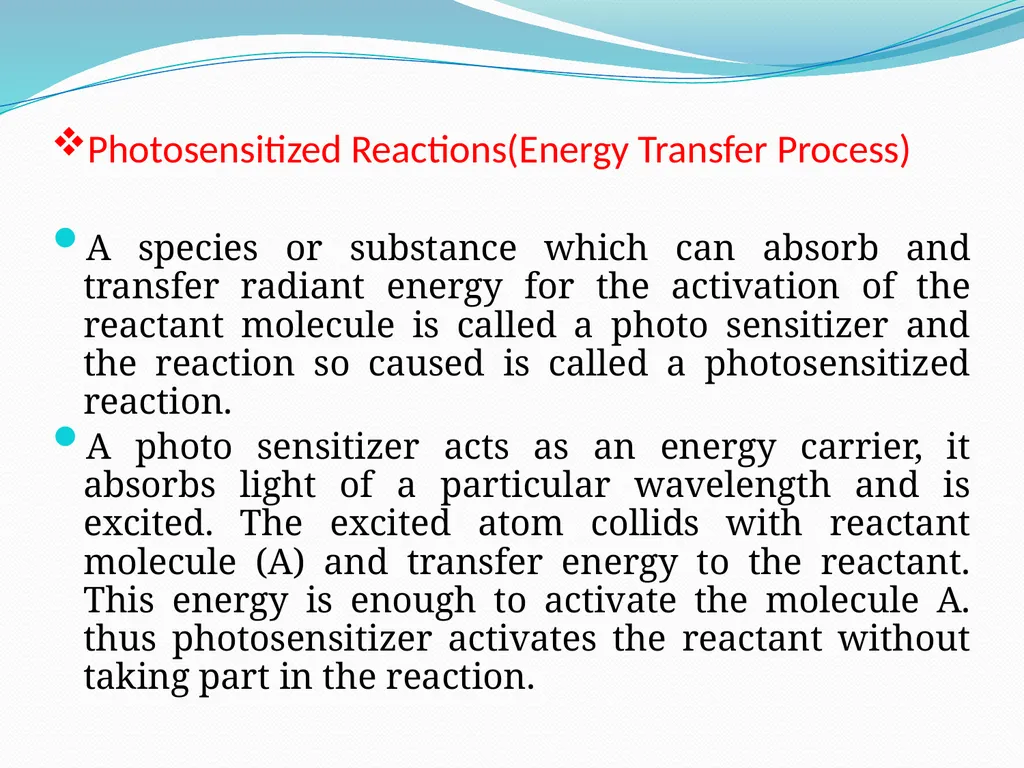
Photosensitized Reactions(Energy Transfer Process) A species or substance which can absorb and transfer radiant energy for the activation of the reactant molecule is called a photo sensitizer and the reaction so caused is called a photosensitized reaction.
A photo sensitizer acts as an energy carrier, it absorbs light of a particular wavelength and is excited. The excited atom collids with reactant molecule (A) and transfer energy to the reactant. This energy is enough to activate the molecule A. thus photosensitizer activates the reactant without taking part in the reaction.<br>
A photo sensitizer acts as an energy carrier, it absorbs light of a particular wavelength and is excited. The excited atom collids with reactant molecule (A) and transfer energy to the reactant. This energy is enough to activate the molecule A. thus photosensitizer activates the reactant without taking part in the reaction.<br>
31
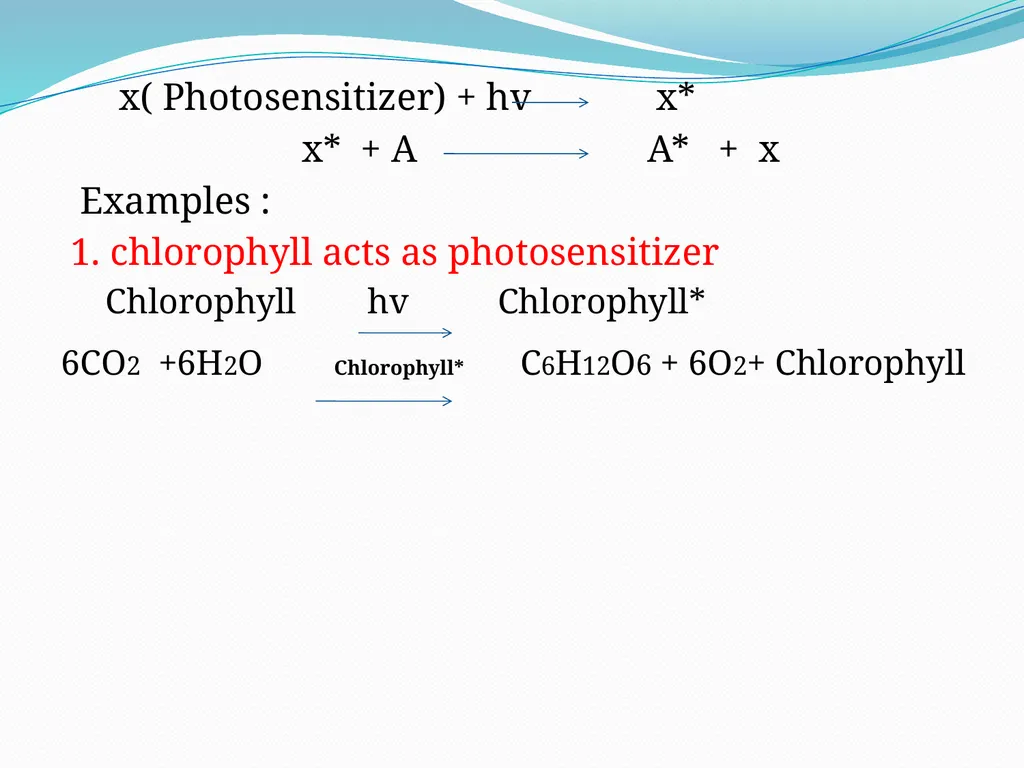
x( Photosensitizer) + hv x*
x* + A A* + x
Examples :
1. chlorophyll acts as photosensitizer
Chlorophyll hv Chlorophyll*
6CO2 +6H2O Chlorophyll* C6H12O6 + 6O2+ Chlorophyll<br>
x* + A A* + x
Examples :
1. chlorophyll acts as photosensitizer
Chlorophyll hv Chlorophyll*
6CO2 +6H2O Chlorophyll* C6H12O6 + 6O2+ Chlorophyll<br>
32
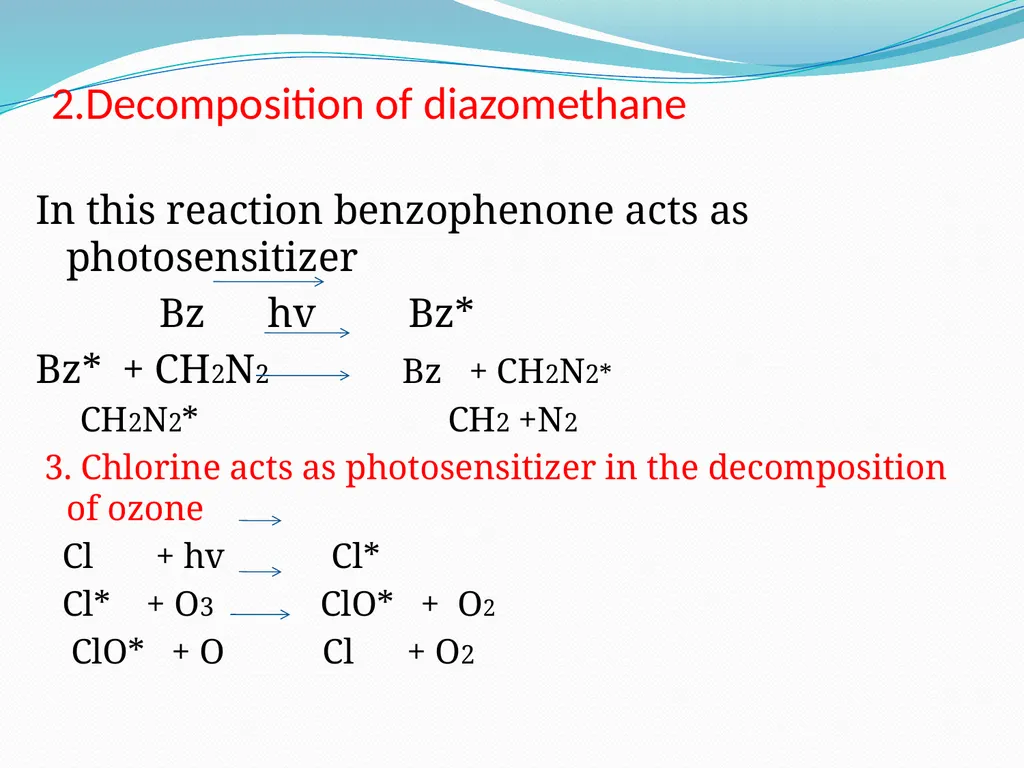
2.Decomposition of diazomethane In this reaction benzophenone acts as photosensitizer
Bz hv Bz*
Bz* + CH2N2 Bz + CH2N2*
CH2N2* CH2 +N2
3. Chlorine acts as photosensitizer in the decomposition of ozone
Cl + hv Cl*
Cl* + O3 ClO* + O2
ClO* + O Cl + O2<br>
Bz hv Bz*
Bz* + CH2N2 Bz + CH2N2*
CH2N2* CH2 +N2
3. Chlorine acts as photosensitizer in the decomposition of ozone
Cl + hv Cl*
Cl* + O3 ClO* + O2
ClO* + O Cl + O2<br>