Photosynthesis Lesson 1 The interrelationship between photosynthesis and respiration Learning Objectives Understand that light energy is used during photosynthesis to produce complex organic molecules. Understand why the products of
"Photosynthesis Lesson 1 The interrelationship" is the property of its rightful owner. Permission is granted to
download and print the materials on this website for personal, non-commercial use only, and to display it
on your personal computer provided you do not modify the materials and that you retain all copyright
notices contained in the materials. By downloading content from our website, you accept the terms of this
agreement.
Presentation Transcript
01
Photosynthesis Lesson 1 The interrelationship between photosynthesis and respiration<br>
02
Learning Objectives Understand that light energy is used during photosynthesis to produce complex organic molecules.
Understand why the products of photosynthesis are essential for respiration.<br>
03
Success Criteria State why plants are known as autotrophic and animals, heterotrophic.
Describe what the process of photosynthesis and respiration involve.
Explain the interrelationship between photosynthesis and respiration.<br>
04
Starter Watch this GCSE Bitesize classic to help you remember the key fundamentals of plants and photosynthesis!
https://www.youtube.com/watch?v=xEhvsXG8cNs<br>
05
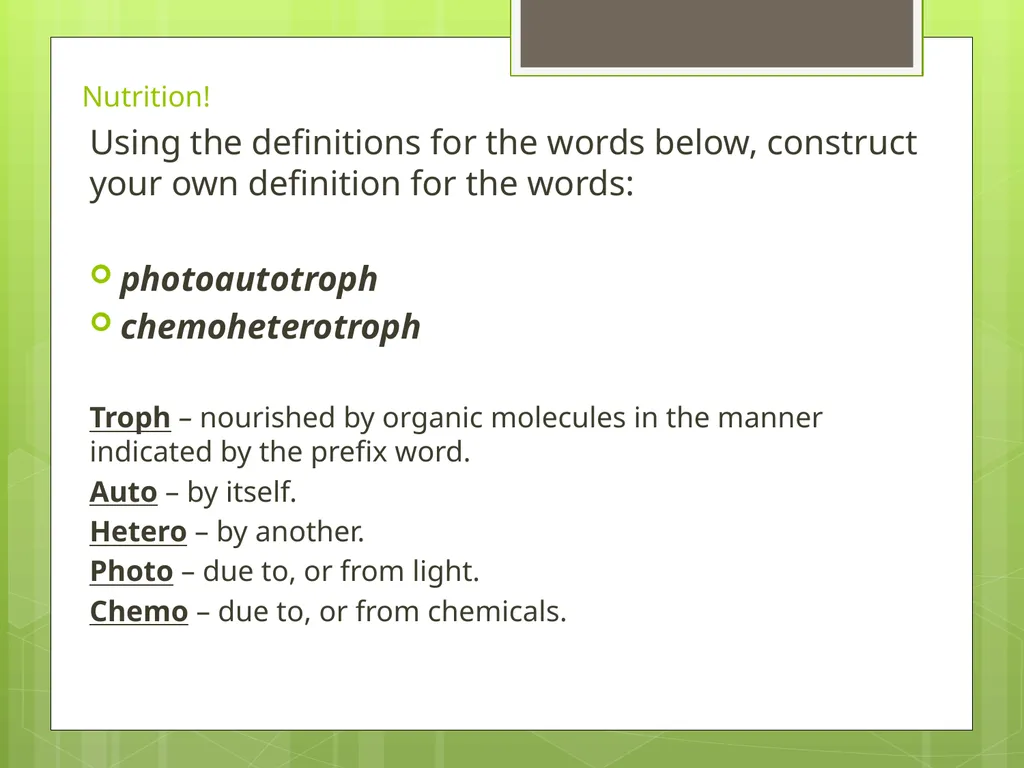
Nutrition! Using the definitions for the words below, construct your own definition for the words:
photoautotroph
chemoheterotroph
Troph – nourished by organic molecules in the manner indicated by the prefix word.
Auto – by itself.
Hetero – by another.
Photo – due to, or from light.
Chemo – due to, or from chemicals.<br>
06
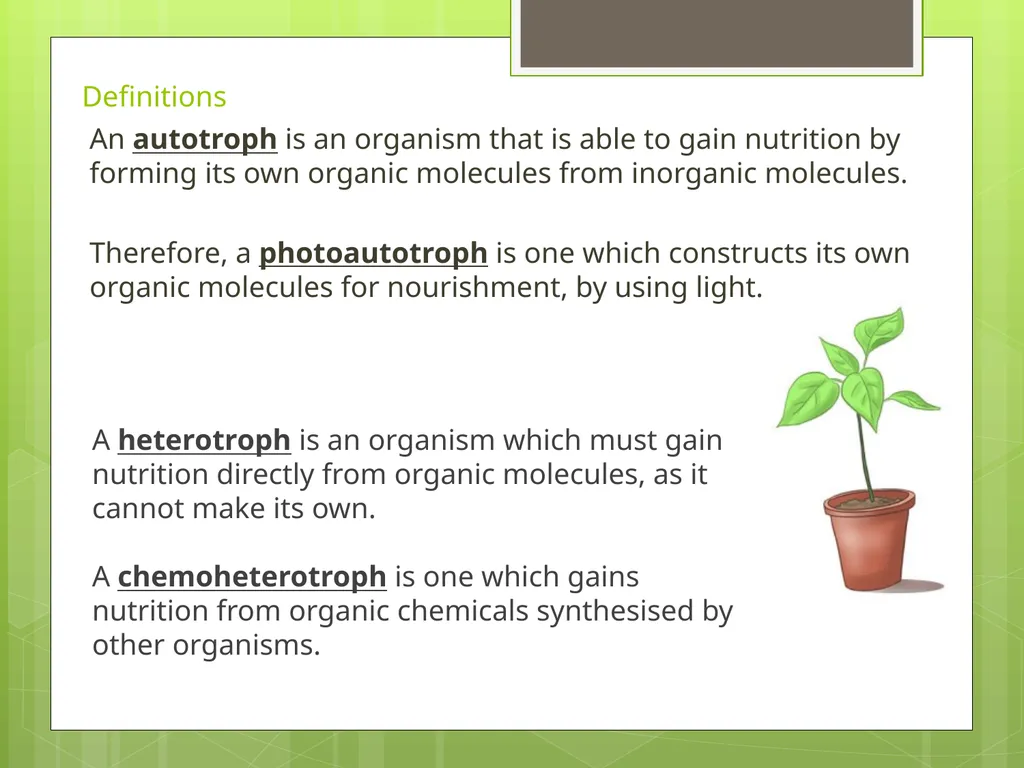
Definitions An autotroph is an organism that is able to gain nutrition by forming its own organic molecules from inorganic molecules.
Therefore, a photoautotroph is one which constructs its own organic molecules for nourishment, by using light. A heterotroph is an organism which must gain nutrition directly from organic molecules, as it cannot make its own.
A chemoheterotroph is one which gains nutrition from organic chemicals synthesised by other organisms.<br>
07
Can you think of an organism that could be described as both a photoautotroph and a chemoheterotroph? Venus Flytrap - Dionaea muscipula<br>
08
Mini whiteboard Questions Balanced symbol equation for photosynthesis
Balanced symbol equation for respiration
Where do the reactants for photosynthesis come from?
Where do the reactants for respiration come from?<br>
09
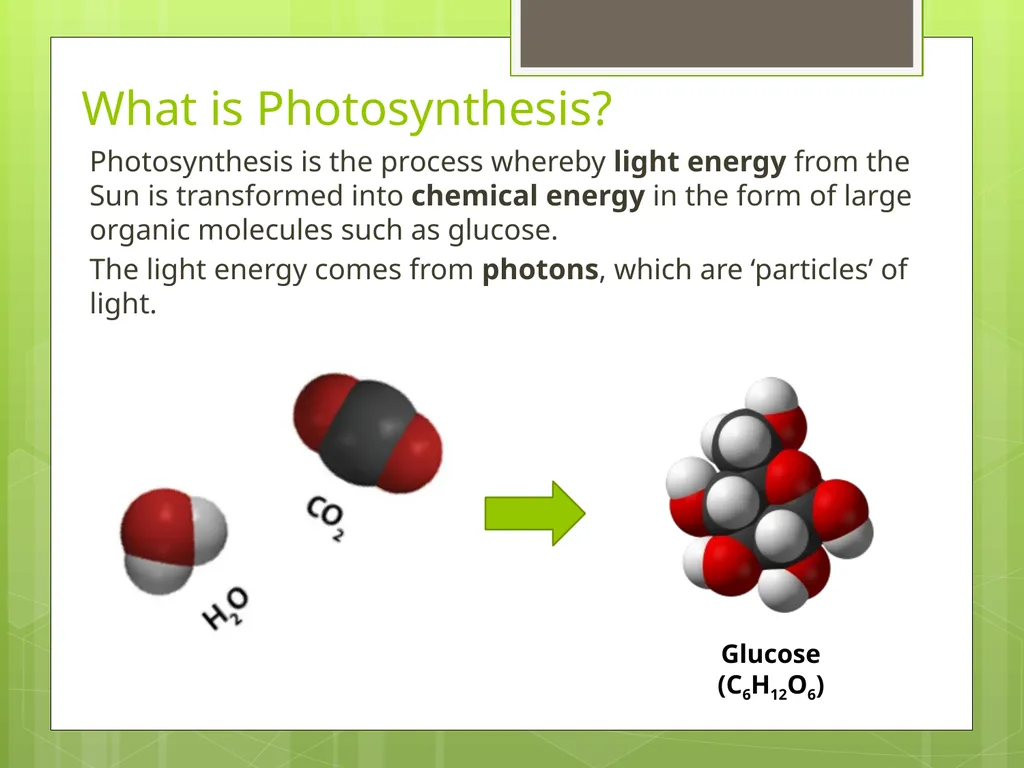
What is Photosynthesis? Photosynthesis is the process whereby light energy from the Sun is transformed into chemical energy in the form of large organic molecules such as glucose.
The light energy comes from photons, which are ‘particles’ of light. Glucose
(C6H12O6)<br>
10
Carbon Fixation Photosynthesis is an example of carbon fixation, which is an endothermic process (requires energy).
Carbon fixation is also a reduction reaction, which means it required the addition of electrons.
Carbon fixation helps to regulate the carbon dioxide concentration in the atmosphere and oceans.<br>
11
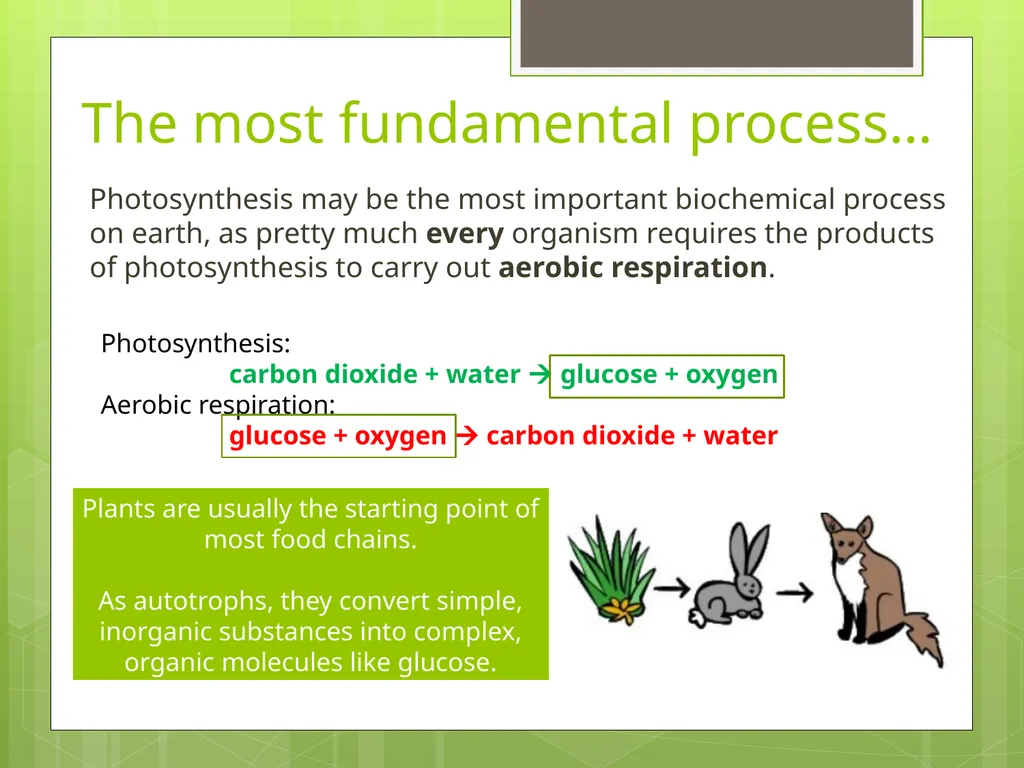
The most fundamental process… Photosynthesis may be the most important biochemical process on earth, as pretty much every organism requires the products of photosynthesis to carry out aerobic respiration. Photosynthesis:
carbon dioxide + water glucose + oxygen
Aerobic respiration:
glucose + oxygen carbon dioxide + water Plants are usually the starting point of most food chains.
As autotrophs, they convert simple, inorganic substances into complex, organic molecules like glucose.<br>
12
Respiration All living things respire.
This includes photosynthetic organisms – they are unique as they both respire and photosynthesise.
Unlike photosynthesis, respiration is exothermic.
Both photosynthesis and respiration are interrelated and are important in cycling carbon dioxide and oxygen in the atmosphere.
Why is it that plants can be kept in sealed containers?<br>
13
Plenary Task Explain why most forms of life on Earth rely on directly or indirectly on photosynthesis.
Use page 115 to find out what is meant by a plant’s compensation point.
Suggest which process – aerobic respiration or photosynthesis – evolved first on Earth. Give reasons for your answer.<br>
14
Learning Objectives Understand that light energy is used during photosynthesis to produce complex organic molecules.
Understand why the products of photosynthesis are essential for respiration.<br>
15
Success Criteria State why plants are known as autotrophic and animals, heterotrophic.
Describe what the process of photosynthesis and respiration involve.
Explain the interrelationship between photosynthesis and respiration.<br>