
PHY418 Particle Astrophysics Introduction: What is
LO
Published · 30 slides · 0 views

1 / 1
Description
PHY418 Particle Astrophysics Introduction: What is particle astrophysics? 1 What is particle astrophysics? Particle astrophysics is the use of particle physics techniques (experimental or theoretical) to address astrophysical questions.
Related Topics
Share
Embed code
Download this presentation From Below
"PHY418 Particle Astrophysics Introduction: What is" is the property of its rightful owner. Permission is granted to download and print the materials on this website for personal, non-commercial use only, and to display it on your personal computer provided you do not modify the materials and that you retain all copyright notices contained in the materials. By downloading content from our website, you accept the terms of this agreement.
Presentation Transcript
01
PHY418 Particle Astrophysics Introduction: What is particle astrophysics? 1<br>
02
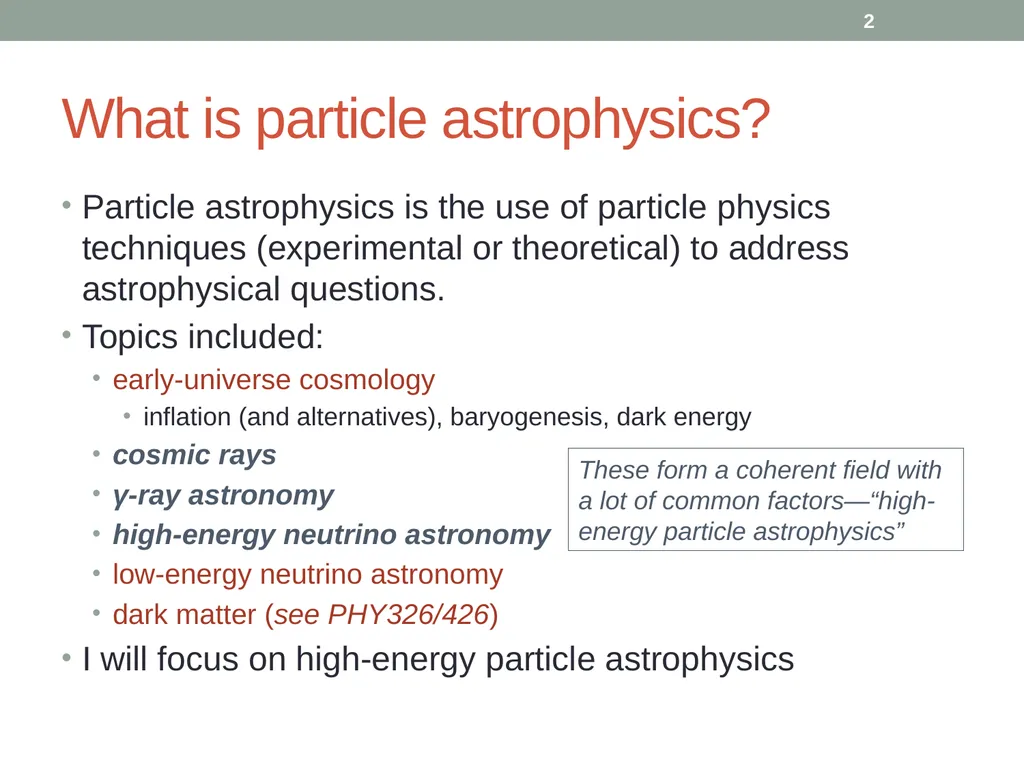
What is particle astrophysics? Particle astrophysics is the use of particle physics techniques (experimental or theoretical) to address astrophysical questions.
Topics included:
early-universe cosmology
inflation (and alternatives), baryogenesis, dark energy
cosmic rays
γ-ray astronomy
high-energy neutrino astronomy
low-energy neutrino astronomy
dark matter (see PHY326/426)
I will focus on high-energy particle astrophysics These form a coherent field with a lot of common factors—“high-energy particle astrophysics” 2<br>
Topics included:
early-universe cosmology
inflation (and alternatives), baryogenesis, dark energy
cosmic rays
γ-ray astronomy
high-energy neutrino astronomy
low-energy neutrino astronomy
dark matter (see PHY326/426)
I will focus on high-energy particle astrophysics These form a coherent field with a lot of common factors—“high-energy particle astrophysics” 2<br>
03
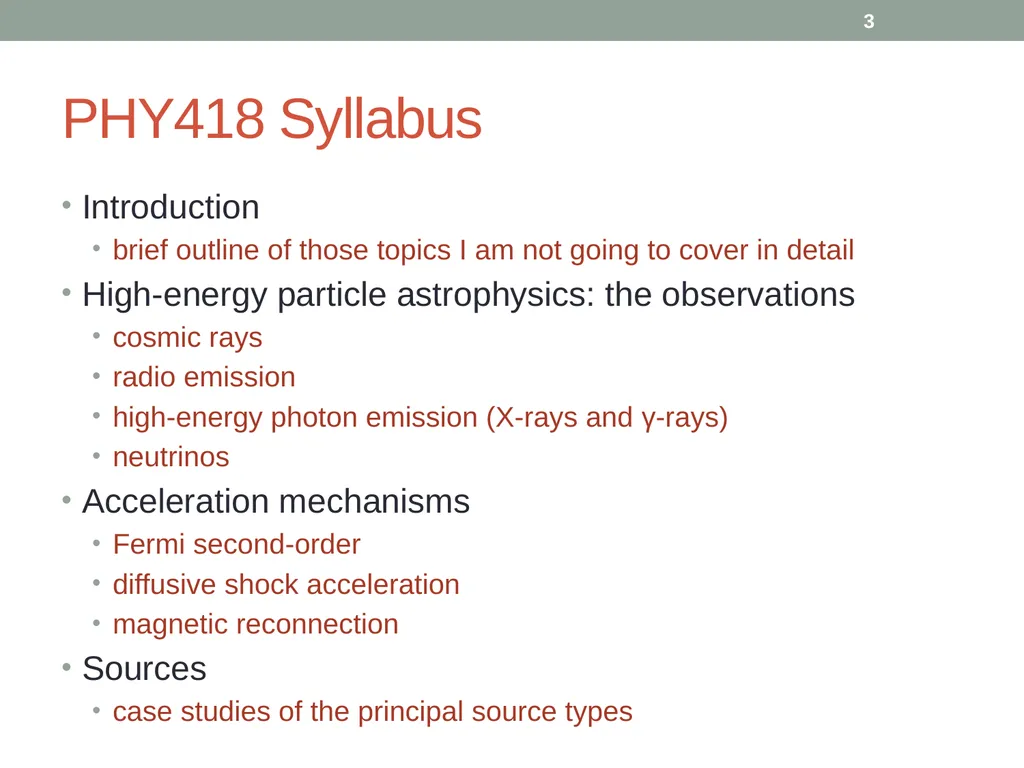
PHY418 Syllabus Introduction
brief outline of those topics I am not going to cover in detail
High-energy particle astrophysics: the observations
cosmic rays
radio emission
high-energy photon emission (X-rays and γ-rays)
neutrinos
Acceleration mechanisms
Fermi second-order
diffusive shock acceleration
magnetic reconnection
Sources
case studies of the principal source types 3<br>
brief outline of those topics I am not going to cover in detail
High-energy particle astrophysics: the observations
cosmic rays
radio emission
high-energy photon emission (X-rays and γ-rays)
neutrinos
Acceleration mechanisms
Fermi second-order
diffusive shock acceleration
magnetic reconnection
Sources
case studies of the principal source types 3<br>
04
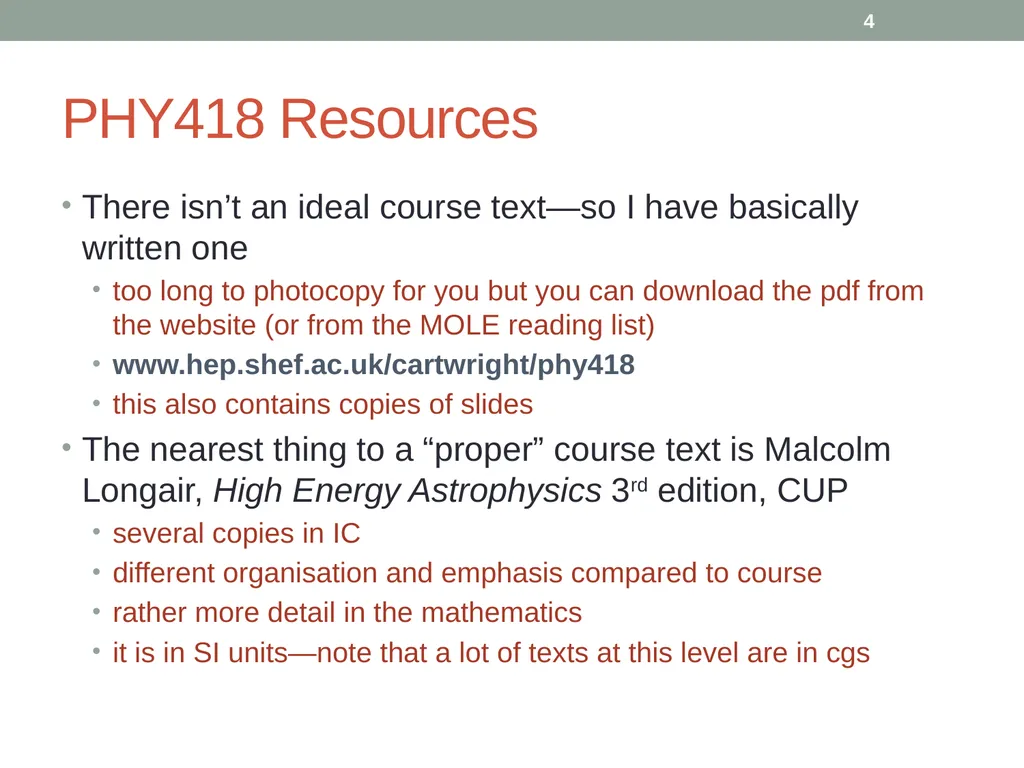
PHY418 Resources There isn’t an ideal course text—so I have basically written one
too long to photocopy for you but you can download the pdf from the website (or from the MOLE reading list)
www.hep.shef.ac.uk/cartwright/phy418
this also contains copies of slides
The nearest thing to a “proper” course text is Malcolm Longair, High Energy Astrophysics 3rd edition, CUP
several copies in IC
different organisation and emphasis compared to course
rather more detail in the mathematics
it is in SI units—note that a lot of texts at this level are in cgs 4<br>
too long to photocopy for you but you can download the pdf from the website (or from the MOLE reading list)
www.hep.shef.ac.uk/cartwright/phy418
this also contains copies of slides
The nearest thing to a “proper” course text is Malcolm Longair, High Energy Astrophysics 3rd edition, CUP
several copies in IC
different organisation and emphasis compared to course
rather more detail in the mathematics
it is in SI units—note that a lot of texts at this level are in cgs 4<br>
05
PHY418 Assessment End-of-semester exam (85%)
One compulsory question (30 marks)
Any two from four optional questions (20 marks each)
A practice exam will be provided since this is a new module
Also short class tests (15%)
designed to test your ability to apply the taught material to problems
similar to exam questions (but without bookwork)
3 (two during Observations, and one after Acceleration Mechanisms)
open notes format 5<br>
One compulsory question (30 marks)
Any two from four optional questions (20 marks each)
A practice exam will be provided since this is a new module
Also short class tests (15%)
designed to test your ability to apply the taught material to problems
similar to exam questions (but without bookwork)
3 (two during Observations, and one after Acceleration Mechanisms)
open notes format 5<br>
06
Introduction to Particle Astrophysics Early-universe cosmology 6<br>
07
Early-universe cosmology In the early universe, energies are extremely high
appropriate physics is very high-energy particle physics
GUTs, string theory??
consequences in early universe
inflation (breakdown of GUT?)
baryogenesis (matter-antimatter asymmetry)
consequences in later universe
dark energy (vacuum energy? scalar field?)
dark matter (lightest supersymmetric particle? axion?)
Particle physics of early universe is very difficult to test
energies are much too high for feasible accelerators 7<br>
appropriate physics is very high-energy particle physics
GUTs, string theory??
consequences in early universe
inflation (breakdown of GUT?)
baryogenesis (matter-antimatter asymmetry)
consequences in later universe
dark energy (vacuum energy? scalar field?)
dark matter (lightest supersymmetric particle? axion?)
Particle physics of early universe is very difficult to test
energies are much too high for feasible accelerators 7<br>
08
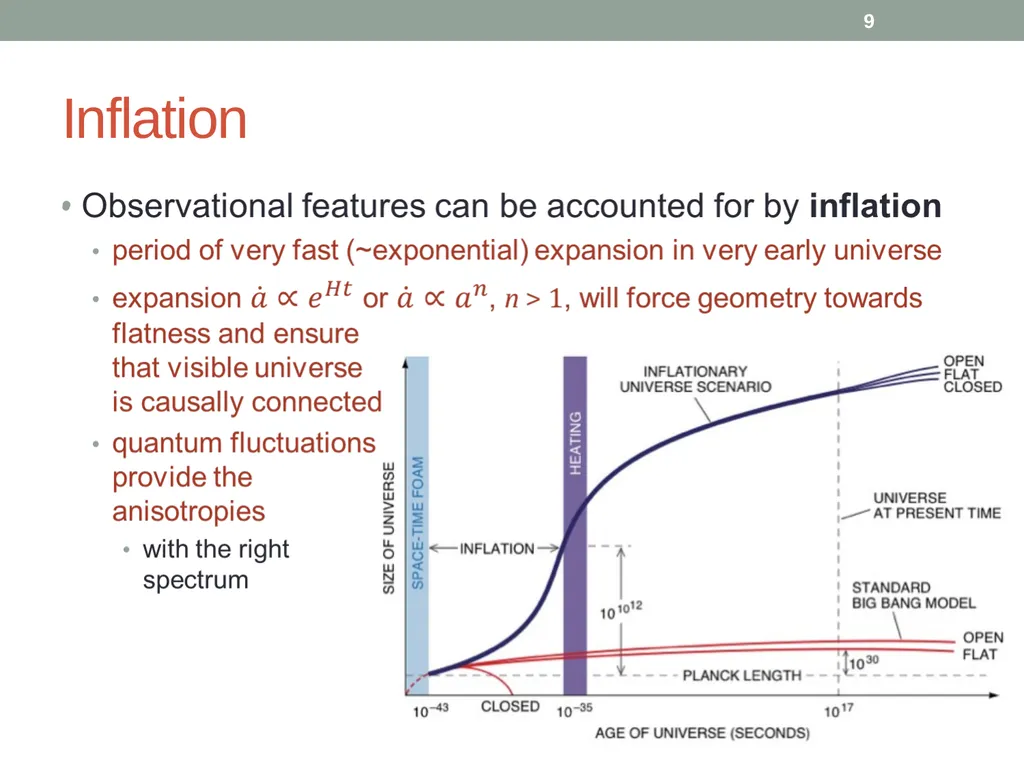
Inflation Observational evidence shows that the universe is
geometrically flat (k = 0 in Robertson-Walker metric)
extremely uniform at early times (ΔT/T ~ 10−5 in CMB)
not precisely uniform (with nearly scale invariant fluctuations)
These properties are unexpected in the classical Big Bang model
no reason in GR why overall geometry should be flat
and if it is not flat originally it evolves rapidly in the direction of increased curvature
no expectation that the CMB temperature should be uniform
horizon distance expands faster than universe, so causally connected regions at ~400000 years correspond to only ~2° on sky now
if initial conditions force it to be uniform, no explanation for the fact that it is not quite uniform 8 notes section 1.2.1<br>
geometrically flat (k = 0 in Robertson-Walker metric)
extremely uniform at early times (ΔT/T ~ 10−5 in CMB)
not precisely uniform (with nearly scale invariant fluctuations)
These properties are unexpected in the classical Big Bang model
no reason in GR why overall geometry should be flat
and if it is not flat originally it evolves rapidly in the direction of increased curvature
no expectation that the CMB temperature should be uniform
horizon distance expands faster than universe, so causally connected regions at ~400000 years correspond to only ~2° on sky now
if initial conditions force it to be uniform, no explanation for the fact that it is not quite uniform 8 notes section 1.2.1<br>
09
Inflation 9<br>
10
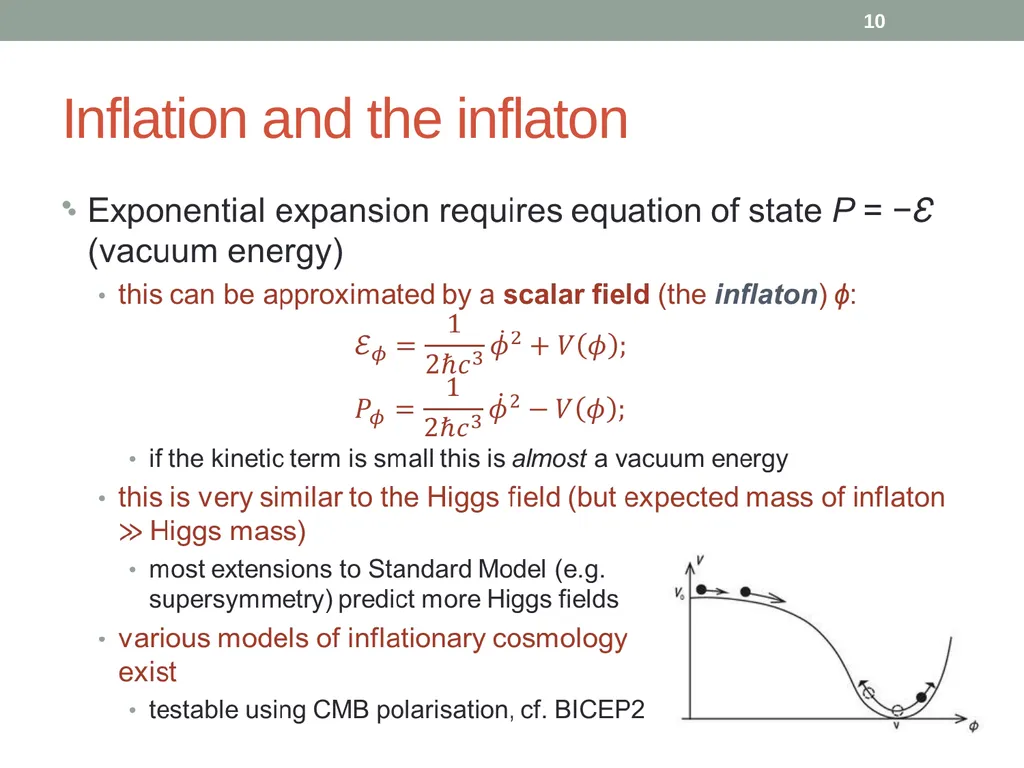
Inflation and the inflaton 10<br>
11
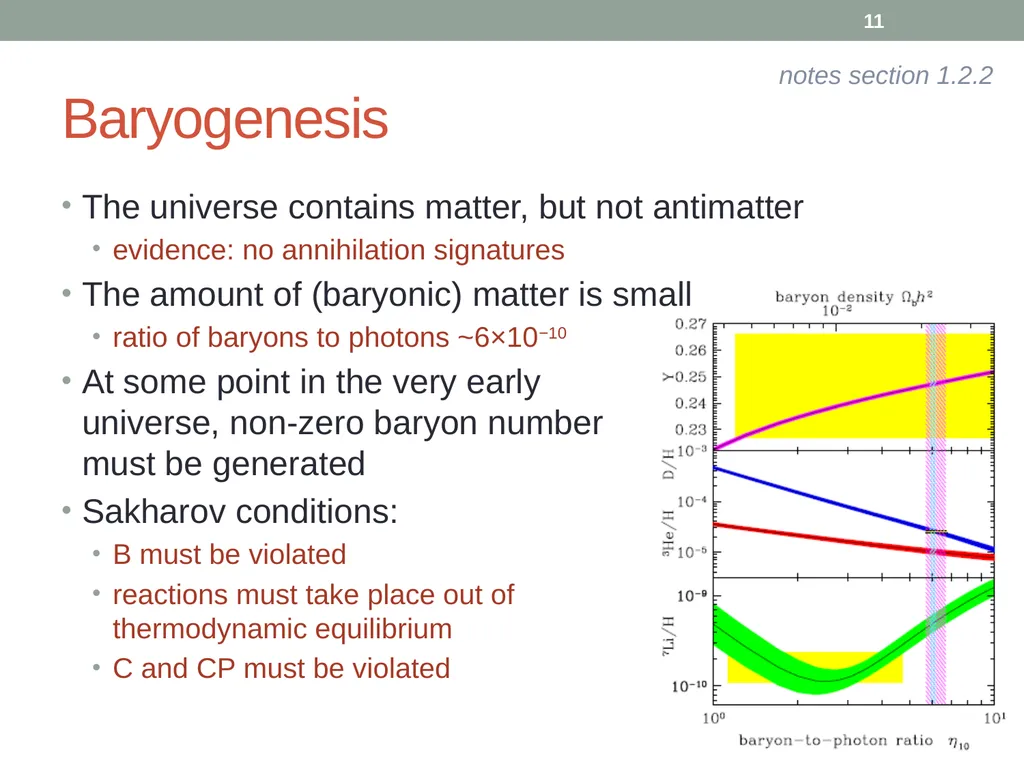
Baryogenesis The universe contains matter, but not antimatter
evidence: no annihilation signatures
The amount of (baryonic) matter is small
ratio of baryons to photons ~6×10⁻¹⁰
At some point in the very early universe, non-zero baryon number must be generated
Sakharov conditions:
B must be violated
reactions must take place out of thermodynamic equilibrium
C and CP must be violated 11 notes section 1.2.2<br>
evidence: no annihilation signatures
The amount of (baryonic) matter is small
ratio of baryons to photons ~6×10⁻¹⁰
At some point in the very early universe, non-zero baryon number must be generated
Sakharov conditions:
B must be violated
reactions must take place out of thermodynamic equilibrium
C and CP must be violated 11 notes section 1.2.2<br>
12
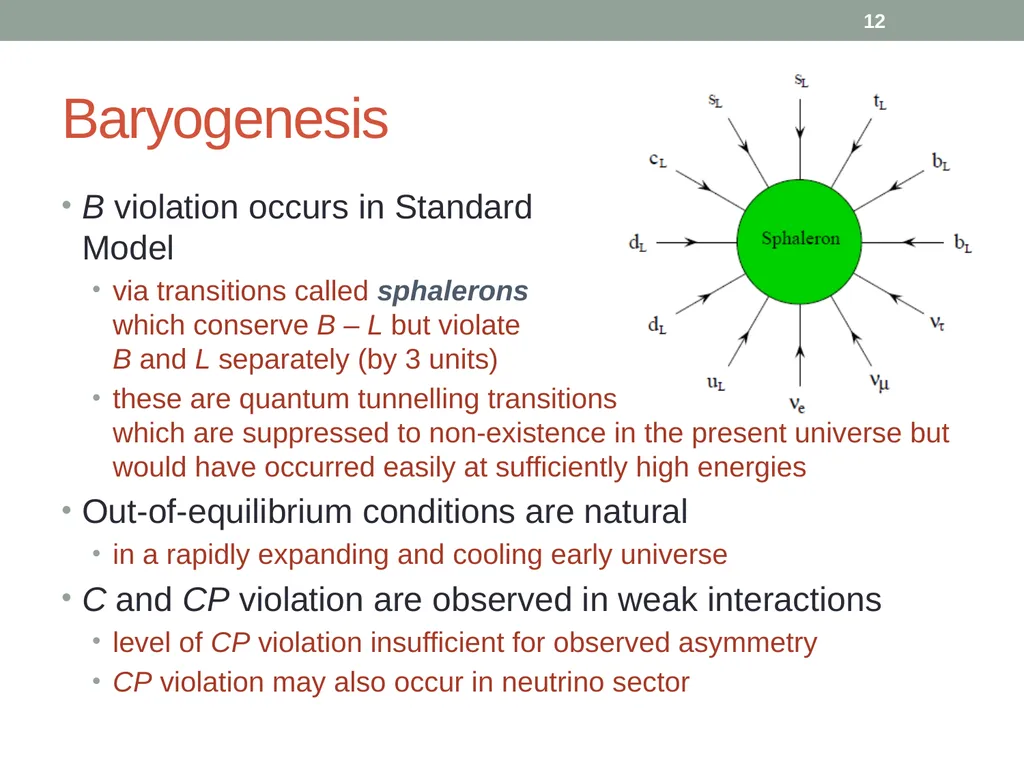
Baryogenesis B violation occurs in Standard
Model
via transitions called sphalerons which conserve B – L but violate B and L separately (by 3 units)
these are quantum tunnelling transitions which are suppressed to non-existence in the present universe but would have occurred easily at sufficiently high energies
Out-of-equilibrium conditions are natural
in a rapidly expanding and cooling early universe
C and CP violation are observed in weak interactions
level of CP violation insufficient for observed asymmetry
CP violation may also occur in neutrino sector 12<br>
via transitions called sphalerons which conserve B – L but violate B and L separately (by 3 units)
these are quantum tunnelling transitions which are suppressed to non-existence in the present universe but would have occurred easily at sufficiently high energies
Out-of-equilibrium conditions are natural
in a rapidly expanding and cooling early universe
C and CP violation are observed in weak interactions
level of CP violation insufficient for observed asymmetry
CP violation may also occur in neutrino sector 12<br>
13
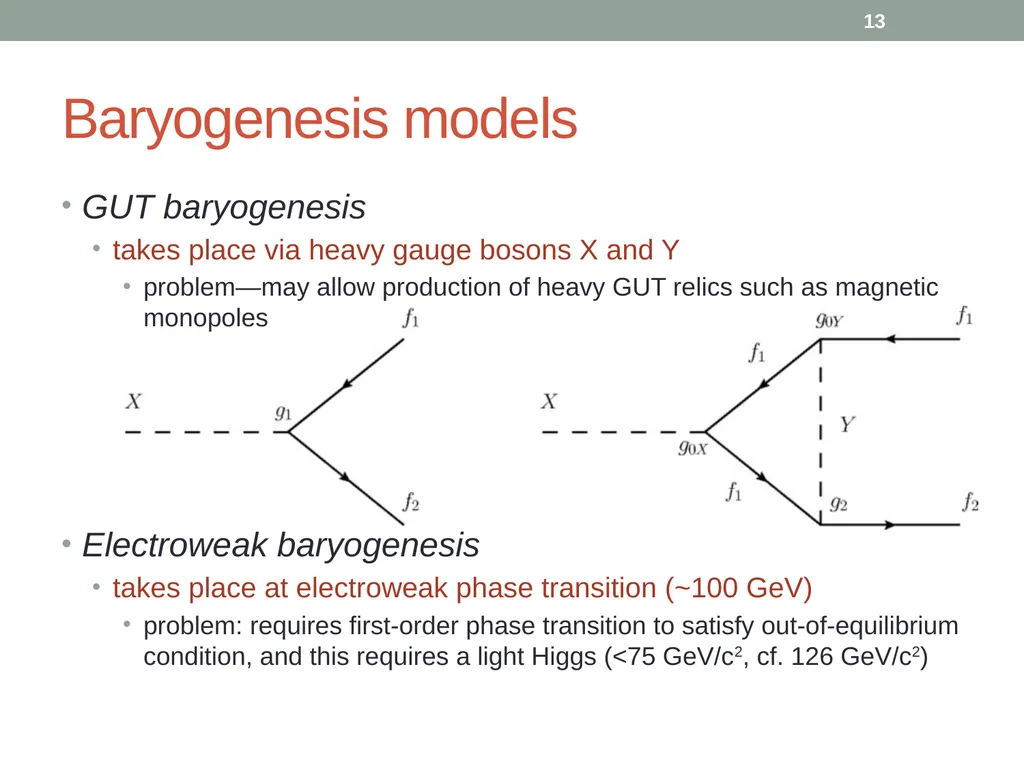
Baryogenesis models GUT baryogenesis
takes place via heavy gauge bosons X and Y
problem—may allow production of heavy GUT relics such as magnetic monopoles
Electroweak baryogenesis
takes place at electroweak phase transition (~100 GeV)
problem: requires first-order phase transition to satisfy out-of-equilibrium condition, and this requires a light Higgs (<75 GeV/c2, cf. 126 GeV/c2) 13<br>
takes place via heavy gauge bosons X and Y
problem—may allow production of heavy GUT relics such as magnetic monopoles
Electroweak baryogenesis
takes place at electroweak phase transition (~100 GeV)
problem: requires first-order phase transition to satisfy out-of-equilibrium condition, and this requires a light Higgs (<75 GeV/c2, cf. 126 GeV/c2) 13<br>
14
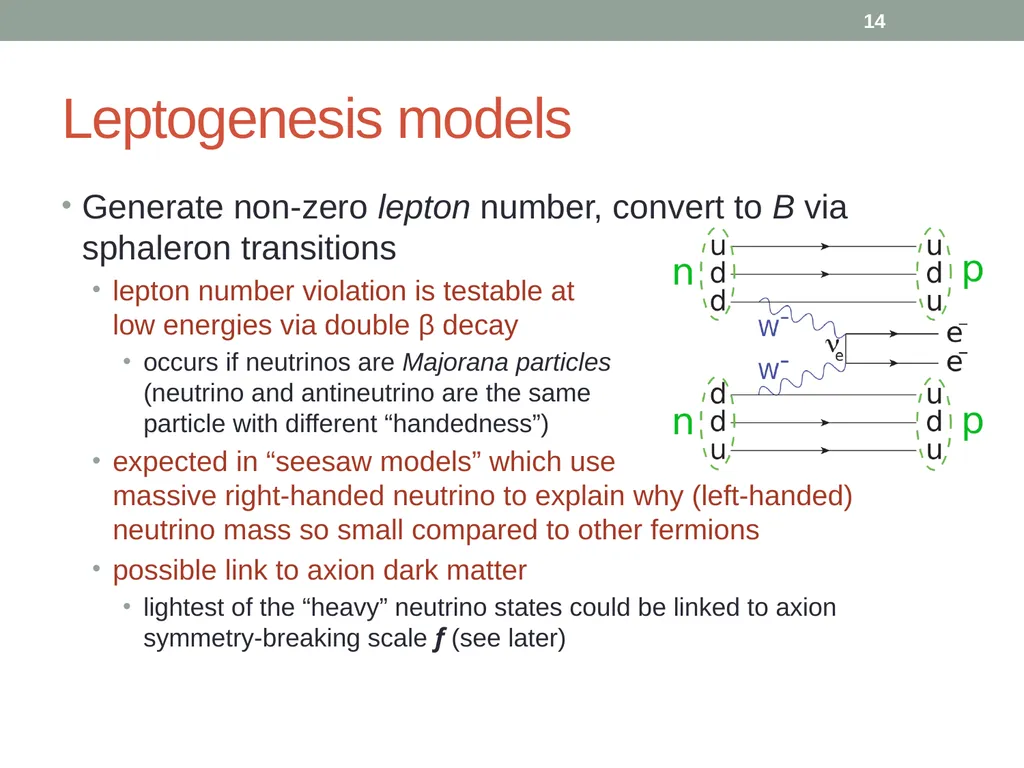
Leptogenesis models Generate non-zero lepton number, convert to B via sphaleron transitions
lepton number violation is testable at low energies via double β decay
occurs if neutrinos are Majorana particles (neutrino and antineutrino are the same particle with different “handedness”)
expected in “seesaw models” which use massive right-handed neutrino to explain why (left-handed) neutrino mass so small compared to other fermions
possible link to axion dark matter
lightest of the “heavy” neutrino states could be linked to axion symmetry-breaking scale f (see later) 14<br>
lepton number violation is testable at low energies via double β decay
occurs if neutrinos are Majorana particles (neutrino and antineutrino are the same particle with different “handedness”)
expected in “seesaw models” which use massive right-handed neutrino to explain why (left-handed) neutrino mass so small compared to other fermions
possible link to axion dark matter
lightest of the “heavy” neutrino states could be linked to axion symmetry-breaking scale f (see later) 14<br>
15
Introduction to Particle Astrophysics Dark Energy and Dark Matter 15<br>
16
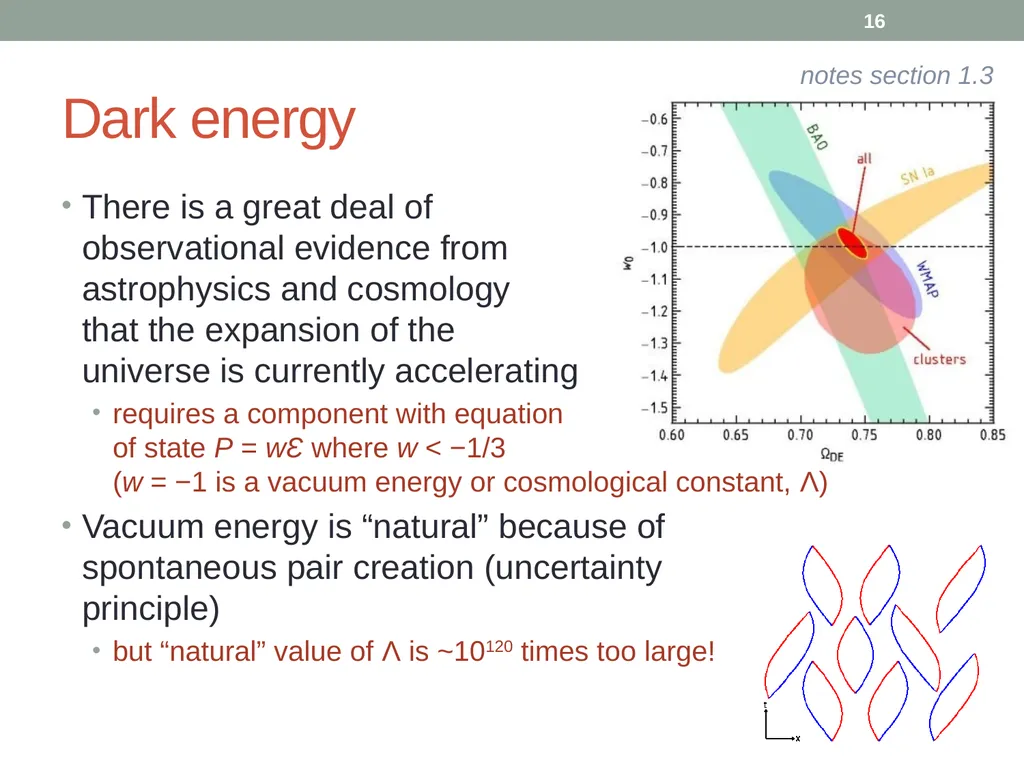
Dark energy There is a great deal of
observational evidence from
astrophysics and cosmology
that the expansion of the
universe is currently accelerating
requires a component with equation of state P = wƐ where w < −1/3 (w = −1 is a vacuum energy or cosmological constant, Λ)
Vacuum energy is “natural” because of spontaneous pair creation (uncertainty principle)
but “natural” value of Λ is ~10120 times too large! 16 notes section 1.3<br>
requires a component with equation of state P = wƐ where w < −1/3 (w = −1 is a vacuum energy or cosmological constant, Λ)
Vacuum energy is “natural” because of spontaneous pair creation (uncertainty principle)
but “natural” value of Λ is ~10120 times too large! 16 notes section 1.3<br>
17
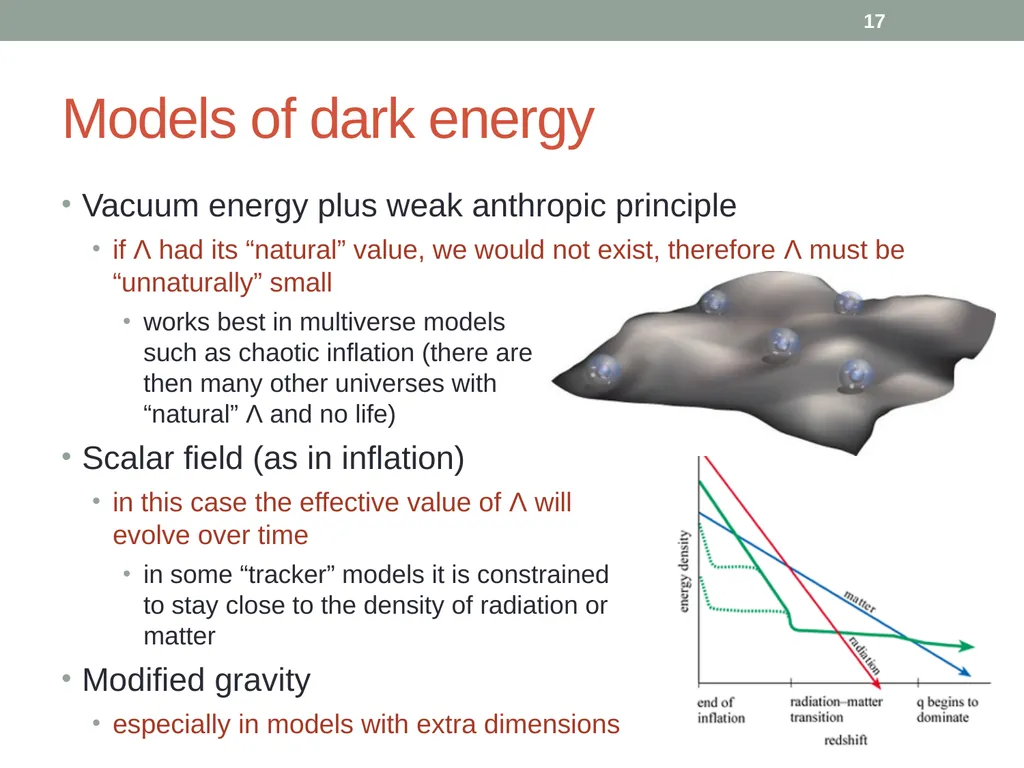
Models of dark energy Vacuum energy plus weak anthropic principle
if Λ had its “natural” value, we would not exist, therefore Λ must be “unnaturally” small
works best in multiverse models such as chaotic inflation (there are then many other universes with “natural” Λ and no life)
Scalar field (as in inflation)
in this case the effective value of Λ will evolve over time
in some “tracker” models it is constrained to stay close to the density of radiation or matter
Modified gravity
especially in models with extra dimensions 17<br>
if Λ had its “natural” value, we would not exist, therefore Λ must be “unnaturally” small
works best in multiverse models such as chaotic inflation (there are then many other universes with “natural” Λ and no life)
Scalar field (as in inflation)
in this case the effective value of Λ will evolve over time
in some “tracker” models it is constrained to stay close to the density of radiation or matter
Modified gravity
especially in models with extra dimensions 17<br>
18
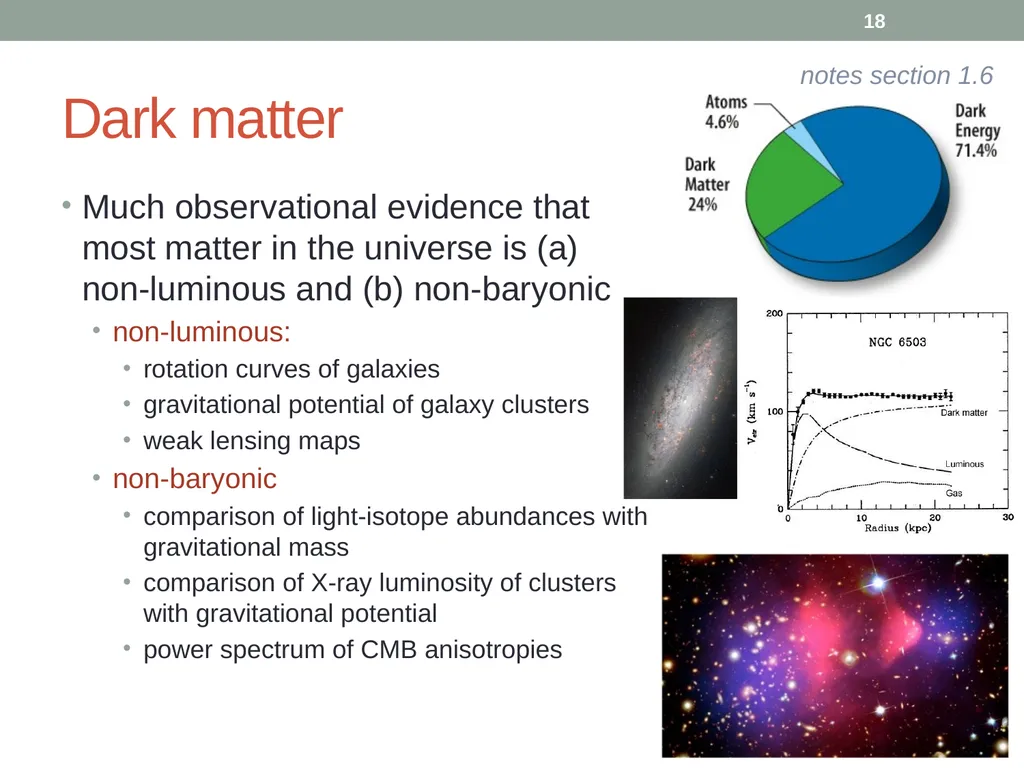
Dark matter Much observational evidence that
most matter in the universe is (a)
non-luminous and (b) non-baryonic
non-luminous:
rotation curves of galaxies
gravitational potential of galaxy clusters
weak lensing maps
non-baryonic
comparison of light-isotope abundances with gravitational mass
comparison of X-ray luminosity of clusters with gravitational potential
power spectrum of CMB anisotropies 18 notes section 1.6<br>
non-luminous:
rotation curves of galaxies
gravitational potential of galaxy clusters
weak lensing maps
non-baryonic
comparison of light-isotope abundances with gravitational mass
comparison of X-ray luminosity of clusters with gravitational potential
power spectrum of CMB anisotropies 18 notes section 1.6<br>
19
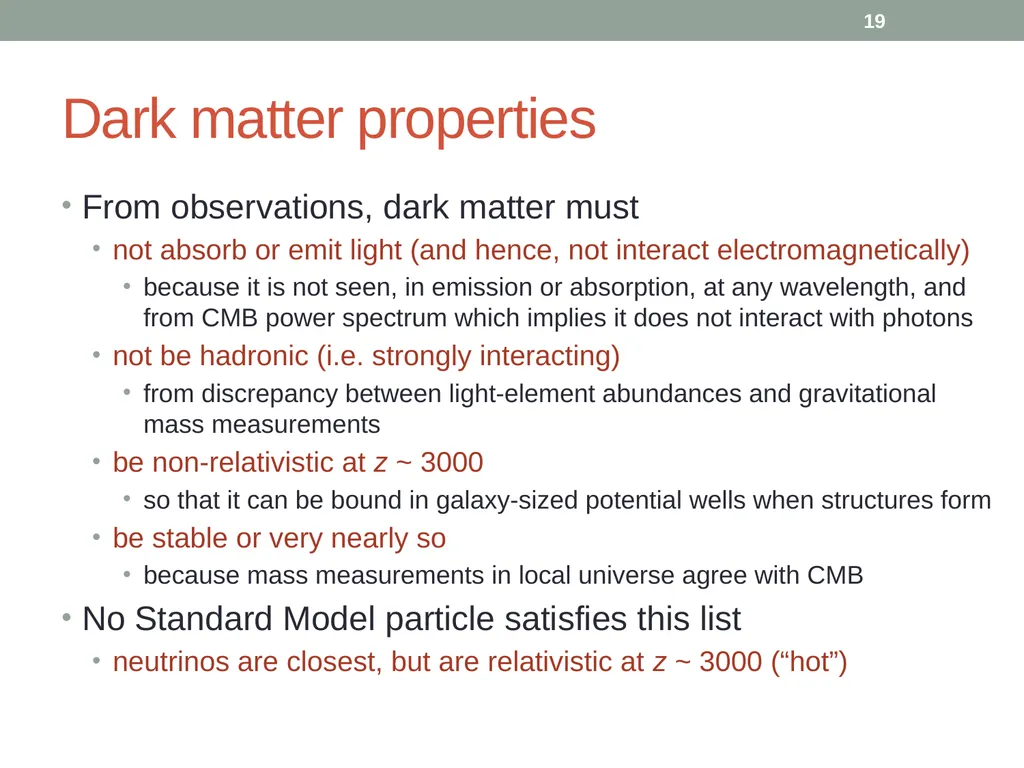
Dark matter properties From observations, dark matter must
not absorb or emit light (and hence, not interact electromagnetically)
because it is not seen, in emission or absorption, at any wavelength, and from CMB power spectrum which implies it does not interact with photons
not be hadronic (i.e. strongly interacting)
from discrepancy between light-element abundances and gravitational mass measurements
be non-relativistic at z ~ 3000
so that it can be bound in galaxy-sized potential wells when structures form
be stable or very nearly so
because mass measurements in local universe agree with CMB
No Standard Model particle satisfies this list
neutrinos are closest, but are relativistic at z ~ 3000 (“hot”) 19<br>
not absorb or emit light (and hence, not interact electromagnetically)
because it is not seen, in emission or absorption, at any wavelength, and from CMB power spectrum which implies it does not interact with photons
not be hadronic (i.e. strongly interacting)
from discrepancy between light-element abundances and gravitational mass measurements
be non-relativistic at z ~ 3000
so that it can be bound in galaxy-sized potential wells when structures form
be stable or very nearly so
because mass measurements in local universe agree with CMB
No Standard Model particle satisfies this list
neutrinos are closest, but are relativistic at z ~ 3000 (“hot”) 19<br>
20
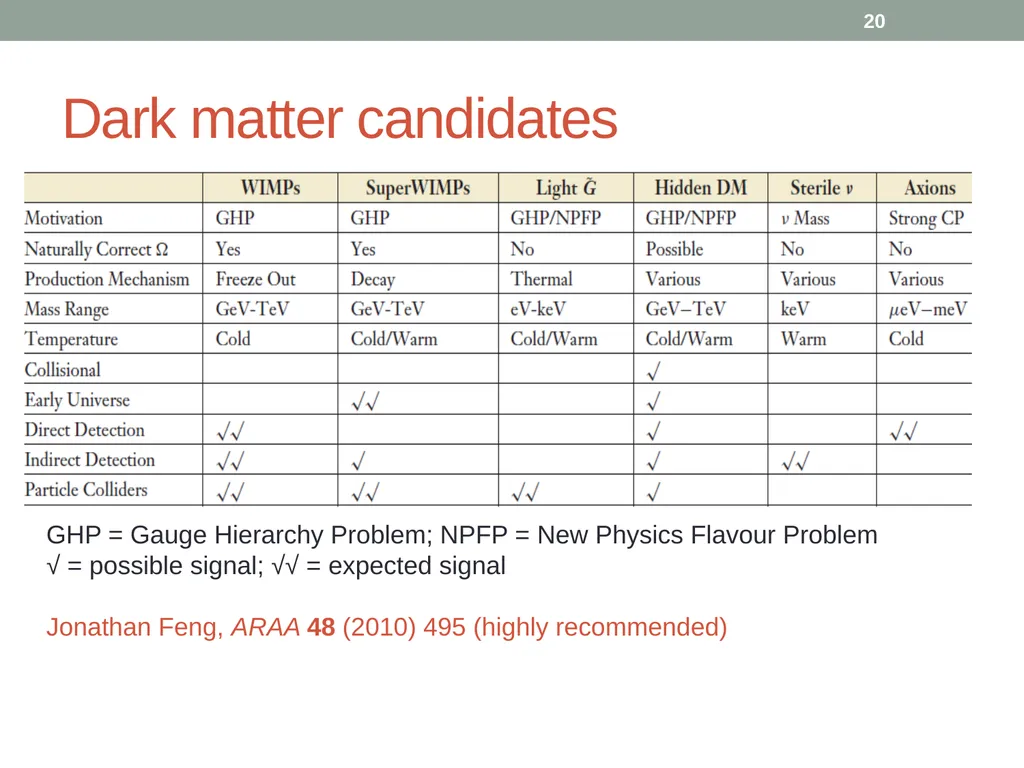
Dark matter candidates 20 GHP = Gauge Hierarchy Problem; NPFP = New Physics Flavour Problem
√ = possible signal; √√ = expected signal
Jonathan Feng, ARAA 48 (2010) 495 (highly recommended)<br>
√ = possible signal; √√ = expected signal
Jonathan Feng, ARAA 48 (2010) 495 (highly recommended)<br>
21
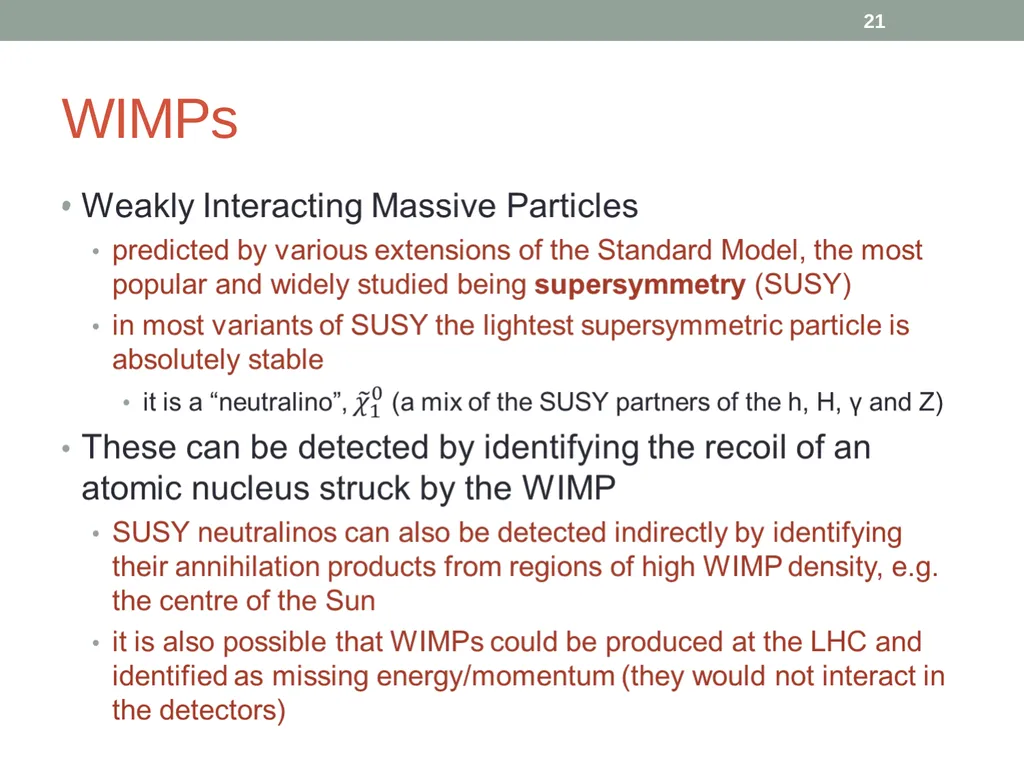
WIMPs 21<br>
22
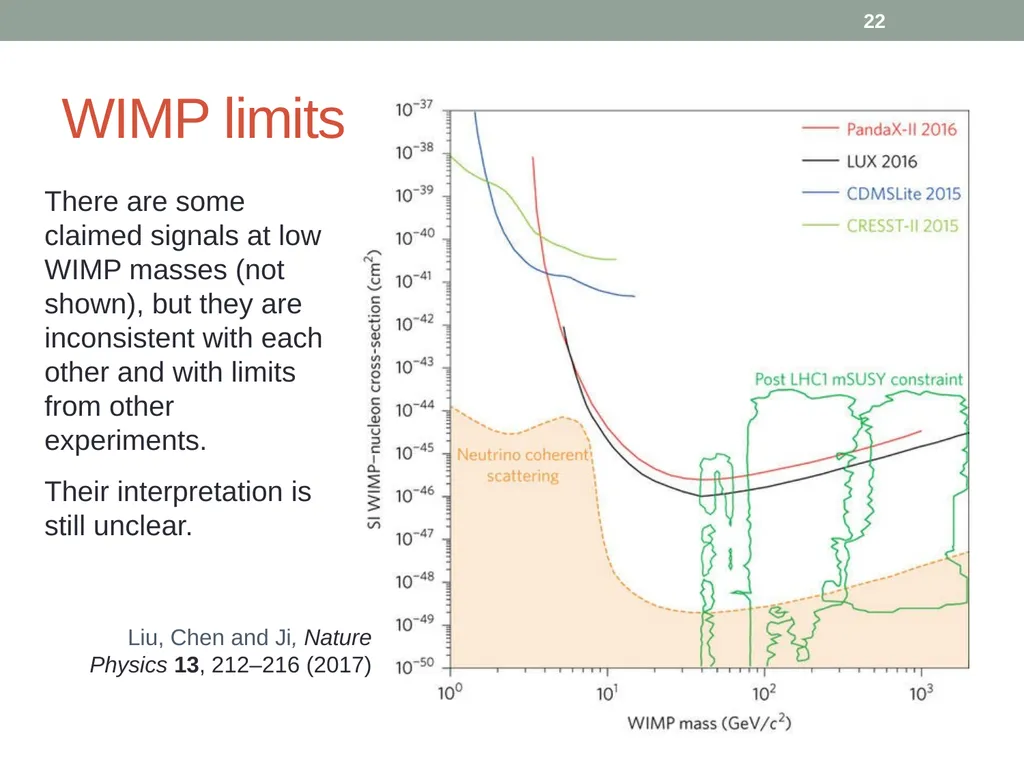
WIMP limits 22 Liu, Chen and Ji, Nature Physics 13, 212–216 (2017) There are some claimed signals at low WIMP masses (not shown), but they are inconsistent with each other and with limits from other experiments.
Their interpretation is still unclear.<br>
Their interpretation is still unclear.<br>
23
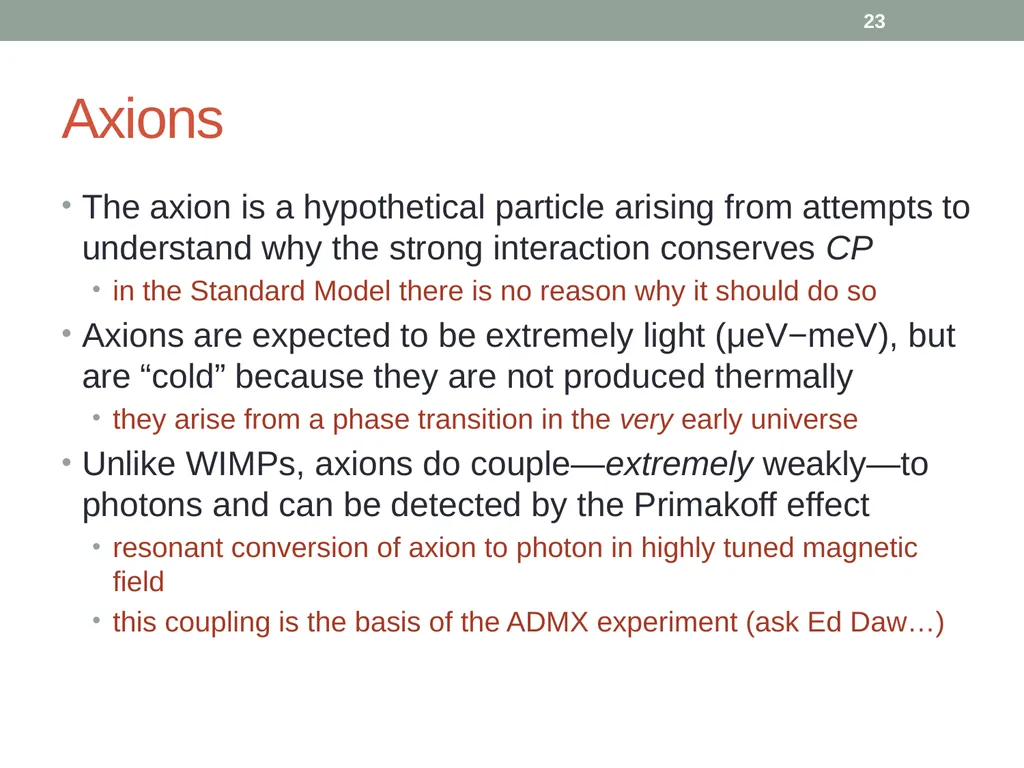
Axions The axion is a hypothetical particle arising from attempts to understand why the strong interaction conserves CP
in the Standard Model there is no reason why it should do so
Axions are expected to be extremely light (μeV−meV), but are “cold” because they are not produced thermally
they arise from a phase transition in the very early universe
Unlike WIMPs, axions do couple—extremely weakly—to photons and can be detected by the Primakoff effect
resonant conversion of axion to photon in highly tuned magnetic field
this coupling is the basis of the ADMX experiment (ask Ed Daw…) 23<br>
in the Standard Model there is no reason why it should do so
Axions are expected to be extremely light (μeV−meV), but are “cold” because they are not produced thermally
they arise from a phase transition in the very early universe
Unlike WIMPs, axions do couple—extremely weakly—to photons and can be detected by the Primakoff effect
resonant conversion of axion to photon in highly tuned magnetic field
this coupling is the basis of the ADMX experiment (ask Ed Daw…) 23<br>
24
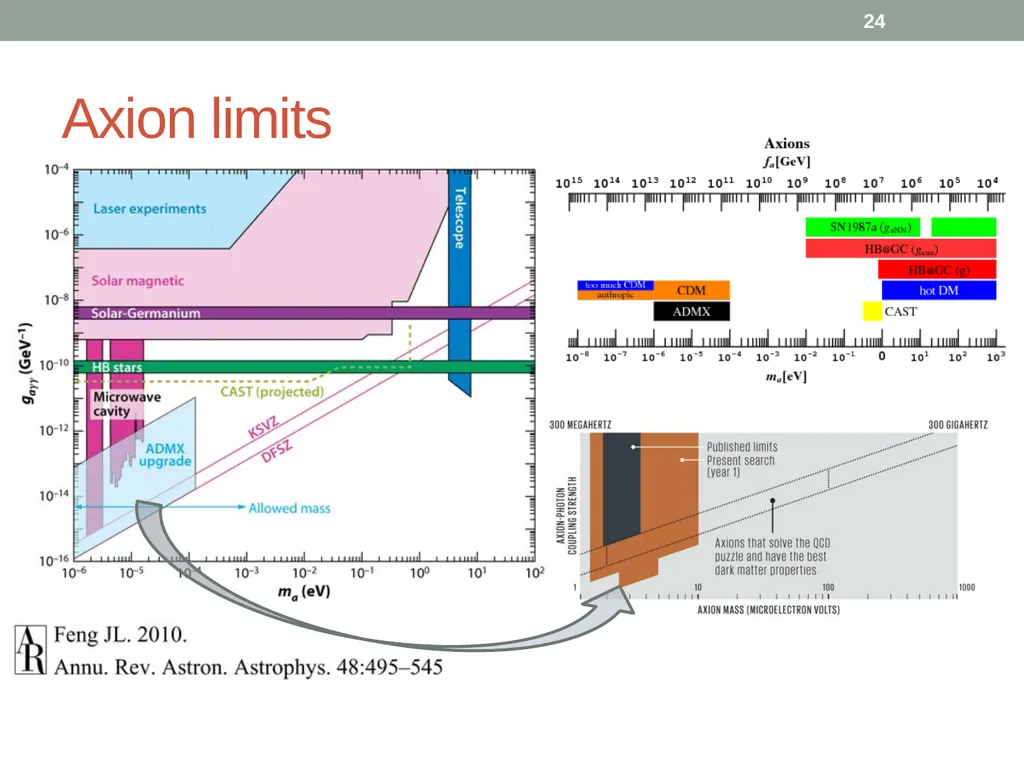
Axion limits 24<br>
25
Introduction to Particle Astrophysics Low energy neutrino astrophysics 25<br>
26
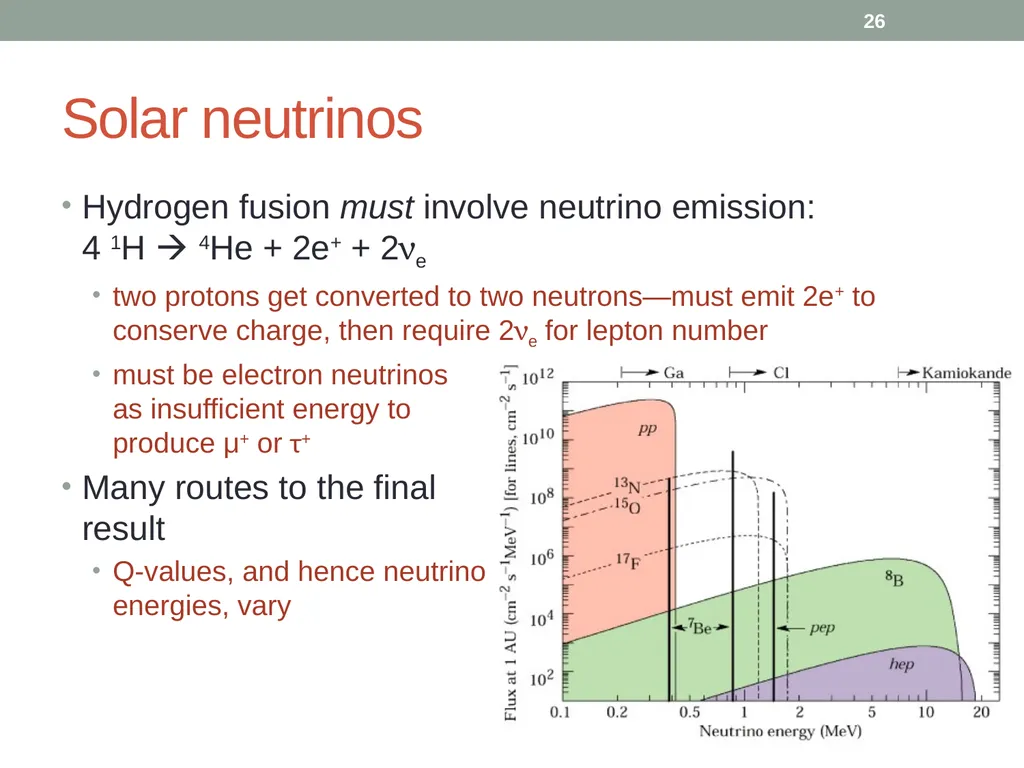
Solar neutrinos Hydrogen fusion must involve neutrino emission:
4 1H 4He + 2e+ + 2νe
two protons get converted to two neutrons—must emit 2e+ to conserve charge, then require 2νe for lepton number
must be electron neutrinos as insufficient energy to produce μ+ or τ+
Many routes to the final result
Q-values, and hence neutrino energies, vary 26<br>
two protons get converted to two neutrons—must emit 2e+ to conserve charge, then require 2νe for lepton number
must be electron neutrinos as insufficient energy to produce μ+ or τ+
Many routes to the final result
Q-values, and hence neutrino energies, vary 26<br>
27
Solar neutrinos Detection techniques
inverse β decay, e.g. 37Cl + νe 37Ar + e−
low energy threshold, especially on 71Ga, but no directional or energy information
electron elastic scattering, ν + e− ν + e−
sensitive to all neutrino types, but mostly νe
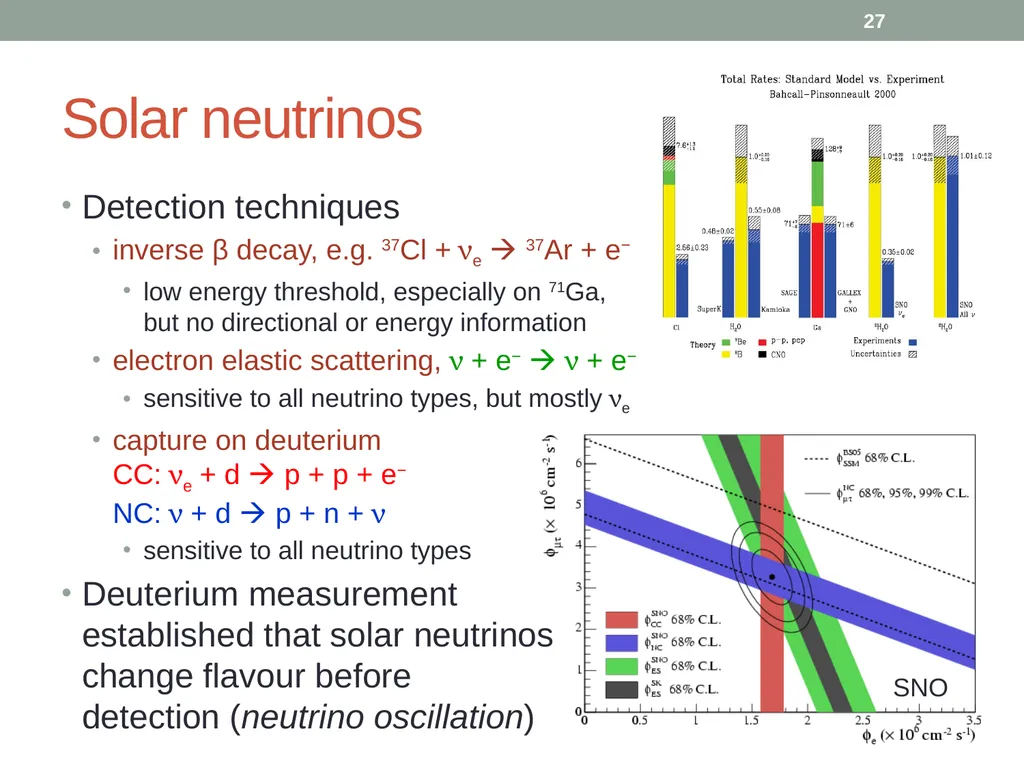
capture on deuterium CC: νe + d p + p + e− NC: ν + d p + n + ν
sensitive to all neutrino types
Deuterium measurement established that solar neutrinos change flavour before detection (neutrino oscillation) 27 SNO<br>
inverse β decay, e.g. 37Cl + νe 37Ar + e−
low energy threshold, especially on 71Ga, but no directional or energy information
electron elastic scattering, ν + e− ν + e−
sensitive to all neutrino types, but mostly νe
capture on deuterium CC: νe + d p + p + e− NC: ν + d p + n + ν
sensitive to all neutrino types
Deuterium measurement established that solar neutrinos change flavour before detection (neutrino oscillation) 27 SNO<br>
28
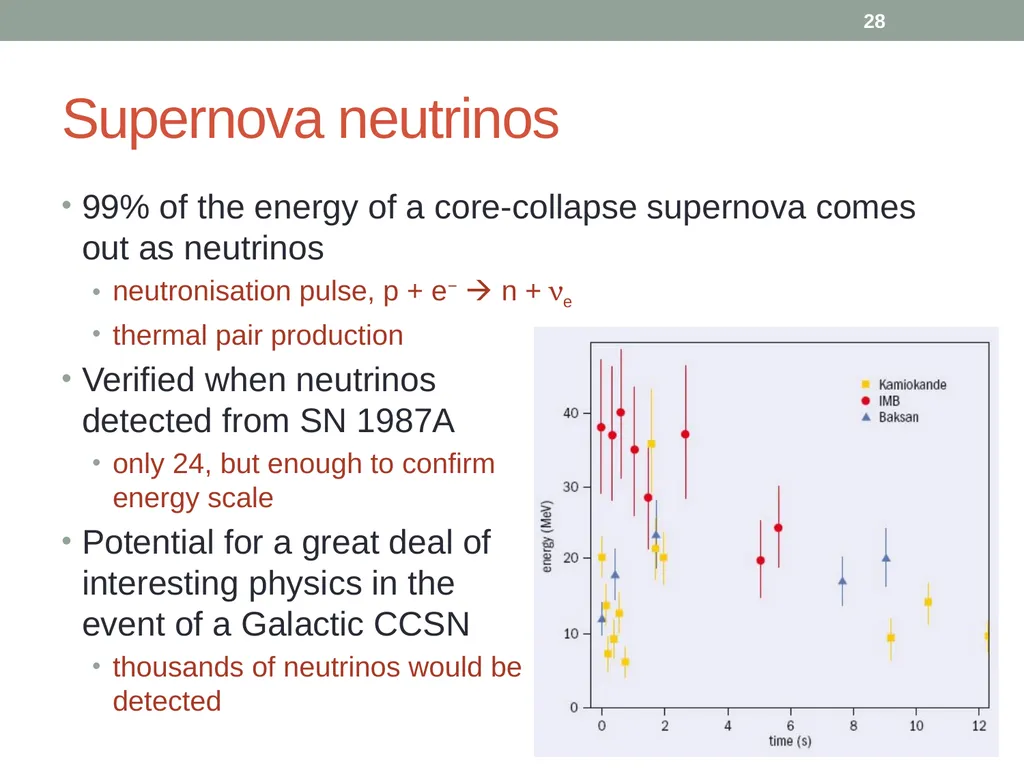
Supernova neutrinos 99% of the energy of a core-collapse supernova comes out as neutrinos
neutronisation pulse, p + e− n + νe
thermal pair production
Verified when neutrinos detected from SN 1987A
only 24, but enough to confirm energy scale
Potential for a great deal of interesting physics in the event of a Galactic CCSN
thousands of neutrinos would be detected 28<br>
neutronisation pulse, p + e− n + νe
thermal pair production
Verified when neutrinos detected from SN 1987A
only 24, but enough to confirm energy scale
Potential for a great deal of interesting physics in the event of a Galactic CCSN
thousands of neutrinos would be detected 28<br>
29
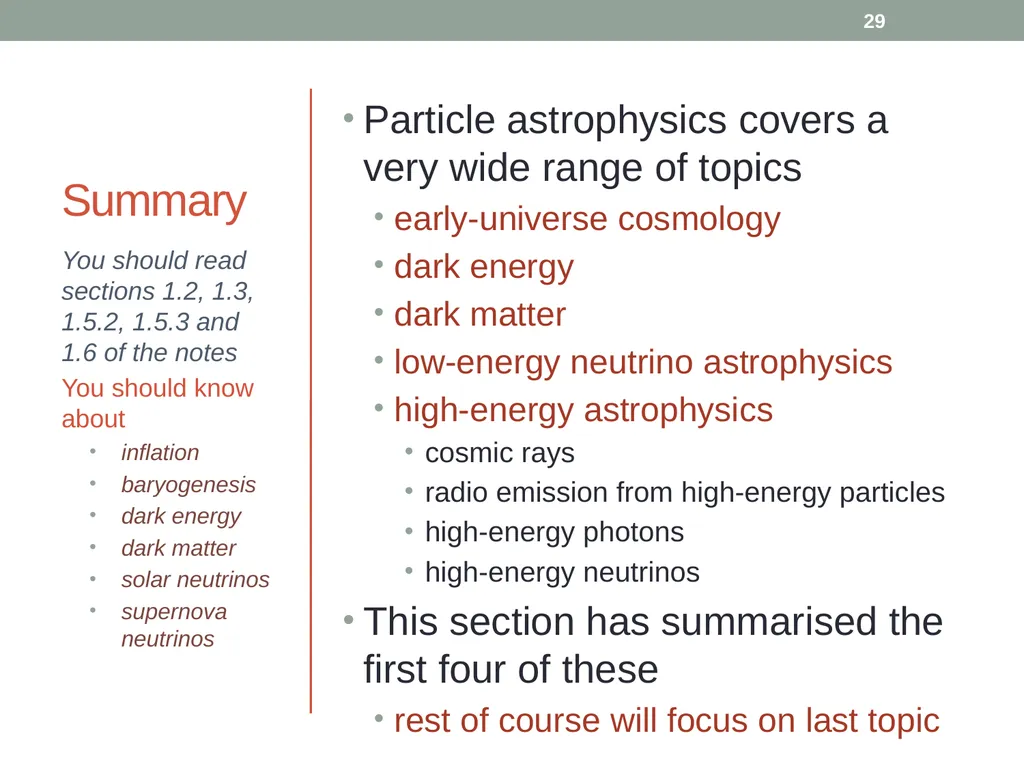
Summary Particle astrophysics covers a very wide range of topics
early-universe cosmology
dark energy
dark matter
low-energy neutrino astrophysics
high-energy astrophysics
cosmic rays
radio emission from high-energy particles
high-energy photons
high-energy neutrinos
This section has summarised the first four of these
rest of course will focus on last topic You should read sections 1.2, 1.3, 1.5.2, 1.5.3 and 1.6 of the notes
You should know about
inflation
baryogenesis
dark energy
dark matter
solar neutrinos
supernova neutrinos 29<br>
early-universe cosmology
dark energy
dark matter
low-energy neutrino astrophysics
high-energy astrophysics
cosmic rays
radio emission from high-energy particles
high-energy photons
high-energy neutrinos
This section has summarised the first four of these
rest of course will focus on last topic You should read sections 1.2, 1.3, 1.5.2, 1.5.3 and 1.6 of the notes
You should know about
inflation
baryogenesis
dark energy
dark matter
solar neutrinos
supernova neutrinos 29<br>
30
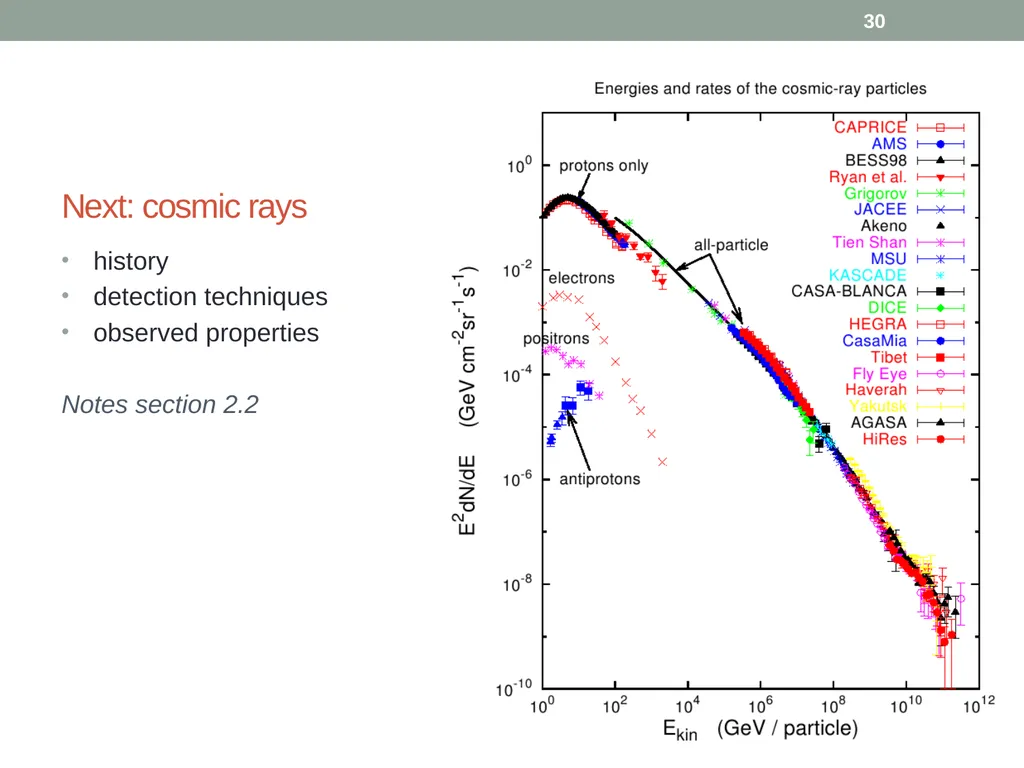
Next: cosmic rays history
detection techniques
observed properties
Notes section 2.2 30<br>
detection techniques
observed properties
Notes section 2.2 30<br>