
Physical Layer (part 3) Transmission Media
LS
Published · 48 slides · 0 views

1 / 1

Description
Physical Layer (part 3) Transmission Media Advanced Computer Networks Advanced Computer Networks Transmission Media 2 Transmission Media Choices Twisted Pair Coaxial Cable Optical Fiber Wireless Communications Advanced Computer Networks
Related Topics
Share
Embed code
Download this presentation From Below
"Physical Layer (part 3) Transmission Media" is the property of its rightful owner. Permission is granted to download and print the materials on this website for personal, non-commercial use only, and to display it on your personal computer provided you do not modify the materials and that you retain all copyright notices contained in the materials. By downloading content from our website, you accept the terms of this agreement.
Presentation Transcript
01
Physical Layer
(part 3)
Transmission Media Advanced Computer Networks<br>
02
Advanced Computer Networks Transmission Media 2 Transmission Media Choices Twisted Pair
Coaxial Cable
Optical Fiber
Wireless Communications<br>
Coaxial Cable
Optical Fiber
Wireless Communications<br>
03
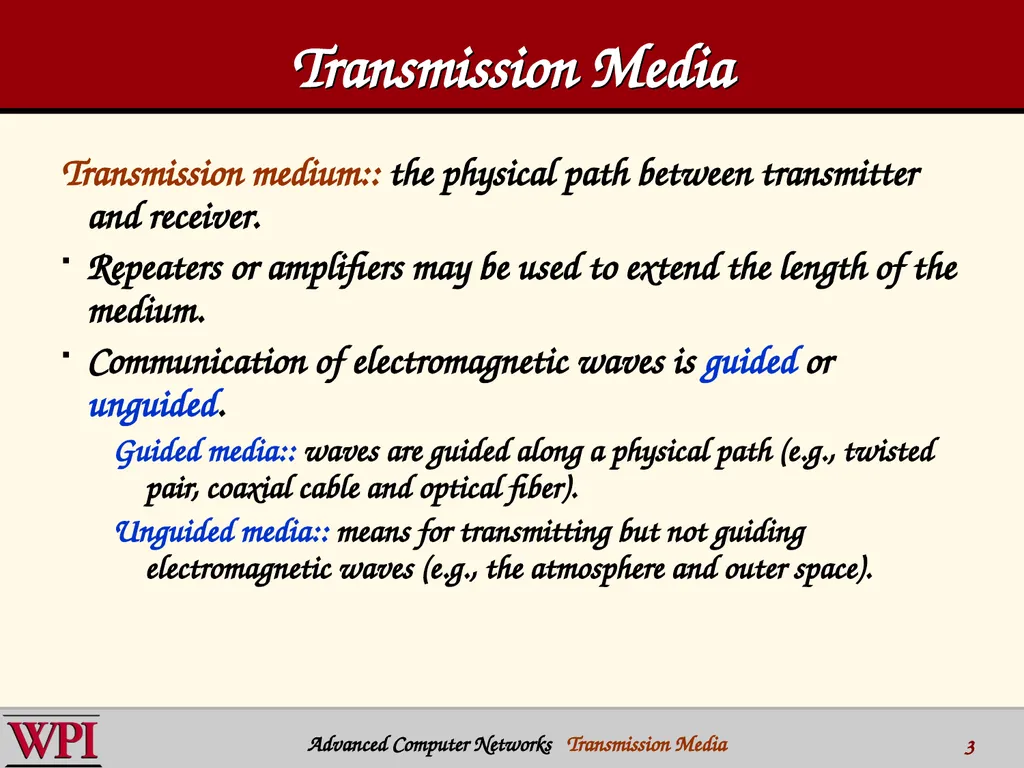
Advanced Computer Networks Transmission Media 3 Transmission Media Transmission medium:: the physical path between transmitter and receiver.
Repeaters or amplifiers may be used to extend the length of the medium.
Communication of electromagnetic waves is guided or unguided.
Guided media:: waves are guided along a physical path (e.g., twisted pair, coaxial cable and optical fiber).
Unguided media:: means for transmitting but not guiding electromagnetic waves (e.g., the atmosphere and outer space).<br>
Repeaters or amplifiers may be used to extend the length of the medium.
Communication of electromagnetic waves is guided or unguided.
Guided media:: waves are guided along a physical path (e.g., twisted pair, coaxial cable and optical fiber).
Unguided media:: means for transmitting but not guiding electromagnetic waves (e.g., the atmosphere and outer space).<br>
04
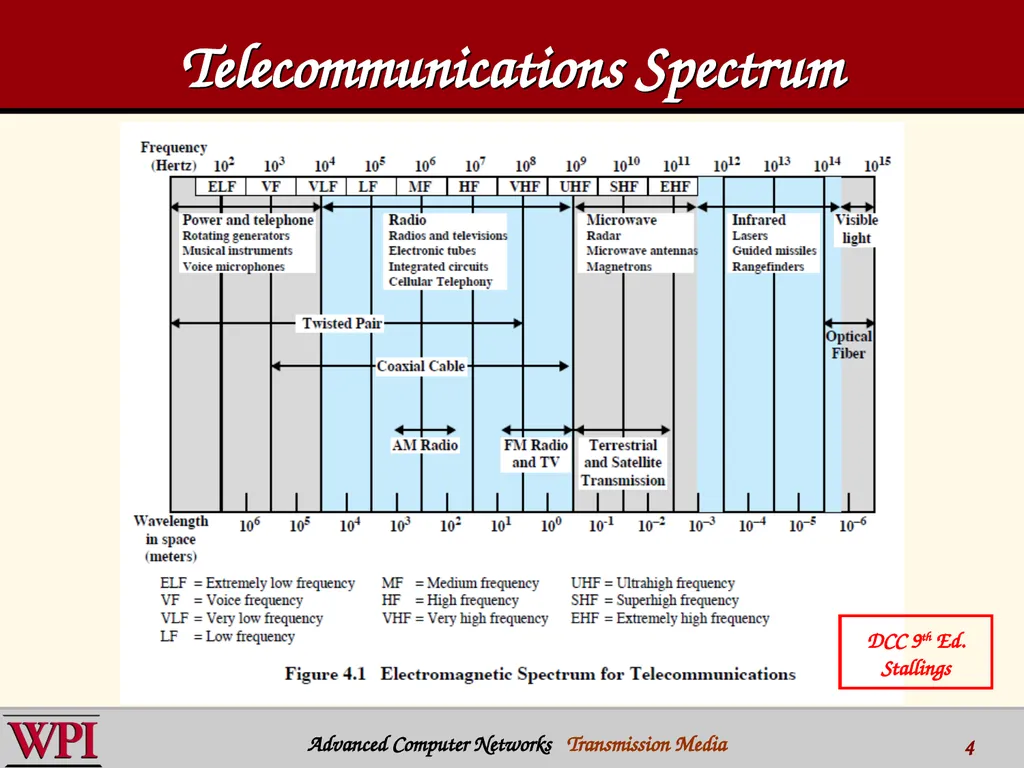
Telecommunications Spectrum Advanced Computer Networks Transmission Media 4 DCC 9th Ed.
Stallings<br>
Stallings<br>
05
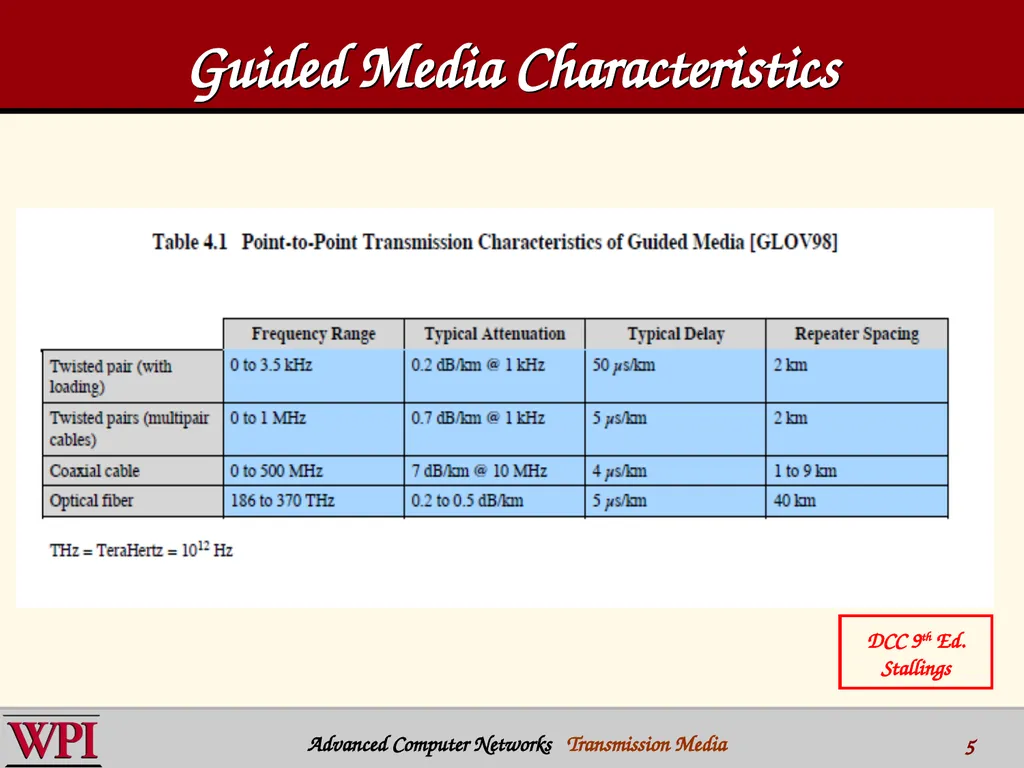
Guided Media Characteristics Advanced Computer Networks Transmission Media 5 DCC 9th Ed.
Stallings<br>
Stallings<br>
06
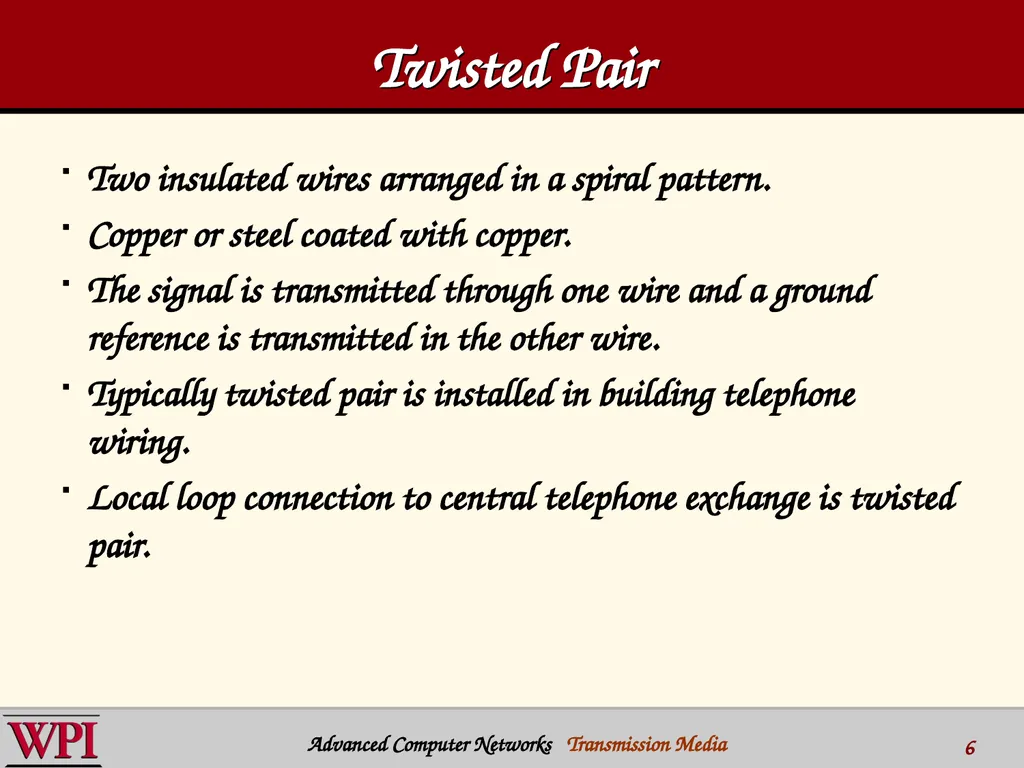
Twisted Pair Advanced Computer Networks Transmission Media 6 Two insulated wires arranged in a spiral pattern.
Copper or steel coated with copper.
The signal is transmitted through one wire and a ground reference is transmitted in the other wire.
Typically twisted pair is installed in building telephone wiring.
Local loop connection to central telephone exchange is twisted pair.<br>
Copper or steel coated with copper.
The signal is transmitted through one wire and a ground reference is transmitted in the other wire.
Typically twisted pair is installed in building telephone wiring.
Local loop connection to central telephone exchange is twisted pair.<br>
07
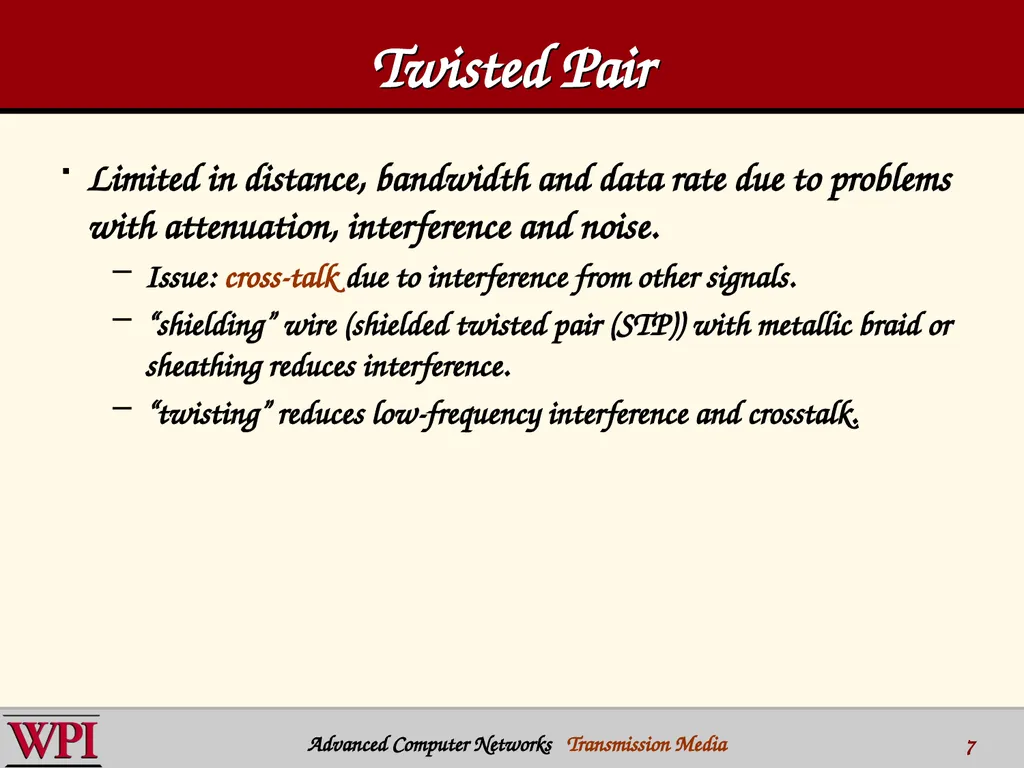
Twisted Pair Advanced Computer Networks Transmission Media 7 Limited in distance, bandwidth and data rate due to problems with attenuation, interference and noise.
Issue: cross-talk due to interference from other signals.
“shielding” wire (shielded twisted pair (STP)) with metallic braid or sheathing reduces interference.
“twisting” reduces low-frequency interference and crosstalk.<br>
Issue: cross-talk due to interference from other signals.
“shielding” wire (shielded twisted pair (STP)) with metallic braid or sheathing reduces interference.
“twisting” reduces low-frequency interference and crosstalk.<br>
08
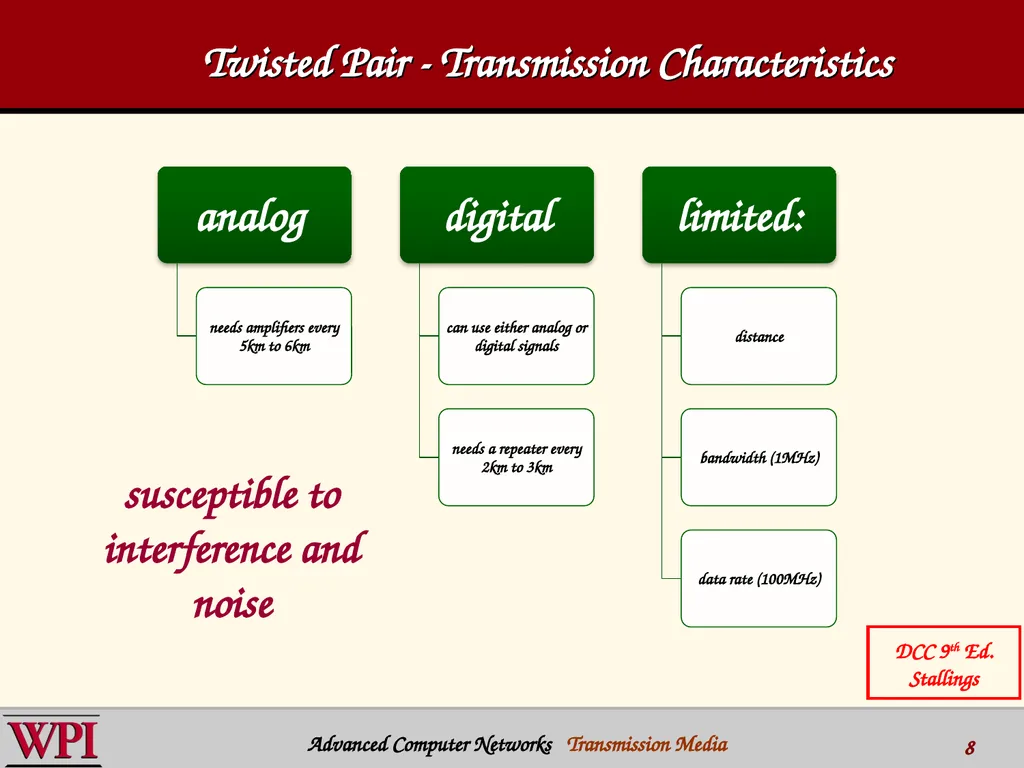
Twisted Pair - Transmission Characteristics susceptible to interference and noise Advanced Computer Networks Transmission Media 8 DCC 9th Ed.
Stallings<br>
Stallings<br>
09
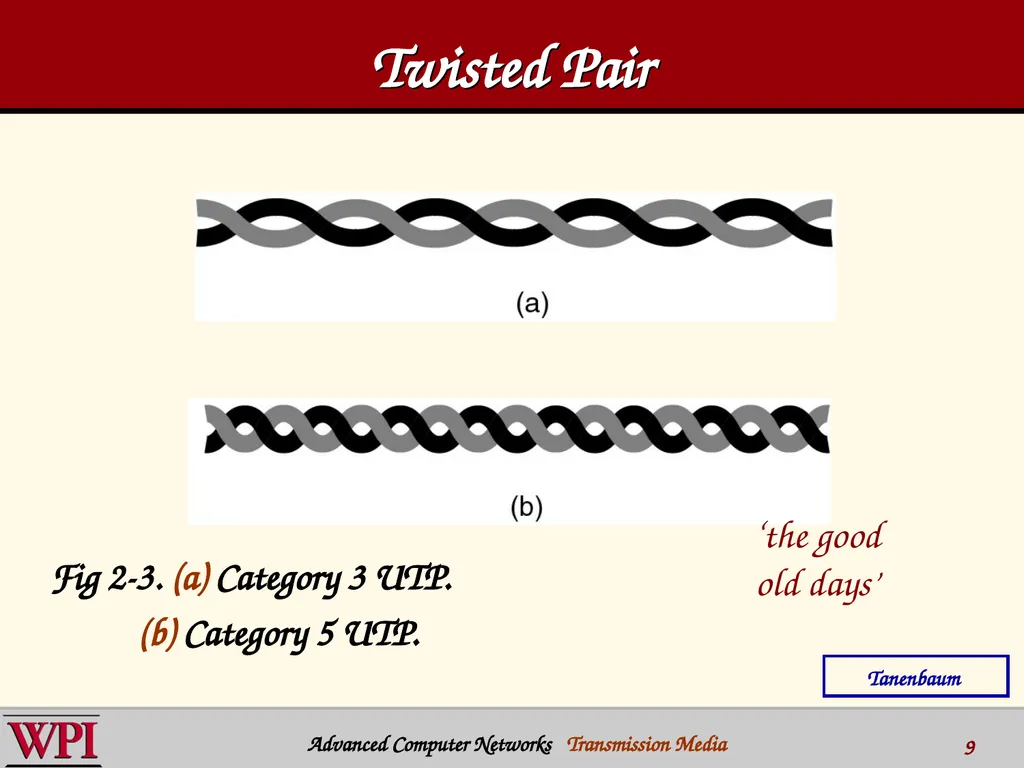
Twisted Pair Advanced Computer Networks Transmission Media 9 Fig 2-3. (a) Category 3 UTP.
(b) Category 5 UTP. Tanenbaum ‘the good
old days’<br>
(b) Category 5 UTP. Tanenbaum ‘the good
old days’<br>
10
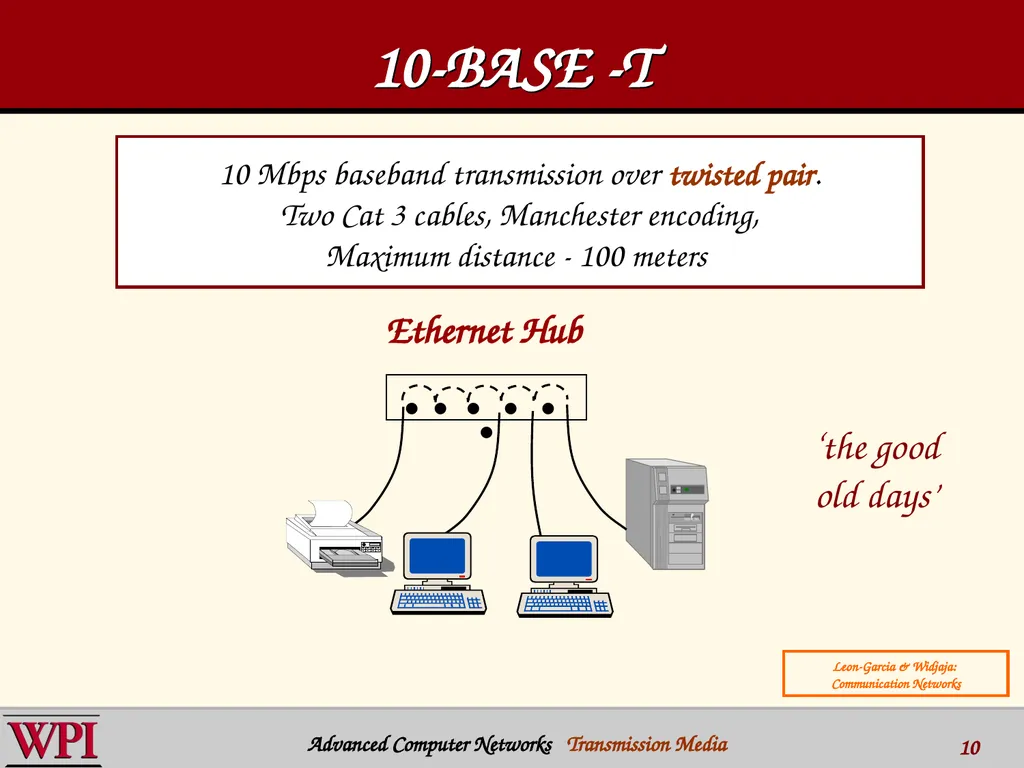
10-BASE -T Advanced Computer Networks Transmission Media 10 10 Mbps baseband transmission over twisted pair.
Two Cat 3 cables, Manchester encoding,
Maximum distance - 100 meters Ethernet Hub Leon-Garcia & Widjaja:
Communication Networks ‘the good
old days’<br>
Two Cat 3 cables, Manchester encoding,
Maximum distance - 100 meters Ethernet Hub Leon-Garcia & Widjaja:
Communication Networks ‘the good
old days’<br>
11
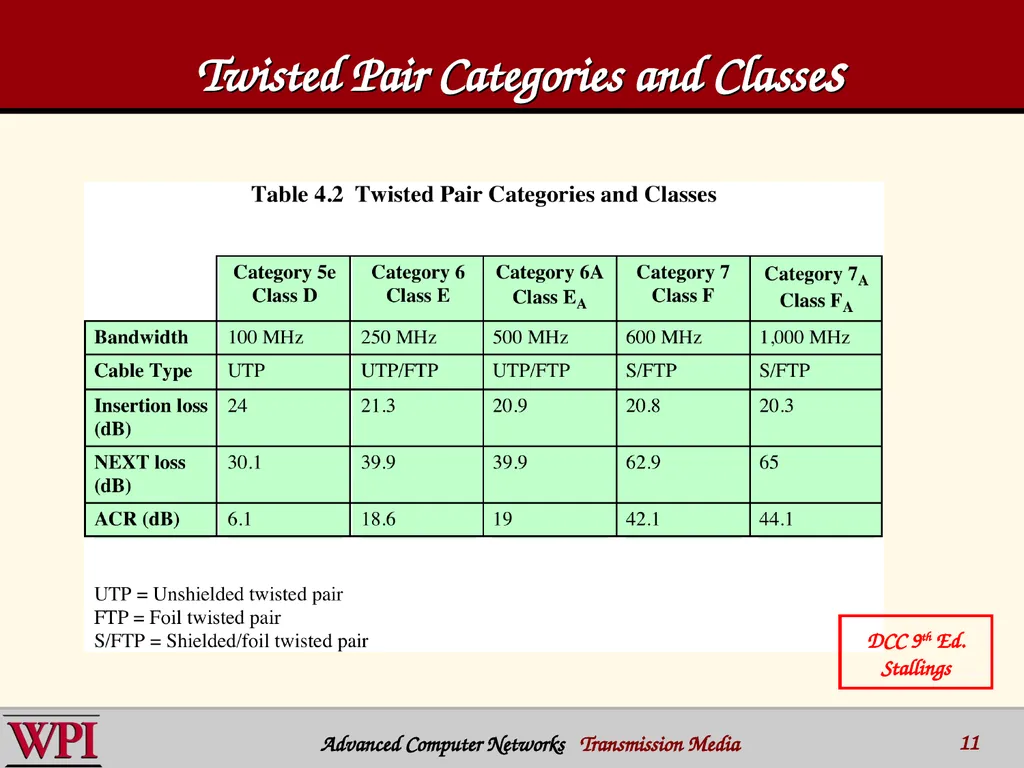
Twisted Pair Categories and Classes DCC 9th Ed.
Stallings Advanced Computer Networks Transmission Media 11<br>
Stallings Advanced Computer Networks Transmission Media 11<br>
12
Advanced Computer Networks Transmission Media 12 Grade 1 - Unshielded Untwisted wiring.
Commonly called inside wire by the Telco community.
Grade 2 - Unshielded twisted pair (UTP) derived from IBM Type 3 spec.
Category 3 - Unshielded twisted pair with 100 ohm impedance and electrical
characteristics supporting transmission at frequencies up to 16 MHz. May
be used with 10Base-T, 100Base-T4, and 100Base-T2 Ethernet. (Obsolete)
Category 4 - Unshielded twisted pair with 100 ohm impedance and electrical
characteristics supporting transmission at frequencies up to 20 MHz.
May be used with 10Base-T, 100Base-T4, and 100Base-T2 Ethernet. (Obsolete)
Category 5 - Unshielded twisted pair with 100 ohm impedance and electrical
characteristics supporting transmission at frequencies up to 100 MHz.
May be used with 10Base-T, 100Base-T4, 100Base-T2, and 100Base-TX Ethernet.
May support 1000Base-T, but cable should be tested. (Superceded by Cat5e) EIA/TIA 568 and ISO/IEC 11801 Wiring Grades<br>
Commonly called inside wire by the Telco community.
Grade 2 - Unshielded twisted pair (UTP) derived from IBM Type 3 spec.
Category 3 - Unshielded twisted pair with 100 ohm impedance and electrical
characteristics supporting transmission at frequencies up to 16 MHz. May
be used with 10Base-T, 100Base-T4, and 100Base-T2 Ethernet. (Obsolete)
Category 4 - Unshielded twisted pair with 100 ohm impedance and electrical
characteristics supporting transmission at frequencies up to 20 MHz.
May be used with 10Base-T, 100Base-T4, and 100Base-T2 Ethernet. (Obsolete)
Category 5 - Unshielded twisted pair with 100 ohm impedance and electrical
characteristics supporting transmission at frequencies up to 100 MHz.
May be used with 10Base-T, 100Base-T4, 100Base-T2, and 100Base-TX Ethernet.
May support 1000Base-T, but cable should be tested. (Superceded by Cat5e) EIA/TIA 568 and ISO/IEC 11801 Wiring Grades<br>
13
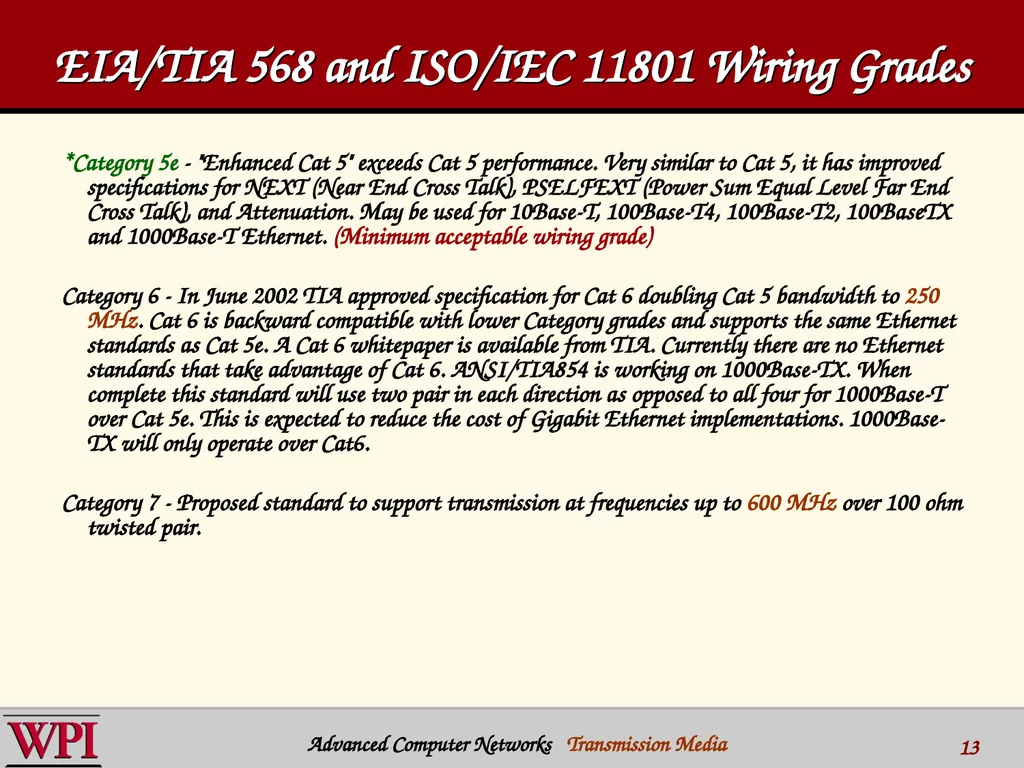
Advanced Computer Networks Transmission Media 13 EIA/TIA 568 and ISO/IEC 11801 Wiring Grades *Category 5e - "Enhanced Cat 5" exceeds Cat 5 performance. Very similar to Cat 5, it has improved specifications for NEXT (Near End Cross Talk), PSELFEXT (Power Sum Equal Level Far End Cross Talk), and Attenuation. May be used for 10Base-T, 100Base-T4, 100Base-T2, 100BaseTX and 1000Base-T Ethernet. (Minimum acceptable wiring grade)
Category 6 - In June 2002 TIA approved specification for Cat 6 doubling Cat 5 bandwidth to 250 MHz. Cat 6 is backward compatible with lower Category grades and supports the same Ethernet standards as Cat 5e. A Cat 6 whitepaper is available from TIA. Currently there are no Ethernet standards that take advantage of Cat 6. ANSI/TIA854 is working on 1000Base-TX. When complete this standard will use two pair in each direction as opposed to all four for 1000Base-T over Cat 5e. This is expected to reduce the cost of Gigabit Ethernet implementations. 1000Base-TX will only operate over Cat6.
Category 7 - Proposed standard to support transmission at frequencies up to 600 MHz over 100 ohm twisted pair.<br>
Category 6 - In June 2002 TIA approved specification for Cat 6 doubling Cat 5 bandwidth to 250 MHz. Cat 6 is backward compatible with lower Category grades and supports the same Ethernet standards as Cat 5e. A Cat 6 whitepaper is available from TIA. Currently there are no Ethernet standards that take advantage of Cat 6. ANSI/TIA854 is working on 1000Base-TX. When complete this standard will use two pair in each direction as opposed to all four for 1000Base-T over Cat 5e. This is expected to reduce the cost of Gigabit Ethernet implementations. 1000Base-TX will only operate over Cat6.
Category 7 - Proposed standard to support transmission at frequencies up to 600 MHz over 100 ohm twisted pair.<br>
14
EIA/TIA 568 and ISO/IEC 11801 Wiring Grades Advanced Computer Networks Transmission Media 14 NOTES:
1) EIA 568 limits UTP copper cabling to maximum distance of 100 meters (328 feet). 90 meters of cable plus 10 meters of patch cord split between both ends.
2) The FCC recently changed the requirement for telephone inside wiring to minimum of Cat 3 due to crosstalk problems with nontwisted quad-four. Cat 3 is no longer recognized by TIA. The minimum wiring grade for structured wiring is Cat 5e.
3) For installation to meet specific Category requirements all components must meet or exceed the designated Category. Using a Cat 3 receptacle (or patch cord) on Cat 6 reduces performance to Cat 3.<br>
1) EIA 568 limits UTP copper cabling to maximum distance of 100 meters (328 feet). 90 meters of cable plus 10 meters of patch cord split between both ends.
2) The FCC recently changed the requirement for telephone inside wiring to minimum of Cat 3 due to crosstalk problems with nontwisted quad-four. Cat 3 is no longer recognized by TIA. The minimum wiring grade for structured wiring is Cat 5e.
3) For installation to meet specific Category requirements all components must meet or exceed the designated Category. Using a Cat 3 receptacle (or patch cord) on Cat 6 reduces performance to Cat 3.<br>
15
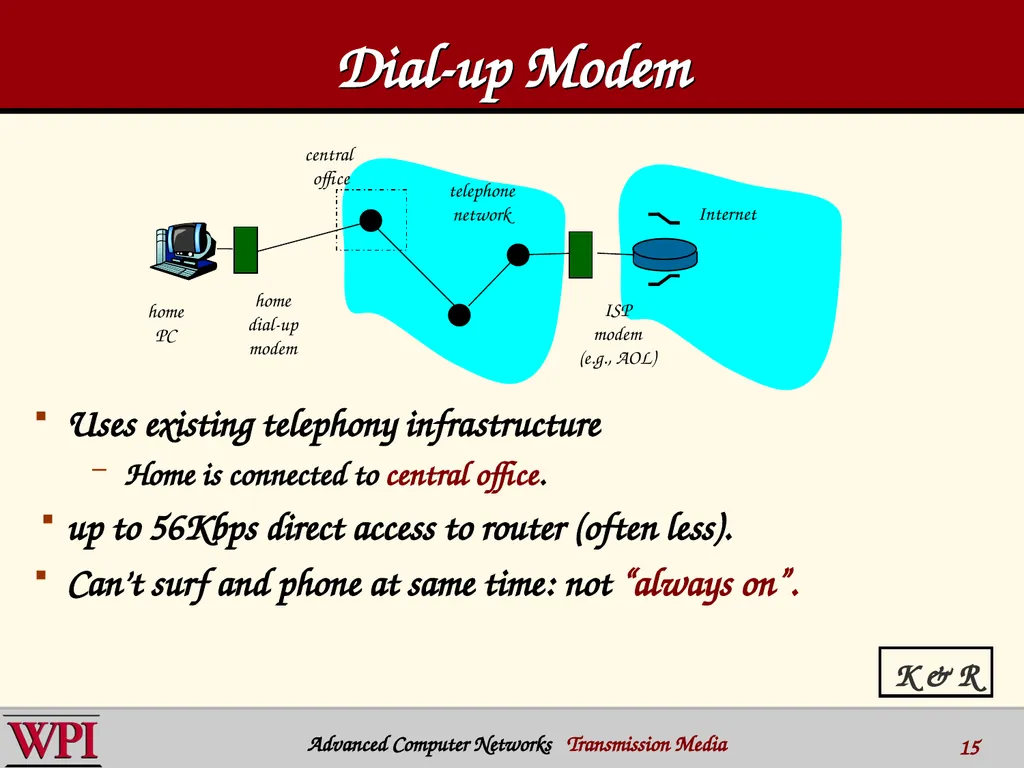
Dial-up Modem Advanced Computer Networks Transmission Media 15 Uses existing telephony infrastructure
Home is connected to central office.
up to 56Kbps direct access to router (often less).
Can’t surf and phone at same time: not “always on”. K & R<br>
Home is connected to central office.
up to 56Kbps direct access to router (often less).
Can’t surf and phone at same time: not “always on”. K & R<br>
16
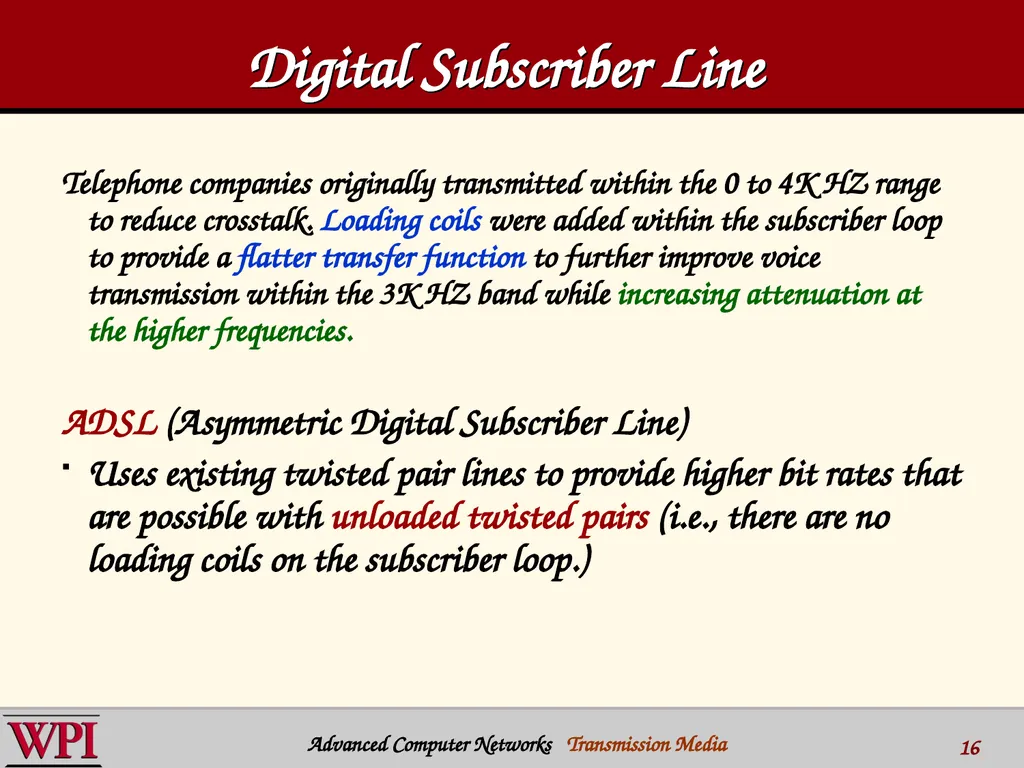
Digital Subscriber Line Advanced Computer Networks Transmission Media 16 Telephone companies originally transmitted within the 0 to 4K HZ range to reduce crosstalk. Loading coils were added within the subscriber loop to provide a flatter transfer function to further improve voice transmission within the 3K HZ band while increasing attenuation at the higher frequencies.
ADSL (Asymmetric Digital Subscriber Line)
Uses existing twisted pair lines to provide higher bit rates that are possible with unloaded twisted pairs (i.e., there are no loading coils on the subscriber loop.)<br>
ADSL (Asymmetric Digital Subscriber Line)
Uses existing twisted pair lines to provide higher bit rates that are possible with unloaded twisted pairs (i.e., there are no loading coils on the subscriber loop.)<br>
17
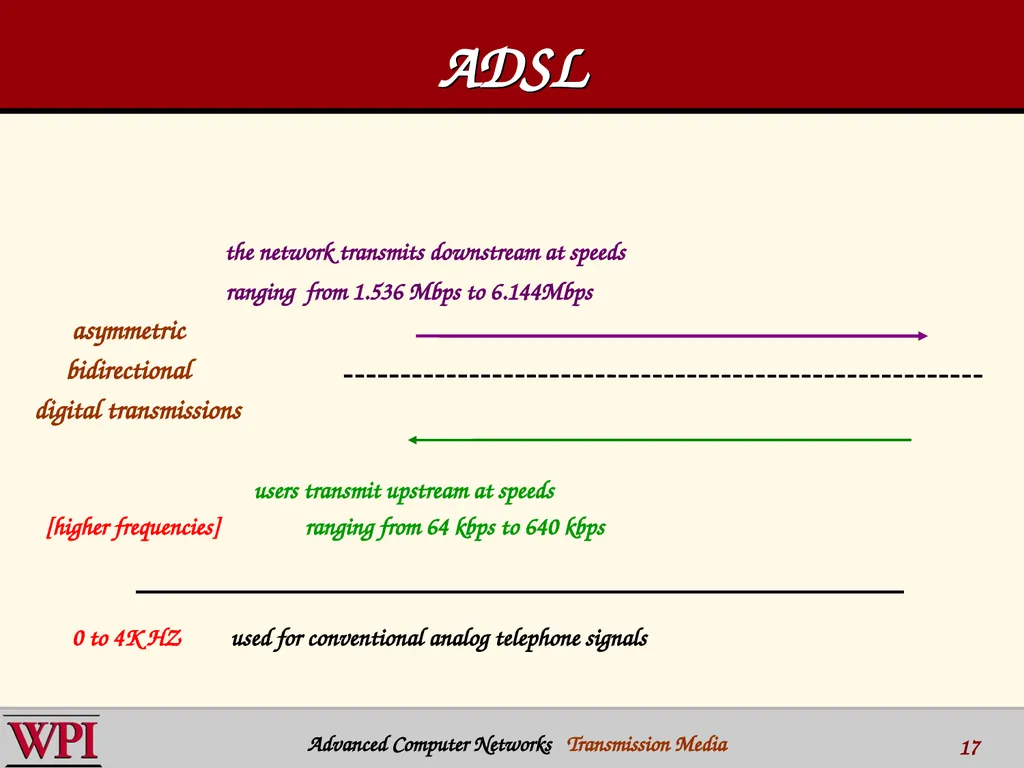
ADSL Advanced Computer Networks Transmission Media 17 the network transmits downstream at speeds
ranging from 1.536 Mbps to 6.144Mbps
asymmetric
bidirectional
digital transmissions
users transmit upstream at speeds
[higher frequencies] ranging from 64 kbps to 640 kbps
0 to 4K HZ used for conventional analog telephone signals<br>
ranging from 1.536 Mbps to 6.144Mbps
asymmetric
bidirectional
digital transmissions
users transmit upstream at speeds
[higher frequencies] ranging from 64 kbps to 640 kbps
0 to 4K HZ used for conventional analog telephone signals<br>
18
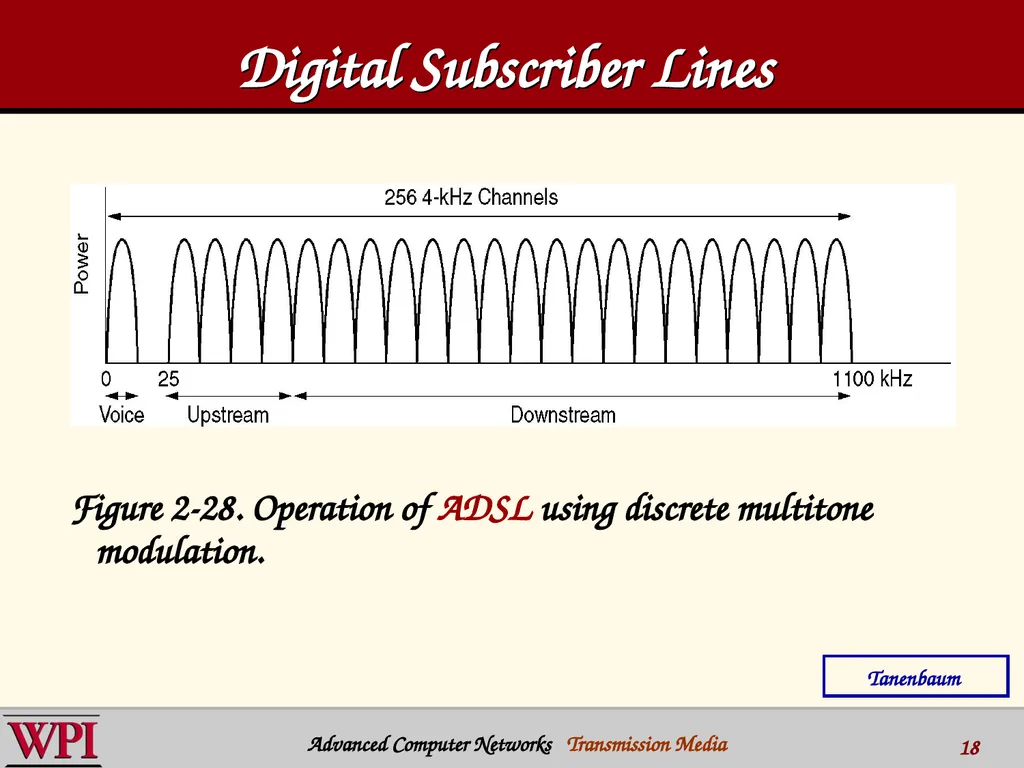
Digital Subscriber Lines Advanced Computer Networks Transmission Media 18 Figure 2-28. Operation of ADSL using discrete multitone modulation. Tanenbaum<br>
19
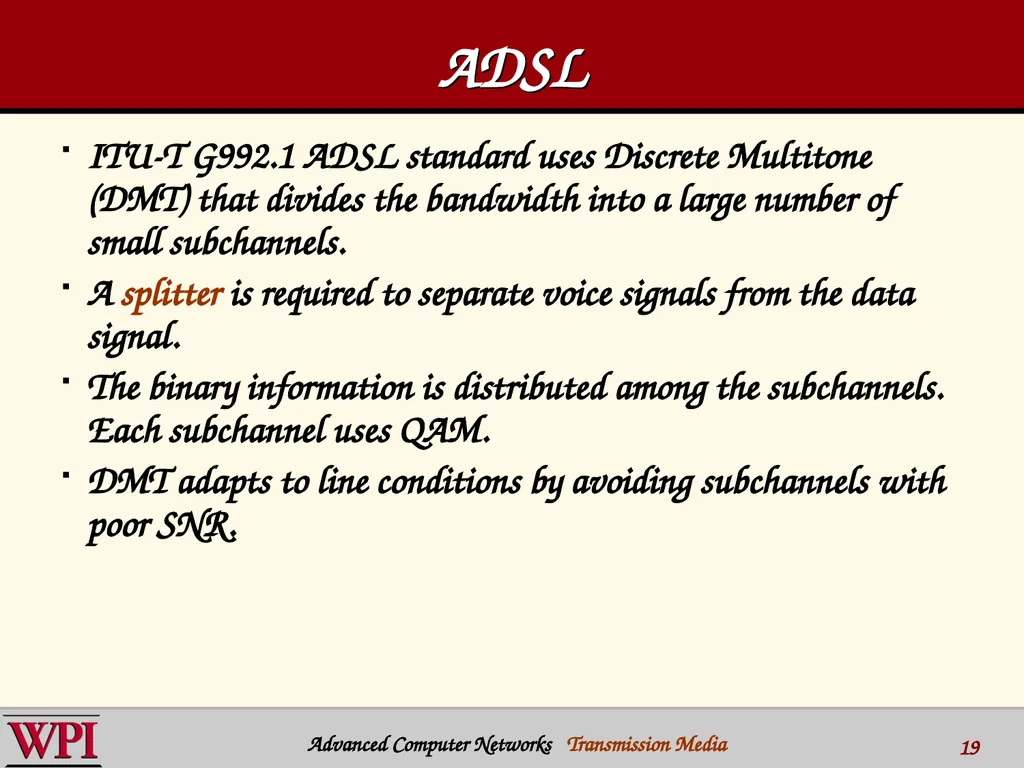
ADSL Advanced Computer Networks Transmission Media 19 ITU-T G992.1 ADSL standard uses Discrete Multitone (DMT) that divides the bandwidth into a large number of small subchannels.
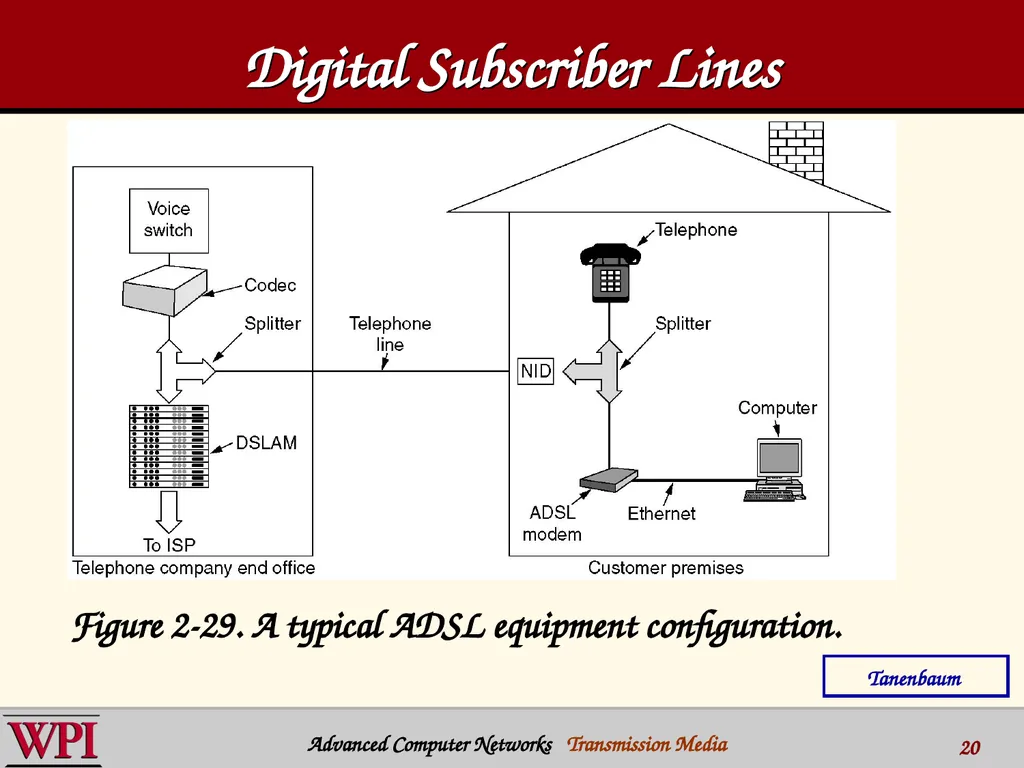
A splitter is required to separate voice signals from the data signal.
The binary information is distributed among the subchannels. Each subchannel uses QAM.
DMT adapts to line conditions by avoiding subchannels with poor SNR.<br>
A splitter is required to separate voice signals from the data signal.
The binary information is distributed among the subchannels. Each subchannel uses QAM.
DMT adapts to line conditions by avoiding subchannels with poor SNR.<br>
20
Digital Subscriber Lines Advanced Computer Networks Transmission Media 20 Figure 2-29. A typical ADSL equipment configuration. Tanenbaum<br>
21
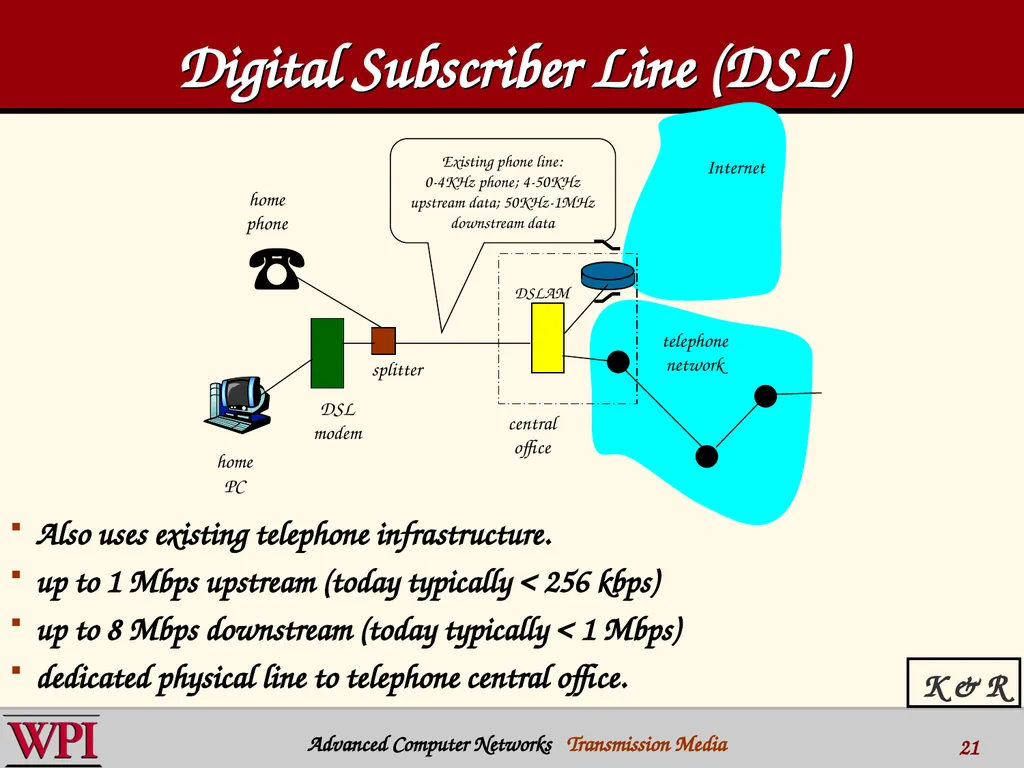
Digital Subscriber Line (DSL) Advanced Computer Networks Transmission Media 21 Also uses existing telephone infrastructure.
up to 1 Mbps upstream (today typically < 256 kbps)
up to 8 Mbps downstream (today typically < 1 Mbps)
dedicated physical line to telephone central office. K & R<br>
up to 1 Mbps upstream (today typically < 256 kbps)
up to 8 Mbps downstream (today typically < 1 Mbps)
dedicated physical line to telephone central office. K & R<br>
22
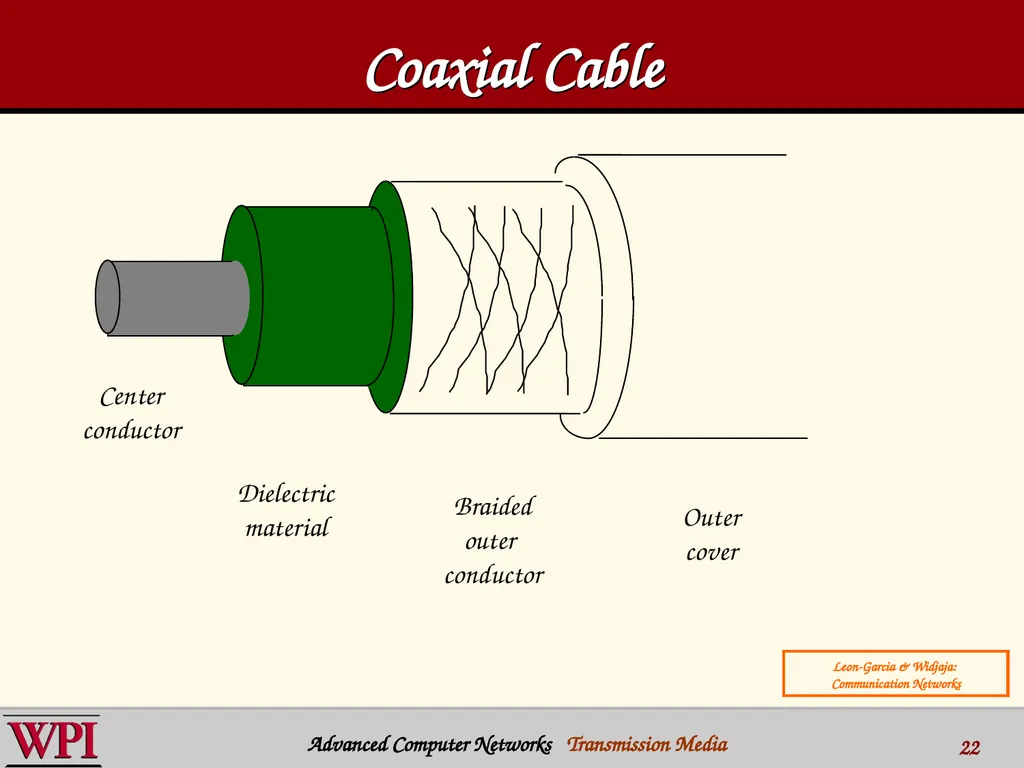
Coaxial Cable Advanced Computer Networks Transmission Media 22 Leon-Garcia & Widjaja:
Communication Networks<br>
Communication Networks<br>
23
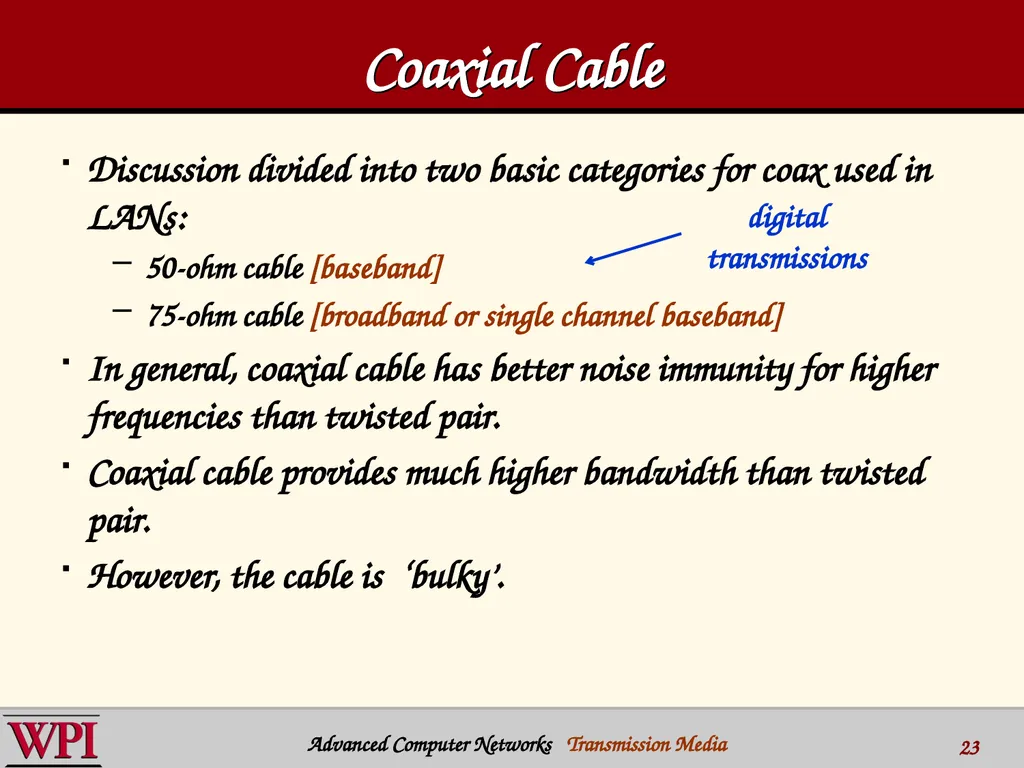
Coaxial Cable Advanced Computer Networks Transmission Media 23 Discussion divided into two basic categories for coax used in LANs:
50-ohm cable [baseband]
75-ohm cable [broadband or single channel baseband]
In general, coaxial cable has better noise immunity for higher frequencies than twisted pair.
Coaxial cable provides much higher bandwidth than twisted pair.
However, the cable is ‘bulky’. digital
transmissions<br>
50-ohm cable [baseband]
75-ohm cable [broadband or single channel baseband]
In general, coaxial cable has better noise immunity for higher frequencies than twisted pair.
Coaxial cable provides much higher bandwidth than twisted pair.
However, the cable is ‘bulky’. digital
transmissions<br>
24
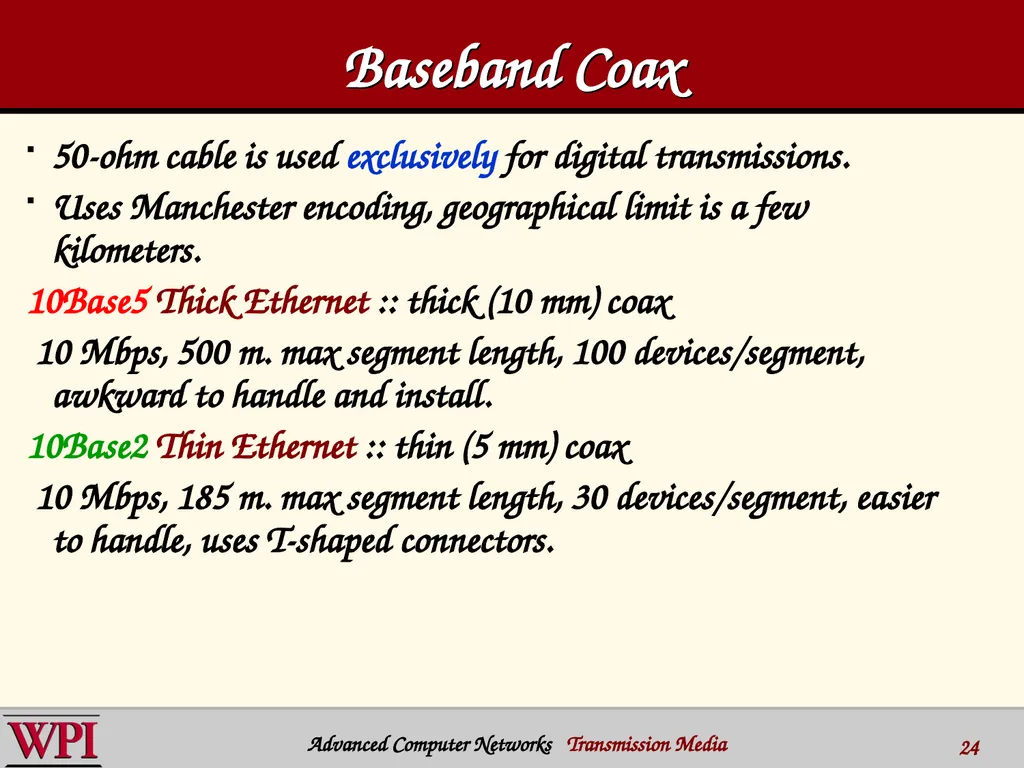
Baseband Coax Advanced Computer Networks Transmission Media 24 50-ohm cable is used exclusively for digital transmissions.
Uses Manchester encoding, geographical limit is a few kilometers.
10Base5 Thick Ethernet :: thick (10 mm) coax
10 Mbps, 500 m. max segment length, 100 devices/segment, awkward to handle and install.
10Base2 Thin Ethernet :: thin (5 mm) coax
10 Mbps, 185 m. max segment length, 30 devices/segment, easier to handle, uses T-shaped connectors.<br>
Uses Manchester encoding, geographical limit is a few kilometers.
10Base5 Thick Ethernet :: thick (10 mm) coax
10 Mbps, 500 m. max segment length, 100 devices/segment, awkward to handle and install.
10Base2 Thin Ethernet :: thin (5 mm) coax
10 Mbps, 185 m. max segment length, 30 devices/segment, easier to handle, uses T-shaped connectors.<br>
25
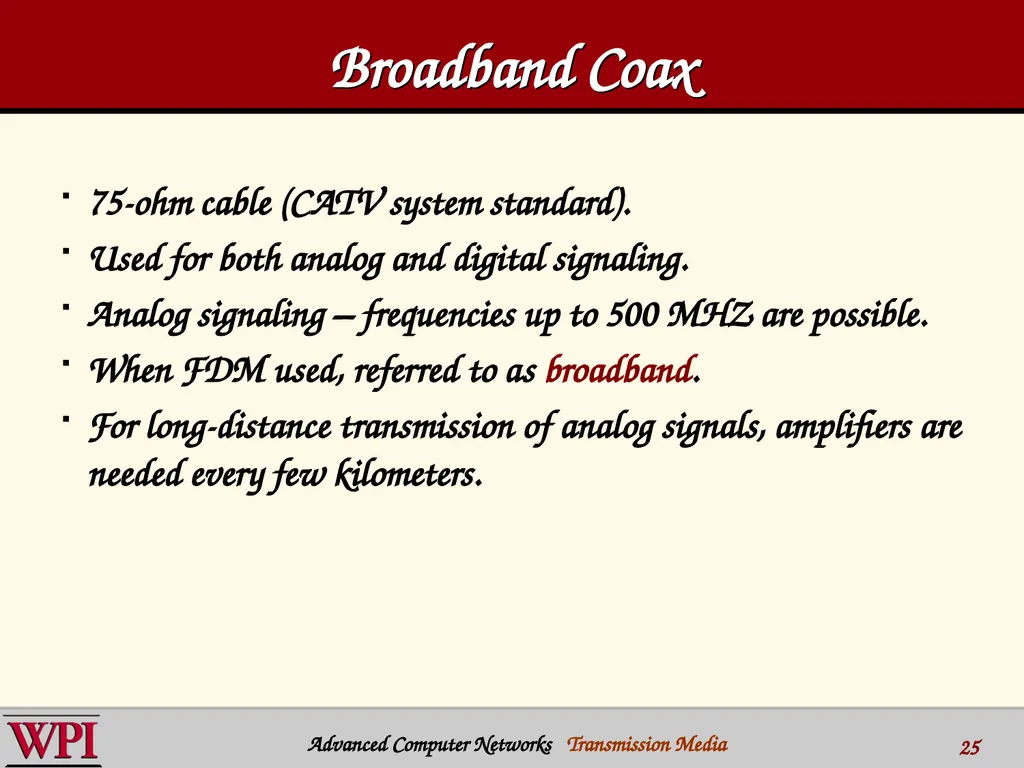
Broadband Coax Advanced Computer Networks Transmission Media 25 75-ohm cable (CATV system standard).
Used for both analog and digital signaling.
Analog signaling – frequencies up to 500 MHZ are possible.
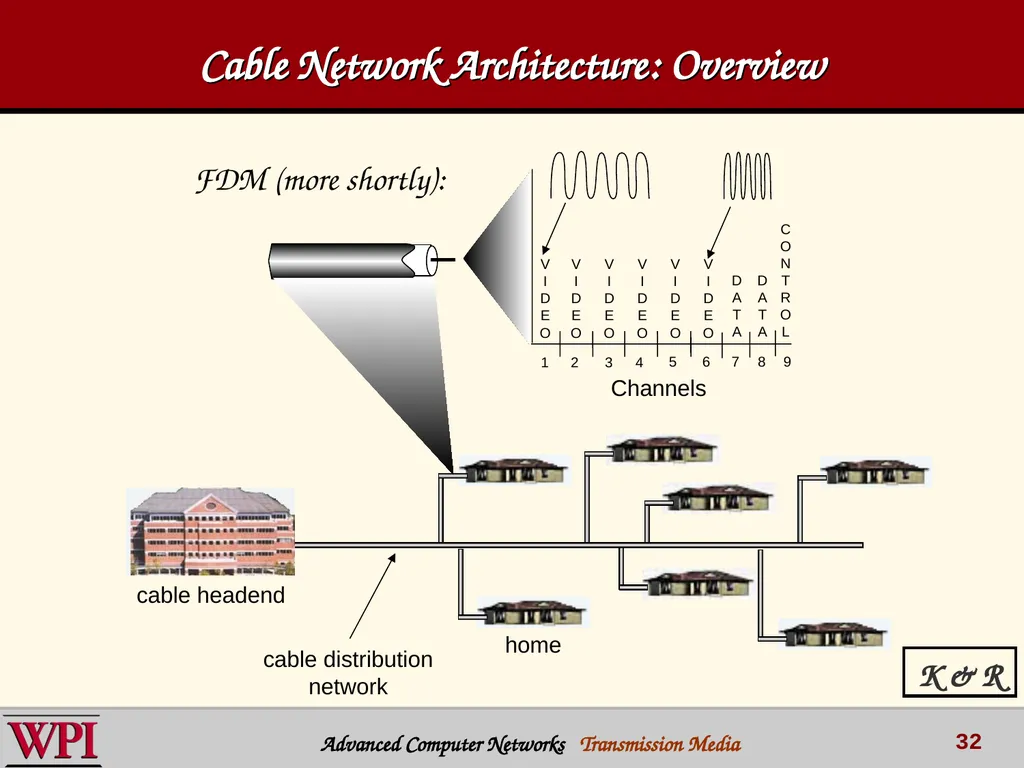
When FDM used, referred to as broadband.
For long-distance transmission of analog signals, amplifiers are needed every few kilometers.<br>
Used for both analog and digital signaling.
Analog signaling – frequencies up to 500 MHZ are possible.
When FDM used, referred to as broadband.
For long-distance transmission of analog signals, amplifiers are needed every few kilometers.<br>
26
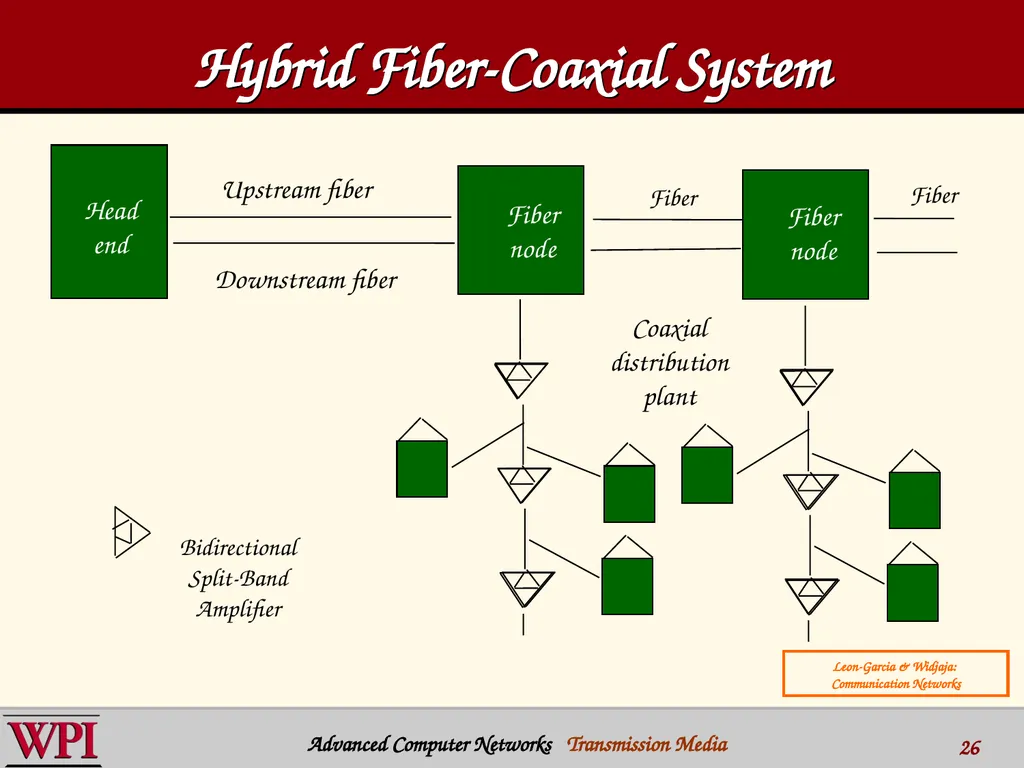
Hybrid Fiber-Coaxial System Advanced Computer Networks Transmission Media 26 Leon-Garcia & Widjaja:
Communication Networks<br>
Communication Networks<br>
27
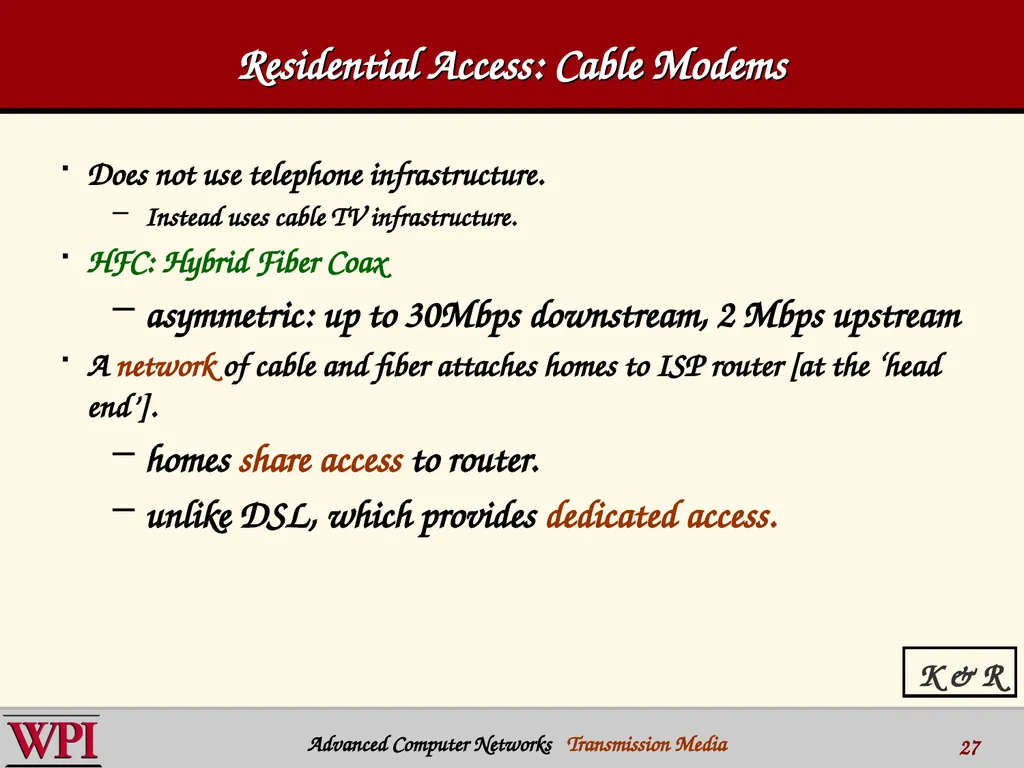
Advanced Computer Networks Transmission Media 27 Does not use telephone infrastructure.
Instead uses cable TV infrastructure.
HFC: Hybrid Fiber Coax
asymmetric: up to 30Mbps downstream, 2 Mbps upstream
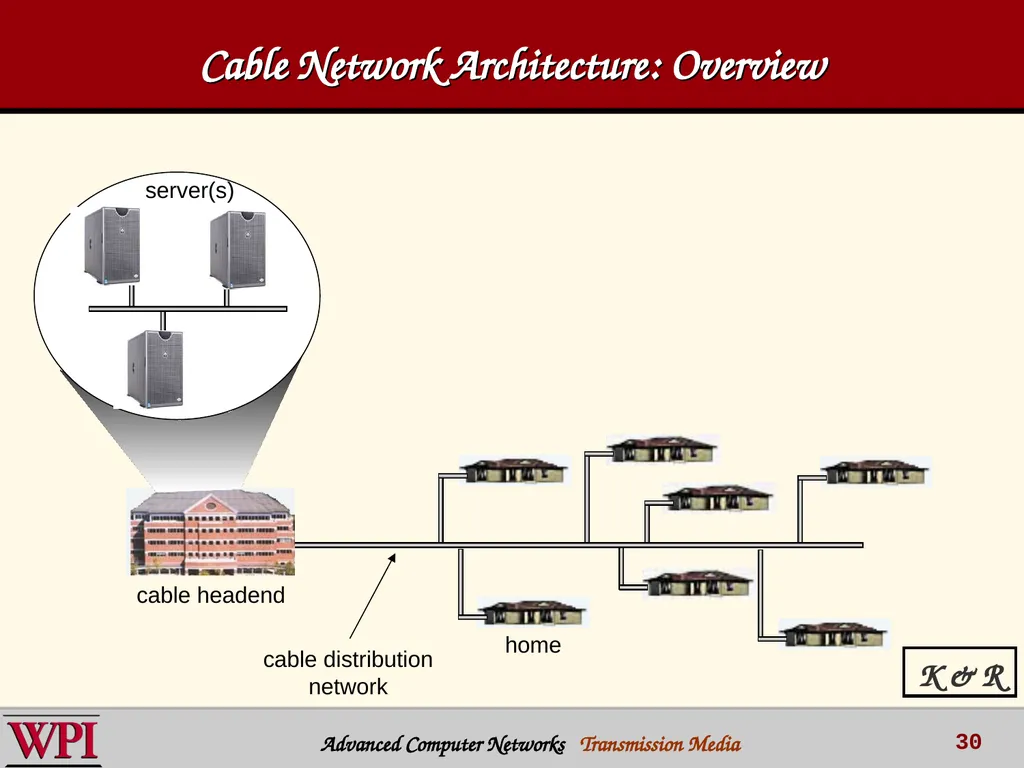
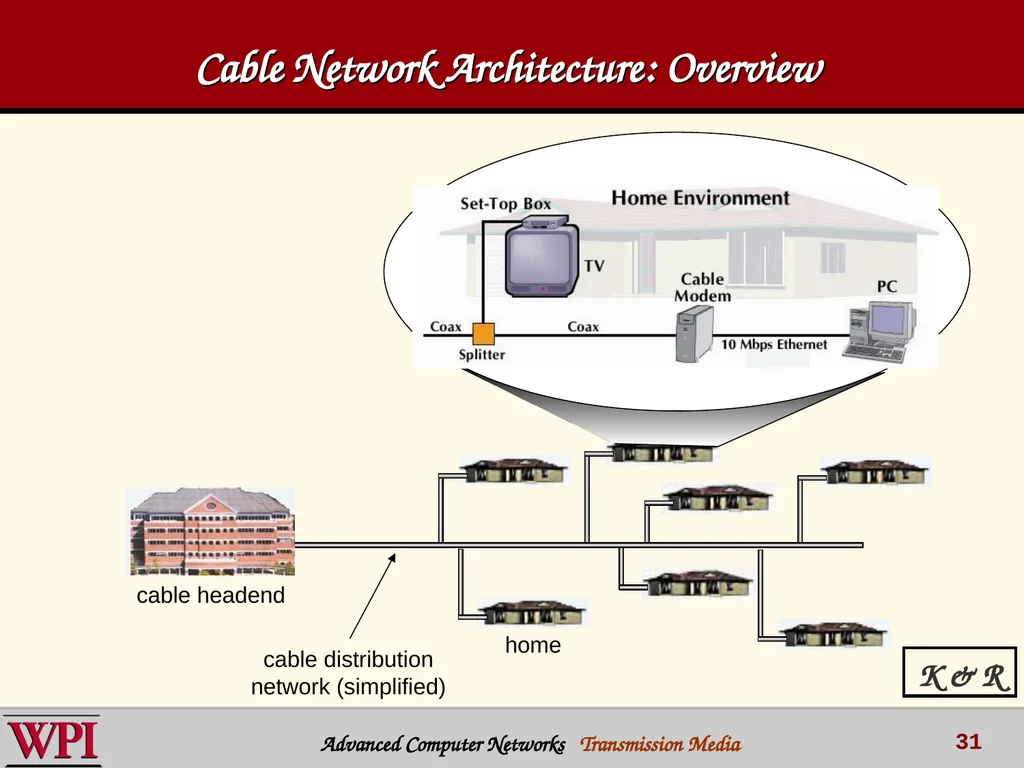
A network of cable and fiber attaches homes to ISP router [at the ‘head end’].
homes share access to router.
unlike DSL, which provides dedicated access. Residential Access: Cable Modems K & R<br>
Instead uses cable TV infrastructure.
HFC: Hybrid Fiber Coax
asymmetric: up to 30Mbps downstream, 2 Mbps upstream
A network of cable and fiber attaches homes to ISP router [at the ‘head end’].
homes share access to router.
unlike DSL, which provides dedicated access. Residential Access: Cable Modems K & R<br>
28
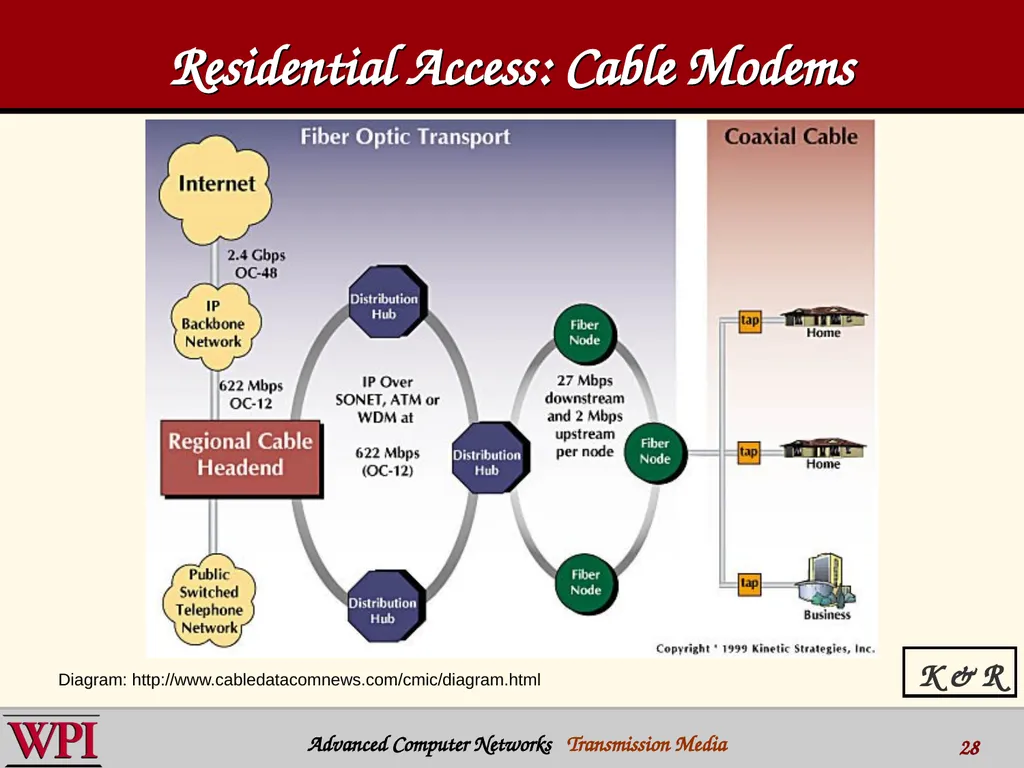
Residential Access: Cable Modems Advanced Computer Networks Transmission Media 28 Diagram: http://www.cabledatacomnews.com/cmic/diagram.html K & R<br>
29
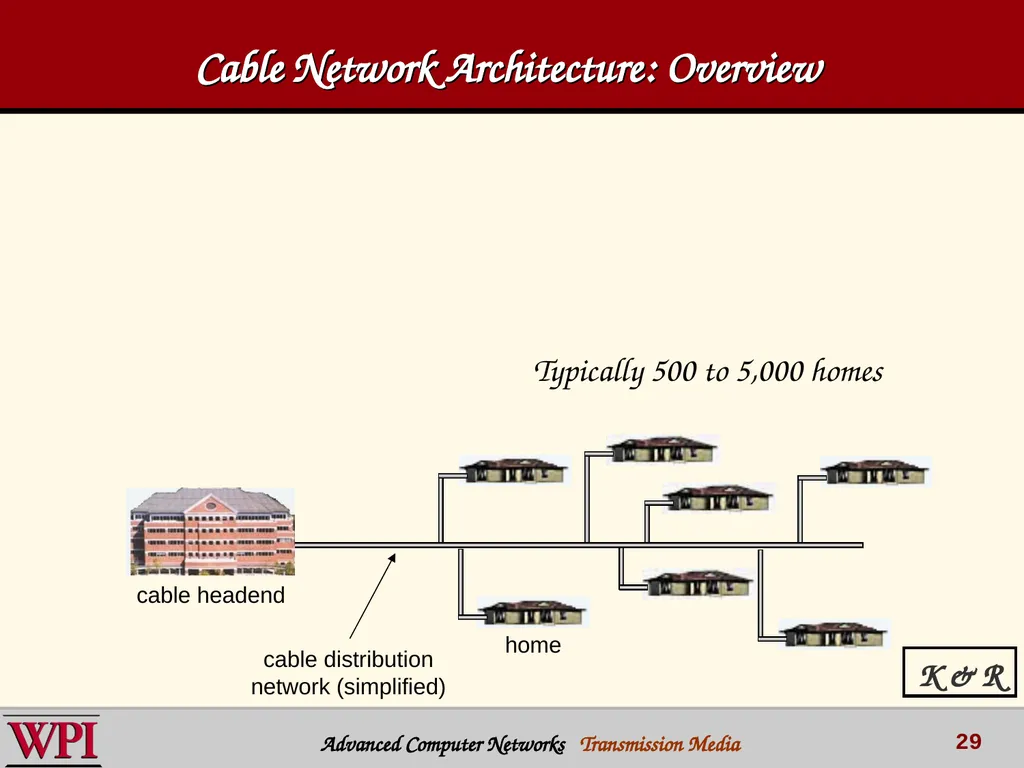
Cable Network Architecture: Overview home cable headend cable distribution
network (simplified) Typically 500 to 5,000 homes 29 Advanced Computer Networks Transmission Media K & R<br>
network (simplified) Typically 500 to 5,000 homes 29 Advanced Computer Networks Transmission Media K & R<br>
30
home cable headend cable distribution
network Cable Network Architecture: Overview 30 Advanced Computer Networks Transmission Media K & R<br>
network Cable Network Architecture: Overview 30 Advanced Computer Networks Transmission Media K & R<br>
31
home cable headend cable distribution
network (simplified) Cable Network Architecture: Overview 31 Advanced Computer Networks Transmission Media K & R<br>
network (simplified) Cable Network Architecture: Overview 31 Advanced Computer Networks Transmission Media K & R<br>
32
home cable headend cable distribution
network FDM (more shortly): Cable Network Architecture: Overview 32 Advanced Computer Networks Transmission Media K & R<br>
network FDM (more shortly): Cable Network Architecture: Overview 32 Advanced Computer Networks Transmission Media K & R<br>
33
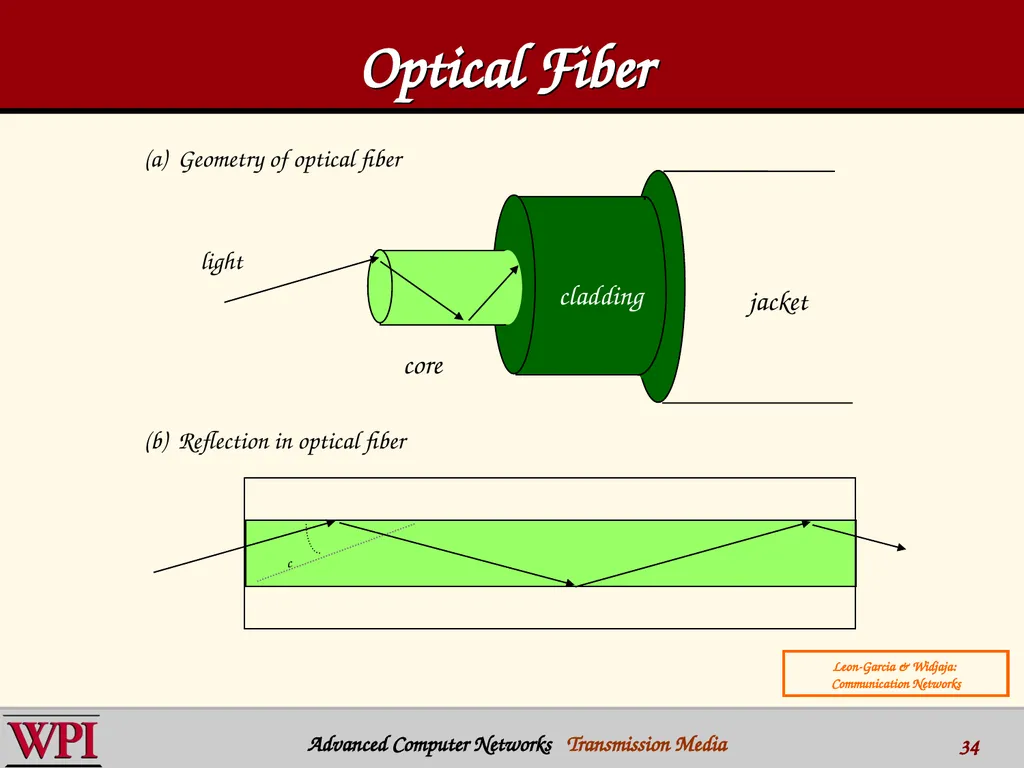
Optical Fiber Advanced Computer Networks Transmission Media 33 Optical fiber:: a thin flexible medium capable of conducting optical rays. Optical fiber consists of a very fine cylinder of glass (core) surrounded by concentric layers of glass (cladding).
a signal-encoded beam of light (a fluctuating beam) is transmitted by total internal reflection.
Total internal reflection occurs in the core because it has a higher optical density (index of refraction) than the cladding.
Attenuation in the fiber can be kept low by controlling the impurities in the glass.<br>
a signal-encoded beam of light (a fluctuating beam) is transmitted by total internal reflection.
Total internal reflection occurs in the core because it has a higher optical density (index of refraction) than the cladding.
Attenuation in the fiber can be kept low by controlling the impurities in the glass.<br>
34
Optical Fiber Advanced Computer Networks Transmission Media 34 (a) Geometry of optical fiber (b) Reflection in optical fiber Leon-Garcia & Widjaja:
Communication Networks<br>
Communication Networks<br>
35
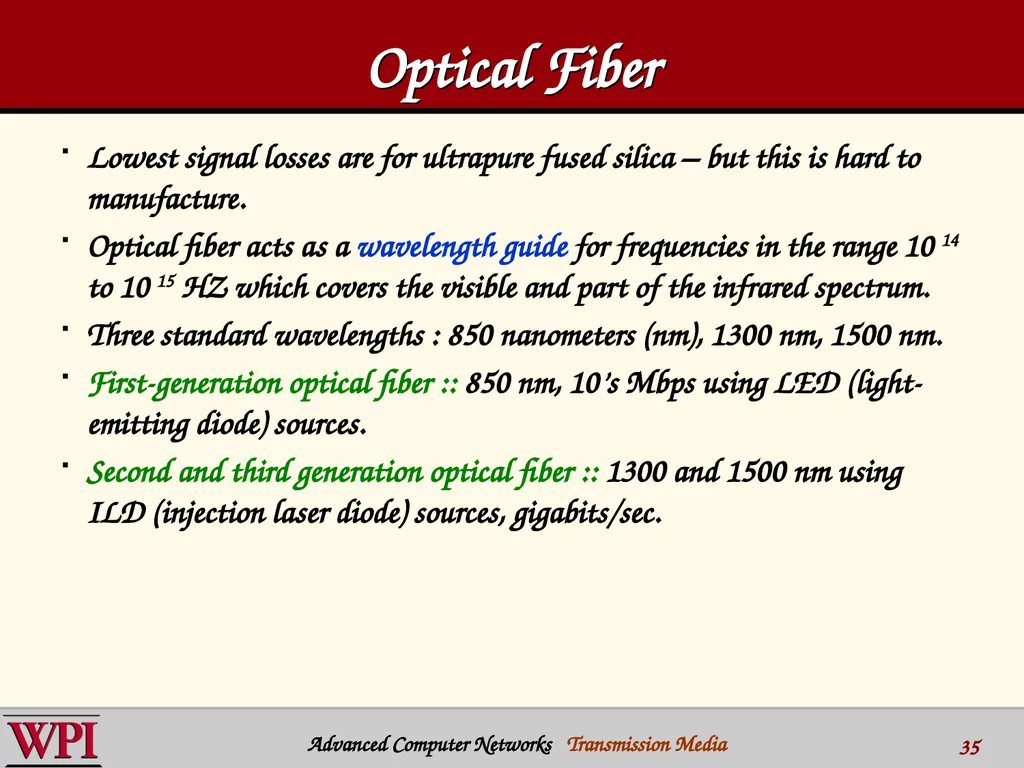
Optical Fiber Advanced Computer Networks Transmission Media 35 Lowest signal losses are for ultrapure fused silica – but this is hard to manufacture.
Optical fiber acts as a wavelength guide for frequencies in the range 10 14 to 10 15 HZ which covers the visible and part of the infrared spectrum.
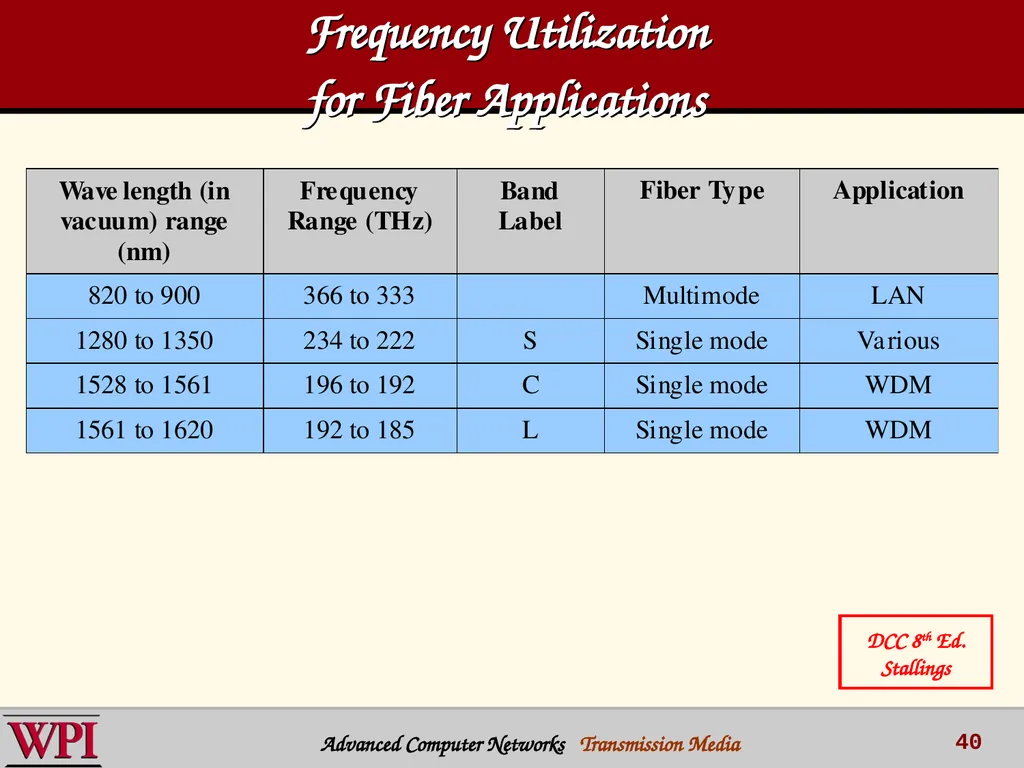
Three standard wavelengths : 850 nanometers (nm), 1300 nm, 1500 nm.
First-generation optical fiber :: 850 nm, 10’s Mbps using LED (light-emitting diode) sources.
Second and third generation optical fiber :: 1300 and 1500 nm using ILD (injection laser diode) sources, gigabits/sec.<br>
Optical fiber acts as a wavelength guide for frequencies in the range 10 14 to 10 15 HZ which covers the visible and part of the infrared spectrum.
Three standard wavelengths : 850 nanometers (nm), 1300 nm, 1500 nm.
First-generation optical fiber :: 850 nm, 10’s Mbps using LED (light-emitting diode) sources.
Second and third generation optical fiber :: 1300 and 1500 nm using ILD (injection laser diode) sources, gigabits/sec.<br>
36
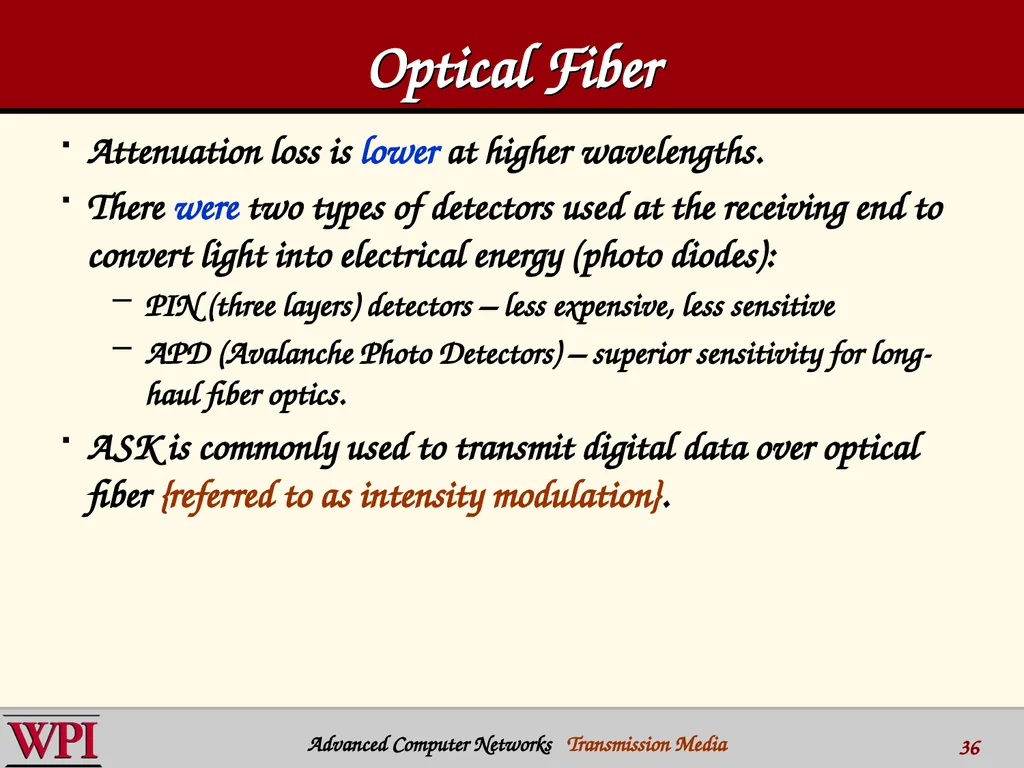
Optical Fiber Advanced Computer Networks Transmission Media 36 Attenuation loss is lower at higher wavelengths.
There were two types of detectors used at the receiving end to convert light into electrical energy (photo diodes):
PIN (three layers) detectors – less expensive, less sensitive
APD (Avalanche Photo Detectors) – superior sensitivity for long-haul fiber optics.
ASK is commonly used to transmit digital data over optical fiber {referred to as intensity modulation}.<br>
There were two types of detectors used at the receiving end to convert light into electrical energy (photo diodes):
PIN (three layers) detectors – less expensive, less sensitive
APD (Avalanche Photo Detectors) – superior sensitivity for long-haul fiber optics.
ASK is commonly used to transmit digital data over optical fiber {referred to as intensity modulation}.<br>
37
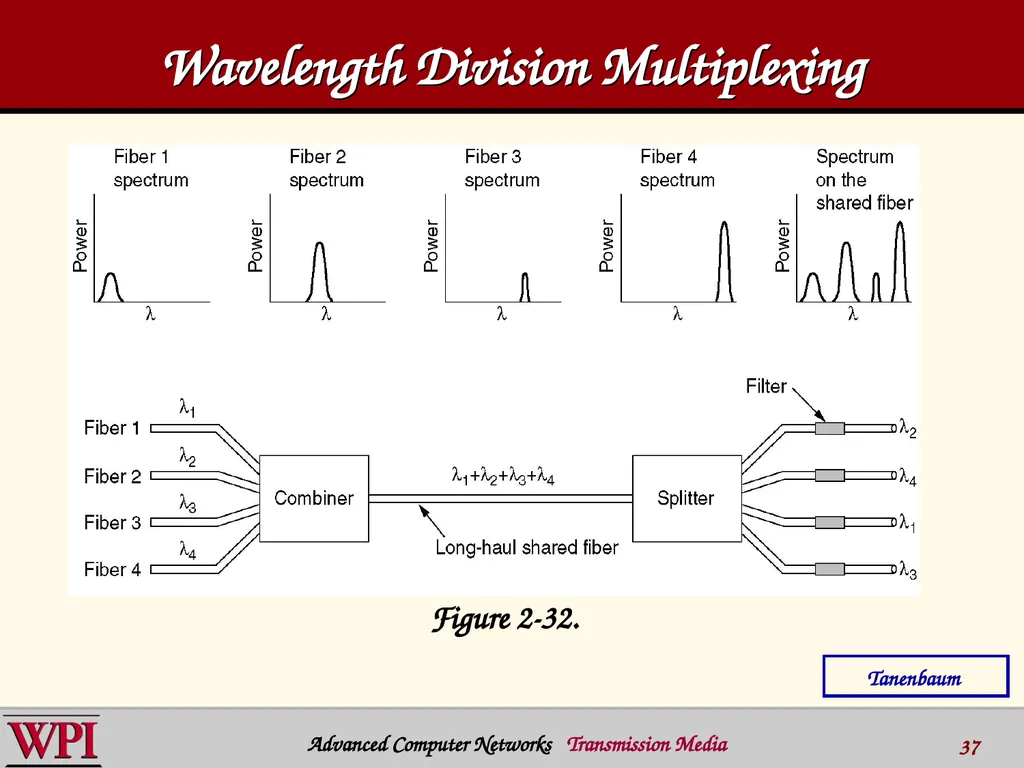
Advanced Computer Networks Transmission Media 37 Wavelength Division Multiplexing Wavelength division multiplexing. Figure 2-32. Tanenbaum<br>
38
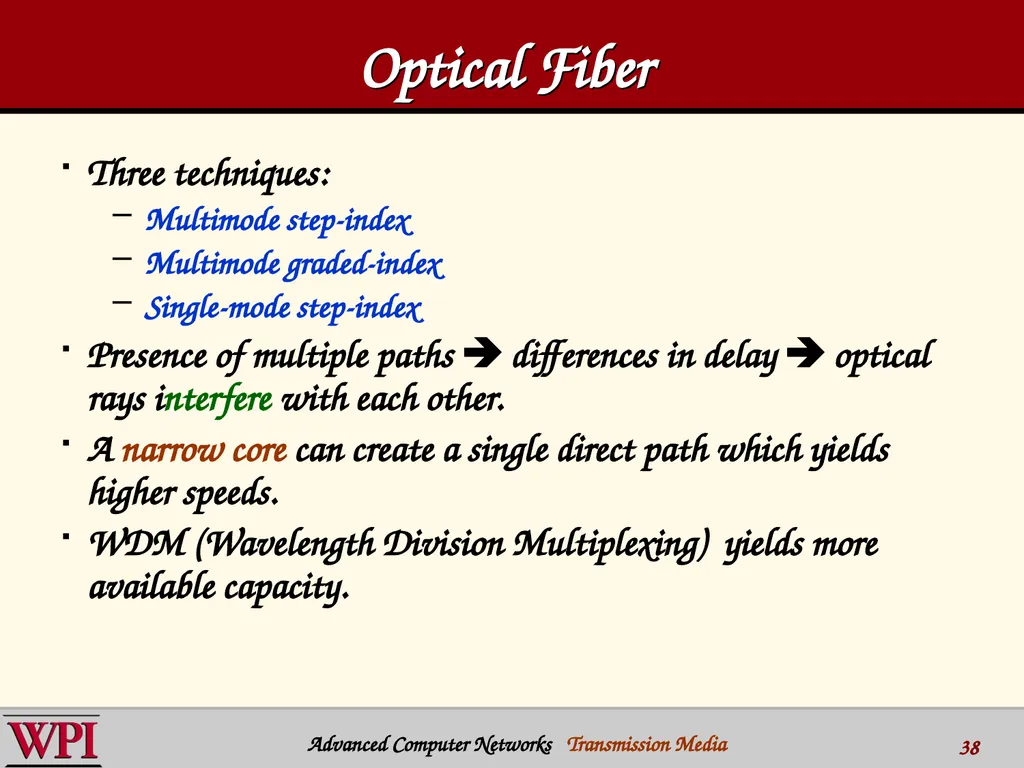
Optical Fiber Advanced Computer Networks Transmission Media 38 Three techniques:
Multimode step-index
Multimode graded-index
Single-mode step-index
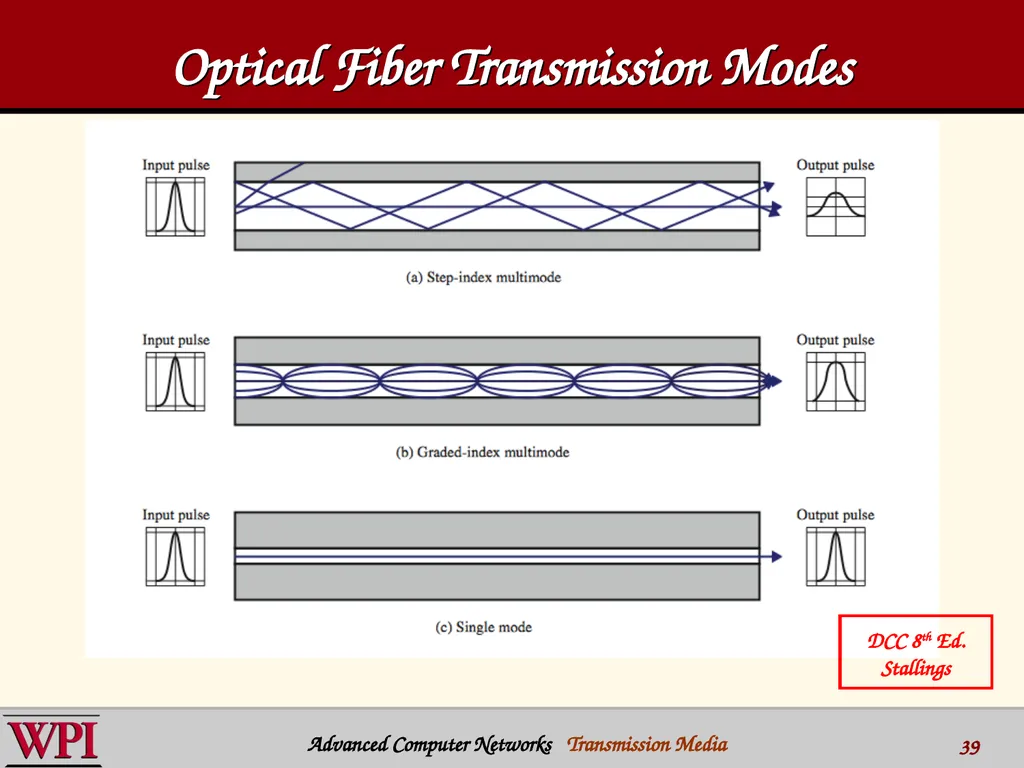
Presence of multiple paths differences in delay optical rays interfere with each other.
A narrow core can create a single direct path which yields higher speeds.
WDM (Wavelength Division Multiplexing) yields more available capacity.<br>
Multimode step-index
Multimode graded-index
Single-mode step-index
Presence of multiple paths differences in delay optical rays interfere with each other.
A narrow core can create a single direct path which yields higher speeds.
WDM (Wavelength Division Multiplexing) yields more available capacity.<br>
39
Advanced Computer Networks Transmission Media 39 Optical Fiber Transmission Modes DCC 8th Ed.
Stallings<br>
Stallings<br>
40
Frequency Utilization
for Fiber Applications DCC 8th Ed.
Stallings 40 Advanced Computer Networks Transmission Media<br>
Stallings 40 Advanced Computer Networks Transmission Media<br>
41
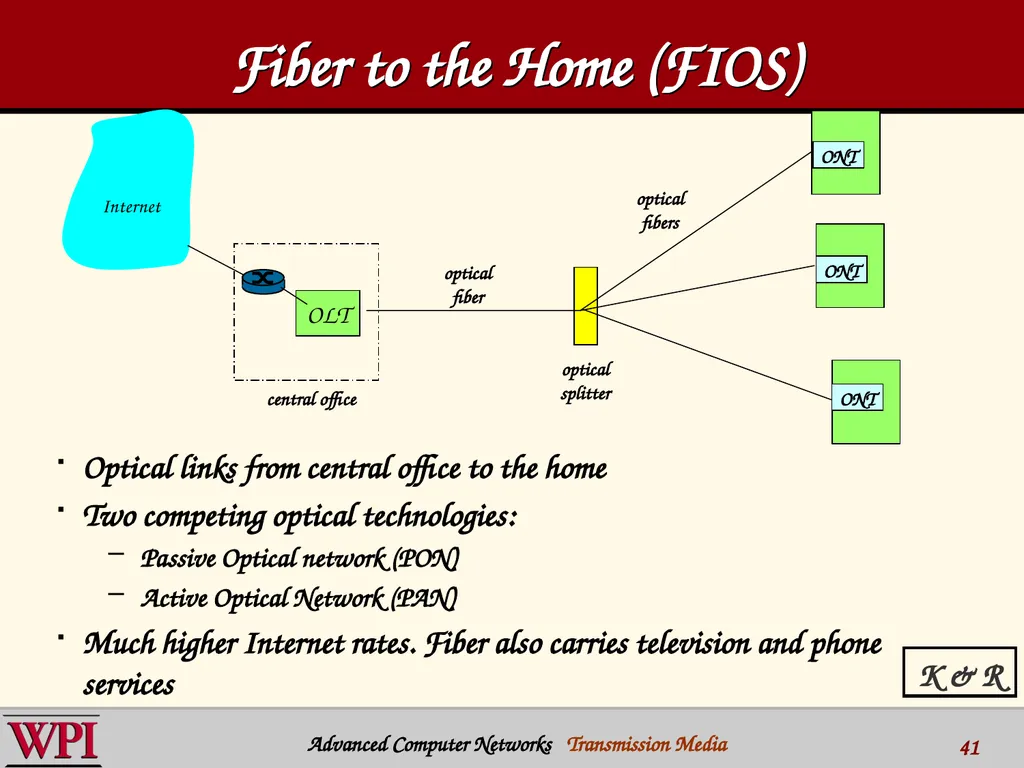
Fiber to the Home (FIOS) Optical links from central office to the home
Two competing optical technologies:
Passive Optical network (PON)
Active Optical Network (PAN)
Much higher Internet rates. Fiber also carries television and phone services ONT ONT ONT 41 Advanced Computer Networks Transmission Media K & R<br>
Two competing optical technologies:
Passive Optical network (PON)
Active Optical Network (PAN)
Much higher Internet rates. Fiber also carries television and phone services ONT ONT ONT 41 Advanced Computer Networks Transmission Media K & R<br>
42
Wireless Communications (briefly) Advanced Computer Networks Transmission Media 42 An application of omni-directional wireless communications to provide high-speed communications among a number of computers located in close proximity.
In 1996 FCC in US announced its intentions to make 350 MHz of spectrum in the 5.15 to 5.35 GHz and 5.725 to 5.825 GHz bands available for unlicensed use in LAN applications.<br>
In 1996 FCC in US announced its intentions to make 350 MHz of spectrum in the 5.15 to 5.35 GHz and 5.725 to 5.825 GHz bands available for unlicensed use in LAN applications.<br>
43
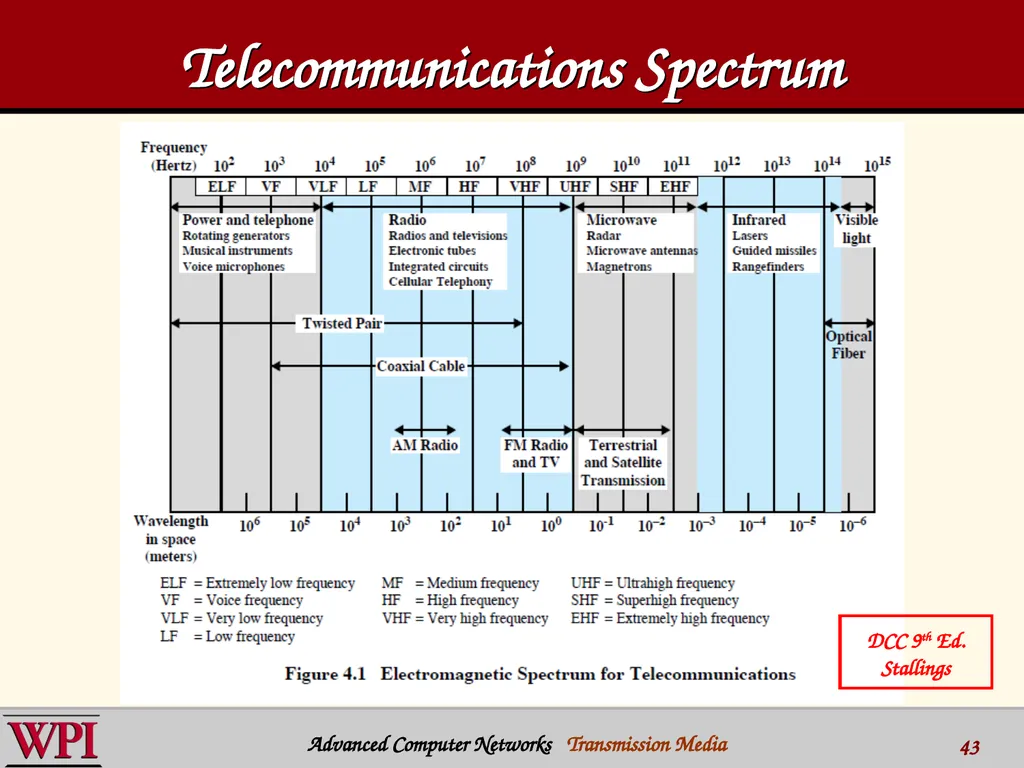
Telecommunications Spectrum Advanced Computer Networks Transmission Media 43 DCC 9th Ed.
Stallings<br>
Stallings<br>
44
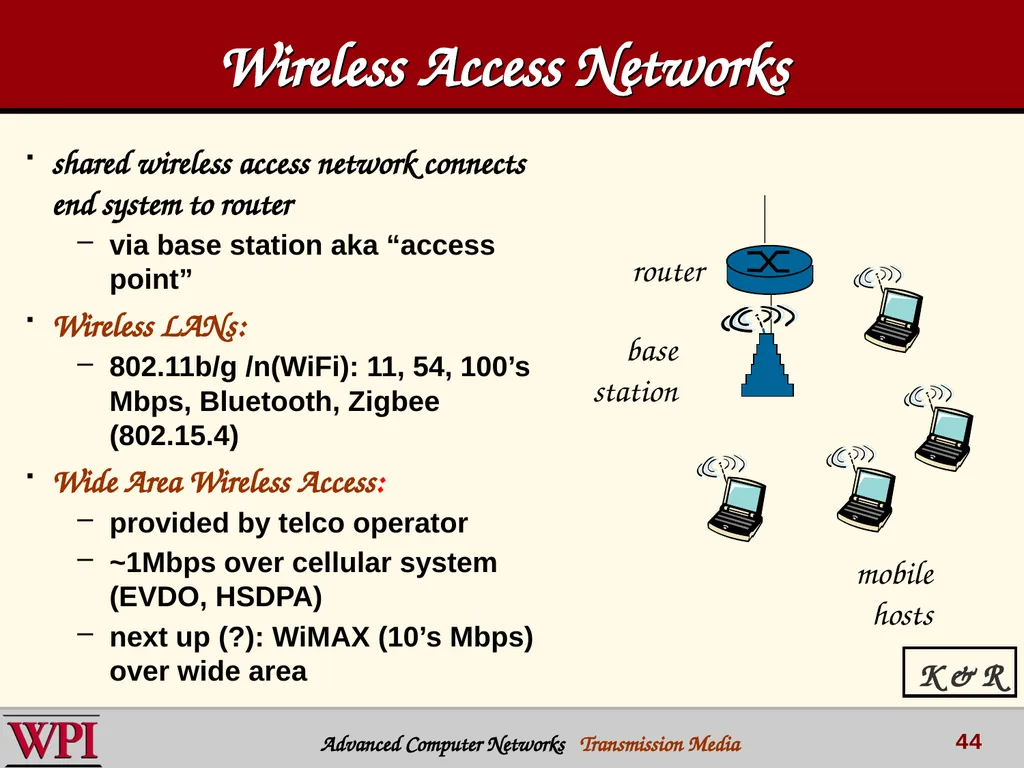
Wireless Access Networks shared wireless access network connects end system to router
via base station aka “access point”
Wireless LANs:
802.11b/g /n(WiFi): 11, 54, 100’s Mbps, Bluetooth, Zigbee (802.15.4)
Wide Area Wireless Access:
provided by telco operator
~1Mbps over cellular system (EVDO, HSDPA)
next up (?): WiMAX (10’s Mbps) over wide area base
station mobile
hosts router 44 Advanced Computer Networks Transmission Media K & R<br>
via base station aka “access point”
Wireless LANs:
802.11b/g /n(WiFi): 11, 54, 100’s Mbps, Bluetooth, Zigbee (802.15.4)
Wide Area Wireless Access:
provided by telco operator
~1Mbps over cellular system (EVDO, HSDPA)
next up (?): WiMAX (10’s Mbps) over wide area base
station mobile
hosts router 44 Advanced Computer Networks Transmission Media K & R<br>
45
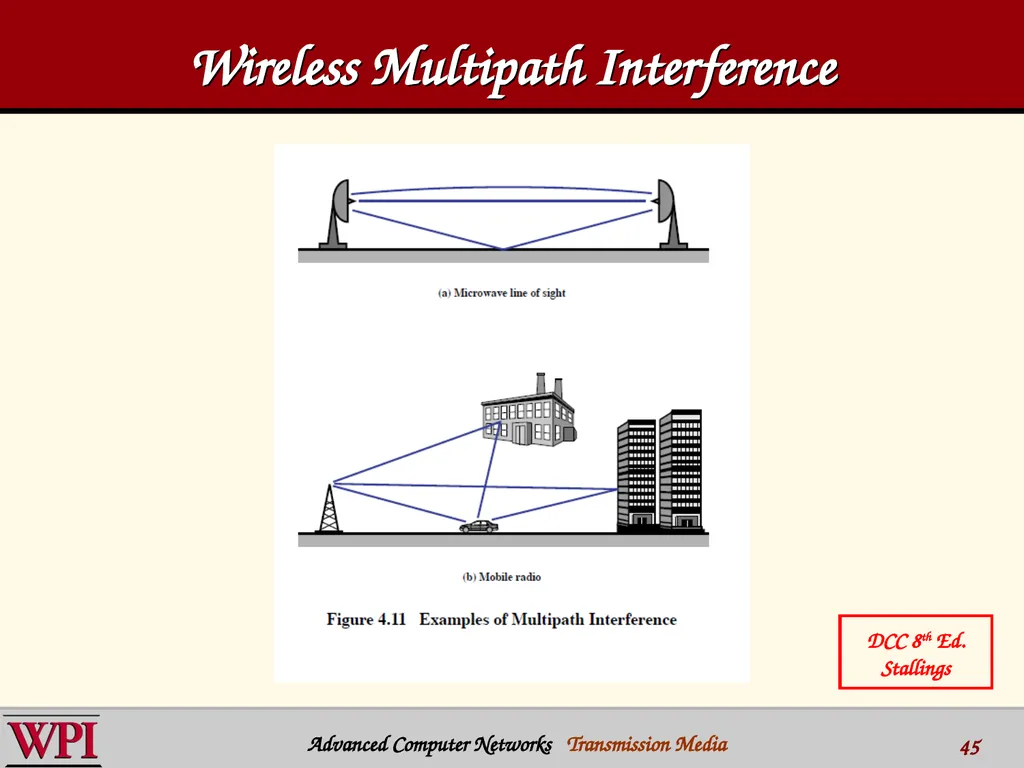
Wireless Multipath Interference Advanced Computer Networks Transmission Media 45 DCC 8th Ed.
Stallings<br>
Stallings<br>
46
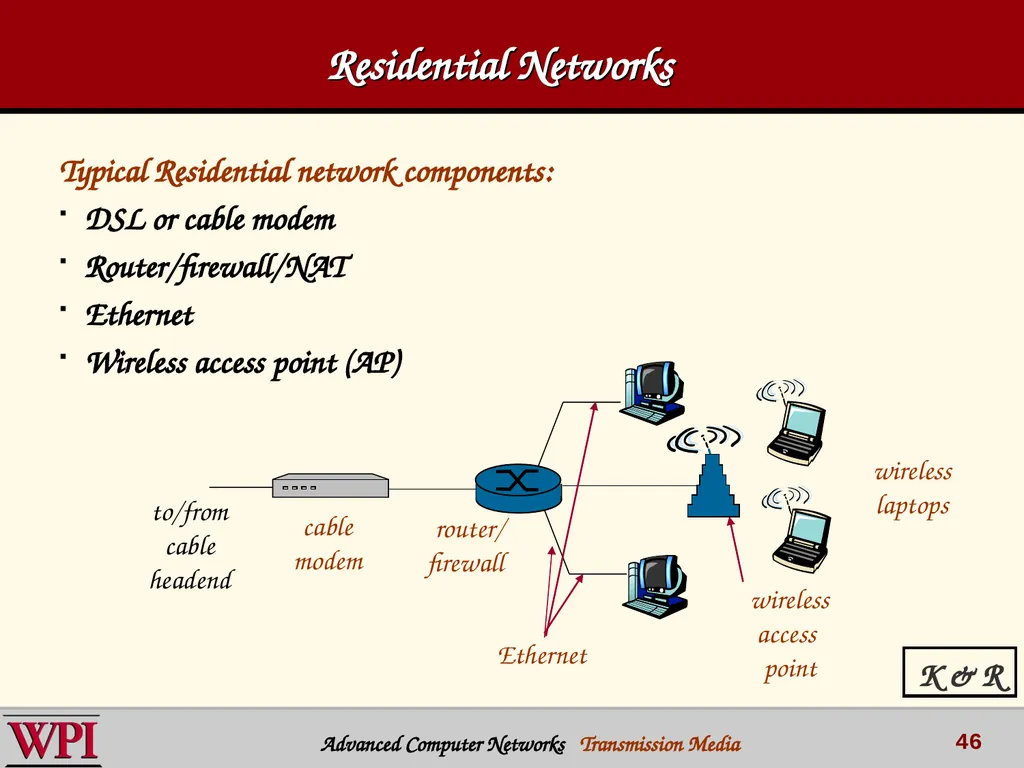
Residential Networks Typical Residential network components:
DSL or cable modem
Router/firewall/NAT
Ethernet
Wireless access point (AP) wireless
access
point wireless
laptops router/
firewall cable
modem to/from
cable
headend Ethernet 46 Advanced Computer Networks Transmission Media K & R<br>
DSL or cable modem
Router/firewall/NAT
Ethernet
Wireless access point (AP) wireless
access
point wireless
laptops router/
firewall cable
modem to/from
cable
headend Ethernet 46 Advanced Computer Networks Transmission Media K & R<br>
47
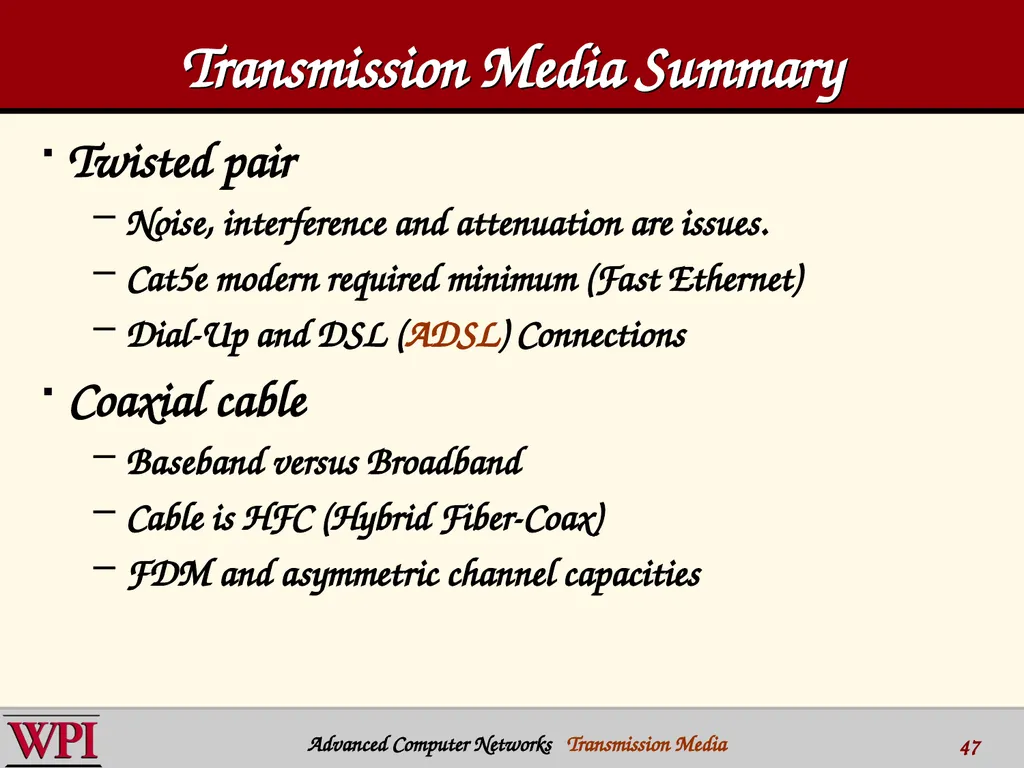
Transmission Media Summary Advanced Computer Networks Transmission Media 47 Twisted pair
Noise, interference and attenuation are issues.
Cat5e modern required minimum (Fast Ethernet)
Dial-Up and DSL (ADSL) Connections
Coaxial cable
Baseband versus Broadband
Cable is HFC (Hybrid Fiber-Coax)
FDM and asymmetric channel capacities<br>
Noise, interference and attenuation are issues.
Cat5e modern required minimum (Fast Ethernet)
Dial-Up and DSL (ADSL) Connections
Coaxial cable
Baseband versus Broadband
Cable is HFC (Hybrid Fiber-Coax)
FDM and asymmetric channel capacities<br>
48
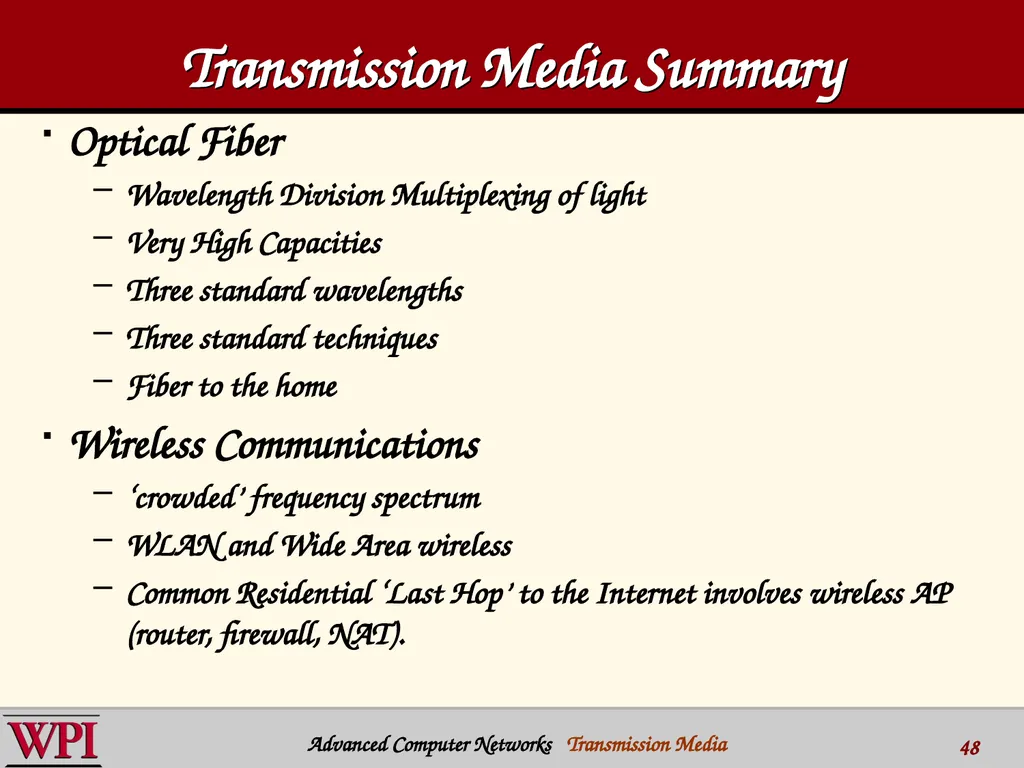
Transmission Media Summary Advanced Computer Networks Transmission Media 48 Optical Fiber
Wavelength Division Multiplexing of light
Very High Capacities
Three standard wavelengths
Three standard techniques
Fiber to the home
Wireless Communications
‘crowded’ frequency spectrum
WLAN and Wide Area wireless
Common Residential ‘Last Hop’ to the Internet involves wireless AP (router, firewall, NAT).<br>
Wavelength Division Multiplexing of light
Very High Capacities
Three standard wavelengths
Three standard techniques
Fiber to the home
Wireless Communications
‘crowded’ frequency spectrum
WLAN and Wide Area wireless
Common Residential ‘Last Hop’ to the Internet involves wireless AP (router, firewall, NAT).<br>