
PHYSTAT-Systematics: Setting the Scene Louis Lyons
T
Published · 19 slides · 0 views
1 / 1
Description
PHYSTAT-Systematics: Setting the Scene Louis Lyons Imperial College London Oxford l.lyonsphysics.ox.ac.uk 1st Nov 2021 PHYSTAT-Systematics: Setting the Scene 1 PHYSTAT-Systematics: Setting the Scene Louis Lyons Imperial College London
Related Topics
Share
Embed code
Download this presentation From Below
"PHYSTAT-Systematics: Setting the Scene Louis Lyons" is the property of its rightful owner. Permission is granted to download and print the materials on this website for personal, non-commercial use only, and to display it on your personal computer provided you do not modify the materials and that you retain all copyright notices contained in the materials. By downloading content from our website, you accept the terms of this agreement.
Presentation Transcript
01
PHYSTAT-Systematics:
Setting the Scene Louis Lyons
Imperial College London & Oxford
l.lyons@physics.ox.ac.uk 1st Nov 2021 PHYSTAT-Systematics: Setting the Scene 1<br>
Imperial College London & Oxford
l.lyons@physics.ox.ac.uk 1st Nov 2021 PHYSTAT-Systematics: Setting the Scene 1<br>
02
PHYSTAT-Systematics:
Setting the Scene Louis Lyons
Imperial College London & Oxford
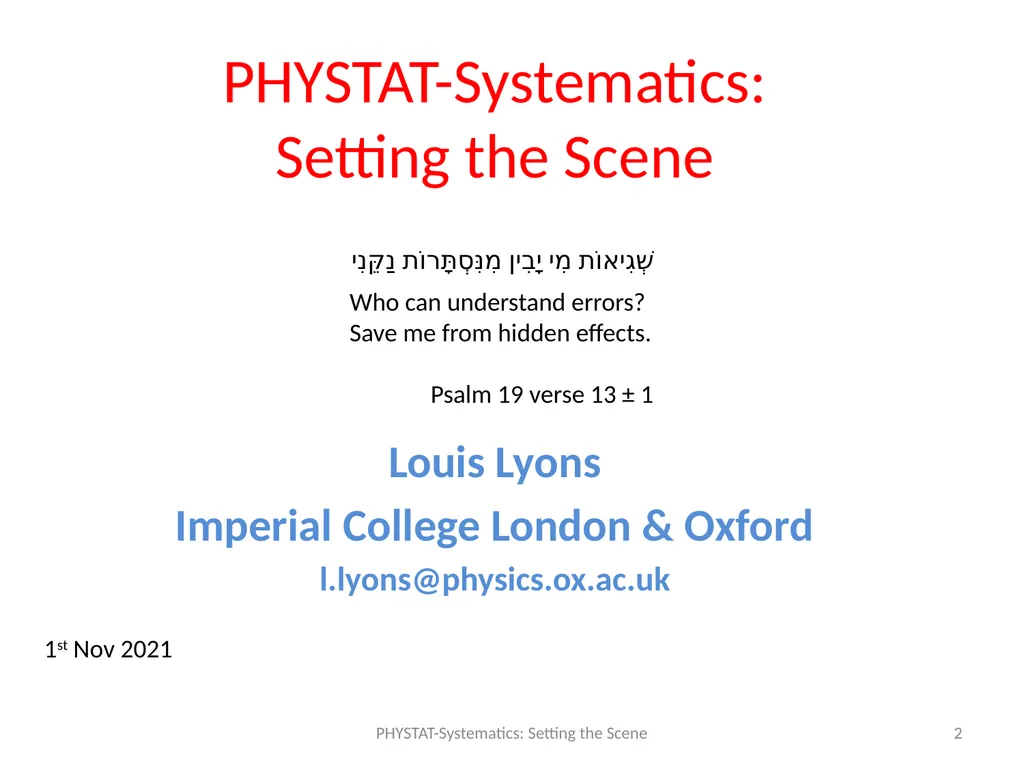
l.lyons@physics.ox.ac.uk 1st Nov 2021 PHYSTAT-Systematics: Setting the Scene 2 שְׁגִיאוֹת מִי יָבִין מִנִּסְתָּרוֹת נַקֵּנִי Who can understand errors? Save me from hidden effects.
Psalm 19 verse 13 ± 1<br>
Imperial College London & Oxford
l.lyons@physics.ox.ac.uk 1st Nov 2021 PHYSTAT-Systematics: Setting the Scene 2 שְׁגִיאוֹת מִי יָבִין מִנִּסְתָּרוֹת נַקֵּנִי Who can understand errors? Save me from hidden effects.
Psalm 19 verse 13 ± 1<br>
03
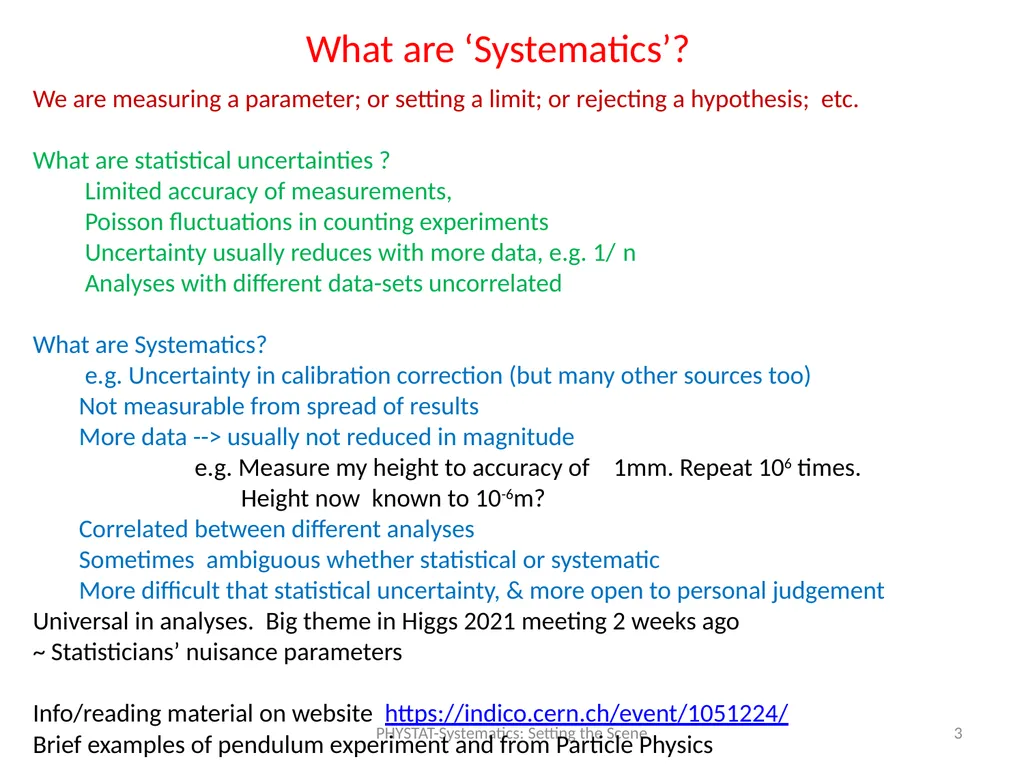
What are ‘Systematics’? We are measuring a parameter; or setting a limit; or rejecting a hypothesis; etc.
What are statistical uncertainties ?
Limited accuracy of measurements,
Poisson fluctuations in counting experiments
Uncertainty usually reduces with more data, e.g. 1/n
Analyses with different data-sets uncorrelated
What are Systematics?
e.g. Uncertainty in calibration correction (but many other sources too)
Not measurable from spread of results
More data --> usually not reduced in magnitude
e.g. Measure my height to accuracy of 1mm. Repeat 106 times.
Height now known to 10-6m?
Correlated between different analyses
Sometimes ambiguous whether statistical or systematic
More difficult that statistical uncertainty, & more open to personal judgement
Universal in analyses. Big theme in Higgs 2021 meeting 2 weeks ago
~ Statisticians’ nuisance parameters
Info/reading material on website https://indico.cern.ch/event/1051224/
Brief examples of pendulum experiment and from Particle Physics PHYSTAT-Systematics: Setting the Scene 3<br>
What are statistical uncertainties ?
Limited accuracy of measurements,
Poisson fluctuations in counting experiments
Uncertainty usually reduces with more data, e.g. 1/n
Analyses with different data-sets uncorrelated
What are Systematics?
e.g. Uncertainty in calibration correction (but many other sources too)
Not measurable from spread of results
More data --> usually not reduced in magnitude
e.g. Measure my height to accuracy of 1mm. Repeat 106 times.
Height now known to 10-6m?
Correlated between different analyses
Sometimes ambiguous whether statistical or systematic
More difficult that statistical uncertainty, & more open to personal judgement
Universal in analyses. Big theme in Higgs 2021 meeting 2 weeks ago
~ Statisticians’ nuisance parameters
Info/reading material on website https://indico.cern.ch/event/1051224/
Brief examples of pendulum experiment and from Particle Physics PHYSTAT-Systematics: Setting the Scene 3<br>
04
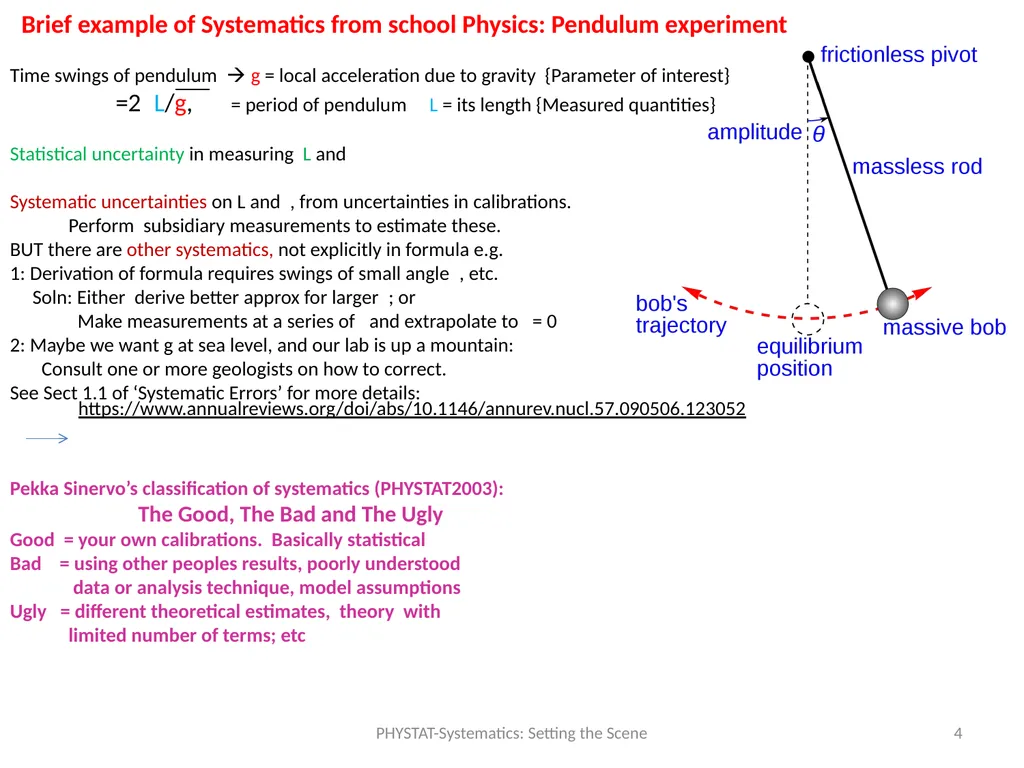
PHYSTAT-Systematics: Setting the Scene 4 Brief example of Systematics from school Physics: Pendulum experiment
Time swings of pendulum g = local acceleration due to gravity {Parameter of interest}
=2L/g, = period of pendulum L = its length {Measured quantities}
Statistical uncertainty in measuring L and
Systematic uncertainties on L and , from uncertainties in calibrations.
Perform subsidiary measurements to estimate these.
BUT there are other systematics, not explicitly in formula e.g.
1: Derivation of formula requires swings of small angle , etc.
Soln: Either derive better approx for larger ; or
Make measurements at a series of and extrapolate to = 0
2: Maybe we want g at sea level, and our lab is up a mountain:
Consult one or more geologists on how to correct.
See Sect 1.1 of ‘Systematic Errors’ for more details:
Pekka Sinervo’s classification of systematics (PHYSTAT2003):
The Good, The Bad and The Ugly
Good = your own calibrations. Basically statistical
Bad = using other peoples results, poorly understood
data or analysis technique, model assumptions
Ugly = different theoretical estimates, theory with
limited number of terms; etc https://www.annualreviews.org/doi/abs/10.1146/annurev.nucl.57.090506.123052<br>
Time swings of pendulum g = local acceleration due to gravity {Parameter of interest}
=2L/g, = period of pendulum L = its length {Measured quantities}
Statistical uncertainty in measuring L and
Systematic uncertainties on L and , from uncertainties in calibrations.
Perform subsidiary measurements to estimate these.
BUT there are other systematics, not explicitly in formula e.g.
1: Derivation of formula requires swings of small angle , etc.
Soln: Either derive better approx for larger ; or
Make measurements at a series of and extrapolate to = 0
2: Maybe we want g at sea level, and our lab is up a mountain:
Consult one or more geologists on how to correct.
See Sect 1.1 of ‘Systematic Errors’ for more details:
Pekka Sinervo’s classification of systematics (PHYSTAT2003):
The Good, The Bad and The Ugly
Good = your own calibrations. Basically statistical
Bad = using other peoples results, poorly understood
data or analysis technique, model assumptions
Ugly = different theoretical estimates, theory with
limited number of terms; etc https://www.annualreviews.org/doi/abs/10.1146/annurev.nucl.57.090506.123052<br>
05
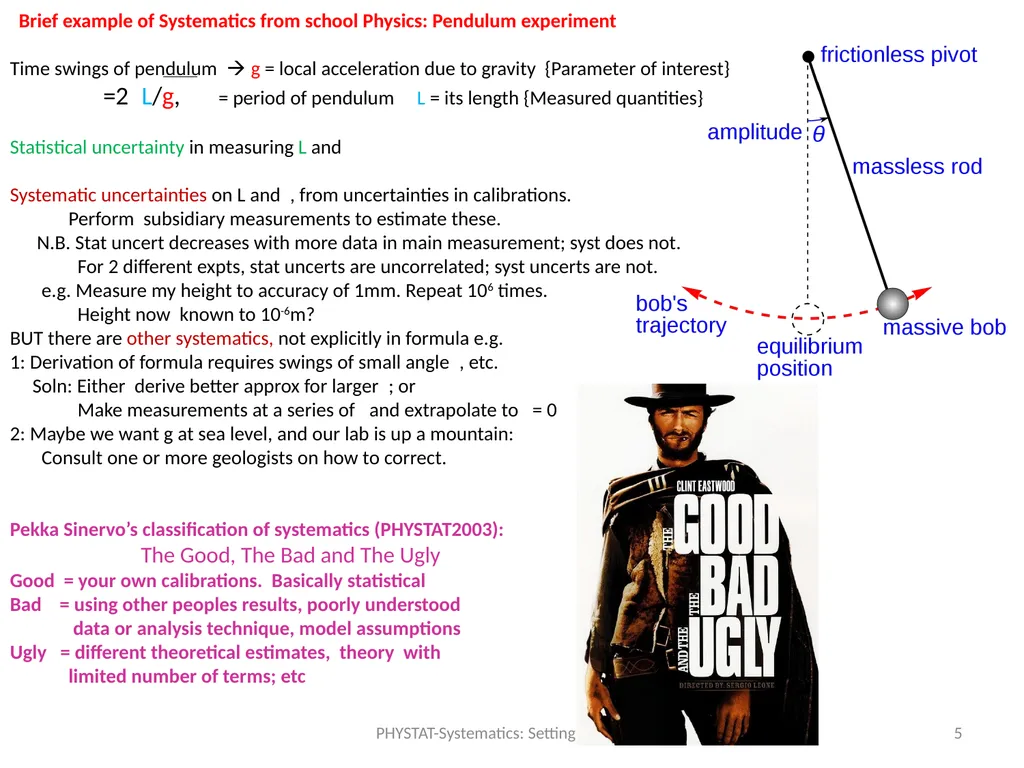
PHYSTAT-Systematics: Setting the Scene 5 Brief example of Systematics from school Physics: Pendulum experiment
Time swings of pendulum g = local acceleration due to gravity {Parameter of interest}
=2L/g, = period of pendulum L = its length {Measured quantities}
Statistical uncertainty in measuring L and
Systematic uncertainties on L and , from uncertainties in calibrations.
Perform subsidiary measurements to estimate these.
N.B. Stat uncert decreases with more data in main measurement; syst does not.
For 2 different expts, stat uncerts are uncorrelated; syst uncerts are not.
e.g. Measure my height to accuracy of 1mm. Repeat 106 times.
Height now known to 10-6m?
BUT there are other systematics, not explicitly in formula e.g.
1: Derivation of formula requires swings of small angle , etc.
Soln: Either derive better approx for larger ; or
Make measurements at a series of and extrapolate to = 0
2: Maybe we want g at sea level, and our lab is up a mountain:
Consult one or more geologists on how to correct.
Pekka Sinervo’s classification of systematics (PHYSTAT2003):
The Good, The Bad and The Ugly
Good = your own calibrations. Basically statistical
Bad = using other peoples results, poorly understood
data or analysis technique, model assumptions
Ugly = different theoretical estimates, theory with
limited number of terms; etc<br>
Time swings of pendulum g = local acceleration due to gravity {Parameter of interest}
=2L/g, = period of pendulum L = its length {Measured quantities}
Statistical uncertainty in measuring L and
Systematic uncertainties on L and , from uncertainties in calibrations.
Perform subsidiary measurements to estimate these.
N.B. Stat uncert decreases with more data in main measurement; syst does not.
For 2 different expts, stat uncerts are uncorrelated; syst uncerts are not.
e.g. Measure my height to accuracy of 1mm. Repeat 106 times.
Height now known to 10-6m?
BUT there are other systematics, not explicitly in formula e.g.
1: Derivation of formula requires swings of small angle , etc.
Soln: Either derive better approx for larger ; or
Make measurements at a series of and extrapolate to = 0
2: Maybe we want g at sea level, and our lab is up a mountain:
Consult one or more geologists on how to correct.
Pekka Sinervo’s classification of systematics (PHYSTAT2003):
The Good, The Bad and The Ugly
Good = your own calibrations. Basically statistical
Bad = using other peoples results, poorly understood
data or analysis technique, model assumptions
Ugly = different theoretical estimates, theory with
limited number of terms; etc<br>
06
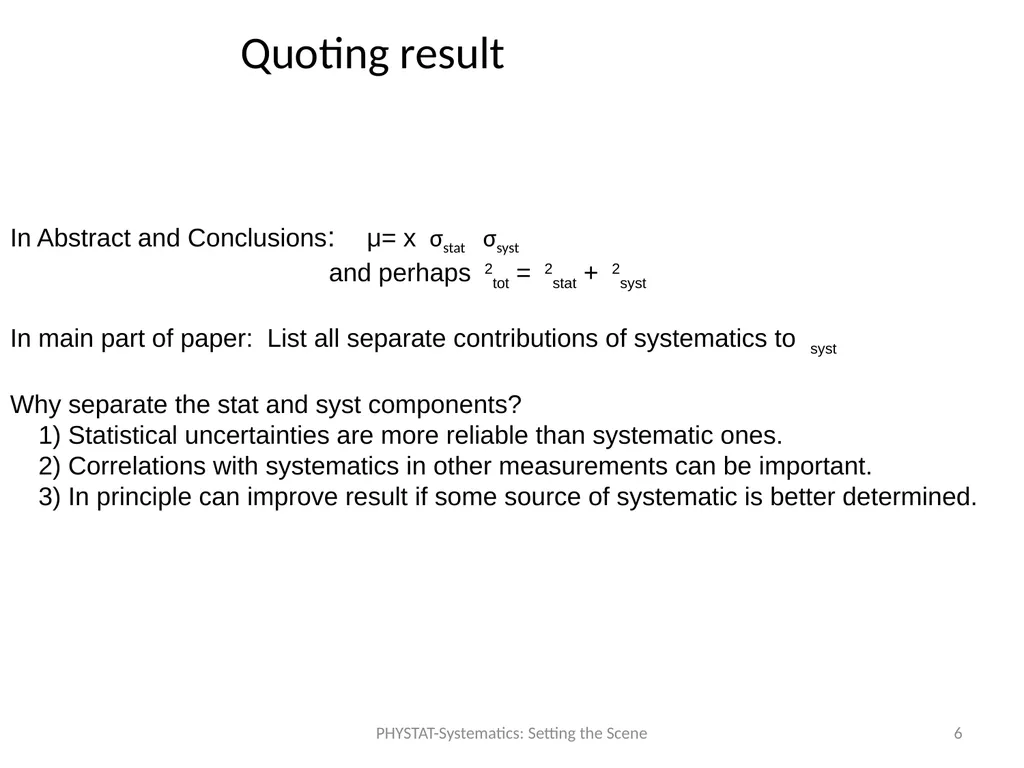
PHYSTAT-Systematics: Setting the Scene 6 Quoting result In Abstract and Conclusions: μ= x σstat σsyst
and perhaps 2tot = 2stat + 2syst
In main part of paper: List all separate contributions of systematics to syst
Why separate the stat and syst components?
1) Statistical uncertainties are more reliable than systematic ones.
2) Correlations with systematics in other measurements can be important.
3) In principle can improve result if some source of systematic is better determined.<br>
and perhaps 2tot = 2stat + 2syst
In main part of paper: List all separate contributions of systematics to syst
Why separate the stat and syst components?
1) Statistical uncertainties are more reliable than systematic ones.
2) Correlations with systematics in other measurements can be important.
3) In principle can improve result if some source of systematic is better determined.<br>
07
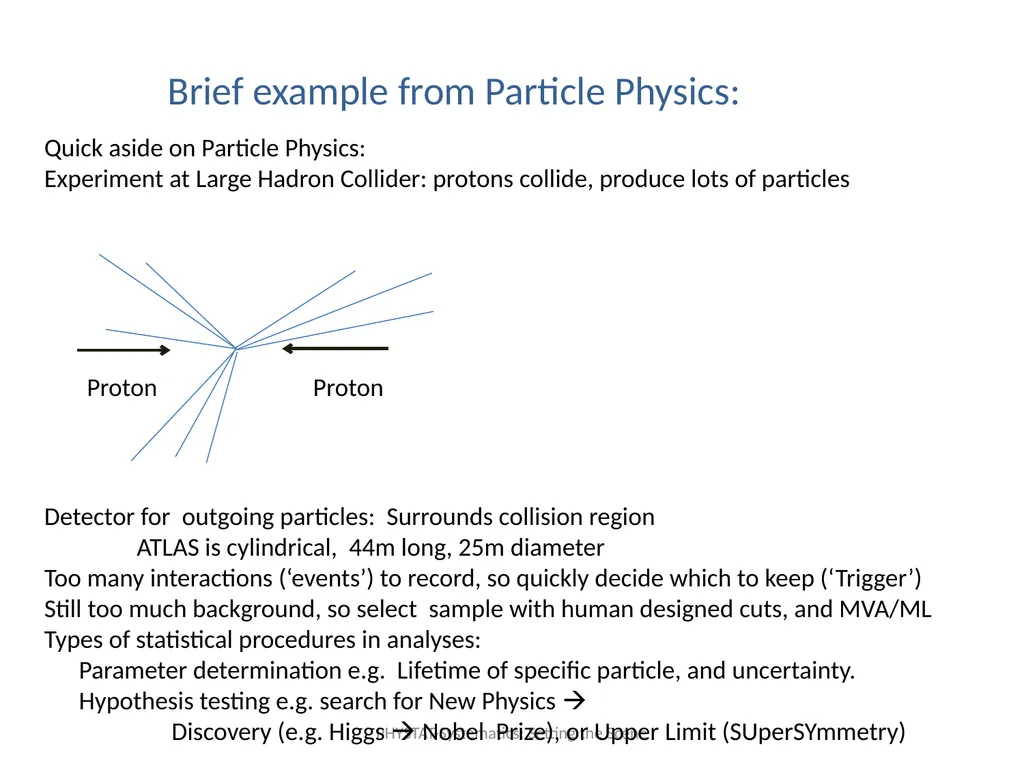
PHYSTAT-Systematics: Setting the Scene Brief example from Particle Physics: Proton Proton Quick aside on Particle Physics:
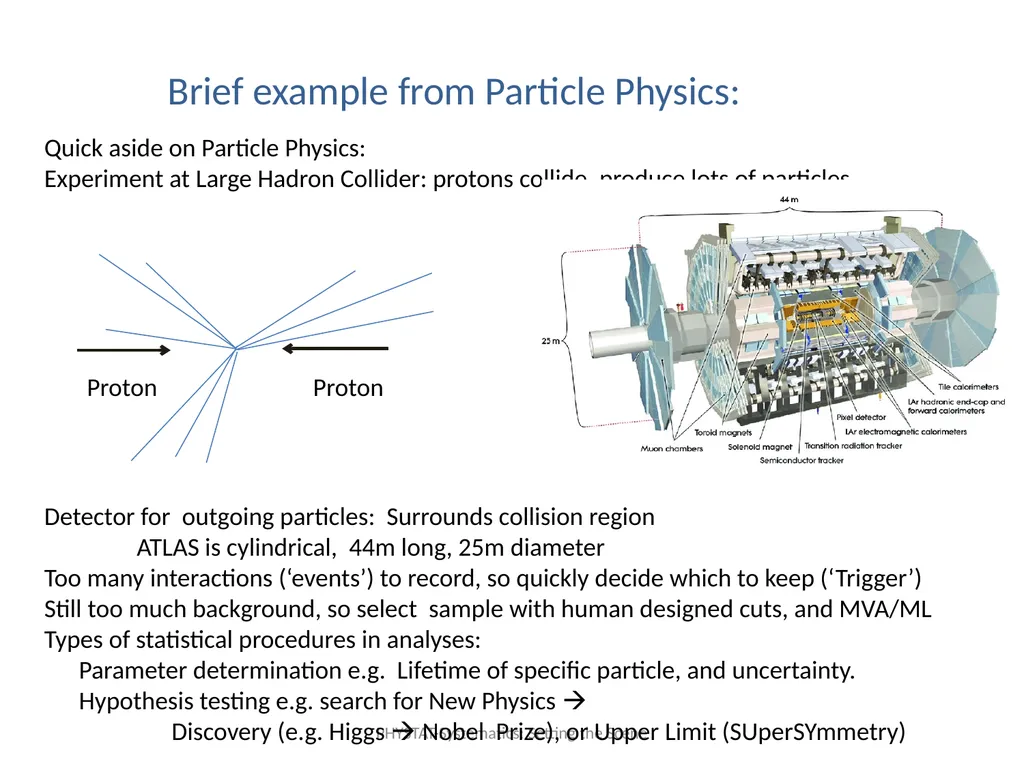
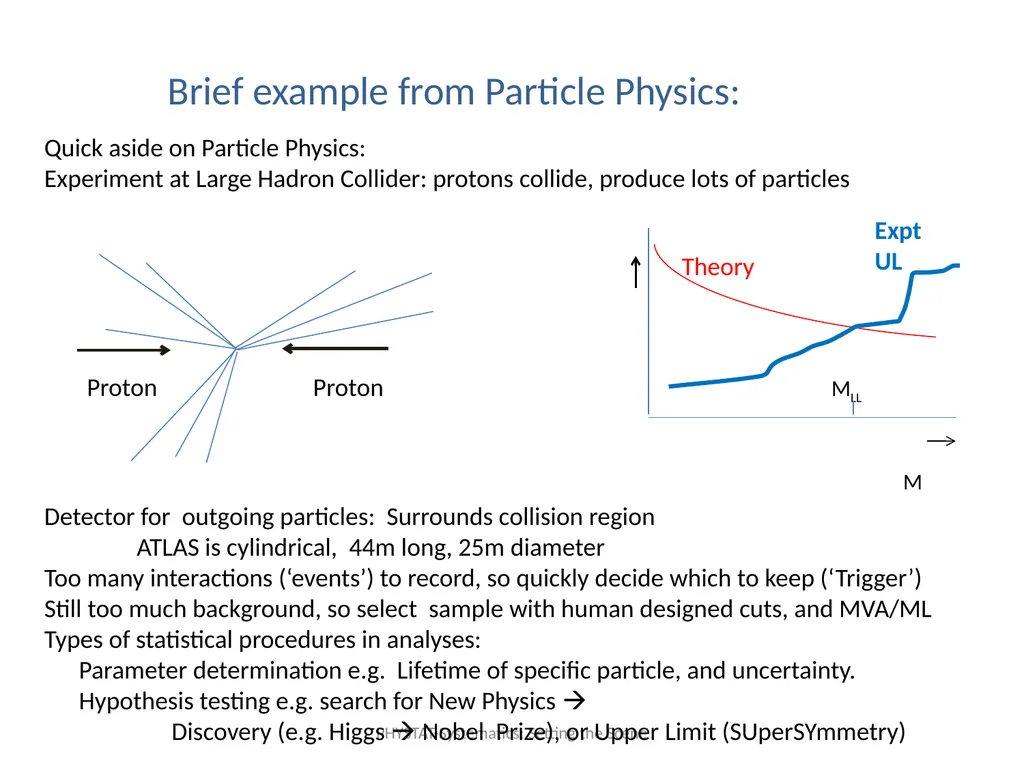
Experiment at Large Hadron Collider: protons collide, produce lots of particles
Detector for outgoing particles: Surrounds collision region
ATLAS is cylindrical, 44m long, 25m diameter
Too many interactions (‘events’) to record, so quickly decide which to keep (‘Trigger’)
Still too much background, so select sample with human designed cuts, and MVA/ML
Types of statistical procedures in analyses:
Parameter determination e.g. Lifetime of specific particle, and uncertainty.
Hypothesis testing e.g. search for New Physics
Discovery (e.g. Higgs Nobel Prize), or Upper Limit (SUperSYmmetry)<br>
Experiment at Large Hadron Collider: protons collide, produce lots of particles
Detector for outgoing particles: Surrounds collision region
ATLAS is cylindrical, 44m long, 25m diameter
Too many interactions (‘events’) to record, so quickly decide which to keep (‘Trigger’)
Still too much background, so select sample with human designed cuts, and MVA/ML
Types of statistical procedures in analyses:
Parameter determination e.g. Lifetime of specific particle, and uncertainty.
Hypothesis testing e.g. search for New Physics
Discovery (e.g. Higgs Nobel Prize), or Upper Limit (SUperSYmmetry)<br>
08
PHYSTAT-Systematics: Setting the Scene Brief example from Particle Physics: Proton Proton Quick aside on Particle Physics:
Experiment at Large Hadron Collider: protons collide, produce lots of particles
Detector for outgoing particles: Surrounds collision region
ATLAS is cylindrical, 44m long, 25m diameter
Too many interactions (‘events’) to record, so quickly decide which to keep (‘Trigger’)
Still too much background, so select sample with human designed cuts, and MVA/ML
Types of statistical procedures in analyses:
Parameter determination e.g. Lifetime of specific particle, and uncertainty.
Hypothesis testing e.g. search for New Physics
Discovery (e.g. Higgs Nobel Prize), or Upper Limit (SUperSYmmetry)<br>
Experiment at Large Hadron Collider: protons collide, produce lots of particles
Detector for outgoing particles: Surrounds collision region
ATLAS is cylindrical, 44m long, 25m diameter
Too many interactions (‘events’) to record, so quickly decide which to keep (‘Trigger’)
Still too much background, so select sample with human designed cuts, and MVA/ML
Types of statistical procedures in analyses:
Parameter determination e.g. Lifetime of specific particle, and uncertainty.
Hypothesis testing e.g. search for New Physics
Discovery (e.g. Higgs Nobel Prize), or Upper Limit (SUperSYmmetry)<br>
09
PHYSTAT-Systematics: Setting the Scene Brief example from Particle Physics: Proton Proton Quick aside on Particle Physics:
Experiment at Large Hadron Collider: protons collide, produce lots of particles
Detector for outgoing particles: Surrounds collision region
ATLAS is cylindrical, 44m long, 25m diameter
Too many interactions (‘events’) to record, so quickly decide which to keep (‘Trigger’)
Still too much background, so select sample with human designed cuts, and MVA/ML
Types of statistical procedures in analyses:
Parameter determination e.g. Lifetime of specific particle, and uncertainty.
Hypothesis testing e.g. search for New Physics
Discovery (e.g. Higgs Nobel Prize), or Upper Limit (SUperSYmmetry) MLL
M Theory Expt
UL<br>
Experiment at Large Hadron Collider: protons collide, produce lots of particles
Detector for outgoing particles: Surrounds collision region
ATLAS is cylindrical, 44m long, 25m diameter
Too many interactions (‘events’) to record, so quickly decide which to keep (‘Trigger’)
Still too much background, so select sample with human designed cuts, and MVA/ML
Types of statistical procedures in analyses:
Parameter determination e.g. Lifetime of specific particle, and uncertainty.
Hypothesis testing e.g. search for New Physics
Discovery (e.g. Higgs Nobel Prize), or Upper Limit (SUperSYmmetry) MLL
M Theory Expt
UL<br>
10
PHYSTAT-Systematics: Setting the Scene 10 Example from Particle Physics:
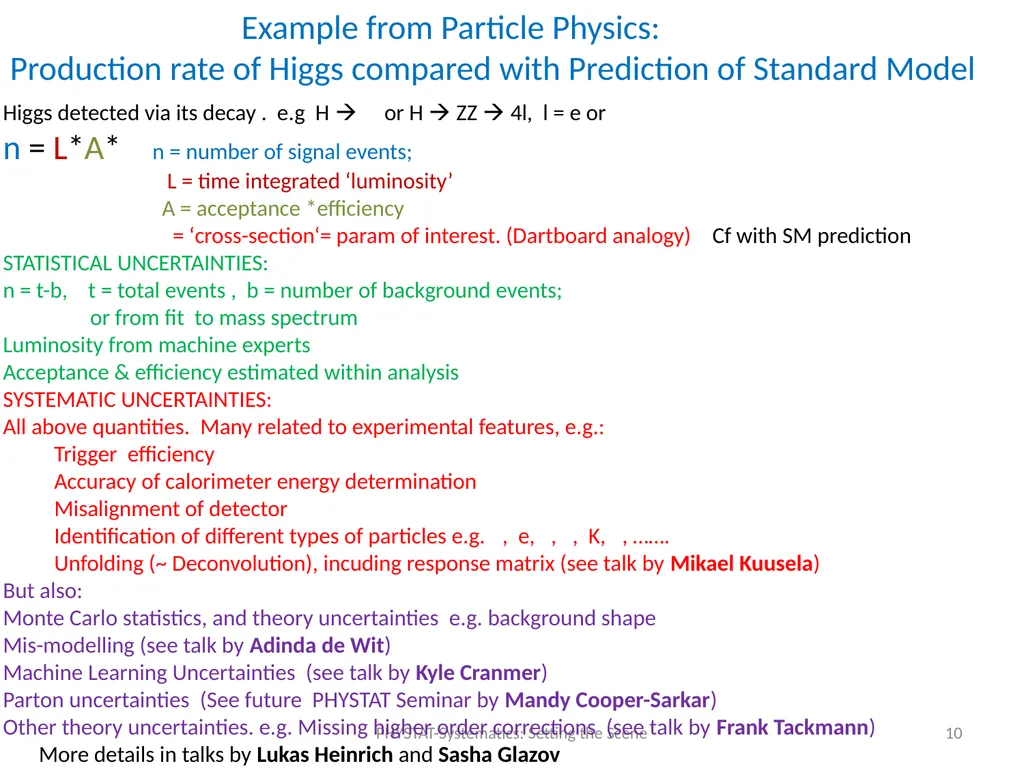
Production rate of Higgs compared with Prediction of Standard Model Higgs detected via its decay . e.g H or H ZZ 4l, l = e or
n = L*A* n = number of signal events;
L = time integrated ‘luminosity’
A = acceptance *efficiency
= ‘cross-section‘= param of interest. (Dartboard analogy) Cf with SM prediction
STATISTICAL UNCERTAINTIES:
n = t-b, t = total events , b = number of background events;
or from fit to mass spectrum
Luminosity from machine experts
Acceptance & efficiency estimated within analysis
SYSTEMATIC UNCERTAINTIES:
All above quantities. Many related to experimental features, e.g.:
Trigger efficiency
Accuracy of calorimeter energy determination
Misalignment of detector
Identification of different types of particles e.g. , e, , , K, , …….
Unfolding (~ Deconvolution), incuding response matrix (see talk by Mikael Kuusela)
But also:
Monte Carlo statistics, and theory uncertainties e.g. background shape
Mis-modelling (see talk by Adinda de Wit)
Machine Learning Uncertainties (see talk by Kyle Cranmer)
Parton uncertainties (See future PHYSTAT Seminar by Mandy Cooper-Sarkar)
Other theory uncertainties. e.g. Missing higher order corrections (see talk by Frank Tackmann)
More details in talks by Lukas Heinrich and Sasha Glazov<br>
Production rate of Higgs compared with Prediction of Standard Model Higgs detected via its decay . e.g H or H ZZ 4l, l = e or
n = L*A* n = number of signal events;
L = time integrated ‘luminosity’
A = acceptance *efficiency
= ‘cross-section‘= param of interest. (Dartboard analogy) Cf with SM prediction
STATISTICAL UNCERTAINTIES:
n = t-b, t = total events , b = number of background events;
or from fit to mass spectrum
Luminosity from machine experts
Acceptance & efficiency estimated within analysis
SYSTEMATIC UNCERTAINTIES:
All above quantities. Many related to experimental features, e.g.:
Trigger efficiency
Accuracy of calorimeter energy determination
Misalignment of detector
Identification of different types of particles e.g. , e, , , K, , …….
Unfolding (~ Deconvolution), incuding response matrix (see talk by Mikael Kuusela)
But also:
Monte Carlo statistics, and theory uncertainties e.g. background shape
Mis-modelling (see talk by Adinda de Wit)
Machine Learning Uncertainties (see talk by Kyle Cranmer)
Parton uncertainties (See future PHYSTAT Seminar by Mandy Cooper-Sarkar)
Other theory uncertainties. e.g. Missing higher order corrections (see talk by Frank Tackmann)
More details in talks by Lukas Heinrich and Sasha Glazov<br>
11
PHYSTAT-Systematics: Setting the Scene 11 Example from Particle Physics:
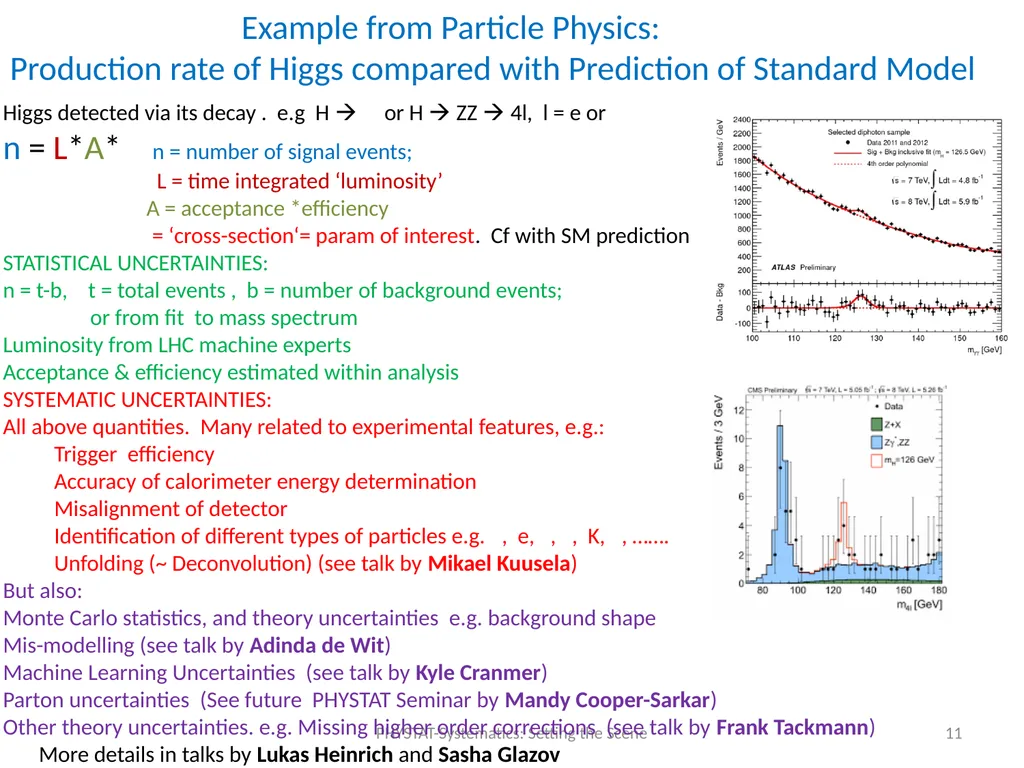
Production rate of Higgs compared with Prediction of Standard Model Higgs detected via its decay . e.g H or H ZZ 4l, l = e or
n = L*A* n = number of signal events;
L = time integrated ‘luminosity’
A = acceptance *efficiency
= ‘cross-section‘= param of interest. Cf with SM prediction
STATISTICAL UNCERTAINTIES:
n = t-b, t = total events , b = number of background events;
or from fit to mass spectrum
Luminosity from LHC machine experts
Acceptance & efficiency estimated within analysis
SYSTEMATIC UNCERTAINTIES:
All above quantities. Many related to experimental features, e.g.:
Trigger efficiency
Accuracy of calorimeter energy determination
Misalignment of detector
Identification of different types of particles e.g. , e, , , K, , …….
Unfolding (~ Deconvolution) (see talk by Mikael Kuusela)
But also:
Monte Carlo statistics, and theory uncertainties e.g. background shape
Mis-modelling (see talk by Adinda de Wit)
Machine Learning Uncertainties (see talk by Kyle Cranmer)
Parton uncertainties (See future PHYSTAT Seminar by Mandy Cooper-Sarkar)
Other theory uncertainties. e.g. Missing higher order corrections (see talk by Frank Tackmann)
More details in talks by Lukas Heinrich and Sasha Glazov<br>
Production rate of Higgs compared with Prediction of Standard Model Higgs detected via its decay . e.g H or H ZZ 4l, l = e or
n = L*A* n = number of signal events;
L = time integrated ‘luminosity’
A = acceptance *efficiency
= ‘cross-section‘= param of interest. Cf with SM prediction
STATISTICAL UNCERTAINTIES:
n = t-b, t = total events , b = number of background events;
or from fit to mass spectrum
Luminosity from LHC machine experts
Acceptance & efficiency estimated within analysis
SYSTEMATIC UNCERTAINTIES:
All above quantities. Many related to experimental features, e.g.:
Trigger efficiency
Accuracy of calorimeter energy determination
Misalignment of detector
Identification of different types of particles e.g. , e, , , K, , …….
Unfolding (~ Deconvolution) (see talk by Mikael Kuusela)
But also:
Monte Carlo statistics, and theory uncertainties e.g. background shape
Mis-modelling (see talk by Adinda de Wit)
Machine Learning Uncertainties (see talk by Kyle Cranmer)
Parton uncertainties (See future PHYSTAT Seminar by Mandy Cooper-Sarkar)
Other theory uncertainties. e.g. Missing higher order corrections (see talk by Frank Tackmann)
More details in talks by Lukas Heinrich and Sasha Glazov<br>
12
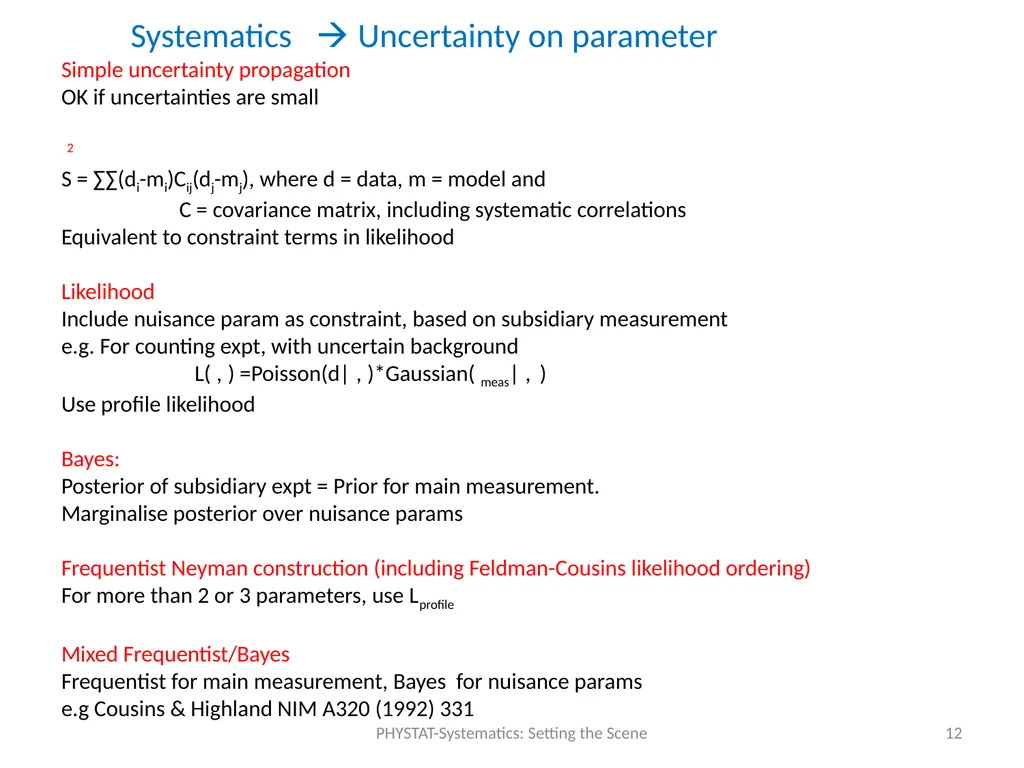
PHYSTAT-Systematics: Setting the Scene 12 Systematics Uncertainty on parameter
Simple uncertainty propagation
OK if uncertainties are small
2
S = ∑∑(di-mi)Cij(dj-mj), where d = data, m = model and
C = covariance matrix, including systematic correlations
Equivalent to constraint terms in likelihood
Likelihood
Include nuisance param as constraint, based on subsidiary measurement
e.g. For counting expt, with uncertain background
L(,) =Poisson(d|,)*Gaussian(meas|,)
Use profile likelihood
Bayes:
Posterior of subsidiary expt = Prior for main measurement.
Marginalise posterior over nuisance params
Frequentist Neyman construction (including Feldman-Cousins likelihood ordering)
For more than 2 or 3 parameters, use Lprofile
Mixed Frequentist/Bayes
Frequentist for main measurement, Bayes for nuisance params
e.g Cousins & Highland NIM A320 (1992) 331<br>
Simple uncertainty propagation
OK if uncertainties are small
2
S = ∑∑(di-mi)Cij(dj-mj), where d = data, m = model and
C = covariance matrix, including systematic correlations
Equivalent to constraint terms in likelihood
Likelihood
Include nuisance param as constraint, based on subsidiary measurement
e.g. For counting expt, with uncertain background
L(,) =Poisson(d|,)*Gaussian(meas|,)
Use profile likelihood
Bayes:
Posterior of subsidiary expt = Prior for main measurement.
Marginalise posterior over nuisance params
Frequentist Neyman construction (including Feldman-Cousins likelihood ordering)
For more than 2 or 3 parameters, use Lprofile
Mixed Frequentist/Bayes
Frequentist for main measurement, Bayes for nuisance params
e.g Cousins & Highland NIM A320 (1992) 331<br>
13
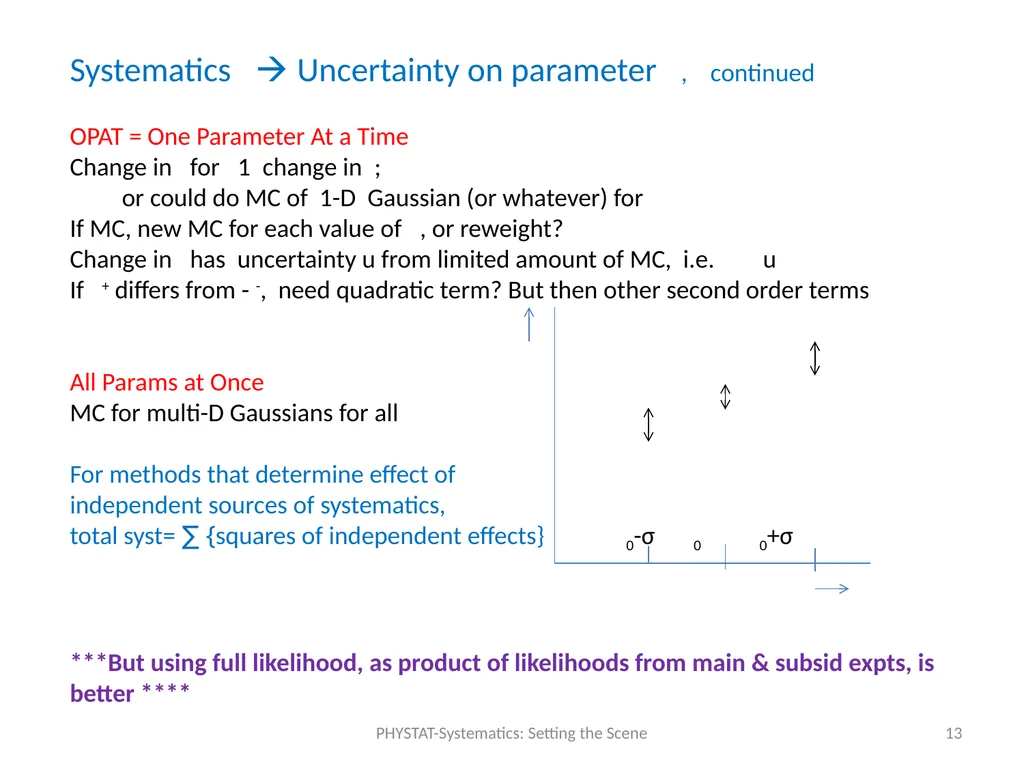
PHYSTAT-Systematics: Setting the Scene 13 Systematics Uncertainty on parameter , continued
OPAT = One Parameter At a Time
Change in for 1 change in ;
or could do MC of 1-D Gaussian (or whatever) for
If MC, new MC for each value of , or reweight?
Change in has uncertainty u from limited amount of MC, i.e. u
If + differs from --, need quadratic term? But then other second order terms
All Params at Once
MC for multi-D Gaussians for all
For methods that determine effect of
independent sources of systematics,
total syst=∑ {squares of independent effects} 0-σ 0 0+σ
***But using full likelihood, as product of likelihoods from main & subsid expts, is better ****<br>
OPAT = One Parameter At a Time
Change in for 1 change in ;
or could do MC of 1-D Gaussian (or whatever) for
If MC, new MC for each value of , or reweight?
Change in has uncertainty u from limited amount of MC, i.e. u
If + differs from --, need quadratic term? But then other second order terms
All Params at Once
MC for multi-D Gaussians for all
For methods that determine effect of
independent sources of systematics,
total syst=∑ {squares of independent effects} 0-σ 0 0+σ
***But using full likelihood, as product of likelihoods from main & subsid expts, is better ****<br>
14
PHYSTAT-SYSTEMATICS Emphasis on systematics
Emphasis on incorporating systematics into analyses
'How to estimate' = another interesting topic
Talks (ample time for discussion):
Introductions: LL, David van Dyk
Specific physics areas: LHC, Neutrinos, Dark Matter, Flavour Physics
Specific topics: Mis-modelling, Machine Learning, Theory, Unfolding, Bootstrap
Short talks by Statisticians: second half of Wednesday
Responders after some of talks
Concluding talks: Physicist: Nick Wardle; Statistician: Sara Algeri .
N.B. Wednesday Nov 10th
Not using Mattermost, etc; send emails to speakers.
Comments /Feedback (during or after Workshop): Send to organisers:
olaf.behnke@cern.ch lockhart@sfu.ca l.lyons@physics.ox.ac.uk nckw@cern.ch PHYSTAT-Systematics: Setting the Scene 14<br>
Emphasis on incorporating systematics into analyses
'How to estimate' = another interesting topic
Talks (ample time for discussion):
Introductions: LL, David van Dyk
Specific physics areas: LHC, Neutrinos, Dark Matter, Flavour Physics
Specific topics: Mis-modelling, Machine Learning, Theory, Unfolding, Bootstrap
Short talks by Statisticians: second half of Wednesday
Responders after some of talks
Concluding talks: Physicist: Nick Wardle; Statistician: Sara Algeri .
N.B. Wednesday Nov 10th
Not using Mattermost, etc; send emails to speakers.
Comments /Feedback (during or after Workshop): Send to organisers:
olaf.behnke@cern.ch lockhart@sfu.ca l.lyons@physics.ox.ac.uk nckw@cern.ch PHYSTAT-Systematics: Setting the Scene 14<br>
15
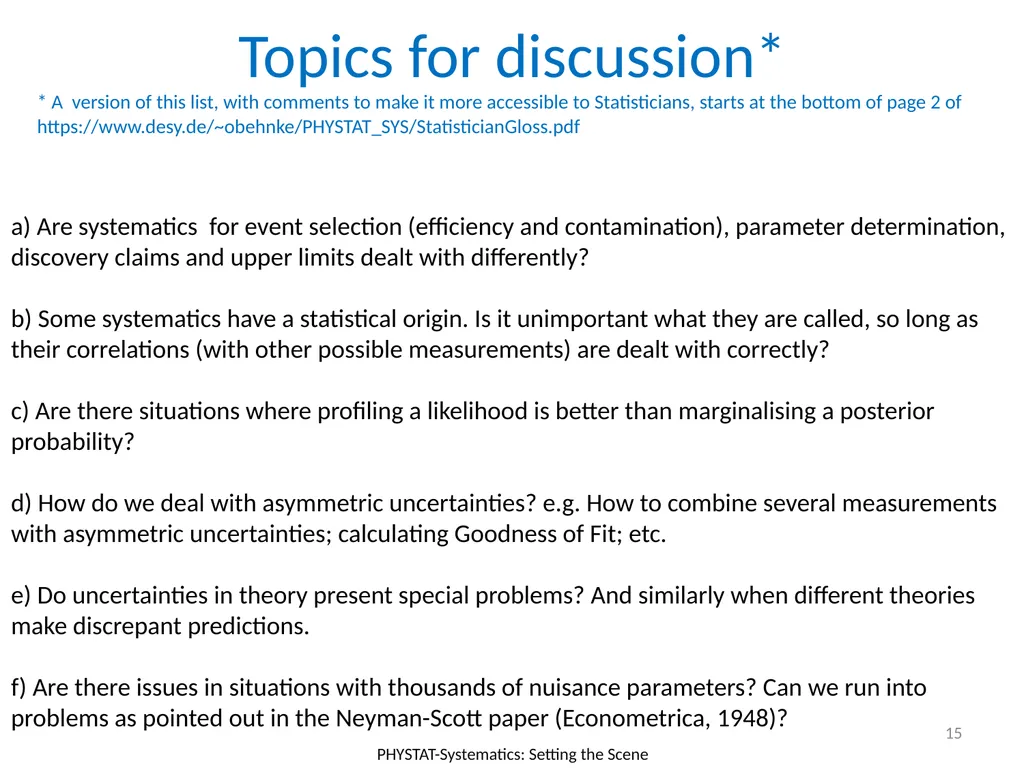
Topics for discussion* a) Are systematics for event selection (efficiency and contamination), parameter determination, discovery claims and upper limits dealt with differently?
b) Some systematics have a statistical origin. Is it unimportant what they are called, so long as their correlations (with other possible measurements) are dealt with correctly?
c) Are there situations where profiling a likelihood is better than marginalising a posterior probability?
d) How do we deal with asymmetric uncertainties? e.g. How to combine several measurements with asymmetric uncertainties; calculating Goodness of Fit; etc.
e) Do uncertainties in theory present special problems? And similarly when different theories make discrepant predictions.
f) Are there issues in situations with thousands of nuisance parameters? Can we run into problems as pointed out in the Neyman-Scott paper (Econometrica, 1948)? PHYSTAT-Systematics: Setting the Scene 15 * A version of this list, with comments to make it more accessible to Statisticians, starts at the bottom of page 2 of
https://www.desy.de/~obehnke/PHYSTAT_SYS/StatisticianGloss.pdf<br>
b) Some systematics have a statistical origin. Is it unimportant what they are called, so long as their correlations (with other possible measurements) are dealt with correctly?
c) Are there situations where profiling a likelihood is better than marginalising a posterior probability?
d) How do we deal with asymmetric uncertainties? e.g. How to combine several measurements with asymmetric uncertainties; calculating Goodness of Fit; etc.
e) Do uncertainties in theory present special problems? And similarly when different theories make discrepant predictions.
f) Are there issues in situations with thousands of nuisance parameters? Can we run into problems as pointed out in the Neyman-Scott paper (Econometrica, 1948)? PHYSTAT-Systematics: Setting the Scene 15 * A version of this list, with comments to make it more accessible to Statisticians, starts at the bottom of page 2 of
https://www.desy.de/~obehnke/PHYSTAT_SYS/StatisticianGloss.pdf<br>
16
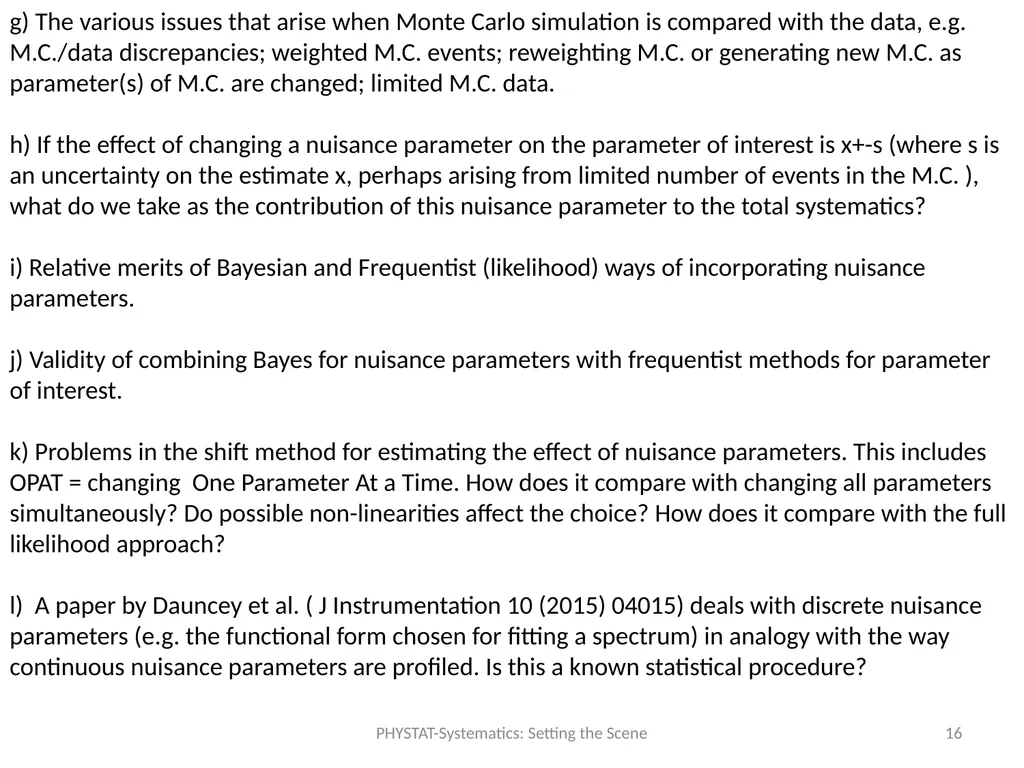
g) The various issues that arise when Monte Carlo simulation is compared with the data, e.g. M.C./data discrepancies; weighted M.C. events; reweighting M.C. or generating new M.C. as parameter(s) of M.C. are changed; limited M.C. data.
h) If the effect of changing a nuisance parameter on the parameter of interest is x+-s (where s is an uncertainty on the estimate x, perhaps arising from limited number of events in the M.C. ), what do we take as the contribution of this nuisance parameter to the total systematics?
i) Relative merits of Bayesian and Frequentist (likelihood) ways of incorporating nuisance parameters.
j) Validity of combining Bayes for nuisance parameters with frequentist methods for parameter of interest.
k) Problems in the shift method for estimating the effect of nuisance parameters. This includes OPAT = changing One Parameter At a Time. How does it compare with changing all parameters simultaneously? Do possible non-linearities affect the choice? How does it compare with the full likelihood approach?
l) A paper by Dauncey et al. ( J Instrumentation 10 (2015) 04015) deals with discrete nuisance parameters (e.g. the functional form chosen for fitting a spectrum) in analogy with the way continuous nuisance parameters are profiled. Is this a known statistical procedure? PHYSTAT-Systematics: Setting the Scene 16<br>
h) If the effect of changing a nuisance parameter on the parameter of interest is x+-s (where s is an uncertainty on the estimate x, perhaps arising from limited number of events in the M.C. ), what do we take as the contribution of this nuisance parameter to the total systematics?
i) Relative merits of Bayesian and Frequentist (likelihood) ways of incorporating nuisance parameters.
j) Validity of combining Bayes for nuisance parameters with frequentist methods for parameter of interest.
k) Problems in the shift method for estimating the effect of nuisance parameters. This includes OPAT = changing One Parameter At a Time. How does it compare with changing all parameters simultaneously? Do possible non-linearities affect the choice? How does it compare with the full likelihood approach?
l) A paper by Dauncey et al. ( J Instrumentation 10 (2015) 04015) deals with discrete nuisance parameters (e.g. the functional form chosen for fitting a spectrum) in analogy with the way continuous nuisance parameters are profiled. Is this a known statistical procedure? PHYSTAT-Systematics: Setting the Scene 16<br>
17
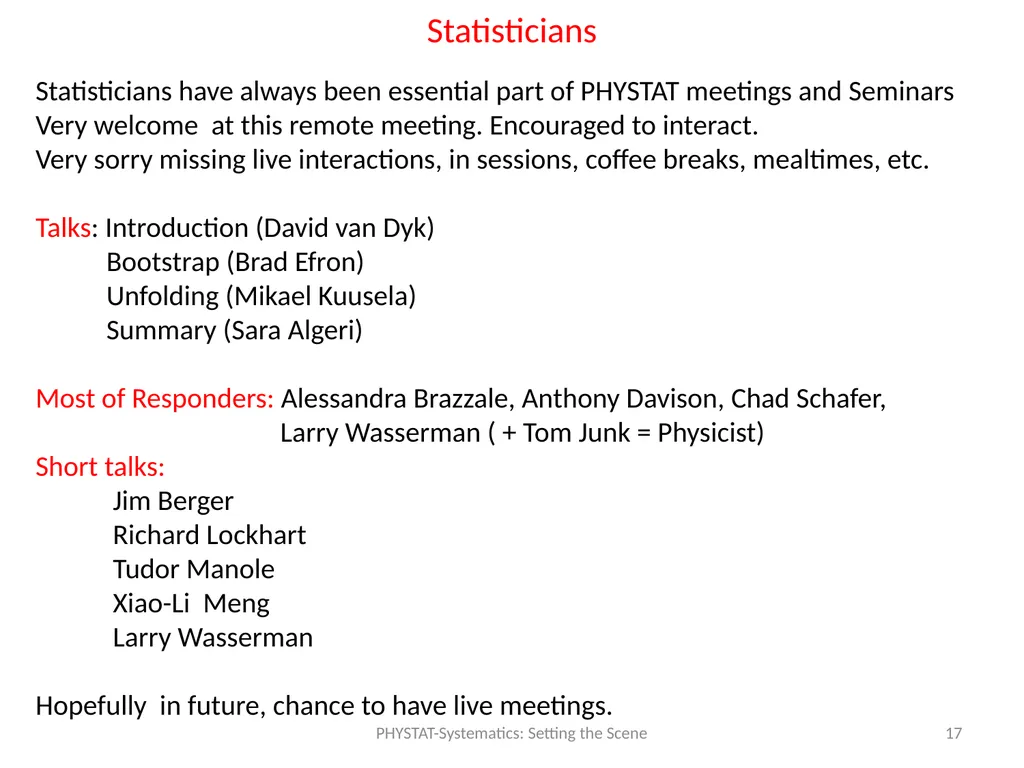
Statisticians Statisticians have always been essential part of PHYSTAT meetings and Seminars
Very welcome at this remote meeting. Encouraged to interact.
Very sorry missing live interactions, in sessions, coffee breaks, mealtimes, etc.
Talks: Introduction (David van Dyk)
Bootstrap (Brad Efron)
Unfolding (Mikael Kuusela)
Summary (Sara Algeri)
Most of Responders: Alessandra Brazzale, Anthony Davison, Chad Schafer,
Larry Wasserman ( + Tom Junk = Physicist)
Short talks:
Jim Berger
Richard Lockhart
Tudor Manole
Xiao-Li Meng
Larry Wasserman
Hopefully in future, chance to have live meetings. PHYSTAT-Systematics: Setting the Scene 17<br>
Very welcome at this remote meeting. Encouraged to interact.
Very sorry missing live interactions, in sessions, coffee breaks, mealtimes, etc.
Talks: Introduction (David van Dyk)
Bootstrap (Brad Efron)
Unfolding (Mikael Kuusela)
Summary (Sara Algeri)
Most of Responders: Alessandra Brazzale, Anthony Davison, Chad Schafer,
Larry Wasserman ( + Tom Junk = Physicist)
Short talks:
Jim Berger
Richard Lockhart
Tudor Manole
Xiao-Li Meng
Larry Wasserman
Hopefully in future, chance to have live meetings. PHYSTAT-Systematics: Setting the Scene 17<br>
18
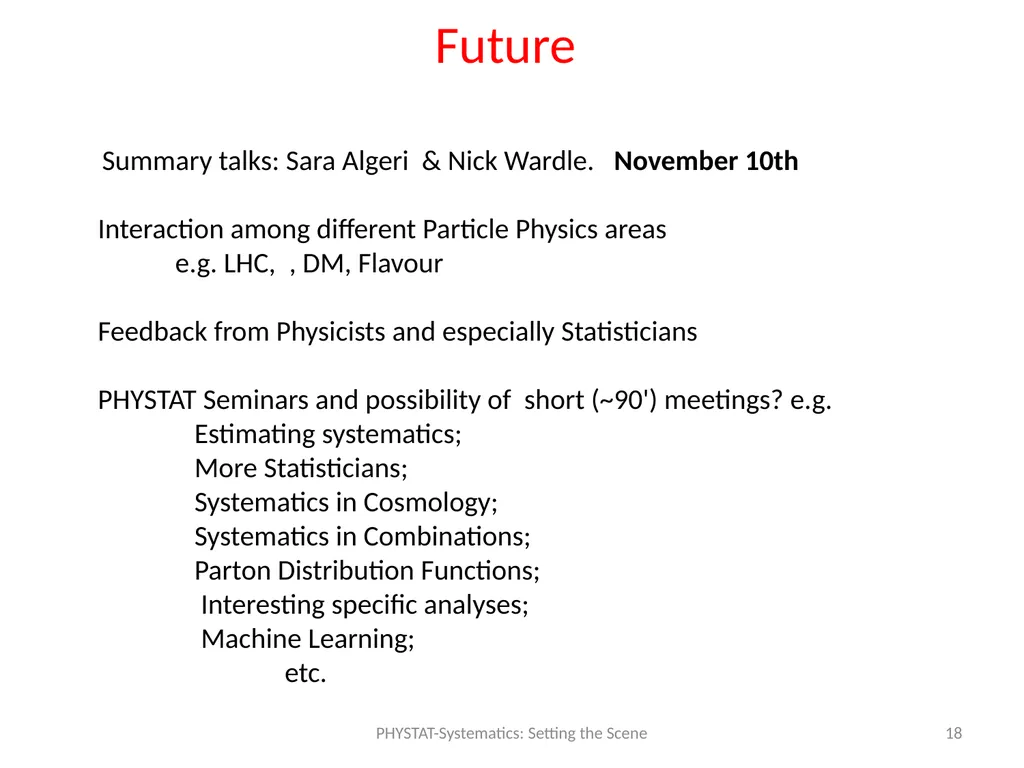
Future Summary talks: Sara Algeri & Nick Wardle. November 10th
Interaction among different Particle Physics areas
e.g. LHC, , DM, Flavour
Feedback from Physicists and especially Statisticians
PHYSTAT Seminars and possibility of short (~90') meetings? e.g.
Estimating systematics;
More Statisticians;
Systematics in Cosmology;
Systematics in Combinations;
Parton Distribution Functions;
Interesting specific analyses;
Machine Learning;
etc. PHYSTAT-Systematics: Setting the Scene 18<br>
Interaction among different Particle Physics areas
e.g. LHC, , DM, Flavour
Feedback from Physicists and especially Statisticians
PHYSTAT Seminars and possibility of short (~90') meetings? e.g.
Estimating systematics;
More Statisticians;
Systematics in Cosmology;
Systematics in Combinations;
Parton Distribution Functions;
Interesting specific analyses;
Machine Learning;
etc. PHYSTAT-Systematics: Setting the Scene 18<br>
19
Enjoy the meeting! PHYSTAT-Systematics: Setting the Scene 19 Olaf Behnke
Richard Lockhart
Louis Lyons
Nick Wardle
(emails on webpage)<br>
Richard Lockhart
Louis Lyons
Nick Wardle
(emails on webpage)<br>