
Planetary Evolution with Variable Stellar
Description: Planetary Evolution with Variable Stellar Metallicity Justin Alderdice Faculty Advisor: Dr. Howard Chen, Dept. of Aerospace, Physics and Space Sciences, Florida Institute of Technology To conduct my research, the software suite MESA
Related Topics
Download Presentation
"Planetary Evolution with Variable Stellar" is the property of its rightful owner. Permission is granted to download and print the materials on this website for personal, non-commercial use only, and to display it on your personal computer provided you do not modify the materials and that you retain all copyright notices contained in the materials. By downloading content from our website, you accept the terms of this agreement.
Presentation Transcript
slide1. Planetary Evolution with Variable Stellar Metallicity
Justin Alderdice
Faculty Advisor: Dr. Howard Chen, Dept. of Aerospace, Physics and Space
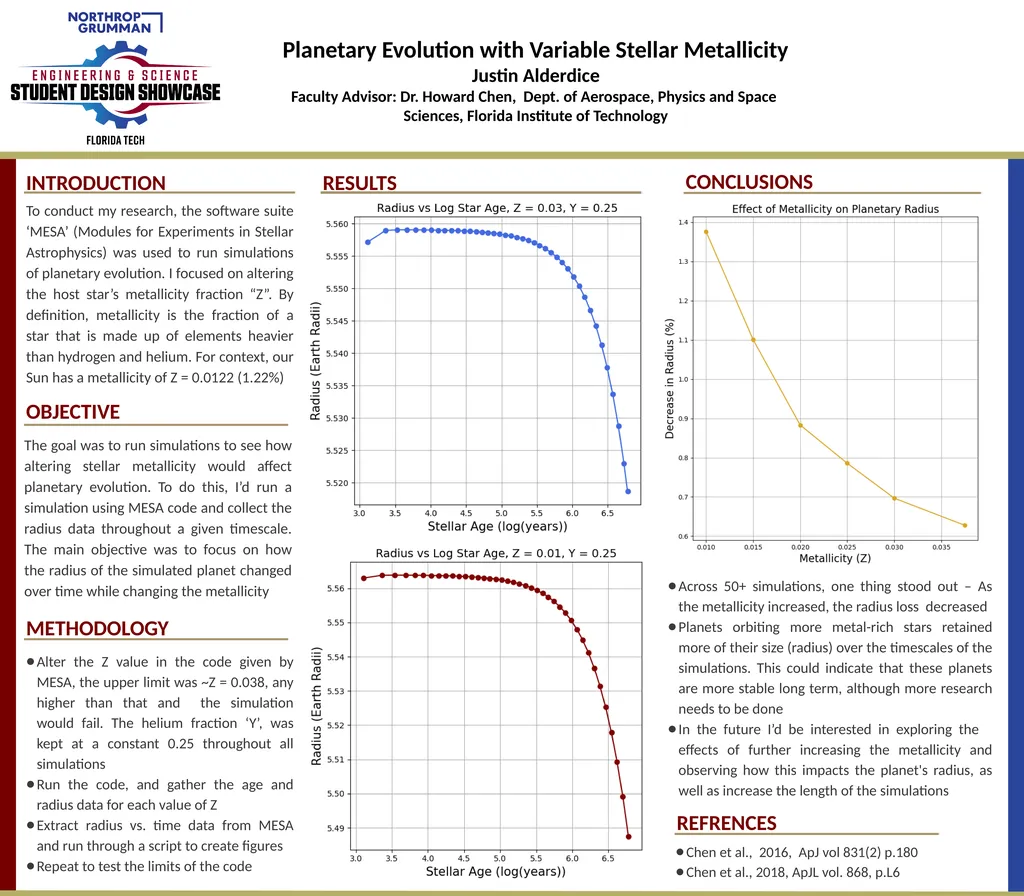
Sciences, Florida Institute of Technology To conduct my research, the software suite ‘MESA’ (Modules for Experiments in Stellar Astrophysics) was used to run simulations of planetary evolution. I focused on altering the host star’s metallicity fraction “Z”. By definition, metallicity is the fraction of a star that is made up of elements heavier than hydrogen and helium. For context, our Sun has a metallicity of Z = 0.0122 (1.22%) INTRODUCTION The goal was to run simulations to see how altering stellar metallicity would affect planetary evolution. To do this, I’d run a simulation using MESA code and collect the radius data throughout a given timescale. The main objective was to focus on how the radius of the simulated planet changed over time while changing the metallicity OBJECTIVE METHODOLOGY RESULTS Alter the Z value in the code given by MESA, the upper limit was ~Z = 0.038, any higher than that and the simulation would fail. The helium fraction ‘Y’, was kept at a constant 0.25 throughout all simulations
Run the code, and gather the age and radius data for each value of Z
Extract radius vs. time data from MESA and run through a script to create figures
Repeat to test the limits of the code CONCLUSIONS REFRENCES Chen et al., 2016, ApJ vol 831(2) p.180
Chen et al., 2018, ApJL vol. 868, p.L6 Across 50+ simulations, one thing stood out – As the metallicity increased, the radius loss decreased
Planets orbiting more metal-rich stars retained more of their size (radius) over the timescales of the simulations. This could indicate that these planets are more stable long term, although more research needs to be done
In the future I’d be interested in exploring the effects of further increasing the metallicity and observing how this impacts the planet's radius, as well as increase the length of the simulations<br>
Justin Alderdice
Faculty Advisor: Dr. Howard Chen, Dept. of Aerospace, Physics and Space
Sciences, Florida Institute of Technology To conduct my research, the software suite ‘MESA’ (Modules for Experiments in Stellar Astrophysics) was used to run simulations of planetary evolution. I focused on altering the host star’s metallicity fraction “Z”. By definition, metallicity is the fraction of a star that is made up of elements heavier than hydrogen and helium. For context, our Sun has a metallicity of Z = 0.0122 (1.22%) INTRODUCTION The goal was to run simulations to see how altering stellar metallicity would affect planetary evolution. To do this, I’d run a simulation using MESA code and collect the radius data throughout a given timescale. The main objective was to focus on how the radius of the simulated planet changed over time while changing the metallicity OBJECTIVE METHODOLOGY RESULTS Alter the Z value in the code given by MESA, the upper limit was ~Z = 0.038, any higher than that and the simulation would fail. The helium fraction ‘Y’, was kept at a constant 0.25 throughout all simulations
Run the code, and gather the age and radius data for each value of Z
Extract radius vs. time data from MESA and run through a script to create figures
Repeat to test the limits of the code CONCLUSIONS REFRENCES Chen et al., 2016, ApJ vol 831(2) p.180
Chen et al., 2018, ApJL vol. 868, p.L6 Across 50+ simulations, one thing stood out – As the metallicity increased, the radius loss decreased
Planets orbiting more metal-rich stars retained more of their size (radius) over the timescales of the simulations. This could indicate that these planets are more stable long term, although more research needs to be done
In the future I’d be interested in exploring the effects of further increasing the metallicity and observing how this impacts the planet's radius, as well as increase the length of the simulations<br>