Planning for Information System Chapter - 5 Kantipur Engineering College Dhapakhel, Lalitpur 1 By Pushpa Thapa What is Information System Planning Information system planning is a formal process that develops plan for developing and
"Planning for Information System Chapter - 5" is the property of its rightful owner. Permission is granted to
download and print the materials on this website for personal, non-commercial use only, and to display it
on your personal computer provided you do not modify the materials and that you retain all copyright
notices contained in the materials. By downloading content from our website, you accept the terms of this
agreement.
Presentation Transcript
01
Planning for Information System Chapter - 5
Kantipur Engineering College
Dhapakhel, Lalitpur 1 By Pushpa Thapa<br>
02
What is Information System Planning Information system planning is a formal process that develops plan for developing and managing information systems that will support goals of an organization.
Information System plan includes:
Activities planner believes will help achieve goals.
Program for monitoring real-world progress.
Means for implementing changes in the plan. 2 By Pushpa Thapa<br>
03
Why Plan? To obtain resources
Financial
Facilities – “Capacity planning”
Staff
To align Information System with the business
To identify needed applications
To establish goal, schedule, and milestone in order to track progress
To provide an opportunity for communication with top management and user management 3 By Pushpa Thapa<br>
04
Approaches to Planning Top-down Planning
Focuses on organizational goals first, then on the needs of business units
Bottom-up Planning
Focuses on needs of business units first, then on organizational goals 4 By Pushpa Thapa<br>
05
Information System Planning Process Establish a mission statement
Assess the environment
Set goals and objectives
Derive strategies and policies
Develop long-, medium-, and short-range plans implement plans and monitor results 5 By Pushpa Thapa<br>
06
Establish a Mission Statement These are services that you are responsible for; it is your place in the organization.
It is not what you are supposed to achieve, it is who you are and what you do in the company. 6 By Pushpa Thapa<br>
07
Goals and Objectives Set goals – what do you want to achieve?
Set objectives – what are your specific, measurable targets? 7 By Pushpa Thapa<br>
08
Derive strategies and policies Strategies for
Technology focus
Personnel and career development
Aligning with the company
Funding criteria; how much to spend on IT?
Policies for
Funding criteria; how much to spend on IT?
Allocation criteria; priority setting
Organizational arrangements
Use of outside IT services, outsourcing
Selling IT services to outside organizations 8 By Pushpa Thapa<br>
09
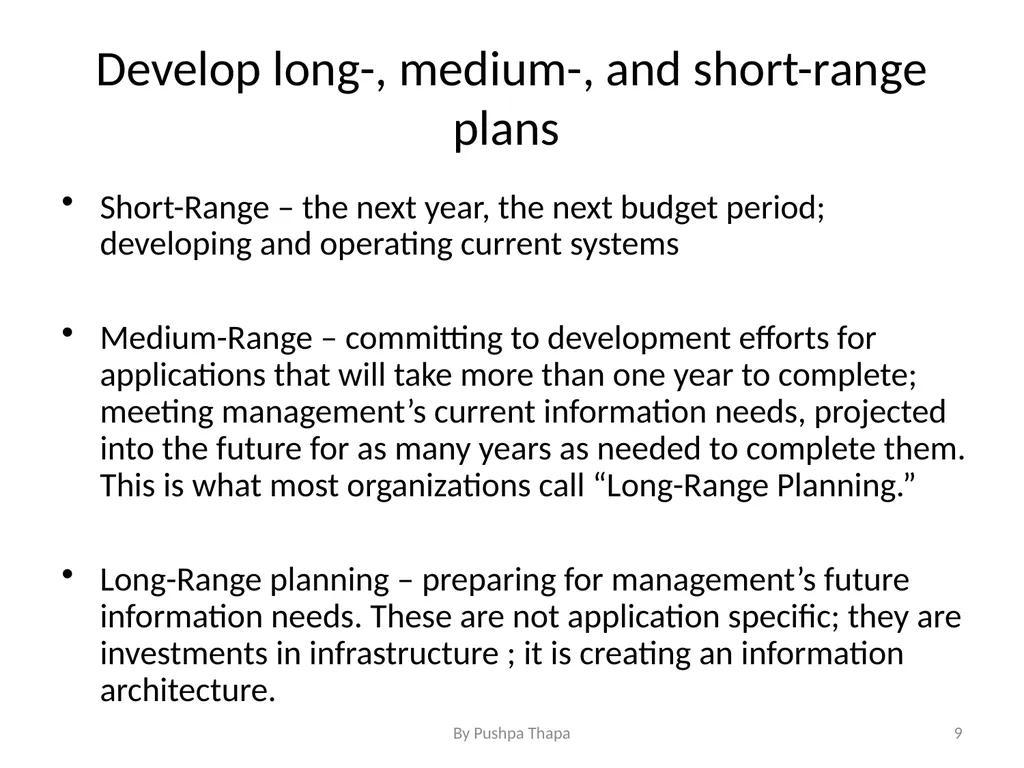
Develop long-, medium-, and short-range plans Short-Range – the next year, the next budget period; developing and operating current systems
Medium-Range – committing to development efforts for applications that will take more than one year to complete; meeting management’s current information needs, projected into the future for as many years as needed to complete them. This is what most organizations call “Long-Range Planning.”
Long-Range planning – preparing for management’s future information needs. These are not application specific; they are investments in infrastructure ; it is creating an information architecture. 9 By Pushpa Thapa<br>
10
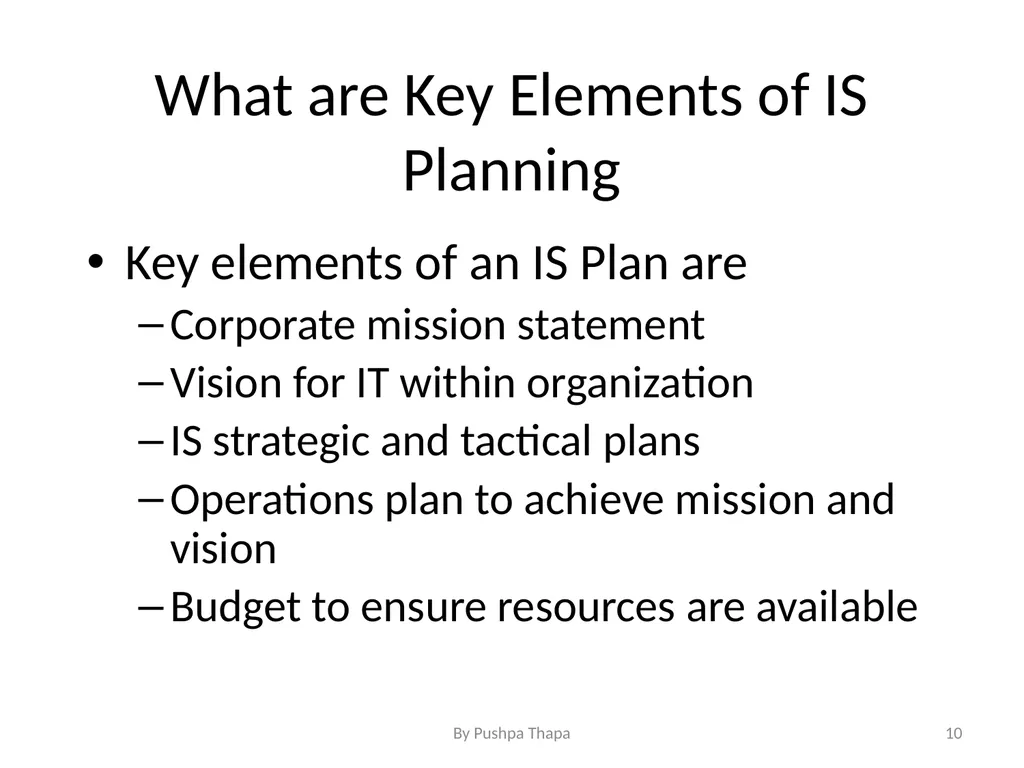
What are Key Elements of IS Planning Key elements of an IS Plan are
Corporate mission statement
Vision for IT within organization
IS strategic and tactical plans
Operations plan to achieve mission and vision
Budget to ensure resources are available 10 By Pushpa Thapa<br>
11
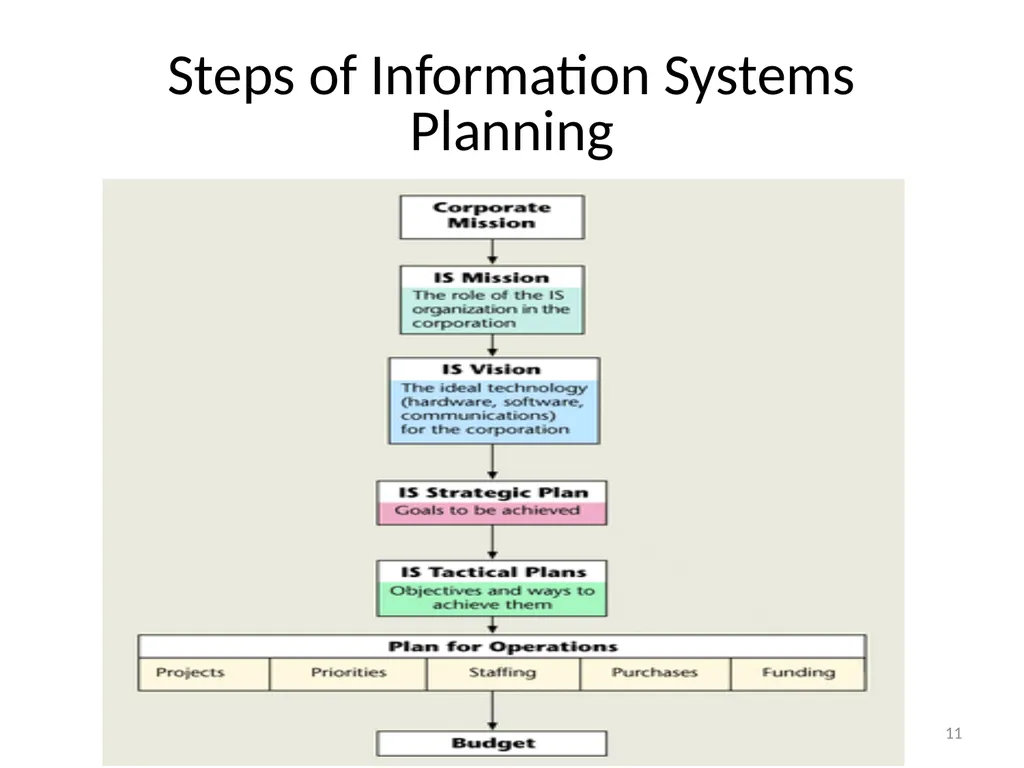
11 Steps of Information Systems Planning By Pushpa Thapa<br>
12
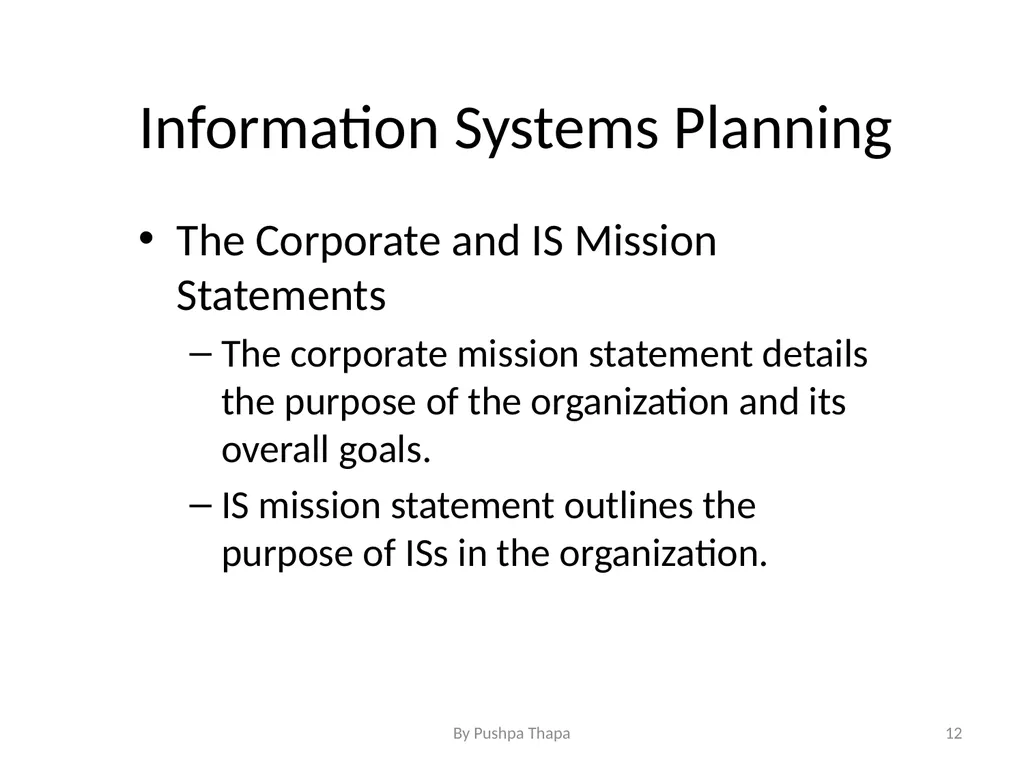
Information Systems Planning The Corporate and IS Mission Statements
The corporate mission statement details the purpose of the organization and its overall goals.
IS mission statement outlines the purpose of ISs in the organization. 12 By Pushpa Thapa<br>
13
Information Systems Planning The IT Vision
Wish list of what IS managers would like to see in terms of hardware, software, and communications, to contribute to goals of the organization 13 By Pushpa Thapa<br>
14
Information Systems Planning Strategic IS Planning
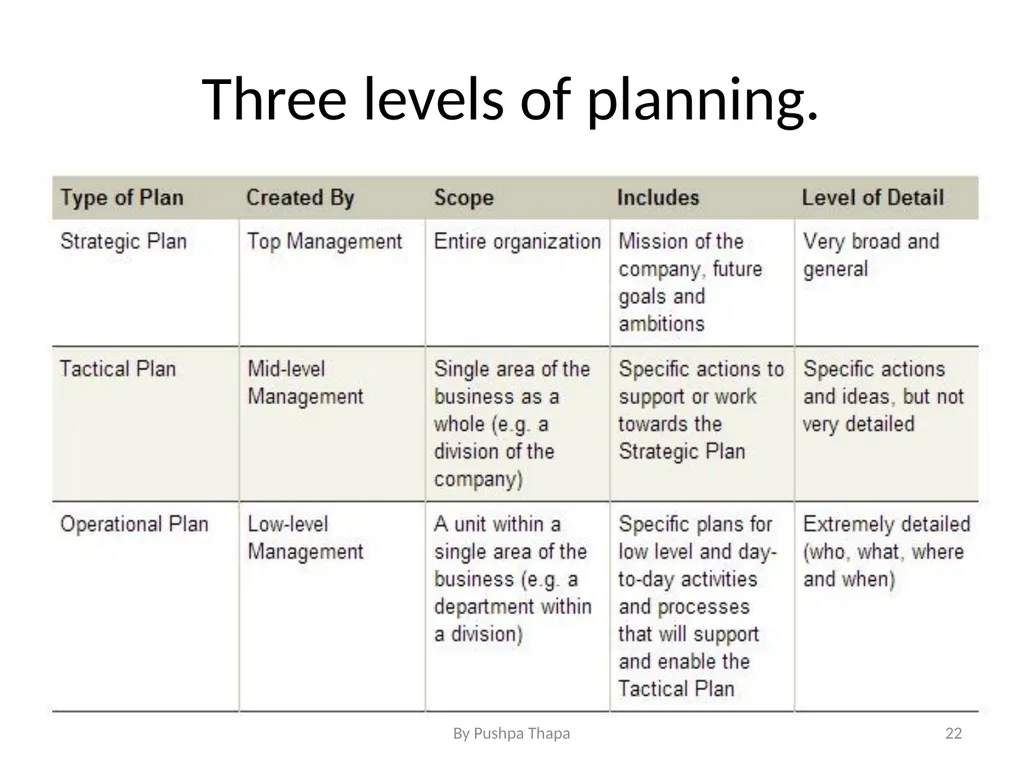
IS Strategic plan details what is to be achieved
Strategic plans are designed with the entire organization in mind and begin with an organization's mission.
Essentially, strategic plans look ahead to where the organization wants to be in three, five, even ten years. Strategic plans, provided by top-level managers, serve as the framework for lower-level planning. 14 By Pushpa Thapa<br>
15
Strategic Information System Strategic Information System is a system that helps companies alter their business strategy. It is used to accelerate the reaction time to environmental changes and aid the company in achieving a competitive advantage over its competitors.
They help in producing low cost quality products.
The strategic role of IS involves using IT to develop products, services, and capabilities that give company major advantages over the competitive forces it faces in the global marketplace. 15 By Pushpa Thapa<br>
16
Typical Strategic-Level Job Titles Top-level Managers
CEOs or Presidents
General Manager
Corporate Boards
Steering Committee
Board of Directors
will design and execute strategic plans to paint a picture of the desired future and long-term goals of the organization. 16 By Pushpa Thapa<br>
17
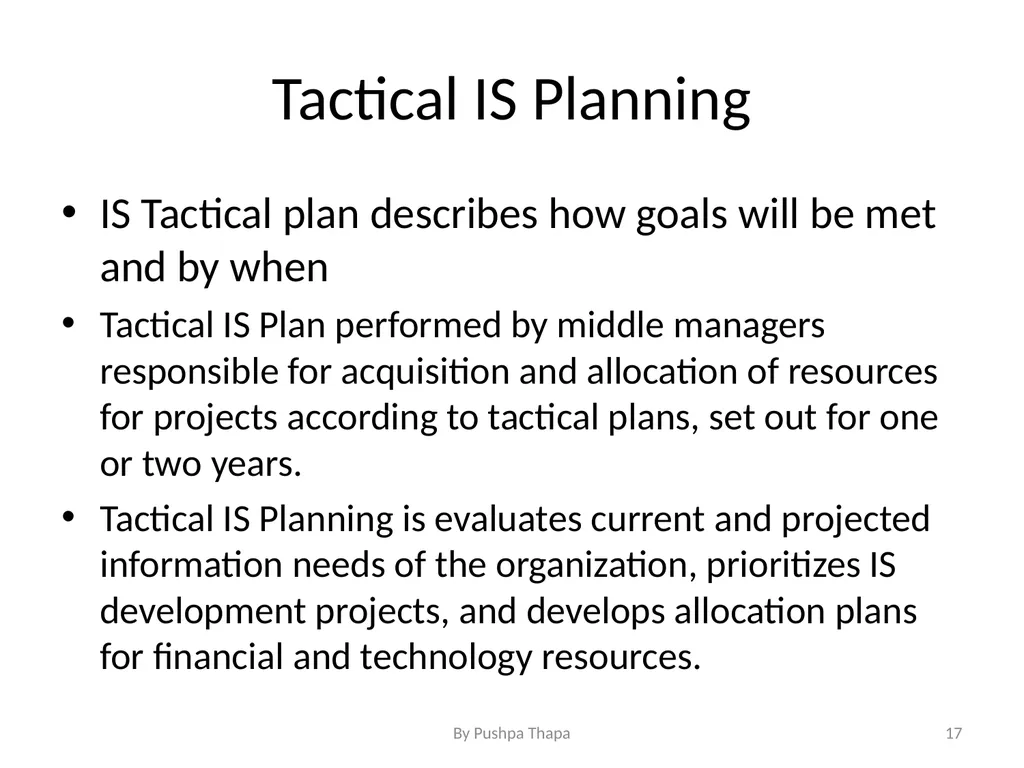
Tactical IS Planning IS Tactical plan describes how goals will be met and by when
Tactical IS Plan performed by middle managers responsible for acquisition and allocation of resources for projects according to tactical plans, set out for one or two years.
Tactical IS Planning is evaluates current and projected information needs of the organization, prioritizes IS development projects, and develops allocation plans for financial and technology resources. 17 By Pushpa Thapa<br>
18
What are important factors in IS tactical planning Important Factors in IS Tactical Planning
Flexibility
Compatibility
Connectivity
Scalability
Standardization
Total Cost of Ownership 18 By Pushpa Thapa<br>
19
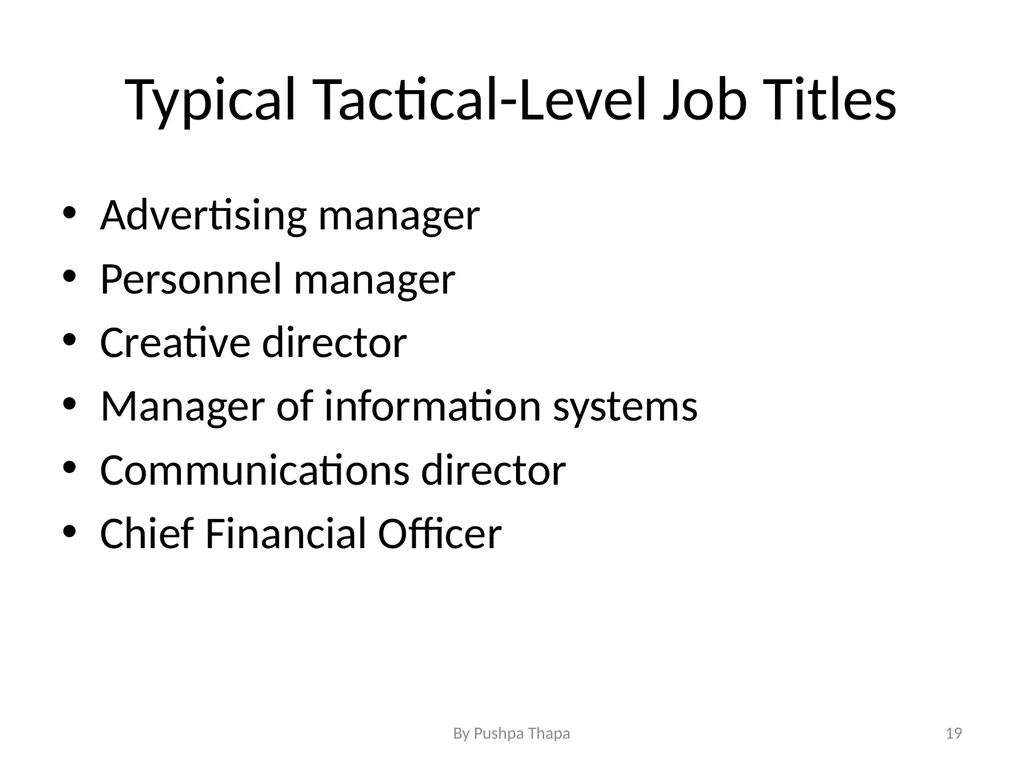
Typical Tactical-Level Job Titles Advertising manager
Personnel manager
Creative director
Manager of information systems
Communications director
Chief Financial Officer 19 By Pushpa Thapa<br>
20
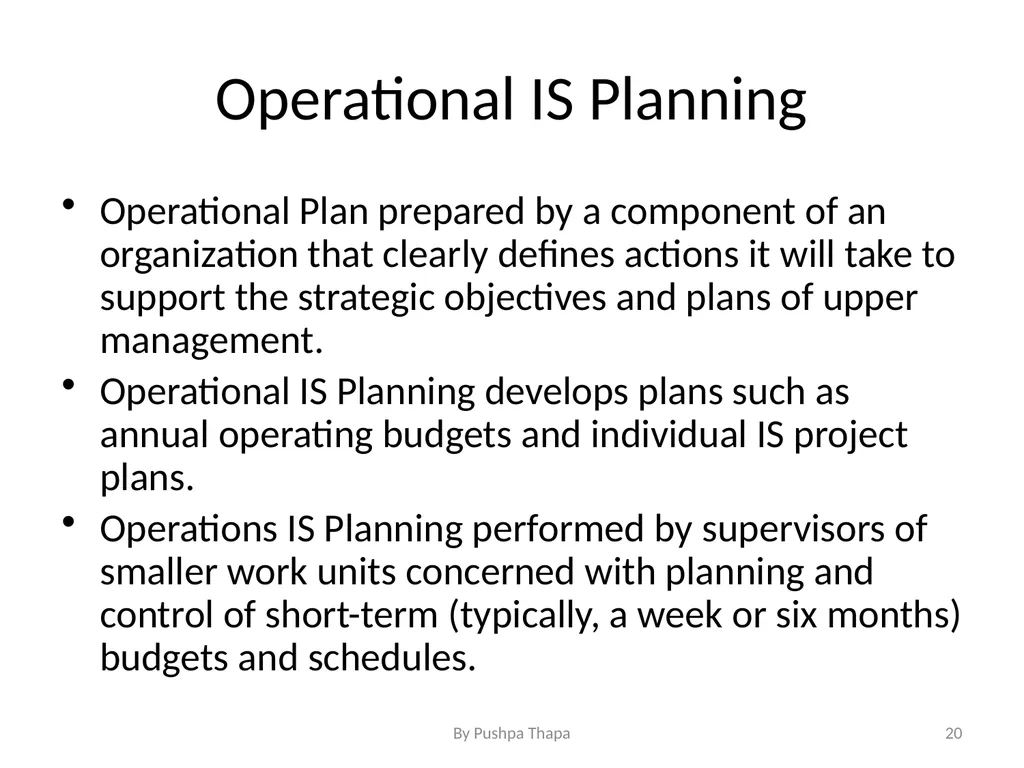
Operational IS Planning Operational Plan prepared by a component of an organization that clearly defines actions it will take to support the strategic objectives and plans of upper management.
Operational IS Planning develops plans such as annual operating budgets and individual IS project plans.
Operations IS Planning performed by supervisors of smaller work units concerned with planning and control of short-term (typically, a week or six months) budgets and schedules. 20 By Pushpa Thapa<br>