
Plant bio-regulators DAY 21 These are compounds

Published  . 0 views
↓ Download
Plant bio-regulators DAY 21 These are compounds
1 / 1
Plant bio-regulators DAY 21 These are compounds - slide 1 of 7 Plant bio-regulators DAY 21 These are compounds - slide 2 of 7 Plant bio-regulators DAY 21 These are compounds - slide 3 of 7 Plant bio-regulators DAY 21 These are compounds - slide 4 of 7 Plant bio-regulators DAY 21 These are compounds - slide 5 of 7 Plant bio-regulators DAY 21 These are compounds - slide 6 of 7 Plant bio-regulators DAY 21 These are compounds - slide 7 of 7
Description: Plant bio-regulators DAY 21 These are compounds that are organic in nature but other than nutrients. These promote, inhibit or otherwise modify physiological processes in plants even when used in small amounts. Type of plant bio-regulators

Related Topics

Download Presentation

"Plant bio-regulators DAY 21 These are compounds" is the property of its rightful owner. Permission is granted to download and print the materials on this website for personal, non-commercial use only, and to display it on your personal computer provided you do not modify the materials and that you retain all copyright notices contained in the materials. By downloading content from our website, you accept the terms of this agreement.

Presentation Transcript

slide1. Plant bio-regulators DAY 21<br>
slide2. These are compounds that are organic in nature but other than nutrients.
These promote, inhibit or otherwise modify physiological processes in plants even when used in small amounts.<br>
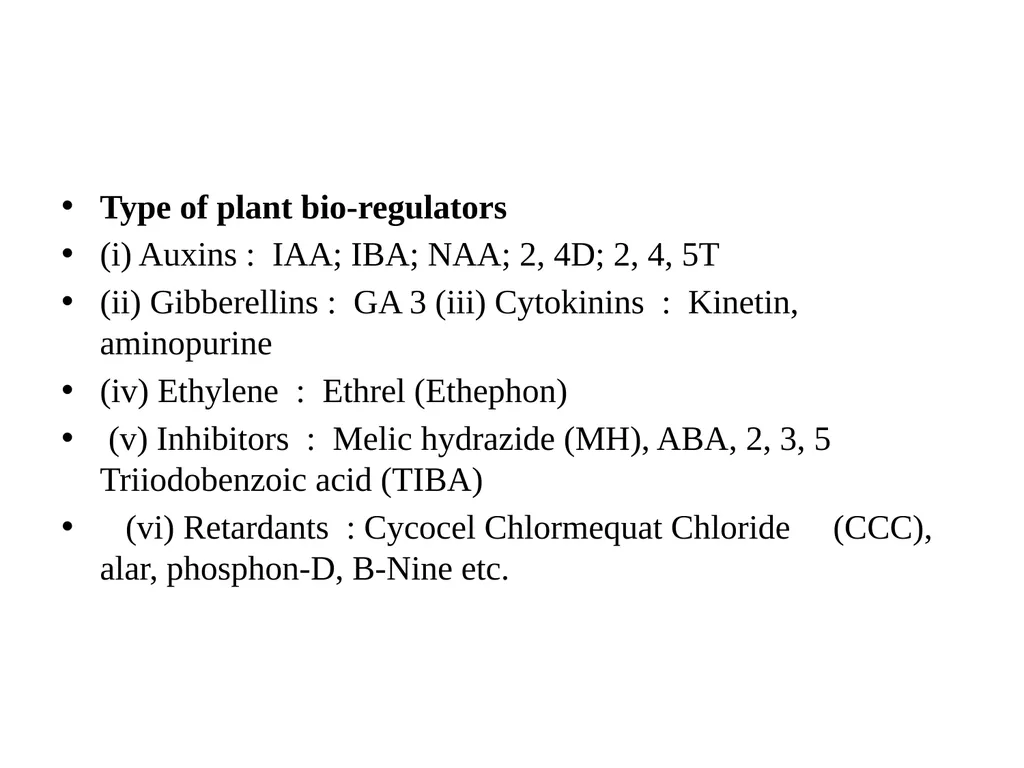
slide3. Type of plant bio-regulators
(i) Auxins : IAA; IBA; NAA; 2, 4D; 2, 4, 5T
(ii) Gibberellins : GA 3 (iii) Cytokinins : Kinetin, aminopurine
(iv) Ethylene : Ethrel (Ethephon)
(v) Inhibitors : Melic hydrazide (MH), ABA, 2, 3, 5 Triiodobenzoic acid (TIBA)
(vi) Retardants : Cycocel Chlormequat Chloride (CCC), alar, phosphon-D, B-Nine etc.<br>
slide4. Classes of plant growth regulators Auxins

In plants, auxins are synthesised in the apical portion of stem and root. Auxins control growth through cell enlargement and influence developmental responses, such as apical dominance. Indole acetic acid (IAA), Indole butyric acid (IBA), Naphthalene acetic acid (NAA), and 2, 4-Dichlorophenoxyacetic acid (2, 4D) are some examples of auxins<br>
slide5. Cytokinins
Cytokinins help transport amino acids in plants. They promote cell division and senescence. Examples are kinetin and benzyladenine.
Gibberellins
These control cell division and elongation in plant shoots. Gibberellic acid (GA3) is an example.
Ethylene
Ethylene is a gaseous hydrocarbon and known as ‘ripening hormone’, e.g., ethephon, ethrel.<br>
slide6. Abscisic acid (ABA)
Abscisic acid is, generally, considered as a growth inhibitor because of its effects on growth inhibition or senescence. It causes metabolic activities in plants, such as abscission of leaf, response to environmental stress, fruit ripening, etc.<br>
slide7. Application of PGRs
Growth regulators may be applied in powder or paste form or as spray solution. It applied at low concentrations, i.e., in parts per million (ppm) (one milligram in one litre of water gives 1 ppm solution).<br>