Plant Growth Learning outcomes Evaluate the experimental evidence for the role of auxins in the control of apical dominance and gibberellin in the control of stem elongation. Plant Growth Plant growth occurs at meristems Apical meristem
"Plant Growth Learning outcomes Evaluate the" is the property of its rightful owner. Permission is granted to
download and print the materials on this website for personal, non-commercial use only, and to display it
on your personal computer provided you do not modify the materials and that you retain all copyright
notices contained in the materials. By downloading content from our website, you accept the terms of this
agreement.
Presentation Transcript
01
Plant Growth<br>
02
Learning outcomes Evaluate the experimental evidence for the role of auxins in the control of apical dominance and gibberellin in the control of stem elongation.<br>
03
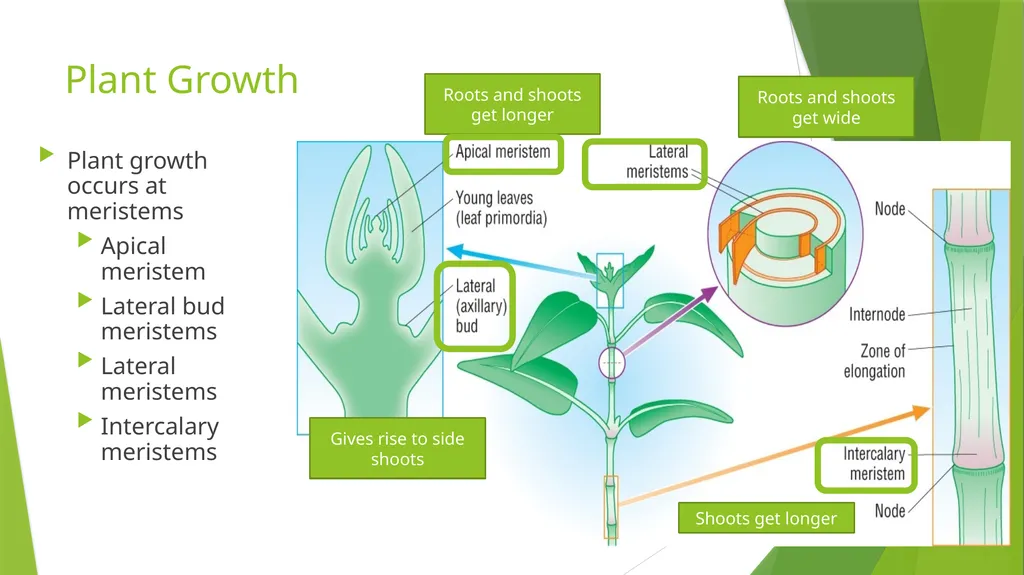
Plant Growth Plant growth occurs at meristems
Apical meristem
Lateral bud meristems
Lateral meristems
Intercalary meristems Roots and shoots get longer Gives rise to side shoots Roots and shoots get wide Shoots get longer<br>
04
Why “plant growth regulators”? Exert influence by affecting growth
Produced in a region of plant structure by unspecialised cells
Some are active at the site of production
Not specific – can have different effects on different tissues<br>
05
The Plant growth regulators There are five main groups
Auxins
Gibberellins
Cytokinins
Abscisic acid
Ethene<br>
06
Plant growth regulators Produced in small quantities
Are active at site of production, or move by diffusion, active transport or mass flow.
Effects are different depending on concentration, tissues they act on and whether there is another substance present as well.<br>
07
Interaction of plant growth regulators Synergism
2 or more act together to reinforce an effect
Antagonism
Have opposing actions and inhibit (diminish) each others effects.<br>
08
Auxins Synthesised in shoot or root tips.
Most common form is IAA (indole-3-acetic acid a.k.a. indoleacetic acid)
Main effects of auxins include:
Promote stem elongation
Stimulate cell division
Prevent leaf fall
Maintain apical dominance.<br>
09
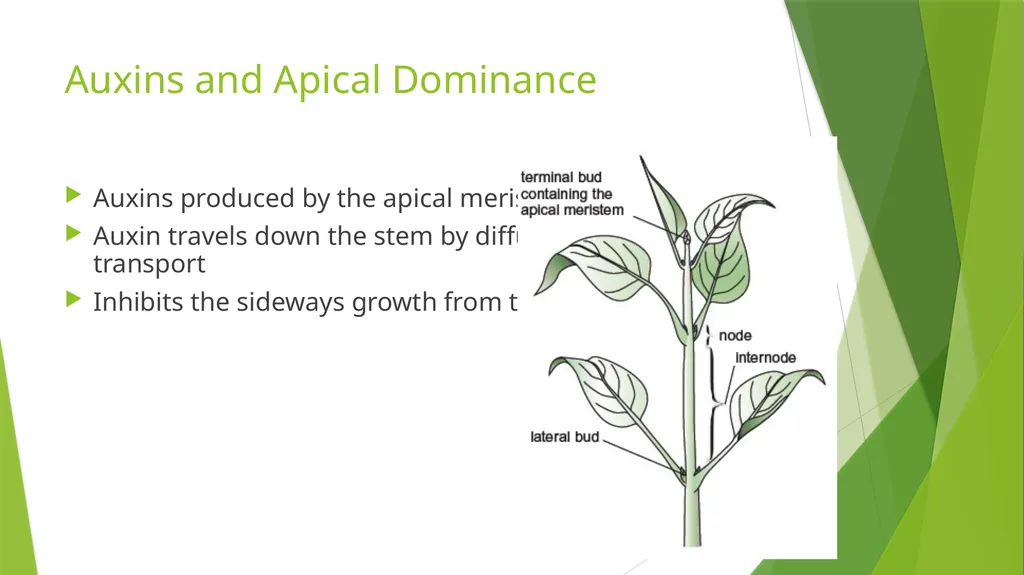
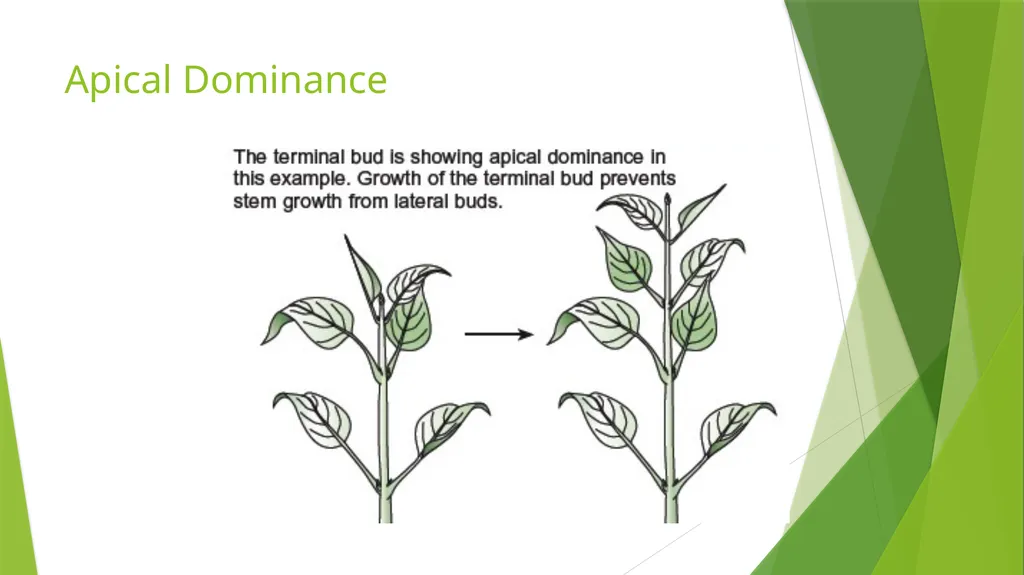
Auxins and Apical Dominance Auxins produced by the apical meristem
Auxin travels down the stem by diffusion or active transport
Inhibits the sideways growth from the lateral buds<br>
10
Apical Dominance<br>
11
Apical Dominance<br>
12
Mechanism for apical dominance Auxin made by cells in the shoot tip
Auxin transported downwards cell to cell
Auxin accumulates in the nodes beside the lateral buds
Presence inhibits their activity<br>
13
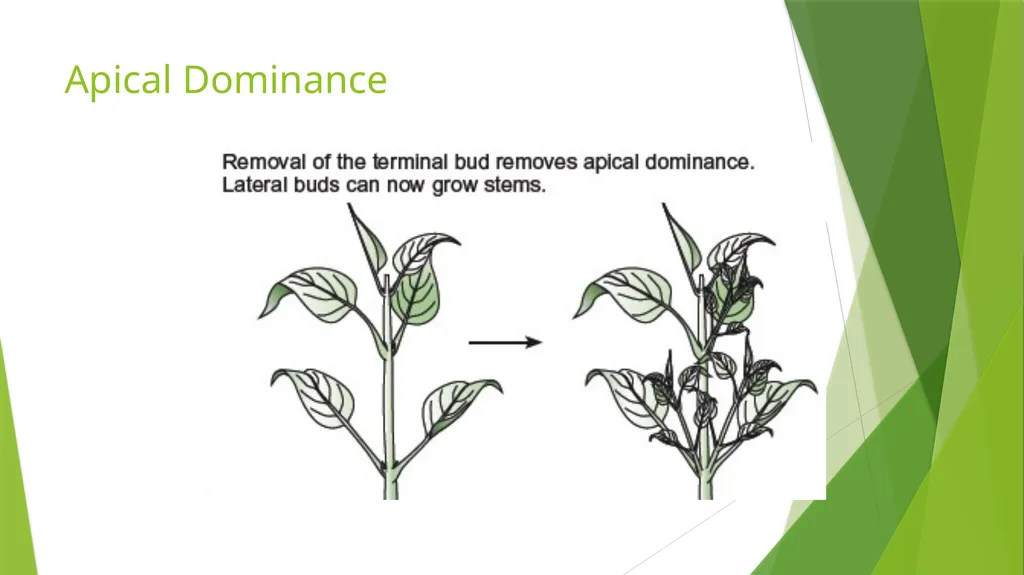
Evidence for mechanism (1) If the tip is cut off of two shoots
Indole-3-acetic-acid (IAA) is applied to one of them, it continues to show apical dominance
The untreated shoot will branch out sideways<br>
14
Evidence for mechanism (2) If a growing shoot is tipped upside down
Apical dominance is prevented
Lateral buds start to grow out sideways
This supports the theory
Auxins are transported downwards, and can not be transported upwards against gravity<br>
15
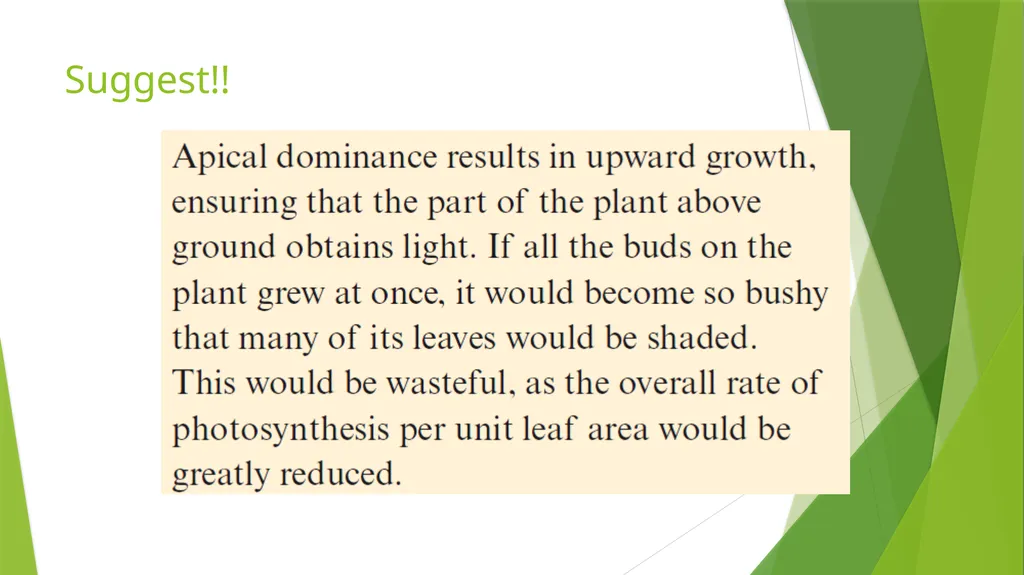
Question and reading Suggest how apical dominance could be an advantage to a plant!<br>
16
Suggest!!<br>
17
Gibberellins and stem elongation Gibberellin (GA) increases stem length
Increases the lengths of the internodes
Stimulating cell division
Stimulating cell elongation<br>
18
Evidence for GA and stem elongation Dwarf beans are dwarf because they lack the gene for producing GA
Mendel’s short pea plants lacked the dominant allele that encodes for GA
Plants with higher GA concentrations are taller<br>
19
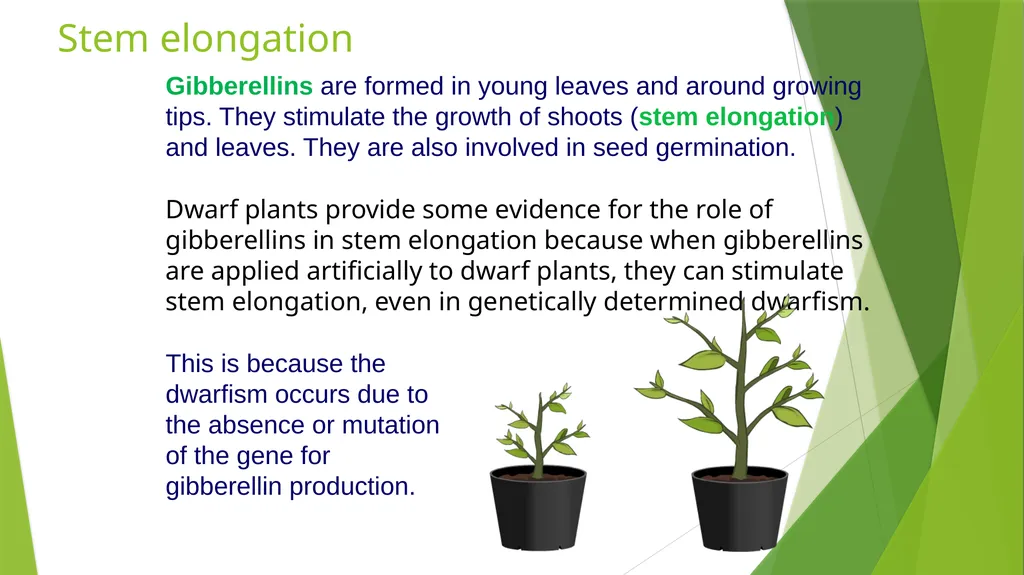
Stem elongation Gibberellins are formed in young leaves and around growing tips. They stimulate the growth of shoots (stem elongation) and leaves. They are also involved in seed germination. This is because the dwarfism occurs due to the absence or mutation of the gene for gibberellin production. Dwarf plants provide some evidence for the role of gibberellins in stem elongation because when gibberellins are applied artificially to dwarf plants, they can stimulate stem elongation, even in genetically determined dwarfism.<br>
20
Gibberellins and seed germination Gibberellins promote seed elongation.
Seed absorbs water gibberellin released enables production of amylase Starch breaks down into glucose for respiration<br>