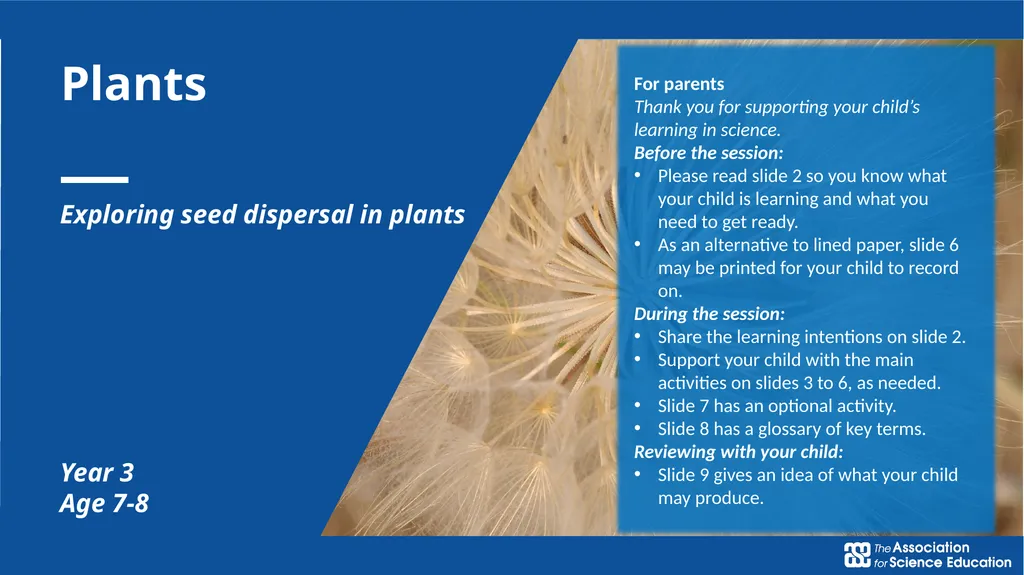
Plants Exploring seed dispersal in plants Year 3 Age 7-8 For parents Thank you for supporting your childs learning in science. Before the session: Please read slide 2 so you know what your child is learning and what you need to get ready.
"Plants Exploring seed dispersal in plants Year 3" is the property of its rightful owner. Permission is granted to
download and print the materials on this website for personal, non-commercial use only, and to display it
on your personal computer provided you do not modify the materials and that you retain all copyright
notices contained in the materials. By downloading content from our website, you accept the terms of this
agreement.
Presentation Transcript
01
Plants Exploring seed dispersal in plants Year 3
Age 7-8 For parents
Thank you for supporting your child’s learning in science.
Before the session:
Please read slide 2 so you know what your child is learning and what you need to get ready.
As an alternative to lined paper, slide 6 may be printed for your child to record on.
During the session:
Share the learning intentions on slide 2.
Support your child with the main activities on slides 3 to 6, as needed.
Slide 7 has an optional activity.
Slide 8 has a glossary of key terms.
Reviewing with your child:
Slide 9 gives an idea of what your child may produce.<br>
02
Key Learning
The life cycle of flowering plants includes germination, pollination, seed formation and seed dispersal.
Seeds need to be scattered or dispersed so they can germinate away from the parent plant. This seed dispersal can be done by animals, water or the wind. Activities (pages 3-6): 40 mins
You will need lined paper and a pencil.
Alternatively, you may like to print page 6 as a worksheet.
Find out more…
There is an optional activity on page 7 to explore some more unusual ways seeds are dispersed. I can…
explain why and how the seeds of plants are dispersed. Plants Exploring seed dispersal in plants Logo for section to sit inside roundel 2<br>
03
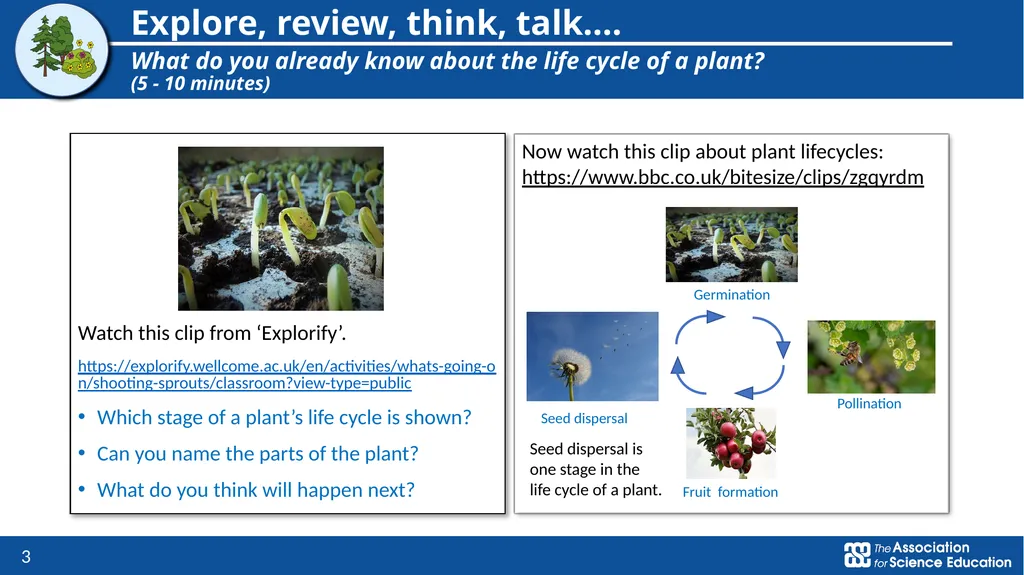
Watch this clip from ‘Explorify’.
https://explorify.wellcome.ac.uk/en/activities/whats-going-on/shooting-sprouts/classroom?view-type=public
Which stage of a plant’s life cycle is shown?
Can you name the parts of the plant?
What do you think will happen next? Now watch this clip about plant lifecycles: https://www.bbc.co.uk/bitesize/clips/zgqyrdm 3 Explore, review, think, talk…. What do you already know about the life cycle of a plant? (5 - 10 minutes) Logo for section to sit inside roundel 3<br>
04
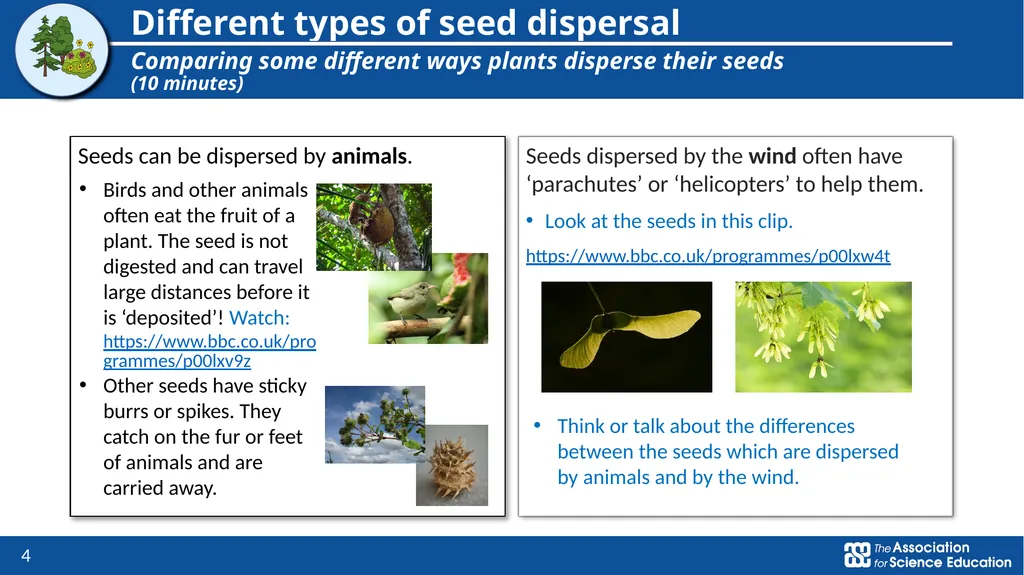
Seeds can be dispersed by animals. Seeds dispersed by the wind often have ‘parachutes’ or ‘helicopters’ to help them.
Look at the seeds in this clip.
https://www.bbc.co.uk/programmes/p00lxw4t Different types of seed dispersal Comparing some different ways plants disperse their seeds (10 minutes) Logo for section to sit inside roundel Birds and other animals often eat the fruit of a plant. The seed is not digested and can travel large distances before it is ‘deposited’! Watch: https://www.bbc.co.uk/programmes/p00lxv9z
Other seeds have sticky burrs or spikes. They catch on the fur or feet of animals and are carried away. 4 Think or talk about the differences between the seeds which are dispersed by animals and by the wind.<br>
05
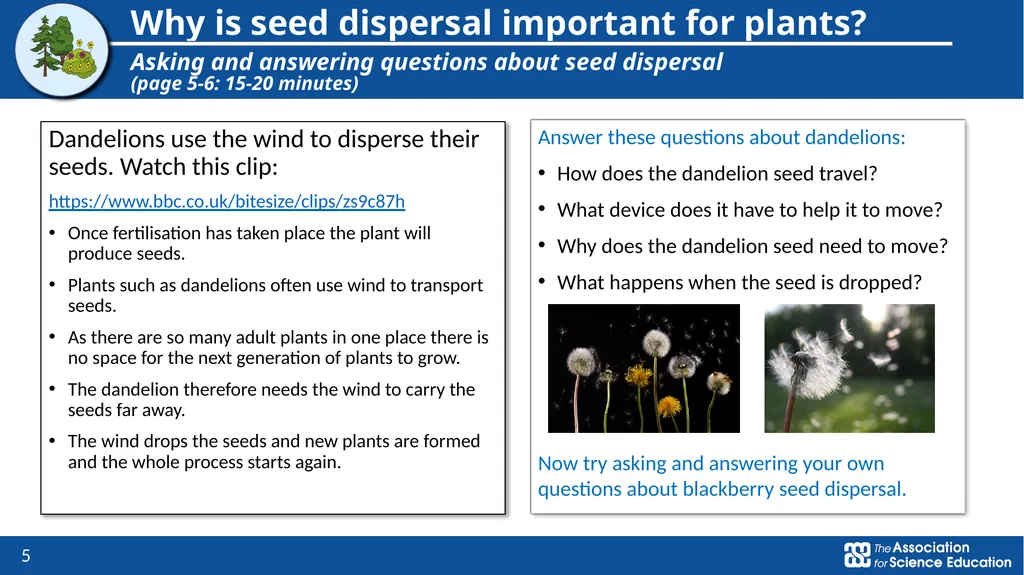
Dandelions use the wind to disperse their seeds. Watch this clip:
https://www.bbc.co.uk/bitesize/clips/zs9c87h
Once fertilisation has taken place the plant will produce seeds.
Plants such as dandelions often use wind to transport seeds.
As there are so many adult plants in one place there is no space for the next generation of plants to grow.
The dandelion therefore needs the wind to carry the seeds far away.
The wind drops the seeds and new plants are formed and the whole process starts again. Answer these questions about dandelions:
How does the dandelion seed travel?
What device does it have to help it to move?
Why does the dandelion seed need to move?
What happens when the seed is dropped?
Now try asking and answering your own questions about blackberry seed dispersal. Why is seed dispersal important for plants? Asking and answering questions about seed dispersal (page 5-6: 15-20 minutes) Logo for section to sit inside roundel 5<br>
06
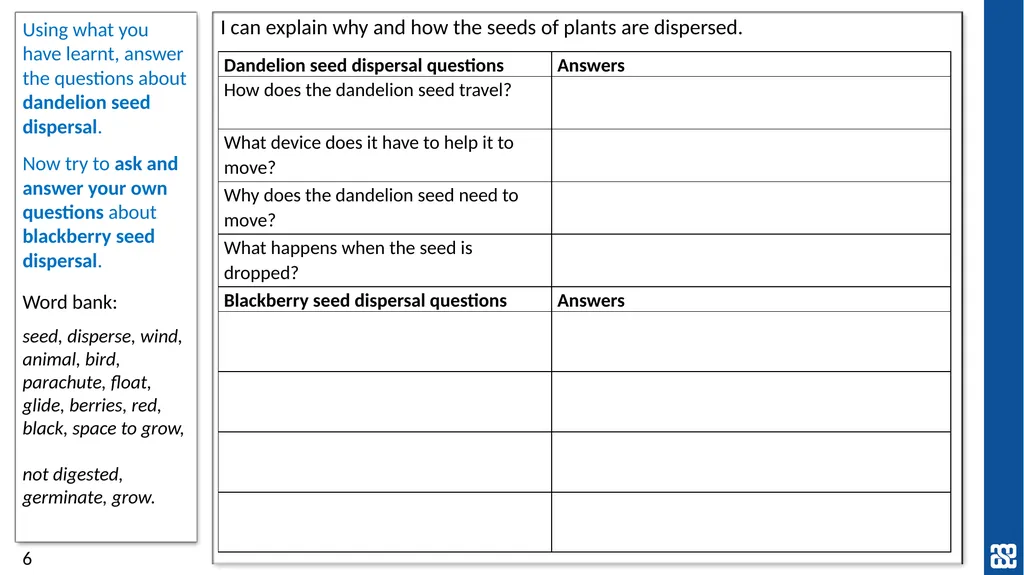
I can explain why and how the seeds of plants are dispersed. 6 Using what you have learnt, answer the questions about dandelion seed dispersal.
Now try to ask and answer your own questions about blackberry seed dispersal.
Word bank:
seed, disperse, wind, animal, bird, parachute, float, glide, berries, red, black, space to grow, not digested, germinate, grow.<br>
07
Some seeds are dispersed by animals in more unusual ways. Watch these three clips from ‘Private Life of Plants’. Think about the journey of one of these seeds:
A seed from an acacia tree which is eaten by an elephant.
A seed which falls to the ground and is found by ants.
A seed in a mistletoe fruit which is eaten by the mistletoe bird.
Write a story about the journey of the seed and how it successfully starts to grow into a new plant.
You may like to imagine you are the seed! Find out more… Find out about some unusual ways that seeds are dispersed by animals Logo for section to sit inside roundel https://www.bbc.co.uk/programmes/p006999s
https://www.bbc.co.uk/programmes/p00lxvrk
https://www.bbc.co.uk/programmes/p00crfc4 7<br>
08
Glossary of terms
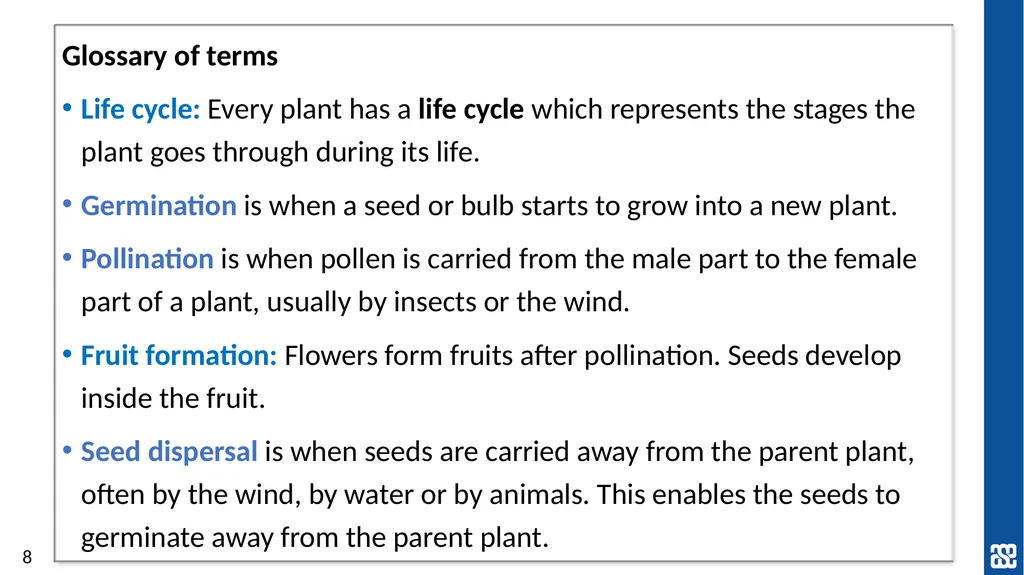
Life cycle: Every plant has a life cycle which represents the stages the plant goes through during its life.
Germination is when a seed or bulb starts to grow into a new plant.
Pollination is when pollen is carried from the male part to the female part of a plant, usually by insects or the wind.
Fruit formation: Flowers form fruits after pollination. Seeds develop inside the fruit.
Seed dispersal is when seeds are carried away from the parent plant, often by the wind, by water or by animals. This enables the seeds to germinate away from the parent plant. 8<br>
09
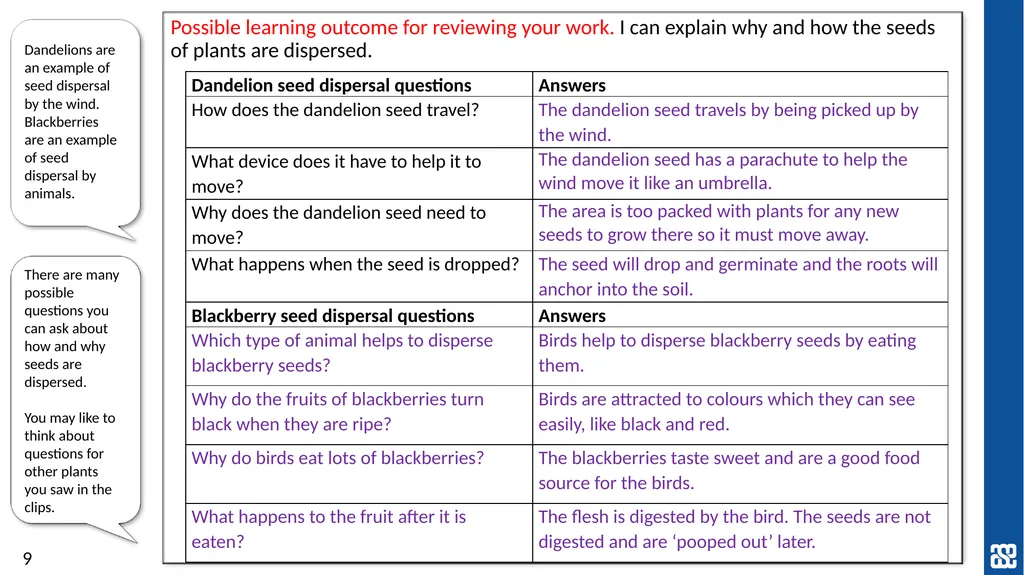
Possible learning outcome for reviewing your work. I can explain why and how the seeds of plants are dispersed. 9<br>