
PLASTIC PRODUCTS MODULE III THERMOFORMING,
BR
Published · 32 slides · 0 views

1 / 1



Description
PLASTIC PRODUCTS MODULE III THERMOFORMING, EXTRUSION AND CALENDERING 3. 3.0 To know the plastic products produced by thermoforming , extrusion and calendering 3.3.1 Identify various plastic products produced by thermoforming, extrusion and
Related Topics
Share
Embed code
Download this presentation From Below
"PLASTIC PRODUCTS MODULE III THERMOFORMING," is the property of its rightful owner. Permission is granted to download and print the materials on this website for personal, non-commercial use only, and to display it on your personal computer provided you do not modify the materials and that you retain all copyright notices contained in the materials. By downloading content from our website, you accept the terms of this agreement.
Presentation Transcript
01
PLASTIC PRODUCTS<br>
02
MODULE III THERMOFORMING, EXTRUSION AND CALENDERING 3. 3.0 To know the plastic products produced by thermoforming , extrusion and calendering
3.3.1 Identify various plastic products produced by thermoforming, extrusion and calendaring
3.3.2 Describe the production process of disposable plastic glass and egg trays from poly olefins
3.3.3 Explain the design factors such as standard dimension ratio, water hammer and stresses (external and internal)
3.3.4 State the equation and simple calculations for SDR and wall thickness for different hoop stress
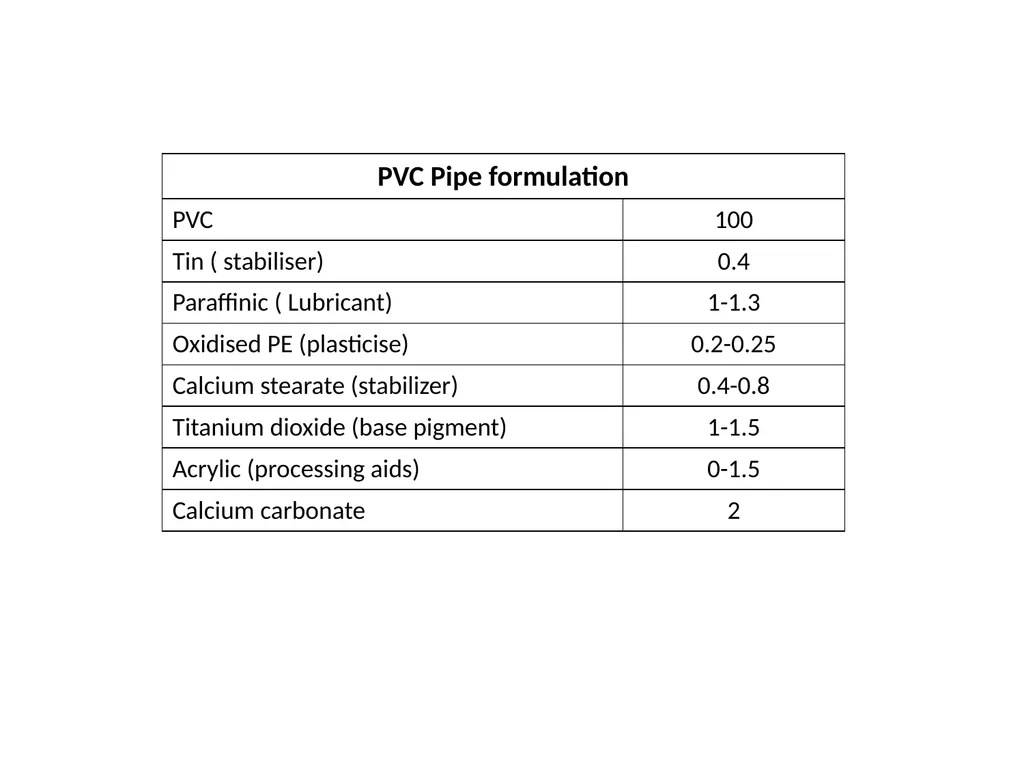
3.3.5 Explain the manufacture of PVC Pipe (rigid and flexible ) with typical formulation
3.3.6 Draw and explain line flow chart for PVC and PE pipe extrusion
3.3.7 Explain the differences in the design of dies of PVC and PE pipe with sketches
3.3.8 Explain the manufacture of blown films .
3.3.9 Explain the manufacture of PVC rexin sheets and vinyl flooring with typical formulations.<br>
3.3.1 Identify various plastic products produced by thermoforming, extrusion and calendaring
3.3.2 Describe the production process of disposable plastic glass and egg trays from poly olefins
3.3.3 Explain the design factors such as standard dimension ratio, water hammer and stresses (external and internal)
3.3.4 State the equation and simple calculations for SDR and wall thickness for different hoop stress
3.3.5 Explain the manufacture of PVC Pipe (rigid and flexible ) with typical formulation
3.3.6 Draw and explain line flow chart for PVC and PE pipe extrusion
3.3.7 Explain the differences in the design of dies of PVC and PE pipe with sketches
3.3.8 Explain the manufacture of blown films .
3.3.9 Explain the manufacture of PVC rexin sheets and vinyl flooring with typical formulations.<br>
03
THERMOFORMING Process of heating a thermoplastic sheet to its softening point and deformed it into desired shape.
The process involves:
Heating plastic sheet to the temperature where in softens
Stretching the softening polymer against a cold mould surface
Cooling the finished part and trimming excess plastics
Applications :
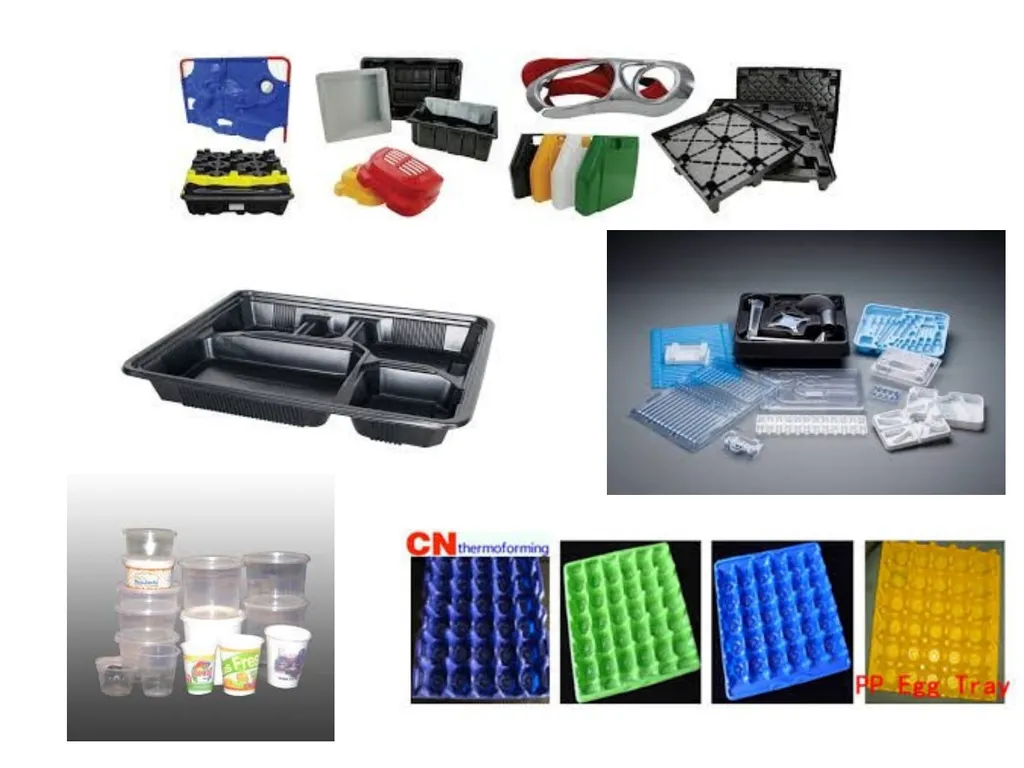
Packaging of consumer products, bathtubs, contoured sky lights, interior door liners for refrigerators<br>
The process involves:
Heating plastic sheet to the temperature where in softens
Stretching the softening polymer against a cold mould surface
Cooling the finished part and trimming excess plastics
Applications :
Packaging of consumer products, bathtubs, contoured sky lights, interior door liners for refrigerators<br>
04
Advantages and Disadvantages of thermoforming Advantages
Flexible design
High production rate
Low set up cost
Low mould cost
Rapid prototype development
Low temperature requirement
Disadvantages
Not eligible for thermosets
All parts needs to be trimmed
Non uniform thickness for the parts
Higher scrap
Limited part shapes
Internal stresses common<br>
Flexible design
High production rate
Low set up cost
Low mould cost
Rapid prototype development
Low temperature requirement
Disadvantages
Not eligible for thermosets
All parts needs to be trimmed
Non uniform thickness for the parts
Higher scrap
Limited part shapes
Internal stresses common<br>
05
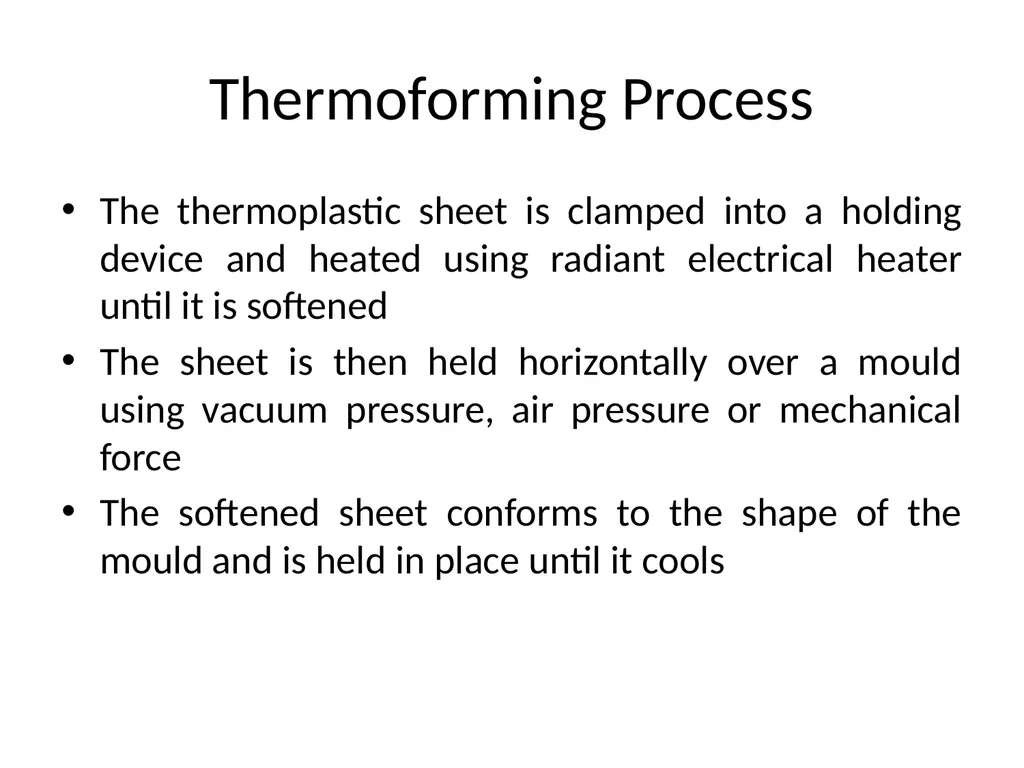
Thermoforming Process The thermoplastic sheet is clamped into a holding device and heated using radiant electrical heater until it is softened
The sheet is then held horizontally over a mould using vacuum pressure, air pressure or mechanical force
The softened sheet conforms to the shape of the mould and is held in place until it cools<br>
The sheet is then held horizontally over a mould using vacuum pressure, air pressure or mechanical force
The softened sheet conforms to the shape of the mould and is held in place until it cools<br>
06
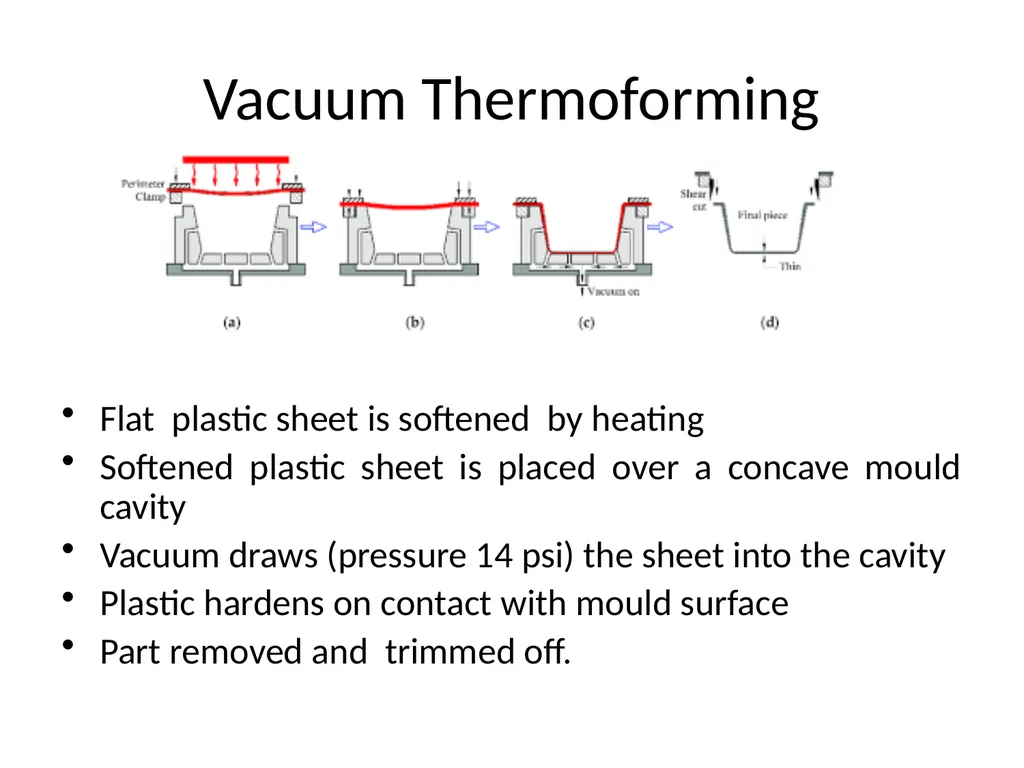
Vacuum Thermoforming Flat plastic sheet is softened by heating
Softened plastic sheet is placed over a concave mould cavity
Vacuum draws (pressure 14 psi) the sheet into the cavity
Plastic hardens on contact with mould surface
Part removed and trimmed off.<br>
Softened plastic sheet is placed over a concave mould cavity
Vacuum draws (pressure 14 psi) the sheet into the cavity
Plastic hardens on contact with mould surface
Part removed and trimmed off.<br>
07
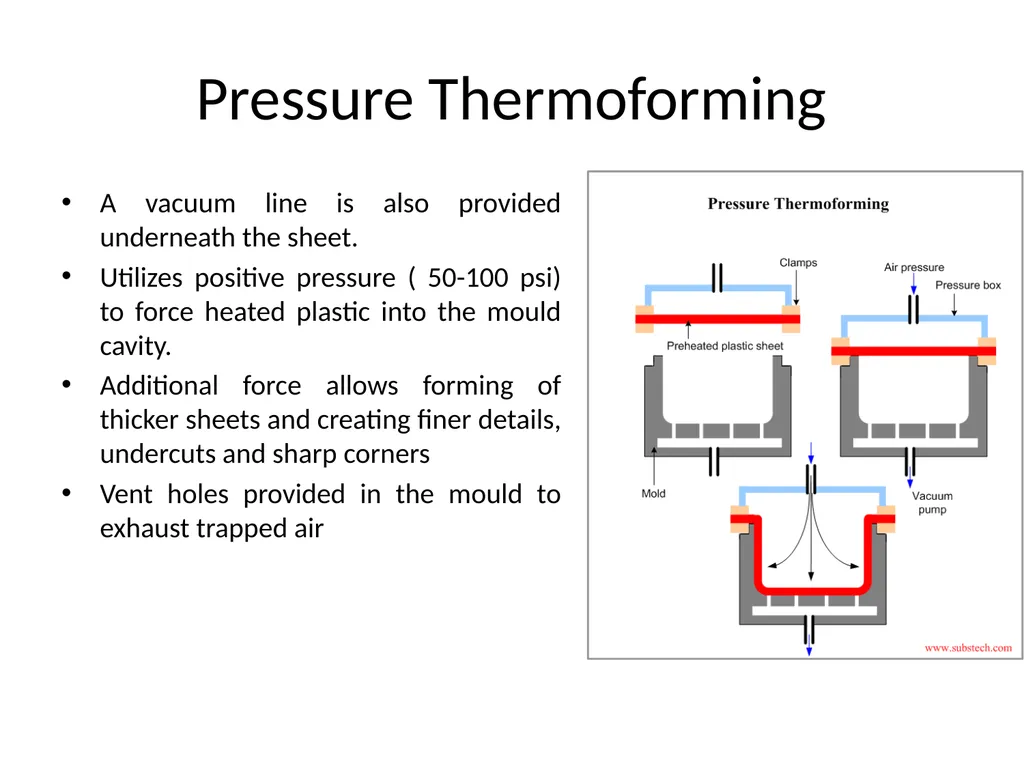
Pressure Thermoforming A vacuum line is also provided underneath the sheet.
Utilizes positive pressure ( 50-100 psi) to force heated plastic into the mould cavity.
Additional force allows forming of thicker sheets and creating finer details, undercuts and sharp corners
Vent holes provided in the mould to exhaust trapped air<br>
Utilizes positive pressure ( 50-100 psi) to force heated plastic into the mould cavity.
Additional force allows forming of thicker sheets and creating finer details, undercuts and sharp corners
Vent holes provided in the mould to exhaust trapped air<br>
08
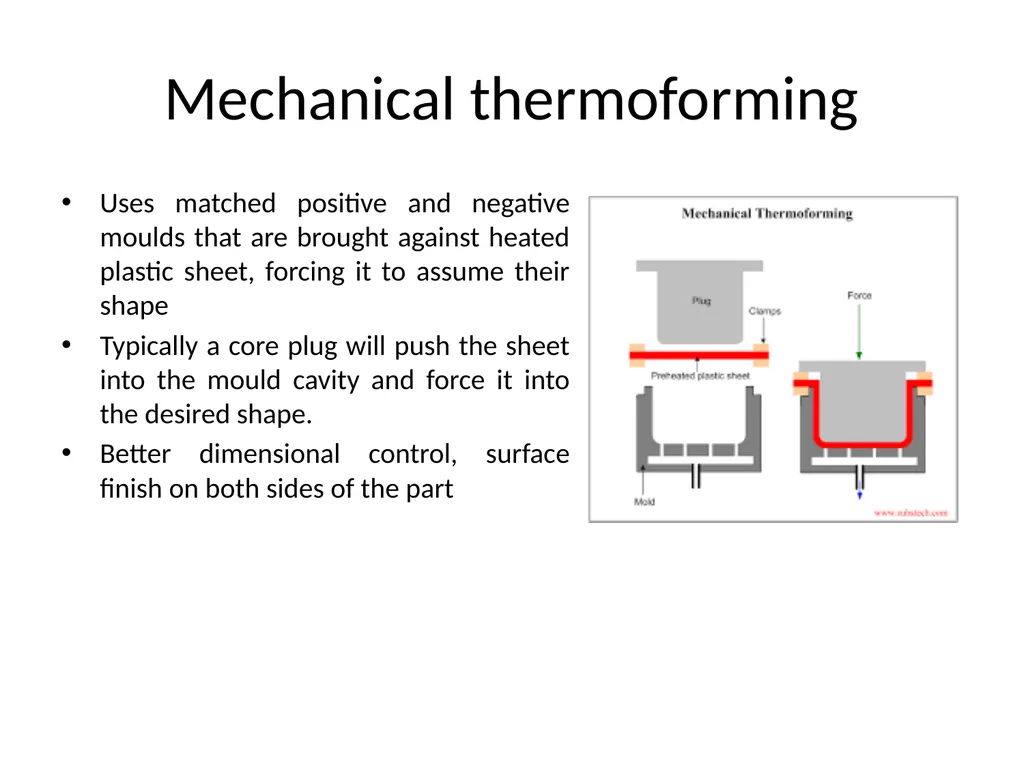
Uses matched positive and negative moulds that are brought against heated plastic sheet, forcing it to assume their shape
Typically a core plug will push the sheet into the mould cavity and force it into the desired shape.
Better dimensional control, surface finish on both sides of the part Mechanical thermoforming<br>
Typically a core plug will push the sheet into the mould cavity and force it into the desired shape.
Better dimensional control, surface finish on both sides of the part Mechanical thermoforming<br>
09
Blown film extrusion https://www.youtube.com/watch?v=qn16JtE_vLc<br>
10
The die is like a vertical cylinder with a circular profile.
The molten plastic is pulled upwards (up to 4 to 20 meters) from the die by a pair of nip rollers.
The compressed air is used to inflate the tube around the die.
In the centre of the die there is an air inlet from which compressed air can be forced into the centre of the circular profile and hence tube creating a bubble.
The extruded circular cross section may be increased 2-3 times of the die diameter<br>
The molten plastic is pulled upwards (up to 4 to 20 meters) from the die by a pair of nip rollers.
The compressed air is used to inflate the tube around the die.
In the centre of the die there is an air inlet from which compressed air can be forced into the centre of the circular profile and hence tube creating a bubble.
The extruded circular cross section may be increased 2-3 times of the die diameter<br>
11
The bubbles are collapsed with the help of collapsing plate.
The nip rolls flatten the bubble into a double layer of film (called lay-flat).
The wall thickness of the film can be controlled by changing the speed of the nip rollers.
The lay-flat can be spooled in the form of roll or cut into desired shapes.
Bottom side of the lay-flat is sealed with the application of heat, and cut across further up to form opening; hence it can be used to make a plastic bag.<br>
The nip rolls flatten the bubble into a double layer of film (called lay-flat).
The wall thickness of the film can be controlled by changing the speed of the nip rollers.
The lay-flat can be spooled in the form of roll or cut into desired shapes.
Bottom side of the lay-flat is sealed with the application of heat, and cut across further up to form opening; hence it can be used to make a plastic bag.<br>
12
Calendering Calendaring is the process of squeezing a plastic melt between two or more counter rotating cylinders or rolls to form a continuous film and sheet.
Calendaring and blown film are the method of making plastic sheets and plastic film
The sheet is formed in the range of 0. 1 to 1. 0 mm and above thickness.
The sheet can be transparent, coloured, embossed, printed or laminated form.<br>
Calendaring and blown film are the method of making plastic sheets and plastic film
The sheet is formed in the range of 0. 1 to 1. 0 mm and above thickness.
The sheet can be transparent, coloured, embossed, printed or laminated form.<br>
13
Plastics used to create film and sheets by calendering are:
Polyvinyl chloride (PVC)
Modified polyethylene (PE)
Polypropylene (PP)
Acrylonitrile-butadiene-styrene (ABS)
Thermosetting compounds<br>
Polyvinyl chloride (PVC)
Modified polyethylene (PE)
Polypropylene (PP)
Acrylonitrile-butadiene-styrene (ABS)
Thermosetting compounds<br>
14
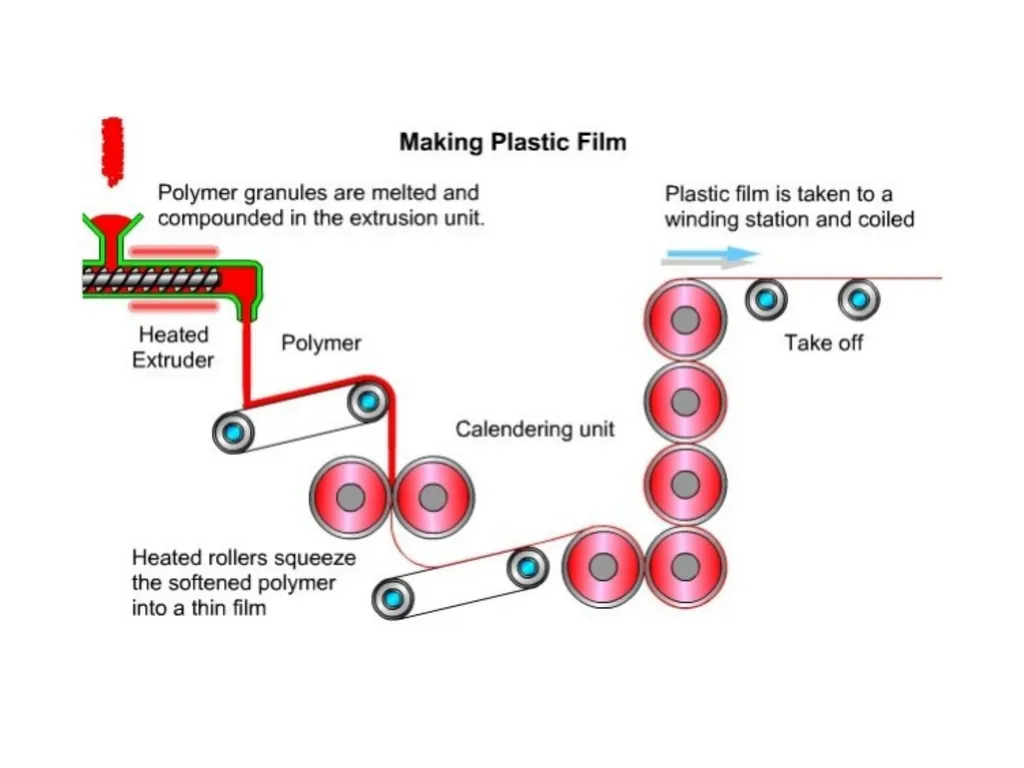
In the calendering process, molten plastic is extruded and then passed between pairs of heated rollers that squeeze the molten plastic into a sheet.
The thickness of the plastic sheet depends upon the gap between the pairs of rollers.
Very thin plastic sheet is called plastic film.
The calendaring process usually involves using four or more pairs of rollers that gradually reduce the plastic thickness, polish the surface, add a texture or emboss a pattern into the plastic sheet.
After the sheet passes between the final pair of rollers, it is cooled and fed to a winding station where it is coiled and edge trimmed.
Thickness of the sheet is given by the gap between last pair of rolls.
Surface quality of sheet depends on the surface of last roll<br>
The thickness of the plastic sheet depends upon the gap between the pairs of rollers.
Very thin plastic sheet is called plastic film.
The calendaring process usually involves using four or more pairs of rollers that gradually reduce the plastic thickness, polish the surface, add a texture or emboss a pattern into the plastic sheet.
After the sheet passes between the final pair of rollers, it is cooled and fed to a winding station where it is coiled and edge trimmed.
Thickness of the sheet is given by the gap between last pair of rolls.
Surface quality of sheet depends on the surface of last roll<br>
15
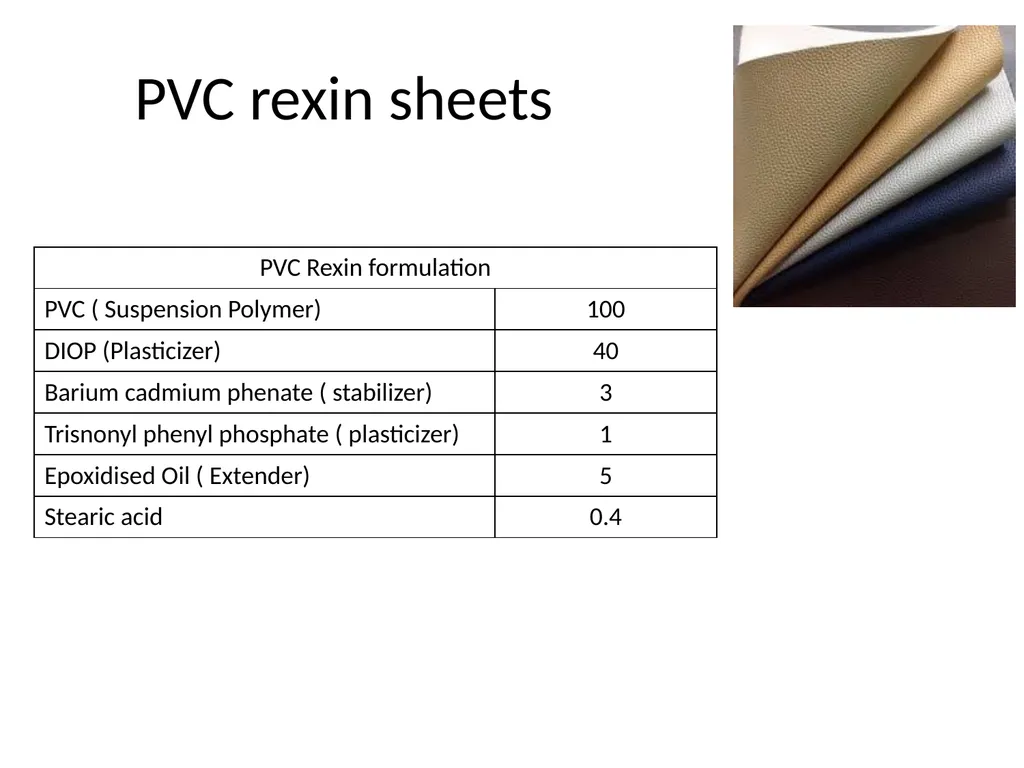
PVC rexin sheets It is a coated fabric, and PVC is usually the coating material used in upholstery, bookbinding and footwear applications
Heat softened PVC material is blended with stabilizers, plasticizers at 120-150 °C for 5-10 min in a Banbury mixer
Made into a rough sheet on a two roll mill before being fed to the calendar.
Molten PVC is applied to cotton cloth coming out of calendering machine and the treated cloth is then subjected to pressure between steel rollers.
It is then printed in desired colours and patterns.
It is finally polished with varnish and dried.<br>
Heat softened PVC material is blended with stabilizers, plasticizers at 120-150 °C for 5-10 min in a Banbury mixer
Made into a rough sheet on a two roll mill before being fed to the calendar.
Molten PVC is applied to cotton cloth coming out of calendering machine and the treated cloth is then subjected to pressure between steel rollers.
It is then printed in desired colours and patterns.
It is finally polished with varnish and dried.<br>
16
PVC rexin sheets<br>
17
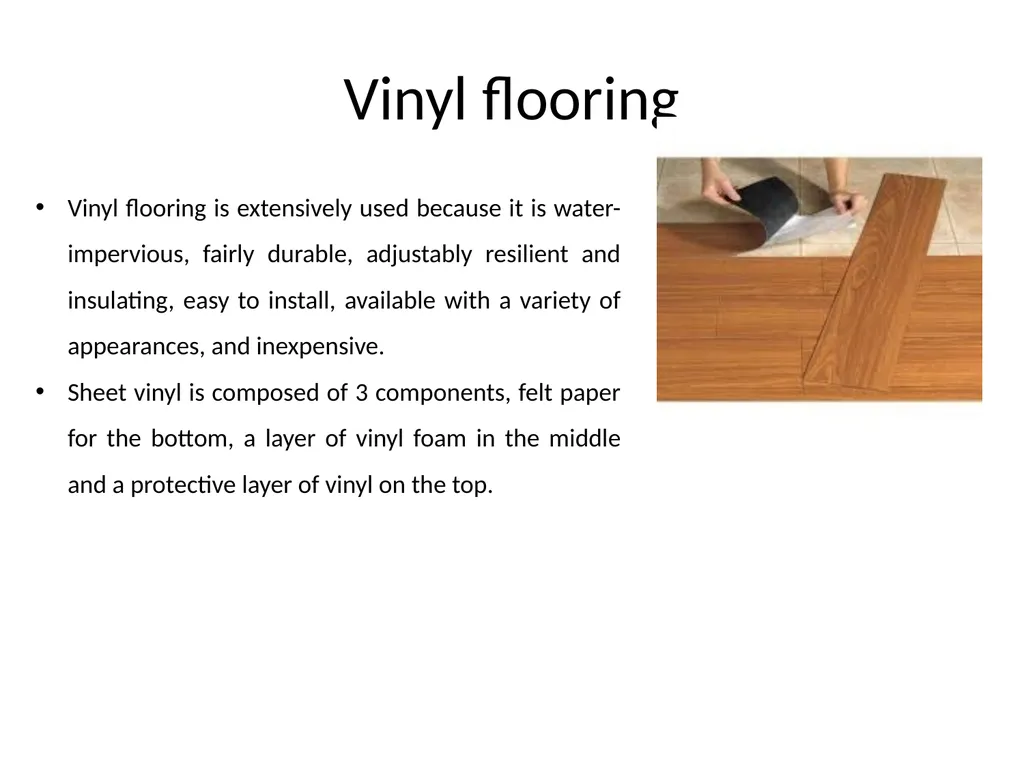
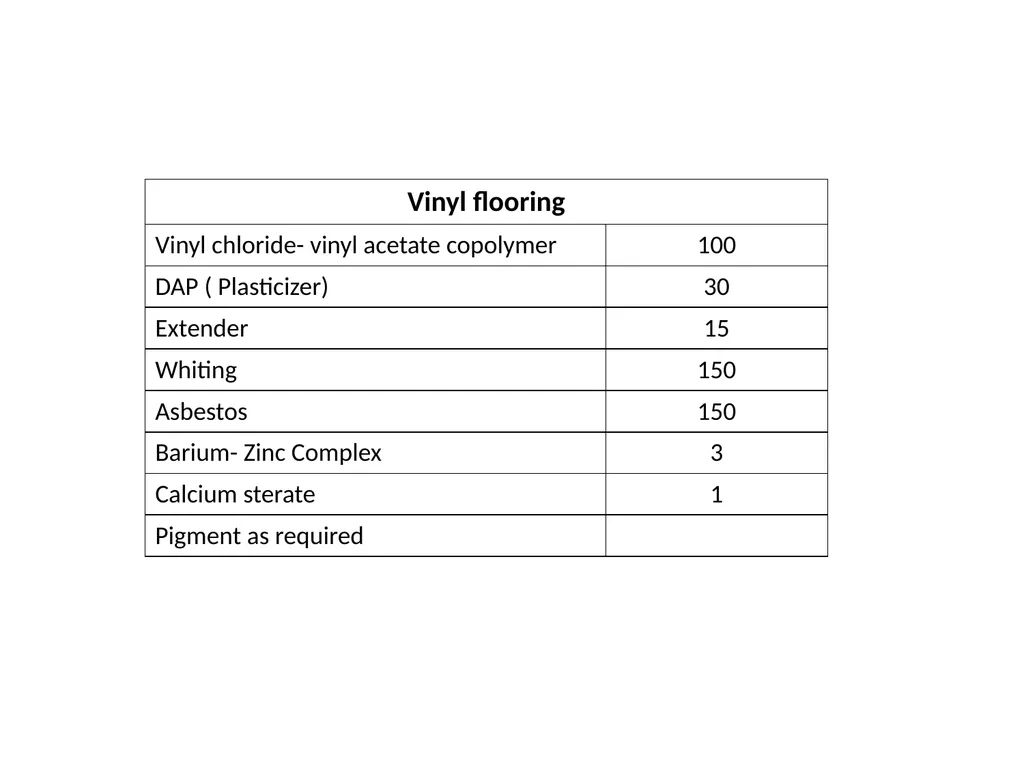
Vinyl flooring Vinyl flooring is extensively used because it is water-impervious, fairly durable, adjustably resilient and insulating, easy to install, available with a variety of appearances, and inexpensive.
Sheet vinyl is composed of 3 components, felt paper for the bottom, a layer of vinyl foam in the middle and a protective layer of vinyl on the top.<br>
Sheet vinyl is composed of 3 components, felt paper for the bottom, a layer of vinyl foam in the middle and a protective layer of vinyl on the top.<br>
18
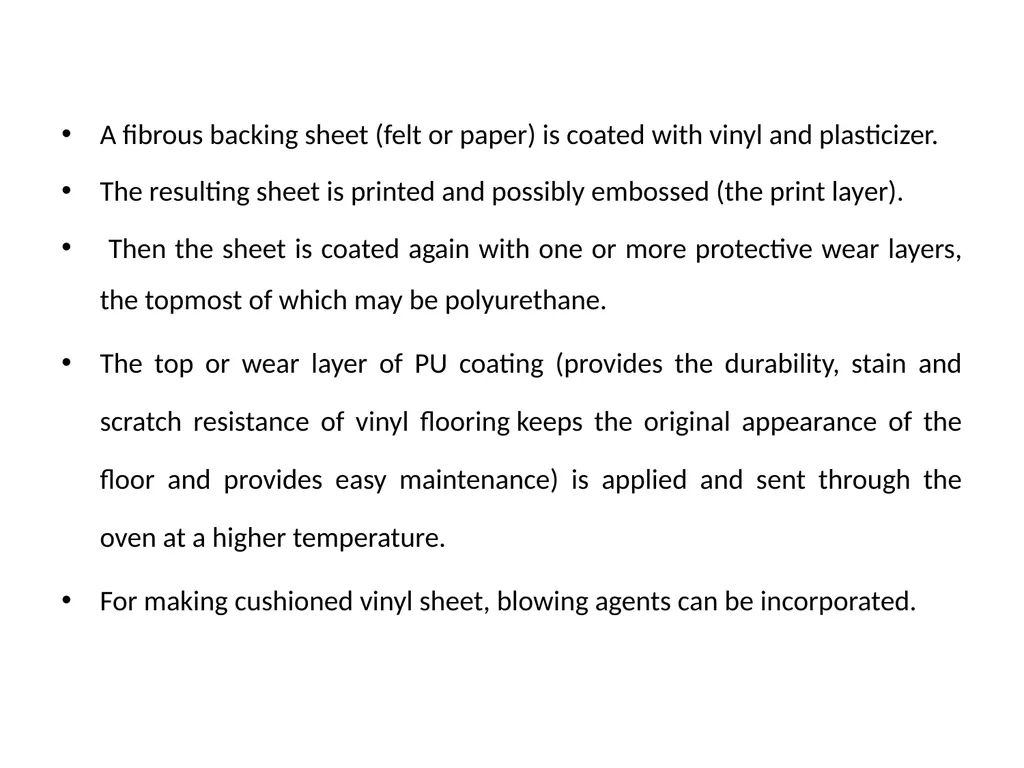
A fibrous backing sheet (felt or paper) is coated with vinyl and plasticizer.
The resulting sheet is printed and possibly embossed (the print layer).
Then the sheet is coated again with one or more protective wear layers, the topmost of which may be polyurethane.
The top or wear layer of PU coating (provides the durability, stain and scratch resistance of vinyl flooring keeps the original appearance of the floor and provides easy maintenance) is applied and sent through the oven at a higher temperature.
For making cushioned vinyl sheet, blowing agents can be incorporated.<br>
The resulting sheet is printed and possibly embossed (the print layer).
Then the sheet is coated again with one or more protective wear layers, the topmost of which may be polyurethane.
The top or wear layer of PU coating (provides the durability, stain and scratch resistance of vinyl flooring keeps the original appearance of the floor and provides easy maintenance) is applied and sent through the oven at a higher temperature.
For making cushioned vinyl sheet, blowing agents can be incorporated.<br>
19
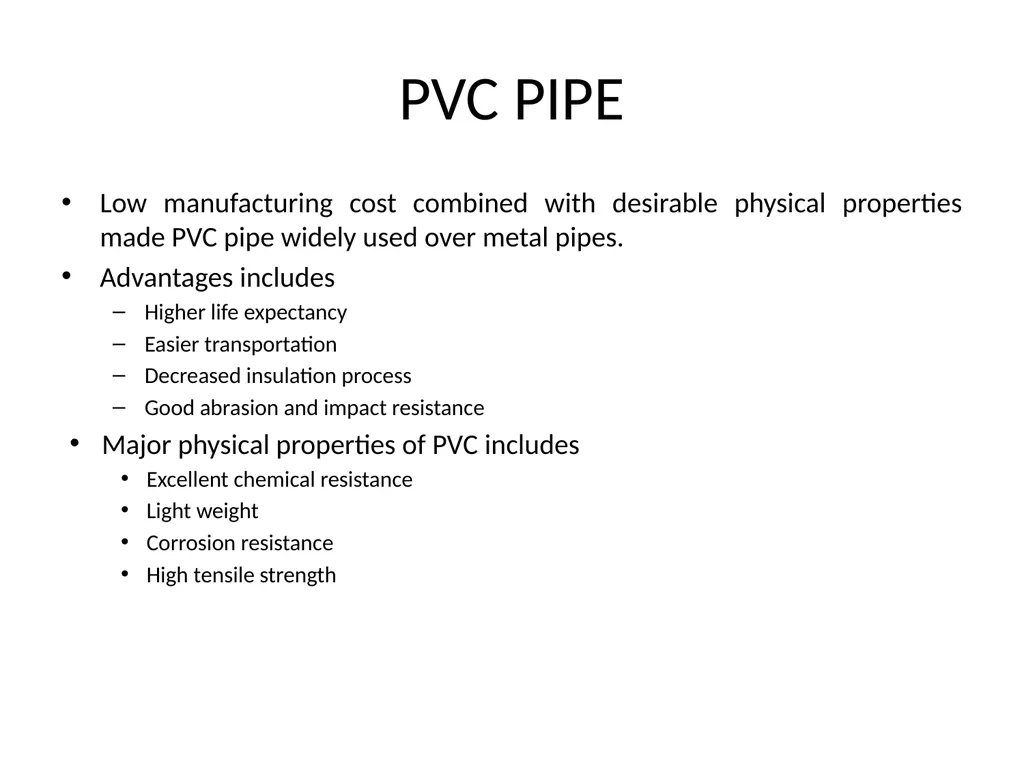
PVC PIPE Low manufacturing cost combined with desirable physical properties made PVC pipe widely used over metal pipes.
Advantages includes
Higher life expectancy
Easier transportation
Decreased insulation process
Good abrasion and impact resistance
Major physical properties of PVC includes
Excellent chemical resistance
Light weight
Corrosion resistance
High tensile strength<br>
Advantages includes
Higher life expectancy
Easier transportation
Decreased insulation process
Good abrasion and impact resistance
Major physical properties of PVC includes
Excellent chemical resistance
Light weight
Corrosion resistance
High tensile strength<br>
20
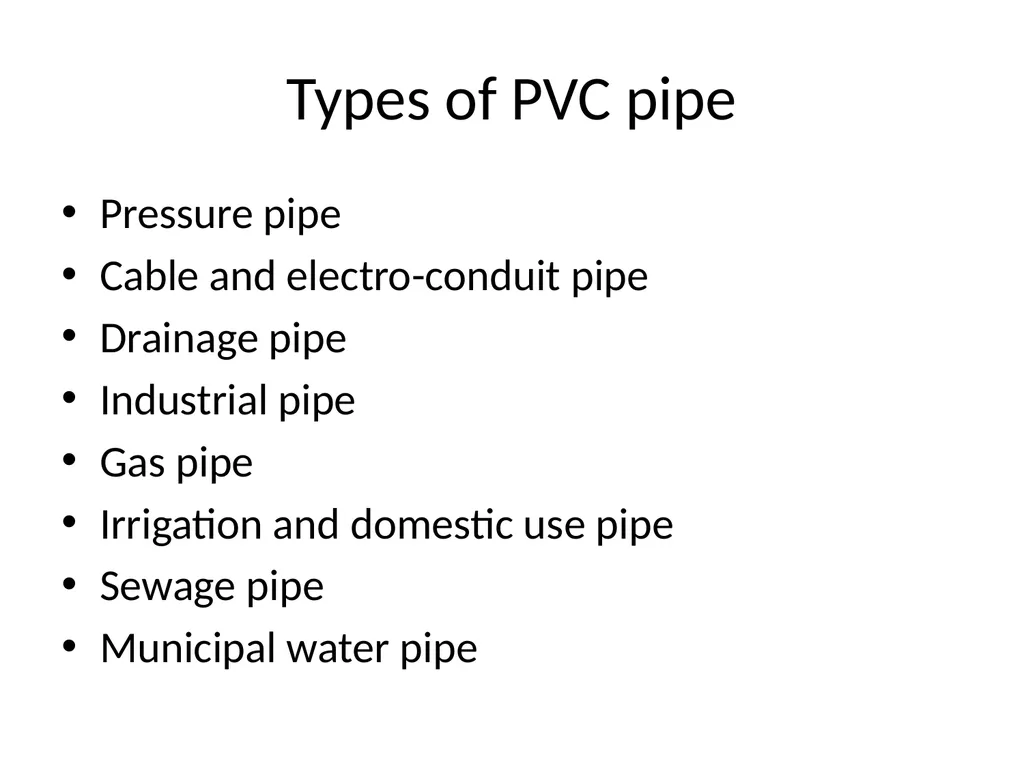
Types of PVC pipe Pressure pipe
Cable and electro-conduit pipe
Drainage pipe
Industrial pipe
Gas pipe
Irrigation and domestic use pipe
Sewage pipe
Municipal water pipe<br>
Cable and electro-conduit pipe
Drainage pipe
Industrial pipe
Gas pipe
Irrigation and domestic use pipe
Sewage pipe
Municipal water pipe<br>
21
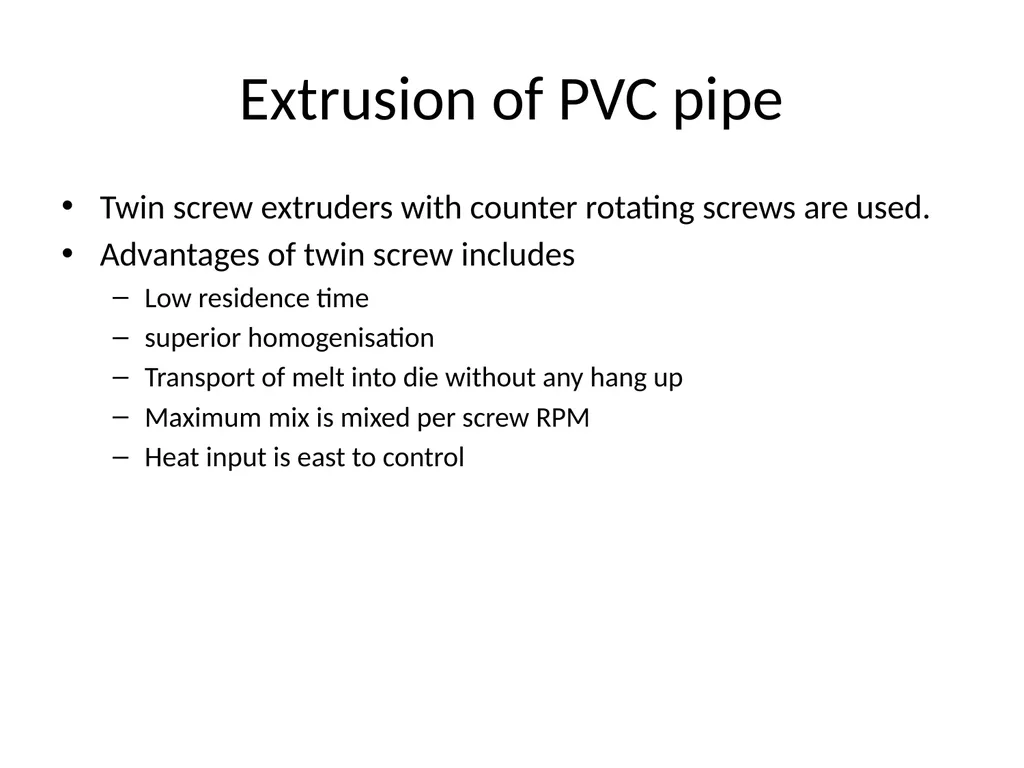
Extrusion of PVC pipe Twin screw extruders with counter rotating screws are used.
Advantages of twin screw includes
Low residence time
superior homogenisation
Transport of melt into die without any hang up
Maximum mix is mixed per screw RPM
Heat input is east to control<br>
Advantages of twin screw includes
Low residence time
superior homogenisation
Transport of melt into die without any hang up
Maximum mix is mixed per screw RPM
Heat input is east to control<br>
22
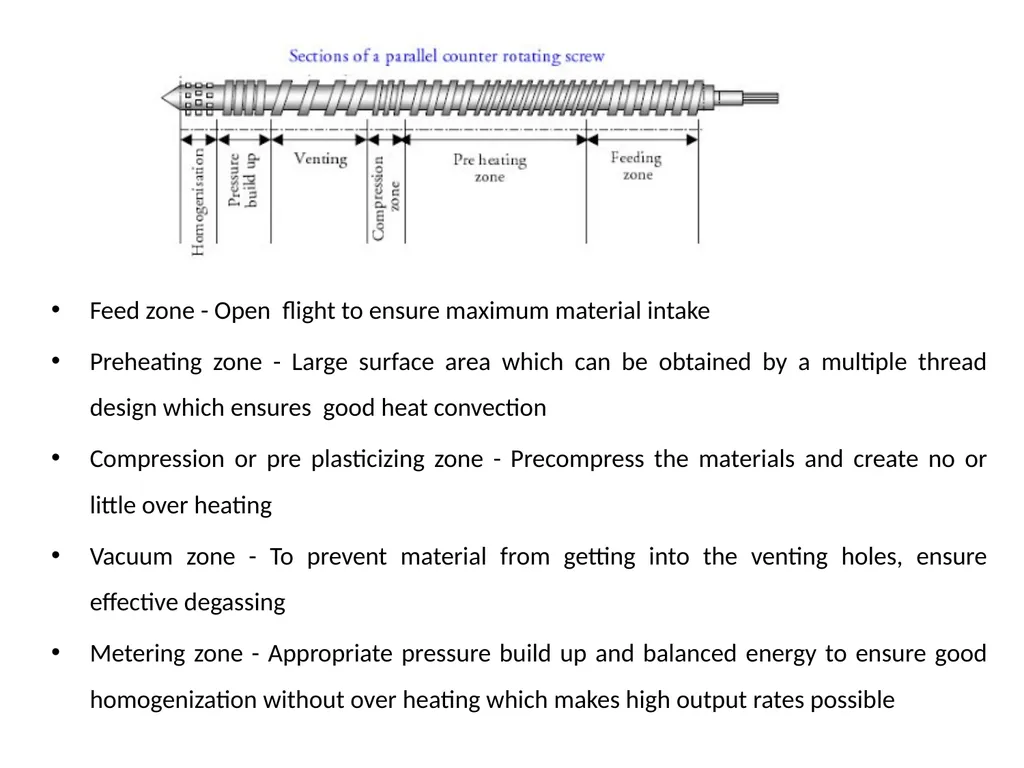
Feed zone - Open flight to ensure maximum material intake
Preheating zone - Large surface area which can be obtained by a multiple thread design which ensures good heat convection
Compression or pre plasticizing zone - Precompress the materials and create no or little over heating
Vacuum zone - To prevent material from getting into the venting holes, ensure effective degassing
Metering zone - Appropriate pressure build up and balanced energy to ensure good homogenization without over heating which makes high output rates possible<br>
Preheating zone - Large surface area which can be obtained by a multiple thread design which ensures good heat convection
Compression or pre plasticizing zone - Precompress the materials and create no or little over heating
Vacuum zone - To prevent material from getting into the venting holes, ensure effective degassing
Metering zone - Appropriate pressure build up and balanced energy to ensure good homogenization without over heating which makes high output rates possible<br>
23
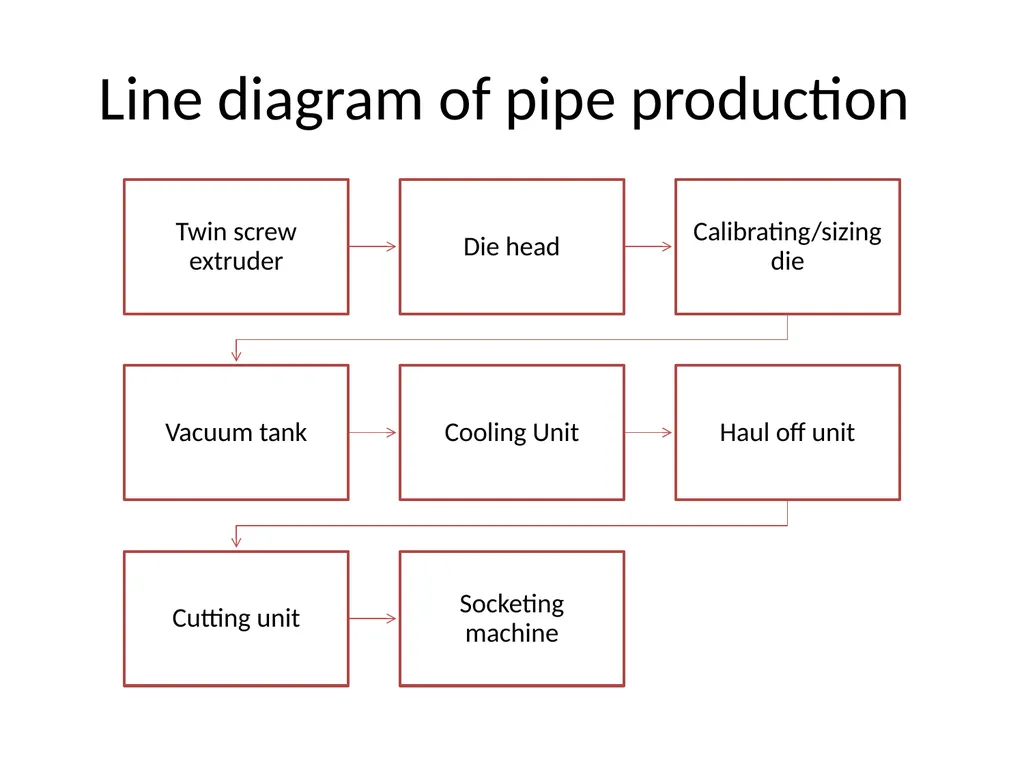
Line diagram of pipe production<br>
24
Material melted in twin screw extruder
Molten polymer pushed from the extruder through a die and takes its shape
Molten polymer exiting the die is first cooled, usually pulled through a water bath
Sizing dies ( aluminium or brass) are used to control shape of molten polymer as it enters the cooling bath. If there were no sizing dies he molten polymer will shrink uncontrollably before it solidifies.
A puller is used to pull the polymer extrudate through the cooling tank after it leaves the sizing die, usually pulls faster than the velocity of polymer exiting the die, thus posses orientation of the polymer and reduces parts size
Once solidified, extruded pipe is usually rolled or cut into individual parts and stacked
Socketing unit helps in assembling PVC pipes lengthwise.<br>
Molten polymer pushed from the extruder through a die and takes its shape
Molten polymer exiting the die is first cooled, usually pulled through a water bath
Sizing dies ( aluminium or brass) are used to control shape of molten polymer as it enters the cooling bath. If there were no sizing dies he molten polymer will shrink uncontrollably before it solidifies.
A puller is used to pull the polymer extrudate through the cooling tank after it leaves the sizing die, usually pulls faster than the velocity of polymer exiting the die, thus posses orientation of the polymer and reduces parts size
Once solidified, extruded pipe is usually rolled or cut into individual parts and stacked
Socketing unit helps in assembling PVC pipes lengthwise.<br>
25
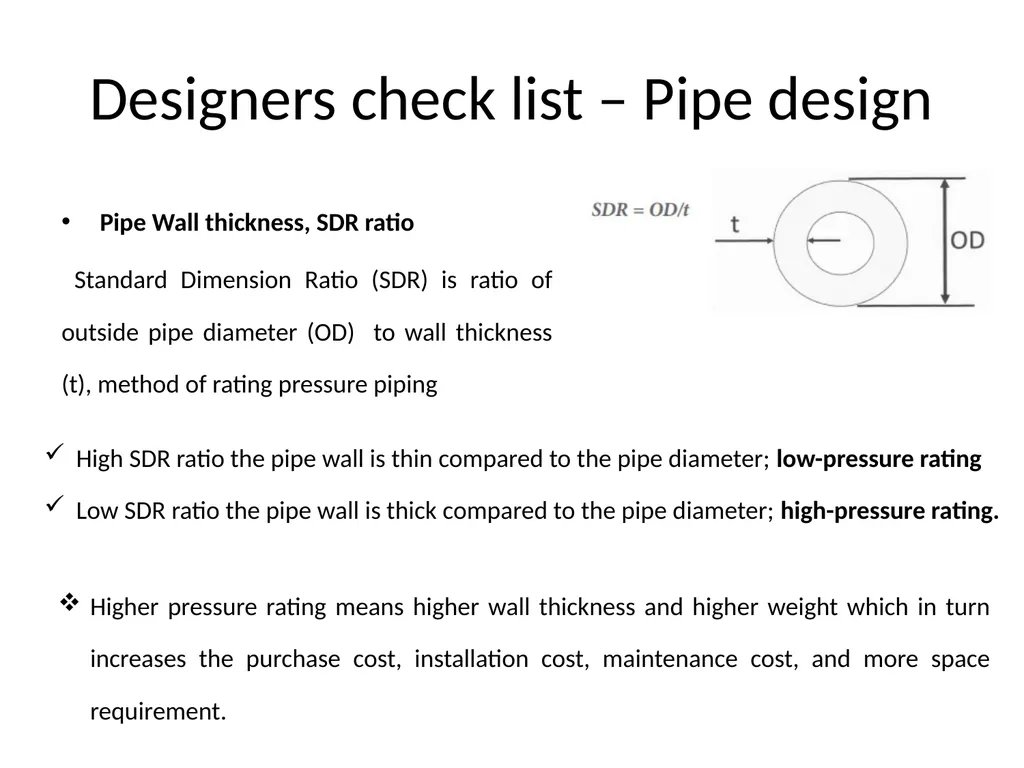
Designers check list – Pipe design Pipe Wall thickness, SDR ratio
Standard Dimension Ratio (SDR) is ratio of outside pipe diameter (OD) to wall thickness (t), method of rating pressure piping High SDR ratio the pipe wall is thin compared to the pipe diameter; low-pressure rating
Low SDR ratio the pipe wall is thick compared to the pipe diameter; high-pressure rating. Higher pressure rating means higher wall thickness and higher weight which in turn increases the purchase cost, installation cost, maintenance cost, and more space requirement.<br>
Standard Dimension Ratio (SDR) is ratio of outside pipe diameter (OD) to wall thickness (t), method of rating pressure piping High SDR ratio the pipe wall is thin compared to the pipe diameter; low-pressure rating
Low SDR ratio the pipe wall is thick compared to the pipe diameter; high-pressure rating. Higher pressure rating means higher wall thickness and higher weight which in turn increases the purchase cost, installation cost, maintenance cost, and more space requirement.<br>
26
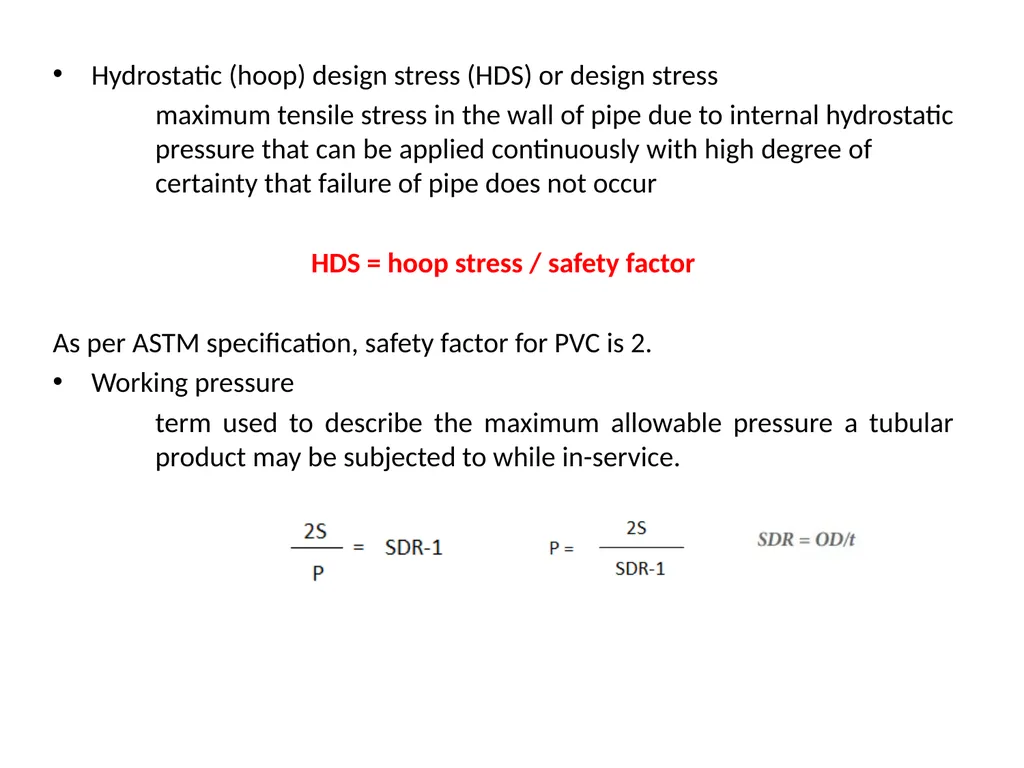
Hydrostatic (hoop) design stress (HDS) or design stress
maximum tensile stress in the wall of pipe due to internal hydrostatic pressure that can be applied continuously with high degree of certainty that failure of pipe does not occur
HDS = hoop stress / safety factor
As per ASTM specification, safety factor for PVC is 2.
Working pressure
term used to describe the maximum allowable pressure a tubular product may be subjected to while in-service.<br>
maximum tensile stress in the wall of pipe due to internal hydrostatic pressure that can be applied continuously with high degree of certainty that failure of pipe does not occur
HDS = hoop stress / safety factor
As per ASTM specification, safety factor for PVC is 2.
Working pressure
term used to describe the maximum allowable pressure a tubular product may be subjected to while in-service.<br>
27
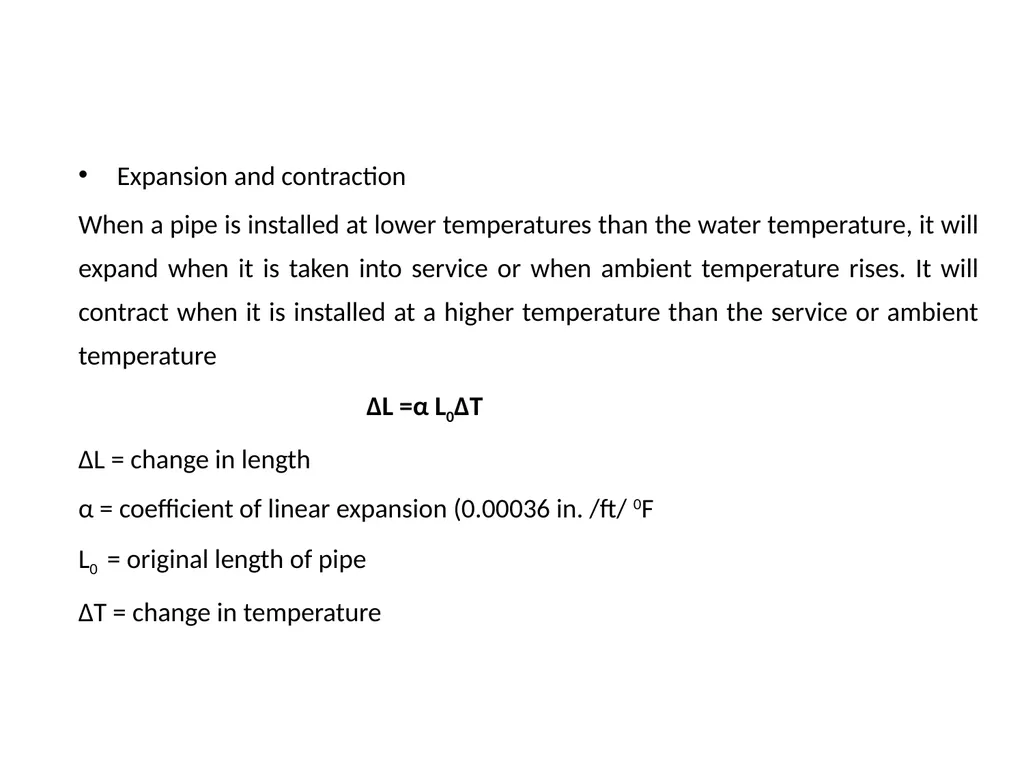
Expansion and contraction
When a pipe is installed at lower temperatures than the water temperature, it will expand when it is taken into service or when ambient temperature rises. It will contract when it is installed at a higher temperature than the service or ambient temperature
ΔL =α L0ΔT
ΔL = change in length
α = coefficient of linear expansion (0.00036 in. /ft/ 0F
L0 = original length of pipe
ΔT = change in temperature<br>
When a pipe is installed at lower temperatures than the water temperature, it will expand when it is taken into service or when ambient temperature rises. It will contract when it is installed at a higher temperature than the service or ambient temperature
ΔL =α L0ΔT
ΔL = change in length
α = coefficient of linear expansion (0.00036 in. /ft/ 0F
L0 = original length of pipe
ΔT = change in temperature<br>
28
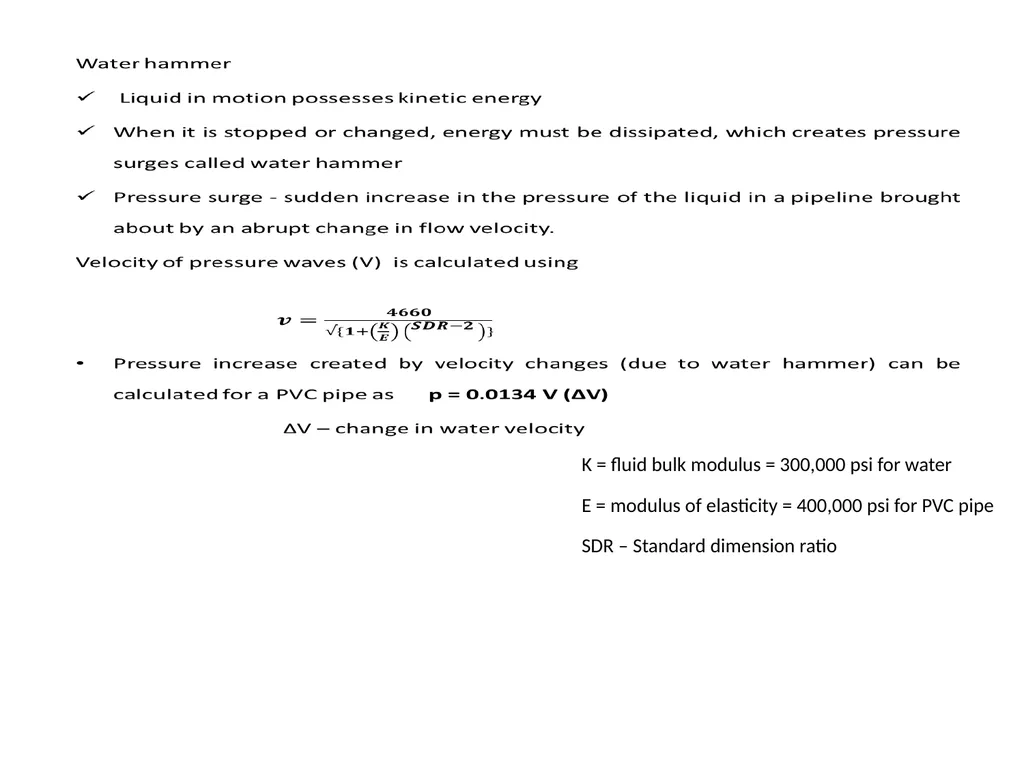
K = fluid bulk modulus = 300,000 psi for water
E = modulus of elasticity = 400,000 psi for PVC pipe
SDR – Standard dimension ratio<br>
E = modulus of elasticity = 400,000 psi for PVC pipe
SDR – Standard dimension ratio<br>