
Plate Tectonics: Earth's Plates and Continental




Description: Plate Tectonics: Earths Plates and Continental Drift Some questions we will answer today: How is the earth always changing? What forces inside the earth create and change landforms on the surface? What is the theory of plate tectonics and
Related Topics
Download Presentation
"Plate Tectonics: Earth's Plates and Continental" is the property of its rightful owner. Permission is granted to download and print the materials on this website for personal, non-commercial use only, and to display it on your personal computer provided you do not modify the materials and that you retain all copyright notices contained in the materials. By downloading content from our website, you accept the terms of this agreement.
Presentation Transcript
slide1. Plate Tectonics:
Earth's Plates and Continental Drift<br>
slide2. Some questions we will answer today:
How is the earth always changing?
What forces inside the earth create and change landforms on the surface?
What is the theory of plate tectonics and how does it work?
What two theories help make up the theory of plate tectonics?
What is continental drift and sea floor spreading?
What happens when the plates crash together, pull apart, and slide against each other?<br>
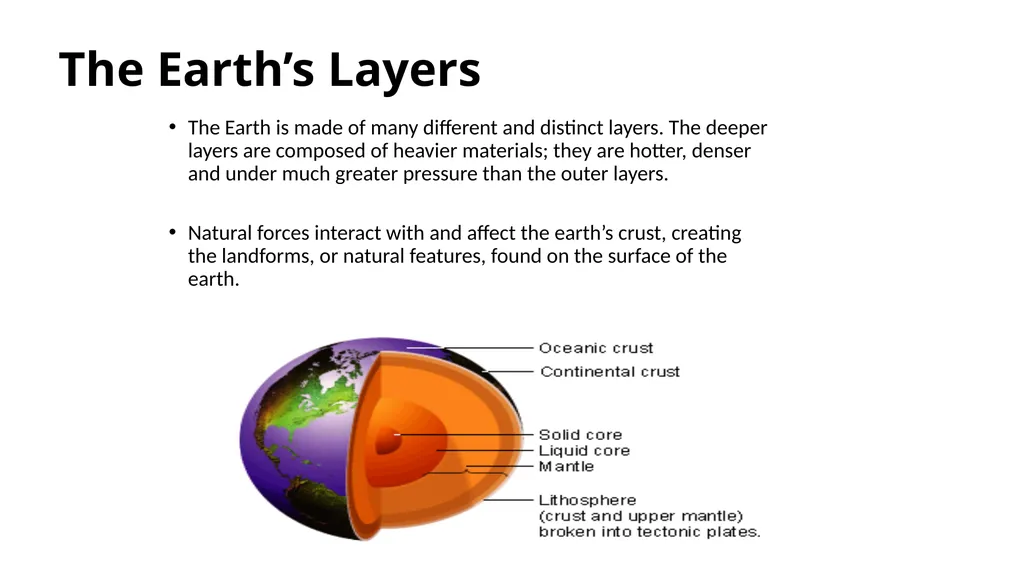
slide3. The Earth’s Layers The Earth is made of many different and distinct layers. The deeper layers are composed of heavier materials; they are hotter, denser and under much greater pressure than the outer layers.
Natural forces interact with and affect the earth’s crust, creating the landforms, or natural features, found on the surface of the earth.<br>
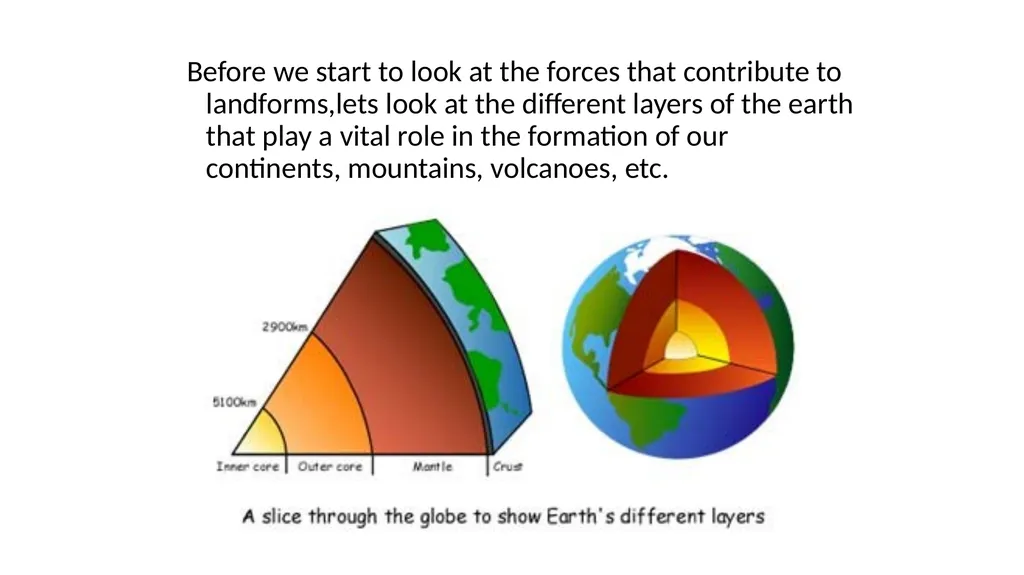
slide4. Before we start to look at the forces that contribute to landforms,lets look at the different layers of the earth that play a vital role in the formation of our continents, mountains, volcanoes, etc.<br>
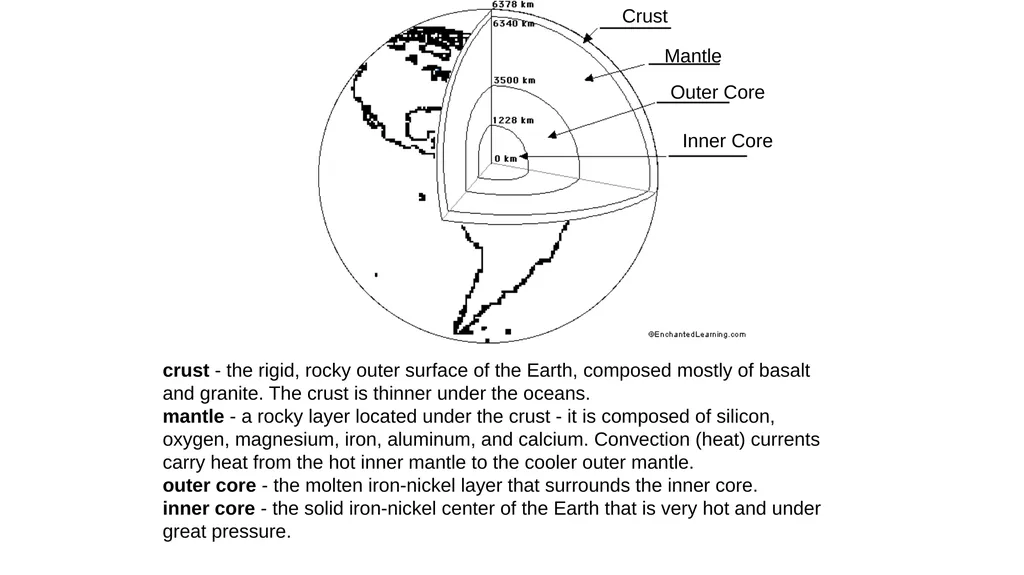
slide5. crust - the rigid, rocky outer surface of the Earth, composed mostly of basalt and granite. The crust is thinner under the oceans.
mantle - a rocky layer located under the crust - it is composed of silicon, oxygen, magnesium, iron, aluminum, and calcium. Convection (heat) currents carry heat from the hot inner mantle to the cooler outer mantle.
outer core - the molten iron-nickel layer that surrounds the inner core.
inner core - the solid iron-nickel center of the Earth that is very hot and under great pressure. Crust Mantle Outer Core Inner Core<br>
slide6. DID YOU KNOW?<br>
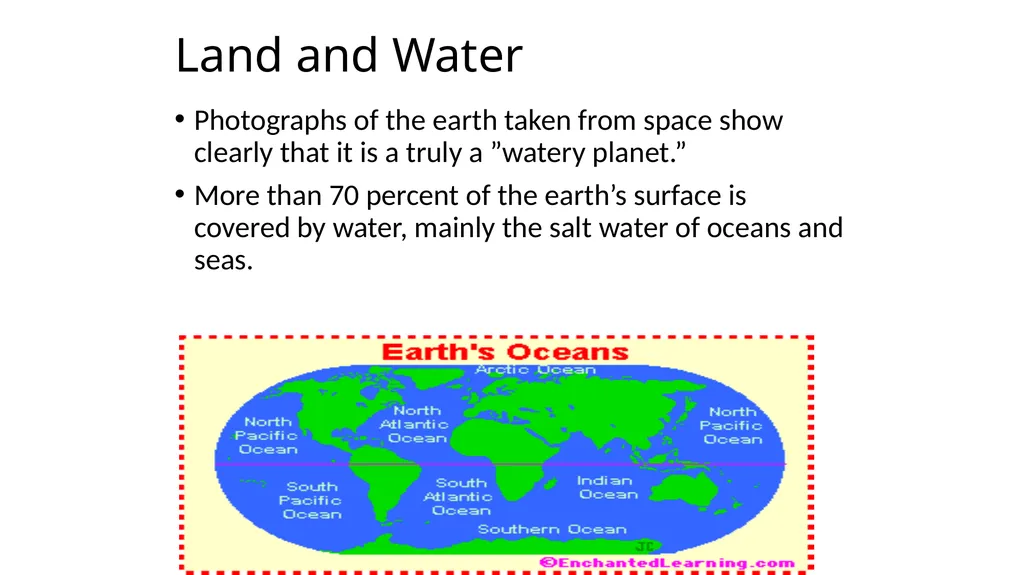
slide7. Land and Water Photographs of the earth taken from space show clearly that it is a truly a ”watery planet.”
More than 70 percent of the earth’s surface is covered by water, mainly the salt water of oceans and seas.<br>
slide8. The large landmasses in the oceans are called continents.
List the continents in your notes.
Landforms are commonly classified according to differences in relief. The relief is the difference in elevation between the highest and lowest points. Another important characteristic is whether they rise gradually or steeply.
The major types of landforms are mountains, hills, plateaus, and plains. Land<br>
slide9. Together, lets look at your Land and Water Features handout.
Please join me in filling out the correct answers. Use a map pencil to color the different types of land and water features.<br>
slide10. Most people know that Earth is moving around the Sun and that it is constantly spinning.
But did YOU know that the continents and oceans are moving across the surface of the planet?
Volcanoes and earthquakes as well as mountain ranges and islands all are results of this movement.
Why is this?<br>
slide2. Some questions we will answer today:
How is the earth always changing?
What forces inside the earth create and change landforms on the surface?
What is the theory of plate tectonics and how does it work?
What two theories help make up the theory of plate tectonics?
What is continental drift and sea floor spreading?
What happens when the plates crash together, pull apart, and slide against each other?<br>
slide3. The Earth’s Layers The Earth is made of many different and distinct layers. The deeper layers are composed of heavier materials; they are hotter, denser and under much greater pressure than the outer layers.
Natural forces interact with and affect the earth’s crust, creating the landforms, or natural features, found on the surface of the earth.<br>
slide4. Before we start to look at the forces that contribute to landforms,lets look at the different layers of the earth that play a vital role in the formation of our continents, mountains, volcanoes, etc.<br>
slide5. crust - the rigid, rocky outer surface of the Earth, composed mostly of basalt and granite. The crust is thinner under the oceans.
mantle - a rocky layer located under the crust - it is composed of silicon, oxygen, magnesium, iron, aluminum, and calcium. Convection (heat) currents carry heat from the hot inner mantle to the cooler outer mantle.
outer core - the molten iron-nickel layer that surrounds the inner core.
inner core - the solid iron-nickel center of the Earth that is very hot and under great pressure. Crust Mantle Outer Core Inner Core<br>
slide6. DID YOU KNOW?<br>
slide7. Land and Water Photographs of the earth taken from space show clearly that it is a truly a ”watery planet.”
More than 70 percent of the earth’s surface is covered by water, mainly the salt water of oceans and seas.<br>
slide8. The large landmasses in the oceans are called continents.
List the continents in your notes.
Landforms are commonly classified according to differences in relief. The relief is the difference in elevation between the highest and lowest points. Another important characteristic is whether they rise gradually or steeply.
The major types of landforms are mountains, hills, plateaus, and plains. Land<br>
slide9. Together, lets look at your Land and Water Features handout.
Please join me in filling out the correct answers. Use a map pencil to color the different types of land and water features.<br>
slide10. Most people know that Earth is moving around the Sun and that it is constantly spinning.
But did YOU know that the continents and oceans are moving across the surface of the planet?
Volcanoes and earthquakes as well as mountain ranges and islands all are results of this movement.
Why is this?<br>