Plate Tectonics Meaning and Concept The term plate was first used by Canadian geophysicist J. Tuzo Wilson in 1965. Mackenzie and Parker discussed in detail the mechanism of plate motions. W. J. Morgan and Le Pichon elaborated the various
"Plate Tectonics Meaning and Concept The term" is the property of its rightful owner. Permission is granted to
download and print the materials on this website for personal, non-commercial use only, and to display it
on your personal computer provided you do not modify the materials and that you retain all copyright
notices contained in the materials. By downloading content from our website, you accept the terms of this
agreement.
Presentation Transcript
01
Plate Tectonics<br>
02
Meaning and Concept The term ‘plate’ was first used by Canadian geophysicist J. Tuzo Wilson in 1965. Mackenzie and Parker discussed in detail the mechanism of plate motions. W. J. Morgan and Le Pichon elaborated the various aspects of plate tectonics in 1968.
It may thus be pointed out that the theory of plate tectonics is not related to any individual scientist rather a host of scientists of various scientific disciplines and research groups and expeditions.
The rigid lithospheric slabs or rigid and solid crustal layers are technically called plates.
The study of the whole mechanism of evolution, nature and motions of plates, deformation within plates and interactions of plate margins with each other is collectively called as plate tectonics.<br>
03
In other words, the whole process of plate motions and resultant deformations is referred to as plate tectonics.
“Moving over the weak asthenosphere, individual lithospheric plates glides slowly over the surface of the globe, much as a pack of ice of the Arctic Ocean drifts under the dragging force of currents and winds”. (A.N. Strahler and A.H. Strahler, 1978)
Plate tectonic theory, a significant scientific advancement of the decade 1960s, is based on two major scientific concepts e.g. 1. the continental drift and the 2. the concept of sea-floor spreading.
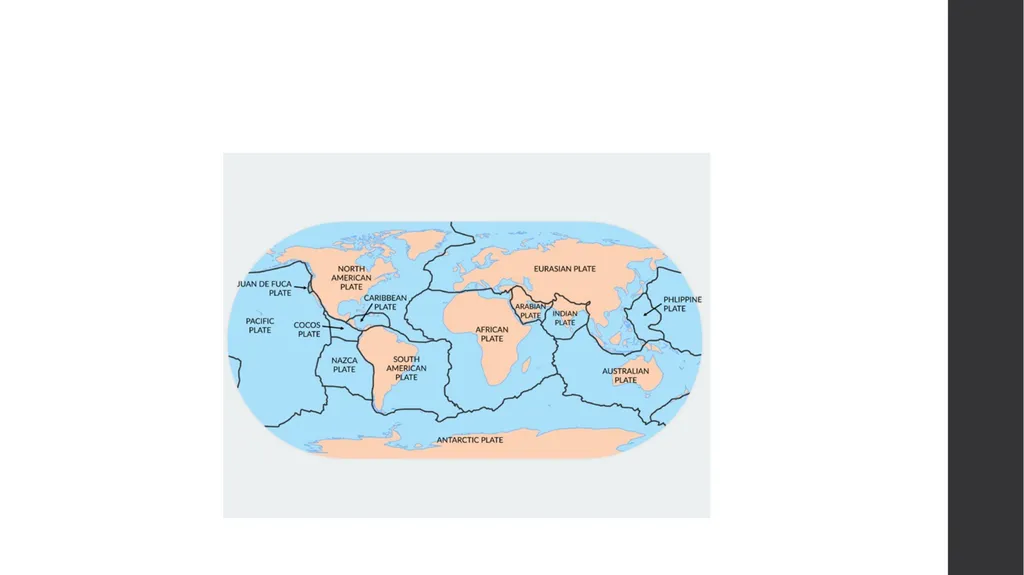
Lithosphere is internally made of rigid plates. Six major plates and 20 minor plates have been identified so far.
Major Plates
Eurasian Plate
Indian-Australian Plate
American Plate
Pacific Plate,
African Plate and
Antartic Plate<br>
04
Plate Margins It may be highlighted that tectonically plate boundaries or plate margins are most significant because all tectonic activities occur along the plate margins e.g. seismic events, vulcanicity, mountain building, faulting etc.
Thus a detailed study of it is desirable. Plate margins are generally divided into three categories:
1. Constructive Plate Margins
They are also called as ‘divergent plate boundaries’ or ‘accreting plate boundaries’.
Constructive plate boundaries represent zones of divergence where there is continuous upwelling of molten material (lava) and thus new oceanic crust is continuously formed.
Oceanic plates split apart along the mid-oceanic ridges and move in opposite directions.
Divergent plate margins are constructive in the sense that there is continuous formation of new crust along these margins because of cooling and solidification of basaltic lava which comes up as magma due to rifting of plates along the mid-oceanic ridges.<br>
05
Divergent movement of plates (i.e. movement of two plates in opposite directions) results in
i. volcanic activity of fissure flow of basaltic magma
ii. creation of new oceanic crusts
iii. Formation of submarine mountain ridges and rises etc.
2. Destructive Plate Margins
They are also termed as ‘convergent plate boundaries’ or ‘consuming plate margins’ because two plates move towards each other (face to face) or two plates converge along a line and collide wherein leading edge of one plate (of relatively denser material) and the overridden plate is subducted or thrust into the upper mantle and thus a part of the crust (plate) is lost in the mantle. That is why convergent plates is also called destructive margins.
The zone of collison of convergent plates is also called as ‘collison zone’, ‘subduction zone’ and ‘Benioff zone).
Convergence, collision and resultant subduction of heavier plate margin under lighter plate margin results in occurrence of explosive type of volcanic eruptions, formation of folded mountains, deep foci earthquake etc.<br>
06
3. Conservative Plate Margins
They are also called as shear plate margins and parallel/transform fault boundaries where two lates pass or slide past each other along transform faults. These are called conservative because crust is neither created or destroyed.<br>